The Binding Is a Later Owner's Object
16 of the 18 manuscripts and printed books in this archive wear a binding a later owner paid for. That rebinding dates the link and is when old evidence went.
Records in this piece: The Lindisfarne Gospels, The Mainz Psalter, Mr. William Shakespeares Comedies, Histories, & Tragedies (the Bodleian copy), The Beauvais Missal, Epistola Christofori Colom (A Letter of Christopher Columbus), Plannck's corrected Latin edition, Liber Chronicarum, the Khuner copy, The Most Lamentable Romaine Tragedie of Titus Andronicus (the Folger quarto, 1594), The Voynich Manuscript, The Newe Testament: William Tyndale's New Testament, Worms, 1526, The Rothschild Prayerbook, Codex Leicester, Codex Sassoon, Biblia Latina, the 42-line Bible: the Library of Congress copy, The Hours of Jeanne d'Evreux, Queen of France, The Ashburnham Pentateuch, Waldseemuller's Globe Gores, The Works of Geoffrey Chaucer (The Kelmscott Chaucer), The English Bible, Containing the Old Testament and the New
On this page 9 sections
ContentsClose
In short
- We read the binding line in all 18 manuscripts and printed books among the 285 published records. In 16 of them the binding was made for a later owner; only the Doves Press Bible, bound by the press's own bindery in 1903 to 1905, and the Bodleian First Folio, bound for its first owner by William Wildgoose in the 1620s, wear a cover contemporary with the book.
- Five bindings carry both a binder and a date, and every one of the five dates is an owner's date: George III's velvet binding for the Mainz Psalter in 1800, Bishop Maltby's silver binding for the Lindisfarne Gospels in 1852 or 1853, Bruyere's Lyon binding for Didier Petit before 1843, Wildgoose for the Bodleian in the 1620s and the Doves Bindery for its own press.
- The holder and the record disagree on the best-known date in the set. The British Library's catalogue dates the Smith, Nicholson and Co binding of the Lindisfarne Gospels to 1853 and does not name Maltby; the usual account, which our record follows, says 1852. The same catalogue records that a sixteenth-century owner's inscription on f. 211r is no longer visible.
- Rebinding is when evidence goes. The Beauvais Missal's leaf with the 1356 gift inscription vanished when Philip Duschnes broke the book in 1942; the Khuner Nuremberg Chronicle kept nothing of its 1493 binding across a 488-year gap; Sotheby's specialist says the Codex Sassoon's trail goes cold at its late-medieval rebinding; nobody knows who disbound the Codex Leicester.
- The best-kept evidence is on pastedowns and endpapers. The Folger preserved two Swedish lottery handbills of about 1770 through every rebinding of the 1594 Titus Andronicus, and the Library of Congress Gutenberg Bible carries three owners on one pastedown inside its pigskin binding of about 1560: Saint Blasien, Vollbehr and the Library itself in 1930.
In 16 of 18 records the binding belongs to a later owner
We pulled every manuscript and printed book out of the 285 published records and read the binding line in the 18 that carry one, and in 16 of those 18 the cover on the book today was made for somebody other than the person who made the book. The two exceptions are the Doves Press Bible, still in the limp vellum the press's own bindery put on it between 1903 and 1905, and the Bodleian's First Folio, still in the Oxford binding the library paid William Wildgoose for in the 1620s, a first owner's binding rather than a printer's.
That matters because a rebinding isn't a repair. It's an ownership event with its own maker, its own date and its own bill, and it is the moment when the evidence of earlier owners is most likely to go. Flyleaves go, pastedowns go, inscriptions on the old boards go and the margins get trimmed. What replaces them is the new owner's statement of who the book belongs to now, and where the archive can date it, it is usually the best-dated link in the chain.
A rebinding names the owner who paid for it
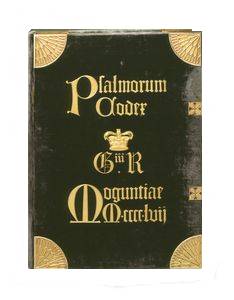
The Royal Collection's Mainz Psalter wears the clearest example in the archive, a purple velvet binding with gilt corner-pieces and a crowned GIIIR monogram, made to receive the book when the University of Gottingen presented it to George III in 1800. The Royal Collection's catalogue describes it in those terms and puts the provenance underneath: St Ursula at Hildesheim, von Duve in 1758, Gottingen in 1782, the King in 1800. Nothing on the outside of that book is from 1457.
The Lindisfarne Gospels tell the same story across a wider gap. Aldred's tenth-century colophon on folio 259r names Ethelwald as the binder and Billfrith as the anchorite who forged the gold, gems and gilded silver on the outside. That binding is gone; no source we read fixes when. The book now wears a silver and jewelled binding by Messrs Smith, Nicholson and Co of Lincoln's Inn, which the British Library's catalogue dates to 1853 and which our record, following the usual account, dates to 1852 at the expense of Edward Maltby, Bishop of Durham.
| Object | Current binding, date and maker | What it replaced | What was lost or kept |
|---|---|---|---|
| Lindisfarne Gospels | Smith, Nicholson and Co, 1853 (BL catalogue) or 1852, for Bishop Maltby | The lost treasure binding of Ethelwald and Billfrith | Lost: a 16th-century inscription, f. 211r. Kept: Bowyer's signature, f. 2v, under UV |
| Mainz Psalter, Royal Collection | Purple velvet, crowned GIIIR, for the 1800 presentation | Unrecorded | Nothing recorded |
| First Folio, Bodleian | William Wildgoose, Oxford, 1620s, for the library | Sheets as issued, 1623 | Kept: the binding and a chaining-staple mark, which identified it in 1905 |
| Beauvais Missal | Bruyere, Lyon, for Didier Petit, before 1843; broken 1942 | An earlier binding | Lost: the 1356 gift-inscription leaf. Kept: 122 of 309 leaves |
| Columbus Letter, Library of Congress | Riviere and Son, London, undated | A 1493 quarto gathering | Kept: an 1816 reprint bound in |
| Nuremberg Chronicle, Khuner copy | Art Bookbinding Studio, undated | The 1493 binding, nothing survives | Lost: all early marks; 488-year gap |
| Titus Andronicus, 1594 quarto | Dark blue goatskin, Folger, undated | Paper wrappers, lottery handbills of c. 1770 as endpapers | Kept: wrappers and handbills, at the end |
| Voynich Manuscript | Vellum case, Jesuit rebinding 1824 to 1870, after woodworm | Worm-eaten wooden boards | Kept: early paper pastedowns, Marci's letter, the Beckx label |
| Tyndale New Testament, 1526 | Eighteenth-century, binder unnamed | Unknown | Lost: title page. Kept: 18th-century note inside the cover |
| Rothschild Prayerbook | Red velvet, renewed; mid-16th-century silver-gilt mounts | The c. 1505 binding | Kept: gauffered edges, never trimmed; inventory numbers 927 and AR3390 |
| Codex Leicester | None; 18 sheets between glass | A leather binding, remover unknown | Lost: the binding and any record of its removal |
| Codex Sassoon | Plain 20th-century leather | Two earlier, 13th century and late medieval | Lost: the trail, at the late rebinding. Kept: Sassoon's bookplate |
| Gutenberg Bible, Vollbehr copy | White pigskin on boards, c. 1560, bindery unidentified | The 1450s binding, unrecorded | Lost: printed signatures. Kept: St Blasien bookplate on each pastedown |
| Hours of Jeanne d'Evreux | Leather with the Chatelet and Gleseneuve arms, 1618 to before 1672 | Pearl-embroidered cover, stripped by 1380; blue silk 1402 | Kept: the arms, sole evidence for two centuries |
| Ashburnham Pentateuch | 19th-century half-binding, Russian leather | Unrecorded | Kept: a spine title saying 5th century, since revised |
| Waldseemuller globe gores, Munich | 19th-century library binding with two Peckham editions | A loose sheet | Kept: the sheet, unrecognised until 2012 |
| Kelmscott Chaucer, Stanford copy | Not stated; issue bindings were quarter holland or Doves pigskin | Sheets as issued | Not established |
| Doves Press Bible | Limp vellum, Doves Bindery, 1903 to 1905, the press's own shop | Nothing | As issued |
Five of the 18 have a binder's name and a date, and every one of the five dates is an owner's date. Three more have a name and no date, and those are the commercial binderies, Riviere and Son on the Columbus letter and the Art Bookbinding Studio on the Khuner Chronicle, whose names say a collector paid for a smart cover and nothing about when.
The rebinding is the moment the evidence goes
The Beauvais Missal lost its best ownership document when it lost its binding. Robert de Hangest gave the book to Beauvais Cathedral in September 1356, recorded in an inscription on the first calendar leaf that the Sotheby's catalogue of 1926 transcribed. Peter Kidd dates the Lyon binding by matching Didier Petit's 1843 sale description, lot 354, to the Broelemann catalogue of 1897, which names the binder Bruyere, and concludes it was made for Petit. We think that's right. Then Philip Duschnes bought the book from the Hearst collection for 1,000 dollars in October 1942 and broke it within a month, and the leaf with the 1356 inscription is among those not found.
The Khuner Nuremberg Chronicle shows the quieter version. The Metropolitan Museum's constituent list reads Bound by Art Bookbinding Studio, with no date, and nothing of the 1493 binding survives; the chain has a 488-year gap and the rebinding is the one event we can name inside it. Sotheby's specialist Shaul Seidler-Feller says the Codex Sassoon's trail goes cold at its late-medieval rebinding. The Codex Leicester has no binding at all: its 18 sheets travel between glass, and nobody we read can say who took the cover off or when.
What survives is what the binder chose to keep
The Folger's 1594 quarto of Titus Andronicus is the archive's best case of a rebinder keeping the evidence. In Sweden the pamphlet was rebound with two handbills for a lottery of about 1770 as endpapers. The Folger has since rebound it in dark blue goatskin, and its Shakespeare Documented page says the handbills have been preserved through subsequent rebindings and conservation, bound in at the end. Charles Robson's name on the back flyleaf and the Swedish inscriptions of 1845 and 1877 are the whole basis for the chain between 1794 and 1905, when Henry Folger paid 2,000 pounds. Throw away the endpapers and that century goes with them.
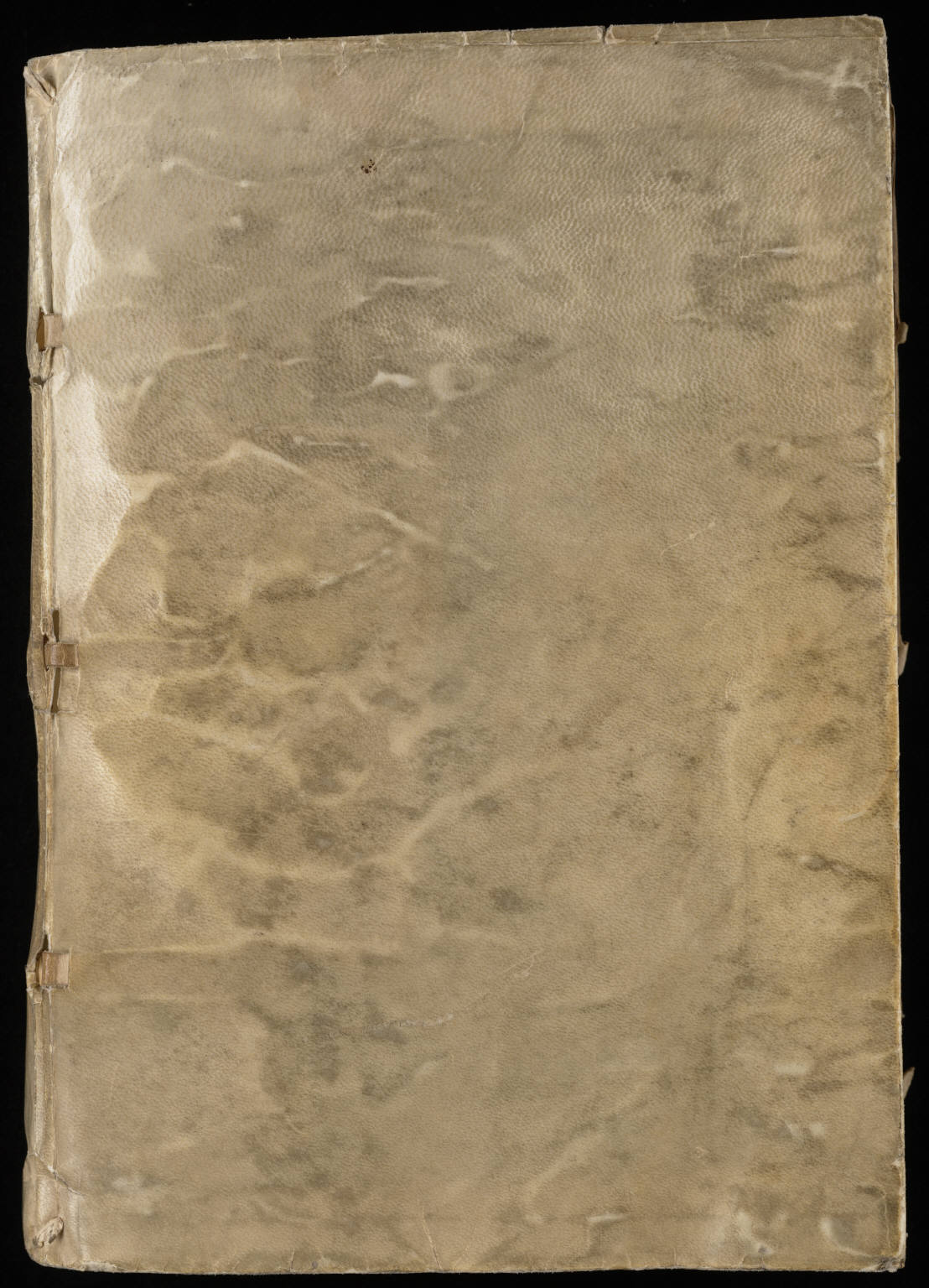
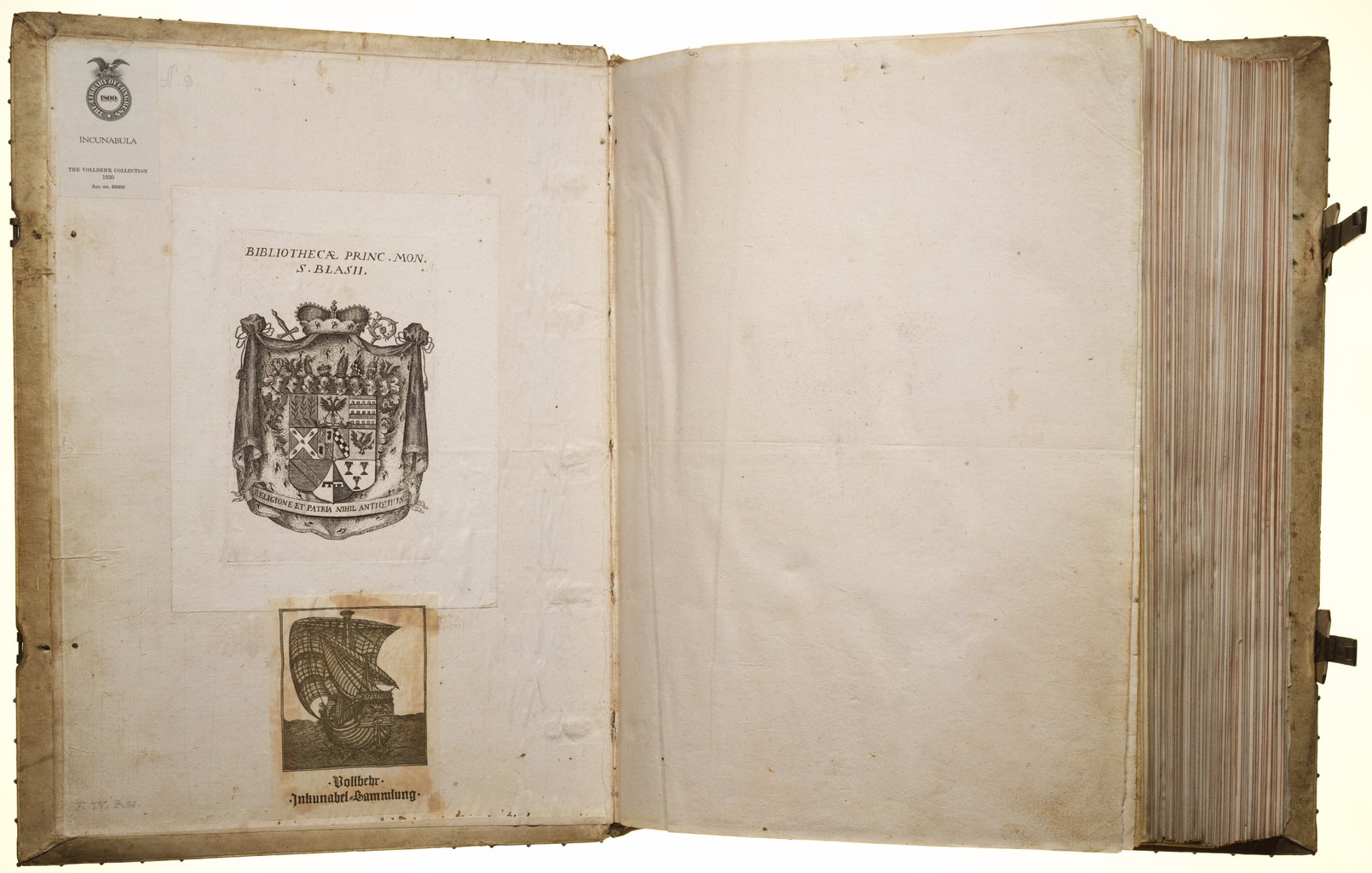
The Library of Congress Gutenberg Bible shows what a pastedown can hold. Its three volumes are in white pigskin over wooden boards that the Library's guide dates to about 1560, from a bindery nobody has identified. What the binder left is the front pastedown, and three owners have written themselves on it in turn: the bookplate of the Prince-Monks of Saint Blasien, the ship bookplate of Otto Vollbehr's collection and the Library's own label of 1930. The Voynich Manuscript keeps less. The Beinecke catalogue describes an eighteenth or nineteenth-century vellum case with remains of early paper pastedowns; Rene Zandbergen records that many Collegio Romano manuscripts were rebound between 1824 and 1870 because of woodworm. Marci's letter to Kircher is still bound in at the front.
When the binding is the only witness
The Hours of Jeanne d'Evreux is a book whose covers have been described, lost and replaced for six hundred years. Charles V's inventory of 1380 lists a book with an embroidered cover from which the pearls have been removed, so the original cover was already stripped nine years after the Queen's death. An entry tied to the Duke of Berry's inventory records a change to blue silk in 1402. After the Duke died in 1416 the book disappears for two centuries, and the only evidence for where it went is on the outside: the leather binding now on it carries the arms of Louis-Jules de Chatelet and Christine de Gleseneuve, married in 1618 and both dead before 1672. The Museum's provenance line reads exactly that.
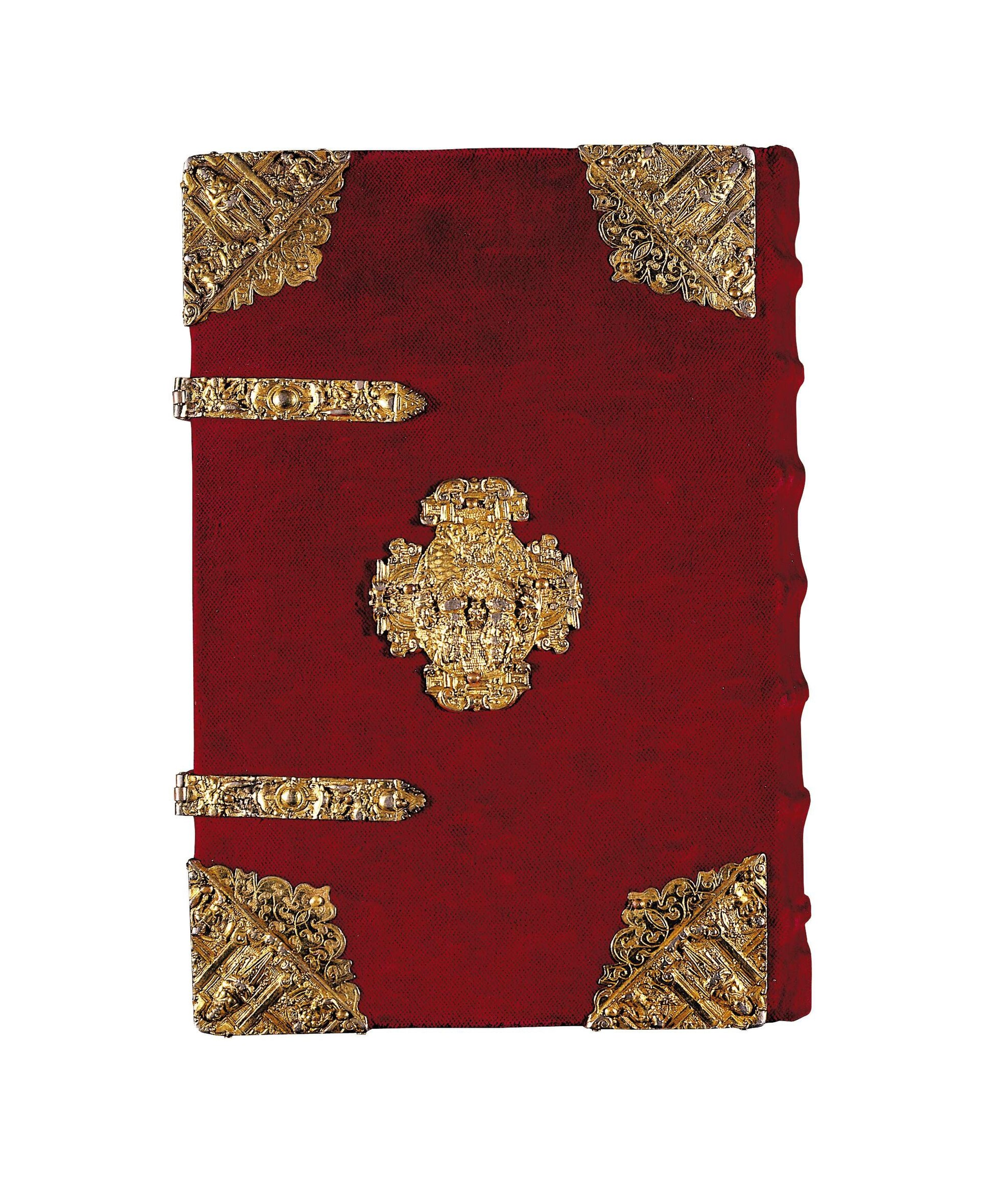
The Rothschild Prayerbook carries the same kind of evidence and the record grades it disputed, which we agree with. Christie's 2014 description reads: red velvet, renewed, with mid-sixteenth-century silver-gilt centrepieces bearing the Wittelsbach arms, attributed to the circle of Wenzel Jamnitzer. The leaf edges are gauffered to the same diaper pattern as the books the painted saints hold, so the leaves were never trimmed. Christie's leaves open whether the metalwork joined the book in the sixteenth century or the nineteenth. The Bodleian First Folio shows how far a binding can carry ownership: in 1905 Strickland Gibson matched the tooling on the Turbutt family's copy to Wildgoose, and the library bought back its own book for 3,000 pounds. The Munich Waldseemuller gores are the inverse: a loose sheet sewn into a nineteenth-century binding with two editions of Peckham's optics, unrecognised until 2012.
The two books whose binding is the maker's
The Doves Press Bible is the one book in the archive where binder and printer were the same shop. T. J. Cobden-Sanderson set up the Doves Bindery in Hammersmith in 1893, and the five volumes printed between 1903 and 1905 went out in the bindery's limp vellum. Pitts Theology Library, which bought a set in 2024, describes its first volume as in the publisher's original limp vellum binding. There is nothing to rebind because the maker's and the owner's binding are one object.
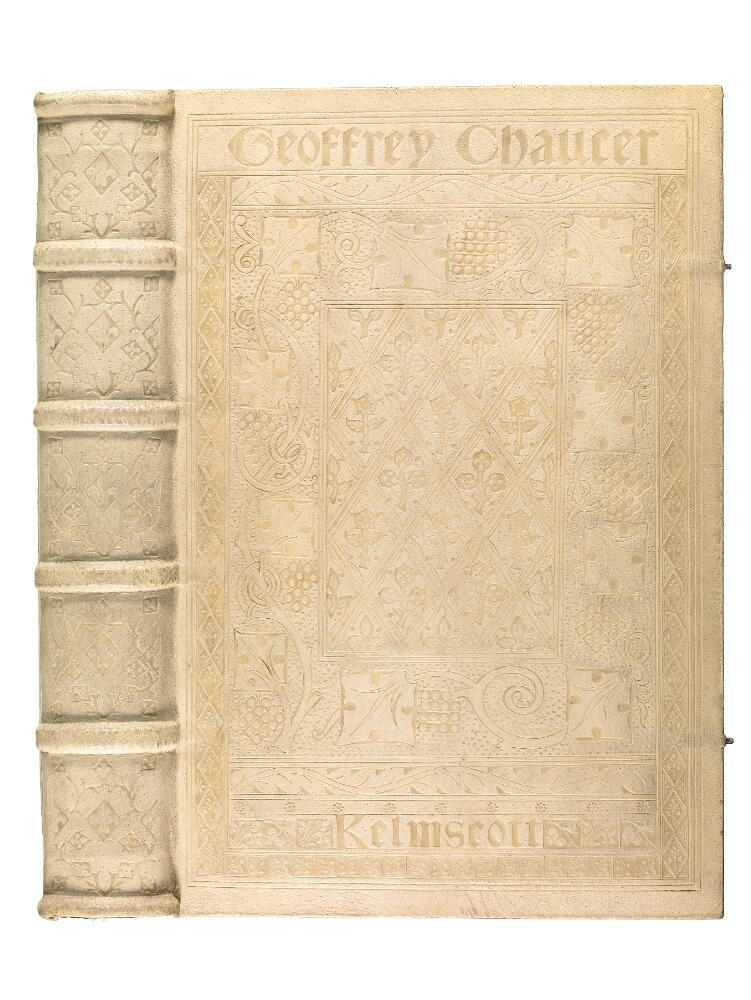
The Kelmscott Chaucer is the case where the maker offered two bindings. Of the 425 paper copies sold at 20 pounds in 1896, most went out in quarter holland with blue paper boards from J. and J. Leighton; a run usually put at 48 was bound in white pigskin at the Doves Bindery, blind-tooled to a design by Morris, for a further 13 pounds 13 shillings. The Bodleian's copy, Broxb. 67.7, is one of those, and the library dates the Doves work to 1899, three years after Morris died. Stanford's Cantor Arts Center does not say which binding its copy wears. At auction a copy rebound in later calf by Riviere and Son made 89,800 dollars hammer at Bonhams; an original pigskin copy at Sotheby's was estimated at 50,000 to 70,000 pounds.
Where the cover disagrees with the catalogue
The binding line is the best-dated link in most of these chains, and it is also where we found the most disagreement between holder and record. The British Library dates the Lindisfarne binding to 1853; our record, following the usual histories, says 1852 and names Maltby, whom the catalogue never mentions. The Ashburnham Pentateuch's nineteenth-century half-binding carries a spine title dating the manuscript to the fifth century, which the Bibliotheque nationale's catalogue quotes while the scholarship it cites has moved the date. A binder's lettering is a claim made in the knowledge of the day, and it outlives the knowledge.
Does a binding date tell you when a book changed hands? Not by itself. It tells you that somebody who could pay for a binding had the book long enough to send it out, which for a book just bought is usually the buyer. The Tyndale New Testament shows the inference failing: H. R. West says the binding is almost certainly eighteenth-century, which fits Edward Harley in the 1730s as well as the college's acquisition in 1784, and nothing on the book chooses.
How to read a binding line
Read a binding line as three questions: who paid for it, what it threw away and what it kept. The holder's catalogue answers the first more often than the press does; we leaned on the British Library, the Royal Collection, the Metropolitan Museum's open-access record and the Library of Congress guide to its Gutenberg copy. The second is usually answered by absence, a gap in the chain that begins where the rebinding sits. The third is answered at the pastedowns and the back of the book, where the Folger left the Swedish handbills and a sixteenth-century binder left room for Saint Blasien's bookplate.
We record the binding as a provenance event wherever the holder names a binder or a date, and we grade it by the same rules as a sale. A named binder with a date is documented. A named binder without one is a name and not a date.
Why this archive is free to read
We do this for everyone who loves art. The people who have studied it for years, and the people who just stopped to look. Iconotheca exists so that what we learn belongs to all of them.
Nobody pays us for this. No ads, no sponsors, no commercial interest. These works belong to all of us, and we would rather share them with as many people as we can than keep them to ourselves.
If it gave you something today, tell us to keep going. Follow us, leave a like, or write a positive comment. We read every one, and they are what keeps us going.
Questions
No. Aldred's tenth-century colophon describes a treasure binding by Ethelwald and Billfrith, and that cover is lost at an unknown date. The book now wears a silver and jewelled binding by Smith, Nicholson and Co of Lincoln's Inn, dated 1853 in the British Library's catalogue and 1852 in most accounts, which say Bishop Edward Maltby of Durham paid for it.
The Lyon binder Bruyere, for the collector Didier Petit de Meurville, before Petit's sale of 1843 where it was lot 354. Peter Kidd dates it by matching the 1843 sale description to the Broelemann catalogue of 1897. The binding was destroyed when Philip Duschnes broke the book up in 1942, and the leaf carrying the 1356 gift inscription has not been found.
Nobody we read can say. The 18 sheets are mounted individually between glass, which is how the manuscript travels and is exhibited. When the leather binding came off, and who removed it, is not established, and the Uffizi's own page describing it as in its original leather binding cannot be reconciled with the exhibition having shown it as separate pages.
One of roughly 48 paper copies of the 1896 Kelmscott Chaucer bound at T. J. Cobden-Sanderson's Doves Bindery in full white pigskin, blind-tooled to William Morris's design, for 13 pounds 13 shillings on top of the 20-pound price. The Bodleian's copy, Broxb. 67.7, is one, and its description dates the binding to 1899. Most paper copies went out in quarter holland with blue paper boards.
From the owner's records around it. The Bodleian's Binders Book of 1621 to 1624 records the First Folio going to Wildgoose. The Beauvais binding is dated by the match between an 1843 sale description and an 1897 catalogue. Where nothing of that kind survives, as with the Riviere binding on the Columbus letter or the Art Bookbinding Studio's work on the Khuner Chronicle, the binder's name is a name and not a date.
Sources
- 1Royal Collection Trust, collection record for The Mainz Psalter, RCIN 1071478, binding description and provenance. Read in full 18 September 2026 in the in-app browser after a 403 on the plain fetch. Source for the purple velvet, gilt corner-pieces, crowned GIIIR monogram, the front-board lettering, the 1758, 1782 and 1800 provenance and the 400 pounds reimbursed in 1817. rct.uk/collection/...
- 2British Library, Archives and Manuscripts catalogue, Cotton MS Nero D IV. Read in full 18 September 2026. Source for the binding by Messrs Smith, Nicholson and Co of Lincoln's Inn, London, 1853, the flyleaf count, Aldred's colophon on f. 259r naming Ethelwald and Billfrith, the Thomas Turner inscription on f. 211r no longer visible and Robert Bowyer's signature on f. 2v under ultraviolet light. searcharchives.bl.uk/catalog/...
- 3Bodleian Libraries, The Bodleian's original First Folio of Shakespeare, The Conveyor. Read in full 18 September 2026. Source for Library Records e.528, the Binders Book of 1621 to 1624 recording the First Folio sent to the binder Wildgoose in Oxford on arrival, and for Falconer Madan's 1905 research. blogs.bodleian.ox.ac.uk/theconveyor/...
- 4Peter Kidd, The Early Provenance of the Beauvais Missal, Medieval Manuscripts Provenance blog, January 2015. Read in full 18 September 2026. Source for Didier Petit de Meurville's sale of 1843, lot 354, the binding description matching the 1897 Broelemann catalogue, the attribution to the Lyon binder Bruyere and the conclusion that the binding was executed for Petit. mssprovenance.blogspot.com/2015/...
- 5The Metropolitan Museum of Art, Open Access Collection API, object 356792, Liber chronicarum, accession 1981.1178.29. Read in full 18 September 2026. Source for the constituent line Bound by Art Bookbinding Studio with role Binder, the isPublicDomain flag and the George Khuner credit line. collectionapi.metmuseum.org/public/...
- 6The Metropolitan Museum of Art, collection record for The Hours of Jeanne d'Evreux, Queen of France, 54.1.2, provenance tab. Read in full 18 September 2026 in the in-app browser after a 429 on the plain fetch. Source for the dimensions with binding, 9.9 by 7.2 by 3.8 cm, and the provenance line Louis-Jules de Chatelet and Christine de Gleseneuve, Bar, France, ca. 1618 to before 1672, and the Neuschwanstein inventory number R.1052. metmuseum.org/art/...
- 7Folger Shakespeare Library, Shakespeare Documented, Titus Andronicus, first edition: only surviving copy of Shakespeare's first printed play. Read in full 18 September 2026 at the corrected URL after a 404 on the record's link. Source for the endpapers made from handbills for an eighteenth-century Swedish lottery, the paper binding glued to them, their preservation through subsequent rebindings and conservation, and the 2,000 pound purchase entered as stock. shakespearedocumented.folger.edu/resource/...
- 8Beinecke Rare Book and Manuscript Library, Yale University, catalogue description of Beinecke MS 408. Read in full 18 September 2026. Source for the binding line: s. xviii-xix, vellum case, remains of early paper pastedowns. pre1600ms.beinecke.library.yale.edu/docs/...
- 9Rene Zandbergen, voynich.nu, History of the MS. Read in full 18 September 2026. Source for the rebinding of a large number of Collegium Romanum manuscripts between 1824 and 1870 because of woodworm in their wooden boards, and for the Beckx label. voynich.nu/history.html
- 10Library of Congress, The Gutenberg Bible at the Library of Congress, Frequently Asked Questions and The Library's Copy pages. Both read in full 18 September 2026. Source for the three volumes bound about 1560 in wooden boards covered with white pigskin, the two roll-stamps of Christ with John, Peter and Paul and of Faith, Hope, Charity and Justice, the unidentified bindery, and the Saint Blasien bookplate on the front pastedown with the motto Religione et Patria Nihil Antiquius. guides.loc.gov/gutenberg/...
- 11Christie's, lot 157, The Rothschild Prayerbook, sale 2819, New York, 29 January 2014, catalogue note. Read in full 18 September 2026. Source for red velvet, renewed, the mid-sixteenth-century silver-gilt centrepieces with the Wittelsbach arms, cornerpieces, clasps and catches attributed to the circle of Wenzel Jamnitzer, the gauffered edges matching the miniatures and the open question of a sixteenth or nineteenth-century date for the mounts. christies.com/en/...
- 12Bibliotheque nationale de France, Archives et manuscrits, NAL 2334, the Ashburnham Pentateuch. Read in full 18 September 2026. Source for the nineteenth-century half-binding in Russian leather over wooden boards and the spine title dating the manuscript to the fifth century. archivesetmanuscrits.bnf.fr/ark:/...
- 13Sotheby's, Will Fenstermaker, The Remarkable History of Codex Sassoon, 15 February 2023. Read in full 18 September 2026. Source for the first rebinding at Makisin in the thirteenth century and for Sassoon's bookplate inside the cover. sothebys.com/en/...
- 14H. R. West, The Bristol 1526 Tyndale Testament, its Origin and its History, Tyndale Society Reformation journal. Read in full 18 September 2026. Source for the present binding being almost certainly eighteenth-century, the eighteenth-century note inside the front cover and the possibility of a rebinding under the Earls of Oxford. tyndale.org/journals/...
- 15Wikimedia Commons, file page and wikitext for Bodleian Libraries, Works 5.jpg, uploaded from Digital Bodleian by the Bodleian's Wikimedian in Residence. Read in full 18 September 2026. Source for the Doves Bindery, 1899, white pigskin binding of the Bodleian's Kelmscott Chaucer, Broxb. 67.7, and for the plate's public-domain status. commons.wikimedia.org/wiki/...
- 16Wikimedia Commons, file page for Gutenberg Bible WDL7782.jpg, from the World Digital Library item 7782, the Library of Congress copy. Read in full 18 September 2026. Source for the identification of the plate as the Library of Congress copy with the Saint Blasien bookplate and for its public-domain status. commons.wikimedia.org/wiki/...
- 17Wikimedia Commons, file page for Rothschild Prayerbook 1.jpg, from the Christie's 2014 lot photography. Read in full 18 September 2026. Source for the plate of the upper cover and its licence tag. commons.wikimedia.org/wiki/...
- 18Pitts Theology Library, Emory University, Pitts acquires the Doves Press Bible, 30 September 2024. Read in full 18 September 2026. Source for the publisher's original limp vellum binding. pitts.emory.edu/2024/...
- 19Universitatsbibliothek der LMU Munchen, catalogue record for the Waldseemuller globe gores, Cim. 107. Read in full 18 September 2026. Source for one print in the volume coming from the Benedictine monastery of Oberalteich, whose library passed to Landshut at the secularisation of 1803. epub.ub.uni-muenchen.de/13138


More in Collectors and Collections
The partThe Collector Became a Legal Person
Twelve records here sit in a museum that carries a collector's name. In none of them is the museum the owner.
The Buyer Who Was a Crowd
Ten objects in this archive were bought, or fought for, by public subscription between 1892 and 2025.
The name that appears in more than one chain
Across 291 objects the recurring names in a provenance line are dealers, not collectors.