Codex Sassoon
An unnamed scribe, with two later Masoretes · c. 900 (radiocarbon 880-960 CE)
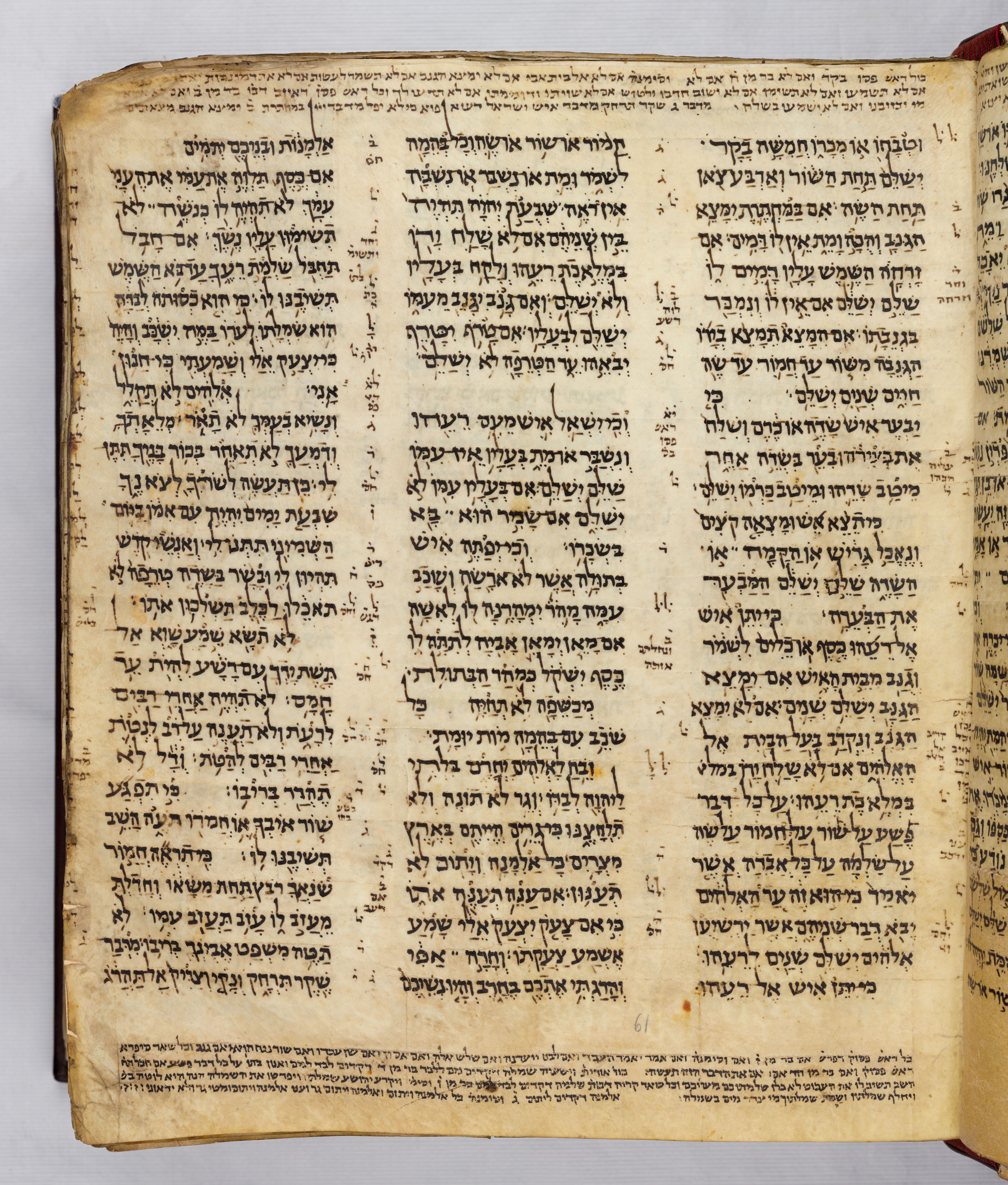
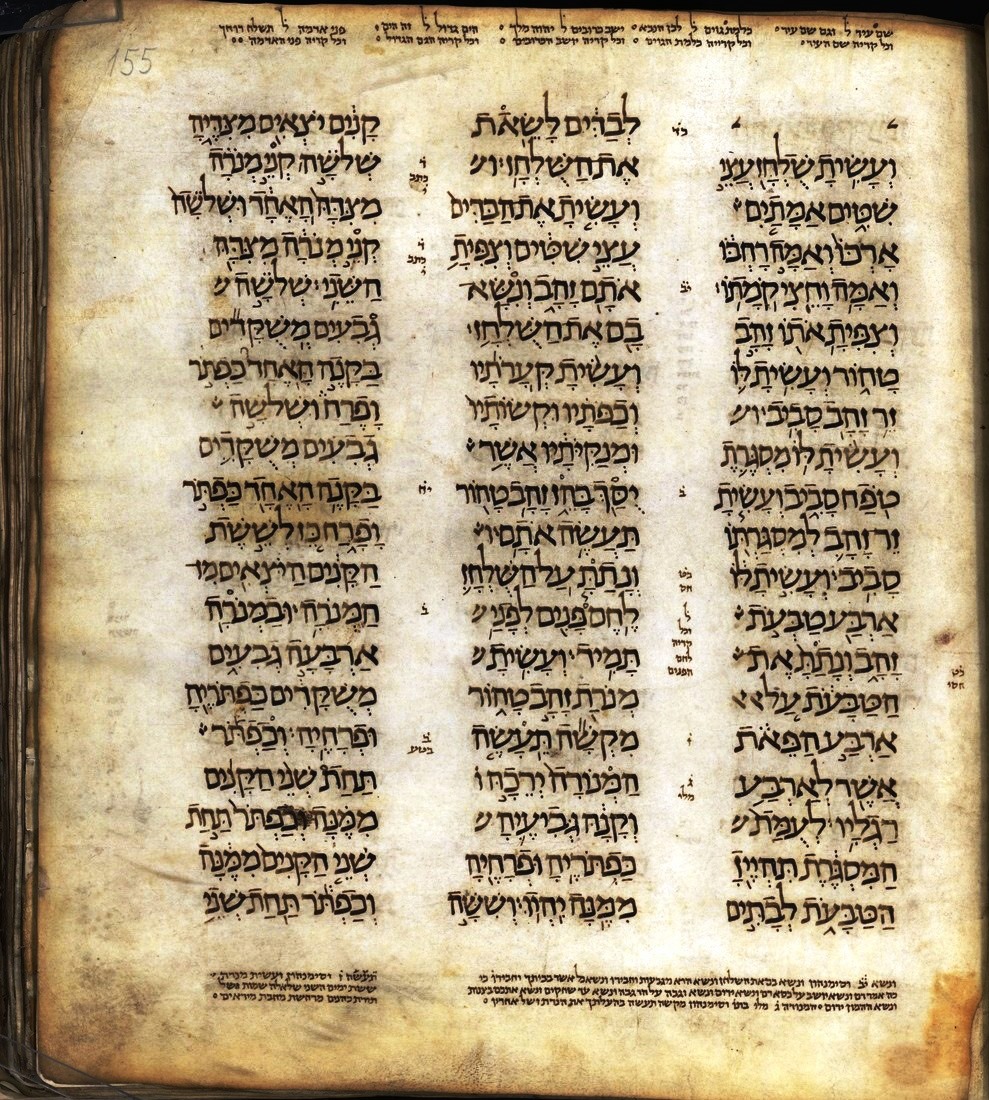
A page from Codex Sassoon (MS 1053), photographed by Ardon Bar-Hama while the manuscript was on long-term deposit at the National Library of Israel, before its 2023 sale and move to the ANU Museum of the Jewish People.
| Artist | An unnamed scribe, with two later Masoretes |
|---|---|
| Date | c. 900 (radiocarbon 880-960 CE) |
| Medium | Iron-gall ink on parchment, Tiberian vocalisation, cantillation and Masorah |
| Dimensions | About 30 x 36 cm; 396 leaves, 792 pages |
| Where it is now | ANU - Museum of the Jewish People, Tel Avivlast confirmed 3 August 2026 |
| Inventory number | ANU MS 1 (formerly Sassoon 1053) |
| Attribution | UnknownThere is no colophon. Full note |
| Object type | Manuscript |
| Period | Near Eastern, tenth century |
| Cases | Has a provenance gap |
| Inscriptions | A sale record naming Khalaf ben Abraham, Isaac ben Ezekiel al-Attar and his sons Ezekiel and Maimon; a dedication reading 'Consecrated to the Lord God of Israel to the synagogue of Makisin'; a later note entrusting the codex to Salama ibn Abi al-Fakhr on condition of return if the synagogue were rebuilt, his sons to inherit on the same terms; the bookplate of David Solomon Sassoon. |
| Owners on record | 10 links9 documented, 1 unknown |
| Sources | 22 cited |
About this record Last verified 19 August 2026 · 22 sources cited · Change log
On this page 12 sections
ContentsClose
An almost complete Hebrew Bible written about the year 900, sold at Sotheby's New York on 17 May 2023 for a hammer price of USD 33.5 million and USD 38.1 million with fees, the highest sum ever paid at auction for a manuscript. It carries its own ownership record in ink: a sale note of about the year 1000 naming the men who bought and sold it, a dedication to the synagogue at Makisin in what is now north-eastern Syria, and a later clause entrusting it to a named guardian against the day the synagogue would be rebuilt. It never was.
Then the trail stops for roughly five centuries. The codex reappears in Turkey in 1929, is bought for 350 pounds, passes through a British pension fund that treated art as an inflation hedge, through an unnamed dealer, and through a Geneva financier, before a ninety-four-year-old former American ambassador placed an irrevocable bid on it and gave the money to a museum in Tel Aviv. Every page of it can be downloaded free, in colour, at full resolution.
Provenance
Each link is graded. Documented: a cited source supports it. Disputed: the identification is argued but not established. Unknown: no owner for that span, and the gap is not smoothed into a narrative. The grades in the glossary.
- c. 900 - c. 1000Made by an unnamed scribe, Land of Israel or Syriadocumented
Radiocarbon analysis of the parchment gave 880 to 960 CE. There is no colophon, so the place is argued from codicology and palaeography: Sotheby's catalogued it as Land of Israel or Syria and the workshop scholarship leans to Syria. Two anonymous Masoretes worked on the margins afterwards, the second of them partly erasing the first.1810
- c. 1000 - 13th centuryKhalaf ben Abraham; then Isaac ben Ezekiel al-Attar; then his sons Ezekiel and Maimondocumented
An early note in the codex records its sale from Khalaf ben Abraham, described as a businessman active in Palestine and Syria, to Isaac ben Ezekiel al-Attar, who transferred it to his two sons. Fine Books and Collections dates the note to the early eleventh century. No source consulted reproduces the original wording; every English version derives from the Sotheby's catalogue. One published account misnames the second son as Maimonides.21117
- 13th century - 14th centuryThe synagogue at Makisin, now Markada, Al-Hasakah governorate, Syriadocumented
An anonymous hand inscribed the codex 'Consecrated to the Lord God of Israel to the synagogue of Makisin'. Sotheby's suggests the book was rebound at this point for the first time. The town was later destroyed, either by the Mongols in the later thirteenth century or by the Timurids at the start of the fifteenth; the sources conflict and this record does not choose.2111215
- 14th century - late 15th centurySalama ibn Abi al-Fakhr, and his sons after himdocumented
A note on the last page, dated by Fine Books and Collections to the late fourteenth century or later, entrusts the codex to Salama ibn Abi al-Fakhr on condition that he return it to the synagogue once rebuilt, his sons to inherit on the same terms if the rebuilding did not happen in his lifetime. It never was rebuilt. This clause is the mechanism by which the book legitimately passed out of communal ownership, and most accounts omit it.1112
- late 15th century - 1929Not recordedunknown
No owner is documented for roughly four and a half to five centuries. Sotheby's own specialist places the loss of the trail at the point where the codex was rebound, at the end of the Middle Ages or the start of the modern period, probably by non-Jewish binders, and says it reappears in Turkey after hundreds of years of silence. The commonly repeated figure of six hundred years is loose.812
- 1929 - 1978David Solomon Sassoon (1880-1942) and his descendants, London and Letchworthdocumented
Bought for 350 pounds. Correspondence of March and April 1929 between Aron Freimann of the Stadtbibliothek in Frankfurt am Main and Sassoon records that the manuscript had surfaced in Turkey, that Freimann could not meet the owner's asking price, and that he referred it to Sassoon, who bought it for considerably less. Catalogued as MS 1053 and published in Sassoon's Ohel Dawid in 1932. Wikipedia places the seller in what is now Ankara.81217
- 1978 - 1989British Rail Pension Funddocumented
Bought at Sotheby's Zurich in 1978, together with thirty-two other manuscripts from the Sassoon collection, for a reported 320,000 dollars; no source states whether that is hammer or total. The fund had decided in 1974 to place roughly 3 per cent of its holdings in works of art as an inflation hedge, buying between 1974 and 1981 with unpaid advice from Sotheby's given on condition that any sales went through Sotheby's. Exhibited at the British Museum in 1982, the only public showing before 2023.81012
- 1989 - 1989An unnamed Jewish antiquarian book dealerdocumented
Bought at Sotheby's London on 5 December 1989 for 2,035,000 pounds and resold privately within the year. Sotheby's specialist Shaul Seidler-Feller identifies the successful bidder as a dealer, not the eventual owner. The dealer is not named and the price he obtained on resale has never been disclosed.81219
- 1989 - 2023Jacob (Jacqui) Eli Safra, Genevadocumented
Bought from the dealer in 1989 at an undisclosed price. The figure of 3.19 million dollars attached to Safra in almost all 2023 coverage is the dollar conversion of the December 1989 auction result and is not his price. ReligionUnplugged gives 4.19 million, an outlier no other source supports. Safra commissioned the radiocarbon dating. No public loan or exhibition during his ownership was found; the manuscript was digitised for the National Library of Israel two years before he sold it.81218
- 2023 - presentAmerican Friends of ANU - Museum of the Jewish People, Tel Avivdocumented
Bought at Sotheby's New York on 17 May 2023 at 33.5 million dollars hammer, 38.1 million with fees, funded by Alfred H. Moses, former United States ambassador to Romania, who had placed an irrevocable bid of 32.5 million before the sale. Sotheby's specialist describes the buyer as ANU courtesy of Moses, who donated the money required; The Art Newspaper describes Moses as acquiring it on behalf of the American Friends of ANU. He gave the money, not the object. Flown to Israel on 5 October 2023 and on permanent display at ANU since 29 May 2025.13457820
Prices realised
| Date | Sale | Estimate | Result | Note |
|---|---|---|---|---|
| 1978 | Sotheby's, Zurich Thirty-three manuscripts from the Sassoon collection, lot Not established in the sources consulted | Not established in the sources consulted | Hammer Not stated in any source consulted With premium Not stated in any source consulted USD | The reported figure is about 320,000 dollars, given by the Associated Press without saying what it includes. The buyer was the British Rail Pension Fund. The month and day of the sale were not established. |
| 5 December 1989 | Sotheby's, London Property of the British Rail Pension Fund, lot Not established in the sources consulted | Not established in the sources consulted | Hammer Not stated in any source consulted With premium Not stated in any source consulted GBP | The result was GBP 2,035,000, quoted in the Sotheby's note to a later Schoyen leaf and repeated since without a hammer or premium breakdown. It converts to about USD 3.19 million, and that dollar figure is what nearly every 2023 account attaches to Jacqui Safra. It is not Safra's price: the buyer at auction was an unnamed dealer, who resold to Safra privately in the same year for a sum never disclosed. |
| 17 May 2023 | Sotheby's, New York Codex Sassoon: The Earliest Most Complete Hebrew Bible, a single-lot sale, lot 1 | USD 30,000,000 - 50,000,000 | Hammer USD 33,500,000 With premium USD 38,100,000 USD | Both figures are stated in the reporting, which is unusual and useful: the gavel price was 33.5 million and the total with fees 38.1 million. Alfred H. Moses had lodged an irrevocable bid of 32.5 million before the sale, so the lot could not fail; an anonymous rival reached 33 million and Moses took it one increment higher. Four minutes between the last two bidders, under six minutes for the lot. The underbidder has not been named. No house guarantee was found in any source, which is not the same as there being none. THE TWO FIGURES CANNOT BOTH BE RIGHT. A hammer of 33.5 million against a total of 38.1 million implies an effective buyer's premium of about 4.6 million, or 13.7 per cent. Buyer's premium scales are tiered downwards, so the effective rate on a lot of this size can never fall below the house's top marginal rate, and no major house charged as little as 13.7 per cent at the top of its scale in 2023. Either the gavel figure is lower than 33.5 million or the total is higher than 38.1 million. This record prints both as reported and resolves neither; the Sotheby's price list for the sale would settle it in one line. Reported as a record for a manuscript, breaking the 30,802,500 dollars including fees paid for the Codex Leicester in November 1994. It is not the highest price for a printed text: a 1787 printing of the United States Constitution made 43.2 million dollars with fees at Sotheby's in November 2021. |
Hammer is the price at which the bidding stopped; with premium adds the fee the house charges the buyer on top. Hammer price and buyer's premium in the glossary.
Technical evidence
| Attribution note | There is no colophon. The scribe is anonymous and no source names him. Date and place rest on radiocarbon analysis of the parchment (880 to 960 CE) and on codicology and palaeography. Sotheby's catalogued the origin as Land of Israel or Syria; the codicological work presented at the 2025 Bar-Ilan and ANU research workshop leans to Syria. Two further hands, both anonymous, added and then partly erased the Masoretic apparatus. |
|---|---|
| Extent | 396 leaves, 792 pages, containing all twenty-four books of the Hebrew Bible.612 |
| Layout | Three columns to the page throughout.12 |
| Support | Parchment, described in the sale reporting as sheepskin.6 |
| Ink | Iron-gall rather than carbon. Ira Rabin of the Bundesanstalt fuer Materialforschung und -pruefung and Nehemia Gordon reported on the inks of the early Masoretic codices, following Malachi Beit-Arie's demonstration that early Oriental codices were written primarily in iron-gall inks and not in the carbon-based inks discussed in Talmudic and medieval halakhic literature.814 |
| Dimensions | About 12 by 14 inches, roughly 30 by 36 cm.12 |
| Dating | Radiocarbon analysis of the parchment gave 880 to 960 CE, reported by Sotheby's senior Judaica specialist Sharon Liberman Mintz and commissioned by the then owner. Neither the laboratory nor the confidence interval has been published.1018 |
| Vocalisation and Masorah | Tiberian vowel points and cantillation. The Masorah parva is complete; the Masorah magna appears on only a few pages and is the work of two hands, the second of whom erased parts of the first.812 |
| Textual affiliation | Where the traditions disagree the text follows Ben Asher about 40 per cent of the time, Ben Naphtali about 20 per cent, and neither about 40 per cent. Ga'ya in an open syllable is marked less often than in the Aleppo Codex.12 |
| Losses | Reported as eight full leaves by Sotheby's material and as twelve by Fine Books and Collections; the Associated Press puts survival at about 92 per cent of the text. Hundreds of further leaves are partly lost. The losses cluster in Genesis and Psalms; the digitisation begins partway through Genesis 11.10111315 |
| Section divisions | The division into open and closed sections differs from the Aleppo Codex. Maimonides based his list of 669 sections in the Torah on the Ben Asher manuscript identified with Aleppo; this codex is one of those that departs from it.8 |
| Binding | Plain twentieth-century leather. At least three bindings are implied: one at Makisin in the thirteenth century, one at the end of the Middle Ages or the start of the modern period, and the present one.8111221 |
| Sigla | Cited in the scholarly literature as S1, or by the Hebrew letter shin with a superscript, and formerly as Sassoon 1053. Now shelfmarked ANU MS 1.812 |
| Collation | Quire structure is not published in any source consulted. This is an ordinary thing to record about a codex and it is missing.8 |
| Digitisation | Photographed in colour in full by Ardon Bar-Hama for the National Library of Israel and published through its Ktiv manuscripts portal before the sale; mirrored on the Internet Archive under a public domain mark and on Wikimedia Commons. No IIIF manifest specific to the codex was located.4131422 |
Images
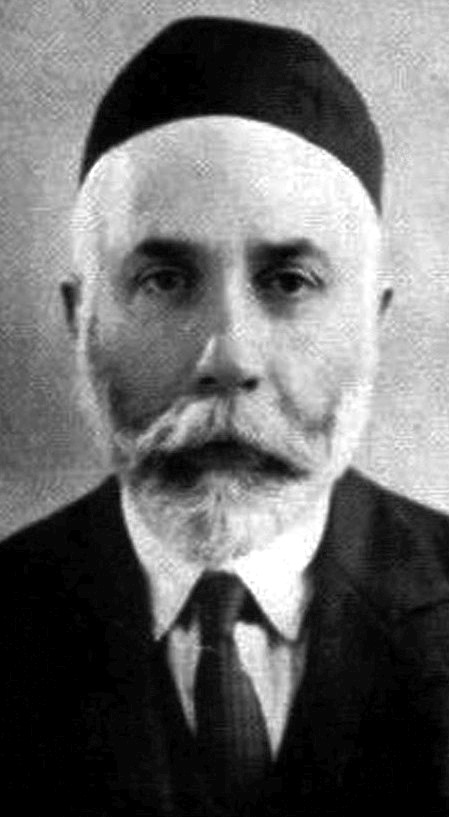
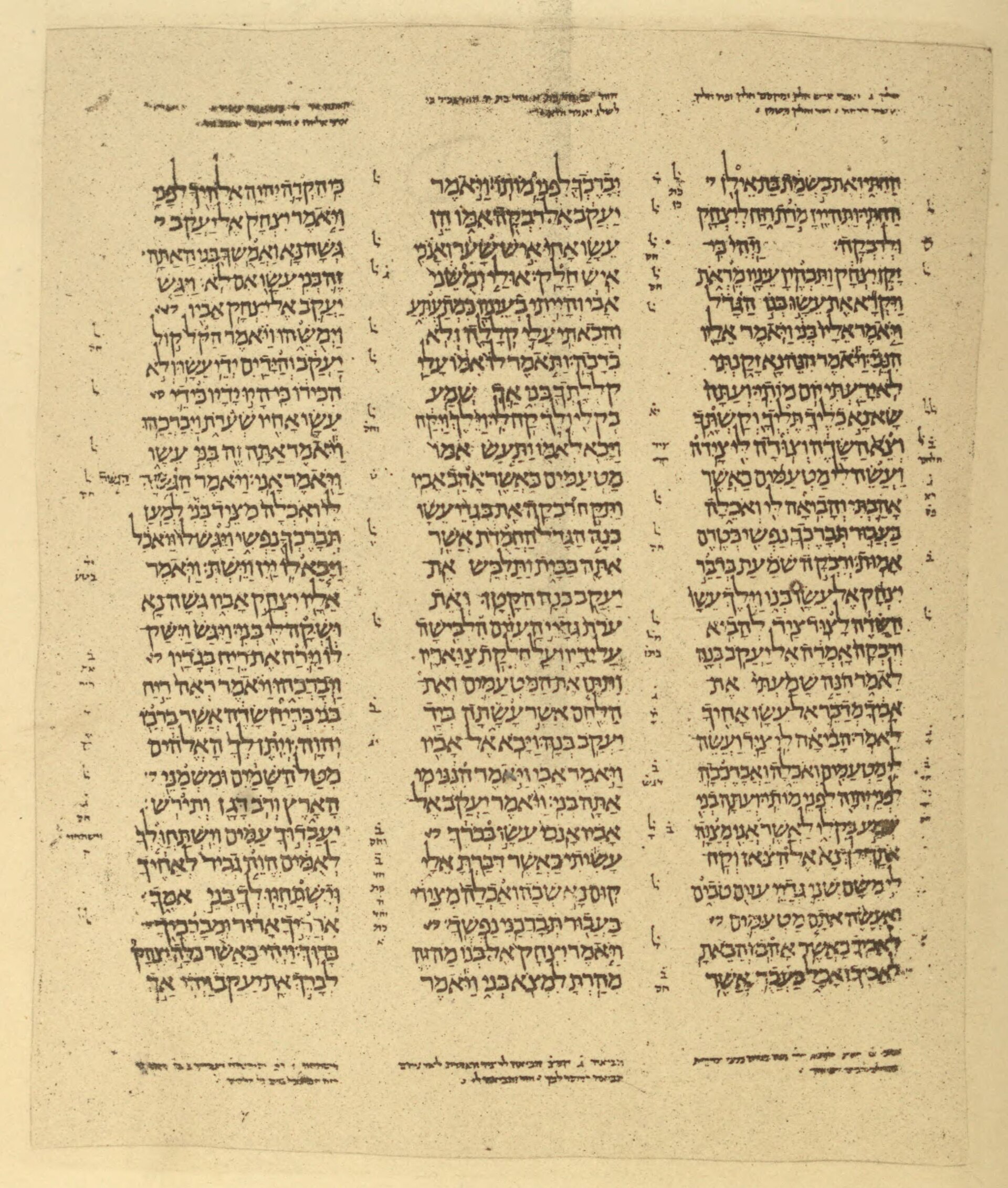
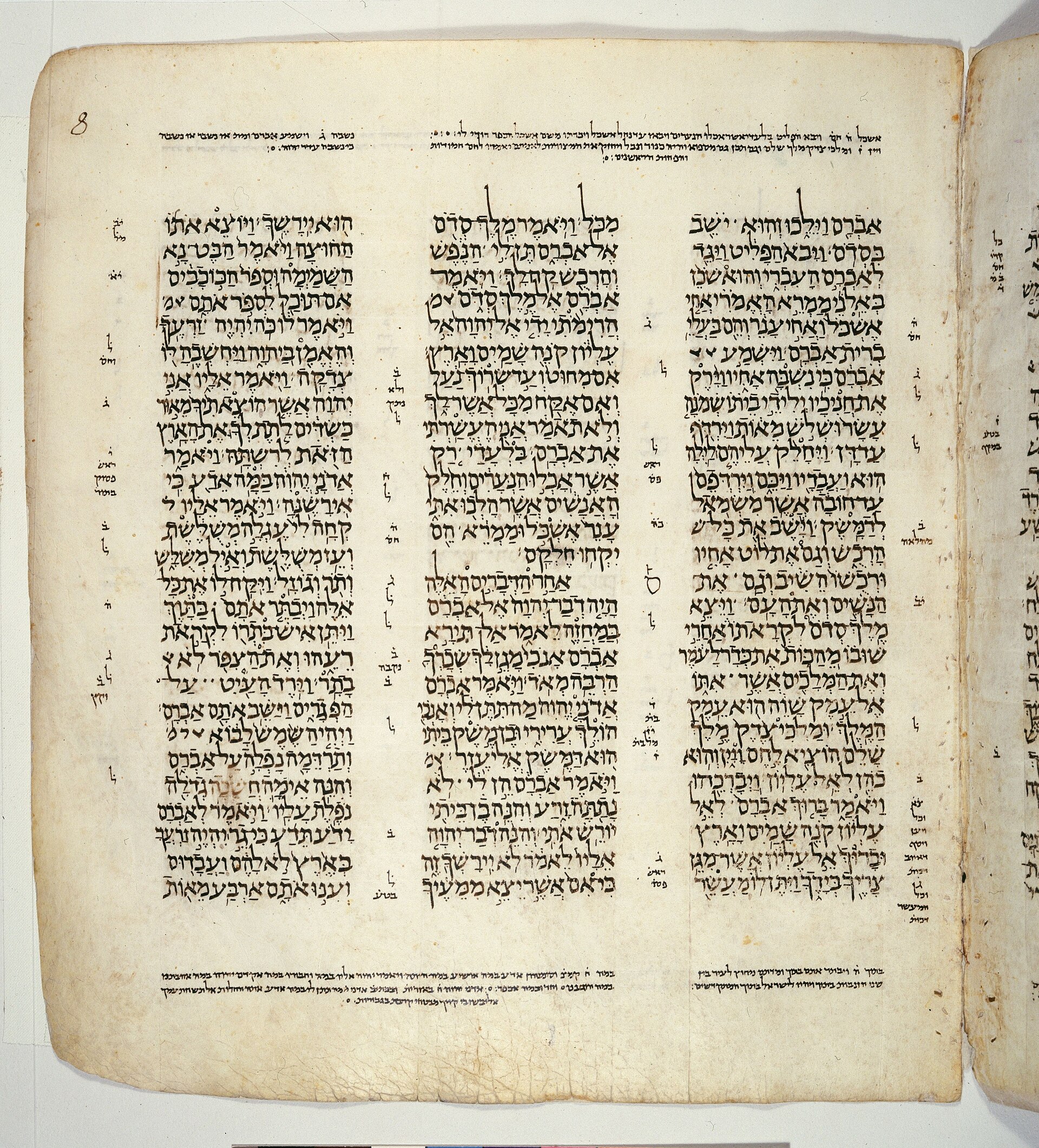
The record in full
Chapter 1It is 792 pages, and the losses are argued about
The codex is a single bound volume of 396 parchment leaves, 792 pages, written three columns to the page in iron-gall ink on what the Times of Israel describes as sheepskin.
The codex is a single bound volume of 396 parchment leaves, 792 pages, written three columns to the page in iron-gall ink on what the Times of Israel describes as sheepskin. It measures roughly 30 by 36 centimetres. It contains all twenty-four books of the Hebrew Bible, with Tiberian vowel points, cantillation marks, and the Masoretic apparatus in the margins.
How much is missing is not agreed. Sotheby's material as reproduced by Medievalists.net says eight leaves are gone; Fine Books and Collections says twelve full leaves; the Associated Press puts survival at about 92 per cent of the text; one account counts fifteen missing chapters, ten of them in Genesis. The metadata attached to the colour scan, which is derived from the object itself rather than from a press release, records that Genesis begins partway through chapter 11. The losses cluster in Genesis and in Psalms, and hundreds of further leaves are partly damaged rather than absent.
The binding is not original and not even second. Sotheby's suggests the book was rebound for the first time at Makisin in the thirteenth century. The Sotheby's specialist Shaul Seidler-Feller places another rebinding at the end of the Middle Ages or the beginning of the modern period, probably by non-Jewish binders. What holds it today is a plain twentieth-century leather binding. The bookplate of David Solomon Sassoon is pasted inside it.
Chapter 2The apparatus is the work of two men, and the second erased the first
Yosef Ofer of Bar-Ilan University, presenting at the research workshop on the codex held jointly by Bar-Ilan and ANU in January 2025, set out a finding that changes how the manuscript should be read.
Yosef Ofer of Bar-Ilan University, presenting at the research workshop on the codex held jointly by Bar-Ilan and ANU in January 2025, set out a finding that changes how the manuscript should be read. The Masorah in the codex is the work of two Masoretes working at different times. Through the first ninety pages the second man added his comments alongside those of his predecessor. Later in the volume he stopped adding and began erasing, scraping out the earlier notes to write his own in their place.
The two are distinguishable by what interests them. The first rarely deals with plene and defective spelling. The second deals with it constantly, and he worked with the Aleppo Codex and with the Babylonian Masorah in front of him. Neither is named anywhere in the book.
That erasure is a physical fact about the object with a consequence for the market. A buyer is not acquiring one act of copying but a layered document in which a later editor destroyed part of an earlier one. Nothing in the sale coverage said so.
Chapter 3The scribe was careless, and scholars say so plainly
The reverence in the auction coverage is not shared by the people who read the manuscript for a living.
The reverence in the auction coverage is not shared by the people who read the manuscript for a living. Israel Yeivin, in his standard introduction to the Tiberian Masorah, records that the scribe frequently omits punctuation, diacritical marks and vowels, and errs in consonantal spelling on dozens of occasions. Where a vowel is repeated on consecutive consonants he often marks only the first. Alephs habitually receive an ordinary shva instead of a hataf vowel. The sof passuq is sometimes forgotten at the end of a verse.
Kim Phillips of Cambridge University Library, writing before the sale, put it in one word to the Associated Press: the work is surprisingly sloppy next to the Aleppo Codex, and a scholar choosing between them would take Aleppo without hesitation.
Yeivin measured the affiliation as well. Where the traditions disagree, this codex follows Ben Asher about 40 per cent of the time, Ben Naphtali about 20 per cent, and neither about 40 per cent. It is not a clean witness to a single school. That is precisely what makes it useful: Vince Beiler, mapping some 45,000 Masorah parva notes across 110 early codices, places it neither at the centre of the surviving Masoretic Bibles nor at their periphery, and reads that in-between position as consistent with a tenth-century date and a Syrian origin.
Chapter 4The book records its own sale, in about the year 1000
Most medieval manuscripts have to have a provenance reconstructed for them.
Most medieval manuscripts have to have a provenance reconstructed for them. This one wrote part of its own down.
An early note attests the sale of the codex by Khalaf ben Abraham, described in one account as a businessman active in Palestine and Syria, to Isaac ben Ezekiel al-Attar, who later transferred ownership to his two sons, Ezekiel and Maimon. Fine Books and Collections dates the note to the early eleventh century. It is worth being exact about the names, because at least one published account renders the second son as Maimonides, which he was not.
No source consulted reproduces the wording of that note in the original. Every English version of it circulating in 2023 is a paraphrase of the Sotheby's catalogue. The scan is public, and the note is in it; a transcription and translation from the manuscript itself is the obvious next piece of work on this record.
Chapter 5Makisin, and a condition that was never met
A second inscription, added by an anonymous hand, consecrates the book to the Lord God of Israel and gives it to the synagogue of Makisin.
A second inscription, added by an anonymous hand, consecrates the book to the Lord God of Israel and gives it to the synagogue of Makisin. Makisin is the medieval name of the place now called Markada, in the Al-Hasakah governorate of north-eastern Syria.
The town was destroyed. By whom is not settled: the destruction is attributed either to the Mongols later in the thirteenth century or to the Timurids at the start of the fifteenth, and the second reading fits better with the date of the note that follows.
That note, written on the last page and dated by Fine Books and Collections to the late fourteenth century or later, is the one that matters most to anyone reading this as a title document. The codex was entrusted to Salama ibn Abi al-Fakhr on condition that he return it to the synagogue once it was rebuilt. If the rebuilding did not happen in his lifetime, his sons would inherit the book on the same terms.
The synagogue was never rebuilt. The inheritance clause is the detail almost every account drops, and it is the clause that legitimately moved the codex out of communal ownership and into a family. Everything that follows, including a price of 38.1 million dollars, runs through it.
Chapter 6Then nothing, for about five centuries
After the Salama note the record stops. Seidler-Feller, writing as Sotheby's own specialist, says the trail goes cold at the end of the Middle Ages or the beginning of the modern period, at the point...
After the Salama note the record stops. Seidler-Feller, writing as Sotheby's own specialist, says the trail goes cold at the end of the Middle Ages or the beginning of the modern period, at the point where the book was rebound, and that after hundreds of years of silence it suddenly reappears in Turkey.
The gap is usually reported as six hundred years. It is closer to four hundred and fifty or five hundred, from the late fifteenth century to 1929, and the looser figure should not be repeated. It is a genuine hole in the chain and no reconstruction has been offered for it.
Chapter 71929: a Frankfurt librarian who could not afford it
The reappearance has been reported two incompatible ways.
The reappearance has been reported two incompatible ways. The Associated Press wire says the codex was acquired in Frankfurt in 1929. Wikipedia says it was bought from an owner living in what is now Ankara. Both are partly right and the workshop paper reconciles them.
Seidler-Feller records correspondence of March and April 1929 between Aron Freimann of the Stadtbibliothek in Frankfurt am Main and David Solomon Sassoon. The manuscript had surfaced in Turkey. Freimann could not afford the owner's asking price, so he brought it to the attention of his friend Sassoon, who then bought it for considerably less than had first been asked.
The price was 350 pounds. Sassoon gave it the number 1053 in his own collection and published it in his library catalogue, Ohel Dawid, in 1932, which is how it entered scholarship under the name it carried until 2023. Photographs of it reached Jerusalem in the late 1950s. It has since been renumbered again: it is now ANU MS 1.
Chapter 81978: the pension fund that bought art
In 1978 the Sassoon family sold the codex, together with thirty-two other manuscripts from the collection, at Sotheby's in Zurich.
In 1978 the Sassoon family sold the codex, together with thirty-two other manuscripts from the collection, at Sotheby's in Zurich. The buyer was the British Rail Pension Fund, and the reported price is about 320,000 dollars. No source consulted states whether that figure is the hammer or the total with fees.
The fund is the point of interest, not the price. In 1974 the trustees of the British Rail pension scheme decided to put a small part of the fund into works of art as a hedge against inflation, eventually committing something in the region of 40 million pounds, about 3 per cent of holdings, across purchases made between 1974 and 1981. It was the first and, so far as is recorded, the only large British pension fund to do it. Sotheby's advised on the buying without charging a fee, on the condition that any eventual sales went through Sotheby's. The fund began selling in 1986 and finished in 2003.
So the manuscript was, for eleven years, an investment asset held against the retirement of British railway workers, and the auction house that advised on the purchase had contracted in advance for the right to sell it. Reported annual returns on the programme, in the region of 13 per cent against roughly 22 per cent on the fund's equities over the same span, come from secondary reporting and should be checked against the academic literature before they are relied on.
Chapter 91989: two sales in one year, and only one of them is reported
Eleven years later the fund put the codex back into the market at Sotheby's in London, on 5 December 1989.
Eleven years later the fund put the codex back into the market at Sotheby's in London, on 5 December 1989. The result was 2,035,000 pounds.
The buyer was not Jacqui Safra. Seidler-Feller states that the successful bidder was a Jewish antiquarian book dealer, unnamed, who promptly sold it on to Jacob, called Jacqui, Eli Safra of Geneva in the same year. The figure of 3.19 million dollars that appears in almost every account of the 2023 sale is the dollar conversion of the London auction result, not the price Safra paid. What Safra paid the dealer has never been disclosed.
Whether 2,035,000 pounds was a hammer figure or a total including the buyer's premium is not stated in any source consulted, and this record does not guess. One outlier is in print: ReligionUnplugged gives Safra's price as 4.19 million dollars against everyone else's 3.19 million, which looks like a transposition but has not been corrected.
Safra kept it for thirty-four years. Over that period the codex was exhibited publicly once, at the British Museum in 1982, which was during the pension fund's ownership rather than his.
Chapter 1017 May 2023: the lot was effectively pre-sold
Sotheby's offered the codex in New York as a single-lot sale titled Codex Sassoon: The Earliest Most Complete Hebrew Bible, lot 1, catalogued as Circa 900, Land of Israel or Syria, estimated at 30 to...
Sotheby's offered the codex in New York as a single-lot sale titled Codex Sassoon: The Earliest Most Complete Hebrew Bible, lot 1, catalogued as Circa 900, Land of Israel or Syria, estimated at 30 to 50 million dollars.
The gavel fell at 33.5 million dollars. With fees the total was 38.1 million. Both figures are stated in the reporting and this record keeps them apart, because a great deal of coverage gave only the second and called it a price.
The structure behind those numbers is the part almost nobody printed. Alfred H. Moses had placed an irrevocable bid of 32.5 million dollars with Sotheby's before the sale opened. An irrevocable bid means the lot cannot fail: the bidder is contractually committed at that level and the auctioneer may bid up to, but not at, that amount on the book. The codex was therefore already sold at 32.5 million before anyone in the room raised a hand. When an anonymous rival reached 33 million, Moses went one increment further to 33.5 and it was over. The Art Newspaper describes a four-minute duel between two buyers; the wider lot, with a handful of bidders in the room and on the telephone, took under six minutes.
The underbidder has never been named. The underbid is known, which is more than most sales disclose, and at 33 million dollars it establishes that the price had real depth behind it rather than resting on one determined buyer.
One thing does not reconcile, and it is not a rounding error. The gap between 33.5 million and 38.1 million is about 4.6 million dollars, an effective buyer's premium of 13.7 per cent. Premium scales are tiered downwards, in bands that fall as the price rises, which means the effective rate on a lot of this size can never drop below the top band. No major house charged as little as 13.7 per cent at the top of its scale in 2023. So either the gavel price was lower than 33.5 million or the total was higher than 38.1 million, and the two numbers that every account of this sale prints side by side cannot both be true. This record prints both and resolves neither.
Chapter 11Who bought it, and in what capacity
Alfred H. Moses is a lawyer, a former United States ambassador to Romania and a former president of the American Jewish Committee.
Alfred H. Moses is a lawyer, a former United States ambassador to Romania and a former president of the American Jewish Committee. He was ninety-four at the time of the sale, and he had never seen the book. He first looked at it about two weeks afterwards.
The capacity in which he bought it is reported inconsistently and the distinction matters for a provenance record. The Art Newspaper describes him as acquiring it on behalf of the American Friends of ANU. Sotheby's own specialist describes the buyer as ANU, courtesy of Moses, who donated the money required for the purchase. Moses himself put it as deciding to buy it and provide the funds for ANU to buy it, and the irrevocable bid stood in his own name.
The reading this record adopts is that Moses funded the purchase and the buyer of record was the American Friends of ANU. He gave the money, not the object.
His stated reason is on the record and is worth quoting because it is a statement about what the price was for: he wanted it somewhere it would be available to the Jewish people rather than in a rich person's bank vault.
Chapter 12Whether it is the earliest most complete Hebrew Bible
The sale title is a claim, and it was contested before the hammer fell.Three manuscripts frame the question.
The sale title is a claim, and it was contested before the hammer fell.
Three manuscripts frame the question. The Aleppo Codex, of about the same date, was the most authoritative text in the tradition and lost roughly 40 per cent of its leaves, including nearly all of the Pentateuch, in the twentieth century. The Leningrad Codex, of 1008 or 1009, is entirely complete but more than a century younger. This codex sits between them: older than Leningrad, far more complete than Aleppo. It is neither the oldest nor the most complete, and the claim rests on the combination.
Kim Phillips of Cambridge University Library attacked the wording directly, calling claims of the form the earliest most complete Hebrew Bible nonsensical, on the ground that a text can be complete or incomplete but not most complete, and grossly misleading. He noted that another codex, the Aleppo Codex, has a competing claim to be the earliest Masoretic Hebrew Bible containing the entire text in a single volume, and that being the earliest surviving example does not make something the first ever made.
There is a harder objection than the wording. The second Masorete of this codex saw the Aleppo Codex and copied at least two Masorah magna notes from it, as Neria Klein of the Hebrew University has established, and a marginal note refers to Aleppo by its Arabic name a-Taj, the Crown. That constrains the date of the second man's layer to after Aleppo. It does not date the original copying, and it should not be reported as if it did, but it is the substantive reason the earliest claim is disputed rather than merely loose.
The case for the manuscript is made in the same scholarly venue. Noam Mizrahi of the Hebrew University calls the Masoretic codex a conceptual revolution and this its earliest sample to date. Beiler argues that its value lies partly in its difference from Aleppo and Leningrad rather than its proximity to them.
Chapter 13What the record actually is, and what it is not
Sotheby's, the Art Newspaper and Fine Books and Collections all fenced the claim to manuscripts.
Sotheby's, the Art Newspaper and Fine Books and Collections all fenced the claim to manuscripts. On that fencing 38.1 million dollars broke a record that had stood since November 1994, when the Codex Leicester made 30,802,500 dollars including fees at Christie's New York.
It is not the most expensive item of text ever auctioned. In November 2021 a 1787 printing of the United States Constitution made 43.2 million dollars with fees at Sotheby's, against the underbidding of ConstitutionDAO, a crowdfunded group that raised roughly 47 million dollars in Ether from some 17,000 contributors and could not bid past about 40 million and still afford conservation. That lot is classed as a printed document rather than a handwritten manuscript, and the distinction is doing real work in every headline written about both sales.
Chapter 14Delayed by a war, then put on permanent display
Before the sale the codex toured: Sotheby's London from 22 to 28 February 2023, Tel Aviv in the week of 20 March, Dallas in the week of 17 April, Los Angeles in the week of 30 April, and New York in...
Before the sale the codex toured: Sotheby's London from 22 to 28 February 2023, Tel Aviv in the week of 20 March, Dallas in the week of 17 April, Los Angeles in the week of 30 April, and New York in early May. The Art Newspaper reports more than 20,000 visitors across the tour.
It flew to Israel on El Al from New York on 5 October 2023 and was to go on permanent display on 11 October. The attacks of 7 October intervened and the display was held. It finally opened on 29 May 2025, ahead of Shavuot, some twenty months late, opened at the page carrying the Ten Commandments in Deuteronomy 5.
It is now in the gallery called The Foundations on the first floor of ANU in Tel Aviv. The museum describes the codex as entrusted to it for safekeeping on behalf of the Jewish people and humanity, which is a formulation about custody rather than ownership and is worth noticing in a document about title. No source dated 2026 was found; the present tense here rests on the permanence of the 2025 installation, not on a fresh report.
Chapter 15The whole book is free, at full resolution
This is the part a student should know and almost nobody writes down.
This is the part a student should know and almost nobody writes down. The entire codex was photographed in colour by Ardon Bar-Hama for the National Library of Israel and was made accessible through the library's Ktiv portal two years before the sale.
The complete colour set is on the Internet Archive, uploaded in February 2023, before the auction, at 9.2 gigabytes, under a Public Domain Mark with any use permitted. There are JP2 archives of 5.2 and 3.0 gigabytes and a 344 megabyte PDF. A separate black and white microfilm scan is there as well. Wikimedia Commons carries the full colour scan and twenty-four further files, one per book of the Bible, plus a single page image at 7,099 by 8,344 pixels.
No IIIF manifest specific to the codex was located from the National Library of Israel, ANU or Sotheby's, and the absence is recorded here as unverified rather than established. What is established is that anybody can read every surviving page of a manuscript that cost 38.1 million dollars without asking permission or paying anything, which is not true of most objects in this archive.
The artist
An unnamed scribe, working c. 900, with two later anonymous Masoretes
Nothing is known about the man who wrote this book, and the reason is simple: he did not sign it. There is no colophon, no dedication by the copyist, no date and no place. Everything said about when and where it was made is reconstructed from the parchment, the script and the ruling, which is why the sale catalogue could only offer a two-country answer. Two further anonymous hands worked on the margins afterwards, and the second of them destroyed part of the first's work to make room for his own. A record of this object that treats it as the product of a single act of devotion by a single pious hand is describing something that did not happen.
Exhibited
- 1982Displayed during the British Rail Pension Fund's ownershipBritish Museum, London
- 2023Pre-sale tour: London 22-28 February, Tel Aviv from 20 March, Dallas from 17 April, Los Angeles from 30 April, New York in early MaySotheby's London, ANU Tel Aviv, Bridwell Library at Southern Methodist University Dallas, Los Angeles, New York
- 2025Permanent display from 29 May 2025, opened at Deuteronomy 5ANU - Museum of the Jewish People, Tel Aviv, The Foundations gallery
Literature
- David Solomon Sassoon, Ohel Dawid: Descriptive Catalogue of the Hebrew and Samaritan Manuscripts in the Sassoon Library, Oxford University Press. The publication that introduced the manuscript to scholarship as Sassoon 1053. (1932)
- Israel Yeivin, Introduction to the Tiberian Masorah, Scholars Press, pp. 21-22, on the scribe's omissions and the Ben Asher and Ben Naphtali agreement rates. (1980)
- Research Workshop on Codex Sassoon, Bar-Ilan University and ANU, 6-8 January 2025. Abstracts by Judith Olszowy-Schlanger, Yosef Ofer, Neria Klein, Vince Beiler, Noam Mizrahi, Nehemia Gordon and Ira Rabin, Leeor Gottlieb, Yossi Peretz and others. The single most useful body of scholarship on the object and it postdates the sale.
- Yosef Ofer has announced a critical edition of the manuscript's masora magna. (forthcoming)
Related works
| Work | Relation | Where it is |
|---|---|---|
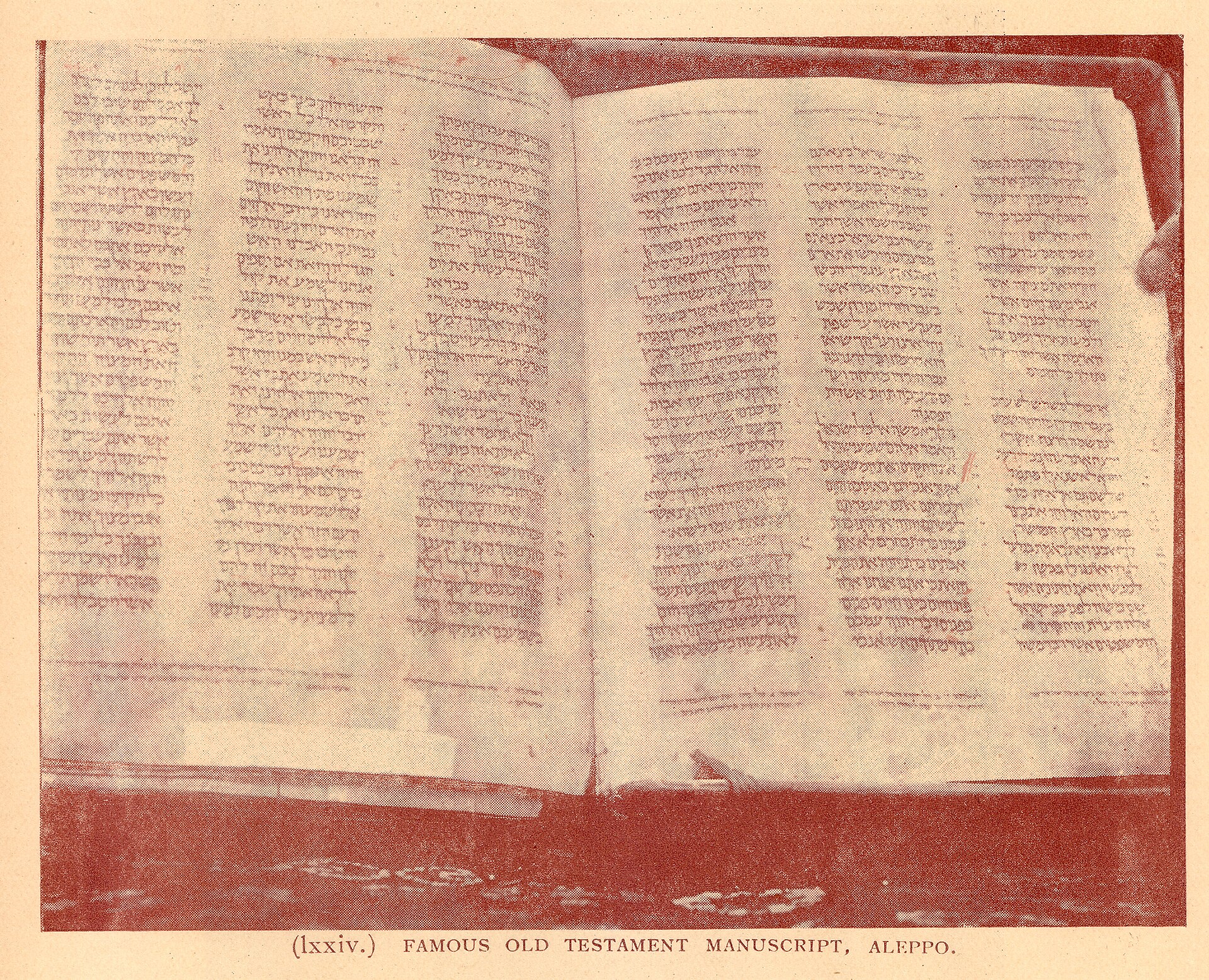
| Aleppo Codex Attributed to the scribe Shlomo ben Buya'a, vocalised by Aaron ben Moses ben Asher | The rival claimant, and the book the second Masorete of this codex worked from About 40 per cent of its leaves are lost, including nearly all of the Pentateuch. Regarded as the more authoritative text. Referred to inside this codex by its Arabic name a-Taj. | Shrine of the Book, Israel Museum, Jerusalem |
| Leningrad Codex Samuel ben Jacob | The completeness benchmark Dated 1008 or 1009 and entirely complete, but more than a century younger. It is the base text of the standard printed critical editions of the Hebrew Bible. | National Library of Russia, Saint Petersburg, Firkovich B 19A |
| Damascus Pentateuch Unnamed scribe, tenth century | Another manuscript from the same collection, Sassoon 507 Sold out of the Sassoon collection separately. Its survival in a public institution is the counterfactual to this record: the same collector, the same century, a different destination. | National Library of Israel, Jerusalem |
| Codex Orientales 4445 Unnamed scribe | Comparandum in the ink and Masorah studies One of the early Masoretic codices analysed alongside this manuscript in the work on iron-gall inks. | British Library, London |
| Codex Leicester Leonardo da Vinci | The record this sale broke USD 30,802,500 including fees at Christie's New York, 11 November 1994. It had held the manuscript record for nearly thirty years. | Bill Gates, Seattle |
Open questions
- Which laboratory carried out the radiocarbon dating, and what was the confidence interval? The 880 to 960 range is quoted everywhere and the analysis behind it has never been published.
- How many leaves are actually missing? Sotheby's material says eight, Fine Books and Collections says twelve, and one account counts fifteen missing chapters. The scan is public and the question is answerable by anyone willing to collate it.
- Who destroyed Makisin, and when? The Mongols in the later thirteenth century and the Timurids around 1400 are both in print, and the date of the second inscription fits the later option better.
- Where was the codex between the late fifteenth century and 1929? Roughly five centuries have no recorded owner, and the rebinding that closed the medieval record is the only physical trace of the period.
- Who was the dealer who bought it in December 1989, and what did he charge Jacqui Safra weeks later? Both are undisclosed, and the margin on that resale is the only unrecorded profit in the whole chain.
- Was the 1989 result of GBP 2,035,000 a hammer figure or a total? No source states it, and the widely quoted USD 3.19 million is a conversion of an unspecified figure.
- Who was the underbidder at 33 million dollars in 2023?
- Was there a house guarantee on the 2023 lot in addition to the irrevocable bid? Sotheby's marks the two with different symbols and only the irrevocable bid is attested.
- Which of the two 2023 figures is wrong? A USD 33,500,000 hammer and a USD 38,100,000 total imply an effective buyer's premium of 13.7 per cent, which is below any major house's top marginal rate in 2023, and a tiered scale can never produce an effective rate below its own top tier. One of the two universally quoted numbers is incorrect and no published source has noticed.
- What is the quire structure? No published source gives a collation for a manuscript that has been examined by two national institutions and an auction house.
Questions about this object
What is Codex Sassoon?
Codex Sassoon is a manuscript, dated c. 900 (radiocarbon 880-960 CE). Medium: Iron-gall ink on parchment, Tiberian vocalisation, cantillation and Masorah.
Who made Codex Sassoon, and is the attribution settled?
The attribution to An unnamed scribe, with two later Masoretes is recorded here as unknown. There is no colophon. The scribe is anonymous and no source names him. Date and place rest on radiocarbon analysis of the parchment (880 to 960 CE) and on codicology and palaeography. Sotheby's catalogued the origin as Land of Israel or Syria; the codicological work presented at the 2025 Bar-Ilan and ANU research workshop leans to Syria. Two further hands, both anonymous, added and then partly erased the Masoretic apparatus.
Where is Codex Sassoon now?
ANU - Museum of the Jewish People, Tel Aviv. Inventory number ANU MS 1 (formerly Sassoon 1053). Last confirmed 3 August 2026. Bought at Sotheby's New York, 17 May 2023, by the American Friends of ANU with funds donated by Alfred H. Moses; on permanent display since 29 May 2025.
What has Codex Sassoon sold for?
Hammer Not stated in any source consulted; with premium, Not stated in any source consulted. Sotheby's, Zurich, 1978.
What is still unknown about Codex Sassoon?
Which laboratory carried out the radiocarbon dating, and what was the confidence interval? The 880 to 960 range is quoted everywhere and the analysis behind it has never been published.
Sources
- 1Sotheby's, lot record: 'Codex Sassoon. Circa 900, Land of Israel or Syria', sale 'Codex Sassoon: The Earliest Most Complete Hebrew Bible', New York, 17 May 2023, lot 1. Estimate USD 30,000,000 to 50,000,000. sothebys.com/en/...
- 2Will Fenstermaker, 'The Remarkable History of Codex Sassoon', Sotheby's, 15 February 2023. The auction house's own account of the inscriptions and the early chain; to be read as an interested party. sothebys.com/en/...
- 3Jewish Telegraphic Agency, 17 May 2023, on the sale. Gives the gavel price of USD 33.5 million against USD 38.1 million with fees and premiums. jta.org/2023/...
- 4Jewish Telegraphic Agency, 1 June 2023, on Alfred Moses seeing the codex for the first time. The source for the irrevocable bid of USD 32.5 million and the anonymous rival's USD 33 million. jta.org/2023/...
- 5The Art Newspaper, 17 May 2023, on the sale, the four-minute contest between two bidders, the visitor figures for the tour, and the classification of the 2021 United States Constitution lot as a printed document. theartnewspaper.com/2023/...
- 6The Times of Israel on the purchase, with Alfred Moses's statement and the description of the parchment. timesofisrael.com/codex-sassoon-oldest-near-complete-hebr...
- 7The Times of Israel on the arrival in Israel, the delay after 7 October 2023 and the opening of the permanent display on 29 May 2025. timesofisrael.com/codex-sassoon-oldest-near-complete-hebr...
- 8Research Workshop on Codex Sassoon, Bar-Ilan University and ANU, 6-8 January 2025, English abstracts. Includes Shaul Seidler-Feller of Sotheby's Books and Manuscripts Department on the modern chain, Judith Olszowy-Schlanger on the script, Yosef Ofer on the two Masoretes, Neria Klein on the use of the Aleppo Codex, Vince Beiler on the Masorah parva dendrogram, Ira Rabin and Nehemia Gordon on the inks. The most substantial scholarship on the object, and it postdates the sale. bible.biu.ac.il/sites/...
- 9Kim Phillips, Cambridge University Library, 'Is the Earliest, Most Complete Hebrew Bible Going on Auction?', Text and Canon Institute. The published objection to the sale title and to the use of radiocarbon dating in the marketing. textandcanon.org/is-the-earliest-most-complete-hebrew-bib...
- 10Associated Press, carried by Phys.org, March 2023, on the radiocarbon range of 880 to 960, the 92 per cent survival figure, the 1978 and 1989 sales, Yosef Ofer's three-manuscript framing and Kim Phillips's judgement on the scribal work. phys.org/news/...
- 11Fine Books and Collections, on the presale announcement: the early eleventh-century date for the sale note, the twelve missing leaves, the late fourteenth-century date of the Salama inscription and the tour dates. finebooksmagazine.com/fine-books-news/...
- 12Wikipedia, 'Codex Sassoon 1053'. Tertiary; used for the three-column layout, the dimensions, the Ben Asher and Ben Naphtali agreement rates from Yeivin, the GBP 350 and GBP 2,035,000 figures and the Ankara attribution. Flagged for replacement with the Sotheby's catalogue and Yeivin at first hand. en.wikipedia.org/wiki/...
- 13Internet Archive, 'Tanakh (Ms. Sassoon 1053), color images', uploaded 16 February 2023, 9.2 GB, Public Domain Mark 1.0, photographs by Ardon Bar-Hama, sourced from the National Library of Israel. The item metadata records that Genesis begins partway through chapter 11. archive.org/details/...
- 14Wikimedia Commons file page for the full colour scan, giving the National Library of Israel as the source, Ardon Bar-Hama as photographer and the licence as public domain. Licence verified from the API field LicenseShortName at fetch time. commons.wikimedia.org/wiki/...
- 15Medievalists.net, May 2023, reproducing the Sotheby's catalogue wording of the Makisin dedication and the count of eight missing leaves. medievalists.net/2023/...
- 16eJewishPhilanthropy on Alfred Moses buying the codex sight unseen, with his statement about not wanting it in a bank vault. ejewishphilanthropy.com/sight-unseen-alfred-moses-bought-...
- 17The Jewish Press, 'The History of the Codex Sassoon', for Khalaf ben Abraham's occupation and the 350 pound purchase. jewishpress.com/the-history-of-the-codex-sassoon
- 18ReligionUnplugged, 26 February 2023. Cited here as the outlier that gives Safra's price as USD 4.19 million and as the source for the dating having been arranged by Safra. religionunplugged.com/news/...
- 19Sotheby's, lot note to a Hebrew Exodus leaf in 'The History of Script: Sixty Important Manuscript Leaves from the Schoyen Collection', 2012, citing the December 1989 result of GBP 2,035,000. sothebys.com/en/...
- 20Bloomberg, 17 May 2023, on the sale at USD 38.1 million and the purchase by the American Friends of ANU with a donation from Alfred H. Moses. bloomberg.com/news/...
- 21Smithsonian Magazine on the presale announcement, including the alternative late ninth-century dating and the twentieth-century binding. smithsonianmag.com/smart-news/...
- 22National Library of Israel, Ktiv portal for Hebrew manuscripts, the origin of the colour digitisation. A stable item permalink for this codex was not retrieved; the record URL returned HTTP 403. nli.org.il/en/...
Last verified 19 August 2026 · Published 4 August 2026
Change log
2 August 2026 - Record deepened to the house standard: narrative sections, technical evidence, artist dossier, related works and open questions added; provenance chain and auction results replaced with the researched versions; sources rebuilt.
4 August 2026 - Record created at the house standard: researched narrative, technical evidence, maker dossier, graded provenance chain, prices with hammer and premium separated, related works, open questions and sources.
19 August 2026 - 2026-08-19: Re-verified. Checked current location (still ANU Museum, Tel Aviv, on permanent display since 29 May 2025, no move or loan found), attribution and dating (no new codicological or radiocarbon study since the January 2025 Bar-Ilan/ANU workshop; Ofer's masora magna critical edition remains forthcoming, unpublished), and litigation or restitution claims (none found; specifically checked for and did not find a Yemenite or Syrian community claim tied to the Makisin dedication). All 22 sources rechecked: 20 resolve live, and 2 return HTTP 403 (bloomberg.com and nli.org.il), consistent with routine bot-blocking rather than dead links; the nli.org.il 403 was already noted in the record's own source citation. No factual change to the record was required.