Codex Leicester
Leonardo da Vinci · c. 1504-1508
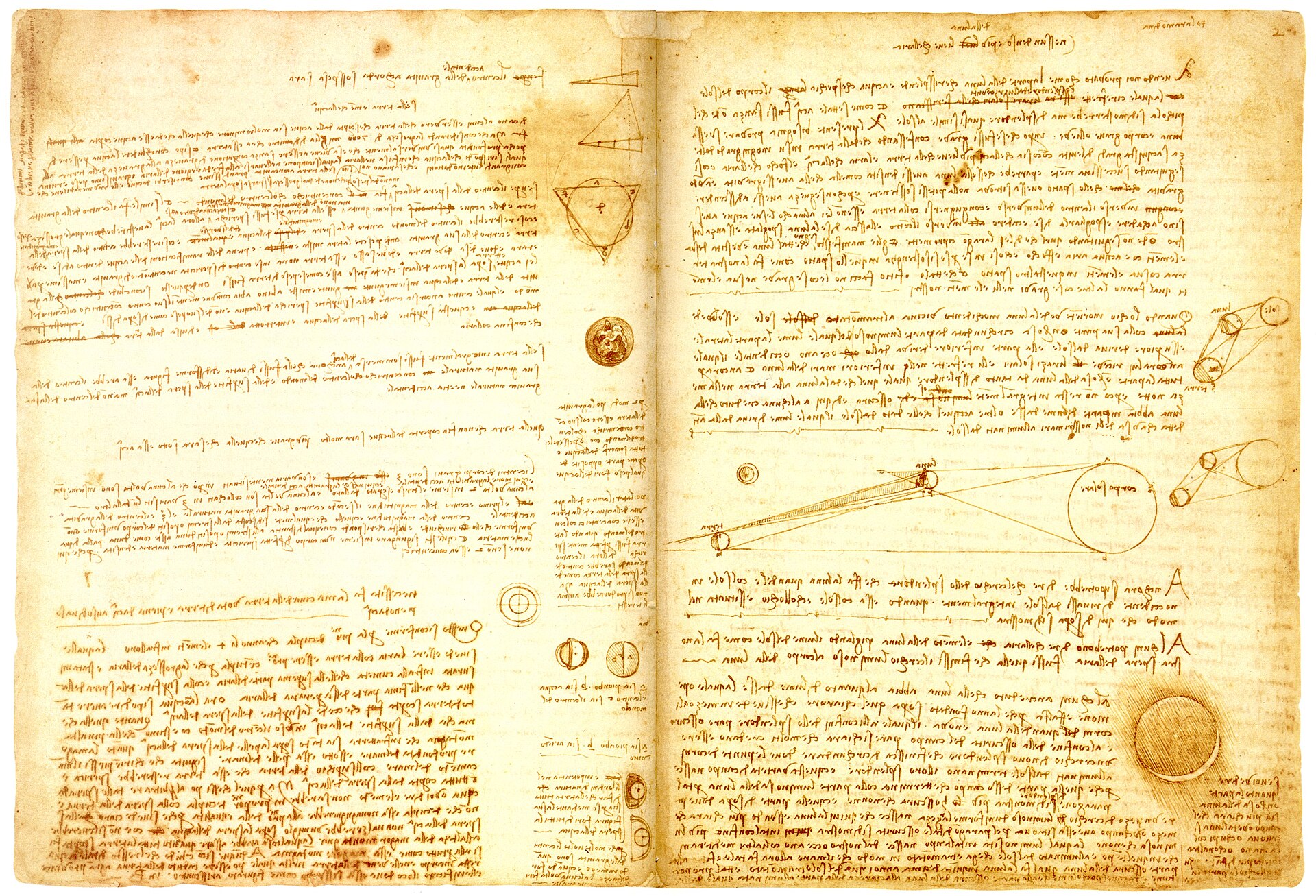
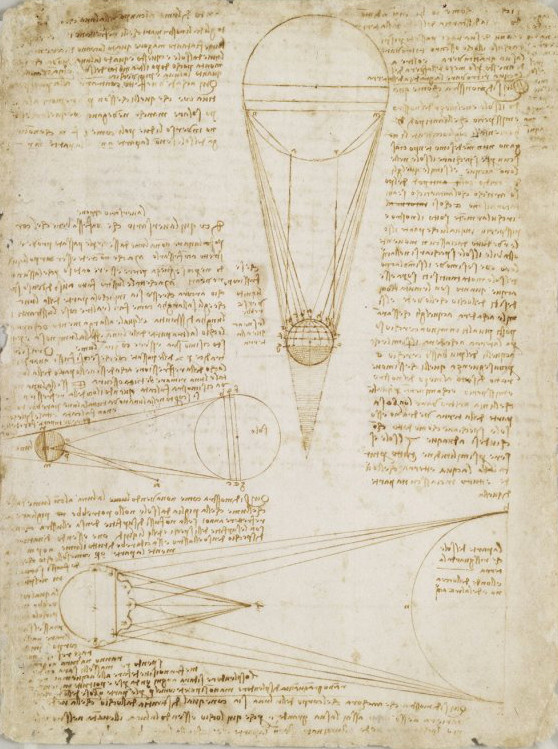
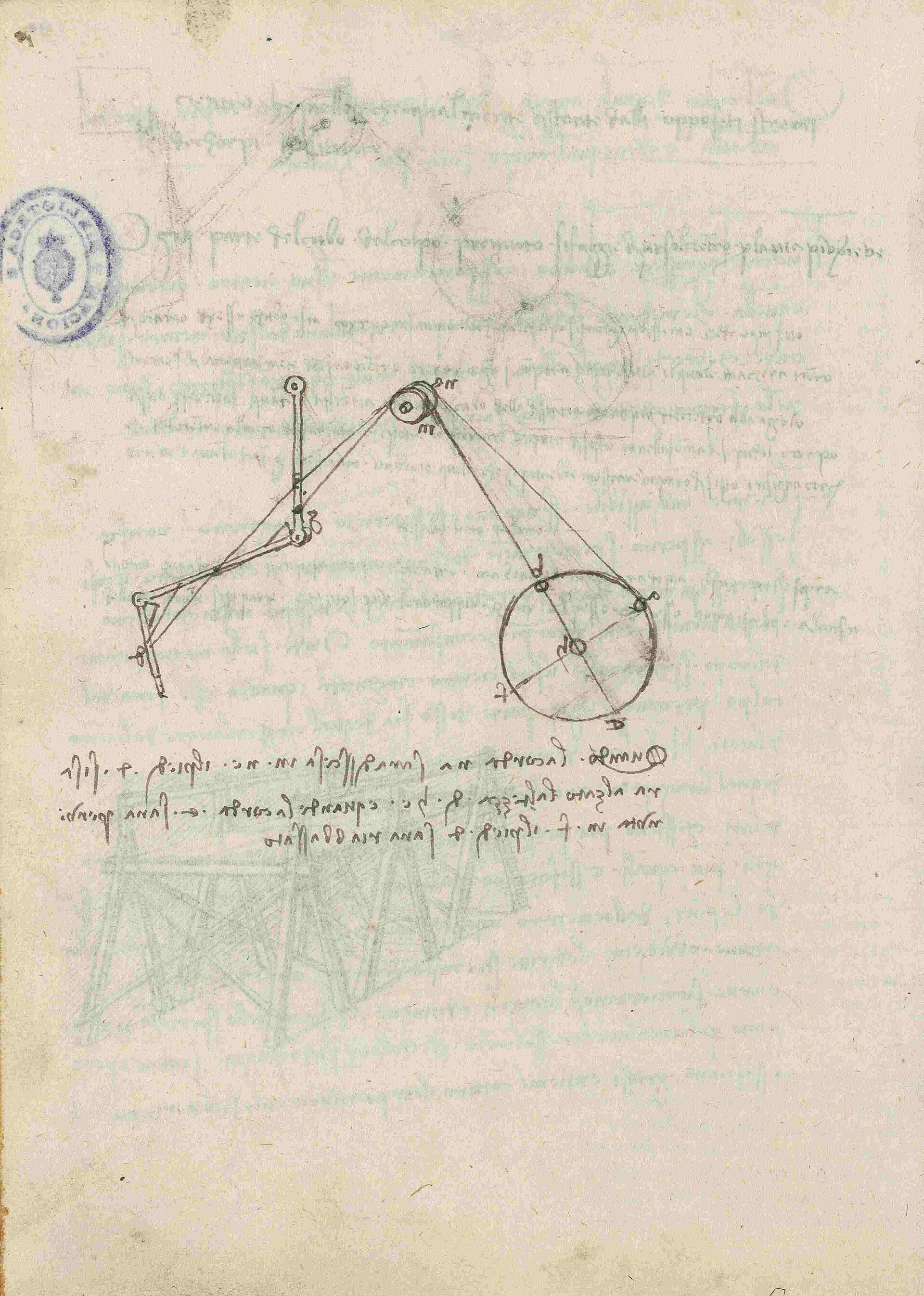
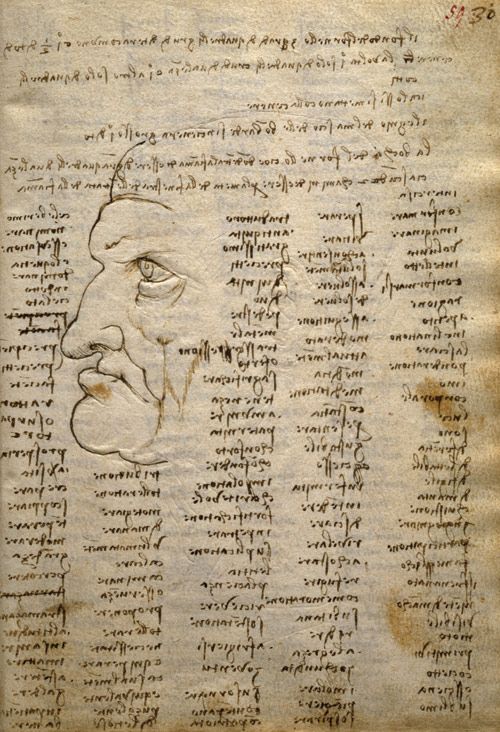
The record subject. A bifolium of the Codex Leicester photographed as it now exists, unbound and flat: folio 35 verso at left, folio 2 recto at right, dense mirror script with marginal diagrams. This is what all seventy-two pages look like.
| Artist | Leonardo da Vinci |
|---|---|
| Date | c. 1504-1508 |
| Medium | Pen and ink on rag paper |
| Dimensions | Each page approximately 29 x 22 cm. Eighteen sheets, each folded once to form a bifolium, giving 72 pages. |
| Where it is now | Private collection, United States. Owned by Bill Gates since 1994.last confirmed 2 August 2026 |
| Attribution | AcceptedAutograph throughout. Full note |
| Object type | Manuscript |
| Period | Italian, early sixteenth century |
| Cases | Has a provenance gap |
| Inscriptions | Written throughout in Italian in Leonardo's mirror script, running right to left, with drawings and diagrams in the margins of almost every page. |
| Owners on record | 9 links6 documented, 1 disputed, 2 unknown |
| Sources | 27 cited |
About this record Last verified 13 August 2026 · 27 sources cited · Change log
On this page 12 sections
ContentsClose
Eighteen sheets of paper, each folded once, seventy-two pages, written in mirror script from right to left in Florence between about 1504 and 1508. It is a notebook about water that turns into a notebook about the moon, about fossils, about the age of the earth and about what the world is made of. In it Leonardo works out that the ashen glow on the dark part of the crescent moon is sunlight reflected from the earth, and argues, in detail and against the Bible, that the marine shells found high in the Italian mountains cannot have been put there by Noah's flood.
It has been sold twice in living memory. Armand Hammer bought it at Christie's London on 12 December 1980 and renamed it the Codex Hammer. Bill Gates bought it back under its old name at Christie's New York on 11 November 1994 for USD 30,802,500, a figure that includes the buyer's premium and is still quoted almost everywhere as though it were the hammer price. It is the only one of Leonardo's surviving notebooks in private hands. Every other one belongs to a library or a museum, and that single fact is what the price is actually measuring.
The record it is usually credited with no longer stands unqualified. The Codex Sassoon made USD 38.1 million at Sotheby's in 2023 and a first printing of the United States Constitution made USD 43.2 million in 2021. In money of the day the Leicester has been passed. Adjusted for inflation it has not.
Provenance
Each link is graded. Documented: a cited source supports it. Disputed: the identification is argued but not established. Unknown: no owner for that span, and the gap is not smoothed into a narrative. The grades in the glossary.
- c. 1504 - 1519Leonardo da Vincidocumented
Compiled largely in Florence between 1504 and 1508, in the years when Leonardo was dissecting bodies, studying the flight of birds and working on the scheme to make the Arno navigable. The eighteen bifolia were written and filled separately and only afterwards gathered into a booklet; the Museo Galileo states that the gathering was probably not done by Leonardo himself. He kept the sheets, as he kept all of them, until his death at Amboise in 1519.25
- 1519 - c. 1537Unknownunknown
No owner is recorded between Leonardo's death and the manuscript's appearance in Rome. Leonardo's papers were dispersed after 1519 and the Codex Leicester is one of the sheaves that went to Italy rather than to France. How it got to Rome, and through whose hands, is not established in any source consulted.23
- c. 1537 - c. 1577Guglielmo della Porta, sculptor, Romedisputed
The Museo Galileo places the manuscript in the hands of the sculptor Guglielmo della Porta in Rome around 1537. The underlying document is not identified in the online exhibition, and popular accounts repeat the della Porta connection without evidence of any kind. Treat the 1537 date as the museum's dating rather than as a transcribed record until the Christie's 1994 provenance essay or the Galluzzi catalogue can be consulted. Della Porta, a pupil of Michelangelo, died in Rome in 1577.3
- c. 1577 - 1690Heirs of Guglielmo della Porta, Romeunknown
The manuscript is said to have stayed with the della Porta family for over a century, unrecorded. The story that Giuseppe Ghezzi found it in 1690 in a chest of family papers belonging to the della Porta heirs is the standard account and is repeated by the Wikipedia article, but no primary document for the chest has been located in the sources consulted. It should be read as tradition until a document is produced. What is not tradition is the outcome: by 1689 the manuscript was Ghezzi's.13
- 1689 - 1717Giuseppe Ghezzi, painter and antiquarian, Romedocumented
The Museo Galileo records the painter Giuseppe Ghezzi (1634-1721) as holding the manuscript by 1689. Ghezzi was secretary of the Accademia di San Luca and a dealer as well as a painter, exactly the sort of man through whose hands loose Renaissance papers moved in Rome, and exactly the sort of man an English visitor on the Grand Tour would be introduced to.3
- 1717 - 1759Thomas Coke, later 1st Earl of Leicesterdocumented
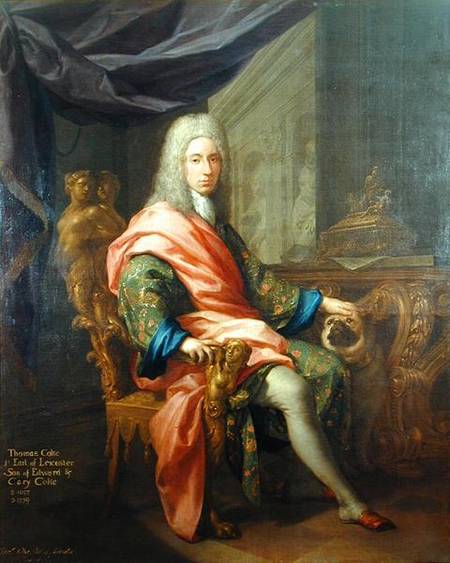
Bought in Italy by Thomas Coke (1697-1759), then a young man on the Grand Tour and later the builder of Holkham Hall. The Museo Galileo and the Christie's 1994 catalogue both give 1717 and record that Coke took the manuscript to Florence to have a copy made; the Wikipedia article gives 1719. The two dates are not reconciled in the sources consulted and both are recorded here. The 1719 date is the one that most popular accounts carry. Francesco Trevisani painted Coke's portrait in Rome in 1717.138
- 1759 - 1980The Coke family, Earls of Leicester, and the Trustees of the Holkham Estate, Norfolkdocumented
Held at Holkham Hall for two hundred and twenty-one years. This is the period in which the manuscript acquired its name and its scholarly reputation: copies of it circulated in Europe, one reaching the Grand-Ducal Library at Weimar around 1818 on Goethe's recommendation, and Jerome Lalande referred to it in print in 1769. Jean Paul Richter, preparing the first serious edition of Leonardo's writings in the 1880s, thanked the Earl of Leicester and his librarian at Holkham for access.36
- 1980 - 1994Armand Hammer, then the Armand Hammer Museum of Art and Cultural Center, Los Angelesdocumented
Bought at Christie's London on 12 December 1980 by the American oil magnate Armand Hammer, president of Occidental Petroleum, who renamed it the Codex Hammer. The vendor is given as the Trustees of the Holkham Estate; contemporary American reporting says Lord Coke was selling to meet inheritance tax on the estate and its collection. Hammer commissioned Carlo Pedretti to edit and translate it, a project completed in 1987. Hammer died in 1990 and the manuscript passed to his museum.17891425
- 1994 - presentBill Gatesdocumented
Bought at Christie's New York on 11 November 1994 by a telephone bidder acting for Bill Gates, who was identified publicly the following day. Gates restored the name Codex Leicester, had the manuscript digitised, and has lent it for exhibition repeatedly since. It remains the only Leonardo notebook in private ownership.11112131516
Prices realised
| Date | Sale | Estimate | Result | Note |
|---|---|---|---|---|
| 12 December 1980 | Christie's, London Property of the Trustees of the Holkham Estate, lot Not established in the sources consulted | Not established in the sources consulted | Hammer GBP 2,200,000 (reconstructed) With premium GBP 2,420,000 GBP | The figure quoted everywhere is USD 5,126,000, and it is quoted without saying what it includes. The Art Newspaper reported in 1994 that Hammer had paid GBP 2 million excluding premium; the London dealer Robin Halwas, describing the Christie's 1994 catalogue, gives the 1980 purchase as GBP 2.42 million. Those two cannot both be right. GBP 2.42 million is GBP 2.2 million plus the ten per cent buyer's premium then charged in London, and GBP 2.2 million converts to USD 5,126,000 at the rate of about 2.33 dollars to the pound obtaining in December 1980. The Associated Press, reporting the 1994 sale, gave Hammer's 1980 price as USD 5.6 million, which is what GBP 2.42 million converts to at the same rate. Three of the four reported figures are therefore consistent with a hammer of GBP 2,200,000 and a premium-inclusive total of GBP 2,420,000, and the widely quoted USD 5,126,000 is the hammer converted, not the total. The Art Newspaper's GBP 2 million is the outlier. Bidding opened at about USD 1.4 million and lasted under two minutes, with Hammer against at least two or three other bidders. The price was the highest then paid for any manuscript, against USD 2 million for a Gutenberg Bible in 1978. |
| 11 November 1994 | Christie's, New York The Leonardo da Vinci Codex Hammer, the property of the Armand Hammer Museum of Art and Cultural Center, Los Angeles, lot Not established. The task brief gives lot 9; the Christie's online lot record displays 1, and the sale catalogue is a 203-page volume devoted entirely to this manuscript, which points to a single-lot sale. Not resolved. | USD 10,000,000 - 15,000,000 | Hammer USD 28,000,000 (reconstructed, not stated in any source consulted) With premium USD 30,802,500 USD | USD 30,802,500 is the figure of record and it is premium-inclusive. It cannot be a hammer price: hammer prices fall on round increments and 30,802,500 is not one. A hammer of USD 28,000,000 with a buyer's premium of fifteen per cent on the first USD 50,000 and ten per cent above produces exactly USD 30,802,500, and that tiered scale is the one the New York rooms were operating in the mid-1990s. The writer could not source Christie's published 1994 rate card, so the USD 28,000,000 hammer is offered as a reconstruction and nothing more. What is safe, and what almost no account says, is that the famous number includes the fees. Guinness gives the sterling equivalent of the day as GBP 19,246,489. Bidding lasted two minutes and forty seconds. The underbidder was the Cariplo Foundation of Milan, backed by one of Italy's largest banks. The buyer bid by telephone and was anonymous on the day; Gates was named on 12 November. |
Hammer is the price at which the bidding stopped; with premium adds the fee the house charges the buyer on top. Hammer price and buyer's premium in the glossary.
Technical evidence
| Attribution note | Autograph throughout. The manuscript is written in Leonardo's own hand in his mirror script, right to left, and has never been seriously contested. Unlike his paintings, which are argued over one by one, his notebooks carry their authorship in the handwriting itself: the script is unmistakable, the orthography idiosyncratic, and the manuscript has an unbroken institutional and private ownership record from the early eighteenth century. Note that this security applies to the original only. Facsimiles of the Codex Leicester exist and are exhibited; the British Library used facsimile sheets of it in its own 2019 Leonardo exhibition and said so in its published film notes. |
|---|---|
| Support | Rag paper. Eighteen sheets, each folded once to form a bifolium.125 |
| Extent | 72 pages. Leonardo filled the four sides of each folded sheet separately and the bifolia were gathered afterwards, probably not by him.25 |
| Dimensions | Approximately 29 x 22 cm per page, given by the Uffizi. Fine Books and Collections gives 11 2/3 by 8 1/2 inches, which is 29.6 x 21.6 cm and agrees. The Wikipedia figure of about 400 x 300 mm does not agree with either and is not used here.1524 |
| Medium | Pen and ink, with drawings and diagrams in the margins of almost every page.1 |
| Script | Italian, in Leonardo's mirror script, running right to left. He amalgamated short words into single long ones and split long words arbitrarily, and used no punctuation and no accents, which is the real reason the notebooks resisted reading for three and a half centuries.6 |
| Watermarks | Reported as including a cardinal's hat, an eagle, a tulip and a fleur-de-lis. Tertiary source; flagged for replacement with a codicological description.1 |
| Binding | Currently unbound, the sheets mounted individually between glass panes. The manuscript was bound at some point after Leonardo, probably not by him. Neither the date of the disbinding nor the person responsible is established in any source consulted, and the Uffizi's exhibition page describing it as retaining its original leather binding conflicts with every other account and with the display of separate sheets.12526 |
| Date of composition | c. 1504-1508 per the Museo Galileo and the Uffizi. Wikipedia gives c. 1506-1510 and 1510-1512. Richter argued in 1883 for about 1510 or later on the strength of a reference in the manuscript to Frontinus on aqueducts, whose first printed edition appeared in Florence in 1513. Unresolved.1256 |
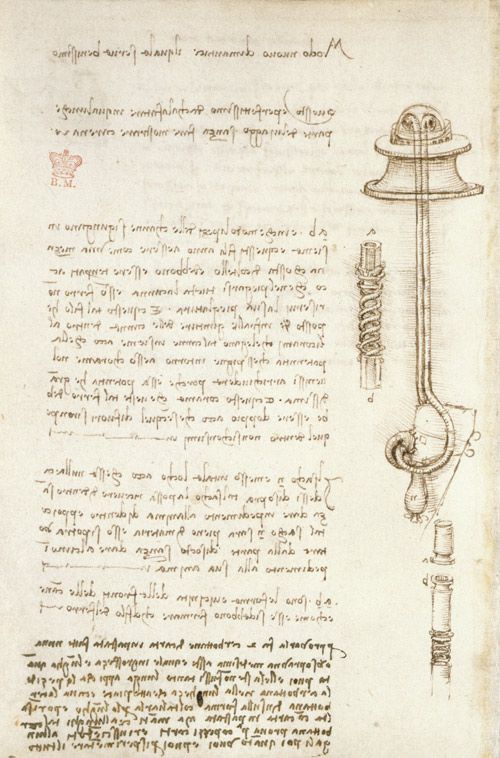
| Subjects | The movement, structure and optical properties of water; vortices, waves, waterfalls, springs and erosion; the origin of rivers; the luminosity of the moon and the ashen light of its dark limb; marine fossils on mountains and the formation of strata; the age of the earth; the blueness of the sky; hydraulic engineering, including a submarine and a snorkel.2451026 |
| Reading notes within the manuscript | Folio 14 verso carries a note to consult Theophrastus on the ebb and flow of the tide, and of eddies, and on water. Elsewhere Leonardo notes Alberti on ships and Frontinus on aqueducts. Folio 9 verso records the red marble of the Verona mountains full of petrified cockle shells.6 |
| Digitisation | Digitised after 1994. Pages were issued as screensavers in Microsoft Plus! for Windows 95 and later in Windows 98 and Windows ME, and a Corbis CD-ROM edition appeared in 1997. An interactive kiosk, the Codescope, accompanies exhibition loans.1 |
| Scholarly edition | Edited and translated into English by Carlo Pedretti at Armand Hammer's commission, completed 1987. The Christie's 1994 catalogue reproduces every page in facsimile with commentary drawn from Pedretti's edition, together with a census of Leonardo's manuscripts.18 |
Images
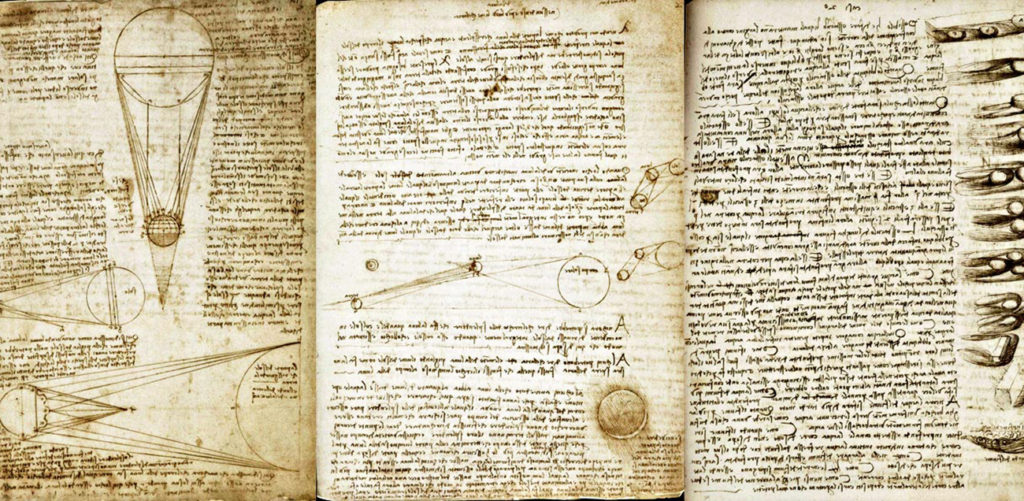
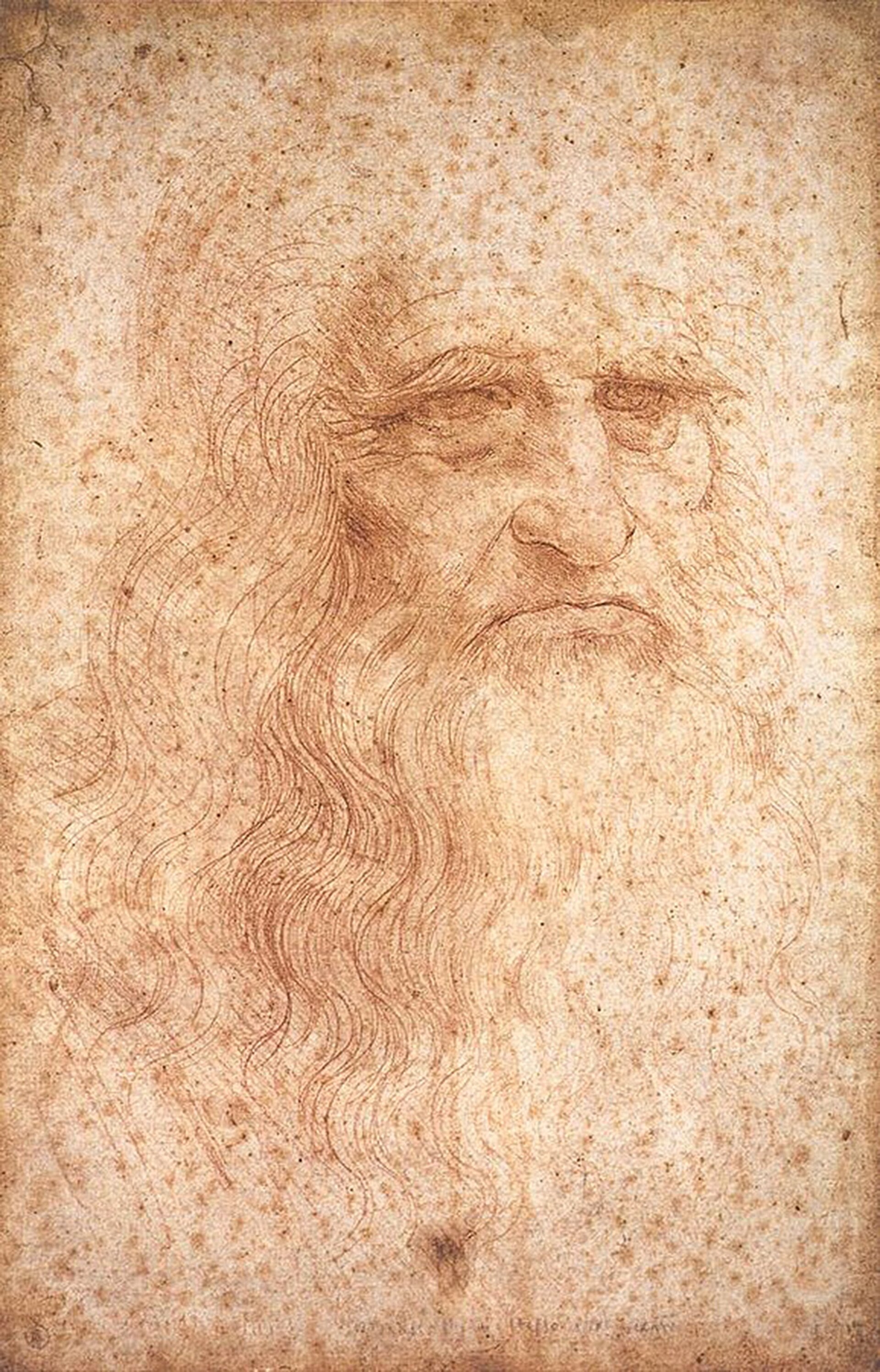
The record in full
Chapter 1It is eighteen sheets of paper and it has no binding
Eighteen sheets of rag paper. Each one folded once down the middle to make a bifolium, four writing surfaces per sheet, seventy-two pages in all.
Eighteen sheets of rag paper. Each one folded once down the middle to make a bifolium, four writing surfaces per sheet, seventy-two pages in all. Each page runs to roughly twenty-nine by twenty-two centimetres, about the size of a modern sheet of A4 turned slightly squarer. That is the whole physical object. It is smaller and thinner than almost anyone expects the most expensive manuscript in the world to be.
Leonardo filled the four sides of each folded sheet separately and gathered them afterwards. The Museo Galileo, which mounted the last full scholarly exhibition of it, states that the gathering into a booklet was probably not his own work. That matters, because it means the sequence in which the sheets now sit is not necessarily the sequence in which he thought.
Today the manuscript is unbound and the sheets are mounted individually between glass, which is how it travels and how it is shown. When the binding came off, and who took it off, is not established by anything read for this record. The Uffizi's own exhibition page describes it as bound in its original leather binding, which cannot be reconciled with the fact that the same exhibition displayed more than eighty separate original pages. That contradiction is left standing here rather than smoothed over, because it is the sort of thing a reader deserves to be told about rather than protected from.
Chapter 2A notebook about water that becomes a notebook about the world
The organising subject is water. Its structure, its vortices, the way it moves in rivers and around obstacles, the way it undermines banks and carries material and lays it down again, waves...
The organising subject is water. Its structure, its vortices, the way it moves in rivers and around obstacles, the way it undermines banks and carries material and lays it down again, waves, waterfalls, springs, the behaviour of drops and bubbles, and the engineering that follows from all of it. Galluzzi's title for the 2018 exhibition, Water as Microscope of Nature, is exactly right: water is the instrument, not the topic.
Because it is the instrument, the manuscript keeps opening outwards. Water carries Leonardo into geology, because rivers cut mountains and lay down the strata he can see in a cliff face. It carries him into palaeontology, because the shells are in the strata. It carries him into astronomy, because he thinks the moon is covered in water too. It carries him into anatomy, because the earth's water and the body's blood are, to him, the same problem.
That last move is not a modern reader's metaphor imposed on him. It is his own stated organising idea, written out in his own hand. The waters circulate with constant motion from the utmost depths of the sea to the highest summits of the mountains, not obeying the nature of heavy matter; and in this case it acts as does the blood of animals which is always moving from the sea of the heart and flows to the top of their heads, and, a few lines later, These waters traverse the body of the earth with infinite ramifications. Richter printed that passage from this manuscript in 1883. Leonardo had set the frame out at greater length two decades earlier in the Paris manuscript A: By the ancients man has been called the world in miniature; and certainly this name is well bestowed - bones for rocks, the ocean's six-hourly tide for the rising and falling of the lungs, veins for springs. The earth is a body. That is the premise the whole notebook runs on, and it is Aristotelian and scholastic natural philosophy put to work by a man who then goes out and checks it against a riverbank.
It is also, in the end, a premise he strains. The blood analogy was supposed to explain why springs rise on mountaintops, and Richter's own footnote to the earlier version records that Leonardo came to recognise the explanation as wrong. A reader looking for a fixed doctrine in this manuscript will not find one. What is in it is a man arguing with himself in writing.
Chapter 3The moon is a second earth
Leonardo rejected the received account of the moon, which held it to be a perfect, self-luminous crystalline body belonging to a different order of matter from the sublunary world.
Leonardo rejected the received account of the moon, which held it to be a perfect, self-luminous crystalline body belonging to a different order of matter from the sublunary world. His moon is made of the same four elements as the earth, arranged around the same centre of gravity, and it does not shine by itself. It shines because sunlight strikes vast oceans covering most of its surface, and the roughened, wind-driven water scatters that light in all directions. The dark patches are land standing above the water.
The moon is wrong, and it is wrong in an interesting way: he has reasoned from the behaviour of water, which he has actually observed, to the behaviour of a body he cannot reach. But it dissolves the boundary between the heavens and the earth a century before anyone had a telescope to do it with, and it removes the moon from the category of things that are perfect because they are heavenly. Nothing in the passage appeals to a scriptural or theological account of the sky. It is a physics argument about reflection.
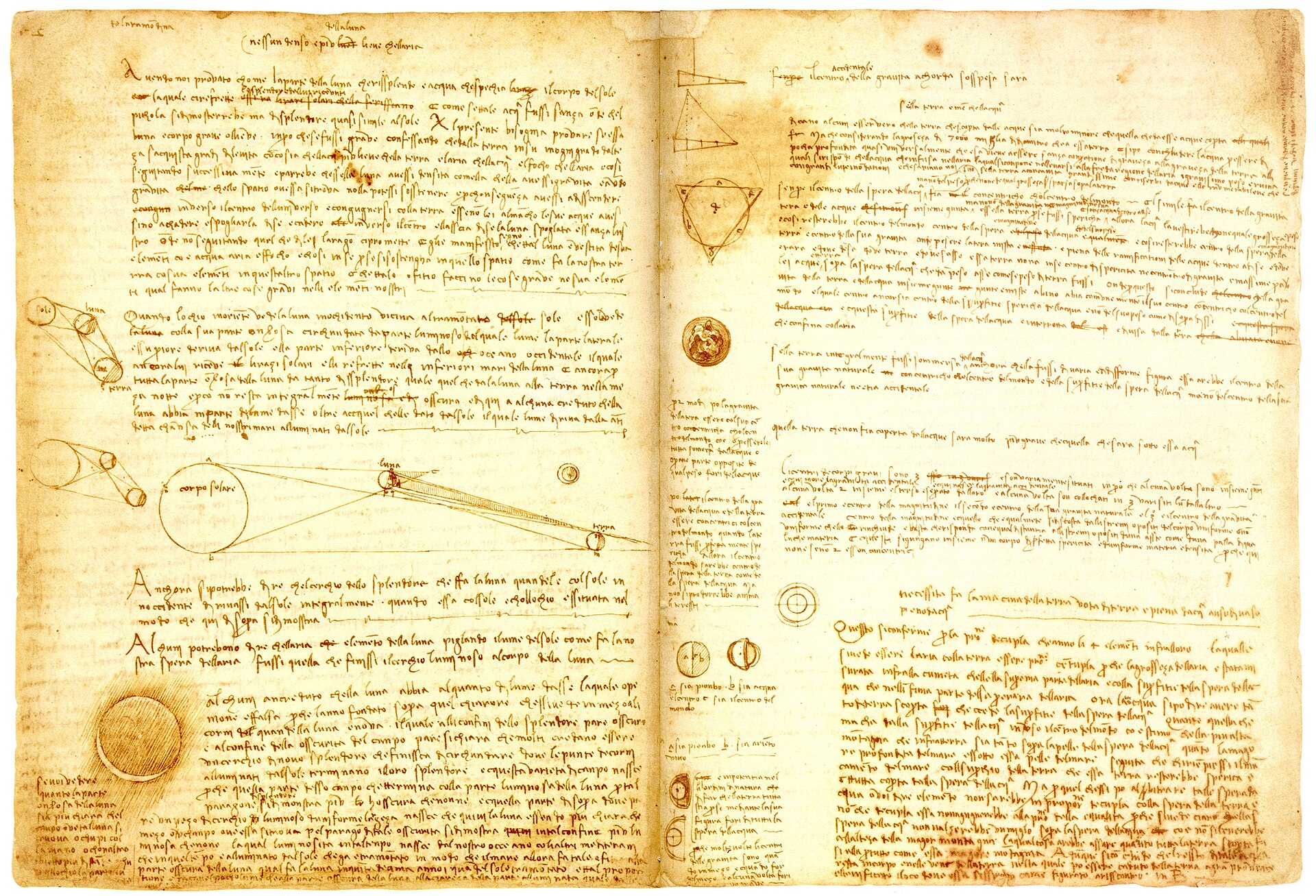
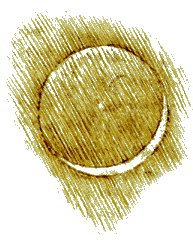
The famous part follows from it. When the moon is a thin crescent, the rest of the disc is faintly visible, a grey ghost inside the bright horn. This is the lumen cinereum, the ashen light, now called earthshine. Leonardo's explanation, in this manuscript, is that the earth is doing to the moon what the moon does to the earth: sunlight falls on the earth's oceans, reflects, crosses the gap and lights the moon's night side. He drew it.
Chapter 4What the earthshine claim is worth, exactly
This is where the popular literature gets loose, and it is worth being precise, because the precise version is more impressive than the loose one.Leonardo's is the earliest known written explanation...
This is where the popular literature gets loose, and it is worth being precise, because the precise version is more impressive than the loose one.
Leonardo's is the earliest known written explanation of earthshine as sunlight reflected from the earth. It was written around 1506 to 1508. It was also written in mirror script in a private notebook that nobody published, that passed to a Roman sculptor, then to a Roman painter, then to an English collector, and that sat in a Norfolk country house until the nineteenth century. Nobody read it. It had no effect on anybody.
The correct explanation entered print separately and independently. The Dictionary of Scientific Biography states flatly that earthshine was correctly explained for the first time in print by Michael Maestlin, the Tubingen astronomer who taught Kepler, and Kepler carried it forward. Maestlin lived from 1550 to 1631, so the gap is on the order of a century, which is the figure usually quoted; the specific publication and its date are not given in the source consulted here and are flagged for an editor.
So the honest formulation is this. Leonardo has priority in time and none in influence. He was first to see it and last to be heard. That is not a small claim, but it is a different claim from the one usually made, and the difference is precisely the kind of thing a manuscript record exists to hold.
Chapter 5The shells did not walk up the mountain in forty days
The most consequential pages in the manuscript are about cockle shells.Fossil marine shells were being found high in the Italian mountains, hundreds of miles from any sea.
The most consequential pages in the manuscript are about cockle shells.
Fossil marine shells were being found high in the Italian mountains, hundreds of miles from any sea. The received explanation was the Flood: the waters of Genesis rose over the highest mountains, carried the shells up, and left them there when they receded. Leonardo takes that explanation apart line by line, and he does it without hedging.
He opens by naming the problem as a problem. Here a doubt arises, and that is: whether the deluge, which happened at the time of Noah, was universal or not. And it would seem not, for the reasons now to be given: We have it in the Bible that this deluge lasted 40 days and 40 nights of incessant and universal rain, and that this rain rose to ten cubits above the highest mountains in the world. He then points out that on a spherical earth a universal covering of water has nowhere to drain to, since water only moves downhill and there is no downhill left. Here, then, natural reasons are wanting; hence to remove this doubt it is necessary to call in a miracle to aid us, or else to say that all this water was evaporated by the heat of the sun. That sentence is the hinge of the whole argument. He is saying that the account requires a miracle, and that invoking one is an admission of defeat.
Then he goes at the shells directly, and the argument turns zoological. Cockles are alive; they move; they move slowly. The cockle is an animal of not more rapid movement than the snail is out of water, or even somewhat slower ... it will travel each day from 3 to 4 braccia; therefore this creature, with so slow a motion, could not have travelled from the Adriatic sea as far as Monferrato in Lombardy, which is 250 miles distance, in 40 days. If the waves carried them instead, dead and empty, they would be jumbled; instead they are found sorted, paired, in ordered layers, with living pairs in one bed and separated dead valves in another. Sorted layers are the signature of repeated deposition over long time, not of one flood over forty days.
He records the field evidence with the specificity of a man who has been to the sites: the cutting at Colle Gonzoli where the Arno is eating the base of the section and the shell beds show plainly in blue clay; the conglomerate at Monte Lupo below Vinci, the village he came from; the red marble of the Verona mountains full of petrified cockles, on folio 9 verso of this manuscript. And he states the epistemological principle underneath it: Since things are much more ancient than letters, it is no marvel if, in our day, no records exist of these seas having covered so many countries ... But sufficient for us is the testimony of things created in the salt waters, and found again in high mountains far from the seas.
Things are older than writing. The rock is a better witness than the text. That is a direct collision with scriptural natural history, written by a man in Catholic Italy in about 1506, and it is the reason this notebook matters to the history of science and not only to the history of the market. Richter, publishing the passages in 1883, noted that they had until then remained unknown.
Chapter 6Backwards, in rude characters, and with the left hand
The mirror writing is the single most mythologised thing about Leonardo, and there is no mystery in it.The oldest explanation is also the correct one and it was published within a generation of his...
The mirror writing is the single most mythologised thing about Leonardo, and there is no mystery in it.
The oldest explanation is also the correct one and it was published within a generation of his death. Vasari wrote that he wrote backwards, in rude characters, and with the left hand, so that any one who is not practised in reading them, cannot understand them. Leonardo was left-handed. A left-handed writer pushing a quill loaded with wet ink from left to right drags a hand through what has just been written. Reversing the direction removes the problem, and it removes it completely.
Two further facts finish the argument. First, mirror script is not a cipher: it requires no key, it is legible to anyone who persists, and Richter, who transcribed thousands of pages of it, remarked that after a little practice he read it directly and found holding a mirror up too tiresome to bother with. Second, Leonardo wrote conventionally left to right when a document was meant for someone else. A man protecting secrets does not adopt a code that a mirror defeats and then abandon it whenever anyone else is going to read the page.
The real obstacles to reading him have nothing to do with direction. He amalgamated short words into long ones and split long words in two arbitrarily; he used no punctuation and no accents; his orthography is his own. That is why his notebooks stayed effectively unread for three hundred and fifty years, and it is a far better reason than conspiracy.
Chapter 7What was actually on his shelf
Leonardo's library is documented, which is unusual and extremely useful, because it settles a large number of arguments about what tradition he was working in.The fullest record is an inventory in...
Leonardo's library is documented, which is unusual and extremely useful, because it settles a large number of arguments about what tradition he was working in.
The fullest record is an inventory in his own hand in Madrid manuscript II, folios 2 verso to 3 verso, listing 116 volumes he owned around 1503, headed with the note to himself to remember the books he keeps locked in the chest. That is a year or so before he began this manuscript. The Museo Galileo puts his collection at over 150 volumes across printed books and manuscripts, grouped as the arts, the mathematical sciences, and the knowledge of nature.
An earlier and shorter list survives in the Codex Atlanticus, studied by the Marchese Girolamo d'Adda in 1873 and printed by Richter. It reads like the working shelf of an ambitious, self-taught, vernacular-reading craftsman, which is what Leonardo was: an arithmetic for merchants, the Fiore di virtu, Pliny's Natural History in Landino's Italian, Diogenes Laertius on the lives of the philosophers, the Bible in Malermi's Italian translation, a lapidary, a book on warfare, the letters of Filelfo, decades of Livy, a health manual, Cecco d'Ascoli, Albertus Magnus, a rhetoric, Crescenzi on agriculture, Aesop, Donatus, the Psalms, Justinus, Petrarch, Burchiello's sonnets, Pulci's Morgante, the travels of Mandeville, Platina on honest eating.
Two observations follow. The first is that the list is overwhelmingly in Italian rather than Latin. Leonardo called himself an unlettered man and meant it technically: he had no university Latin, and he read what had been translated. The second is what the list does not contain. There is no Hermetic corpus, no Kabbalistic text, no book of practical alchemy, nothing that would place him in the tradition popular writing keeps assigning him to. One entry, on the immortality of the soul, was identified by d'Adda as possibly Ficino's Theologia platonica or an Italian version of it, which would be the only Neoplatonic item in the list; that identification is d'Adda's inference from a two-word entry, and should be treated as an argued reading rather than a fact.
This manuscript carries its own reading notes, which is better evidence still, because they are contemporaneous with the text around them. On folio 14 verso Leonardo reminds himself to consult Theophrastus on the ebb and flow of the tide, and of eddies, and on water. Elsewhere he notes Alberti on ships and Frontinus on aqueducts. Theophrastus, Alberti, Frontinus: a Greek natural philosopher, a Florentine architect and a Roman water engineer. That is the company this notebook was written in.
Chapter 8The dating problem, and how a Roman engineer created it
The Museo Galileo and the Uffizi date the bulk of the manuscript to 1504-1508.
The Museo Galileo and the Uffizi date the bulk of the manuscript to 1504-1508. The Wikipedia article gives 1506-1510 and 1510-1512. Richter, in 1883, thought it was written about 1510 or later.
Richter had a reason, and it was the Frontinus note. The first printed edition of Frontinus De aquaeductibus appeared in Florence in 1513, and Richter took Leonardo's reminder to consult it as evidence that the manuscript could not be earlier. The argument only holds if Leonardo was thinking of a printed edition, which he need not have been; manuscript copies of Frontinus circulated, and Leonardo's notes are full of books he intended to borrow from named individuals rather than buy.
The dating is therefore not closed. It is worth stating plainly rather than quietly averaging, because the range 1504 to 1513 spans the difference between a manuscript begun in Florence during the Arno canal years and one finished in Milan or Rome at the end of his working life.
Chapter 9Rome, a chest, and a painter with an eye for paper
After 1519 the manuscript vanishes for roughly two decades and then surfaces in Rome.
After 1519 the manuscript vanishes for roughly two decades and then surfaces in Rome. The Museo Galileo places it with the sculptor Guglielmo della Porta, a pupil of Michelangelo, around 1537, and with the painter Giuseppe Ghezzi by 1689. Those are the two fixed points. Everything between them is inference.
The story attached to the gap is that the sheets sat unrecognised among della Porta family papers for a century and that Ghezzi found them in a chest in 1690. It is a good story and it may be true. It is also exactly the shape of story that gets invented afterwards to fill a silence, and no document supporting the chest has been produced in anything read for this record. It is recorded here as tradition and graded accordingly.
Ghezzi himself is not tradition. He was secretary of the Accademia di San Luca, a working painter and a dealer, and the kind of Roman figure through whom loose old master material moved. Whether or not he opened a chest, he is the man who put the manuscript back into circulation, and he held it for something like thirty years.
Chapter 10The Grand Tour purchase that gave it a name
Thomas Coke bought it in Italy in 1717, aged about twenty, on the Grand Tour that also furnished the house he had not yet built.
Thomas Coke bought it in Italy in 1717, aged about twenty, on the Grand Tour that also furnished the house he had not yet built. He would become the 1st Earl of Leicester and the builder of Holkham Hall in Norfolk. Christie's 1994 catalogue and the Museo Galileo both give 1717; Wikipedia gives 1719, which is the date most popular accounts repeat. The manuscript carries the name of a title Coke did not hold until 1744, awarded for a purchase made when he was still plain Thomas Coke.
He took it to Florence and had a copy made, and that copy is the beginning of the manuscript's European life. Copies travelled where the original did not. One reached the Grand-Ducal Library at Weimar around 1818 on Goethe's recommendation. Jerome Lalande wrote about it in 1769. English scientists were shown the original in Coke's London house between 1719 and 1759. For two hundred and twenty-one years it stayed with the family, and when Richter came to prepare the first substantial edition of Leonardo's writings in the 1880s he thanked the Earl of Leicester and Mr Napier, the librarian at Holkham, for the access that let him print the deluge passages for the first time.
Chapter 1112 December 1980: the day a notebook got a price
Christie's sold it in London on 12 December 1980 for the Trustees of the Holkham Estate.
Christie's sold it in London on 12 December 1980 for the Trustees of the Holkham Estate. Contemporary American reporting says Lord Coke was selling to meet inheritance tax on the estate and its collection, which is the usual reason English country houses put their best object in a saleroom.
Bidding opened at about USD 1.4 million and lasted under two minutes. Armand Hammer, then eighty-two and president of Occidental Petroleum, bid against at least two or three others and won. The price broke the record for any manuscript: a Gutenberg Bible had made USD 2 million in 1978.
What the price actually was takes a paragraph, and the paragraph is the point of this record. The number everyone quotes is USD 5,126,000, and almost nobody says whether it includes the buyer's premium. It does not. Reconstructed from the reported sterling figures, the hammer was GBP 2,200,000 and the premium-inclusive total GBP 2,420,000; USD 5,126,000 is the hammer converted at the December 1980 rate of about 2.33 dollars to the pound, and the USD 5.6 million that the Associated Press cited in 1994 as Hammer's price is the same sale with the fees left in. The Art Newspaper's 1994 statement that Hammer paid GBP 2 million excluding premium is the one figure that does not fit and is flagged for checking.
The Spectator reported in September 1994 that the codex had been bought with USD 5 million of Occidental Petroleum's money rather than Hammer's own, and that the discovery produced shareholder litigation over the use of corporate assets. That report could not be retrieved in full for this record and is entered as reported rather than verified, but if it stands it changes the character of the 1980 purchase considerably: not a collector buying a manuscript, but a chief executive buying one with the company's money.
Chapter 12The export licence, and the eight days at the Corcoran
An object of this quality leaving Britain engages the export licensing system, and in January 1981 the matter was still open.
An object of this quality leaving Britain engages the export licensing system, and in January 1981 the matter was still open. The New York Times, reporting the manuscript's appearance at the Corcoran Gallery in Washington during the inaugural festivities that month, wrote that after its eight-day showing it would return to London pending the issue of a definitive export licence, and that Hammer intended it to be shown widely.
So the codex crossed the Atlantic in January 1981 on a temporary basis, with the permanent question unresolved, and went back. It plainly left Britain for good at some point thereafter, since it was in Florence by 1982 and in Los Angeles by the end of the decade, but the resolution itself - whether the licence was deferred to allow a British institution to match the price, whether any institution tried, and on what date the licence was finally granted - is not established by anything read for this record. Claims circulating online that a licence was granted after deliberation trace to an AI-generated encyclopaedia entry and are not used here. This is a real gap and it is left open.
The 1994 sale raised no comparable question. The manuscript was American property, consigned by an American museum, sold in New York, and bought by an American.
Chapter 13Codex Hammer: a renaming, an edition, and a museum in trouble
Hammer renamed it after himself immediately, and for fourteen years the most important scientific manuscript in private hands carried the name of an oil executive rather than of the Norfolk earl who...
Hammer renamed it after himself immediately, and for fourteen years the most important scientific manuscript in private hands carried the name of an oil executive rather than of the Norfolk earl who had bought it on the Grand Tour. He also did something more durable: he commissioned Carlo Pedretti, the leading Leonardo manuscript scholar of the period, to edit and translate the whole of it. Pedretti worked for seven years and finished in 1987. That edition is the reason the Christie's 1994 catalogue could print a facsimile of every page with a commentary attached.
The manuscript went on show. Florence saw it at the Palazzo Vecchio in 1982, where the Uffizi records more than four hundred thousand visitors in three months.
Then Hammer died in 1990 and his affairs came apart. His museum's title to its collection was challenged by Joan Weiss, the niece and sole heir of his late wife Frances, who sought a share of the collection's appraised value; about half the collection went into escrow pending settlement. The Art Newspaper reported in June 1994 that the museum was selling the codex to cover the potential legal costs, and quoted the new director Henry Hopkins calling it more a scientific item and not necessarily an art object, which is how a museum explains selling its most famous possession. The piece speculated that the Getty might buy it and that it would become the Codex Getty.
Chapter 1411 November 1994: two minutes and forty seconds
Christie's New York estimated it at USD 10 to 15 million.
Christie's New York estimated it at USD 10 to 15 million. The catalogue was a 203-page volume devoted entirely to the manuscript, with a facsimile of every page, Pedretti's commentary, and a census of Leonardo's manuscripts.
The bidding lasted two minutes and forty seconds. The winner bid by telephone through a representative and was anonymous in the room. The underbidder was the Cariplo Foundation of Milan, backed by one of Italy's largest banks: an Italian institution trying to bring a Leonardo notebook home, and failing by one bid. Christopher Burge, Christie's America's chairman, called it an extraordinary moment in auction history and the highest price ever paid for a manuscript.
The price was USD 30,802,500. It is premium-inclusive. It cannot be a hammer figure, because hammer figures land on round increments and this one does not; a hammer of USD 28 million with the tiered premium the New York rooms were then charging produces it to the dollar. The writer could not obtain Christie's published 1994 rate card, so the USD 28 million is a reconstruction and is labelled as one throughout this record. What is not a reconstruction, and what almost every account since has got wrong by omission, is that the famous number includes the fees. Guinness recorded the sterling equivalent of the day as GBP 19,246,489.
Bill Gates, then thirty-nine, was named as the buyer on 12 November. Within days he had said he would show the manuscript publicly about half the time, and by 16 November it was reported that he intended to lend it to the Italian institution he had outbid. In 1996 the New York Times, writing about a New York showing, recorded that when he bought it he had promised to lend it to museums. So the lending is real and documented, and it was an undertaking he gave rather than a condition Christie's imposed: nothing in the sources consulted indicates that the sale carried any legal obligation to display it. He restored the name Codex Leicester.
Chapter 15The record, and what the record actually is
The Codex Leicester is routinely described as the most expensive book or manuscript ever sold.
The Codex Leicester is routinely described as the most expensive book or manuscript ever sold. It has not been, unqualified, since 2021.
In November 2021 Sotheby's sold a first printing of the United States Constitution for USD 43.2 million, the highest price for any book, manuscript or printed text at auction, after a bidding contest between Ken Griffin and a crowdfunded group. In May 2023 Sotheby's sold the Codex Sassoon, the oldest near-complete Hebrew Bible, on a hammer of USD 33.5 million for a premium-inclusive USD 38.1 million.
Compare like with like and the picture is clean. Leicester 1994: USD 30,802,500 with premium. Sassoon 2023: USD 38.1 million with premium, USD 33.5 million hammer. On either basis Sassoon is the larger number, and on the same basis so is the Constitution. In money of the day, the Leicester's record for a manuscript stood for twenty-eight years and then fell.
Two qualifications survive, and both are real. The first is inflation: USD 30.8 million in 1994 is on the order of USD 65 million in the 2020s, which is comfortably above both later sales, and any claim that Leicester remains the most expensive in real terms should say so explicitly rather than let the reader assume nominal figures. The second is category. The Constitution is a printed document, not a manuscript. Among manuscripts in the strict sense, the Leicester's record fell to Sassoon in 2023 and to nothing before it.
The claim that does survive without qualification has nothing to do with price at all, and it is stated on the front of the Christie's 1994 catalogue: this is the only one of Leonardo's scientific notebooks in private hands.
Chapter 16The only one that can be bought
Leonardo's surviving notebooks are otherwise institutional property, and have been for a long time.
Leonardo's surviving notebooks are otherwise institutional property, and have been for a long time. The Codex Atlanticus, the largest of them at twelve bound volumes, is in the Biblioteca Ambrosiana in Milan. The Codex Arundel is Arundel MS 263 in the British Library. The Codex Trivulzianus is in the Castello Sforzesco in Milan. The two Madrid codices, lost for centuries and rediscovered in the Biblioteca Nacional de Espana in 1965, are Spanish state property; Madrid II carries the inventory of his own library. The three Forster notebooks are in the Victoria and Albert Museum. The Codice sul volo degli uccelli is in the Biblioteca Reale in Turin. Manuscripts A to M are in the Institut de France in Paris, and the great mass of the drawings is in the Royal Collection at Windsor.
None of those will ever come to auction. That is the whole of the Leicester's market position: it is the only unit of the world's supply that is transferable, and it has changed hands twice in a hundred years. A price set on the only sellable example of something is not a valuation of the category. It is a valuation of the exception.
Chapter 17What he is said to have believed, and what he wrote down
No figure in the history of art attracts more invented doctrine than Leonardo, and a record of this manuscript is the right place to say what the documents show, because the documents are unusually...
No figure in the history of art attracts more invented doctrine than Leonardo, and a record of this manuscript is the right place to say what the documents show, because the documents are unusually good.
The most persistent claim, that Leonardo was the twelfth Grand Master of a secret order called the Priory of Sion from 1510 to 1519, is a proven fabrication and its author confessed. The Priory was founded as an ordinary French association at Annemasse on 7 May 1956 by Pierre Plantard and Andre Bonhomme. Between 1965 and 1967 Plantard and Philippe de Cherisey planted forged documents, the Dossiers Secrets, in the Bibliotheque nationale in Paris; the grand master list, including Leonardo, was among them. In September 1993 a French investigating judge searched Plantard's home in an unrelated inquiry, found a hoard of forgeries including papers declaring Plantard the rightful king of France, and Plantard admitted under oath that he had made all of it up. The dates the forgery assigns to Leonardo, 1510 to 1519, are the years in which this manuscript was being completed and kept. Nothing whatever connects them.
On the other charges Leonardo is his own best witness, because he wrote about them at length and with contempt. On necromancy: Of all human opinions that is to be reputed the most foolish which deals with the belief in Necromancy, and he then spends two pages demonstrating that if it worked its practitioners would rule the world, and since they do not, it does not. On the alchemists: The false interpreters of nature declare that quicksilver is the common seed of every metal, not remembering that nature varies the seed according to the variety of the things she desires to produce in the world, and, flatly, many have made a trade of delusions and false miracles, deceiving the stupid multitude. On authority in general he told himself to trust only those who had exercised their wits on the effects of experience rather than on the signs of nature, and he had a settled loathing of abbreviators, of people who summarise what they have not understood.
That is the mind that wrote this manuscript, and the manuscript is consistent with it from end to end. It contains a physical explanation of a lunar phenomenon that displaces a theological one, and a geological argument that requires the Flood either to be non-universal or to be a miracle. It contains no cipher, no allegory and no hidden doctrine. A man who thinks the rock is a better witness than the text is not the author of a secret system. The absence of one here is a finding, and it is a more interesting finding than any of the things that have been made up to replace it.
Chapter 18Where it is now, and how anybody sees it
The manuscript belongs to Bill Gates and lives in the United States.
The manuscript belongs to Bill Gates and lives in the United States. He had it digitised soon after buying it; pages appeared as screensavers in Microsoft Plus! for Windows 95 and later in Windows 98 and Windows ME, and Corbis issued a CD-ROM edition in 1997. He commissioned the Codescope, a touchscreen kiosk that lets a visitor at an exhibition read a page in mirror and in translation while looking at the sheet itself.
It tours. Sydney in 2000, Chambord in 2004, Tokyo in 2005, Dublin in 2007, a single sheet in Seattle in 2006, the American tour of 2015 and 2015-16 that took it to Phoenix, Minneapolis and Raleigh under the title Leonardo da Vinci's Codex Leicester and the Power of Observation, and the Uffizi in Florence from 30 October 2018 to 20 January 2019, curated by Paolo Galluzzi, where more than eighty original pages were shown alongside the Codice sul volo degli uccelli.
One caution for anyone matching photographs to this record. Facsimiles of the Codex Leicester exist, are exhibited, and photograph identically to the original at anything short of raking light. The British Library's own 2019 exhibition Leonardo da Vinci: A Mind in Motion used facsimile sheets of both the Leicester and the Forster notebooks, and said so in the notes to its curator films. A page of mirror script with a marginal diagram is not, on its face, evidence of anything.
The artist
Leonardo di ser Piero da Vinci
Leonardo left about a dozen and a half paintings and several thousand pages of writing, and the writing is the larger achievement by volume by an enormous margin. He is the rare case of an artist whose intellectual life can be reconstructed from primary evidence rather than inferred: his library is inventoried in his own hand, his opinions on the questions of his day are written out at length, and his working method is visible page by page. The dossier below uses that evidence and nothing else, which means it is shorter and flatter than the popular account and considerably more reliable.
Exhibited
- 1981Codex Leicester, eight-day showingCorcoran Gallery of Art, Washington DC
- 1982Codex HammerPalazzo Vecchio, Florence
- 2015Leonardo da Vinci's Codex Leicester and the Power of ObservationPhoenix Art Museum; Minneapolis Institute of Arts; North Carolina Museum of Art
- 2018Water as Microscope of Nature. Leonardo da Vinci's Codex LeicesterGalleria degli Uffizi, Aula Magliabechiana, Florence
Literature
- Carlo Pedretti, The Codex Hammer of Leonardo da Vinci, translated into English and annotated (1987) The scholarly edition, commissioned by Armand Hammer and completed after seven years' work. The Christie's 1994 catalogue commentary is drawn from it. Not consulted directly for this record.
- Paolo Galluzzi (ed.), Leonardo da Vinci's Codex Leicester. Water as Microscope of Nature (2018) Exhibition catalogue, Giunti, for the Uffizi exhibition of 2018-19. The current standard treatment. Only the associated online exhibition was consulted for this record.
- Jean Paul Richter, The Literary Works of Leonardo da Vinci (1883) The first substantial edition of the writings, and the first printing of the Codex Leicester deluge and fossil passages, made from the manuscript then at Holkham Hall.
- Andrea Baucon, Leonardo da Vinci, the Founding Father of Ichnology, PALAIOS 25, 361-373 (2010) On the Codex Leicester's trace-fossil observations. Only the abstract was consulted.
- Complete Dictionary of Scientific Biography, Maestlin, Michael States that earthshine was correctly explained for the first time in print by Maestlin, and points to Edward Rosen, Kepler's Conversation, 117-119 and 157, for the passage in English.
- The British Library, Leonardo da Vinci: A Mind in Motion, exhibition, 7 June to 8 September 2019 The exhibition in which facsimile sheets of the Codex Leicester and the Forster notebooks were shown, disclosed in the library's own film notes.
Related works
| Work | Relation | Where it is |
|---|---|---|
| Codex Atlanticus Leonardo da Vinci | The largest of the surviving notebooks; institutional, and never saleable Twelve bound volumes. Contains the earlier of Leonardo's two surviving book lists, published by Girolamo d'Adda in 1873 and printed by Richter. | Veneranda Biblioteca Ambrosiana, Milan |
| Codex Arundel (Arundel MS 263) Leonardo da Vinci | Comparable compilation of scientific notes; the nearest thing to the Leicester in a public collection Notes dating mostly from between 1480 and 1518. Folio 104 recto carries sketches of the earth and moon, the same problem the Leicester works on. | British Library, London |
| Codex Trivulzianus Leonardo da Vinci | Early notebook; municipal property Originally 62 sheets, of which 55 survive. | Castello Sforzesco, Milan |
| Madrid Codices I and II Leonardo da Vinci | Lost for centuries and rediscovered in 1965; Madrid II carries the inventory of his own library Madrid I is a treatise on mechanics and statics; Madrid II covers fortification, statics and geometry. Folios 2v-3v of Madrid II list 116 books Leonardo owned around 1503. | Biblioteca Nacional de Espana, Madrid |
| Forster Codices I, II and III Leonardo da Vinci | Three pocket notebooks; museum property Shown in facsimile alongside facsimile Leicester sheets in the British Library's 2019 exhibition. | Victoria and Albert Museum, London |
| Codice sul volo degli uccelli Leonardo da Vinci | Contemporary with the Leicester and shown beside it at the Uffizi in 2018 c. 1506, pen and ink, 210 x 150 mm. | Biblioteca Reale, Turin |
| Manuscripts A to M Leonardo da Vinci | The Paris notebooks; state property Manuscript A, roughly twenty years earlier than the Leicester, contains the fullest statement of the earth-as-body analogy that the Leicester carries forward. | Institut de France, Paris |
| Codex Sassoon Unknown scribe, Levant, c. 900 | The sale that took the manuscript record away from the Leicester Sotheby's New York, 17 May 2023. Hammer USD 33.5 million; USD 38.1 million with premium. Bought by Alfred H. Moses for the American Friends of ANU and given to the museum. | ANU Museum of the Jewish People, Tel Aviv |
| The Constitution of the United States, first printing, 1787 Printed for the Continental Congress | The sale that took the book and printed-text record away from the Leicester Sotheby's New York, 18 November 2021, USD 43.2 million, bought by Ken Griffin against a crowdfunded group. A printed document, not a manuscript, which is why the two records are not the same record. | Private collection |
Open questions
- When was the binding removed and by whom? Every account agrees the manuscript is now shown as loose sheets between glass, and none consulted names the conservator or the date. The Uffizi's own page says it retains its original leather binding, which cannot be right as stated.
- 1717 or 1719? Christie's 1994 catalogue and the Museo Galileo give 1717 for Thomas Coke's purchase; Wikipedia and most popular accounts give 1719. The two are not reconciled anywhere consulted.
- What is the documentary basis for the della Porta ownership around 1537? The Museo Galileo asserts it; the underlying record is not cited, and the chest in which Ghezzi is said to have found the sheets in 1690 rests on no document located for this record.
- What was the hammer price in 1994? USD 30,802,500 is premium-inclusive, and a USD 28 million hammer reproduces it exactly under the tiered premium then usual in New York, but Christie's published 1994 rate card was not obtained and the hammer is not stated in any source consulted.
- Which is right about 1980: The Art Newspaper's GBP 2 million excluding premium, or the GBP 2.42 million total that the dealer description of the Christie's catalogue gives and that the dollar figures support?
- What was the lot number in 1994? The task brief gives lot 9; the Christie's online lot record shows 1; the catalogue is devoted entirely to this manuscript, which suggests a single-lot sale.
- How was the British export licence resolved after January 1981? The New York Times recorded that the codex would return to London pending a definitive licence. Whether the case was deferred to let a British institution match the price, whether any tried, and when the licence issued, is not established.
- Was the Codex Hammer bought in 1980 with Occidental Petroleum's money rather than Armand Hammer's own, and did that produce shareholder litigation? Reported by The Spectator in September 1994; the full text could not be retrieved for this record.
- When exactly did the correct explanation of earthshine first reach print? The Dictionary of Scientific Biography credits Michael Maestlin without giving the work or the date, and the widely repeated interval of about a century between Leonardo and publication rests on that unstated date.
- Is the dating of the manuscript 1504-1508, 1506-1510, or later? Richter's argument for 1510 or later turns on a note referring to Frontinus, first printed in Florence in 1513, and holds only if Leonardo meant a printed copy.
- Did Giuseppe Ghezzi add a calligraphic title page to the manuscript? The claim circulates but no source examined for this record establishes it.
Questions about this object
What is Codex Leicester?
Codex Leicester is a manuscript, dated c. 1504-1508. Medium: Pen and ink on rag paper.
Who made Codex Leicester, and is the attribution settled?
The attribution to Leonardo da Vinci is recorded here as accepted. Autograph throughout. The manuscript is written in Leonardo's own hand in his mirror script, right to left, and has never been seriously contested. Unlike his paintings, which are argued over one by one, his notebooks carry their authorship in the handwriting itself: the script is unmistakable, the orthography idiosyncratic, and the manuscript has an unbroken institutional and private ownership record from the early eighteenth century. Note that this security applies to the original only. Facsimiles of the Codex Leicester exist and are exhibited; the British Library used facsimile sheets of it in its own 2019 Leonardo exhibition and said so in its published film notes.
Where is Codex Leicester now?
Private collection, United States. Owned by Bill Gates since 1994. Last confirmed 2 August 2026. Purchased at Christie's New York, 11 November 1994. Lent regularly for exhibition; the last loan recorded in the sources consulted is the Uffizi Galleries, Florence, 30 October 2018 to 20 January 2019.
What has Codex Leicester sold for?
Hammer GBP 2,200,000 (reconstructed); with premium, GBP 2,420,000. Christie's, London, 1980-12-12.
What is still unknown about Codex Leicester?
When was the binding removed and by whom? Every account agrees the manuscript is now shown as loose sheets between glass, and none consulted names the conservator or the date. The Uffizi's own page says it retains its original leather binding, which cannot be right as stated.
Sources
- 1Wikipedia, 'Codex Leicester'. Tertiary; used for the physical description, watermarks, sale figures, digitisation and exhibition list. Flagged for replacement with the Christie's 1994 catalogue and Pedretti's 1987 edition. en.wikipedia.org/wiki/...
- 2Museo Galileo, 'Water as Microscope of Nature. Leonardo da Vinci's Codex Leicester', online exhibition, Introduction and Codex sections; curated by Paolo Galluzzi for the Uffizi, 2018. mostre.museogalileo.it/codiceleicester/...
- 3Museo Galileo, 'The European circulation of the Codex Leicester', in the same online exhibition. The provenance timeline from della Porta to Weimar. mostre.museogalileo.it/codiceleicester/...
- 4Museo Galileo, 'The Moon: a second Earth', in the same online exhibition. Leonardo's rejection of the crystalline self-luminous moon and his account of lunar oceans. mostre.museogalileo.it/codiceleicester/...
- 5Gallerie degli Uffizi, exhibition record for 'Water as Microscope of Nature. Leonardo da Vinci's Codex Leicester', Aula Magliabechiana, 30 October 2018 to 20 January 2019. uffizi.it/en/...
- 6Jean Paul Richter, The Notebooks of Leonardo da Vinci, 1883, Project Gutenberg ebook 5000. Used for the Codex Leicester deluge and fossil passages (nos. 984-987), the Verona marble note (Leic. 9b, no. 1061), the Theophrastus reading note (Leic. 14b, no. 1499), the Frontinus dating argument (no. 1472), the earth-as-body passages (nos. 929, 963, 967-970), the passages against necromancy and alchemy (nos. 1207, 1208, 1213), the passage against abbreviators (no. 1210), the Codex Atlanticus book list (no. 1469), Vasari on the mirror writing, and Richter's own remarks on reading it. gutenberg.org/cache/...
- 7The Art Newspaper, 'Leonardo codex on the market', 1 June 1994. Hammer's 1980 price given as GBP 2 million excluding premium; the Weiss lawsuit and the museum's reason for selling. theartnewspaper.com/1994/...
- 8Robin Halwas Ltd, bookseller's description of Christie, Manson and Woods, The Leonardo da Vinci Codex Hammer, the property of the Armand Hammer Museum of Art and Cultural Center, sale catalogue, New York, 11 November 1994. Gives Coke's 1717 acquisition, the GBP 2.42 million 1980 price, the 203-page catalogue with a census of the manuscripts, and the statement that this is the only Leonardo notebook in private hands. robinhalwas.com/002865-leonardo-da-vinci-codex-hammer-the...
- 9History.com, 'Da Vinci notebook sells for over $5M', on the sale of 12 December 1980. The USD 5,126,000 figure, the opening bid of USD 1.4 million, the two-minute bidding, the two or three rival bidders, and the Gutenberg comparison. history.com/this-day-in-history/...
- 10Deseret News (Associated Press), 'Bidder Reflects on Mirror Script, Pays $30.8 Million for Da Vinci Notes', 12 November 1994. The USD 10-15 million estimate, Christopher Burge's statement, Hammer's 1980 price given as USD 5.6 million, and the contents summary. deseret.com/1994/...
- 11The Seattle Times, '$30.8 Million Gets Gates Closer Look At Da Vinci', 13 November 1994. Gates's undertaking to show the manuscript publicly about half the time, and the identification of the Cariplo Foundation of Milan as underbidder. archive.seattletimes.com/archive/...
- 12Los Angeles Times, 'Microsoft's Gates Revealed as Leonardo's Mystery Buyer', 13 November 1994, and 'Leonardo Work Fetches Record $30.8 Million', 12 November 1994. The underbidder and the two minutes forty seconds of bidding. latimes.com/archives/...
- 13Orlando Sentinel, 'Gates Set to Lend Da Vinci to Loser of Bidding Battle', 16 November 1994. Gates's plan to lend the manuscript to the Italian institution he outbid. Retrieved as an index record only; the article body is region-blocked and is flagged for verification. orlandosentinel.com/1994/...
- 14The New York Times, 'Codex Leicester Adds to the Inaugural Luster', 18 January 1981. The Corcoran showing and the return to London pending a definitive export licence. Retrieved as an index record with quoted text; the full article is behind a paywall and is flagged for verification. nytimes.com/1981/...
- 15The New York Times, 'A New York Stop for Leonardo's $30.8 Million Notebook', 14 May 1996. Records that Gates promised at the time of purchase to lend the manuscript to museums. Retrieved as an index record with quoted text; flagged for verification. nytimes.com/1996/...
- 16Guinness World Records, 'Most expensive manuscript that is illustrated'. Gives USD 30,802,500 and GBP 19,246,489 at Christie's New York, 11 November 1994, and describes it as the only Leonardo manuscript in private hands. guinnessworldrecords.com/world-records/...
- 17Fine Books and Collections, 'Codex Sassoon Becomes Most Valuable Manuscript Ever Sold at $38.1m', 2023. finebooksmagazine.com/fine-books-news/...
- 18Artnet News, 'The Codex Sassoon, an Ancient Hebrew Bible, Raked in $33.5 Million at Sotheby's'. Separates the USD 33.5 million hammer from the USD 38.1 million total. news.artnet.com/market/...
- 19CNN, 'First-edition copy of US Constitution sells for record $43.2M at Sotheby's', 18 November 2021. The record for any book, manuscript or printed text, and the Griffin bidding contest. cnn.com/style/...
- 20Museo Galileo, 'La mente di Leonardo': Leonardo's Library. The 116-volume inventory at Madrid manuscript II, folios 2v-3v, around 1503, and the collection of over 150 volumes. brunelleschi.imss.fi.it/menteleonardo/...
- 21Complete Dictionary of Scientific Biography, 'Maestlin, Michael', via Encyclopedia.com: 'Earthshine was correctly explained for the first time in print by Maestlin.' The work and date are not given in the entry. encyclopedia.com/science/...
- 22Wikipedia, 'Priory of Sion'. Tertiary; used for the 1956 registration at Annemasse, the Dossiers Secrets planted 1965-67, the grand master list naming Leonardo for 1510-1519, and Plantard's admission under oath in September 1993. Flagged for replacement with the French court record and with Jean-Luc Chaumeil's documentation. en.wikipedia.org/wiki/...
- 23The British Library, 'Curators on Camera: Leonardo da Vinci's observations of natural phenomena', 2 May 2019, film note accompanying the exhibition 'Leonardo da Vinci: A Mind in Motion', 7 June to 8 September 2019: 'Please note the Codex Leicester and Codex Forster in this short film are facsimile copies.' commons.wikimedia.org/wiki/...
- 24Fine Books and Collections, 'Codex Leicester Goes on Exhibit'. Page dimensions of 11 2/3 by 8 1/2 inches and the 2015-16 American tour schedule. finebooksmagazine.com/fine-books-news/...
- 25The Spectator archive, 'A sordid saga of greed and Weiss', 17 September 1994. Reports that the codex was bought with USD 5 million of Occidental Petroleum funds and that this produced shareholder litigation, and gives the background to the Weiss claim. Retrieved as an index record only; the article body could not be loaded and every claim taken from it is marked as reported. archive.spectator.co.uk/article/...
- 26Manuscriptum, facsimile publisher's description of the Codex Leicester. Commercial and tertiary; used only for the statement that the manuscript was originally bound and is now individually mounted between glass panes, and for the 29 x 22 cm page size. Flagged for replacement with a conservation report. manuscriptum.eu/codex-leicester
- 27Andrea Baucon, 'Leonardo da Vinci, the Founding Father of Ichnology', PALAIOS 25 (2010), 361-373. Cited as further reading on the Codex Leicester's fossil observations; only the abstract was consulted for this record. pubs.geoscienceworld.org/sepm/...
Last verified 13 August 2026 · Published 4 August 2026
Change log
13 August 2026 - Re-verified: no change to custody (Bill Gates, since 1994) or any open question. Checked specifically for a new loan, exhibition or sale since the last check: none found. All 27 cited source URLs re-resolved live except three ordinary paywalls (two nytimes.com archive pieces, one Palaios/GeoScienceWorld academic article) and one artnet bot-block, none of them load-bearing alone. No change to the manuscript's status as the only Leonardo notebook in private hands.
2 August 2026 - Record deepened to the house standard: narrative sections, technical evidence, artist dossier, related works and open questions added; provenance chain and auction results replaced with the researched versions; sources rebuilt.
4 August 2026 - Record created at the house standard: researched narrative, technical evidence, maker dossier, graded provenance chain, prices with hammer and premium separated, related works, open questions and sources.