The English Bible, Containing the Old Testament and the New
T. J. Cobden-Sanderson and Sir Emery Walker, the Doves Press · 1903-1905
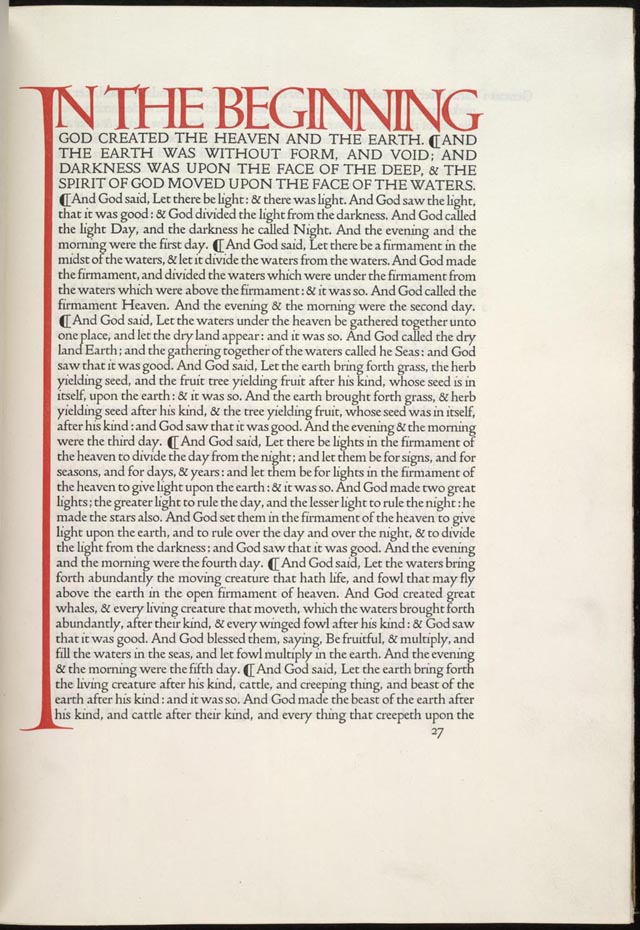
The Genesis opening of the Library of Congress's copy of the Doves Bible, showing Edward Johnston's hand-lettered red initial I. Sourced from the Library's own exhibits server; the Library identifies this copy as part of the Lessing J. Rosenwald Collection.
| Artist | T. J. Cobden-Sanderson and Sir Emery Walker, the Doves Press |
|---|---|
| Date | 1903-1905 |
| Medium | Letterpress in the Doves Type, a private roman type cut for the press, printed in red and black on handmade paper (two copies on vellum); initials designed and hand-lettered in red by Edward Johnston; bound in limp vellum by the Doves Bindery with gilt-lettered spines |
| Dimensions | 5 volumes, quarto. Exact leaf and type-page measurements were not found in the sources consulted for this record; see open questions. |
| Where it is now | Library of Congress, Rare Book and Special Collections Division, Washington DClast confirmed |
| Inventory number | Lessing J. Rosenwald Collection, LOC catalog record loc.gov/item/49034965 (digitized as rbc0001.2022rosen2243, volumes 1-5) |
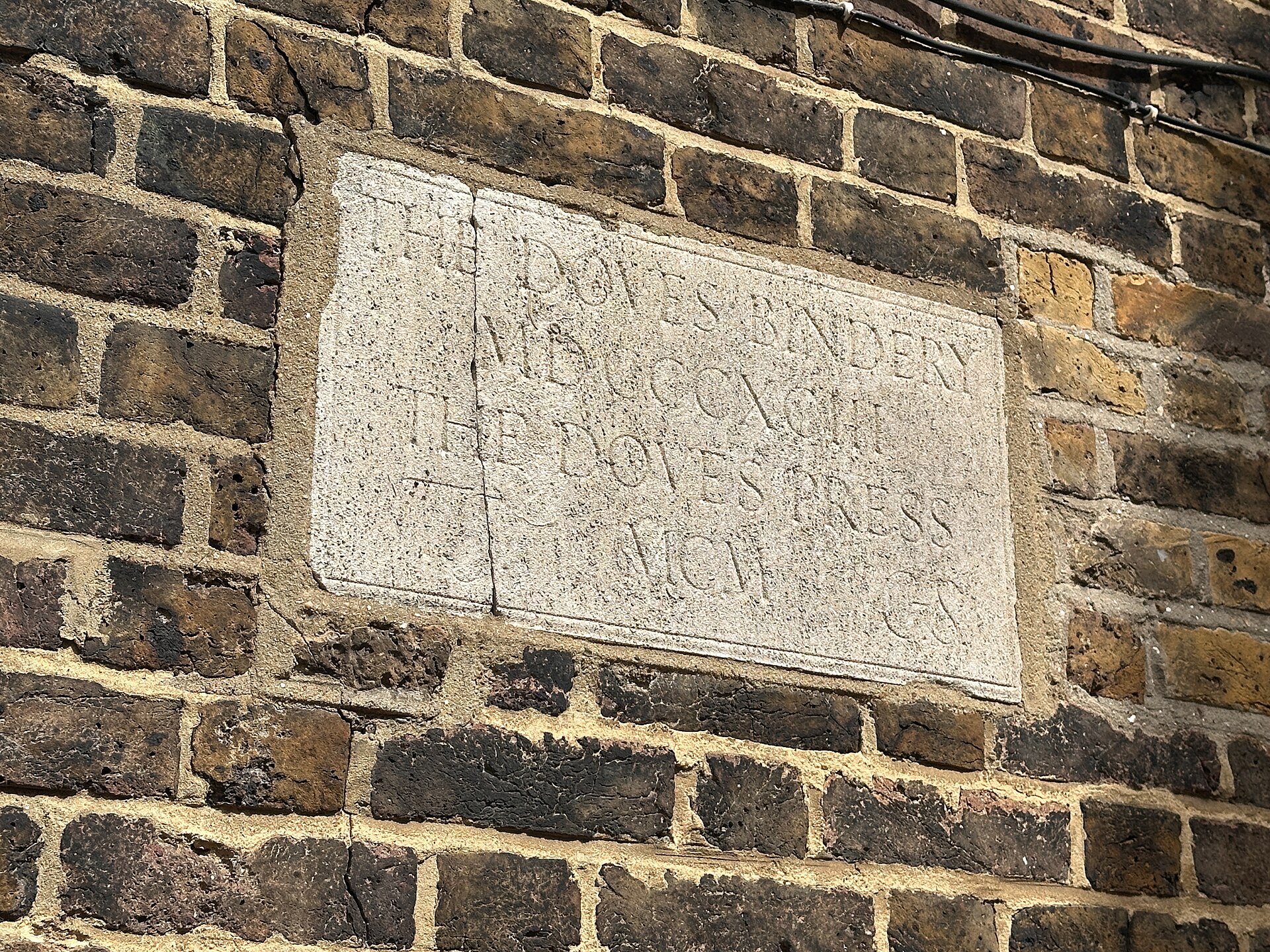
| Attribution | AcceptedPrinted at the Doves Press, Hammersmith, London, by Thomas James Cobden-Sanderson and Sir Emery Walker. Full note |
| Object type | Printed book |
| Period | British, Arts and Crafts movement, early twentieth century |
| Cases | Has a provenance gap |
| Inscriptions | Not documented for this specific copy in the sources consulted. The edition as a whole carries a printed limitation statement; individual copies commonly carry booksellers' or former owners' bookplates, none of which is confirmed for this copy. |
| Owners on record | 5 links4 documented, 1 unknown |
| Sources | 14 cited |
About this record Last verified · 14 sources cited · Change log
On this page 9 sections
ContentsClose
Five plain, unillustrated quarto volumes, printed in red and black between 1903 and 1905 at the Doves Press in Hammersmith, and generally regarded as the masterpiece of the private press movement's most austere maker. The one ornament in the whole Bible, a single elongated red initial hand-lettered by Edward Johnston at the opening of Genesis, sits on a page otherwise built from nothing but type, ink and margin.
The press's two founders, T. J. Cobden-Sanderson and Sir Emery Walker, fell out bitterly within a few years of finishing it. Rather than let a dissolution agreement hand the Doves Type to Walker on his own death, Cobden-Sanderson spent years secretly throwing the type, piece by piece, into the Thames from Hammersmith Bridge, an act he recorded in his own diary and that left the typeface unusable for nearly a century, until a graphic designer working from those same diary entries had part of it dredged back up from the riverbed in 2014.
This particular copy is identified, on the Library of Congress's own authority, as part of the Lessing J. Rosenwald Collection, now held in the Library's Rare Book and Special Collections Division. Its life before it reached that collection, who first owned it and when Rosenwald acquired it, is not documented in the sources this record could consult, and the record says so plainly rather than inventing a chain to fill the gap.
Provenance
Each link is graded. Documented: a cited source supports it. Disputed: the identification is argued but not established. Unknown: no owner for that span, and the gap is not smoothed into a narrative. The grades in the glossary.
- 1903 - 1905The Doves Press, Hammersmithdocumented
Printed and bound in five volumes between 1903 and 1905 by T. J. Cobden-Sanderson and Sir Emery Walker, in an edition of 500 sets on paper and 2 on vellum.279
- 1905 -Unidentified original subscriber or purchaserunknown
No first owner is documented for this specific copy in the sources consulted. Original subscribers to Doves Press books are recorded for some copies of the edition (a receipt to a 'Mr J. Guttridge' survives with one other set) but no such record for this copy has been located.9
- Lessing J. Rosenwalddocumented
Entered the collection of Lessing J. Rosenwald (1891-1979), former chairman of Sears, Roebuck and Company, as part of his roughly forty-year rare book collecting career. Exact acquisition date and source (dealer, sale, or private purchase) not stated in the sources consulted; the item is not identified in any auction record located for this research.813
- 1943 - 1980Lessing J. Rosenwald, in physical custody at Alverthorpe Gallery, Jenkintown, Pennsylvania, with title passing by gift to the Library of Congressdocumented
Rosenwald announced in 1943 that his entire graphic arts collection, and all future acquisitions, would go to the Library of Congress and the National Gallery of Art. He retained physical custody at his own Alverthorpe Gallery for the rest of his life; the collection reached the Library in a series of gifts from 1943, with final delivery in 1980, the year after his death in 1979. Which tranche included this Bible is not documented in the sources consulted.13
- 1980 - presentLibrary of Congress, Rare Book and Special Collections Divisiondocumented
Held as part of the Lessing J. Rosenwald Collection, catalogued at loc.gov/item/49034965 and fully digitized under the accession stem rbc0001.2022rosen2243 across all five volumes. Exhibited in the Library's 'World Treasures: Beginnings' exhibition, whose caption is the basis for identifying this copy as the one reproduced in the Commons photograph anchoring this record.78
Technical evidence
| Attribution note | Printed at the Doves Press, Hammersmith, London, by Thomas James Cobden-Sanderson and Sir Emery Walker. The text follows F.H.A. Scrivener's Paragraph Bible, with the verse divided into sense-paragraphs by Cobden-Sanderson himself. The calligraphic initials, most famously the single elongated red I that opens Genesis, were designed and lettered by Edward Johnston. None of this rests on connoisseurship: the press kept its own production records, later assembled into a catalogue raisonne, and Cobden-Sanderson's journals document the work in his own hand. |
|---|---|
| Format and extent | 5 volumes, quarto, printed 1903-1905.26 |
| Type | Doves Roman, a private type designed for the press by Cobden-Sanderson and Emery Walker, capitals derived from Nicolas Jenson's roman of the 1470s and lowercase from the related type of Jacobus Rubeus, cut by the punchcutter Edward Prince from photographic enlargements Walker supplied of early printed pages.25 |
| Text source | Set from F.H.A. Scrivener's Paragraph Bible (King James text), with the verse re-divided into sense-paragraphs by Cobden-Sanderson rather than printed in a numbered-verse grid.7 |
| Print run | 500 sets on handmade paper and 2 sets on vellum. Sources consulted do not identify which of these the Library of Congress copy is.79 |
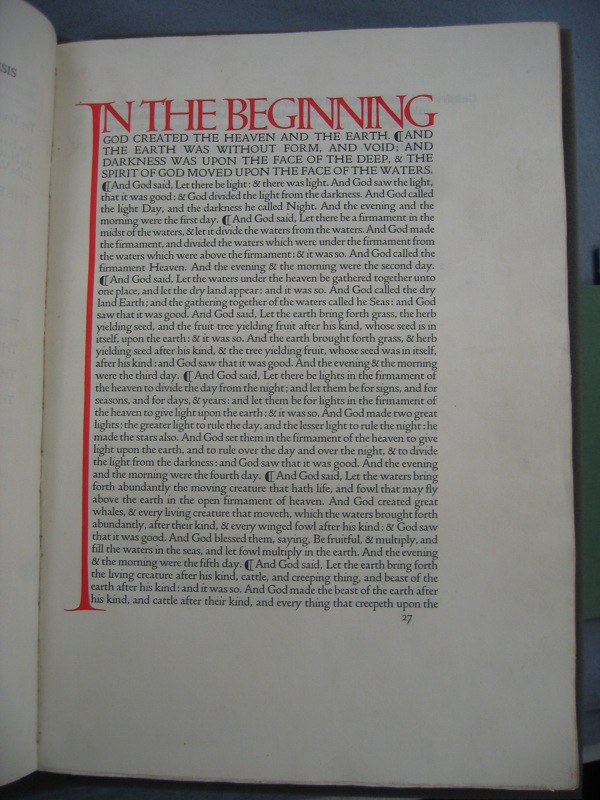
| Illumination | Calligraphic initials, most prominently the single elongated red I opening the Book of Genesis, designed and hand-lettered by Edward Johnston rather than printed with the letterpress text.1011 |
| Binding | Limp vellum by the Doves Bindery, spine lettered in gilt directly on the vellum.9 |
| Illustration | None. No woodcuts, borders or illustrations appear anywhere in the five volumes, a deliberate departure from the ornamented page of Kelmscott Press books.34 |
| Digitization | The Library of Congress's copy is digitized in full, all five volumes, under the accession stem rbc0001.2022rosen2243.8 |
Images

The record in full
Chapter 1A Bible built from nothing but type and paper
Five quarto volumes, printed in red and black, bound in limp vellum with the title lettered in gilt directly on the spine: that is the entire visual vocabulary of the Doves Bible.
Five quarto volumes, printed in red and black, bound in limp vellum with the title lettered in gilt directly on the spine: that is the entire visual vocabulary of the Doves Bible. There is no woodcut, no historiated border, no illustration of any kind across all five volumes, an absence that was a stated principle rather than an economy. Five hundred sets were printed on handmade paper and two on vellum. The paper copies are what nearly every surviving example, including this one, represents; sources consulted for this record do not specify whether the Library of Congress copy is paper or one of the two vellum sets, and that gap is recorded rather than guessed at.
The single ornamental gesture in the entire Bible is calculated rather than decorative: an elongated calligraphic initial I, lettered in red by Edward Johnston, that runs the height of the opening page of Genesis beside the words IN THE BEGINNING. Bernard Newdigate's contemporary description of the Doves initials as spare geometric forms rather than illuminated ornament is echoed by later cataloguers who call the page one of the most powerful title openings in the history of printing. It is powerful because it is nearly bare. Everything else on the page is the type, the margin, and the black-and-red printing.
Chapter 2Cobden-Sanderson before the Press
Thomas James Sanderson was born in Alnwick, Northumberland, in 1840, trained in law at Trinity College, Cambridge, and practiced as a barrister for two decades before abandoning the bar around 1884...
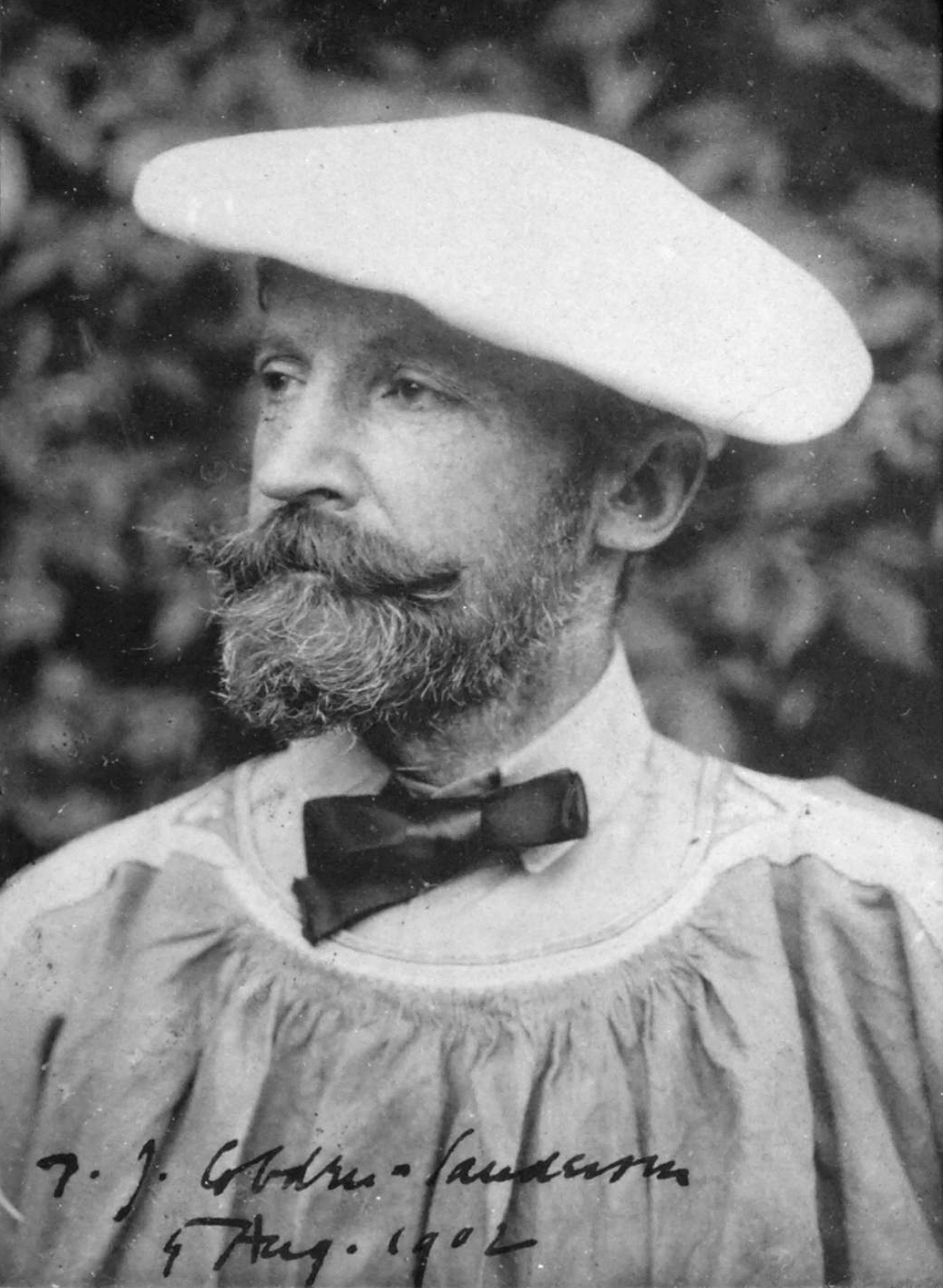
Thomas James Sanderson was born in Alnwick, Northumberland, in 1840, trained in law at Trinity College, Cambridge, and practiced as a barrister for two decades before abandoning the bar around 1884, in his mid-forties, for bookbinding. In 1882 he had married Anne Cobden, daughter of the free-trade politician Richard Cobden; the couple took the combined surname Cobden-Sanderson, and Anne's independent means underwrote his change of career and, later, the founding of the press itself.
He set up the Doves Bindery in Hammersmith in 1893, naming it, as he would later name the press, after a local public house, the Dove. His binding work brought him into the circle of the Arts and Crafts movement and into direct contact with William Morris, whose Kelmscott Press had begun printing three years earlier. Cobden-Sanderson bound Kelmscott books; the two men's aesthetics would diverge sharply once he began designing type of his own.
Chapter 3A philosophy stated in print before it was printed
Cobden-Sanderson did not arrive at the Doves Type by trial alone.
Cobden-Sanderson did not arrive at the Doves Type by trial alone. In 1892 he delivered a paper to the Art Workers' Guild that he later expanded and printed at his own press in February 1901 as The Ideal Book, or Book Beautiful, an edition of 310 copies, 300 on paper and 10 on vellum. The tract states his position directly: a book's beauty is composite, arising from the interaction of its literary content, its writing or type, its printing, its illustration if any, and its binding, and it can be made beautiful either by the harmony of all these parts together or by the supreme beauty of one part allowed to dominate.
He used that essay to state, in print, a direct critique of Morris's own Kelmscott books: their narrow margins, their heavy black-letter type, and their subordination of the printed text to border ornament. The Doves Press was his counter-proposal. Where Kelmscott surrounded its type with pattern, Doves surrounded its type with air: wide margins, a single clean roman face, no border, no illustration. This is a documented position, argued by Cobden-Sanderson himself in a published tract before the Bible was printed, not a later scholar's reading of the finished object back onto its maker.
Chapter 4The Doves Type
The type at the center of all of this was designed by Cobden-Sanderson working with Emery Walker, who joined him as a formal partner in 1900 and financed and technically directed the type's creation...
The type at the center of all of this was designed by Cobden-Sanderson working with Emery Walker, who joined him as a formal partner in 1900 and financed and technically directed the type's creation, and cut by the punchcutter Edward Prince, the same craftsman who had earlier cut Morris's Golden Type for Kelmscott. The Doves Roman took its model from Venetian printing of the 1470s: capitals derived from Nicolas Jenson's roman, lowercase from the related type of Jacobus Rubeus, both examined by Walker through photographic enlargements of early printed pages, a method Walker had used before for Morris.
The result was a single size of roman type with no italic and, by design, no companion display face, cut in one weight for one purpose: to set continuous text with nothing standing between the reader and the words. Contemporaries and later type historians alike treat the Doves Roman as one of the most disciplined revivals of the private press movement, precisely because Walker and Prince worked from photographic evidence of real Renaissance printing rather than freely reinterpreting it.
Chapter 5Printing the Bible, 1903-1905
The Doves Bible was the press's largest undertaking and, by near-universal agreement among the institutions and dealers who now hold copies, its masterpiece.
The Doves Bible was the press's largest undertaking and, by near-universal agreement among the institutions and dealers who now hold copies, its masterpiece. The text was set from F.H.A. Scrivener's Paragraph Bible, with Cobden-Sanderson himself responsible for breaking the King James text into sense-paragraphs rather than printing it in the conventional numbered-verse grid, a real editorial decision about how the reader should encounter continuous scripture rather than a lookup table of chapter and verse.
Printing ran across five volumes issued between 1903 and 1905 in an edition of 500 sets on handmade paper and 2 on vellum, a print run tiny by any commercial standard but large for a hand press operating without power machinery. Johnston's initials, most famously the Genesis I, were not printed with the text but lettered by hand afterward in red, a workflow that made every volume, in that one respect, a manuscript addition to a printed book rather than a purely mechanical object. When Cobden-Sanderson received Johnston's design for the Genesis opening, he recorded in his journal that he was now, finally, satisfied with all their books, a private note of completion from a man who was rarely satisfied with anything, including, within a few years, his own partnership.
Chapter 6The partnership and its dissolution
Walker's formal role began in 1900, though the two men had worked together informally before that, and the arrangement was never an equal division of labour: Cobden-Sanderson pressed and bound...
Walker's formal role began in 1900, though the two men had worked together informally before that, and the arrangement was never an equal division of labour: Cobden-Sanderson pressed and bound; Walker, already established as a photo-engraver and the technical eye behind Morris's own type designs, supplied the scholarship, the photographic method, and much of the capital standing behind the type. Cobden-Sanderson increasingly felt he was not getting adequate working support from a partner whose attention was divided among several other ventures and public roles.
The partnership was dissolved amid considerable bitterness by around 1908-1909; sources consulted give both years, and this record does not resolve the discrepancy beyond noting it. The dissolution agreement contained the clause that would detonate a few years later: on Cobden-Sanderson's death, all rights to the Doves Type, punches, matrices and the type itself, were to pass to Walker. Cobden-Sanderson had designed and financed the letter that made the press's reputation, and the agreement he had signed meant his estranged former partner would inherit it whole.
Chapter 7Destruction: the punches and matrices, then the type itself
Cobden-Sanderson decided that Walker would inherit nothing.
Cobden-Sanderson decided that Walker would inherit nothing. Rather than let the type pass to a man he now regarded as an adversary, he began systematically destroying it himself, in secret, over a period of years, recording the act as he went in his own diary. Accounts consulted for this record differ on the exact chronology: some place an initial disposal of the punches and matrices as early as Good Friday, 21 March 1913; the fullest published accounts of the diary place the sustained destruction of the type itself in the second half of the decade, beginning at midnight on 31 August 1916, a date Cobden-Sanderson recorded as one that 'seemed a suitable night, and time.'
From that night through into 1917 he made repeated trips, commonly given as around 170, on foot across Hammersmith Bridge, carrying paper parcels of type tied with string and dropping them into the Thames below, a stretch of river he could see from the windows of his own house and workshop at Hammersmith Terrace. He described the act in his diary as bequeathing the type to the river. Estimates of the total metal destroyed run to roughly a ton, with one detailed account putting the figure at 2,600 pounds. He also destroyed the tools and jigs needed to recut the letter, so that even a determined attempt to reconstruct the punches from scratch would have had almost nothing physical to work from.
This was not an accident of an old man clearing out a workshop. It was a deliberate, nightly, years-long act aimed at a single outcome: that Emery Walker, and no one else, would never again set a line of Doves type. Cobden-Sanderson died in 1922, six years into the disposal and long after its completion; Walker outlived him by over a decade, dying in 1933, having inherited, in the end, nothing of the type at all.
Chapter 8A century of silence and a digital attempt
For most of the twentieth century the Doves Type existed only as ink on the page of the roughly fifty books the press had printed between 1900 and 1916, and as a cautionary story in the history of...
For most of the twentieth century the Doves Type existed only as ink on the page of the roughly fifty books the press had printed between 1900 and 1916, and as a cautionary story in the history of British printing. Robert Green, a London graphic designer who had been drawn to the letter since encountering it in art school in the early 2000s, spent around three years working from printed specimens to redraw the Doves Roman as a digital font, releasing a first version in 2013. He was not satisfied with its accuracy against the original metal, which he had never seen and had assumed no one ever would again.
Chapter 9The 2014 recovery
In October 2014, working from Cobden-Sanderson's own diary entries recording where along the river he had made his drops, Green obtained a mudlarking permit and found three lowercase sorts, the...
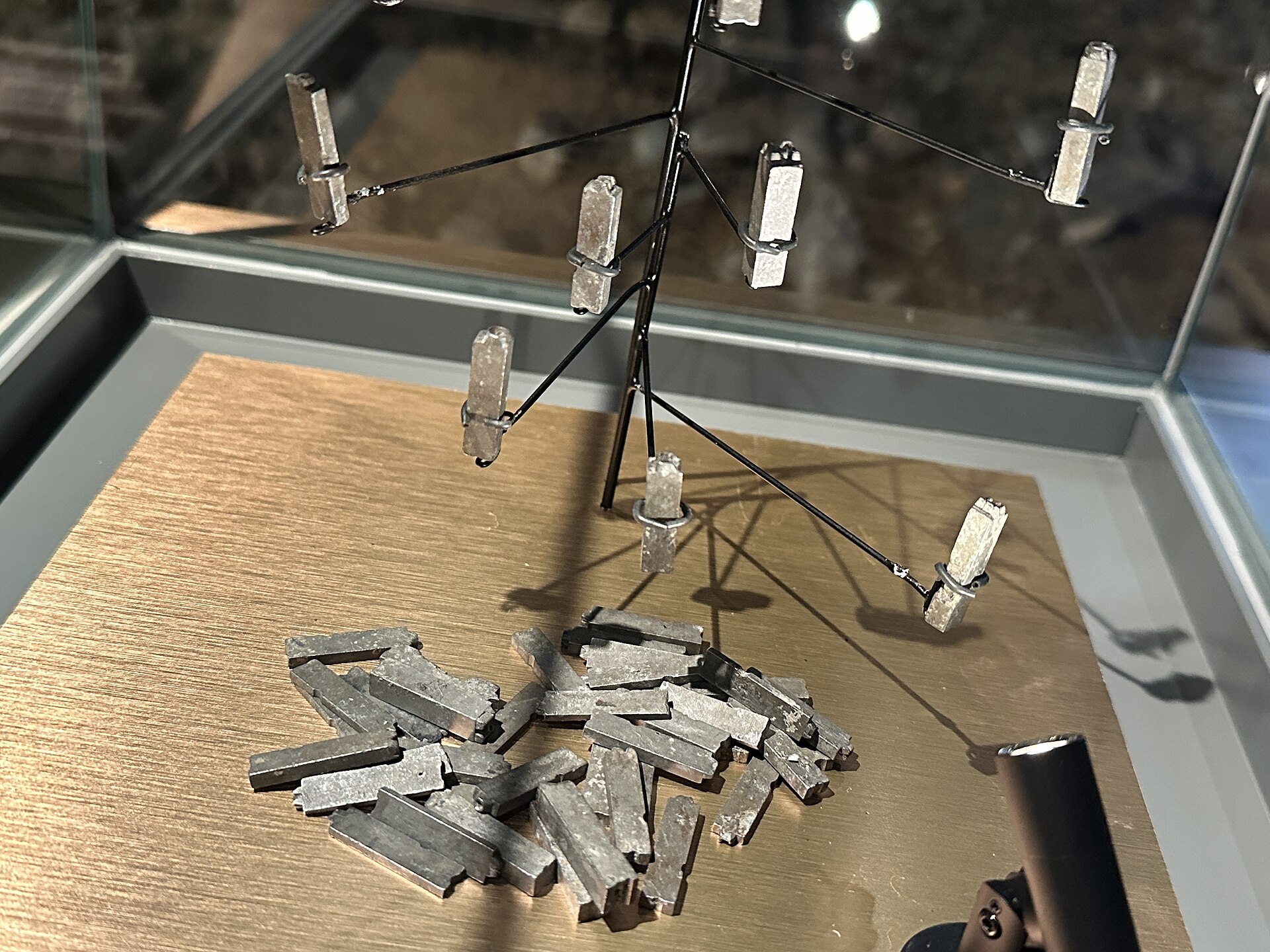
In October 2014, working from Cobden-Sanderson's own diary entries recording where along the river he had made his drops, Green obtained a mudlarking permit and found three lowercase sorts, the letters v, i and e, on the Thames foreshore near Hammersmith Bridge at low tide. He then arranged for the Port of London Authority to send a professional diving team to the same stretch of riverbed. Over a main operation on 10 November 2014 and a further day of diving, the divers recovered a total reported as 147 to 151 individual pieces of type, the sources consulted give both figures and this record does not adjudicate between them, out of an original casting that once ran to hundreds of thousands of sorts. The recovery was filmed by the documentary maker Toby Amies.
Green used the recovered originals to correct and finish a more accurate digital revival of the Doves Type, released after the dive. Of the physical pieces recovered, a portion was donated to the Emery Walker Trust, which maintains Walker's former house at 7 Hammersmith Terrace, a short walk from the bridge, as a small recompense, as one account of the recovery put it, for Cobden-Sanderson's original act against Walker. Separately from Green's PLA-organized dive, individual mudlarks searching the same stretch of foreshore under license have continued to find further pieces in the years since; one licensed mudlark alone is reported to have recovered more than 500 additional sorts, recorded through the Portable Antiquities Scheme and in at least one case donated to the Emery Walker Trust in December 2020. Recovered fragments have also been shown to the public: pieces of Dove type dredged from the river were on display in the Museum of London Docklands' 'Secrets of the Thames' exhibition as of August 2025.
This record was briefed with a claim that recovered type is now held by the Victoria and Albert Museum. Searches of the sources above, of the V&A's own online collections search, and of general web search turned up no reporting or catalogue record placing any of the recovered Doves Type at the V&A; every account located instead names the Emery Walker Trust as the recipient institution, with pieces also exhibited at the Museum of London Docklands. This record therefore states the Emery Walker Trust and the Museum of London Docklands as the documented holders and declines to repeat the V&A claim. See notes to the editor.
Chapter 10This copy: the Library of Congress and the Rosenwald Collection
The Library of Congress's own 'World Treasures: Beginnings' exhibition identifies its copy of the Doves Bible as part of the Lessing J.
The Library of Congress's own 'World Treasures: Beginnings' exhibition identifies its copy of the Doves Bible as part of the Lessing J. Rosenwald Collection, held in the Library's Rare Book and Special Collections Division, and it is this copy that the Commons photograph anchoring this record reproduces; the image file is served directly from the Library's own exhibits server. The Library's digitized version of the same Bible carries the accession stem 'rosen2243' across its five separately digitized volumes, which corroborates the Rosenwald attribution independently of the exhibition caption.
Lessing J. Rosenwald, chairman of Sears, Roebuck and Company from 1932 to 1939, built his rare book collection over roughly forty years and announced in 1943, at the height of the Second World War, that he would give his entire graphic arts collection, together with everything he acquired afterward, to the Library of Congress and the National Gallery of Art. He kept physical custody of the books at his own Alverthorpe Gallery on his estate in Jenkintown, Pennsylvania, for the rest of his life, with the collection reaching the Library in a series of gifts beginning in 1943 and culminating in a final delivery in 1980, the year after his death in 1979. Which of those gift tranches carried this particular Bible, and from whom and when Rosenwald himself acquired it, is not stated in the sources consulted for this record; that gap is recorded honestly in the open questions below rather than filled with an assumed date.
Chapter 11What other copies have sold for, and why that is not this copy's price
The Library of Congress copy came to the institution as a gift, not a purchase, and no sale of this specific set is documented in the sources consulted; there is accordingly no auction result to...
The Library of Congress copy came to the institution as a gift, not a purchase, and no sale of this specific set is documented in the sources consulted; there is accordingly no auction result to report for the object this record describes. Other copies of the same 500-set edition do come to market with some regularity and establish a comparanda cohort worth recording precisely because it is easy to confuse with this copy if the two are not kept separate.
A set with a documented ownership chain through the collector Templeton Crocker, a past president of the California Historical Society, then the Julia Scribner Bigham Memorial Collection at St. Mark's Library, then a collector named L.W. Jordan, Jr., sold at Bonhams in a sale running 15 to 25 June 2024 for a hammer price of USD 9,000, USD 11,520 with buyer's premium, described as showing occasional foxing concentrated in volume four and light wear to its custom slipcases. A separate set was offered at Sotheby's on 11 July 2024 with an estimate of GBP 7,000 to 9,000; the result was not available in the sources consulted, which noted only that results required a login this record's research did not have access to. Neither of these two sets is the Library of Congress copy, and nothing in their sale descriptions is transferred to it here.
Chapter 12What remains open
The record above is deliberately more definite about the press, the type, and the destruction than it is about this one copy's own life before it reached Washington.
The record above is deliberately more definite about the press, the type, and the destruction than it is about this one copy's own life before it reached Washington. That asymmetry is real: the Doves Press kept records of its own output and Cobden-Sanderson kept a diary of his own crime against his former partner, so those events are unusually well documented for a private press story. The path of one particular Bible from a Hammersmith printing house in 1903-1905 into the hands of a Philadelphia-area collector by some point before 1980 is not.
The artist
Thomas James Cobden-Sanderson (1840-1922), in partnership with Sir Emery Walker (1851-1933), the Doves Press
The Doves Bible has two makers, and they are worth treating separately because the story that overtakes this object, the destruction of the type, is a story about exactly how unequal their partnership actually was. Cobden-Sanderson supplied the philosophy, the hands-on printing and binding, and, in the end, the will to destroy what they had made together rather than let it survive under one name alone. Walker supplied the photographic and typographic scholarship that made the letter itself possible, and inherited nothing.
Related works
| Work | Relation | Where it is |
|---|---|---|
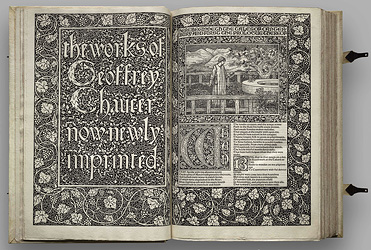
| The Kelmscott Chaucer William Morris, Kelmscott Press, illustrations by Edward Burne-Jones | The private press movement's other landmark book of the period, and the direct aesthetic foil against which Cobden-Sanderson defined the plainer Doves manner Printed 1896, heavily bordered and illustrated, everything the Doves Bible's page deliberately is not. | Multiple copies in institutional collections |
| The Ideal Book, or Book Beautiful T. J. Cobden-Sanderson, Doves Press | Cobden-Sanderson's own published statement of the printing philosophy the Bible puts into practice First printed at the Doves Press in February 1901, an edition of 310, 300 on paper and 10 on vellum. | Library of Congress and other rare book collections |
| Fragments of recovered Doves Type Cut by Edward Prince to the design of Cobden-Sanderson and Emery Walker; recovered by Robert Green with the Port of London Authority | Surviving physical sorts of the same typeface the Bible is printed in, dredged from the Thames after a century underwater Around 147 to 151 pieces recovered by the Port of London Authority dive in November 2014; further pieces found since by licensed mudlarks. | Emery Walker Trust, 7 Hammersmith Terrace, London; examples shown at the Museum of London Docklands |
| Doves Press Bible, first volume, publisher's limp vellum binding T. J. Cobden-Sanderson and Sir Emery Walker, Doves Press | A different institutional copy of the same edition, acquired separately Acquired in 2024 and displayed on the library's second floor; illustrates that surviving sets continue to enter institutional collections individually rather than as a single tracked cohort. | Pitts Theology Library, Emory University |
Open questions
- Is the Library of Congress's copy one of the 500 paper sets or one of the 2 vellum sets? The sources consulted for this record do not say.
- When and from whom did Lessing Rosenwald acquire this particular Bible, and in which of his gift tranches to the Library of Congress (1943-1980) did it travel? Not stated in the sources consulted.
- Who was the first purchaser or subscriber to this specific set in 1903-1905, and where did it go between then and its entry into the Rosenwald collection? No owner is documented for that interval in the sources consulted.
- Does this copy carry any bookplate, inscription, or binder's stamp beyond the standard Doves Bindery work? Not documented in the sources consulted.
- Was the partnership dissolution finalized in 1908 or 1909? Secondary sources consulted give both years without reconciling the discrepancy.
- What is the precise, word-for-word text of Cobden-Sanderson's diary entries describing the type's disposal? This record relies on secondary summaries and a widely repeated but not independently verified quotation ('bequeathed to the river' and the fuller sentence given in the artist dossier); the printed edition of the journals (A Journal of T. J. Cobden-Sanderson, published 1926) has not been consulted directly.
- How many pieces of type were recovered by the Port of London Authority dive in November 2014: 147, 150, or 151? Sources consulted give all three figures.
Questions about this object
What is The English Bible, Containing the Old Testament and the New?
The English Bible, Containing the Old Testament and the New is a printed book, dated 1903-1905. Medium: Letterpress in the Doves Type, a private roman type cut for the press, printed in red and black on handmade paper (two copies on vellum); initials designed and hand-lettered in red by Edward Johnston; bound in limp vellum by the Doves Bindery with gilt-lettered spines.
Who made The English Bible, Containing the Old Testament and the New, and is the attribution settled?
The attribution to T. J. Cobden-Sanderson and Sir Emery Walker, the Doves Press is recorded here as accepted. Printed at the Doves Press, Hammersmith, London, by Thomas James Cobden-Sanderson and Sir Emery Walker. The text follows F.H.A. Scrivener's Paragraph Bible, with the verse divided into sense-paragraphs by Cobden-Sanderson himself. The calligraphic initials, most famously the single elongated red I that opens Genesis, were designed and lettered by Edward Johnston. None of this rests on connoisseurship: the press kept its own production records, later assembled into a catalogue raisonne, and Cobden-Sanderson's journals document the work in his own hand.
Where is The English Bible, Containing the Old Testament and the New now?
Library of Congress, Rare Book and Special Collections Division, Washington DC. Inventory number Lessing J. Rosenwald Collection, LOC catalog record loc.gov/item/49034965 (digitized as rbc0001.2022rosen2243, volumes 1-5). Last confirmed 23 August 2026. Identified from the Library of Congress's own 'World Treasures: Beginnings' exhibition, whose caption for this object states it is held in the Rosenwald Collection, Rare Book and Special Collections Division, Library of Congress. The Commons photograph used on this record is served directly from the Library of Congress exhibits server (loc.gov/exhibits/world/images/s3.jpg), and the Library's digitized surrogate of the same Bible carries the Rosenwald accession stem 'rosen2243'. Direct retrieval of the LOC exhibit and catalog pages returned HTTP 403 to automated fetch; the identification rests on cached search-index text of those pages plus the corroborating digital-collection URL, not on a page this record's author viewed unfiltered. Treat the institutional identification as strong but not independently re-verified by direct page load.
What is still unknown about The English Bible, Containing the Old Testament and the New?
Is the Library of Congress's copy one of the 500 paper sets or one of the 2 vellum sets? The sources consulted for this record do not say.
Sources
- 1Wikipedia, 'T. J. Cobden-Sanderson', for biography, marriage, partnership dissolution and the type's destruction. en.wikipedia.org/wiki/...
- 2Wikipedia, 'Doves Press', for the press's founding, the Doves Type's design basis, the Bible's print dates, and the dissolution agreement's terms. en.wikipedia.org/wiki/...
- 3Pitts Theology Library, Emory University, 'Pitts acquires the Doves Press Bible' (30 September 2024), for the Bible's reputation as the press's magnum opus and description of the Genesis initial. pitts.emory.edu/2024/...
- 4London Museum (Museum of London), 'The lost Doves Type: A Thames mystery solved', blog post on the type's destruction and its recovery and donation to the Emery Walker Trust. londonmuseum.org.uk/blog/...
- 5Macfilos, 'Death of a typeface: The secret of the Doves Press' (23 March 2018), for the feud's terms, the destruction narrative and total weight of metal destroyed, and Robert Green's recovery. macfilos.com/2018/...
- 6Typespec (Robert Green), 'Recovering the Doves Type', first-person account of the October-November 2014 recovery, dates, personnel and piece counts. typespec.co.uk/recovering-the-doves-type
- 7Library of Congress, 'World Treasures: Beginnings' exhibition, object page for the Doves Press Bible, identifying the exhibited copy as part of the Rosenwald Collection and naming Edward Johnston's role. Flagged for direct re-verification by a researcher able to load loc.gov exhibit pages. loc.gov/exhibits/...
- 8Library of Congress catalog record and digitized volumes for 'The English Bible: containing the Old Testament & the New' (Doves Press, 1903-1905), Rosenwald Collection, accession stem rosen2243. loc.gov/item/...
- 9Bonhams, sale 30066, lot 112, Doves Press Bible with Templeton Crocker / Julia Scribner Bigham / L. W. Jordan Jr. provenance, sale 15-25 June 2024, hammer USD 9,000, USD 11,520 with premium. bonhams.com/auction/...
- 10Ampersand Book Studio (Substack), 'Edward Johnston and the Especial Beauty of Headings', on Johnston's hand-lettered initials for the Doves Press including the Genesis I. ampersandbookstudio.substack.com/p/...
- 11Bonhams, earlier Doves Bible sale listing quoting Ransom's description of the Johnston initials as 'a pattern for all time of complexity reduced to the minimum of simplicity', and Cobden-Sanderson's journal note of satisfaction on seeing the finished Genesis opening. bonhams.com/auction/...
- 12Library of Congress rare book record and secondary summaries of T. J. Cobden-Sanderson, 'The Ideal Book, or Book Beautiful' (Doves Press, February 1901), for the essay's publication details and its argument against Kelmscott Press design. loc.gov/resource/...
- 13Library of Congress, 'The Lessing J. Rosenwald Collection', Library of Congress Information Bulletin (October 2007) and 'About this Collection' page, for the 1943 gift announcement, Alverthorpe Gallery custody, and the 1980 final delivery after Rosenwald's 1979 death. loc.gov/collections/...
- 14Wikimedia Commons, file description and for File:Doves Press Bible.jpg, confirming Public Domain licensing and the Library of Congress source URL. commons.wikimedia.org/wiki/...

Last verified · Published
Change log
23 August 2026 - Record created at the house standard: researched narrative, technical evidence, maker dossier, graded provenance chain, prices with hammer and premium separated, related works, open questions and sources.