Mr. William Shakespeares Comedies, Histories, & Tragedies (the Bodleian copy)
William Shakespeare · 1623
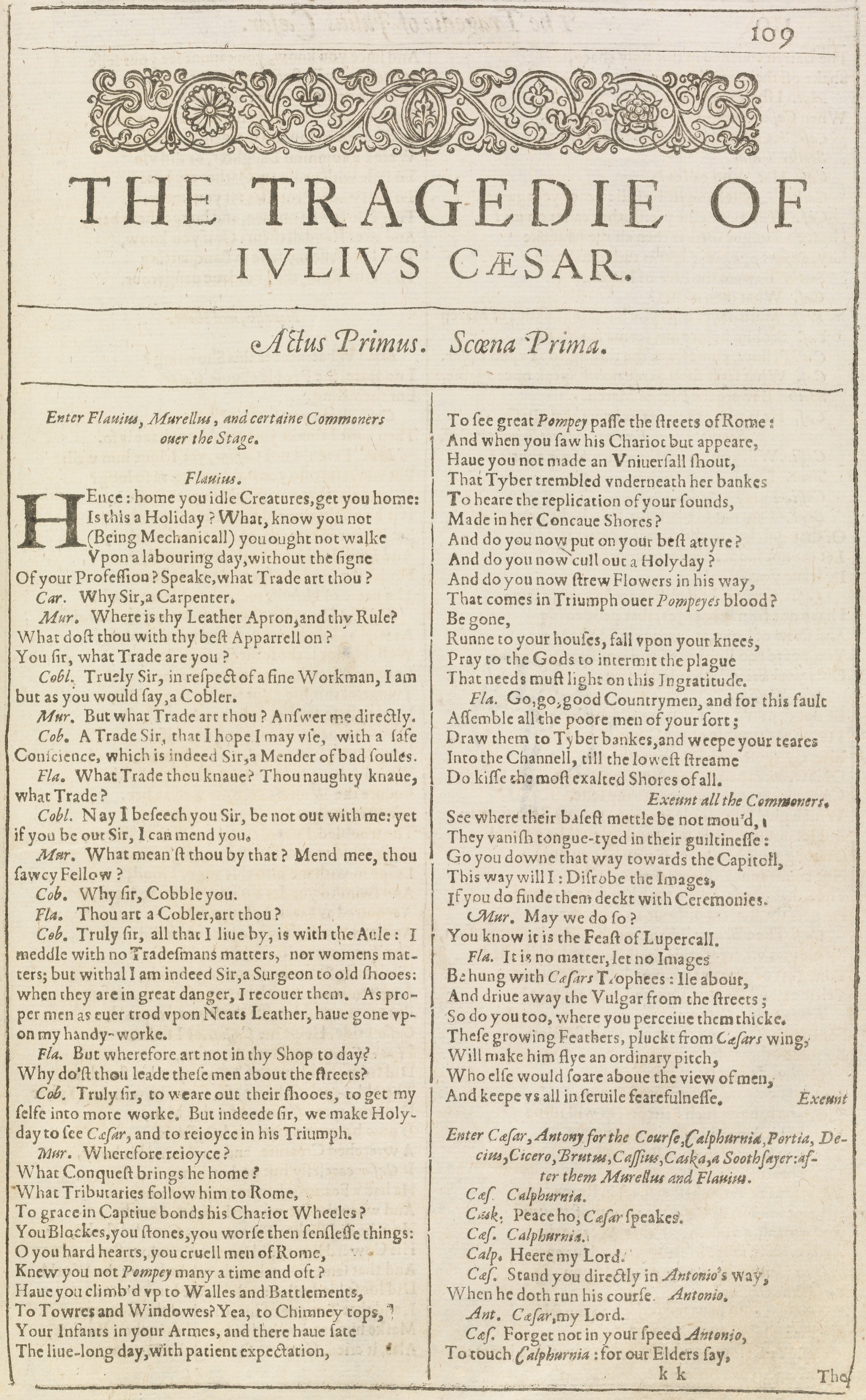
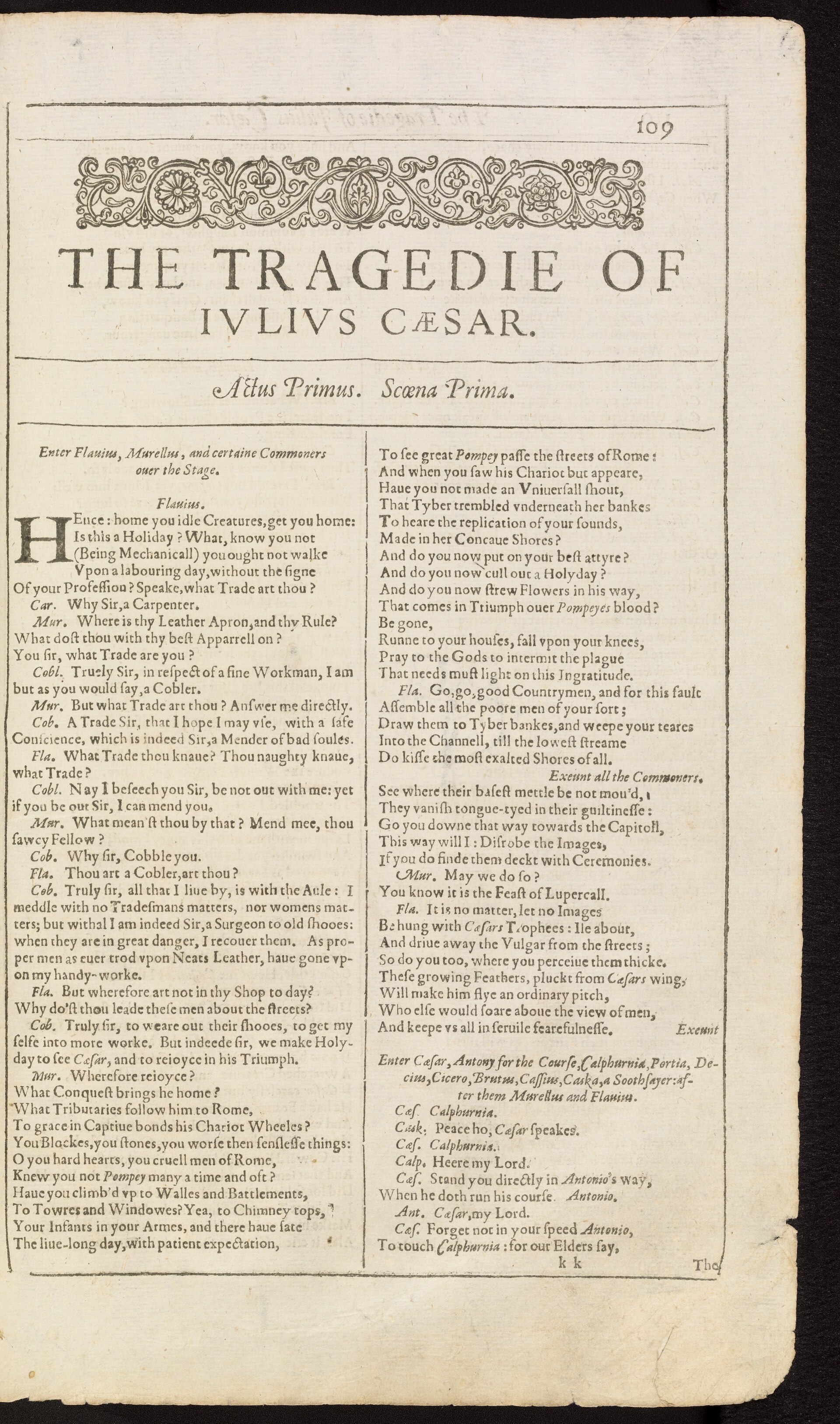
Opening page of The Tragedy of Julius Caesar from the Bodleian's digital facsimile of Arch. G c.7, the object described in this record.
The Bodleian First Folio: digital facsimile of the First Folio of Shakespeare's plays, Bodleian Arch. G c.7, http://firstfolio.bodleian.ox.ac.uk/ · Photograph by William Shakespeare · CC BY 3.0| Artist | William Shakespeare |
|---|---|
| Date | 1623 |
| Medium | Letterpress printing on laid paper, black-letter and roman type, single sheets folded in folio gatherings, sewn and bound |
| Dimensions | Folio format, approximately 33.5 x 21.5 cm as bound (individual copies vary with trimming); 908 pages as issued |
| Where it is now | Bodleian Library, University of Oxford, Weston Librarylast confirmed |
| Inventory number | Arch. G c.7 |
| Attribution | AcceptedThe 36 plays are the collected work of William Shakespeare, assembled after his death by two of his fellow actors in the King's Men, John Heminges and Henry Condell. Full note |
| Object type | Printed book |
| Period | English, Jacobean, seventeenth century |
| Cases | Rediscovered |
| Inscriptions | None of the manuscript annotations reported for this copy could be independently verified from the sources consulted; see notes_for_editor |
| Owners on record | 5 links5 documented |
| Sources | 23 cited |
About this record Last verified · 23 sources cited · Change log
On this page 9 sections
ContentsClose
The Bodleian Library's own copy of the 1623 First Folio, shelfmarked Arch. G c.7, is the only First Folio known to have been owned, lost and recovered by the same institution. It reached the library under Thomas Bodley's 1610 agreement with the Stationers' Company, the founding document of legal deposit in Britain, within months of publication. In the 1660s the library judged the newly issued Third Folio the more useful text and sold the First as surplus stock, along with a batch of other superseded books, to the Oxford bookseller Richard Davis.
The copy then disappeared from the documentary record for roughly two and a half centuries. It resurfaced in January 1905 when Gladwyn Maurice Revell Turbutt, an undergraduate of Magdalen College whose family had owned the book since about 1750, brought it to the Bodleian's sub-librarian, Falconer Madan, apparently to have storm damage to the binding assessed. Comparing the binding tooling and the marks left by a chaining staple with other books bound for the library in the 1620s, the Bodleian's bindings expert Strickland Gibson concluded that this was the library's own lost copy, still in its original Oxford binding.
A public subscription raised the 3,000 pounds needed to buy it back from the Turbutt family in 1906, in competition with the American collector Henry Clay Folger, who eventually amassed 82 First Folios and would very likely have added this one to a private collection abroad. It has remained in the Bodleian since, and since 2013 a conserved, high-resolution facsimile has been freely available online.
Provenance
Each link is graded. Documented: a cited source supports it. Disputed: the identification is argued but not established. Unknown: no owner for that span, and the gap is not smoothed into a narrative. The grades in the glossary.
- 1623 - 1663 or 1664Bodleian Library, University of Oxforddocumented
Received under the agreement of 12 December 1610 between Sir Thomas Bodley and Thomas Man, Master of the Stationers' Company, by which the refounded Bodleian was entitled to a free copy of every book entered at Stationers' Hall - generally treated as the founding instrument of legal deposit in the British Isles, later extended to the Royal Library and Cambridge University Library (1662) and given statutory force by the Copyright Act of 1710. Bodley himself had died in 1613, ten years before the Folio was printed, so the library received the book under an arrangement he had set up but did not live to see used for this volume. The copy was bound for the library in Oxford, in a binding later identified as the work of the binder William Wildgoose.189
- 1663 or 1664 - c. 1750Richard Davis, Oxford bookseller, then unrecorded intermediate handsdocumented
The Third Folio, issued 1663-64, added seven plays (six now regarded as apocryphal or only partly Shakespeare's) to the 36 of the First and Second Folios, and was judged by the library the more complete and useful text. The Bodleian's benefaction register records that Richard Davis paid 24 pounds for a lot of 'superfluous library books sold by order of the Curators', of which this First Folio was one; the entry prices the batch, not the book individually, so no per-copy figure for the Folio is recoverable from it. What happened to the volume between its sale and its appearance in the Turbutt family is not documented in any source consulted for this record.126
- c. 1750 - January 1905The Turbutt family, Ogston Hall, Brackenfield, Derbyshiredocumented
Bought by an ancestor of the family around 1750; no purchase price or seller is recorded in the sources consulted. The book remained in the family library at Ogston Hall, apparently unrecognised for what it was, until storm or damp damage to the binding prompted its owners to have it examined.236
- January 1905 - 1906Gladwyn Maurice Revell Turbutt, on behalf of the Turbutt familydocumented
Turbutt, an undergraduate of Magdalen College, Oxford, brought the family's copy to Falconer Madan, the Bodleian's sub-librarian, in January 1905. Madan and the library's bindings specialist, Strickland Gibson, identified it as the library's own lost First Folio by comparing its Oxford binding and the physical marks of a chaining staple with other books bound for the Bodleian in the 1620s, including work attributed to the binder William Wildgoose. E. W. B. Nicholson, Bodley's Librarian, then led a public subscription to buy the volume back for 3,000 pounds; more than 80 subscribers contributed. The American collector Henry Clay Folger, who went on to assemble 82 First Folios at what became the Folger Shakespeare Library, was reported to be bidding against the library for the same copy, which is presented in Bodleian accounts as the spur for the public appeal.12346
- 1906 - presentBodleian Library, University of Oxforddocumented
Held continuously since the 1906 repurchase, shelfmarked Arch. G c.7. Conserved and digitised in 2012-2013 under the Sprint for Shakespeare public campaign, a separate fundraising effort from the 1906 subscription, which is not to be confused with it: the 2012 campaign paid for conservation and photography and produced the freely licensed online facsimile, not for ownership of the book, which the library already held.51011
Technical evidence
| Attribution note | The 36 plays are the collected work of William Shakespeare, assembled after his death by two of his fellow actors in the King's Men, John Heminges and Henry Condell. No autograph manuscript of any Shakespeare play survives, so every text in the volume is an editorial and typesetting product of Heminges, Condell and the Jaggard printing house, working from playhouse papers, prompt books and earlier printed texts of varying reliability. Authorship of the plays themselves is not in scholarly dispute; the fidelity of any individual First Folio text to what Shakespeare wrote varies play by play and is a live editorial question. |
|---|---|
| Format | Folio: full printer's sheets folded once to make a large page, gathered in sixes. 908 pages as issued, containing 36 plays divided into Comedies, Histories and Tragedies.712 |
| Printer and publishers | Printing begun by William Jaggard and completed after his death by his son Isaac Jaggard, London, working with the stationers Edward Blount, William Aspley and John Smethwick, who shared the financial risk and the rights to the plays they already held. Five compositors are estimated to have set the type over roughly two years of intermittent work. Entered for registration at Stationers' Hall on 8 November 1623.1213 |
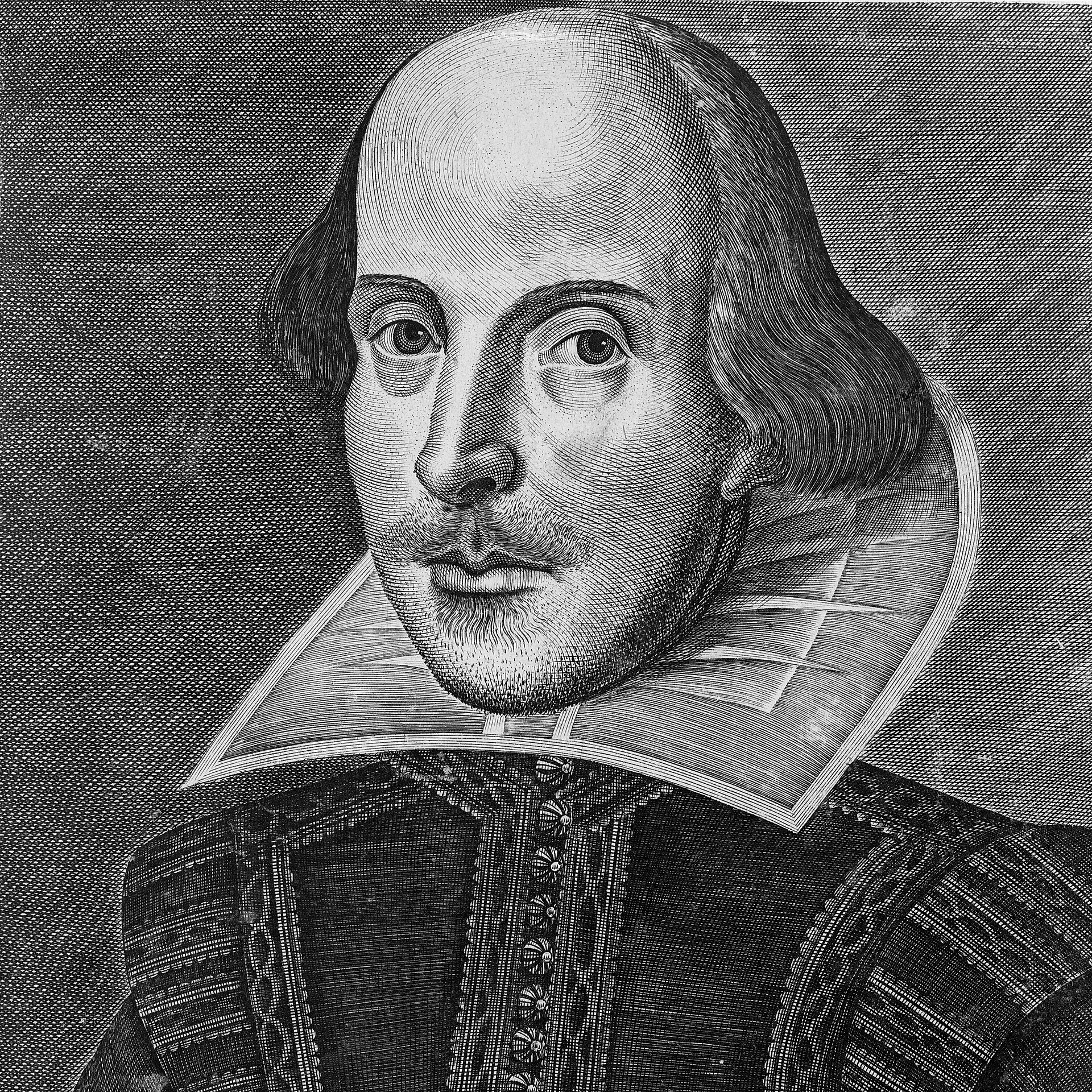
| Title-page portrait | Engraved by Martin Droeshout (1601-1650), one of only two portraits of Shakespeare with a claim to authenticity independent of textual description (the other is the Stratford funerary bust). Several states of the engraving exist across the print run.14 |
| Binding on this copy | Bound for the Bodleian in Oxford shortly after the library received it, in a binding whose tooling was attributed by Strickland Gibson to the binder William Wildgoose, who is documented as working for the library in the 1620s. The volume also carries physical evidence of having once been secured to a shelf by a chaining staple, standard practice for valuable library books of the period.123 |
| Condition | The Bodleian conservators who prepared the volume for digitisation in 2012 recorded paper that is in places extremely thin and of second-grade quality, with creases, pleats and papermaker's flaws throughout, and the lower corners of many leaves torn or broken away from heavy handling.10 |
| Shelfmark | Arch. G c.7, Bodleian Library, University of Oxford. The Bodleian holds a second, separately shelfmarked First Folio copy acquired later, which is not the subject of this record.15 |
| Digital facsimile licence | Images from the Bodleian's 2012-13 digitisation are released under Creative Commons Attribution 3.0 Unported (CC BY 3.0), with credit specified as 'The Bodleian First Folio: digital facsimile of the First Folio of Shakespeare's plays, Bodleian Arch. G c.7'.16 |
Images
The record in full
Chapter 1What the book physically is
The First Folio is a single large volume of 908 pages collecting 36 of Shakespeare's plays, printed in the folio format: full printer's sheets folded once, giving large pages bound into thick...
The First Folio is a single large volume of 908 pages collecting 36 of Shakespeare's plays, printed in the folio format: full printer's sheets folded once, giving large pages bound into thick gatherings. It was set in a mixture of roman and black-letter type by five compositors working in the London shop of William Jaggard and, after his death partway through the job, his son Isaac Jaggard, with three other stationers, Edward Blount, William Aspley and John Smethwick, sharing the financial risk and the rights. The whole job took roughly two years, with numerous interruptions, and the book was entered for registration at Stationers' Hall on 8 November 1623.
The Bodleian's copy, Arch. G c.7, is a working copy from the library's early decades before it left the collection, and its paper shows it: the Sprint for Shakespeare conservation project that prepared it for digitisation in 2012 found the paper in places extremely thin, of second-grade quality, with creases, pleats and papermaker's flaws throughout, and the lower corners of many leaves torn or broken away from heavy use. This is a book that was read, not merely kept.
Chapter 2Why a printed playbook physically looked like scripture
The choice of format was itself a claim.
The choice of format was itself a claim. In early Stuart England the folio, the largest and most expensive standard book size, was conventionally reserved for history, theology, law and the classics - texts assumed to be permanent and consulted rather than read once and discarded. Stage plays were commercial entertainment, printed cheaply in quarto pamphlets that were not expected to outlast their run.
Ben Jonson had tested that convention in 1616 by publishing his own collected Workes in folio, and was mocked for the presumption of treating his stage plays as if they belonged on the same shelf as Camden's history or a Bible. Heminges and Condell's decision to give Shakespeare's plays the same treatment seven years later was therefore not a neutral publishing choice: it was an argument, made in the physical form of the book itself, that these plays deserved to be read as literature and kept rather than performed once and forgotten. Jonson underwrote the argument directly, contributing two commendatory poems to the front matter, including the line that Shakespeare was 'not of an age, but for all time.'
Chapter 3Why the book exists at all
Shakespeare died in April 1616 without arranging for his plays to be collected.
Shakespeare died in April 1616 without arranging for his plays to be collected. About half of the 36 plays in the Folio had never been printed in any form before 1623; without this volume, Macbeth, The Tempest, Twelfth Night, Julius Caesar, Antony and Cleopatra, As You Like It, The Winter's Tale, Coriolanus, Measure for Measure, The Comedy of Errors, The Taming of the Shrew, King John, All's Well That Ends Well, Henry VIII, Timon of Athens, Cymbeline and two others would have no early text at all and might not have survived in any recognisable form.
Heminges and Condell were King's Men actors who had worked alongside Shakespeare for two decades; both are named as beneficiaries in his will. Their dedicatory epistle states their purpose as keeping 'the memory of so worthy a friend and fellow' alive, 'only to keepe the memory of so worthy a Friend, and Fellow aliue, as was our SHAKESPEARE'. Whatever commercial motive the four sharing stationers also had, the editorial project itself is framed by its editors as an act of memorial for a dead colleague, not a normal print-trade commission.
Chapter 4How this specific copy reached the Bodleian
The Bodleian received its copy automatically, not by purchase in the ordinary sense.
The Bodleian received its copy automatically, not by purchase in the ordinary sense. On 12 December 1610 Sir Thomas Bodley, who had refounded and endowed the University's library nine years earlier, obtained an agreement from Thomas Man, Master of the Stationers' Company, that the Bodleian would receive a free copy of every book entered at Stationers' Hall. The arrangement is generally treated as the founding instrument of legal deposit in the British Isles: it was extended to the Royal Library and to Cambridge University Library by 1662, and eventually given statutory footing by the Copyright Act of 1709/1710. Bodley died in 1613, a decade before the First Folio was printed, so the volume arrived at the library under a standing arrangement he had negotiated rather than through any transaction involving the book itself. It was bound for the library in Oxford shortly after arrival.
Chapter 5Why the library got rid of it
The Third Folio, published in 1663 with a reissue in 1664 that added a title-page attribution to a set of new plays, presented itself as the fuller and more current edition: it carried seven...
The Third Folio, published in 1663 with a reissue in 1664 that added a title-page attribution to a set of new plays, presented itself as the fuller and more current edition: it carried seven additional plays beyond the 36 of the First and Second Folios (six of the seven are now regarded by scholars as apocryphal or, at most, only partly Shakespeare's, but that judgement postdates the 1660s by a long way). To a library managing shelf space for a working text rather than curating a literary monument, replacing an older, worn edition with a newer one that had more content in it was a reasonable decision by the standards of the time.
The Bodleian's benefaction register records that in 1663 or 1664 the Oxford bookseller Richard Davis paid 24 pounds for a lot described as 'superfluous library books sold by order of the Curators'. The First Folio was one book among that lot; the register prices the batch as a whole, not the Folio individually, so there is no documented per-copy figure for what the library actually received for the book that would later cost it 3,000 pounds to get back. This is the moment cited in Bodleian's own published account of the volume's history, and in Emma Smith's scholarly study of the book, as the point the original copy left the collection.
Chapter 6Where it went, and how long it stayed lost
What happened to the volume between its sale in the 1660s and its appearance in the possession of the Turbutt family of Ogston Hall in Derbyshire is not documented in any source consulted for this...
What happened to the volume between its sale in the 1660s and its appearance in the possession of the Turbutt family of Ogston Hall in Derbyshire is not documented in any source consulted for this record. The Turbutt family is recorded as having acquired the book around 1750, roughly ninety years into the gap; no source names the seller, the price, or the route by which it reached Derbyshire. The book therefore has two separate undocumented stretches in its history: an unknown number of years immediately after the 1660s sale, and the family's own unrecorded acquisition around the middle of the eighteenth century. It then sat in the library at Ogston Hall for roughly a century and a half.
Chapter 7How it was recognised as the Bodleian's own copy
In January 1905 Gladwyn Maurice Revell Turbutt, an undergraduate at Magdalen College, Oxford, brought the family's copy of the First Folio into the Bodleian.
In January 1905 Gladwyn Maurice Revell Turbutt, an undergraduate at Magdalen College, Oxford, brought the family's copy of the First Folio into the Bodleian. The most consistent account across the sources is that his father had noticed the binding deteriorating and sent his son to have it looked at, not that anyone in the family suspected a connection to the library's own lost copy.
The identification was made by Falconer Madan, then the Bodleian's sub-librarian and later Bodley's Librarian himself, working with Strickland Gibson, the library's specialist in bindings. Gibson's evidence was physical rather than textual: the tooling on the leather matched work he attributed to William Wildgoose, the binder used by the Bodleian in the 1620s, and the book carried the mark of having once been secured by a chaining staple of the kind used to fix valuable volumes to a library shelf. Taken together, an Oxford binding of the right date, in the hand of a binder the library is known to have used, on a book that had once been chained, was treated as sufficient physical proof that this was the library's own copy rather than simply another surviving First Folio that happened to have passed through Derbyshire. No source consulted for this record describes a manuscript price annotation as part of the identification; the case rests on the binding and the chaining evidence, and any claim that a price written in the book itself was used to trace it should be treated as unverified. See notes_for_editor.
Chapter 8The subscription and the Folger competition
Once the identification was accepted, the question was how to get the book back into the library's ownership rather than simply confirm which copy it was.
Once the identification was accepted, the question was how to get the book back into the library's ownership rather than simply confirm which copy it was. E. W. B. Nicholson, Bodley's Librarian since 1882, led a public subscription to buy the volume from the Turbutt family, who had offered it for sale. More than 80 subscribers contributed to raise the 3,000 pounds needed.
The urgency behind the campaign is generally attributed to competition from Henry Clay Folger, the American oil executive who was assembling what would become the largest single collection of First Folios in the world - 82 copies, now held at the Folger Shakespeare Library in Washington, D.C. Had Folger secured the Turbutt copy, the one demonstrable case of a library recovering its own lost First Folio would instead have become one more copy inside a private American collection, indistinguishable in provenance terms from any other Folger acquisition. The 1906 purchase is therefore not simply a nostalgic repatriation story; it is the reason the Bodleian, rather than a Washington vault, can point to a documented, continuous chain of ownership broken by exactly one identifiable transaction.
Chapter 9Conservation and the digital facsimile
By the early twenty-first century the copy's condition - thin, flawed paper, torn corners, heavy use marks from its years as a working library book before the 1660s - made it unsuitable for routine...
By the early twenty-first century the copy's condition - thin, flawed paper, torn corners, heavy use marks from its years as a working library book before the 1660s - made it unsuitable for routine handling. In August 2012 the library launched Sprint for Shakespeare, a public fundraising campaign timed to the London 2012 Cultural Olympiad, with a target of 20,000 pounds to conserve, photograph and publish a free online facsimile of Arch. G c.7. The actor Vanessa Redgrave helped launch the appeal, and figures including Stephen Fry, Sir Peter Hall, Gregory Doran and Tom Hiddleston lent it public support; the target was met before the end of 2012, and a second phase of support, including a lead gift from Dr Geoffrey Eibl-Kaye and support from the Dallas Shakespeare Club, funded further development. The resulting digital facsimile went online in 2013 and remains freely available, with its images released under a Creative Commons Attribution 3.0 licence.
This 2012-13 conservation and digitisation campaign is a distinct event from the 1906 repurchase and should not be conflated with it: the earlier campaign bought the book itself back into the library's ownership; the later one paid to conserve and photograph a book the library already owned.
Chapter 10What survives of the edition as a whole
Roughly 750 copies of the First Folio are estimated to have been printed in 1623.
Roughly 750 copies of the First Folio are estimated to have been printed in 1623. Census work, beginning with Sidney Lee's 1902 count of 152 known copies and substantially extended by Anthony James West's systematic worldwide census published in the 1990s and 2000s, puts the current figure at 235 copies known to survive, in varying states of completeness. Of these, about 149 are in the United States, around 50 in the United Kingdom and Ireland, and the remainder, roughly 36, spread across the rest of the world. A small number remain in private hands, including at least a few aristocratic family collections and the British royal collection; the great majority are institutionally held. The Folger Shakespeare Library alone holds 82, more than a third of every known surviving copy, a concentration built directly through the kind of competitive acquisition that the Bodleian's 1906 campaign was run to defeat.
Chapter 11What is unresolved
The book's own history contains two gaps that no source consulted for this record closes: the years immediately after its sale in the 1660s, and the circumstances of the Turbutt family's acquisition...
The book's own history contains two gaps that no source consulted for this record closes: the years immediately after its sale in the 1660s, and the circumstances of the Turbutt family's acquisition of it around 1750. Both are treated in this record as documented gaps, not filled with inference. The claim, repeated in some popular retellings, that a manuscript price or ownership note inside the book helped trace it back to the Bodleian could not be verified against the sources consulted, which describe the identification as resting on binding and chaining evidence alone; it is flagged here rather than repeated as fact.
The artist
William Shakespeare
Nothing in this dossier is specific to the Bodleian copy; it covers Shakespeare himself only insofar as it explains why this particular printed object exists. The plays collected in the First Folio survive as printed texts because two of Shakespeare's fellow actors chose, seven years after his death, to gather them into a book, at a moment when publishing a playwright's stage works in the expensive folio format was itself a contested claim about their worth.
Related works
| Work | Relation | Where it is |
|---|---|---|
| The Second Folio William Shakespeare, ed. Thomas Cotes for Robert Allot and others | Second collected edition, 1632, reprinting the First Folio's 36 plays with corrections and modernised spelling Not the edition that displaced the Bodleian's First Folio; that was the Third. | Multiple institutional and private collections |
| The Third Folio William Shakespeare and, in the disputed 1664 issue, seven additional attributed plays | The edition the Bodleian acquired in place of its First Folio, prompting the 1660s sale Added seven plays in its 1664 reissue; six of the seven are now regarded by scholars as apocryphal or only partly Shakespeare's, a judgement that postdates the library's 1660s decision by centuries. | Bodleian Library, University of Oxford (among other collections) |
| The Folger Shakespeare Library First Folio collection William Shakespeare | The largest single holding of First Folio copies, assembled by Henry Clay Folger, the same collector whose competing interest is credited with prompting the urgency of the Bodleian's 1906 subscription 82 copies, over a third of the 235 known to survive worldwide. | Folger Shakespeare Library, Washington, D.C. |
| The Original Bodleian First Folio of Shakespeare (the Turbutt facsimile) Horace Hart (printer), for the Clarendon Press | Facsimile edition of this specific copy, published in 1905 at the time of its identification, before the library had completed the repurchase A period document of the rediscovery in its own right, published while the Turbutt family still owned the original. | Held in rare-book collections generally |
Open questions
- Where was the book between its sale in the 1660s and the Turbutt family's acquisition of it around 1750? No source consulted documents this stretch.
- How and from whom did the Turbutt family acquire the book around 1750, and what did they pay for it? Not recorded in any source consulted.
- Is there a documented manuscript price or ownership annotation inside the volume that contributed to its 1905 identification, as some popular accounts imply, or does the identification rest solely on binding and chaining evidence as the sources consulted for this record describe? This record treats the binding and chaining evidence as the documented basis and flags the annotation claim as unverified.
- What exactly did the Bodleian's benefaction register record as the individual value of the First Folio within the 24-pound lot sold to Richard Davis in 1663 or 1664, if any breakdown survives, as against the value of the batch as a whole?
- What is the shelfmark, acquisition history and condition of the Bodleian's second First Folio copy, distinct from Arch. G c.7, and how does its provenance compare?
Questions about this object
What is Mr. William Shakespeares Comedies, Histories, & Tragedies (the Bodleian copy)?
Mr. William Shakespeares Comedies, Histories, & Tragedies (the Bodleian copy) is a printed book, dated 1623. Medium: Letterpress printing on laid paper, black-letter and roman type, single sheets folded in folio gatherings, sewn and bound.
Who made Mr. William Shakespeares Comedies, Histories, & Tragedies (the Bodleian copy), and is the attribution settled?
The attribution to William Shakespeare is recorded here as accepted. The 36 plays are the collected work of William Shakespeare, assembled after his death by two of his fellow actors in the King's Men, John Heminges and Henry Condell. No autograph manuscript of any Shakespeare play survives, so every text in the volume is an editorial and typesetting product of Heminges, Condell and the Jaggard printing house, working from playhouse papers, prompt books and earlier printed texts of varying reliability. Authorship of the plays themselves is not in scholarly dispute; the fidelity of any individual First Folio text to what Shakespeare wrote varies play by play and is a live editorial question.
Where is Mr. William Shakespeares Comedies, Histories, & Tragedies (the Bodleian copy) now?
Bodleian Library, University of Oxford, Weston Library. Inventory number Arch. G c.7. Last confirmed 18 August 2026. Repurchased by public subscription 1905-1906 after leaving the library's collection in the 1660s; held continuously since.
What is still unknown about Mr. William Shakespeares Comedies, Histories, & Tragedies (the Bodleian copy)?
Where was the book between its sale in the 1660s and the Turbutt family's acquisition of it around 1750? No source consulted documents this stretch.
Sources
- 1Bodleian Libraries, 'The Bodleian's original First Folio of Shakespeare', The Conveyor (Bodleian blog). blogs.bodleian.ox.ac.uk/theconveyor/...
- 2'The One That Got Away', Or What You Will (Oxford Shakespeare-focused blog), 6 October 2015. Secondary account; flagged for cross-check against Bodleian primary records. orwhatyouwill.wordpress.com/2015/...
- 3Sam Kinchin-Smith, 'The First Folio at 400', London Review of Books blog, November 2023, citing Michael Dobson and Emma Smith. lrb.co.uk/blog/...
- 4Folgerpedia, 'First Folios at the Folger' (82 copies held by the Folger Shakespeare Library). folgerpedia.folger.edu/First_Folios_at_the_Folger
- 5University of Oxford news, 'Stage and screen stars support Bodleian's Shakespeare campaign', 2 August 2012. ox.ac.uk/news/...
- 6'The Bodleian' First Folio, Teaching the Book (academic teaching blog), 16 November 2020. teachingthebookcom.wordpress.com/2020/...
- 7folio400.com, 'Where are they?' - current worldwide census figures for surviving First Folio copies. folio400.com/where-are-they
- 8The Stationers' Company, 'Keeping Everything Forever: The Stationers' Company and Legal Deposit'. stationers.org/company/...
- 9Bodleian Libraries, 'Historical background', Legal Deposit pages. bodleian.ox.ac.uk/collections-and-resources/...
- 10Sprint for Shakespeare campaign site (Bodleian Libraries), conservation notes on the physical condition of Arch. G c.7 before digitisation. Archived campaign site. shakespeare.bodleian.ox.ac.uk/tag/...
- 11BBC News, 'Bodleian Library launches online Shakespeare appeal', 2 August 2012. feeds.bbci.co.uk/news/...
- 12Wikipedia, 'First Folio'. Greg's bibliography. en.wikipedia.org/wiki/...
- 13Wikipedia, 'Early texts of Shakespeare's works'. en.wikipedia.org/wiki/...
- 14Wikipedia, 'Droeshout portrait'. en.wikipedia.org/wiki/...
- 15Web search result summary noting the Bodleian holds two First Folio copies, one shelfmarked Arch. G c.7. The identity and shelfmark of the second copy could not be independently confirmed from the sources consulted; see notes_for_editor. teachingthebookcom.wordpress.com/2020/...
- 16Wikimedia Commons, File:Bodleian First Folio Tragedy of Julius Caesar (cropped).jpg, licence and credit metadata. commons.wikimedia.org/wiki/...
- 17Wikipedia, 'Ben Jonson folios', and Folger Shakespeare Library, 'The Other First Folio' (Collation blog), on the 1616 Jonson Workes as precedent for publishing plays in folio format. en.wikipedia.org/wiki/...
- 18Britannica Kids / general reference summary of Heminges and Condell's dedicatory epistle and Ben Jonson's commendatory poems. kids.britannica.com/students/...
- 19Lives of the First World War (Imperial War Museums), life story of Gladwyn Maurice Revell Turbutt. livesofthefirstworldwar.iwm.org.uk/lifestory/...
- 20Magdalen College Oxford War Memorial, biography of Gladwyn Maurice Revell Turbutt, BA, JP. slowdusk.magd.ox.ac.uk/people/...
- 21Wikipedia, 'Falconer Madan', for his role as Bodleian sub-librarian in 1905 and later Bodley's Librarian. en.wikipedia.org/wiki/...
- 22Wikipedia, 'Strickland Gibson', for his role as the Bodleian's bindings specialist. en.wikipedia.org/wiki/...
- 23Wikipedia, 'Edward Nicholson (librarian)', for E.W.B. Nicholson's tenure as Bodley's Librarian, 1882-1912, during the 1906 subscription. en.wikipedia.org/wiki/...
.jpg)
Last verified · Published
Change log
18 August 2026 - Record created at the house standard: researched narrative, technical evidence, maker dossier, graded provenance chain, prices with hammer and premium separated, related works, open questions and sources.