Liber Chronicarum, the Khuner copy
Michael Wolgemut, with Wilhelm Pleydenwurff and their Nuremberg workshop · Nuremberg, printed by Anton Koberger; Latin edition completed 12 July 1493
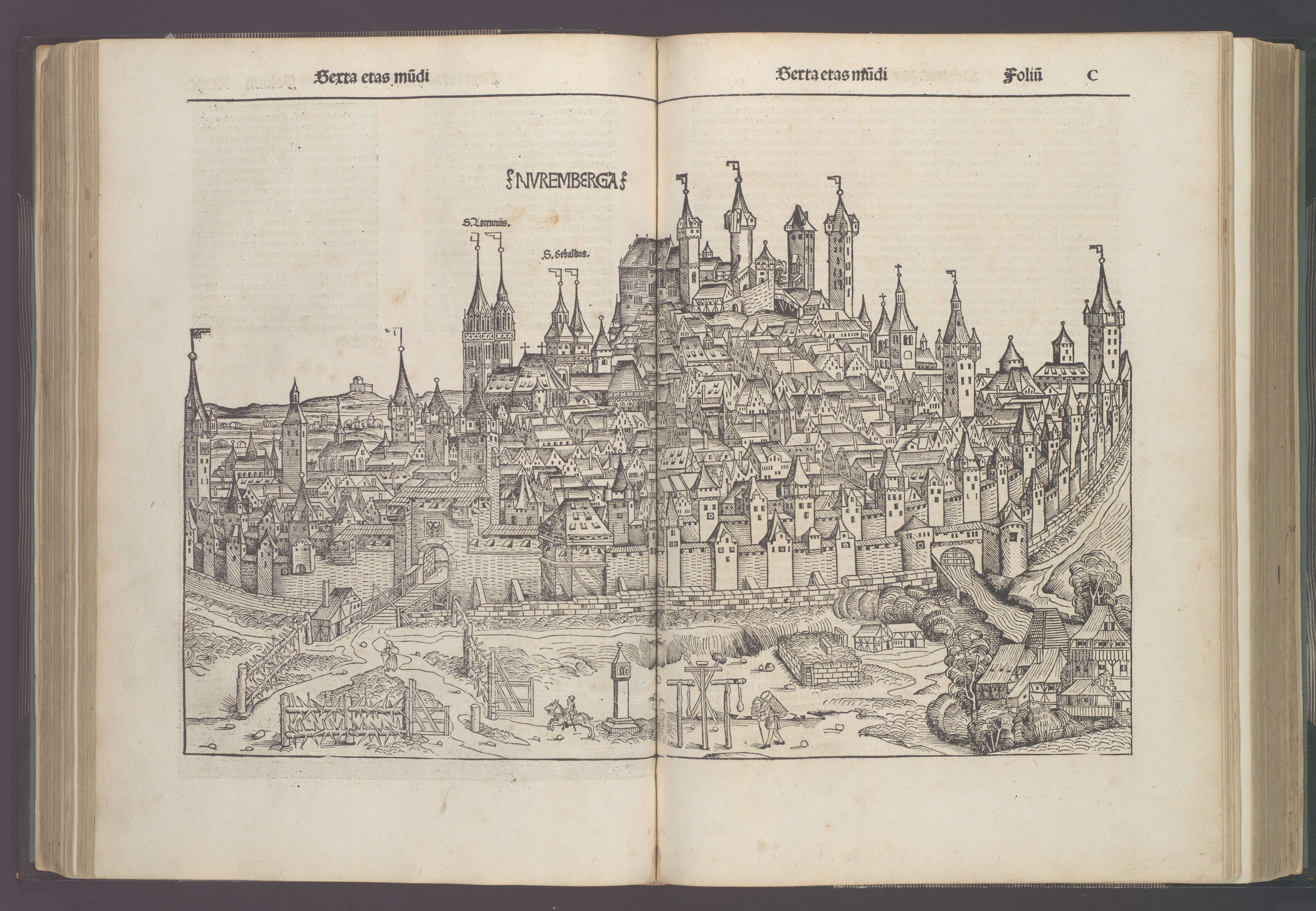
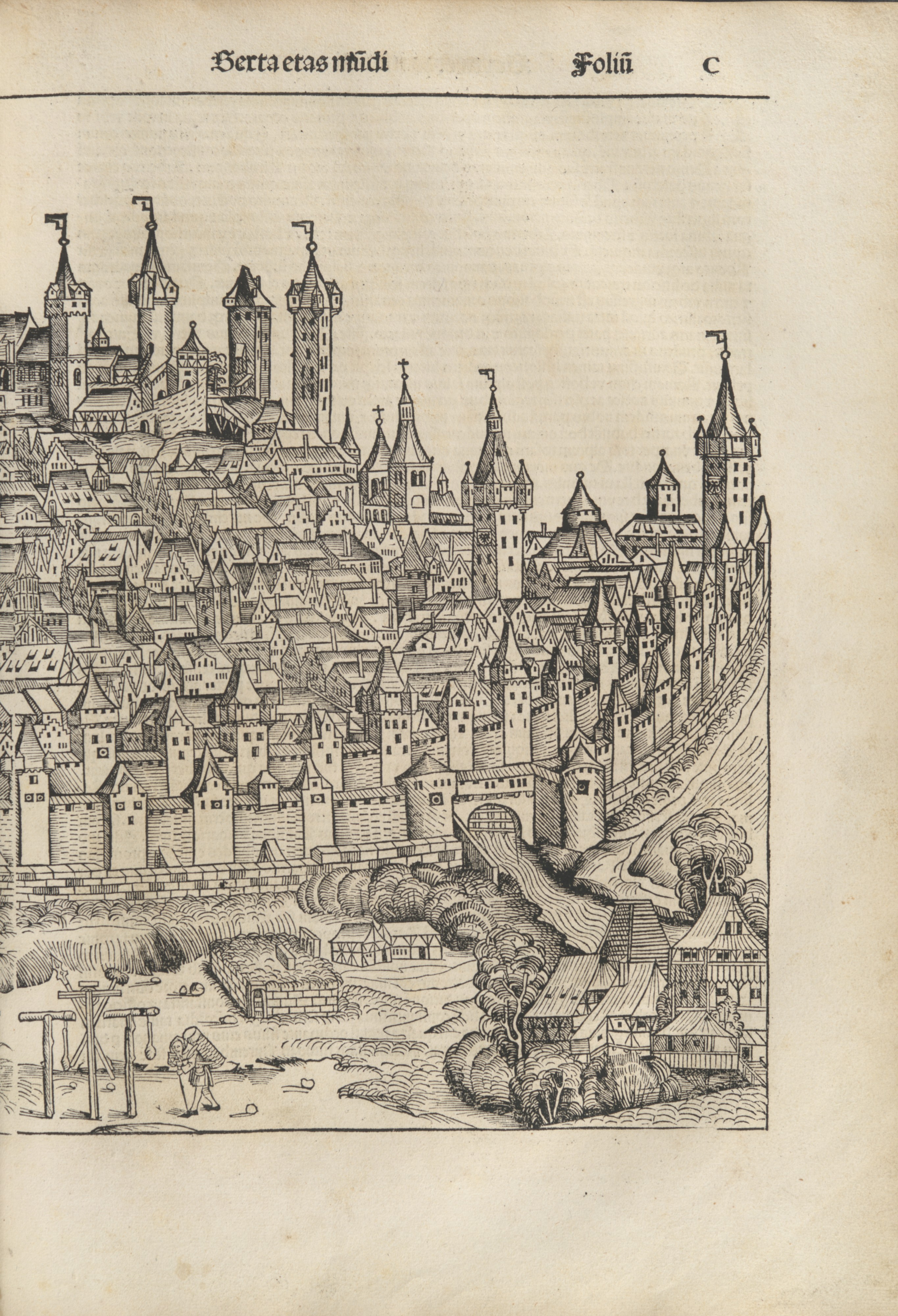
This copy, opened to the double-page woodcut view of Nuremberg itself, captioned NVREMBERGA, placed at the opening of the sixth age of the world. Photographed directly for this record from the Metropolitan Museum of Art's own open-access image of accession 1981.1178.29; no color or rubrication is visible on the leaf.
| Artist | Michael Wolgemut, with Wilhelm Pleydenwurff and their Nuremberg workshop |
|---|---|
| Date | Nuremberg, printed by Anton Koberger; Latin edition completed 12 July 1493 |
| Medium | Letterpress on paper, with woodcut illustrations printed in black ink from wooden blocks; uncolored in this copy |
| Dimensions | 45.2 x 32.2 x 7 cm closed, per the Metropolitan Museum of Art's catalogue record |
| Where it is now | The Metropolitan Museum of Art, New York, Department of Drawings and Printslast confirmed |
| Inventory number | Accession number 1981.1178.29; object ID 356792 |
| Attribution | DisputedThe roughly 1,800 woodcut impressions (from 645 blocks) are contracted to the Nuremberg workshop of Michael Wolgemut and his stepson Wilhelm Pleydenwurff. Full note |
| Object type | Printed book |
| Period | German, fifteenth century |
| Cases | Disputed attribution · Has a provenance gap |
| Inscriptions | None recorded by the Metropolitan Museum of Art beyond the printed text and printed page and folio numbers; no manuscript ownership inscription or bookplate is noted in the Museum's public record |
| Owners on record | 5 links4 documented, 1 unknown |
| Sources | 16 cited |
About this record Last verified · 16 sources cited · Change log
On this page 10 sections
ContentsClose
A copy of the most heavily illustrated book of the fifteenth century: Hartmann Schedel's universal history from the Creation to 1493, printed by Anton Koberger in Nuremberg and carrying about 1,800 woodcut impressions pulled from 645 blocks. This copy, uncolored and rebound at an unrecorded date, entered the Metropolitan Museum of Art in 1981 as the gift of Mrs. George Khuner, and almost nothing is documented about where it was for the four and a half centuries before that.
The book's real dispute is not about this copy's ownership, which is thin rather than contested, but about who cut its pictures. The woodcuts are contracted to the Nuremberg workshop of Michael Wolgemut and his stepson Wilhelm Pleydenwurff. Albrecht Durer served his apprenticeship in that same workshop for the three years immediately before the contract, and no cut in the book carries a signature. Whether any specific image is the young Durer's own work, Wolgemut's, or an unnamed journeyman's has been argued by named scholars for decades and has never been settled.
What is certain is what the object itself shows: a plain, unrubricated, uncolored copy of an edition that other surviving copies show hand-colored, sometimes at the press and sometimes decades later by a private owner. The difference between those two kinds of copy is a real, documented, and frequently mismarketed distinction, and this copy's plainness is itself evidence.
Provenance
Each link is graded. Documented: a cited source supports it. Disputed: the identification is argued but not established. Unknown: no owner for that span, and the gap is not smoothed into a narrative. The grades in the glossary.
- 1493 -The Nuremberg printing house of Anton Kobergerdocumented
Printed in Nuremberg; the Latin edition was completed 12 July 1493. Bibliographic estimates of the Latin print run range from about 1,300 to about 1,500 copies depending on the source, of which roughly 400 are thought to survive.1234
- 1493 - 1981Unknownunknown
No owner is documented for this copy across a span of roughly four hundred and eighty-eight years. Nothing in the Metropolitan Museum's public record or in the other sources consulted for this record identifies an intermediate owner, sale, or location.12
- - 1981George Khunerdocumented
The Museum's credit line names this book as part of The George Khuner Collection. No acquisition date, source, or biographical detail about Khuner was found in the sources consulted; his ownership is documented only by the Museum's own credit line, not independently corroborated.12
- 1981 - presentThe Metropolitan Museum of Art, New Yorkdocumented
Gift of Mrs. George Khuner, 1981. Accession number 1981.1178.29, object ID 356792, Department of Drawings and Prints. Marked public domain in the Museum's own open-access data.12
- Art Bookbinding Studiodocumented
The Museum's constituent record credits the Art Bookbinding Studio as binder, meaning the volume was rebound at some point after 1493. No date is given for the rebinding, and no part of a binding contemporary with the printing is recorded as surviving.12
Prices realised
| Date | Sale | Estimate | Result | Note |
|---|---|---|---|---|
| 11 December 2020 | Bonhams | USD 200,000 - 300,000 | With premium USD 437,813 (premium-inclusive total) USD | A different copy from the one described in this record: a hand-colored Latin first edition in its original first Nuremberg binding, sold at Bonhams' Fine Books and Manuscripts sale in New York and announced by the house as a new world auction record for the Nuremberg Chronicle. Bonhams' own press materials state a single total of USD 437,813 realized against the estimate and do not separate a hammer price from the buyer's premium; this record does not invent a split its source does not provide. Not a sale of the Khuner copy, which has no recorded auction history. |
Hammer is the price at which the bidding stopped; with premium adds the fee the house charges the buyer on top. Hammer price and buyer's premium in the glossary.
Technical evidence
| Attribution note | The roughly 1,800 woodcut impressions (from 645 blocks) are contracted to the Nuremberg workshop of Michael Wolgemut and his stepson Wilhelm Pleydenwurff. No artist in the workshop signed a single cut. Albrecht Durer was apprenticed to Wolgemut from 1486 to 1489, overlapping the years the workshop was designing and cutting the blocks, and scholars including Erwin Panofsky, Leonhard Sladeczek, Adrian Wilson and Stephan Fussel have argued over whether any specific woodcut is the young Durer's own hand rather than his master's or a journeyman's. No consensus exists. This record treats every unsigned attribution to Durer as argued, not established. |
|---|---|
| Collation and illustration count | Folio; approximately 1,800 woodcut impressions printed from 645 physical blocks, many blocks reused under different captions for different cities, rulers, or popes.34 |
| Block economy | Only 53 city-view blocks stand for 101 different named cities and countries, and only 96 portrait-type blocks stand for 593 different named saints, popes, kings, and scholars; a single block appears an average of about six times across the book under different captions.15 |
| Support | Printed on paper (not vellum). Vassar College's account of the printing estimates roughly 400,000 sheets of large superregal paper were required, drawn from more than one mill.4 |
| Dimensions | 45.2 x 32.2 x 7 cm closed, per the Metropolitan Museum of Art's own catalogue record for this object.12 |
| Text and printing | Latin text, letterpress, printed by Anton Koberger's Nuremberg press; the Latin edition was completed 12 July 1493, printed over a run bibliographers estimate at roughly 1,300 to 1,500 copies depending on source.34 |
| Color and rubrication | Uncolored and unrubricated in this copy: no red or blue was added by hand to any initial, headline, or chapter mark in any of the five openings photographed by the Metropolitan Museum and examined for this record.12 |
| Binding | Rebound at an unrecorded date by the Art Bookbinding Studio, a twentieth-century American bindery credited in the Museum's constituent record; no part of a binding contemporary with the 1493 printing is recorded as surviving with this copy.12 |
| Credit line and accession | The George Khuner Collection, Gift of Mrs. George Khuner, 1981. Accession number 1981.1178.29; object ID 356792; Department of Drawings and Prints.12 |
| Rights status | Marked public domain (isPublicDomain: true) in the Metropolitan Museum's own open-access data, which is the basis on which this record's photographs were sourced.2 |
Images
The record in full
Chapter 1What the book is
The Liber Chronicarum, known in English as the Nuremberg Chronicle, is a universal history of the world from the Creation to the year of its own printing, 1493, compiled in Latin by the Nuremberg...
The Liber Chronicarum, known in English as the Nuremberg Chronicle, is a universal history of the world from the Creation to the year of its own printing, 1493, compiled in Latin by the Nuremberg physician and humanist Hartmann Schedel and printed by Anton Koberger. It is organized as six ages of the world, from Adam to Noah, Noah to Abraham, Abraham to David, David to the Babylonian captivity, the captivity to the birth of Christ, and the birth of Christ to Schedel's own present. A seventh age, still to come, is given over to the Antichrist, and the book closes with the Last Judgment. Genealogies, papal and imperial successions, and city views are threaded through the historical narrative, and the whole is illustrated far more heavily than any printed book before it: about 1,800 separate woodcut impressions, pulled from 645 physical blocks, many of the blocks reused under different captions for different towns, kings, or popes when no specific image existed or could be justified as worth cutting twice.
This copy is the Latin first edition. It is unrubricated: no chapter headings, initials, or paragraph marks were added by hand in red or blue, and no part of it is hand-colored. That is a plain, working copy of the kind Koberger's press produced in the low thousands, not one of the smaller number of copies a purchaser paid an illuminator to finish.
Chapter 2Who paid for it, and how it was printed
The book was commissioned by two Nuremberg merchants, Sebald Schreyer and his brother-in-law Sebastian Kammermeister, who contracted in 1491 with Michael Wolgemut and Wilhelm Pleydenwurff for the...
The book was commissioned by two Nuremberg merchants, Sebald Schreyer and his brother-in-law Sebastian Kammermeister, who contracted in 1491 with Michael Wolgemut and Wilhelm Pleydenwurff for the illustrations and, separately, with Anton Koberger for the printing. Koberger ran the largest publishing and printing operation in Germany at the time the Chronicle went to press, reportedly with as many as eighteen or more presses working simultaneously at his peak in the 1490s. Printing the Latin edition ran from March 1492 to 12 July 1493; a German translation followed by 23 December of the same year. Bibliographers differ on the exact print run: one widely cited estimate puts it at roughly 1,400 to 1,500 Latin copies and 700 to 1,000 German copies, of which about 400 Latin and 300 German are thought to survive; a separate accounting from Vassar College's Special Collections gives roughly 1,300 Latin and 600 German copies. The two figures are both bibliographic estimates rather than a documented print total, and this record reports both rather than averaging them into a false precision.
The scale of production was itself unusual for the period. Vassar's account of the printing puts the paper requirement at some 400,000 sheets of large superregal stock, drawn from more than one mill, and notes that cutting and casting the type alone occupied several months before a single sheet of the Chronicle went through a press. A document from 1509, sixteen years after publication, records 539 unsold Latin copies and 60 unsold German copies still in the printer's or the financiers' hands, which is a plain statement that the book had not sold through and that its backers had overestimated the market for it.
One secondary account, Citizendium's entry on the Chronicle, gives the original retail price as 2 gulden for a copy sold unbound and uncolored, rising to roughly three times that for a copy bound and colored, and equates the unbound price to the contemporary cost of about 120 pounds of beef. This record treats that figure as a tertiary source's report rather than a verified primary price list, and flags it for replacement with a documented period price record if one can be found; it is nonetheless useful for scale, since it puts even the plainest copy, of the kind the Khuner copy is, well above the price of an ordinary purchase for most fifteenth-century buyers.
Chapter 3Anton Koberger, the printer
Anton Koberger, about 1440 or 1445 to 3 October 1513, ran Nuremberg's first printing house and, by the 1490s, one of the largest publishing operations in Germany.
Anton Koberger, about 1440 or 1445 to 3 October 1513, ran Nuremberg's first printing house and, by the 1490s, one of the largest publishing operations in Germany. Estimates of his press's scale differ slightly by source: Vassar College's account of the Chronicle's printing gives eighteen or more presses running at his peak, while Wikipedia's biography of Koberger gives twenty-four presses and about one hundred employees. Over his career he published some 220 titles. He had trained as a goldsmith before turning to printing around 1470.
Koberger's connection to the Chronicle's disputed apprentice was personal as well as commercial: he was Albrecht Durer's godfather, and the Durer family lived on the same Nuremberg street as the Kobergers. He is also thought to have commissioned a later Durer painting, the Haller Madonna, as a wedding gift for his own daughter, though that picture has nothing to do with this book.
The Chronicle's commercial success was immediate enough to attract theft rather than only sales. Pirated editions, most notably Johann Schonsperger's cheaper Augsburg reprints of 1496 and 1500, appeared within a few years of Koberger's own printing, copying the layout and woodcut compositions at smaller size and lower cost. That piracy, arriving before the 1509 stocktaking that found hundreds of Koberger's own copies still unsold, suggests the market was real but that Koberger's financiers had priced and sized the print run for a demand the pirated editions then undercut.
Chapter 4The economics of a reused woodblock
The Chronicle's illustration programme looks far larger than it is because the workshop built it out of a small number of blocks used repeatedly.
The Chronicle's illustration programme looks far larger than it is because the workshop built it out of a small number of blocks used repeatedly. Letterform Archive's account of the printing states that only 53 city views were cut to represent 101 different named cities and countries, and only 96 portrait-type cuts were used to represent 593 different named saints, popes, kings, and scholars; on average, a single block appears about six times across the book under different captions. A reader flipping through a copy quickly notices the same skyline standing for two unrelated towns, or the same generic bearded face captioned with two different names a hundred pages apart. This was not carelessness. Cutting an individual block was the most expensive and slowest part of production, and reusing one for a minor town or a minor scholar the compilers had no specific image for was the only way to keep the book's price and production schedule within what its financiers had budgeted.
Chapter 5The workshop that made the pictures
The woodcuts are the work of the Nuremberg workshop of the painter Michael Wolgemut and his stepson Wilhelm Pleydenwurff, contracted for the purpose in 1491 alongside the printing agreement.
The woodcuts are the work of the Nuremberg workshop of the painter Michael Wolgemut and his stepson Wilhelm Pleydenwurff, contracted for the purpose in 1491 alongside the printing agreement. Wolgemut ran one of the largest workshops in the city, producing panel paintings, altarpieces, and designs for woodcut and stained glass with the help of numerous assistants, and the Chronicle commission was executed inside that existing shop rather than by any single named hand working alone.
No woodcut in the book is signed. That is not unusual for the period, when book illustration was treated as workshop production rather than as an individually authored artwork, but it means that every specific attribution inside the corpus of 645 blocks rests on connoisseurship, comparison with signed or securely documented work elsewhere, and argument, not on anything printed in the book itself.
Chapter 6The Durer question
This is the book's genuine, unresolved dispute.
This is the book's genuine, unresolved dispute. Albrecht Durer was apprenticed in Wolgemut's workshop from 1486 to 1489, immediately before the Chronicle's illustration contract was signed and while its earliest design work is thought to have begun. He would have been between fifteen and eighteen years old during his time there, and by his own later account he left Wolgemut's shop in 1490 to travel before returning to Nuremberg and setting up independently in 1495.
Whether any of the Chronicle's woodcuts show Durer's own hand, rather than Wolgemut's, Pleydenwurff's, or an unnamed journeyman's, has been argued in print for close to a century. Vassar College's own account of the printing names Erwin Panofsky, Leonhard Sladeczek, Adrian Wilson and Stephan Fussel among scholars who have taken up the question, and states plainly that Durer's contribution, if any, has never been definitively proven. Wikipedia's summary of the same debate is blunter still: there is no consensus, and the absence of any signed cut in the entire book means the question cannot be closed by evidence internal to the object. What can be said with confidence is only that a fifteen-to-eighteen-year-old apprentice was physically present in the workshop that produced these blocks during the years they were designed, which makes the possibility of his involvement real without making any single image his.
This record does not attribute any specific woodcut to Durer. Where later cataloguers, dealers, or museums have done so, including the National Gallery of Art's own artist credit for its copy, that is their argued position, not a settled fact, and it is recorded here as argued.
Chapter 7Six ages, a seventh, and Nuremberg as the New Jerusalem
The Chronicle's structure is not neutral bookkeeping.
The Chronicle's structure is not neutral bookkeeping. Dividing history into six ages culminating in the reader's own lifetime, followed by a seventh age of the Antichrist and a final section on the Last Judgment, was a standard medieval Christian scheme, but Schedel used it to make a specific claim about where his own city stood in sacred time. The chronicle places a view of Nuremberg at the opening of the sixth age, the Christian era, and presents the city in terms that identify it with the New Jerusalem, an authorial choice rather than an inherited convention, since other chronicles of the period made no such claim for any German city.
Schedel's own stated motive, reported in the secondary literature on the book, was to correct what he saw as an injustice: that earlier universal chronicles had slighted German history relative to the history of Italy, Greece, and Rome. The book's enormous illustration programme, the largest ever attempted in print to that date, served that ambition directly. A reader who could not read Schedel's Latin could still see, in the reused and city-specific woodcuts alike, how large a place Germany and above all Nuremberg occupied in a history that ran from Adam to the reader's own century. This is a documented editorial intention, not a hidden one: it sits in the placement and the text of the book itself, and it requires no argument from resemblance to establish.
Chapter 8Hartmann Schedel, physician and collector
Hartmann Schedel, 1440 to 1514, was a Nuremberg physician and humanist who compiled the Chronicle's text; he did not design or cut its pictures, and his role in this record's `artist` field is...
Hartmann Schedel, 1440 to 1514, was a Nuremberg physician and humanist who compiled the Chronicle's text; he did not design or cut its pictures, and his role in this record's `artist` field is deliberately given to Wolgemut's workshop rather than to him, since the disputed craftsmanship belongs there. Schedel was also a considerable book collector, and part of his personal library survives, chiefly in the Bayerische Staatsbibliothek in Munich, which also holds Schedel's own annotated copy of the Chronicle he compiled, bound with Erhard Etzlaub's later Rom-Weg pilgrimage map added after 1500. That fact belongs to the Munich copy specifically, not to the Khuner copy described in this record, and this record does not claim otherwise.
Chapter 9This copy: what the Museum's own photographs show
The Metropolitan Museum publishes ten of its own photographs of this copy under its open-access policy, and this record was written after examining five of them directly.
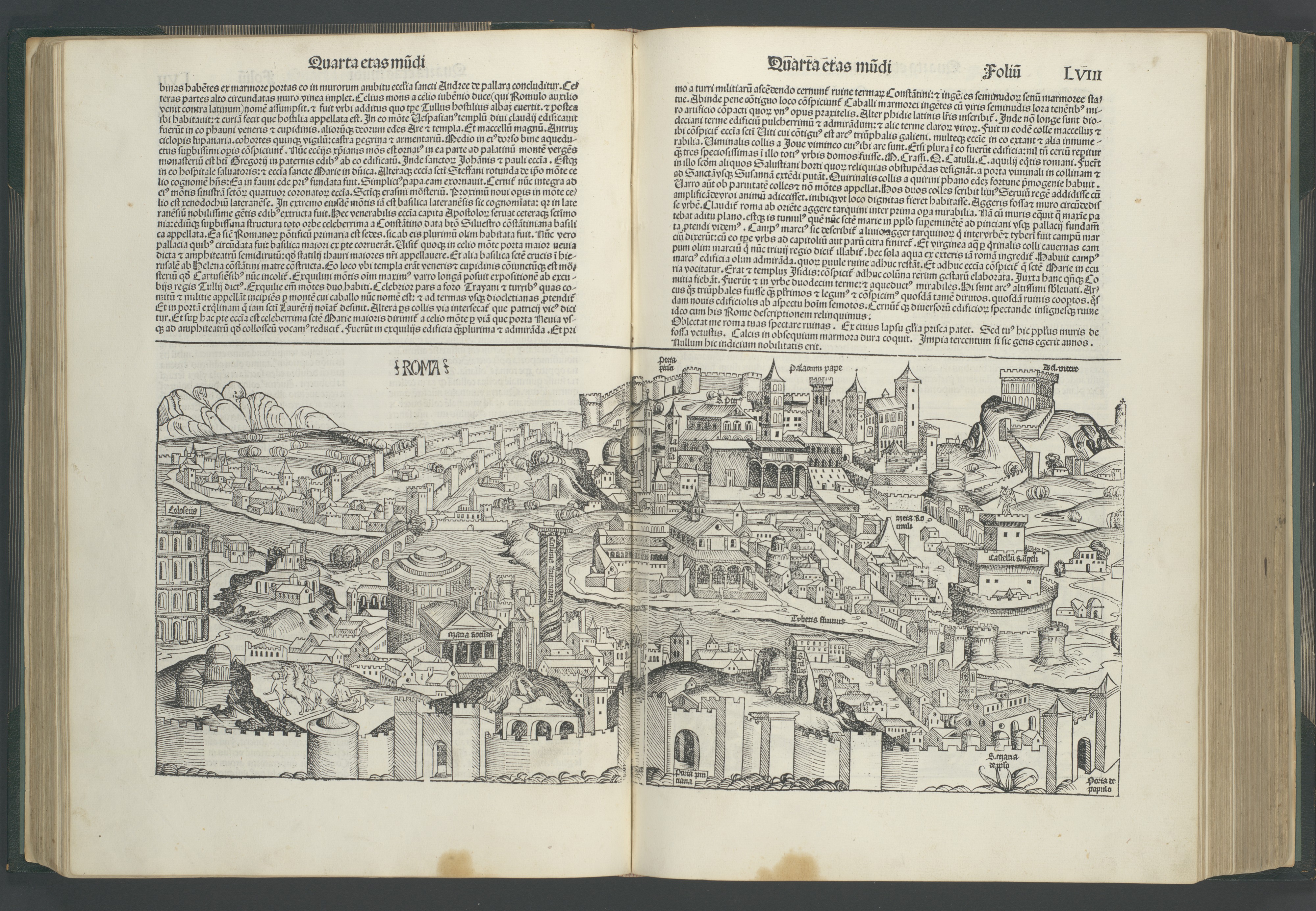
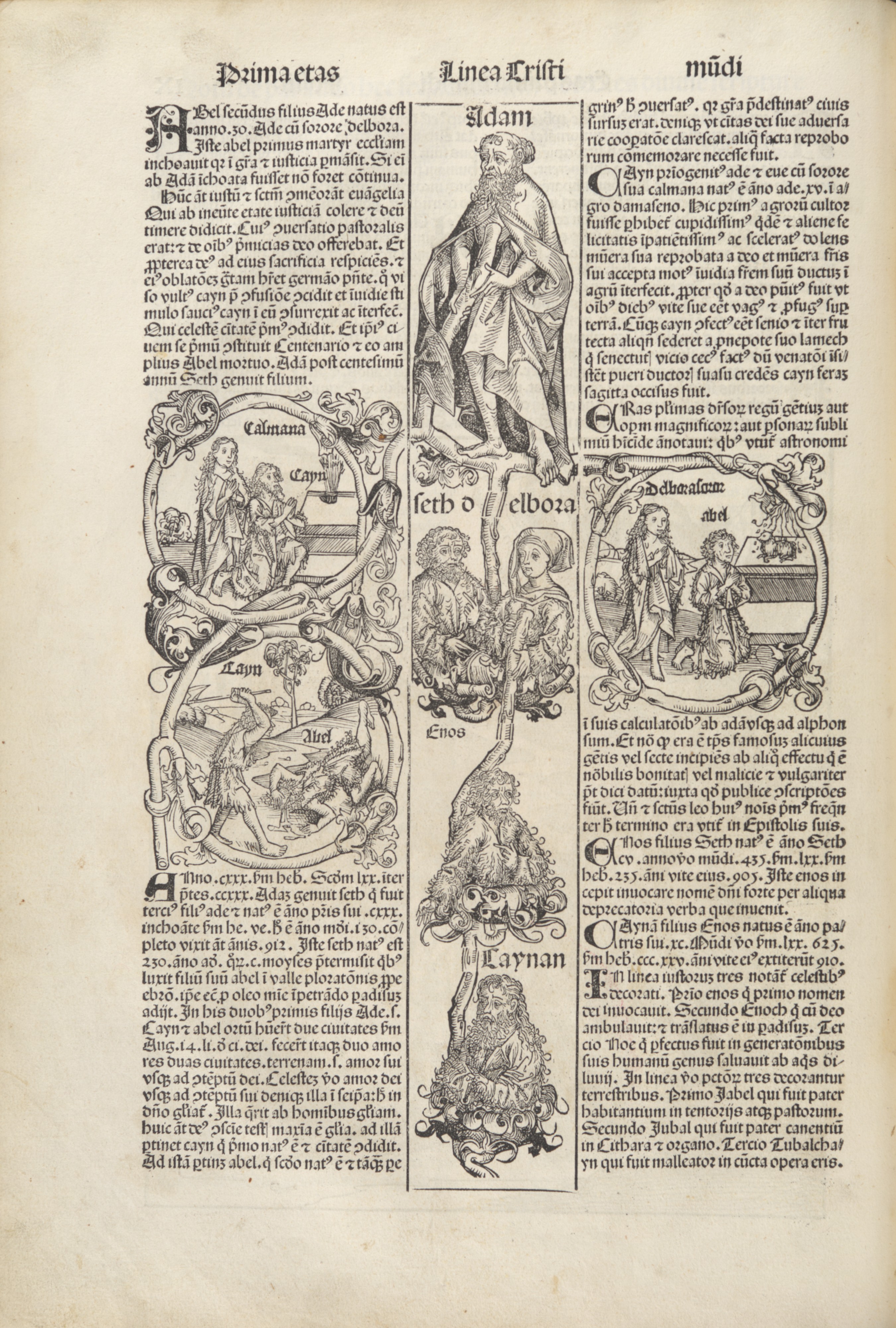
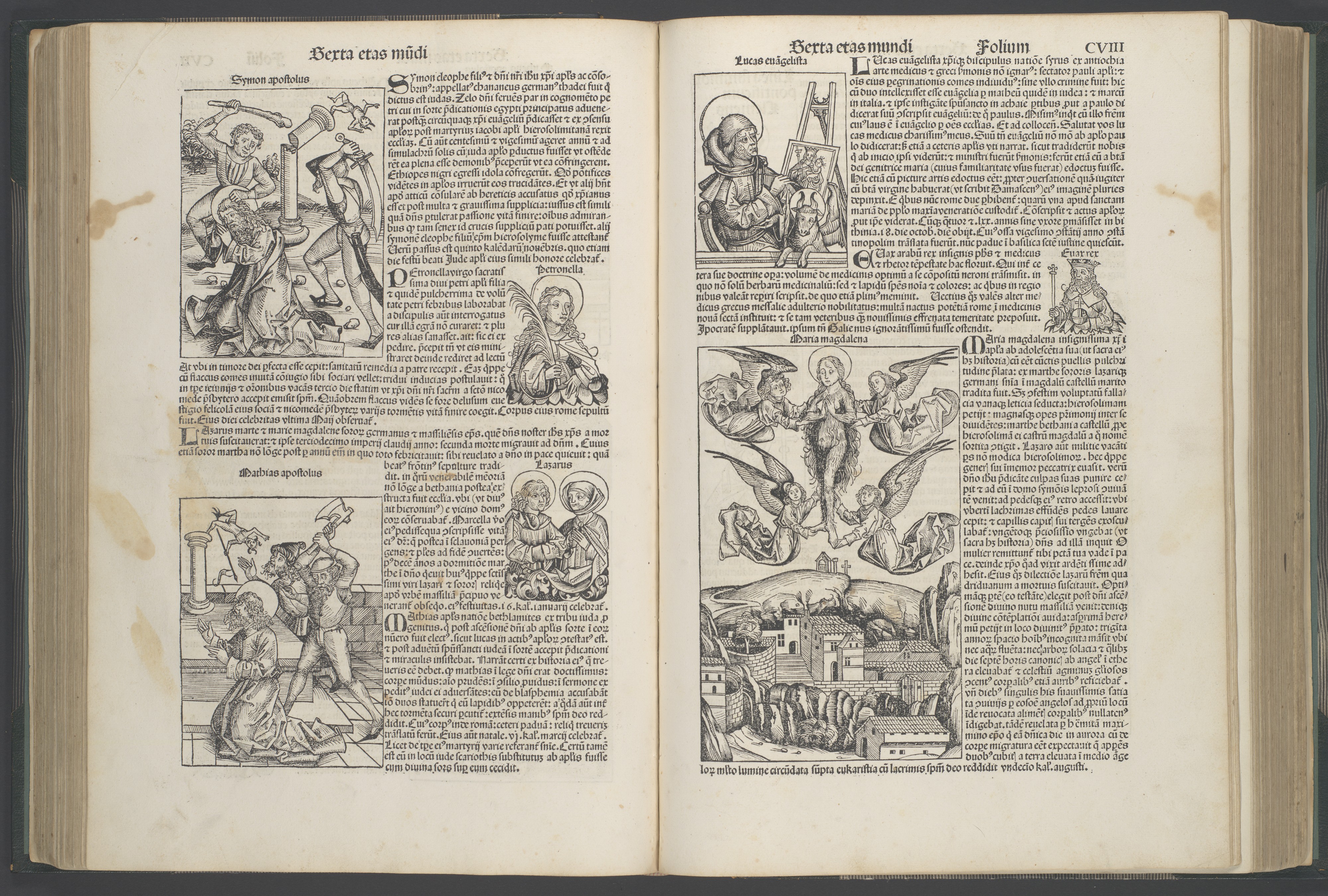
The Metropolitan Museum publishes ten of its own photographs of this copy under its open-access policy, and this record was written after examining five of them directly. They show a Latin first edition, bound as a single thick folio volume, opened in the photographs to the double-page woodcut view of Nuremberg itself (captioned NVREMBERGA, at what the printed foliation gives as folio C), to the Rome cityscape at folio LVIII, to a genealogical page from the First Age at folio X, and to an illustrated leaf from the Sixth Age carrying woodcuts of the apostles Simon and Matthias, Saint Petronella, Saint Luke painting the Virgin with his ox, and Mary Magdalene borne up by angels, at folios CVII to CVIII.
None of the photographed openings shows any hand-coloring, and none shows rubrication: no red or blue is visible on any initial, headline, or chapter mark in any of the five leaves examined. The book is described in the Museum's own record only as printed with woodcut illustrations, with no mention of color, which is consistent with what the photographs show. This is worth stating plainly because a reader searching for the Nuremberg Chronicle will find many hand-colored copies illustrated online, and this copy is not one of them.
The Museum's constituent record names a binder, the Art Bookbinding Studio, meaning the volume has been rebound at some point since 1493 by a named twentieth-century American bindery rather than surviving in a binding contemporary with its printing. No date is given for that rebinding in the public record, and this record treats the date as unknown rather than guessing at it.
Chapter 10The Khuner Collection, and what is not documented about it
The Museum's credit line for this copy reads: The George Khuner Collection, Gift of Mrs.
The Museum's credit line for this copy reads: The George Khuner Collection, Gift of Mrs. George Khuner, 1981. That sentence is the entire documented provenance available in the sources consulted for this record. It establishes that the book was part of a collection assembled by or associated with a man named George Khuner, and that it reached the Metropolitan Museum as a gift from his widow in 1981. It does not establish when or from whom Khuner acquired the book, where it had been between 1493 and whenever he acquired it, or any biographical detail about Khuner himself. No search conducted for this record turned up a public account of who George Khuner was.
One structural detail is worth recording without overstating it. The accession number, 1981.1178.29, follows the Museum's ordinary convention of grouping a single year's gift from one source under one root number with a sequential suffix for each object, which is consistent with Mrs. Khuner having given the Museum a group of objects in 1981 rather than this single volume alone. That is an inference from ordinary museum accessioning practice, not a documented fact about the Khuner collection's contents, and it is offered here only as a lead for further research, not as a finding.
Chapter 11Color, and the question every hand-colored copy raises
Because this copy is plain, it throws into relief a distinction that the market for the Chronicle regularly blurs: the difference between a copy colored at or near the time of printing and one...
Because this copy is plain, it throws into relief a distinction that the market for the Chronicle regularly blurs: the difference between a copy colored at or near the time of printing and one colored much later by a private owner or a dealer. Bridwell Library at Southern Methodist University holds a specific hand-colored copy, catalogued as Prothro B-03, in which an illuminator filled in blank heraldic shields left in the printed design with the actual coats of arms of two documented sixteenth-century owners, Hartmut XIII von Kronberg and his wife Margarete Brendel von Homburg. Bridwell's own published account of that copy states plainly that the coloring is late sixteenth century, roughly eighty to a hundred years after the book was printed, not contemporary with it. That is a resolved question for that specific copy, established by the owners' coats of arms rather than by pigment analysis, and it stands as a documented example of exactly the kind of dating question a hand-colored copy raises and a plain copy like the Khuner copy does not.
This record makes no claim about the coloring status of any copy other than the two named here. It does not know, and does not guess, whether the Khuner copy was ever intended for coloring and left unfinished, or was always meant to remain plain; nothing in the Museum's public record answers that question, and it is carried into this record's open questions rather than resolved by assumption.
Chapter 12The market for this book
Nuremberg Chronicle copies reach the auction market with some regularity, because enough survive, in enough different states of completeness, coloring, and binding, to support a continuing trade.
Nuremberg Chronicle copies reach the auction market with some regularity, because enough survive, in enough different states of completeness, coloring, and binding, to support a continuing trade. The current benchmark is a hand-colored first edition sold at Bonhams in New York on 11 December 2020, described by the house as bound in its original first Nuremberg binding and carrying bold contemporary hand-coloring; it sold for 437,813 US dollars against a pre-sale estimate of 200,000 to 300,000 dollars, which Bonhams announced as a new world auction record for the book. The press materials consulted for this record state the total realized price rather than separating hammer from premium, and this record does not invent a split that its source does not provide.
A plain, unrubricated, rebound copy without a recorded early provenance, such as the Khuner copy, is not comparable to that Bonhams lot and this record makes no claim about what it would fetch if sold; coloring, an original or near-original binding, and a documented early history are each independently valuable to buyers of incunabula, and this copy has none of the three.
Chapter 13Other named copies, for comparison
Setting the Khuner copy against a small sample of other named institutional copies shows how differently individual survivors of the same print run can be documented.
Setting the Khuner copy against a small sample of other named institutional copies shows how differently individual survivors of the same print run can be documented. The Boston Athenaeum bought its Latin Liber Chronicarum in 1847 using the proceeds of its Bromfield Fund, giving that copy a clean nineteenth-century institutional acquisition record. The Wellcome Collection in London holds three copies; its Copy 1, shelfmark EPB/INC/5.f.6, is rubricated and partly hand-colored, carries extensive contemporary manuscript marginal notes from an early, unidentified owner, and bears the bookplate of William Morris's Kelmscott House library, from which it was bought at Sotheby, Wilkinson and Hodge between 5 and 10 December 1898, the sale that dispersed Morris's library after his death. The Bayerische Staatsbibliothek in Munich holds Hartmann Schedel's own copy, annotated in his hand and bound with additional material.
None of those three copies is the Khuner copy, and none of their provenance, coloring, or annotation belongs to it. They are recorded here only as comparanda: evidence of how unevenly documentation survives across copies of an edition that, on the page, is otherwise identical from one surviving example to the next.
Chapter 14Reproduction and circulation, then and now
The Chronicle's images began circulating outside Koberger's own edition almost immediately, through the Schonsperger piracies of 1496 and 1500 noted above, which is itself a form of reproduction...
The Chronicle's images began circulating outside Koberger's own edition almost immediately, through the Schonsperger piracies of 1496 and 1500 noted above, which is itself a form of reproduction history: the pictures were valuable enough to copy and undercut within three years of first publication, decades before copyright in any modern sense existed to stop it.
In its modern circulation, the German edition has been reproduced in facsimile: Taschen published a 2001 facsimile of the German text in Cologne, based on the copy held by the Herzogin Anna Amalia Bibliothek in Weimar, with an added English-language introduction and appendix. That is a different copy again from the Khuner copy, reproduced from a different institution's holding, and this record does not claim any connection between the two beyond both being copies of the same edition. No IIIF manifest or published technical imaging specific to the Khuner copy was found in the sources consulted; the Metropolitan Museum's own ten open-access photographs, examined for this record, are the fullest public documentation of this particular copy currently available.
Chapter 15What remains unresolved
Two different kinds of question sit unanswered in this record, and they should not be confused with each other.
Two different kinds of question sit unanswered in this record, and they should not be confused with each other. One is a scholarly question about the book as an edition: how much, if any, of the woodcut corpus is the young Durer's own work, a question that has been argued by named art historians for most of a century without resolution and that no examination of any single copy, including this one, can settle, because the evidence would have to be stylistic rather than documentary in the absence of any signature. The other is a plain gap in this specific copy's paper trail: where it was for roughly four hundred and eighty-eight years between its printing in 1493 and its appearance in the Khuner collection by 1981, who George Khuner was, and when the volume was rebound. Both kinds of gap are recorded as gaps in this record rather than bridged with a plausible-sounding guess.
The artist
Michael Wolgemut
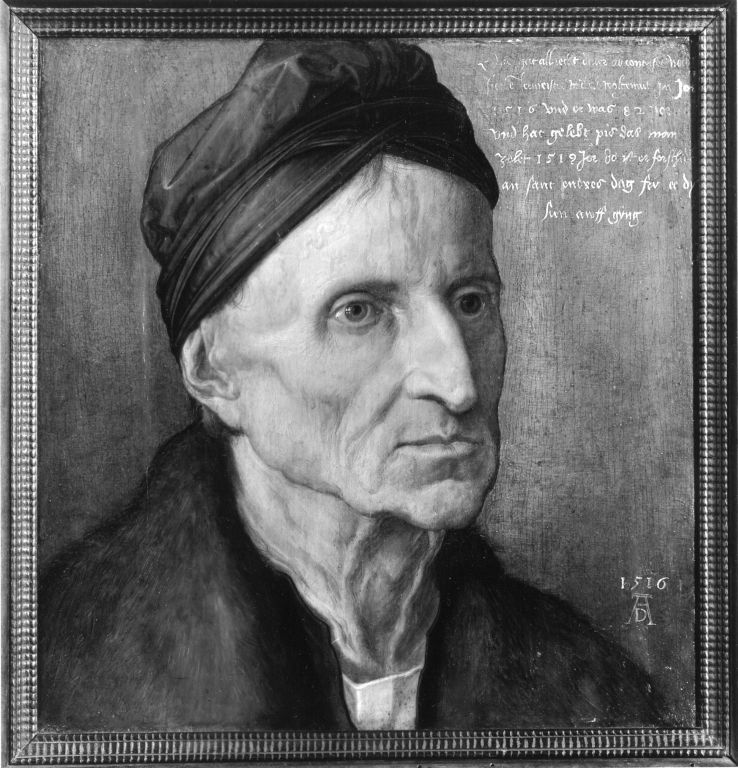
Michael Wolgemut ran the Nuremberg workshop under whose contract the Chronicle's woodcuts were produced, and he is the closest thing this book has to a named artist, even though not one of its roughly 1,800 illustrations carries his signature or anyone else's. What can be said about him rests on documented biography, a securely dated and inscribed portrait, and a contract; what cannot be said, and what this dossier does not claim, is which specific cuts in the Chronicle came from his own hand rather than his stepson's, an assistant's, or his most famous apprentice's.
Related works
| Work | Relation | Where it is |
|---|---|---|
| Liber Chronicarum, Copy 1 (Prothro B-03) Workshop of Michael Wolgemut and Wilhelm Pleydenwurff | Same edition, hand-colored copy with a documented late-sixteenth-century coloring date and named owners Coats of arms of Hartmut XIII von Kronberg and Margarete Brendel von Homburg, added by an illuminator roughly eighty to a hundred years after printing. | Bridwell Library, Southern Methodist University, Dallas |
| Liber Chronicarum, Copy 1 Workshop of Michael Wolgemut and Wilhelm Pleydenwurff | Same edition, with a documented nineteenth-century owner Carries the bookplate of William Morris's Kelmscott House library; bought at the December 1898 Sotheby, Wilkinson and Hodge sale that dispersed Morris's library after his death, and extensive contemporary manuscript marginal notes from an unidentified earlier owner. | Wellcome Collection, London (shelfmark EPB/INC/5.f.6) |
| Liber Chronicarum, Schedel's own copy Workshop of Michael Wolgemut and Wilhelm Pleydenwurff | Same edition, the compiler's personal annotated copy Bound with Erhard Etzlaub's Rom-Weg pilgrimage map, added after 1500, and part of what survives of Hartmann Schedel's own library. | Bayerische Staatsbibliothek, Munich |
| Liber Chronicarum Workshop of Michael Wolgemut and Wilhelm Pleydenwurff | Same edition, bought by public subscription in the nineteenth century Purchased in 1847 with proceeds of the Athenaeum's Bromfield Fund. | Boston Athenaeum |
| Portrait of Michael Wolgemut Albrecht Durer | A documented portrait of the workshop master by his most famous former apprentice Painted 1516, with an inscription Durer added recording Wolgemut's death in 1519; not a picture of this book, but the clearest surviving link between the two names at the center of the attribution dispute. | Germanisches Nationalmuseum, Nuremberg |
Open questions
- Which, if any, of the Chronicle's roughly 1,800 woodcut impressions were designed or cut by the young Durer rather than by Wolgemut, Pleydenwurff, or an unnamed journeyman? Argued by named scholars for decades, unresolved, and not answerable from any single copy in the absence of a signature.
- Where was the Khuner copy between its printing in 1493 and its appearance in George Khuner's collection by 1981? No owner is documented for that span.
- Who was George Khuner, and when and from whom did he acquire this copy? No public biographical account was found in the sources consulted for this record.
- When was the Khuner copy rebound by the Art Bookbinding Studio, and does any part of an earlier binding survive in the Museum's files even if not on the book itself?
- Was the Khuner copy ever intended for hand-coloring or rubrication and left unfinished, or was it always meant to remain plain? Nothing in the Museum's public record answers this.
- Does the accession number 1981.1178 correspond to a larger group gift from Mrs. Khuner, and if so, what other objects did it include and are their present locations documented?
Questions about this object
What is Liber Chronicarum, the Khuner copy?
Liber Chronicarum, the Khuner copy is a printed book, dated nuremberg, printed by Anton Koberger; Latin edition completed 12 July 1493. Medium: Letterpress on paper, with woodcut illustrations printed in black ink from wooden blocks; uncolored in this copy.
Who made Liber Chronicarum, the Khuner copy, and is the attribution settled?
The attribution to Michael Wolgemut, with Wilhelm Pleydenwurff and their Nuremberg workshop is recorded here as disputed. The roughly 1,800 woodcut impressions (from 645 blocks) are contracted to the Nuremberg workshop of Michael Wolgemut and his stepson Wilhelm Pleydenwurff. No artist in the workshop signed a single cut. Albrecht Durer was apprenticed to Wolgemut from 1486 to 1489, overlapping the years the workshop was designing and cutting the blocks, and scholars including Erwin Panofsky, Leonhard Sladeczek, Adrian Wilson and Stephan Fussel have argued over whether any specific woodcut is the young Durer's own hand rather than his master's or a journeyman's. No consensus exists. This record treats every unsigned attribution to Durer as argued, not established.
Where is Liber Chronicarum, the Khuner copy now?
The Metropolitan Museum of Art, New York, Department of Drawings and Prints. Inventory number Accession number 1981.1178.29; object ID 356792. Last confirmed 10 August 2026. The George Khuner Collection, Gift of Mrs. George Khuner, 1981.
What is still unknown about Liber Chronicarum, the Khuner copy?
Which, if any, of the Chronicle's roughly 1,800 woodcut impressions were designed or cut by the young Durer rather than by Wolgemut, Pleydenwurff, or an unnamed journeyman? Argued by named scholars for decades, unresolved, and not answerable from any single copy in the absence of a signature.
Sources
- 1The Metropolitan Museum of Art, collection record for Liber Chronicarum, object 356792, accession 1981.1178.29, The George Khuner Collection, Gift of Mrs. George Khuner, 1981. metmuseum.org/art/...
- 2The Metropolitan Museum of Art, Open Access Collection API, object 356792 (accession number, dimensions, isPublicDomain flag, constituents including Art Bookbinding Studio, credit line, and the ten photographs of this copy examined for this record). collectionapi.metmuseum.org/public/...
- 3Wikipedia, 'Nuremberg Chronicle', for the print run estimates, the financing contract, the Durer apprenticeship dates and lack of scholarly consensus, and the six-ages structure. en.wikipedia.org/wiki/...
- 4Vassar College Archives and Special Collections Library, 'The Printing of the Nuremberg Chronicle', for Koberger's press scale, the paper requirement, the printing schedule, the alternative print-run estimate, and the named scholars in the Durer debate (Panofsky, Sladeczek, Wilson, Fussel). vassar.edu/specialcollections/...
- 5Bridwell Library, Southern Methodist University, online exhibit 'Nuremberg Chronicle, 1493', for the Prothro B-03 copy's hand-coloring, its late-sixteenth-century date, and the identification of Hartmut XIII von Kronberg and Margarete Brendel von Homburg from the coats of arms added to the coloring. bridwell.omeka.net/exhibits/...
- 6Bonhams, press release, 'World Record for Extremely Rare Hand-Colored First Edition of the Nuremberg Chronicle', for the 11 December 2020 sale result and its description as a new world auction record. bonhams.com/press_release/...
- 7Bonhams, press release, 'Extremely Rare Hand-Colored First Edition of the Nuremberg Chronicle at Bonhams Fine Books Sale in New York', pre-sale announcement, for the estimate and the lot description. bonhams.com/press_release/...
- 8Wikipedia, 'Michael Wolgemut', for biography, workshop scale, the Durer apprenticeship, other major works, and the 1516 Durer portrait. en.wikipedia.org/wiki/...
- 9Wikipedia, 'Hartmann Schedel', for biography and his personal library. en.wikipedia.org/wiki/...
- 10Wellcome Collection, catalogue record for Liber chronicarum, Copy 1, shelfmark EPB/INC/5.f.6, for the binding, hand-coloring, manuscript marginal notes, the William Morris Kelmscott House bookplate, and the December 1898 Sotheby, Wilkinson and Hodge acquisition. wellcomecollection.org/works/...
- 11Bayerische Staatsbibliothek / Munich Digitization Center (MDZ), collection page for the Nuremberg Chronicle of Hartmann Schedel, for the identification of Schedel's own annotated copy and the added Etzlaub Rom-Weg map. digitale-sammlungen.de/en/...
- 12Boston Athenaeum, 'Liber Chronicarum, Nuremberg, 1493', for the 1847 purchase and the Bromfield Fund. bostonathenaeum.org/news/...
- 13Secondary literature on Durer's 1516 portrait of Michael Wolgemut, for the text of Durer's own inscription recording his master's age and death, as widely published in translation. smallartpress.wordpress.com/2013/...
- 14Wikipedia, 'Anton Koberger', for his biography, press scale, employee count, title count, his godfathering of Durer, the Haller Madonna commission, and the near-immediate pirated editions. en.wikipedia.org/wiki/...
- 15Letterform Archive, 'This Just In: The Nuremberg Chronicle', for the block-reuse figures (53 city-view cuts for 101 places, 96 portrait-type cuts for 593 named figures, an average of six uses per block) and the 2001 Taschen facsimile of the Herzogin Anna Amalia Bibliothek copy. letterformarchive.org/news/...
- 16Citizendium, 'Nuremberg Chronicle', for the reported original retail price (2 gulden unbound and uncolored, roughly three times that bound and colored) and its comparison to the period cost of about 120 pounds of beef. en.citizendium.org/wiki/...
Last verified · Published
Change log
10 August 2026 - Record created at the house standard: researched narrative, technical evidence, maker dossier, graded provenance chain, prices with hammer and premium separated, related works, open questions and sources.