The Works of Geoffrey Chaucer (The Kelmscott Chaucer)
William Morris · 1896 (printing ran August 1894 to 8 May 1896; issued 26 June 1896)
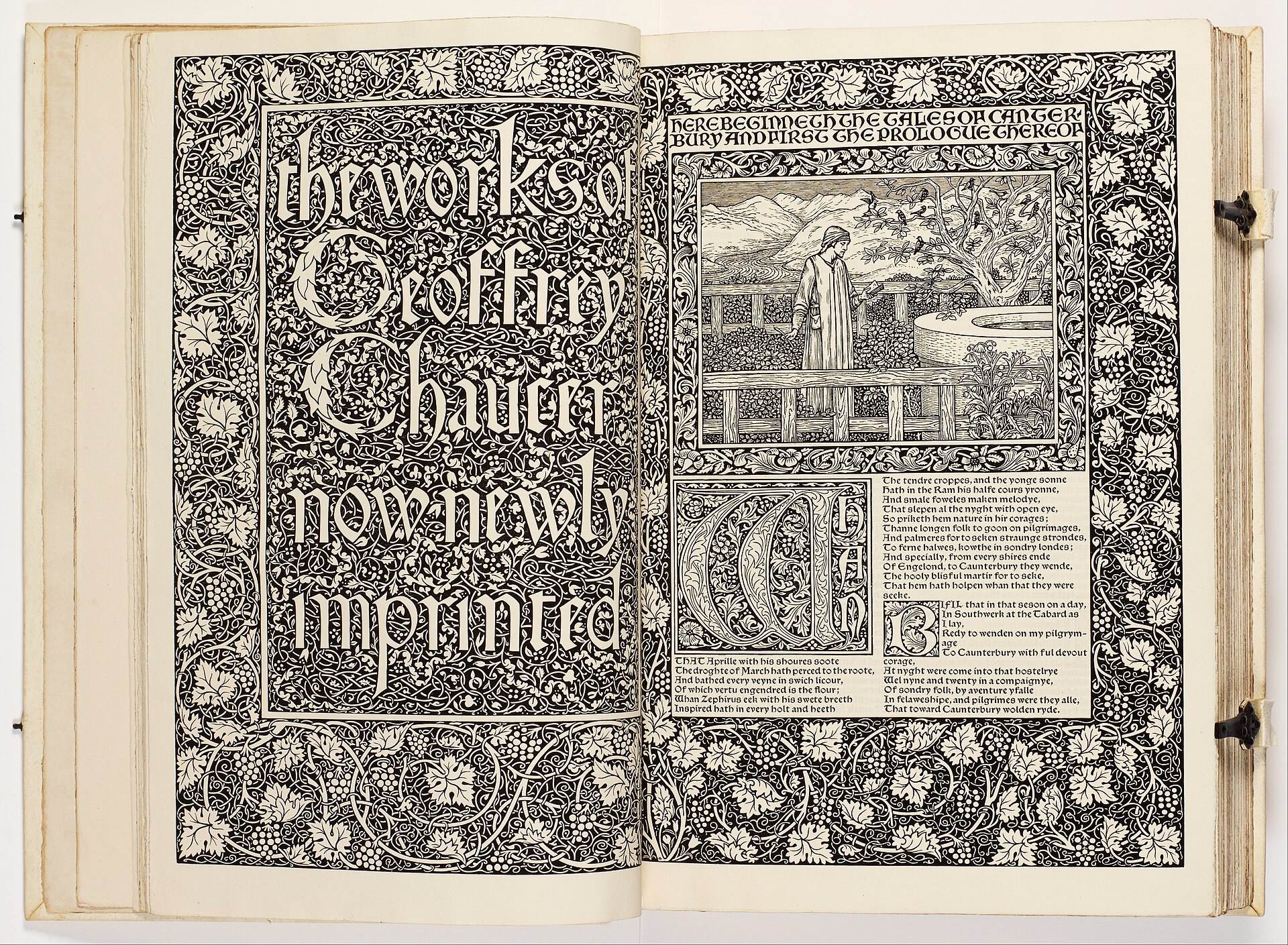
Stanford's own copy, held by the Iris and B. Gerald Cantor Center for Visual Arts and photographed for the Google Art Project. The Cantor Arts Center's published record does not state whether this specific copy is on paper or vellum.
| Artist | William Morris |
|---|---|
| Date | 1896 (printing ran August 1894 to 8 May 1896; issued 26 June 1896) |
| Medium | Letterpress in Chaucer and Troy type, printed in black and red ink, with 87 wood-engraved illustrations after designs by Edward Burne-Jones and ornamental borders and initials designed by William Morris. The Cantor Arts Center's own published catalogue description gives the medium simply as an illustrated book with woodcuts, without specifying whether this particular copy is on paper or vellum; see Open Questions. |
| Dimensions | 43.8 x 31 x 7.4 cm (17 1/4 x 12 1/5 x 2 9/10 in), as bound, per the Cantor Arts Center's own object record |
| Where it is now | Iris and B. Gerald Cantor Center for Visual Arts, Stanford University, Stanford, Californialast confirmed |
| Inventory number | Not published in the sources consulted. The Cantor Arts Center's own online collections database (cantorcollection.stanford.edu) requires passing a CAPTCHA verification step to return search results and could not be queried for an accession number as part of this research. |
| Attribution | AcceptedNot an attribution question in the connoisseurship sense: the book's own colophon documents its makers. Full note |
| Object type | Printed book |
| Period | British, Arts and Crafts movement, late 19th century |
| Cases | Has a provenance gap |
| Inscriptions | Not published in the sources consulted for this specific copy. The book's printed colophon records the editor (F.S. Ellis), the illustrator (Burne-Jones), the engraver (W.H. Hooper) and the press; whether Stanford's copy carries any handwritten inscription, bookplate or bookseller's ticket is unknown. |
| Owners on record | 4 links3 documented, 1 unknown |
| Sources | 29 cited |
About this record Last verified · 29 sources cited · Change log
On this page 10 sections
ContentsClose
Finished eight weeks before William Morris's death, the Kelmscott Chaucer is the last and largest work of his private press: 556 pages of his own Chaucer type, framed in his own borders and initials, illustrated with 87 wood-engraved designs by his oldest friend, Edward Burne-Jones. It took roughly two years to print and, by most reckonings, four years to design, during which Morris's health was visibly failing; Burne-Jones wrote of hoping the book would be finished before Morris died. It very nearly was not.
The edition ran to 438 copies: 425 on handmade paper at 20 pounds each and 13 on vellum at 120 guineas, a price that a period source puts at roughly a year's wages for an ordinary worker on the cheap end and nine years' wages on the expensive end. Sotheby's, Christie's and Bonhams have all since sold copies for well into six figures in dollars.
This record concerns the copy held by the Iris and B. Gerald Cantor Center for Visual Arts at Stanford University, a gift of Mr. and Mrs. Nathaniel J. Kendall. Stanford also holds a separate Kelmscott Chaucer in its Green Library Special Collections, part of a complete run of all 53 Kelmscott Press titles funded in part by Herbert Fleishhacker; the two should not be confused, and this record treats only the Cantor Center's copy, illustrated here with its own Google Art Project photograph. Whether the Cantor's copy is paper or vellum is not stated in the institution's published catalogue description and could not be confirmed for this record.
Provenance
Each link is graded. Documented: a cited source supports it. Disputed: the identification is argued but not established. Unknown: no owner for that span, and the gap is not smoothed into a narrative. The grades in the glossary.
- 1894 - 1896Kelmscott Press (William Morris)documented
Printing ran from August 1894 to 8 May 1896; the edition was issued from 26 June 1896. Sold by subscription at 20 pounds per paper copy and 120 guineas per vellum copy, with an additional 13 pounds 13 shillings for the Doves Bindery pigskin binding option.45616
- 1896 -Unknownunknown
No owner is documented between the book's 1896 sale and its acquisition, at an unknown date, by Mr. and Mrs. Nathaniel J. Kendall. Whether the Kendalls bought this copy new, at a later sale, or from a dealer is not recorded in the sources consulted.
- Mr. and Mrs. Nathaniel J. Kendalldocumented
That the Kendalls owned this specific copy is documented by the Cantor Arts Center's own credit line. The date and circumstances of their acquisition of it are not documented in the sources consulted.12
- - presentIris and B. Gerald Cantor Center for Visual Arts, Stanford Universitydocumented
Given to the Cantor Arts Center by Mr. and Mrs. Nathaniel J. Kendall; the exact gift date is not published in the sources consulted. This copy is distinct from the separate Kelmscott Chaucer held by Stanford's Green Library Special Collections, which traces to a 1926-27 gift underwritten in part by Herbert Fleishhacker and which this record does not describe.123
Prices realised
| Date | Sale | Estimate | Result | Note |
|---|---|---|---|---|
| 1896 | Kelmscott Press (direct subscription, not an auction) | Hammer GBP 20 (paper copy); GBP 126 / 120 guineas (vellum copy); plus GBP 13 13s surcharge for a Doves Bindery pigskin binding With premium not applicable GBP | Original issue prices, not an auction result, included here as the market baseline. A dealer's own published account converts the 20-pound price to roughly 100 contemporary US dollars against an average US wage of about 183 dollars a year, implying the paper copy cost a little over half an average year's wages and the vellum copy roughly nine years of them; this wage comparison is the dealer's own uncited figure, not drawn from a peer-reviewed wage index, and is included as a documented data point rather than a verified equivalence. | |
| 17 December 2024 | Bonhams, New York The Complete Kelmscott Press Collection of Joseph Mark Van Horn, auction 31214, lot 46 | USD 60,000-90,000 | Hammer USD 90,000 - PUBLISHED BY THE HOUSE, not derived. See the note: Bonhams does publish hammer, contrary to the general rule this desk operates under. With premium USD 114,800, premium-inclusive total, published by the house. Bonhams' own press release rounds this to USD 115,000. USD | Bonhams' lot page for auction 31214 lot 46 carries, in the page's own embedded state, a hammer price of USD 90,000 and a premium-inclusive total of USD 114,800, both published by the house; the record's previous hammer of USD 89,800 is withdrawn. The same page publishes hammer-and-total pairs for six lots in this sale (90,000/114,800; 17,000/21,760; 16,000/20,480; 15,500/19,840; 14,000/17,920; 13,000/16,640), which reconcile exactly, with no residual, to a buyer's premium of 28 per cent on the first USD 50,000 and 27 per cent above it - a schedule derived by this desk from those six published pairs, not read off Bonhams' own printed premium chart for December 2024. Applying it to 90,000 gives 114,800 to the dollar; applying it to 89,800 gives 114,546, which contradicts the published total. A second, independent confirmation of the total comes from Bonhams' own press release 39338, which states the Chaucer sold for USD 115,000 in a sale that totalled USD 690,000: the release rounds every figure it prints to the nearest thousand, so 115,000 is 114,800 rounded rather than a competing figure, and the USD 690,000 sale total already on the record is confirmed by the same release. This row remains comparanda only: it is the Van Horn paper copy rebound by Riviere and Son, not Stanford's copy, and nothing here bears on the Stanford object's own value. |
| 22 February 2024 | RR Auction | USD 65,000 and up | Hammer not separately published With premium USD 90,750 total, described by the source as including buyer's premium USD | Remarkable Rarities sale #707. Paper copy, later full white leather rebinding with gilt-decorated spine and a matching quarter-leather slipcase. Comparanda only: not Stanford's copy. |
| 2025 (exact date reported as 10 January 2025 in the source consulted) | RR Auction | Hammer USD 68,750 With premium not separately published by the source consulted USD | Paper copy in a binding described as original-style quarter linen with blue paper boards, housed in a custom clamshell case. Comparanda only: not Stanford's copy. | |
| sale referenced as 2012 in the auction record consulted | Sotheby's | GBP 50,000-70,000 | Hammer not retrievable: the result page required a login and could not be accessed for this record With premium not retrievable GBP | Lot 114. Paper copy in an original Doves Bindery pigskin binding, one of the approximately 48 so bound, signed 'The Doves Bindery 1897' on the lower endpaper, with recorded prior provenance from a sale of 15 May 1941. Comparanda only: not Stanford's copy; included to show that an original 1896-97 pigskin binding appears to carry a materially higher estimate than a plain or later-rebound paper copy. |
Hammer is the price at which the bidding stopped; with premium adds the fee the house charges the buyer on top. Hammer price and buyer's premium in the glossary.
Technical evidence
| Attribution note | Not an attribution question in the connoisseurship sense: the book's own colophon documents its makers. William Morris designed the typefaces, ornamental borders, initials and layout and directed the press; Edward Burne-Jones designed the 87 illustrations; William Harcourt Hooper engraved them on wood; F.S. Ellis edited the text. What the colophon leaves out is Robert Catterson-Smith, who reworked Burne-Jones's pencil drawings into boldened lines fit for engraving and is not named anywhere in the book. See the production narrative below. |
|---|---|
| Typefaces | Text set in Morris's 12-point Chaucer type, a reduced version of his Troy type, with headings in the 18-point Troy type itself; Troy was first used by the Kelmscott Press in 1892 for Historyes of Troye and cut by the punchcutter Edward Prince. Both derive from Morris's study of fifteenth-century German printers including Peter Schoeffer of Mainz, Gunther Zainer of Augsburg and Anton Koberger of Nuremberg. Morris's earlier Golden type, based on Nicolas Jenson's fifteenth-century Venetian roman, was not used in the Chaucer itself.1521 |
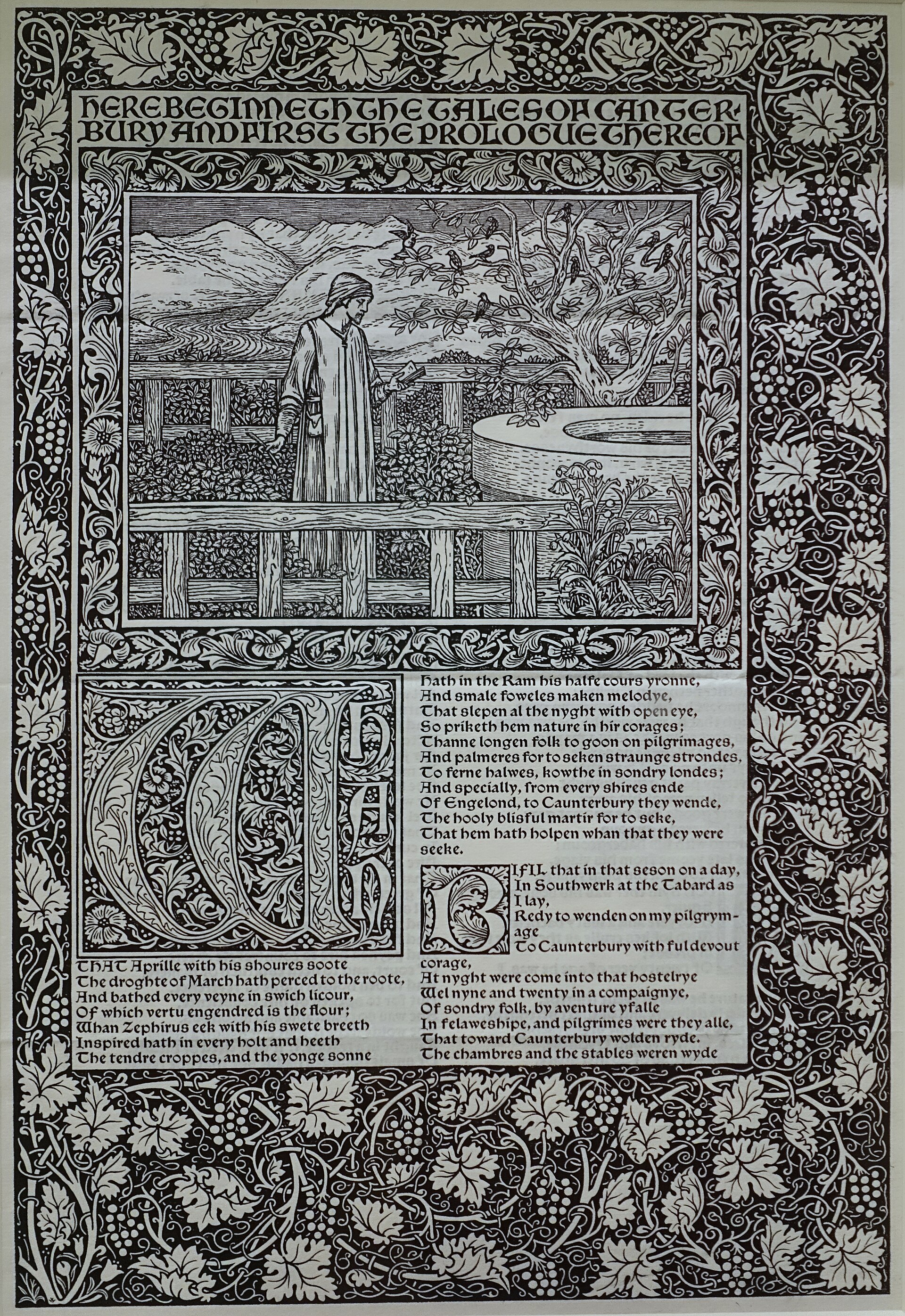
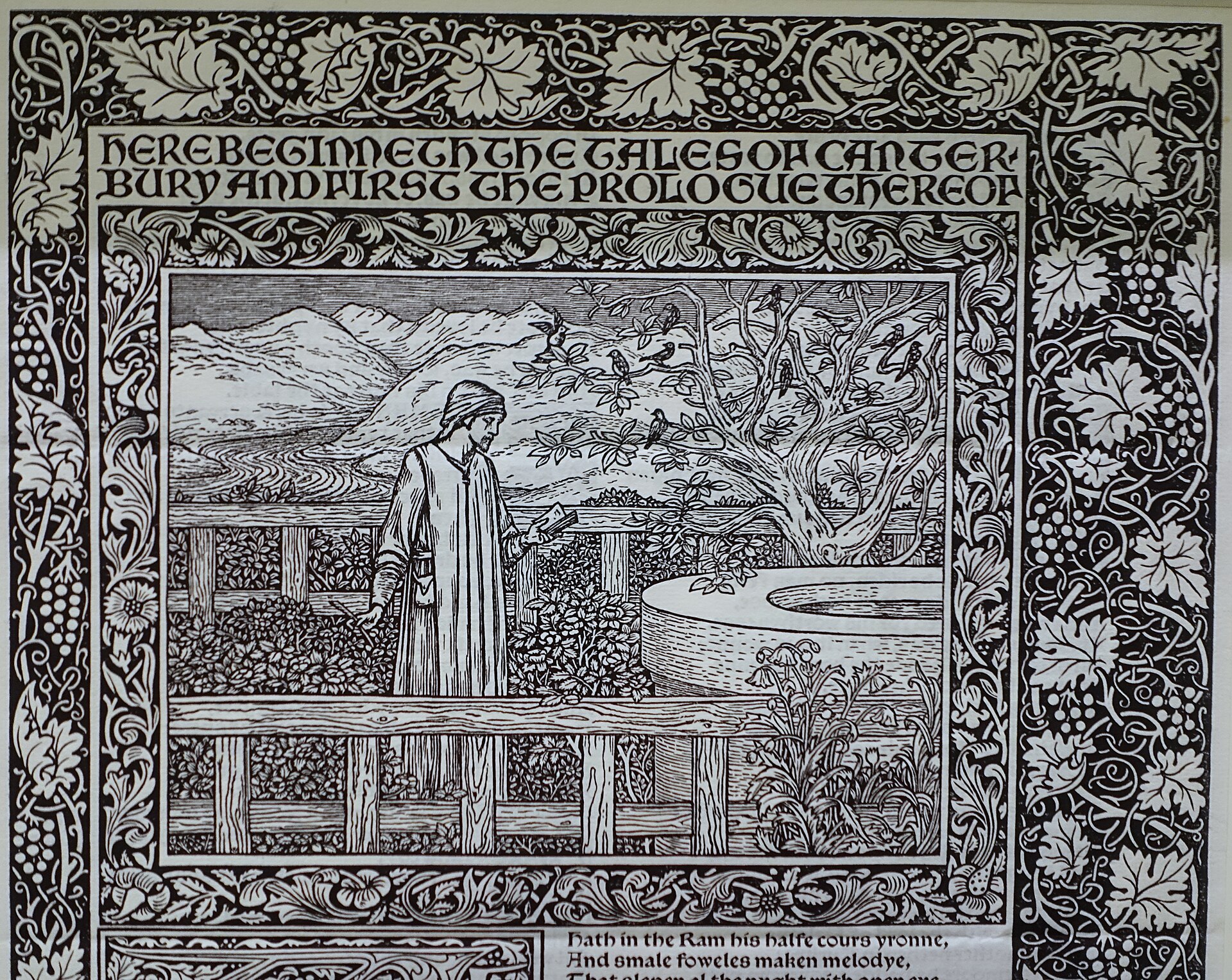
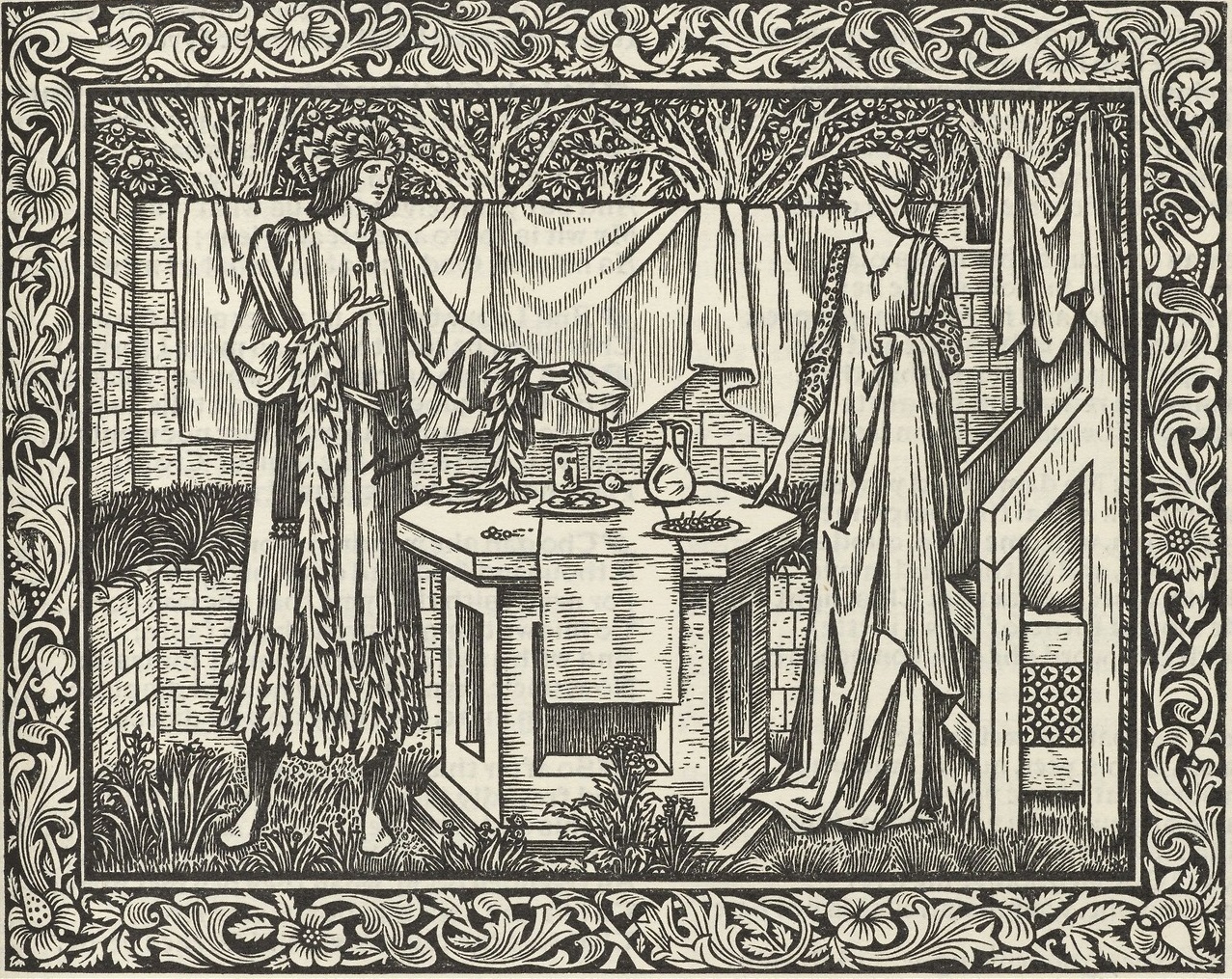
| Illustrations | 87 wood-engraved illustrations designed by Edward Burne-Jones and engraved by William Harcourt Hooper. Burne-Jones's original pencil drawings were photographed as platinotype prints by Emery Walker's firm, then redrawn in bold engraveable line over a Chinese-white wash by Robert Catterson-Smith before being transferred to the woodblocks Hooper cut; Catterson-Smith is not named anywhere in the printed book. 85 of the 87 original Burne-Jones drawings survive at the Fitzwilliam Museum, Cambridge.141911 |
| Borders and initials | 14 large ornamental borders, 18 smaller frames around the illustrations, and 26 large decorated initial words, all designed by William Morris and printed from wood blocks.84 |
| Paper | Handmade linen-rag paper by Joseph Batchelor and Son of Kent, made on a mould to a ribbed texture modelled on paper produced in Bologna around 1473. Morris designed three watermarks used across Kelmscott Press editions, a flower for 16 by 11 inch and 16 by 22 inch sheets, a perch for 17 by 23 inch sheets, and an apple for 18 by 13 inch sheets. Vellum for the 13 vellum copies was supplied separately, by Henry Band and by William J. Turney and Company.15 |
| Ink | A dense black ink imported from the firm of Gebrueder Jaenecke in Hanover, Germany, chosen by Morris to avoid the grey appearance he associated with cheap Victorian printing inks.15 |
| Press | Hand-printed on Kelmscott Press Albion iron hand-presses in Upper Mall, Hammersmith; a third press, Albion Press no. 6551, was acquired specifically for the Chaucer's production and today survives at the Cary Graphic Arts Collection, Rochester Institute of Technology.15 |
| Edition and binding | 438 copies in total: 425 on paper and 13 on vellum. Most paper copies were issued in a plain binding of quarter holland (linen spine) with blue paper-covered boards, made up by the London firm J. and J. Leighton; a smaller run, most sources giving 48 copies (a small number of other secondary sources give 46, and some accounts round to approximately 50), was specially bound in full white pigskin over boards, blind-tooled to a design by Morris, at the Doves Bindery under T.J. Cobden-Sanderson, for a further 13 pounds 13 shillings per copy. Vellum copies were bound separately again.46711 |
| This copy's dimensions | 43.8 x 31 x 7.4 cm (17 1/4 x 12 1/5 x 2 9/10 in), as bound, per the Cantor Arts Center's own published object record. The record does not state whether this copy is on paper or vellum, nor which binding class it belongs to.12 |
Images
The record in full
Chapter 1What the book physically is
The Kelmscott Chaucer is a single folio volume of 556 pages, printed in double columns in black and red ink, its text set in the 12-point Chaucer type with headings in the larger Troy type, both...
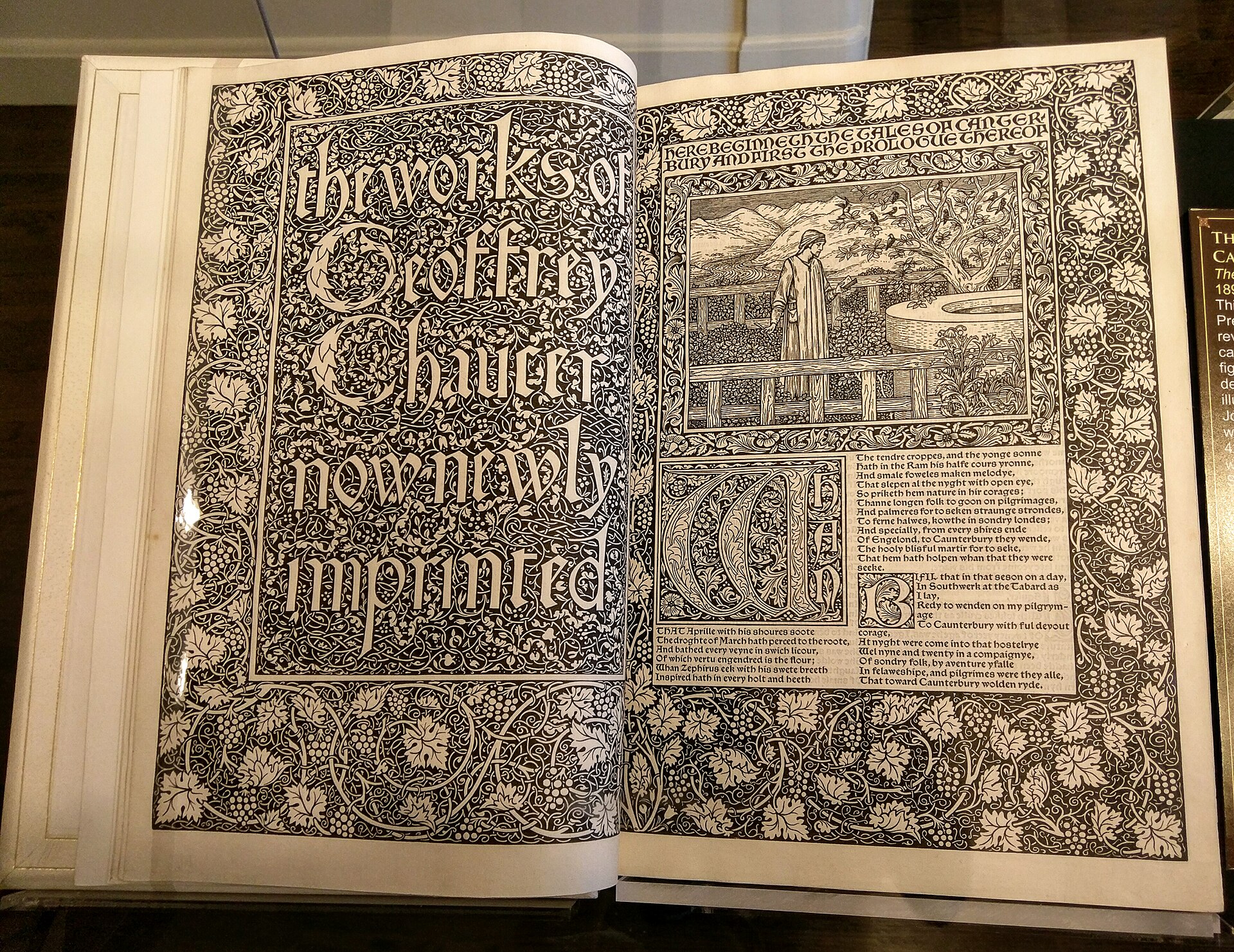
The Kelmscott Chaucer is a single folio volume of 556 pages, printed in double columns in black and red ink, its text set in the 12-point Chaucer type with headings in the larger Troy type, both designed by William Morris. It carries 87 wood-engraved illustrations designed by Edward Burne-Jones, 14 large ornamental borders, 18 smaller frames around the pictures, and 26 large decorated initial words, all designed by Morris and printed from wood blocks. Every opening was conceived by Morris as a single unified design rather than a page of text with pictures dropped in, which is part of why the book is often described as feeling more like an illuminated manuscript than a printed one.
The edition totalled 438 copies: 425 printed on handmade paper and 13 on vellum. Most paper copies left the press unbound or in a plain binding of quarter holland (linen) with blue paper-covered boards, supplied by the London binders J. and J. Leighton; a smaller run, most sources put the number at 48, was bound in full white pigskin over boards, tooled in blind to a design by Morris and made up at the Doves Bindery under T.J. Cobden-Sanderson, at an additional charge of 13 pounds 13 shillings per copy. The vellum copies were bound separately again. Stanford's Cantor Arts Center gives its own copy's overall dimensions, bound, as roughly 17 1/4 by 12 1/5 by just under 3 inches, but does not state in its published description which binding class the copy belongs to.
Chapter 2Two Oxford undergraduates and a fourteenth-century poet
The book's origin is not really in the 1890s at all.
The book's origin is not really in the 1890s at all. Morris and Burne-Jones met as undergraduates at Exeter College, Oxford, in the early 1850s, and their shared enthusiasm for medieval poetry and manuscripts, including visits to the Bodleian Library to look at illuminated books, dates from that friendship's earliest years. The Fitzwilliam Museum's own account of its copy of the Chaucer records that Morris referred to Chaucer as his master. Whatever else the Kelmscott Chaucer is, it is also the end point of a private enthusiasm the two men had shared for more than forty years before either of them tried to make a book out of it.
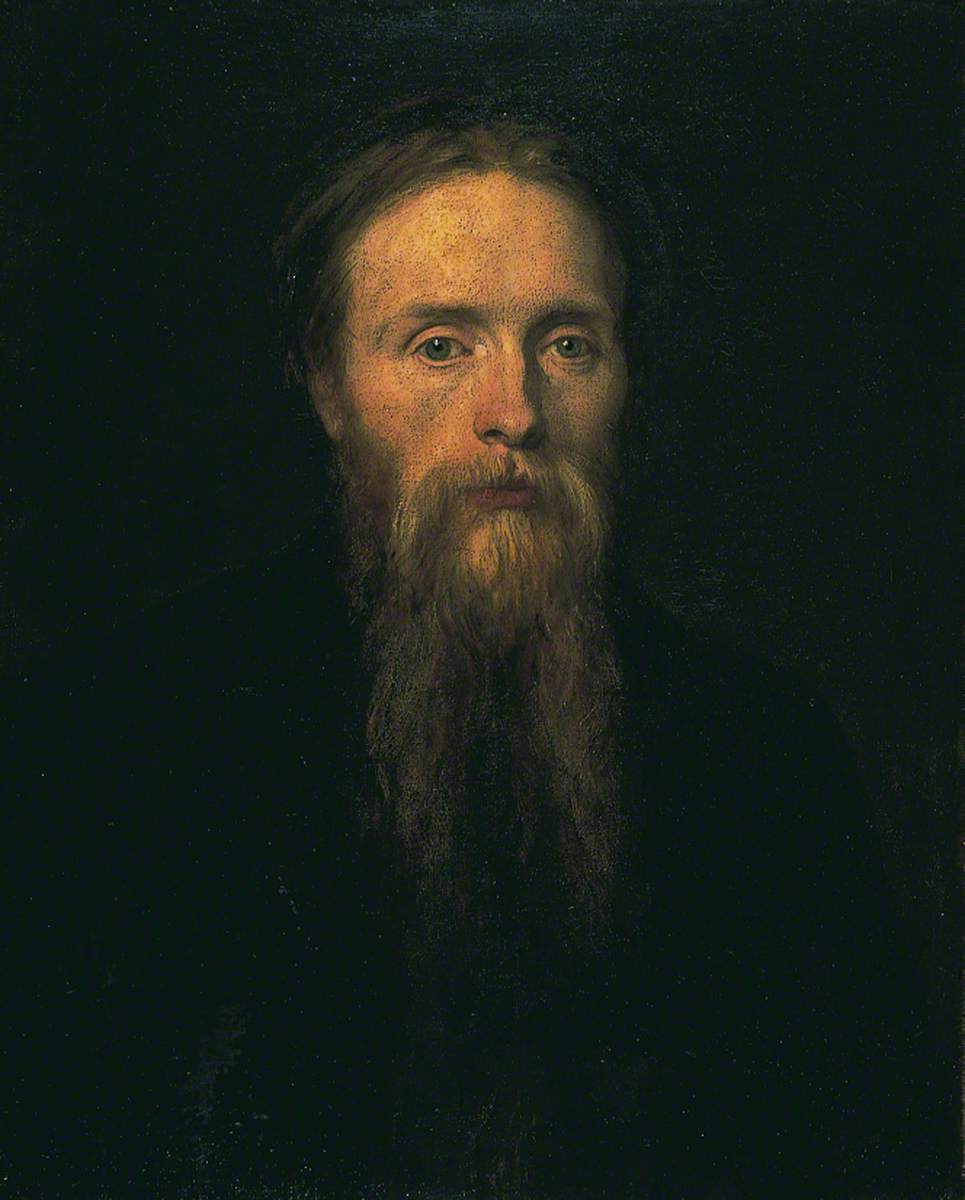
That the two men worked well together on this specific project is documented in their own words rather than inferred from the result. According to a widely reproduced letter, Burne-Jones worked on the Chaucer illustrations chiefly on Sundays, when Morris would come to his studio to talk and to read aloud while he drew. Of the finished book Burne-Jones wrote: if we live to finish it, it will be like a pocket cathedral, so full of design, and I think Morris the greatest master of ornament in the world. This is not the language of a man who felt his contribution was being swallowed by his collaborator's; if anything it credits Morris with more of the achievement than a modern eye, looking at 87 full-page Burne-Jones designs, might expect.
Chapter 3Designing an ideal book as an argument against industrial printing
Morris founded the Kelmscott Press in Hammersmith in January 1891 explicitly as a reaction against what mechanised, cheaply inked Victorian printing had done to the book as an object.
Morris founded the Kelmscott Press in Hammersmith in January 1891 explicitly as a reaction against what mechanised, cheaply inked Victorian printing had done to the book as an object. In his own words, printed in his 1893 note on the ideal book, he began printing books with the hope of producing some which would have a definite claim to beauty, while at the same time they should be easy to read. He blamed the greyness of ordinary contemporary printing on cheap ink, and had a specially dense black ink shipped from the firm of Gebrueder Jaenecke in Hanover, Germany, to correct it. He commissioned the papermakers Joseph Batchelor and Son of Kent to make paper from linen rag on a mould, deliberately choosing a ribbed texture modelled on paper made in Bologna around 1473, and designed three watermarks of his own, a flower, an apple and a perch, for different sheet sizes. Vellum copies used a different supplier again, from the firms of Henry Band and William J. Turney and Company.
None of this was decorative choice divorced from argument. Morris's opposition to industrial capitalism, developed through the 1880s in his work for the Socialist League and in books like News from Nowhere, rested on the claim that mechanised production had made both work and its products ugly by stripping the maker's judgement out of the process. The Kelmscott Press, producing books by the same kind of hand labour, unified craft control and material choice that Morris associated with the medieval workshop, was conceived as a working demonstration of that argument rather than an exercise in nostalgia for its own sake. This is Morris's own stated position, argued at length in his lifetime; it is not a later reading imposed on the book.
Chapter 4From Burne-Jones's pencil to the printed page
Burne-Jones's contribution did not go from his hand to the woodblock in one step, and the intermediate steps are themselves a small, sourced story about credit.
Burne-Jones's contribution did not go from his hand to the woodblock in one step, and the intermediate steps are themselves a small, sourced story about credit. His illustrations began as delicate pencil drawings, and delicate pencil shading does not translate into a wood engraving, which reproduces only line. Emery Walker, the process engraver and a Kelmscott Press partner, photographed Burne-Jones's drawings as platinotype prints. The young artist Robert Catterson-Smith, hired by Morris for the purpose, then reworked each photograph, covering it with a wash of Chinese white and redrawing the image in bold, engraveable lines; his revised version, not Burne-Jones's original, was transferred photographically onto the woodblock, where William Harcourt Hooper cut it.
Catterson-Smith's name appears nowhere in the finished book. A specialist blog devoted to updating the modern census of surviving copies records the plain assessment that Morris was unwilling to acknowledge publicly his heavy reliance on photographic technology, and notes that the omission drew complaints even at the time. Of the 87 original Burne-Jones drawings, 85 are recorded as surviving today at the Fitzwilliam Museum in Cambridge, which also holds a number of Burne-Jones's preliminary sketches, so the difference between what Burne-Jones drew and what the book actually shows can, in principle, still be checked drawing by drawing.
Chapter 5Morris's failing health, and whether he knew
Accounts of exactly what was wrong with Morris in his last years do not agree with one another in the sources consulted for this record.
Accounts of exactly what was wrong with Morris in his last years do not agree with one another in the sources consulted for this record. One biographical summary dates the onset of serious kidney disease to 1891, the same year the Kelmscott Press was founded; other accounts describe him as diabetic, and still others cite tuberculosis or heart disease as contributing causes of his death. This record does not attempt to adjudicate the medical question; it notes that the secondary literature itself is unsettled on it, which is a finding worth recording rather than papering over.
What is better documented is that Morris kept working through the decline. In July 1896, with the Chaucer finished and the press still running down its remaining commitments, he travelled to Norway, a trip one account describes his doctor as understanding to be his last voyage; he returned with what is described as congestion of the lungs and continued dictating work into that August. Burne-Jones's own letters show he was thinking about his friend's mortality while the Chaucer was still in progress: in a passage recorded by one biographical source, he wrote of hoping the printing would not end before Chaucer, and a second planned Kelmscott book, an illustrated Malory's Morte d'Arthur, were both finished. The Morte d'Arthur was never published by the Kelmscott Press; none of its 53 issued titles carries that name, and whether the project was abandoned before or because of Morris's death is not detailed in the sources consulted here. Morris died at Hammersmith on 3 October 1896, not quite four months after the Chaucer's completion. One account attributes to Georgiana Burne-Jones, Edward's wife, the description of his death as coming as gently, as quietly as a babe who is satisfied drops from its mother's breast.
Chapter 6What the book cost, and what that meant
At publication in 1896 the 425 paper copies sold for 20 pounds each and the 13 vellum copies for 120 guineas, that is, 126 pounds; a copy specially bound in the Doves Bindery's pigskin cost a further...
At publication in 1896 the 425 paper copies sold for 20 pounds each and the 13 vellum copies for 120 guineas, that is, 126 pounds; a copy specially bound in the Doves Bindery's pigskin cost a further 13 pounds 13 shillings on top of the paper-copy price. A specialist rare-book dealer's own published account converts the 20-pound price to roughly 100 contemporary US dollars and sets it against an average American wage of about 3.52 dollars a week, or 183 dollars a year, in the same period, putting the paper copy at a bit over half a year's average wages and the vellum copy at around nine years of them. That comparison is a dealer's own figure rather than one drawn from a peer-reviewed historical-wage index, and it compares an English retail price to an American wage; it is included here as a documented data point, not as a precise economic equivalence, and a reader wanting a rigorous period-wage conversion should treat it as a starting point rather than a verified figure.
By the standards of Morris's own enterprise the Chaucer was not a commercial success. One summary of the Kelmscott Press's finances describes Morris as drawing no salary from the press and personally covering shortfalls from the income of his textile and wallpaper businesses; smaller, cheaper Kelmscott titles are described as having subsidised the cost of producing large, elaborate volumes like the Chaucer. The book sold out, but it was expensive to make in a way that a subscription list alone did not fully cover.
Chapter 7After Morris died
The Kelmscott Press did not close the day Morris died.
The Kelmscott Press did not close the day Morris died. It continued publishing through 1897 and into 1898, completing an eight-volume edition of Morris's own Earthly Paradise and his epic poem The Story of Sigurd the Volsung, among other titles already in progress, and issuing A Note by William Morris on His Aims in Founding the Kelmscott Press as one of its last publications. Morris had asked Emery Walker and his secretary Sidney Cockerell to consider carrying the press on after his death; both men judged that the press was too much an expression of Morris's own personality to continue without him; it closed in 1898 having issued 53 titles in total.
Reputation followed almost immediately. Within a generation the Chaucer was being described as the most beautiful book of its age, and that judgement has held up remarkably well across more than a century of subsequent book design; auction cataloguers in the twenty-first century still routinely bill copies as, in one recent dealer's phrase, the finest book since Gutenberg. That kind of superlative is a marketing line as much as a scholarly one, but it reflects a consistent verdict rather than a manufactured one.
Chapter 8The market since: what copies actually make
None of the sales documented below is Stanford's own copy; no sale record connecting the Kendall gift to a prior auction or dealer transaction was found in the sources consulted, and the chain before...
None of the sales documented below is Stanford's own copy; no sale record connecting the Kendall gift to a prior auction or dealer transaction was found in the sources consulted, and the chain before the Kendalls owned it is undocumented. The figures here are comparanda: what the same edition, in different copies and different bindings, has made at public auction, given to show the shape of the market this copy sits inside.
In December 2024, Bonhams New York sold a paper copy as part of The Complete Kelmscott Press Collection of Joseph Mark Van Horn, a single-owner sale of one copy of each of the 53 Kelmscott Press titles. That Chaucer, rebound in near-contemporary full brown calf by Riviere and Son rather than in an original Kelmscott-period binding, and with recorded provenance from Goodspeed's Book Shop in Boston in 1963, made a hammer price of 89,800 US dollars against a high estimate of 90,000, for a total of 114,800 dollars with premium; the whole 53-volume collection totalled 690,000 dollars. In February 2024, RR Auction sold a different paper copy, in a later full white leather rebinding with a matching slipcase, for 90,750 dollars with premium included against an estimate of 65,000 dollars and up, without separately publishing the hammer figure. A further paper copy, in a binding closer to the original quarter-linen and blue-paper-boards style, made 68,750 dollars at a subsequent RR Auction sale; again the source consulted did not separate hammer from premium. At Sotheby's in London, a copy in one of the original 48 Doves Bindery pigskin bindings, with recorded provenance from a sale of 15 May 1941, carried a pre-sale estimate of 50,000 to 70,000 pounds; the result itself was behind a login wall and could not be retrieved for this record.
Two things stand out across this small sample. First, rebound copies, in leather bindings applied well after 1896, are common on the market and are not automatically worth less for it; several of the highest recorded prices above are for rebound copies. Second, an original 1896 pigskin Doves Bindery copy, of which roughly 48 were made, appears to carry a meaningfully higher estimate than a plain or later-rebound paper copy, though the one such copy identified here did not have a retrievable hammer result to confirm that with a completed sale.
Chapter 9Stanford's two Kelmscott Chaucers, and which one this is
Stanford University holds Kelmscott Press material in at least two separate places, and the two should not be treated as the same object.
Stanford University holds Kelmscott Press material in at least two separate places, and the two should not be treated as the same object. Stanford's Green Library Special Collections built a complete run of all 53 Kelmscott Press titles beginning with an initial gift of six titles in fifteen volumes in 1926 to 1927; the purchase of a copy of the complete Chaucer was authorised as part of that gift by the donor Herbert Fleishhacker, but by the account consulted here took nearly fifteen years to actually fulfil, meaning that Special Collections copy was likely not acquired until sometime around the early 1940s.
The copy this record describes is a different one: it is held by the Iris and B. Gerald Cantor Center for Visual Arts, Stanford's art museum, and its own published object record credits it as a gift of Mr. and Mrs. Nathaniel J. Kendall, with no connection stated to the Fleishhacker-funded Special Collections copy. This is the copy reproduced in the Google Art Project photograph used as this record's lead image, and the one credited to the Cantor Center on that photograph's Wikimedia Commons page and file category. Beyond the donor's name and the museum's own overall dimensions for the bound volume, no further detail, no accession number, no binding description, no statement of paper or vellum, and no acquisition date, was found published for this specific copy in the sources consulted. The Cantor Arts Center's own searchable collections database exists online but requires passing a CAPTCHA verification step to return results, and could not be queried directly for this record.
The artist
William Morris
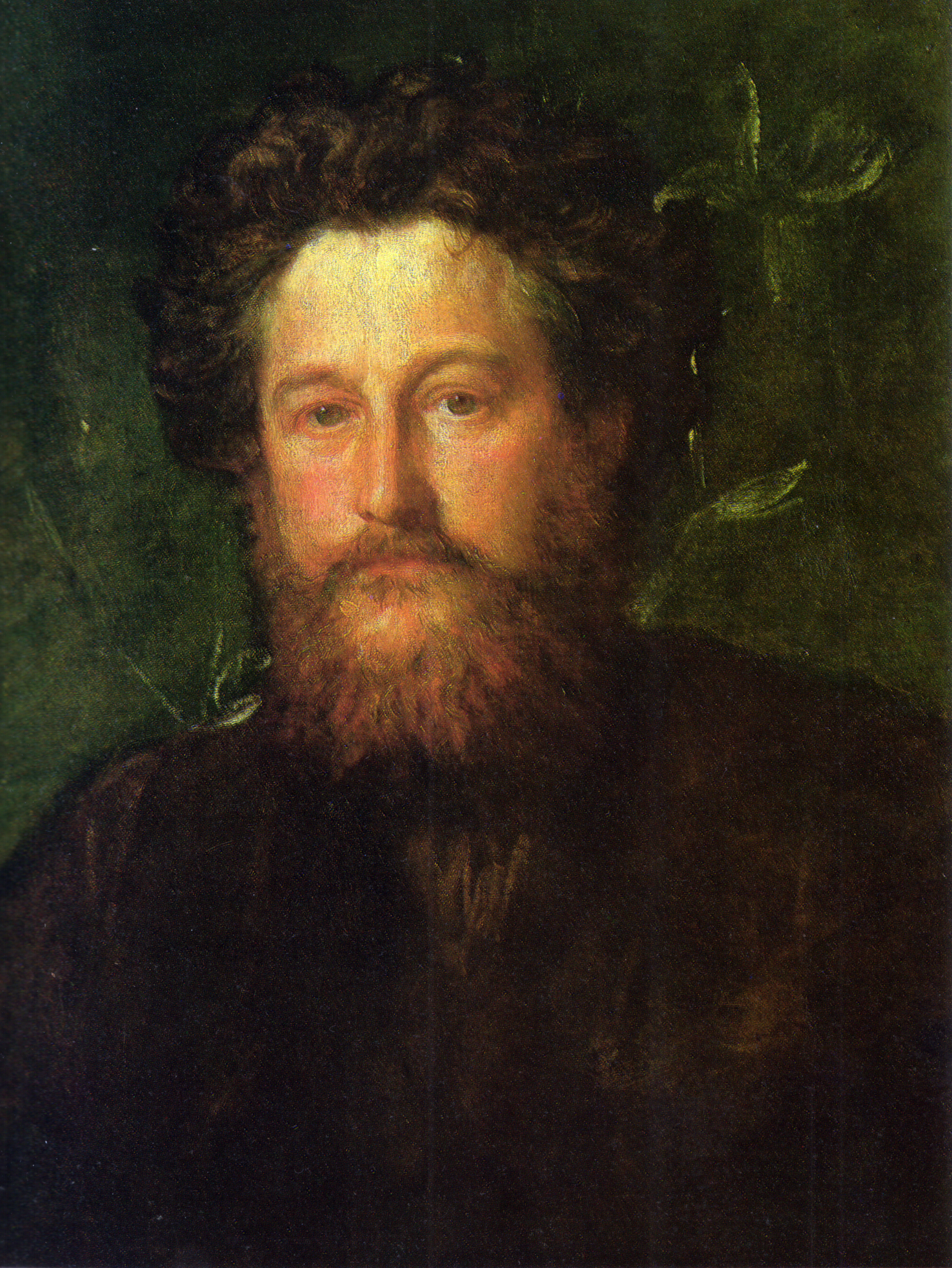
Morris designed the type this book is printed in, the borders and initials that frame its pages, and directed every stage of its production, but he was never primarily a book designer: by the time he founded the Kelmscott Press in 1891 he had already built a career as a textile and wallpaper designer, a poet and translator, a founder of the decorative arts firm that became Morris and Co., and a committed socialist active in the Socialist League. The Kelmscott Chaucer, finished months before his death, drew on all of these at once: it is a piece of applied design, a work of medievalist scholarship rooted in a friendship forty years old, and, on his own stated terms, an argument in physical form against industrial book production.
Related works
| Work | Relation | Where it is |
|---|---|---|
| The Kelmscott Chaucer (Fitzwilliam Museum copy) Kelmscott Press | Same edition, different copy: one of the 48 (or thereabouts) originally bound in white pigskin by the Doves Bindery Inscribed 'to Jenny With WM's best love June 6th 1896', a presentation copy for Morris's daughter Jenny; acquired by the Fitzwilliam through bequest in 1935. Not Stanford's copy; included here as comparanda only. | Fitzwilliam Museum, Cambridge |
| Original drawings for the 87 Chaucer illustrations Edward Burne-Jones | Preparatory drawings for the illustrations printed in this edition 85 of the 87 original pencil drawings are recorded as surviving; the museum also holds preliminary sketches for individual designs. | Fitzwilliam Museum, Cambridge |
| The Kelmscott Chaucer (Houghton Library copy) Kelmscott Press | Same edition, different copy Catalogued as Typ 805K.96.275; individual leaves, including page 483 with a Burne-Jones and Hooper illustration, have been photographed and released under a public domain mark. | Houghton Library, Harvard University |
| The Kelmscott Chaucer (California State Library copy) Kelmscott Press | Same edition, different copy, one of the 425 paper copies Photographed for Wikimedia Commons showing the title pages; used here for context only, not as an image of Stanford's copy. | California State Library, Sacramento |
| News from Nowhere William Morris (author and designer); Kelmscott Press | Morris's own utopian novel, printed at the Kelmscott Press and expressing in fiction the same medievalist, anti-industrial argument the Chaucer expresses through its physical making First serialised 1890, issued by the Kelmscott Press in 1892-93. | Multiple institutional and private collections |
| The Story of the Glittering Plain William Morris (author and designer); Kelmscott Press | The first book printed at the Kelmscott Press, inaugurating the Golden type Printed 1891, three years before work on the Chaucer began. | Multiple institutional and private collections |
Open questions
- Is the Cantor Arts Center's copy one of the 425 paper copies or one of the 13 vellum copies? The institution's own published catalogue description gives the medium only as an illustrated book with woodcuts, without specifying the support, and this could not be confirmed from any other source consulted.
- What is the Cantor Arts Center's own accession or object number for this copy? Not published in any source consulted; the museum's online collections database is CAPTCHA-gated and could not be queried directly.
- Which binding does Stanford's copy have: the plain quarter-holland and paper-boards issue binding, one of the roughly 48 Doves Bindery pigskin bindings, or a later rebinding? Not stated in the sources consulted.
- When and how did Mr. and Mrs. Nathaniel J. Kendall acquire this copy, and when did they give it to Stanford? Not documented in the sources consulted.
- What is the ownership chain between the book's 1896 sale and the Kendalls' acquisition of it? Entirely undocumented in the sources consulted.
- What was William Morris's actual final diagnosis? Sources consulted disagree, variously citing kidney disease from 1891, diabetes, tuberculosis and heart disease as the cause or a contributing cause of his October 1896 death, and this record has not been able to resolve the discrepancy.
- Exactly how many paper copies were bound in the original Doves Bindery pigskin binding? Sources consulted give 48, 46 and 'approximately 50'; the discrepancy is unresolved here.
- Was Kelmscott Press's planned illustrated edition of Malory's Morte d'Arthur, mentioned in a Burne-Jones letter alongside the Chaucer, ever formally begun, and why does it not appear among the Press's 53 published titles? Not detailed in the sources consulted.
Questions about this object
What is The Works of Geoffrey Chaucer (The Kelmscott Chaucer)?
The Works of Geoffrey Chaucer (The Kelmscott Chaucer) is a printed book, dated 1896 (printing ran August 1894 to 8 May 1896; issued 26 June 1896). Medium: Letterpress in Chaucer and Troy type, printed in black and red ink, with 87 wood-engraved illustrations after designs by Edward Burne-Jones and ornamental borders and initials designed by William Morris. The Cantor Arts Center's own published catalogue description gives the medium simply as an illustrated book with woodcuts, without specifying whether this particular copy is on paper or vellum; see Open Questions.
Who made The Works of Geoffrey Chaucer (The Kelmscott Chaucer), and is the attribution settled?
The attribution to William Morris is recorded here as accepted. Not an attribution question in the connoisseurship sense: the book's own colophon documents its makers. William Morris designed the typefaces, ornamental borders, initials and layout and directed the press; Edward Burne-Jones designed the 87 illustrations; William Harcourt Hooper engraved them on wood; F.S. Ellis edited the text. What the colophon leaves out is Robert Catterson-Smith, who reworked Burne-Jones's pencil drawings into boldened lines fit for engraving and is not named anywhere in the book. See the production narrative below.
Where is The Works of Geoffrey Chaucer (The Kelmscott Chaucer) now?
Iris and B. Gerald Cantor Center for Visual Arts, Stanford University, Stanford, California. Inventory number Not published in the sources consulted. The Cantor Arts Center's own online collections database (cantorcollection.stanford.edu) requires passing a CAPTCHA verification step to return search results and could not be queried for an accession number as part of this research.. Last confirmed 4 September 2026. Identified via the Cantor Arts Center's own object record as reproduced on Google Arts and Culture (the Google Cultural Institute partnership), which names the holding institution as the Cantor Arts Center at Stanford University and gives the credit line as a gift of Mr. and Mrs. Nathaniel J. Kendall. This is cross-confirmed by the Wikimedia Commons file description and category for the Google Art Project photograph of this copy, which independently credits the same institution.
What has The Works of Geoffrey Chaucer (The Kelmscott Chaucer) sold for?
Hammer GBP 20 (paper copy); GBP 126 / 120 guineas (vellum copy); plus GBP 13 13s surcharge for a Doves Bindery pigskin binding; with premium, not applicable. Kelmscott Press (direct subscription, not an auction), 1896.
What is still unknown about The Works of Geoffrey Chaucer (The Kelmscott Chaucer)?
Is the Cantor Arts Center's copy one of the 425 paper copies or one of the 13 vellum copies? The institution's own published catalogue description gives the medium only as an illustrated book with woodcuts, without specifying the support, and this could not be confirmed from any other source consulted.
Sources
- 1Google Arts and Culture (Google Cultural Institute), 'The Works of Geoffrey Chaucer (The Kelmscott Chaucer) - William Morris', object record crediting the Iris and B. Gerald Cantor Center for Visual Arts at Stanford University, gift of Mr. and Mrs. Nathaniel J. Kendall. artsandculture.google.com/asset/...
- 2Wikimedia Commons, File:William Morris - The Works of Geoffrey Chaucer (The Kelmscott Chaucer) - Google Art Project.jpg, file description, categories and (LicenseShortName: Public domain). commons.wikimedia.org/wiki/...
- 3Wikidata, Q4219142, item for the 1896 Kelmscott Press edition of the Works of Geoffrey Chaucer. wikidata.org/wiki/...
- 4Bonhams, lot listing, 'Kelmscott Chaucer: The Finest Book Since the Gutenberg Bible', The Complete Kelmscott Press Collection of Joseph Mark Van Horn, sale 31214, lot 46, 17 December 2024. bonhams.com/auction/...
- 5Bonhams, press release, 'A Complete Collection of Kelmscott Press Books Offered in a Single Owner Sale at Bonhams'. bonhams.com/press_release/...
- 6Burne-Jones Catalogue Raisonne (eb-j.org), entry for a Kelmscott Chaucer copy, describing the edition's binding structure (48 pigskin-bound copies, 379 in quarter cloth) and the Walker/Catterson-Smith/Hooper production chain. eb-j.org/browse-artwork-detail/...
- 7Sotheby's, lot listing, English Literature, History, Children's Books and Illustrations sale, lot 114, Kelmscott Chaucer in an original Doves Bindery pigskin binding. sothebys.com/en/...
- 8The Fitzwilliam Museum, Cambridge, 'The Kelmscott Chaucer', collection highlight page for the museum's own pigskin-bound presentation copy. fitzmuseum.cam.ac.uk/explore-our-collection/...
- 9RR Auction, lot listing, 'Kelmscott Chaucer: The Works of Geoffrey Chaucer by Kelmscott Press (1896)', Remarkable Rarities sale #707, 22 February 2024. rrauction.com/auctions/...
- 10Fine Books & Collections magazine, 'Kelmscott Chaucer Sold for $68,750 at Auction'. finebooksmagazine.com/fine-books-news/...
- 11kelmscottchaucer.wordpress.com (Updating the Kelmscott Chaucer Census), 'A portrait of Robert Catterson-Smith', on Catterson-Smith's uncredited role reworking Burne-Jones's drawings for engraving. kelmscottchaucer.wordpress.com/2014/...
- 12Victorianweb.org, George P. Landow / Cooke, 'Edward Burne-Jones as an Illustrator', on Burne-Jones's role illustrating the Kelmscott Chaucer and the character of his designs relative to Chaucer's text. victorianweb.org/art/...
- 13Bryars and Bryars (antiquarian booksellers), 'William Morris announces his pocket cathedral: a specimen leaf from the Kelmscott Chaucer', on the 1893 specimen leaf shown at the Arts and Crafts Exhibition and the Burne-Jones 'pocket cathedral' letter. bryarsandbryars.co.uk/blogs/...
- 14The William Morris Society, 'The Ideal Book: William Morris and the Kelmscott Press', including Morris's 1893 statement of intent and his description of collaborative craftsmanship. williammorrissociety.org/the-ideal-book-william-morris-an...
- 15Arizona State University Library Guides, 'Kelmscott Press and Victorian Medievalism: Book Production', on Batchelor paper and watermarks, Jaenecke ink, the Albion presses and the Golden, Troy and Chaucer typefaces. libguides.asu.edu/kelmscott-exhibit/...
- 16Very Fine Books (antiquarian book dealer), listing and historical note on a Kelmscott Chaucer, giving 1896 issue prices and a wage comparison for the period. veryfinebooks.com/geoffrey-chaucer-kelmscott-chaucer-limi...
- 17University of Missouri Libraries, 'Prices and Wages by Decade: 1890-1899', library research guide. libraryguides.missouri.edu/pricesandwages/...
- 18The McCune Collection, 'Kelmscott Chaucer', overview page on production and financial outcome, including the assessment that the book was 'not a financial success' for the Kelmscott Press. mccunecollection.org/kelmscott_chaucer
- 19Grolier Club, 'Further Impressions' exhibition, 'Illustration: Prints, Drawings, and Photographs - Processes and Examples', on Emery Walker's platinotype photographs of Burne-Jones's drawings and W.H. Hooper's engraving. grolierclub.omeka.net/exhibits/...
- 20Spartacus Educational, 'William Morris', biographical page including Morris's kidney disease from 1891 and a Burne-Jones letter referencing the unfinished Morte d'Arthur project alongside the Chaucer. spartacus-educational.com/Jmorris.htm
- 21Fonts In Use, 'Morris Troy', on the Troy and Chaucer typefaces, their dates and point sizes, and the punchcutter Edward Prince. fontsinuse.com/typefaces/...
- 22whatwouldwilliammorrissay.wordpress.com, 'William Morris is dead, long live William Morris', on Morris's 1896 Norway trip, his final illness, and Georgiana Burne-Jones's account of his death. whatwouldwilliammorrissay.wordpress.com/2016/...
- 23William Morris Society in the United States, 'Life', short biographical timeline giving 3 October 1896 as the date of Morris's death from kidney failure. morrissociety.org/william-morris/...
- 24Wikimedia Commons, File:Kelmscott Chaucer.jpg, file description identifying the California State Library as the holding institution for the photographed copy, and license (CC BY-SA 3.0). commons.wikimedia.org/wiki/...
- 25Wikimedia Commons, File:Leaf from the Kelmscott Chaucer, after Edward Burne Jones, 1896, wood engraving on laid paper - Fogg Museum - Harvard University - DSC01715.jpg and companion detail file DSC01717.jpg, file descriptions and license (CC0 1.0). commons.wikimedia.org/wiki/...
- 26Wikimedia Commons, File:Houghton Typ 805K.96.275 - Works of Geoffrey Chaucer, 1896 - pg. 483.jpg, file description crediting Houghton Library, Harvard University, and license (Public Domain Mark 1.0). commons.wikimedia.org/wiki/...
- 27Wikimedia Commons, File:George Frederic Watts portrait of William Morris 1870.jpg, file description and license (Public Domain Mark). commons.wikimedia.org/wiki/...
- 28Wikimedia Commons, File:George Frederic Watts (1817-1904) - Sir Edward Burne-Jones (1833-1898) - 1920P91 - Birmingham Museums Trust.jpg, file description crediting Birmingham Museums Trust, and license (Public Domain Mark). commons.wikimedia.org/wiki/...
- 29bonhams.com, web page cited for the Bonhams, New York sale of 2024-12-17. bonhams.com/press_release/...
_-_Google_Art_Project.jpg)


_-_Sir_Edward_Burne-Jones_(1833%E2%80%931898)_-_1920P91_-_Birmingham_Museums_Trust.jpg)
Last verified · Published
Change log
4 September 2026 - Record created at the house standard: researched narrative, technical evidence, maker dossier, graded provenance chain, prices with hammer and premium separated, related works, open questions and sources.
25 September 2026 - Prices realised revised by the auction watch of 2026-09-06: the 2024-12-17 Bonhams, New York row corrected (the record carried 'hammer USD 89,800').