Biblia Latina, the 42-line Bible: the Library of Congress copy
Printer of the 42-line Bible, Johann Gutenberg · Mainz, between 1454 and 1455, not after 1456
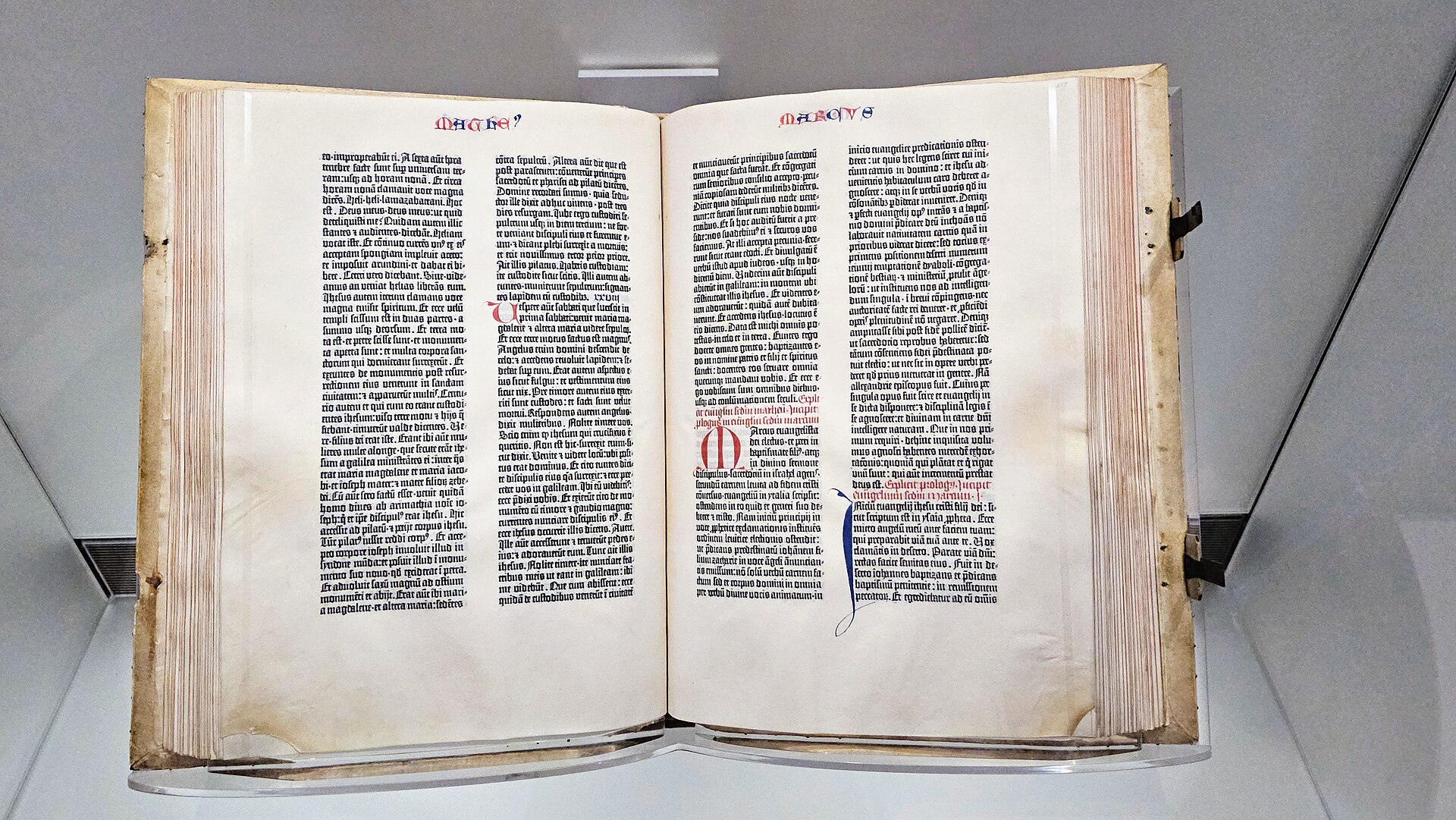
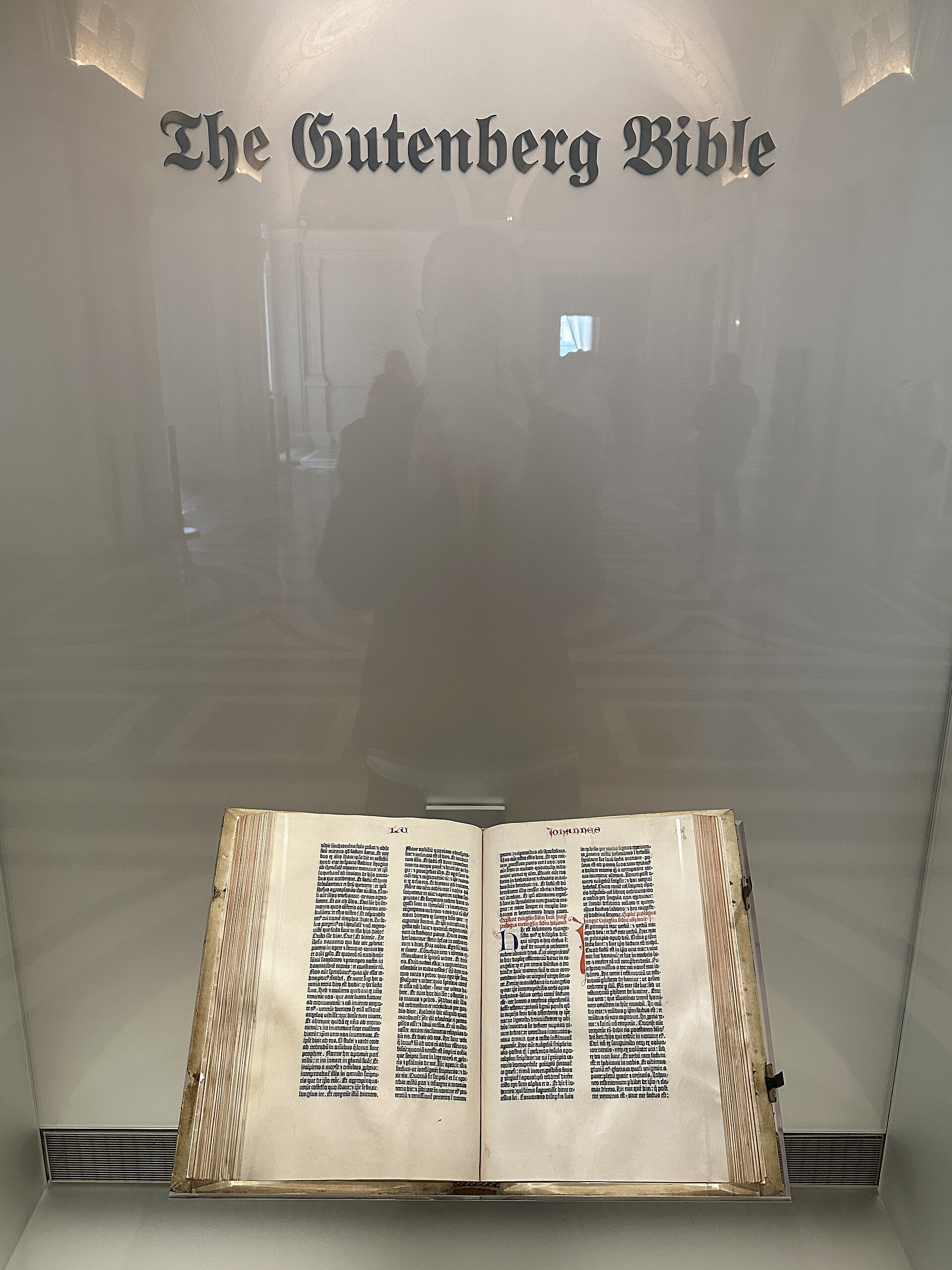
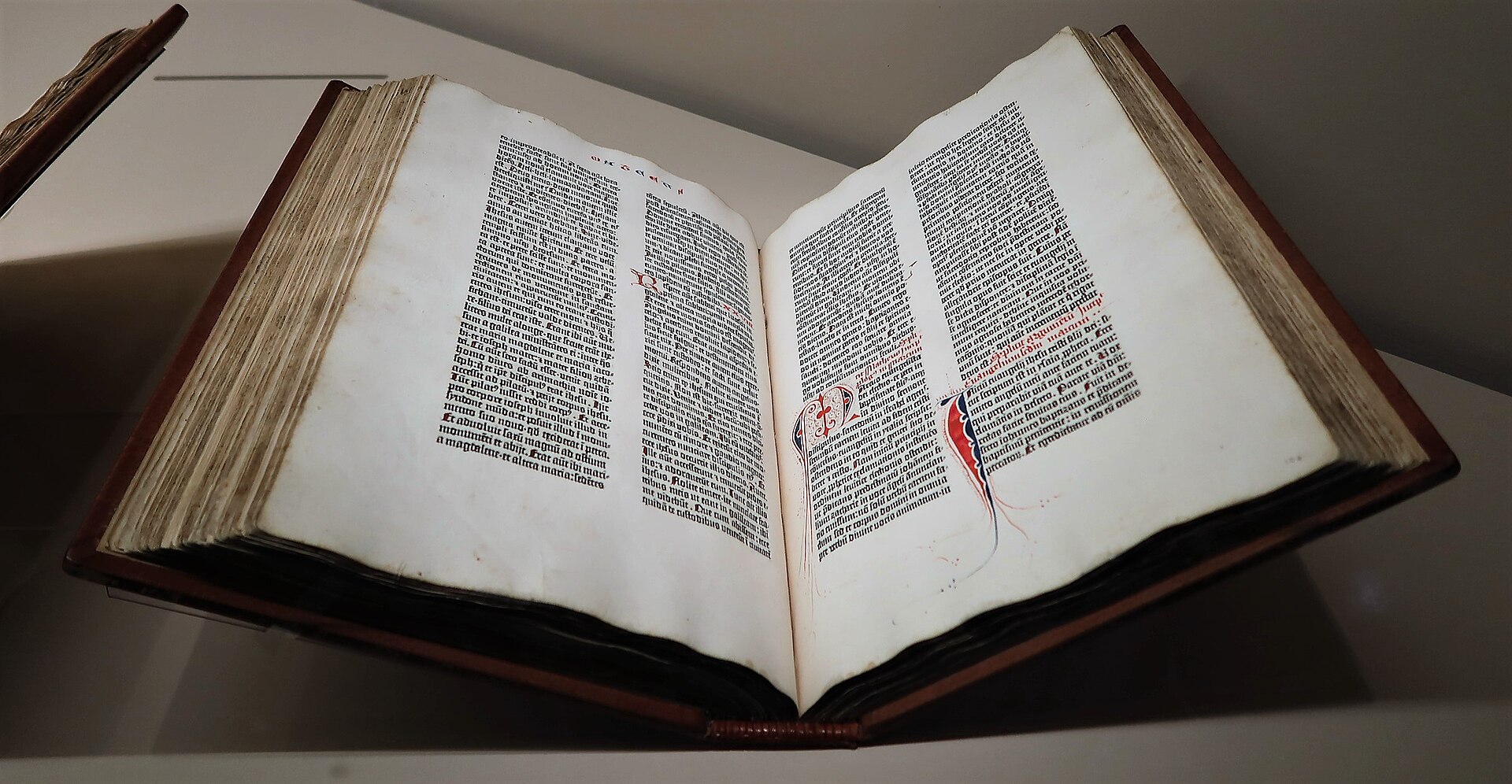
The copy described in this record, in its case in the Great Hall of the Thomas Jefferson Building. Note what kind of picture this is: a photograph of a bound volume as a three-dimensional object, which carries its own fresh copyright no matter how old the book is. It is usable here because the photographer released it under CC0.
| Artist | Printer of the 42-line Bible, Johann Gutenberg |
|---|---|
| Date | Mainz, between 1454 and 1455, not after 1456 |
| Medium | Printed from movable metal type on vellum, with rubrication, initials and headlines supplied by hand in red and blue |
| Dimensions | 42.5 cm as bound; leaf 407 x 300 mm; [643] leaves in three volumes |
| Where it is now | Library of Congress, Rare Book and Special Collections Division, Washington DC; on permanent display in the Great Hall of the Thomas Jefferson Buildinglast confirmed 4 August 2026 |
| Inventory number | Incun. 1454 .B5; class BS75 1454; LCCN 52002339 |
| Attribution | AttributedThe book names no printer, carries no title page and no colophon, and the Library of Congress catalogues the maker as 'Printer of the 42-line Bible (Johann Gutenberg)'. Full note |
| Object type | Printed book |
| Period | German, mid fifteenth century |
| Cases | Has a provenance gap |
| Inscriptions | Engraved bookplate of the Benedictine Abbey of Sankt Blasien on the front pastedown of each volume, with the motto Religione et Patria Nihil Antiquius. Manuscript signatures, generally cut off; catchword on leaf [125b] |
| Owners on record | 7 links6 documented, 1 unknown |
| Sources | 8 cited |
About this record Last verified 6 August 2026 · 8 sources cited · Change log
On this page 10 sections
ContentsClose
The copy of the 42-line Bible that the United States bought in 1930: three volumes on vellum in sixteenth-century white pigskin, [643] leaves, printed at Mainz between 1454 and 1455, on permanent display in the Great Hall of the Library of Congress. It is the St Blasius-St Paul copy, named for the two Benedictine houses that owned it for most of five centuries, and it is called the Vollbehr copy after the dealer who sold it.
The number attached to it in every retelling, USD 1.5 million, is not its price. That was the appropriation authorised by Public Law 71-533 for Otto Vollbehr's collection of three thousand incunabula with the Bible included, and no apportionment between them was ever made. The congressman who carried the bill, Ross Collins of Mississippi, lost his Senate primary in 1934 to an opponent who asked what a million and a half dollars could do for a state knee-deep in depression. Later that year the House Un-American Activities Committee established that Vollbehr had spent most of the money on pro-Nazi and antisemitic propaganda inside the United States.
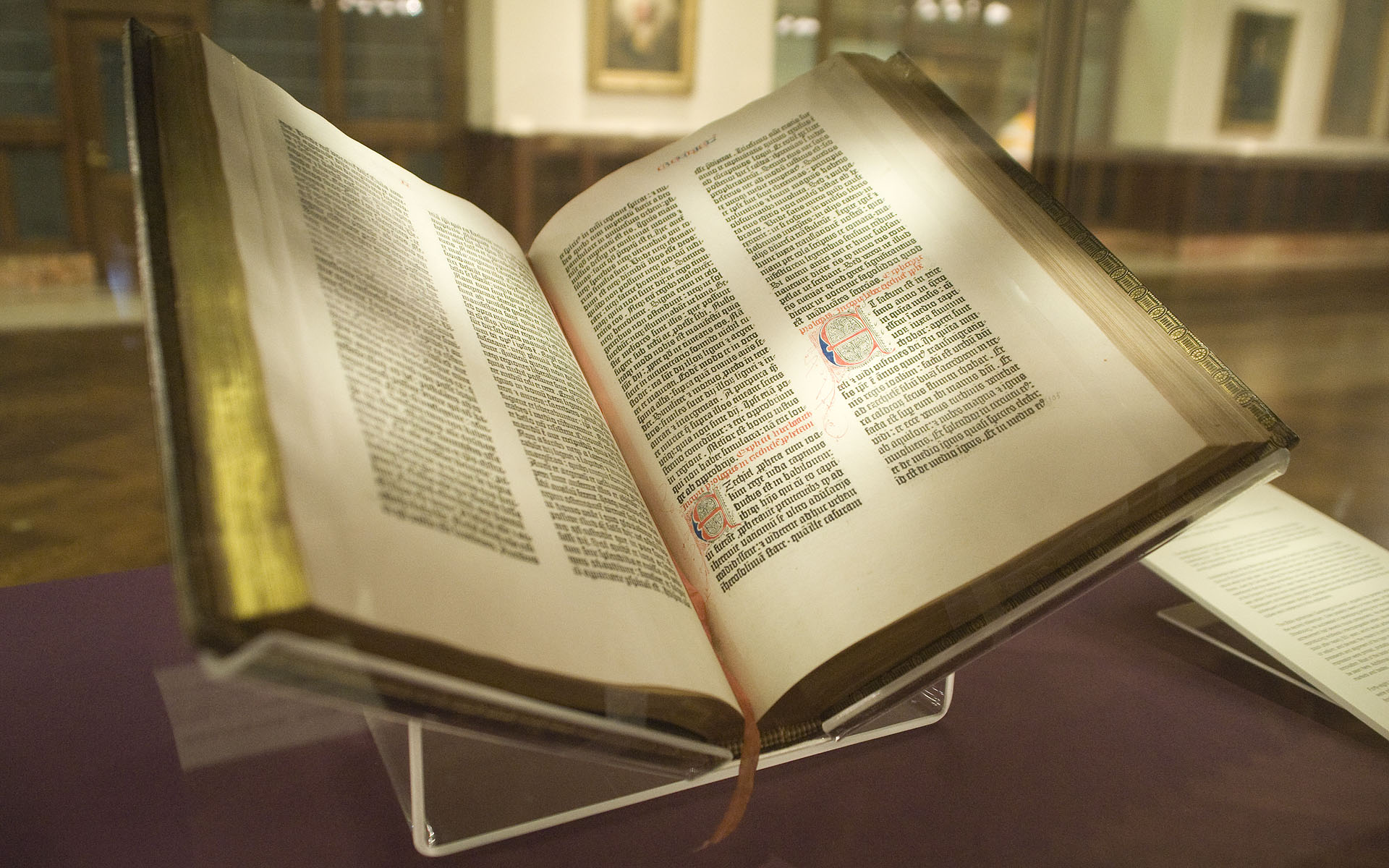
Everything here turns on which copy is which. There are about 49 more or less complete copies, 12 of them on vellum. The Library of Congress states on one of its own pages that this is one of three perfect vellum copies and on another that it is one of four. Every plate below that shows another copy is labelled as another copy, and named.
Provenance
Each link is graded. Documented: a cited source supports it. Disputed: the identification is argued but not established. Unknown: no owner for that span, and the gap is not smoothed into a narrative. The grades in the glossary.
- between 1454 and 1455 - eighteenth centuryNot establishedunknown
The catalogue record gives the imprint as [Mainz, Printer of the 42-line Bible (Johann Gutenberg) between 1454 and 1455?, not after 1456]. No owner is documented before the abbey.
- by the eighteenth century - 1796Benedictine Abbey of Sankt Blasien, Black Forestdocumented
The abbey's engraved bookplate survives on the front pastedown of each of the three volumes. Gerbert compared it with the 36-line Bible at Memmingen and published an engraving of the Genesis incipit.12
- 1796 - 1807Benedictine monastery at Einsiedeln, Schwyzdocumented
This stop is usually omitted from popular accounts.2
- 1807 - 1809Kollegiatstift of Spital am Pyhrndocumented
Also usually omitted.2
- 1809 - 1926Benedictine Abbey of Sankt Paul in Lavanttal, Carinthiadocumented
The catalogue record's provenance note reads: formerly in the Benedictine Abbey of St. Blasius in the Black Forest, after 1809 in the Benedictine Abbey of St. Paul in Carinthia.12
- 1926 - 1930Otto H. F. Vollbehrdocumented
The price Vollbehr paid the abbey is not established. Figures from USD 150,000 to USD 375,000 circulate and trace back to a single second-hand account. It is not the price the United States later paid.2
- 3 July 1930 - presentUnited States of America, Library of Congress, Rare Book and Special Collections Divisiondocumented
No official apportionment of the appropriation between the Bible and the rest of the collection was ever made. Library staff travelled to Austria to complete the transfer.234
Prices realised
The copy described in this record has never been offered at auction. It came to the United States inside a bulk purchase of three thousand incunabula and no separate price for it was ever set. The sale below is of a DIFFERENT copy and its figures must not be read as a value for this one. It is given because it is the last Gutenberg Bible auction for which a source separates the hammer from the premium in words.
| Date | Sale | Estimate | Result | Note |
|---|---|---|---|---|
| 22 October 1987 | Christie's, New York | 1,500,000 to 2,000,000 | Hammer 4,900,000 With premium 5,390,000 USD | NOT this copy. The Estelle Doheny copy, sold for the Roman Catholic Archdiocese of Los Angeles and bought by Maruzen Co. Ltd of Tokyo. UPI, quoting the Christie's spokeswoman Lily Zimmerman, gives USD 4.9 million plus a ten per cent commission of USD 490,000, which is the clearest hammer-and-premium statement in the literature of this book. The lot was one of 131 incunabula in the first of seven sales for the archdiocese. |
Hammer is the price at which the bidding stopped; with premium adds the fee the house charges the buyer on top. Hammer price and buyer's premium in the glossary.
Technical evidence
| Attribution note | The book names no printer, carries no title page and no colophon, and the Library of Congress catalogues the maker as 'Printer of the 42-line Bible (Johann Gutenberg)'. The attribution to Gutenberg rests on external evidence and on the type, not on anything printed in the book. |
|---|---|
| Collation | [643] leaves, of which [642] is wanting and [643] is blank. Bound in three volumes: Genesis to IV Ezra; Tobias to Ezekiel; Daniel to the Apocalypse of John.13 |
| Support | Printed entirely on vellum. The Library of Congress states that between about 120 paper copies and perhaps as many as 40 vellum copies were printed in total.13 |
| Dimensions | 42.5 cm as bound, per the catalogue record; the leaf is given by the Library as 407 mm tall by 300 mm wide.13 |
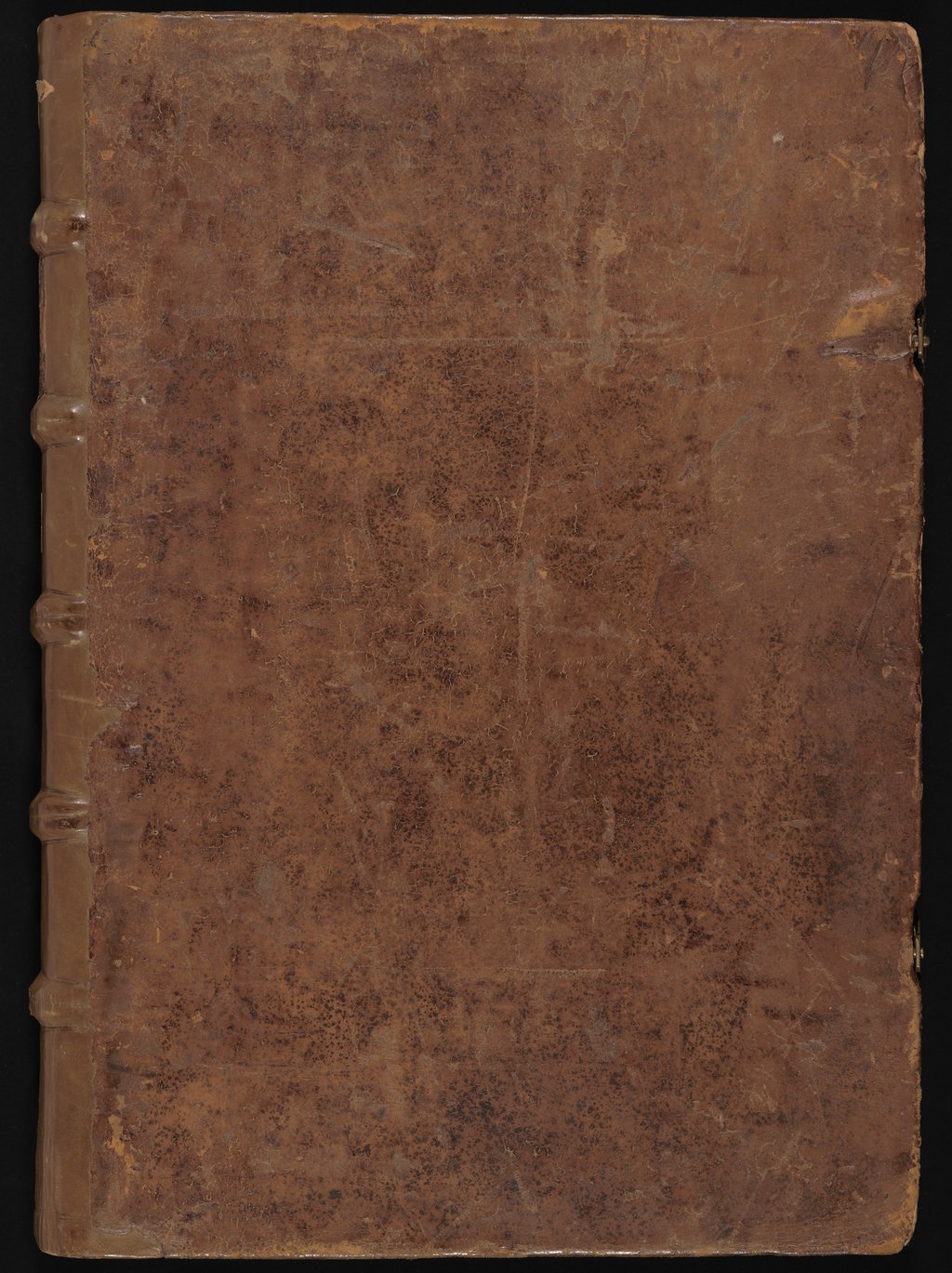
| Binding | Sixteenth-century blind-stamped white pigskin over wooden boards, in three volumes; one of the rolls used is dated 1560. Roll-stamp designs show Christ with the apostles John, Peter and Paul, and Faith, Hope, Charity and Justice. The bindery has not been identified.13 |
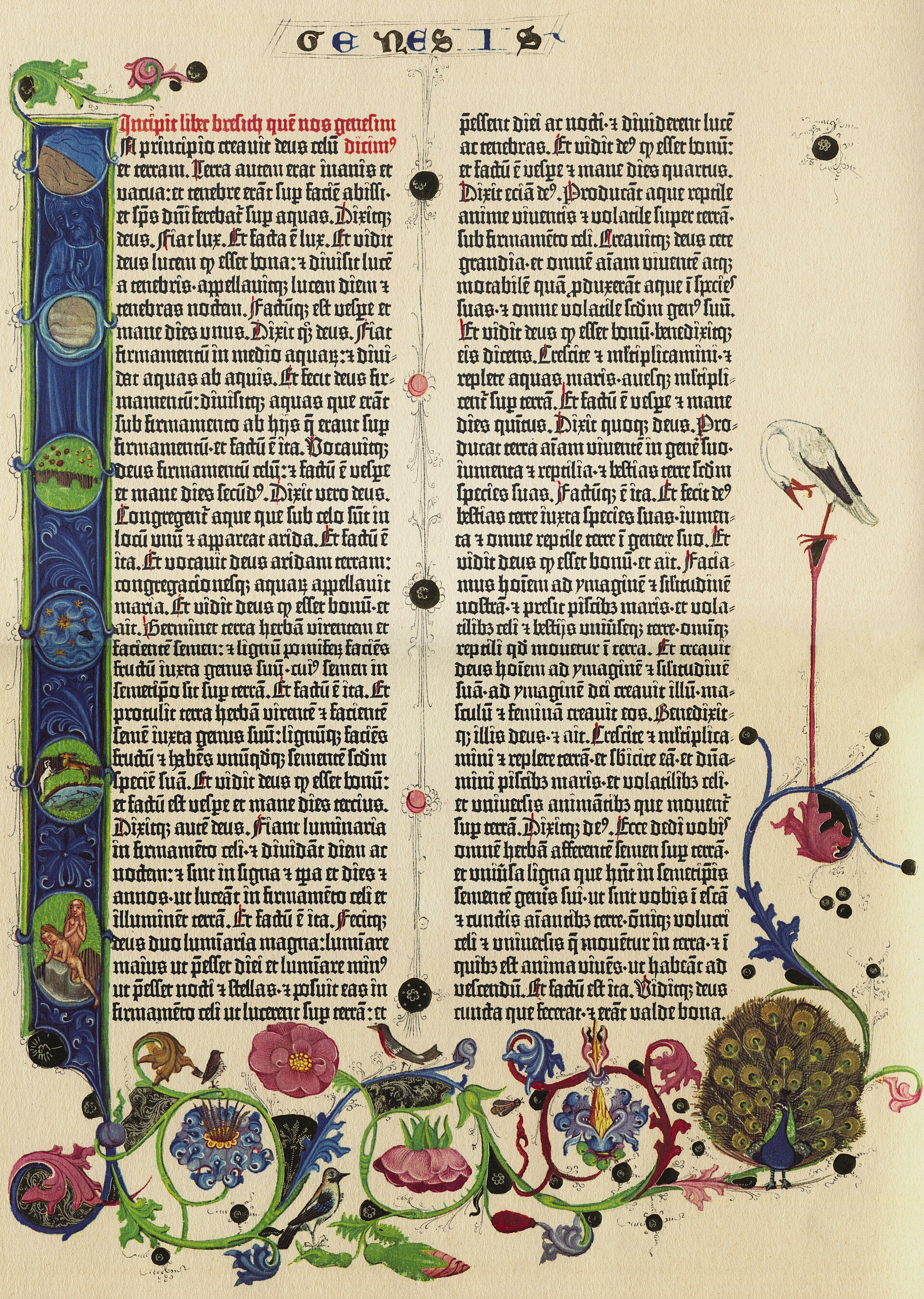
| Rubrication and decoration | Chapter headings on leaves [1a], [4a], [5a], [12a] and [129b] printed in red, the rest supplied by hand; initial strokes in red on leaves [1] to [130]; headlines in alternating red and blue; initials in red or blue, some larger ones in both, a few with ornament extending into the margin.1 |
| Press variants | Leaves [11]-[32a], [139]-[158] and [486a] are of the second printing. Leaf [192a] presents numerous variants from the 1913-14 Insel-Verlag facsimile of the Berlin copy.1 |
| Binder's evidence | Signatures in manuscript, generally cut off by the binder; catchword on leaf [125b].1 |
| Ownership marks | Engraved bookplate of the Benedictine Abbey of Sankt Blasien on the front pastedown of each volume, lettered for the Library of the Prince-Monks of Saint Blasien with the motto Religione et Patria Nihil Antiquius.12 |
| References | Goff B-526; GW 4201; Hain 3031; Schwenke, Johannes Gutenbergs 42-zeilige Bibel, no. 12. Catalogued at LCCN 52002339; shelfmark Incun. 1454 .B5; class BS75 1454.1 |
| Display and access | On permanent display in the Great Hall of the Thomas Jefferson Building. The volume is changed every six months and the opening every three. All three volumes are digitised in full by the Library, with a microfilm surrogate as well.13 |
Images
The record in full
Chapter 1Three volumes, on vellum, and the catalogue says a leaf is missing
The Library of Congress copy of the 42-line Bible is collated in its own catalogue record as [643] leaves, of which [642] is wanting and [643] is blank.
The Library of Congress copy of the 42-line Bible is collated in its own catalogue record as [643] leaves, of which [642] is wanting and [643] is blank. It stands 42.5 cm as bound; the Library gives the leaf as 407 mm by 300 mm. It is printed entirely on vellum. It is bound in three volumes, and the division is Genesis to IV Ezra, Tobias to Ezekiel, Daniel to the Apocalypse.
The binding is sixteenth-century blind-stamped white pigskin over wooden boards, and one of the rolls used on it is dated 1560. Two of the roll-stamp designs are distinctive: one shows Christ with the apostles John, Peter and Paul, the other Faith, Hope, Charity and Justice. The Library's own reading of that is that the book was still in Catholic liturgical use in the late sixteenth century, and that the tooling may eventually identify the bindery. It has not yet.
The decoration is modest. Chapter headings on five leaves are printed in red and the rest supplied by hand; initial strokes are supplied in red through the first 130 leaves; headlines alternate red and blue; initials are red or blue, a few with ornament running into the margin. A buyer in 1455 could pay for illumination, and whoever bought this one did not pay for much. The Library notes that this is why the staff choosing which opening to display look for a chapter start: there is not much else to look at.
Chapter 2The catalogue record contains real bibliographical evidence, and almost nobody reads it
Buried in the notes field of a record catalogued in 1952 is the following: leaves [11] to [32a], [139] to [158] and [486a] are of the second printing.
Buried in the notes field of a record catalogued in 1952 is the following: leaves [11] to [32a], [139] to [158] and [486a] are of the second printing. That is a statement about how the book was made. Gutenberg's shop reset and reprinted sections as the edition size was increased mid-production, and this copy carries three such stretches. The same note records that leaf [192a] presents numerous variants from the facsimile edition of the Berlin copy published by the Insel-Verlag in 1913 and 1914.
There is more. The signatures are in manuscript and generally cut off, and there is a catchword on leaf [125b]. Signatures cut away by a binder are the ordinary evidence of trimming, and a catchword in a printed book of 1455 is a scribal habit surviving into print.
None of this is obscure. It is on a public catalogue record with a permanent identifier. It is simply not the kind of fact that reaches the coverage, which prefers the price.
Chapter 3How many copies exist depends on who is counting, and the Library gives two answers itself
The census in general circulation is 49 more or less complete copies, 12 on vellum and 37 on paper.
The census in general circulation is 49 more or less complete copies, 12 on vellum and 37 on paper. UPI reported in 1987 that the book sold that year was one of 48 in existence. The two numbers are not a contradiction so much as a difference in what counts as a copy: separated volumes and substantial fragments can be counted once, twice or not at all.
The interesting disagreement is internal. The Library of Congress catalogue record states that its copy is one of only three perfect vellum copies known to exist, and names the other two as the Bibliotheque nationale de France and the British Library. The Library's own research guide, maintained and updated more recently, states that the Library is one of only four institutions with a complete vellum copy, and names Gottingen, the National Library of France and the British Library. Same institution, same object, two counts and two lists, both live.
The guide points the reader to Eric Marshall White's Editio Princeps of 2017, pp. 307-353, for the census. That is the right answer, and this record repeats it rather than arbitrating between two pages of the same website.
Chapter 4Five centuries inside one religious order, and four houses
In the eighteenth century the copy belonged to the Benedictine Abbey of Sankt Blasien in the Black Forest, a princely abbey whose abbot held the title of Prince-Abbot.
In the eighteenth century the copy belonged to the Benedictine Abbey of Sankt Blasien in the Black Forest, a princely abbey whose abbot held the title of Prince-Abbot. Its engraved bookplate is still on the front pastedown of each of the three volumes, reading, above the crest, that the book is from the library of the Prince-Monks of Saint Blasien, and carrying the motto Religione et Patria Nihil Antiquius: nothing is more venerable than one's religion and homeland.
In 1765 the Prince-Abbot Martin Gerbert von Horneau, a scholar of history, theology and music, compared his abbey's 42-line Bible with the 36-line Bible at Memmingen, and published his notes. In the German and Latin editions of his Iter Alemannicum of 1767 he included an engraving of the incipit of Genesis 1:1 with its distinctive initial I, which gave other scholars a means of identifying further copies. Which of the two Bibles was printed first was not settled until 1890.
Then the book moves because armies do. With Napoleon's invasion in 1796 it went to the Benedictine house at Einsiedeln in Schwyz; in 1807 to the Kollegiatstift of Spital am Pyhrn; and in 1809 to the monastery of Sankt Paul in Lavanttal, Carinthia. A Gutenberg specialist documented it there in 1900. The two intermediate stops are routinely dropped from the popular account, which jumps straight from the Black Forest to Carinthia.
Chapter 51926: an arrangement with the monks
In 1926 Otto H. F. Vollbehr made an arrangement with the monks at Sankt Paul to buy the three-volume Bible for his own collection of early printed books, which, in the Library of Congress's own...
In 1926 Otto H. F. Vollbehr made an arrangement with the monks at Sankt Paul to buy the three-volume Bible for his own collection of early printed books, which, in the Library of Congress's own phrase, he had amassed for very little following the devastation of the First World War. The Bible stayed in Austria.
What Vollbehr paid the abbey is not settled. Figures between USD 150,000 and USD 375,000 circulate, and they trace back through a chain of retellings to a single second-hand account of an address given by a Library of Congress officer. This record does not pick one. It records that the sum is not established, and that it is not the same thing as the price the United States later paid, a confusion that recurs in almost every popular retelling.
Chapter 63 July 1930: what one and a half million dollars actually bought
The authorising statute is Public Law 71-533, chapter 860, from H.R.
The authorising statute is Public Law 71-533, chapter 860, from H.R. 12696, entitled 'An Act Authorizing an appropriation for the purchase of the Vollbehr collection of incunabula', at 46 Stat. 1012. The Library of Congress states the arithmetic plainly: the Gutenberg Bible was part of a larger sale of 3,000 fifteenth-century imprints from Vollbehr's collection, and Congress authorised an appropriation of USD 1,500,000 for the 3,000 incunabula as well as the Gutenberg Bible.
That sentence is the single most misquoted fact about this object. USD 1.5 million is not the price of a Gutenberg Bible. It is the price of three thousand incunabula with a Gutenberg Bible included, and no official apportionment between the two was ever made. Anybody citing 1.5 million dollars as what America paid for its Gutenberg Bible in 1930 is quoting the price of a library and attributing it to one book.
The incunabula had already reached the United States. Library staff had to travel to Austria to complete the sale and transfer of the Bible itself, which did not arrive in Washington until 3 September 1930.
Chapter 7The congressman who carried the bill lost his seat over it
The measure is known as the Collins bill, after Ross A.
The measure is known as the Collins bill, after Ross A. Collins, Democrat of Mississippi. In 1934 Theodore Bilbo ran against him and, according to Turner Catledge, decried in every county in the state, then knee-deep in depression, what a million and a half dollars could do to alleviate distress. Collins answered in kind, proclaiming that it would have been worth a billion dollars to secure these sacred books from the heathen Germans. Bilbo eliminated him in the first primary.
Collins regained a House seat in 1936 and remained a champion of libraries, including increased funding for the public libraries of the District of Columbia. The American Library Association made him an honorary member in 1938.
Every acquisition of this kind has a political cost and it is almost never recorded on the object's page. Here it is measurable: one congressional career, interrupted for one term, over one purchase.
Chapter 8The seller spent most of the money on Nazi propaganda in the United States
On 30 November 1934, in an executive session held in New York City, the House Un-American Activities Committee questioned Otto Vollbehr about what he had done with the money paid for his collection.
On 30 November 1934, in an executive session held in New York City, the House Un-American Activities Committee questioned Otto Vollbehr about what he had done with the money paid for his collection. The reading public knew nothing of it until 16 December 1934, when John W. McCormack, a Massachusetts Democrat, made Vollbehr's testimony public through the New York Times.
The scholarly account of the episode states it without hedging: Vollbehr had spent most of the USD 1.5 million on pro-Nazi and anti-Semitic propaganda in the United States. The matter had reached the committee because many of Collins's own correspondents, people who had campaigned for the purchase, began receiving mailings from Vollbehr defending German aggression in Europe and the treatment of Jews, whom Vollbehr insisted were communists. He justified the seven Memoranda, as he called his mailings, as an answer to anti-German accounts in the American press: 'I see those reports are at least incomplete. They are an injustice to Germany.' Samuel Dickstein of New York described the mailings as a direct attack upon certain creeds and races of this country. McCormack, making the testimony public, said Vollbehr had intended to incite American against American.
Vollbehr left for Germany soon after the hearings, returned to sell the remainder of his collection through Gimbel's department store in New York, and left the country for good in 1939 with the FBI behind him. He died some time after the war ended, almost without resources.
This belongs on the object's page and not in a footnote. A federal appropriation, voted in the depths of the Depression and defended as a purchase of civilisation, put one and a half million dollars into the hands of a man who used most of it to distribute antisemitic propaganda in the country that had paid him.
Chapter 91940: the first public argument that the purchase was a mistake
In 1940 Burton Rascoe published a blistering criticism of the purchase in the Saturday Review of Literature.
In 1940 Burton Rascoe published a blistering criticism of the purchase in the Saturday Review of Literature. He charged that the collection was over-priced and that Vollbehr had looked upon Americans as a prize bunch of suckers; that the German native had conducted one of the most impressive lobbies ever staged for any bill, one that would stagger any old-time professional lobbyist; and that at a cost of USD 1,500,000 Uncle Sam had become the proud possessor of a Gutenberg Bible and some early printing do-dads. He also raised the question of whether Vollbehr had used any of the money to establish German credits in America for spy work.
Frederick R. Goff, later chief of the Library's Rare Books and Special Collections Division, wrote a vigorous defence of the acquisition and dismissed Rascoe's article as a complete misunderstanding and a misrepresentation of the facts of the 1930 transaction. He did not deny that on his return to Germany Vollbehr became an active propagandist.
Both men were right about different things. The collection was worth having, and the seller was what Rascoe said he was.
Chapter 1022 October 1987: the figures from the last great sale, separated
No copy of the 42-line Bible has come to auction in a generation, and when one does the reported number is almost always the wrong one.
No copy of the 42-line Bible has come to auction in a generation, and when one does the reported number is almost always the wrong one. The 1987 sale is the exception because the wire report split it.
A Gutenberg Bible from the Estelle Doheny Collection, sold by Christie's New York on behalf of the Roman Catholic Archdiocese of Los Angeles, went to Maruzen Co. Ltd of Tokyo for USD 4.9 million plus a ten per cent commission of USD 490,000. The Christie's spokeswoman Lily Zimmerman gave both figures. The estimate had been USD 1.5 to 2 million, so the winning bid was more than twice what the house predicted. The book was in its original brown calf binding, illuminated, and measured 403 by 292 mm. It was one lot among 131 books printed before 1500 in the first of seven sales for the archdiocese, which was disposing of about 8,000 books to fund a foundation to increase seminary enrolment.
So the hammer was USD 4,900,000 and the total paid was USD 5,390,000. The figure USD 5.39 million, which is what most sources print, is the premium-inclusive total. The figure USD 4.9 million, which is what the headline said, is the hammer. Neither is a price for the copy in this record, which has never been at auction and which the United States acquired inside a bulk purchase of three thousand books.
Chapter 11The one thing an institutional copy does not have is a price
The Library of Congress copy has no market value in any published sense.
The Library of Congress copy has no market value in any published sense. It has never been offered, no insurance valuation for it has been published, and the only sum ever attached to it is an appropriation that also bought three thousand other books. Its comparables are all copies that behave differently: privately owned books, single volumes, copies coming out of seminary collections being liquidated.
The last complete copy sold at auction went in 1978. This desk could not reach a source that separates the hammer from the premium on that sale, so no figure for it appears here. Leaving it out is the correct treatment; printing a number whose basis is unknown is how the 1930 appropriation came to be quoted as the price of a Bible.
Chapter 12How the page you see in the Great Hall is chosen
The three volumes remain on public display in the Great Hall of the Jefferson Building.
The three volumes remain on public display in the Great Hall of the Jefferson Building. The Conservation Division controls the display. A member of the conservation staff changes the volume every six months, rotating through the three, and turns to a new opening every three months. Because the copy is not much decorated, staff look for an opening with some visual interest, usually the start of a chapter with a modestly decorated capital, and deliberately choose openings from different parts of the book so that no one place in the binding takes repeated stress.
All three volumes are digitised in full and published by the Library with persistent handles, and the record also carries a microfilm surrogate made before that. A reader who wants leaf [192a], with its variants against the Berlin facsimile, can call it up.
The artist
Johann Gutenberg, the Printer of the 42-line Bible
The Library of Congress catalogues the maker of this book as 'Printer of the 42-line Bible (Johann Gutenberg)', which is the careful form: the book carries no printer's name, no date, no title page and no pagination, and the attribution to Gutenberg rests on external evidence and on the type. The dossier below therefore concerns the shop as much as the man, and what this particular copy shows about how it worked.
Related works
| Work | Relation | Where it is |
|---|---|---|
| The Vollbehr collection of incunabula Various fifteenth-century printers | The 3,000 early printed books bought by the United States in the same appropriation The Bible was one item in this purchase. The Senate companion bill would have required the whole collection to be named for the Librarian, Herbert Putnam; the Library calls it the Otto Vollbehr Collection. | Library of Congress, Rare Book and Special Collections Division |
| The Estelle Doheny copy Printer of the 42-line Bible | A different copy; the last to make an auction record Hammer USD 4,900,000 plus a ten per cent commission of USD 490,000, against an estimate of USD 1.5 to 2 million. | Japan, bought by Maruzen Co. Ltd in 1987 |
| The Bayerische Staatsbibliothek copy Printer of the 42-line Bible | A different copy, and one of only two in which the separately printed rubrication table survives The other copy retaining that table is in the Austrian National Library. The table is direct evidence of a production decision Gutenberg reversed. | Bayerische Staatsbibliothek, Munich |
| The Lenox copy Printer of the 42-line Bible | A different copy; the first Gutenberg Bible to reach the United States Held in the Rare Books Division, from the Lenox Library. | New York Public Library |
| The 36-line Bible Printer of the 36-line Bible | The rival claimant to primacy in printing Which of the two was printed first was not settled until 1890. | Several institutions; the Memmingen copy is the one the Prince-Abbot of Sankt Blasien compared with this book in 1765 |
Open questions
- Is the Library of Congress copy one of three perfect vellum copies or one of four? Its catalogue record says three and names the Bibliotheque nationale de France and the British Library; its research guide says four and adds Gottingen. Both statements are live on the same website.
- How is the copy 'perfect' when the catalogue collation says leaf [642] is wanting? The missing leaf is almost certainly a blank, but the point should be settled against White's census at pp. 307-353 rather than assumed.
- What did Otto Vollbehr actually pay the abbey of Sankt Paul in 1926? Reported figures run from USD 150,000 to USD 375,000 and all of them descend from one second-hand account.
- Was any part of the USD 1,500,000 appropriation ever apportioned to the Bible as distinct from the other 3,000 incunabula? No official apportionment has been found, which is why every 'price of the Gutenberg Bible' figure for 1930 is an invention.
- Did the Austrian authorities intervene in the export, and on what terms? An export fee and a state-driven increase in the price are reported, but only through a single chain of retellings, and no Austrian or German source has been consulted here.
- What was the hammer price at the 1978 sale of the last complete copy to come to auction, as distinct from the price including premium? No source reachable from this desk separates them, so no figure is printed here.
- Can the sixteenth-century bindery be identified from the roll-stamp designs? The Library suggests the tooling may help; nobody has done it.
Questions about this object
What is Biblia Latina, the 42-line Bible: the Library of Congress copy?
Biblia Latina, the 42-line Bible: the Library of Congress copy is a printed book, dated mainz, between 1454 and 1455, not after 1456. Medium: Printed from movable metal type on vellum, with rubrication, initials and headlines supplied by hand in red and blue.
Who made Biblia Latina, the 42-line Bible: the Library of Congress copy, and is the attribution settled?
The attribution to Printer of the 42-line Bible, Johann Gutenberg is recorded here as attributed. The book names no printer, carries no title page and no colophon, and the Library of Congress catalogues the maker as 'Printer of the 42-line Bible (Johann Gutenberg)'. The attribution to Gutenberg rests on external evidence and on the type, not on anything printed in the book.
Where is Biblia Latina, the 42-line Bible: the Library of Congress copy now?
Library of Congress, Rare Book and Special Collections Division, Washington DC; on permanent display in the Great Hall of the Thomas Jefferson Building. Inventory number Incun. 1454 .B5; class BS75 1454; LCCN 52002339. Last confirmed 4 August 2026. Purchased by the United States under Public Law 71-533, approved 3 July 1930; arrived in Washington 3 September 1930.
What is still unknown about Biblia Latina, the 42-line Bible: the Library of Congress copy?
Is the Library of Congress copy one of three perfect vellum copies or one of four? Its catalogue record says three and names the Bibliotheque nationale de France and the British Library; its research guide says four and adds Gottingen. Both statements are live on the same website.
Sources
- 1Library of Congress catalogue record, Biblia Latina, LCCN 52002339, MARC21 record, giving the collation, binding, rubrication, press variants and provenance note for the Library's copy. lccn.loc.gov/52002339/...
- 2Library of Congress, 'The Library's Copy of the Gutenberg Bible', The Gutenberg Bible at the Library of Congress: A Resource Guide. guides.loc.gov/gutenberg/...
- 3Library of Congress, 'Frequently Asked Questions', The Gutenberg Bible at the Library of Congress: A Resource Guide. guides.loc.gov/gutenberg/...
- 4United States Government Publishing Office, govinfo metadata for Public Law 71-533, chapter 860, H.R. 12696, 'An Act Authorizing an appropriation for the purchase of the Vollbehr collection of incunabula', 46 Stat. 1012. The page images in the Statutes at Large are scans and carry no machine-readable text. api.govinfo.gov/packages/...
- 5Martha H. Swain, 'Ross Collins and the Incunabula', Journal of Mississippi History 76:1 (2014), pp. 1-18. Peer-reviewed; text extracted directly from the journal PDF at this address. mississippihistory.org/sites/...
- 6William K. Rashbaum, 'Record $4.9 million spent on Gutenberg Bible', United Press International, 23 October 1987, quoting the Christie's spokeswoman Lily Zimmerman. upi.com/Archives/...
- 7World Digital Library description of the Bayerische Staatsbibliothek copy of the Gutenberg Bible, giving the census as 49 more or less complete copies, 12 on vellum and 37 on paper; reproduced on the Wikimedia Commons file page. commons.wikimedia.org/wiki/...
- 8Wikipedia, 'Gutenberg Bible'. Tertiary, used only for orientation. Flagged for replacement with Eric Marshall White, Editio Princeps: A History of the Gutenberg Bible, Harvey Miller, 2017, whose census at pp. 307-353 is the authority the Library of Congress itself cites. en.wikipedia.org/wiki/...

Last verified 6 August 2026 · Published 6 August 2026
Change log
6 August 2026 - Record created at the house standard: researched narrative, technical evidence, maker dossier, graded provenance chain, prices with hammer and premium separated, related works, open questions and sources.