The Ashburnham Pentateuch
Unidentified Late Antique workshop (called in modern scholarship the Master of the Ashburnham Pentateuch) · Late 6th or early 7th century (main text and surviving miniatures); marginal corrections and 13 replacement leaves added in the mid-8th century, apparently after the manuscript reached Francia
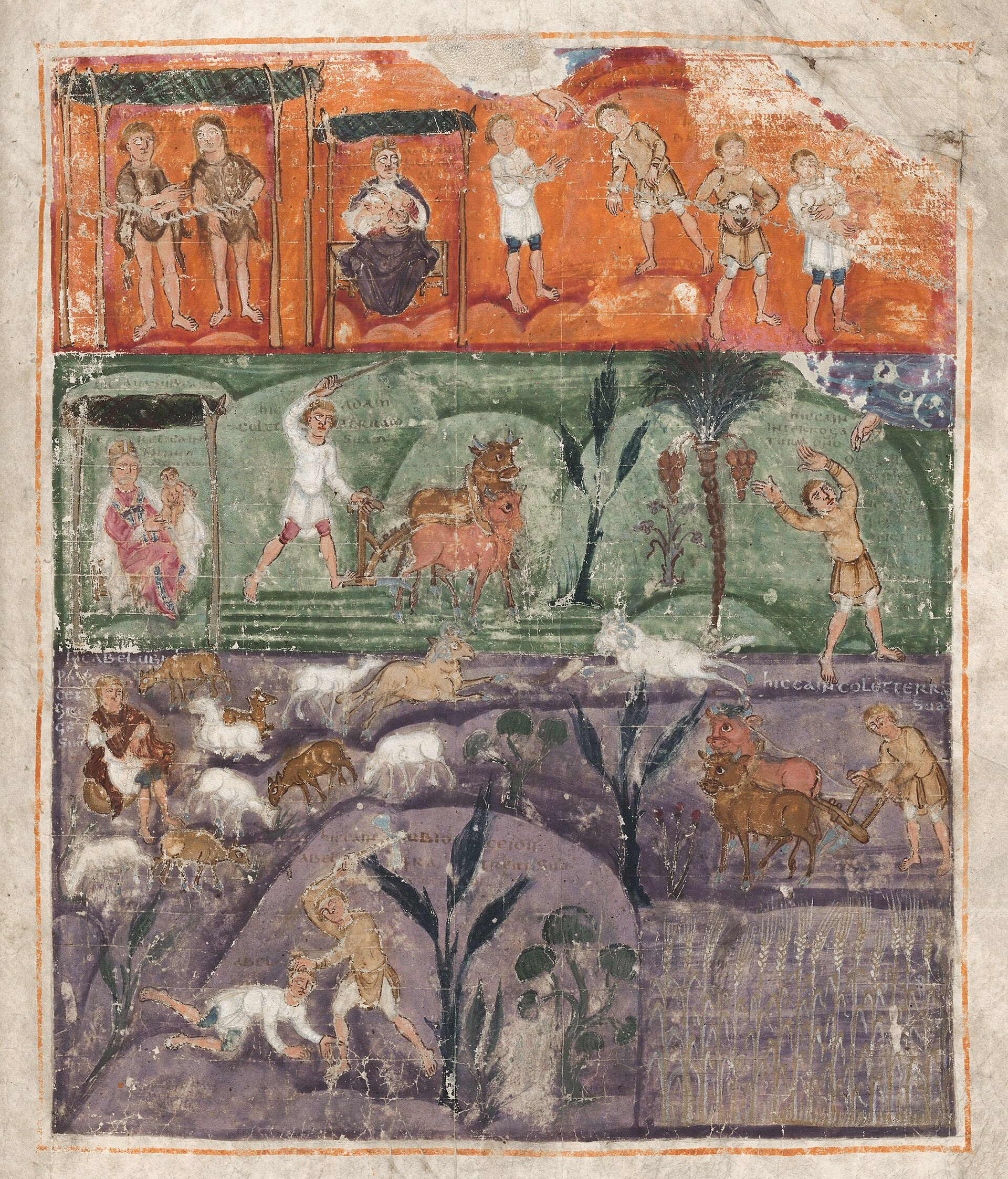
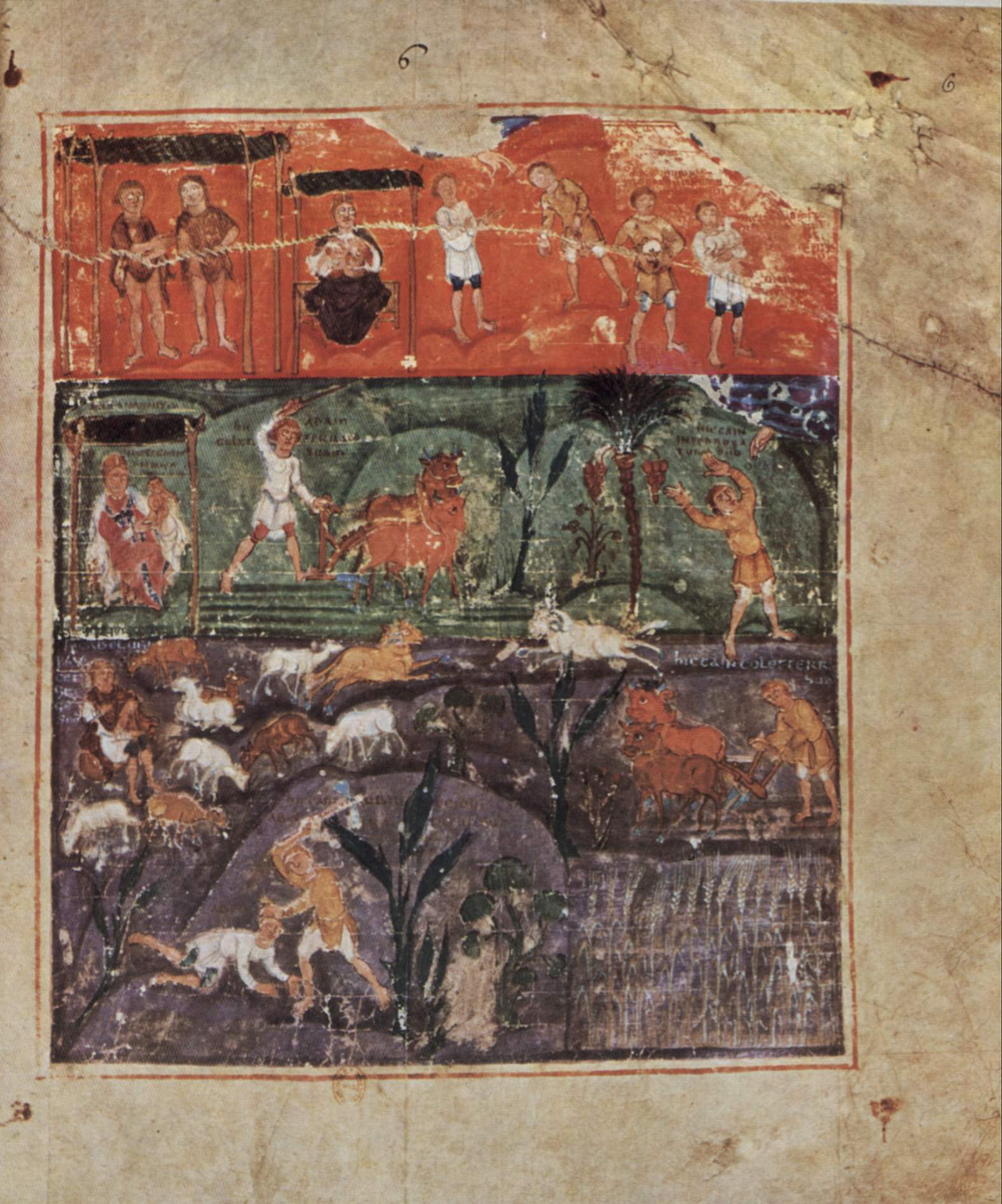
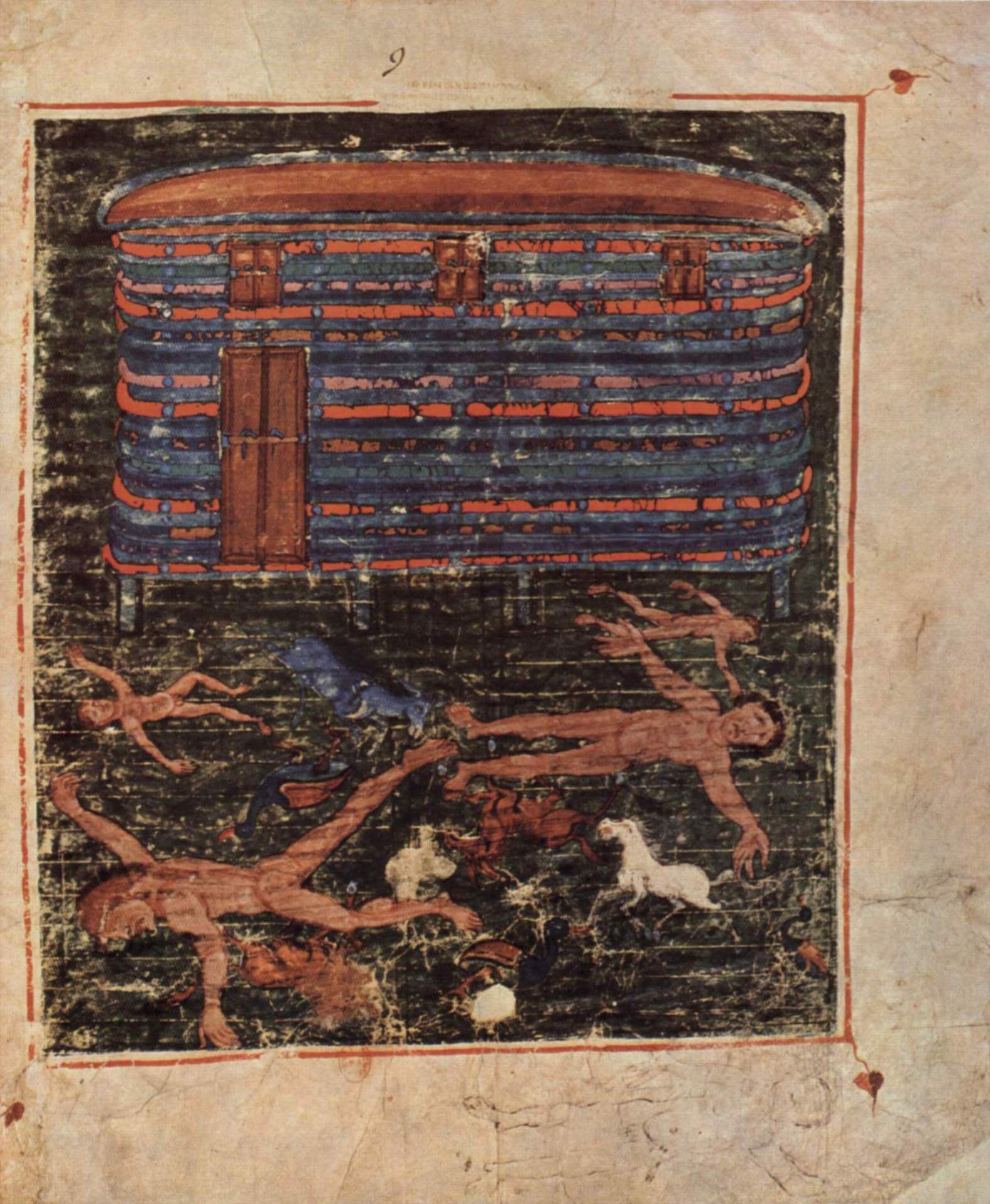
The lead plate for this record: folio 6r of the manuscript, showing the story of Cain and Abel. Photographed directly from the Bibliotheque nationale de France's holding.
Bibliotheque nationale de France, Paris; photograph by Gennadii Saus i Segura, CC BY-SA 4.0| Artist | Unidentified Late Antique workshop (called in modern scholarship the Master of the Ashburnham Pentateuch) |
|---|---|
| Date | Late 6th or early 7th century (main text and surviving miniatures); marginal corrections and 13 replacement leaves added in the mid-8th century, apparently after the manuscript reached Francia |
| Medium | Ink and tempera with gold on parchment; uncial script, with later marginal additions mixing uncial, semi-uncial and Caroline minuscule |
| Dimensions | 142 folios in two columns, 375 x 310 mm (written space 280 x 240 mm) |
| Where it is now | Bibliotheque nationale de France, Departement des manuscrits, Parislast confirmed 17 September 2026 |
| Inventory number | Nouvelles acquisitions latines (NAL) 2334; former shelfmark Libri 13 |
| Attribution | DisputedNo scribe or painter is named anywhere in the manuscript, and there is no colophon. Full note |
| Object type | Manuscript |
| Period | Late Antique to Early Medieval, Latin West |
| Cases | Disputed attribution |
| Inscriptions | Roman-numeral quire signatures survive at twelve points (e.g. f.34v 'Q. VII', f.138 'Q. XXV'); a 9th- or 10th-century hand added notes partly in Tironian shorthand recording missing leaves ('hic deest folium I', at ff.70v, 118v and 126v); a marginal rubric at f.125r reads 'lectio ordinationis diaconorum' (a reading for the ordination of deacons), suggesting liturgical use; the 19th-century spine is lettered 'Pentateucus cum antiquissimi(is) picturis. Litteris uncial(is) saec. V', an outdated date estimate kept as a historical curiosity of the binding rather than a scholarly dating |
| Owners on record | 11 links10 documented, 1 disputed |
| Sources | 14 cited |
About this record Last verified 17 September 2026 · 14 sources cited · Change log
On this page 9 sections
ContentsClose
The Ashburnham Pentateuch is a Latin manuscript of the first five books of the Bible, made in the late 6th or early 7th century by a workshop whose location is still disputed among named scholars, with Italy, Rome, Visigothic Spain and North Africa all argued in the literature. It is one of the oldest surviving illustrated biblical manuscripts, its Creation page originally showing a rare anthropomorphic image of the Trinity later partly painted over at Tours, where the book spent the whole medieval period.
In 1842 it was stolen from Tours by Guglielmo Libri, the French government's own Inspector-General of Libraries, who fled to England in 1848 ahead of arrest and was convicted of theft in absentia by a French court in 1850. Libri had already sold it, in 1847, to Bertram Ashburnham, 4th Earl of Ashburnham, whose son's estate sold it back to the Bibliotheque nationale de France in 1888, after a decade-long campaign by the scholar Leopold Delisle to document its theft.
It has been held in Paris ever since, under the shelfmark Nouvelles acquisitions latines 2334, and remains, on its dating, its iconographic sources and important details of its own theft and sale, an object with more open questions than closed ones.
Provenance
Each link is graded. Documented: a cited source supports it. Disputed: the identification is argued but not established. Unknown: no owner for that span, and the gap is not smoothed into a narrative. The grades in the glossary.
- c. late 6th - early 7th century -Unknown Latin biblical workshop (region disputed)disputed
The text and the original cycle of about 69 full-page miniatures were produced by a single workshop. Its location is unresolved: Italy, an imperial scriptorium at Rome, Visigothic Spain and North Africa have all been argued by named scholars on the basis of script, iconography and textual affiliation, with no consensus reached.13
- - 8th centuryUnknowndocumented
The manuscript had reached Frankish Gaul by the 8th century. Thirteen folios lost from the original quires were replaced at this time with new leaves copied directly onto the damaged book, and marginal corrections were added mixing uncial and semi-uncial script.1
- 9th century -Unknown (a Carolingian-period corrector, apparently at Tours)documented
The anthropomorphic Trinity on the Creation page was partly painted over, reducing an original scheme of paired Father-and-Son figures and a winged Holy Spirit to a single Creator figure, a change read as consistent with Carolingian theological concerns about Trinitarian unity. The identity of the corrector is not recorded.8
- 9th century - 1842Custodians at Toursdocumented
The manuscript is documented as having remained at Tours throughout the medieval period. A secondary, non-scholarly source consulted for this record states more specifically that it was held in the library of the cathedral chapter of Saint-Gatien and transferred, with other confiscated ecclesiastical holdings, to the civic Bibliotheque municipale de Tours during the French Revolution; this detail could not be corroborated in the scholarly or institutional sources consulted and is flagged as unverified.113
- 1842 - 1842Guglielmo Libridocumented
Stolen at Tours in 1842 by Guglielmo Libri, then serving as the French government's Inspector-General of Libraries, a post that gave him unsupervised access to provincial collections he was nominally cataloguing.134
- 1842 - 1847Guglielmo Libridocumented
Held privately by Libri, who catalogued it among his own manuscripts as item 'Libri 13', the number still used cross-referentially in the Bibliotheque nationale's own catalogue.1
- 1847 - 1878Bertram Ashburnham, 4th Earl of Ashburnhamdocumented
Bought by the 4th Earl of Ashburnham in 1847 as part of a much larger purchase of manuscripts from Libri, who fled France the following year. A single non-scholarly source consulted claims Libri represented the manuscript to Ashburnham as originating at Grottaferrata, near Rome, to disguise its French origin; this claim could not be corroborated elsewhere and is flagged as unverified.313
- 1850 -Unknowndocumented
On 22 June 1850 a French court convicted Libri of theft and sentenced him in absentia to ten years' imprisonment. He remained in England and never returned to France; he went back to Italy in 1868 and died near Florence in 1869. Ownership of the manuscript, by then in England, was unaffected by the verdict.34
- 1878 - 1888Estate of Bertram Ashburnham, 5th Earl of Ashburnhamdocumented
After the 4th Earl's death in 1878, his son opened negotiations to sell part of the manuscript collection. Leopold Delisle spent much of the following decade assembling documentary proof that a large part of the Ashburnham manuscripts of French origin, including this one, had been stolen from French public libraries by Libri and by the bookseller Jean-Baptiste Barrois.1910
- 1888-02-23 - 1888-02-23Bibliotheque nationale (France)documented
Purchased from the London bookselling firm Trubner on 23 February 1888 and entered into the manuscripts department's register under no. 8070(12); published the same year in Delisle's Catalogue des manuscrits des fonds Libri et Barrois. The price paid, individually or as part of the wider purchase, was not found in the sources consulted.19
- 1888 - presentBibliotheque nationale de Francedocumented
Held since 1888 in the Departement des manuscrits of the Bibliotheque nationale de France, Paris, under the shelfmark Nouvelles acquisitions latines 2334. Distinct from the parallel, separately negotiated 1884 Italian government purchase that sent the Italian portion of Libri's manuscripts sold to Ashburnham to the Biblioteca Medicea Laurenziana in Florence; no part of that group's later history belongs to this manuscript.1211
Technical evidence
| Attribution note | No scribe or painter is named anywhere in the manuscript, and there is no colophon. Scholars agree only that one workshop produced the text and the original cycle of roughly 69 full-page miniatures in the late 6th or early 7th century. Where that workshop stood is the central unresolved question in the literature: named scholars have argued for Italy, for an imperial scriptorium at Rome, for Visigothic Spain on stylistic and palaeographic grounds, and, in older literature, for North Africa on iconographic grounds. No position commands consensus. |
|---|---|
| Support and collation | Parchment, 142 folios in two columns, with quire signatures in Roman numerals surviving at twelve points (f.34v 'Q. VII' through f.138 'Q. XXV').1 |
| Script | Formal biblical uncial for the main text; 8th-century replacement leaves mix uncial and semi-uncial forms, with one leaf (f.32v) in Caroline minuscule.1 |
| Dimensions | 375 x 310 mm overall; written space 280 x 240 mm.1 |
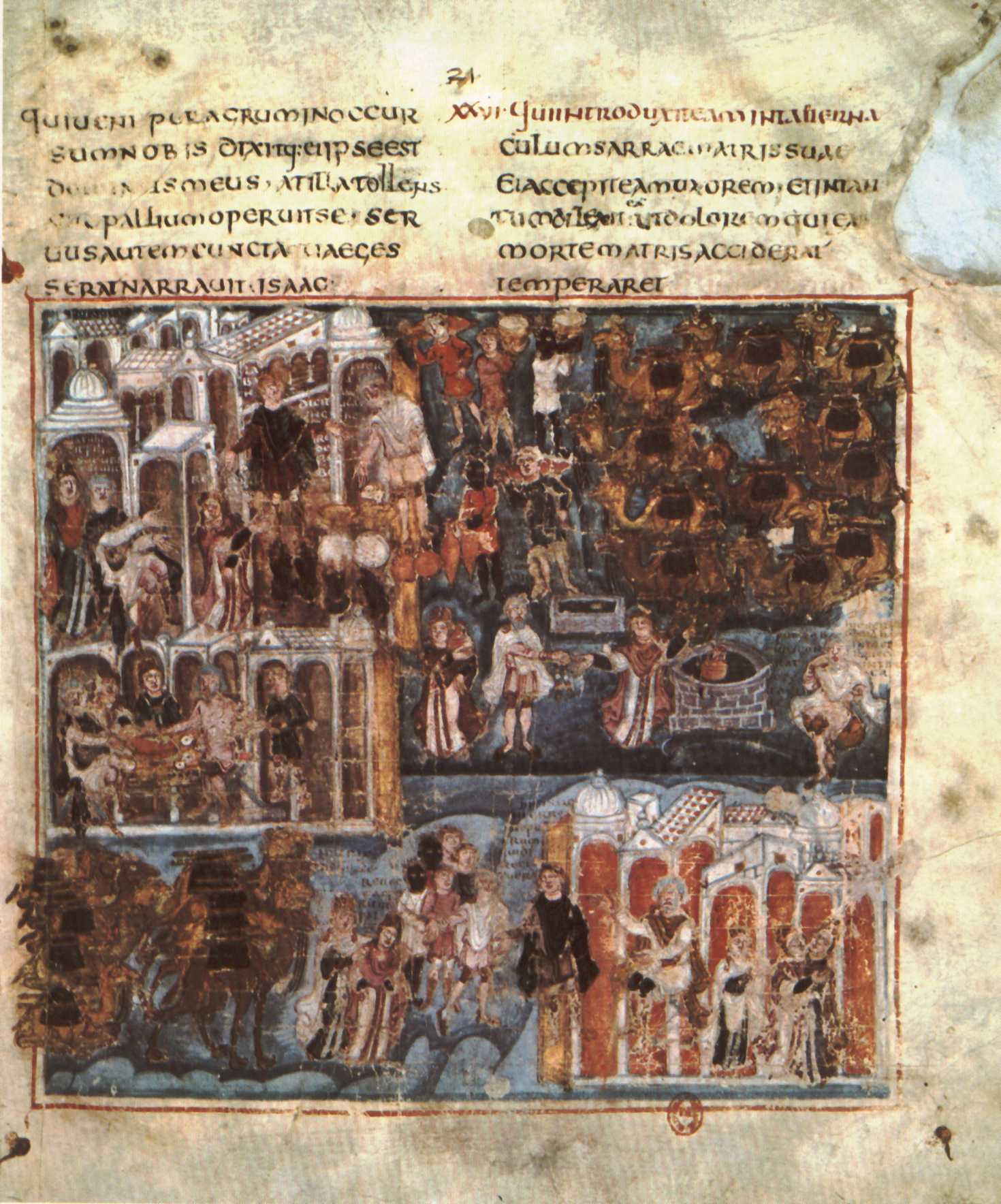
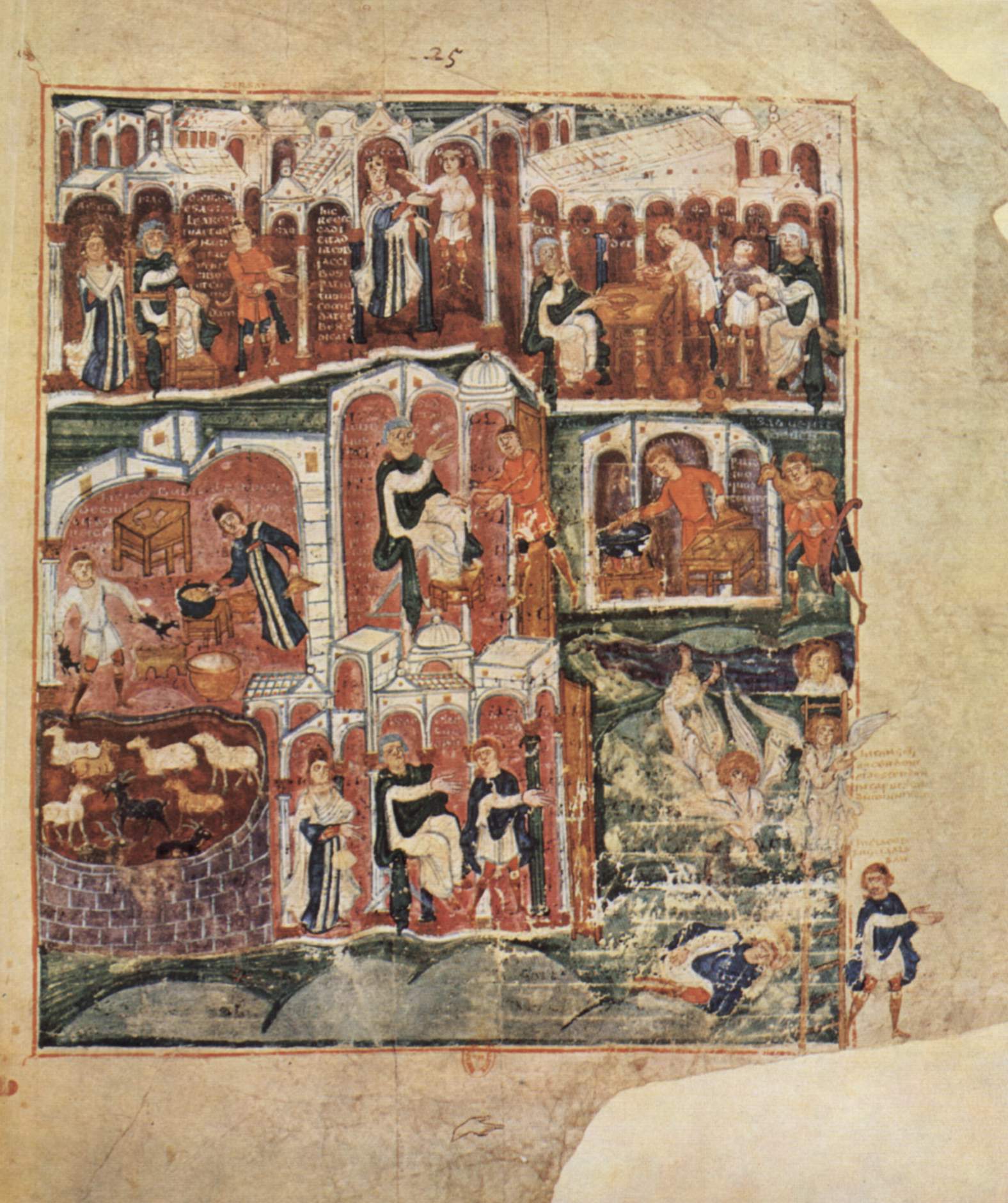
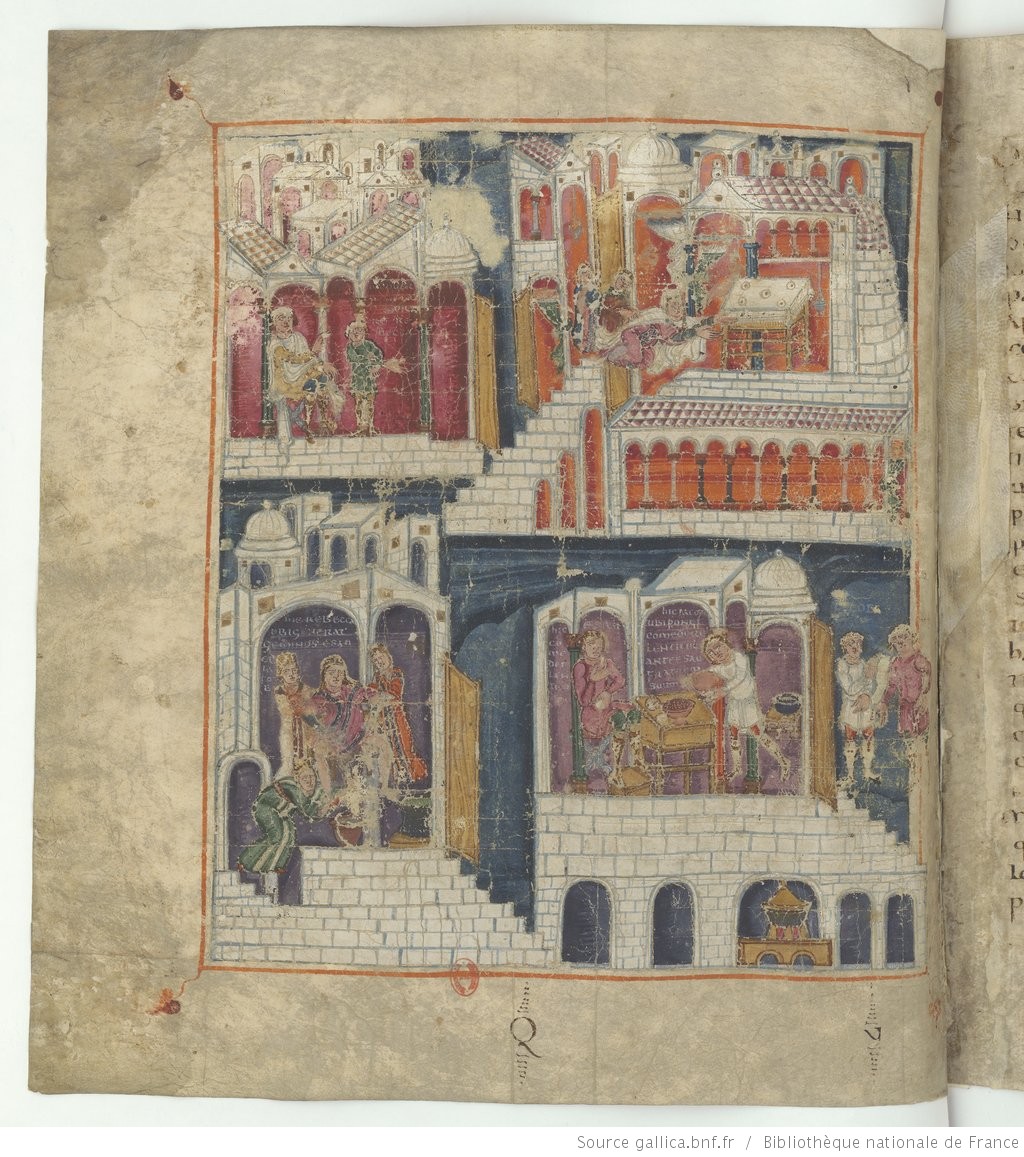
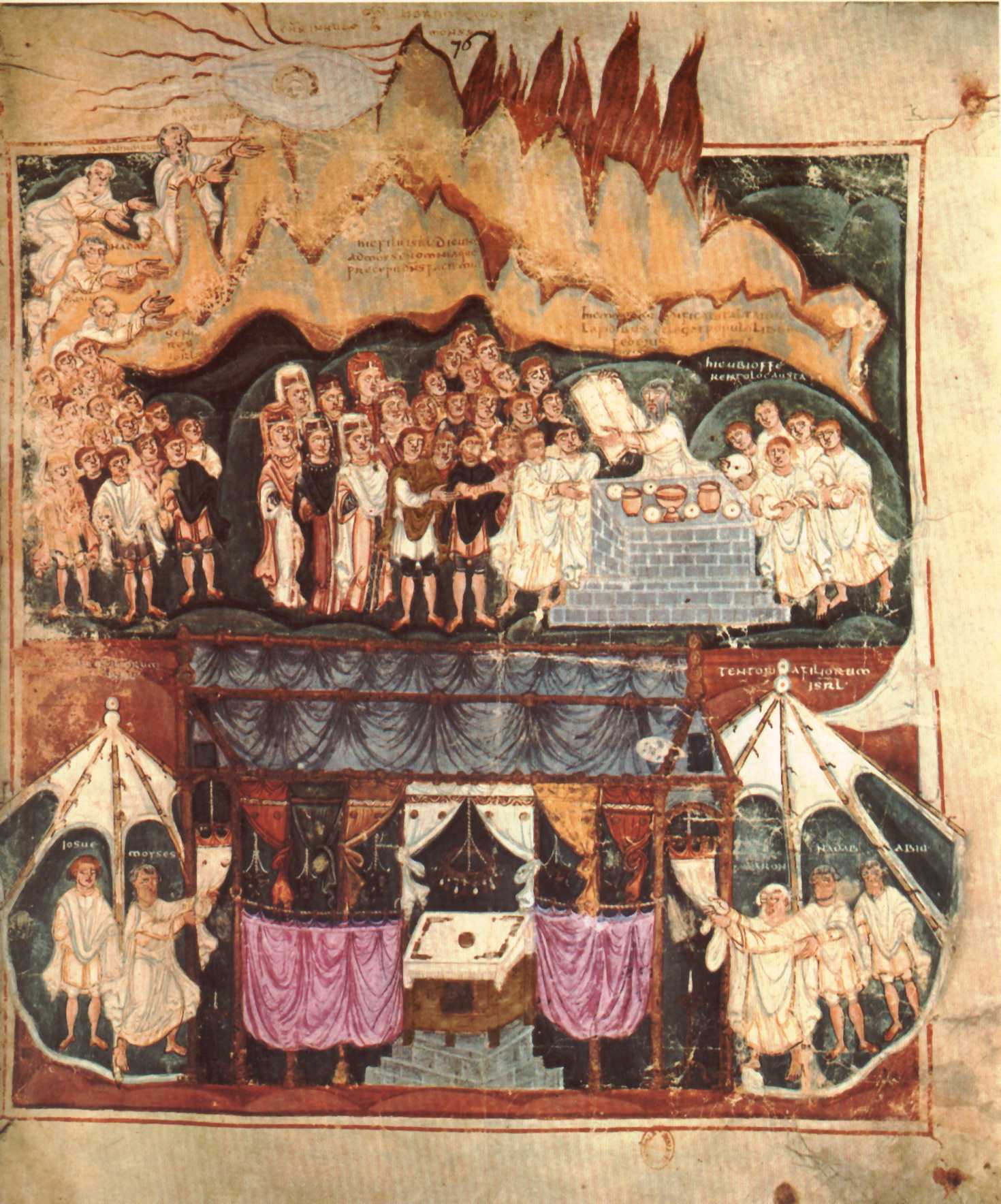
| Illumination | Originally an estimated 69 full-page miniatures; 18 survive (ff.1v, 6r, 9r, 10v, 18r, 21r, 22v, 25r, 30r, 40r, 44r, 50r, 56r, 58r, 65v, 68r, 76r, 127v), plus a decorated frontispiece and three sets of painted-arcade table pages.1 |
| Pigment analysis | Non-invasive FORS, spectrofluorimetry, XRF and optical microscopy (2020) found extensive Egyptian blue synthesised from a copper/zinc alloy source (Cu:Zn approximately 4:1), an unusual, non-traditional manufacturing route for the pigment.5 |
| Later repair leaves | Thirteen folios (ff.3-4, 8, 37-38, 60-64, 122, 129) are 8th-century replacements for lost original leaves, copied directly onto the damaged book rather than into a fresh copy.1 |
| Binding | 19th-century half-binding in Russian leather over wooden boards; spine lettered 'Pentateucus cum antiquissimi(is) picturis. Litteris uncial(is) saec. V', an outdated dating kept as a feature of the binding's own history. Bibliotheque nationale ownership stamp of the model used from 1870.1 |
Images
The record in full
Chapter 1What survives
The Ashburnham Pentateuch is a parchment codex of 142 folios, written in two columns and measuring 375 by 310 millimetres, now held by the Bibliotheque nationale de France under the shelfmark...
The Ashburnham Pentateuch is a parchment codex of 142 folios, written in two columns and measuring 375 by 310 millimetres, now held by the Bibliotheque nationale de France under the shelfmark Nouvelles acquisitions latines 2334. Its main text is in a formal uncial hand of the late 6th or early 7th century. It once carried as many as 69 full-page miniatures illustrating the first five books of the Hebrew Bible; 18 survive today, at folios 1v, 6r, 9r, 10v, 18r, 21r, 22v, 25r, 30r, 40r, 44r, 50r, 56r, 58r, 65v, 68r, 76r and 127v, alongside a decorated frontispiece and three sets of table pages framed by painted arcades.
The book is fragmentary in a specific and telling way. Of the five books of the Pentateuch it was made to contain, Deuteronomy survives as a single leaf. Genesis, Exodus, Leviticus and Numbers are all present but with substantial gaps, and a 9th- or 10th-century reader left notes, in places using Tironian shorthand, recording exactly where leaves were already missing by then. The book that reaches the reader today is therefore not simply an old manuscript; it is the visible record of a long process of loss that had already been underway for centuries before the manuscript's more famous 19th-century misadventure.
Chapter 2A pre-Alcuinian Bible in fragments
The Latin text is a pre-Alcuinian version of the Vulgate, one that the manuscript's own cataloguers at the Bibliotheque nationale describe as related in places to the text tradition associated with...
The Latin text is a pre-Alcuinian version of the Vulgate, one that the manuscript's own cataloguers at the Bibliotheque nationale describe as related in places to the text tradition associated with Cassiodorus and in places to an older Italian version. This textual affiliation is itself a piece of evidence in the dating and localisation debate, since it ties the manuscript to text-critical traditions current in Italy in Late Antiquity, without settling where the physical book itself was copied and painted.
The surviving books run: Genesis (ff.2r-49v, opening with a table of contents), Exodus (ff.51r-90v, with a table of capitula under painted arcades), Leviticus (ff.91r-115r, missing its opening), Numbers (ff.115v-141v, with its own table of capitula) and, from Deuteronomy, a single leaf (f.142r). Scraped and rewritten passages in the same hand that supplied the missing leaves show that whoever restored the book in the 8th century worked directly on the damaged original, not on a fresh copy.
Chapter 3How it was made
The main text is written in a disciplined biblical uncial, the formal book-hand of Late Antiquity, with rubricated titles alternating red and black ink.
The main text is written in a disciplined biblical uncial, the formal book-hand of Late Antiquity, with rubricated titles alternating red and black ink. Thirteen folios (ff.3-4, 8, 37-38, 60-64, 122 and 129) are replacements copied in the mid-8th century, after the book had left its place of origin; their script mixes uncial and semi-uncial forms, and one leaf, f.32v, is written in Caroline minuscule, the reformed script of the Carolingian era, showing that the book continued to be worked on for centuries after it was first made.
A 2020 technical study of the pigments, using non-invasive UV-visible reflectance spectrophotometry, spectrofluorimetry, X-ray fluorescence and optical microscopy, found extensive use of Egyptian blue across the miniatures, an unusual choice for manuscript illumination of any period. More strikingly, the analysis found the pigment had been synthesised from a copper and zinc alloy in roughly a four-to-one ratio, rather than from the metallic copper or copper-ore sources documented in traditional Roman and earlier Egyptian manufacture of the same pigment. That is a genuine technical fingerprint, not yet matched to any single known regional workshop tradition, and it sits alongside the script and the text as a third independent body of evidence bearing on where the book was made.
Chapter 4Where and when: a dispute with no resolution
The manuscript's date is usually given as late 6th or early 7th century, with the 8th-century Frankish restoration folios treated separately.
The manuscript's date is usually given as late 6th or early 7th century, with the 8th-century Frankish restoration folios treated separately. Its place of origin is not settled at all. The Bibliotheque nationale's own catalogue entry lists the candidates without choosing among them: Spain, North Africa, northern Italy, or Rome, with a question mark against each.
Bezalel Narkiss, after years of study of the manuscript, argued for production in an imperial scriptorium at Rome in the 5th century, a full one to two centuries earlier than most other scholars accept, and associated it with the patronage of Galla Placidia; this fifth-century Roman hypothesis is a minority position. Others, on the basis of stylistic and palaeographic similarities to later Spanish manuscripts, argue for a Visigothic Spanish origin, typically in or around Seville, while allowing that the pictorial models the painters were copying could themselves have been North African or Egyptian. Depictions within the miniatures of both light-skinned and dark-skinned Egyptians have been cited on more than one side of this argument, as evidence read differently depending on the interpreter's starting assumption about where the artists were working. No single reading has displaced the others, and this record does not adjudicate between them; it reports the live dispute as a live dispute.
Chapter 5The Creation page and its Trinity
The manuscript's single most discussed image is its Creation page, at the front of Genesis, which originally depicted an anthropomorphic Trinity: paired figures representing the Father and the Son...
The manuscript's single most discussed image is its Creation page, at the front of Genesis, which originally depicted an anthropomorphic Trinity: paired figures representing the Father and the Son across a sequence of Creation vignettes, together with a winged figure representing the Holy Spirit, set in an undefined landscape. Jennifer Awes Freeman's 2022 study argues that this scheme once affirmed a strong, visually literal equality between Father and Son, at a moment when this manner of imagining the Trinity had only a few precedents in early Christian sarcophagus sculpture and no real continuation for centuries afterward.
At some point in the Carolingian period, by which time the manuscript had come to Tours, a corrector painted over parts of the image. The alteration is described as removing three figures representing the Son and one representing the Father, leaving, in the surviving state, three Fathers and one Son, an inversion Awes Freeman reads as a deliberate response to Carolingian anxieties about preserving the unity of the Trinity during a period of active Christological and image-theory debate following the Byzantine iconoclastic controversy. Neither the identity of the corrector nor the exact date of the repainting is recorded; what is documented is the change itself, and its consistency with a known current of Carolingian theological concern.
Chapter 6A lost Jewish model, or a Christian teaching book
In 1953-54, Joseph Gutmann argued in the Jewish Quarterly Review that the Ashburnham miniatures preserve echoes of midrashic exegesis not found in the biblical text itself, and concluded that the...
In 1953-54, Joseph Gutmann argued in the Jewish Quarterly Review that the Ashburnham miniatures preserve echoes of midrashic exegesis not found in the biblical text itself, and concluded that the pictorial conception underlying them was fundamentally Jewish, descending from a lost tradition of Jewish biblical illustration related in spirit to the wall paintings of the Dura-Europos synagogue. Kurt Weitzmann, whose own work on the transmission of biblical picture cycles gave the comparison real authority, treated the Dura-Europos connection with caution rather than adopting Gutmann's thesis outright.
Dorothy Verkerk's 2004 study argues instead for a Roman origin and reads the cycle as a teaching tool aimed at instructing catechumens in the Christian community, pushing back against what her reviewer, Herbert Kessler, describes as "the tendency to look through the Paris manuscript to lost Jewish pictorial prototypes." Kessler is careful to note that Verkerk's target on this point is not really Weitzmann, who had already distinguished the Ashburnham cycle from the Dura-Europos paintings rather than equating them. The dispute is not resolved in the literature consulted for this record. It is presented here as a live disagreement between named scholars, not as a settled fact in either direction; folkloric and exegetical elaboration of the Hebrew Bible was shared by Jewish and Christian communities in Late Antiquity, and that overlap is itself part of why the argument has not been closed by either side.
Chapter 7Arrival in Francia and its afterlife at Tours
The manuscript had reached Frankish Gaul by the 8th century, when the 13 replacement leaves were copied in to repair losses from the original quires.
The manuscript had reached Frankish Gaul by the 8th century, when the 13 replacement leaves were copied in to repair losses from the original quires. By the following century it was at Tours, where it remained for the whole of the medieval period. It was at Tours, not at its place of origin, that the Creation page was later reworked, and it was at Tours that a 9th- or 10th-century reader added the marginal notes recording missing folios.
The manuscript's presence at Tours left a mark beyond its own pages. Andre Grabar's 1957 study in Cahiers archeologiques traces Romanesque wall paintings in the former church of Saint-Julien at Tours back to the Ashburnham Pentateuch's Tabernacle imagery, arguing that the manuscript itself served as the model consulted by the medieval muralists. The manuscript is also described in the literature as a model consulted for the group of Carolingian-era Touranian ('Tours') bibles, the great illustrated Bibles produced in the Tours scriptoria in the 9th century, connecting this one small, damaged, largely un-illustrated-looking Late Antique codex to one of the major manuscript-painting enterprises of the Carolingian renaissance.
Chapter 8Guglielmo Libri, inspector of libraries
Guglielmo Libri Carucci dalla Sommaja was an Italian-born mathematician who became a naturalised French citizen in 1833 and, over the following decade, built a career inside French academic and...
Guglielmo Libri Carucci dalla Sommaja was an Italian-born mathematician who became a naturalised French citizen in 1833 and, over the following decade, built a career inside French academic and political institutions, holding a chair at the College de France and a post at the Sorbonne. In 1841, helped by his connections to the statesman and historian Francois Guizot, he secured appointment as the French government's Inspector-General of Libraries, a role charged in part with cataloguing valuable books and manuscripts in provincial collections across the country.
That official position is what makes Libri's thefts a case study rather than an isolated crime. He used the access it gave him, combined with a performance of poor health that let him work alone and unsupervised in archive rooms, to remove items that were never returned. Documented losses attributed to him include material from the Bibliotheque inguimbertine at Carpentras, among it the bulk of Descartes's surviving letters to Father Marin Mersenne, and the mutilation of several volumes from the Peiresc collection, from which an estimated two thousand leaves disappeared. Estimates of the total scale of what he removed from French libraries run into the tens of thousands of items.
Chapter 9The 1842 theft at Tours
The Ashburnham Pentateuch was stolen at Tours in 1842, during the years Libri held his inspectorate.
The Ashburnham Pentateuch was stolen at Tours in 1842, during the years Libri held his inspectorate. The Bibliotheque nationale's own catalogue entry states plainly that Libri took it at Tours in that year; it is one of the best-documented single items in his catalogue of thefts precisely because its recovery, decades later, depended on proving exactly this fact.
A secondary, non-scholarly source consulted for this record adds a more specific claim: that the manuscript had been kept, through the medieval period, in the library of the cathedral chapter of Saint-Gatien at Tours, and had been transferred, along with other confiscated ecclesiastical holdings, to the civic Bibliotheque municipale de Tours during the French Revolution, and that it was from this municipal library that Libri took it. This record has not been able to corroborate the Saint-Gatien detail or the Revolutionary transfer in the scholarly or institutional sources consulted, and flags it here as unverified rather than presenting it as established fact.
Chapter 10Trial, exile, and a false pedigree
As the French monarchy fell in the 1848 revolution and a warrant was issued for his arrest, Libri was tipped off and fled to London, shipping eighteen large trunks containing an estimated 30,000...
As the French monarchy fell in the 1848 revolution and a warrant was issued for his arrest, Libri was tipped off and fled to London, shipping eighteen large trunks containing an estimated 30,000 books and manuscripts ahead of him. In London he found a protector in Antonio Panizzi, Principal Librarian of the British Museum, and successfully framed the accusations against him to English opinion as anti-Italian prejudice rather than a substantiated criminal case.
On 22 June 1850, a French court convicted Libri of theft in absentia and sentenced him to ten years' imprisonment. He never returned to France to serve it; he lived in England on the proceeds of selling his collection, two large sales in 1861 alone reportedly netting him over a million francs, before returning to Italy in 1868 and dying near Florence the following year. The same non-scholarly source that describes the Saint-Gatien provenance also claims that Libri sold the manuscript to Lord Ashburnham under a false attribution, representing it as having come from Grottaferrata, near Rome, rather than from France. This record could not corroborate that specific claim in any other source consulted and flags it as unverified; it is included here only because, if true, it would be directly consistent with Libri's documented general practice of falsifying records to cover the origin of what he sold.
Chapter 11Bertram Ashburnham and the question of knowledge
In 1847, Bertram Ashburnham, 4th Earl of Ashburnham, bought the Ashburnham Pentateuch from Libri as part of a much larger purchase, one that eventually brought roughly 2,000 manuscripts from Libri's...
In 1847, Bertram Ashburnham, 4th Earl of Ashburnham, bought the Ashburnham Pentateuch from Libri as part of a much larger purchase, one that eventually brought roughly 2,000 manuscripts from Libri's holdings into the Ashburnham library at Ashburnham Place in Sussex. It is this purchase that gives the manuscript its English name.
Whether the 4th Earl knew, or should have known, that a substantial part of what he was buying had been stolen from French and Italian public collections is a genuine point of historical debate, and the sources consulted for this record do not resolve it. What is documented is the outcome rather than the Earl's state of mind: decades later, French and Italian investigators were able to identify large numbers of manuscripts in the Ashburnham collection as items missing from specific French and Italian public libraries, a task that would not have been straightforward, and arguably would not have been necessary, had the collection's origins been openly declared at the time of purchase.
Chapter 12Delisle's campaign and the 1888 purchase
Bertram Ashburnham, 4th Earl, died in 1878.
Bertram Ashburnham, 4th Earl, died in 1878. His son, the 5th Earl, opened negotiations to sell part of his father's manuscript collection, and Leopold Delisle, the Bibliotheque nationale's leading manuscripts scholar, spent much of the following decade building the documentary case that a large part of what the Ashburnham family held of French origin, including this manuscript, had been stolen from French public libraries by Libri and by the bookseller Jean-Baptiste Barrois. Delisle later published this material in full, first in a report to the French Minister of Public Instruction and Fine Arts, and then, once the purchase was complete, in his Catalogue des manuscrits des fonds Libri et Barrois of 1888, whose preface sets out the whole history of the affair.
The Ashburnham Pentateuch itself was purchased from the London bookselling firm Trubner, acting as intermediary, on 23 February 1888, and entered into the Bibliotheque nationale's manuscripts register under the number 8070(12). This record has not found a published figure for the price paid, either for this manuscript individually or as its share of the wider 1888 purchase, in the sources consulted, and records that gap rather than estimating a figure.
Chapter 13The wider Libri-Ashburnham dispersal
The Ashburnham Pentateuch was one item within a much larger, internationally scattered problem created by Libri's thefts.
The Ashburnham Pentateuch was one item within a much larger, internationally scattered problem created by Libri's thefts. Manuscripts he had stolen in Italy and later sold to Lord Ashburnham were the subject of a separate recovery: in 1884, the Italian government purchased essentially the whole of this Italian portion of the Ashburnham manuscripts, all but about 100 of them, and deposited it in the Biblioteca Medicea Laurenziana in Florence, where it remains catalogued today as the Fondo Ashburnham. The French recovery negotiated by Delisle in 1888 was a separate transaction, covering manuscripts of French origin (100 further Libri manuscripts and 66 from Barrois), of which the Ashburnham Pentateuch was one.
This distinction matters for accuracy. Other Libri-Ashburnham manuscripts went to different institutions at different dates, under different negotiations, for different and in some cases still-undocumented prices; none of that later history belongs to this specific manuscript, whose documented path runs from Tours, to Libri, to Ashburnham, to the Bibliotheque nationale de France in 1888, and no further.
Chapter 14Conservation, digitization, and display
The manuscript's current binding, a 19th-century half-binding in Russian leather over wooden boards, postdates its arrival in France and is itself an artefact of that period's conservation practice...
The manuscript's current binding, a 19th-century half-binding in Russian leather over wooden boards, postdates its arrival in France and is itself an artefact of that period's conservation practice rather than of the manuscript's medieval history; its spine lettering, giving a 5th-century date, reflects an estimate later scholarship has revised. A digitised facsimile is available through the Bibliotheque nationale's Gallica platform, and the library also holds microfilm substitute copies for consultation, with access to the original manuscript restricted and requiring the director's authorisation.
The manuscript has been included in a sequence of major exhibitions at the Bibliotheque nationale itself (1954, 1972 and 2007) and beyond, including the Metropolitan Museum of Art's 1977-78 exhibition Age of Spirituality, edited by Kurt Weitzmann, and the Musee de Cluny's 2016-17 exhibition on the Merovingian centuries. The 2020 pigment study represents its most recent published scientific examination found in the sources consulted, and Jennifer Awes Freeman's 2022 monograph is its most recent dedicated scholarly study.
The artist
Unidentified (referred to in modern cataloguing as the workshop or 'Master' of the Ashburnham Pentateuch)
No scribe or painter is named in the manuscript, and it carries no colophon. What scholarship calls the identity question for this object is really a regional question: which workshop, in which part of the Late Antique Latin or Mediterranean world, produced a single Latin biblical manuscript with an ambitious, largely narrative picture cycle at a moment when narrative biblical illustration of this kind was rare. The debate has run for more than a century and remains open.
Related works
| Work | Relation | Where it is |
|---|---|---|
| Dura-Europos synagogue wall paintings Unknown Jewish workshop, 3rd century | Proposed by Joseph Gutmann (1953-54) as evidence for a lost Jewish pictorial tradition standing behind the Ashburnham miniatures; the comparison is contested rather than accepted, and Kurt Weitzmann treated it with caution. Cited in the scholarly debate over the manuscript's iconographic sources, not as a work by the same hand or workshop. | Formerly in situ at Dura-Europos, Syria; paintings largely relocated to the National Museum of Damascus |
| Early Christian sarcophagi with anthropomorphic Trinity imagery Various unidentified Roman workshops, 4th century | Cited by Jennifer Awes Freeman (2022) as the few visual precedents for the Ashburnham Creation page's original anthropomorphic depiction of the Trinity, a scheme with almost no continuation after this manuscript. Comparanda for the manuscript's Creation iconography before its Carolingian-period alteration. | Various Roman collections |
| Wall paintings, former church of Saint-Julien, Tours Unknown Romanesque painters | Documented by Andre Grabar (1957) as having copied the Ashburnham Pentateuch's Tabernacle imagery, evidence that the manuscript itself was consulted as a model by later medieval artists at Tours. Physical evidence of the manuscript's local afterlife and influence, independent of its own text and provenance history. | Formerly Tours, France; the paintings are largely lost or altered |
| The Miniatures of the Ashburnham Pentateuch (facsimile publication) Oscar von Gebhardt (editor) | An 1883 photographic facsimile edition of the manuscript's illustrations, published in London and cited in the Bibliotheque nationale's own bibliography for the object. An early documentary record of the miniature cycle, useful for comparison with the manuscript's present, further-diminished state. | Published edition, London, 1883 |
Open questions
- Where, and in what workshop, was the manuscript actually made. Italy, an imperial scriptorium at Rome, Visigothic Spain and North Africa have all been argued by named scholars, and the dispute remains open.
- When, and by whom, was the Creation page's original anthropomorphic Trinity overpainted. The alteration is dated to the Carolingian period and located at Tours, but no individual corrector or exact date is recorded.
- How and when most of the book of Deuteronomy was lost, and whether the manuscript was already this fragmentary before Libri stole it in 1842 or suffered further loss afterward. Not addressed in the sources consulted.
- Whether Bertram, 4th Earl of Ashburnham, knew or suspected in 1847 that manuscripts he was buying from Libri had been stolen from French and Italian public collections. A genuine point of historical debate this record has not been able to resolve.
- What price the Bibliotheque nationale paid for the manuscript, individually or as part of the 1888 Libri-Barrois purchase. Not published in the sources consulted.
- Whether the claim that Libri sold the manuscript to Ashburnham under a false attribution to Grottaferrata, near Rome, is corroborated by any primary or scholarly source. It appears only in a single non-scholarly source consulted for this record.
- Which specific scenes the roughly 51 lost original miniatures depicted. No reconstruction of the full lost picture cycle was found in the sources consulted.
Questions about this object
What is The Ashburnham Pentateuch?
The Ashburnham Pentateuch is a manuscript, dated late 6th or early 7th century (main text and surviving miniatures); marginal corrections and 13 replacement leaves added in the mid-8th century, apparently after the manuscript reached Francia. Medium: Ink and tempera with gold on parchment; uncial script, with later marginal additions mixing uncial, semi-uncial and Caroline minuscule.
Who made The Ashburnham Pentateuch, and is the attribution settled?
The attribution to Unidentified Late Antique workshop (called in modern scholarship the Master of the Ashburnham Pentateuch) is recorded here as disputed. No scribe or painter is named anywhere in the manuscript, and there is no colophon. Scholars agree only that one workshop produced the text and the original cycle of roughly 69 full-page miniatures in the late 6th or early 7th century. Where that workshop stood is the central unresolved question in the literature: named scholars have argued for Italy, for an imperial scriptorium at Rome, for Visigothic Spain on stylistic and palaeographic grounds, and, in older literature, for North Africa on iconographic grounds. No position commands consensus.
Where is The Ashburnham Pentateuch now?
Bibliotheque nationale de France, Departement des manuscrits, Paris. Inventory number Nouvelles acquisitions latines (NAL) 2334; former shelfmark Libri 13. Last confirmed 17 September 2026. Purchased from the London bookselling firm Trubner on 23 February 1888, entry register no. 8070(12), at the close of Leopold Delisle's campaign to recover the Libri-Ashburnham manuscripts for France.
What is still unknown about The Ashburnham Pentateuch?
Where, and in what workshop, was the manuscript actually made. Italy, an imperial scriptorium at Rome, Visigothic Spain and North Africa have all been argued by named scholars, and the dispute remains open.
Sources
- 1Bibliotheque nationale de France, Departement des Manuscrits, Archives et manuscrits catalogue entry for NAL 2334 ('Libri 13. Biblia. Pentateuchus [Pentateuque dit d'Ashburnham ou de Tours]'), including its 'Historique de la conservation', physical description and bibliography. archivesetmanuscrits.bnf.fr/ark:/...
- 2Biblissima+ portail, catalogue record for Paris, Bibliotheque nationale de France, Departement des manuscrits, NAL 2334. portail.biblissima.fr/ark:/...
- 3Wikipedia, 'Ashburnham Pentateuch'. Tertiary source, flagged for replacement with the underlying scholarly literature (Awes Freeman, Verkerk, Narkiss, the BnF catalogue) wherever a specific claim depends on it alone. en.wikipedia.org/wiki/...
- 4Wikipedia, 'Guglielmo Libri Carucci dalla Sommaja'. Tertiary source, flagged for replacement with a scholarly biography of Libri or with Delisle's own published account of the thefts. en.wikipedia.org/wiki/...
- 5Maurizio Aceto, Elisa Cala, Gaia Fenoglio, Maria Labate, Charlotte Denoel, Lorenza Operti, Angelo Agostino, 'New evidence of non-traditional Egyptian blue manufacture in the 6th century Ashburnham Pentateuch,' Journal of Archaeological Science: Reports 33 (October 2020), article 102487. doi.org/10.1016/...
- 6Joseph Gutmann, 'The Jewish Origin of the Ashburnham Pentateuch Miniatures,' The Jewish Quarterly Review, n.s. 44 (1953-54), pp. 59-69. Citation as recorded in the Bibliotheque nationale's own manuscript bibliography (source 1); the article itself was not independently fetched for this record. archivesetmanuscrits.bnf.fr/ark:/...
- 7Herbert L. Kessler, review of Dorothy Verkerk, Early Medieval Bible Illumination and the Ashburnham Pentateuch (Cambridge University Press, 2004), CAA Reviews. caareviews.org/reviews/...
- 8Jennifer Awes Freeman, The Ashburnham Pentateuch and its Contexts: The Trinity in Late Antiquity and the Early Middle Ages, Boydell Studies in Medieval Art and Architecture 23 (Woodbridge: Boydell Press, 2022). boydellandbrewer.com/blog/...
- 9Leopold Delisle, Catalogue des manuscrits des fonds Libri et Barrois (Paris: Bibliotheque nationale, 1888). gallica.bnf.fr/ark:/...
- 10Leopold Delisle, The Manuscripts of the Earl of Ashburnham: Report to the Minister of Public Instruction and Fine Arts. books.google.com/books/...
- 11Biblioteca Medicea Laurenziana, 'Historical Notes' and Fondo Ashburnham catalogue pages, on the 1884 Italian government purchase and deposit of the Italian portion of Libri's manuscripts sold to Ashburnham. bmlonline.it/en/...
- 12Arlima (Archives de litterature du Moyen Age), manuscript notice for Paris, BnF, NAL 2334, with bibliography including Awes Freeman (2022). arlima.net/mss/...
- 13Turismo Prerromanico, 'Pentateuco Ashburnham'. Non-scholarly tourism/heritage source, used only for two specific claims (the Saint-Gatien/Bibliotheque-municipale pre-theft location and the alleged Grottaferrata false attribution at sale to Ashburnham), both explicitly flagged in this record as unverified and in need of a stronger source. turismo-prerromanico.com/home-b__trashed-2__trashed-2__tr...
- 14Wikimedia Commons, Category:Ashburnham Pentateuch, and individual file API records (extmetadata), used to verify licence, photographer credit and folio identification for every image used in this record. commons.wikimedia.org/wiki/...
Last verified 17 September 2026 · Published 17 September 2026
Change log
17 September 2026 - Record created at the house standard: researched narrative, technical evidence, maker dossier, graded provenance chain, prices with hammer and premium separated, related works, open questions and sources.