The Hours of Jeanne d'Evreux, Queen of France
Jean Pucelle · c. 1324-1328
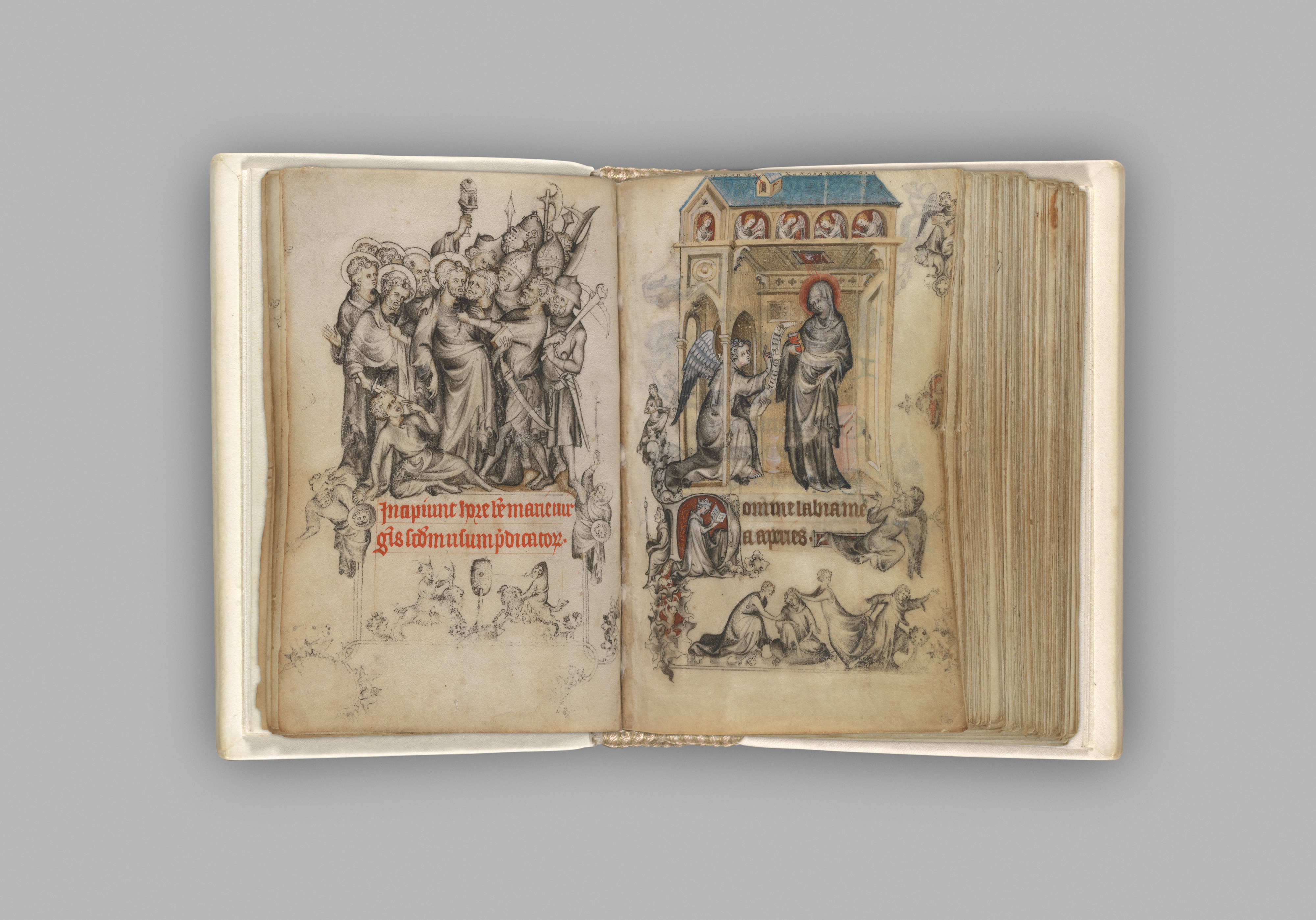
The record subject, open, photographed by the Metropolitan Museum: a book of hours barely the size of a modern smartphone, its miniatures painted almost entirely in grisaille with the rubrics in red. Its 209 vellum leaves carry 25 full-page miniatures, and it is the surest surviving example of the hand of Jean Pucelle.
| Artist | Jean Pucelle |
|---|---|
| Date | c. 1324-1328 |
| Medium | Grisaille (camaieu gris) and tempera with gold leaf on vellum, in a Gothic textualis book hand |
| Dimensions | Each folio 9.2 x 6.2 cm (3 5/8 x 2 7/16 in); bound volume 9.9 x 7.2 x 3.8 cm (3 7/8 x 2 13/16 x 1 1/2 in); 209 folios |
| Where it is now | The Cloisters, The Metropolitan Museum of Art, New Yorklast confirmed 28 August 2026 |
| Inventory number | 54.1.2 |
| Attribution | AcceptedAttributed to Jean Pucelle on the strength of a near-contemporary textual link: the manuscript is entered in the 1401-02 inventory of Jean, Duke of Berry as 'les Heures de Pucelle' (the Hours of Pucelle), only about seventy years after it was made, when the name could still have meant something to the people cataloguing the library. Full note |
| Object type | Manuscript |
| Period | French Gothic, early fourteenth century |
| Cases | Has a provenance gap · Seized, looted or confiscated · Restituted or repatriated |
| Inscriptions | Calendar and liturgical rubrics in Latin, in the use of the Parisian diocese for the calendar but the Dominican (Jacobin) rite for the hours themselves; no signature or colophon by the illuminator |
| Owners on record | 15 links10 documented, 2 disputed, 3 unknown |
| Sources | 17 cited |
About this record Last verified 28 August 2026 · 17 sources cited · Change log
On this page 9 sections
ContentsClose
A prayer book barely the size of a modern smartphone, painted almost entirely in shades of grey for a queen of France between 1325 and 1328, and now recognised as the surest surviving example of the hand of Jean Pucelle, the most consequential Parisian illuminator of his generation. Its 209 vellum leaves carry 25 full-page grisaille miniatures and roughly 700 further images, run in facing pairs of Passion and Infancy scenes borrowed from the format of contemporary ivory diptychs, with a marginal world of beggars, drolleries, and games running underneath that recent scholarship reads as a deliberate commentary on the pictures above.
Its ownership can be documented in short, well-lit stretches separated by long stretches of dark. It passed, on strong but not undisputed evidence, from the queen to Charles V, then by an unrecorded route into the library of Jean, Duke of Berry, who by 1401 had it catalogued as 'the Hours of Pucelle.' After his death in 1416 it disappears for two centuries, resurfaces only as a coat of arms stamped into a rebound cover, disappears again, and does not reappear in the documentary record until it turns up in a nineteenth-century Rothschild collection.
It was seized by German occupation authorities from the Rothschild family in 1940, found by an American Monuments officer in a Bavarian castle in 1945, restituted in 1948, and sold to the Metropolitan Museum in 1954 - the acquisition that broke the museum's own standing policy against buying manuscripts. It has been on public view at the Cloisters ever since.
Provenance
Each link is graded. Documented: a cited source supports it. Disputed: the identification is argued but not established. Unknown: no owner for that span, and the gap is not smoothed into a narrative. The grades in the glossary.
- c. 1324 - 1328Made for Jeanne d'Evreux, Queen of France (married Charles IV in 1325)documented
Dated on stylistic and internal grounds to the years of Jeanne d'Evreux's marriage to Charles IV, who died in February 1328; her own 1371 will states that Charles IV 'had it made for Madame' and that Pucelle illuminated it, though the identification of that will entry with this specific object is itself disputed (see Open Questions).12313
- 1328 - 1371Jeanne d'Evreux, Queen of France, then Queen Dowager of Francedocumented
- 1371 - 1380Charles V, King of Francedisputed
Identification rests on the will's reference to a 'petit livret d'oroisons... que pucelle enlumina' bequeathed to Charles V; Elizabeth Flinn dissented from equating this with the present manuscript in the Metropolitan Museum's own 1971 Bulletin. If accepted, the book entered the royal library at Jeanne d'Evreux's death and appears, described in physical detail, in Charles V's 1380 inventory of jewels and small treasures.3713
- 1380 - 1401-1402Transmission unclear; reaches Jean, Duke of Berryunknown
Charles V died in 1380; his library passed first toward his son, the future Charles VI. The mechanism by which this book (or the belief that Charles V had owned it) reached his brother, Jean, Duke of Berry, is not documented in the sources consulted - by gift, inheritance, or purchase are all possible for objects in Berry's collection generally, but none is attested here specifically.315
- 1401-1402 - 1416Jean, Duke of Berrydocumented
Catalogued in the Duke's own inventory, published by Jules Guiffrey, as 'les Heures de Pucelle... enlumees de blanc et de noir, a la usaige des Prescheurs.' The same period of ownership records the binding being changed to blue silk in 1402. The Duke died in 1416.13
- 1416 - 1618 (approx.)Unknownunknown
No owner, sale, or location is documented in any source consulted for this record across roughly two centuries following the Duke of Berry's death.3
- 1618 - before 1672Louis-Jules de Chatelet and Christine de Gleseneuve Bardocumented
Established by physical evidence: two coats of arms on the leather binding currently on the manuscript, identifying the couple, who married in 1618 and were both dead before 1672. No document of acquisition or sale from this ownership survives in the sources consulted.3
- before 1672 - 19th centuryUnknownunknown
A second extended gap of close to two centuries with no owner, sale, or location documented in the sources consulted.3
- 19th century - 1900Rothschild family collection (named as Alphonse de Rothschild of Geneva in general reference sources; named as Adolphe de Rothschild in Christopher de Hamel's specialist study of Rothschild manuscript collecting)disputed
Sources consulted for this record disagree on which member of the Rothschild family first acquired the manuscript. Both accounts agree the collection passed, at the collector's death in 1900, toward Maurice de Rothschild in Paris.311
- 1900 - 1940Maurice de Rothschild, Parisdocumented
In the possession of Maurice de Rothschild in Paris by the early twentieth century, per both accounts of the preceding Rothschild ownership.311
- 1940 - April 1945Confiscated; held by German occupation authoritiesdocumented
Seized from Rothschild family holdings following the German occupation of France, as part of the organised confiscation of Jewish-owned art collections carried out by the Einsatzstab Reichsleiter Rosenberg (ERR); transported to and stored at Neuschwanstein Castle in Bavaria, alongside the ERR's own administrative card files on looted collections.1011
- April 1945 - 1948Recovery by Allied Monuments, Fine Arts and Archives officers; restitution processdocumented
Found by Second Lieutenant James Rorimer at Neuschwanstein Castle, left in a wastepaper basket by retreating German personnel, together with two other illuminated manuscripts including the Belles Heures of Jean, Duke of Berry. Restituted to Maurice de Rothschild in 1948.1011
- 1948 - 1953Maurice de Rothschild, Parisdocumented
Held by Maurice de Rothschild following restitution until it was placed on the market.311
- 1953 - 1954New York art marketdocumented
Came onto the New York market in 1953 as Maurice de Rothschild began selling parts of his manuscript collection.3
- 1954 - presentThe Cloisters, The Metropolitan Museum of Art, New Yorkdocumented
Acquired in 1954; James Rorimer, by then a Museum curator, is credited with persuading the institution to override its usual policy against purchasing manuscripts in order to secure this one. Accession number 54.1.2 records the year. The purchase price has not been located in the sources consulted for this record.12311
Prices realised
Acquired by purchase, not gift or bequest, but the price paid has never been disclosed. The Metropolitan Museum's own collection record and Heilbrunn Timeline essay state only a Credit Line of The Cloisters Collection, 1954, with no sum named. Maurice de Rothschild was selling his family's manuscript collection in 1953-54 when James Rorimer persuaded the Museum to acquire it; no purchase figure appears there, in Timothy Graham's review of Christopher de Hamel's specialist study of Rothschild manuscript collecting, or in any other source consulted for this record.
Technical evidence
| Attribution note | Attributed to Jean Pucelle on the strength of a near-contemporary textual link: the manuscript is entered in the 1401-02 inventory of Jean, Duke of Berry as 'les Heures de Pucelle' (the Hours of Pucelle), only about seventy years after it was made, when the name could still have meant something to the people cataloguing the library. No signature or colophon by Pucelle survives in this manuscript itself. The attribution is supported by comparison with the Belleville Breviary and the Bible of Robert de Billyng, the latter carrying an actual colophon naming Pucelle among its illuminators. Florens Deuchler and, following him, Elizabeth Flinn - both writing in the Metropolitan Museum's own 1971 Bulletin devoted to the question - argued that too little is documented about Pucelle the man to treat any attribution as secure, and that this book might not even be the object named in Jeanne d'Evreux's will. Kathleen Morand and Karen Gould, writing independently, hold that this is the one manuscript we can be most confident was executed by Pucelle's own hand rather than his workshop's. This record follows the majority view while keeping the dissent visible, because the dissent was raised by the museum that owns the object. |
|---|---|
| Support | Fine vellum, described in the technical literature as exceptionally thin and nearly transparent.13 |
| Dimensions | Each folio 9.2 x 6.2 cm (3 5/8 x 2 7/16 in); the bound volume 9.9 x 7.2 x 3.8 cm (3 7/8 x 2 13/16 x 1 1/2 in).12 |
| Extent | 209 folios, with 25 full-page miniatures and, counting historiated initials and marginal drawings, close to 700 illustrations in total. Ten folios carry no ornamentation.13 |
| Painting technique | Grisaille (camaieu gris): monochrome grey and white modelling in ink and paint, with limited colour accents (lilac, turquoise, pink) and sparing use of gold leaf, producing a sculptural rather than flat pictorial effect.136 |
| Pictorial format | Eight facing-page pairs set a Passion scene opposite an Infancy scene, a layout adapted from contemporary Parisian ivory devotional diptychs rather than native to manuscript illumination.13 |
| Liturgical use | Calendar in the use of the diocese of Paris; the hours themselves in the Dominican (Jacobin) use, as recorded already in the 1380 and 1401-02 royal and ducal inventory descriptions.313 |
| Binding history | Original cover was embroidered and pearl-studded, with the pearls already removed by the time of the 1380 inventory; changed to blue silk by 1402 per the Duke of Berry's inventory annotation; the surviving leather binding, now on the book, carries two coats of arms identifying seventeenth-century ownership by Louis-Jules de Chatelet and Christine de Gleseneuve Bar.313 |
| Condition | Reported to be in excellent condition for an object of this age and handling history, with some damage noted to the calendar's opening pages.3 |
The record in full
Chapter 1An object made to fit in one hand
The first fact about this manuscript is its size.
The first fact about this manuscript is its size. Each vellum leaf measures 9.2 by 6.2 centimetres, and the bound volume with its covers is 9.9 by 7.2 by 3.8 centimetres - smaller than most modern passports, and thin enough with its 209 leaves to sit comfortably in a closed fist. The vellum itself is described in the technical literature as exceptionally thin and nearly transparent, which is part of why the grisaille painting on the recto of a leaf can be made out, faintly, through the verso.
Scale here is not incidental. This was made to be held a few centimetres from the face, read and looked at by one person, in private, for a devotional practice - the recitation of the Hours of the Virgin at fixed points across the day - that a fourteenth-century queen consort would have performed daily. A book this small could not function as furniture or display; it functioned as an object of touch and repeated private attention, which is also why, unlike a large altarpiece, it could travel, be inherited, be hidden in a wastepaper basket, and survive.
Chapter 2Grisaille: painting in the absence of colour
Twenty-five full-page miniatures and the great majority of the roughly 700 further illustrations are painted in camaieu gris - grisaille, a monochrome technique built up in washes and highlights of...
Twenty-five full-page miniatures and the great majority of the roughly 700 further illustrations are painted in camaieu gris - grisaille, a monochrome technique built up in washes and highlights of grey and white ink and paint, with colour reserved for small accents: touches of lilac and turquoise in drapery, pink in flesh, and gold leaf used sparingly rather than as a ground. The effect, repeatedly noted since the manuscript's rediscovery, is sculptural: figures read as small carved reliefs rather than flat painted shapes, an effect grisaille was well suited to produce because it removes colour as a competing signal and leaves modelling in light and shade to do the work of describing form.
This was a technical choice, not an economy. Grisaille miniatures took specialist skill to execute well, and Pucelle's grisaille work in this manuscript is the example against which the rest of his output, and the output attributed to his workshop, is measured.
Chapter 3The paired-page format and the debt to ivory
Eight of the full-page openings are arranged as facing pairs: a scene from the Passion of Christ on the left-hand page opposite a scene from the Infancy of Christ on the right.
Eight of the full-page openings are arranged as facing pairs: a scene from the Passion of Christ on the left-hand page opposite a scene from the Infancy of Christ on the right. This pairing of the sorrowful and the joyful mysteries on facing leaves is not native to manuscript illumination - it is borrowed from the format of small Parisian ivory diptychs of devotion that were being carved in the same city in the same decades, which folded shut on hinges to protect two facing scenes exactly like these.
The borrowing tells us something about how this book was meant to be used and understood: as an object continuous with a wider Parisian luxury trade in small devotional things - ivories, goldsmiths' work, small panel paintings - rather than as a manuscript operating in isolation from the other portable arts a court patron would have owned.
Chapter 4An Italian education, delivered through Duccio and Strasbourg
Pucelle's figures are more spatially and physically credible than the flat, linear figures of the Parisian illumination that came before him - deeper drapery, weight placed convincingly on a hip or a...
Pucelle's figures are more spatially and physically credible than the flat, linear figures of the Parisian illumination that came before him - deeper drapery, weight placed convincingly on a hip or a foot, interiors suggested by receding architecture rather than a flat gold or patterned field. Scholarship since the mid-twentieth century has traced this to direct or indirect contact with Italian trecento painting: Kathleen Morand and later commentators point to passages that recall Duccio's Maesta, completed in Siena in 1311, close enough in date that a Parisian illuminator could plausibly have seen drawings, prints, or the work itself through the trade in luxury goods between Italy and France.
Karen Gould's 1992 study in the Art Bulletin adds a second, non-Italian source for the same modelled, three-dimensional figure style: the sculpture of Strasbourg Cathedral. Gould argues that specific figures and iconographic choices in this manuscript and in the related Miracles de Notre Dame manuscript draw directly on the Strasbourg carvings, and further proposes that Pucelle himself designed the south narthex window at Strasbourg - a claim, if accepted, that would place him working across media (glass as well as vellum) and would explain the sculptural quality of his figures as the habit of a designer who thought in three dimensions rather than only in line. The Italian and the Strasbourg readings are not mutually exclusive; both describe an illuminator absorbing forms from outside the flat Parisian tradition he inherited and fusing them with it.
Chapter 5Saint Louis, poverty, and a discourse in the margins
Alongside the Infancy and Passion cycles, the manuscript carries scenes from the life of Louis IX, Jeanne d'Evreux's canonised ancestor, canonised in 1297 and already the subject of a small body of...
Alongside the Infancy and Passion cycles, the manuscript carries scenes from the life of Louis IX, Jeanne d'Evreux's canonised ancestor, canonised in 1297 and already the subject of a small body of hagiography by the 1320s. Three of these scenes show the sainted king in acts of charity toward the poor, drawn from the near-contemporary Lives of Louis then circulating at court.
Gerald B. Guest's 1995 study in Viator argues that the marginal figures running beneath these three miniatures are not decorative filler but a deliberate visual gloss on the scenes above: a set of beggars and poor figures positioned, repeatedly, at the edge of the frame, excluded from the charity taking place within it. Guest reads this as a fourteenth-century discourse on who counted as a deserving object of charity and who did not - an argument made in the margins, in visual terms, running alongside the pious central image of a royal saint's generosity. This is a scholar's reading of the material, citable and specific, not a claim about what Pucelle or his patron privately believed; Guest names the ambivalence as something the pictures do, and does not claim it as anyone's stated intention.
Chapter 6Games in the margins: Randall's reading of the drolleries
Close to 700 illustrations run through the manuscript's margins and initials: bishops, beggars, street dancers, musicians, apes, rabbits, dogs, and invented hybrid creatures, the standard repertoire...
Close to 700 illustrations run through the manuscript's margins and initials: bishops, beggars, street dancers, musicians, apes, rabbits, dogs, and invented hybrid creatures, the standard repertoire of Gothic marginalia but here unusually dense for so small a book. Lilian Randall's 1972 study in Speculum argued that specific bas-de-page scenes are not random drollery but carry a considered relationship to the miniature above them. Her example: beneath the Annunciation, facing the Arrest of Christ across the opening, the margin shows a group of young people playing a game in which one figure sits on the ground while the others provoke him into giving chase - a game of teasing and pursuit set directly opposite an image of Christ's own arrest and pursuit by his captors.
Randall's is an argued reading of a real pattern in the images, not a decoding of hidden symbolism; she demonstrates the correspondence image by image rather than asserting a single master key to the whole cycle. Where a margin scene has no demonstrated relationship to its miniature, this record does not manufacture one for it. Most of the marginalia in a manuscript this large is exactly what it looks like: the fashionable ornamental vocabulary of the period, deployed because it was expected in a luxury commission of this kind, not because every rabbit conceals a doctrine.
Chapter 7A queen who collected and gave away books
Jeanne d'Evreux was Charles IV's third wife, married in 1325; he died in February 1328 without a surviving son, ending the direct Capetian line.
Jeanne d'Evreux was Charles IV's third wife, married in 1325; he died in February 1328 without a surviving son, ending the direct Capetian line. Joan A. Holladay's 2006 study of fourteenth-century French queens as book collectors places this manuscript inside a wider, documented pattern: Jeanne d'Evreux assembled a substantial personal library over her long widowhood - she outlived Charles IV by more than forty years, dying in 1371 - and her will records her distributing individual books by name to specific relatives and friends, a practice Holladay reads as evidence of real personal attachment to particular volumes rather than a formal disposal of undifferentiated property. This manuscript's small scale and intensely private character - a book for one pair of hands, not a chapel or a hall - fits that pattern of a queen's book collection more comfortably than it fits a purely dynastic or diplomatic commission.
Chapter 8The 1371 will, and a doubt raised by the Museum's own scholars
Shortly before her death on 4 March 1371, Jeanne d'Evreux dictated a will that bequeaths to Charles V - by then king - 'un bien petit livret d'oroisons que le roy Charles, dont Dieu l'ame, avoit...
Shortly before her death on 4 March 1371, Jeanne d'Evreux dictated a will that bequeaths to Charles V - by then king - 'un bien petit livret d'oroisons que le roy Charles, dont Dieu l'ame, avoit faict faire pour Madame, que pucelle enlumina': 'a very small prayer book which King Charles, may God keep his soul, had made for Madame, which Pucelle illuminated.' This sentence is the single strongest piece of evidence connecting the artist's name to any specific book owned by Jeanne d'Evreux, and it is the sentence usually cited to identify the will's 'petit livret' with this manuscript.
The identification is not universally accepted. Elizabeth Flinn, writing in the Metropolitan Museum's own 1971 Bulletin devoted to Pucelle, dissented from it. The will calls the object a prayer book (livret d'oroisons), not a book of hours in the terms usually used for this genre; the manuscript itself carries none of Jeanne d'Evreux's heraldry on its pages, unlike other manuscripts securely linked to her queenship; and the calendar contains more than thirty misspelled saints' names and roughly fifteen incorrect feast days, an unusual number of errors to leave uncorrected in an object commissioned for a queen. None of these points disproves the identification, and the majority of subsequent scholarship - including the Museum's own current cataloguing - treats this manuscript as the book named in the will. But the doubt was raised inside the institution that now owns the object, on codicological grounds, and this record keeps it visible rather than smoothing it away.
Chapter 9Into the royal library, and a change of clothes
If the will identification is accepted, the book entered Charles V's possession at Jeanne d'Evreux's death in 1371 and appears nine years later in the 1380 inventory of his jewels and small...
If the will identification is accepted, the book entered Charles V's possession at Jeanne d'Evreux's death in 1371 and appears nine years later in the 1380 inventory of his jewels and small treasures, described in enough physical detail to be unmistakably this object: 'ung livre a ungs aiz de brodeure, dont les perles ont este ostees, aux armes de la royne Jehanne d'Evreux, ou d'un coste est l'ymage de Nostre Dame, et d'autre, l'Annonciacion, et dedens sont les Heures a l'usaige des jacobins, et a deux fermoirs d'or' - a book with an embroidered cover, from which the pearls have been removed, bearing the arms of Queen Jeanne d'Evreux, showing the image of Our Lady on one side and the Annunciation on the other, containing Hours in the Dominican (Jacobin) use, with two gold clasps. This is the earliest surviving physical description of the object as a bound book, and it already records that its original pearl-set cover had been stripped by 1380.
By whatever route - the 1380 inventory belonged to Charles V, who died that same year and whose library passed first toward his son, the future Charles VI, and only later, by mechanisms this record's sources do not spell out, into pieces of his uncle Jean, Duke of Berry's collection - the book had reached the Duke of Berry by 1401-02, when his own inventory, published by Jules Guiffrey, records it as: 'Item une petites heures de Nostre Dame, nommee Heures de Pucelle, enlumees de blanc et de noir, a la usaige des Prescheurs' - a little hours of Our Lady, called the Hours of Pucelle, illuminated in black and white, in the use of the Preachers (the Dominicans). The same entry, or an annotation associated with it, records that the binding was changed to blue silk in 1402. This is the earliest instance of the artist's name being attached to the book in a documentary source, some seventy years after the manuscript was painted - close enough in time that the name recorded may reflect a real, remembered attribution rather than a later scholarly guess.
Chapter 10Two silences: 1416 to the seventeenth century, and beyond
Jean, Duke of Berry died in 1416, one of the great bibliophile collections of the age, and this manuscript is not traceable in any inventory or record for roughly two hundred years afterward.
Jean, Duke of Berry died in 1416, one of the great bibliophile collections of the age, and this manuscript is not traceable in any inventory or record for roughly two hundred years afterward. It resurfaces only through physical evidence on the object itself: the current leather binding carries two coats of arms identifying Louis-Jules de Chatelet and his wife, Christine de Gleseneuve Bar, who married in 1618 and were both dead before 1672. Nothing in the sources consulted for this record explains how the book passed from the Duke of Berry's library, or wherever it went after his death, into the hands of a seventeenth-century French noble couple: the binding proves ownership, not the route by which ownership was acquired.
A second, only slightly shorter silence follows. Between the Chatelet couple's deaths, before 1672, and the manuscript's documented appearance in a Rothschild collection in the nineteenth century, no owner, sale, or location is recorded in any source consulted for this record. That is close to two centuries unaccounted for, on top of the two centuries already unaccounted for between 1416 and 1618-72. Very little about this manuscript's ownership between the death of the Duke of Berry and the rise of the Rothschild collections can be stated as fact, and this record does not attempt to bridge either gap with inference.
Chapter 11A name in dispute: which Rothschild, and how
The manuscript is documented in the nineteenth century as part of a Rothschild family collection, and here the sources consulted for this record disagree with each other on a specific point.
The manuscript is documented in the nineteenth century as part of a Rothschild family collection, and here the sources consulted for this record disagree with each other on a specific point. General reference summaries, echoing the manuscript's own Wikipedia entry, name Alphonse de Rothschild of Geneva as the collector who acquired it, with the collection passing at his death in 1900 to his nephew, Maurice de Rothschild, in Paris. Christopher de Hamel's specialist study of Rothschild manuscript collecting, as reported in Timothy Graham's 2006 review in The Medieval Review, instead names Adolphe de Rothschild as the collector who acquired this manuscript. Alphonse and Adolphe de Rothschild were two distinct members of the same banking family active in the same period, and this record has not been able to resolve, from the sources consulted, which of the two the surviving documentation actually supports. What both accounts agree on is the endpoint: by the early twentieth century the book belonged to Maurice de Rothschild in Paris.
Chapter 12Confiscation, a wastepaper basket, and a Monuments officer
The manuscript was confiscated from the Rothschild family's holdings by German occupation authorities following the fall of France in 1940, part of the wider organised plunder of Jewish-owned art...
The manuscript was confiscated from the Rothschild family's holdings by German occupation authorities following the fall of France in 1940, part of the wider organised plunder of Jewish-owned art collections conducted through the Einsatzstab Reichsleiter Rosenberg. It was transported to Neuschwanstein Castle in Bavaria, which the ERR was using as a storage and administrative centre for looted French collections, complete with the card catalogues and object files documenting what had been taken and from whom.
In April 1945, Second Lieutenant James Rorimer, an American Monuments, Fine Arts and Archives officer who would later become the Metropolitan Museum's curator of medieval art and then its director, found this manuscript along with two other illuminated books - among them the Belles Heures of Jean, Duke of Berry - left behind in a wastepaper basket by retreating German personnel. The book was restituted to Maurice de Rothschild in 1948.
Chapter 13To the Cloisters, and a policy overridden
The manuscript came onto the New York art market in 1953, when Maurice de Rothschild began selling parts of his collection, and was acquired by the Metropolitan Museum the following year.
The manuscript came onto the New York art market in 1953, when Maurice de Rothschild began selling parts of his collection, and was acquired by the Metropolitan Museum the following year. James Rorimer, by then a curator at the Museum and the same officer who had found the book in Bavaria eight years earlier, is credited with persuading the institution to set aside its usual policy against acquiring manuscripts in order to secure this one. The purchase price has not been located in any source consulted for this record; the credit line records only 'The Cloisters Collection, 1954,' and the accession number, 54.1.2, itself records the year.
The manuscript has remained in the Museum's medieval collection at the Cloisters, in Fort Tryon Park, New York, since 1954, and is usually on public display there - meaning that for most of its documented life since 1954 it has been more continuously accessible to the public than at almost any point since it was painted.
Chapter 14What the calendar itself does not resolve
The manuscript's own calendar sits awkwardly against its royal commission.
The manuscript's own calendar sits awkwardly against its royal commission. Its saints follow the use of the diocese of Paris, while the hours proper follow Dominican (Jacobin) practice, a combination consistent with a book made in Paris for someone with a personal or family attachment to the Dominican rite. But the calendar also carries, by the count reported in the scholarly literature, more than thirty misspelled saints' names and roughly fifteen incorrect feast days - an unusually high error rate for a manuscript this lavishly illuminated and, on the accepted identification, made for a queen. Ten folios in the manuscript carry no ornamentation at all, suggesting the illumination programme was, in some narrow sense, left incomplete. None of the sources consulted for this record offer a settled explanation for either fact; they are recorded here as unresolved features of the object rather than folded into a smooth narrative of flawless royal production.
The artist
Jean Pucelle (also recorded as Jehan Pucele, Jehan Pucelle)
Jean Pucelle is one of a small number of named illuminators from fourteenth-century Paris whose work can be tied, with reasonable confidence, to a specific surviving body of manuscripts rather than remaining purely anonymous. That confidence is more limited than it looks. He signed nothing in this manuscript. What exists instead is a set of independent documentary traces - tax and confraternity records placing a Paris illuminator of this name in the 1320s, a scribe's colophon naming him in one other manuscript, and a royal inventory attaching his name to this one some seventy years after it was painted - which scholars have had to weave into a single biography and a single artistic personality. Not everyone weaves it the same way, and this record treats the resulting picture as a reconstruction built from real, citable documents, not as settled biographical fact.
Related works
| Work | Relation | Where it is |
|---|---|---|
| Belleville Breviary Jean Pucelle (attributed, with collaborators) | The other manuscript most confidently attributed to Pucelle; a separate commission for a separate patron, not a sibling volume of this book. Made in Paris, probably 1323-1326, probably for Jeanne de Belleville, wife of Olivier IV de Clisson, per Deuchler's 1971 attribution study - not for Jeanne d'Evreux and not a version of this object. Its own provenance runs through Charles V, Charles VI, Richard II and Henry IV of England, and Jean, Duke of Berry, before reaching a nun of Poissy in 1454 - a separate chain that happens to cross the same royal library. | Bibliotheque nationale de France, Paris, MS lat. 10483-10484 (2 volumes) |
| Bible of Robert de Billyng Jean Pucelle, Anciau de Cens and Jacquet Maci (named in the colophon); scribe Robert Billyng | The only manuscript in which Pucelle's name appears in a contemporary colophon rather than a later inventory; the documentary anchor for his entire attributed corpus. Completed 1327, the same years this manuscript was in production. | Bibliotheque nationale de France, Paris, MS lat. 11935 |
| Petites Heures du Duc de Berry Jacquemart de Hesdin and collaborators (Master of the Trinity, Pseudo-Jacquemart) | Not by Pucelle and not a version of this manuscript. Included here only because both books passed through the library of Jean, Duke of Berry and are easily confused by name. Commissioned by the Duke of Berry himself, 1375 to c. 1390 - roughly fifty years after this manuscript was painted, and by a different artist working in a different, later style. | Bibliotheque nationale de France, Paris |
| Belles Heures of Jean de France, Duc de Berry Herman, Paul and Jean Limbourg | Not by Pucelle. Relevant here because it was recovered alongside this manuscript at Neuschwanstein in April 1945 by the same Monuments officer, James Rorimer, and both passed into the Metropolitan Museum's medieval collection. A shared wartime rescue, not a shared authorship or a shared medieval provenance. | The Cloisters, The Metropolitan Museum of Art, New York |
Open questions
- Is this actually the 'petit livret d'oroisons' named in Jeanne d'Evreux's 1371 will? Elizabeth Flinn, writing for the Metropolitan Museum itself in 1971, doubted the identification on the grounds of the will's wording, the manuscript's lack of Jeanne d'Evreux's heraldry, and the calendar's uncorrected errors. The majority view accepts the identification; this record does not treat the question as closed.
- Is the manuscript entirely by Pucelle's own hand, as Morand and Gould argue, or a workshop production circulating under his name, as Deuchler and Flinn argue? No autograph benchmark exists to settle the comparison.
- By what route did the book pass from Charles V's library (recorded 1380) into the collection of Jean, Duke of Berry (recorded 1401-02)? The mechanism - gift, inheritance, or purchase - is not documented in the sources consulted.
- Where was the manuscript between the Duke of Berry's death in 1416 and the physical evidence, on its current binding, of ownership by Louis-Jules de Chatelet and Christine de Gleseneuve Bar by the mid-seventeenth century? No owner, sale or location is recorded for this span.
- Where was the manuscript between the Chatelet couple's deaths, before 1672, and its documented appearance in a Rothschild collection in the nineteenth century? A second gap of close to two centuries with no recorded owner.
- Which Rothschild first acquired the manuscript, and how? Sources consulted for this record disagree by name - Alphonse de Rothschild of Geneva in general reference summaries, Adolphe de Rothschild in Christopher de Hamel's specialist study of Rothschild manuscript collecting - and this record has not resolved the conflict.
- What price did the Metropolitan Museum pay Maurice de Rothschild in 1954? Not published in any source consulted for this record.
- Why does the calendar of a manuscript this lavish, made on the accepted identification for a queen, carry more than thirty misspelled saints' names, roughly fifteen incorrect feast days, and ten wholly unornamented folios? No source consulted offers a settled explanation.
Questions about this object
What is The Hours of Jeanne d'Evreux, Queen of France?
The Hours of Jeanne d'Evreux, Queen of France is a manuscript, dated c. 1324-1328. Medium: Grisaille (camaieu gris) and tempera with gold leaf on vellum, in a Gothic textualis book hand.
Who made The Hours of Jeanne d'Evreux, Queen of France, and is the attribution settled?
The attribution to Jean Pucelle is recorded here as accepted. Attributed to Jean Pucelle on the strength of a near-contemporary textual link: the manuscript is entered in the 1401-02 inventory of Jean, Duke of Berry as 'les Heures de Pucelle' (the Hours of Pucelle), only about seventy years after it was made, when the name could still have meant something to the people cataloguing the library. No signature or colophon by Pucelle survives in this manuscript itself. The attribution is supported by comparison with the Belleville Breviary and the Bible of Robert de Billyng, the latter carrying an actual colophon naming Pucelle among its illuminators. Florens Deuchler and, following him, Elizabeth Flinn - both writing in the Metropolitan Museum's own 1971 Bulletin devoted to the question - argued that too little is documented about Pucelle the man to treat any attribution as secure, and that this book might not even be the object named in Jeanne d'Evreux's will. Kathleen Morand and Karen Gould, writing independently, hold that this is the one manuscript we can be most confident was executed by Pucelle's own hand rather than his workshop's. This record follows the majority view while keeping the dissent visible, because the dissent was raised by the museum that owns the object.
Where is The Hours of Jeanne d'Evreux, Queen of France now?
The Cloisters, The Metropolitan Museum of Art, New York. Inventory number 54.1.2. Last confirmed 28 August 2026. Purchased from Maurice de Rothschild, The Cloisters Collection, 1954.
What is still unknown about The Hours of Jeanne d'Evreux, Queen of France?
Is this actually the 'petit livret d'oroisons' named in Jeanne d'Evreux's 1371 will? Elizabeth Flinn, writing for the Metropolitan Museum itself in 1971, doubted the identification on the grounds of the will's wording, the manuscript's lack of Jeanne d'Evreux's heraldry, and the calendar's uncorrected errors. The majority view accepts the identification; this record does not treat the question as closed.
Sources
- 1The Metropolitan Museum of Art, Heilbrunn Timeline of Art History, 'Jean Pucelle: The Hours of Jeanne d'Evreux, Queen of France.' metmuseum.org/toah/...
- 2The Metropolitan Museum of Art, collection record for The Hours of Jeanne d'Evreux, Queen of France, accession 54.1.2. metmuseum.org/art/...
- 3Wikipedia, 'Hours of Jeanne d'Evreux.' Tertiary source consolidating provenance and codicological detail; flagged for replacement with Elizabeth Flinn's and Florens Deuchler's original 1971 Metropolitan Museum Bulletin essays and Kathleen Morand's 1962 monograph. en.wikipedia.org/wiki/...
- 4Wikipedia, 'Jean Pucelle.' Tertiary source for the biographical and documentary summary. Flagged for replacement with Marc Gil's archival study and Kathleen Morand's monograph. en.wikipedia.org/wiki/...
- 5Wikipedia, 'Belleville Breviary.' Tertiary source, used only for the comparandum entry in Related Works. Flagged for replacement with Florens Deuchler's original attribution study. en.wikipedia.org/wiki/...
- 6Deuchler, Florens. 'Jean Pucelle: Facts and Fictions.' The Metropolitan Museum of Art Bulletin, n.s. 29, no. 6 (February 1971): 253-256. metmuseum.org/met-publications/...
- 7Flinn, Elizabeth Haight. 'A Magnificent Manuscript: A Historical Mystery.' The Metropolitan Museum of Art Bulletin, n.s. 29, no. 6 (February 1971). metmuseum.org/met-publications/...
- 8Morand, Kathleen. 'Jean Pucelle: A Re-Examination of the Evidence.' The Burlington Magazine 103, no. 699 (June 1961): 206-211. Cited via Wikipedia's bibliography for this manuscript; the original article was not independently fetched for this record. en.wikipedia.org/wiki/...
- 9Gould, Karen. 'Jean Pucelle and Northern Gothic Art: New Evidence from Strasbourg Cathedral.' The Art Bulletin 74, no. 1 (March 1992): 51-74. tandfonline.com/doi/...
- 10Graham, Timothy. Review of Christopher de Hamel, The Rothschilds and Their Collections of Illuminated Manuscripts (London: British Library, 2005). The Medieval Review 06.10.18 (2006). scholarworks.iu.edu/journals/...
- 11Reporting on James Rorimer's April 1945 discovery of looted manuscripts, including this one, at Neuschwanstein Castle, and his subsequent role at the Metropolitan Museum; consolidated from the Metropolitan Museum's own account of Rorimer's Monuments Men service and from Timothy Graham's review (source 10). metmuseum.org/perspectives/...
- 12Holladay, Joan A. 'Fourteenth-century French Queens as Collectors and Readers of Books: Jeanne d'Evreux and Her Contemporaries.' Journal of Medieval History 32, no. 2 (2006): 119-136. sciencedirect.com/science/...
- 13Guiffrey, Jules, ed. Inventaires de Jean, duc de Berry (1401-1416). Paris, 1894-96. Full text consulted for the 1401-02 inventory entry describing 'les Heures de Pucelle.' archive.org/stream/...
- 14Gil, Marc. 'L'enlumineur Jean Pucelle et les graveurs de sceaux parisiens: l'exemple du sceau de Jeanne de France, reine de Navarre (1329-1349).' Archival study of Pucelle's documented Parisian activity, including the confraternity of Saint-Jacques-aux-Pelerins and the Parisian tax rolls of the 1320s. academia.edu/5910089/...
- 15The Metropolitan Museum of Art, 'Patronage of Jean de Berry (1340-1416),' Heilbrunn Timeline of Art History essay, consulted for the general mechanism by which manuscripts entered the Duke of Berry's library. metmuseum.org/essays/...
- 16The Metropolitan Museum of Art, 'Making The Met's Collection More Accessible,' on the 2017 Open Access (CC0) policy governing the Museum's own photography of public-domain works, used to verify the licence basis for the images in this record. metmuseum.org/perspectives/...
- 17Wikimedia Commons, Category:The Hours of Jeanne d'Evreux, and the individual file pages for each image used in this record, consulted to verify folio identification and the extmetadata.LicenseShortName field (CC0 for Metropolitan Museum donations; Public domain for the self-scanned Belleville Breviary comparandum) on a per-file basis. commons.wikimedia.org/wiki/...
Last verified 28 August 2026 · Published 6 August 2026
Change log
2 August 2026 - Record deepened to the house standard: narrative sections, technical evidence, artist dossier, related works and open questions added; provenance chain and auction results replaced with the researched versions; sources rebuilt.
6 August 2026 - Record created at the house standard: researched narrative, technical evidence, maker dossier, graded provenance chain, prices with hammer and premium separated, related works, open questions and sources.
28 August 2026 - Re-verified: confirmed on view at The Met Cloisters, Gallery 13, attribution to Jean Pucelle unchanged, no new litigation, export or restitution activity found. No substantive change; last_verified bumped.