The Mainz Psalter
Johann Fust and Peter Schoffer · 14 August 1457 (colophon date)
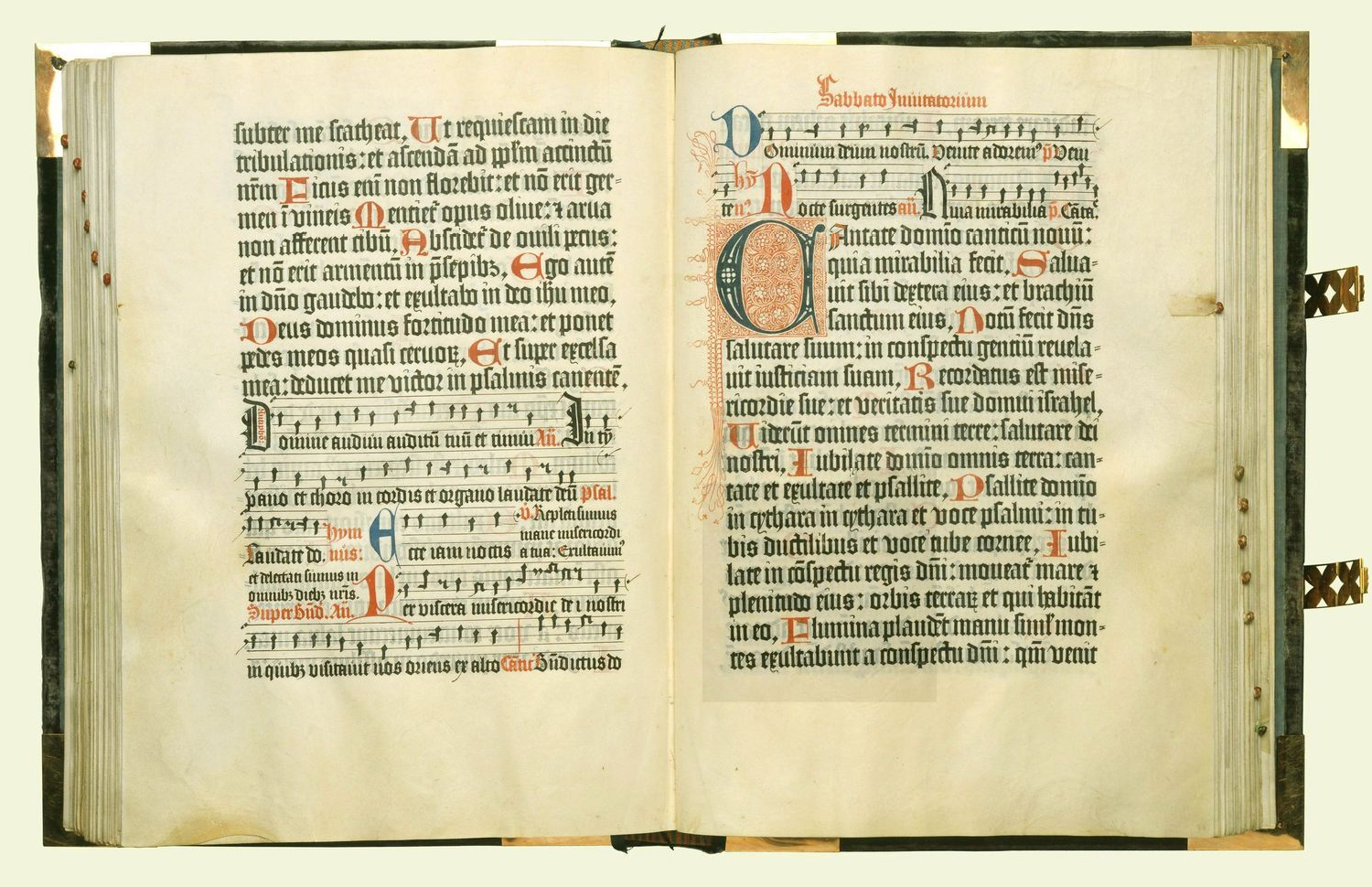
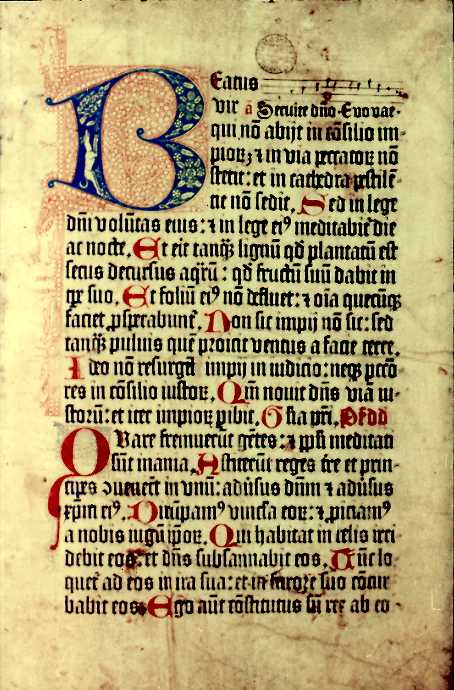
An opening of the Royal Collection's own copy of the 1457 Mainz Psalter, printed by Johann Fust and Peter Schoffer.
| Artist | Johann Fust and Peter Schoffer |
|---|---|
| Date | 14 August 1457 (colophon date) |
| Medium | Letterpress printing in black, red and (in the large initials) blue ink on vellum; manuscript square musical notation added by hand after printing |
| Dimensions | 323 x 438 x 75 mm as bound (short-issue folio, Royal Collection copy) |
| Where it is now | Royal Collection, Royal Library, Windsor Castlelast confirmed |
| Inventory number | RCIN 1071478 |
| Attribution | AcceptedThe printers named themselves, in print, in the book's own colophon: Fust and Schoffer, of Mainz, completed 14 August 1457. Full note |
| Object type | Printed book |
| Period | German, fifteenth century (Mainz, incunable period) |
| Cases | Has a provenance gap |
| Inscriptions | Colophon (abbreviated as printed): 'Presens spalmorum codex... Per Johannem Fust civem Maguntinum. Et Petrum Schoffer de Gernszheim. Anno domini Millesimo. cccc. lvii. In vigilia Assumpcionis.' Binding, front board: 'Psalmorum Codex Moguntiae Mcccclvii'. |
| Owners on record | 5 links4 documented, 1 unknown |
| Sources | 14 cited |
About this record Last verified · 14 sources cited · Change log
On this page 9 sections
ContentsClose
Printed at Mainz on 14 August 1457 by Johann Fust and Peter Schoffer, this Psalter is the second substantial book printed in Europe with movable type, following Gutenberg's 42-line Bible by about two years, and it is the first printed book to name its printers, place and date in a colophon, and the first to carry initials printed in color rather than painted by hand. It exists because of a rupture: in November 1455 Fust successfully sued Gutenberg over unpaid loans, and the workshop that produced this book two years later was staffed in large part by Gutenberg's own former chief assistant, Peter Schoffer, who married Fust's daughter and testified against his old master in the same lawsuit that made the new partnership possible.
Ten copies of the 1457 edition survive, all on vellum, and this is one of the six short-issue copies made for general use rather than the four long-issue copies produced specifically for the diocese of Mainz. The Royal Collection's copy has a documented chain from the Monastery of St Ursula in Hildesheim, through the collector Friedrich Wilhelm von Duve and the University of Gottingen, to its presentation to King George III in 1800, and it has remained in the Royal Library at Windsor since, bound in purple velvet with the King's monogram. Its own two centuries in royal hands have been quiet: no exhibition drama, no near-loss, nothing beyond a well-kept book doing exactly what a royal library is for.
Provenance
Each link is graded. Documented: a cited source supports it. Disputed: the identification is argued but not established. Unknown: no owner for that span, and the gap is not smoothed into a narrative. The grades in the glossary.
- 1457 -The press of Johann Fust and Peter Schoffer, Mainzdocumented
This short-issue copy was printed at Mainz and completed, per the printed colophon, on 14 August 1457.15
- - 1758Unrecorded, then the Monastery of St Ursula, Hildesheimunknown
No owner is documented for roughly three centuries after printing. The book's earliest documented owner is the Monastery of St Ursula in Hildesheim; how or when the convent acquired it is not stated in the sources consulted.4
- 1758 - 1782Friedrich Wilhelm von Duve (1707-1785)documented
Bought from the Monastery of St Ursula, Hildesheim, in 1758.4
- 1782 - 1800University of Gottingendocumented
Acquired from von Duve's collection in 1782.4
- 1800 - presentThe Royal Collection (King George III and successors)documented
Presented to King George III by the University of Gottingen in 1800; the university received 400 pounds in reimbursement in 1817. Held in the Royal Library, Windsor Castle, within the Royal Collection since, as RCIN 1071478.4
Technical evidence
| Attribution note | The printers named themselves, in print, in the book's own colophon: Fust and Schoffer, of Mainz, completed 14 August 1457. This is the first time in the history of European printing that a book stated in print who made it, where, and when, so the attribution rests on the object's own primary statement rather than on later scholarship. |
|---|---|
| Support | Vellum. All ten surviving copies of the 1457 edition are on vellum; no paper copy is known and it is not established whether one was printed.15 |
| Text ink | Black and red, printed together: both are relief-process letterpress and could share a single pass through the press.15 |
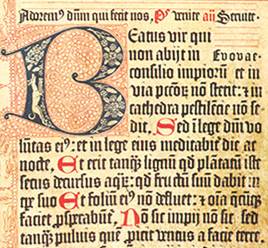
| Initials | Large capitals printed in red and blue from separately-inked interlocking pieces, run through the press with the text; smaller initials printed in a single color. The precise step-by-step mechanics are not fully reconstructed in the literature this record could verify.15 |
| Type | Two sizes of a square gothic type, a larger size for the psalms and a smaller size for the hymns and canticles, distinct from the Bible type used in Gutenberg's 42-line Bible.1 |
| Music notation | Square musical notation for the hymns was added by hand after printing, not printed.1 |
| Issue | Short issue, 143 leaves (the Royal Collection copy), against a long issue of 175 leaves made specifically for the diocese of Mainz.14 |
| Dimensions (this copy, bound) | 323 x 438 x 75 mm, folio.4 |
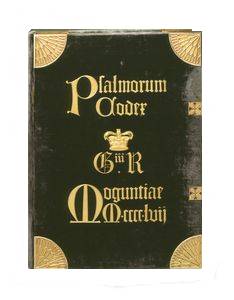
| Binding (this copy) | Purple velvet with gilt applique corner-pieces and a crowned GIIIR (George III Rex) monogram; front board lettered 'Psalmorum Codex Moguntiae Mcccclvii'; floral clasps on the fore-edge. Consistent with a binding commissioned to mark the 1800 royal presentation.4 |
| Colophon date | 14 August 1457, the eve of the Feast of the Assumption, as printed. Some secondary sources misstate this as 15 August, which is Assumption Day itself, not its eve.15 |
Images
The record in full
Chapter 1A working liturgical book, not a curiosity
This is the short-issue text of the Psalter that Johann Fust and Peter Schoffer printed at Mainz in August 1457: the Book of Psalms with the canticles, hymns, capitula and the greater and lesser...
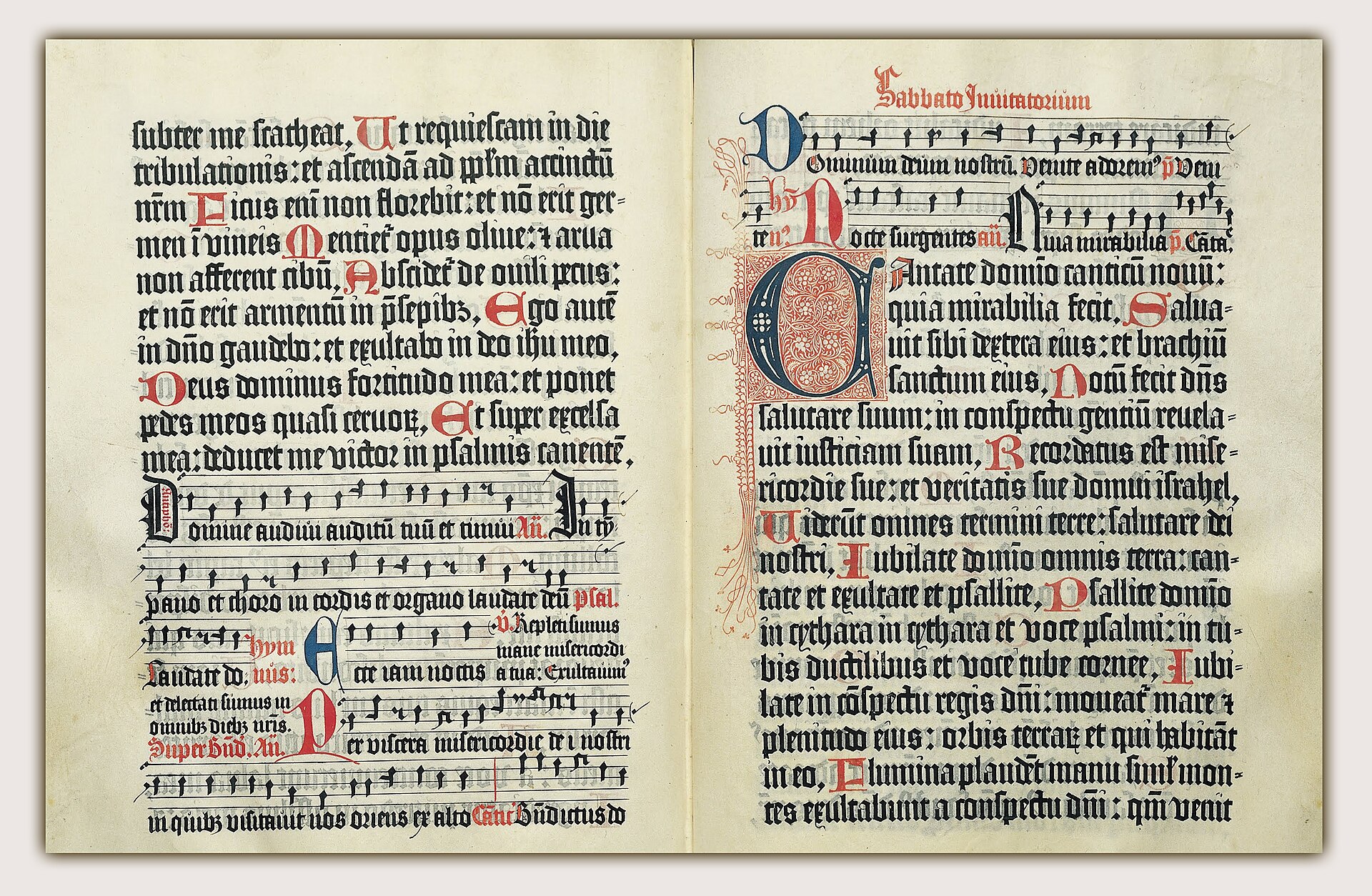
This is the short-issue text of the Psalter that Johann Fust and Peter Schoffer printed at Mainz in August 1457: the Book of Psalms with the canticles, hymns, capitula and the greater and lesser preces used alongside them in the Divine Office. It is a large folio, printed on vellum in black and red, with the small initials printed in a second color and the large capitals printed in red and blue and then finished by hand. The Royal Collection's copy, bound, measures 323 by 438 by 75 millimetres.
It was made to be used, not admired: a book for singing and reading the Office from, at the scale a choir or a chapter could actually work with. That everyday liturgical purpose is the plainest and best-documented fact about it, and it is worth stating before anything else, because the object's fame as a printing landmark can make it easy to forget what it was actually for.
Chapter 2Second in Europe, first to say who made it
The Mainz Psalter followed Gutenberg's 42-line Bible by roughly two years and is generally reckoned the second substantial book printed in Europe with movable type.
The Mainz Psalter followed Gutenberg's 42-line Bible by roughly two years and is generally reckoned the second substantial book printed in Europe with movable type. This archive already holds two copies of that Bible, the Doheny copy and the Vollbehr copy at the Library of Congress; both were produced under Gutenberg's own name and credit, and neither carries a printed statement of who made it, where, or when. This record is a different object, from a different, later print shop, under different printers' names, and it should not be confused with either.
What makes the Psalter a landmark in its own right is that it broke with the anonymity that governed manuscript production for centuries. A medieval scribe's colophon, where one exists at all, is typically a private aside; it was not standard practice to advertise, in the finished object itself, who had produced it and when. A printing press was a different kind of enterprise: a capital investment that needed future commissions, and a public statement of authorship and date was itself a form of advertising, proof that the workshop could deliver a book of this quality, on time, at scale. The Psalter's colophon is a business signature as much as a historical record.
Chapter 3The colophon
The printed colophon, abbreviated as it appears on the page, reads: 'Per Johannem Fust civem Maguntinum.
The printed colophon, abbreviated as it appears on the page, reads: 'Per Johannem Fust civem Maguntinum. Et Petrum Schoffer de Gernszheim. Anno domini Millesimo. cccc. lvii. In vigilia Assumpcionis.' In English: this volume of the Psalms, adorned with a magnificence of capital letters and clearly divided by rubrics, has been fashioned by a mechanical process of printing and producing characters, without use of a pen, and was completed for God's glory by Johann Fust, citizen of Mainz, and Peter Schoffer of Gernsheim, on the eve of the Assumption, in the year of Our Lord 1457, that is, 14 August.
The phrase worth pausing on is 'without use of a pen'. In 1457 that claim needed to be made explicit, because a reader could not otherwise be sure what they were holding. The book announces its own method of manufacture as the thing worth boasting about, which is a strange thing for a devotional book to do, and precisely the point: the Psalter is as much a demonstration of the press as it is a Psalter.
Chapter 4Two colors, printed, not painted
The large initials are printed, not hand-illuminated: red and blue ink applied to separately-inked type or blocks that interlock and were run through the press, usually together with the...
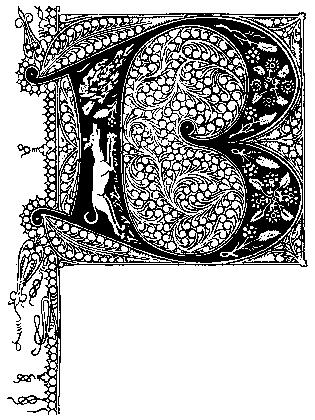
The large initials are printed, not hand-illuminated: red and blue ink applied to separately-inked type or blocks that interlock and were run through the press, usually together with the black-and-red text on the same sheet. Because both letterpress and the printing of the decorative blocks are relief processes, they could in principle share a single pass through the press, which is what modern accounts of the technique describe. The exact mechanical sequence, how the compositor achieved a clean boundary between two colors on a single small letterform without smearing, has not been fully reconstructed step by step by modern bibliographers; the general method is understood, the precise procedure is not settled.
The technique did not last. It was laborious, and later Fust-Schoffer books rarely attempt it again at this scale, which several sources read as the workshop concluding it was not worth repeating for the return it gave. That makes the Psalter not the beginning of a production method so much as its single, uneconomic high point: the most ambitious two-color printing job of the fifteenth century, tried once at full scale and then largely abandoned.
Chapter 5The rupture that made this book possible: Fust against Gutenberg
Fust was a Mainz burgher, a member of the Strasbourg goldsmiths' guild, and a financier.
Fust was a Mainz burgher, a member of the Strasbourg goldsmiths' guild, and a financier. He advanced Gutenberg money twice, roughly 800 guilders in 1450 and a further 800 guilders in 1452, along with an annual sum for running costs, to fund what the surviving legal document calls the 'Work of the Books', generally understood to mean the 42-line Bible. On 6 November 1455, in the refectory of the Barefoot Friars at Mainz, Fust sued Gutenberg for the return of the money with interest, a total said to be around 2,020 to 2,026 guilders. The proceedings were recorded by the notary Ulrich Helmasperger and the document is known as the Helmasperger Instrument.
The suit was decided in Fust's favor. What exactly changed hands as a result is less clear than the outcome: the Instrument itself does not itemize which type, punches, presses or other equipment passed to Fust, only the money judgment. What is well attested elsewhere is that Fust went on to run a print shop with Peter Schoffer, previously Gutenberg's most senior workman, who had himself testified against Gutenberg in the same proceeding. Two years later that shop produced this Psalter.
Chapter 6Whose hand, whose type: an open question
This is the question this record was asked to weigh honestly, and the honest answer is that it is not settled.
This is the question this record was asked to weigh honestly, and the honest answer is that it is not settled. Between the November 1455 judgment and the Psalter's completion in August 1457, Fust and Schoffer designed and cut, or otherwise obtained, two sizes of a square gothic type distinct from the Bible type, and developed a genuinely difficult two-color initial printing process, all in under two years. Fust was a financier with no personal background in typefounding or presswork. Schoffer was a trained scribe and Gutenberg's former chief assistant, which gives him the most plausible personal claim to technical competence, but he had not run an independent shop before.
Set against that timeline is the fact, established above, that the primary legal record of the split does not specify what type or equipment Fust actually took control of. That silence is exactly why the question stays open: it leaves room to argue that some of the type or technical groundwork for the Psalter originated in Gutenberg's own workshop before the judgment, carried over involuntarily rather than invented fresh by Fust and Schoffer, and equally room to argue that Schoffer's documented skill was sufficient on its own. This record has not been able to verify, from sources it could directly examine, a named scholarly consensus on the point, only that the debate is real and that the primary document does not resolve it. Readers who want the specialist literature should start with the technical-imaging and type-comparison work associated with the Gutenberg Museum in Mainz and the British Library's incunabula scholarship, neither of which this record was able to consult directly.
Chapter 7A dynasty formed in the same year
Schoffer married Fust's only daughter, Christina, around the time the partnership was formed, which converted a business arrangement between a former employee and his old master's creditor into a...
Schoffer married Fust's only daughter, Christina, around the time the partnership was formed, which converted a business arrangement between a former employee and his old master's creditor into a family firm. The marriage mattered beyond sentiment: it is why, when Fust died in 1466, the workshop and its capital stayed inside one family rather than being dispersed, and why Fust and Schoffer's descendants remained in printing for three further generations. The Psalter of 1457 is the first product of that new family enterprise.
Chapter 8How many survive, and where
Ten copies of the 1457 Psalter are known to survive, all on vellum; no paper copy is recorded and it is not known whether one was ever printed.
Ten copies of the 1457 Psalter are known to survive, all on vellum; no paper copy is recorded and it is not known whether one was ever printed. Two issues were produced: a long issue of 175 leaves, made specifically for liturgical use in the diocese of Mainz, of which four copies survive, and a shorter, more generally usable issue of 143 leaves, of which six copies survive, including the Royal Collection's. That makes the 1457 Psalter rarer than the Gutenberg Bible, of which roughly 49 copies or substantial fragments are known.
The surviving copies are held by the Berlin State Library, the Saxon State Library in Dresden, Darmstadt University Library, the Austrian National Library in Vienna (inscribed on the UNESCO Memory of the World register for Austria in 2011), the Bibliotheque nationale de France in Paris, the municipal library in Angers, the British Library in London, the John Rylands Library in Manchester, the Scheide Library at Princeton University, and the Royal Collection at Windsor.
Chapter 9From a Hildesheim convent to a king's library
Nothing is documented about this copy's whereabouts for roughly three centuries after it left the press.
Nothing is documented about this copy's whereabouts for roughly three centuries after it left the press. Its first recorded owner is the Monastery of St Ursula in Hildesheim; how or when the convent acquired it is not stated in the sources this record could verify. In 1758 the book was bought from the monastery by Friedrich Wilhelm von Duve (1707-1785). From von Duve's collection it passed, in 1782, to the University of Gottingen. Gottingen presented the volume to King George III in 1800, and the university was reimbursed 400 pounds for it in 1817. It has remained in the Royal Library at Windsor, within the Royal Collection, ever since.
That is a clean, well-documented chain from a German monastic library, through a private eighteenth-century collector and a university library, into the British royal library, but it is a quiet one. There is no rediscovery story here and no near-loss: a monastery sold a book it presumably no longer needed, a collector and then a university held it in turn, and a university made a royal gift. The drama, such as it is, belongs to the edition as a whole and to the 1455 lawsuit that made the print shop possible, not to this particular copy's own two and a half centuries of ownership.
Chapter 10Binding and condition
The Royal Collection's copy is bound in purple velvet, with gilt applique corner-pieces and a crowned monogram, GIIIR, George the Third Rex, at the center of each board: a binding made to mark the...
The Royal Collection's copy is bound in purple velvet, with gilt applique corner-pieces and a crowned monogram, GIIIR, George the Third Rex, at the center of each board: a binding made to mark the book's arrival in the royal library rather than one that traveled with it from Germany. The front board is lettered 'Psalmorum Codex Moguntiae Mcccclvii', Latin for 'Book of Psalms, Mainz, 1457', and the fore-edge carries floral clasps. Read against the 1800 presentation date, the binding is best understood as a contemporary royal commission to receive the gift, made in the last months of the eighteenth century, rather than an inherited German binding.
Chapter 11A quiet ownership since 1800
This record found no documented exhibition loan, theft, war damage, or recorded threat to this specific copy since it entered the Royal Collection.
This record found no documented exhibition loan, theft, war damage, or recorded threat to this specific copy since it entered the Royal Collection. It has been digitized and appears in the Royal Collection's own online catalogue and in aggregator records such as Europeana and Google Arts and Culture, but nothing in the sources consulted describes it leaving Windsor, being lent, or being at risk. Where a record like this one usually earns its keep by surfacing a near-miss or a dispute, the honest finding here is that this copy's own two-hundred-and-twenty-five years in royal hands have been administratively uneventful. That is worth recording plainly rather than dressing up as more than it is.
Chapter 12What it was for
A psalter's function was liturgical, not decorative: the psalms, canticles and hymns needed for the Divine Office, laid out with rubrics, text printed in red, marking the instructions and feast-day...
A psalter's function was liturgical, not decorative: the psalms, canticles and hymns needed for the Divine Office, laid out with rubrics, text printed in red, marking the instructions and feast-day cues a manuscript scribe would traditionally have picked out by hand. Printing those rubrics mechanically, in registered red ink rather than added afterward with a pen, was itself a claim that the press could reproduce a manuscript convention that mattered to the people using the book in choir, not merely imitate a manuscript's general appearance. The long issue, tailored specifically to the use of the diocese of Mainz, shows the workshop selling not just a generic devotional book but a liturgical edition matched to a specific institutional customer, which is early evidence of print being used as a commercial answer to an institution's actual liturgical requirements rather than a one-size-fits-all product.
The artist
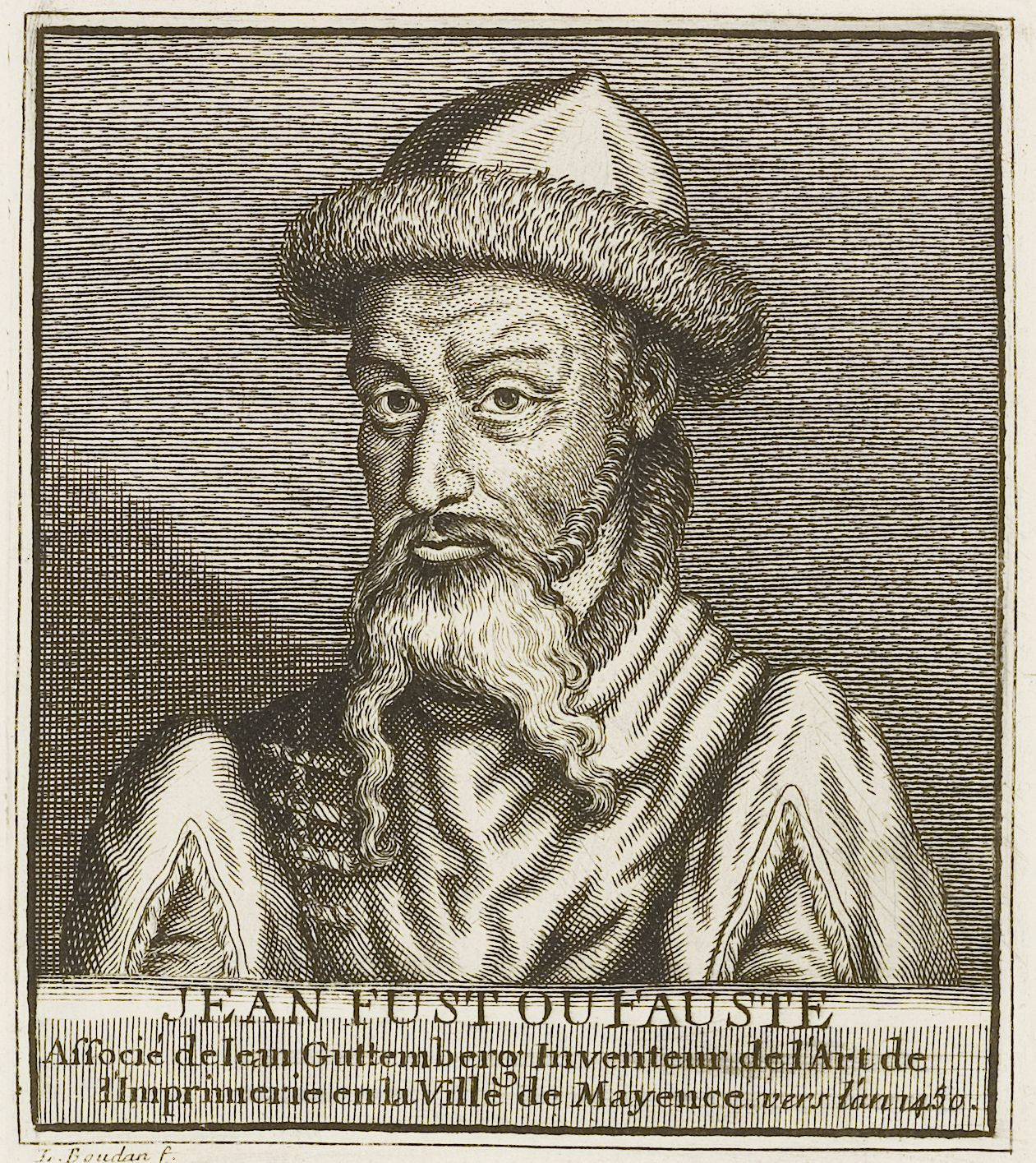
Johann Fust (financier and publisher) and Peter Schoffer von Gernsheim (scribe and printer)
The Psalter's colophon credits two men with two entirely different backgrounds. Fust put up the money, first to Gutenberg and then to his own shop; nothing suggests he cut type or worked a press himself. Schoffer had the hands-on skill, trained as a scribe before he ever touched a printing press, and had already worked at the top of Gutenberg's own workshop. Their partnership, sealed by Schoffer's marriage to Fust's daughter, is what actually produced the object described in this record, and it survived Fust's death by more than three further generations of the same family in the same trade.
Related works
| Work | Relation | Where it is |
|---|---|---|
| Gutenberg Bible, Old Testament Volume (The Doheny Copy) Johannes Gutenberg (printing workshop, Mainz) | The book this record's printers are defined against: the first substantial European book printed with movable type, made under Gutenberg's own credit roughly two years before the Psalter, without a colophon and without printed color initials Already published in this archive as gutenberg-bible-doheny-copy. Do not confuse the two records: different printer credit, different book, printed roughly two years apart. | Held in this archive; Hubay Census No. 45 |
| Biblia Latina, the 42-line Bible: the Library of Congress copy Printer of the 42-line Bible, Johann Gutenberg | The same relationship as above: the Gutenberg Bible this Psalter followed and is constantly compared against Already published in this archive as gutenberg-bible-vollbehr-copy. | Library of Congress; Incun. 1454 .B5 |
| Psalter (second edition, Benedictine use) Johann Fust and Peter Schoffer | Fust and Schoffer's own second printing of the Psalter, dated 29 August 1459 Not the object described in this record and not the 1457 first edition. Named here as comparanda only; an image of this later edition is included in the gallery and is explicitly captioned as such. | Bodleian Library, Oxford, and other holdings |
| Biblia Sacra Latina (the 1462 Bible) Johann Fust and Peter Schoffer | The partnership's next major production after the Psalter, a two-volume Latin Bible Cited here to show the Psalter as the opening work of a sustained printing enterprise, not an isolated technical experiment. | Various institutional holdings |
Open questions
- How much of the Psalter's type and two-color initial technique represents work Gutenberg had already developed before the 1455 judgment, carried over with his workshop, versus genuine independent development by Fust and Schoffer in under two years. The Helmasperger Instrument records the money judgment but does not itemize the type or equipment that changed hands, and this record could not verify a settled scholarly consensus from sources it could directly examine.
- The exact mechanical sequence used to print the two-color initials in clean register has not been fully reconstructed step by step in the literature consulted for this record.
- Whether this specific copy was ever exhibited, loaned, or placed at any documented risk between its presentation to George III in 1800 and today; no such record turned up in the sources consulted.
- How and when the Monastery of St Ursula in Hildesheim, the copy's earliest documented owner, itself acquired the book; nothing is recorded for the roughly three centuries between printing in 1457 and the monastery's 1758 sale.
- Whether a paper copy of the 1457 Psalter was ever printed alongside the vellum copies; none survive and the sources consulted do not establish whether one ever existed.
Questions about this object
What is The Mainz Psalter?
The Mainz Psalter is a printed book, dated 14 August 1457 (colophon date). Medium: Letterpress printing in black, red and (in the large initials) blue ink on vellum; manuscript square musical notation added by hand after printing.
Who made The Mainz Psalter, and is the attribution settled?
The attribution to Johann Fust and Peter Schoffer is recorded here as accepted. The printers named themselves, in print, in the book's own colophon: Fust and Schoffer, of Mainz, completed 14 August 1457. This is the first time in the history of European printing that a book stated in print who made it, where, and when, so the attribution rests on the object's own primary statement rather than on later scholarship.
Where is The Mainz Psalter now?
Royal Collection, Royal Library, Windsor Castle. Inventory number RCIN 1071478. Last confirmed 25 August 2026. Presented to King George III by the University of Gottingen in 1800; held in the Royal Library, Windsor Castle, within the Royal Collection since.
What is still unknown about The Mainz Psalter?
How much of the Psalter's type and two-color initial technique represents work Gutenberg had already developed before the 1455 judgment, carried over with his workshop, versus genuine independent development by Fust and Schoffer in under two years. The Helmasperger Instrument records the money judgment but does not itemize the type or equipment that changed hands, and this record could not verify a settled scholarly consensus from sources it could directly examine.
Sources
- 1Wikipedia, 'Mainz Psalter', for the colophon text and translation, the printing technique, the census of surviving copies, and the long and short issues. en.wikipedia.org/wiki/...
- 2Wikipedia, 'Johann Fust', for Fust's biography, the loans to Gutenberg, the 1455 lawsuit, his death in 1466, and the witchcraft legend (treated by the article itself with appropriate caution). en.wikipedia.org/wiki/...
- 3Wikipedia, 'Peter Schoffer', for Schoffer's training, his role in Gutenberg's workshop, his testimony in the 1455 suit, his marriage to Christina Fust, and his later career and descendants. en.wikipedia.org/wiki/...
- 4Google Arts and Culture, 'Mainz Psalter, Mainz: Johann Fust and Peter Schoeffer (printers)', mirroring the Royal Collection Trust's own catalogue record, for the provenance chain, binding description, and dimensions of the Royal Collection's copy. artsandculture.google.com/asset/...
- 5Osterreichische UNESCO-Kommission, 'Mainz Psalter' (Austrian National Library copy, Memory of the World Register), for the printing significance, colophon function, and confirmation that the exact steps of the two-color initial technique are not fully reconstructed. unesco.at/en/...
- 6Bridwell Library Special Collections Exhibitions, 'Gutenberg, Fust, and Schoeffer', Peter Schoeffer: Printer of Mainz, for the Helmasperger Instrument, confirmation that the document does not itemize the equipment or type that passed to Fust, and the subsequent Fust-Schoeffer partnership. bridwell.omeka.net/exhibits/...
- 7Wikimedia Commons, File:1457 Mainz Psalter.jpg, (LicenseShortName: Public domain), for licence verification of the lead image. commons.wikimedia.org/wiki/...
- 8Wikimedia Commons, File:The Mainz Psalter, 1457.jpg, for the binding image and its description of the 18th-century bookbinding and George III monogram. commons.wikimedia.org/wiki/...
- 9Wikimedia Commons, File:Mainz - Johann Fust & Peter Schoeffer (printers) - Mainz Psalter - Google Art Project.jpg, for the high-resolution scan of the Royal Collection copy. commons.wikimedia.org/wiki/...
- 10Wikimedia Commons, File:Init001.jpg, for the printed initial B illustrating the two-color technique; source copy not identified in the file metadata. commons.wikimedia.org/wiki/...
- 11Wikimedia Commons, File:Mainz psalter detail.jpg, for the initial detail illustrating the printing technique; source copy not identified in the file metadata. commons.wikimedia.org/wiki/...
- 12Wikimedia Commons, File:Mainz psalter (Fust and Schoeffer).jpg, Bodleian Library copy of the 1459 second edition, used as comparanda and explicitly captioned as not the object described in this record. commons.wikimedia.org/wiki/...
- 13Wikimedia Commons, File:Jean Fust ou Fauste, PA08079.jpg, an imagined portrait of Johann Fust by Louis Boudan, used for context and explicitly captioned as not a contemporary likeness. commons.wikimedia.org/wiki/...
- 14Wikimedia Commons, File:Fust und Schoffer.png, the Fust and Schoffer printer's device, used for context and explicitly captioned as not appearing in the 1457 Psalter per the file's own description. commons.wikimedia.org/wiki/...


_-_Mainz_Psalter_-_Google_Art_Project.jpg)


.jpg)


Last verified · Published
Change log
25 August 2026 - Record created at the house standard: researched narrative, technical evidence, maker dossier, graded provenance chain, prices with hammer and premium separated, related works, open questions and sources.