The Beauvais Missal
Unknown illuminator associated with the Cholet Group · c. 1270-1300, usually placed within a decade either side of 1290
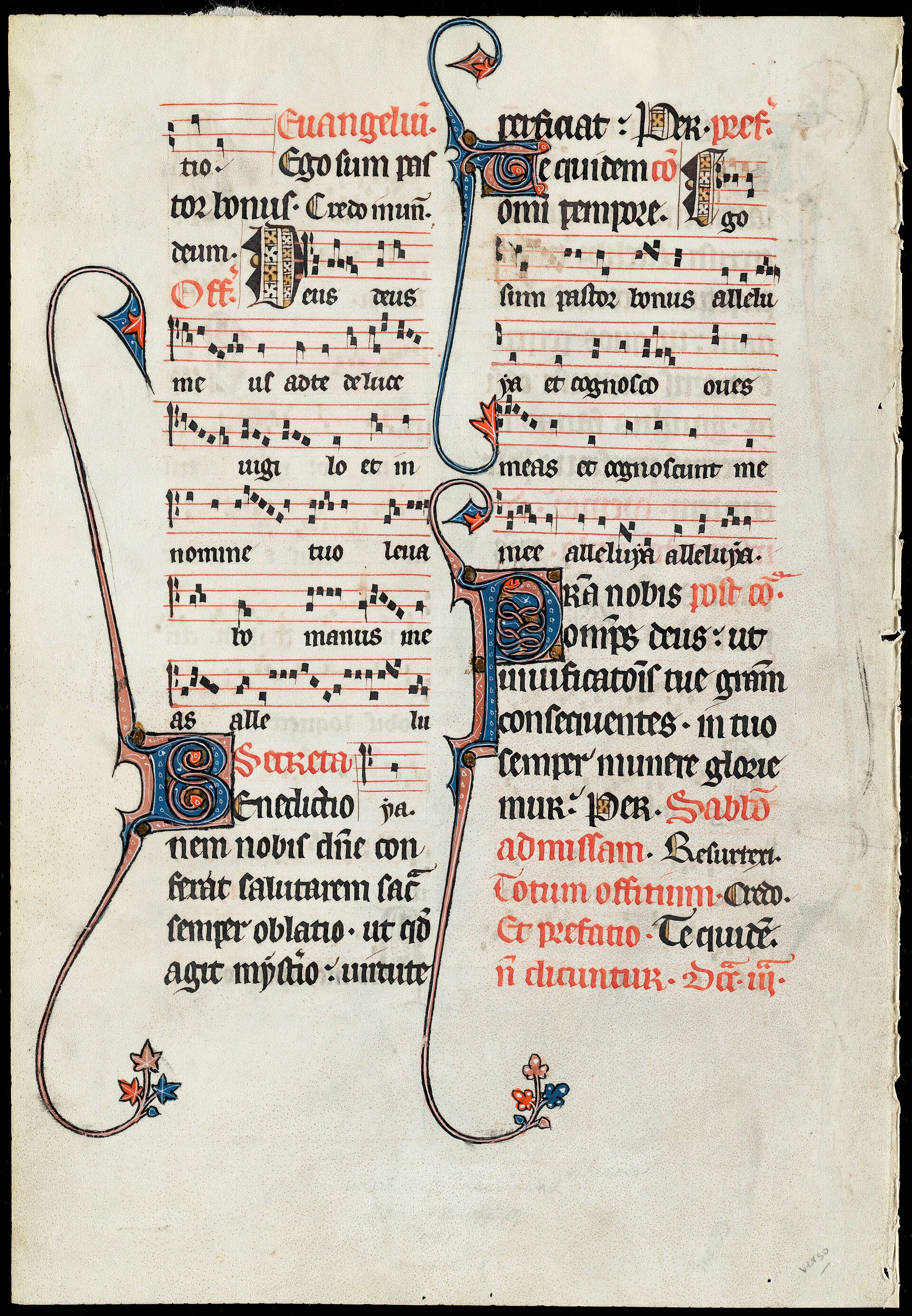
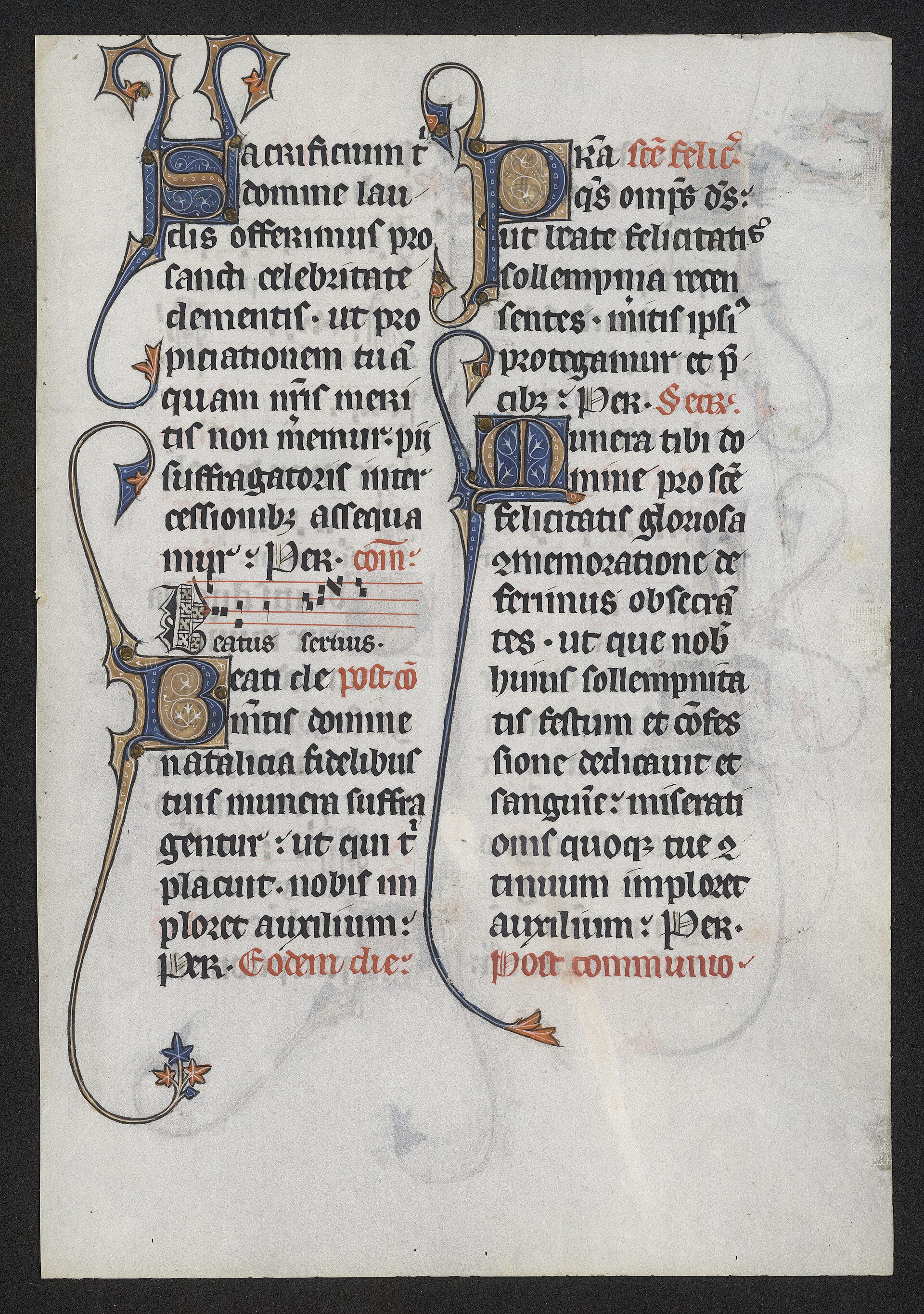
A surviving leaf of this manuscript, held by Boston Public Library and digitised through the Digital Public Library of America. The object is dispersed, so a photograph of a located leaf is a photograph of part of the object itself. Boston bought these two leaves from Philip Duschnes in 1950.
| Artist | Unknown illuminator associated with the Cholet Group |
|---|---|
| Date | c. 1270-1300, usually placed within a decade either side of 1290 |
| Medium | Ink, tempera and gold on parchment, with square Gothic musical notation on four-line red staves |
| Dimensions | Leaves 290 x 204 mm; written area about 195 x 135 mm; 309 leaves when intact |
| Where it is now | Dispersed. 122 of 309 leaves located in more than one hundred institutional and private collections; a virtual reconstruction is hosted by Fragmentariumlast confirmed 4 August 2026 |
| Inventory number | Fragmentarium F-4ihz (virtual reconstruction); Boston Public Library MS pb Med. 110; Cleveland Museum of Art 1982.141; Oberlin, Allen Memorial Art Museum 1993.16 |
| Attribution | WorkshopNo maker is named. Full note |
| Object type | Manuscript |
| Period | French, late thirteenth century |
| Cases | Has a provenance gap |
| Inscriptions | Donation inscription of Robert de Hangest on the blank recto of the first leaf of the calendar, now lost, recorded in the 1926 Sotheby's catalogue: Dominus Robertus de hangestis quondam canonicus Beluacii legauit Istam terciam partem missalis Ecclesie Beluacii pro obitu suo in eadem perpetuum singulis annis faciendo tercia die Novembris |
| Owners on record | 10 links8 documented, 2 unknown |
| Sources | 12 cited |
About this record Last verified 1 September 2026 · 12 sources cited · Change log
On this page 10 sections
ContentsClose
A missal written for the use of Beauvais Cathedral at the end of the thirteenth century, 309 leaves of parchment, the third volume of a set of three. It was given to the cathedral in September 1356 by a canon, Robert de Hangest, in exchange for a Mass said for him every year on 3 November, and it stayed in that library for about 450 years.
It no longer exists as a book. In October 1942 the New York dealer Philip Duschnes bought it out of William Randolph Hearst's collection for USD 1,000, through Gimbel Brothers, and had single leaves on the market within a month at USD 25 to USD 40 each. Otto F. Ege of Cleveland, who had published a defence of book-breaking in 1938, distributed leaves as number 15 in forty boxed sets of Fifty Original Leaves from Medieval Manuscripts. The leaf carrying Hangest's donation inscription was lost in the process: the page recording why the book existed was destroyed in the act of selling it.
This record exists because biblioclasm is a provenance subject and almost nobody treats it as one. The chain here is unusually complete for a medieval manuscript, and the destructive act sits in the middle of it, fully documented, carried out by named professionals for a return that can be calculated. Lisa Fagin Davis has located 122 of the 309 leaves. One of them turned up framed on a wall at an estate sale in Waterville, Maine, and was bought for USD 75.
Provenance
Each link is graded. Documented: a cited source supports it. Disputed: the identification is argued but not established. Unknown: no owner for that span, and the gap is not smoothed into a narrative. The grades in the glossary.
- c. 1270-1300 - by 1356Unidentified patron, for the use of Beauvais Cathedralunknown
The liturgy fixes it to Beauvais use. The patron is not recorded. Peter Kidd observes that Robert de Hangest was too young to have commissioned a book of about 1290 and proposes his relative Guillaume de Hangest, who founded a chapel in the Beguine house at Beauvais in 1294, as a possibility. That is a proposal.
- by September 1356 - 1356Robert de Hangest, canon of Beauvaisdocumented
Recorded by an inscription on the blank recto of the first leaf of the calendar, transcribed in the 1926 Sotheby's catalogue, and independently by later transcripts of the Beauvais registers. The leaf carrying the inscription was lost in the dismemberment.345
- 1356 - late eighteenth centuryBeauvais Cathedral, Cathedrale Saint-Pierredocumented
Listed as 'Missale Roberti Hangesto; en beau velin et belles miniatures'.45
- French Revolution - by 1833Not establishedunknown
A group of Beauvais manuscripts had reached Lyon by 1833. Kidd describes this as the only undocumented part of the missal's provenance.
- by 1843 - 1843Didier Petit de Meurville (1793-1873), Lyondocumented
The binding description of 1843 matches that published in the Broelemann catalogue of 1897.345
- 1843 - 4 May 1926The Broelemann family, Lyon: Henry-Auguste (1775-1854), Emile-Thierry (1800-1869), Arthur-Auguste (1826-1904), Albertine (1831-1920), Blanche Bontoux (1859-1955), Madame Etienne Malletdocumented
Arthur-Auguste published a private catalogue of the collection in 1897.35
- 4 May 1926 - October 1942William Randolph Hearst (1863-1951)documented
Permain's role as agent was established by Peter Kidd. The auction record names the dealer, not the buyer.345
- October 1942 - 1942Philip C. Duschnes (1897-1970), New Yorkdocumented
Single leaves were offered at USD 25 to USD 40 each, priced by the quantity of gold on the page.34
- 1942 - 1951Otto F. Ege (1888-1951), Cleveland, and the tradedocumented
Ege had published his defence of book-breaking in Avocations in March 1938, four years before this book reached him.37
- 1942 - presentDispersed: more than one hundred institutional and private collectionsdocumented
Holders include Harvard Houghton, Cleveland Museum of Art, the Morgan, the Metropolitan Museum, the Beinecke, Boston Public Library, Oberlin, Temple University, Waseda, Oslo Cathedral School and the Australian National University. Boston Public Library bought its two leaves from Duschnes in 1950.18911
Prices realised
The intact codex came to auction once, in 1926. The 1942 transfer to the dealer who destroyed it was a private sale through a department store, not an auction, and carries no premium. Everything sold since has been a single leaf or a boxed portfolio containing one leaf among fifty, so no post-1942 price is a price for this object. Ege's set no. 18 was sold at Christie's London on 14 December 2022 as lot 19; the price realised was not obtainable from this desk, and when it is, note that a Christie's published price includes the buyer's premium and the hammer must be worked back from it.
| Date | Sale | Estimate | Result | Note |
|---|---|---|---|---|
| 4 May 1926 | Sotheby's, London | Hammer 970 GBP | Lot 161. Sold by Blanche Bontoux, Madame Etienne Mallet. Bought by the dealer William Permain acting as agent for William Randolph Hearst. Sources give a single figure and record no buyer's premium; it is treated here as the hammer. This is the only auction of the manuscript as a book. |
Hammer is the price at which the bidding stopped; with premium adds the fee the house charges the buyer on top. Hammer price and buyer's premium in the glossary.
Technical evidence
| Attribution note | No maker is named. Alison Stones has affiliated the illumination with the Cholet Group, attributed to Amiens or Paris in the last decades of the thirteenth century, on the treatment of hair, drapery and eyes compared with Bibliotheque de l'Arsenal manuscript 25. The use is fixed to Beauvais by the liturgy and by the lost donation inscription. |
|---|---|
| Material and extent | Parchment. 309 leaves when intact; 122 leaves located as of the Fragmentarium reconstruction.13 |
| Dimensions | 290 x 204 mm; written area about 195 x 135 mm. The Boston Public Library gives its leaves as 290 x 200 mm with a written area of 200 x 135 mm.128 |
| Layout | Two columns of fifteen or twenty-one lines, or ten staves of music, per page. Quoting '21 lines in 2 columns' alone describes the text pages and not the chant pages.238 |
| Script and notation | Gothic bookhand in black ink with red rubrics; square Gothic notation on a four-line red staff.8 |
| Decoration | Initials of one to seven lines throughout in gold and colours, with tendril-like marginal extensions ending in leafy finials, many incorporating serpents, dragons or birds, with small dogs or other animals.2 |
| Historiated initials | Four in the Canon of the Mass. Three identified: two on Cleveland Museum of Art 1982.141, one on Oberlin, Allen Memorial Art Museum 1993.16. The fourth is unlocated.2 |
| Contents | A summer volume, carrying Mass texts and chant for the feasts from the week after Easter onward. It was the third of a three-volume set.35 |
| Binding, as last recorded | Russian leather with brass catches and clasps and metal studs along the board edges, the leaf edges gilt-tooled, lettered Missel de Bauvais au pointille on the lower edge of the bookblock. Bound and gilt by the Lyon binder Bruyere, apparently for Didier Petit de Meurville before 1843.25 |
| Present state | Dismembered. Leaves in more than one hundred collections and in private hands; many circulated as no. 15 in Otto Ege's Fifty Original Leaves portfolios, of which forty sets were issued.139 |
Images
The record in full
Chapter 1It was the third volume of three, and nobody has ever found the other two
The Beauvais Missal was a summer volume: the Mass texts and the chant for the feasts falling between the week after Easter and the end of the liturgical year, written for the use of Beauvais...
The Beauvais Missal was a summer volume: the Mass texts and the chant for the feasts falling between the week after Easter and the end of the liturgical year, written for the use of Beauvais Cathedral in the last decades of the thirteenth century. Complete, it ran to 309 leaves of parchment, about 290 by 204 mm, ruled in two columns of fifteen or twenty-one lines, or ten staves of music, with the text block about 195 by 135 mm.
It was one book of a set of three. The Latin donation inscription calls it istam terciam partem missalis, this third part of the missal, and the French registers of Beauvais record the gift as a missal in three volumes. No trace of the first two has ever been identified. That is the first thing a reader should hold on to: two thirds of this object were already lost before anybody thought to cut up the third.
Chapter 2A canon bought a yearly Mass with it, and the page recording the transaction was the first thing destroyed
Robert de Hangest, a canon of Beauvais Cathedral, gave the missal to the cathedral in September 1356, reserving its use for his own lifetime, on condition that his death be commemorated every year on...
Robert de Hangest, a canon of Beauvais Cathedral, gave the missal to the cathedral in September 1356, reserving its use for his own lifetime, on condition that his death be commemorated every year on 3 November. He died that November. The transaction is a purchase in the only currency that mattered to him: a book against an obit in perpetuity.
The inscription recording it stood on the blank recto of the first leaf of the calendar. It read, in the transcription made for the 1926 auction catalogue, Dominus Robertus de hangestis quondam canonicus Beluacii legauit Istam terciam partem missalis Ecclesie Beluacii pro obitu suo in eadem perpetuum singulis annis faciendo tercia die Novembris. That leaf no longer exists. It was lost when the manuscript was broken up, which means the document establishing why the book was in the cathedral at all was destroyed in the act of turning the book into merchandise. Everything now known about the donation is known from copies made by other people.
Peter Kidd has pointed out the obvious difficulty with calling Hangest the patron. The missal is dated by art historians to within a decade either side of 1290 and Hangest died in 1356; he is unlikely to have been old enough to commission it. Kidd notes a relative, Guillaume de Hangest, Tresorier de France, who founded a chapel in the Beguine house at Beauvais in 1294, and asks whether he commissioned the book for a younger kinsman. That is a question, not an answer, and it is recorded here as one.
Chapter 3Four hundred and fifty years in one library, then the Revolution
The missal stayed at Beauvais and is identified in successive cathedral inventories.
The missal stayed at Beauvais and is identified in successive cathedral inventories. A seventeenth-century catalogue lists it as Missale Roberti Hangesto; en beau velin et belles miniatures. Then the cathedral library was dispersed, as most French ecclesiastical collections were, at or soon after the Revolution.
What happened next is the one genuine hole in the chain, and the scholar who reconstructed the rest of it says so plainly: this is the only undocumented part of the missal's provenance. A group of Beauvais manuscripts had reached Lyon by 1833. Nobody has shown how.
Chapter 4Lyon, a new binding, and four generations of one family
The book surfaces in the collection of Didier Petit de Meurville of Lyon, and appears in his sale of 1843 as lot 354.
The book surfaces in the collection of Didier Petit de Meurville of Lyon, and appears in his sale of 1843 as lot 354. By then it had been rebound and gilt by the Lyon binder Bruyere, with the title Missel de Bauvais au pointille tooled on the lower edge of the bookblock; the binding description in 1843 matches the one published in 1897, which is how the binding is dated to Petit's ownership. When it was last intact it was in Russian leather with brass catches and clasps and metal studs along the board edges.
Henri Auguste Broelemann, a commercial broker in Lyon, bought it in 1843. It then passed through four generations of one family: to his son Emile-Thierry, to his son Arthur-Auguste, to his sister Albertine, and to her daughter Blanche Bontoux, Madame Etienne Mallet. The Broelemann books were catalogued privately by Arthur-Auguste in 1897, which is the document that fixes the collection.
Chapter 54 May 1926: lot 161, and a bidder who was not bidding for himself
Blanche Bontoux sold the missal at Sotheby's in London on 4 May 1926, lot 161.
Blanche Bontoux sold the missal at Sotheby's in London on 4 May 1926, lot 161. It made GBP 970 to the dealer William Permain.
Permain was not the buyer. Peter Kidd established that he was acting as agent for William Randolph Hearst, who took the manuscript to the United States. This is the single most important correction in the early modern chain, and it was made by a provenance scholar working through catalogues, not by the auction house or by any of the institutions now holding the pieces. Named on the ticket: the dealer. Named in the record: nobody, for eighty-nine years.
The GBP 970 is reported as one figure. No buyer's premium is separately recorded, and none is stated in the sources consulted here, so the sum should be read as the price at which the lot was knocked down.
Chapter 6October 1942: one thousand dollars, through a department store
Hearst kept the missal for sixteen years and sold it in October 1942, through Gimbel Brothers in New York, for USD 1,000.
Hearst kept the missal for sixteen years and sold it in October 1942, through Gimbel Brothers in New York, for USD 1,000. Hearst's collections were being liquidated through a department store because that is how the Hearst dispersal was run; a thirteenth-century French missal moved through the same channel as furniture.
The buyer was Philip C. Duschnes, a New York dealer. Less than a month after the sale he began offering single leaves at USD 25 to USD 40 apiece, the price depending on how much gold was on the particular page. Broken Books puts the commercial logic in one sentence: Duschnes needed to sell forty of the cheaper leaves to break even, and he had more than three hundred.
The arithmetic is worth doing because nobody ever does it. At USD 25 to USD 40 a leaf, 309 leaves are worth between about USD 7,700 and USD 12,400 against an outlay of USD 1,000. That range is DERIVED here from the leaf prices and the leaf count, not quoted from any source, and it assumes every leaf sells, which no dealer achieves. Even discounted heavily, the return on breaking the book was somewhere between seven and twelve times the return on selling it whole. That ratio, and not vandalism or ignorance, is the entire explanation of biblioclasm.
Chapter 7Number 15 in the portfolio, and the man who wrote a defence of book-breaking
Duschnes sold many of the leaves to Otto F.
Duschnes sold many of the leaves to Otto F. Ege of Cleveland, a professor of art history who was also a dealer, and a friend and business associate. Leaves of the Beauvais Missal are best known as number 15 in Ege's boxed sets, 'Fifty Original Leaves from Medieval Manuscripts', of which forty were issued, each containing one leaf from each of fifty different manuscripts.
Ege did not do this quietly. In March 1938 he published an essay called 'I Am a Biblioclast' in the hobby magazine Avocations. It opens: 'For more than twenty-five years I have been one of those strange, eccentric, book-tearers.' He notes that William Blades and Holbrook Jackson each devoted a chapter to condemning mutilators of books, and that Andrew Lang classified them, adding: 'I find I am the aesthetic ghoul of the book world.'
He then sets out a code of practice, which begins with a rule he did not apply to this book: never to take apart a museum piece or a unique copy if it is complete. And he offers the justification the trade has used ever since: 'Surely to allow a thousand people to have and to hold an original manuscript leaf, and to get the thrill and understanding that comes only from actual and frequent contact with these art heritages, is justification enough for the scattering of fragments. Few, indeed, can hope to own a complete manuscript book; hundreds, however, may own a leaf.'
The argument is not stupid and it should be stated at full strength, because it is the argument that won. What it omits is that a leaf out of a missal cannot be read as a missal: the sequence, the quire structure, the calendar and the inscription that told you whose book it was are properties of the codex, and they are exactly what the sale destroys.
Chapter 8What the leaves show, and what a connoisseur can still say about the hand
The decoration runs to initials of one to seven lines throughout in gold and colours, with tendril-like marginal extensions ending in leafy finials, many incorporating serpents, dragons or birds...
The decoration runs to initials of one to seven lines throughout in gold and colours, with tendril-like marginal extensions ending in leafy finials, many incorporating serpents, dragons or birds, with small dogs and other animals. The art historian Alison Stones has affiliated the book with the cluster known as the Cholet Group, attributed to Amiens or Paris in the last decades of the thirteenth century, comparing the curling hair, the deeply modelled drapery and the delicately drawn eyes with a glossed Psalter of that group, Bibliotheque de l'Arsenal manuscript 25.
The Canon of the Mass originally carried four historiated initials. Three have been identified. Two of them are on a single leaf in Cleveland, and the third is at Oberlin. The fourth has not been found.
Chapter 9The Cleveland leaf is a gift in memory of the man who destroyed the book
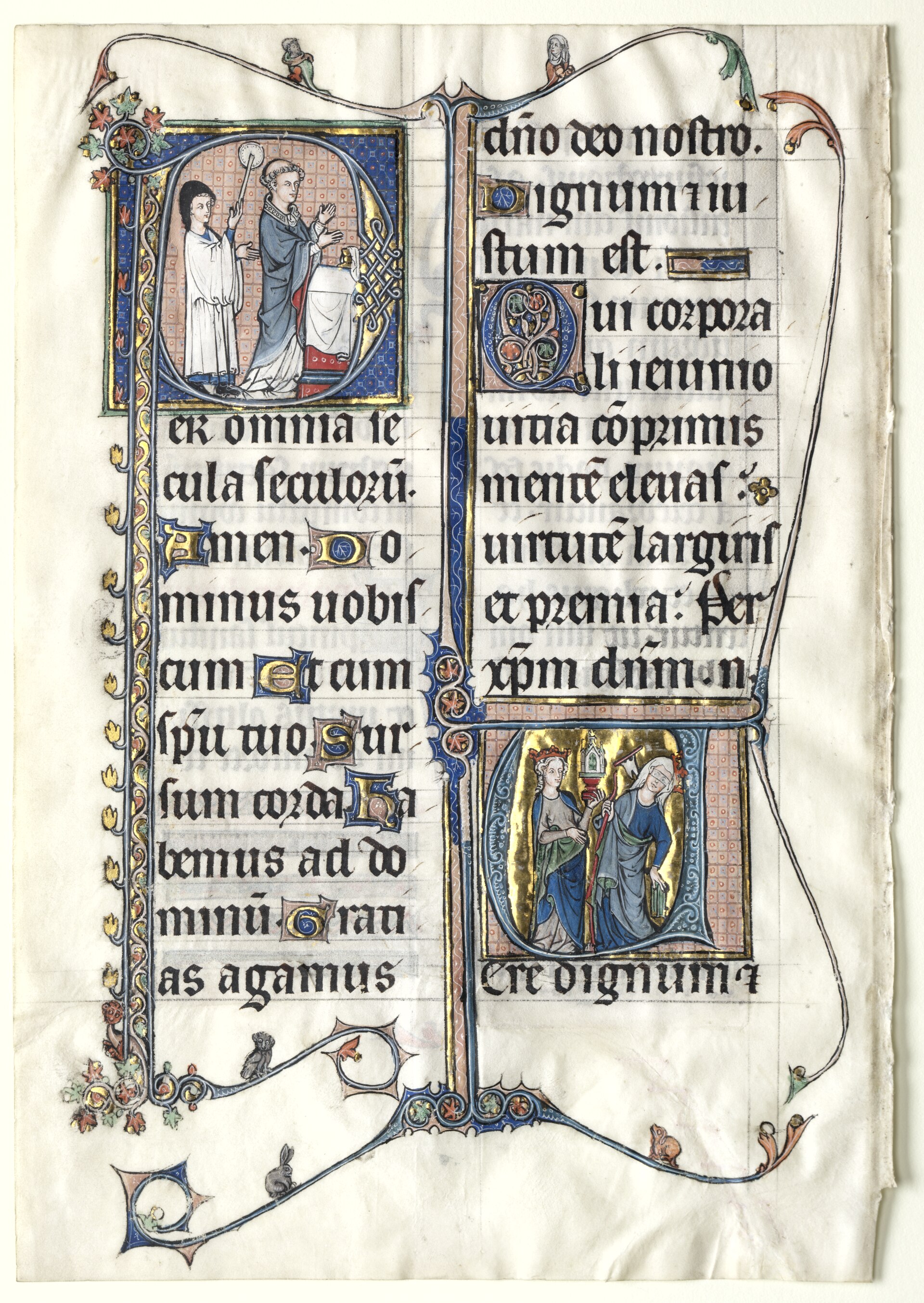
Cleveland Museum of Art accession 1982.141 is a leaf from the Canon, ink, tempera and gold on vellum, sheet 28.5 by 20 cm, dated about 1300.
Cleveland Museum of Art accession 1982.141 is a leaf from the Canon, ink, tempera and gold on vellum, sheet 28.5 by 20 cm, dated about 1300. It carries two historiated initials: a P, for Per omnia saecula saeculorum, showing a priest celebrating Mass, and a V, for Vere dignum et iustum est, showing Ecclesia and Synagoga. The museum's own description states that this leaf and others survive from a magnificent missal made for the use of Beauvais Cathedral, and that the two initials illustrate the preface to the Canon of the Mass.
The credit line reads: Gift of Mr. and Mrs. Milton Freudenheim in memory of Otto Ege.
That sentence is the whole subject of this record in eleven words. The leaf is in a public collection, catalogued, conserved, photographed and released for anyone to use, and it is there as a memorial to the man who cut it out of the book.
Chapter 10Boston bought its leaves directly from the man who cut them
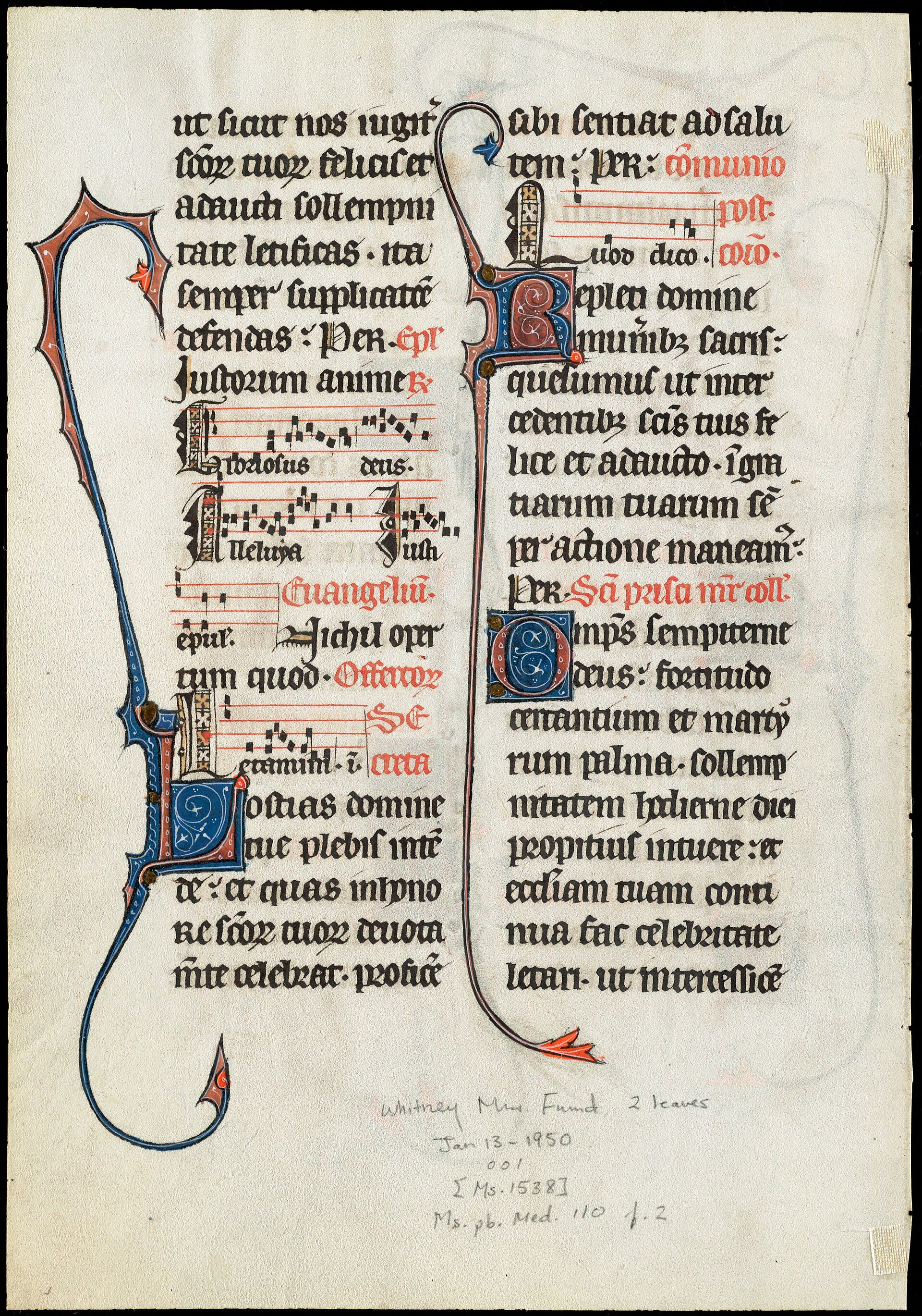
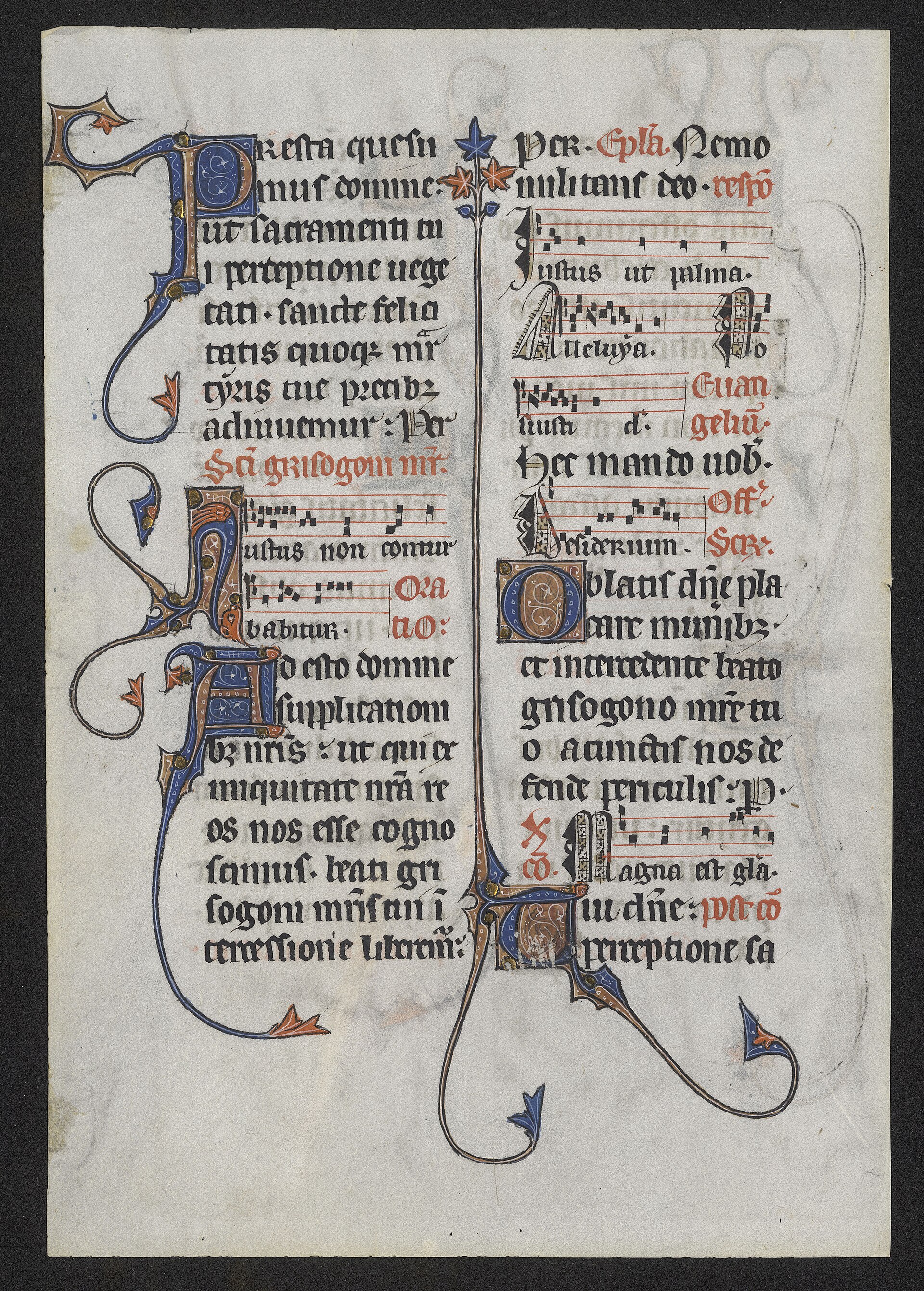
Boston Public Library holds two leaves under MS pb Med.
Boston Public Library holds two leaves under MS pb Med. 110, formerly BPL MS 1538: parchment, 290 by 200 mm with a written area of 200 by 135 mm, Gothic bookhand in black ink with red rubrics, two columns of twenty-one lines, square Gothic notation on a four-line red staff, two-line initials in red and blue with white filigree. One leaf carries the Second Sunday after Easter; the other, Masses for saints' feasts between 29 August and 1 September.
The library's catalogue names its former owners in order: the Catholic Church, Robert de Hangest, Henri August Broelemann, Otto F. Ege, Philip C. Duschnes, the Cathedrale Saint-Pierre at Beauvais. The leaves were bought from Duschnes in 1950. A research library acquired the pieces from the dealer who made them pieces, eight years after he did it, and catalogued him as a previous owner. Nothing in this history was hidden. It was all in the front of the file.
Chapter 11122 of 309, and the reconstruction that will never be finished
Lisa Fagin Davis has been locating and reassembling the leaves since the mid-2010s, first as a case study for the Broken Books platform developed at Saint Louis University's Center for Digital...
Lisa Fagin Davis has been locating and reassembling the leaves since the mid-2010s, first as a case study for the Broken Books platform developed at Saint Louis University's Center for Digital Humanities, and now as a virtual reconstruction hosted on Fragmentarium. The reconstruction gathers images and metadata, pairs consecutive leaves by matching the gold offset one leaf leaves on the next, and rebuilds the quire structure. There are no folio numbers to work from.
The count has moved: more than eighty leaves identified by March 2015, ninety-three assembled that month across twenty-two states and six countries, the hundredth folio in June 2016, and 122 of 309 on the Fragmentarium record, where that figure has stood since at least December 2023. Holding institutions include Harvard's Houghton Library, the Cleveland Museum of Art, the Morgan Library, the Metropolitan Museum, the Beinecke, Boston Public Library, Oberlin, Waseda University in Tokyo, Oslo Cathedral School and the Australian National University.
One hundred and eighty-seven leaves are unaccounted for. That figure is DERIVED, 309 less 122, and it is not a statement that they are destroyed. Davis noted in 2015 that as many as thirty leaves were known but untraced, which is a different category again: photographed or catalogued once, and now nowhere.
Chapter 12A framed page on a wall at an estate sale in Maine
In September 2022 Will Sideri, a recent Colby College graduate who had taken a manuscripts course there, saw a framed page at an estate sale in Waterville, Maine, recognised the script, and called...
In September 2022 Will Sideri, a recent Colby College graduate who had taken a manuscripts course there, saw a framed page at an estate sale in Waterville, Maine, recognised the script, and called his former professor Megan Cook. Davis confirmed it as a leaf of the Beauvais Missal. Sideri had paid USD 75 for it. Davis estimated it was worth between USD 5,000 and USD 10,000.
The story was picked up by the Associated Press and travelled. Davis then wrote that in the months after publication seven more leaves came to light, in South Carolina, Delaware, Kansas, Connecticut, Tennessee, California and Ohio, every one of them identified by an owner who had read the story or one of its offshoots. She had never seen so many identifications in such a short time.
That is how a dismembered manuscript is now recovered: not by a dealer's ledger but by publicity reaching the people who inherited a framed page and never knew what it was. Meanwhile the trade continues in the other direction. Ege's set number 18 was offered as a boxed lot at Christie's in London on 14 December 2022, lot 19; it was bought by Martin Schoyen of Oslo, who gave it to the Oslo Cathedral School Rare Book and Manuscript Library in 2025. Its Beauvais leaf is number 15 in the box.
Chapter 13Nobody is proposing to put it back together
No museum in this record has deaccessioned or returned a leaf, and no published argument for physically reuniting the manuscript was found.
No museum in this record has deaccessioned or returned a leaf, and no published argument for physically reuniting the manuscript was found. The movement is all one way: accession, gift, catalogue entry. A leaf in a public collection is a leaf that is safe and a leaf that is staying where it is.
What replaces the codex is the reconstruction, and the reconstruction is a genuinely better research object than the book was in 1941, because it is open, searchable and used by anyone with a browser rather than by whoever can reach the shelf. It is also not the book. The calendar is gone. The donation inscription is gone. The two companion volumes were gone before any of this started. A digital reconstruction records what a manuscript said; it cannot restore what a manuscript was.
The artist
The Beauvais Missal illuminator, associated with the Cholet Group
No name survives for the people who made this book, and none is likely to. What survives is a hand, and a body of comparable work. The art historian Alison Stones has affiliated the Beauvais Missal with a cluster of manuscripts known as the Cholet Group, attributed to Amiens or Paris in the last decades of the thirteenth century and named after Cardinal Jean Cholet rather than after any artist. The dossier below is about that workshop, and about the second author every leaf of this book now carries: the men who took it apart.
Related works
| Work | Relation | Where it is |
|---|---|---|
| Fifty Original Leaves from Medieval Manuscripts, set no. 18 Otto F. Ege (compiler) | A boxed set containing one Beauvais Missal leaf as no. 15 Sold at Christie's London, 14 December 2022, lot 19; bought by Martin Schoyen of Oslo and given to the school in 2025. Forty such sets were issued. | Oslo Cathedral School Rare Book and Manuscript Library |
| Leaf from a Missal with Two Historiated Initials The Beauvais Missal illuminator | A leaf of this manuscript, carrying two of the four Canon initials Gift of Mr. and Mrs. Milton Freudenheim in memory of Otto Ege. Released CC0 by the museum. | Cleveland Museum of Art, 1982.141 |
| Leaf from the Beauvais Missal The Beauvais Missal illuminator | A leaf of this manuscript, carrying the third identified Canon initial Named in the Fragmentarium description as the third of the four historiated initials of the Canon. | Oberlin, Allen Memorial Art Museum, 1993.16 |
| Two leaves from the Beauvais Missal The Beauvais Missal illuminator | Two leaves of this manuscript Purchased from Philip Duschnes in 1950, eight years after he broke the book up. | Boston Public Library, MS pb Med. 110 (formerly BPL MS 1538) |
| Volumes one and two of the three-volume Beauvais missal The Beauvais Missal illuminator | The companion volumes of the set Robert de Hangest gave to the cathedral No trace of either has ever been identified. Their loss predates the twentieth-century dismemberment of the third volume. | Unlocated |
Open questions
- Where are the first and second volumes of the missal? The donation records a set of three; only the third is known, and no fragment of the other two has been identified.
- Who commissioned the manuscript, around 1290? Robert de Hangest was the donor, not plausibly the patron. Guillaume de Hangest is a proposal by Peter Kidd and nothing more.
- How did the book travel from Beauvais Cathedral to Lyon between the Revolution and 1833? This is the single undocumented stretch in an otherwise unusually complete chain.
- Where are the remaining 187 leaves? The figure is derived from 309 less the 122 located, and it mixes leaves in unrecorded private hands, leaves catalogued once and now untraced, and leaves that may be destroyed.
- What did Ege's set no. 18 make at Christie's London on 14 December 2022, as lot 19? The price realised was not obtainable here, and a Christie's published figure includes the buyer's premium.
- Which is the fourth historiated initial of the Canon, and where is it? Three of the four are located.
- Did Hearst, or the Hearst office, know that Duschnes broke books when the manuscript was sold to him through Gimbel Brothers in 1942?
Questions about this object
What is The Beauvais Missal?
The Beauvais Missal is a manuscript, dated c. 1270-1300, usually placed within a decade either side of 1290. Medium: Ink, tempera and gold on parchment, with square Gothic musical notation on four-line red staves.
Who made The Beauvais Missal, and is the attribution settled?
The attribution to Unknown illuminator associated with the Cholet Group is recorded here as workshop. No maker is named. Alison Stones has affiliated the illumination with the Cholet Group, attributed to Amiens or Paris in the last decades of the thirteenth century, on the treatment of hair, drapery and eyes compared with Bibliotheque de l'Arsenal manuscript 25. The use is fixed to Beauvais by the liturgy and by the lost donation inscription.
Where is The Beauvais Missal now?
Dispersed. 122 of 309 leaves located in more than one hundred institutional and private collections; a virtual reconstruction is hosted by Fragmentarium. Inventory number Fragmentarium F-4ihz (virtual reconstruction); Boston Public Library MS pb Med. 110; Cleveland Museum of Art 1982.141; Oberlin, Allen Memorial Art Museum 1993.16. Last confirmed 4 August 2026. Dismembered by Philip Duschnes, New York, in October 1942.
What is still unknown about The Beauvais Missal?
Where are the first and second volumes of the missal? The donation records a set of three; only the third is known, and no fragment of the other two has been identified.
Sources
- 1Fragmentarium, 'Beauvais Missal - Virtual Reconstruction', F-4ihz, description by Lisa Fagin Davis, online since 19 November 2019. Gives 122 leaves of 309, 290 x 204 mm, 1270-1300 CE. fragmentarium.ms/overview/...
- 2Fragmentarium, 'Beauvais Missal', F-3h31, full description by Lisa Fagin Davis: codicology, the Cholet Group affiliation after Alison Stones, the historiated initials of the Canon, and the binding as last recorded. fragmentarium.ms/description/...
- 3Lisa Fagin Davis, 'Manuscript Road Trip: Reconstructing the Beauvais Missal', Manuscript Road Trip, 24 March 2015. manuscriptroadtrip.wordpress.com/2015/...
- 4Broken Books, 'The Story of the Beauvais Missal', Reconstructing the Beauvais Missal, Saint Louis University Center for Digital Humanities. brokenbooks2.omeka.net/exhibits/...
- 5Peter Kidd, 'The Early Provenance of the Beauvais Missal', Medieval Manuscripts Provenance, 3 January 2015. A scholar's blog, cited as such; it transcribes the 1926 catalogue's record of the lost donation inscription and the Beauvais registers. mssprovenance.blogspot.com/2015/...
- 6Cleveland Museum of Art, open access API record for accession 1982.141, 'Leaf from a Missal with Two Historiated Initials', share_license_status CC0. openaccess-api.clevelandart.org/api/...
- 7Denison University, Otto F. Ege Collection, biography part 3 ('Biblioclasty'), quoting Otto F. Ege, 'I Am a Biblioclast', Avocations 1 (March 1938). ege.denison.edu/ege_biography_p3.php
- 8Boston Public Library, 'Two leaves from the Beauvais Missal', MS pb Med. 110 (formerly BPL MS 1538), Digital Commonwealth record commonwealth:7d279x48j. digitalcommonwealth.org/search/...
- 9Fragmentarium, 'Beauvais Missal - Fragment', F-ul3u, Oslo Cathedral School, description by Lisa Fagin Davis: leaf no. 15 in Fifty Original Leaves set no. 18, Christie's London 14 December 2022 lot 19, acquired by Martin Schoyen and given to Oslo Cathedral School in 2025. fragmentarium.ms/overview/...
- 10David Dahl, 'Story on discovery of medieval manuscript in Waterville yields even more finds', The Maine Monitor, 1 January 2023. themainemonitor.org/story-on-discovery-of-medieval-manusc...
- 11Wikimedia Commons file metadata for a Beauvais Missal leaf contributed to the Digital Public Library of America by Temple University Libraries. commons.wikimedia.org/wiki/...
- 12Wikipedia, 'Beauvais Missal'. Tertiary, and wrong in at least two places: it presents Robert de Hangest as the commissioner rather than the donor, and has been read as putting the 1926 purchase in Otto Ege's hands rather than Hearst's. Flagged for replacement with Davis and Kidd, both used here. en.wikipedia.org/wiki/...
.jpg)
Last verified 1 September 2026 · Published 4 August 2026
Change log
4 August 2026 - Record created at the house standard: researched narrative, technical evidence, maker dossier, graded provenance chain, prices with hammer and premium separated, related works, open questions and sources.
1 September 2026 - Re-verified. Leaf count unchanged at 122 of 309 located per Fragmentarium virtual reconstruction (F-4ihz), matching the figure already on record. All 12 sources re-checked and resolve. No new leaf discoveries, sales or institutional acquisitions found since last check.