The Newe Testament: William Tyndale's New Testament, Worms, 1526
William Tyndale (translator); Peter Schoffer the Younger (printer) · 1526 (printed February-March 1526, Worms)
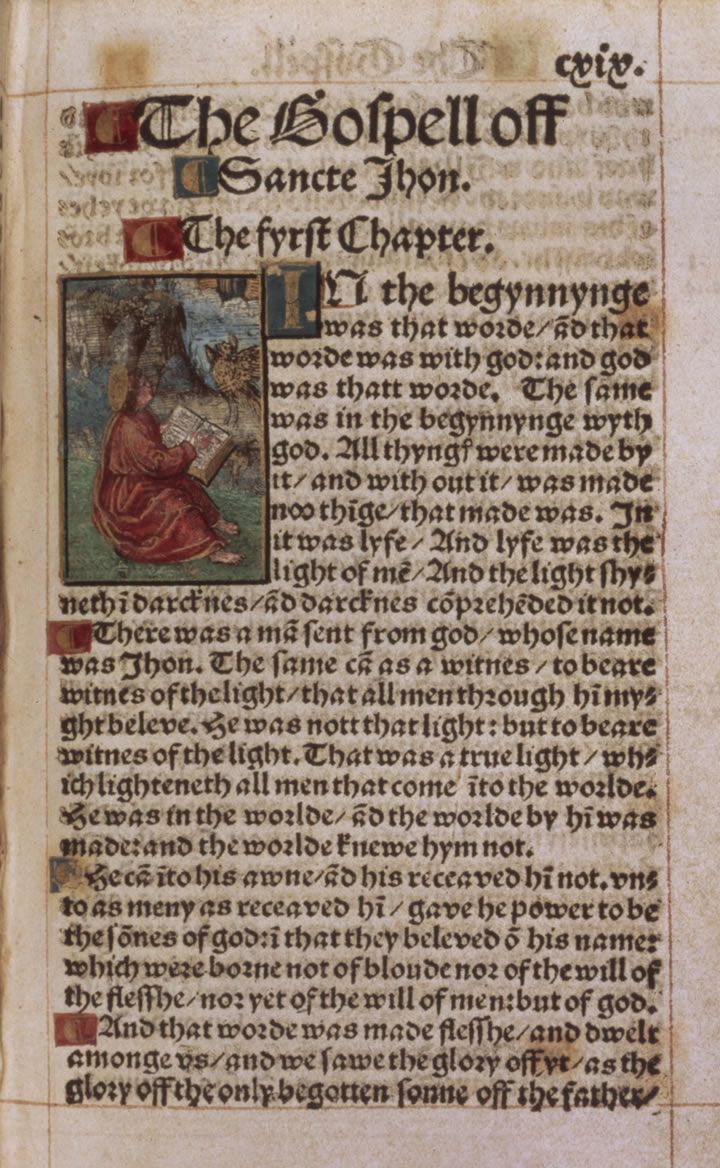
First page of the Gospel of Saint John from the 1526 Worms printing of Tyndale's New Testament. The Commons file is sourced and credited to the British Library Board rather than to the Wurttembergische Landesbibliothek, which is the basis for treating this as a reproduction of the British Library's own copy, C.188.a.17, rather than the Stuttgart copy; no shelfmark is stated on the file page itself, so this attribution, while the best available, is not from a source that states the shelfmark explicitly.
| Artist | William Tyndale (translator); Peter Schoffer the Younger (printer) |
|---|---|
| Date | 1526 (printed February-March 1526, Worms) |
| Medium | Letterpress, black-letter (Bastarda-type) printing on paper, octavo, hand-illumination added later to some initials |
| Dimensions | Octavo, approximately 16.4 x 11.3 cm for the edition format; the British Library copy's binding and exact leaf count are not published in the sources consulted |
| Where it is now | British Library, Londonlast confirmed |
| Inventory number | C.188.a.17 |
| Attribution | AcceptedThe translation is Tyndale's own, made directly from Erasmus's Greek text and not from the Latin Vulgate; his authorship is not in dispute. Full note |
| Object type | Printed book |
| Period | Northern European, Reformation, sixteenth century |
| Cases | Has a provenance gap |
| Inscriptions | An eighteenth-century manuscript note inside the front cover, added at Bristol Baptist College, cites Tyndale's Address to the Reader as evidence of the volume's first-edition status |
| Owners on record | 8 links7 documented, 1 unknown |
| Sources | 15 cited |
About this record Last verified · 15 sources cited · Change log
On this page 9 sections
ContentsClose
One of only two substantially complete copies known to survive of the first printed New Testament in English: William Tyndale's translation, printed in secret at Worms by Peter Schoffer the Younger in 1526 after an earlier attempt at Cologne was raided and abandoned. This copy is missing its own title page. For two hundred and ten years it belonged to Bristol Baptist College, which bought it in 1994 for the British Library, describing it at the time as the most important printed book in the English language.
Its status changed twice more after that. In 1996, two years after the British Library's purchase, a second complete copy was identified at the Wurttembergische Landesbibliothek in Stuttgart during a routine catalogue computerisation, sitting unrecognised in the collection since the sixteenth century. The Stuttgart copy has the title page this one lacks, and between them the two books now form the closest thing scholarship has to a complete original 1526 Tyndale New Testament. A third copy, badly incomplete, survives at St Paul's Cathedral, on the site where earlier copies were burned.
Tyndale did not live to see his translation's eventual triumph. He was betrayed, tried for heresy, and executed near Brussels in 1536. Independent scholarly sampling later found that roughly four in five words of the New Testament in the 1611 King James Bible are his.
Provenance
Each link is graded. Documented: a cited source supports it. Disputed: the identification is argued but not established. Unknown: no owner for that span, and the gap is not smoothed into a narrative. The grades in the glossary.
- 1526 - 1730sUnknownunknown
No owner is documented for this copy between its printing at Worms in 1526 and its appearance in the possession of an agent acting for Edward Harley, 2nd Earl of Oxford, in the 1730s. How or when it reached England, and who held it in the intervening two hundred years, is not recorded in the sources consulted.2
- 1730s - March 1742Edward Harley, 2nd Earl of Oxforddocumented
Acquired for Harley by an agent named Murrey. Sold at the dispersal of Harley's library, March 1742, to the bookseller Thomas Osborne.2
- 1742 - 1743Thomas Osborne (bookseller)documented
Osborne purchased the volume at the March 1742 Harley sale; sold it on to the antiquarian Joseph Ames in 1743 for fifteen shillings.2
- 1743 - 13 May 1760Joseph Amesdocumented
Ames bought the Testament for fifteen shillings in 1743. At the sale of his own library on 13 May 1760, it was bought by John White for fifteen pounds four shillings and sixpence.2
- 13 May 1760 - 13 May 1776John Whitedocumented
White held the volume for exactly sixteen years, then sold it on the same calendar date, 13 May 1776, to Andrew Gifford for twenty guineas.2
- 13 May 1776 - July 1784Andrew Gifford (Baptist minister and British Museum sub-librarian)documented
Gifford bought the Testament from White in 1776 and owned it until his death in July 1784. His will directed his executors to distribute items from his library, manuscripts and curiosities as they judged proper.2
- Autumn 1784 - 21 April 1994Bristol Baptist Collegedocumented
The Testament arrived at Bristol Baptist College with the Gifford bequest in autumn 1784 and remained the college's single most celebrated possession for two hundred and ten years, held in trust across successive college presidents. The current binding, almost certainly eighteenth-century, is consistent with rebinding around this period. In 1919 a stained-glass window commemorating Tyndale was commissioned at the college partly because of its ownership of this book. How the volume was physically kept, displayed or conserved through this period is not detailed in sources consulted.234
- 21 April 1994 - presentBritish Library, Londondocumented
Sale agreed 21 April 1994, negotiated for Bristol Baptist College by Robert A. Gilbert; reported consistently as a price of one million pounds, with some accounts describing it as somewhat more than that figure. No source consulted publishes an exact final price or itemises any grant contribution. The British Library described the purchase at the time as the most important printed book in the English language; this record has not located the Library's original statement verbatim and flags that gap rather than treating the widely repeated quotation as independently verified against a primary source.1245
Technical evidence
| Attribution note | The translation is Tyndale's own, made directly from Erasmus's Greek text and not from the Latin Vulgate; his authorship is not in dispute. The printing is attributed to Peter Schoffer the Younger's workshop at Worms on typographic and documentary grounds, and this attribution is accepted by the holding institutions and by Tyndale scholarship, including the study by Guido Latre and colleagues republished in the journal Reformation. No copy of the 1526 edition, including this one, carries a printer's colophon naming Schoffer, because the book was produced and shipped as contraband; the identification rests on type comparison with Schoffer's other Worms output. |
|---|---|
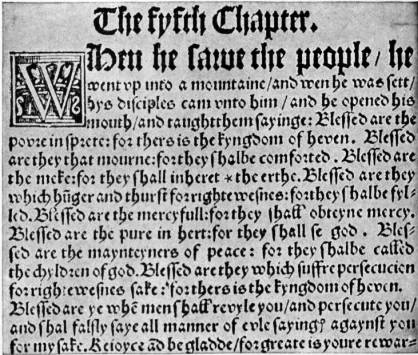
| Format | Octavo, black-letter (Bastarda-type) letterpress on paper; the edition measured approximately 16.4 x 11.3 cm, deliberately reduced from the larger quarto format of the abandoned 1525 Cologne attempt so that copies could be concealed for smuggling.1115 |
| Printer and place | Printed by Peter Schoffer the Younger at his workshop in the Meielburg, Worms, February-March 1526. No copy carries a colophon naming printer or place, a deliberate omission given the book's illegal status in England.1114 |
| Completeness of this copy | The British Library's copy (C.188.a.17) is missing its own title page and, by most accounts, its table of contents. No other missing leaves are specified in the sources consulted; a fuller collation was not located.129 |
| Illumination and binding | Some initials carry hand-applied illumination, likely added in the sixteenth century. The current binding is almost certainly eighteenth-century, consistent with the book's documented ownership by John White and Andrew Gifford in the 1760s-1780s.2 |
| Print run | Sources give the Worms edition's print run as somewhere between about 3,000 and 6,000 copies; scholarship is not agreed on a single figure and this record does not choose between them.1213 |
| Provenance marginalia | An eighteenth-century manuscript note inside the front cover, added at Bristol Baptist College, cites Tyndale's own Address to the Reader as internal evidence for the volume's status as a genuine first edition.2 |
Images
The record in full
Chapter 1What survives, and what does not
This is a small book, printed to be hidden.
This is a small book, printed to be hidden. It is an octavo volume, roughly 16.4 by 11.3 centimetres when the edition left Schoffer's press in Worms in 1526, smaller than a modern paperback and deliberately so: its predecessor, an aborted quarto edition begun the previous year at Cologne, was roughly twice the size and had been seized before it could be finished. The British Library's copy, shelfmark C.188.a.17, is one of only two copies of the completed 1526 edition known anywhere in the world to survive close to complete. It is missing its own title page and, by most accounts, its table of contents; nothing else about its collation as it stands today is described in the sources consulted for this record, and that gap is recorded rather than filled.
The text is set in a Bastarda-family black-letter type, the looser, more rounded Gothic face conventionally used for vernacular scripture in this period, as distinct from the heavier formal Textura reserved for Latin liturgical books such as the Gutenberg Bible. Some initials in the British Library copy carry hand-applied illumination, most likely added in the sixteenth century rather than at the press; the illumination is decorative rubrication, not narrative illustration, and should not be mistaken for a later, separate hand.
Chapter 2Two copies, four years apart, and a third that almost was not
The drama of this book is inseparable from the drama of its nearest surviving relative, and the two must not be run together.
The drama of this book is inseparable from the drama of its nearest surviving relative, and the two must not be run together. In 1994 the British Library paid what it described as the most important printed book in the English language into its permanent collection, believing it held, alongside a fragmentary copy at St Paul's Cathedral, one of only two witnesses anywhere to the completed 1526 first edition. That description held for exactly two years.
In November 1996, Eberhard Zwink, a librarian at the Wurttembergische Landesbibliothek in Stuttgart, was overseeing the transfer of the library's handwritten catalogue records to a computerised system when he recognised that a book long catalogued in the collection was, in fact, a genuine 1526 Tyndale New Testament: complete, and crucially, still carrying the title page that the British Library's own copy lacks. The Stuttgart volume's earlier history, so far as it has been traced, runs back through the library of Duke Friedrich I of Wurttemberg and the Cistercian abbey at Schonthal to the collection of the Elector Ottheinrich of the Palatinate; how it came to rest unidentified in a German state library for four centuries, and precisely when its Tyndale authorship was first lost from record, is not established in the sources consulted here.
Between them, the British Library's copy and the Stuttgart copy are usually described as the two substantially complete survivors of the Worms edition. A third copy exists at St Paul's Cathedral, acquired in 1710 under circumstances the cathedral's own account calls surreptitious; it survived the intervening centuries only because at some point its Gospel and epistle leaves were deliberately shuffled out of sequence to disguise its contents, and it is missing on the order of 140 pages, roughly 71 leaves, of its original text. It was rebound and its leaves restored to correct order only in the nineteenth century. The three copies are not interchangeable witnesses to one book: each is missing different leaves, and any claim about what is or is not present in the 1526 edition needs to specify which of the three copies is being described. This record describes the British Library's copy only.
Chapter 3The first attempt, and why it failed
Tyndale did not print this New Testament first.
Tyndale did not print this New Testament first. Unable to secure backing to translate and print an English Bible in England, where the practice had been treated as heresy since the Constitutions of Oxford in 1408, he left for the Continent in 1524, working first in Hamburg and reportedly visiting Wittenberg before settling in Cologne in the summer of 1525 to begin printing a quarto edition with the local printer Peter Quentell.
The Cologne edition never reached completion. The anti-Lutheran controversialist Johann Cochlaeus later recorded that he learned of the project after overhearing Cologne printers boasting, apparently while drinking, that an English Bible was being set in type to subvert the English church; accounts differ on exactly how the tip reached him, but the outcome is agreed: Cochlaeus alerted the Cologne authorities, printing was halted, and he wrote to Henry VIII, Cardinal Wolsey and the Bishop of Rochester to warn them that heretical English Testaments were on their way. Tyndale and his collaborator William Roye salvaged what sheets they could, roughly the first ten quires, covering the text as far as Matthew chapter 22 in a print run reported at around 3,000 copies, and fled up the Rhine. Only 31 leaves of that abandoned Cologne quarto are known to survive anywhere, and they are themselves held by the British Library, as a separate, distinct object from the volume described in this record; the two must not be confused.
Chapter 4A translation made from Greek, not from the Latin Church's Bible
What makes this printing significant is not only that it is in English.
What makes this printing significant is not only that it is in English. English translations of parts of the Bible had existed since the Wycliffite manuscripts of the fourteenth century, itself already banned reading. What is different about Tyndale's text is its source: he translated directly from Erasmus's printed Greek New Testament of 1516 and its subsequent editions, rather than from the Latin Vulgate that had been the basis of the Wycliffite version and of the Church's own authority over scriptural meaning. Contemporaries record Tyndale as fluent in Greek, Hebrew, Latin, German and several Romance languages; that range let him work from the original text and, where he judged the Vulgate's Latin had shifted or softened the sense, to translate against it.
The result was also a translation built for a reader rather than for a lectern. Tyndale had no reformist backing when he began; he had failed to persuade Cuthbert Tunstall, Bishop of London, to sponsor an authorised English New Testament, and left England judging, as later tradition records him saying, that there was no safe place in the country to do the work. The Worms edition he eventually produced dropped the prologues and marginal glosses that had marked his aborted Cologne attempt, leaving plain text: a translation meant to be read by a ploughboy, in the phrase attributed to him by Foxe, not annotated by a bishop.
Chapter 5Worms, and the finished book
Tyndale reached Worms, by then a free imperial city moving toward Lutheranism, and started again from scratch rather than simply resuming the interrupted Cologne edition.
Tyndale reached Worms, by then a free imperial city moving toward Lutheranism, and started again from scratch rather than simply resuming the interrupted Cologne edition. He engaged Peter Schoffer the Younger, whose Worms workshop operated from the Meielburg, the residence of the city's Schultheiss Balthasar Meiel. Schoffer was not printing in an untested trade: he was the son of the elder Peter Schoffer and grandson, through his father's line, of Johann Fust, the financier and later printing partner of Johannes Gutenberg whose Mainz firm had produced the second printed book to carry a dated colophon, the 1457 Mainz Psalter, seventy years earlier. The line from the Gutenberg workshop's financier to the first printed English New Testament runs through one family across three generations.
Rather than complete the abandoned quarto, Tyndale had the whole New Testament reset in the smaller octavo format, dropped the prologues and marginal notes that had marked the Cologne attempt, and had it printed without a colophon naming printer or place, again for concealment. Scholarship gives the print run of the Worms edition as somewhere between about 3,000 and 6,000 copies; sources are not agreed on a single figure, and this record states the range rather than choosing between them. Sheets were smuggled into England and Scotland hidden in bales of cloth and other cargo through the summer and autumn of 1526.
Chapter 6Suppression, and the purchase that funded its own revision
Cuthbert Tunstall, Bishop of London, and Cardinal Wolsey moved against the book almost immediately.
Cuthbert Tunstall, Bishop of London, and Cardinal Wolsey moved against the book almost immediately. Wolsey declared the translation corrupt and ordered it burned along with punishment for anyone found translating, distributing or reading it; Tunstall staged a public burning of confiscated copies at St Paul's Cross in October 1526, a location that later became, by the cathedral's own account, the site where its own surviving fragment is now kept.
The best-known episode in this campaign is also its most ironic, and the sources describing it are later chronicles rather than a contemporary hand, so it is reported here as the traditional and widely repeated account rather than a documented certainty. Tunstall is said to have arranged, through the English merchant Augustine Packington, to buy up the remaining unsold stock of Testaments in Antwerp for burning in England. The money is said to have gone to Tyndale, financing the revised edition that reached England within a few years, so that the bishop unknowingly paid for the very project he was trying to suppress. Where this record cannot verify a detail of that story independently of the secondary chronicles that carry it, it says so rather than repeating it as settled fact.
Chapter 7Betrayal, trial and execution
Tyndale did not return to England. Working in exile, latterly in Antwerp under the protection of the English Merchant Adventurers, he was betrayed in 1535 by an Englishman, Henry Phillips, to agents...
Tyndale did not return to England. Working in exile, latterly in Antwerp under the protection of the English Merchant Adventurers, he was betrayed in 1535 by an Englishman, Henry Phillips, to agents of the Holy Roman Empire and seized at the English House in Antwerp. He was imprisoned at Vilvoorde Castle near Brussels for roughly a year and a half; a surviving letter from his cell asks his gaolers for warmer clothing, a lamp, and his Hebrew Bible, grammar and dictionary, so that he could keep working.
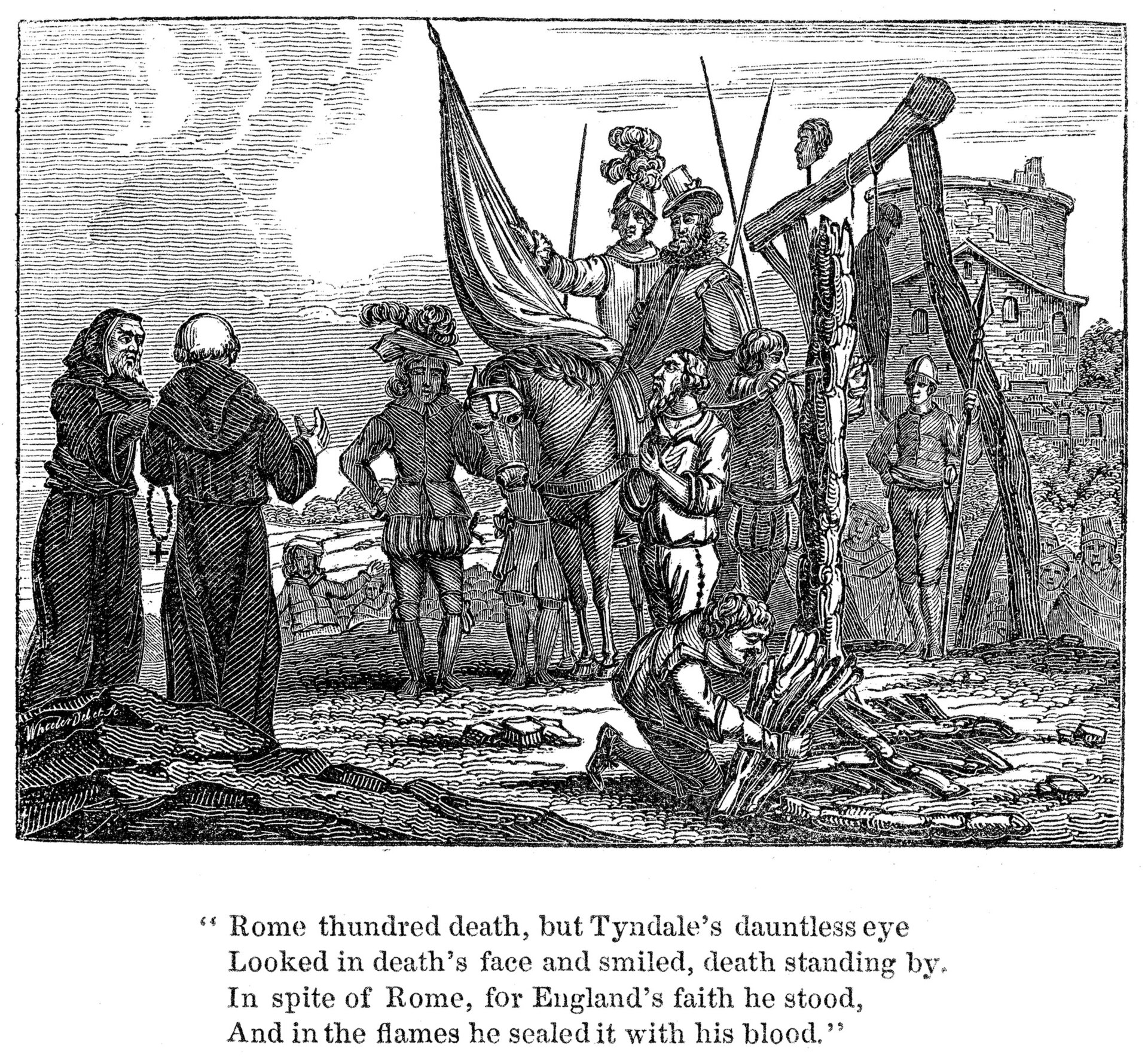
He was tried for heresy in 1536; the charge, notably, did not concern Bible translation itself, which was not illegal under Imperial law in the Low Countries, but doctrinal heresy of the Lutheran kind. He was convicted, and on 6 October 1536 he was led out at Vilvoorde, strangled at the stake, and his body then burned. The martyrologist John Foxe, writing a generation later, recorded his last words as a cry that the King of England's eyes be opened. The account cannot be verified independently of Foxe and is reported here as his account.
Chapter 8What outlived him
Tyndale's New Testament did not die with him.
Tyndale's New Testament did not die with him. David Daniell, whose 1994 biography remains the standard modern life, calculated that roughly 83 percent of the New Testament as it appears in the 1611 King James Bible is Tyndale's wording essentially unaltered. An independent sampling study by Jon Nielson and Royal Skousen, published in the journal Reformation in 1998, arrived at a closely corroborating figure of around 84 percent for the New Testament, and 76 percent for the portions of the Old Testament Tyndale lived to translate before his death. Estimates in less rigorous secondary sources range as low as 55 percent depending on method, and this record reports the range rather than asserting a single number as fact.
Phrases first fixed in English by Tyndale's translation and still in ordinary use include "the powers that be," "my brother's keeper," "the salt of the earth," "a moment in time," "filthy lucre," and the closing image of an eye's twinkling. Whatever else the 1526 Worms edition did or did not survive intact, its wording, transmitted through revision after revision, is embedded in English as it is spoken today.
Chapter 9Two hundred and ten years at Bristol Baptist College
Andrew Gifford's bequest was not built around this single book; it was a substantial personal library and cabinet of curiosities, reported at over 3,500 divinity volumes, manuscripts, and assorted...
Andrew Gifford's bequest was not built around this single book; it was a substantial personal library and cabinet of curiosities, reported at over 3,500 divinity volumes, manuscripts, and assorted scientific and antiquarian items, valued at over 1,000 pounds at the time of his death. His will instructed his executors to preserve those items they judged proper for his old college, language that gave them discretion rather than binding them to any specific list; the 1526 Testament was evidently judged proper, and travelled with the rest of the collection to Bristol in the autumn of 1784. Within that much larger gift, this one book became, over time, the single object the college's own later accounts single out as its greatest treasure.
The documented chain of ownership for this specific copy, as distinct from the printing history above, begins in the 1730s. An agent named Murrey acquired it for Edward Harley, second Earl of Oxford; at the Harley sale of March 1742 it passed to the bookseller Thomas Osborne; in 1743 the antiquarian Joseph Ames bought it for fifteen shillings; at Ames's own sale on 13 May 1760 it was bought by John White for fifteen pounds four shillings and sixpence; and on the same date sixteen years later, 13 May 1776, White sold it on to the Baptist minister and British Museum sub-librarian Andrew Gifford for twenty guineas.
Gifford died in July 1784, and under the terms of his will his executors selected items from his library, manuscripts and collection of curiosities to pass to Bristol Baptist College. The Testament arrived with that bequest in the autumn of 1784 and remained the college's single most celebrated possession for the next two hundred and ten years, guarded, according to the college's own account, as a charge passed from each president to the next. In 1919 the college commissioned a stained-glass window, designed by Arnold Wathen Robinson and funded by a Mrs Edward Robinson, depicting twelve scenes from Tyndale's life and martyrdom; her stated reason for the gift was explicitly the college's possession of the 1526 Testament. How the book itself was kept, displayed or conserved by the college across those two centuries is not detailed in the sources consulted, beyond the note that its current binding is almost certainly an eighteenth-century one, consistent with rebinding around the time of its arrival at Bristol.
Chapter 10The 1994 sale
By the early 1990s the college judged that a sale to the British Library was consistent with Gifford's own intentions, reasoning that the library's national reach would let the book's beauty and...
By the early 1990s the college judged that a sale to the British Library was consistent with Gifford's own intentions, reasoning that the library's national reach would let the book's beauty and tradition be shared openly in perpetuity in a way that a small denominational college's library could not match. The sale, negotiated for the college by Robert A. Gilbert, was agreed on 21 April 1994. The price is reported consistently across the sources as one million pounds, with some accounts specifying a sum somewhat above that figure; none of the sources consulted publish an exact final figure to the penny, and none independently confirms or itemises any grant contribution toward the purchase, though institutional funding of this kind commonly draws on bodies such as the National Heritage Memorial Fund. That detail is flagged in the editor's notes below rather than asserted.
At the time, the British Library described the book as the most important printed book in the English language. That description is widely and consistently reported across secondary sources; this record has not been able to locate the British Library's own original 1994 statement or press release verbatim, and notes that gap rather than presenting the quotation as independently verified against a primary text.
Chapter 11A 500th-anniversary reckoning
The British Library has scheduled a Treasures Gallery display, The Power of the Printed Word: Tyndale's New Testament 1526-2026, running from 28 February to 29 June 2026 to mark the five-hundredth...
The British Library has scheduled a Treasures Gallery display, The Power of the Printed Word: Tyndale's New Testament 1526-2026, running from 28 February to 29 June 2026 to mark the five-hundredth anniversary of the first complete printing of Tyndale's New Testament. Announced alongside the British Library's own copy are related Tudor Bible material, including a copy of Tyndale's own later 1534 revised New Testament associated with Anne Boleyn and a copy of the 1539 Great Bible associated with Henry VIII; those are separate, later books by different or partly different hands and are not to be confused with the 1526 first edition described in this record. A facsimile edition of the British Library's copy was also published in London in 1976 to mark the 450th anniversary of the original printing.
The artist
William Tyndale (also spelled Tindale or Hychyns), translator; Peter Schoffer the Younger, printer
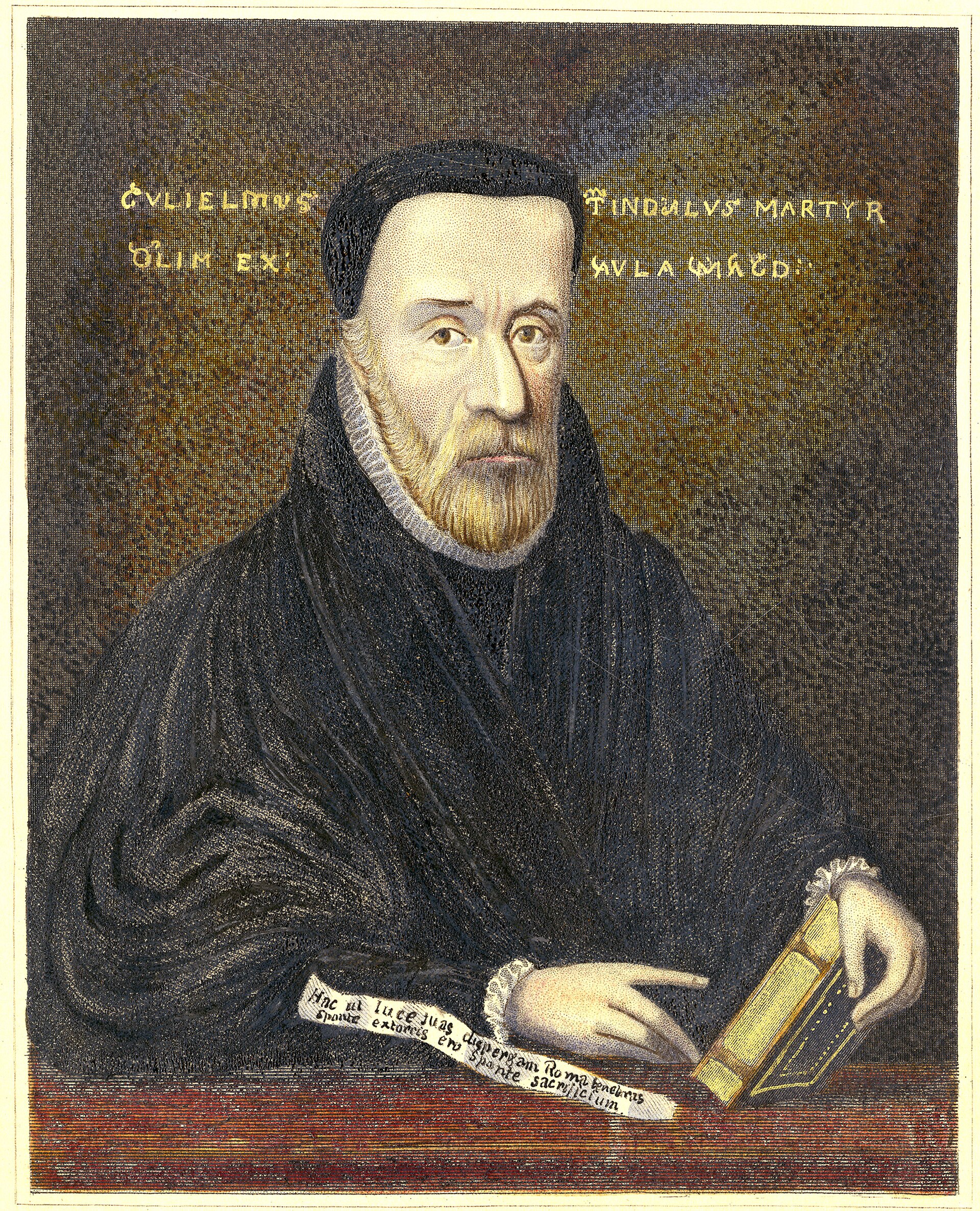
Tyndale left almost no personal archive. No letter in his own hand survives except one written from his prison cell at Vilvoorde, no contemporary portrait made from life is known, and even the year and place of his birth are estimated rather than recorded, usually given as around 1494 in Gloucestershire. What survives instead is his prose: a translation so exact and so rhythmically final that later revisers, working right through to 1611, kept changing very little of it. The book itself is the biography.
Related works
| Work | Relation | Where it is |
|---|---|---|
| Tyndale New Testament, 1526 (Wurttembergische Landesbibliothek copy) William Tyndale (translator); Peter Schoffer the Younger (printer) | The only other substantially complete copy of the same 1526 Worms edition; has the title page this copy lacks Identified as a genuine 1526 Tyndale in November 1996 by librarian Eberhard Zwink during catalogue computerisation, two years after the British Library bought this copy. A physically distinct object with its own missing/present leaves; not to be confused with C.188.a.17. | Wurttembergische Landesbibliothek, Stuttgart |
| Tyndale New Testament, 1526 (St Paul's Cathedral copy) William Tyndale (translator); Peter Schoffer the Younger (printer) | A third surviving copy of the same edition, badly incomplete Acquired by the cathedral in 1710; missing roughly 71 leaves (about 140 pages); its Gospel and epistle leaves were once deliberately shuffled out of order to disguise its contents and were restored to sequence only in the 19th century. | St Paul's Cathedral Library, London |
| Tyndale New Testament, 1525 (Cologne fragment) William Tyndale (translator); Peter Quentell (printer) | The abandoned earlier quarto edition Tyndale fled with when Cologne printing was raided; a different, incomplete edition, not the book this record describes Only 31 leaves survive, covering the text as far as Matthew chapter 22. Held by the same institution as C.188.a.17 but a physically and bibliographically distinct object; must not be conflated with it. | British Library, London |
| Tyndale's revised New Testament, 1534 William Tyndale (translator) | Tyndale's own later, thoroughly revised edition of the same translation A separate, later printing with substantial textual revision; distinct from the 1526 first edition and not to be confused with it. | Various, including a copy associated with Anne Boleyn shown alongside the British Library's 1526 copy in 2026 |
| Coverdale Bible, 1535 Miles Coverdale (translator) | The first complete printed Bible in English, incorporating Tyndale's New Testament alongside Coverdale's own Old Testament translation A different translator's different, later work; distinct from Tyndale's own New Testament and not to be confused with it in this record. | Various institutional collections |
| The Mainz Psalter Johann Fust and Peter Schoffer (the elder) | Printed by the grandfather and father, respectively, of this book's printer; the second printed book known to carry a dated colophon Peter Schoffer the Younger, who printed this Testament at Worms in 1526, was the son of the elder Peter Schoffer and grandson, through him, of Gutenberg's financier and later partner Johann Fust. Already catalogued in this archive as tyndale record's sibling under slug mainz-psalter-1457-royal-collection. | Royal Collection, London (rcin 1071478) and other institutions |
Open questions
- What was the exact route by which this copy passed from Andrew Gifford's 1784 bequest through two centuries at Bristol Baptist College without documented loss or damage? No detailed custodial record for the intervening period was located.
- What is the complete modern collation of the British Library's copy beyond the missing title page and table of contents - are any other leaves supplied in facsimile or otherwise imperfect?
- Did the 1994 purchase price include, or was it supplemented by, a grant from a body such as the National Heritage Memorial Fund? Sources gesture at institutional support but no source consulted itemises the funding.
- What is the true print run of the completed 1526 Worms edition - scholarship gives figures from about 3,000 to about 6,000 and no source consulted resolves the discrepancy.
- Exactly how and when did the Wurttembergische Landesbibliothek's copy enter that library's holdings, and when was its Tyndale authorship first lost from the catalogue record, prior to Eberhard Zwink's 1996 re-identification?
- Is the traditional account of Bishop Tunstall unwittingly financing Tyndale's revision through Augustine Packington's buy-up of copies independently attested in a contemporary document, or does it rest solely on later chronicle tradition?
Questions about this object
What is The Newe Testament: William Tyndale's New Testament, Worms, 1526?
The Newe Testament: William Tyndale's New Testament, Worms, 1526 is a printed book, dated 1526 (printed February-March 1526, Worms). Medium: Letterpress, black-letter (Bastarda-type) printing on paper, octavo, hand-illumination added later to some initials.
Who made The Newe Testament: William Tyndale's New Testament, Worms, 1526, and is the attribution settled?
The attribution to William Tyndale (translator); Peter Schoffer the Younger (printer) is recorded here as accepted. The translation is Tyndale's own, made directly from Erasmus's Greek text and not from the Latin Vulgate; his authorship is not in dispute. The printing is attributed to Peter Schoffer the Younger's workshop at Worms on typographic and documentary grounds, and this attribution is accepted by the holding institutions and by Tyndale scholarship, including the study by Guido Latre and colleagues republished in the journal Reformation. No copy of the 1526 edition, including this one, carries a printer's colophon naming Schoffer, because the book was produced and shipped as contraband; the identification rests on type comparison with Schoffer's other Worms output.
Where is The Newe Testament: William Tyndale's New Testament, Worms, 1526 now?
British Library, London. Inventory number C.188.a.17. Last confirmed 4 September 2026. Purchased by the British Library from Bristol Baptist College, sale agreed 21 April 1994.
What is still unknown about The Newe Testament: William Tyndale's New Testament, Worms, 1526?
What was the exact route by which this copy passed from Andrew Gifford's 1784 bequest through two centuries at Bristol Baptist College without documented loss or damage? No detailed custodial record for the intervening period was located.
Sources
- 1Various press and reference syntheses on the British Library's 1994 acquisition, converging on: sale agreed 21 April 1994, price reported as one million pounds, description of the book as 'the most important printed book in the English language.' The Library's own original statement was not independently located in full; this citation flags that limitation. en.wikipedia.org/wiki/...
- 2H. R. West, 'The Bristol 1526 Tyndale Testament - its Origin and its History', Reformation / Tyndale Society journal. tyndale.org/journals/...
- 3'The Tyndale Window, Bristol Baptist College', Tyndale Society Journal (Osborn), on the 1919 memorial window, the college's custody of the Testament, and the 1994 sale negotiated by Robert A. Gilbert. tyndale.org/journals/...
- 4Wurttembergische Landesbibliothek Stuttgart, institutional page on its Tyndale New Testament 1526 (Kostbarkeiten), on the print run of the Worms edition, the British Library's 1994 purchase, and the St Paul's Cathedral fragment. Direct fetch of the page returned an error at time of research; content reported here is corroborated via independent search synthesis of the same page and cross-checked against other sources. Flagged for a follow-up direct verification. wlb-stuttgart.de/sammlungen/...
- 5St Paul's Cathedral, 'Tyndale's New Testament', on the cathedral's own 1710 acquisition, the disguised and later-restored leaf order, and the site of the 1526 book-burnings at St Paul's Cross. stpauls.co.uk/tyndales-new-testament
- 6Wikipedia, 'William Tyndale', for the betrayal by Henry Phillips, imprisonment at Vilvoorde, 1536 trial and execution, and the range of scholarly estimates (55-83%) for Tyndale's wording surviving into the King James New Testament. en.wikipedia.org/wiki/...
- 7Wikipedia, 'Tyndale Bible', for the three surviving copies (British Library, Stuttgart, St Paul's), the British Library copy's missing title page, and the Cologne printing's interruption. en.wikipedia.org/wiki/...
- 8British Library events page, 'The Power of the Printed Word: Tyndale's New Testament 1526-2026', for the 2026 Treasures Gallery display dates and accompanying Tudor Bible material (Anne Boleyn's 1534 New Testament, Henry VIII's Great Bible). events.bl.uk/exhibitions/...
- 9Search synthesis on the British Library shelfmark C.188.a.17, confirming the copy is 'almost complete, wanting only the title page,' and citing a 1976 facsimile edition marking the 450th anniversary; underlying page at vll-minos.bl.uk no longer resolves and is flagged as link rot. vll-minos.bl.uk/onlinegallery/...
- 10Tyndale's Ploughboy (Dr Herbert Samworth), 'Worms New Testament', for the Cologne-to-Worms flight, the 3,000-to-6,000 range for the Worms print run, and comparative completeness of the British Library, St Paul's and Stuttgart copies (St Paul's given as missing approximately 140 pages). tyndalesploughboy.org/worms-new-testament
- 11I Love Typography, 'The Most Dangerous Book in the World', for the format and typography comparison between the 1525 Cologne quarto and 1526 Worms octavo editions, the Cologne raid, Peter Schoffer the Younger's family relation to Johann Fust and the elder Peter Schoffer, dimensions of the 1526 edition (16.4 x 11.3 cm), and Tyndale's coined phrases; citing David Daniell's 1994 biography and James F. Mozley's 1937 biography as its own sources for these claims. ilovetypography.com/2020/...
- 12Jon Nielson and Royal Skousen, 'How Much of the King James Bible Is William Tyndale's? An Estimation Based on Sampling', Reformation, vol. 3, no. 1, 1998 - the independent sampling study giving approximately 84% for the New Testament and 76% for the portions of the Old Testament Tyndale completed. tandfonline.com/doi/...
- 13Search synthesis on David Daniell's calculation, in his 1994 biography William Tyndale: A Biography, that 83 percent of the King James New Testament reproduces Tyndale's own wording. en.wikipedia.org/wiki/...
- 14Search synthesis on Peter Schoffer the Younger's biography and workshop locations (Mainz, Worms, Strasbourg, Venice) and his printing of the Tyndale New Testament at Worms in 1526, corroborating en.wikipedia.org/wiki/Peter_Sch%C3%B6ffer_the_Younger. en.wikipedia.org/wiki/...
- 15Wikimedia Commons file page, 'File:Tyndale Bible - Gospel of John.jpg', for the file's description, Public Domain Mark licensing, and its credit line to the British Library Board. commons.wikimedia.org/wiki/...

Last verified · Published
Change log
4 September 2026 - Record created at the house standard: researched narrative, technical evidence, maker dossier, graded provenance chain, prices with hammer and premium separated, related works, open questions and sources.