The Lindisfarne Gospels
Eadfrith of Lindisfarne (attributed) · c. 700-721, most narrowly argued as c. 715-722
Last verified 14 September 2026 · 16 sources cited · Change log
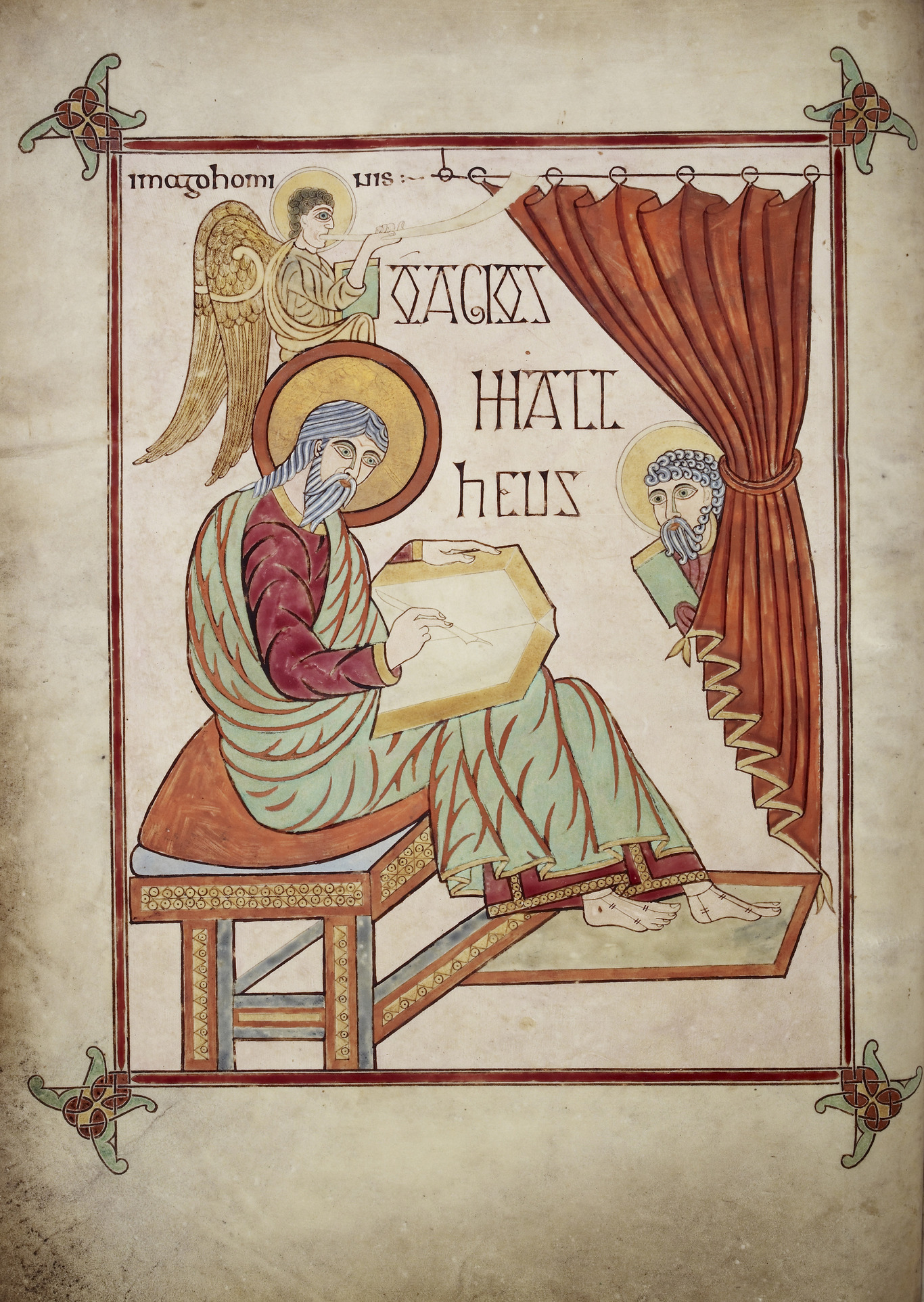
The evangelist portrait opening the Gospel of Matthew. Matthew is shown writing, accompanied by his winged-man symbol blowing a trumpet, captioned in Greek letters as the saint Matthew. Confirmed on the file's own description page as folio 25v of this manuscript.
| Artist | Eadfrith of Lindisfarne (attributed) |
|---|---|
| Date | c. 700-721, most narrowly argued as c. 715-722 |
| Medium | Ink, pigments and gold on vellum (calfskin), in a modern (1852) silver and gem binding |
| Dimensions | Approximately 340 x 250 mm; 258 or 259 folios depending on counting convention, c. 516 pages |
| Where it is now | British Library, London, Cotton MS Nero D IVlast confirmed 14 September 2026 |
| Attribution | acceptedAttributed to Eadfrith, bishop of Lindisfarne 698-721, solely on the basis of a colophon added by the priest Aldred at Chester-le-Street roughly two and a half centuries after the manuscript was made. Full note |
| Object type | Manuscript |
| Period | Anglo-Saxon Northumbria, early eighth century |
| Cases | Has a provenance gap |
| Inscriptions | Aldred's colophon, folio 259r, added mid 10th century in Old English, naming Eadfrith as writer, Ethelwald as binder, Billfrith as ornamenter and Aldred himself as glossator; an ownership signature of Robert Bowyer on folio 2v, visible only under ultraviolet light |
- Where it is now
- British Library, Londonlast confirmed 14 September 2026
- Attribution
- accepted
- Provenance
- 13 links9 documented, 1 disputed, 3 unknown
- Sources
- 16 cited
- Last verified
- 14 September 2026Change log
On this page 9 sections
A Latin Gospel book made at or for the monastery of Lindisfarne around the year 700-721, traditionally credited to the scribe-artist Eadfrith on the sole evidence of a colophon written two and a half centuries later. It carries the oldest surviving translation of any part of the Gospels into English, an interlinear gloss added around the mid tenth century by the priest Aldred, and it survived a Viking-era flight from Lindisfarne, the Dissolution of the Monasteries and the 1731 fire that destroyed a large part of Sir Robert Cotton's library.
The jewelled treasure-binding that Aldred's colophon describes does not survive; the book now wears an 1852 replacement. The manuscript has never been sold. It passed from the Lindisfarne community to Durham, into private hands by the early seventeenth century, into Robert Cotton's library, and from there into the founding collection of the British Museum in 1753 and the British Library in 1973, where it remains on public display.
This record treats the story of the book falling into the sea and being recovered unharmed, first recorded by Simeon of Durham around 1104, as pious legend rather than documented fact, and separates it clearly from the well-evidenced parts of the community's flight.
Provenance
Each link is graded. Documented: a cited source supports it. Disputed: the identification is argued but not established. Unknown: no owner for that span, and the gap is not smoothed into a narrative. The grades in the glossary.
- c. 700 - 721Lindisfarne priory scriptorium, attributed to Eadfrithdocumented
Made at or for the monastery of Lindisfarne during the episcopate of Eadfrith (698-721), on the sole later documentary attribution of Aldred's colophon; the physical dating to this period is independently supported by script and decoration.11315
- 721 - c. 875Lindisfarne priory, shrine of St Cuthbertdocumented
Kept at Lindisfarne as an object associated with Cuthbert's shrine.114
- c. 875 - 995The itinerant community of St Cuthbertdocumented
Community left Lindisfarne under Viking pressure carrying Cuthbert's relics and books. Route per the Historia de Sancto Cuthberto: an attempted crossing to Ireland from the Derwent estuary, turned back by storm, then Crayke, then Chester-le-Street after seven years, where the community remained until 995.31
- Unknowndisputed
Recorded only by Simeon of Durham, writing c. 1104, more than two centuries after the events described, evidently to explain water-staining already visible on some leaves. Treated here as pious legend attached after the fact, not as a documented event.41
- c. 950 - c. 970Aldred, priest, Chester-le-Streetdocumented
Aldred added a continuous Old English interlinear gloss, the oldest surviving translation of the Gospels into English, and appended the colophon naming Eadfrith, Ethelwald and Billfrith.115
- 995 - 1539Durham Cathedral Priory (probable, not certain)unknown
Medieval Durham inventories list several Gospel books; this manuscript may be one of them but cannot be identified with certainty in any surviving list.1
- 1539 - 1605Unrecordedunknown
No owner documented between the Dissolution of Durham Cathedral Priory and Robert Bowyer's attested ownership by 1605.2
- 1605 - 1621Robert Bowyer, Clerk of the Parliamentsdocumented
Owned the manuscript and signed folio 2v, a mark now visible only under ultraviolet light. Clerk of the Parliaments and Keeper of the Records in the Tower of London from 1610 until his death in 1621.25
- 1621 - 1631Sir Robert Bruce Cottonunknown
Entered Cotton's library after Bowyer's 1621 death by an unrecorded transaction. Cotton and Bowyer were connected through the office of Clerk of the Parliaments and through manuscript exchange, but no source found documents the specific date, price or mechanism of this particular acquisition.26
- 1631 - 1702Cotton family (heirs of Sir Robert Cotton)documented
Retained in the Cotton library, catalogued under the shelfmark Nero D IV.6
- 1702 - 1753The nation, under the British Museum Act 1700-1701documented
Sir John Cotton, grandson of Sir Robert, bequeathed the library to the nation on his death in 1702. Moved to Essex House and then Ashburnham House, where it survived the fire of 23 October 1731 without being among the manuscripts recorded as destroyed or severely damaged.6
- 1753 - 1973British Museumdocumented
Became one of the three founding collections of the British Museum in 1753, alongside the Sloane and Harley libraries.6
- 1973 - presentBritish Library, Londondocumented
Transferred with the British Museum's manuscript collections to the newly created British Library in 1973. On rotating display in the Sir John Ritblat Treasures Gallery; lent to Palace Green Library, Durham (Jul-Sep 2013) and the Laing Art Gallery, Newcastle upon Tyne (17 Sep - 3 Dec 2022).678
Technical evidence
| Attribution note | Attributed to Eadfrith, bishop of Lindisfarne 698-721, solely on the basis of a colophon added by the priest Aldred at Chester-le-Street roughly two and a half centuries after the manuscript was made. No contemporary document names a maker, and no other work is attributed to Eadfrith by name. Scholars including Janet Backhouse and Michelle Brown accept the colophon as recording a well-established community tradition rather than a scribe's own signature, and stylistic analysis has found the whole manuscript, script and illumination together, to be the work of a single hand. The attribution therefore rests on documentary tradition and internal consistency, not on a contemporary record. |
|---|---|
| Support | Vellum (calfskin), approximately 150 calfskins used for 258 or 259 folios, c. 516 pages.111 |
| Dimensions | Approximately 340 x 250 mm.1 |
| Script | Latin text in a large, regular Insular majuscule, attributed to a single scribal hand; a continuous Old English interlinear gloss in a smaller, spikier hand was added by the priest Aldred in the mid 10th century.115 |
| Ink | Dense, near-black ink containing carbon particles from soot or lamp black.1 |
| Pigments | Around 90 distinct tints from only six local minerals and plant extracts. Raman microscopy in the 2000s identified the blue used throughout as indigo, correcting an earlier assumption that it was imported ultramarine.1 |
| Colophon | Added by Aldred at Chester-le-Street, mid 10th century, naming Eadfrith as writer, Ethelwald as binder, Billfrith as ornamenter of the original treasure-binding, and Aldred himself as glossator. The sole documentary basis for attributing the manuscript.115 |
| Original binding | A leather treasure-binding made by Ethelwald and ornamented with gold, gems and gilded silver by Billfrith the anchorite, per Aldred's colophon. Does not survive; sources disagree on whether it was lost in the 793 raid on Lindisfarne or the later Viking pressure of the 870s, and no source consulted documents the specific date.115 |
| Current binding | Silver and jewelled binding of 1852, commissioned by Edward Maltby, Bishop of Durham, executed by Smith, Nicholson and Co., with a design drawing on decorative motifs from the manuscript itself. A Victorian object, not a reconstruction of the lost original.1 |
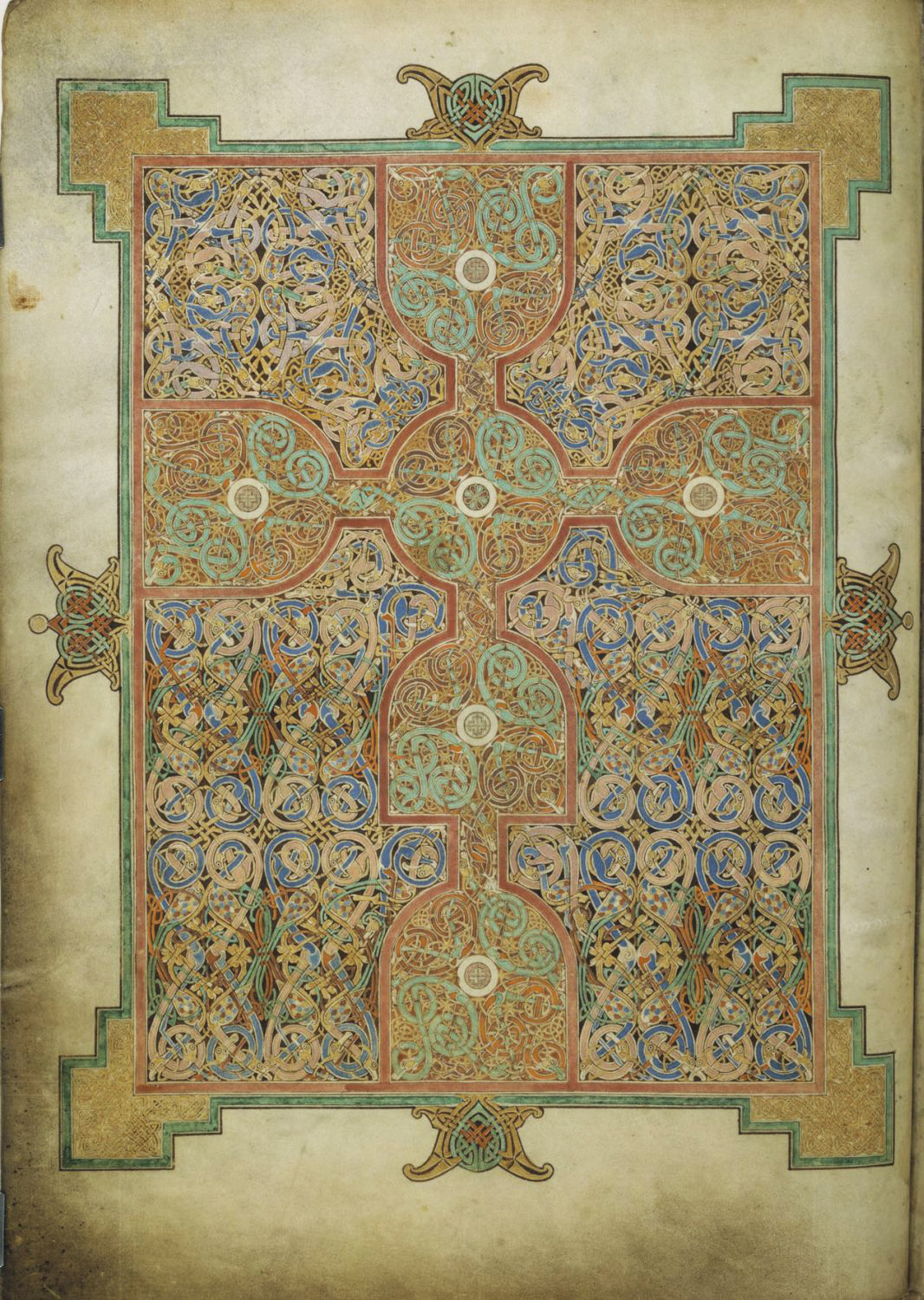
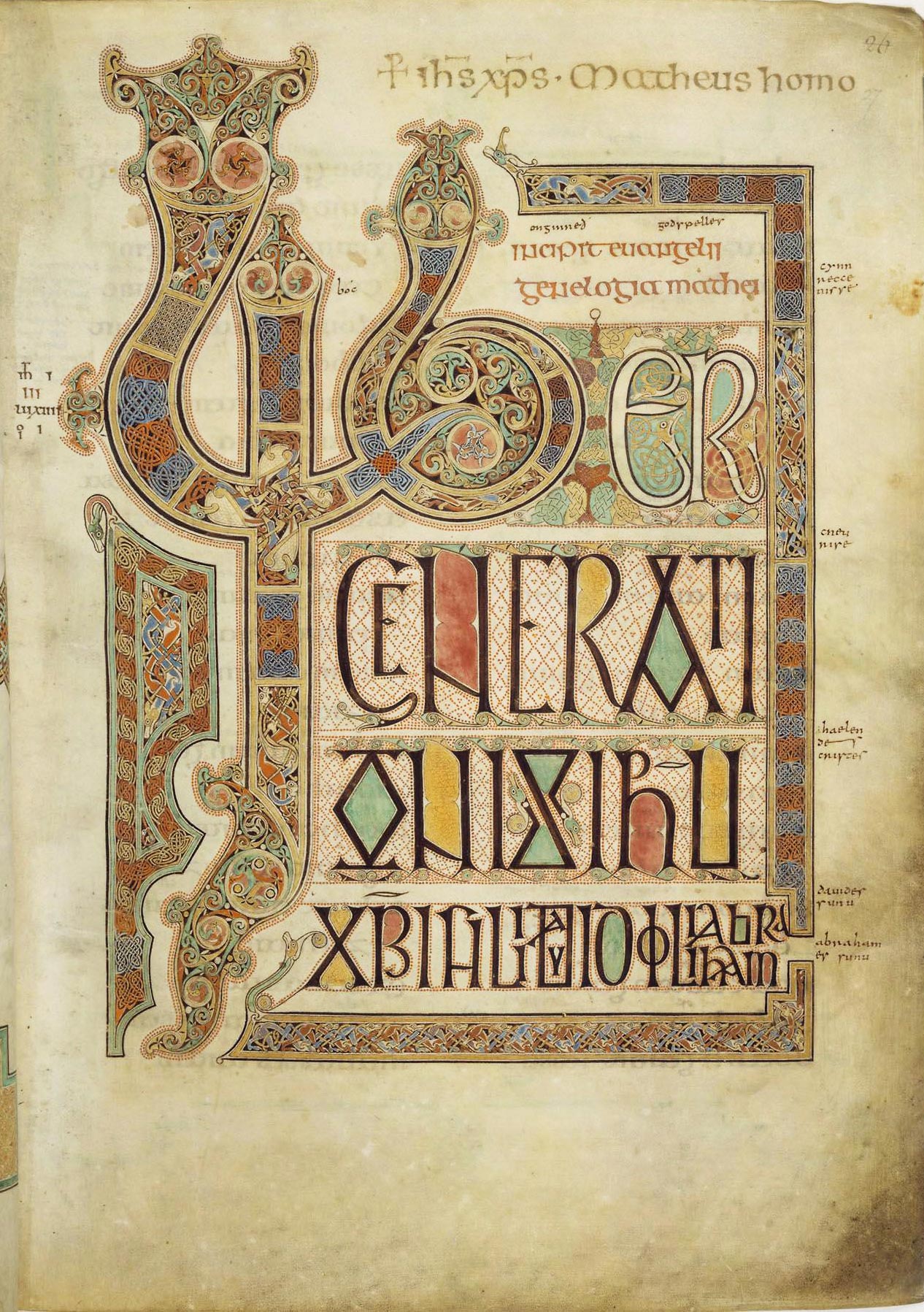
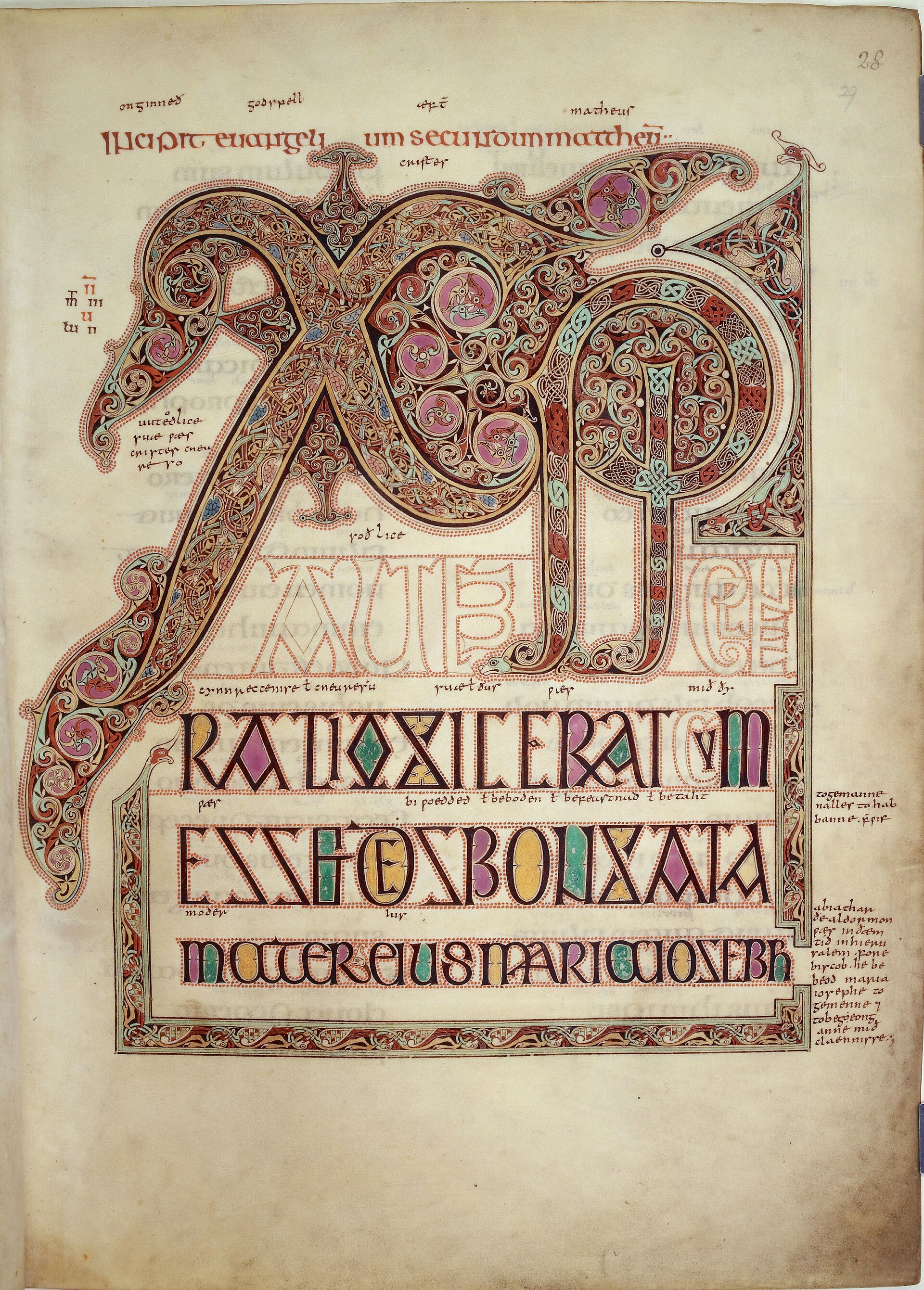
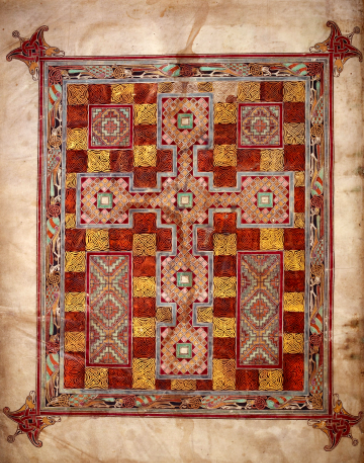
| Carpet pages and decoration | Five full cross-carpet pages, one before each Gospel and the prefatory matter, combining Insular interlace with cross-forms; evangelist portraits paired with the tetramorph symbols of Matthew, Mark, Luke and John; decorative incipit pages including a Chi-Rho monogram page at Matthew 1:18.112 |
| Ownership mark | Signature of Robert Bowyer on folio 2v, visible only under ultraviolet light, the earliest identifiable post-medieval owner's mark on the volume.5 |
Images
The record in full
What the book physically is
The Lindisfarne Gospels is a single volume of the four Gospels in the Latin Vulgate text, written on vellum measuring roughly 340 by 250 millimetres, running to 258 or 259 folios depending on how the preliminary and closing leaves are counted, made from around 150 calfskins. The text is written in a large, extremely regular Insular majuscule script in a dense, near-black carbon-based ink, with capitula lists, canon tables, and a prefatory letter from Jerome to Pope Damasus preceding the Gospel text itself.
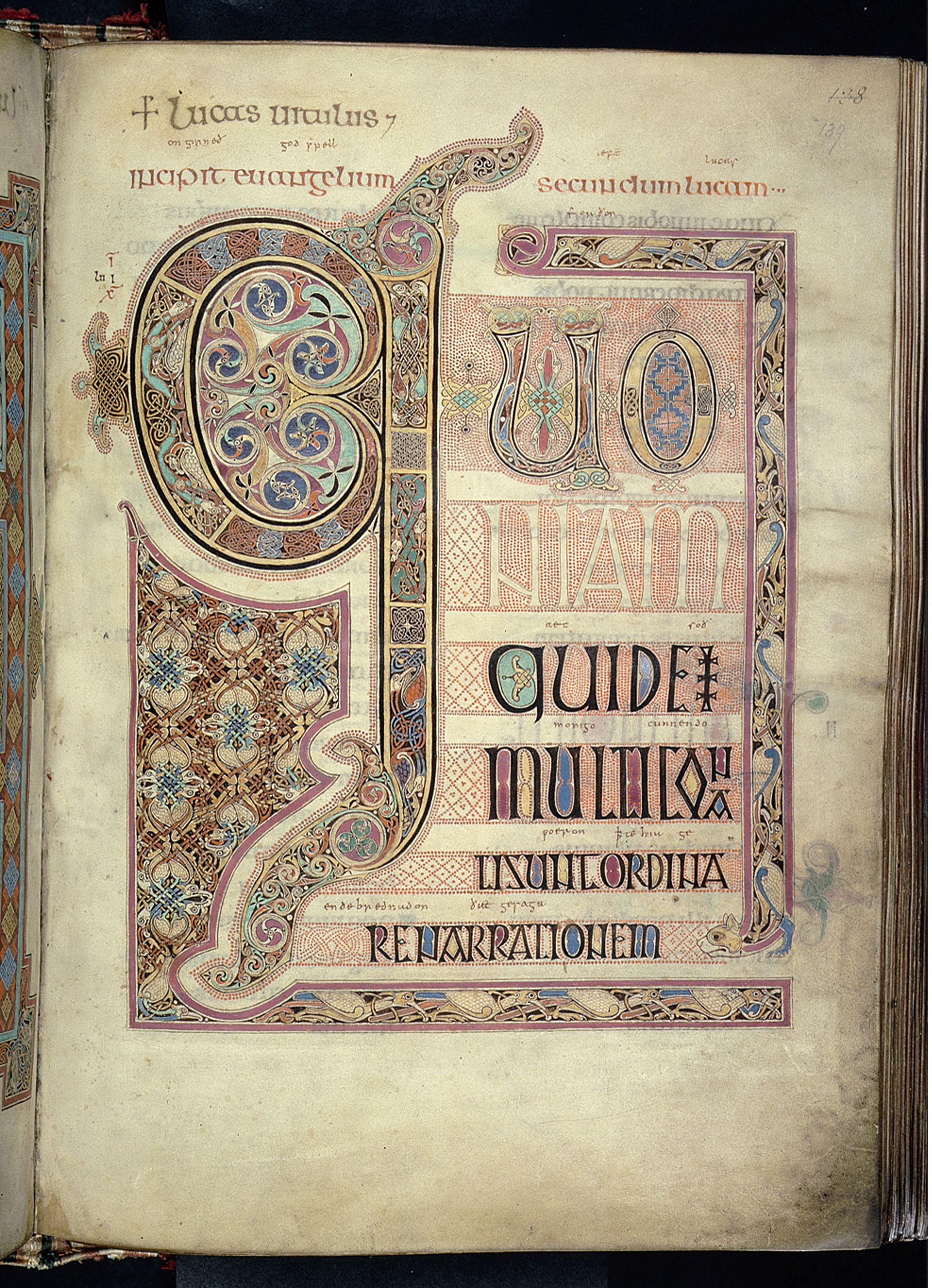
Each Gospel opens with a full page devoted to its evangelist, an interlaced cross-carpet page, and a heavily decorated incipit page for its opening words. In the mid tenth century a second layer of text was added: a continuous word-for-word Old English gloss squeezed in a smaller, spikier hand between the lines of the Latin, the work of the priest Aldred.
How it was made
Tradition, resting on Aldred's colophon, holds that one person, Eadfrith, wrote and illuminated the entire volume. Alan Thacker has described the manuscript as undoubtedly the work of a single hand, an unusual claim for a book of this scale and one that has generally been accepted rather than seriously challenged. Sophie Kelly, discussing the manuscript's production, gives roughly ten years as the likely time such a book would have taken one scribe-artist to complete.
Eadfrith worked with pigments he prepared himself, reportedly achieving around ninety distinct tints from only six local minerals and plant extracts, an economy of materials that is itself a technical achievement given the range of colour in the finished pages. Raman microscopy carried out in the 2000s corrected a long-standing assumption about one of those colours: the blue used throughout the manuscript was shown to be indigo, a locally or regionally available plant dye, not the imported lapis-derived ultramarine that had previously been assumed. That single finding changes the economics of the object, since it removes the presumption of a long-distance luxury pigment trade behind its most striking colour.
Made for Cuthbert
Lindisfarne priory was founded around 635 by the Irish missionary Aidan at the invitation of King Oswald of Northumbria, and by the time the Gospels were made it was inseparable from the cult of Cuthbert, the ascetic bishop who died in 687 and whose body was found, according to community tradition, undecayed when his tomb was opened in 698. That discovery prompted the translation of his relics to a new shrine and the growth of Lindisfarne as a pilgrimage site built around his cult.
Aldred's colophon states plainly that the book was made for God and for Cuthbert. Whatever its liturgical use in daily practice, its dedication ties it directly to Cuthbert's shrine, and its production falls within the same years, 698-721, that Eadfrith held the bishopric that had care of that shrine. This is a documented fact about what the community said the book was for, not a claim about hidden meaning: a Gospel book made for a saint's shrine is an ordinary and well attested form of medieval devotional patronage, and there is no need to look past that plain purpose for something more esoteric.
The decorative programme
The manuscript's carpet pages, one preceding each Gospel, are built from interlace and cross-forms, some Latin, some Greek, in patterns that art historians have linked to several possible sources: Coptic decorated book pages, contemporary Insular and Anglo-Saxon metalwork, and, more speculatively, oriental textiles and Roman mosaic pavement. No single source is agreed; the pages are better understood as a synthesis than a copy of any one tradition.
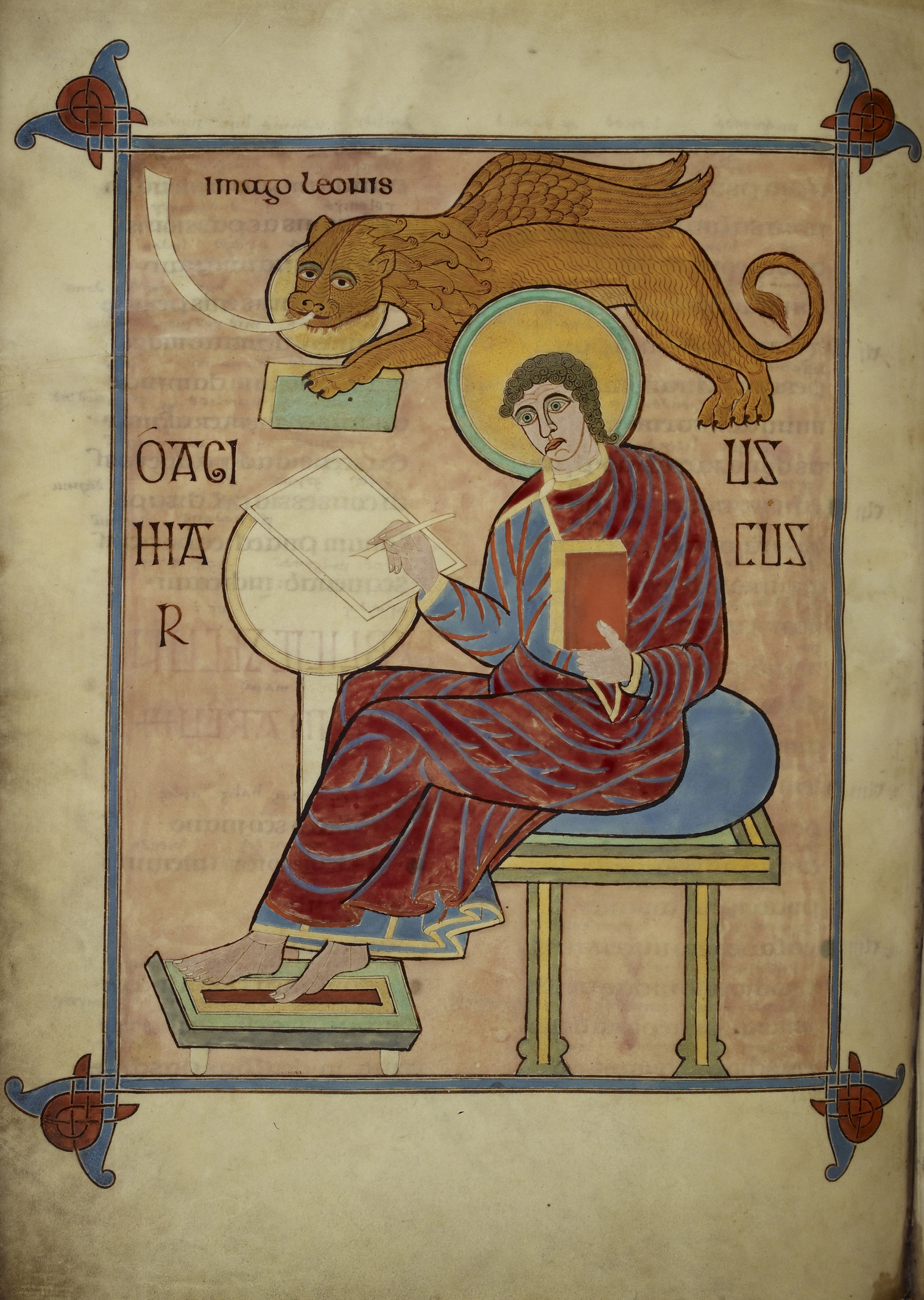
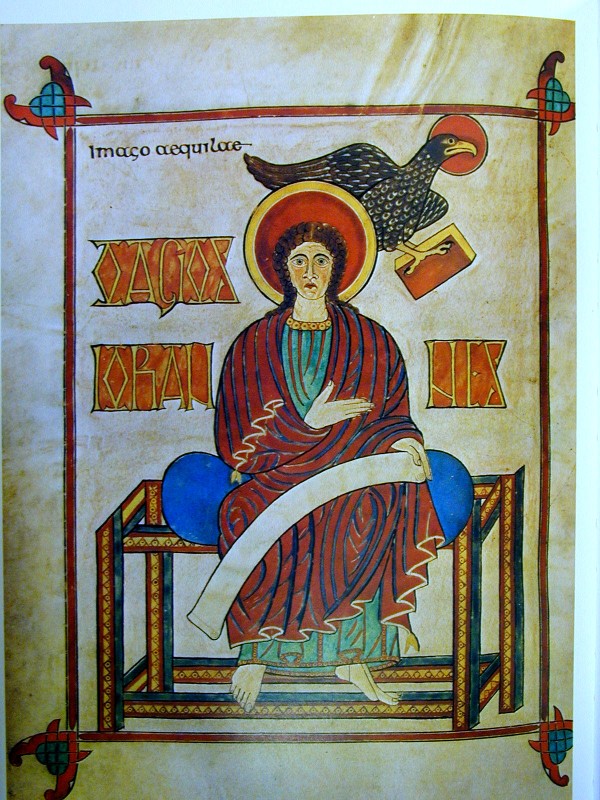
The evangelist portraits pair each writer with the tetramorph beast of Ezekiel and Revelation, the winged man for Matthew, the lion for Mark, the calf for Luke and the eagle for John, a convention already old by the eighth century but rendered here with facial and drapery types that several scholars, including Michelle Brown, connect to late-antique Mediterranean models transmitted into Northumbria through the sister house of Wearmouth-Jarrow, where Bede was working and where an Italian-derived Gospel text and layout, later embodied in the Codex Amiatinus, was in active use. Older scholarship framed the manuscript's style chiefly as an insular fusion of Irish, Pictish and Anglo-Saxon motifs; more recent work argues for a stronger and more direct Mediterranean and Coptic component carried through Wearmouth-Jarrow's library rather than through indirect diffusion. Both positions are argued in citable scholarship; this record does not arbitrate between them.
Aldred's gloss and colophon
Around the middle of the tenth century, a priest named Aldred, provost at Chester-le-Street where the Lindisfarne community had by then settled, added a continuous Old English gloss between the lines of the Latin text. It is the oldest surviving translation of any part of the four Gospels into the English language, made roughly two centuries before the Wycliffite Bible is sometimes wrongly credited as the first English scripture.
At the end of the text Aldred added a colophon recording who he believed had made the book: Eadfrith, bishop of the Lindisfarne church, first wrote this book, for God and for St Cuthbert and generally for all the saints whose relics are in the island. And Ethelwald, bishop of the Lindisfarne islanders, bound it on the outside and covered it, as he well knew how to do. And Billfrith, the anchorite, forged the ornaments that are on the outside and adorned it with gold and with gems, and also with gilded silver, pure metal. And Aldred, unworthy and most miserable priest, glossed it in English between the lines with the help of God and St Cuthbert. This is the entire documentary basis for naming all three makers of the original book and its lost binding; without Aldred's colophon, none of their names would be attached to this object at all.
A binding that does not survive
Aldred's colophon describes a treasure-binding: a leather cover made by Ethelwald and then ornamented by Billfrith the anchorite with gold, gems and gilded silver. That binding is gone. Sources are not consistent about exactly when it was lost, some pointing to the first Viking raid on Lindisfarne itself in 793, others to the later Viking pressure that led the community to leave the island around 875; no source consulted in this research documents the specific date or circumstances of the binding's loss, and this record treats it as unknown rather than guessing between the two.
What the book wears today is a nineteenth-century replacement: a silver and jewelled binding made in 1852 at the expense of Edward Maltby, Bishop of Durham, executed by the firm of Smith, Nicholson and Co. and designed to echo motifs drawn from the manuscript's own decoration. It is a Victorian object in its own right, not a reconstruction with any claim to represent what Billfrith actually made, and the two should not be confused.
The flight from Lindisfarne, and what is legend
Under continuing Viking pressure, the Lindisfarne community left the island, conventionally dated to around 875, carrying Cuthbert's body, other relics, and their books, among them, on the community's own later account, this Gospel book. The Historia de Sancto Cuthberto, a source compiled from earlier material by around the eleventh century, records that the community's leaders Eadred and Eardulf attempted to sail from the mouth of the river Derwent to Ireland, were turned back by a storm, and settled instead first at Crayke and then, after seven years of movement, at Chester-le-Street, where they remained until 995 before a further move, by way of Ripon, to Durham. This sequence of relocations is the well-evidenced part of the story.
A specific and much more vivid claim, that the Gospel book itself was washed overboard during that storm and later recovered from the shore at low tide practically undamaged, appears only in the account of Simeon of Durham, writing around 1104, more than two centuries after the events it describes and after the volume had already acquired a reputation, evidenced by water-staining on some of its leaves, as the book of St Cuthbert which fell into the sea. This record treats that specific episode as pious legend attached after the fact to explain physical evidence already visible on the book, not as a documented event, and separates it explicitly from the community's well-attested general itinerary.
Durham, dissolution, and an undocumented gap
Medieval Durham inventories list several Gospel books in the cathedral priory's keeping, and it is plausible that the Lindisfarne Gospels was among them once the community's relics and library settled there permanently after 995, but no source consulted here can identify this specific volume in a Durham inventory with certainty. The Dissolution of the Monasteries under Henry VIII, completed by 1540, ended Durham Cathedral Priory's independent existence and scattered much of its library; how the Gospels left Durham custody after that is not documented.
The next firm point is the ownership of Robert Bowyer, Clerk of the Parliaments and Keeper of the Records in the Tower of London from 1610 until his death in 1621, who is recorded as owning the manuscript by 1605 and who left his own signature on folio 2v, a mark now visible only under ultraviolet light. Between the Dissolution and 1605 there is no documented owner: a real and acknowledged gap of roughly sixty years, not a smooth chain.
Into the Cotton library, and an unrecorded transaction
At some point after Bowyer's death in 1621, the manuscript entered the library of Sir Robert Bruce Cotton, the antiquarian whose personal collection of British manuscripts became one of the most consequential ever assembled by a private Englishman. Cotton and Bowyer were connected: Cotton purchased his own house within the precincts of the Palace of Westminster in 1622 from the heirs of a previous Clerk of the Parliaments, the office Bowyer himself had held, and the two men are independently known to have exchanged manuscripts. No source found in this research documents the specific date, price, or mechanism by which the Lindisfarne Gospels passed from the Bowyer estate into Cotton's hands; historians of the Cotton library note more broadly that Cotton's acquisition methods for individual items are frequently unrecorded, ranging from ordinary purchase to material drawn from dissolved institutional and state collections. This transaction is one of those unrecorded cases and this record does not guess at it.
Cotton catalogued his library by the busts of Roman emperors that stood on top of each bookpress; this manuscript took its permanent shelfmark, Nero D IV, meaning the fourth volume on the second shelf of the press under the bust of Nero, a filing scheme that has nothing to do with the book's contents and has simply stuck.
Fire, gift, and the founding of the British Museum
Cotton's grandson, Sir John Cotton, bequeathed the library to the nation on his death in 1702, under the statutory framework of the British Museum Act of 1700-1701. The collection was moved, first to Essex House on the Strand and then to Ashburnham House near the old Palace of Westminster, where on 23 October 1731 a fire broke out that destroyed or badly damaged a large part of the collection; accounts of the toll vary between sources, with figures cited ranging from around thirteen manuscripts destroyed outright to considerably higher counts of manuscripts lost or seriously damaged by fire and water, including the near-total loss of the unique copy of The Battle of Maldon and heavy damage to Beowulf and to the Cotton Genesis. Nero D IV was not among the manuscripts recorded as destroyed or severely damaged that night.
The surviving Cotton library became, in 1753, one of the three founding collections of the newly established British Museum, alongside the Sloane and Harley libraries. It remained part of the Museum's manuscript holdings until 1973, when the British Library was created as a separate institution and inherited the Museum's manuscript collections, including this one, which has been catalogued as British Library, Cotton MS Nero D IV ever since.
Display, loan, and the campaign to move it north
The manuscript is normally on public display at the British Library in London, in the Sir John Ritblat Treasures Gallery. Because light and physical handling degrade the pigments and vellum, the volume is shown open at one spread for a period, rested, and then turned to expose new pages, with the whole book withdrawn from display for extended rest periods between cycles of exhibition, a conservation-driven rotation rather than a curatorial choice about which pages matter most.
It has left London twice on record in the twenty-first century for exhibitions in the north-east of England, the region it was made in: Palace Green Library, Durham, from July to September 2013, where it was seen by close to 100,000 visitors, and the Laing Art Gallery, Newcastle upon Tyne, from 17 September to 3 December 2022, which recorded more than 55,000 visits over its eleven-week run. Both loans have fed a long-running, still unresolved campaign, backed at various points by the Bishop of Durham and regional cultural bodies, to have the manuscript permanently relocated to the north-east; the British Library has consistently opposed permanent relocation while continuing to agree occasional loans.
Naming, and the manuscripts this one is not
The book has been called, across periods and sources, the Lindisfarne Gospels, the Book of Lindisfarne, and, by its Cotton library shelfmark, Nero D IV; none of these names is original to the manuscript itself, which carries no title of its own beyond the Gospel text and Jerome's prefatory letter. Because several other early medieval Gospel books share elements of its subject matter, its Insular style, or its association with Cuthbert, this record states plainly what this manuscript is not.
It is not the St Cuthbert Gospel, also called the Stonyhurst Gospel, a much smaller pocket Gospel of John found in Cuthbert's coffin and bought by the British Library in a separate acquisition in 2012; the two share a saint but are entirely different physical books with entirely different acquisition histories. It is not the Book of Kells or the Book of Durrow, both at Trinity College Dublin and both Irish rather than Northumbrian in production, with no relationship of physical custody to Lindisfarne. It is not the Durham Gospels or the Echternach Gospels, both stylistically close products of what scholars call the Lindisfarne scriptorium group, but physically separate objects now held respectively at Durham Cathedral Library and the Bibliotheque nationale de France. And it is not the Lichfield Gospels, a different manuscript at a different institution. Confusing any of these with the object catalogued as Cotton MS Nero D IV is a documented and recurring error in loose popular writing about Insular manuscripts, and the naming history above exists specifically to prevent it.
The artist
Eadfrith of Lindisfarne
Almost nothing about Eadfrith is independently documented. He appears in the historical record chiefly as bishop of Lindisfarne from 698 until his death in 721, a churchman rather than a named artist. The entire attribution of this manuscript to him rests on one piece of evidence: a colophon written by a different man, at a different place, roughly two and a half centuries after Eadfrith's death. That is a thinner evidentiary basis than most attributions in this publication, and it is stated plainly here rather than smoothed over.
Related works
| Work | Relation | Where it is |
|---|---|---|
| St Cuthbert Gospel (Stonyhurst Gospel) Unknown, Wearmouth-Jarrow | Shares the Cuthbert association but is a completely different, much smaller pocket Gospel of John, found in Cuthbert's coffin Acquired by the British Library in 2012 in a separate acquisition, not part of the Cotton collection. Never to be conflated with this manuscript despite the shared saint. | British Library, London (Add MS 89000) |
| Codex Amiatinus Scriptorium of Wearmouth-Jarrow | Produced at Lindisfarne's sister house at the same period, embodying the Italian-derived Gospel text and layout that scholars argue also reached Eadfrith Cited as evidence for the Mediterranean component of the Lindisfarne Gospels' iconography. | Biblioteca Medicea Laurenziana, Florence |
| Durham Gospels Attributed to the Lindisfarne scriptorium group | Stylistically close relative, possibly by related hands A physically separate manuscript. Not to be confused with this object. | Durham Cathedral Library, MS A.II.17 |
| Echternach Gospels Attributed to the Lindisfarne scriptorium group | Stylistically close relative associated with the same scriptorium tradition A physically separate manuscript, taken to the continent by Willibrord's mission. Not to be confused with this object. | Bibliotheque nationale de France, Paris |
| Book of Kells Unknown, Irish (Iona/Kells) | Later and more heavily decorated Insular Gospel book, frequently confused with this one in popular writing No relationship of physical custody to Lindisfarne. Explicitly distinguished here as a version-safety measure. | Trinity College Dublin, MS 58 |
| Book of Durrow Unknown, Insular | Earlier Insular Gospel book of the same broad decorative tradition A different manuscript, different institution, different date. | Trinity College Dublin, MS 57 |
| Lichfield Gospels (St Chad Gospels) Unknown, Insular | Comparable Insular Gospel book of related date and style A different manuscript at a different institution. | Lichfield Cathedral |
Open questions
- When and how was the original jewelled treasure-binding lost? Sources disagree between the 793 raid on Lindisfarne and the later Viking pressure of the 870s, and no source consulted documents a specific date.
- Did the manuscript actually fall into the sea during the community's flight, as Simeon of Durham claims around 1104? The claim postdates the event by more than two centuries and is treated here as legend, not documented fact.
- By what transaction, and on what date, did the manuscript pass from Robert Bowyer's estate after his death in 1621 into Sir Robert Cotton's library? No source found documents this specifically.
- Where was the manuscript between the Dissolution of Durham Cathedral Priory (completed by 1540) and Robert Bowyer's documented ownership by 1605? No owner is recorded for this roughly sixty-year gap.
- Is the manuscript identifiable in any surviving medieval Durham Cathedral Priory book-list, among the several Gospel books recorded there? No source consulted can confirm this with certainty.
- Was Eadfrith solely responsible for the whole manuscript, as the single-hand analysis and Aldred's colophon both suggest, or did he have assistance not recorded by tradition?
- What is the manuscript's precise date within its traditional range? Sources vary between a broad c. 700-721 and Michelle Brown's narrower codicological argument for c. 715-722.
Questions about this object
What is The Lindisfarne Gospels?
The Lindisfarne Gospels is a manuscript, dated c. 700-721, most narrowly argued as c. 715-722. Medium: Ink, pigments and gold on vellum (calfskin), in a modern (1852) silver and gem binding.
Who made The Lindisfarne Gospels, and is the attribution settled?
The attribution to Eadfrith of Lindisfarne (attributed) is recorded here as accepted. Attributed to Eadfrith, bishop of Lindisfarne 698-721, solely on the basis of a colophon added by the priest Aldred at Chester-le-Street roughly two and a half centuries after the manuscript was made. No contemporary document names a maker, and no other work is attributed to Eadfrith by name. Scholars including Janet Backhouse and Michelle Brown accept the colophon as recording a well-established community tradition rather than a scribe's own signature, and stylistic analysis has found the whole manuscript, script and illumination together, to be the work of a single hand. The attribution therefore rests on documentary tradition and internal consistency, not on a contemporary record.
Where is The Lindisfarne Gospels now?
British Library, London, Cotton MS Nero D IV. Last confirmed 14 September 2026. Part of the Cotton library, a founding collection of the British Museum from 1753, transferred with the Museum's manuscripts to the newly created British Library in 1973.
What is still unknown about The Lindisfarne Gospels?
When and how was the original jewelled treasure-binding lost? Sources disagree between the 793 raid on Lindisfarne and the later Viking pressure of the 870s, and no source consulted documents a specific date.
Sources
- 1Wikipedia, 'Lindisfarne Gospels'. Tertiary source consolidating production date, Aldred's colophon, the treasure-binding and its 1852 replacement, the Viking-era flight and sea legend, the 1753 and 1973 institutional transfers, and art-historical description. Flagged for replacement with the British Library's own catalogue entry and Michelle Brown's 2003 facsimile commentary. en.wikipedia.org/wiki/...
- 2British Library, Archives and Manuscripts Catalogue, 'Cotton MS Nero D IV'. Direct fetch blocked during this research by an expired TLS certificate on the British Library's own server; content used here is drawn from a search-engine summary of this catalogue page and should be directly re-verified once the certificate is renewed. searcharchives.bl.uk/catalog/...
- 3Wikipedia, 'Historia de Sancto Cuthberto', for the documented route of the community's flight (Derwent estuary, aborted crossing to Ireland, Crayke, Chester-le-Street). en.wikipedia.org/wiki/...
- 4katapi.org.uk, 'Lindisfarne Gospels: John, full page miniature'. A popular compilation citing Simeon of Durham's c. 1104 account of the book falling into the sea; tertiary, included because it names its source (Simeon of Durham) and date precisely. katapi.org.uk/BibleMSS/...
- 5Wikipedia, 'Robert Bowyer (diarist)', for Bowyer's dates, his tenure as Clerk of the Parliaments from 1610, and his ownership signature on folio 2v. en.wikipedia.org/wiki/...
- 6Wikipedia, 'Cotton library', for the British Museum Act 1700-1701, Sir John Cotton's 1702 donation, the 23 October 1731 Ashburnham House fire and its toll, and the 1753 founding of the British Museum. en.wikipedia.org/wiki/...
- 7North East Museums, 'Lindisfarne Gospels exhibition attracts over 50,000 visitors to the Laing Art Gallery', for the 2022 Newcastle loan dates and visitor numbers. northeastmuseums.org.uk/news/...
- 8British Library Medieval Manuscripts Blog (Kathleen Doyle, curator), 'The Lindisfarne Gospels in the Treasures Gallery', 12 July 2017, read via the Wayback Machine's 20231208 snapshot because the live blogs.bl.uk platform no longer serves individual post URLs (checked directly: 404 on both blogs.bl.uk and its blogs-archive.bl.uk successor, and the British Library's own site currently displays a cyber-attack service-disruption notice). Source for the Sir John Ritblat Treasures Gallery display location, the three-monthly page-turn cycle, and the international conservation committee that sets it. Replace with a live British Library primary source once the platform is restored. web.archive.org/web/...
- 9Wikimedia Commons, file description page, 'File:St. Matthew - Lindisfarne Gospels (710-721), f.25v - BL Cotton MS Nero D IV.jpg'. CC0, credited to the British Library. commons.wikimedia.org/wiki/...
- 10Wikimedia Commons, file description page, 'File:St. Mark - Lindisfarne Gospels (710-721), f.93v - BL Cotton MS Nero D IV.jpg'. CC0, credited to the British Library. commons.wikimedia.org/wiki/...
- 11Sophie Kelly, Lecturer in History of Art, University of Bristol, 'The Lindisfarne Gospels: the story of how a medieval masterpiece was made', The Conversation, 2022. theconversation.com/the-lindisfarne-gospels-the-story-of-...
- 12Wikipedia, 'Carpet page', tertiary, for the range of proposed sources (Coptic, metalwork, textile, mosaic) for the carpet-page tradition. en.wikipedia.org/wiki/...
- 13Michelle P. Brown, 'The Lindisfarne Gospels: Society, Spirituality and the Scribe' (London: British Library / Toronto: University of Toronto Press, 2003). Cited here via secondary summaries and published reviews of the facsimile commentary; the monograph itself was not directly consulted in this research pass and should be checked against the primary text. amazon.com/Lindisfarne-Gospels-Society-Spirituality-Medie...
- 14English Heritage, 'History of Lindisfarne Priory', for the priory's founding by Aidan c. 635 and its context. english-heritage.org.uk/visit/...
- 15Margaret Walker, 'The Lindisfarne Gospels: A Living Manuscript', FORUM: University of Edinburgh Postgraduate Journal of Culture and the Arts, Special Issue 3, Winter 2014. Direct extraction of the article's body text was not possible from the PDF encoding retrieved; the colophon translation quoted here was cross-checked against multiple independent renderings found in the course of this research and is consistent across them. journals.ed.ac.uk/forum/...
- 16Wikimedia Commons, Category:Lindisfarne Gospels (710-721) - BL Cotton MS Nero D IV, and the individual file description pages for folios 2v, 26v, 27r, 29r, 139r and 209v, used to identify and licence-check each gallery image. commons.wikimedia.org/wiki/...
,_f.25v_-_BL_Cotton_MS_Nero_D_IV.jpg)
,_f.93v_-_BL_Cotton_MS_Nero_D_IV.jpg)
Last verified 14 September 2026 · Published 14 September 2026
Change log
14 September 2026 - Record created at the house standard: researched narrative, technical evidence, maker dossier, graded provenance chain, prices with hammer and premium separated, related works, open questions and sources.