The Voynich Manuscript
Unknown maker (anonymous scribes and illustrators) · Parchment radiocarbon-dated to 1404-1438 (95% probability); the text and illustrations are presumed, but not independently proven, to have been added within a similar timeframe
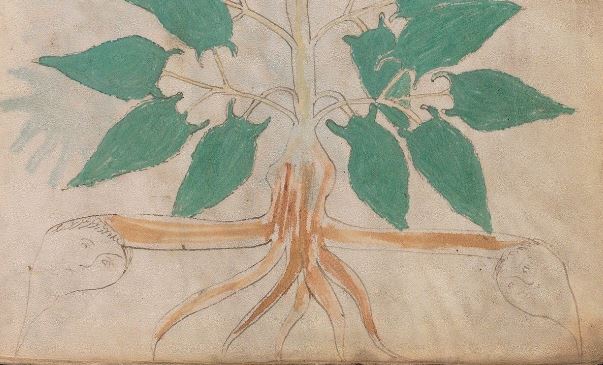
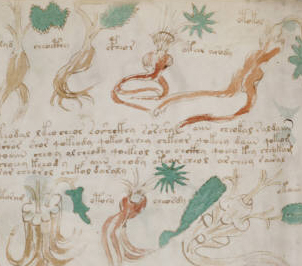
Detail of the root of an unidentified plant on folio 33 recto, part of the manuscript's largest section, roughly 113 pages of botanical drawings that match no plant reliably identified by modern botanists. The root is drawn with two human-like faces, a recurring and unexplained feature of the botanical section.
| Artist | Unknown maker (anonymous scribes and illustrators) |
|---|---|
| Date | Parchment radiocarbon-dated to 1404-1438 (95% probability); the text and illustrations are presumed, but not independently proven, to have been added within a similar timeframe |
| Medium | Iron gall ink, tempera-type pigments (azurite, copper resinate, red ochre, egg-white ground) and ink washes on vellum (calfskin parchment) |
| Dimensions | Approx. 225 x 160 mm bound. Contains 5 double-folio, 3 triple-folio, 1 quadruple-folio and 1 sextuple-folio fold-out leaves of larger dimensions |
| Where it is now | Beinecke Rare Book and Manuscript Library, Yale University, New Haven, Connecticutlast confirmed |
| Inventory number | MS 408 |
| Attribution | UnknownNo scribe, artist, author or patron is named anywhere in the manuscript, and none has ever been identified by any external document. Full note |
| Object type | Manuscript |
| Period | Late medieval / early Renaissance, Central Europe |
| Cases | Has a provenance gap |
| Inscriptions | Ex libris of Jacobus Horcicky de Tepenec on f1r, added after 1608; 15th/16th-century quire and folio numbering; scattered marginalia in a script distinct from the main text, including a disputed line on f116v sometimes transcribed as containing the words 'michiton oladabas'; a partial Latin alphabet added to f1r in a distinct high-carbon, low-iron ink (identified by McCrone Associates' chemical analysis) |
| Owners on record | 15 links11 documented, 2 disputed, 2 unknown |
| Sources | 17 cited |
About this record Last verified · 17 sources cited · Change log
On this page 9 sections
ContentsClose
An illustrated vellum codex of roughly 240 surviving pages, written entirely in an unidentified script that no one has been able to read since at least the 1660s, and quite possibly never could. Its parchment has been radiocarbon-dated to 1404-1438; its earliest secure documentary trace is a 1665 or 1666 letter sending it from Prague to Rome, which reports, at second hand and without the letter-writer's own endorsement, that it once belonged to Emperor Rudolf II and was believed to be the work of Roger Bacon, an attribution the radiocarbon date makes impossible on its own terms.
From the Jesuit library in Rome it was hidden from state confiscation in 1870, most likely at Villa Torlonia in Castel Gandolfo rather than the long-assumed Villa Mondragone, sold in 1912 to the antiquarian dealer Wilfrid Voynich, held by his widow and her circle until 1961, bought and unsuccessfully offered for resale by the dealer Hans Kraus, and given to Yale's Beinecke Library in 1969, where it has remained since. A century of claimed decipherments, from William Newbold's 1921 microscopic-shorthand theory to Gerard Cheshire's 2019 proto-Romance claim, has been examined and rejected by specialists one after another.
What remains genuinely unresolved, and is stated here as unresolved rather than settled in either direction, is whether the text encodes a real language, a working but unbroken cipher, or nothing at all. Named scholars hold each position, on record, and the manuscript itself has not yet given either side a conclusive answer.
Provenance
Each link is graded. Documented: a cited source supports it. Disputed: the identification is argued but not established. Unknown: no owner for that span, and the gap is not smoothed into a narrative. The grades in the glossary.
- 1404 - 1438Unknown maker(s)documented
Radiocarbon dating (University of Arizona, 2009) of four vellum samples places the parchment's creation in this range at 95% probability. This dates the animal skin, not conclusively the writing or illustration added to it.56
- c. 1404-1438 -Unknown maker(s)unknown
No document records when the text and drawings were added relative to the parchment's manufacture. Ink and pigment analysis (McCrone Associates) found materials consistent with other 15th-century manuscripts, which supports but does not prove a composition date close to the parchment date.1317
- - c. 1590sUnknownunknown
No owner is documented for roughly a century and a half after the parchment's creation.3
- 1599 -Possibly the bookseller Karl Widemann, via the financier Zacharias Geizkofler, to the imperial chamberlain Hans Poppdisputed
A documented March 1599 sale of a consignment of books for 600 Rheinische gulden is argued by some researchers (following Karin Guzy's archival work) to be the transaction later garbled into Marci's '600 ducats' story, but the manuscript is not named in the surviving correspondence, so the identification is an argument, not a document.316
- c. 1600 - 1612Holy Roman Emperor Rudolf II (reported)disputed
Reported only in Marci's 1665/1666 letter, at second hand, from Dr. Raphael Mnishovsky, who is said to have recalled the purchase from decades earlier. Marci himself explicitly declined to endorse the Bacon attribution. No contemporary Rudolfine inventory or record naming this manuscript has been found.7
- after 1608 -Jacobus Horcicky de Tepenecdocumented
Ex libris on folio 1 recto uses the 'de Tepenec' form of his name, adopted only after his 1608 ennoblement by Rudolf II, dating the inscription (and so this ownership) to after that year. How he acquired the manuscript is not documented.13
- - 1637Georg Bareschdocumented
Baresch is independently documented writing to Athanasius Kircher in 1639 about an unreadable book in his possession, sending a partial transcription; the identification of that book with the Voynich manuscript is accepted by specialists on the strength of matching detail, though Baresch's letter does not name the book explicitly.317
- c. 1662-1665 - 1665/1666Johannes Marcus Marci (Jan Marek Marci)documented
Marci's own letter, sent with the manuscript to Rome, states he inherited it from a deceased friend (understood to be Baresch) and forwarded it to Kircher. The letter survives bound into the manuscript.7
- 1665/1666 - 1680Athanasius Kircherdocumented
Kircher received the manuscript and Marci's letter at the Collegio Romano, where he lived and worked until his death in 1680. No record survives of what analysis, if any, Kircher performed on it.7
- 1680 - 1870Library of the Society of Jesus, Collegio Romano, Romedocumented
The manuscript remained among the Collegio Romano's holdings following Kircher's death; Jesuit records note a rebinding of the volume sometime between 1824 and 1870 owing to woodworm damage.13
- 1870 - 1912Private library of Superior General Pieter Jan Beckx and the Society of Jesus, hidden from confiscationdocumented
Removed from Rome in 1870 to avoid confiscation of Church property under new Italian anticlerical law. The manuscript's binding carries a label reading 'Ex Bibliotheca privata P. Petri Beckx.' The long-repeated claim that the collection was hidden at Villa Mondragone in Frascati is now considered an error, traceable to a public statement by Hans Kraus roughly thirty years after Voynich's death; 2022 archival research by Francesca Potenza, using 1912 inventory catalogues and Jesuit-Vatican correspondence, identifies Villa Torlonia at Castel Gandolfo as the actual location, with no evidence placing Voynich himself at either site.3415
- 1912 - 1930Wilfrid M. Voynichdocumented
Voynich acquired the manuscript as part of a larger group purchase from the Jesuit owners, arranged through the intermediary Father Joseph Strickland, under a promise of secrecy. Voynich's own public account of personally discovering the collection unknown to its owners is contradicted by his wife Ethel's later, independently sealed and opened account, and is not treated here as established fact. The specific price paid for this manuscript has not been published in any source consulted.34
- 1930 - 1960Ethel Lilian Voynich, then briefly Anne Nilldocumented
Ethel Voynich, Wilfrid's widow, held the manuscript until her death in 1960; it then passed briefly to Anne Nill, Wilfrid Voynich's former secretary and Ethel's close friend.3
- 1961 - 1969Hans P. Krausdocumented
Kraus purchased the manuscript from Anne Nill in 1961 for 24,500 dollars and subsequently offered it for sale at an asking price of 160,000 dollars, without finding a buyer.3
- 1969 - presentBeinecke Rare Book and Manuscript Library, Yale Universitydocumented
Kraus donated the manuscript to the Beinecke Library in 1969, where it is catalogued as MS 408 and has remained since, leaving the building only once, for a 2014-2015 loan exhibition at the Folger Shakespeare Library.12
Technical evidence
| Attribution note | No scribe, artist, author or patron is named anywhere in the manuscript, and none has ever been identified by any external document. The best-known historical attribution, to the thirteenth-century English friar Roger Bacon, rests on a single secondhand report in a 1665/1666 letter and is chronologically impossible: the vellum has been radiocarbon-dated to 1404-1438, more than a century after Bacon's death in 1292. Paleographic study identifies multiple scribal hands (two by Prescott Currier's 1970s count, as many as five in Lisa Fagin Davis's 2020 analysis) but assigns none of them a name. |
|---|---|
| Support | Vellum (calfskin parchment); protein and codicological analysis found no evidence of a palimpsest and estimated at least 14-15 whole calfskins used, of ordinary to below-average quality with unrepaired natural flaws.17 |
| Dimensions and collation | 225 x 160 mm bound, with 5 double-folio, 3 triple-folio, 1 quadruple-folio and 1 sextuple-folio fold-out leaves. 102 foliated leaves plus 1 paper leaf; complex, inconsistently foliated collation.1 |
| Foliation gaps and missing quires | At least 6 bifolios missing from within quires, plus entire quires 16 and 18 missing (2 leaves' worth of foliation gap each). Reconstructed original extent about 272 pages; roughly 240 (about 88%) survive across 18 of an original 20 quires. Numbering was added before the losses, so some material was already missing by 1912.1317 |
| Ink | Main text and drawings in standard iron gall ink; folio numbers in a separate high-iron-content ink; quire numbers and the partial Latin alphabet on f1r in a distinct high-carbon, low-iron ink bound with a protein rather than gum medium. McCrone Associates analysis found no ink-chemistry difference correlating with the different scribal hands identified paleographically.1317 |
| Pigments | Blue: ground azurite with minor cuprite. Green: copper resinate mixed with an atacamite-like copper-chloride compound. White: egg white and calcium carbonate. Red-brown: red ochre/hematite. All materials and techniques consistent with other 15th-century European manuscripts (McCrone Associates, for the Beinecke Library).1317 |
| Radiocarbon dating | Four vellum samples (folios 8, 26, 47, 68), 1-6 mm each, analyzed by AMS at the University of Arizona under Greg Hodgins; combined calibrated result 1404-1438 CE at 95% probability, all four samples statistically consistent. Dates the parchment only, not conclusively the ink or text.56 |
| Scribal hands | Prescott Currier identified two statistically distinct 'languages'/hands (A and B) in the 1970s, concentrated differently by section. Lisa Fagin Davis's 2020 digital paleography extended this to as many as five distinct hands, distinguished between sections rather than within them.31417 |
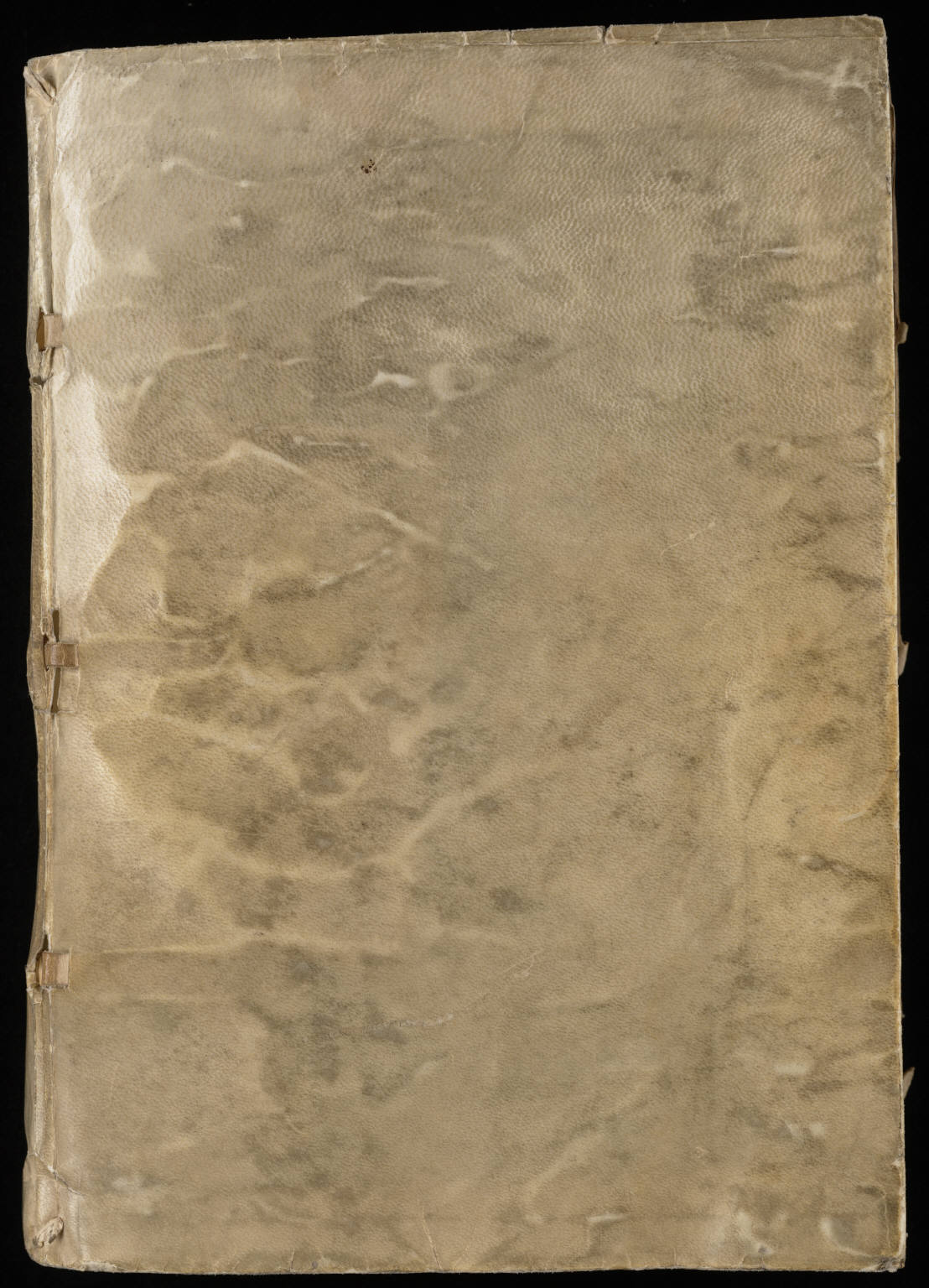
| Binding | Current binding is an 18th-19th century vellum case with remnants of earlier paper pastedowns, not the manuscript's original medieval binding. Jesuit-era records note rebinding necessitated by woodworm damage sometime between 1824 and 1870.13 |
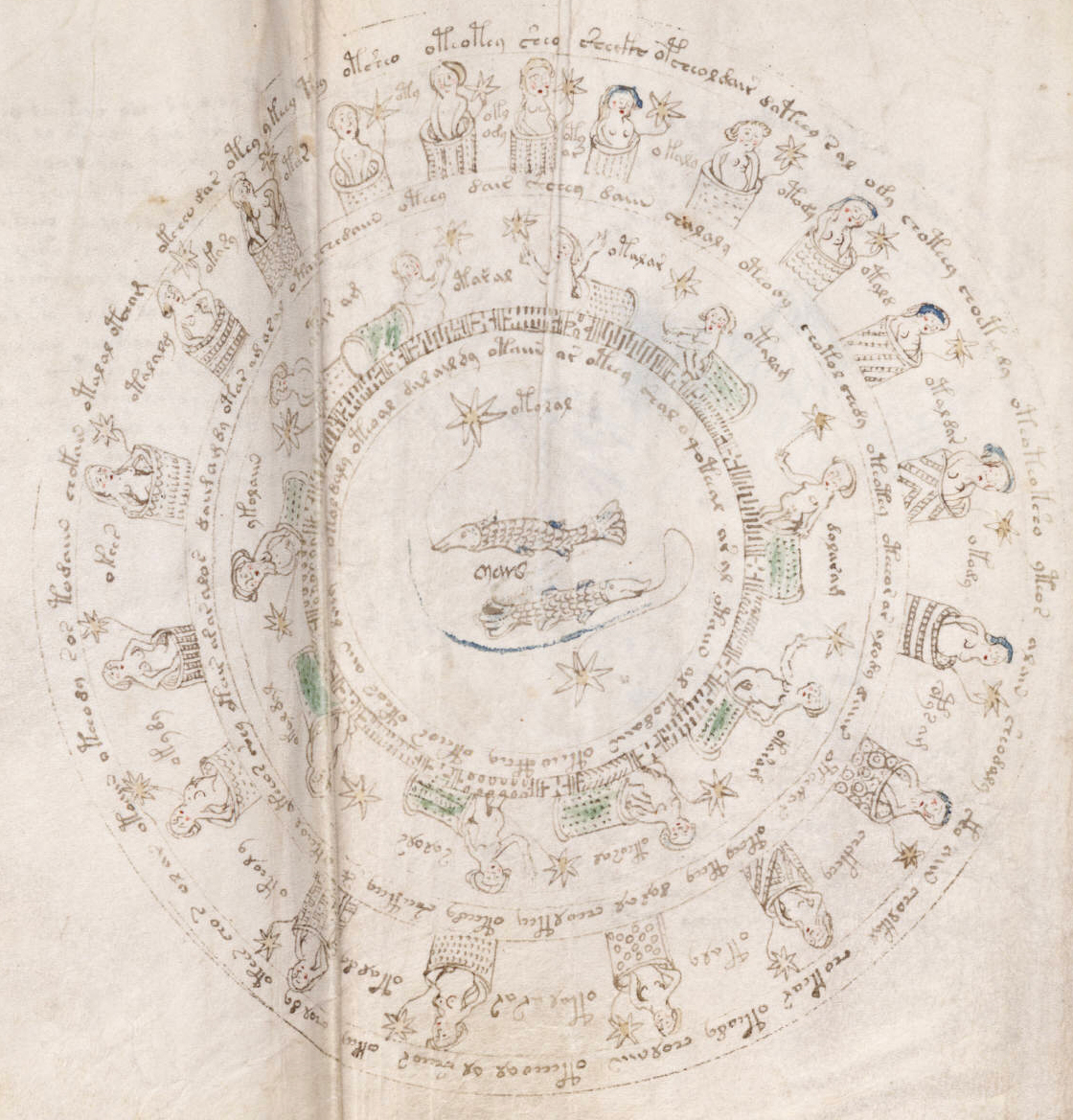
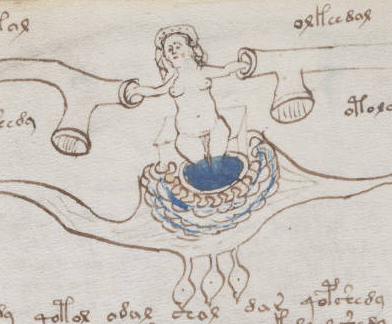
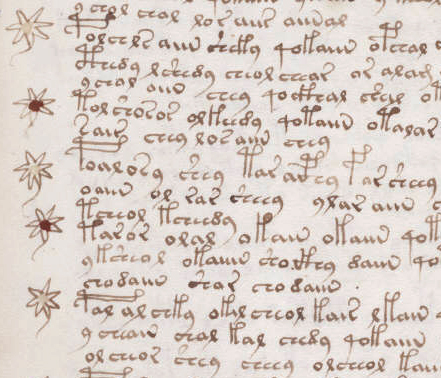
| Illustrated sections | Six content divisions by scholarly convention: botanical (approx. 113 unidentified plants), astronomical/astrological (25 diagrams), balneological/'biological' (nude female figures in pools and connected tubing), a multi-page cosmological medallion foldout, pharmaceutical (100+ labeled jars and herb fragments), and a final continuous, unillustrated 'recipes' section with star-shaped paragraph markers.12 |
Images
The record in full
Chapter 1A book that resists every category built for it
The Voynich manuscript is a vellum codex of roughly 240 surviving pages, written entirely in an unidentified script that has never been read by anyone since at least the seventeenth century, if it...
The Voynich manuscript is a vellum codex of roughly 240 surviving pages, written entirely in an unidentified script that has never been read by anyone since at least the seventeenth century, if it was ever read by anyone at all. It is illustrated throughout, and the illustrations are the only part of it anyone can describe with confidence: drawings of plants that match no reliable botanical identification, star charts and zodiac diagrams, small nude female figures standing or sitting in interconnected pools and pipes, jars and vessels that resemble pharmacy equipment, and pages of continuous unillustrated text broken only by star-shaped paragraph markers.
Cataloguers divide the manuscript into six sections by content rather than by any internal division the maker marked: a botanical section of about 113 unidentified plants, each given a full page and a block of text; an astronomical or astrological section of 25 diagrams including zodiac roundels; a section of small nude women in pools and connecting tubes, usually called balneological, or 'biological' by scholars who are unwilling to commit to the bathing interpretation; a cosmological section built around a large multi-page foldout of circular diagrams; a pharmaceutical section of more than a hundred labeled jars and herb fragments; and a final section of continuous text with no illustration at all, popularly called the 'recipes' section because of its short paragraph structure. No date, name, dedication, title or colophon appears anywhere in it.
Chapter 2How it was physically made
The support is calfskin vellum. Modern protein and codicological study, following the 2009 radiocarbon work, found no evidence that the parchment is a palimpsest and estimated that at least fourteen...
The support is calfskin vellum. Modern protein and codicological study, following the 2009 radiocarbon work, found no evidence that the parchment is a palimpsest and estimated that at least fourteen to fifteen whole calfskins were used to produce the volume, of ordinary to below-average quality, with natural flaws such as holes and thin patches left unrepaired in several places. The manuscript today runs to 102 foliated leaves plus one paper leaf, with a complex collation of single, double, triple, quadruple and one sextuple-folio fold-out leaves, some of them foliated inconsistently, which has made a full physical reconstruction of the original gathering structure difficult.
Chemical analysis of the ink and pigments was carried out by McCrone Associates on behalf of the Beinecke Library. The main text and drawings were done in an iron gall ink typical of the period. Folio numbers were added in a separate ink with unusually high iron content; the quire numbers, and a partial Latin alphabet added to folio 1 recto, were written in a third ink, high in carbon and very low in iron, bound with what appears to be a protein medium rather than gum. The blue paint is ground azurite with minor cuprite; the green is a copper resinate mixed with a copper-chloride compound consistent with atacamite; whites use egg white and calcium carbonate. McCrone's report found the materials and technique consistent with other fifteenth-century European manuscripts, and found no chemical difference in the inks used across sections that paleographers assign to different hands, which the report treats as a negative result for the idea that different scribes used physically different ink batches, not as proof that only one scribe worked on the book.
Paleographic study is a separate line of evidence from ink chemistry, and it tells a different story. Prescott Currier, working in the 1970s, was the first to identify two distinct statistical 'languages' in the text, which he called Currier A and Currier B, correlating loosely with two different hands concentrated in different sections, most visibly in the herbal pages. In 2020 the manuscript scholar Lisa Fagin Davis extended Currier's work using digital paleography and proposed as many as five distinct scribal hands across the volume, distinguished by consistent small differences in letterforms between sections rather than within them, which she has argued points to production by a working group over time rather than by one person working alone.
Chapter 3The earliest secure trace: a letter to Kircher
The earliest point at which the manuscript can be tied to a specific, datable, surviving document is a letter, most likely written in 1665 or 1666, from the Prague physician and rector of...
The earliest point at which the manuscript can be tied to a specific, datable, surviving document is a letter, most likely written in 1665 or 1666, from the Prague physician and rector of Charles-Ferdinand University Johannes Marcus Marci (Jan Marek Marci) to the Jesuit polymath Athanasius Kircher in Rome, sent together with the manuscript itself. The letter survives, bound into the front of the volume, and its text has been transcribed and translated many times since.
In it, Marci reports what he had been told by a third party, Dr. Raphael Mnishovsky, tutor in the Bohemian language to the future Emperor Ferdinand III: 'Dr. Raphael... told me the said book had belonged to the Emperor Rudolph and that he presented to the bearer who brought him the book 600 ducats. He believed the author was Roger Bacon, the Englishman.' Marci's own response to that claim is on record in the same letter: 'On this point I suspend judgment.'
Every later popular account of the manuscript that states flatly that Rudolf II owned it, paid 600 ducats for it, and believed it was the work of Roger Bacon is repeating a claim that Marci himself explicitly declined to endorse, reported to him at second hand, decades after the fact, by a man recalling a transaction from his own earlier life. It is the earliest attribution the manuscript has, and it is also, on its own terms, unverified tradition rather than record. The radiocarbon dating of the vellum to 1404-1438 makes the Roger Bacon authorship chronologically impossible on its own account, since Bacon died in 1292, more than a century before the parchment existed; whatever else the 600-ducats story preserves, it cannot preserve a true attribution to Bacon.
Chapter 4Before the letter: the search for Rudolf II and John Dee
Wilfrid Voynich, who bought the manuscript in 1912, was the first to try to fill in the roughly two centuries between the parchment's radiocarbon date and Marci's letter.
Wilfrid Voynich, who bought the manuscript in 1912, was the first to try to fill in the roughly two centuries between the parchment's radiocarbon date and Marci's letter. He proposed that the English mathematician and astrologer John Dee had brought the manuscript to Prague and sold it to Rudolf II, since Dee and his associate Edward Kelley were resident at Rudolf's court in the 1580s and Dee is known to have owned and sold manuscripts to the emperor. This hypothesis is no longer accepted by specialists: no document ties Dee to this specific book, Dee's own detailed diaries do not mention it, and the theory rests entirely on the coincidence of Dee's presence in Prague at roughly the right period. A related and more colorful theory, that Dee and Kelley forged the manuscript themselves as a confidence trick on Rudolf, fails on the same radiocarbon evidence that undermines the Bacon attribution: the vellum was already a century and a half old by the time Dee and Kelley were active, ruling out the two of them as its makers, whatever their reputations as tricksters.
Archival research since the late 1990s, principally by the German researcher Karin Guzy working from Fugger and Rudolfine court financial records, found a documented purchase in March 1599: the bookseller Karl Widemann sold a consignment of books to the Augsburg financier Zacharias Geizkofler, who passed at least part of it on to Hans Popp, a chamberlain at Rudolf II's court, for 600 Rheinische gulden, a figure roughly equivalent, depending on the exchange rates used, to the 600 ducats Marci later reported. Whether this transaction is the same event Marci was describing, or merely a coincidentally similar number attached to an unrelated purchase, is disputed among specialists; the manuscript itself is not named or described in the surviving Widemann-Geizkofler correspondence, so the identification, however suggestive, is an argument, not a document.
Between the manuscript's creation and this cluster of claims about the 1590s, no owner at all is documented. That gap runs to roughly a century and a half and is recorded here as a gap, not bridged by supposition.
Chapter 5From Prague to the Collegio Romano
An ex libris inscribed on the manuscript's first folio identifies an early, datable owner: Jacobus Horcicky de Tepenec (sometimes called Sinapius), a Prague apothecary and naturalist who was ennobled...
An ex libris inscribed on the manuscript's first folio identifies an early, datable owner: Jacobus Horcicky de Tepenec (sometimes called Sinapius), a Prague apothecary and naturalist who was ennobled by Rudolf II in 1608, since his ex libris uses the 'de Tepenec' form of his name that he adopted only after that date. How Tepenec obtained the manuscript, and whether it came to him directly from the imperial court, is not documented. Some time after Tepenec, and before 1637, the manuscript belonged to Georg Baresch, a little-known Prague alchemist who is independently documented writing to Kircher in 1639 about a mysterious book in his possession that he could not read, sending a partial transcription and asking for help; scholars now generally accept that this was the Voynich manuscript, on the strength of matching detail rather than an explicit statement in the letter.
Baresch died sometime between 1662 and 1665. Marci's letter states that he inherited the book from Baresch's estate before sending it on to Kircher in Rome. From that point, custody of the manuscript is documented as passing into the library of the Society of Jesus: Kircher, who lived in Rome at the Jesuit Collegio Romano until his death in 1680, is understood to have kept the manuscript there, and it remained part of the college's library holdings for roughly two centuries.
Chapter 7Wilfrid Voynich's purchase, and what he actually said about it
The Jesuits sold a large part of their hidden library, some 30 or more manuscripts including this one, around 1911-1912 for financial reasons, in a transaction that both the Vatican and Voynich...
The Jesuits sold a large part of their hidden library, some 30 or more manuscripts including this one, around 1911-1912 for financial reasons, in a transaction that both the Vatican and Voynich needed to keep quiet because Italian law still treated Church property acquired before 1870 as potentially subject to state claim. Voynich's own public account, repeated in a 1921 presentation in Philadelphia, was that he had personally discovered the collection, unknown to its owners, in chests in an old European castle. That account is now understood to be an embellishment: Voynich was invited to inspect and purchase part of the collection by its Jesuit owners, under a promise of absolute secrecy about the source, and did not discover anything by accident. The clearest evidence against Voynich's own story comes from his own household: his wife Ethel Voynich wrote down what she had been told about the transaction, including the Frascati association and Father Strickland's role, in a sealed letter that was opened roughly thirty years after it was written and confirmed a rather more mundane arrangement than the discovery story Voynich told the public.
The price Voynich paid the Jesuits for the manuscript specifically has not been published in any source consulted for this record; contemporary accounts of the sale of the broader collection mention a Vatican-related transaction in the tens of thousands of lire, but no figure has been reliably tied to this one item. What can be stated as documented is that Voynich acquired the manuscript in 1912, that it stayed in his possession until his death in 1930, and that its physical binding today still carries a typewritten label reading 'Ex Bibliotheca privata P. Petri Beckx,' recording its presence in Beckx's private library during the hidden decades.
Chapter 8Ethel Voynich, Anne Nill, and the sale to Hans Kraus
After Wilfrid Voynich's death in 1930, the manuscript passed to his widow, Ethel Lilian Voynich, herself a novelist.
After Wilfrid Voynich's death in 1930, the manuscript passed to his widow, Ethel Lilian Voynich, herself a novelist. On her death in 1960 it passed briefly to Anne Nill, her longtime friend and Wilfrid Voynich's former secretary and business associate, who sold it in 1961 to the New York rare-book dealer Hans P. Kraus for 24,500 dollars.
Kraus, one of the most prominent antiquarian booksellers of the twentieth century, tried for years afterward to place the manuscript with a buyer, listing it at an asking price of 160,000 dollars, a figure that reflected the growing cryptological and popular fame the book had accumulated since Voynich first publicized it, rather than any settled scholarly value. No buyer came forward at that price. In 1969, after roughly eight years of failed private sale attempts, Kraus donated the manuscript to the Beinecke Rare Book and Manuscript Library at Yale University, where it has remained since, catalogued as MS 408.
Chapter 9What the 2009 radiocarbon dating actually established
In 2009, a team at the University of Arizona's Accelerator Mass Spectrometry Laboratory, led by Greg Hodgins, radiocarbon-dated four vellum samples taken from folios 8, 26, 47 and 68 of the...
In 2009, a team at the University of Arizona's Accelerator Mass Spectrometry Laboratory, led by Greg Hodgins, radiocarbon-dated four vellum samples taken from folios 8, 26, 47 and 68 of the manuscript, using samples between one and six millimeters in size cut from areas that Beinecke conservators had identified as unrebound and unrepaired original parchment. The measured carbon-14 fractions, calibrated against the IntCal curve, produced a combined date range for the parchment's creation of 1404 to 1438 at 95 percent probability, with all four samples statistically consistent with one another. The results were first shared publicly at a Voynich centenary event at Yale in May 2012.
The dating establishes when the animal whose skin became the parchment was alive, or very shortly after, since vellum is normally used within a few years of preparation. It does not, and does not claim to, establish when the text and illustrations were added to that parchment, and Hodgins himself has been explicit that direct radiocarbon dating of the ink was not attempted, because the trace quantities of carbon in ink applied to a surface make it extremely difficult to date independently of the substrate. The chemical consistency of the ink and pigments with other fifteenth-century materials, established separately by the McCrone analysis, supports but does not prove that the writing followed reasonably soon after the parchment's manufacture. Every claim that flatly states the manuscript 'is from 1420' or similarly collapses the parchment date and the writing date into one fact is going beyond what either study established.
Chapter 10A century of claimed solutions
The manuscript has attracted more announced decipherments than perhaps any other undeciphered document, and each has failed to persuade the specialist community.
The manuscript has attracted more announced decipherments than perhaps any other undeciphered document, and each has failed to persuade the specialist community. The first came from William Romaine Newbold, a University of Pennsylvania philosophy professor who worked on the text at Voynich's own request beginning in 1919 and announced in 1921 that he had found a system of microscopic shorthand embedded within the visible letters, supporting an authorship by Roger Bacon that fit Voynich's own hopes for the manuscript's importance. Newbold's full theory was published posthumously in 1928 as 'The Cipher of Roger Bacon.' It was dismantled in 1931 by John Matthews Manly, a University of Chicago medievalist and former wartime codebreaker, in the journal Speculum; Manly, despite having been a friend of Newbold's, showed that what Newbold had read as deliberate microscopic shorthand marks were simply natural cracks in the aged ink, and that Newbold's decoding method was flexible enough to extract almost any desired message from the same text.
Other announced solutions followed across the twentieth century without gaining acceptance: Joseph Martin Feely proposed in 1943 that the text was a private Latin shorthand, a claim scholars rejected outright; Leonell C. Strong and later Robert S. Brumbaugh each proposed different cipher systems yielding medical or herbal readings that other cryptanalysts could not reproduce; the Ukrainian-born engineer John Stojko proposed in 1978 that the text was Ukrainian with the vowels removed, a claim never accepted by Slavicists. William F. Friedman, the U.S. Army's leading twentieth-century cryptanalyst, spent decades of his career and organized two informal after-hours research groups of fellow military cryptanalysts, the First and Second Voynich Manuscript Study Groups of the 1940s, applying the same statistical and combinatorial methods used against wartime ciphers; Friedman never published a solution and by the end of his life concluded only that the text might encode an artificial or constructed language rather than a natural one in cipher, a guess rather than a decipherment.
Claimed solutions have continued into the twenty-first century. In 2014 the applied linguist Stephen Bax proposed a partial, bottom-up decoding identifying ten proper names, mostly of plants and one constellation, built from fourteen recurring symbol clusters matched against botanical and astronomical vocabulary in medieval Arabic, Hebrew and other sources; other Voynich researchers have found his character-to-name matches statistically indistinguishable from chance, and no further extension of his method was completed before Bax's death in 2017. In May 2019, the University of Bristol publicized a claimed full decipherment by its research associate Gerard Cheshire, who argued the text was a lost proto-Romance language and that the manuscript was produced by Dominican nuns for Maria of Castile, Queen of Aragon, publishing the claim in the journal Romance Studies. The claim drew immediate and pointed rejection from specialists in medieval Romance philology, who found that Cheshire assigned phonetic values to symbols without consistent method and then selected readings from multiple Romance languages until a plausible-sounding result emerged; the medievalist Lisa Fagin Davis, executive director of the Medieval Academy of America, called the work 'just more aspirational, circular, self-fulfilling nonsense,' and the University of Bristol subsequently withdrew its promotional coverage of the paper. As of this record, no proposed reading of the Voynich manuscript has achieved acceptance from the specialist community, and the Beinecke Library's own catalogue description states plainly that cryptographic approaches have failed to decipher the text, if it is indeed encoded at all.
Chapter 11Hoax, cipher, or unknown language: the live argument
Beneath the parade of failed solutions sits a harder and still unresolved question: whether the text encodes any message at all.
Beneath the parade of failed solutions sits a harder and still unresolved question: whether the text encodes any message at all. In 2004 the psychologist Gordon Rugg, working with Gavin Taylor, proposed that the text could have been generated as meaningless gibberish using a simple mechanical method available in the fifteenth century, a table of syllable fragments combined with a moving grille or stencil, sometimes called a Cardan grille. Rugg demonstrated experimentally that this method could reproduce several of the text's more unusual statistical properties, including its close-to-binomial word-length distribution, and that a single person working with period materials could plausibly produce a manuscript of the Voynich's length, fully illustrated, in the range of 250 to 500 hours. Rugg's argument does not claim to prove the manuscript is a hoax; it claims only that the statistical regularities long cited as evidence of a real underlying language can also arise as an unintended side effect of a simple meaningless production method, which removes those regularities as proof of meaning.
Scholars arguing for a genuine underlying language point to a different body of statistical evidence. In 2013 the physicists Marcelo Montemurro and Damian Zanette published an information-theoretic analysis in PLOS ONE arguing that the long-range distribution of words across the manuscript's sections forms coherent semantic word-networks comparable to those found in real-language texts, structure that Montemurro has argued would be an implausible thing for a hoaxer working in the fifteenth century to have known how to fake, since the relevant concepts in information theory did not exist yet. Other statistical studies, including a 2014 network-based comparison by Diego Amancio and colleagues, have likewise found the text's internal structure closer to that of known natural languages than to random text in a majority of the tests applied. Neither side of this argument has persuaded the other, and this record states both positions, and the names attached to them, without resolving the underlying dispute, because it has not been resolved.
Chapter 12What is missing
The manuscript survives incomplete, and the gaps are old.
The manuscript survives incomplete, and the gaps are old. Numbering on the quires and folios, added while more of the book was still intact, shows that at least six bifolios are missing from within existing quires, and that two entire quires, numbered 16 and 18 corresponding to gaps in the foliation of two leaves each, are missing altogether. Reconstructing the original page count from the surviving numbering gaps suggests the manuscript once ran to as many as 272 pages, of which roughly 240, or about 88 percent, survive today across 18 of an original 20 quires. Because the quire and folio numbers were added before the losses occurred, some of this material was already missing by the time Wilfrid Voynich acquired the manuscript in 1912, and nothing is known about when, how, or by whom the missing bifolios and quires were removed, or whether any of them survive unrecognized elsewhere.
One further identification once cited as physical evidence for the manuscript's date has not held up under scrutiny: an early claim that one of the botanical folios (f93v) depicted a New World sunflower, which would have required a composition date after Columbus's voyages, was reexamined by the computer scientist Jorge Stolfi, who found the resemblance to a sunflower superficial, based mainly on the plant's large central disc, a feature also found in Old World composite flowers already known in Europe before 1492. The identification is not now considered reliable evidence for the manuscript's date, and the radiocarbon dating of the vellum to 1404-1438 in any case places the parchment's manufacture before Columbus's voyages, whatever conclusion is eventually reached about the text and illustrations added to it.
Chapter 13The manuscript today
Yale digitized the entire manuscript and made high-resolution images freely available through its digital library, with the complete set online since 2020, following an earlier partial digitization...
Yale digitized the entire manuscript and made high-resolution images freely available through its digital library, with the complete set online since 2020, following an earlier partial digitization in 2004; anyone can examine every surviving page, including the fold-outs, at full resolution without visiting New Haven. The Beinecke and Yale University Press published a facsimile edition, with scholarly commentary, in 2016, and a separate full-color facsimile was issued by the Spanish publisher Siloe in 2017. The manuscript has left the Beinecke building only once since arriving there in 1969, for the exhibition 'Decoding the Renaissance: 500 Years of Codes and Ciphers' at the Folger Shakespeare Library in Washington, D.C., in 2014-2015.
Research continues on the manuscript's codicology rather than on new decipherment claims from the library's own side: Lisa Fagin Davis's paleographic study of the multiple scribal hands, presented at Beinecke public programs, is part of an active project examining the manuscript's physical production as a codex, independent of any claim about what the text says. The Beinecke Library's own public description of the manuscript states its content, script, and origin as unresolved, records the standard provenance chain from Rudolf II onward as historically reported rather than uniformly proven, and does not endorse any decipherment. That caution, maintained by the institution that has now held the book for more than half a century, is itself part of the accurate record of what is and is not known about it.
The artist
Unidentified. No scribe, artist, author or patron has ever been named by any surviving document.
The maker of the Voynich manuscript is unknown in the strictest sense: not disputed among candidates, simply never identified. No signature, colophon, dedication or ownership mark from the period of composition survives. The one attribution that reached wide popular currency, to the English Franciscan Roger Bacon, does not originate with any contemporary document at all; it originates in a single secondhand claim reported more than a century after Bacon's death, by a man recalling what he had been told, in a letter whose own author explicitly declined to endorse it. What follows is confined to what has actually been established about the manuscript's physical production, since nothing at all has been established about who carried it out.
Related works
| Work | Relation | Where it is |
|---|---|---|
| Rohonc Codex Unknown | Another illustrated manuscript in an unidentified script that remains undeciphered A recurring comparandum in Voynich scholarship for how an undeciphered illustrated manuscript is treated when no attribution or reading has achieved consensus. | Library of the Hungarian Academy of Sciences, Budapest |
| Copiale Cipher Unknown (18th-century German secret society) | Contrasting case: an enciphered manuscript once considered as mysterious as the Voynich manuscript, successfully decrypted in 2011 Demonstrates that a genuinely enciphered historical text can be solved with modern computational cryptanalysis when the underlying language and cipher system are tractable; the Voynich manuscript has resisted the same techniques for far longer. | East Berlin Academy library holdings |
| Book of Soyga (Aldaraia) Unknown | Another cipher-adjacent text once owned by John Dee, later substantially decoded Relevant to the now-rejected theory that Dee brought the Voynich manuscript to Prague; unlike the Voynich text, most of the Book of Soyga's encoded tables were successfully explained in 1999 as alphabetic reversal, an outcome that has not been replicated for the Voynich script. | Bodleian Library, Oxford, and British Library, London |
| Codex Seraphinianus Luigi Serafini | Modern deliberately invented illustrated 'encyclopedia' in an invented, meaningless script Cited in Voynich scholarship as proof of concept that a single modern artist can produce a lengthy, fully illustrated volume in a wholly invented and meaningless script, supporting the plausibility (not the proof) of a deliberate-hoax reading of the Voynich manuscript. | Various editions in private and library collections; not a rare or unique object |
Open questions
- Who wrote and illustrated the manuscript, and where? No scribe, artist, author or patron is named or identified by any surviving contemporary document.
- Does the text encode a real natural or constructed language, an unbroken cipher, or nothing at all? Specialists remain divided, citing the same statistical evidence for opposite conclusions (Rugg's hoax-generation model versus Montemurro and Zanette's information-theoretic argument for genuine structure).
- Where was the manuscript for the roughly 150 years between its radiocarbon-dated creation (1404-1438) and the first plausible trace of an owner in the late 1590s? No owner is documented for this period.
- Was the 1599 Widemann-to-Geizkofler-to-Hans Popp sale of books to Rudolf II's court, for 600 Rheinische gulden, actually this manuscript, or is the resemblance between that figure and Marci's later '600 ducats' a coincidence or a garbled memory of an unrelated transaction? The manuscript is not named in the surviving sale correspondence.
- How many scribal hands actually produced the manuscript, two (Currier) or as many as five (Davis), and does that number reflect a workshop, a single scribe's habits changing over time, or something else? No paleographic study has yet settled on a final count.
- What became of the manuscript's missing bifolios and the two entirely missing quires? The gaps predate Voynich's 1912 acquisition, and nothing is known about when, how, or by whom the material was removed, or whether any of it survives unrecognized elsewhere.
- What price did Wilfrid Voynich actually pay the Jesuits in 1912, and how much of his own public account of a chance discovery in an old castle was true, given that his own wife's later, independently opened account describes a rather more ordinary private arrangement?
Questions about this object
What is The Voynich Manuscript?
The Voynich Manuscript is a manuscript, dated parchment radiocarbon-dated to 1404-1438 (95% probability); the text and illustrations are presumed, but not independently proven, to have been added within a similar timeframe. Medium: Iron gall ink, tempera-type pigments (azurite, copper resinate, red ochre, egg-white ground) and ink washes on vellum (calfskin parchment).
Who made The Voynich Manuscript, and is the attribution settled?
The attribution to Unknown maker (anonymous scribes and illustrators) is recorded here as unknown. No scribe, artist, author or patron is named anywhere in the manuscript, and none has ever been identified by any external document. The best-known historical attribution, to the thirteenth-century English friar Roger Bacon, rests on a single secondhand report in a 1665/1666 letter and is chronologically impossible: the vellum has been radiocarbon-dated to 1404-1438, more than a century after Bacon's death in 1292. Paleographic study identifies multiple scribal hands (two by Prescott Currier's 1970s count, as many as five in Lisa Fagin Davis's 2020 analysis) but assigns none of them a name.
Where is The Voynich Manuscript now?
Beinecke Rare Book and Manuscript Library, Yale University, New Haven, Connecticut. Inventory number MS 408. Last confirmed 10 September 2026. Donated to the Beinecke Library by the dealer Hans P. Kraus in 1969, after Kraus had been unable to find a buyer at his asking price since acquiring the manuscript from Ethel Voynich's estate, via Anne Nill, in 1961. Held continuously by Yale since 1969.
What is still unknown about The Voynich Manuscript?
Who wrote and illustrated the manuscript, and where? No scribe, artist, author or patron is named or identified by any surviving contemporary document.
Sources
- 1Beinecke Rare Book and Manuscript Library, Yale University, catalogue description, Beinecke MS 408 ('Cipher manuscript, known as: Voynich manuscript') pre1600ms.beinecke.library.yale.edu/docs/...
- 2Beinecke Rare Book and Manuscript Library, Yale University, 'The Beinecke Cipher (Voynich) Manuscript' beinecke.library.yale.edu/beinecke/...
- 3Rene Zandbergen, voynich.nu, 'History of the MS' (specialist reference site maintained since the 1990s, widely cited in Voynich scholarship) voynich.nu/history.html
- 4Rene Zandbergen, voynich.nu, 'Where was the Voynich MS kept and how did Voynich find it?' voynich.nu/extra/...
- 5Rene Zandbergen, voynich.nu, 'Radio-carbon dating of the Voynich MS,' summarizing the University of Arizona AMS Laboratory report (G. Hodgins et al.), first presented publicly 11 May 2012 voynich.nu/extra/...
- 6EurekAlert!, 'University of Arizona experts determine age of book nobody can read' eurekalert.org/news-releases/...
- 7Johannes Marcus Marci, letter to Athanasius Kircher, 1665 or 1666, accompanying the manuscript to Rome (surviving letter, bound into the manuscript; translated text as widely reproduced in Voynich scholarship, including on voynich.nu and in secondary discussion) voynich.nu/history.html
- 8Wikipedia, 'William Romaine Newbold' (; with John Matthews Manly, 'Roger Bacon and the Voynich MS,' Speculum 6:3, 1931, pp. 345-391) en.wikipedia.org/wiki/...
- 9Cipher Mysteries, 'Gordon Rugg, The Man Who Cracked The Mystery Of The Voynich Manuscript, cracks it once again (NOT)', discussing Rugg & Taylor, 'Hoaxing statistical features of the Voynich Manuscript,' Cryptologia 41:3 (2016) ciphermysteries.com/2016/...
- 10Marcelo A. Montemurro and Damian H. Zanette, 'Keywords and Co-Occurrence Patterns in the Voynich Manuscript: An Information-Theoretic Analysis,' PLOS ONE 8(6): e66344 (2013) journals.plos.org/plosone/...
- 11Stephen Bax, 'A proposed partial decoding of the Voynich script' (2014) archive.org/details/...
- 12Language Log (Victor Mair), scholarly-linguistics reception of Gerard Cheshire's 2019 claimed decipherment, published in Romance Studies (Taylor and Francis) and distanced from by the University of Bristol following criticism languagelog.ldc.upenn.edu/nll
- 13Cipher Mysteries, 'Voynich - the McCrone report now online!', summarizing McCrone Associates' chemical analysis of the manuscript's inks and pigments, commissioned by the Beinecke Library ciphermysteries.com/2011/...
- 14Beinecke Rare Book and Manuscript Library, 'Mondays at Beinecke: Voynich Manuscript with Lisa Fagin Davis, Raymond Clemens, Claire Bowern,' on Davis's digital paleography and the proposed five scribal hands beinecke.library.yale.edu/event/...
- 15Francesca Potenza (2022) archival research on the Jesuit collection's 1870-1912 hiding place, as reported and summarized by Rene Zandbergen, voynich.nu voynich.nu/extra/...
- 16Voynich Ninja research forum, discussion thread on the 1599 Widemann-Geizkofler book sale and its possible identification with the '600 ducats' tradition, summarizing archival research by Karin Guzy (forum secondary source; with Guzy's primary publication) voynich.ninja/printthread.php
- 17Wikipedia, 'Voynich manuscript' (; used to cross-check dates, names and figures already established elsewhere, including the Kraus purchase and asking price, the missing-quire count, and additional named decipherment claimants; with primary and specialist sources throughout) en.wikipedia.org/wiki/...
Last verified · Published
Change log
10 September 2026 - Record created at the house standard: researched narrative, technical evidence, maker dossier, graded provenance chain, prices with hammer and premium separated, related works, open questions and sources.