The Rothschild Prayerbook
Gerard Horenbout, Alexander Bening and Simon Bening, with Gerard David and the Master of the Prayerbooks of c. 1500 · c. 1505-1510, Ghent or Bruges
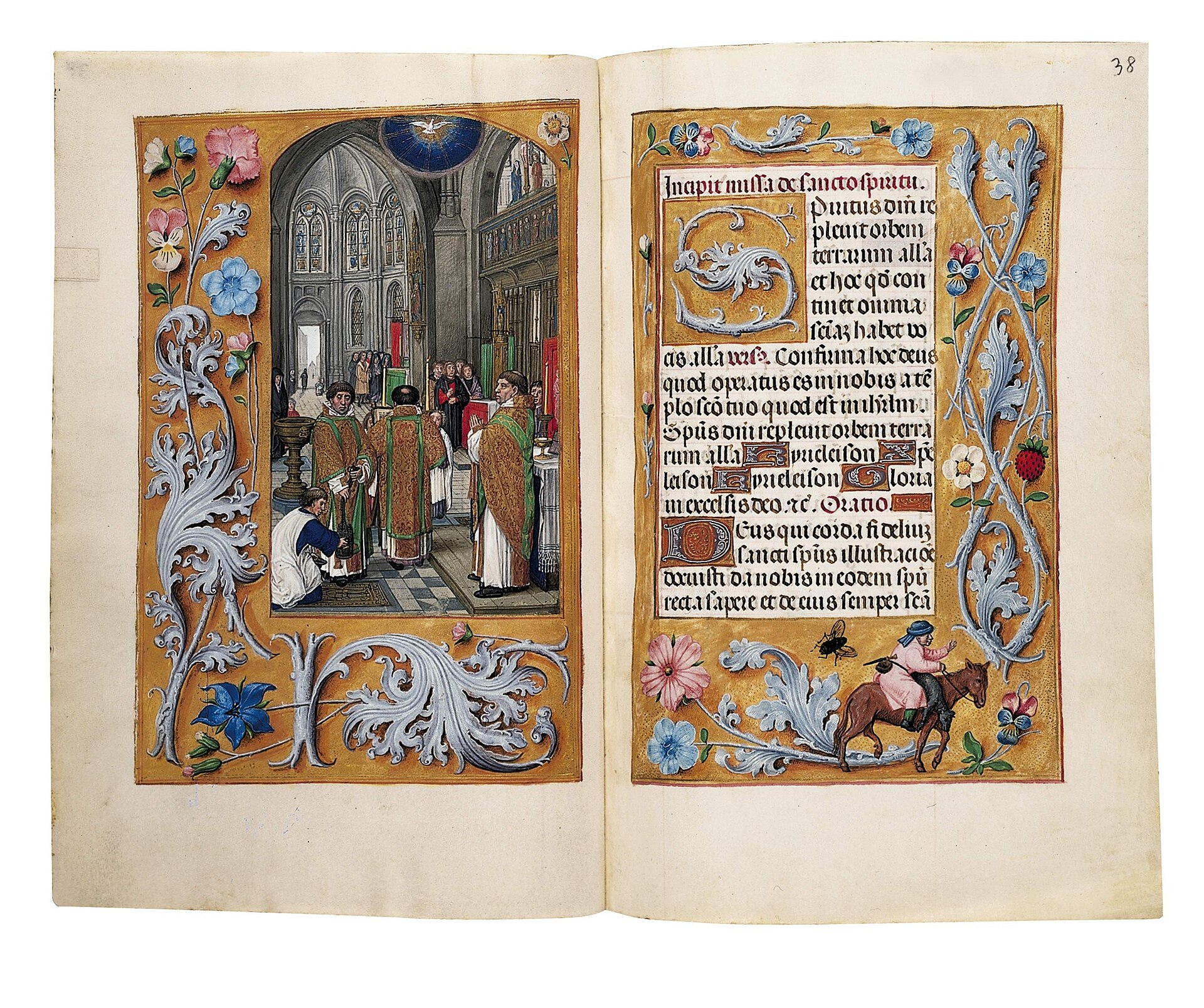
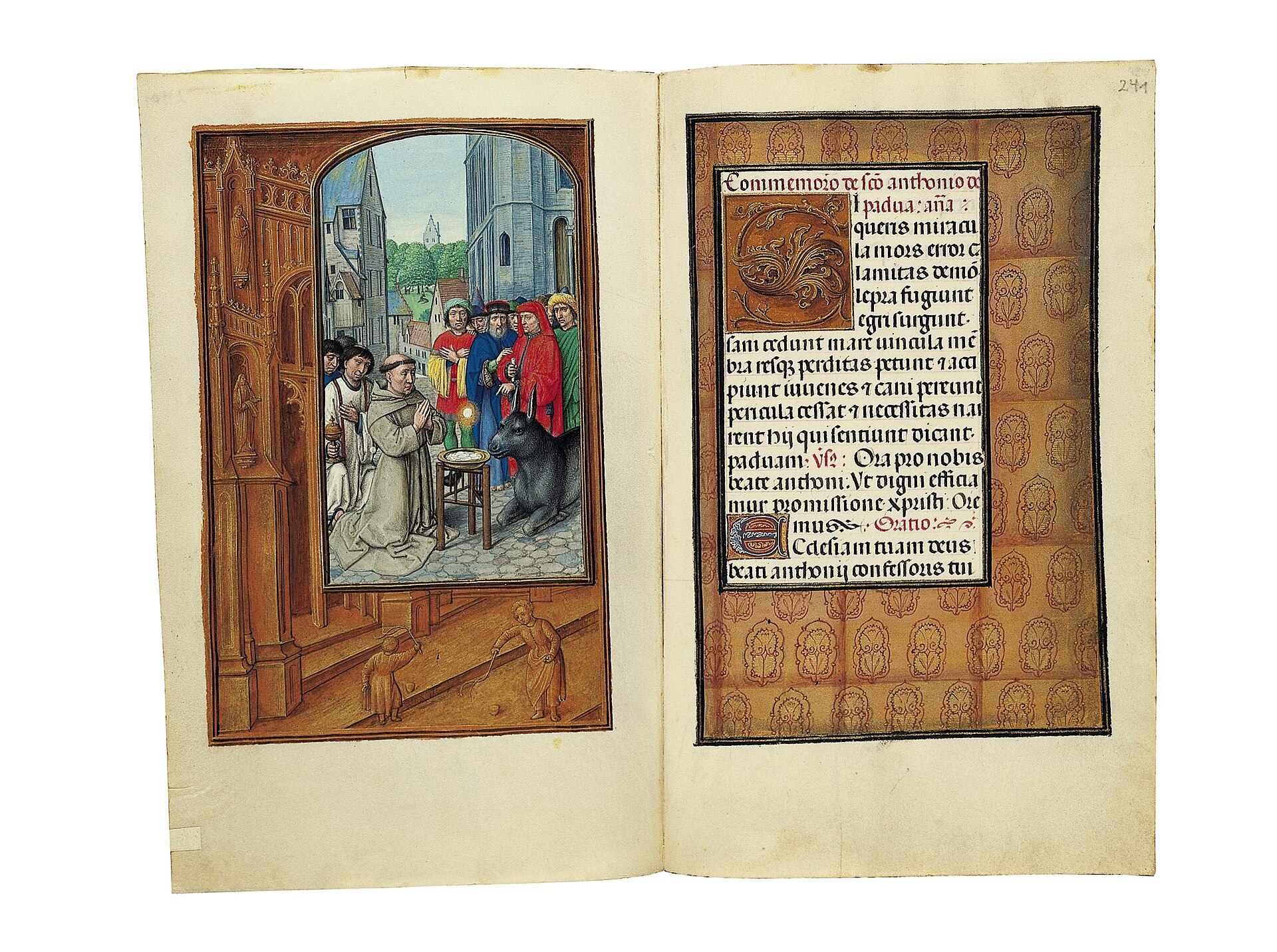
The record subject. One of Horenbout's liturgical openings for the abbreviated Masses of the days of the week: the celebration itself on the left, the text on the right, both framed in trompe l'oeil borders of acanthus and strewn flowers with a fly and a rider on a mule painted as if resting on the surface of the vellum.
| Artist | Gerard Horenbout, Alexander Bening and Simon Bening, with Gerard David and the Master of the Prayerbooks of c. 1500 |
|---|---|
| Date | c. 1505-1510, Ghent or Bruges |
| Medium | Tempera, gold and ink on vellum |
| Dimensions | 228 x 160 mm; 252 leaves |
| Where it is now | Kerry Stokes Collection, Perth, lent for public display in Australialast confirmed 4 August 2026 |
| Inventory number | Formerly Vienna, Oesterreichische Nationalbibliothek, Codex Vindobonensis Series Nova 2844 |
| Attribution | AttributedNo contract, colophon or signature survives, and the miniatures are divided among hands by connoisseurship. Full note |
| Object type | Manuscript |
| Period | Flemish, early sixteenth century |
| Cases | Has a provenance gap · Seized, looted or confiscated · Restituted or repatriated |
| Inscriptions | No arms, emblem or portrait identifying an original owner. Rothschild inventory number 927 on a label at the upper corner of the lower cover and AR3390 in pencil on the front flyleaf. Arms in the painted stained glass behind St Vincent on f.238v, including a displayed eagle and a shield of gules with a chevron and three small charges or. |
| Owners on record | 10 links7 documented, 1 disputed, 2 unknown |
| Sources | 6 cited |
About this record Last verified 13 August 2026 · 6 sources cited · Change log
On this page 12 sections
ContentsClose
A Flemish book of hours of about 1505 to 1510, 252 leaves carrying sixty-seven full-page miniatures by the leading illuminators of the last generation of the craft, and the most expensive illuminated manuscript ever sold at auction. It has set that record twice, in 1999 and again in 2014.
Between those two sales lies the reason it came to market. Appropriated from the Rothschild palace in the Theresianumgasse in Vienna in 1938, it was handed after the war to the Austrian National Library under the export-permit system by which the Republic extracted donations from the families it had failed to protect, and catalogued for half a century as Codex Vindobonensis Series Nova 2844. Austria's restitution law of December 1998 sent it back to the heirs, who sold it the following July.
Nobody knows who it was made for. There is no coat of arms, no emblem and no donor portrait anywhere in it. The arms on the binding belong to a later owner and to a set of silver-gilt mounts made a generation after the book.
Provenance
Each link is graded. Documented: a cited source supports it. Disputed: the identification is argued but not established. Unknown: no owner for that span, and the gap is not smoothed into a narrative. The grades in the glossary.
- c. 1505 - mid-16th centuryUnknown patron, Ghent or Brugesunknown
The manuscript contains nothing that identifies its intended first owner: no arms, no emblems, no portrait. The Suffrages on ff.239-246v are later modifications in a different scribe's hand and may reflect a patron's wishes; the arms in the painted stained glass on f.238v, a displayed eagle and a shield of gules with a chevron and three small charges or, have not been identified. Christie's notes that there is no firm evidence for the intended owner of any manuscript in this group.1
- mid-16th century - 1860sPossibly the house of Wittelsbachdisputed
The silver-gilt centrepieces carry the lion rampant of the Palatinate and the diaper of Bavaria, and are attributed to the workshop or circle of Wenzel Jamnitzer of Nuremberg. That is the whole of the evidence, and it is evidence about the mounts rather than about the book. Christie's states that nothing supports Trenkler's 1979 suggestion that the arms are those of Herzog Ernst von Wittelsbach and that the manuscript was later in the Palatine library, so accounts that route it through Heidelberg are repeating a rejected proposal. It is also possible the metalwork joined the book in the nineteenth century.1
- c. 1868 - 1874Baron Anselm von Rothschild (1803-1874), Viennadocumented
Number 597 in Schestag's 1872 catalogue of Anselm's collection. Number 595 in the same catalogue, the Bening prayerbook for Cardinal Albrecht von Brandenburg now in the Getty, was bought in 1868, which points to an acquisition shortly after that date. J. H. Middleton noted in 1892 that two books of hours with miniatures by Gerard David had been in the collection of the late Baron Anselm Rothschild of Vienna.1
- 1874 - 1905Baron Nathaniel von Rothschild (1836-1905), son of Anselmdocumented
Number 452 in the February 1906 inventory of his estate, listed as hanging in the Galerie of the palace in the Theresianumgasse and valued at 150,000 Kronen. The Brandenburg prayerbook, number 453, was valued at 80,000.1
- 1905 - 1938Baron Alphonse von Rothschild (1878-1942), Viennadocumented
He inherited Nathaniel's palace and, presumably, the manuscript with it. It appears in two subsequent inventories of the palace, whose numbers survive on the object: 927 on a label at the upper corner of the lower cover and AR3390 in pencil on the front flyleaf. Note that Wikipedia names Louis Nathaniel von Rothschild as the owner from whom it was seized; the Christie's catalogue names Alphonse, and this record follows the catalogue while recording the conflict.12
- 1938 - c. 1947Appropriated by the German authorities after the Anschlussdocumented
The manuscript remained in the Theresianumgasse palace until 1938, when it was appropriated. What happened to it between the seizure and its recovery, and whether it was earmarked for the projected Fuehrermuseum at Linz, has not been established in the sources consulted.1
- c. 1947 - 1999Oesterreichische Nationalbibliothek, Viennadocumented
After the war Austria required owners of restituted property to donate significant works to state collections in exchange for permits to export the rest. The manuscript went to the Austrian National Library on those terms and was shelfmarked Codex Vindobonensis Series Nova 2844. It was published in full facsimile from that shelfmark at Graz in 1979.12
- 1998 - 1999The Rothschild heirsdocumented
Returned under the Austrian art restitution law of December 1998 and sold within months. The exact date of the restitution decision affecting this object has not been established here; sources give both 1998 and 1999 for the return.12
- 1999 - 2014Not identified in any source consultedunknown
Bought at Christie's London on 8 July 1999, lot 102, for GBP 8,580,000. The buyer was not publicly identified and the seller in 2014 has not been identified either. Fifteen years of this manuscript's ownership carry no name.
- 2014 - presentKerry Stokes, Perthdocumented
Bought at Christie's New York on 29 January 2014, sale 2819 lot 157, for USD 13,605,000 with fees. The buyer remained anonymous until September 2014. The manuscript is part of the Kerry Stokes Collection and has been lent for display in Australia, reported at the National Library of Australia in Canberra.123
Prices realised
| Date | Sale | Estimate | Result | Note |
|---|---|---|---|---|
| 8 July 1999 | Christie's, London The Collection of the Barons Nathaniel and Albert von Rothschild, lot 102 | A high estimate of USD 4.9 million is reported; a separate report gives up to GBP 5 million. Neither has been checked against the catalogue | Hammer GBP 7,800,000 (DERIVED, not stated in any source consulted) With premium GBP 8,580,000 GBP | Christie's published prices include the buyer's premium, so GBP 8,580,000 is the total. The derived hammer assumes a flat 10 per cent premium, which reproduces the published figure exactly; the London scale of the period, 15 per cent on the first GBP 30,000 and 10 per cent above, would give GBP 8,581,500 on the same hammer. The 1,500 pound discrepancy is unresolved, so the hammer is labelled DERIVED. Reported at the time as USD 13,378,558 and as a record for an illuminated manuscript, at close to three times the high estimate. The sale as a whole raised close to USD 90 million. |
| 29 January 2014 | Christie's, New York Renaissance, sale 2819, lot 157 | USD 12,000,000 - 18,000,000 | Hammer USD 12,000,000 (DERIVED, not stated in any source consulted) With premium USD 13,605,000 USD | USD 13,605,000 has been printed as a hammer price, including by the trade press. It is not one: it is not a bid increment, and it is exactly what a hammer of USD 12,000,000 becomes under a premium of 25 per cent on the first USD 100,000, 20 per cent to USD 2,000,000 and 12 per cent above, giving USD 1,605,000 in fees. The derived hammer lands on the low estimate. It must not be promoted to a fact without the Christie's price list for the sale. The result broke the manuscript's own 1999 record for an illuminated manuscript. The buyer, Kerry Stokes, was not revealed until September 2014, on Australian television. The underbidder has not been identified. |
Hammer is the price at which the bidding stopped; with premium adds the fee the house charges the buyer on top. Hammer price and buyer's premium in the glossary.
Technical evidence
| Attribution note | No contract, colophon or signature survives, and the miniatures are divided among hands by connoisseurship. Christie's 2014 catalogue gives the principal work to Gerard Horenbout - who is generally accepted as the illuminator long catalogued under the notname Master of James IV of Scotland - and to Alexander Bening, widely accepted as the Master of the Older Prayerbook of Maximilian I, with his son Simon Bening, one miniature accepted as Gerard David's, and several by the Master of the Prayerbooks of c. 1500. The Suffrages are the contested section: two miniatures on a single bifolium often appear to be by different artists, and Gerard David, Horenbout and Simon Bening have all been proposed for the same leaves. |
|---|---|
| Extent | 252 leaves. Wikipedia gives 254; the Christie's 2014 catalogue, which is the fuller description, gives 252 and this record follows it.12 |
| Page size | 228 x 160 mm.12 |
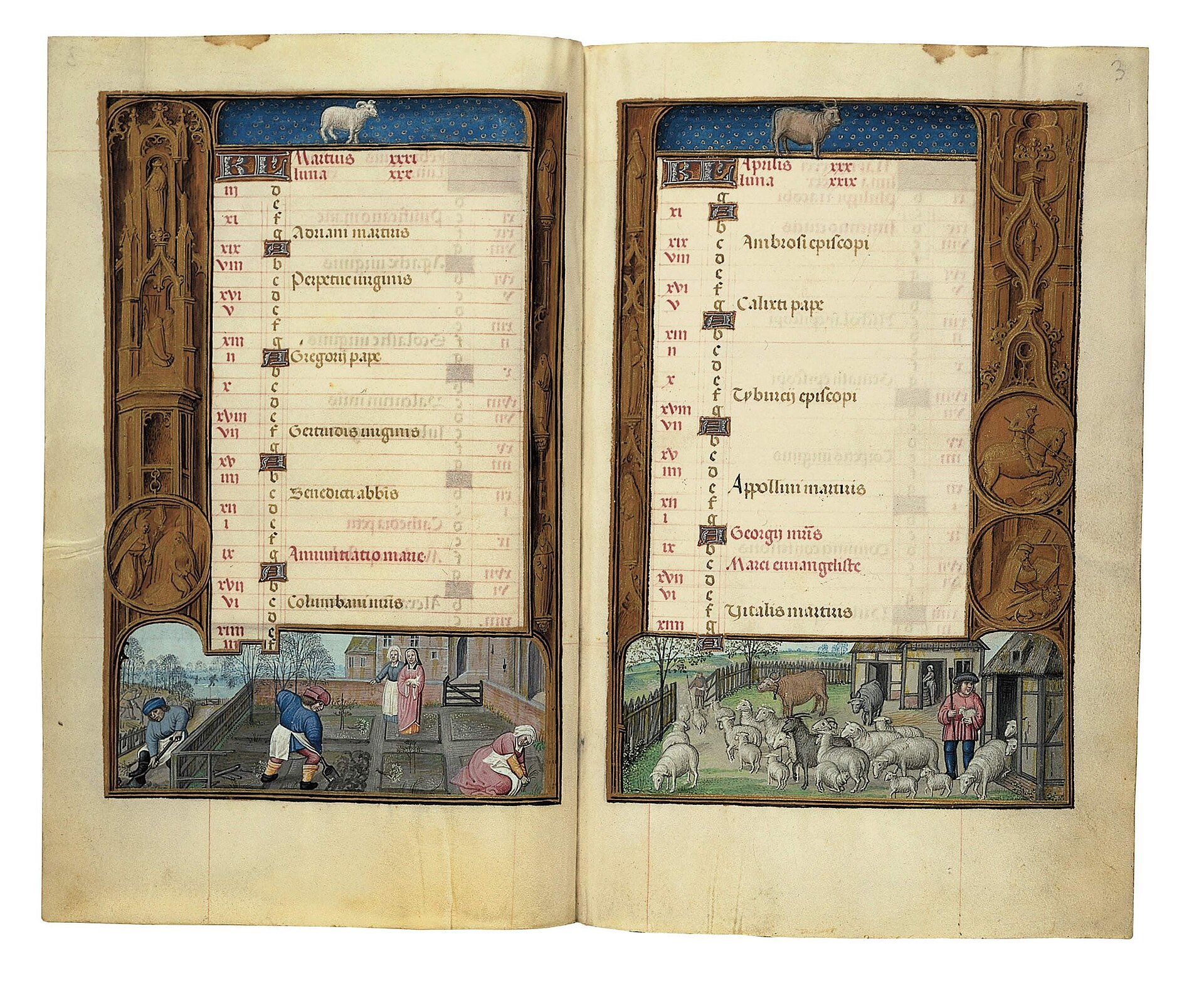
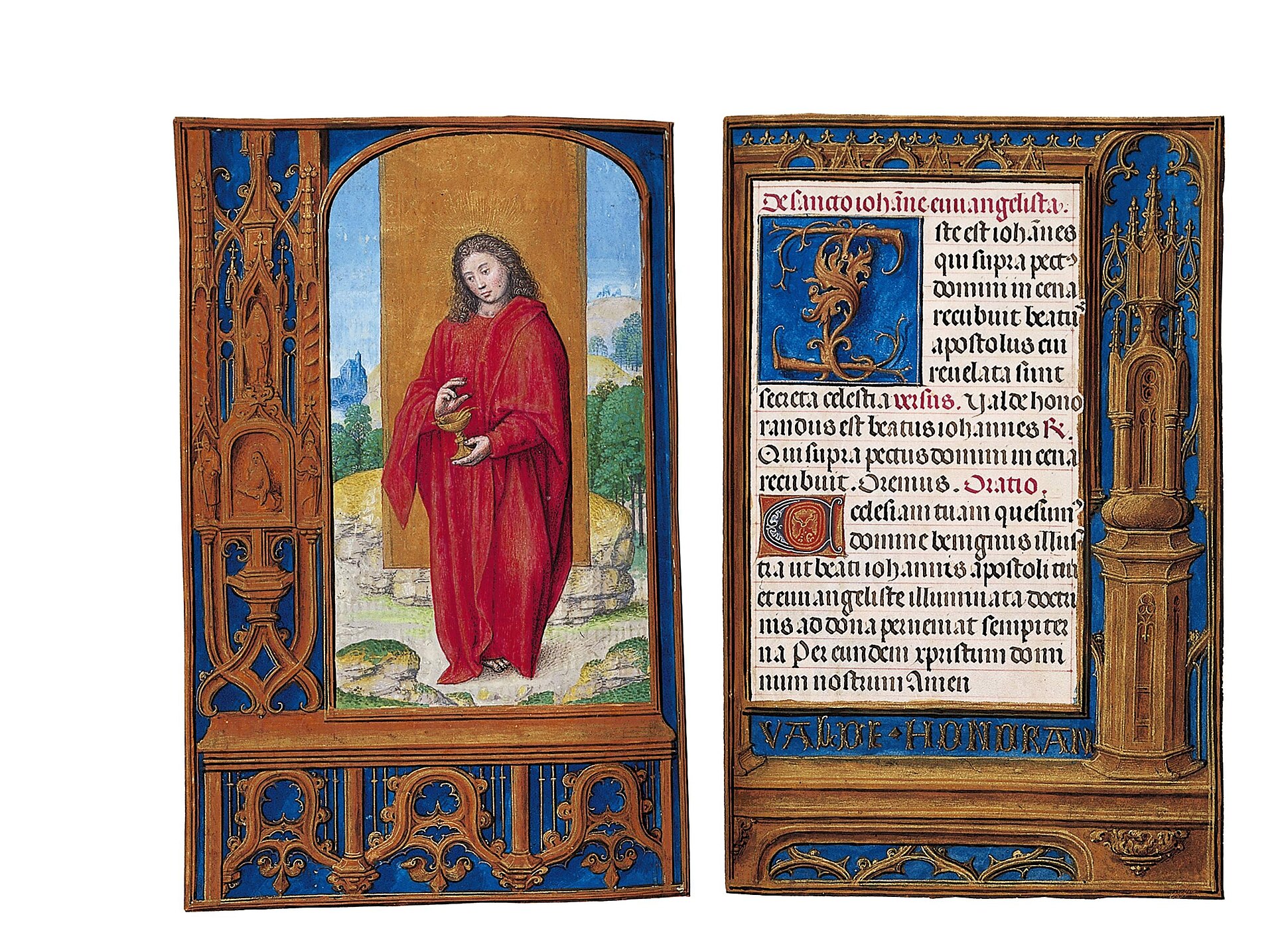
| Illumination | Sixty-seven full-page arch-topped miniatures with surrounding borders and complementary borders facing; twelve full-page calendar borders in camaieu d'or frames with roundels of feasts and zodiac signs and full-colour occupations of the months; five small miniatures with full-page borders; two further text pages with full borders; every devotion opening with a five- or six-line illuminated initial.1 |
| Losses | Lacking four leaves, three of them with miniatures and one with a full-page border. Slight pigment losses in the backgrounds of two miniatures, ff.120v and 124v; small smudges at border edges on ff.1v, 2, 5v and 125.1 |
| Support | Vellum. Christie's singles out the quality of the parchment as one of the things that places the book among the most prestigious examples of Flemish illumination.1 |
| Text and use | A book of hours, use of Rome, in Latin. Calendar ff.1v-7; abbreviated Offices and Masses for the days of the week ff.10v-79; Gospel extracts; Office of the Virgin ff.84v-140v; Obsecro te and O Intemerata; Seven Penitential Psalms and Litany; Office of the Dead ff.165-196v; Seven Joys of the Virgin ff.198-199; thirty-seven Suffrages ff.204-243; Athanasian Creed ff.247-249v.1 |
| Binding | Red velvet, renewed, over mid-sixteenth-century silver-gilt cast and chased centrepieces, cornerpieces, clasps and catches attributed to the workshop or circle of the Nuremberg goldsmith Wenzel Jamnitzer, died 1585. Leaf edges gilt and gauffered to a diaper pattern. The centrepieces carry the lion rampant of the Palatinate and the diaper of Bavaria.1 |
| Evidence the book was not cut down | Two miniatures inside the manuscript depict bound books with edges gauffered to the same diaper pattern that survives on this volume, which indicates it was not trimmed when rebound.1 |
| Owner's marks | Rothschild inventory 927 on a label at the upper corner of the lower cover; AR3390 in pencil on the front flyleaf; number 597 in Schestag's 1872 catalogue of Anselm von Rothschild's collection; number 452 in the February 1906 inventory of Nathaniel von Rothschild's estate.1 |
| Austrian shelfmark | Codex Vindobonensis Series Nova 2844, Oesterreichische Nationalbibliothek, Vienna, from the post-war years until 1999. Published in full facsimile from that shelfmark at Graz in 1979.12 |
| Related manuscripts | Grouped by Christie's with the London Hours (British Library Add. MS 35313), the Spinola Hours (J. Paul Getty Museum, Ludwig IX 18) and the Grimani Breviary (Biblioteca Marciana, Venice, MS Lat. XI).16 |
Images
The record in full
Chapter 1252 leaves, sixty-seven miniatures, and four leaves gone
The book measures 228 by 160 millimetres and runs to 252 leaves.
The book measures 228 by 160 millimetres and runs to 252 leaves. Christie's catalogued sixty-seven full-page arch-topped miniatures with surrounding borders and complementary borders on the facing pages, twelve full-page calendar borders framed in camaieu d'or with roundels of the feasts and the zodiac signs and full-colour miniatures of the occupations of the months, five small miniatures with full-page borders of their own, and two further text pages with full borders.
Four leaves are missing, three of them with miniatures and one with a full-page border. There are slight pigment losses in the backgrounds of two miniatures, on folios 120 verso and 124 verso, and small smudges at the edge of borders on four other leaves. Otherwise the catalogue describes it as in immaculate condition.
That is worth stating flatly because the sale coverage did not. The most expensive illuminated manuscript ever auctioned is an imperfect copy, and three of its full-page miniatures have been cut out.
Chapter 2The Master of James IV of Scotland is Gerard Horenbout
Anyone reading about this manuscript will meet two lists of artists that do not match, and the reason is that one of the painters has been catalogued for a century under two names.The illuminator...
Anyone reading about this manuscript will meet two lists of artists that do not match, and the reason is that one of the painters has been catalogued for a century under two names.
The illuminator called the Master of James IV of Scotland, named from a portrait in a book of hours in Vienna, is generally recognised as Gerard Horenbout, a documented Ghent artist. Christie's states the identification as settled. A record that lists both as separate contributors is counting one man twice, and several accounts of this book do exactly that.
Horenbout became court painter to Margaret of Austria, Regent of the Netherlands, in 1515. He designed tapestries and stained glass as well as painting and illuminating. In the 1520s he moved to England with his family and appears in the accounts of Henry VIII's household between 1528 and 1531. Christie's argues that the Prayerbook predates his entry into Margaret's household, and that it was on the strength of this work that she appointed him.
Chapter 3A father, a son, and a guild register
Horenbout's principal collaborator is known as the Master of the Older Prayerbook of Maximilian I, after a manuscript made for the emperor, and is now widely believed to be Alexander Bening.The...
Horenbout's principal collaborator is known as the Master of the Older Prayerbook of Maximilian I, after a manuscript made for the emperor, and is now widely believed to be Alexander Bening.
The identification rests on the correspondence between the career the pictures imply and a documented life: Alexander, or Sanders, Bening joined the painters' guild in Ghent in 1469 and died there in 1519. He was a friend of Hugo van der Goes and of Justus of Ghent, and is regarded as the most productive pupil of the illuminator known as the Vienna Master of Mary of Burgundy. What supports the identification in this particular book is that his work is so closely integrated with that of his son Simon Bening, born about 1483 and dead in 1561, who became the most celebrated illuminator in Europe.
Simon's most individual contribution here is the Vision of St Bernard on folio 245 verso. His Miracle of the Ass and St Anthony of Padua, on folio 240 verso, is a version of a miniature his father had painted for the Breviary of Eleanor of Portugal, a design that Gerard David then took up and reversed for a panel painting. Three generations of the same composition, in two media, inside one family workshop.
A fourth hand, the Master of the Prayerbooks of c. 1500, contributed several miniatures for the Hours of the days of the week and some of the infancy scenes in the Office of the Virgin. He is better known for secular manuscripts, above all the Roman de la Rose in the British Library. His Nativity at the opening of prime, on folios 108 verso and 109, is bordered by further episodes of the story and faces a scene of shepherds dancing at the angels' announcement - four painters' work interlocking across one opening.
Chapter 4The one miniature that is a painting
On folio 197 verso, introducing the Seven Joys of the Virgin, is a three-quarter-length Virgin and Child on a crescent moon, isolated against a golden radiance inside a narrow pearl-studded frame...
On folio 197 verso, introducing the Seven Joys of the Virgin, is a three-quarter-length Virgin and Child on a crescent moon, isolated against a golden radiance inside a narrow pearl-studded frame, with two small angels holding a crown above her head. It is handled in a completely different manner from everything around it and is accepted as the work of Gerard David, the Bruges panel painter.
The catalogue's own reasoning is unusually candid about how such an attribution is made. The drapery and figure style suggest the composition was drawn by the Older Prayerbook Master, and the angels may be his too. What is given to David is the mother and the child, on the ground that the handling conveys their relationship as well as their appearance, and that this is comparable to his Virgin among Virgins in the Morgan Library. On the same grounds two further miniatures, a St Catherine and a St Clara, are proposed for him.
A single miniature by a named panel painter inside a manuscript is exactly the kind of attribution that moves a price, and it is an argument from quality rather than a document. This record marks it as such.
Chapter 5Flowers that cast shadows on the page
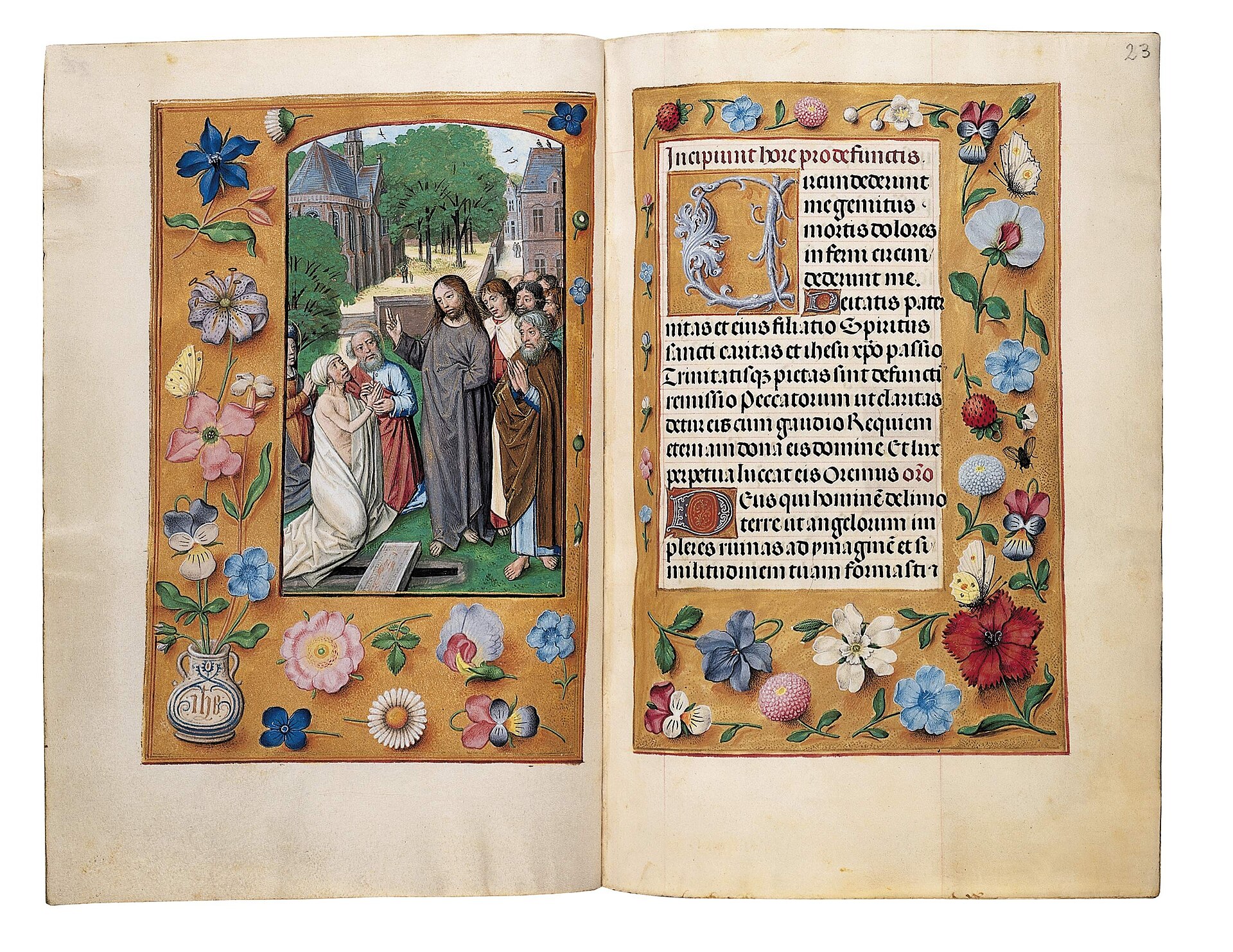
Over half the book carries significant decoration outside the text.
Over half the book carries significant decoration outside the text. The borders are the reason it is famous, and they are systematically deceptive.
They are described as richly varied trompe l'oeil: sprays of acanthus and strewn flowers with insects and vignettes, camaieu d'or architectural surrounds with sculptural figures and reliefs, jewels and enamels against coloured grounds, and individual borders that replicate cloth of gold and peacock feathers. Naturalistic flowers lie as if scattered on the surface of the vellum and cast shadows onto it. On some pages the border carries a narrative of its own, extending or answering the subject of the miniature.
The device is not this workshop's invention. It goes back to the Vienna Master of Mary of Burgundy and to the margins of the Hours of Engelbert of Nassau in the Bodleian, usually dated to the 1480s, and Alexander Bening was among the earliest to use it. Two of the most striking borders here, the peacock feathers on folio 225 verso and the skulls on folio 164 verso, trace back to that source.
Chapter 6A record of the Mass as it was actually celebrated
The first sequence of devotions, the abbreviated Offices and Masses for the days of the week, presented a problem: there is no conventional set of images for it.
The first sequence of devotions, the abbreviated Offices and Masses for the days of the week, presented a problem: there is no conventional set of images for it. Horenbout's answer was to paint, for each feast, a moment from the celebration of its Mass.
The result is a series of liturgical scenes devised individually rather than copied, showing vestments, altars, celebrants and congregations in real architectural space. Christie's calls it a fascinating record of contemporary liturgical practice and setting, and it is: a book made for private devotion contains one of the better visual records of how the public rite was performed in the Netherlands around 1505.
That is what the object was for. A book of hours is not a picture gallery; it is an instrument for saying the right words at the right hours of the day, and the pictures are there to fix attention on what is being said. The Offices of the Virgin and of the Dead, which carry Horenbout's most prominent miniatures, are the two sequences a lay owner would have used most.
Chapter 7Nobody knows who it was made for
For a production this expensive the silence is remarkable.
For a production this expensive the silence is remarkable. There are no arms, no emblems and no donor portrait anywhere in the manuscript.
Christie's identifies one component that may reflect a commissioning patron: the Suffrages to Saints Vincent, Benedict and Anthony of Padua and two prayers to the Virgin, on folios 239 to 246 verso. These appear to be modifications to the book as originally written and planned. They are in a different scribe's hand from the Suffrages before them and the Athanasian Creed after them, and they are laid out with no allowance for integral miniatures - yet the miniatures supplied on single leaves are by the same artists as the finest work earlier in the book. In one of them, on folio 238 verso, the stained glass behind St Vincent carries coats of arms, including a displayed eagle and a shield of gules with a chevron and three small charges or.
That is the closest thing to a clue in the entire volume, and it has not been resolved. The manuscript belongs to a group of luxury books made around 1490 to 1520 for an international clientele and for members of the Habsburg court in the Netherlands - the London Hours in the British Library, the Spinola Hours in the Getty, the Grimani Breviary in Venice - and Christie's notes that there is no firm evidence for the intended owner of any of them.
Chapter 8The binding belongs to a different owner
The red velvet is renewed. What is old on the outside of this book is the metalwork: mid-sixteenth-century silver-gilt cast and chased centrepieces, cornerpieces, clasps and catches, attributed to...
The red velvet is renewed. What is old on the outside of this book is the metalwork: mid-sixteenth-century silver-gilt cast and chased centrepieces, cornerpieces, clasps and catches, attributed to the workshop or circle of the Nuremberg goldsmith Wenzel Jamnitzer, who died in 1585. The leaf edges are gilt and gauffered to a diaper pattern.
The centrepieces carry the lion rampant of the Palatinate and the diaper of Bavaria, which is why the manuscript is usually said to have passed through the house of Wittelsbach. That inference comes from the binding mounts and from nothing else. Christie's is explicit that nothing supports Trenkler's suggestion, made in the commentary to the 1979 facsimile, that the arms are those of Herzog Ernst von Wittelsbach and that the book had a later provenance in the Palatine library at Heidelberg. Accounts that send this manuscript through Heidelberg are repeating a rejected proposal.
Two of the miniatures inside the book show bound volumes with edges gauffered to the same diaper pattern that survives on this one, which tells us the leaves were not trimmed when it was rebound, and raises the possibility that red velvet with gilt cornerpieces and clasps was the book's original appearance, replicated for a mid-sixteenth-century owner. It is equally possible the metalwork joined the manuscript in the nineteenth century. Both readings are in the catalogue and neither is settled.
Chapter 9Into the Rothschild collections, and what it was worth in 1906
Anselm von Rothschild, who died in 1874, laid the foundation of the Austrian Rothschild collections and bought Netherlandish pictures in particular.
Anselm von Rothschild, who died in 1874, laid the foundation of the Austrian Rothschild collections and bought Netherlandish pictures in particular. The Prayerbook was number 597 in Schestag's 1872 catalogue of his collection. Number 595 in the same catalogue, the Bening prayerbook made for Cardinal Albrecht von Brandenburg and now in the Getty, had been bought in 1868, which suggests this one was acquired at about the same time.
It passed to his son Baron Nathaniel von Rothschild, and appears as number 452 in the February 1906 inventory of Nathaniel's estate, hanging in the Galerie of the palace in the Theresianumgasse. It was valued there at 150,000 Kronen. The Brandenburg prayerbook, listed immediately after it as number 453, was valued at 80,000.
That pair of numbers is the most useful thing in the whole nineteenth-century record, because it is a valuation made by a family for probate rather than a price made in a saleroom, and it shows that they already regarded this book as worth nearly twice the other. Both are now among the most celebrated Flemish manuscripts in existence.
Nathaniel's palace, and presumably the manuscript with it, went to Baron Alphonse von Rothschild, who died in 1942. Two later inventory numbers of the palace are still on the book: 927 on a label at the upper corner of the lower cover, and AR3390 in pencil on the front flyleaf. It stayed in the Theresianumgasse until 1938.
Chapter 101938, and the donation that was not a donation
Germany annexed Austria in March 1938 and the Rothschild collections in Vienna were appropriated.The part of what followed that the sale coverage does not carry is what the Republic of Austria did...
Germany annexed Austria in March 1938 and the Rothschild collections in Vienna were appropriated.
The part of what followed that the sale coverage does not carry is what the Republic of Austria did afterwards. Objects recovered at the end of the war were returned to Austria and in principle to their owners, but a family that wanted to take restituted property out of the country was expected to donate significant works to Austrian state collections in exchange for export permits. The Rothschilds, who were not staying, gave up a great deal on those terms. This manuscript went to the Oesterreichische Nationalbibliothek and was shelfmarked Codex Vindobonensis Series Nova 2844.
It sat in Vienna for half a century, published in a full facsimile edition in 1979 as an Austrian national treasure, having been obtained by pressure applied to people the same state had failed to protect. Calling that a donation without qualification is the error this record exists to correct.
Chapter 111998 and 1999: the law, and the sale eleven days later
Austria passed its art restitution law in December 1998 after sustained international pressure.
Austria passed its art restitution law in December 1998 after sustained international pressure. The manuscript was among the property returned to the Rothschild heirs.
They sold at once. Christie's offered the collection of the Barons Nathaniel and Albert von Rothschild in London on 8 July 1999, and the Prayerbook was lot 102. It made GBP 8,580,000, reported at the time as USD 13,378,558, then a record for an illuminated manuscript, against a high estimate reported as USD 4.9 million. The sale as a whole raised close to USD 90 million.
Christie's published prices include the buyer's premium, so GBP 8,580,000 is a total. A hammer of GBP 7,800,000 with a flat 10 per cent premium reproduces it exactly, while the London scale of the period, 15 per cent on the first GBP 30,000 and 10 per cent above, would give GBP 8,581,500 on the same hammer. The gap is 1,500 pounds and it is unresolved, so the hammer in this record is given as derived rather than asserted.
Chapter 1229 January 2014: the record set again, and misreported again
Fifteen years later the manuscript returned in Christie's New York sale 2819, Renaissance, as lot 157, estimated at USD 12 million to 18 million.
Fifteen years later the manuscript returned in Christie's New York sale 2819, Renaissance, as lot 157, estimated at USD 12 million to 18 million. It made USD 13,605,000 and broke its own record.
That figure has been printed as a hammer price, including in the trade press. It is not one. USD 13,605,000 is exactly what a hammer of USD 12,000,000 becomes under a premium of 25 per cent on the first USD 100,000, 20 per cent to USD 2,000,000 and 12 per cent above: 25,000 plus 380,000 plus 1,200,000, or USD 1,605,000 in fees. The derived hammer lands on a round increment and on the low estimate, which is what real hammer prices do and what USD 13,605,000 does not.
The buyer stayed anonymous for eight months. In September 2014 the Australian media proprietor Kerry Stokes was revealed as the purchaser on Australian television.
The seller in 2014 has not been identified, and neither has the buyer in 1999. Fifteen years of this book's ownership carry no name at all, which is a gap of the same kind as the four centuries before Anselm von Rothschild, only more recent and more surprising.
Chapter 13Where it is now
The manuscript is part of the Kerry Stokes Collection in Perth and has been lent for public display in Australia, reported as being at the National Library of Australia in Canberra.
The manuscript is part of the Kerry Stokes Collection in Perth and has been lent for public display in Australia, reported as being at the National Library of Australia in Canberra. It was published in 2015 in two books produced around an exhibition of the Stokes collection, one of them Margaret Manion's study of the Prayerbook and other works.
A privately owned manuscript that is exhibited and published is a better outcome for scholarship than most sales of this kind produce. What it does not have is an open digitisation. The images that circulate are the Christie's sale photographs, which is why the plates on this page come from a saleroom rather than a library.
The artist
Gerard Horenbout, Alexander Bening and Simon Bening, with Gerard David
This book has no single author, and two of the men who made it spent the twentieth century catalogued under invented names. The Master of James IV of Scotland and the Master of the Older Prayerbook of Maximilian I are notnames, labels attached to a hand rather than to a person, and both have since been resolved into documented Ghent artists: Gerard Horenbout and Alexander Bening. Bening's son Simon worked alongside him in this manuscript and became the most celebrated illuminator in Europe. They were the last generation of a trade the printing press was destroying, and both families ended by exporting themselves - Horenbout to the household of Henry VIII, the Benings into portrait miniature painting through Simon's daughter Levina.
Exhibited
- 2015An Illumination: The Rothschild Prayer Book and Other Works from the Kerry Stokes Collection 1280-1685Australia
- since 2014Lent for public display from the Kerry Stokes CollectionReported at the National Library of Australia, Canberra
Literature
- F. Schestag, Katalog der Kunstsammlung des Freiherrn Anselm von Rothschild in Wien, Vienna. The manuscript is number 597. (1872)
- Rothschild Gebetbuch: vollstaendige Faksimile-Ausgabe im Originalformat des Codex Vindobonensis Series nova 2844, Codices Selecti LXVII, Graz, 2 vols, commentary by E. Trenkler. The facsimile made while the book was Austrian state property; its Wittelsbach and Palatine provenance argument is rejected by Christie's. (1979)
- F. Unterkircher, Das Rothschild-Gebetbuch: die schoensten Miniaturen eines flaemischen Stundenbuches, Graz. (1984)
- T. Kren and S. McKendrick, eds, Illuminating the Renaissance: the Triumph of Flemish Manuscript Painting in Europe, catalogue of the exhibition at the J. Paul Getty Museum and the Royal Academy, 2003-2004.
- C. de Hamel, The Rothschilds and their Collections of Illuminated Manuscripts, London. (2005)
- M. Krieger, Gerard Horenbout und der Meister Jacobs IV. von Schottland, Vienna. On the identification of the notname with the documented artist. (2012)
- Margaret M. Manion, An Illumination: The Rothschild Prayer Book and Other Works from the Kerry Stokes Collection 1280-1685; and Revealing the Rothschild Prayer Book c. 1505-1510, Fremantle Press. (2015)
Related works
| Work | Relation | Where it is |
|---|---|---|
| The London Hours Gerard Horenbout, Alexander Bening and others | One of the closest manuscripts of the same group; also ex-Anselm von Rothschild Number 599 in Schestag's 1872 catalogue of the same collection, alongside this manuscript at 597. Middleton in 1892 cited the two together as the David manuscripts in Anselm Rothschild's collection. | British Library, London, Add. MS 35313 |
| The Spinola Hours Ghent-Bruges illuminators | Principal manuscript of the same group Suggested, without firm evidence, to have been made for Margaret of Austria. | J. Paul Getty Museum, Ludwig IX 18 |
| The Grimani Breviary Ghent-Bruges illuminators | Principal manuscript of the same group The largest of the group. | Biblioteca Nazionale Marciana, Venice, MS Lat. XI |
| Prayerbook of Cardinal Albrecht von Brandenburg Simon Bening | Bought by the same collector, valued in the same inventory Number 595 in Schestag 1872, acquired 1868; number 453 in the 1906 Rothschild estate inventory, valued at 80,000 Kronen against this manuscript's 150,000. | J. Paul Getty Museum, Ludwig IX 19 |
| Hours of Engelbert of Nassau The Vienna Master of Mary of Burgundy | The source of the border type Usually dated to the 1480s. The peacock-feather and skull borders in the Prayerbook trace back to its margins. | Bodleian Library, Oxford, Douce 219-220 |
| Codex Sassoon An unnamed scribe | The manuscript record this one does not hold USD 38.1 million with fees in 2023. The Rothschild Prayerbook's record is for an ILLUMINATED manuscript specifically, which is how both claims stand side by side. | ANU - Museum of the Jewish People, Tel Aviv |
Open questions
- Who commissioned it? There are no arms, emblems or portrait, and the arms in the painted stained glass on f.238v have not been identified.
- What are the hammer prices? Both published figures are premium-inclusive totals and both hammers in this record are derived from published premium scales.
- Who bought it in 1999, and who was the seller in 2014? Fifteen years of the chain carry no name.
- Are the silver-gilt mounts mid-sixteenth-century furniture from a Wittelsbach owner, or a nineteenth-century addition? Christie's leaves both open.
- Where was the manuscript between the seizure of 1938 and its recovery, and was it earmarked for the Fuehrermuseum at Linz?
- On what date, and under which decision, was it restituted? Sources give both 1998 and 1999.
- Which of the four missing leaves carried which miniatures, and when were they removed?
- Was it Alphonse or Louis Nathaniel von Rothschild who owned it in 1938? The Christie's catalogue and Wikipedia disagree.
- Is there any open digitisation or IIIF manifest? None was found, and the images in circulation are all saleroom photographs.
Questions about this object
What is The Rothschild Prayerbook?
The Rothschild Prayerbook is a manuscript, dated c. 1505-1510, Ghent or Bruges. Medium: Tempera, gold and ink on vellum.
Who made The Rothschild Prayerbook, and is the attribution settled?
The attribution to Gerard Horenbout, Alexander Bening and Simon Bening, with Gerard David and the Master of the Prayerbooks of c. 1500 is recorded here as attributed. No contract, colophon or signature survives, and the miniatures are divided among hands by connoisseurship. Christie's 2014 catalogue gives the principal work to Gerard Horenbout - who is generally accepted as the illuminator long catalogued under the notname Master of James IV of Scotland - and to Alexander Bening, widely accepted as the Master of the Older Prayerbook of Maximilian I, with his son Simon Bening, one miniature accepted as Gerard David's, and several by the Master of the Prayerbooks of c. 1500. The Suffrages are the contested section: two miniatures on a single bifolium often appear to be by different artists, and Gerard David, Horenbout and Simon Bening have all been proposed for the same leaves.
Where is The Rothschild Prayerbook now?
Kerry Stokes Collection, Perth, lent for public display in Australia. Inventory number Formerly Vienna, Oesterreichische Nationalbibliothek, Codex Vindobonensis Series Nova 2844. Last confirmed 4 August 2026. Bought at Christie's New York, 29 January 2014, sale 2819 lot 157.
What has The Rothschild Prayerbook sold for?
Hammer GBP 7,800,000 (DERIVED, not stated in any source consulted); with premium, GBP 8,580,000. Christie's, London, 1999-07-08.
What is still unknown about The Rothschild Prayerbook?
Who commissioned it? There are no arms, emblems or portrait, and the arms in the painted stained glass on f.238v have not been identified.
Sources
- 1Christie's, lot record and catalogue note for lot 157, 'THE ROTHSCHILD PRAYERBOOK, a Book of Hours, use of Rome, in Latin, ILLUMINATED MANUSCRIPT ON VELLUM', sale 2819, Renaissance, New York, 29 January 2014. The primary description: collation, illumination, condition, binding, contents, the attribution argument, the full provenance from Anselm von Rothschild, and the selected bibliography. christies.com/en/...
- 2Wikipedia, 'Rothschild Prayerbook'. Tertiary; used for the Nazi confiscation, the Austrian donation and restitution, the reported sale prices and the loan to the National Library of Australia. Note two conflicts with the Christie's catalogue: it gives 254 leaves against 252, and names Louis Nathaniel von Rothschild as the owner seized from, where the catalogue names Alphonse. en.wikipedia.org/wiki/...
- 3Paul Fraser Collectibles, on the 2014 sale: the estimate of USD 12 to 18 million, the 29 January 2014 date, the 1999 price of USD 13.3 million and the division of hands including the miniature given to Gerard David. paulfrasercollectibles.com/blogs/...
- 4Rare Book Hub, 'Rothschild Prayerbook sells at Christies for $13,605,000'. Cited as the example of the conflation this record corrects: it calls USD 13,605,000 a hammer price. It also gives the estimate as USD 12-18 million and the 1999 result as USD 13,378,558 against a high estimate of USD 4.9 million. rarebookhub.com/articles/...
- 5Robin Halwas Ltd, bookseller's description of Christie, Manson and Woods, 'The Rothschild Prayerbook and the Cornaro Missal: Two Illuminated Manuscripts from the Collection of Anselm von Rothschild', sale catalogue, London, 8 July 1999. Establishes the sale date, the catalogue title and the dedicated two-manuscript catalogue. robinhalwas.com/003038-rothschild-prayerbook-cornaro-miss...
- 6Wikimedia Commons, Category:Rothschild Prayerbook. The plates used here derive from the Christie's 2014 lot page (sale 2819, lot 157) and are tagged public domain as faithful reproductions of a public domain manuscript. Licence verified from the API field LicenseShortName for each file at fetch time. commons.wikimedia.org/wiki/...
Last verified 13 August 2026 · Published 4 August 2026
Change log
13 August 2026 - Re-verified: no change to custody (Kerry Stokes Collection, Perth, since 2014) or any open question - commissioner, hammer prices, the 1999 seller, the mounts' date and the Alphonse-vs-Louis-Nathaniel ownership question all remain genuinely unresolved in every source checked. One publication surfaced in this search, 'Revealing the Rothschild Prayer Book c.1505-1510 from the Kerry Stokes Collection' (Sutton and Manion) - checked directly and confirmed to be the 2015 Kerry Stokes Collection catalogue, not a new study; a bookseller's current-stock listing had made it look like a 2025/2026 title. All six cited source URLs re-resolved live.
2 August 2026 - Record deepened to the house standard: narrative sections, technical evidence, artist dossier, related works and open questions added; provenance chain and auction results replaced with the researched versions; sources rebuilt.
4 August 2026 - Record created at the house standard: researched narrative, technical evidence, maker dossier, graded provenance chain, prices with hammer and premium separated, related works, open questions and sources.