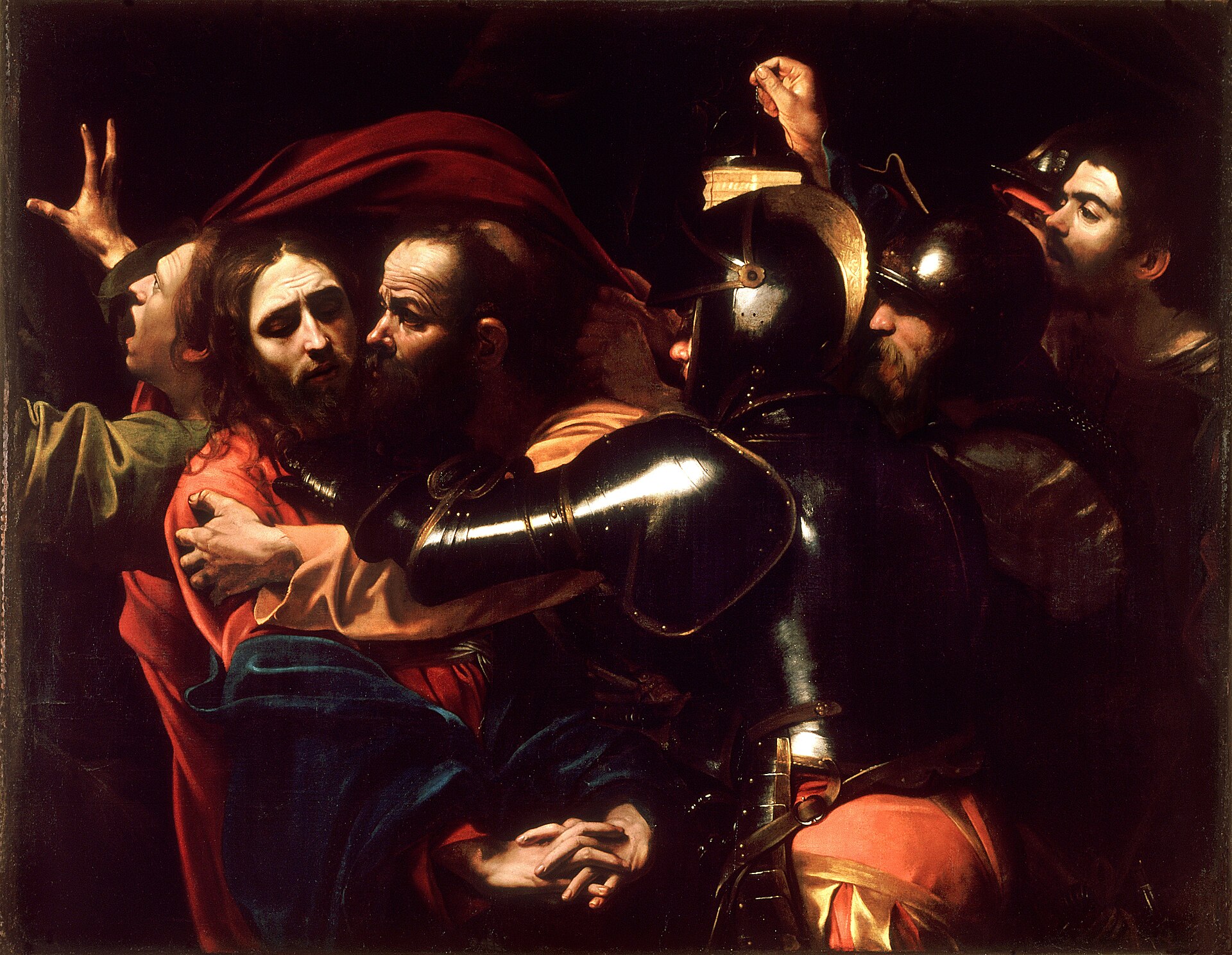
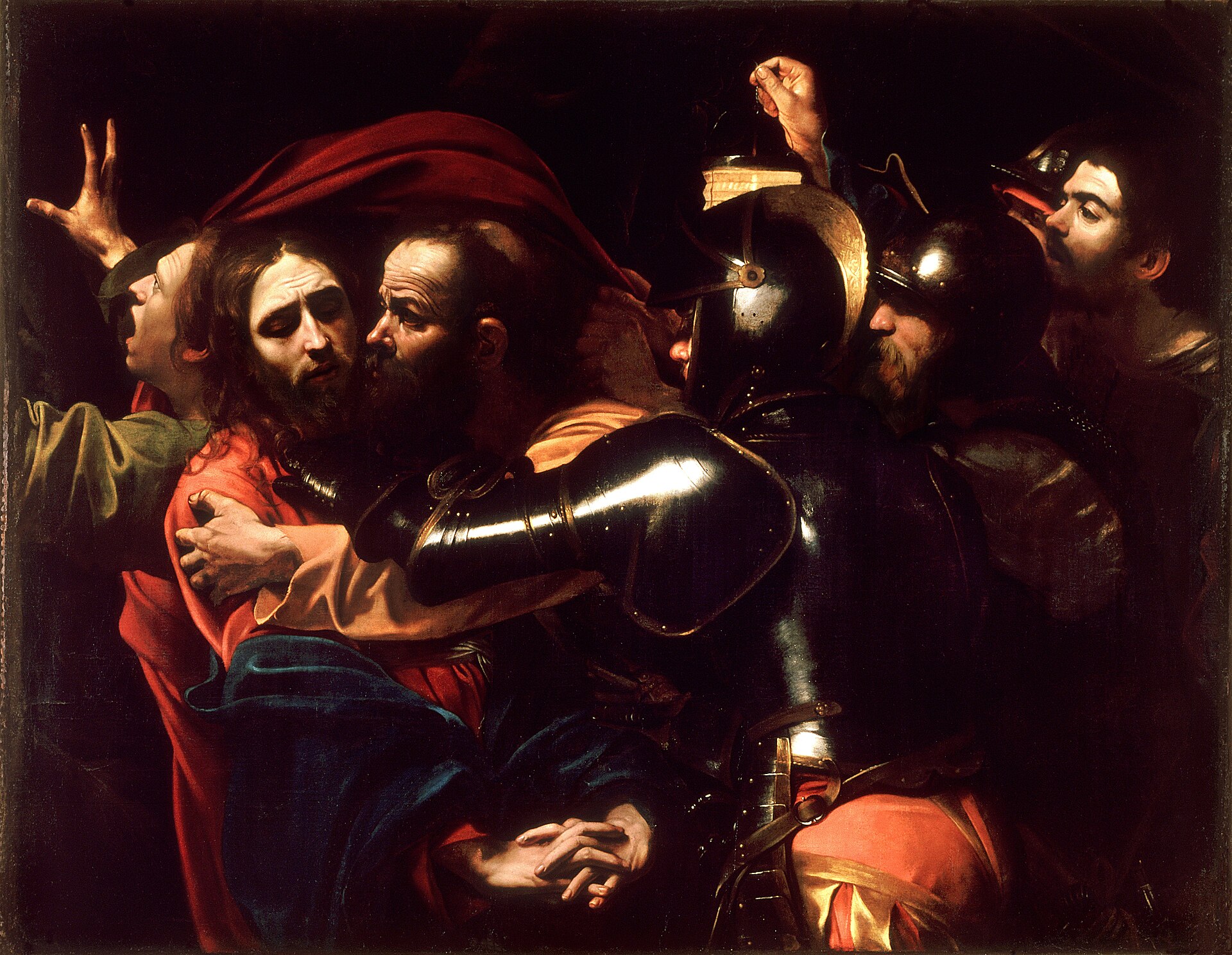
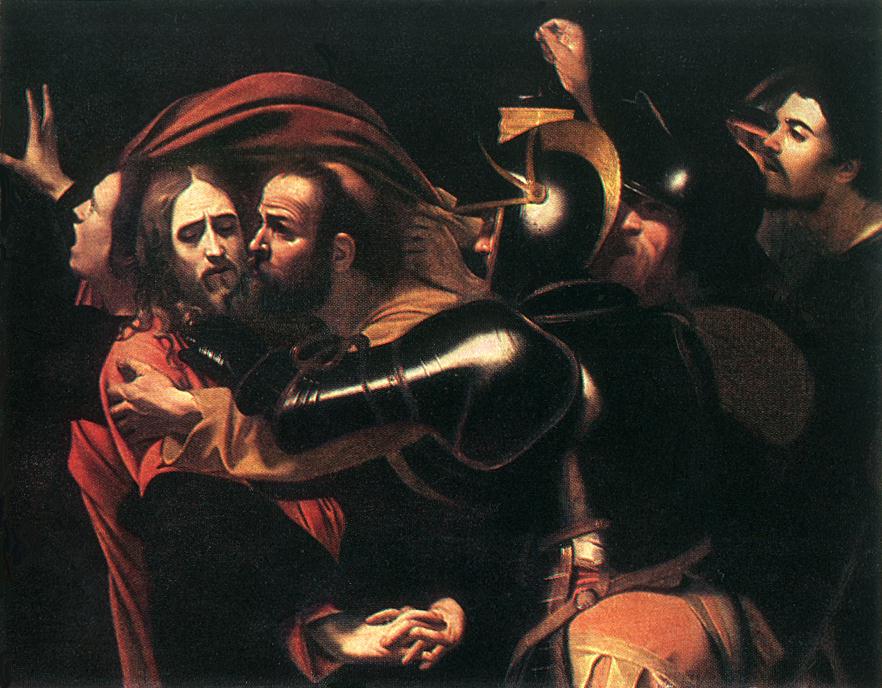
The Taking of Christ
1602 · Oil on canvas
National Gallery of Ireland, Dublin.
 Italian · 1571-1610
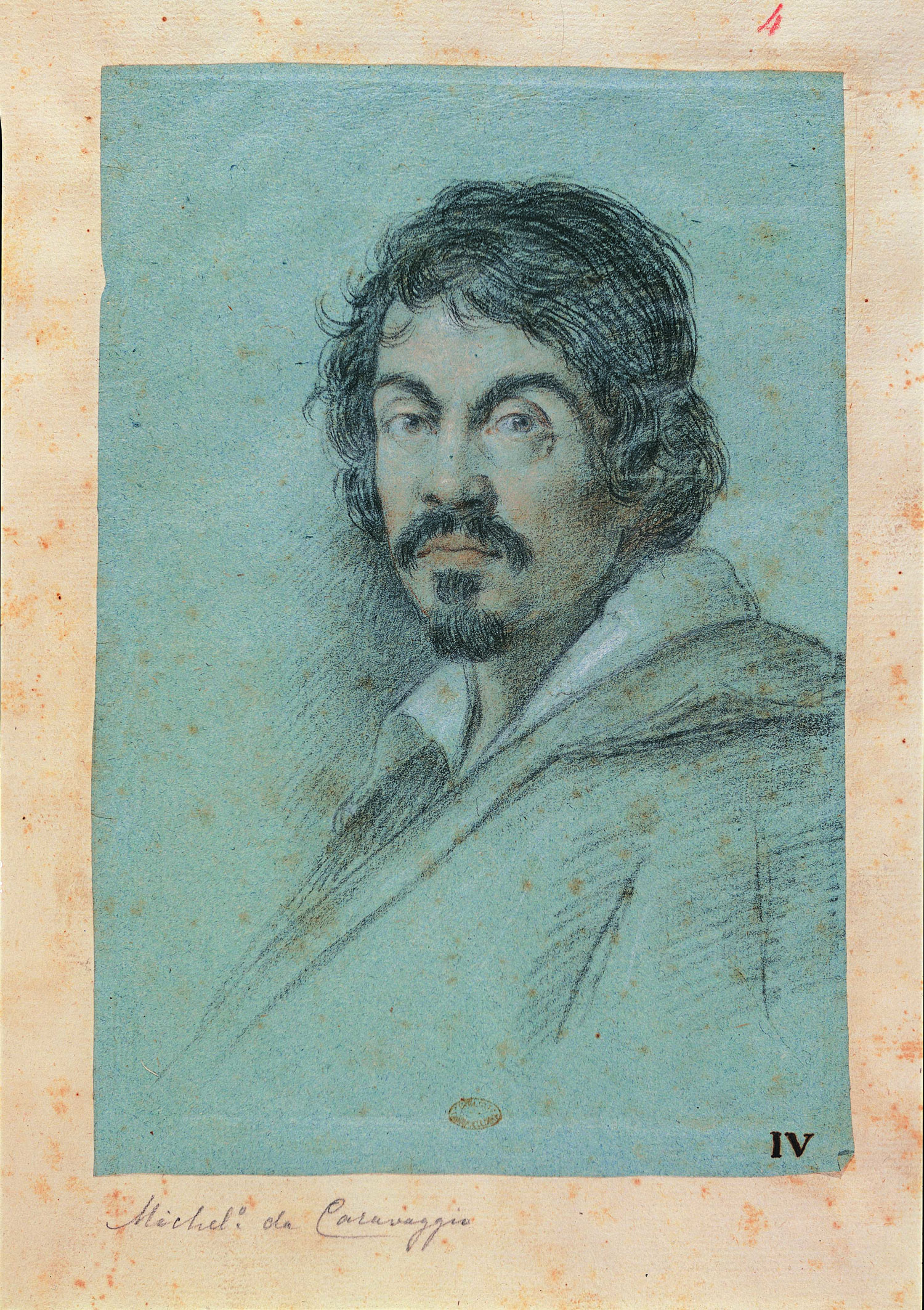
Portrait drawing in coloured chalks traditionally identified as Michelangelo Merisi da Caravaggio, attributed to Ottavio Leoni, Biblioteca Marucelliana, Florence. No securely identified portrait of Caravaggio exists. This sheet is the usual candidate and the ancestor of nearly every likeness published since, but the identification rests on an inscription and on tradition rather than on a documented sitting, and it is not certain. Heads inside his own paintings have been proposed as self-portraits, among them the man holding the lantern in The Taking of Christ, the severed head in the Salome sent to Wignacourt and the head of Goliath in the Borghese David; none is documented as such by the artist or by a contemporary. This record therefore sets verified_is_this_artist to false.
Biblioteca Marucelliana, Florence, via Wikimedia Commons; licence verified as Public domain from extmetadata.LicenseShortName| Full name | Michelangelo Merisi da Caravaggio |
|---|---|
| Worked as | Painter |
| Born | 29 September 1571 · Milan, Duchy of Milan |
| Died | 18 July 1610, the date given by a poet who knew him · Porto Ercole, near Grosseto, Tuscany |
| Nationality | Italian |
| Movement | Roman naturalism of the 1590s and 1600s |
| In this archive | 2 artworks |
| Sources | 36 cited |
| Last verified | 17 September 2026 |
About this page 2 artworks in the archive · Last verified 17 September 2026 · 36 sources cited
The Caravaggio corpus is small, it has no drawings behind it, it was assembled in living memory, and there is nobody with authority to add to it or subtract from it. Those four facts govern everything a buyer, a curator or a court has to decide about this name. The High Court of England and Wales, setting out the background to a negligence trial in 2015, put the number of known paintings at about sixty and recorded that Caravaggio neither taught nor organised a studio of pupils. No preparatory drawing is securely attributed to him. There is no catalogue raisonne the field treats as final. There is no authentication board of the kind that once ruled on other artists, and no successor to one.
What stands in place of all that is a small number of individual scholars, and knowing who they were is the single most useful thing a reader can hold when assessing a Caravaggio attribution. The painter was effectively forgotten for three centuries. Roberto Longhi rebuilt him across four decades of publication, and the rebuilding became a public fact with the exhibition Longhi organised at the Palazzo Reale in Milan in April 1951. Denis Mahon, who wrote on that exhibition, became the principal English-language authority for the next half century. Mina Gregori, Richard Spear, John Spike, Keith Christiansen, Sybille Ebert-Schifferer and Sebastian Schutze followed, and they disagree with one another in print about individual pictures. A Caravaggio attribution is therefore not a fact to be looked up. It is a state of opinion at a date, held by named people, and it moves.
The consequences are commercial, they are recent, and they are litigated. In April 2021 a Madrid saleroom offered a picture as by an associate of Jusepe de Ribera at 1,500 euros; the Spanish state stopped the sale, and the painting hangs in the Prado as a Caravaggio. In March 2026 the Italian state paid 30 million euros for a portrait Longhi had published as autograph in 1963. And in December 2006 a version of the Cardsharps sold at Sotheby's Olympia at a hammer price of 42,000 pounds under the heading Follower of Michelangelo Merisi da Caravaggio, was announced eleven months later by its buyer as an autograph replica, and produced the clearest statement in English law of what a leading auction house owes when it catalogues a picture. This record sets that judgment out in full, because no other page does.
1602 · Oil on canvas
National Gallery of Ireland, Dublin.
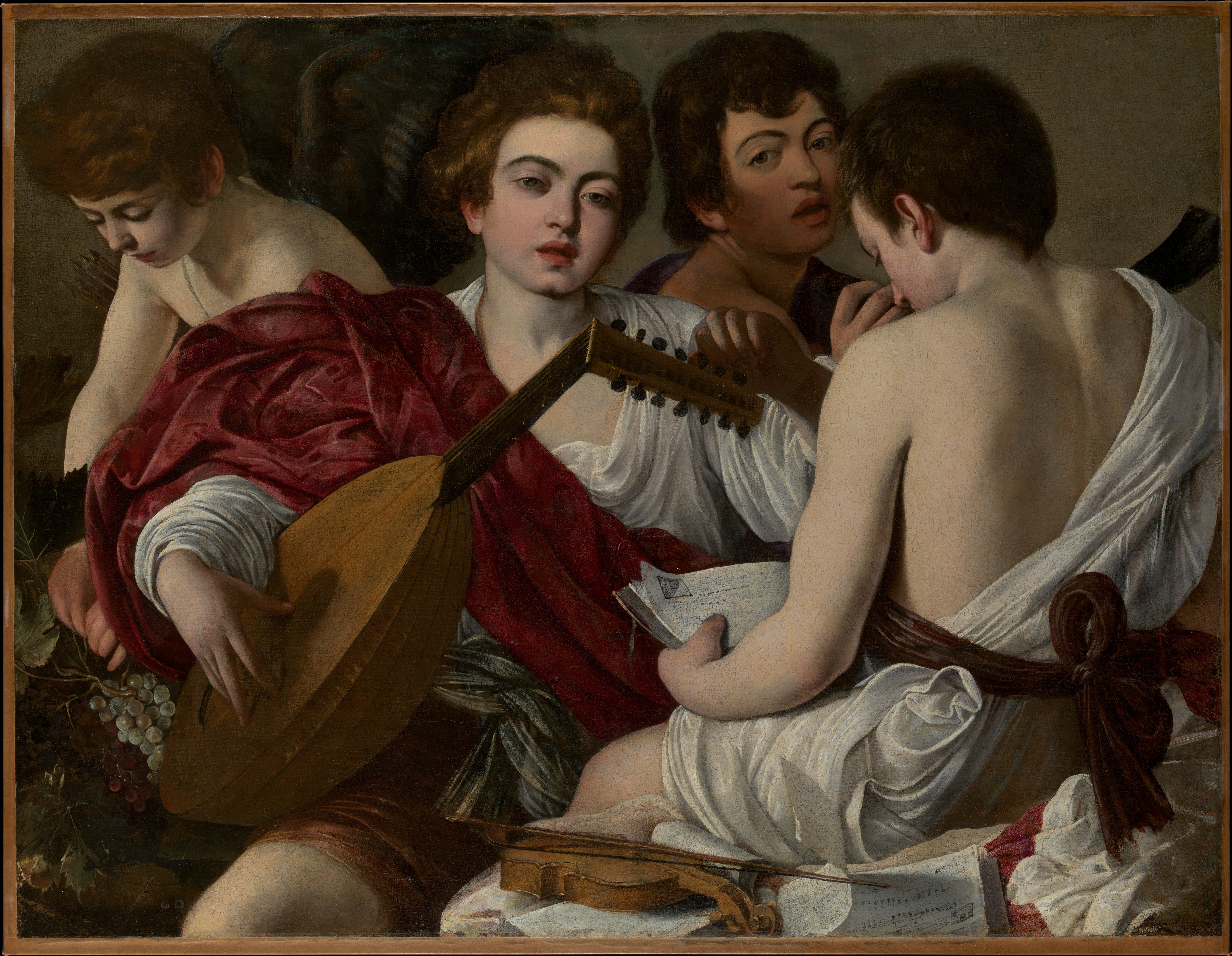
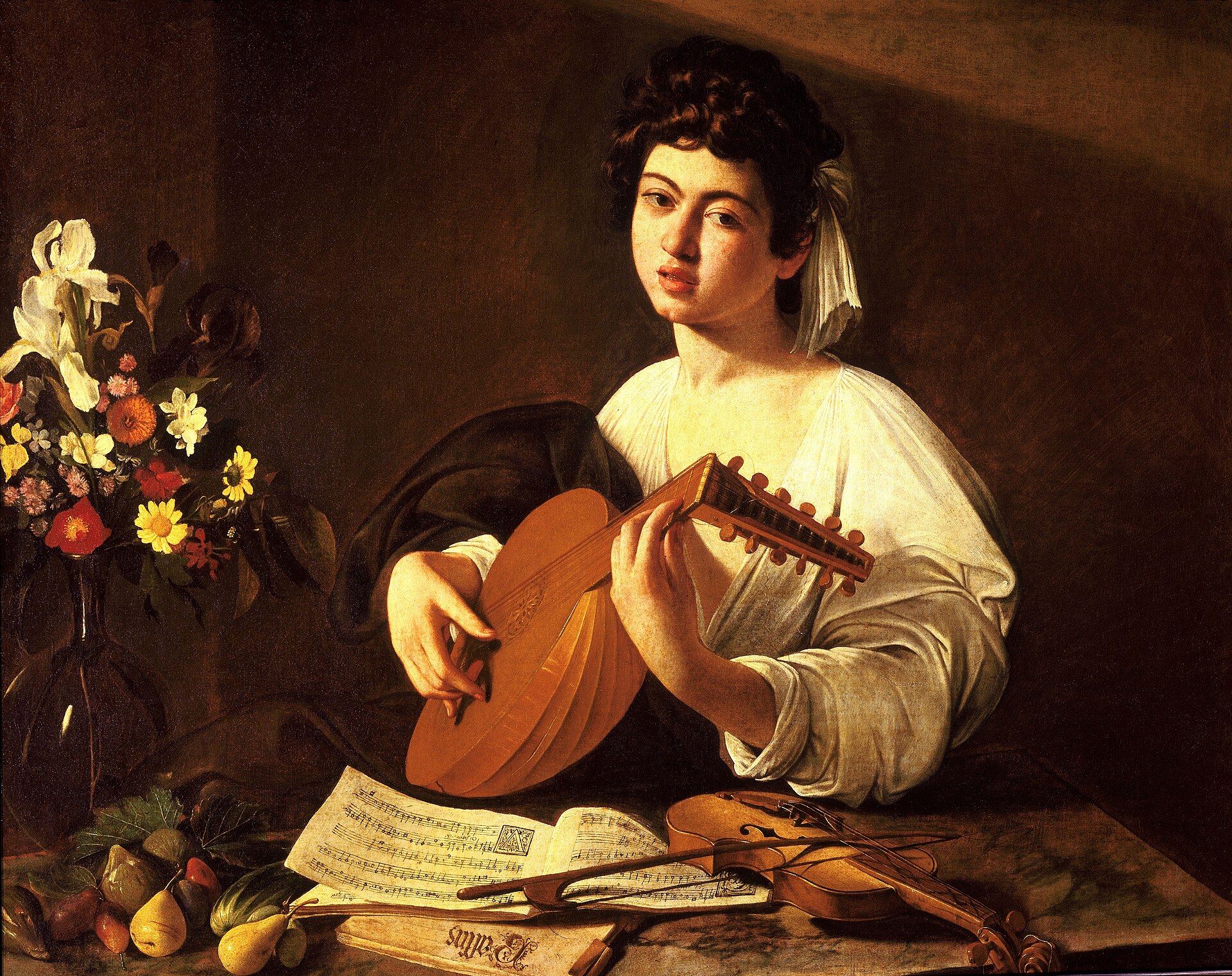
1597 · Oil on canvas
The Metropolitan Museum of Art, New York
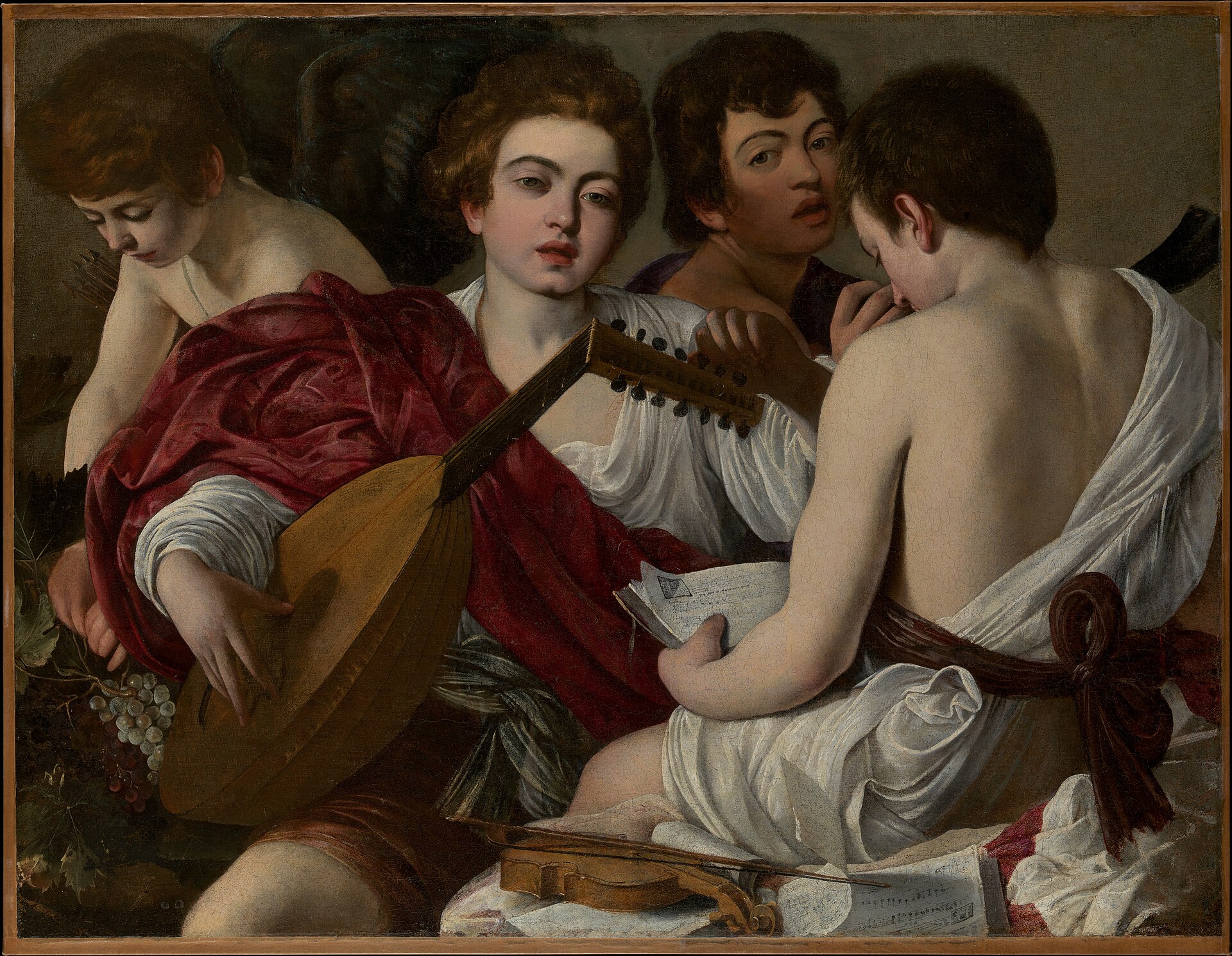
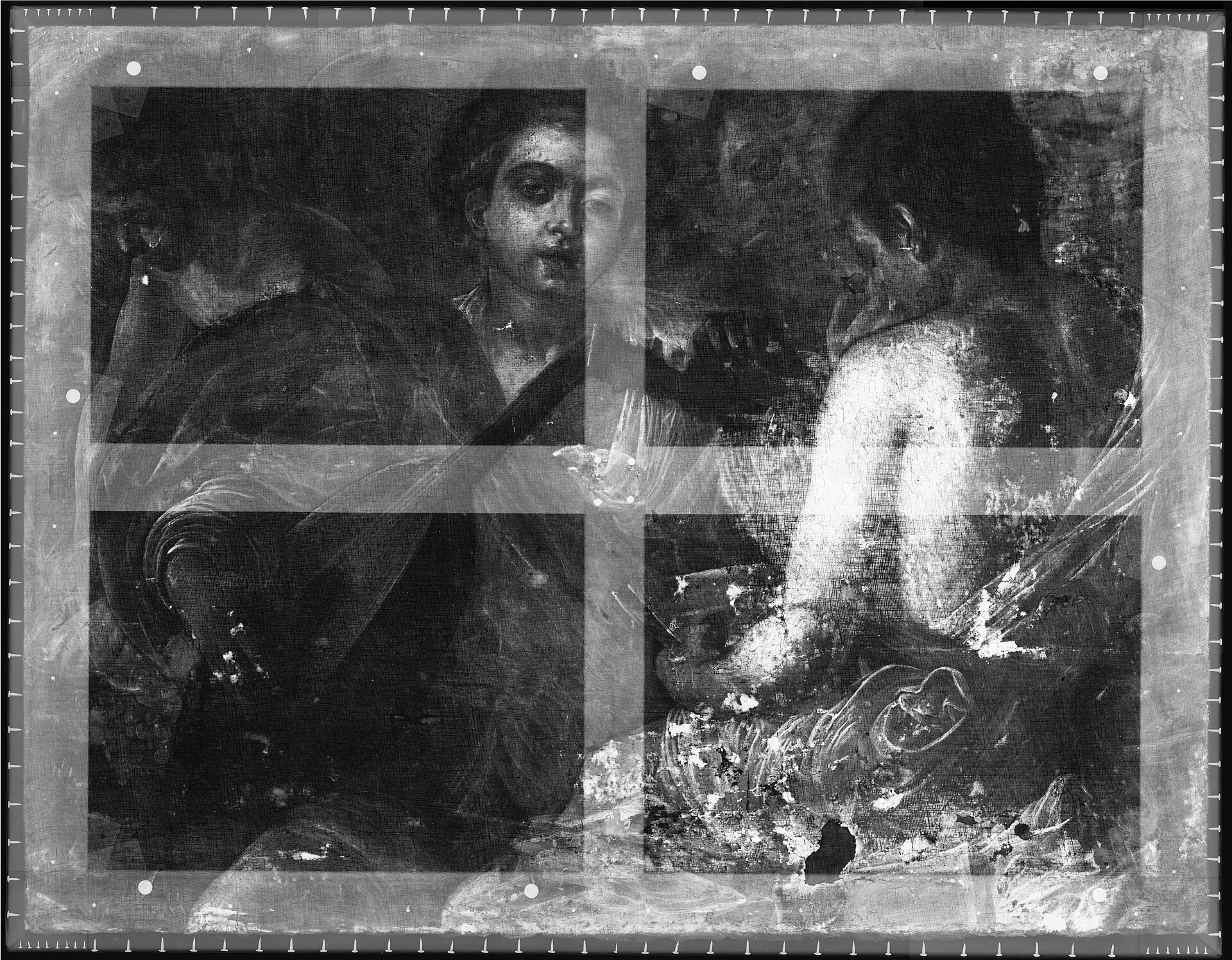
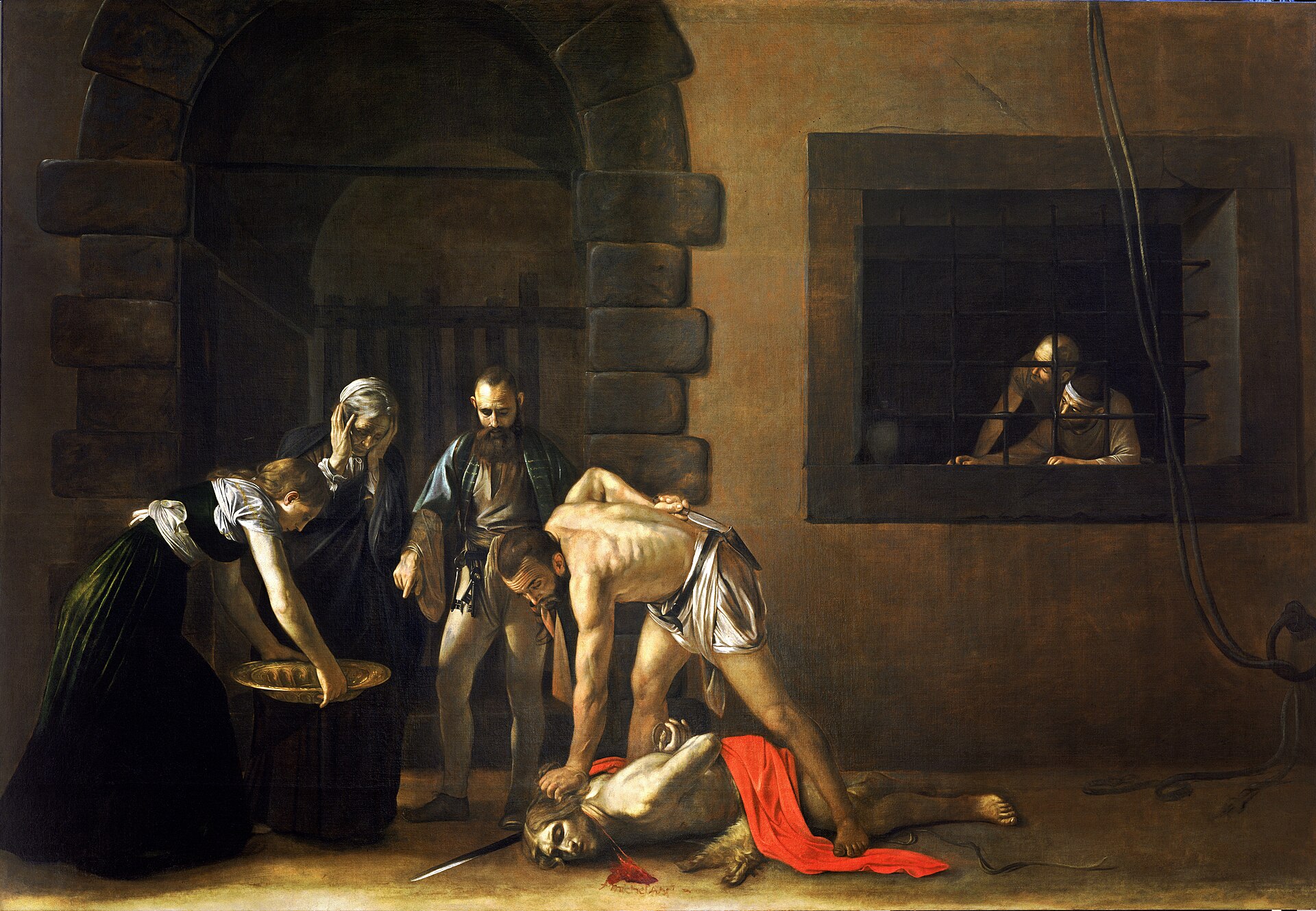
29 September: Michelangelo Merisi born in Milan. The family came from Caravaggio in Lombardy, and the town's name became his.16
Apprenticed in Milan to Simone Peterzano on a four-year contract that describes the master as a pupil of Titian. His mother dies the same year.16
Leaves Milan after quarrels and the wounding of a police officer, and reaches Rome without fixed address or provision. He changes lodgings about ten times between 1592 and 1595, working for Giuseppe Cesari painting flowers and fruit and, for a dealer, three heads a day at nominal pay.16
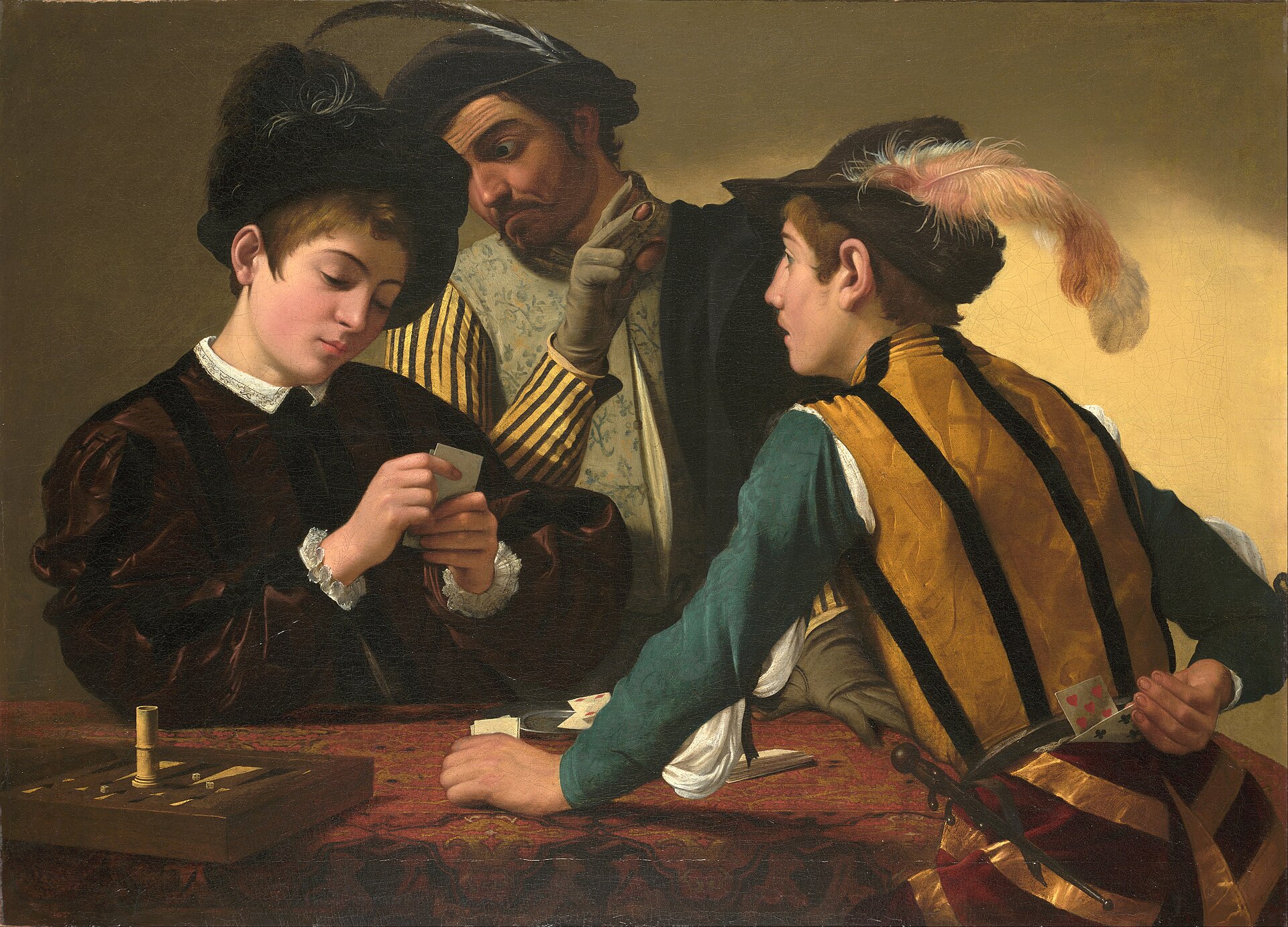
Paints The Cardsharps for Cardinal Francesco Maria del Monte. The dating is not settled: the High Court's summary gives about 1594, standard reference accounts give about 1595 or 1596 to 1597. It is an immediate success and is copied repeatedly.117
Sells the first Fortune Teller, now in the Musei Capitolini, for eight scudi at a point when he has no money. It passes to Marchese Vincenzo Giustiniani.34
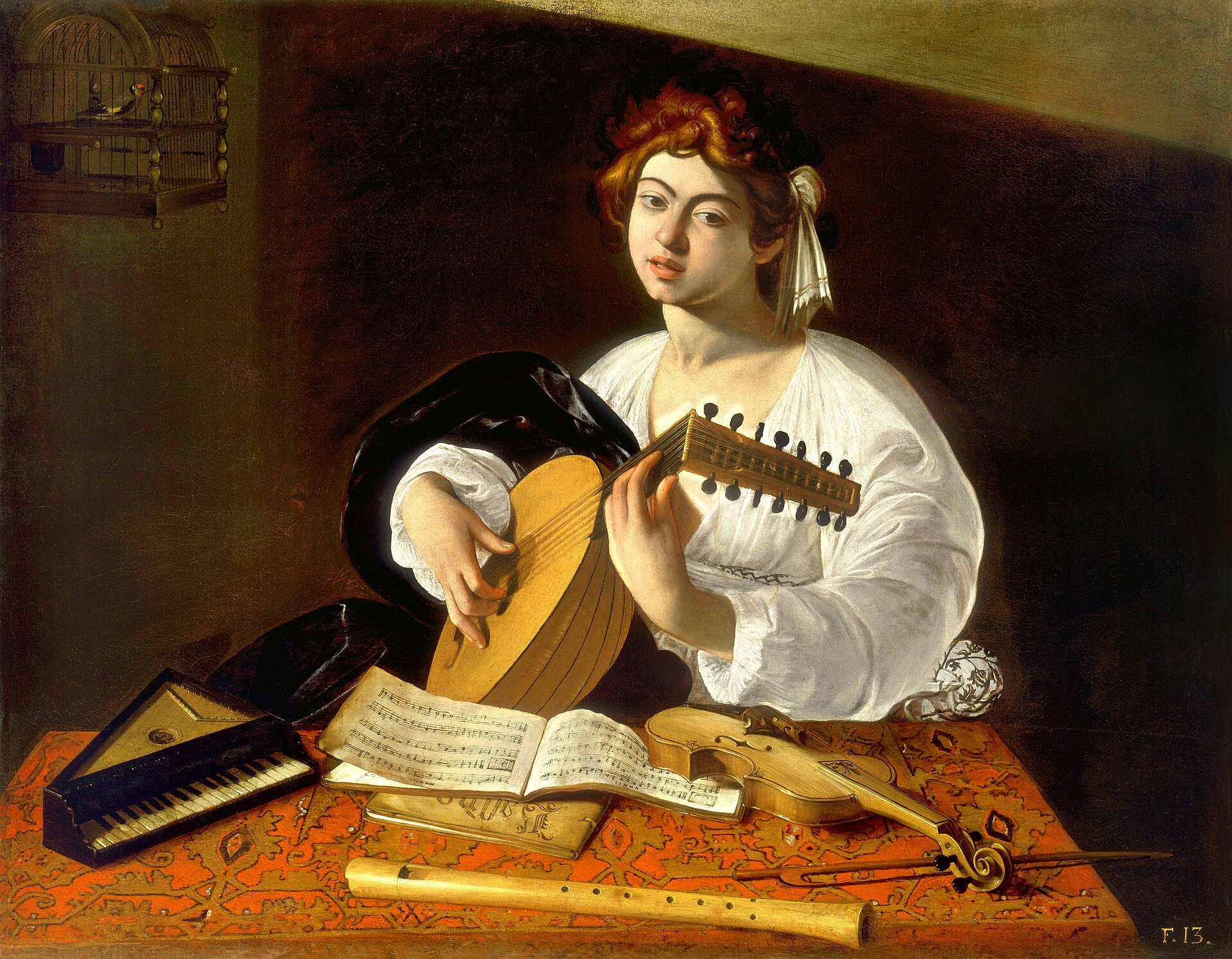
Taken into del Monte's household at the Palazzo Madama. The Fortune Teller, The Musicians, The Lute Player and Bacchus belong to this circle.16
Contracted to decorate the Contarelli Chapel in San Luigi dei Francesi. The Calling and the Martyrdom of Saint Matthew are delivered in 1600 and cause a sensation.16
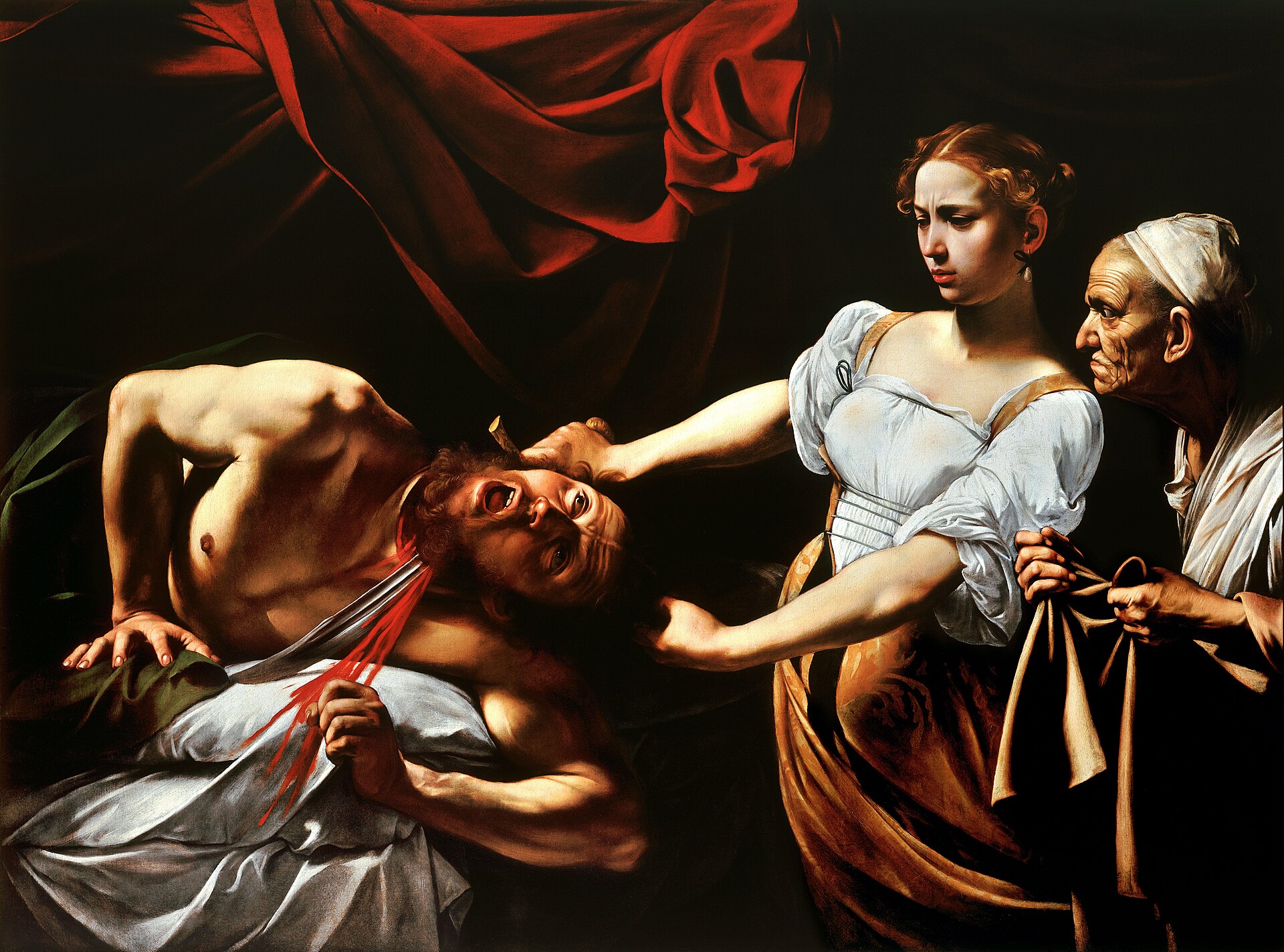
Paints Judith Beheading Holofernes, 145 by 195 cm, commissioned on Baglione's account by the Genoese banker Ottavio Costa. The dating is given variously as about 1599 to 1600 and as 1602.36
The first version of Saint Matthew and the Angel is refused for the Contarelli altar and replaced. The rejected canvas enters the Giustiniani collection, goes to Berlin, and is destroyed there in 1945; it survives only in photographs.16
The Death of the Virgin is commissioned for Santa Maria della Scala in Trastevere.16
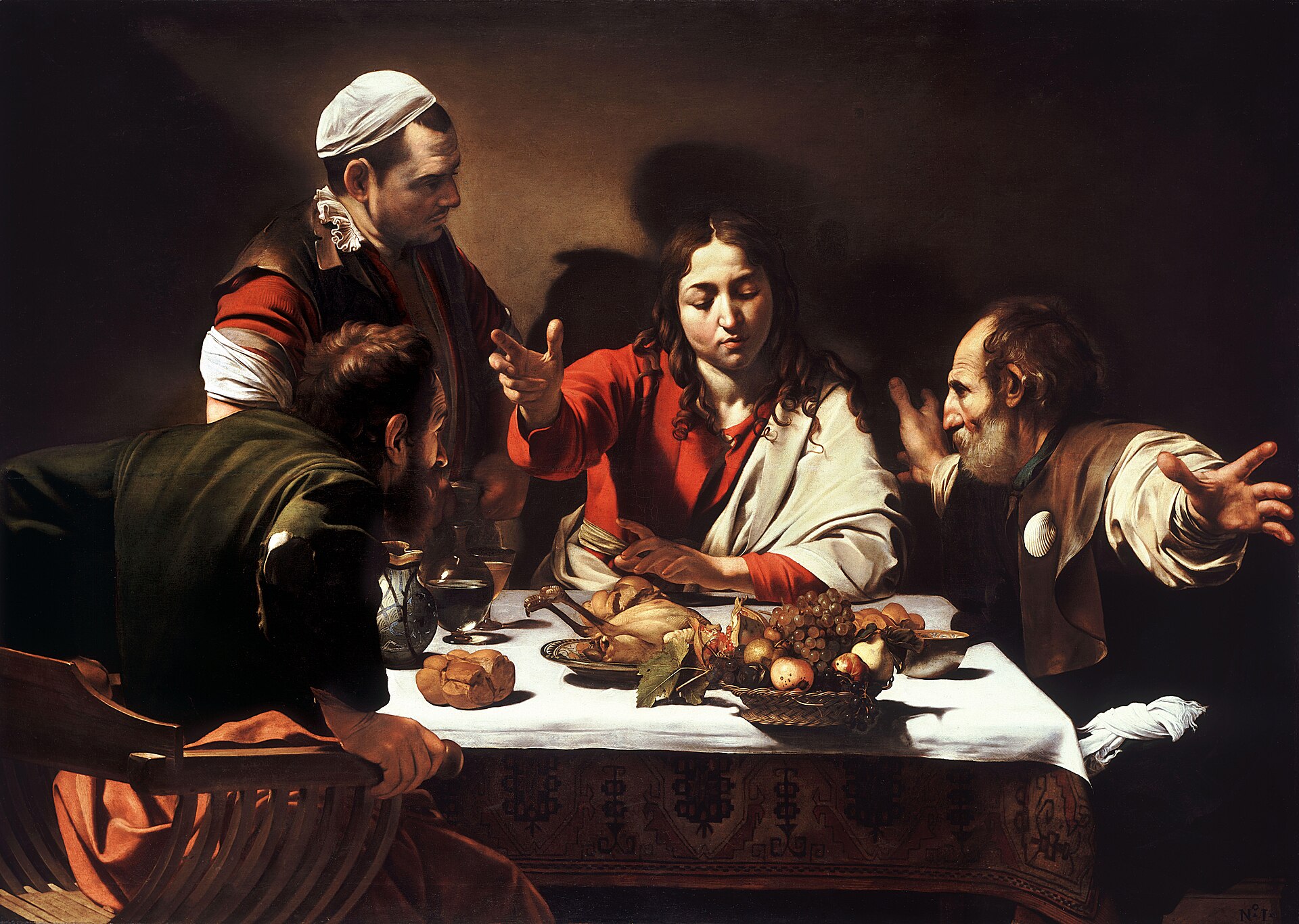
Paints the Supper at Emmaus now in the National Gallery, London, NG172, 141 by 196.2 cm, commissioned and paid for by Ciriaco Mattei, brother of Cardinal Girolamo Mattei. The same patron commissions The Taking of Christ the following year.35
Paints The Taking of Christ for Ciriaco Mattei, a Roman patrician and city official.2
Prosecuted for defaming the painter Giovanni Baglione. The French ambassador intervenes and he is moved from the prison at Tor di Nona to house arrest.16
Repeated arrests in Rome for carrying weapons without licence and insulting the guards; a suit by a waiter over a plate of artichokes; and in July 1605 flight to Genoa for three weeks after seriously injuring a notary.16
The Death of the Virgin is refused by the Carmelites. It is bought for the Duke of Mantua on Rubens's recommendation and is now in the Louvre.1612
29 May: kills Ranuccio Tomassoni in Rome. A bando capitale is issued, permitting anyone who recognises him to carry out the sentence, and he flees the same day to Colonna estates south of the city.1316
By October he is in Naples under the protection of Costanza Colonna Sforza, where he paints the Madonna of the Rosary and the Seven Works of Mercy.16
Reaches Malta with the help of Fabrizio Sforza Colonna. Becomes official painter to the Grand Master Alof de Wignacourt and is received into the Order of Saint John.16
12 July: lands at Valletta. He had reached Naples around late September 1606 and stayed some ten months.30
The Beheading of Saint John the Baptist is completed for the oratory of the conventual church in Valletta, his largest picture and the only one he signed.1614
In Sicily: Syracuse, where he rejoins Mario Minniti, and Messina. The Burial of Saint Lucy, the Raising of Lazarus and an Adoration of the Shepherds date from these months.16
Night of 18 August: the brawl with an aristocratic knight in Malta. He is imprisoned in Valletta, is out by early October, and is expelled from the Order in November 1608 as tamquam membrum putridum et foetidum.30
Late summer: returns to Naples. In October he is attacked and his face seriously disfigured; Rome hears rumours that he is dead. Sends Wignacourt a Salome with the Head of John the Baptist in which the severed head is his own.16
Paints the Nativity with Saint Francis and Saint Lawrence, 268 by 197 cm, for the Oratory of San Lorenzo in Palermo.32
18 July, the date given by a poet who knew him: dies at Porto Ercole while travelling north with three paintings in expectation of a papal pardon. A Roman newsletter of 28 July reports the death and one of 31 July attributes it to fever.16
Del Monte's heirs sell the Wildenstein Lute Player to Cardinal Antonio Barberini. The Cardsharps travels the same route into Barberini hands.33
Giovanni Volpato engraves The Cardsharps. The engraving becomes a reference image for the composition and shows both the added top strip and a dark form at the dupe's elbow.1
The Taking of Christ is described as a work by Gerard van Honthorst. A Mattei inventory of 1793 repeats the error.3
Duke Giuseppe Mattei sells The Taking of Christ, with other pictures from the family collection, to William Hamilton Nisbet as a Honthorst. It hangs in Scotland until 1921.2
Alexander I of Russia buys the Hermitage Lute Player at the Paris auction of the Giustiniani collection.33
Braun, Clement et Compagnie of Paris photograph the autograph Cardsharps. When the picture disappears the photograph becomes the standard against which claimants are judged.1
The autograph Cardsharps is sold, leaves Italy, and is lost for about eighty years.1
The Taking of Christ leaves Scotland and is acquired by Marie Lea-Wilson, an Irish paediatrician whose husband was shot dead on 15 June 1920. The sources conflict on the year: the National Gallery of Ireland gives 1924, a standard tertiary account gives 1921.23
A receipt records twenty pounds paid to the restoration firm of James Hicks in Lower Pembroke Street, Dublin, for one large oil painting, The Betrayal of Christ. It is the only sum of money anywhere in the recorded history of The Taking of Christ.26
Roberto Longhi publishes Quesiti caravaggeschi in instalments, the beginning of the modern reconstruction of the corpus. Ultimi studi caravaggeschi follows in 1943 and a monograph in 1968.20
Marie Lea-Wilson gives The Taking of Christ, still attributed to Honthorst, to the Jesuit Fathers of Leeson Street in Dublin in gratitude for their support. It hangs in their dining room for some sixty years.210
Surgeon Captain William Glossop Thwaytes buys The Musicians from a dealer in Kendal.1
Judith Beheading Holofernes is rediscovered. It is now in the Gallerie Nazionali di Arte Antica at the Palazzo Barberini.36
Longhi founds Paragone, the journal in which he will publish the Portrait of Monsignor Maffeo Barberini as autograph in 1963.2822
21 April: Longhi's exhibition of Caravaggio and the Caravaggisti opens at the Palazzo Reale in Milan. On the standard account it draws more than four hundred thousand visitors in three months and establishes the artist publicly.6
The Musicians is identified as an autograph Caravaggio. David Carritt and Benedict Nicolson spotted its potential and pursued the authentication.1
The Palermo Nativity is restored and photographed, including on black-and-white glass plate negatives. Eighteen years later that documentation becomes the only surviving evidence of the object.32
The Metropolitan Museum of Art buys The Musicians from Surgeon Captain Thwaytes for a substantial sum. Mahon publishes it in the Burlington Magazine in January, describing how he was shown a tiny photograph of a picture belonging to a private amateur in an English country house.1
The Metropolitan Museum of Art acquires The Musicians, 92 by 118.5 cm, through the Jacob S. Rogers fund. The picture is extensively restored there in 1983; its painted musical notation had been badly damaged by earlier restoration.31
February: Surgeon Captain Thwaytes buys a version of The Cardsharps at Sotheby's in New Bond Street for 140 pounds, catalogued as Caravaggio (After), The Cardplayers.1
Longhi publishes the Portrait of Monsignor Maffeo Barberini as autograph in Paragone, in an article titled Il vero Maffeo Barberini del Caravaggio. The picture remains in private hands for the next sixty-three years.22
June: Surgeon Captain Thwaytes dies. His Cumbrian house, Holesfoot, and its contents pass in trust to Lancelot Thwaytes, then aged four.1
Night of 17 to 18 October: the Palermo Nativity is cut from its frame in the Oratory of San Lorenzo, together with a carpet believed to have been used to roll it. It has never been recovered.32
The Fondazione Roberto Longhi is established in Florence. Marie Lea-Wilson dies in Dublin the same year, aged eighty-four.2826
The autograph Cardsharps surfaces at the Institut fur Kunstwissenschaft in Zurich, where it had been deposited for restoration and analysis. Mina Gregori recognises it. The Kimbell Art Museum acquires it through a New York dealer; the Metropolitan Museum's paintings department cleans and restores it.1
January: the Burlington Magazine publishes Mahon's Fresh Light on Caravaggio's Earliest Period: His Cardsharps Recovered, with a technical appendix by Keith Christiansen recording the removal of a fourteen-centimetre added strip whose whereabouts are now unknown, the removal of a non-original black mass at the dupe's elbow, and the discovery of a del Monte collection stamp on the original canvas.1
August: Sergio Benedetti, senior conservator at the National Gallery of Ireland, recognises The Taking of Christ in the Jesuit house on Leeson Street.210
Gregori and Roberta Lapucci co-curate a Caravaggio exhibition in Florence and Rome showing life-size illuminated x-ray mosaics of ten paintings, the turning point in making technical imaging part of the public argument about the artist.1
Mina Gregori's exhibition catalogue Caravaggio. Come nascono i capolavori appears, with chapters by Gregori and Roberta Lapucci on technique using multispectral imaging, infrared reflectography, x-radiography and raking light. It remains the fullest technical reference and contains no analytical study of the materials and no cross-sections.27
16 November: The Taking of Christ goes on public display as an autograph Caravaggio at the National Gallery of Ireland, in the exhibition Caravaggio: The Master Revealed, on indefinite loan from the Jesuit Community, Leeson Street.2
Saint John at the Well comes to Sotheby's with the potential to be a late Caravaggio. Mahon and Gregori both reject it emphatically; it is cleaned and sold as circle of Caravaggio; both later see it cleaned and reverse their opinions. A contemporary file note records the department's irritation and that Mahon did not appear to recall his earlier negative opinion.1
25 January: the Badminton House Lute Player is offered at Sotheby's in New York as circle of Caravaggio. The dealer Clovis Whitfield afterwards argues that it is autograph.33
Sotheby's values the Thwaytes Cardsharps at 9,000 pounds for insurance, slightly above another version of the same composition in the same house.1
The FBI lists the stolen Palermo Nativity among its top ten art crimes. Italian investigators at this point believe the picture is still in Sicily.32
5 December: the picture is sold at Sotheby's Olympia as FOLLOWER OF MICHELANGELO MERISI DA CARAVAGGIO against an estimate of 20,000 to 30,000 pounds, as the first lot of the afternoon session in a sale of 223 lots. Underbid 40,000 pounds by a consortium of dealers; hammer 42,000 pounds to Orietta Benocci Adam acting at least in part for Denis Mahon. The consignor nets 34,468.24 pounds.1
November: at a party for his ninety-seventh birthday, Mahon announces the cleaned and restored picture as an autograph replica by Caravaggio. Gregori supports the attribution and publishes it in the Forli exhibition catalogue.1
The Odesa version of The Taking of Christ is stolen. It is recovered in Germany in 2010 and returned to Ukraine.3
28 May: Keith Christiansen writes that he saw the Mahon picture at Forli, cannot agree with Mahon, considers it an obvious later copy and not of particularly outstanding quality, knows of no documentary evidence that Caravaggio made trial versions or replicas, and has yet to find a colleague who agrees. The email is put in evidence in 2014.1
24 April: Denis Mahon dies aged one hundred. His collection of some fifty-seven pictures, valued at around 100 million pounds, had been distributed on loan to British and Irish institutions on terms that they never deaccession and never charge admission; his library and archive went to the National Gallery of Ireland in 2010.19
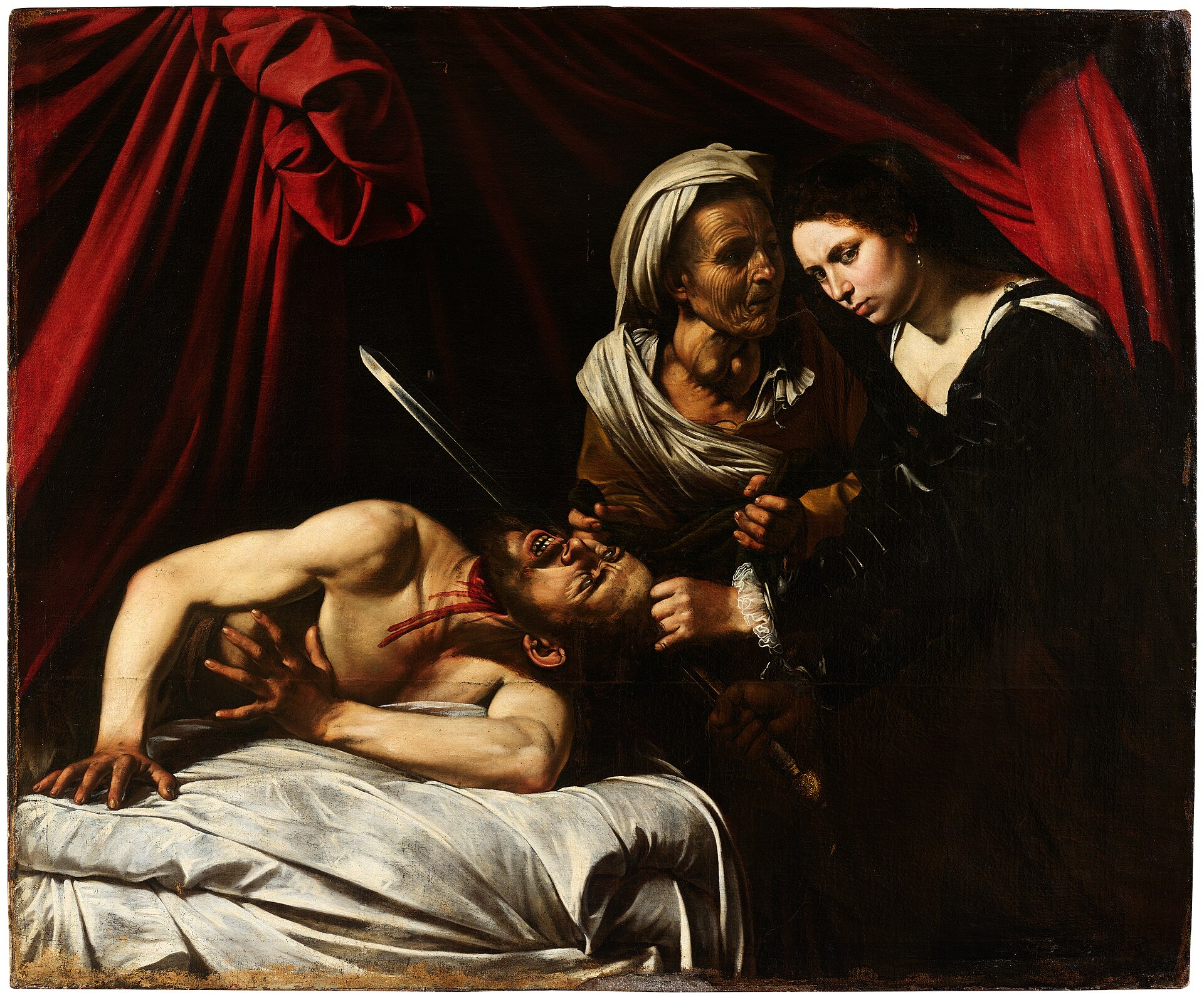
April: the auctioneer Marc Labarbe is called to a house in Toulouse and finds a Judith beheading Holofernes in the attic. Eric Turquin publishes it as an autograph Caravaggio; others hold it to be an original by Louis Finson.421
July: the Sacrifice of Isaac, bought as a Caravaggio with Gregori's support and exhibited as such through the 1990s, is sold by Sotheby's under the corrected attribution to Bartolomeo Cavarozzi, after the collector's death.1
27 October to 21 November: Thwaytes v Sotheby's is tried before Mrs Justice Rose in the Chancery Division. During the first week two copies of the Cardsharps sell in London, at Bonhams for 1,250 pounds and at Christie's for 10,000 pounds.123
16 January: judgment. The claim is dismissed. Reported as [2015] EWHC 36 (Ch), [2016] 1 WLR 2143, [2016] 1 All ER 423, [2015] PNLR 12. The court records the picture as then on display at the Museum of the Order of St John, Clerkenwell, insured for 10 million pounds.19232425
12 December: a full-size Factum Arte replica of the Palermo Nativity, worked up from photographs and from the 1951 glass plate negatives, is installed above the altar in the Oratory of San Lorenzo.32
24 December: the French export block on the Toulouse Judith lapses and the state declines to acquire the picture.511
June: the Toulouse Judith is withdrawn days before its scheduled auction at the Halle aux Grains in Toulouse and sold privately to J. Tomilson Hill under a confidentiality agreement. No price has been published.421
April: an Ecce Homo is offered at the Ansorena saleroom in Madrid, lot 229, catalogue 409, as by an associate of Jusepe de Ribera at 1,500 euros. The Spanish state halts the sale after scholars alert the authorities.18
The Sannini version of The Taking of Christ, shown in Longhi's 1951 Milan exhibition and then obscure, re-emerges and is placed on long-term display at the Palazzo Chigi in Ariccia. Its authorship is contested.3
27 May: the Madrid Ecce Homo goes on display at the Museo del Prado after restoration, having been sold privately in the interval. Terzaghi and Pulini support the attribution; Spinosa and Manzitti reject it.18
November 2024 onward: the Caravaggio 2025 exhibition at the Palazzo Barberini in Rome draws more than 450,000 visitors.22
10 March: the Italian government signs the deed acquiring the Portrait of Monsignor Maffeo Barberini for 30 million euros, one of the largest sums the Italian state has committed to a single work of art. The picture enters the collections of the Palazzo Barberini.22
No securely accepted Caravaggio has come to public auction in recent decades. That single fact governs the market: there are no comparables, the specialists who catalogue Old Masters have never handled an autograph example, and every price under this name is therefore a copy price, a follower price, or a bet on an attribution. The bet is not symmetric. Assembling a consensus takes years and several scholars; dismantling one takes a single article.
At the top of the market, price discovery happens away from the rostrum. The two largest recent transactions were a private treaty sale in Madrid and a negotiated state purchase in Rome, and only one of them has a published figure. Prices below are given as recorded, with hammer separated from premium wherever the source separates them or where the arithmetic is unambiguous. Where a figure is a valuation opinion rather than a transaction it is labelled as such, and where a sale was private under a confidentiality agreement the price is recorded as unpublished rather than estimated.
| Date | Sale | Work | Result | Note |
|---|---|---|---|---|
| February 1962 | Sotheby's, New Bond Street, London | The Cardsharps, catalogued as Caravaggio (After), The Cardplayers; the picture later at issue in Thwaytes v Sotheby's | Hammer 140 With premium none; a buyer's premium was not charged by London houses at this date GBP | Bought by Surgeon Captain William Glossop Thwaytes. Forty-four years later the same picture returned to the same house and made three hundred times the price. |
| 5 December 2006 | Sotheby's Olympia, London, Old Master Paintings | The Cardsharps, catalogued FOLLOWER OF MICHELANGELO MERISI DA CARAVAGGIO, described as a seventeenth-century copy after the Kimbell original | Hammer 42,000 With premium 8,400, derived: secondary accounts give the buyer's total outlay as 50,400 pounds, exactly 120 per cent of the hammer GBP | Estimate 20,000 to 30,000 pounds. First lot of the afternoon session in a sale of 223 lots during Old Master pictures week. Underbid 40,000 pounds by a consortium of prestigious dealers. Bought by Orietta Benocci Adam acting at least in part for Sir Denis Mahon. The consignor received 34,468.24 pounds after commission, testing, shipping and expenses. The judgment gives the hammer and the net; the total outlay is from a tertiary source and the premium figure is arithmetic on the two. |
| First week of the trial, from 27 October 2014 | Bonhams, London | A copy of The Cardsharps | Hammer 1,250 (the source does not separate hammer from premium) With premium not separated in the source GBP | Sold while the trial about a different version of the same composition was running in the Chancery Division. The judgment records the figure as the price at the sale and does not state whether it is inclusive of premium; this record does not assume either way. |
| First week of the trial, from 27 October 2014 | Christie's, London | A copy of The Cardsharps, catalogued After Caravaggio | Hammer 10,000 (the source does not separate hammer from premium) With premium not separated in the source GBP | Against an estimate of 2,000 to 3,000 pounds. Recorded in the judgment alongside the Bonhams result to show the band within which period copies of this composition trade. As with the Bonhams figure, the source does not separate hammer from premium and this record does not assume either way. |
Hammer is the price at which the bidding stopped; with premium adds the fee the house charges the buyer on top. Hammer price and buyer's premium in the glossary.
| Institution | City | Holdings | Note |
|---|---|---|---|
| National Gallery of Ireland | Dublin | The Taking of Christ, 1602, oil on canvas, about 133.5 by 169.5 cm | On indefinite loan from the Jesuit Community, Leeson Street, Dublin, since its identification by Sergio Benedetti in August 1990 and its public display from 16 November 1993. It is a loan and not a gift; the ownership sits with the Jesuits and the record should say so. The gallery also holds Denis Mahon's library and archive, given in 2010. |
| Kimbell Art Museum | Fort Worth, Texas | The Cardsharps, about 131 by 94 cm in its present form | The autograph picture, lost from the 1890s until 1987, recognised at Zurich and published in the Burlington Magazine in January 1988. It is a different object from the Thwaytes and Mahon picture and the two are constantly confused in reporting. Its dating is given variously as about 1594, about 1595 and about 1596 to 1597. |
| Metropolitan Museum of Art | New York | The Musicians, bought from Surgeon Captain W. G. Thwaytes in 1952; The Lute Player, the New York version, formerly Wildenstein | The Musicians is the picture whose 1951 identification made the Thwaytes name relevant to the Cardsharps litigation half a century later. The Metropolitan's paintings department also cleaned and restored the Kimbell Cardsharps in 1987, and its head curator's opinion was the pivot of the 2015 counterfactual. |
| National Gallery | London | The Supper at Emmaus, NG172; Boy Bitten by a Lizard; Salome receives the Head of John the Baptist | The Supper at Emmaus has been the subject of published technical examination in the gallery's own Technical Bulletin, the most accessible starting point for anyone wanting to see how incisions, the abbozzo and painting from the model are read from a picture. Letizia Treves, one of the Sotheby's specialists who examined the disputed Cardsharps at Olympia in December 2006, joined the gallery as curator of Italian and Spanish paintings in 2013. |
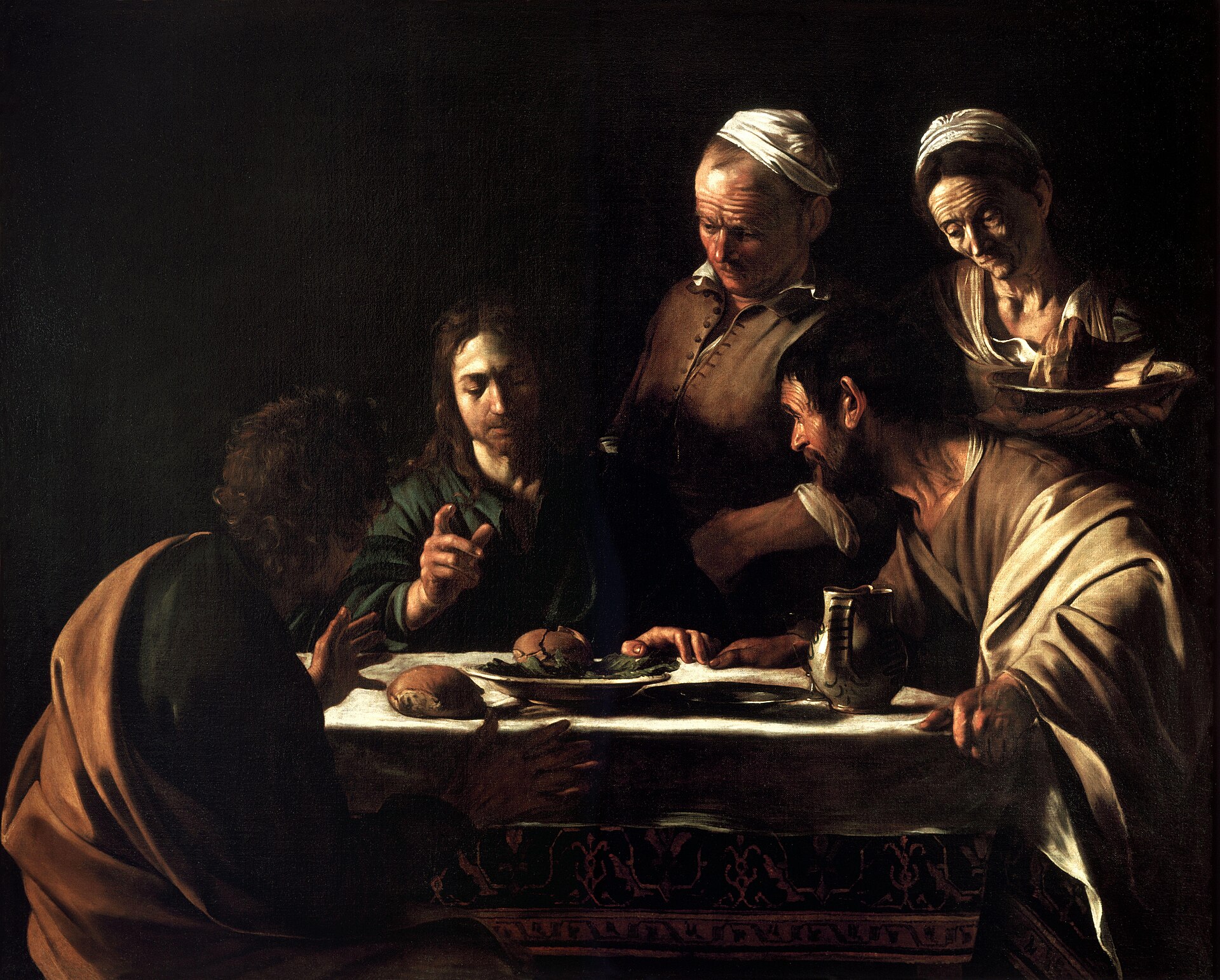
| Pinacoteca di Brera | Milan | The Supper at Emmaus, the later version | A repetition of the London subject, not a replica of the London picture: the same event, different figures, different composition. The two are routinely captioned as though they were one work. |
| Galleria Borghese | Rome | David with the Head of Goliath, the Roman picture, in which the severed head is generally read as a self-portrait; Boy with a Basket of Fruit; Saint Jerome Writing; the Ailing Bacchus | The group came into the collection through Cardinal Scipione Borghese, whose acquisitions were not always voluntary on the seller's side, and whose favour Caravaggio was courting from Naples in 1610. The Borghese David is NOT the David with the Head of Goliath in the Prado in Madrid, which is a separate picture with its own attribution literature; both circulate under the same title and are routinely substituted for one another. The provenance of individual pictures in this group should be checked case by case rather than treating the collection as a single event. |
| Gallerie Nazionali di Arte Antica, Palazzo Barberini | Rome | Judith Beheading Holofernes; Narcissus, attributed; and from March 2026 the Portrait of Monsignor Maffeo Barberini | The Barberini Judith is the autograph Roman picture and is a different composition from the Naples Judith known through Finson's version and from the Toulouse picture; all three circulate under one title. The Maffeo Barberini portrait was bought by the Italian state for 30 million euros in March 2026 after the Caravaggio 2025 exhibition here. |
| Musei Capitolini | Rome | The Fortune Teller, the Capitoline version; Saint John the Baptist | The Capitoline Fortune Teller and the Louvre Fortune Teller are both accepted as autograph and are variants, not replicas: the same scene, deliberately different treatment, similar figures in the same clothes. |
| Musee du Louvre | Paris | The Death of the Virgin; The Fortune Teller, the Louvre version | The Death of the Virgin reached the French royal collection by way of its rejection: refused by the Carmelites of Santa Maria della Scala in 1606, it was bought for the Duke of Mantua on Rubens's advice. Rejection by the commissioning body is what put it into a documented chain of ownership. |
| Museo Nacional del Prado | Madrid | Ecce Homo, about 86 by 111 cm, c. 1605-1609, on display since 27 May 2024; David with the Head of Goliath, the Madrid picture | The Ecce Homo is a loan following a private sale, not a museum acquisition, and the attribution is supported by Terzaghi and Pulini and rejected by Spinosa and Manzitti. The Prado's David with the Head of Goliath is NOT the Borghese picture of the same title in Rome; the two are different objects and must never share a caption. |
| St John's Co-Cathedral, Oratory | Valletta, Malta | The Beheading of Saint John the Baptist, 1608 | Still in the room it was painted for, which is exceptional in this corpus, and carrying the only known signature by the artist. No provenance chain exists because there has never been a transfer, and no auction record exists because it has never been for sale. |
| State Hermitage Museum | Saint Petersburg | The Lute Player, the Hermitage version | The other pole of the Lute Player question. The Hermitage and New York pictures are closely related and each carries its own attribution literature; a caption naming only The Lute Player is not usable. |
| Odesa Museum of Western and Eastern Art | Odesa, Ukraine | The Taking of Christ, a version attributed to Caravaggio by Soviet scholars in the 1950s | Authorship disputed. Stolen in 2008, recovered in Germany in 2010 and returned. Its present condition, location and display status should be verified from a primary institutional source before anything is asserted about it. |
| San Luigi dei Francesi, Contarelli Chapel | Rome | The Calling of Saint Matthew; The Martyrdom of Saint Matthew; The Inspiration of Saint Matthew | The first version of the altarpiece was refused, entered the Giustiniani collection, went to Berlin and was destroyed there in 1945; it survives only in photographs. A complete provenance chain for a picture that no longer exists is worth more to a researcher than a smooth account of its replacement. |
| Museum of the Order of St John | Clerkenwell, London | The Cardsharps, the Thwaytes and Mahon version | The picture at the centre of Thwaytes v Sotheby's. The High Court recorded in January 2015 that it was on display here and insured for 10 million pounds. It is not the Kimbell picture and any caption must say so. Loans move; this location should be re-verified before it is relied on. |
| Palazzo Chigi | Ariccia, Lazio | The Sannini version of The Taking of Christ, on long-term display | Shown in Longhi's 1951 Milan exhibition, then out of view for decades, re-emerging in 2023. Authorship contested and the literature thin and recent. |
| Oratory of San Lorenzo | Palermo, Sicily | Nativity with Saint Francis and Saint Lawrence, 1609, 268 by 197 cm: STOLEN 1969, not recovered. A full-size Factum Arte replica has hung above the altar since 12 December 2015. | What is on the altar is a replica and every caption must say so. The original was cut from its frame on the night of 17 to 18 October 1969 and remains listed among the FBI's top ten art crimes. Informant accounts of its fate contradict one another and none has been corroborated by the object. |
| Badminton House | Gloucestershire | The Lute Player, the third version, offered at Sotheby's New York on 25 January 2001 as circle of Caravaggio | Attribution contested and argued for by the dealer Clovis Whitfield. Any statement about its current location or ownership should be re-verified; a private house is not a public collection and access cannot be assumed. |
Most Old Master corpora are inherited. They pass from an inventory to a gallery catalogue to a monograph, thinning and correcting as they go, but the thread is continuous.
Most Old Master corpora are inherited. They pass from an inventory to a gallery catalogue to a monograph, thinning and correcting as they go, but the thread is continuous. Caravaggio's is not like that. He was famous when he died in 1610, imitated across Europe within a decade, and then dropped out of the account almost entirely. By the nineteenth century he survived mainly as a device for explaining other painters. The revaluation that put him back at the centre of the seventeenth century is a twentieth-century event with a small number of named authors, and the fact that the corpus is a reconstruction rather than an inheritance is the reason attribution here is so much more contested than it is for painters of comparable stature.
Roberto Longhi, born at Alba in Piedmont in December 1890 and dead in Florence in June 1970, did the work. His Quesiti caravaggeschi appeared in instalments between 1928 and 1934; Ultimi studi caravaggeschi followed in 1943; a monograph came in 1968. The pivotal public moment fell in the middle of that run. The exhibition of Caravaggio and the Caravaggisti opened at the Palazzo Reale in Milan on 21 April 1951, organised by Longhi, and it assembled autograph paintings that had never been in one room. On the standard account it drew more than four hundred thousand visitors within three months. It turned a scholarly campaign into a public fact, and the market followed the scholarship rather than the other way round.
Two consequences matter for a provenance record. The first is that a great many pictures now catalogued as autograph carry an attribution first proposed, or first published, within the last seventy-five years, which means the documentary chain behind them frequently runs through a twentieth-century article rather than a seventeenth-century inventory. The portrait of Monsignor Maffeo Barberini that the Italian state bought in March 2026 for 30 million euros was published as autograph by Longhi in an article in Paragone in 1963 titled Il vero Maffeo Barberini del Caravaggio, and the state's cheque is, in a real sense, payment on that article.
The second consequence is the copies problem in its modern form. Once the name recovered its value, every period version of a Caravaggio composition became a candidate, and the field has never had the money to study the copies systematically. Alexander Bell of Sotheby's put the point in evidence in 2014 with unusual bluntness: nobody funds the technical study of fifty pictures that are not by Caravaggio in order to learn what distinguishes the five that are. The research exists on the accepted works and almost nowhere else, which means that most statements of the form this feature is characteristic of Caravaggio rest on a sample that contains no controls.
Longhi is the origin, and he trained, directly or by example, much of the Italian side of the field; Evelina Borea, Giovanni Previtali and Luciano Bellosi were among his students, and the Fondazione...
Longhi is the origin, and he trained, directly or by example, much of the Italian side of the field; Evelina Borea, Giovanni Previtali and Luciano Bellosi were among his students, and the Fondazione Longhi in Florence holds his collection, library and photographic archive and still funds research.
Denis Mahon, born in London on 8 November 1910 and dead on 24 April 2011 at the age of one hundred, began as a specialist in Guercino and became, on the High Court's finding, the principal reference in the English-speaking world for Caravaggio after writing on the 1951 Milan exhibition. His authority was not only scholarly, and this matters for how his opinions were weighed. He assembled some fifty-seven pictures, distributed them on loan across British institutions in the 1990s, and attached conditions that the recipients neither deaccession them nor charge for admission; the collection has been valued at around 100 million pounds. He gave his library and archive to the National Gallery of Ireland in 2010. A scholar who is also a collector, a lender and a bidder is a different kind of authority from one who is not.
Mina Gregori, born in 1924, was Longhi's pupil and became the most prominent living Italian authority. With Roberta Lapucci she co-curated the 1991-92 Caravaggio exhibition shown in Florence and Rome, which put life-size illuminated x-ray mosaics of ten paintings on public display and which Lapucci described in evidence as the turning point in making technical imaging part of the ordinary argument about this artist.
Richard Spear, an American Baroque specialist with a Princeton doctorate who taught for many years at Oberlin and later at Maryland, represents the sceptical connoisseurial position; he told the court in 2014 that he had studied every one of Caravaggio's paintings at first hand, most of them many times. Keith Christiansen, long the head curator of European paintings at the Metropolitan Museum of Art, wrote the technical appendix that accompanied the publication of the Kimbell Cardsharps in 1988 and has been consistently restrictive on autograph replicas. John Spike published the catalogue that auction-house staff reach for as a working reference. Sybille Ebert-Schifferer, director of the Bibliotheca Hertziana in Rome, and Sebastian Schutze at Vienna both published general accounts around 2009 to 2012.
These are not interchangeable authorities. In evidence in 2014, Sotheby's specialists described Mahon and Gregori as taking an expansionist view of the oeuvre, meaning they were more willing than others to accept proposed additions. Whether that is fair is itself contested, but the market behaves as though it were true. A reader assessing a Caravaggio attribution should always establish which names carry it. An attribution supported by Mahon and Gregori alone, against Christiansen and Spear, is a different commercial object from one supported by all four, and the 2015 judgment quantified that difference as the whole of the case.
One further fact about Longhi belongs on a page about attribution, and it is not comfortable. Federico Zeri, himself among the most formidable connoisseurs of the twentieth century, accused Longhi of authenticating fakes to pay gambling debts. That is an allegation by a named scholar against a named scholar and this record reports it as one; no finding has ever been made and Longhi was long dead when it circulated. It is set down here because the whole structure of Caravaggio attribution rests on personal authority rather than on an institution, and where authority is personal its reputation is part of the evidence. The correct response is not to discount Longhi, whose reconstruction of this artist has been tested for seventy years and has largely held. It is to keep doing what this page does throughout: name the person, name the publication, name the year, and name whoever disagreed.
For a number of artists, attribution is settled by a committee with a name, a submission procedure and a published decision.
For a number of artists, attribution is settled by a committee with a name, a submission procedure and a published decision. For Caravaggio there is nothing of the kind. It was common ground in the 2015 High Court proceedings that there is no single ultimate authoritative voice on the attribution of Caravaggio as there is with some artists. Nobody issues a certificate. Nobody maintains a register. No institution has standing to say that a picture is in or out.
What exists instead is a distributed and unstable consensus among a dozen or so scholars, expressed in articles, exhibition catalogues, private letters and opinions given informally to dealers and salerooms. Some of those scholars, because they hold museum posts, are constrained from allowing their opinions to be published at all, which means the field's real balance of opinion is systematically under-recorded. Salerooms navigate this by canvassing views privately and disclosing selectively. Sotheby's evidence was that it will take however long is necessary to build academic support for a picture it believes in; in one Vermeer case it took eleven years to move a cataloguing from attributed to the artist to the artist's name alone.
The practical consequence for diligence is that there is no document to ask for. A Caravaggio attribution is a list of names and dates and it should be recorded as one: who said what, in which publication, in which year, and who said the opposite. A file containing a single favourable letter is not evidence of consensus. It is evidence of one opinion, and the 2015 judgment records that a leading house will not upgrade a heading on the strength of it.
There is a second-order effect worth naming. Because the field polices itself through publication rather than certification, an attribution can be reversed by a single article, and the reversal costs its author nothing. That asymmetry is the structural reason Caravaggio attribution risk runs one way: assembling a consensus takes years and several scholars, while dismantling one takes an afternoon and a journal.
The most consequential fact about Caravaggio's practice is negative.
The most consequential fact about Caravaggio's practice is negative. He did not run a studio. He trained in one, apprenticed in 1584 to Simone Peterzano in Milan on a four-year contract that described the master as a pupil of Titian, and he worked in other men's shops in Rome, painting flowers and fruit for Giuseppe Cesari and, at one point, three heads a day for very nominal pay for a dealer. But he never organised pupils and assistants of his own.
That distinguishes him sharply from almost every comparable figure. Guido Reni is difficult to attribute precisely because his pupils painted copies which the master sometimes retouched, producing a continuum of autograph status. Caravaggio produces no such continuum. On Richard Spear's evidence in 2014, this makes him in one respect easier rather than harder: a picture is by him or it is not, and there is no intermediate category of studio work executed under supervision. It also means that Studio of Caravaggio is a saleroom heading that cannot properly exist, and any catalogue offering it should be read with suspicion.
The second negative is the drawings. No preparatory drawing is securely attributed to him. For a painter of this period that is extraordinary, and it removes an entire class of evidence on which attribution normally rests. There is no sheet to compare, no squared cartoon, no chalk study of a hand. Everything that would ordinarily have been settled on paper was settled on the canvas. That is why technical imaging of the paint layers carries so much more weight in Caravaggio studies than elsewhere, why the field's methods changed sharply once x-ray and infrared mosaics became routine in the 1980s and 1990s, and why the 1991-92 Florence and Rome exhibition that showed x-ray mosaics at life size counts as a methodological event and not merely a display.
Both negatives create the same commercial problem. Where there is no workshop there is no legitimate intermediate label, so a saleroom's real choice is stark: the artist, or a follower. Where there are no drawings there is no cheap corroboration, so the cost of building a case is high. That is precisely why a dealer who suspects a sleeper may still decline to bid it up, and it was the explanation offered to the court for why a consortium of prestigious dealers bid to 40,000 pounds on a disputed Cardsharps in December 2006 and then stopped.
Caravaggio's method is legible in the picture itself, and the vocabulary used to describe it is worth having exactly, because it is used and misused in attribution arguments.He worked on a coloured...
Caravaggio's method is legible in the picture itself, and the vocabulary used to describe it is worth having exactly, because it is used and misused in attribution arguments.
He worked on a coloured ground, generally dark, over a priming layer that covered the bare canvas; different colour grounds could be used over different parts of the same canvas. Into that preparation, while it was still receptive, he frequently cut incisions with the end of a brush handle or a similar tool, marking the boundary of a head, a shoulder, an arm or an object. These incisions are visible in raking light and in technical imaging and they are among the characteristic traces of his practice. He then laid in broad indications of the forms, the stage called the abbozzo, and painted from live models posed in the studio, building the image broadly from the back forwards so that figures further from the viewer went in first.
Two further terms recur constantly. A figure painted en reserve is one for which the artist left a shaped gap in the layer behind it rather than painting over a completed passage, so that the later figure sits on the same layer as its background rather than above it. Where the later figure is not carried quite to the edge of that gap, a narrow strip of ground remains visible along the contour: a bordo a risparmio. In the Kimbell Cardsharps this is not an accident of execution but part of the finished image, read by the viewer as a double profile where the young cheat's face meets the older man's cloak. The alternative construction is overlapping, and the Kimbell picture shows that too: the dice holder was painted over a fully painted backgammon board, and as the upper paint has grown more transparent with age the triangular point of the board has come through it.
Larry Keith's technical work on the National Gallery's pictures in London, published in the gallery's Technical Bulletin, established the same three elements as the signature of the working practice: incised lines, broad brushed indications of the forms, and the use of live models to fix each pose. The conclusion that matters is that painting direct did not mean painting unplanned. The planning simply happened in paint and in the physical arrangement of bodies in a room rather than on paper.
The attributional weight of each technical observation differs, and the difference is routinely elided in catalogue prose.
The attributional weight of each technical observation differs, and the difference is routinely elided in catalogue prose. This section states it plainly because the 2015 judgment is the only place it has been stated under cross-examination.
Incisions are evidence of a method Caravaggio used. They are not evidence that only he used it. The same holds for the visible ground along a contour: a competent contemporary copyist can reproduce a visible effect, and Richard Spear made exactly that point by citing Constable's detailed copy of a Ruisdael landscape, in which Constable left the ground showing through in the same passages where Ruisdael had. A good copyist copies what he sees, including effects of ground.
The class of evidence that does carry real weight is the major pentimento: a substantial change of mind visible below the surface, a figure turned, an arm moved. A copyist reproducing an existing image has no reason to produce one. Everyone in the 2014 trial accepted that proposition, and it is why x-ray imaging is the first technical step on a picture of this kind. Lead white is dense and opaque to x-rays and reads white; low-density material reads dark; an x-ray image markedly different from the surface discloses a change.
Infrared reveals carbon and therefore charcoal or pencil underdrawing, which shows best against a light ground. Its yield on Italian Baroque painting is limited for exactly that reason, though infrared images were taken of the Kimbell Cardsharps during its restoration at the Metropolitan Museum, one of which showed that the position of the young cheat's right hand had been altered during composition. Ultraviolet light from a hand torch reveals retouching and restoration of roughly the last eighty to a hundred years as purple patches; it generates no image and is done as a matter of course. Consignors confuse it with infrared imaging, and that confusion was one of the factual disputes the court had to resolve in Thwaytes.
Materials analysis is the weakest link in this chain and the most oversold. Where a candidate is accepted to be roughly contemporary with Caravaggio, pigment analysis cannot separate the master from the copyist, because none of his materials was unique to him. It can exclude a later date. It cannot confer an attribution.
Finally, the court made a finding about the standing of technical evidence itself that anyone commissioning a report should read. Most scholars accept that technical analysis can establish that a picture is not from a given period or not by a given artist; its value in establishing a positive attribution is much less widely accepted. Some connoisseurs regard scientific data as over-relied on and misused; some technical specialists regard it as more reliable than the eye. On the facts before her, Rose J preferred the eye, and said so: on questions of connoisseurship and the visual assessment of quality she placed greater weight on Spear's evidence than on that of the two technical experts called against him.
The Cardsharps, in Italian I Bari, is an early genre picture and was an immediate success.
The Cardsharps, in Italian I Bari, is an early genre picture and was an immediate success. Its first owner was Cardinal Francesco Maria del Monte, Caravaggio's first important patron. It passed to Cardinal Antonio Barberini, nephew of Pope Urban VIII, descended to Maffeo Barberini, Prince of Palestrina, and entered the Colonna-Sciarra collection. In 1772 Giovanni Volpato engraved it, and the engraving became one of the reference images for the composition; there is still scholarly dispute over whether Volpato worked from the autograph picture or from a version of it.
Its date is not settled and the disagreement is worth recording rather than smoothing. The High Court, summarising the common ground, put it at about 1594. Standard reference accounts give about 1595, and some give 1596 to 1597. Nothing in this record depends on which is right, but a catalogue entry that states one of them without qualification is asserting more than the evidence supports.
The original left Italy after a sale in the 1890s and was then lost. The judgment gives the interval as about eighty years; measured from the 1890s to its reappearance in 1987 it is closer to ninety, and the shorter figure appears to be the trade's habitual rounding rather than a computation. What survived was a photograph taken in about 1890 by the Parisian firm Braun, Clement et Compagnie, known to be a photograph of the autograph work, and that photograph became the standard against which every claimant was measured. In 1987 the picture surfaced at the Institut fur Kunstwissenschaft in Zurich, where it had been deposited for restoration and analysis, and Mina Gregori, seeing it by chance, recognised it as the missing original. The Kimbell Art Museum in Fort Worth acquired it through a New York dealer. It was cleaned and restored in 1987 by the paintings department of the Metropolitan Museum of Art. It measures about 131 centimetres wide by 94 high in its present state.
Two publications in the Burlington Magazine of January 1988 established it. The first was Mahon's article, Fresh Light on Caravaggio's Earliest Period: His Cardsharps Recovered, in which he singled out the handling of the feather in the young cheat's hat and the execution of his breeches as the passages that convinced him, and recorded that he had always been sceptical on this subject. The second was a technical appendix by Keith Christiansen, who described the condition as exceptionally fine.
Two details in that appendix have become load-bearing in every subsequent argument about versions of this composition. First, before restoration the Kimbell picture carried an added strip of canvas about fourteen centimetres high running the length of the top; it was removed and nobody now knows where it is. It appears in the Volpato engraving, and Christiansen recorded that there is no way of establishing precisely when it was added. Evidence at the 2014 trial established a further fact not in the 1988 publication: the strip was glued on, not sewn. A seventeenth-century painter enlarging his own composition would have sewn it; gluing indicates that the canvas was already too brittle to sew, which points to the enlargement happening when the picture was more than a century old.
Second, before cleaning there was a blackish mass running across the carpeted table by the dupe's right elbow, old but certainly not original, which was removed. Christiansen recorded that both the Volpato engraving and an old copy show at that point a well-defined form suggestive of a cape folded over a chair, that microscopic examination showed the background grey had been used by Caravaggio to tidy and slightly reduce the contour of the sleeve, that an early restorer had broken through the grey, probably trying to remove the cape, and had substituted a penumbral black area which contradicts the light source. He also recorded candle scorch marks visible on the back wall of the copy. During relining, a stamp was found in the bottom left corner of the original canvas showing that the picture had been in del Monte's collection: a physical provenance link, not an opinion.
The number of copies is the other half of the story. Several dozen period and later versions are known; standard accounts put the surviving copies and variants at over fifty. Sotheby's produced in its defence an Artnet listing recording about thirty versions other than the disputed picture offered at auction between 1988 and 2012, over half through Christie's or Sotheby's, of varying quality and at a wide range of prices. During the first week of the 2014 trial two more sold in London: one at Bonhams for 1,250 pounds and one at Christie's, catalogued as After Caravaggio, for 10,000 pounds against an estimate of 2,000 to 3,000 pounds.
Lancelot Thwaytes inherited a version of the Cardsharps from his father's cousin, Surgeon Captain William Glossop Thwaytes, who died in June 1965 and who had lived at Holesfoot, a small country...
Lancelot Thwaytes inherited a version of the Cardsharps from his father's cousin, Surgeon Captain William Glossop Thwaytes, who died in June 1965 and who had lived at Holesfoot, a small country estate in Cumbria. Surgeon Captain Thwaytes had bought that picture in February 1962 at Sotheby's in New Bond Street for 140 pounds, catalogued as Caravaggio (After), The Cardplayers. He had form. In 1947 he bought The Musicians from a dealer in Kendal; it was identified in 1951 as an autograph Caravaggio, and in 1952 the Metropolitan Museum of Art bought it from him for a substantial sum. Mahon published that picture in the Burlington Magazine in January 1952, describing how he had been shown a tiny photograph of a picture belonging to a private amateur in an English country house; the judgment records that it was David Carritt and Benedict Nicolson who first spotted its potential and pursued the authentication. The house at Holesfoot contained two further versions of the Cardsharps besides the one at issue, one of them apparently with a fourth figure, and Thwaytes's own father had acquired another in the early 1970s.
The picture was valued at 3,000 to 4,000 pounds by Christie's in 1989 or 1990 and at 9,000 pounds by Sotheby's for insurance in 2002, slightly above another version in the same house. In 2006 Thwaytes was raising money for school fees. Matthew Barton of Sotheby's visited Holesfoot on 4 April 2006, and the conversation about how to research the picture produced the misunderstanding that would run through the case: the court found that Barton described ultraviolet examination, which is done as a matter of course, and that Thwaytes came away believing infrared imaging had been promised.
The picture was collected on 10 July 2006. On 11 July Thwaytes wrote saying he understood it would be researched with infrared and possibly x-rayed. It was allocated internally on 4 September 2006 to Tom Baring, who examined it with white spirit, a torch and ultraviolet light, found a large clear photograph of the Kimbell picture in the departmental library in the Spike catalogue, and drafted a catalogue entry describing it as by a follower.
It was examined at a picture meeting in New Bond Street on 6 September 2006 by Baring, Alexander Bell, George Gordon and the catalogue coordinator. They looked at it in natural light, wiped it with white spirit on cotton wool, and inspected it under ordinary and ultraviolet torchlight. Nobody consulted the Volpato engraving or the January 1988 Burlington articles. Bell's evidence was that the figures looked flat and dead and were unconvincing. The unanimous view was that it was a seventeenth-century copy by a follower.
Thwaytes asked for x-rays. Baring told him he would be wasting his money and then arranged them anyway. Nicholas Eastaugh produced twelve plates joined into a mosaic, which was emailed to Thwaytes in October 2006; the published judgment gives the delivery date as 9 October 2014, plainly a slip for 2006. Nothing in the images changed the department's view; Bell recalled noticing no pentimenti of any kind. Infrared imaging was not done. The sale agreement was signed on 9 November 2006.
The catalogue gave the picture a double-page spread. The heading read FOLLOWER OF MICHELANGELO MERISI DA CARAVAGGIO, THE CARDSHARPS; the entry called it a seventeenth-century copy after the Kimbell original and added a provenance note recording that Surgeon Captain Thwaytes had been a keen and important collector of Caravaggio compositions and had sold The Musicians to the Metropolitan. The estimate was 20,000 to 30,000 pounds.
On 4 December 2006, during the pre-sale exhibition at Olympia, Baring saw enough interest in the picture to telephone New Bond Street and ask for a second look. He could not later remember what triggered it, and nor could anyone else. Bell came across by taxi with Letizia Treves and Christopher Apostle, then head of the department in New York. The picture was taken down and examined for about twenty minutes in a side room, with white spirit again. Bell's evidence was that the department kept pushing itself with the question it always asks, whether the picture might be better than it thinks, because a Caravaggio would have been worth far more to the house. The cataloguing was confirmed. Thwaytes, who telephoned that day to ask whether there had been interest, was told there had been a bit but nothing untoward.
The sale took place on the afternoon of 5 December 2006, in a sale of 223 lots, with the picture given the favourable position of first lot of the afternoon session during Old Master pictures week. Only one condition report had been requested before the sale, and not by anyone likely to pay a large sum. A consortium of prestigious dealers underbid at 40,000 pounds; the notification of the consortium reached Sotheby's only very late on the day of the sale. Orietta Benocci Adam, a close friend of Denis Mahon and acting at least in part for him, took it at a hammer price of 42,000 pounds. Secondary accounts give Mahon's total outlay as 50,400 pounds, which is the hammer plus exactly twenty per cent; on that arithmetic the buyer's premium was 8,400 pounds. The consignor received 34,468.24 pounds after commission, the cost of the testing, shipping and other expenses.
Mahon then spent on research something close to what he had paid for the picture.
Mahon then spent on research something close to what he had paid for the picture. It was photographed and cleaned by R.M.S. Shepherd Associates at their Wimbledon studio. The conservator Simon Bobak examined it after cleaning and wrote a condition and treatment report: a large antler-shaped tear above the dupe's head, a vertical tear with lost canvas in the young cheat's neck, a lining about 150 to 200 years old that had failed along the top edge, and a ground light brown in colour with a touch of pink in it, generally sound and well bonded to the original canvas. He relined it.
Davide Bussolari of Diagnostica per l'Arte in Bologna imaged it after cleaning and after the stretcher was removed but before relining and restoration: high-resolution images in ordinary light, a complete x-ray mosaic, infrared reflectography, false-colour infrared and ultraviolet fluorescence photography. R.M.S. Shepherd then restored it and reported in December 2007. Nicholas Eastaugh reported on 30 October 2007, noting that comparison with the radiograph of the Kimbell picture shows a marked difference in appearance ascribable to likely differences in ground composition.
The invoices, excluding VAT, were about 18,800 pounds to Shepherd for cleaning, restoration, scientific analysis and reporting; about 6,400 pounds to Bobak for relining; about 2,500 pounds to Eastaugh; and 1,000 euros to Bussolari. That is about 27,700 pounds plus 1,000 euros of work on a picture bought for 50,400 pounds, and it is a useful benchmark for anyone budgeting an attribution case: the research bill on a single disputed Old Master ran to more than half the purchase price, and it did not settle the question.
At a party to celebrate his ninety-seventh birthday in November 2007, Mahon announced that the picture was an autograph replica of the Kimbell Cardsharps painted by Caravaggio himself. Mina Gregori supported him and published her case in the catalogue of an exhibition at Forli, praising the brush strokes running at speed over the dupe's plum-coloured garments, the golden glow of the young cheat's clothes, the tufts of the ostrich feather swaying against the light background, and the subtle fall of light on hands and faces. She explained the different shape of the dice holder by proposing that the scene is viewed from a higher vantage point. The announcement received wide publicity, and Thwaytes sued.
The claim was brought in negligence and for breach of contract, case number HC-2012-000042, the test being the same for both.
The claim was brought in negligence and for breach of contract, case number HC-2012-000042, the test being the same for both. The hearing ran from 27 October to 21 November 2014 before Mrs Justice Rose, and judgment was handed down on 16 January 2015 as Thwaytes v Sotheby's [2015] EWHC 36 (Ch), reported at [2016] 1 WLR 2143, [2016] 1 All ER 423 and [2015] PNLR 12. Henry Legge QC and Andrew Bruce appeared for Thwaytes, instructed by Boodle Hatfield; Andrew Onslow QC and Richard Edwards for Sotheby's, instructed by Freshfields Bruckhaus Deringer. Thwaytes did not assert that the picture is by Caravaggio. His case was that if Sotheby's had done its job he could have sold it for much more, or would have kept it.
On the standard of care the court began from Luxmoore-May and another v Messenger May Baverstock [1990] 1 WLR 1009, in which a provincial auctioneer failed to spot that two small paintings of foxhounds might be by George Stubbs, gave the pair a reserve of 40 pounds, sold them for 840 pounds and watched them resell as Stubbs for 88,000 pounds. The Court of Appeal allowed the auctioneer's appeal against a finding of negligence, treating the firm as the equivalent of a general practitioner rather than a specialist, and warning that the court should be cautious before convicting a valuer of negligence merely for failing to be the first to spot a sleeper.
Rose J held that a leading international auction house is held to a higher standard than that, and specified how. First, a consignor is entitled to have the work assessed by highly qualified people, qualified in art history, in familiarity with the styles and oeuvres of different artists, and in the connoisseur's eye, with ready access to art historians at the highest levels of scholarship. Second, the house must give the work a proper examination and devote enough time to arrive at a firm view where that is possible. Third, it is much more difficult for a leading house than for a provincial one to rely on a picture's poor condition as a reason for failing to notice its potential. She also accepted that an art expert must know his or her own limitations and when to bring in an outside expert, while holding that the threshold at which a leading house crosses that line is set much higher.
She accepted one further submission from the claimant, drawn from Edward Wong Finance Co Ltd v Johnson Stokes and Master [1984] 1 AC 297: merely because Christie's and Sotheby's can be shown to act in a particular way does not automatically mean that that way is not negligent, and there must be a backstop consideration of the client's interests. She then found on the facts that no bad habit had been established.
She rejected every argument that the duty was heavier still on these facts. Consigning a work for research rather than for sale does not raise the duty; it would be illogical, since a house that expects no commission would then owe more than one that does. The fact that the picture came from the same collection as an autograph Caravaggio bought by the Metropolitan does not raise it; Surgeon Captain Thwaytes owned many low-value pictures, including two other versions of the same composition, and there was no evidence he had a good eye. Nor does the consignor's own belief that his picture is right; consignors frequently hold that belief and a house must assess each picture on its merits.
On the substance she made findings that go to the heart of how salerooms work. Sotheby's was entitled to approach the picture first and foremost through connoisseurship, by assessing quality. The variability of Caravaggio's early work, urged on the basis that even Spike had called the New York Lute Player competent but never exciting and that Mahon himself had written about the artist's difficulties with the human form, did not oblige the department to hand the question to outside scholars; Bell's evidence, which she accepted, was that technical shortcomings do not diminish the overwhelming impression of a masterpiece. The contested state of Caravaggio attribution generally, and the unsettled question whether he ever painted replicas of his own compositions, likewise did not oblige them to step back. Dirt and discoloured varnish did not disable them; that is something they handle hundreds of times a year, and Gregori herself had written that the varnish was not so darkened as to obscure the picture's quality. The interest of the dealers' consortium did not oblige them to reconsider.
She held that the department was entitled to compare the picture directly against the Kimbell original, on the reasoning that if Caravaggio could paint a convincing ear, pewter plate or lace cuff in one picture there is no reason he could not do so in a replica. She then went through the passages herself, conscious of the warning in Drake v Thos. Agnew and Sons Ltd [2002] EWHC 294 (QB) against substituting her own assessment for the experts', but finding the exercise inescapable and noting that a lay person may be more justified in judging quality where the artist's achievement lies in convincing naturalism. She found the dice holder out of kilter within its own perspective system and rejected Gregori's higher-viewpoint explanation. She found the ostrich plume shiny and waxy, failing to capture the barbs extending over the hat. She accepted Spear's evidence that the older cheat's striped sleeve was plain and flat where the Kimbell sleeve carries dense diagonal striations, and his description of the copy's sleeve as fabric run through too hot an iron. She found the muslin folds less convincing and the lace at the dupe's cuffs schematic and stiff. Her conclusion was that Sotheby's was entitled to take the view that the quality was not sufficiently high to merit further investigation.
On the technical evidence she held that the house was entitled to rely on its own specialists to read the x-rays and that there was nothing in them to unsettle the assessment; that Sotheby's was under no obligation to carry out infrared imaging or to advise the consignor to commission it; and, going further, that had infrared images been taken before the sale there is nothing in them that would have alerted the department to Caravaggio potential. The drawing lines shading the tips of the dupe's fingers, which Lapucci called characteristic of Caravaggio and Spear said he had seen nowhere else in the artist, she found to be the sort of mark any competent painter might make when replicating an image.
She dealt one by one with the features said to be inconsistent with a copy. The extra space above the older cheat's hat would reasonably have been explained by the Burlington appendix as indicating that the copy was made after the Kimbell picture was enlarged. The black mass at the dupe's elbow would reasonably have been explained the same way, and while Helen Glanville gave evidence that it lies in the abbozzo layer and is therefore an invention, the court held that Sotheby's could not reasonably have discovered that in 2006 and left the underlying question open with the words if indeed it is. The claimed shift of viewpoint and the claimed depiction of a later psychological moment she found illusory. The claimed change of palette she could not see. The looped ribbon at the young cheat's elbow may have been added to the Kimbell picture by a later restorer painting over the tacking edge. The marks on the dice holder visible under ultraviolet light form no logical pattern and she was not persuaded there is decoration there at all.
Finally she held that Sotheby's was not negligent in failing to tell the consignor about the second viewing at Olympia. She accepted Rachel Kaminsky's evidence that houses do not update consignors about repeat viewings unless something material changes, that interest means more than people looking, and that in the days before a sale the department's job is to sell. She found it implausible, and coloured by hindsight, that Thwaytes would have withdrawn the lot. The claim was dismissed.
Because she might be wrong on liability, Rose J went on to decide what would have happened if Sotheby's had spotted potential and gone out to scholars.
Because she might be wrong on liability, Rose J went on to decide what would have happened if Sotheby's had spotted potential and gone out to scholars. This part of the judgment is the most useful thing in it for anyone valuing a disputed picture, and it is almost never reported.
The first question was whom the house would have consulted. Bell's evidence was that the principal scholar he would have invited to look at the picture was Keith Christiansen at the Metropolitan, with Schutze and Ebert-Schifferer as other candidates; that one goes to the scholar with the best reputation, because if that person backs the picture others are more likely to follow; and that in 2006 Mahon was ninety-six and his eye was no longer reliable for Caravaggio. Bell's reason, and the analogy he offered for it, are set out under the Saint John at the Well case below; Letizia Treves gave similar evidence from her own experience of showing Mahon pictures.
The court nevertheless found, on the balance of probabilities, that Sotheby's would have consulted Mahon. He was in London and could see the picture at first hand; he had published both the Kimbell Cardsharps and The Musicians from the same collection; and documents disclosed late from the New York office showed George Gordon advising in January 2005, on a copy of the Supper at Emmaus from the Berkman estate that had been bought as autograph in 1958, that both Mahon and Gregori should be consulted, in part at least to cover our backs. Catalogue entries and correspondence showed the house continuing to thank Mahon for his support on Guercino, Salvator Rosa, Pietro Testa and Giovanni Sirani.
She found that Sotheby's would not have consulted Gregori, and that the house did not place much weight on her expertise for Caravaggio. She found that Mahon would have given the same positive opinion he later gave as owner, and that Christiansen would have been consulted and would have given a firm contrary view. His email of 28 May 2009, put in evidence, states that he saw the picture at Forli, that he regretfully cannot agree with Mahon, that it seemed an obvious later copy and not of particularly outstanding quality, that a number of scholars have embraced the view that Caravaggio made trial versions and replicas but that so far as he is aware there is no documentary evidence for this and no reason to believe it part of his practice, that there is abundant evidence his paintings were copied and copied very well at an early date and later inventoried as originals, and that he had yet to find a colleague who went along with Mahon.
The counterfactual world she constructed was therefore one in which Sotheby's held one positive attribution from a revered scholar, a number of negative opinions from other eminent ones, and its own strong doubts. Her finding was that this would not have been enough for the house to catalogue the picture as by Caravaggio or even as attributed to Caravaggio. It would still have been offered as by a follower, possibly with a note recording Mahon's view.
On value the two experts were as far apart as it is possible to be. Guy Sainty, a dealer since December 1975 and the claimant's expert on saleroom practice, put the Kimbell Cardsharps at about 55 million pounds and said the disputed picture, sold with a well-prepared catalogue entry setting out the scholarly support, would realistically have made 11 million pounds; he cited a Temptation of Saint Anthony sold for under 1 million pounds with one scholar attributing it to Michelangelo and resold after further research for more than 6 million dollars, although almost all acknowledged Michelangelo scholars have rejected that attribution. Rachel Kaminsky, formerly head of Old Master paintings at Christie's, said the picture might well have made less than 42,000 pounds, because the sense of mystery would have gone and any speculative buyer would have seen the uphill struggle ahead.
Rose J's conclusion was that it would probably have made slightly more with a full catalogue entry, but not a great deal more, and that the negative views would have carried much more weight in 2006 than those of Mahon and Gregori. She noted that to reach 11 million pounds at auction one needs at least two bidders willing to go there, not one, and that we cannot know how much beyond 42,000 pounds Mahon would have gone had the consortium stayed in. The parties agreed that quantum should not be assessed on the footing that the picture might have been consigned to an unscrupulous dealer who suppressed the negative opinions. Given her findings on liability she declined to fix a figure.
She also flagged, and expressly left open, the legal question underneath. Sotheby's argued that its duty does not extend to obtaining an inflated price on the strength of scholarly opinions that are in fact wrong, and that it is not responsible for a consignor failing to benefit from the currency of a wrong opinion. She left that point for a case in which it arises.
Four propositions can be taken from the judgment and used directly.The first is that the duty is tiered and the tiers are now described.
Four propositions can be taken from the judgment and used directly.
The first is that the duty is tiered and the tiers are now described. A provincial auctioneer is a general practitioner; a leading international house is a specialist, and specialist status imports qualified staff, sufficient examination time, access to top-level scholarship, and a much reduced ability to plead poor condition. That is the practical content of the higher standard, and it is stated nowhere else in English law with this specificity.
The second is that connoisseurship survived. The house was entitled to decide the question on quality, using its own eye, and to let that judgment determine how much further work was done. Bell accepted in terms that if he reaches a conclusion about quality, that determines what further work is carried out, and the court did not treat that as a defect. Anyone who assumed that the spread of technical imaging had displaced the eye in the saleroom should read this judgment and revise.
The third is that there is no free-standing duty to commission technical imaging. X-rays were taken here only because the consignor asked and paid. Infrared was not taken and did not have to be. A consignor who wants imaging must ask for it in terms and expect to pay, and should be aware that the house may tell him he is wasting his money.
The fourth is what the case did not decide. It did not decide whether the picture is by Caravaggio; it decided that Sotheby's was entitled to conclude that it is not. It did not decide the measure of damages, nor whether an auctioneer must catalogue consistently with prevailing expert opinion where that opinion contradicts its own assessment, nor whether a duty can extend to capturing the value of an opinion that is wrong. Those questions are live.
The picture itself did not disappear. The High Court recorded in January 2015 that it was on display at the Museum of the Order of St John in Clerkenwell, London, and insured for 10 million pounds. That is what an owner chose to insure for, on a picture a court had just held a leading department was entitled to treat as a copy. An insurance figure is set by the owner and tested by nobody.
The Taking of Christ, oil on canvas, about 133.5 by 169.5 centimetres, was painted in 1602 for Ciriaco Mattei, a Roman patrician and city official who lived from 1545 to 1614.
The Taking of Christ, oil on canvas, about 133.5 by 169.5 centimetres, was painted in 1602 for Ciriaco Mattei, a Roman patrician and city official who lived from 1545 to 1614. It is the clearest modern case of a Caravaggio hiding in plain sight, and the mechanism of its disappearance is the mechanism that produces most of this artist's version problems: a wrong name attached early and then repeated by everyone who copied the last catalogue.
By 1786 the picture was being described as a work by Gerard van Honthorst, the Utrecht painter who worked in Rome in Caravaggio's manner and was known in Italy as Gherardo delle Notti. A Mattei inventory of 1793 repeated the error. In 1802 Duke Giuseppe Mattei sold it under that name, together with other pictures from the family collection, to William Hamilton Nisbet, a wealthy Scottish collector then in Rome, and it hung in Scotland until 1921.
It was then sold, still unrecognised, and acquired by Marie Lea-Wilson. She was born Marie Monica Ryan at Charleville in County Cork in 1887 and married Percival Lea-Wilson, an officer of the Royal Irish Constabulary, in January 1914 over her family's objection to his Protestantism. He was shot dead at Gorey on 15 June 1920, aged thirty-three, on Michael Collins's orders, in reported reprisal for his conduct during the suppression of the 1916 Rising. She then read medicine at Trinity College Dublin, graduated in 1928 and practised as a paediatrician at Sir Patrick Dun's Hospital. She died in Dublin in 1971 aged eighty-four.
She bought the picture in 1921, the year after the killing, while on holiday in Scotland. What she paid is not known. It was then titled The Betrayal of Christ and given to Gerard van Honthorst. A receipt survives from 1924 recording that she sent one large oil painting, The Betrayal of Christ, to the restoration firm of James Hicks in Lower Pembroke Street, Dublin, for twenty pounds. That receipt is the reason the acquisition date is sometimes given as 1924, including by the National Gallery of Ireland; on the Irish Times account the purchase was in 1921 and 1924 is the repair. This record gives both and says which is which.
In the early 1930s she gave the picture, still attributed to Honthorst, to a Jesuit priest, Fr Thomas Finlay, in gratitude for his friendship after her husband's murder, and it hung in the Leeson Street house for some sixty years. Twenty pounds for a repair in 1924 is the only sum of money that appears anywhere in the history of this painting.
In August 1990 Sergio Benedetti, senior conservator at the National Gallery of Ireland, was in the Jesuit house looking at paintings and recognised the subject and composition as those of the lost Caravaggio, despite the condition of the surface. Three years of research, analysis and consultation with scholars abroad followed. The picture was shown publicly as an autograph Caravaggio on 16 November 1993 in the exhibition Caravaggio: The Master Revealed at the National Gallery of Ireland. It remains there on indefinite loan from the Jesuit Community, Leeson Street.
Two features of this history are worth stating plainly because they are unusual. First, the picture was never sold after its identification. It passed from private hands into public display as a loan, which means no price was ever set on it, no export licence question arose, and no auction house ever catalogued it. A record of the most important Caravaggio rediscovery of the last half century therefore contains no money at all. Second, the finder was a conservator rather than a dealer or an academic, working from the object rather than the label, which is exactly the sequence the copies problem defeats when it is run the other way round.
At least three pictures of this composition are in play and they are routinely reproduced under a single title, which is the precise error a provenance record exists to prevent.The Dublin picture is...
At least three pictures of this composition are in play and they are routinely reproduced under a single title, which is the precise error a provenance record exists to prevent.
The Dublin picture is the one identified in 1990 and on loan to the National Gallery of Ireland. The Odesa Museum of Western and Eastern Art in Ukraine holds a version attributed to Caravaggio by Soviet scholars in the 1950s, whose authorship remains disputed; it was stolen in 2008, recovered in Germany in 2010, and returned. A third version, long in the hands of the Sannini family in Florence and formerly associated with the Ruffo collection, was shown in Longhi's 1951 Milan exhibition, dropped from view for decades, resurfaced in 2023 and has since been placed on long-term display at the Palazzo Chigi in Ariccia; its authorship is contested.
Denis Mahon's own record on this composition illustrates the difficulty. Secondary accounts credit him with authenticating versions of the Taking of Christ in both 1993 and 2004, which is to say he backed more than one picture of the same design. Whether that is consistent depends entirely on whether one accepts that Caravaggio made replicas, which is the open question underneath this whole corpus.
The operational rule follows. Any caption, catalogue entry, image credit or database record for this composition must name which version it shows and where that version is. A file captioned only The Taking of Christ, Caravaggio is unusable, and a record that reproduces one version while narrating the history of another has produced exactly the confusion it was written to correct.
Three distinctions do most of the work in Caravaggio attribution and they are constantly collapsed in reporting.
Three distinctions do most of the work in Caravaggio attribution and they are constantly collapsed in reporting. A replica or copy is a picture virtually identical to another. A variant shows the same scene with significant modifications. A repetition treats the same subject in a substantially different way. The court adopted this vocabulary in 2015 and it is worth using.
That Caravaggio painted repetitions is not in doubt. The Supper at Emmaus in the National Gallery in London and the Supper at Emmaus in the Brera in Milan show the same moment, Christ revealed to the disciples after the resurrection, with different figures, different composition and different temperature. Nobody argues that one is a copy of the other. The London picture is the more theatrical and includes the passage, put to Bell in cross-examination, in which the outstretched hands of the disciple on the right are out of perspective and incorrectly foreshortened; Bell's answer, which the court accepted, was that this does not affect the visual impact, and that a passage can be powerful without being anatomically correct.
That he painted variants is likewise accepted. The two versions of The Fortune Teller are both autograph and clearly not intended to be identical: the same young dandy having his palm read and his ring quietly removed, similar figures in the same clothes, deliberately different pictures. The Capitoline version, about 115 by 150 cm and dated to about 1594, is generally taken to be the earlier; its background is undifferentiated. The Louvre version, about 93 by 131 cm and dated to about 1595, was painted for del Monte, and its background becomes a real wall broken by the shadow of a half-drawn curtain and a window sash. The difference is a painter improving his own idea, not a copyist reproducing it, and that is the distinction the market keeps failing to make.
The Lute Player is the harder case, and it is harder than most accounts allow because there are three pictures, not two. The Wildenstein version, about 100 by 126.5 cm and dated to about 1596, shows a carpet-covered table with a tenor recorder, a small keyboard and a caged songbird; it was sold by del Monte's heirs to Cardinal Antonio Barberini in 1628 and hung for many years at the Metropolitan Museum of Art. The Hermitage version, about 94 by 119 cm and dated to about 1600, has a bare marble table with a violin and an arrangement of flowers and fruit; it came from the collection of Marchese Vincenzo Giustiniani and was bought by Alexander I of Russia at the Paris auction of 1808. A third version at Badminton House in Gloucestershire is close to the Hermitage picture but slightly larger; its flowers carry dewdrops and its carafe reflects a window, details that match Giovanni Baglione's early description more closely than the Hermitage picture does. It surfaced at Sotheby's in New York on 25 January 2001 catalogued as circle of Caravaggio, and the dealer Clovis Whitfield argued afterwards that it is by Caravaggio himself.
Each of the three carries its own attribution literature and its own chain of ownership, and a caption or database entry naming only The Lute Player is unusable. Spike's published assessment of the Wildenstein picture, that it is competent but never excites in any particular, was put to Sotheby's witnesses in 2014 to establish that accepted works are not uniformly admired, and it did that job because the picture it describes is one of the accepted ones.
What remains genuinely open is whether Caravaggio ever painted a replica of his own composition, meaning a second picture intended to be the same picture. A minority of scholars hold that he did. Christiansen's position, stated in the email put before the High Court, is that there is no documentary evidence for the practice and no reason to believe it formed part of his method, while there is abundant evidence that his pictures were copied, copied very well, and inventoried later as originals. This is not a technicality. It is the question on which the value of half a dozen pictures turns, and it has never been resolved.
In April 2014 the auctioneer Marc Labarbe was called to a house in Toulouse to look at a large canvas found in an attic.
In April 2014 the auctioneer Marc Labarbe was called to a house in Toulouse to look at a large canvas found in an attic. It showed Judith beheading Holofernes. This is not the accepted Roman Judith Beheading Holofernes of about 1599 to 1602 in the Palazzo Barberini, commissioned on Baglione's account by the Genoese banker Ottavio Costa and rediscovered in 1950. It belongs instead to a second, Neapolitan composition that Caravaggio is documented as having painted and that was known from a version associated with the Flemish painter Louis Finson, now in the collection of Intesa Sanpaolo in Naples. Three different pictures therefore travel under the title Judith and Holofernes, and conflating them is the standard error in coverage of this case. The Paris dealer and expert Eric Turquin published the Toulouse picture as an autograph Caravaggio. Other specialists hold that the Toulouse picture is an original creation of Finson rather than a copy after a lost Caravaggio.
The documentary spine of the argument is thin and worth stating exactly, because it is the kind of evidence that gets summarised into something stronger than it is. Finson made a will in Amsterdam on 19 September 1617, shortly before his death, leaving his interest in two Caravaggio paintings to Abraham Vinck. Vinck died in 1619 and his widow two years later. That is a record of two Caravaggios passing through a Netherlandish circle. It is not a record of which pictures they were.
The French state classified the Toulouse picture a national treasure, which under French law blocked its export for thirty months while the Louvre decided whether to acquire it. The Louvre did not. The export block lapsed on 24 December 2018 and the state declined the picture. It was shown at Colnaghi in London and scheduled for auction at the Halle aux Grains in Toulouse in June 2019. Days before the sale it was withdrawn and sold privately to the American collector J. Tomilson Hill, under a confidentiality agreement covering both the price and, initially, the buyer's identity.
The case is the cleanest illustration available of how a contested Caravaggio behaves as a commercial object. A public auction would have produced a published price and a public verdict on the attribution. A private sale produces neither, and the record is correspondingly poorer: this page cannot state what the picture made. The state's refusal to buy is itself a data point, and a strong one. A national museum with first refusal, thirty months to decide and access to every French specialist declined to acquire it as a Caravaggio. That is not a finding that it is not one. It is the most consequential public signal any institution has given about it.
In April 2021 the Perez de Castro family consigned a painting of the Ecce Homo to the Ansorena saleroom in Madrid, lot 229 in catalogue 409.
In April 2021 the Perez de Castro family consigned a painting of the Ecce Homo to the Ansorena saleroom in Madrid, lot 229 in catalogue 409. It was catalogued as by an associate of Jusepe de Ribera, the Spanish painter who worked in Caravaggio's manner, and the opening figure was 1,500 euros. Scholars who saw the catalogue alerted the Spanish authorities that it might be a Caravaggio, and the state stopped the sale.
The picture, oil on canvas, about 86 by 111 centimetres and dated to about 1605 to 1609, has a long documented Spanish history: recorded in 1631 with Juan de Lezcano, secretary to a Spanish viceroy; with the Count of Castrillo in 1657; then in the royal collection under Philip IV; then with Manuel Godoy, first minister under Charles IV; and then passing during the Peninsular War to the politician Evaristo Perez de Castro, in whose family it remained in Madrid until 2021. That is a two-hundred-year chain of ownership under the wrong name, in a capital city, in the possession of politically prominent people, which is a useful corrective to the assumption that a picture must be obscure to be misattributed.
The attribution is supported and it is disputed, and both sides have names. Maria Cristina Terzaghi of Roma Tre pointed to the head and torso of Christ and the three-dimensionality of the three figures, and to affinities with Salome with the Head of John the Baptist and the Madonna of the Rosary. Massimo Pulini of the Bologna academy pointed to the inclination of Christ's face, the light, and the soldier's face, comparing the last to the Bacchus of the Young Sick Bacchus. Against them, Nicola Spinosa holds that the picture is in Caravaggio's manner but not by him, and Camillo Manzitti published a piece in Finestre sull'Arte on 20 May 2024 under the title Reflection on Madrid's Ecce Homo: it is not by Caravaggio, arguing that it lacks the artist's dramatic force.
The picture went on display at the Museo del Prado on 27 May 2024 following restoration, and it was sold privately in the interval between the halted auction and the unveiling. This record does not publish a price for that sale, because it has not been able to reach a primary or full-text source for the figure that circulated in the press; the open questions below record what is reported and what remains unconfirmed. What can be stated is the shape of the event, and the shape is the point. A picture offered at 1,500 euros became a picture the Prado hangs, without a public auction ever taking place, and the difference between those two states was created entirely by scholarship and by a state's power to stop a sale.
On 10 March 2026 the Italian government signed the deed acquiring Caravaggio's Portrait of Monsignor Maffeo Barberini for 30 million euros.
On 10 March 2026 the Italian government signed the deed acquiring Caravaggio's Portrait of Monsignor Maffeo Barberini for 30 million euros. It is among the largest sums the Italian state has ever committed to a single work of art, and it is the largest publicly recorded transaction in this artist's name that this record has been able to verify. The picture enters the collections of the Palazzo Barberini in Rome, where it will hang alongside the museum's other works by Caravaggio.
Three things about the purchase are worth holding together. The first is the attribution history: Roberto Longhi published this picture as autograph in 1963, in an article in Paragone titled Il vero Maffeo Barberini del Caravaggio, and it then remained in private hands. The state paid, in 2026, on a judgement first published sixty-three years earlier by the scholar who reconstructed the artist. That is the clearest available demonstration of what the twentieth-century rediscovery was worth in cash.
The second is the mechanism. This was a negotiated acquisition by the state, not an auction, and it followed the Caravaggio 2025 exhibition at the Palazzo Barberini, which opened in November 2024 and drew more than 450,000 visitors. An exhibition that establishes a picture in public view, followed by a state purchase of that picture, is a sequence a collector should be able to read: the show is part of the price.
The third is the sitter. Maffeo Barberini, born 1568, became Pope Urban VIII in 1623 and died in 1644; the portrait shows him as a young cleric of about thirty. The Barberini family owned the Cardsharps, and Maffeo Barberini, Prince of Palestrina, appears in its descent. The same surname sits at both ends of this record, on the family that owned the picture that produced the litigation and on the sitter in the picture that produced the price.
Version safety applies here as everywhere. More than one portrait of Maffeo Barberini has been associated with Caravaggio, and any reproduction must name the specific picture. The one bought by the Italian state is the portrait of him as a monsignor, dated to about 1599 to 1604, published by Longhi in 1963 and shown in the 2025 exhibition.
Caravaggio's Roman career was made in two settings and they pulled in different directions.
Caravaggio's Roman career was made in two settings and they pulled in different directions. The first was the household of Cardinal Francesco Maria del Monte, who took him in around 1595 and gave him lodgings at the Palazzo Madama. Del Monte bought The Fortune Teller and The Cardsharps and commissioned or received the chamber pictures: The Musicians, The Lute Player, Bacchus. He was a Medici agent with scientific and philosophical interests, brother of the mathematician Guidobaldo del Monte, and the audience for these pictures was a small learned circle in a cardinal's private rooms.
The subjects follow from the setting. Cheating at cards, telling fortunes, playing music and the ambiguities of youth are calibrated for viewers who would read them as wit, as social observation and as a display of the painter's ability to render the surface of things. There is nothing hidden in them that needs decoding; there is a great deal that needs situating. The Cardsharps is a picture about a specific and legible fraud, executed with signals a contemporary viewer could follow, and its instant popularity is the best evidence of how it was read.
The pictures were also, and this is easy to lose, demonstrations. Caravaggio was building a reputation in a city crowded with painters, and a cabinet picture in a cardinal's rooms was seen by the people who awarded commissions. The pattern that follows, private secular pictures first, then a public altarpiece, is a career structure, and del Monte is the hinge.
Almost nothing survives about what Caravaggio was paid, which is itself a finding.
Almost nothing survives about what Caravaggio was paid, which is itself a finding. The one figure that circulates for the early Roman years is that he sold the first Fortune Teller, the picture now in the Capitoline Museums, for eight scudi, at a point when he had no money. That picture then went to Marchese Vincenzo Giustiniani, a banker and one of the most acquisitive collectors in Rome, whose collection also held the Hermitage Lute Player and the rejected first Saint Matthew.
Eight scudi is a small sum and it is worth resisting the temptation to convert it. Modern equivalents for early seventeenth-century Roman money differ by an order of magnitude depending on whether the conversion is built on silver content, on a labourer's daily wage, on the price of grain or on the cost of a house, and any single figure quoted without its method is misleading. What can be said without a conversion is the shape: the picture was sold at a price that reflected an unknown painter's need for cash rather than the value of the image, and within a few years the same composition was being painted again for a cardinal.
The second figure that survives is the sale of del Monte's pictures after his death. His heirs sold the Wildenstein Lute Player to Cardinal Antonio Barberini in 1628, and the Cardsharps travelled the same route into Barberini hands. A cardinal's collection passing to another cardinal's family is the ordinary mechanism by which Caravaggio's early secular pictures moved, and it kept them in Rome and out of the market for a further century.
The third is not a price at all but a repair bill: twenty pounds paid in Dublin in 1924 to have The Betrayal of Christ restored. For the Taking of Christ that is the only sum in the record. A picture of this rank passing through three centuries and two countries with one receipt to its name is the strongest possible illustration of why prices are the least reliable spine on which to build a provenance chain, and why ownership, not money, is what this publication tracks.
The second setting arrived in 1599, when Caravaggio was contracted to decorate the Contarelli Chapel in San Luigi dei Francesi.
The second setting arrived in 1599, when Caravaggio was contracted to decorate the Contarelli Chapel in San Luigi dei Francesi. The Calling of Saint Matthew and the Martyrdom of Saint Matthew were delivered in 1600 and were an immediate sensation. Here the audience was a congregation and the terms were set by the Church's own rules on sacred images, tightened after the decree of the Council of Trent in 1563, which required that religious paintings be intelligible, decorous and free of anything that might mislead the unlearned.
Caravaggio's practice of painting from an unidealised model, lit as if by a single source, satisfied the intelligibility requirement completely and ran directly against the decorum requirement. The results were divisive in exactly the way the decrees anticipated, and the record of rejection is documented. It is a provenance fact, not an anecdote, and it is the reason several of these pictures are in northern museums rather than Roman churches.
The first version of Saint Matthew and the Angel for the Contarelli altar was refused; the objection recorded is that it showed the evangelist as a bald peasant with dirty feet attended by an over-familiar boy angel. It was replaced by the picture known as The Inspiration of Saint Matthew. The rejected canvas entered the Giustiniani collection, went to Berlin, and was destroyed there in 1945, which is why it survives only in photographs. That is a complete provenance chain for a picture that no longer exists, and it is worth more to a researcher than a smooth account of the one that replaced it.
The Death of the Virgin, commissioned in 1601 for Santa Maria della Scala in Trastevere, was refused by the Carmelites in 1606. The reasons recorded in the tradition are that the model was a known prostitute and that the Virgin's legs are bare and her body swollen. The picture was bought for the Duke of Mantua on Rubens's recommendation and is now in the Louvre. Rejection by a commissioning body is one of the strongest provenance events there is: it moves a picture out of the building it was made for, into the market, and into a documented chain of ownership. A record that treats a rejection as a colourful biographical detail has missed that it is the mechanism by which the object came to be where it is.
Caravaggio's record with the Roman authorities before 1606 is long and mundane.
Caravaggio's record with the Roman authorities before 1606 is long and mundane. He beat a nobleman with a club in November 1600. He was prosecuted in 1603 for defaming the painter Giovanni Baglione, and the French ambassador intervened to get him out of the prison at Tor di Nona and into house arrest. Between May and October 1604 he was arrested repeatedly for carrying weapons without a licence and for insulting the guards, and was sued by a waiter over a plate of artichokes. In July 1605 he seriously injured a notary in a dispute over a model and fled to Genoa for three weeks.
On 29 May 1606 he killed Ranuccio Tomassoni; one standard account of the exile gives the date as 28 May, and the conflict is recorded here rather than resolved. The traditional account has the two quarrelling over a wager on a ball game; a body of later scholarship argues the underlying dispute concerned the courtesan Fillide Melandroni and the standing of the men around her. Accounts differ as to whether it was a brawl or a duel with swords at the Campo Marzio; the sword opened Tomassoni's thigh and severed the artery. A bando capitale was issued, a capital sentence which in practice meant that any person who recognised him could carry out the sentence and claim the reward.
He left Rome and went first to Colonna estates south of the city, then to Naples by October 1606, under the protection of Costanza Colonna Sforza. The four years that follow are the reason so much of the late corpus is in southern Italy and Malta rather than Rome, and the reason so much of its documentation is fragmentary. A wanted man does not leave a tidy paper trail. For a provenance record this is the crucial biographical fact, and it is the only reason the biography belongs on this page at all: the pictures of 1606 to 1610 were painted fast, in places where he had protectors rather than a market, and their early ownership is often attested by a single local document or by nothing.
He reached Naples around late September 1606 and stayed some ten months.
He reached Naples around late September 1606 and stayed some ten months. He landed at Valletta on 12 July 1607, brought there with the help of Fabrizio Sforza Colonna, and became official painter to the Grand Master Alof de Wignacourt and a knight of the Order of Saint John. The Beheading of Saint John the Baptist, painted in 1608 for the oratory of the conventual church in Valletta, is his largest picture and the only one he is known to have signed, the signature written into the blood running from the Baptist's throat. It has never left the room it was painted for, which is exceptional in this corpus and means it has no provenance chain to reconstruct because it has never been transferred.
The membership did not last. The brawl with an aristocratic knight took place on the night of 18 August 1608; he was imprisoned in Valletta, was out by early October, and was expelled from the Order in his absence in November 1608, the record describing him as tamquam membrum putridum et foetidum, as a putrid and fetid limb. Expulsion in absentia is a documentary event with a date and a formula, and it is the hard line that separates the Maltese pictures from the Sicilian ones that follow.
In Sicily he found his old friend Mario Minniti in Syracuse and worked through Syracuse, Messina and Palermo: the Burial of Saint Lucy at Syracuse, the Raising of Lazarus and an Adoration of the Shepherds at Messina, and at Palermo the Nativity with Saint Francis and Saint Lawrence, which was cut out of its frame in 1969 and has never been recovered. Contemporary reports of his behaviour describe him sleeping fully clothed and armed and destroying a picture at a word of criticism. After about nine months he judged Sicily unsafe and returned to Naples in late summer 1609, still seeking a papal pardon and still under Colonna protection.
In October 1609 he was attacked in Naples and his face was seriously disfigured; rumours reached Rome that he was dead. He painted the Denial of Saint Peter, a final John the Baptist and the Martyrdom of Saint Ursula in this period, and sent Wignacourt a Salome with the Head of John the Baptist in which the severed head is his own. The David with the Head of Goliath, in which the head is again his, may have been painted for Cardinal Scipione Borghese, the man whose favour would decide whether the pardon came.
On the night of 17 to 18 October 1969 two men entered the Oratory of San Lorenzo in Palermo and cut Caravaggio's Nativity with Saint Francis and Saint Lawrence, painted in 1609 and measuring about...
On the night of 17 to 18 October 1969 two men entered the Oratory of San Lorenzo in Palermo and cut Caravaggio's Nativity with Saint Francis and Saint Lawrence, painted in 1609 and measuring about 268 by 197 centimetres, out of its frame. They also took a carpet from the oratory, which investigators believe was used to roll the canvas. It has never been recovered. It is the largest hole in this corpus and it is a documented one.
What makes the case worth setting out in a provenance record is not the theft but the evidence about what happened afterwards, because it is a case study in how unreliable testimony becomes when an object leaves the documented world. At least five mutually inconsistent accounts exist, most of them from Mafia informants speaking decades later. One holds that the picture was stolen to order and that the commissioning buyer refused it once he saw the damage done in the removal. A second, favoured at times by the Carabinieri, holds that amateurs learned of its value from a television programme, took it, and were then relieved of it by the Mafia, after which it passed between bosses and was buried before an arrest in 1981. A third, from an informant speaking in 2009, holds that it was kept in a farm outbuilding, ruined by rats and pigs, and burned in the 1980s. A fourth, from an informant speaking in 2018, holds that it went to Gaetano Badalamenti and was sold to a Swiss dealer, now dead, who intended to cut it into pieces for transport. Others have proposed collectors in eastern Europe or South Africa, or destruction in the Irpinia earthquake of 1980.
None of these has been corroborated by an object. The FBI placed the picture among its top ten art crimes in 2005, Italian investigators have at various points believed it still to be in Sicily, and published estimates of its value have ranged from about twenty million dollars to about twenty million pounds, with the standing caveat that a black-market resale typically realises a small fraction of a fair-market figure. In December 2015 a full-size replica made by Factum Arte, worked up from photographs and from black-and-white glass plate negatives taken at the picture's last restoration in 1951, was installed above the altar in place of the enlarged photograph that had stood there.
Three lessons follow for a record. Photographic and technical documentation made during a routine conservation campaign in 1951 turned out, eighteen years later, to be the only surviving evidence of the object; that is the argument for imaging everything while it is still there. Informant testimony about a missing artwork is not evidence of its fate, it is evidence of what an informant chose to say. And a corpus of about sixty pictures that has lost one of them has lost a great deal more, proportionally, than the headline suggests.
In the summer of 1610 he took a boat north towards Rome with three paintings aboard, expecting the pardon.
In the summer of 1610 he took a boat north towards Rome with three paintings aboard, expecting the pardon. He died at Porto Ercole, near Grosseto. An anonymous Roman newsletter of 28 July 1610 reported his death; another of 31 July said he had died of fever on his way from Naples to Rome; a poet who knew him later gave 18 July as the date. He was buried in the cemetery of San Sebastiano at Porto Ercole and the remains were moved to the cemetery of Saint Erasmus when the first was closed in 1956.
The cause has been argued for four centuries. Contemporary rumour said the Tomassoni family or the knights had taken revenge. Later accounts proposed syphilis, malaria, brucellosis and lead poisoning. A year-long investigation reported in 2010 claimed a high degree of confidence in identifying remains using DNA, carbon dating and other methods, and its initial findings pointed to lead poisoning; research published in 2018 concluded that death resulted from sepsis caused by Staphylococcus aureus following the wound sustained in the Naples attack. Documents reported in 2002 were taken to support the vendetta theory. No account is settled, and this record does not pick one.
The consequence for provenance is precise and it is the reason this section exists. He died in exile with no studio to seal, no heirs on the spot and no estate to administer in the ordinary way. There is no death inventory of studio contents, no probate list, no atelier sale. Almost every other major European artist's corpus is anchored at one end by such a document, and the Caravaggio corpus is not. The three pictures said to have been on the boat are themselves a mystery with no agreed resolution.
Almost nothing does. No securely accepted painting by Caravaggio has come to public auction in recent decades, and the specialists who catalogue Old Masters are therefore working without the ordinary...
Almost nothing does. No securely accepted painting by Caravaggio has come to public auction in recent decades, and the specialists who catalogue Old Masters are therefore working without the ordinary calibration of recent comparable sales. That was put in evidence in 2014 and not disputed; the argument was only about what follows from it. The claimant's case was that a department which has never handled an autograph Caravaggio cannot have developed an eye for one. The court rejected that, holding that quality can be judged against the artist's own comparable passage in a picture that is accepted.
What trades instead falls into three tiers. Period copies of Caravaggio compositions sell in the low thousands to low tens of thousands of pounds; the two Cardsharps copies sold in London during the first week of the 2014 trial made 1,250 pounds at Bonhams and 10,000 pounds at Christie's against a 2,000 to 3,000 pound estimate. Pictures by named followers sell on their own names. And contested pictures are priced as a function of who supports the attribution and how publicly.
The third tier behaves badly in both directions and the evidence in Thwaytes documents both. Kaminsky gave evidence of a Still Life with Fruit on a Stone Ledge offered by Sotheby's in New York in January 2013 as Roman School, circa 1605-1610 with an estimate of 2 to 3 million dollars. It belonged to a notable Caravaggio scholar who had bought it a decade earlier as a Follower, built and published the case for it, and seen it exhibited in prominent museums as a Caravaggio. It went unsold: the market declined the attribution. Running the other way, a Sacrifice of Isaac supported by Gregori and bought by a collector as a Caravaggio, extensively exhibited as such through the 1990s, was later recognised as the work of Bartolomeo Cavarozzi and sold by Sotheby's under that name in July 2014, worth on Bell's evidence a fraction of what had been paid for it. The correction waited until the collector's death, because she was unreceptive to challenges.
Two transactions establish the ceiling, and they are both recent and both outside the auction room. In 2024 a picture of the Ecce Homo that a Madrid saleroom had offered at 1,500 euros was sold privately and lent to the Prado. In March 2026 the Italian state paid 30 million euros for the Portrait of Monsignor Maffeo Barberini. Neither was a public sale. That is the pattern to expect: at the top of this market, price discovery happens in private treaty and in state negotiation, not on the rostrum, and the published record is correspondingly thin.
For orientation on the value of an accepted early picture, the only figure any expert put in evidence was Guy Sainty's estimate of about 55 million pounds for the Kimbell Cardsharps, given in 2014. It is a valuation opinion offered in litigation, not a transaction, and it should be handled as one.
The saleroom vocabulary is not decorative and the 2015 judgment set it out in the houses' own terms.
The saleroom vocabulary is not decorative and the 2015 judgment set it out in the houses' own terms. The artist's name alone means the house's opinion is that the work is by him. Attributed to means probably by him, with less certainty expressed. Studio of means a work by an unknown hand in his studio, which may or may not have been executed under his direction. Circle of means an unidentified but distinct hand closely associated with him, not necessarily a pupil. Style of, or Follower of, means a painter working in his style, contemporary or nearly contemporary, and nearly contemporary is defined as within about fifty years. Manner of means in his style but of a later date. After means a copy of a known work.
For Caravaggio specifically, Studio of should not appear, because there was no studio. A catalogue that offers it is either using the language loosely or asserting something about workshop practice that the evidence does not support.
Two things follow that a bidder should hold together. First, an authenticity warranty attaches only to the unqualified heading; a picture catalogued at any lower rung is sold with the house expressly declining responsibility for authorship. Second, the estimate is the department's tested opinion, and where the heading and the estimate disagree the estimate is the more reliable signal of what the specialists actually think. The Thwaytes picture is the textbook case in both directions: catalogued at the Follower rung, estimated at 20,000 to 30,000 pounds, and bought by two parties who each thought the department was wrong, one of whom stopped at 40,000 pounds and one of whom went to 42,000 and then spent almost as much again finding out.
The judgment also records how houses behave when scholars disagree with them. Sotheby's evidence, which the court accepted as reasonable, was that it relies on its own specialists rather than deferring to outside opinions; that if it is confident a picture is right it will catalogue it accordingly while referring to contrary views; and that if it is convinced a picture is not right it will not catalogue it more optimistically unless the positive views change its mind. That is a defensible policy. It also means a consignor cannot buy a better heading by producing a favourable letter, and that a buyer should read a note of scholarly support inside a catalogue entry as an opinion the house has declined to adopt.
One more practical rule comes out of the evidence. Interest in a lot, as the trade measures it, is not people looking. It is condition reports requested and telephone bidding registered. The Thwaytes picture attracted enough attention at the view to bring three specialists across London in a taxi, and generated exactly one condition report request, from someone unlikely to pay a large sum. Both facts are true and they point in opposite directions, which is why a single indicator of interest is worth very little.
The corpus is unusually dispersed for an artist of this rank and unusually immobile.
The corpus is unusually dispersed for an artist of this rank and unusually immobile. Several of the most important pictures are in the buildings they were painted for: the Contarelli Chapel canvases in San Luigi dei Francesi, the Cerasi Chapel pictures in Santa Maria del Popolo, the Beheading in the Valletta oratory. Those objects have no provenance chain because they have never been transferred, and no auction record because they have never been for sale. A researcher wanting them must go to them.
A second group sits in national museums by way of a rejection or a sale out of Italy: the Death of the Virgin in the Louvre, refused by the Carmelites; The Musicians and the New York Lute Player at the Metropolitan; the Supper at Emmaus in London. A third sits in Rome in collections that were themselves formed by cardinals with the leverage to acquire, above all the Borghese group, whose individual acquisitions are worth checking case by case rather than treating the collection as a single event.
Two pictures in this record are loans rather than possessions and the distinction matters. The Taking of Christ belongs to the Jesuit Community at Leeson Street and hangs in the National Gallery of Ireland on indefinite loan. The Thwaytes and Mahon Cardsharps was recorded by the High Court in January 2015 as on display at the Museum of the Order of St John in Clerkenwell. Loans can be withdrawn. A record that lists a loan as a holding will be wrong the day it moves.
What a researcher can get at without travelling is thinner than for most comparable artists. The x-ray and infrared material generated during the 1980s and 1990s campaigns, and shown publicly at life size in the 1991-92 Florence and Rome exhibition, is largely locked in exhibition catalogues rather than in open image repositories. The National Gallery in London has published technical work on its own pictures in its Technical Bulletin. Beyond that, the technical record is fragmentary, and the observation Bell made in evidence remains true: the imaging exists on the accepted works and almost nowhere on the copies, which is exactly where it would be most useful.
Painter. 1571-1610.
Born 29 September 1571, Milan, Duchy of Milan; the family name comes from Caravaggio, the town in Lombardy from which they came; died 18 July 1610, the date given by a poet who knew him; the first news reached Rome on 28 July, Porto Ercole, near Grosseto, Tuscany; buried in the cemetery of San Sebastiano and moved to the cemetery of St Erasmus when the first was closed in 1956.
The copies problem is not forgery, and conflating the two is the commonest error in this field. Caravaggio's compositions were copied immediately, extensively and often very well, by competent painters working in the same decades with the same materials. Those copies were not made to deceive; they were made because the images were wanted.
National Gallery of Ireland (Dublin); Kimbell Art Museum (Fort Worth, Texas); Metropolitan Museum of Art (New York); National Gallery (London); Pinacoteca di Brera (Milan); Galleria Borghese (Rome).
No securely accepted Caravaggio has come to public auction in recent decades. That single fact governs the market: there are no comparables, the specialists who catalogue Old Masters have never handled an autograph example, and every price under this name is therefore a copy price, a follower price, or a bet on an attribution.
Did Caravaggio ever paint a replica of his own composition? A minority of scholars hold that he did.
When the same object returns to a saleroom the price series looks like an index of the object.
8 min read
Across 1,322 provenance events in this archive nineteen name a woman, and four of those give her no personal name at all.
11 min read
Of 187 auction results in this archive, 106 state a currency and they use sixteen different descriptions of it.
11 min read
One object in this archive was displayed under a British Museum number for 135 years before the Museum bought it, and the...
11 min read
Last verified 17 September 2026
One artwork and its story every Tuesday, with the picture: who owned it, what it made, and what closes soon in the exhibition calendar. No promotion, and nothing we cannot cite.
We send one email to confirm the address and keep nothing else. Every letter carries a one-click unsubscribe. How we handle your data.