The Frame Has Its Own Provenance
Ten records carry evidence on a frame. Van Eyck's integral frames date the panels to 1410-1440; a 1970 loan label on a frame in Maine proves nothing at all.
Records in this piece: Portrait of a Girl, Salvator Mundi, The Taking of Christ, The Crucifixion; The Last Judgment, View from the Window at Le Gras, La Princesse du pays de la porcelaine, The Astronomer, The Mocking of Christ, The Concert, Vase with Viscaria
On this page 10 sections
ContentsClose
In short
- Ten of the 285 published records in this archive carry evidence on or about a frame. In three the frame is original to the picture and in four it is a documented replacement. In three, including both stolen paintings, nobody knows when frame and picture were joined.
- The Camden attic Rembrandt's 1970 Philadelphia Museum of Art loan label is on the reverse of the frame, not the panel, and the museum told CNN that a slip or label doesn't necessarily verify a work of art. What the frame does prove is arithmetic: a sight width of 41.9 cm cannot be cut from the 41.5 cm panel a 1908 misprint gave the picture, and fits the 44.5 cm panel the Mauritshuis catalogued in 1910.
- The Met's van Eyck frames are cut from the same oak plank as the paintings, so dendrochronology on the frames, felling between about 1410 and 1440 in the eastern Baltic, dates the pictures. The frames were cut away in the 1867 transfer to canvas and kept; in 2015 to 2016 they were found to carry Middle Dutch inscriptions under brass leaf.
- The Taking of Christ's original frame was inside the 125 scudi Ciriaco Mattei paid on 2 January 1603 and is lost. An 1802 frame carried a gilt tablet with the wrong painter's name, misspelled. The earliest Irish record of the picture is a 1924 receipt for 20 pounds to the Dublin restorer James Hicks for repairing the frame, found in April 2016.
- The Salvator Mundi's Cook Collection number 106 was on a nineteenth-century frame in New Orleans in 2005 and, decisively, also on the cradle. Vermeer's Astronomer hangs in a frame De Boer gave the Louvre in 1983, and the Cimabue was sold in 2019 inside nailed strips that made a fragment look like an icon.
A frame is a second object, and the record keeps forgetting it
A frame is a second object with its own maker, its own date and its own ownership history, and a mark found on a frame is evidence about the frame before it is evidence about the picture. We pulled ten records out of the 285 published ones in this archive where the frame appears in the technical fields and read what each frame carries: a loan label, an inventory number, a cabinetmaker's receipt, a botanist's note, a felling date in the oak. In three of the ten the frame has been on the picture since it was made and in four it is a documented replacement. In three, including both stolen pictures, we don't know when frame and picture met.
A label or a number on a frame travels with the frame. It proves something about the picture only where the two can be shown not to have parted since the mark was made, and that is provable exactly where the frame is integral or its own history is written down. Everywhere else the frame is the weak point everyone leans on.
A loan label on the back of a frame in Maine
The Camden attic Rembrandt carries its only twentieth-century document on the back of its frame, not on the panel. The Thomaston Place lot record for 24 August 2024 reads: oil on cradled oak panel, unsigned, label verso from the Philadelphia Museum of Art, lent for a 1970 exhibition, in a hand carved Dutch gold frame. The house's press release puts the slip on the verso of the frame. The museum couldn't confirm it had ever borrowed the panel and told CNN that a slip or label doesn't necessarily verify a work of art. We agree: the label records where a frame was in 1970, not what was inside it.
What ties panel to frame is arithmetic. The lot gives a sight size of 20 1/2 by 16 1/2 inches, 52.1 by 41.9 cm. The Mauritshuis catalogue of 1910 gives the panel Bredius lent as 56.4 by 44.5 cm; a 1908 plate misprints the width as 41.5. A sight width of 41.9 cm can't be cut from a 41.5 cm panel and fits a 44.5 cm one with about 1.3 cm covered each side. The rebate measures the panel it holds today; the label on the other side proves nothing about authorship, and the panel made a hammer of 1,175,000 dollars against an estimate of 10,000 to 15,000.
The number that was on the frame and on the cradle
The Salvator Mundi's pre-1958 history rests on a number that appears twice, once on a frame and once on the panel's cradle, and the second appearance is the one that matters. Dianne Dwyer Modestini records that the picture sold as lot 664 at the St Charles Gallery in New Orleans in April 2005 was in a nineteenth-century gilded frame carrying the inventory number 106 in the lower left corner, and that in New York the same number and the letters CC were found painted in white on the back of the early nineteenth-century cradle. Robert Simon matched CC 106 to the 1913 Cook Collection catalogue.
On the frame alone, 106 would have been an argument, because dealers swap frames. On the cradle as well, it's a match. Even so the number dates from the cradle, a later object, not from the paint. The frame the picture wears now, after 450,312,500 dollars at Christie's on 15 November 2017, isn't on public record.
The frame that was in the price, and the frame that got the name wrong
The Taking of Christ has a frame in its first document and in its latest, and they're different objects. Ciriaco Mattei's bank book entry of 2 January 1603 records 125 scudi paid to Caravaggio for a painting, with its frame, of Christ taken in the garden. That frame is lost. After the sale to William Hamilton Nisbet on 27 January 1802 as a Honthorst, a new frame was made, and the National Gallery of Ireland records that a gilt tablet once attached to it repeated the Mattei clerks' misspelling of Honthorst's nickname, Gherardo della Notte. For 119 years the frame named the wrong painter, and the picture sold under that name at Dowell's in Edinburgh for eight guineas in 1921 and five in 1922.
Then the frame becomes the best document in Ireland. The gallery's provenance says only that Dr Marie Lea-Wilson bought the picture at an unknown date. A receipt for 20 pounds paid to the Dublin furniture restorer James Hicks for restoring the frame came to light among her papers in April 2016 and places the painting in Dublin by 1924. It dates the frame, and dates the picture only because the two stayed together until Sergio Benedetti saw it at Leeson Street in August 1990.
Two oak boards from the Baltic, cut off in 1867 and kept
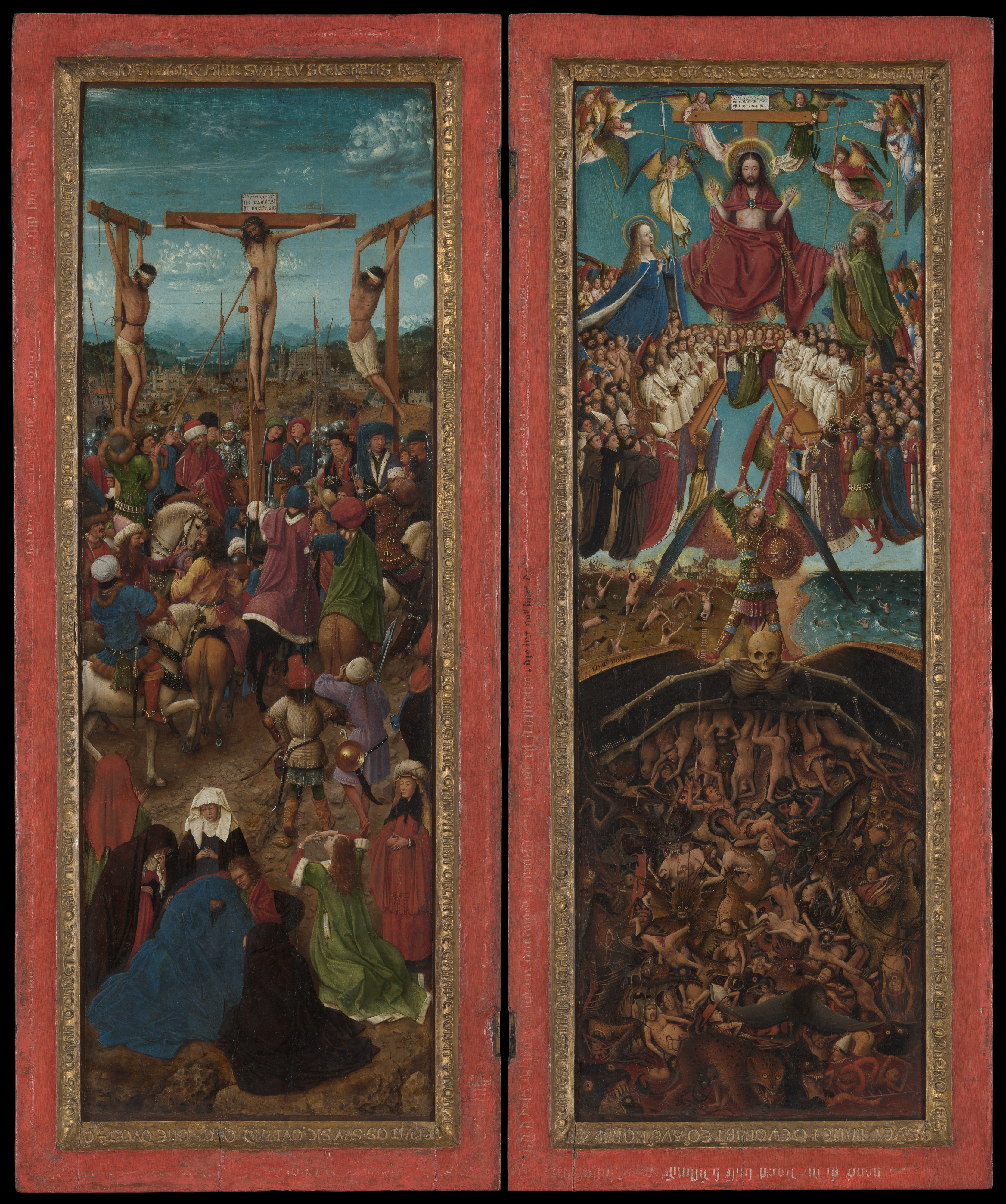
The Met's van Eyck Crucifixion and Last Judgment is the one case here where a test on the frame is a test on the picture, because each painting and its frame were carved from a single oak plank. In 1867, in the Hermitage, the paint was transferred to canvas; the restorer Aleksandr Sidorov signed each reverse, in Russian, transferred from wood 1867. The integral frames were cut away and kept. Ian Tyers's dendrochronology of November 2012 dated the felling of the frame oak to between about 1410 and 1440, in the eastern Baltic.
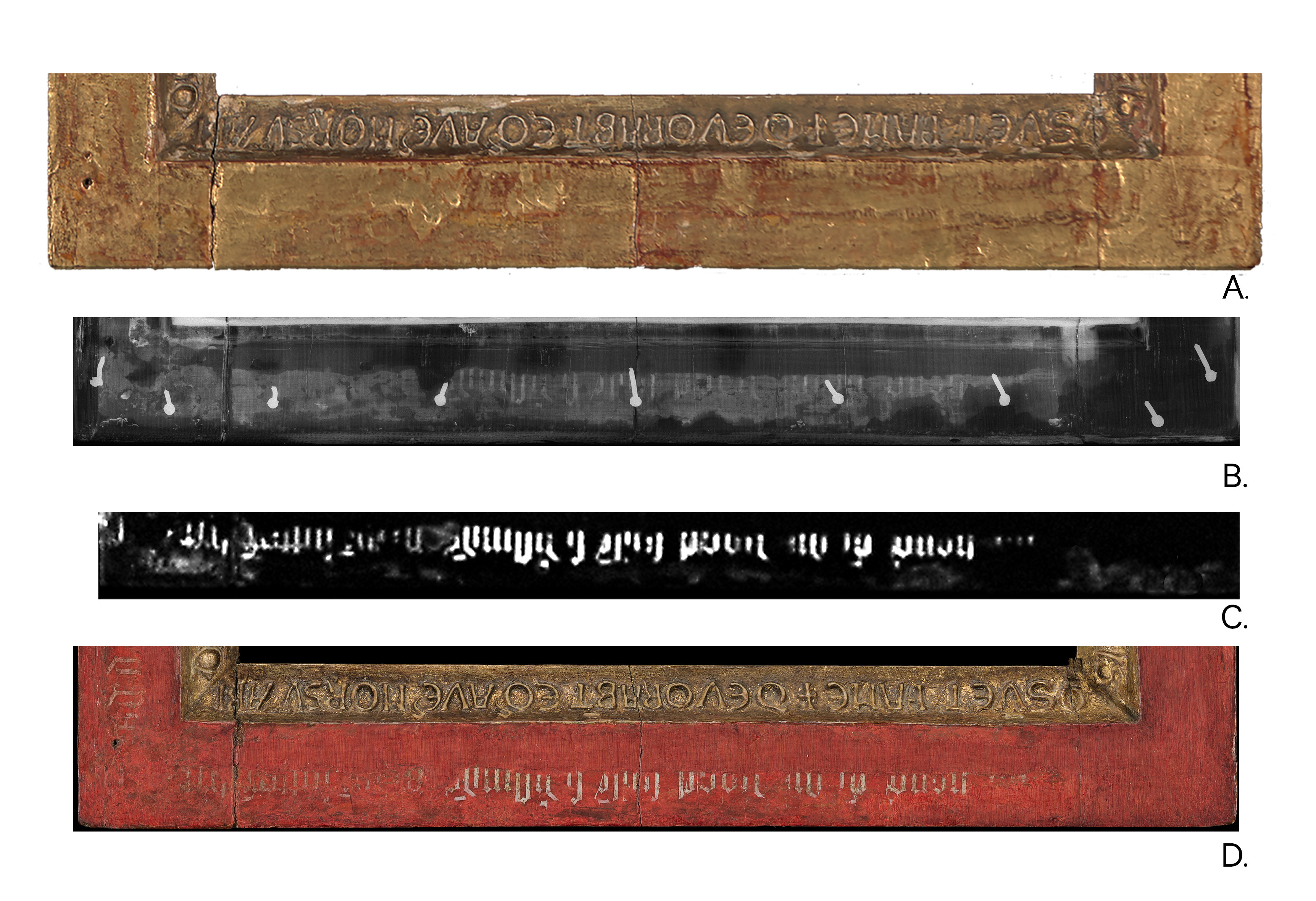
The frames also hold the display history the pictures lost: hinge recesses, three square latch holes for closing as a diptych and nails seen only in the x-radiograph from hardware that latched them as triptych wings. Under modern brass leaf, the 2015 to 2016 treatment uncovered outer borders painted red with white and black inscriptions that the palaeographer Marc Smith identified as Middle Dutch translations of the Latin pastiglia. The canvas reverses carry the Hermitage number 444, on a stretcher made in 1867; it proves the Hermitage, not the painter.
A note on the backing paper, and a frame the painter carved
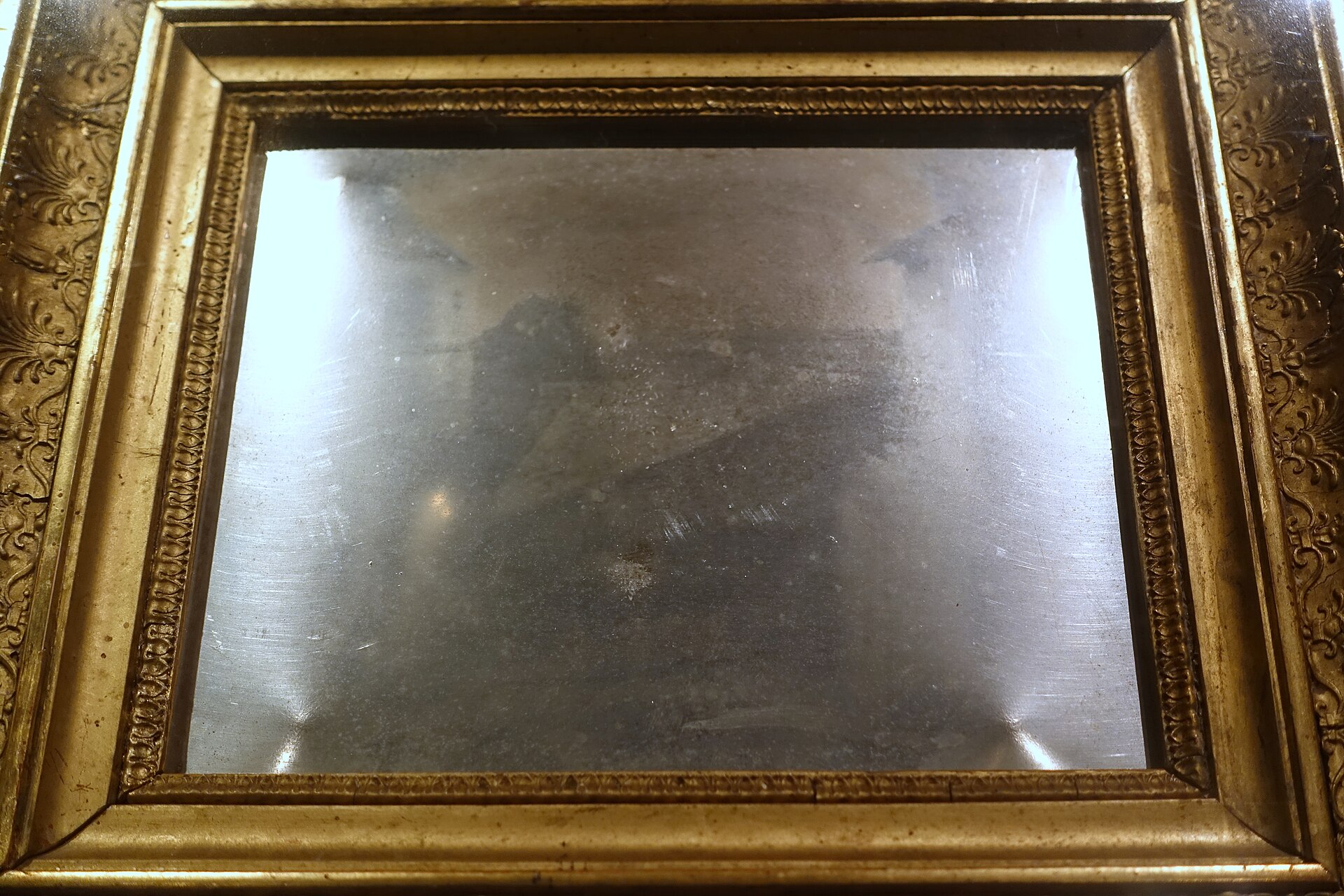
Two frames in the archive carry the identity of the object rather than a later owner's bookkeeping, and both are frames that never left. The Niepce heliograph is a pewter plate that shows almost nothing until it is tilted to the light; what identified it was the frame. Niepce left the plate with the botanist Francis Bauer in 1827, and Bauer wrote the inventor's name and an account of the process on the paper backing of the frame that held it. Helmut Gernsheim, handed the framed plate on 14 February 1952, matched that note to the record of the 1827 visit, and the Getty's frame conservator Gene Karraker found in 2002 that the gilt wood frame is of the plate's period. Had anyone reframed it between Bauer's death in 1840 and Pritchard's purchase in 1884, the note would have gone with the old frame.
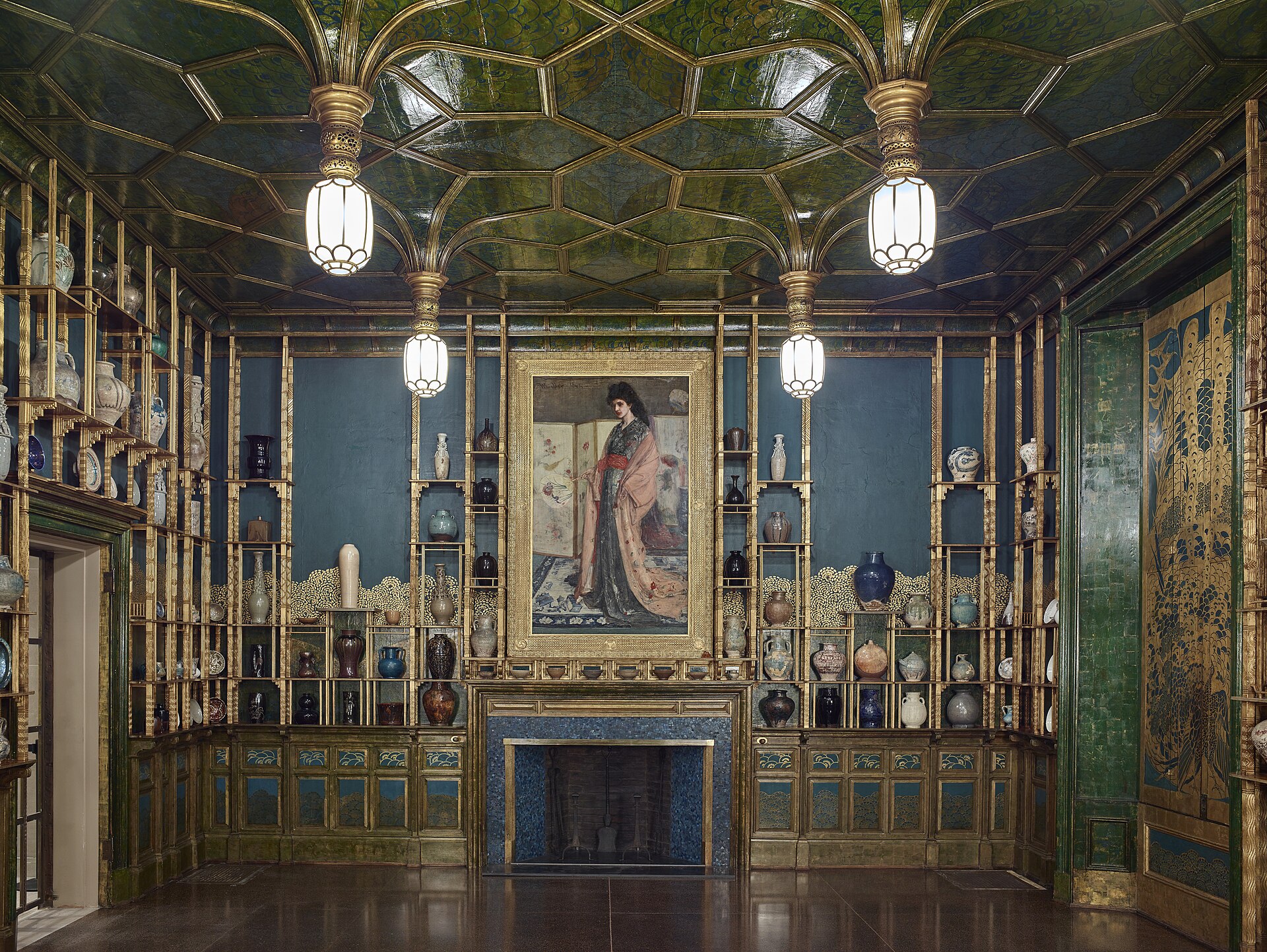
Whistler's Princesse du pays de la porcelaine has a frame the painter made. The Glasgow catalogue raisonne records an 1864 Whistler frame with carved decoration, possibly made by Joseph Green, believed to have remained on the painting since 1864. Frame and painting were sold together at Christie's on 28 May 1892, lot 39, to Alexander Reid for 420 guineas, and reached Charles Lang Freer in August 1903 for 3,750 pounds. The Peacock Room, F1904.61, reached him eleven months later by another route. The frame shares the painting's provenance and the room doesn't.
Frames that arrived later: a mirror in Paris and four nailed strips in Compiegne
Vermeer's Astronomer hangs in a frame that has nothing to do with Vermeer, and the Louvre says so. Its record describes a Dutch seventeenth-century frame, possibly a mirror frame, given specifically for this painting by the De Boer gallery of Amsterdam in 1983, the year the picture entered the collection; with it the object measures 91.7 by 84.8 cm. Any stamp found on that frame would document an Amsterdam gallery in 1983. The wartime evidence, a small swastika reported to have been stamped in 1940, is on the canvas reverse, and we haven't seen it.
The Cimabue Mocking of Christ went the other way. When it sold at Senlis on 27 October 2019 for a hammer of 19,500,000 euros, strips of wood had been nailed against the grain around all four sides to give the fragment the look of a small independent icon. The C2RMF removed them in the 2022 to 2024 restoration. The frame evidence that counts is on the panel: the gesso ends along the bottom and left in a barbe, the ridge that forms against an applied frame. Gilding from that lost engaged frame survives under the paint on the same two sides. The panel remembers a frame that's gone; the frame that was present was a costume.
Two empty frames
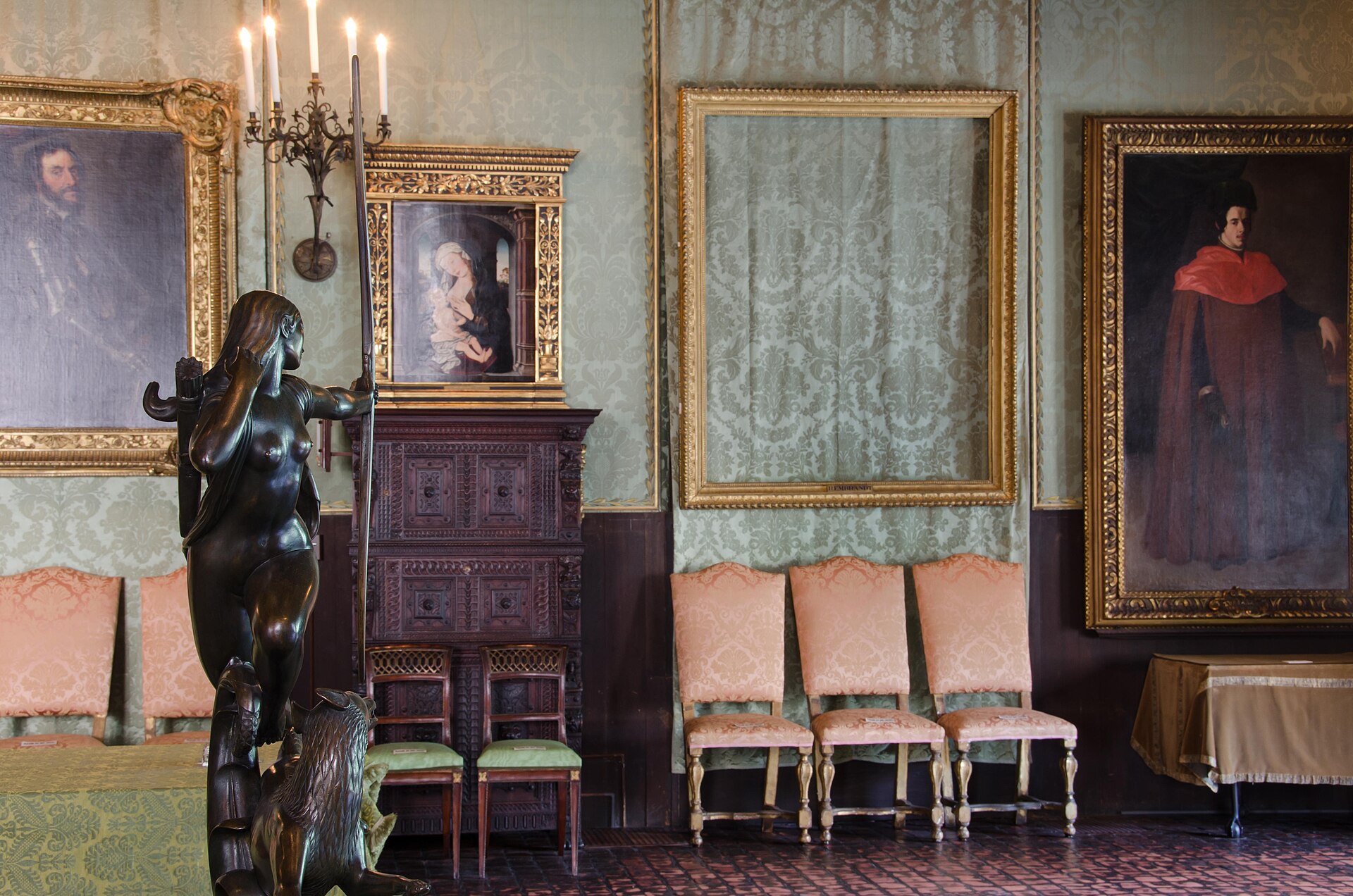
An empty frame proves that a picture was once in it and that the thief didn't want it. The Gardner Museum's own account of 18 March 1990 says the two men cut Rembrandt's Christ in the Storm on the Sea of Galilee and A Lady and Gentleman in Black from their frames, removed Vermeer's Concert and Flinck's Landscape with an Obelisk from theirs and left the Manet's frame behind as well. The frames still hang in the Dutch Room because Gardner's 1924 will requires the collection kept as she arranged it, nothing moved, sold or added; the museum needed a court's permission in 2008 to add a wing. The frame is the only part of P21W27 it still holds.
In Giza the same thing happened in daylight. On Saturday 21 August 2010, during opening hours at the Mohamed Mahmoud Khalil Museum, somebody cut van Gogh's Vase with Viscaria out of its frame with a box cutter; the prosecutor general found no working alarm and seven working cameras of forty-three. The frame stayed on the wall; its history before 2010 isn't published anywhere we could find. Is an empty frame evidence about the painting at all? Only of its dimensions and its last address. Everything else it proves is about the institution.
What a frame proves, object by object
A frame proves the picture's history only as far back as the frame's own history can be traced, and the ten records line up on that rule.
| Object | On or about the frame | Original? | Proves | Does not prove |
|---|---|---|---|---|
| Rembrandt, Camden panel | 1970 loan label on the reverse; sight 52.1 x 41.9 cm | Unknown | Frame in Philadelphia 1970; panel 44.5 cm wide | The panel was in it in 1970; authorship |
| Salvator Mundi | 106 on a 19th-century frame; 106 and CC on the cradle | No; current frame unrecorded | Cook Collection no. 106, via the cradle | Anything before the cradle |
| Caravaggio, Taking of Christ | In the 125 scudi of 1603; 1802 tablet naming Honthorst; 1924 Hicks receipt | No; 1603 frame lost | In Dublin by 1924 | The name on the tablet |
| Van Eyck, Met diptych | Integral frames cut off 1867; oak felled 1410 to 1440; hinges, latches, two languages | Yes, same plank | Date, origin, display, a lay audience | Which shrine it stood in |
| Niepce, Le Gras | Bauer's 1827 note on the backing | Of the period | Maker, process, the 1952 identification | Where it was 1840 to 1884 |
| Whistler, La Princesse | Carved 1864 frame by Whistler | Yes, since 1864 | The frame's chain is the painting's | Anything about the room, F1904.61 |
| Vermeer, The Astronomer | 17th-century frame, De Boer gift 1983 | No | A gift in 1983 | Anything earlier |
| Cimabue, Mocking of Christ | Nailed strips, removed 2022 to 2024; barbe of the lost frame on the panel | No; engaged frame lost | One scene of a larger object | When it was cut apart |
| Vermeer, The Concert | Frame empty in the Dutch Room since 1990 | Unknown | Where it hung; the 1924 will | Condition or location of the canvas |
| Van Gogh, Vase with Viscaria | Frame left on the wall, canvas cut out, 2010 | Unknown | 65 x 54 cm, in Giza | Which canvas was taken |
Three rules fall out of the table. Find out whether the mark is on the support or on the frame, because a cradle or a stretcher stays with the paint and a frame doesn't. Find out whether the frame is integral, because only then is a test on the wood a test on the picture. Where the frame is separate, trace its own provenance back to the mark, as the Hicks receipt does and the Philadelphia label can't.
Why this archive is free to read
We do this for everyone who loves art. The people who have studied it for years, and the people who just stopped to look. Iconotheca exists so that what we learn belongs to all of them.
Nobody pays us for this. No ads, no sponsors, no commercial interest. These works belong to all of us, and we would rather share them with as many people as we can than keep them to ourselves.
If it gave you something today, tell us to keep going. Follow us, leave a like, or write a positive comment. We read every one, and they are what keeps us going.
Questions
No. A frame can be taken off one picture and put on another, so a label on a frame proves where the frame was and what the lender called the picture in it. The Philadelphia Museum of Art said as much about the 1970 label on the Camden attic Rembrandt: a slip or label does not necessarily verify a work of art.
Because each painting and its frame were carved from a single oak plank. The frames were cut away when the paint was transferred to canvas in 1867 and preserved, and Ian Tyers dated the felling of the wood to between about 1410 and 1440 in November 2012. On a separate frame the same test would date only the frame.
No. The Louvre's own record describes a Dutch seventeenth-century frame, possibly originally a mirror frame, given specifically for this painting by the De Boer gallery of Amsterdam in 1983. With the frame the object measures 91.7 by 84.8 cm.
Because Isabella Stewart Gardner's 1924 will requires the collection to be kept as she arranged it, with nothing moved, sold or added. The museum needed a court's permission in 2008 to add a wing. The frames are what compliance looks like, not a memorial.
A receipt for 20 pounds paid to the Dublin furniture maker and restorer James Hicks for restoring the painting's frame, dated 1924, which came to light among Dr Marie Lea-Wilson's papers in April 2016. It is a bill for the frame, and it is what places the picture in Dublin by that year.
Sources
- 1The Metropolitan Museum of Art, collection record 436282, Jan van Eyck, The Crucifixion; The Last Judgment, 33.92ab, Technical Notes by Sophie Scully (2025), Frame, and Signatures, Inscriptions and Markings tabs. Read in full 18 September 2026 in the in-app browser after a 429 on the plain fetch. Source for the single-plank integral frames, the 1867 transfer and Sidorov's signed inscription, the frames cut away and preserved, Ian Tyers's dendrochronology of November 2012 giving 1410 to 1440 and the eastern Baltic, the hinge recesses, latch holes and nails, the red outer mouldings with white and black Middle Dutch inscriptions found under brass leaf in the 2015 to 2016 treatment, and Marc Smith's palaeography. metmuseum.org/art/...
- 2The Metropolitan Museum of Art Open Access API, object 436282. Read 18 September 2026. Source for isPublicDomain true, the primary image and the sixteen additional images including the frame member in four states and the reverse of the canvases. collectionapi.metmuseum.org/public/...
- 3Thomaston Place Auction Galleries, lot record for lot 2363, After Rembrandt Harmenszoon van Rijn, Summer Grandeur 2024 Day 2, 24 August 2024, read 18 September 2026 in the Internet Archive capture of 9 September 2024 because the live site returns 403. Source for the wording label verso from the Philadelphia Museum of Art, lent for a 1970 exhibition, the hand carved Dutch gold frame, the overall size 28 1/2 by 24 1/2 inches, the sight size 20 1/2 by 16 1/2 inches, the estimate of 10,000 to 15,000 dollars and the sold price of 1,175,000 dollars. live.thomastonauction.com/auction-lot/...
- 4Thomaston Place Auction Galleries, press release, New England Art Discovery: Rare 17th Century Portrait Fetches 1.4 Million, PR Newswire, 30 August 2024. Read in full 18 September 2026. Source for the statement that a label on the verso of the frame attributed the work to Rembrandt and recorded a 1970 loan to the Philadelphia Museum of Art, and for the 1,410,000 dollar total and the private European collector. prnewswire.com/news-releases/...
- 5Oscar Holland, CNN, A portrait found in a Maine attic unexpectedly sold for 1.4M. Could it be a long-lost Rembrandt?, 8 September 2024, read in full 18 September 2026 in the ABC17 syndication. Source for the label on the frame's reverse, the Philadelphia Museum of Art being unable to confirm the loan, and the spokesperson's statement that a slip or label doesn't necessarily verify a work of art. abc17news.com/entertainment/...
- 6Dianne Dwyer Modestini, History of the Salvator Mundi, Salvator Mundi Revisited. Read in full 18 September 2026. Source for the nineteenth-century gilded frame carrying inventory number 106 at the lower left in the April 2005 sale, the same number and the letters CC painted in white on the back of the early nineteenth-century cradle, and the match to the Cook Collection catalogue. salvatormundirevisited.com/History-of-the-Salvator-Mundi
- 7National Gallery of Ireland, online collection, object 2882, The Taking of Christ, L.14702. Read in full 18 September 2026. Source for the 125 scudi of 1602, the sale to William Hamilton Nisbet on 27 January 1802, the Dowell's sales of 25 June 1921 at eight guineas and 3 May 1922 at five guineas, and the line that Dr Marie Lea-Wilson bought the picture at an unknown date. onlinecollection.nationalgallery.ie/objects/...
- 8National Gallery of Ireland, Caravaggio: The Irish Connection, from the exhibition Caravaggio: 25 Years on Display. Read in full 18 September 2026. Source for the archival material that came to light in April 2016, the receipt for 20 pounds for restoration of the painting's frame by James Hicks (1886-1936) of 5 Lower Pembroke Street, and the finding that it establishes the painting in Dublin by 1924. nationalgallery.ie/art-and-artists/...
- 9National Gallery of Ireland, How did a masterpiece by Caravaggio end up in a Dublin dining room?. Read in full 18 September 2026. Source for the gilt tablet once attached to the painting's frame repeating the misspelling Gherardo della Notte, made for the new frame after the 1802 sale, and for the photograph of the 1924 Hicks receipt. nationalgallery.ie/art-and-artists/...
- 10Musee du Louvre, collections database, L'Astronome, RF 1983 28, ark:/53355/cl010064324. Read in full 18 September 2026. Source for the Dutch seventeenth-century frame, possibly a mirror frame, given specifically for this painting by the De Boer gallery of Amsterdam in 1983, and the dimensions with frame of 0.917 by 0.848 m and 6.7 cm deep. collections.louvre.fr/en/...
- 11C2RMF, La derision du Christ de Cimabue - Restauration, 7 November 2024. Read in full 18 September 2026. Source for the strips of wood nailed on all four sides to give the fragment the look of a small independent icon, their removal against the grain by Jonathan Graindorge-Lamour in the 2022 to 2024 restoration, and the barbes marking the lost applied frame. c2rmf.fr/actualite/...
- 12Barbara Appelbaum Brown, The First Photograph, WAAC Newsletter, reprinted in Abbey Newsletter vol. 26 no. 3, November 2002, together with the companion note GCI/HRC Research World's First Photograph in the same issue. Both read in full 18 September 2026. Source for Bauer recording Niepce's name and an account of the process on the paper backing of the frame in 1827, and for the Getty frame conservator Gene Karraker's finding that the gilt wood frame dates stylistically to the period of the heliograph. cool.culturalheritage.org/byorg/...
- 13Harry Ransom Center, The Niepce Heliograph, object page. Read in full 18 September 2026. Source for the plate's dimensions of 16.7 by 20.3 by 0.15 cm, the Gernsheim Collection number 964:0000:0001 and the 1963 purchase with the Gernsheim Collection. hrc.utexas.edu/niepce-heliograph
- 14University of Glasgow, The Paintings of James McNeill Whistler, catalogue raisonne YMSM 050, La Princesse du pays de la porcelaine, Technical description and History tabs. Read in full 18 September 2026. Source for the 1864 Whistler frame with carved decoration, English made and possibly by Joseph Green, believed to have remained on the painting since 1864, the framing by the Peacock Room shelving, the Christie's sale of 28 May 1892, lot 39, to Alexander Reid for 420 guineas, and the sale to Charles Lang Freer in August 1903 for 3,750 pounds. whistlerpaintings.gla.ac.uk/catalogue/...
- 15Isabella Stewart Gardner Museum, Theft, the museum's own account of 18 March 1990. Read in full 18 September 2026. Source for the two Rembrandts cut from their frames, the Concert and the Flinck removed from theirs, and the Manet's frame left behind. gardnermuseum.org/about/...
- 16Tufts University Museum Studies blog, The Contested Legal Legacy of the Isabella Stewart Gardner Museum, 4 March 2022. Read in full 18 September 2026. Source for the terms of the 1924 will, nothing moved, sold or added on pain of dispersal, and the 2008 application for legal permission to build the New Wing. sites.tufts.edu/museumstudents/...
- 17Al Jazeera, Egypt blames security for art theft, 23 August 2010, and The History Blog, Van Gogh Poppy Flowers stolen from Egypt museum, 22 August 2010. Both read in full 18 September 2026. Source for the canvas cut out of its frame with box cutters during opening hours on 21 August 2010 and the security official's statement that the cameras and alarm had not worked for a long time. The prosecutor general's count of no working alarms and seven of forty-three cameras is taken from the archive's record, which cites the same contemporaneous account. aljazeera.com/news/...
- 18Wikimedia Commons, file page for Empty Frames at Isabella Stewart Gardner Museum, FBI photograph released 2013, LicenseShortName Public domain, read 18 September 2026 via the API and the file page; used for the hero plate. commons.wikimedia.org/wiki/...

More in Attribution and Authenticity
The partThe Object With No Maker
Eighty-nine of the 266 objects published here name nobody as their maker. The rate runs from 71 per cent in glass and goldsmiths' work to 3 per cent...
An inscription is read on a date, not seen
Six objects in this archive carry writing that settled what they are. In every case the reading is an event with a date and a reader, and in four of...
Two Objects Here Can Prove Who Made Them
Of 257 published records, 156 carry an accepted attribution and two carry one the object itself documents.