The Musicians
Michelangelo Merisi da Caravaggio · 1597
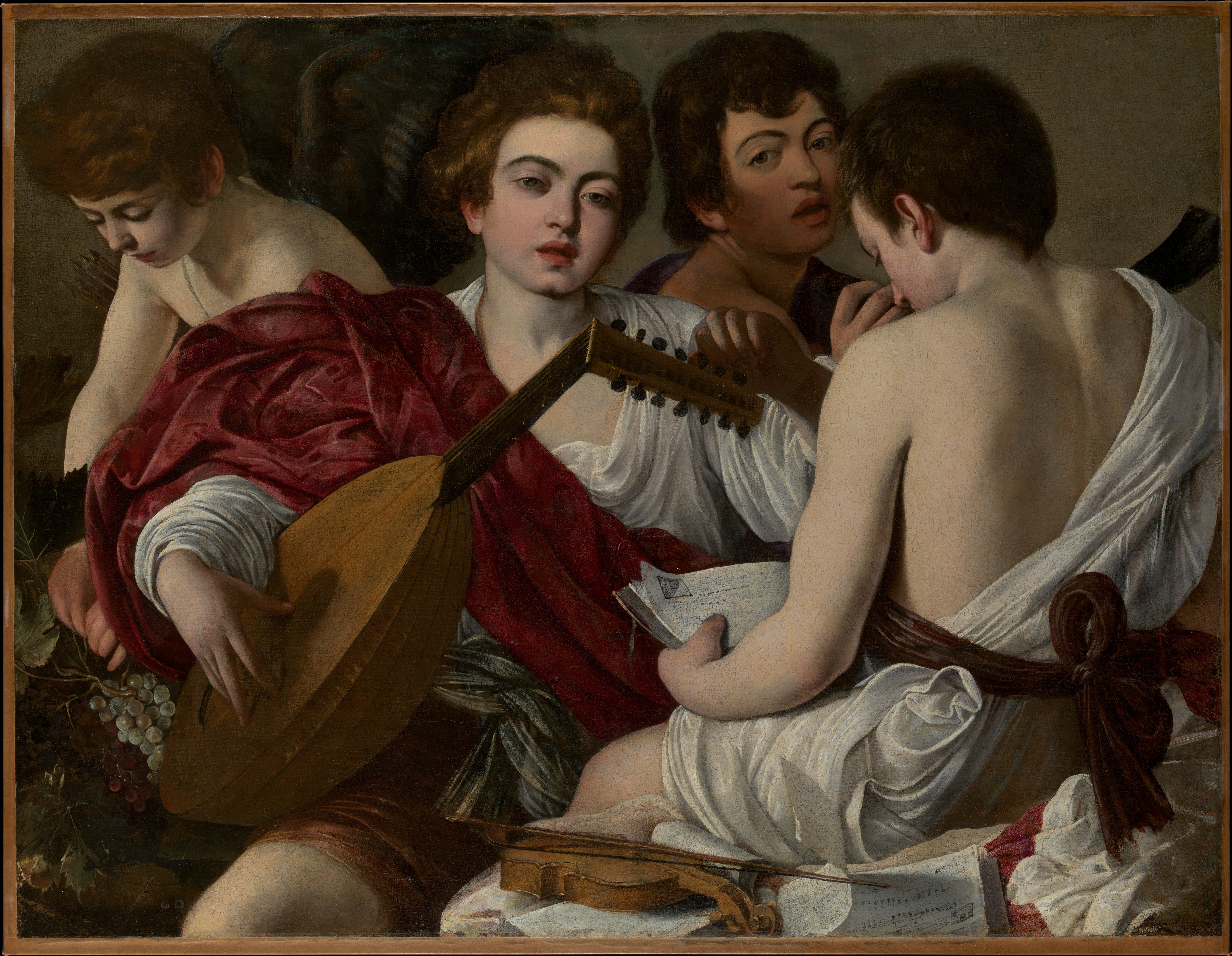
The record subject. Oil on canvas, 92.1 x 118.4 cm, painted for Cardinal Del Monte in 1597. The Metropolitan Museum of Art, 52.81, published by the museum as open access.
| Artist | Michelangelo Merisi da Caravaggio |
|---|---|
| Date | 1597 |
| Medium | Oil on canvas |
| Dimensions | 92.1 x 118.4 cm (36 1/4 x 46 5/8 in.), in the present cut-down state |
| Where it is now | The Metropolitan Museum of Art, New Yorklast confirmed 4 August 2026 |
| Inventory number | 52.81 |
| Attribution | AcceptedUniversally identified with the concert of youths that Giovanni Baglione, writing in 1642, says Caravaggio painted immediately after entering Cardinal Francesco Maria del Monte's household. Full note |
| Object type | Painting |
| Period | Italian, late sixteenth century |
| Cases | Has a provenance gap · Rediscovered |
| Inscriptions | A yellow inscription in capitals giving Caravaggio's name was formerly visible in the lower left corner and is now painted over. It resembles the inscription on another picture that belonged to Marechal de Crequy, Veronese's Supper at Emmaus in the Louvre. The 1933 Burns inventory at Whitehaven recorded the picture as signed Helang da Caravagio. |
| Owners on record | 12 links10 documented, 1 disputed, 1 unknown |
| Sources | 3 cited |
About this record Last verified 7 September 2026 · 3 sources cited · Change log
On this page 10 sections
ContentsClose
Caravaggio's first picture for his first great patron, painted in 1597 for Cardinal Francesco Maria del Monte, and the earliest work in which he built a composition out of separately posed models rather than a scene. It is an allegory of Music and Love, not a concert: the cornetto player is a self-portrait, the lutenist may be a singer in the cardinal's employ, and the winged boy gathering grapes is the only conventional thing in it.
Its provenance runs from Del Monte through Cardinal Antonio Barberini, the French ambassador Charles de Crequy, Cardinal Richelieu and the duchesse d'Aiguillon, and then stops dead for two hundred and forty-five years. It reappears in a house in Whitehaven in Cumberland in the 1920s, inventoried in 1933 as a musical party signed Helang da Caravagio, is sold for a hundred pounds in 1947, and is recognised in 1952 by the dealer David Carritt and published within weeks by Denis Mahon. The Met bought it that year. It is the worst-preserved great Caravaggio in any museum, and the damage is itself the reason the x-ray is so informative.
Provenance
Each link is graded. Documented: a cited source supports it. Disputed: the identification is argued but not established. Unknown: no owner for that span, and the gap is not smoothed into a narrative. The grades in the glossary.
- 1597 - 1626Cardinal Francesco Maria del Monte, Palazzo Madama, Romedocumented
Painted for Del Monte, probably the first work Caravaggio made expressly for him, and recorded in the inventory taken after his death in 1626. The cardinal already owned the Fortune Teller now in the Pinacoteca Capitolina and the Cardsharps now at the Kimbell, both bought on the open market through the dealer Costantino Speti. This one he ordered.1
- 1626 - 1628Uguccione del Monte and then Alessandro del Monte, Romedocumented
To the cardinal's nephew Uguccione, who died the same year, and then to his brother Alessandro, who sold the collection.1
- 1628 - 1634Monsignor Prospero Fagnani, probably acting for Cardinal Antonio Barberini, Romedisputed
Sold at the Giardino di Ripetta in Rome on 8 May 1628 as a picture of youths singing, in a single lot with a Caravaggio of a carafe of flowers, now lost, and a music piece by Bernardino Licinio. Payment was made five days later by Fagnani, almost certainly for Cardinal Antonio Barberini. The Met carries the Barberini ownership with a question mark. An avviso of 8 July 1634 says Cardinal Antonio had bought a Caravaggio from the Vigna Ludovisi and given it to the French ambassador; the Vigna Ludovisi was Del Monte's casino near the Porta Pinciana, sold to Cardinal Ludovisi in 1621, which is how a picture from Palazzo Madama comes to be described as coming from there.1
- 1634 - 1638Charles I de Blanchefort, Marechal de Crequy, French ambassador in Rome, then Parisdocumented
Given to Crequy by Cardinal Antonio Barberini, together with a Lanfranco, and recorded as no. 119 in the posthumous inventory of his collection in 1638. Crequy was a serious Caravaggio buyer: he tried and failed to prise the Amor vincit omnia, now in Berlin, out of Vincenzo Giustiniani. The yellow inscription formerly in the lower left corner of this canvas matches one on another Crequy picture, the Veronese Supper at Emmaus now in the Louvre, which suggests it was applied in his collection.1
- 1638 - 1650Cardinal Richelieu, Palais du Cardinal, Paris, and his estatedocumented
Recorded as no. 996 in the inventory of 1643, the year after Richelieu's death, and sold as the same number in the estate sale that ran from 7 January to 8 February 1650, for 1,030 livres tournois.1
- 1650 - 1675Marie Wignerod de Pontcourlay, duchesse d'Aiguillon, le petit Luxembourg, Parisdocumented
Richelieu's niece bought it out of his estate sale. Her inventory of 1675 lists it as no. 48 and notes that the canvas had been glued to a wooden support, which the Met's curators believe may have contributed to the picture's present condition.1
- 1675 - 1920sUnrecordedunknown
Two hundred and forty-five years with no owner recorded. The picture leaves a Paris palace in the reign of Louis XIV and reappears in a house in Cumberland. How it crossed the Channel, when, and in whose hands is not established in any source consulted.1
- by the 1920s - 1941David Burns, Fernacre, Whitehaven, Cumberlanddocumented
Acquired during the 1920s, according to his son D. Graham Burns, who wrote about the family's ownership in the Whitehaven News and the Burlington Magazine in 1952. The Burns inventory of pottery, porcelain and pictures at Fernacre, taken in August 1933, lists it as no. 846: a musical party signed Helang da Caravagio, 36 x 46. The dimensions in that line are the picture's, to within an inch.1
- 1941 - 1947Mrs David Burns, Fernacre, Whitehavendocumented
Sold shortly before her death in 1947 to the Kendal dealer Joe Cookson.1
- 1947 - 1947Joe Cookson, Kendal, Westmorelanddocumented
Sold on to Thwaytes for 100 pounds. The Times reported the figure on 29 January 1952, five years after the fact and days after the attribution became public.1
- 1947 - 1952Surgeon Captain W. G. Thwaytes, Maulds Meaburn, Penrithdocumented
The owner at the moment of recognition. David Carritt identified the picture in his house; Denis Mahon published it in January 1952; Thwaytes sold it to the Metropolitan Museum in the same year.1
- 1952 - presentThe Metropolitan Museum of Art, New Yorkdocumented
Rogers Fund, accession 52.81. Hung within months; the New York Times noted the new picture on 29 May 1952. The price the Met paid is not published in the sources consulted; the Whitehaven News headline of 31 January 1952 called it That 50,000 Pound Picture, which is a report of local talk about value and not a record of a transaction.12
Prices realised
| Date | Sale | Estimate | Result | Note |
|---|---|---|---|---|
| 8 May 1628 | Sale at the Giardino di Ripetta, Rome Dispersal of the Del Monte collection, lot Sold in a single lot with two other pictures | None recorded | Hammer Not published in the sources consulted With premium No buyer's premium existed in seventeenth-century Rome Roman scudi | The Musicians was sold together with a Caravaggio of a carafe of flowers, since lost but much admired, and a music piece by Bernardino Licinio. Payment was made on 13 May 1628 by Monsignor Prospero Fagnani. Because the three pictures went as one lot, no price can be assigned to this canvas even if the lot total is recovered. |
| 7 January 1650 | The Richelieu estate sale, Paris Estate of Cardinal Richelieu, 7 January to 8 February 1650, lot 996 | None recorded | Hammer 1,030 livres tournois With premium No buyer's premium existed. The figure is the price paid. Livres tournois | Bought by the duchesse d'Aiguillon, Richelieu's niece, out of her uncle's estate. This is the only figure in the picture's first three centuries that is unambiguously a price for this painting alone. |
| 1947 | Private sale, Kendal Joe Cookson to Surgeon Captain W. G. Thwaytes | Hammer GBP 100 (private treaty, not a hammer price) With premium None. This was not an auction and no premium applies. GBP | Reported by The Times on 29 January 1952. Five years later the picture was in the Metropolitan Museum. It is listed here because it is the last recorded price before recognition and the most useful single number in the object's market history, but it must not be read as an auction result. |
Hammer is the price at which the bidding stopped; with premium adds the fee the house charges the buyer on top. Hammer price and buyer's premium in the glossary.
Technical evidence
| Attribution note | Universally identified with the concert of youths that Giovanni Baglione, writing in 1642, says Caravaggio painted immediately after entering Cardinal Francesco Maria del Monte's household. The identification was made by Denis Mahon in January 1952 within weeks of the picture's discovery in an English private house, and has not been challenged since. What has changed repeatedly is the date. Mahon first proposed 1594-95, Baumgart argued 1589, Baroni about 1590, and Roberto Longhi held that it preceded the Del Monte connection altogether. The Met now dates it 1597, on documentary evidence published by Lothar Sickel in 2009-10 establishing that Caravaggio joined Del Monte's household that year and not in 1595. |
|---|---|
| Support | Canvas, relined at least twice. Recorded in the 1675 inventory of the duchesse d'Aiguillon as having been glued to a wooden support, which the Met's curators believe may have contributed to the picture's condition.1 |
| Trimming | Cut down slightly at the top and bottom, about two inches on the left side and about one inch on the right, according to Theodore Rousseau's note on condition published in 1953.1 |
| Dimensions | 92.1 x 118.4 cm (36 1/4 x 46 5/8 in.) in the present state. The 1933 Burns inventory at Whitehaven recorded the picture as 36 x 46 inches.12 |
| Condition of the paint | The lute is reduced to a shape with the strings obliterated; the shadows cast by the player's right hand are smudges; none of the musical scores is legible. The violin and the upturned page of music were reconstructed by restorers on the basis of a later copy.1 |
| Abandoned wings | Mahon observed in 1952 that Caravaggio began to paint wings on the figure at the far left and abandoned them at an early stage.1 |
| X-radiography | The x-ray shows the lutenist's shirt and sash revised into more rhythmic drapery and the right arm painted before the red mantle was laid over it. An x-radiograph detail was published with Mahon's article in the Metropolitan Museum of Art Bulletin in October 1953.1 |
| Lost inscription | A yellow inscription in capitals giving Caravaggio's name was formerly visible at the lower left and is now painted over. A similar inscription appears on Veronese's Supper at Emmaus in the Louvre, which also came from the Crequy collection.1 |
| Open access | The Metropolitan Museum publishes the primary photograph of this painting as open access under CC0, verified against the museum's own isPublicDomain flag at fetch time.2 |
Images
The record in full
Chapter 1What it is
Oil on canvas, 92.1 by 118.4 centimetres in its present state, which is smaller than Caravaggio left it.
Oil on canvas, 92.1 by 118.4 centimetres in its present state, which is smaller than Caravaggio left it. Four youths fill the picture. One tunes a lute in the centre and looks out of the canvas with wet eyes; behind him a boy in a white shirt holds a cornetto and turns his head towards us; a third figure bends over a part-book; at the left a winged cupid reaches into a bunch of grapes. A violin and an upturned page of music lie in the foreground.
It is not a picture of a concert. Nobody in it is playing. The lute is being tuned, the music is being read, the cornetto is being held. Caravaggio has painted the moment before performance, which is the moment in which the instruments are objects and the players are models.
Chapter 2Made to order, and the first thing he made to order
Giovanni Baglione, a contemporary painter who wrote one of the two primary lives of Caravaggio, records that immediately after entering the household of Cardinal Francesco Maria del Monte he painted...
Giovanni Baglione, a contemporary painter who wrote one of the two primary lives of Caravaggio, records that immediately after entering the household of Cardinal Francesco Maria del Monte he painted a concert with some youths portrayed from nature very well. The Met's picture is universally identified with that sentence.
The sequence matters. Del Monte already owned two Caravaggios, the Fortune Teller now in the Capitoline and the Cardsharps now at the Kimbell, and he had bought both on the market through the dealer Costantino Speti. This is the first one he ordered. A painter who had been supplying the trade acquired, in a single transaction, a patron with a palace and a programme.
The date of that transaction has moved. It used to be given as 1595. Lothar Sickel's archival work published in 2009-10 put Caravaggio's entry into the Del Monte household in 1597, which is why the Met's tombstone now reads 1597 and why every dating of this picture before about 2010 is out by two years or more.
Chapter 3An allegory of Music and Love, built out of separate sittings
The picture is an allegory, not a genre scene.
The picture is an allegory, not a genre scene. The cupid gathering grapes carries the meaning: Love, and wine. Cesare Ripa's Iconologia, the standard handbook of allegorical figures, had been published in Rome in 1593 with a dedication to Del Monte himself, and it recommends including wine with Music because music was invented to keep spirits cheerful as wine does. Caravaggio took the wine and refused everything else Ripa offered. Where Ripa would have given a single idealised female figure as Music, Caravaggio gave four boys, an untuned lute and a room.
Scholars agree that the cornetto player is a self-portrait. The lutenist may be a specific person, possibly a male soprano in the cardinal's employ, an argument developed by Franca Trinchieri Camiz in 1988 from the costume and the repertoire. He wears a classicising pastoral costume, as though dressed for a performance rather than living in one.
Giovanni Pietro Bellori, annotating his own copy of Baglione, complained that the composition is flat. He was right about the cause: Caravaggio built it piece by piece from individually posed models, and the pieces do not recede. What Bellori recorded as a fault is the earliest description of the working method that produced everything Caravaggio did afterwards.
Chapter 4A cardinal, an ambassador and a first minister
Del Monte died in 1626 and his collection was sold at the Giardino di Ripetta on 8 May 1628.
Del Monte died in 1626 and his collection was sold at the Giardino di Ripetta on 8 May 1628. The Musicians went in a single lot with a Caravaggio of a carafe of flowers, now lost, and a music piece by Licinio. Prospero Fagnani paid for the lot five days later, almost certainly on behalf of Cardinal Antonio Barberini.
An avviso of 8 July 1634 records that Cardinal Antonio gave a Caravaggio, bought from the Vigna Ludovisi, to Charles de Blanchefort, Marechal de Crequy, the French ambassador in Rome. The Vigna Ludovisi was Del Monte's own casino near the Porta Pinciana, which he had sold to Cardinal Ludovisi in 1621. A Roman avviso reporting the provenance of a diplomatic gift got the address right and the history wrong, and it has taken modern archival work to reconcile the two.
Crequy died in 1638 and the picture appears as no. 119 in his posthumous inventory. It then belonged to Cardinal Richelieu, appears as no. 996 in the 1643 inventory of his estate, and was sold as the same number in the estate sale of January and February 1650 for 1,030 livres tournois to his niece, the duchesse d'Aiguillon. Her inventory of 1675 lists it as no. 48 and adds a sentence with physical consequences: the canvas had been glued to a wooden support.
Chapter 5Two hundred and forty-five years missing
After 1675 the record stops. The picture is next heard of in the 1920s in a house called Fernacre at Whitehaven in Cumberland, belonging to David Burns.This is not a small gap that better research...
After 1675 the record stops. The picture is next heard of in the 1920s in a house called Fernacre at Whitehaven in Cumberland, belonging to David Burns.
This is not a small gap that better research will close in a footnote. It covers the whole of the eighteenth century, the French Revolution and the Napoleonic dispersals, and it is the period in which most French cabinet pictures either went to England or went to the fire. Nothing in the sources consulted names an owner, a sale or a port. The gap is recorded here as a gap and this record refuses to bridge it.
Chapter 6Signed Helang da Caravagio
In August 1933 D. Graham Burns had an inventory made of the pottery, porcelain and pictures at Fernacre.
In August 1933 D. Graham Burns had an inventory made of the pottery, porcelain and pictures at Fernacre. Item 846 reads: a musical party signed Helang da Caravagio, 36 x 46.
Everything in that line is nearly right and nothing in it is quite right. A musical party is what the picture looks like. Helang da Caravagio is a garbled reading of an inscription; the Met's catalogue entry records that a yellow inscription in capitals giving Caravaggio's name was formerly visible in the lower left corner and is now painted over. And 36 by 46 inches is this canvas, within an inch on each side.
The document is therefore both the proof that the picture was at Whitehaven in 1933 and a demonstration of how a masterpiece can sit in a private inventory, correctly measured and approximately attributed, for a generation without anyone acting on it. When Benedict Nicolson wrote his editorial note in the Burlington in April 1952 discussing the provenance, the 1933 inventory was the document he leaned on.
Chapter 7A hundred pounds in 1947
Mrs Burns sold the picture shortly before her death in 1947 to Joe Cookson, a dealer in Kendal.
Mrs Burns sold the picture shortly before her death in 1947 to Joe Cookson, a dealer in Kendal. Cookson sold it to Surgeon Captain W. G. Thwaytes of Maulds Meaburn, near Penrith, for 100 pounds. The Times printed the figure on 29 January 1952.
Five years separate that hundred pounds from the Metropolitan Museum. In between, the dealer David Carritt saw the picture in Thwaytes's house and recognised it. Carritt was twenty-five at the time and would spend the rest of his career finding things; this was among the first.
What the Met paid has not been published in any source consulted. The Whitehaven News of 31 January 1952 ran a letter under the heading That 50,000 Pound Picture, which records what the town was saying about the value and is not evidence of a price. This record does not convert it into one.
Chapter 8Mahon, Longhi, and a dispute about a decade
Denis Mahon published the picture twice in January 1952, in the Burlington Magazine and in Paragone.
Denis Mahon published the picture twice in January 1952, in the Burlington Magazine and in Paragone. He reported its discovery by David Carritt in an English private collection, identified it with the concert mentioned by Baglione and Bellori in Del Monte's collection, described its condition, noted that it had been cut down slightly, and observed that Caravaggio had begun to give wings to the figure at the far left and abandoned them. He dated it 1594-95.
Roberto Longhi disagreed at once and in two directions. In Paragone in the same month he attacked the homoerotic reading of Caravaggio's early pictures, in a piece titled with a sneer about the inverted Caravaggio. In his book of the same year he argued that this picture precedes the Del Monte association altogether and that the concert Baglione described must have been a different work with figures in contemporary dress. Fritz Baumgart dated it 1589. Costantino Baroni dated it about 1590.
Mahon replied in the Metropolitan Museum of Art Bulletin in October 1953, refuting Longhi in a postscript, and again in the Burlington in 1953 in an article about art-historical method. Nobody ever doubted the hand. What was fought over for a decade was whether the picture came before or after the patron, and the answer arrived not from connoisseurship but from a Roman archive, fifty-seven years later.
Chapter 9The worst-preserved great Caravaggio, and why that is useful
Theodore Rousseau set out the condition in the Met Bulletin in October 1953.
Theodore Rousseau set out the condition in the Met Bulletin in October 1953. The picture has been relined at least twice. It has been cut down slightly at the top and bottom, about two inches on the left and about one inch on the right. The duchesse d'Aiguillon's inventory of 1675 records that it had been glued to a wooden support, which the museum's curators believe may have contributed to the damage.
The losses are severe and specific. The lute is scarcely more than a shape, its strings obliterated and the shadow of the player's right hand reduced to smudges. None of the musical scores is legible. The violin and the upturned page of music in the foreground were reconstructed by restorers on the basis of a later copy. Even the best-preserved passages, the lutenist's head and the still life, have lost their subtlety.
The compensation is that a damaged surface is a transparent one. The Met's curators argue that the picture's compromised state makes it possible to watch Caravaggio revising: the lutenist's shirt and sash were reworked with more rhythmic drapery, the right arm was painted first and the red mantle laid over it, each change pulling the figure further from the everyday and closer to allegory. The x-ray makes the same point more sharply. This was an experiment in a kind of painting that was new to him, and the experiment is legible because the finish is gone.
Chapter 10The copies, and one that was made to order and refused
A copy of this composition exists and it is reproduced in the Met's own catalogue entry.
A copy of this composition exists and it is reproduced in the Met's own catalogue entry. Its relationship to the copy documented in 1614-15 is uncertain, and the documentation of that one is unusually complete.
A series of letters running from 27 December 1614 to 13 March 1615 shows that Giulio Mancini, later papal physician and the author of a treatise on painting, arranged to have copies made of three Caravaggios then in Del Monte's collection: the Fortune Teller, the Cardsharps and the Musicians. He paid a professional copyist 15 scudi. The intended buyer was Agostino Chigi. The copy of the Musicians was finished on 13 March 1615 and sent to Siena on 26 June, because Chigi had decided against buying it.
The surviving copy introduces a number of changes, and the Met's curators note that a connoisseur as demanding as Mancini would have been unlikely to accept it. So the documented copy and the surviving copy are probably two different objects, and a reproduction of this composition may be either of them, or a third. Any photograph of the Musicians has to be checked against the Met's canvas before it is attached to this record.
Chapter 11What was read into it, and by whom
A biographical and homoerotic reading has been attached to this picture for most of a century.
A biographical and homoerotic reading has been attached to this picture for most of a century. The Met's own catalogue entry takes a careful position on it and this record follows that position rather than improving on it. The sensual quality of the image is real, particularly the lutenist's wet eyes meeting the viewer's. Caravaggio's bisexuality can be established with reasonable confidence from documentary work. Del Monte's own sexual character is not known. What bearing, if any, the second has on the picture is therefore conjecture built on the first.
Longhi's 1952 objection to the reading was polemical rather than evidential, and the modern position is neither his nor his opponents'. The picture was commissioned by a cardinal who had just been dedicated the standard handbook of allegory, and it is an allegory that departs from that handbook. That is a documented fact about its making. The rest is interpretation, and the honest thing is to name it as such.
The artist
Michelangelo Merisi da Caravaggio
More novelistic biographies have been written about Caravaggio than about any other old master, and the biography has done real damage to the reading of the pictures. The documented life is violent enough without embellishment: a flight from Rome after a killing, a knighthood in Malta followed immediately by a prison cell, an escape to Sicily, an assault in Naples that left him scarred, and death of fever on the Tuscan coast at thirty-eight. What is worth holding on to when looking at the Musicians is that all of it came later. This picture is the work of a young man who had just been taken into a cardinal's palace and given a room.
Related works
| Work | Relation | Where it is |
|---|---|---|
| The Cardsharps Caravaggio | In Del Monte's collection, bought rather than commissioned Acquired by Del Monte through the dealer Costantino Speti, with the Fortune Teller. Copied for Agostino Chigi in 1614-15 in the same commission as the copy of this picture. | Kimbell Art Museum, Fort Worth |
| The Fortune Teller Caravaggio | In Del Monte's collection, bought rather than commissioned The third of the Del Monte Caravaggios copied for Chigi in 1614-15. | Pinacoteca Capitolina, Rome |
| The Lute Player Caravaggio | A personalised variant made for Del Monte a few years later Del Monte commissioned his own version of a lute player Caravaggio had painted for the market for Vincenzo Giustiniani. A second version is in a private collection; the Met showed it in 1990. | State Hermitage Museum, Saint Petersburg |
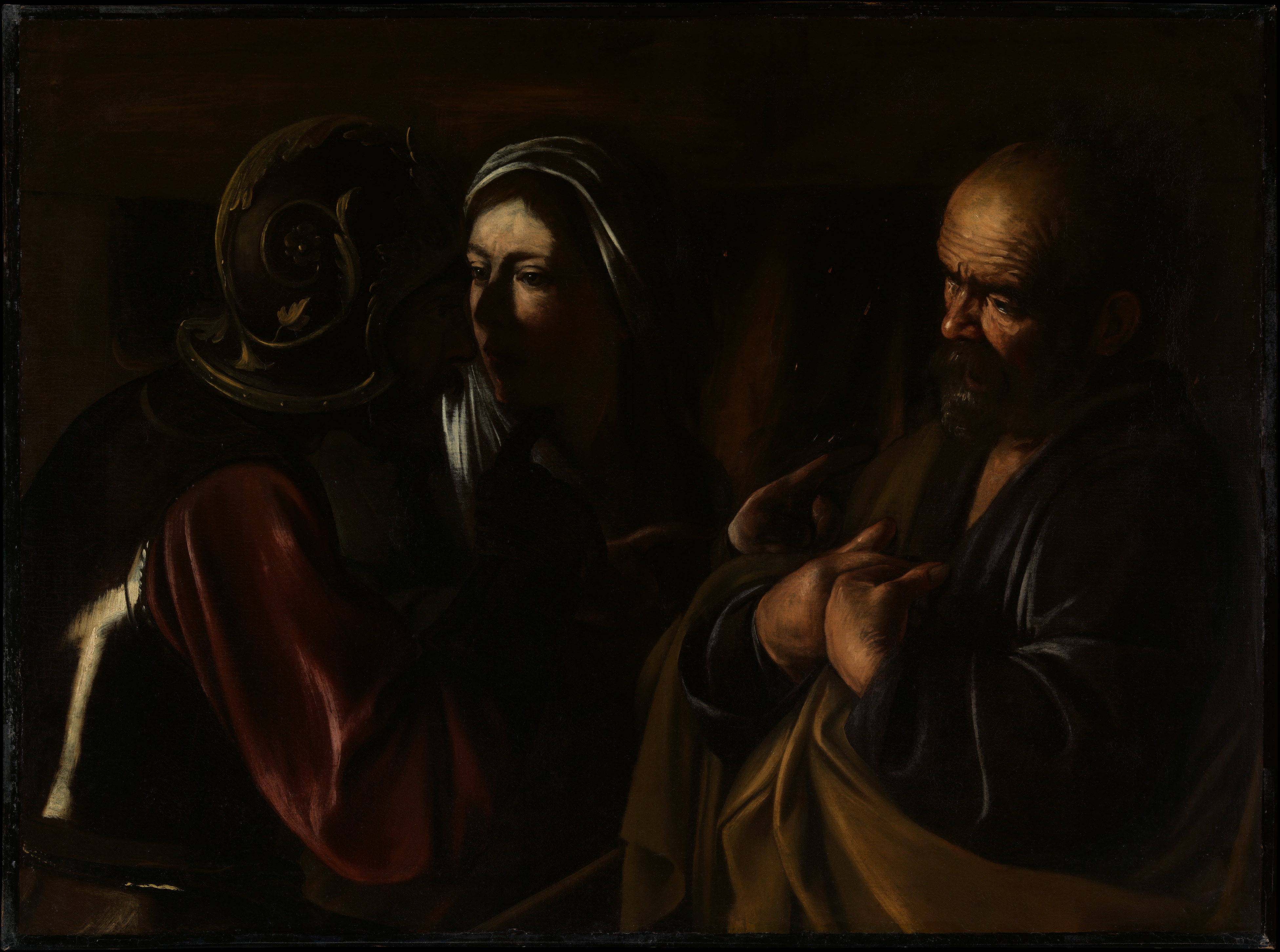
| The Denial of Saint Peter Caravaggio | The other Caravaggio in the same museum, from the end of his life Painted in 1610, thirteen years after the Musicians. The Met holds one picture from each end of the career and says so. | The Metropolitan Museum of Art, New York, 1997.167 |
| Amor vincit omnia Caravaggio | The picture Crequy tried and failed to buy Owned by Vincenzo Giustiniani. Crequy's unsuccessful attempt to acquire it is the evidence that his interest in Caravaggio was more than diplomatic. | Gemaeldegalerie, Berlin |
Open questions
- Where was the picture between 1675 and the 1920s? Two hundred and forty-five years are unrecorded, including the entire eighteenth century and the Napoleonic dispersals.
- How and when did it reach England, and had it been in another British collection before David Burns bought it in the 1920s?
- What did the Metropolitan Museum pay Surgeon Captain Thwaytes in 1952? The Whitehaven News headline of 31 January 1952 referred to a fifty thousand pound picture, but no transaction figure is published in the sources consulted.
- What did the 1628 Del Monte lot fetch, and can a value be apportioned to this canvas out of a lot that also held a lost Caravaggio still life and a Licinio?
- Is the surviving copy of this composition the one Mancini commissioned in 1614-15, or a different copy? The Met's curators note that the surviving version introduces changes Mancini would have been unlikely to accept.
- Where is the lost Caravaggio of a carafe of flowers that was sold in the same lot in 1628?
- Is the lutenist a specific individual, and if so which? Camiz's proposal of a castrato in Del Monte's employ is an argued identification, not a documented one.
Questions about this object
What is The Musicians?
The Musicians is a painting, dated 1597. Medium: Oil on canvas.
Who made The Musicians, and is the attribution settled?
The attribution to Michelangelo Merisi da Caravaggio is recorded here as accepted. Universally identified with the concert of youths that Giovanni Baglione, writing in 1642, says Caravaggio painted immediately after entering Cardinal Francesco Maria del Monte's household. The identification was made by Denis Mahon in January 1952 within weeks of the picture's discovery in an English private house, and has not been challenged since. What has changed repeatedly is the date. Mahon first proposed 1594-95, Baumgart argued 1589, Baroni about 1590, and Roberto Longhi held that it preceded the Del Monte connection altogether. The Met now dates it 1597, on documentary evidence published by Lothar Sickel in 2009-10 establishing that Caravaggio joined Del Monte's household that year and not in 1595.
Where is The Musicians now?
The Metropolitan Museum of Art, New York. Inventory number 52.81. Last confirmed 4 August 2026. Rogers Fund, 1952; bought from Surgeon Captain W. G. Thwaytes.
What has The Musicians sold for?
Hammer Not published in the sources consulted; with premium, No buyer's premium existed in seventeenth-century Rome. Sale at the Giardino di Ripetta, Rome, 1628-05-08.
What is still unknown about The Musicians?
Where was the picture between 1675 and the 1920s? Two hundred and forty-five years are unrecorded, including the entire eighteenth century and the Napoleonic dispersals.
Sources
- 1The Metropolitan Museum of Art, object record 435844, Caravaggio, The Musicians, accession 52.81. Consulted for the tombstone, the catalogue entry, the full provenance, the exhibition history and the bibliography, which supplies Baglione 1642, Bellori 1672, the Burns inventory of 1933, Mahon 1952 in the Burlington Magazine and in Paragone, Longhi 1952, Baumgart 1952, Baroni 1952, Nicolson's editorial note of April 1952, The Times of 29 January 1952, the Whitehaven News of 31 January 1952, the New York Times of 29 May 1952, Rousseau 1953, Camiz 1988, Boyer and Volf 1988, Maccherini 1997, Lorizzo 2006 and Sickel 2009-10. metmuseum.org/art/...
- 2The Metropolitan Museum of Art Open Access API, object 435844. Consulted for isPublicDomain, primaryImage, medium, dimensions, artist dates, accession number and credit line. collectionapi.metmuseum.org/public/...
- 3The Metropolitan Museum of Art Open Access API, object 437986, Caravaggio, The Denial of Saint Peter, accession 1997.167. Consulted to verify open-access status and the tombstone of the comparison plate. collectionapi.metmuseum.org/public/...
Last verified 7 September 2026 · Published 4 August 2026
Change log
4 August 2026 - Record created at the house standard: researched narrative, technical evidence, maker dossier, graded provenance chain, prices with hammer and premium separated, related works, open questions and sources.
7 September 2026 - Re-verified. No change to location, attribution or dating: still the Metropolitan Museum of Art, gallery 620, Rogers Fund 1952, object 52.81, still dated 1597 per the Sickel documentary evidence already on record, still Public Domain per the Met's own object page. No new scholarship, litigation or sale found addressing the 1675-1920s provenance gap, the Thwaytes purchase price, the lutenist's identity, or the lost companion still-life sold in the same 1628 lot. All three source URLs re-checked and resolve 200.