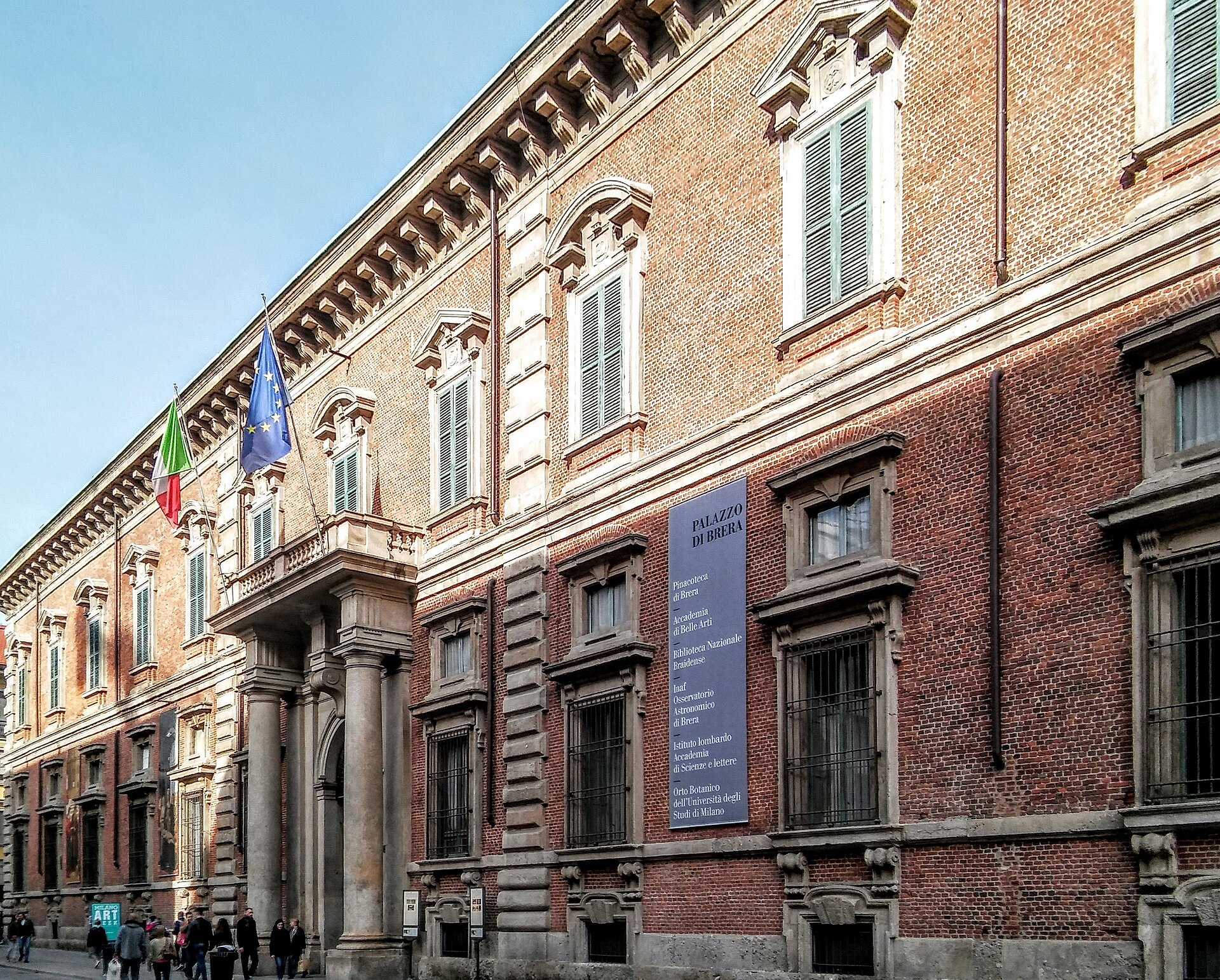
The brick facade of Palazzo Brera on Via Brera, with the museum's own signage reading PALAZZO DI BRERA visible at street level.
Melancholia~itwiki · CC BY-SA 4.0Pinacoteca di Brera
Museum · Founded 1809
Open, admission and hours confirmed 23 August 2026 · 12 sources
On this page 15 sections
ContentsClose
The Brera's strength is the direct, still-visible trace of how it was built: a single Napoleonic act of confiscation and redistribution across the Kingdom of Italy produced, in a handful of years, a concentration of north Italian Renaissance and Venetian altarpieces that took the Uffizi and the Louvre centuries of purchase and inheritance to assemble by comparison. That gives the collection unusual coherence for its size - it reads less like an accumulation of individual purchases than like a single administrative decision made visible.
| Kind | Museum |
|---|---|
| Founded | Gallery commissioned by Napoleon Bonaparte, opened 15 August 1809 (Napoleon's birthday) as the Reale Pinacoteca, inside the Palazzo di Brera, built on the site of a Jesuit college suppressed in 1773; administratively separated from the Accademia di Belle Arti in 1882; autonomous state museum since 2014-2015 |
| City and country |  Milan, Italy Milan, Italy |
| Address | Via Brera 28, 20121 Milano, Italy |
| Website | pinacotecabrera.org/en |
| Status | Open, confirmed |
| Record last verified |
Visiting
- Hours
- Tuesday to Sunday08:30 to 19:15Last entry 18:00
- Closed
- Monday. 1 May. 25 December. 1 January.
- Admission
- Grande Brera, full priceEUR 20Covers the Pinacoteca di Brera permanent collection, the exhibition La Bellezza e l'Ideale, the Pinacoteca Viaggiante display, and the permanent collection of Palazzo Citterio, the last valid for six days after the visit date
- Grande Brera, reduced, ages 18-25EUR 4
Free entry: First Sunday of the month, with reservation. Under 18, at all times. Visitors with disabilities, at all times. Italian state school teachers, fine arts academy students, professional guides, and credentialed journalists, at all times- Tickets
- pinacotecadibrera.eventim-inhouse.de/webshop/... The museum's own ticket page.
- Do I need to book?
- Not required for the general public, though the museum's ticketing runs through an external platform (Eventim) and reservation is required for the free first-Sunday admission
- Address
- Via Brera 28, 20121 Milano, Italy MapMetro Lanza or Montenapoleone stations, both a short walk
- Website
- pinacotecabrera.org/en
- Telephone
- +39 02 72105 141
- [email protected]
Before you go how long, access, photography, bags, eating, shop
- How long to allow
- Not confirmed on the pages consulted for this file; the gallery is a single-floor circuit of roughly 38 rooms, which most sources describe as a two-hour visit at a normal pace
- Access
- Not detailed on the pages consulted for this file beyond a dedicated accessibility page being linked from the visit section; not confirmed further
- Photography
- Not stated on the pages consulted for this file; not confirmed
- Bags
- Not stated on the pages consulted for this file; not confirmed
- Eating
- Not confirmed on the pages consulted for this file
- Shop
- Not confirmed on the pages consulted for this file
Prices and hours change. We take them from the institution's own pages and print the day we read them, and you can check the current position at the source we used. Confirm before you travel.
What is inside
The main courtyard
The arcaded courtyard of the former Jesuit college, now ringed by the Accademia di Belle Arti and the gallery entrance. Holds a bronze cast of Canova's Napoleon as Mars the Peacemaker, made in Rome in 1811 by Francesco Righetti and his son from cannon bronze and installed here in 1859; the marble original the cast reproduces is a different, separately owned object at Apsley House in London.
The early Renaissance rooms
Holds Mantegna's Lamentation over the Dead Christ and Giovanni Bellini's Pieta, alongside Gentile and Giovanni Bellini's St Mark Preaching in Alexandria - the core of the museum's claim to be the reference collection for north Italian Renaissance painting outside a church setting.
The Piero della Francesca and Urbino rooms
Holds the Montefeltro Altarpiece (the Brera Madonna), Piero della Francesca's altarpiece for Federico da Montefeltro, deposited here by Napoleon-era transfers from Urbino rather than bought by the gallery.
The High Renaissance and Venetian rooms
Holds Raphael's Marriage of the Virgin (Sposalizio della Vergine) and Tintoretto's Discovery of the Body of Saint Mark, part of the material redistributed to Milan from Venetian and central Italian churches and confraternities under Napoleonic administration.
The Caravaggio and Baroque room
Holds Caravaggio's Supper at Emmaus, one of at least two autograph versions of the subject Caravaggio painted; the other is in the National Gallery, London.
The 19th-century rooms
Holds Francesco Hayez's The Kiss, painted in 1859, the year of the bronze Napoleon cast's installation in the courtyard outside - Romantic-era Italian painting at the point the gallery's own acquisitions, rather than Napoleonic transfer, start to define what is on the walls.
What to see first
Lamentation over the Dead Christ
Andrea Mantegna, c. 1483An extreme foreshortened view of the dead Christ's body that places the viewer at his feet; passed from the Gonzaga court through Cardinal Mazarin's Roman circle and the Bossi family before the Bossi sold it to the Brera, and scholars still dispute whether the mourning figures at left are original to the panel or a later addition.5
The Montefeltro Altarpiece (Brera Madonna)
Piero della Francesca, 1472-1474Commissioned by Federico da Montefeltro, Duke of Urbino, and deposited at the Brera under Napoleon; darkened varnish had it misattributed to Fra Carnevale for decades after it entered the collection, until modern cleaning recovered Piero's own technique and confirmed the correct hand.6
The Marriage of the Virgin (Sposalizio della Vergine)
Raphael, 1504Painted for a chapel in Citta di Castello and moved to Milan through Napoleonic-era transfers; one of the works most often used to date the transition from Raphael's teacher Perugino's style to his own.4
Supper at Emmaus
Caravaggio, 1606One of at least two autograph versions Caravaggio painted of the same subject, the other in London's National Gallery; painted in the year he fled Rome after killing a man, which every account of the picture has to reckon with.4
The Kiss (Il Bacio)
Francesco Hayez, 1859The single image most reproduced from the collection, painted the same year Italy's unification wars restarted against Austria; read at the time as an allegory of the Franco-Italian alliance as much as a genre scene of a couple.4
Discovery of the Body of Saint Mark
Jacopo Tintoretto, 1562-1566Part of a cycle for the Scuola Grande di San Marco in Venice, redistributed to Milan under Napoleonic-era reorganisation of church and confraternity property - one of several major Venetian works whose presence in Milan, rather than Venice, is a direct record of that redistribution.4
Napoleon as Mars the Peacemaker (bronze cast)
Cast by Francesco Righetti and son, 1811, after Antonio CanovaNot the same object as this archive's own Canova record, which describes the marble original now at Apsley House in London: this is a separate bronze cast, made from cannon bronze and installed in the Brera courtyard in 1859, and the two should not be confused.7
St Mark Preaching in Alexandria
Gentile Bellini and Giovanni Bellini, 1504-1507Left unfinished by Gentile Bellini at his death and completed by his brother Giovanni - one of the clearer documented cases in the collection of a picture finished by a second hand after the first painter's death.5
Past exhibitions here
- Closed26 May to 13 Sep 2026Confirmed · check before you travel
A Jesuit college becomes an academy, and an academy becomes a gallery
The building on Via Brera began as a Jesuit college; the order took over the site in 1572 and held it until the Jesuits were suppressed across the Habsburg lands in 1773. Empress Maria Theresa of Austria used the vacated buildings to found the Accademia di Belle Arti di Brera in 1776, an art academy rather than a public gallery. The Pinacoteca itself is younger and came from a different ruler entirely: Napoleon Bonaparte, as King of Italy, commissioned the gallery to give the Academy's students works to study and copy, and the new Reale Pinacoteca opened to the public on 15 August 1809 - Napoleon's own birthday, a date chosen for the opening rather than an incidental one.
Built from confiscation, not from a founding donation
Almost none of the Brera's founding collection was bought. Napoleonic administration across the Kingdom of Italy suppressed religious houses and confraternities and reassigned their art, in large part to Milan, both to give the new academy teaching material and to build a public collection that could stand alongside the Louvre, which Napoleon was assembling in Paris by exactly the same method on a larger scale. Tintoretto's Discovery of the Body of Saint Mark came from the Scuola Grande di San Marco in Venice; Raphael's Marriage of the Virgin travelled from a chapel in Citta di Castello; the Piero della Francesca altarpiece was, in the flat language of the museum's own record, 'deposited by Napoleon' rather than acquired by any transaction the gallery itself made. The Brera's founding character is a direct, unconcealed record of state confiscation repurposed as public education - not a scandal the museum hides, since its own history pages state the Napoleonic transfers plainly, but a fact worth stating in full rather than folding into a vaguer word like 'acquired'.
Mantegna's Dead Christ: an image nobody could look away from
Andrea Mantegna's Lamentation over the Dead Christ, painted probably in the early 1480s, remains the single work most identified with the Brera. Its foreshortening places the viewer at Christ's feet, distorting proportion to keep the composition in the panel's small frame while denying the usual comfortable distance of a devotional image - one scholarly reading holds that its intensity may be exactly why it was never delivered to whatever original altar it was painted for. Its ownership history after Mantegna's death runs through the Gonzaga court at Mantua, into Cardinal Sigismondo Gonzaga's hands with Isabella d'Este's permission, through the 1630 sack and dispersal of Mantua, into Cardinal Mazarin's circle in Rome, and eventually to the Bossi family in Milan, who sold it to the Brera a century and a half after it left Mantua. Scholars still argue whether the mourning figures crowded into the left edge of the panel are part of Mantegna's original design or a later addition, and whether a second, mourner-free version that also survives is an autograph variant or simply a copy.
The Brera Madonna and a case of mistaken identity that lasted decades
Piero della Francesca's altarpiece for Federico da Montefeltro, Duke of Urbino, painted around 1472 to 1474 and commonly called the Brera Madonna, is dated by the absence of the Order of the Garter insignia Federico received after that date. An ostrich egg hangs from a shell above the Madonna's head, read variously as a reference to the Duke's newborn son Guidobaldo, to the Virgin's own fertility, and to resurrection and immortality - the kind of layered symbolism Piero's patrons expected and that a modern viewer easily misses. When the panel entered the Brera's collection under Napoleonic-era transfers from Urbino, its surface was so obscured by darkened varnish that its authorship was misread: for years it was catalogued as the work of Fra Carnevale rather than Piero della Francesca, because the paint handling that identifies Piero's hand was simply not visible under the grime. Modern cleaning recovered the original surface and settled the attribution the earlier restorers could not see past.
One statue, two cities, and a caution this archive takes seriously
The Brera's main courtyard holds a bronze cast of Antonio Canova's Napoleon as Mars the Peacemaker, made from cannon bronze in Rome in 1811 by Francesco Righetti and his son and installed here in 1859. It is not the same object as the marble Canova carved first: that marble left Italy after Napoleon's fall and now stands at Apsley House in London, a different museum this archive already records separately. The two are related by design and by the sitter but are physically distinct objects with distinct ownership histories, and treating a photograph or a fact about one as evidence about the other would be exactly the kind of version error this archive exists to avoid. The Brera courtyard bronze is documented here as what it is: a contemporary cast of the composition, not the original, and not interchangeable with it.
Grande Brera: a two-century renovation, still not finished
The gallery separated administratively from the Accademia di Belle Arti in 1882 and became an autonomous state museum in the mid-2010s, but the project to expand it, known as Grande Brera, is still under way. The neighbouring Palazzo Citterio, intended since the 1970s to give the museum room for its 20th-century holdings and temporary exhibitions, has moved toward full integration only in the past few years, and the single Grande Brera ticket now sold covers the Pinacoteca's permanent collection, a temporary exhibition, and Palazzo Citterio's collection together, with the Palazzo Citterio portion valid for six days after the ticketed visit rather than on the same day. A museum built in 1809 to demonstrate that the Napoleonic state could organise Italian art as well as the Louvre organised French art is, in 2026, still visibly a work in progress rather than a finished institution.
What visitors say
Visitors and critical sources consistently describe the Brera as one of Italy's essential painting collections, distinguished from the Uffizi and the Vatican museums by being a manageable single-floor circuit rather than an exhausting multi-wing complex, and the recurring praise is precisely that it can be seen properly in a couple of hours without the crowding of Florence or Rome's largest museums.
What is praised, what is criticised
- Praised: The concentration of major north Italian Renaissance and Venetian painting in a small number of rooms is repeatedly named as the gallery's core strength
- Praised: The relative lack of crowding compared with Florence's or Rome's largest museums is noted often enough to be a consistent visitor observation rather than an isolated one
- Criticised: The Grande Brera ticket structure, bundling the permanent collection with temporary shows and separately timed access to Palazzo Citterio, is not self-explanatory at the point of purchase
- Criticised: Wall labelling and gallery layout are described in visitor accounts as dated relative to the quality of the collection, an observation the ongoing Grande Brera renovation project is intended to address
Ratings on other platforms
TripAdvisor: 4.5 from 5,789 ratings, read 7 August 2026
A platform average is a tertiary source: it moves, it is not audited, and we quote no visitor's words.
Questions about Pinacoteca di Brera
Where is Pinacoteca di Brera?
Via Brera 28, 20121 Milano, Italy.
How much does it cost to visit?
Grande Brera, full price: EUR 20; Grande Brera, reduced, ages 18-25: EUR 4. As confirmed 23 August 2026.
When is it open?
Tuesday to Sunday 08:30-19:15. Closed: Monday. 1 May. As confirmed 23 August 2026.
How do you get there?
Metro: Lanza or Montenapoleone stations, both a short walk.
What should you see first?
Lamentation over the Dead Christ (Andrea Mantegna, c. 1483); The Montefeltro Altarpiece (Brera Madonna) (Piero della Francesca, 1472-1474); The Marriage of the Virgin (Sposalizio della Vergine) (Raphael, 1504); Supper at Emmaus (Caravaggio, 1606); The Kiss (Il Bacio) (Francesco Hayez, 1859); Discovery of the Body of Saint Mark (Jacopo Tintoretto, 1562-1566).
What we could not confirm
- Whether the mourning figures in Mantegna's Lamentation over the Dead Christ are original to the panel or a later addition is unresolved among the scholars cited in the sources consulted for this record.
- The exact circumstances under which the Piero della Francesca altarpiece was 'deposited by Napoleon' - whether as an outright confiscation, a forced transfer, or something else - are stated in the sources consulted only in that flat administrative language, without further documentation of the transaction itself.
- This record does not establish whether any of the Napoleonic-era transfers into the Brera's founding collection were ever formally contested for return after 1815, in the way some Napoleonic seizures elsewhere in Europe were; that question was not resolved in the sources consulted.
Images
Sources
- 1Pinacoteca di Brera, Opening hours (museum's own site) pinacotecabrera.org/en/visit/orari/
- 2Pinacoteca di Brera, Contact us (museum's own site) pinacotecabrera.org/en/contact-us/
- 3Pinacoteca di Brera, Visit (museum's own site) pinacotecabrera.org/en/visit/
- 4Wikipedia, Pinacoteca di Brera () en.wikipedia.org/wiki/Pinacoteca_di_Brera
- 5Wikipedia, Lamentation over the Dead Christ (Mantegna) () en.wikipedia.org/wiki/Lamentation_over_the_Dead_Christ_(Mantegna)
- 6Wikipedia, Montefeltro Altarpiece () en.wikipedia.org/wiki/Montefeltro_Altarpiece
- 7Wikipedia, Napoleon as Mars the Peacemaker () en.wikipedia.org/wiki/Napoleon_as_Mars_the_Peacemaker
- 8Pinacoteca di Brera, Masterpieces / Collections (museum's own site) pinacotecabrera.org/en/collezioni/capolavori/
- 9Pinacoteca di Brera, About us (museum's own site) pinacotecabrera.org/en/about-us/
- 10Pinacoteca di Brera, Entrances / admission rules (museum's own site) pinacotecabrera.org/en/visit/entrances/
- 11TripAdvisor, Pinacoteca di Brera, aggregate rating () tripadvisor.com/Search?q=Pinacoteca%20di%20Brera
- 12Wikidata Q150066, Pinacoteca di Brera (, identity and coordinates) wikidata.org/wiki/Q150066