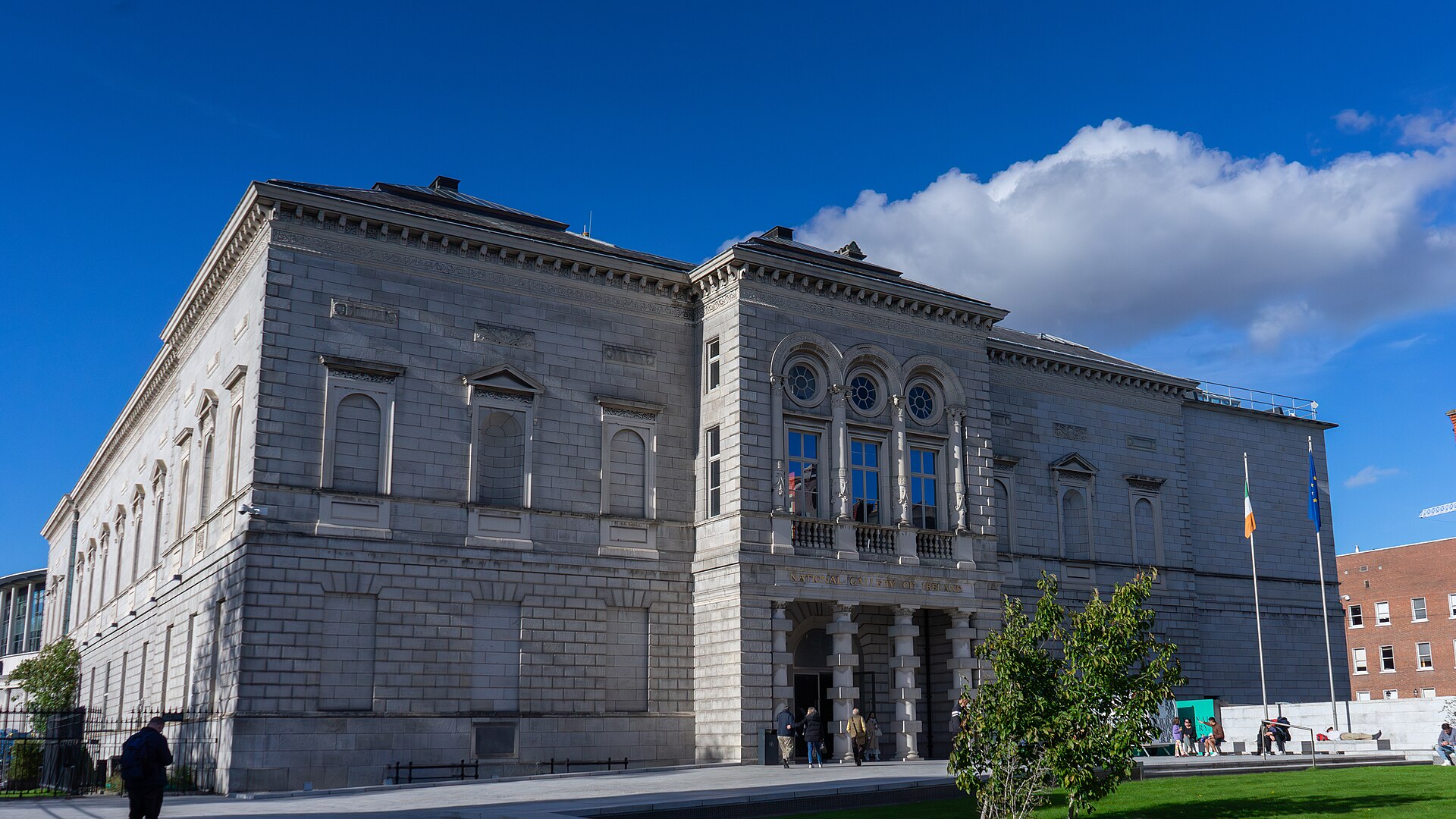
On this page 15 sectionsContentsCloseThe National Gallery of Ireland seen from Merrion Square, with the Irish tricolour flying over the entrance portico added when the Milltown Wing extended the original Dargan Wing building.Photograph by Davekern · CC BY-SA 4.0
More than 16,000 works of art dated from around 1300 to the present, described by the Gallery itself as including the world's greatest collection of Irish paintings alongside individual masterpieces by Vermeer, Rembrandt, Goya, Caravaggio, Gainsborough, Monet and Picasso. The National Portrait Collection is housed within it. Almost none of this was bought outright with state funds in any concentrated way: the core came from a Milltown bequest of over 200 pictures in 1901, a Beit gift of seventeen masterpieces in 1987, and a Vaughan bequest of 31 Turner watercolours in 1900 that is still shown only in January light, on the terms its donor set.
National Gallery of Ireland at a glance
Kind
Museum
Founded
Campaign for a national gallery began 1853, under the Irish Institution and the Dargan committee; the Gallery designed by Francis Fowke opened to the public on 30 January 1864. Wikidata records an inception date of 1854, a year we could not confirm to a primary source; see open_questions.
What it costs and when it is openConfirmed 4 September 2026
Hours
Monday11:00 to 17:30
Tuesday-Wednesday09:15 to 17:30
Thursday09:15 to 20:30
Friday-Saturday09:15 to 17:30
Sunday11:00 to 17:30
Closed
24 to 26 December, inclusive, and Good Friday. 1 January: the Gallery opens 11.00 to 17.30, its usual Monday and Sunday hours. Entry to the galleries ceases 15 minutes before closing; the Gallery, including temporary exhibitions, begins closing at 16.50 daily (19.50 on Thursdays), starting with the upper floors.
Admission
Permanent collectionFreeFree every day, no booking required, for all visitors
Current temporary exhibitionsFreeAs of this check all open temporary exhibitions are free admission: Rembrandt to Matisse - A Celebration of European Works on Paper (Print Gallery, 18 July-6 December 2026), Visual Poetry - The Photography of John Minihan, Creatuir na Cartlainne, and Highlights from Hugh Lane Gallery
Free entry: Permanent collection: free every day, all year, no booking required. All current temporary exhibitions are free admission as of this check; the Gallery has had no chargeable exhibition since William Blake: The Age of Romantic Fantasy closed on 19 July 2026. Free for Friends and Patrons members, for children under 18 with a parent or guardian, and by prior arrangement for carers, refugees, VAI/IAA and ICOM card holders, press and staff of Irish cultural institutions, on any future exhibition that does charge
No booking is needed for the permanent collection or for most temporary exhibitions. Only one or two exhibitions a year carry a charge; those need a timed ticket, booked online in advance or bought at the door subject to availability
On foot Around ten minutes on foot from St Stephen's Green, Grafton Street and Trinity College DART Pearse Station, a five minute walk from the Gallery LUAS Green Line to Dawson Street, six minutes on foot; Red Line to Abbey Street, about twenty minutes on foot Bus Dublin Bus routes 4, 7 and 8 to Merrion Square North and Clare Street; route 39a to Merrion Row Dublinbikes Stations at Clare Street and at Merrion Square West, both beside the Gallery Car Metered parking on Merrion Square, with disabled parking spaces outside the Merrion Square entrance
Before you go how long, access, photography, bags, eating, shop
How long to allow
Not published as a single figure by the Gallery; the collection runs to more than 16,000 works across four connected wings, from the thirteenth century to the present
Access
All galleries and facilities are wheelchair and buggy accessible; a limited number of wheelchairs can be borrowed on request. Hearing induction loops are fitted at the information desks, the lecture theatre and the Gallery Shop. Large-text description booklets, in English and Irish, are placed through the permanent-collection galleries. A Changing Places toilet is in the Beit Wing at Level -1, key held at the information desks or by phone. Assistance dogs are welcome throughout
Photography
Not published on the pages we checked; ask at an information desk on the day
Bags
Self-service lockers (45 x 37 x 45 cm) at the Merrion Square entrance. Suitcases larger than a handheld bag or a regular backpack are not admitted to the Gallery at all, and there is no other storage; items left overnight are logged to Lost and Found
Eating
Gallery Cafe, on Level 0 of the Millennium Wing, reached most easily from the Clare Street entrance
Shop
Gallery Shop on site, plus a separate online shop
Prices and hours change. We take them from the institution's own pages and print the day we read them, and you can check the current position at the source we used. Confirm before you travel.
What is inside
4 spaces, 2 photographed
Photograph by Sailko · CC BY 3.0
The Dargan Wing
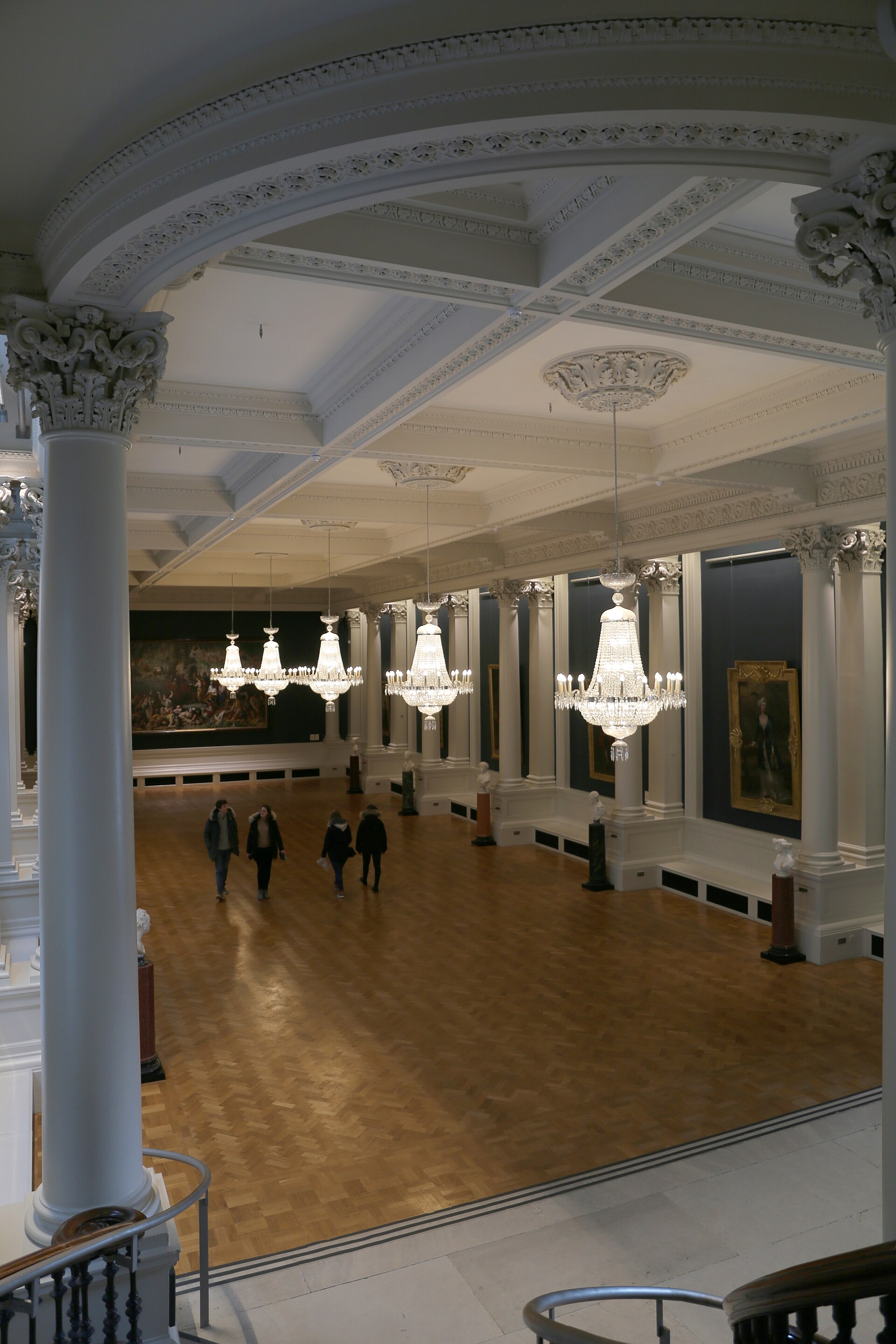
The original building, designed by Francis Fowke and opened in 1864, its facade matching the neighbouring Natural History Museum under the terms of the lease from the Royal Dublin Society. The wing is named for William Dargan, sponsor of the 1853 Irish Industrial Exhibition whose success led directly to the campaign for a national gallery, and whose statue stands outside the Merrion Square entrance. Since the 2011-2017 refurbishment the ground floor has displayed the Irish collection, with European art on the level above. The Shaw Room, at entry level, is named for George Bernard Shaw, who left a third of his royalties to the Gallery, and holds Daniel Maclise's monumental The Marriage of Strongbow and Aoife.
The Milltown Wing
Opened in 1903 to hold the bequest of the Dowager Countess of Milltown, who in 1901 gave the Gallery more than 200 pictures from Russborough House together with silver, furniture and books. Designed by Thomas Newenham Deane and completed to his son Thomas Manly Deane's revised plans, it added a new portico to the Merrion Square facade. Refurbished alongside the Dargan Wing between 2011 and 2017, its upper rooms hold further Old Master paintings from the permanent collection.
The Beit Wing
Added in 1968 to designs by Frank DuBerry of the Office of Public Works, and named in 1987 in recognition of Sir Alfred and Lady Clementine Beit's gift that year of seventeen masterpieces, among them Vermeer's Woman Writing a Letter, with her Maid and Velazquez's Kitchen Maid with the Supper at Emmaus. A Changing Places accessible toilet is on Level -1.
Photograph by Russ McGinn · CC BY-SA 2.5
The Millennium Wing
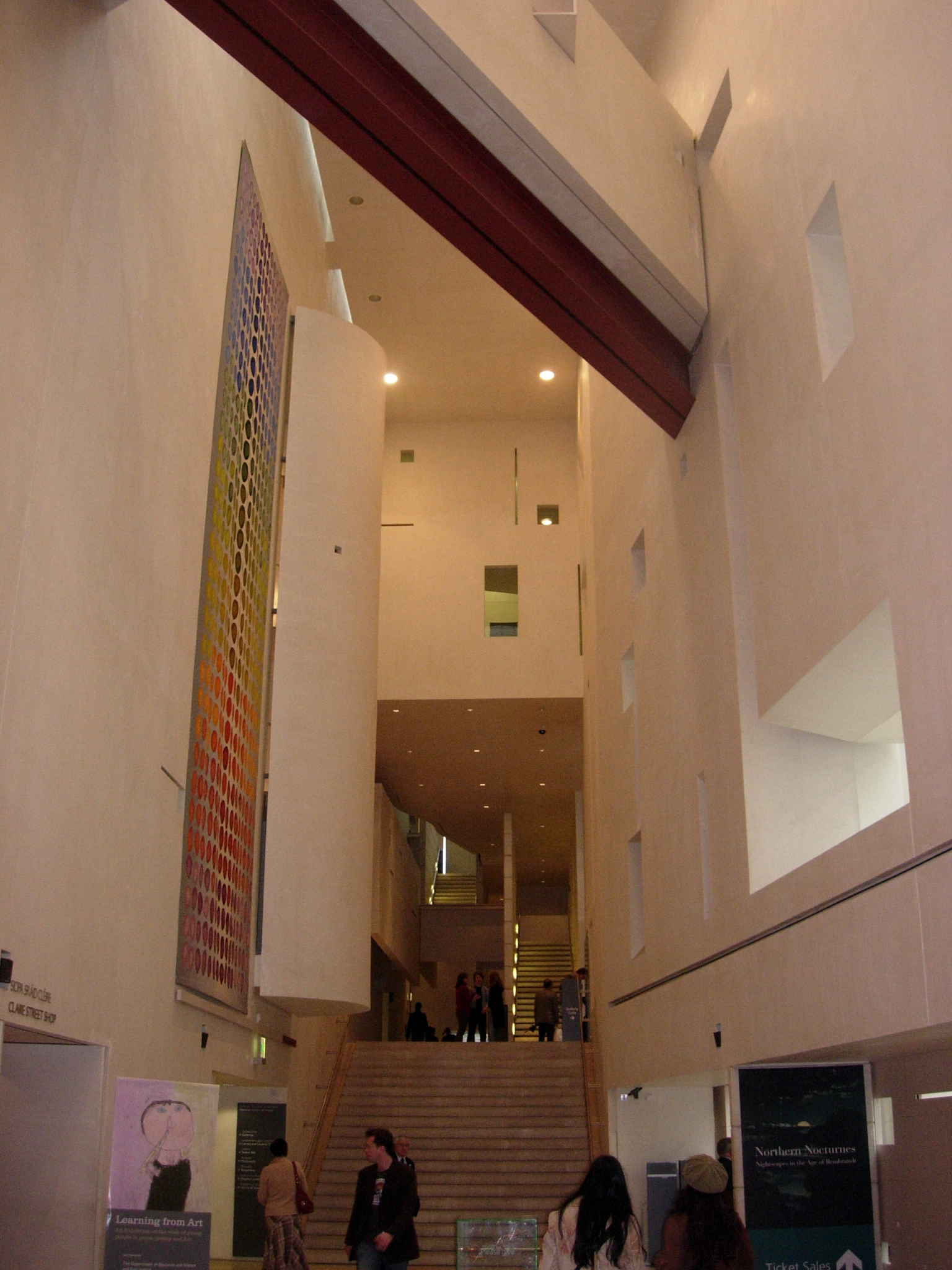
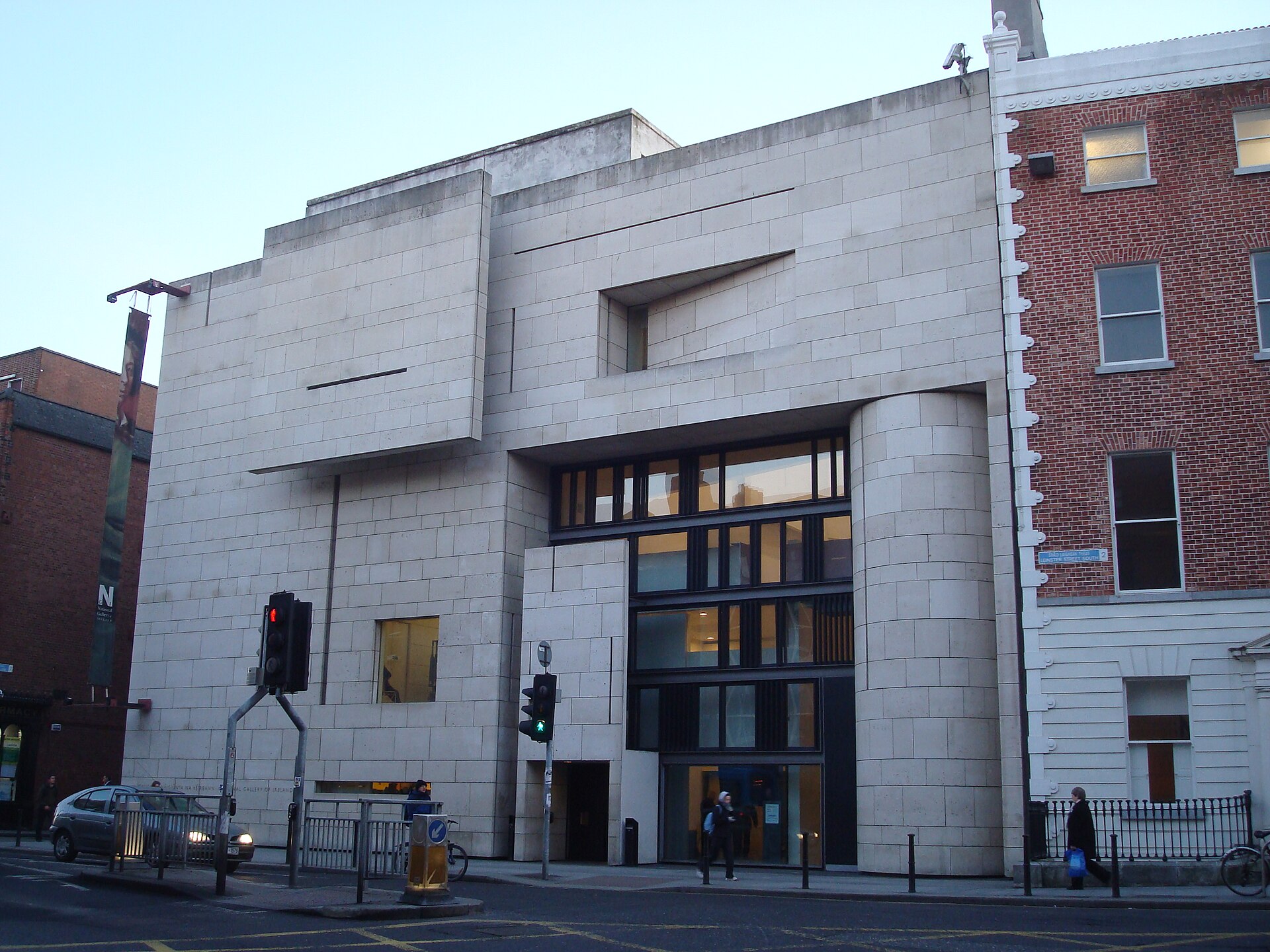
The Gallery's first twenty-first-century addition, designed by the London firm Benson and Forsyth and opened in January 2002 on sites the Gallery had bought in 1990 and 1996. It gave the Gallery a second public entrance, on the busy Clare Street thoroughfare, and today holds the temporary exhibition galleries (the current William Blake show occupies Rooms 6-10), the Gallery Shop and the Gallery Cafe.
What to see first
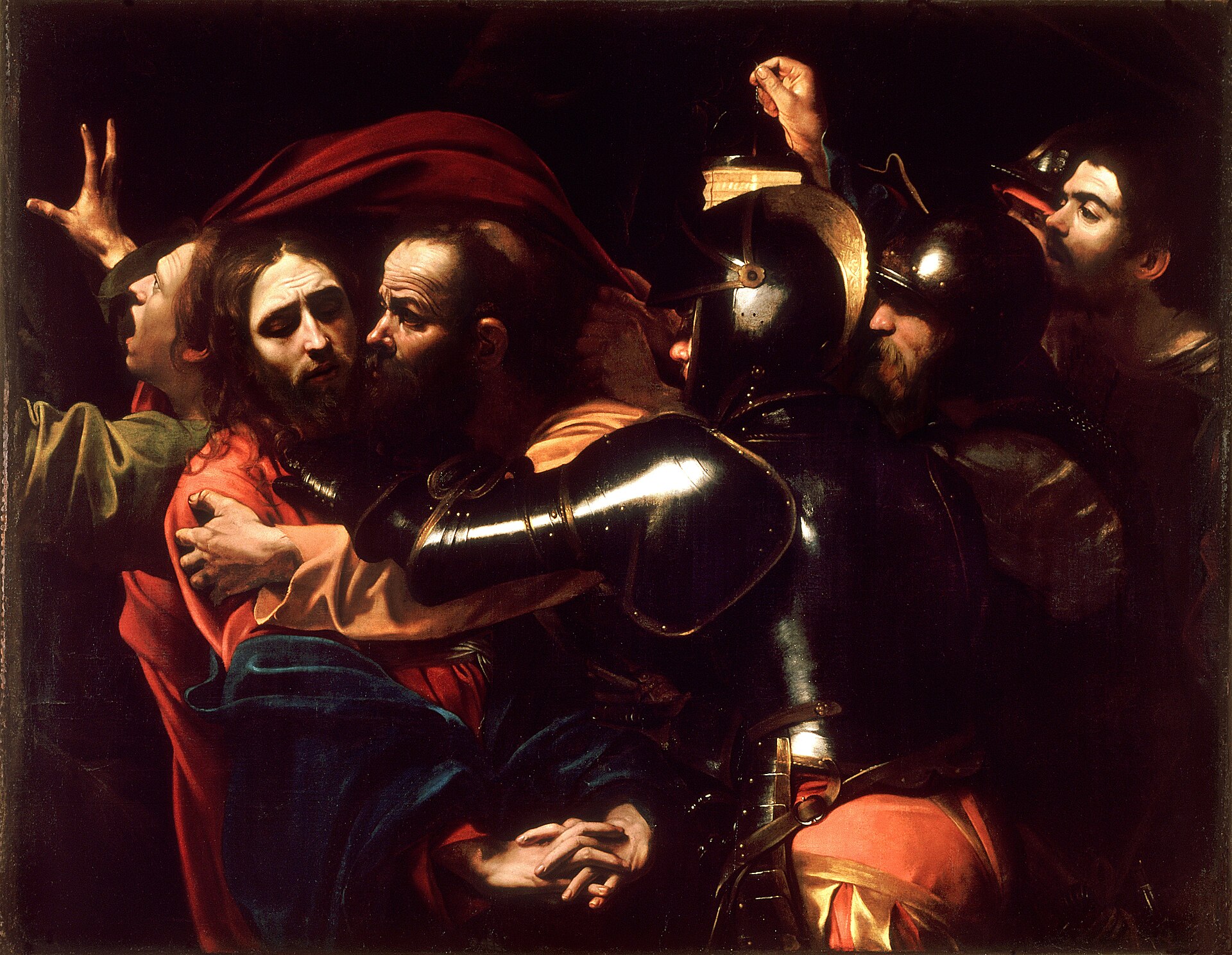
The Taking of Christ
Michelangelo Merisi da Caravaggio, 1602
Presumed lost for two centuries, mislabelled in the Mattei family's own records as the work of Gerrit van Honthorst under a misspelled Italian nickname, and found in August 1990 hanging in the dining room of a Jesuit house on Leeson Street, Dublin, by the Gallery's senior conservator Sergio Benedetti. Three years of research and conservation followed before it went on public display in November 1993. It remains on indefinite loan from the Jesuit Community, and in 2025 it travelled to the Palazzo Barberini in Rome for the exhibition Caravaggio 2025.9
Stolen twice from Russborough House before it ever reached the Gallery: taken in the 1974 raid led by Rose Dugdale and recovered within weeks, then taken again in the 1986 robbery organised by Martin Cahill and not fully recovered until 1993. Sir Alfred and Lady Beit gave it to the Gallery in 1987. It hangs in Room 38, and in 2025 it travelled to New York for the Frick Collection's reopening exhibition Vermeer's Love Letters.24
Hellelil and Hildebrand, the Meeting on the Turret Stairs
Frederic William Burton, 1864
A watercolour so light-sensitive, and so loved, that the Gallery displays it only two hours a week, Thursdays 11.30am to 12.30pm and Sundays 2pm to 3pm. Burton, who never painted in oils, built up the intensity of a history painting through the layered technique of a miniaturist, illustrating a medieval Danish ballad of doomed lovers.12
Landscape with the Rest on the Flight into Egypt
Rembrandt van Rijn, 1647
One of only nine landscape paintings by Rembrandt, and the single night scene among them; the biblical subject is reduced to a small incident inside a hilly, multiply lit nocturne. Purchased by the Gallery in 1883.13
The Liffey Swim
Jack B. Yeats, 1923
Records a Dublin sporting fixture that had run every year since 1920, and marks Yeats's own turn toward Expressionism, fluid brushwork and a charged palette in place of his earlier illustrative sporting scenes.14
A Ship against the Mewstone, at the Entrance to Plymouth Sound
J.M.W. Turner, c.1814
One of 31 Turner watercolours bequeathed by Henry Vaughan in 1900 on condition they be shown only in January light each year, a condition the Gallery has kept ever since; this sheet was made for a print series of the southern English coast and recorded a headland that had already claimed many ships.15
Kitchen Maid with the Supper at Emmaus
Diego Velazquez, c.1617-1618
Widely considered Velazquez's earliest known picture, painted in Seville before he became court painter to Philip IV, inverting a Flemish device by pushing the religious subject into the background behind a Moorish kitchen servant. Given to the Gallery in the Beit gift of 1987.16
Young Ireland
William Orpen, 1907
Bequeathed to the Gallery by the collectors Mary and Alan Hobart and announced by the Gallery in June 2026 as a significant addition to its holdings of works depicting figures and moments in Irish history; on display in Room 16.30
The Bathing Hour, the Lido, Venice
John Lavery, 1912
Given to the national collection in 2026 under the heritage-donation tax relief in Section 1003 of the Taxes Consolidation Act 1997, deepening the Gallery's holdings of Lavery's work; on display in Room 16 alongside the Orpen bequest.30
9 Sep 2027 to 9 Jan 2028Confirmed 31 Aug 2026, 2 weeks ago
William Dargan and the founding of the Gallery
The National Gallery of Ireland exists because of an exhibition, not a bequest. In 1852 William Dargan, the railway engineer who had built much of the Irish rail network, offered to underwrite a great exhibition on Leinster Lawn in Dublin, in imitation of the Crystal Palace show in London the year before. It opened just eleven months later, on 12 May 1853, in a purpose-built series of pavilions, and drew over a million visitors in its first six months. Unlike the London exhibitions it had copied, this one included a gallery of European paintings, and it was the most popular part of the show.
The enthusiasm convinced organisers that Dublin wanted a permanent public collection, and a dedicated Dargan committee and a body called the Irish Institution were formed to press for one. It took a decade of fundraising and construction before the building, designed by the architect Francis Fowke, was ready. As a condition of the lease from the Royal Dublin Society, its facade had to match that of its neighbour, the Natural History Museum, and both still read as matching wings reaching out from Leinster House. On Saturday 30 January 1864 the Earl of Carlisle formally opened the National Gallery of Ireland to the public. The founding collection was modest: 112 pictures, thirty-nine of them bought in Rome in 1856 and thirty on loan from the National Gallery in London. Dargan himself was honoured with a bronze statue outside the entrance, in what one contemporary account called an unbuttoned frock coat and creased trousers; it still stands there.
Growing through bequest: the Milltown and Beit wings
Everything the Gallery has become since 1864 has come through gift rather than purchase alone. An annual purchase grant of 1,000 pounds was set in 1866, but the collection's scale owes far more to the people who gave it away. In 1901 the Dowager Countess of Milltown presented more than 200 paintings from Russborough House, along with silver, furniture and books from her library, a gift so large that a new wing had to be built to hold it. The Milltown Wing opened in 1903, designed by Thomas Newenham Deane and completed to revised plans by his son Thomas Manly Deane, adding a portico to give the extended building a second grand entrance.
The next major extension came in 1968, designed by Frank DuBerry of the Office of Public Works, but it only took its present name in 1987, when Sir Alfred and Lady Clementine Beit gave the Gallery seventeen outstanding Old Master paintings. The Beit Wing now carries their name in recognition of that gift, which included Vermeer's Woman Writing a Letter, with her Maid and Velazquez's Kitchen Maid with the Supper at Emmaus, both now among the works this record treats as highlights of the collection. Beit himself was made an honorary Irish citizen in 1993 in recognition of his philanthropy. The pattern repeated in 2002, when the Millennium Wing, designed by the London architects Benson and Forsyth, opened on sites the Gallery had bought through the 1990s, giving Dublin's Clare Street a second public entrance and the Gallery its first purpose-built temporary exhibition galleries.
A Caravaggio rediscovered in a Dublin dining room
In 1602 Caravaggio painted The Taking of Christ for the Roman patrician Ciriaco Mattei. It stayed in the Mattei family for two centuries, but by the mid-eighteenth century the family's own records had reattributed it, misspelling the nickname of the Caravaggio follower Gerrit van Honthorst, Gherardo delle Notti, as Gherardo della Notte. That misspelling, repeated on a gilt plaque on the frame and copied into every later document, later became one of the clues that unravelled the mistake. Sold out of the Mattei collection in 1802 to a Scottish collector, the picture passed through Edinburgh auction rooms in the 1920s and, in 1924, was bought by Dr Marie Lea-Wilson, who brought it to Ireland still attributed to Honthorst. In the 1930s she gave it to the Jesuit Fathers of Leeson Street in Dublin, and it hung in their dining room, darkened by old varnish, for more than fifty years.
In August 1990 the Jesuit community asked the National Gallery of Ireland to assess the paintings in the house. The Gallery's senior conservator, Sergio Benedetti, recognised the subject and composition of the dark canvas in the dining room as the long-lost Caravaggio, known until then only from copies and from descriptions in early biographies of the artist, including a lengthy one by Giovanni Pietro Bellori. Three years of research, conservation and consultation with international experts followed before the picture was authenticated. On 16 November 1993 it went on public display in the exhibition Caravaggio: the Master Revealed, in what the Gallery itself has called one of the great art discoveries of the twentieth century. Benedetti later wrote that when he left the Jesuit house that August morning in 1990, he could hardly have imagined that within three years his conviction would be borne out by an exhibition. The painting remains at the Gallery on indefinite loan from the Jesuit Community, and in 2025 it travelled to the Palazzo Barberini in Rome for the exhibition Caravaggio 2025, on loan from the institution that still, technically, does not own it.
Stolen twice: the Vermeer that came back from Russborough
Before it was a National Gallery picture, Vermeer's Woman Writing a Letter, with her Maid was a Beit picture at Russborough House in County Wicklow, and Russborough was robbed three times. On 26 April 1974 an armed gang led by the English heiress and IRA sympathiser Rose Dugdale broke in, bound Sir Alfred and Lady Beit, and made off with nineteen paintings including the Vermeer, a Goya and works by Gainsborough and Rubens. All of them were recovered within weeks, in a cottage in County Cork, and Dugdale was sentenced to nine years.
The house was robbed again in May 1986, this time by a gang led by the Dublin crime boss Martin Cahill, who took around fifteen pictures including, once more, the Vermeer, a Goya portrait and two paintings by Metsu. What followed was a years-long trail through criminals, dealers and paramilitaries in Ireland, Belgium, Turkey and England, with a major breakthrough in 1993 that finally recovered the Vermeer along with other missing works; a small number of paintings from that robbery, including a Rubens portrait head, have never resurfaced. A third theft, in 2001, took a Gainsborough portrait for the third time in its history and a work by Bernardo Bellotto, neither of which has been recovered. Sir Alfred and Lady Beit's decision in 1987 to give seventeen of their finest pictures to the National Gallery of Ireland, including the twice-stolen Vermeer, moved that painting out of a private house that had proved impossible to secure and onto public walls in central Dublin, where it has stayed.
Refurbishment, restitution and the Gallery today
Between 2011 and 2017 the Office of Public Works carried out a multimillion-euro refurbishment of the historic Dargan and Milltown wings, with Heneghan Peng as design-team leaders, keeping the Gallery open throughout even as more than four-fifths of its galleries closed in stages; it still drew more than 700,000 visitors a year during the works. The project restored original nineteenth-century features, built a new underground energy centre for climate and fire systems, and created a glazed courtyard between the historic wings and the Print Gallery, the site of a large sculpture, Magnus Modus, by Joseph Walsh. The refurbished galleries reopened in June 2017 displaying more than 650 works chronologically, Irish art at ground level and European art above, and returned Daniel Maclise's monumental The Marriage of Strongbow and Aoife, newly conserved, to the Shaw Room.
The Gallery has also had to answer, in public, for the origins of part of its collection. In 2012 and 2013 it received two separate claims for the restitution of paintings acquired in the twentieth century, on the grounds that they had been sold under duress or looted during the Nazi era: two sixteenth-century German panels bought from a Berlin gallery in 1934, and The Descent into Limbo, a Bosch-follower panel bought from London dealers in 1954. The Gallery commissioned an independent provenance researcher for both claims and, having reviewed its own curatorial files and the researcher's findings, concluded that neither claim was supported by the evidence and declined to return the paintings or settle. It published its reasoning, including the individual histories of both claims, on its own website rather than leaving the matter to the claimants' account alone; we have not established, from the Gallery's own pages, whether either family has pursued the matter further since.
None of that has slowed attendance. The Gallery welcomed 1,049,683 visitors in 2025, its third consecutive year over the million mark, driven by exhibitions on Turner's Scottish watercolours, the painters Mainie Jellett and Evie Hone, and a Picasso studio show. Its 2026 programme pairs a first Irish monograph on the Swedish modernist Hilma af Klint with a major loan exhibition on William Blake organised with Tate, alongside the annual January return of the Turner watercolour bequest that has been shown every year since 1901 under the terms Henry Vaughan set when he gave it.
What visitors say
We publish no visitor review prose and cite only the aggregate rating below. What is documented is a gallery that draws over a million visitors a year for the third year running, gives its entire permanent collection away free with no booking, sits within a ten-minute walk of Trinity College and Grafton Street, and has been naming a Travelers' Choice award on Tripadvisor into 2026. Its own account of itself stresses free access and openness: 1,840 high-resolution images from the collection are released for free download under Creative Commons Attribution 4.0, with new images added most months.
What is praised, what is criticised
Praised: free entry to the permanent collection every day, with no booking and no exceptions
Praised: the central Georgian location, an easy walk from St Stephen's Green, Grafton Street and Trinity College
Praised: the breadth of loans the Gallery's own masterpieces attract abroad: the Caravaggio to the Palazzo Barberini in Rome in 2025, the Vermeer to the Frick's reopening in New York the same year
Praised: 1,840 collection images released free for download under Creative Commons Attribution 4.0, usable even commercially, with more added most months
Criticised: the pricing on the one or two exhibitions a year that do charge is layered rather than a single number: a EUR 16 adult ticket for William Blake: The Age of Romantic Fantasy drops to EUR 5 in an early morning or a Thursday evening slot and is free only in a narrow Wednesday morning window, for under-18s, or for a list of card holders who must still book ahead
Criticised: the Gallery's own visitor guide is explicit that there is no cloakroom or luggage storage: suitcases larger than a handheld bag are refused outright, and anything placed in a self-service locker overnight is logged to Lost and Found rather than held
Named the Gallery's Mainie Jellett and Evie Hone exhibition, The Art of Friendship, among the newspaper's ten favourite Irish exhibitions of 2025.The Irish Times, Gemma Tipton, 20 December 2025 [25]
Ratings on other platforms
Tripadvisor: 4.3 from 2,339 ratings, read 10 August 2026 A platform average is a tertiary source: it moves, it is not audited, and we quote no visitor's words.
Questions about National Gallery of Ireland
Where is National Gallery of Ireland?
Merrion Square West, Dublin 2, Ireland.
How much does it cost to visit?
Permanent collection: free; Current temporary exhibitions: free. As confirmed 4 September 2026.
When is it open?
Monday 11:00-17:30; Tuesday-Wednesday 09:15-17:30; Thursday 09:15-20:30; Friday-Saturday 09:15-17:30; Sunday 11:00-17:30. Closed: 24 to 26 December, inclusive, and Good Friday. 1 January: the Gallery opens 11.00 to 17.30, its usual Monday and Sunday hours. As confirmed 4 September 2026.
How do you get there?
On foot: Around ten minutes on foot from St Stephen's Green, Grafton Street and Trinity College; DART: Pearse Station, a five minute walk from the Gallery; LUAS: Green Line to Dawson Street, six minutes on foot; Red Line to Abbey Street, about twenty minutes on foot; Bus: Dublin Bus routes 4, 7 and 8 to Merrion Square North and Clare Street; route 39a to Merrion Row.
What should you see first?
The Taking of Christ (Michelangelo Merisi da Caravaggio, 1602); Woman Writing a Letter, with her Maid (Johannes Vermeer, c.1670); Hellelil and Hildebrand, the Meeting on the Turret Stairs (Frederic William Burton, 1864); Landscape with the Rest on the Flight into Egypt (Rembrandt van Rijn, 1647); The Liffey Swim (Jack B. Yeats, 1923); A Ship against the Mewstone, at the Entrance to Plymouth Sound (J.M.W. Turner, c.1814).
What we could not confirm
Wikidata records an inception date of 1854 for the institution, a year before the Gallery's own history page describes even the building's fundraising as complete; we could not trace this figure to a primary source and note it only as the tertiary machine record.
Whether either family behind the 2012-13 Nazi-era restitution claims (the Cranach-circle panels, NGI.973 and NGI.974, and The Descent into Limbo, NGI.1296) pursued the matter after the Gallery declined to return the paintings or settle; the Gallery's own account states its conclusion but not the claimants' response to it.
Which named room in the historic wing is shown in the Commons photograph of the colonnaded, chandeliered hall attached to the Dargan Wing above. It matches the Gallery's own description of the Shaw Room closely, but the file's own record does not name the room and we have not independently confirmed it.
William Blake: The Age of Romantic Fantasy closed on schedule on 19 July 2026 and the Gallery currently has no chargeable exhibition; whether the same discount structure (Wednesday free window, earlybird and Thursday evening EUR 5 rates) will carry over to its next ticketed show has not been published. The next announced exhibitions are Hilma af Klint: Artist and Visionary (15 October 2026) and Jan Steen: Sacred and Profane (21 November 2026); neither page states a ticket price as of this check.
Three paintings taken in the 1986 Russborough robbery, including a Rubens portrait head, and both works taken in the 2001 robbery, a Gainsborough and a Bellotto, remain unrecovered; none of the missing works were part of the 1987 Beit gift to the Gallery, and their current whereabouts are unknown.
Images
3 plates
The Millennium Wing on Clare StreetThe Gallery's second public entrance, on Clare Street, added in 2002 to designs by Benson and Forsyth. The photograph is taken from Lincoln Place.CC0
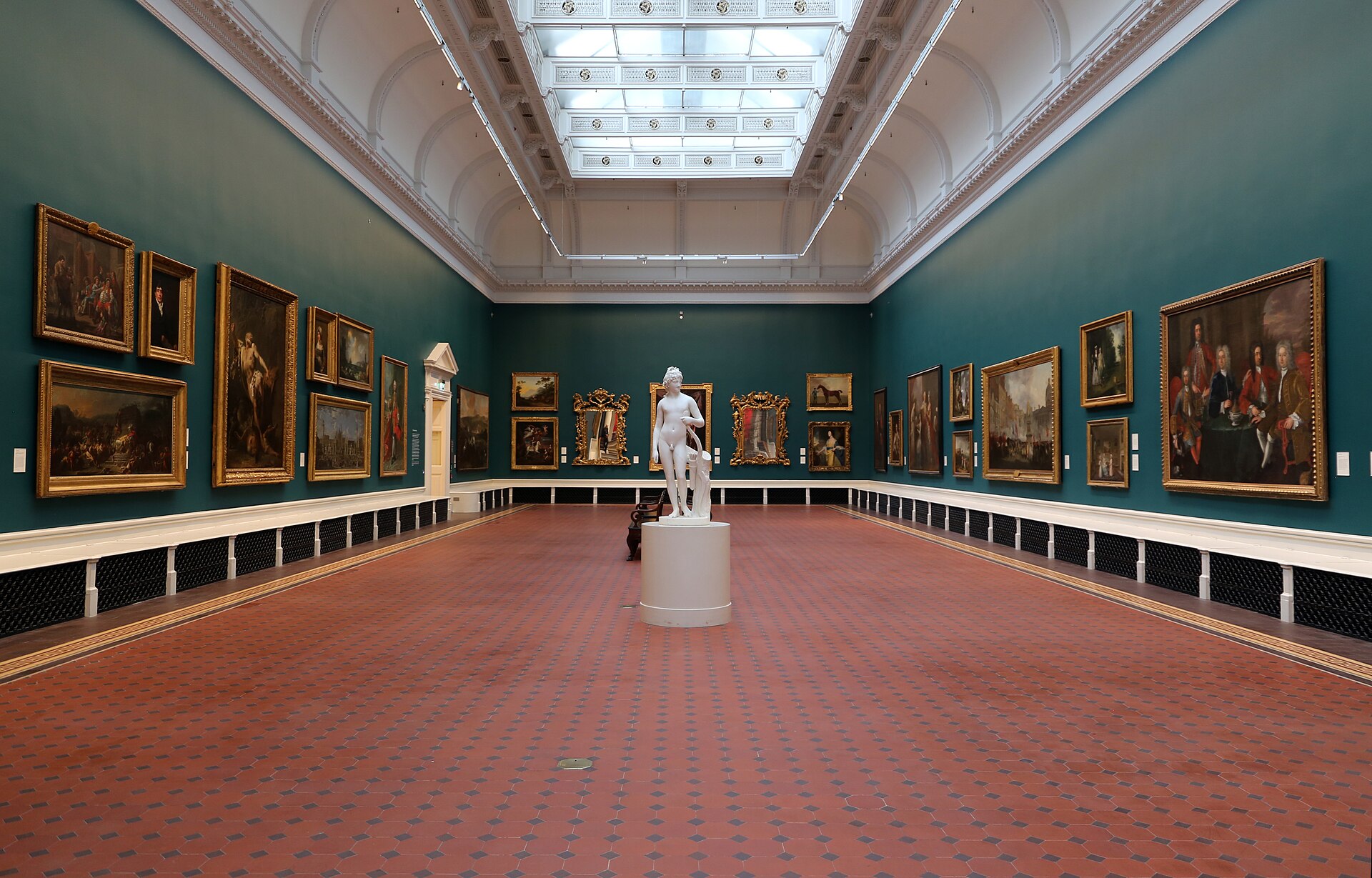
A long gallery in the historic wingA hung gallery in the historic building, with a classical marble figure on a plinth at its centre and paintings ranked floor to cornice along both walls.Photograph by Sailko · CC BY 3.0
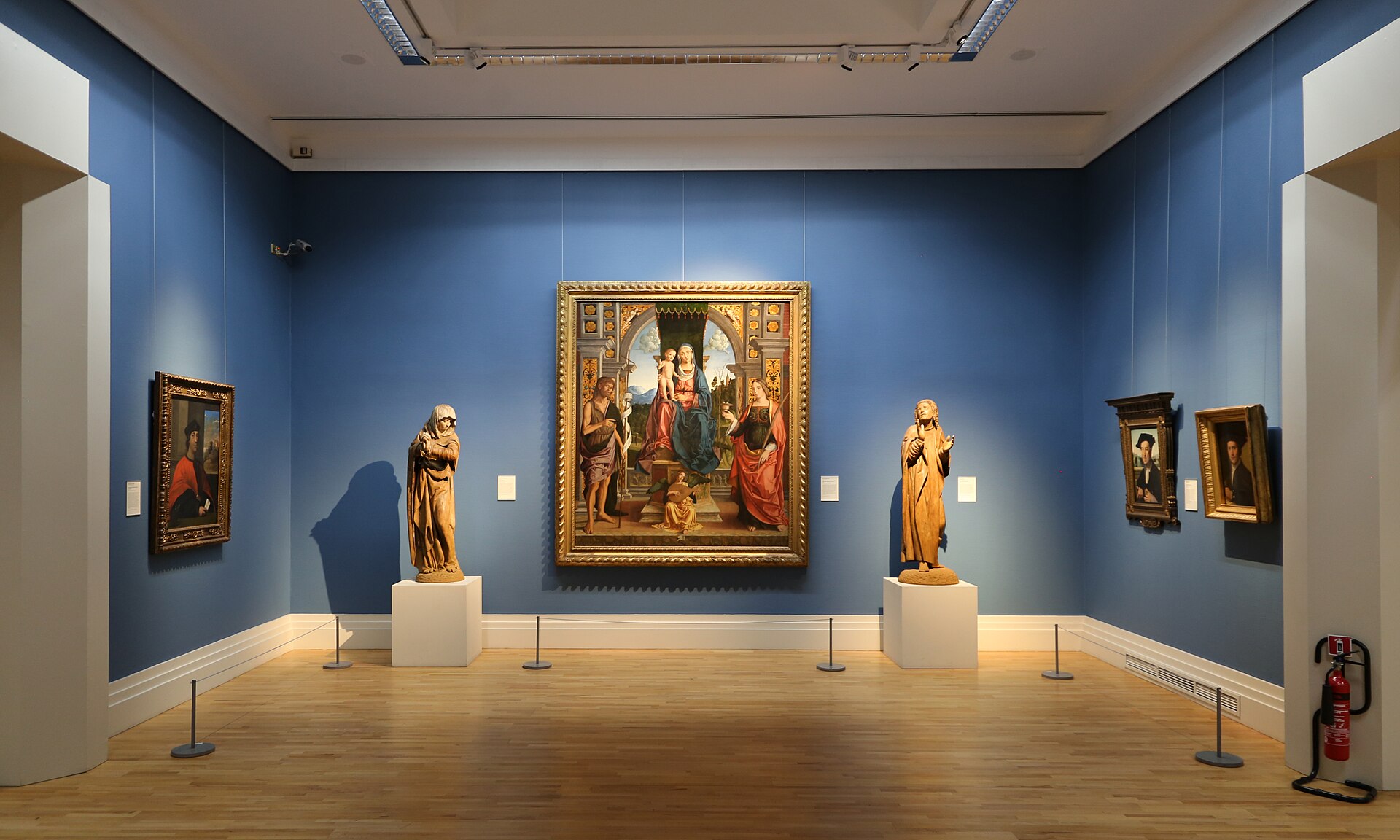
A gallery of earlier European paintingA room in the historic wing hung with earlier European paintings, centred on an altarpiece by Marco Palmezzano flanked by sculpture.Photograph by Sailko · CC BY 3.0
3National Gallery of Ireland, Exhibition Tickets FAQs: William Blake: The Age of Romantic Fantasy ticket pricing, concessions, free-entry windows and terms. nationalgallery.ie/exhibition-tickets-faqs
4National Gallery of Ireland, Visitor Guide: free entry policy, entrances, cloakroom and locker rules, wheelchairs, the Atrium Creative Space. nationalgallery.ie/visit-us/visitor-guide
5National Gallery of Ireland, Accessibility for visitors with disabilities: free carer tickets, wheelchair access, hearing loops, the Changing Places facility in the Beit Wing. nationalgallery.ie/visit-us/access
6National Gallery of Ireland, History of the Gallery: William Dargan, the Irish Institution, the 1864 opening, the Milltown bequest, the Beit Wing, the Millennium Wing. nationalgallery.ie/what-we-do/history-gallery
8National Gallery of Ireland, Press release, 12 June 2017: the reopening of the refurbished Dargan and Milltown Wings, the Shaw Room, the new courtyard and Magnus Modus, visitor figures during the works. nationalgallery.ie/press-release-1262017-2
17National Gallery of Ireland, Provenance Research: the 2012-13 restitution claims for the Cranach-circle panels (NGI.973, NGI.974) and The Descent into Limbo (NGI.1296), the Gallery's commissioned research and its decision to decline both claims. nationalgallery.ie/provenance-research
22Wikidata, National Gallery of Ireland (Q2018379): coordinates, address and inception date, used as the machine identity and cross-checked against the museum's own pages; labelled tertiary throughout. wikidata.org/wiki/Q2018379
25The Irish Times, Gemma Tipton, '2025 in art: Our 10 favourite Irish exhibitions of the year', 20 December 2025, naming the Gallery's Mainie Jellett and Evie Hone show among the year's ten favourites; the full review is paywalled, and only the published headline and description are cited here. irishtimes.com/culture/art/2025/12/20/2025-in-art-our-10-favourite-irish-exhibitions-of-the-year/
27National Gallery of Ireland, 'Creative Commons: downloadable artworks': 1,840 high-resolution images released for free download under an Open Data Initiative and Creative Commons Attribution 4.0 International, with more added most months. nationalgallery.ie/explore-and-learn/creative-commons-download-artwork
28National Gallery of Ireland, Exhibitions: the four exhibitions open as of this check (Rembrandt to Matisse, Visual Poetry, Creatuir na Cartlainne, Highlights from Hugh Lane Gallery), all marked free admission, and the upcoming programme (Hilma af Klint, AIB Portrait Prize, Jan Steen, German Expressionism). nationalgallery.ie/art-and-artists/exhibitions
30National Gallery of Ireland, Press release: paintings by John Lavery (The Bathing Hour, the Lido, Venice, 1912, acquired under Section 1003 tax relief) and William Orpen (Young Ireland, 1907, bequeathed by Mary and Alan Hobart) acquired for the national collection, both on display in Room 16; Director Dr Caroline Campbell quoted. nationalgallery.ie/what-we-do/press-room/press-releases/lavery-orpen-new-acquisitions
Last verified 10 August 2026Open, confirmed 4 September 2026Wikidata Q2018379
One artwork and its story every Tuesday, with the picture: who owned it, what it made, and what closes soon in the exhibition calendar. No promotion, and nothing we cannot cite.
We send one email to confirm the address and keep nothing else. Every letter carries a one-click unsubscribe. How we handle your data.
 Dublin, Ireland