Nativity with St Francis and St Lawrence
Michelangelo Merisi da Caravaggio · Disputed. Traditionally 1609, during Caravaggio's Sicilian months; argued since 2012 on documentary and technical grounds to be Rome, 1600
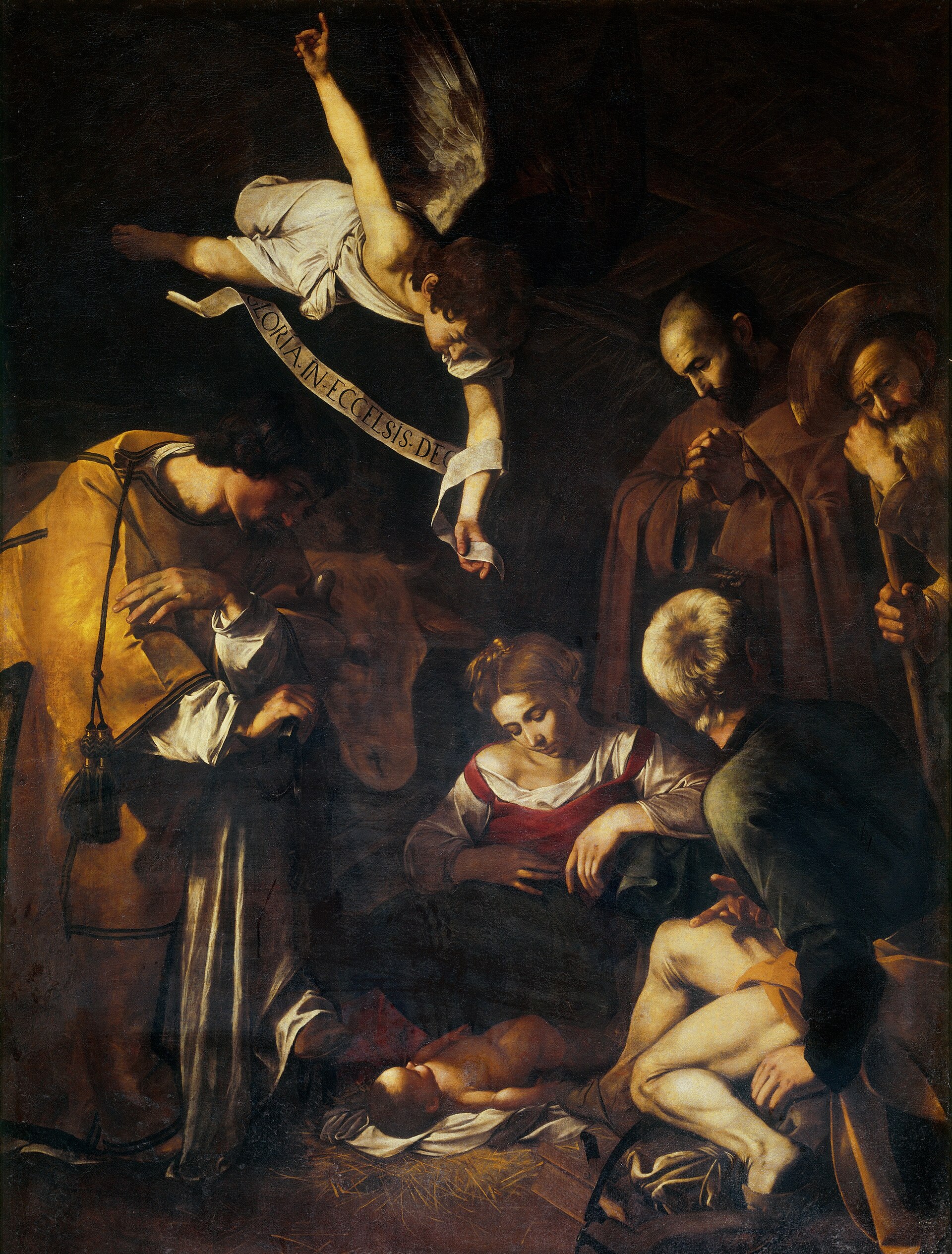
The lost altarpiece, 268 x 197 cm. This is a photographic reproduction made before the theft. No photograph of the painting has been possible since the night of 17 to 18 October 1969, and no one has seen the canvas itself since.
| Artist | Michelangelo Merisi da Caravaggio |
|---|---|
| Date | Disputed. Traditionally 1609, during Caravaggio's Sicilian months; argued since 2012 on documentary and technical grounds to be Rome, 1600 |
| Medium | Oil on canvas, on a single uncut width of plain-weave canvas of the type Caravaggio used in Rome |
| Dimensions | 268 x 197 cm. The Amici dei Musei Siciliani, who commission a new work at the original size each year, give the altar opening as 267 x 198 cm |
| Where it is now | Missing. Taken from the Oratorio di San Lorenzo, Palermo, on the night of 17 to 18 October 1969 and not recovered. A full-size re-creation made by Factum Arte hangs in its place above the altar; the painting itself has not been seen by any named witness who has produced it since 1969.last confirmed |
| Inventory number | FBI National Stolen Art File reference 01155; listed on the FBI Top Ten Art Crimes. No Italian state inventory number was found in the sources consulted. |
| Attribution | AcceptedThe attribution to Caravaggio has never been seriously contested. Full note |
| Object type | Painting |
| Period | Italian, Baroque, about 1600 |
| Cases | Has a provenance gap |
| Inscriptions | The angel above the group holds a scroll lettered Gloria in excelsis Deo. No signature is recorded. Caravaggio signed only one painting in his life, the Valletta Beheading of St John the Baptist, and this was not it. |
| Owners on record | 6 links4 documented, 1 disputed, 1 unknown |
| Sources | 27 cited |
About this record Last verified · 27 sources cited · Change log
On this page 11 sections
ContentsClose
A large altarpiece by Caravaggio, about 268 by 197 centimetres, painted for a confraternity of merchants in Palermo and cut from its stretcher in their oratory on the night of 17 to 18 October 1969. It has not been seen since. It sits on the FBI's Top Ten Art Crimes list and is routinely called the most wanted painting in the world.
Two separate arguments run through its record and neither is closed. The first is art historical: the picture was believed for three centuries to have been painted in Sicily in 1609, in the last year of Caravaggio's life, but a Roman notarial act of 5 April 1600 and the physical evidence of the canvas itself have convinced a number of specialists of a Roman execution in 1600, against an iconographic argument that the altarpiece was made for its Palermo room. The second is criminal: at least six Italian state witnesses have given accounts of what became of the painting, and those accounts contradict each other flatly. It has been described as burned beside a river, eaten by animals in a farm building, displayed at mafia meetings, buried under rubble in an earthquake and cut into four or more pieces and sold in Switzerland.
This record separates what is documented from what was said, names who said it and when, and leaves the contradictions standing. A re-creation built by Factum Arte from a 1968 colour transparency and a set of 1951 radiographic plates hangs above the altar today. It is not the painting.
The theft
Still missing
The Italian parliamentary Antimafia Commission reported in 2018 that the altarpiece was taken from the Oratorio di San Lorenzo in October 1969, and no body has recorded its recovery since.
- 1600Made A notarial act of 5 April 1600 records that Caravaggio undertook for the merchant Fabio Nuti to paint a picture with figures for 200 scudi, which Michele Cuppone identifies as this altarpiece.46
- 1627Owned Archival work published by Giovanni Mendola records that the Palermo painter Paolo Geraci was commissioned in 1627 to copy the picture, which places it in the oratory by that year.4
- 1951Exhibited Correspondence published by Cuppone records that the rector sent the painting to the Milan exhibition of 1951 and that it was shipped back from the Rome restoration institute on 14 March 1952.7
- 1969-10-18Stolen The FBI records that in October 1969 two thieves entered the Oratory of San Lorenzo in Palermo and removed the Caravaggio Nativity from its frame.13
- 1969-10-20Claimed Gaetano Grado told the Antimafia Commission on 11 May 2017 that two days after the disappearance he was asked to find the canvas, and that it was then passed upward to Gaetano Badalamenti, according to the Commission's report.3
- 1970Claimed The Commission's report of 2018 records Grado's statement that Badalamenti sold the work to a Swiss dealer, that it left Italy intact and that it was afterwards divided for sale.314
- 1996-11-04Claimed Francesco Marino Mannoia told the Andreotti court on 4 November 1996 that the canvas had been ruined when it was rolled and that the intended buyer wept and refused it, on a recording published in April 2025.8
- 2009Claimed Gaspare Spatuzza stated in 2009 that the work had been left in a stable and ruined there by rodents, an account the Commission found had reached him at second hand and treated as unreliable.3
- 2018-02-21Listed The Antimafia Commission approved its report on the theft on 21 February 2018, concluding that the work had not been destroyed and transmitting its papers to the Palermo prosecutors.314
- 2018-06Filed Press reports of June 2018 record that the Palermo prosecutors reopened the file, assigning it to the deputy prosecutor Marzia Sabella and the prosecutor Roberto Tartaglia.9
- 2026Listed As checked on 25 September 2026 the painting is still carried on the FBI Top Ten Art Crimes list and in the National Stolen Art File under reference 01155, and the Carabinieri public search front end returned no retrievable record for it.1226
In the official registers: FBI Top Ten Art Crimes Theft of Caravaggio's Nativity with San Lorenzo and San Francesco · FBI National Stolen Art File 01155 · Comando Carabinieri per la Tutela del Patrimonio Culturale, Banca dati dei beni culturali illecitamente sottratti A selection of the archive is publicly searchable by material, technique, object type and image, but not by title or artist, so no public record number could be retrieved. Seen this work? Report it to the police or to the register, not to us.
Provenance
Each link is graded. Documented: a cited source supports it. Disputed: the identification is argued but not established. Unknown: no owner for that span, and the gap is not smoothed into a narrative. The grades in the glossary.
- 1600 - 1600Fabio Nuti, Sienese merchant, acting at Romedisputed
A notarial act of 5 April 1600, registered in the house of the merchant Alessandro Albani, records Caravaggio undertaking for Fabio Nuti to paint a picture cum figuris for 200 scudi, about 12 palmi high by 7 or 8 wide, which converts to roughly 268 by 156 or 179 centimetres. Delivery was set for mid-June and the balance was paid on 20 November by Albani in Nuti's absence. Nuti supplied a designum, Caravaggio produced an approved sbozzo, and two valuers were named. Michele Cuppone and others identify this as the Palermo altarpiece; no document states the identification in terms, which is why this link is graded disputed rather than documented.46
- by 1627 - 1969Compagnia di San Francesco, Oratorio di San Lorenzo, Palermodocumented
The picture is recorded in the oratory by Bellori in 1672, and its presence there is fixed earlier by a commission of 1627 to the Palermo painter Paolo Geraci to copy it. The oratory was built in 1569 for a confraternity largely of Genoese merchants, affiliated to the Conventual Franciscans, and the Compagnia di San Francesco met there. The altarpiece hung above the altar at a height of roughly six metres, framed from 1699 onward within Giacomo Serpotta's stucco decoration.41119
- about 1940 - 1948Removed from the oratory for wartime safekeepingdocumented
The canvas was taken out of the oratory during the Second World War, a removal made awkward by its integration with Serpotta's stucco frame and its angels. The oratory itself was damaged in the air raid of 15 February 1943. On 3 February 1948 the rector Don Filippo Meli wrote to the superintendent Filippo Di Pietro that the painting had been returned to the oratory by Cardinal Ruffini, and asked for skilled staff to rehang it because he would not accept responsibility for damage.7
- 1951 - 1952Lent to Milan, then restored at the Istituto Centrale del Restauro, Romedocumented
The picture travelled to the Caravaggio exhibition at the Palazzo Reale in Milan, 21 April to 15 July 1951, and arrived in poor condition because there had been no time to restore it first. Restoration followed at the Istituto Centrale del Restauro in Rome, under a directorate that included Cesare Brandi, and the picture was shipped back from Rome on 14 March 1952. The conservation reports were published by Giovanni Urbani in the Bollettino dell'Istituto Centrale del Restauro in 1951 and by Giovanni Carandente in La Giara in 1952. The large-format black and white glass plate negatives made during that campaign are the best surviving record of the paint surface.457
- 1969 - 1969Removed by theftdocumented
Cut from its stretcher in the oratory on the night of 17 to 18 October 1969 and taken away. The FBI records that two thieves entered the oratory and removed the painting from its frame. A carpet was taken from the oratory at the same time and is believed to have been used to roll the canvas. Roberta Lapucci, who examined the abandoned stretcher in September 2009, found canvas remnants around the whole perimeter and recorded that the picture had been cut and partly torn away in haste from the outer edges of the stretcher rather than cleanly inside the frame opening.1418
- 1969 - presentUnknownunknown
No custody of the painting after October 1969 has been established by any court or by the Antimafia Commission. Multiple state witnesses have given accounts, they contradict each other, and none has produced the object or any part of it. The Commission's 2018 report set out a reconstruction on which the picture left Italy for Switzerland within months and was divided; it also recorded that this rests on testimony and not on physical evidence. The painting remains unrecovered. The two men the testimony places at the centre of any transfer are both dead: Gaetano Badalamenti was arrested in Madrid on 8 April 1984, extradited to the United States that November and died in an American prison in 2004, and the Swiss dealer named to the Commission was already dead when it reported.3121527
Prices realised
This painting has never been offered at auction and has no sale history. It passed from the artist to a Palermo confraternity and stayed there until it was stolen. Every money figure attached to it in print is either the 1600 commission price of 200 scudi or a modern insurance-style estimate produced for press and law enforcement purposes, most often the FBI's figure of 20 million US dollars. None of those modern figures is a realised price and none carries a published valuation date or method.
Technical evidence
| Attribution note | The attribution to Caravaggio has never been seriously contested. Giovanni Baglione in 1642 and Giovan Pietro Bellori in 1672 both record a Nativity by him at Palermo, and Bellori names the oratory. What is contested is the date and the place of execution, and therefore the moment in the artist's career to which the picture belongs: the traditional account places it in Sicily in 1609, while documentary work published from 2012 onward argues that it was painted in Rome in 1600 and shipped south. Both positions are set out in full in this record and neither is treated as settled. Because the painting has not been examined since 1969, no new technical evidence can be brought to bear on the question. |
|---|---|
| Support | A single uncut width of plain-weave canvas. The 1951 radiographs and raking-light photographs show no seam. Only two or three other Caravaggios are painted on a single width this wide, and all are Roman: the Death of the Virgin, the Madonna dei Palafrenieri and, less certainly, the Deposition.4 |
| Thread count | About 7.2 x 7 threads per centimetre, tabby weave, open and characteristic of the so-called Roman canvases. Cuppone gives three Sicilian comparisons in one sentence: the Burial of St Lucy about 11 or 12 x 11, the Raising of Lazarus 11.6 x 8.4 and the Messina Adoration of the Shepherds 7 x 11. The third matches the Nativity in one direction and not the other, and qualifies the generalisation that the Sicilian canvases are denser.4 |
| Loom width and localisation | Single cloth widths in Sicilian painting of the period did not normally exceed 100 to 110 cm, and Caravaggio's three Sicilian canvases use strips between about 63 and 95 cm. A 197 cm wide Sicilian support would have required two or three sewn strips. This is the core physical argument for a Roman execution.4 |
| Medium | Oil on canvas. Factum Arte's analysis of the 1951 plates records Caravaggio's characteristic coarse directional underpainting in placed areas, impasto in the whites, incised contour lines and a complex mix of green, brown and blue in the shadows.45 |
| Dimensions | 268 x 197 cm. The 5 April 1600 contract specifies about 12 palmi high by 7 or 8 wide, roughly 268 x 156 or 179 cm, with the width expressly approximate. The Amici dei Musei Siciliani give the altar opening as 267 x 198 cm.413 |
| Inscription | The angel's scroll is lettered Gloria in excelsis Deo. In Paolo Geraci's 1627 copy the dots are omitted from the letter i, one of very few departures from the original.4 |
| Condition before the theft | Poor. Several earlier restorations are visible in the 1951 plates, with a network of cracks showing white ghosting to either side and significant damage to the ground in the pre-restoration raking-light images. It reached the 1951 Milan exhibition unrestored because there had been no time.457 |
| Conservation record | Restored at the Istituto Centrale del Restauro, Rome, after the 1951 Milan exhibition; shipped back from Rome 14 March 1952. Reports published by Giovanni Urbani in the Bollettino dell'Istituto Centrale del Restauro in 1951 and Giovanni Carandente in La Giara in 1952.47 |
| Surviving imaging | Large-format black and white glass plate negatives made at the 1951 ISCR campaign, radiographs of the same campaign (none along the top and left margins), raking-light photographs made before the restoration, the ISCR photographic archive reference image, and Enzo Brai's 5 x 4 inch colour transparency of 1968.45 |
| Stretcher and cut edge | The stretcher stayed in the oratory. Roberta Lapucci examined it in September 2009 and found canvas remnants around the whole perimeter, fixed with rusted round-headed nails and showing no seam. Her conclusion was that the canvas had been cut and partly torn away in haste from the outer edges of the stretcher, not cut cleanly inside the frame opening. The surviving scrap is a modern lining canvas of three sewn strips, not the original support.4 |
| Setting | Hung above the altar of the Oratorio di San Lorenzo at a height of roughly six metres, within the stucco decoration executed by Giacomo Serpotta between 1699 and 1706. The stucco angels around the frame made the canvas awkward to remove for wartime safekeeping.71119 |
Images
The record in full
Chapter 1The size of the thing is the first fact about the crime
The painting is about 268 centimetres high and 197 wide, oil on canvas.
The painting is about 268 centimetres high and 197 wide, oil on canvas. That is a little over eight and a half feet by six and a half. It is an altarpiece, made to be seen from the floor of a room by people standing below it, and in the Oratorio di San Lorenzo it hung above the altar at a height of roughly six metres. Anyone who takes it has to get it down from there, off its stretcher and out of the building, and then carry a rolled tube of canvas more than two and a half metres long through the streets of the Kalsa. Every account of the theft has to answer for that, and the accounts differ on whether it was done by people who knew what they were doing.
The composition is a nocturnal adoration rather than a nativity in the processional sense. The Virgin sits on the ground, not on a bed and not enthroned, with the child laid on straw in front of her. The stable is roofed with crossed timbers laid thinly, and the ox is given real prominence while the ass is little more than a silhouette. Carpenter's tools lie about, among them a plane with a small ring-shaped fitting. An angel comes in at the upper left with a scroll lettered Gloria in excelsis Deo, the wording of the announcement to the shepherds. At the left margin kneels St Lawrence with the gridiron of his martyrdom, drawn in a steep and difficult foreshortening. At the right is a Franciscan in a habit with a mantle.
Michele Cuppone has argued that the Franciscan may not be St Francis at all. The figure carries no stigmata; his hair and beard are black rather than the chestnut Caravaggio gives Francis in the Hartford, Cremona and Carpineto pictures; the habit is unpatched and untorn; and he stands set back, partly hidden by the other figures, further behind than the ox. On that reading he is an ordinary friar adoring alongside the shepherd who stands at the right as the representative of ordinary people. Cuppone flags the difficulty in his own argument: the habit reads as more Capuchin than Conventual, while it was the Conventuals who held the neighbouring church of San Francesco and had the closer relations with the company. The title Nativity with Saints Lawrence and Francis is itself an inheritance from an indirect reading of Bellori rather than from any document of the picture's own making.
Behind the altar, from 1699 onward, the whole room was worked over in stucco by Giacomo Serpotta. The altarpiece sat inside that stucco, with angels of Serpotta's making around it. That detail matters twice over in what follows: once because it made the canvas awkward to remove for safekeeping during the war, and once because the stucco was not damaged on the night it was cut out.
Chapter 2The night of 17 and 18 October 1969, and a week that is not accounted for
The standard account, and the one carried by the registers, is short.
The standard account, and the one carried by the registers, is short. On the night of 17 to 18 October 1969 two men entered the oratory through a side door that was poorly secured, cut the canvas from its stretcher with a blade, rolled it and carried it out. A carpet was taken from the oratory at the same time and is believed to have been used to roll the picture. The FBI's own text is shorter still: in October 1969 two thieves entered the Oratory of San Lorenzo in Palermo and removed the Caravaggio Nativity from its frame. The theft was found on the morning of 18 October by people preparing the oratory for the following day's service, and it was reported in the Giornale di Sicilia on 20 October.
The Art Newspaper, marking the fiftieth anniversary in October 2019, pointed out that the account has a hole in it. The last confirmed sighting of the painting in place was at Sunday mass on 12 October. Nobody has established that it was still on the wall on the evening of the seventeenth. If the window is six days rather than one night, the picture could have left Palermo before anyone noticed it was gone, and every reconstruction that turns on the events of a single night is built on an assumption. The same piece records that the police report on the state of the premises, the one document that would settle how the intruders got in and what they disturbed, has disappeared from the file.
The physical evidence that does survive is thin and it comes late. In September 2009 the conservation scientist Roberta Lapucci examined the abandoned stretcher, still kept at the oratory. Canvas remnants were present around the entire perimeter, held by round-headed nails that had rusted in place, and there was no seam anywhere along them. On 9 October 2009 she was given a fragment of that canvas, about four square centimetres, for analysis. Her finding was that the picture had been cut and partly torn away in a hurry from the outer edges of the stretcher, not cut cleanly inside the opening of the frame in the way the Valletta St Jerome was taken in 1984. That is the technical description of a rushed job, and it argues against the version in which the canvas was excised with skill.
Against that sits the argument from the room. To reach the picture at six metres and take it out without breaking Serpotta's stucco is not obviously the work of two casual opportunists, and the Giornale di Sicilia said as much within days, as did the carabiniere Guelfo Giuliano Andrei. The tension between a clean removal and a torn edge has never been resolved, because the only object that could resolve it is the object that is missing.
Chapter 3The painting was probably made in Rome in 1600, and that is a recent conclusion
For three centuries the picture was dated 1609 and placed in Palermo, in the last months before Caravaggio's death.
For three centuries the picture was dated 1609 and placed in Palermo, in the last months before Caravaggio's death. The whole of that dating rests on two sentences written decades after the fact by two Roman biographers who were not there. Giovanni Baglione, publishing in 1642, has Caravaggio travelling through Sicily. Giovan Pietro Bellori, publishing in 1672, adds the stop that matters: passing through Sicily he moved from Messina to Palermo, where for the oratory of the Company of San Lorenzo he made another Nativity. That is the source. There is no Sicilian document of the commission, no payment record in Palermo and no local notice of the picture's arrival.
Doubt is old. Enrico Mauceri proposed a Roman dating on purely stylistic grounds in the mid-1920s, and Edoardo Arslan narrowed it to about 1600 to 1601 in the 1950s. Alfred Moir made the connection that mattered by linking the painting to a documented Roman contract of 5 April 1600, and Maurizio Calvesi argued that the picture described in that contract was this one. The archival case was then built out in Palermo by Giovanni Mendola and in Rome by Michele Cuppone, and reviewed in the Burlington Magazine in 2013. Cuppone's monograph, first published by Campisano in 2019 and expanded in 2021, is the fullest statement of it.
The stylistic argument runs like this. The Palermo picture does not look like the three paintings that are beyond dispute Sicilian, the Burial of St Lucy at Syracuse and the Raising of Lazarus and Adoration of the Shepherds at Messina, and the difference is not simply that those three are in poorer condition. The handling in the Palermo canvas is more careful, the palette richer and hotter and the framing much closer. The three Sicilian pictures all carry a large empty field of space above the figures which Caravaggio built into them deliberately, and the Nativity has no such field. What it does resemble, in the arrangement of many figures, in the poses and in technique and palette alike, are the Roman works made around 1600 while Caravaggio was at work in the Contarelli Chapel. Cuppone sets the pose of St Lawrence beside the young man at the head of the table in the Calling of St Matthew, and the Palermo angel beside the angel of the San Luigi dei Francesi altarpiece, and notes that the Virgin and the Judith of the Palazzo Barberini picture appear to be the same model.
Against this, it should be said plainly, stands an iconographic argument. Writing on the oratories of the companies of Palermo, one scholar held that close examination of the unusual iconography leaves little doubt that the altarpiece was painted specifically for the Compagnia di San Francesco, and that a picture so exactly fitted to that room was made for it on the spot. Cuppone's answer is that a Roman painter working from a drawing supplied by the commissioning intermediary could produce exactly that fit without ever seeing Palermo. Scholars including Claudio Strinati, Alessandro Zuccari, Keith Christiansen, Clovis Whitfield, Francesca Curti and Vittorio Sgarbi have been convinced by the Roman dating. The record here does not close the question, because the decisive evidence would be the canvas, and the canvas is gone.
Chapter 4The contract of 5 April 1600 names a merchant, a price and a size
The document at the centre of the argument is a notarial act drawn up in Rome on 5 April 1600 and registered in the house of the merchant Alessandro Albani.
The document at the centre of the argument is a notarial act drawn up in Rome on 5 April 1600 and registered in the house of the merchant Alessandro Albani. By it Caravaggio undertook, for the merchant Fabio Nuti, to paint a picture cum figuris for 200 scudi. The dimensions are given approximately, with the word in circa, as 12 palmi high by 7 or 8 wide. That converts to roughly 268 centimetres high by 156 or 179 wide. The height is exact against the Palermo altarpiece. The width is not, and Cuppone does not pretend otherwise; he notes only that for reasons unknown to us the width was left deliberately loose in the contract, which would make sense if the final form of the altar was not yet fixed.
The other terms are more telling than the measurements. Nuti handed over a designum, a drawing setting out what was wanted. Caravaggio made a preliminary sbozzo which was approved before work began, which is why the contract did not need to specify which figures were to appear. Two valuers were named. Delivery was set for the middle of June. The balance was paid on 20 November by Albani, in Nuti's absence. A commission structured that way, at that scale and with that level of formality, points to an altarpiece for a public building rather than a picture for a private room.
The link to Palermo came from the Palermo archives. Fabio Nuti was a merchant whose business ran mostly to the south of Italy, and he is documented in dealings with Palermo from at least 12 January 1601, two months after the picture was paid for. The oratory's own company, the Compagnia di San Francesco, was made up in large part of merchants. On Cuppone's reading Nuti was not the patron at all but the agent: the man in Rome with the financial relationship to the confraternity, who took delivery and arranged the shipping. That would explain the one thing the document conspicuously does not say, which is where the painting was going.
The honest objection is the obvious one. There is no document that states in terms that the picture Nuti ordered is the picture that hung in Palermo. Cuppone accepts the point and answers that if the act of 5 April 1600 is the commission, there is no second and better-worded one to hope for, and that a great many Caravaggio commissions and payments, from the Mattei, the Costa, the Barberini, the Massimo, the De Franchis, the company of Sant'Anna dei Parafrenieri and the Pio Monte della Misericordia, likewise fail to name their subject in plain words. There is also a bitter accident of timing in it. By the time the commissioning document was published, the painting it may describe had already been stolen.
Chapter 5The canvas was the strongest evidence, and it went with the picture
The technical case for a Roman origin is built almost entirely on the support, and it is the part of the record that a reader is least likely to find assembled anywhere else.
The technical case for a Roman origin is built almost entirely on the support, and it is the part of the record that a reader is least likely to find assembled anywhere else. Caravaggio's three undisputed Sicilian canvases are woven from strips between about 63 and 95 centimetres wide, which is what the local looms could supply. Giovanna Comes, who has restored hundreds of Sicilian paintings of the period including Paolo Geraci's copy of this very picture, reports that the individual width of cloth in Sicilian painting of the time did not normally exceed 100 to 110 centimetres. A canvas 197 centimetres wide made in Sicily would therefore have to be two or, more probably, three strips sewn together.
The radiographs made in 1951 and the raking-light photographs of the same campaign show that the Nativity was painted on a single uncut piece of cloth. Only two, or possibly three, other Caravaggios are on a single width that wide, and all of them are Roman: the Death of the Virgin, the Madonna dei Palafrenieri and, less certainly, the Deposition. The weave is open, about 7.2 by 7 threads per centimetre in plain tabby, which is characteristic of the so-called Roman canvases and specifically of Caravaggio's Roman maturity. It is unlike the cloth of two of the three Sicilian pictures, where the Burial of St Lucy runs to about 11 or 12 by 11 threads per centimetre and the Raising of Lazarus to 11.6 by 8.4. The third qualifies the point and is given here because it does: the Messina Adoration of the Shepherds is 7 by 11, which matches the Nativity in one direction and not in the other.
Roberta Lapucci's analysis of the fragment taken from the stretcher in 2009 added a caution rather than a confirmation. The fibres in that scrap are pale and only slightly photo-oxidised, so on her reading it is a modern lining canvas rather than a seventeenth-century original. Its density, about seven or eight by seven or eight threads per square centimetre, sits close to the figure Claudio Seccaroni calculated for the picture's own canvas from the Istituto Centrale del Restauro radiographs. Both the Geraci copy and the lining canvas of the original are made of three vertical strips sewn together; the painting's own support was not.
What all of this amounts to is an argument that cannot now be tested. The one object that would settle the dating dispute is the object the thieves rolled up. Every technical statement about this painting is a statement about photographs, radiographic plates taken in 1951, a scrap of lining cloth and a stretcher. It is a rare case in which a theft did not merely remove a picture from the public but closed a scholarly question by removing the evidence, and closed it in the wrong direction: the physical case for a Roman date was assembled after 1969 from surviving documentation, and it can never be checked against the thing itself.
Chapter 6The oratory belonged to a company of merchants, and the picture was made for their altar
The Oratorio di San Lorenzo stands in the Kalsa, the old seaward quarter of Palermo, immediately beside the basilica of San Francesco d'Assisi.
The Oratorio di San Lorenzo stands in the Kalsa, the old seaward quarter of Palermo, immediately beside the basilica of San Francesco d'Assisi. It was built in 1569 to replace a smaller church of St Lawrence, funded by a confraternity drawn largely from Genoese merchants and affiliated to the Conventual Franciscans. The building is dedicated to Lawrence; the company that met in it was the Compagnia di San Francesco. That is the plainest explanation of why the altarpiece carries both saints, and it is the explanation Cuppone gives: the titular saint of the building at the left, a Franciscan reference for the company at the right.
Function explains the rest of the picture too. The angel with the scroll is not decorative; the announcement to the shepherds is the reason a shepherd stands in the composition at all, and the wording on the scroll is the announcement itself. The Virgin seated on the bare ground, a motif Caravaggio had already used in the Rest on the Flight into Egypt, is a statement of humility appropriate to a lay confraternity of working merchants rather than a noble chapel. If the Franciscan at the right is a friar rather than the saint, then the picture shows the religious and the laity adoring side by side, which is a fair description of what the company itself was.
The timetable in the 1600 contract fits the same reading. Delivery was set for the middle of June, and Cuppone connects that to the feast of St Lawrence on 10 August: allow for shipping from Rome to Palermo and for fitting the canvas into an altar surround, and a mid-June delivery is what you would specify if you wanted the altarpiece in place for the titular feast. The looseness of the stated width would follow from the same situation, if the final form of the altar frame had not yet been settled when the contract was drawn.
Everything above the altar came later. Giacomo Serpotta worked the oratory in stucco between 1699 and 1706, filling the walls with scenes from the life of St Francis and with the modelled figures and putti for which he is famous, and the Caravaggio was set into that scheme. By the twentieth century the room had become one of the show interiors of Palermo. In August 1969, two months before the theft, RAI broadcast a television programme about the treasures of the oratory. The rector, Monsignor Benedetto Rocco, had opposed the broadcast and had already asked for the security of the building to be improved. After the theft he blamed the programme for it.
Chapter 7Its condition was poor before it was taken, and that record is now the only condition report there will ever be
The painting was not in good order when it disappeared.
The painting was not in good order when it disappeared. Cuppone states flatly that it was in seriously compromised condition before its last restoration, and Factum Arte, working from the 1951 documentation, reached the same conclusion independently: the glass plate negatives make clear that the Nativity had been through several restorations and that before the last one it was in poor condition. The raking-light photographs taken before the 1951 intervention show both the incised lines that Caravaggio drew along some of the contours and a significant amount of damage to the ground.
The twentieth-century chronology can be reconstructed in some detail from correspondence in the Palermo superintendency, published by Cuppone in 2018. The canvas was removed from the oratory for safekeeping during the Second World War, a removal made difficult by the way it sat inside Serpotta's stucco frame with its angels. The oratory was damaged in the air raid of 15 February 1943, which left the Via Immacolatella impassable with rubble and required the building to be shored. On 3 February 1948 the rector Don Filippo Meli wrote to the superintendent Filippo Di Pietro that the painting had been returned to the oratory on the part of Cardinal Ruffini, and asked for capable staff to put it back up, since he wanted no responsibility for any damage.
Three years later it left again. The picture went to Milan for the Caravaggio exhibition at the Palazzo Reale, which ran from 21 April to 15 July 1951, and it arrived there in poor condition because there had been no time to restore it beforehand. Restoration was postponed until the exhibition closed and then carried out in Rome. Don Meli corresponded at length with the superintendent Giorgio Vigni and with Cesare Brandi about the delays, and the picture was finally shipped from Rome on 14 March 1952. Giovanni Urbani published the conservation account in the Bollettino dell'Istituto Centrale del Restauro in 1951 and Giovanni Carandente wrote the restoration up in La Giara in 1952.
That campaign left behind the single most valuable object in this record after the painting itself: a set of large-format black and white glass plate negatives, held with the Istituto Superiore per la Conservazione ed il Restauro in Rome, which record the brushwork and the surface at high resolution. The ISCR photographic archive also owns the reference image of the whole picture. Without those plates there would be no usable record of how the paint was actually laid on, and the 2015 re-creation could not have been attempted.
Chapter 8Every account of what happened next contradicts the others, and each belongs to the man who gave it
What follows is testimony, not fact. Each account is given here with the name of the person who gave it and, where this record could establish them, the date and the body he gave it to.
What follows is testimony, not fact. Each account is given here with the name of the person who gave it and, where this record could establish them, the date and the body he gave it to. Where all that could be established is that a press report carries the statement, the outlet is named instead and the gap is left visible. None of it has produced the painting or any fragment of it that has been authenticated, and this record states none of it as established.
Francesco Marino Mannoia has given more than one version. In statements to the magistrate Giovanni Falcone from 1989, and again in the 1990s, he said that the picture was stolen to order, that it was damaged when it was rolled and that the buyer wept and refused it when he saw the state of it. Before the Commission he said he belonged to the crew that organised the theft but was not there on the night, in his own words that he did not take part that evening because he was with a girl, though they had talked about it beforehand; the Commission's own framing is that he took part in organising the crime and in what followed but did not himself carry off the canvas. On 4 November 1996, in the bunker courtroom at Rebibbia during the Andreotti trial, he testified that the work had been ruined in transport and was no longer in a usable state. In a statement of 7 November 1996 he said it had been cut up with knives, doused with petrol and burned near the Oreto river. That audio, from the 1996 hearing, was published on a YouTube channel and reported by Cuppone on 11 April 2025, which is the first time the general public could hear the words as spoken. Before the Antimafia Commission, Mannoia withdrew the account of the burning, saying that he had given it so as not to be bothered about the matter again.
The Art Newspaper reported in 2019 that Salvatore Cancemi had told investigators the canvas was displayed at meetings of the Cosa Nostra leadership as an object of prestige. Mannoia, before the Commission, dismissed that specifically, calling the story that the picture was shown at commission meetings an urban legend. The Art Newspaper reported in October 2019 that Giovanni Brusca offered in 1996 to return the painting in exchange for more lenient treatment. The Antimafia Commission's report records the contrary: that on the accounts of Brusca and other collaborators, Cosa Nostra, in the so-called negotiation between the state and the mafia, tried to open an exchange with the institutions over the return of stolen works of art but made no mention at all of returning this one. The Art Newspaper reported in 2019 that Gerlando Alberti claimed possession and had buried the picture along with dollars, and that excavations found nothing. The Commission's report describes a different account: Vincenzo La Piana, a collaborator related to Alberti, told it that Alberti had buried the Nativity inside an iron chest in the ground of his own villa. On being re-heard by the Commission, La Piana gave descriptions of the canvas in Alberti's possession that the report calls wholly incompatible with the Nativity, and the Commission concluded that, with Fabio Manno's ignorance of the matter, the Alberti line had lost its footing. Gaspare Spatuzza told the authorities in 2009 that the picture had been put in a stable and ruined there by rodents. The Commission established that his information came at second hand from another person who had himself learned it at second hand, and it treated the account as indirect and unreliable. The Commission withholds the names of the private individuals involved throughout its report and this record follows it; the English Wikipedia account of the theft, which this record flags for replacement, adds a family name and an informant's name that the parliamentary source does not give, and they are not repeated here.
Gaetano Grado, heard by the Commission on 11 May 2017 after nearly fifty years of silence, gave the account the Commission chose to credit. He said the theft was not carried out to order; that the picture was taken by young men who did not know what they had and kept it in a derelict house; that when the press revealed its value Gaetano Badalamenti asked him to trace it two days after the theft; that it passed through intermediaries to Stefano Bontade and then to Badalamenti; that Badalamenti sold it to a Swiss dealer whom Grado picked out from photographs decades later; that it travelled to Switzerland intact and was divided there; and that he himself was given 50,000 Swiss francs. He said the canvas was cut into four parts and sold.
Two further threads sit outside the pentiti. The Art Newspaper records that the journalist Peter Watson went undercover for the Carabinieri in 1979, posing as a collector, and that he said his negotiation ended when the painting was buried under rubble in the Irpinia earthquake of 1980. He never saw it, and this record has found no independent corroboration of the earthquake account. And Monsignor Benedetto Rocco, the oratory's rector, said that he had been approached twice by letter after the theft. The first letter asked him to follow instructions and place a notice in a newspaper. The second, he said, contained a piece of the canvas as proof. He said this in a video interview recorded by the film-maker Massimo D'Anolfi in 2001 and released by the Guardian only in September 2019, which is more than two years after the Commission had taken Grado's evidence without it. The Journal of Cultural Heritage Crime records that his evidence was omitted from the investigative file and the recordings withheld, and that when he reported the approach he was investigated rather than believed.
Chapter 9The Antimafia Commission called it a simple story and handed the file back to the prosecutors
The Italian parliamentary commission of inquiry into the mafias took the case up in the seventeenth legislature under its president Rosy Bindi, and approved a dedicated report, Il furto della...
The Italian parliamentary commission of inquiry into the mafias took the case up in the seventeenth legislature under its president Rosy Bindi, and approved a dedicated report, Il furto della Nativita del Caravaggio, in its sitting of 21 February 2018. It was presented to parliament the following day and presented publicly in Palermo, in the oratory itself, on 30 May 2018. It is Doc. XXIII n. 44 and it is available in full on the Chamber of Deputies website.
Its central finding was negative and it was the finding that reopened the case: the Commission concluded that the painting had not been destroyed. Mannoia's withdrawal removed the principal basis for the destruction story. Spatuzza's account was found to be second hand. The Alberti theory lost its footing. What remained was Grado's narrative, which the Commission judged credible and consistent with Mannoia's revised evidence. Bindi stated that it had without doubt been a mafia theft. On the Commission's reconstruction, inexperienced thieves took the picture on their own initiative, the organisation appropriated it within days once the newspapers revealed what it was worth, it was in the hands of a Swiss dealer within months, it left Italy by 1970 and it was divided, on estimates the report canvasses, into somewhere between four and eight sections which then entered private hands abroad.
The Commission's own summary of this was deliberately deflationary. The report says the work was not lost, as had previously been believed, and its final chapter is headed Conclusioni: Una storia semplice. That title is a citation. The last story Leonardo Sciascia wrote, published in 1989, is called Una storia semplice and turns on the theft of a famous picture. The Commission's point was that the reality was not the elaborate legend that had grown up around the case but something much plainer: men who treated a masterpiece the way they treated contraband cigarettes and moved it out of the country for money.
The Commission transmitted its papers to the Palermo public prosecutor's office, called for the search to be pursued vigorously, asked for international judicial cooperation and intergovernmental support, and pressed for the work to be returned to Palermo. In June 2018 the Palermo prosecutors reopened the file, assigning it to the deputy prosecutor Marzia Sabella and the prosecutor Roberto Tartaglia. Bindi said at the time that the dealer was one they believed they had identified, and that on the account they had he would have cut the picture up to sell it in any case. That dealer is dead. So is Badalamenti, who was arrested in Madrid on 8 April 1984 in a raid coordinated by the FBI with Interpol and the Spanish and Italian authorities, was extradited to the United States that November and died in an American prison in 2004. Several accounts of this case, including the one cited here for the Swiss line of inquiry, place the arrest in the United States. Nothing has been recovered, and this record was unable to establish from sources it fetched the date on which the reopened Palermo inquiry was itself archived. Nobody has ever been convicted in connection with this theft. The Commission recorded that it regarded all those responsible for the theft as identified, but that the offence is by now time-barred, which is why its file went to the prosecutors as a search for an object rather than as a case against anyone.
Chapter 10The registers that carry it do not agree about who painted it
The painting appears on the FBI's Top Ten Art Crimes list, where it was placed in 2005.
The painting appears on the FBI's Top Ten Art Crimes list, where it was placed in 2005. The page is headed Theft of Caravaggio's Nativity with San Lorenzo and San Francesco, and its entire description reads that in October 1969 two thieves entered the Oratory of San Lorenzo in Palermo and removed the Caravaggio Nativity from its frame, and that experts estimate its value at 20 million dollars. No reward figure is published on it. The page carries the standard instruction to contact a field office, an embassy or consulate or the online tip line.
The same painting also has an entry in the FBI's National Stolen Art File, under reference number 01155. That entry describes it as a nativity scene with two saints, categorises it as a painting in oil on canvas of the seventeenth century, and gives the maker as Polidoro da Caravaggio. Polidoro Caldara da Caravaggio was a different artist, a pupil of Raphael who died around 1543, roughly thirty years before Michelangelo Merisi was born. The two men share only the name of the town. This is recorded here as what the register says, not as an argument about the picture, and it is the kind of error that makes a database search fail: anyone querying the National Stolen Art File for Caravaggio in the sense the world uses the word will not retrieve the entry by artist.
In Italy the object sits in the Banca dati dei beni culturali illecitamente sottratti maintained by the Comando Carabinieri per la Tutela del Patrimonio Culturale, which the Comando describes as the largest database of its kind in the world. A selection of that archive is publicly searchable through the Comando's own front end, by material, technique, object type and subject type, and by uploading an image, but not by title or by artist, so no public record number for this painting could be retrieved. Italian reporting routinely calls the Nativity the most sought-after painting in the world and puts it at the head of the Comando's most wanted list.
One widely repeated claim about that police unit should be corrected here, because it is repeated in serious places. It is often said that the outrage over this theft caused Italy to create the world's first dedicated art crime police force. The Comando's own organisational page gives its origin as 3 May 1969, when the Nucleo Tutela Patrimonio Artistico was set up at the Ministry of Public Instruction on the initiative of General Arnaldo Ferrara. That is five and a half months before the theft. The unit was raised to the rank of a corps command on 20 September 1971 and took its present name under a decree of 1992. The theft did not create the Carabinieri art squad. It arrived in the squad's first year and has stayed on its books ever since, which is a different and in some ways worse fact.
A search of Interpol's stolen works of art database was not completed for this record, because public access to that database requires registration. No Interpol reference number is therefore stated here, and the omission is deliberate rather than an oversight.
Chapter 11Two hundred scudi in 1600, and twenty million dollars now
The one price attached to this painting that was actually agreed and actually paid is 200 scudi, in Rome, in 1600, if the Nuti contract is the commission for it.
The one price attached to this painting that was actually agreed and actually paid is 200 scudi, in Rome, in 1600, if the Nuti contract is the commission for it. That figure is worth something only against its contemporaries, and there is a good one. On 24 September 1600, five months later, Monsignor Tiberio Cerasi contracted Caravaggio to paint two large panels for his chapel in Santa Maria del Popolo, ten palmi by eight, for 400 scudi, with 50 scudi advanced through the banker Vincenzo Giustiniani and eight months to deliver. Two hundred scudi for one large altarpiece is therefore squarely the going rate for Caravaggio's work at the height of his Roman reputation, neither a bargain nor a premium. It is also, taken with the involvement of two valuers, the approved preliminary sketch and the supplied drawing, the shape of a serious public commission rather than a dealer's speculation.
Every modern figure is of a different kind. The FBI publishes 20 million dollars and attributes it to experts, without a date or a method, and this record found no other valuation it could trace to a stated basis. It is not a realised price, because this painting has never been sold at auction and has no market history at all: it went from the artist to a confraternity and stayed there for over three centuries.
There is a further reason to be careful with those numbers. A stolen painting of this rank has no lawful market, and estimates of what stolen art actually changes hands for on criminal markets run at a small fraction of open-market value, commonly cited at around a tenth. On Grado's account, the sum that actually moved in this case was measured in Swiss francs and his own share was 50,000 of them. The gap between a headline valuation of twenty million and the money that a criminal transfer of the object would generate is the economic fact underneath the whole case, and it is also the reason the Commission's reconstruction is internally coherent: on that logic, dividing the canvas into four or more pieces was a way of converting an unsaleable object into several saleable ones.
No insurance value, customs valuation or probate figure for this painting was found in the sources consulted. It was church property in continuous use, and there is no reason to assume it was ever separately insured.
Chapter 12What hangs above the altar now is a re-creation, and it is not the painting
For decades after the theft the frame held an enlarged photographic print.
For decades after the theft the frame held an enlarged photographic print. The photograph was taken by Enzo Brai in 1968, a five by four inch colour transparency of good quality for its purpose, and blown up to the size of an altarpiece it did what such enlargements do: it faded, and it read to anyone entering the room as an over-enlarged picture in a book. Factum Arte, whose account of the project is the fullest published description of the painting's surface anybody now has, describe the effect as an empty frame bearing witness to an absence.
In December 2014 Peter Glidewell brought Adam Lowe of Factum Arte to Palermo to meet Bernardo Tortorici, head of the Associazione Dimore Storiche and of the Amici dei Musei Siciliani, and the project that followed was carried out with Sky TV and Ballandi Multimedia. The method was layered. Brai's transparency, which at one to one resolves to only 44 pixels per inch, was cleaned of grain, colour fringing, dust and fading and scaled up. Colour and surface information was taken from Factum Arte's own 2009 recording of Caravaggio's three Contarelli Chapel canvases in San Luigi dei Francesi, which had been photographed in one to one sections at 700 dpi with macro raking-light images of the surface. Tonal and textural information came from the 1951 ISCR glass plate negatives. Gabriel Scarpa led the digital restoration with Anna Paola Ferrara; Rafa Rachewsky printed in multiple registered layers of pigment ink onto canvas prepared with animal glue and a half-chalk ground; Paolo Freri, Jordi Pons and Adam Lowe made manual interventions in oil under Glidewell's direction; the result was rephotographed at one to one at 600 dpi and the cycle repeated. The whole process took about five months. Working between the print and the file, the team recovered the angel's missing wing and the roof beams from an upper right corner that in the photograph is effectively black.
The re-creation was installed in November 2015 and unveiled on 12 December 2015 at a ceremony attended by the President of Italy, Sergio Mattarella. It hangs in the exact position the original occupied. Factum Arte are explicit that it is not a copy and not a fake but a performance of the painting, made with today's technology and filtered through today's understanding, and that its purpose is to give a visitor something to respond to. They are equally explicit about what it is made from, which is a 1968 photograph, a set of 1951 negatives and the surface of three other paintings.
Any photograph of the interior of the Oratorio di San Lorenzo taken after December 2015 shows this object and not the Caravaggio. That warning belongs in this record because the confusion is already in circulation. Since 2010 the Amici dei Musei Siciliani have also run an annual commission, the NEXT project, in which a living artist makes a new Nativity at the altarpiece's own dimensions, given by the association as 267 by 198 centimetres, to keep the loss in view. Alessandro Bazan, Vanessa Beecroft and Fulvio Di Piazza have all contributed, and Michelangelo Pistoletto's Annunciazione Terzo Paradiso was unveiled at midnight on Christmas Eve 2024 for the fifteenth edition. None of these is the painting either.
Chapter 13Two copies carry information the original no longer can
In 1627 the Palermo painter Paolo Geraci was commissioned to copy the Nativity, along with Raphael's Spasimo, for a patron whose pictures went to Orazio Giancardo.
In 1627 the Palermo painter Paolo Geraci was commissioned to copy the Nativity, along with Raphael's Spasimo, for a patron whose pictures went to Orazio Giancardo. That copy, dated 1627 to 1628, is in the Museo Civico Castello Ursino at Catania. It measures about 270 by 200 centimetres against the original's 268 by 197, and unlike the original it is painted on three vertical strips of canvas sewn together, which is exactly what a large Sicilian canvas of that date had to be. It is the single most important secondary witness to the lost picture, because Geraci appears to have worked by one to one transfer and to have invented nothing.
Cuppone's comparison of the two is precise about where the copy departs. The composition widens slightly at the right, enough to show the whole of St Joseph's back where the original cropped it, and by smaller amounts at the other edges, probably to fit a different altar. Geraci left the dots off the letter i in the angel's scroll. He did not reproduce the small ring-shaped fitting on the carpenter's plane. It is not clear whether he copied the ass, which was barely visible in the original in any case. Against Geraci's fidelity, Cuppone sets the other known copy: it handles St Lawrence's gridiron with a ruler and set square rather than the bold foreshortening of the original, and it takes other liberties, so the Catania picture stands as the more faithful of the two.
That other copy has a stranger history. While looking for photographs of the 1951 Milan exhibition, Cuppone found in the photographic library of the Fondazione Longhi in Florence a black and white reproduction of a previously unrecorded copy of the Nativity, of modest quality, with a note in Luigi Federzoni's own hand on the back of the photograph giving its provenance. Federzoni, who lived from 1878 to 1967, was a leading figure of the Fascist regime. The painting itself has not been located; only the photograph is known. Roberta Lapucci published it. Its maker enlarged the composition considerably around the angel and less so at the sides, and made the faces awkward, apparently working freehand from the original rather than by transfer.
Between them the two copies, the 1951 radiographs, the ISCR glass plates and Enzo Brai's 1968 transparency are the whole of what survives of a painting that no living person has examined in over fifty years. It is a substantial archive by the standards of lost pictures, and it is the reason that a serious argument about the picture's date could still be conducted in 2017, forty-eight years after it left the building.
Chapter 14What the file supports, and what it does not
The documented part of this record is narrow and it is solid.
The documented part of this record is narrow and it is solid. A very large altarpiece by Caravaggio hung above the altar of the Oratorio di San Lorenzo in Palermo from the seventeenth century until October 1969. It was painted on a single wide Roman-type canvas. It was in poor condition, restored in Rome in 1951 and 1952, and photographed in colour by Enzo Brai in 1968. It was cut from its stretcher and taken. It has not been recovered, it remains on the FBI's Top Ten Art Crimes list, and the Italian parliament's own inquiry concluded in 2018 that it had not been destroyed.
Everything between the night of the theft and today is testimony, and the testimony does not agree with itself. One man said it was burned by a river and then said he had invented that to be left alone. One said it was eaten by animals in a shed, and had it from a third party in prison. One said it was displayed at meetings as a trophy and another called that a legend. One offered to produce it in exchange for a lighter regime. One said it went whole to Switzerland and came apart there. The Commission chose among these, and it said why it chose, and it was careful to say that its reconstruction rested on what witnesses told it. That is where the matter stands.
What would change it is not another account. It is an object: a fragment of canvas with a paint layer that can be matched against the 1951 radiographs and the ISCR plates, or a whole picture. No such object has been produced in fifty-seven years, including by the men who said they had handled it.
The painting is therefore best understood as two separate open cases that happen to share a subject. One is a criminal investigation that has been opened, archived and reopened repeatedly since 1969 and has never recovered anything. The other is an art historical question that the theft rendered permanently untestable, and which the surviving documentation has nonetheless carried a long way toward an answer. The second of those has made real progress. The first has not.
The artist
Michelangelo Merisi da Caravaggio
Caravaggio is the rare old master whose biography is documented mainly through police and court records, and that is not a literary flourish. He was born in Milan in 1571, apprenticed at thirteen to Simone Peterzano, reached Rome around 1592 and was famous by 1600. In May 1606 he killed a man and was sentenced to death in absentia, and he spent the remaining four years of his life in Naples, Malta and Sicily trying to buy a pardon with pictures. This altarpiece belongs at one end or the other of that break, which is exactly what the dating dispute is about: on the traditional account it is one of the last things he made, painted in a fugitive's few months in Palermo; on the documentary account it is a work of the height of his Roman career, made in the same year as the Contarelli laterals and shipped south by a merchant who never mentioned where it was going.
Related works
| Work | Relation | Where it is |
|---|---|---|
| Adoration of the Shepherds Michelangelo Merisi da Caravaggio | The undisputed Sicilian nativity, and the picture most often confused with this one Painted in Messina in 1609. Different in almost every respect that matters to the dating argument: a large empty field above the figures, a rougher plank roof on an orthogonal post structure, the ass given prominence over the ox, a different selection and placement of the carpenter's tools, and a denser Sicilian canvas. Any image search for a Caravaggio nativity will return this picture, which is not the lost one. | Museo Regionale, Messina |
| Burial of St Lucy Michelangelo Merisi da Caravaggio | One of the three canvases that fix what Caravaggio's Sicilian practice actually looked like 1608. Its canvas runs to about 11 or 12 by 11 threads per centimetre, notably denser than the Palermo picture, and it carries the tall empty upper field the Nativity lacks. | Chiesa di Santa Lucia alla Badia, Syracuse |
| The Raising of Lazarus Michelangelo Merisi da Caravaggio | Second of the Sicilian comparison pieces 1608 to 1609. Canvas of 11.6 by 8.4 threads per centimetre, in strips of up to about 63 cm. The Messina fathers acknowledged delivery on 10 June 1609. | Museo Interdisciplinare Regionale, Messina |
| Nativity with Saints Lawrence and Francis, copy Paolo Geraci | The most faithful surviving record of the composition in paint Commissioned 1627, painted 1627 to 1628, about 270 x 200 cm on three sewn vertical strips. Appears to have been made by one to one transfer. Departures are minimal: the composition widens slightly at the right, the dots are missing from the i in the angel's scroll and the ring fitting on the carpenter's plane is absent. | Museo Civico Castello Ursino, Catania |
| Nativity, copy, formerly Luigi Federzoni collection Unknown copyist | Second known copy, present whereabouts unknown Rediscovered by Michele Cuppone while searching for images of the 1951 Milan exhibition and published by Roberta Lapucci. Provenance to Federzoni, who died in 1967, is written on the back of the photograph in his hand. Worked freehand rather than by transfer, with enlargements around the angel and a ruled gridiron in place of the original's steep foreshortening. | Known only from a black and white photograph in the Fondazione Longhi, Florence |
| St Jerome Writing Michelangelo Merisi da Caravaggio | The other Caravaggio theft, and the control case for how this one was carried out Stolen in 1984 and recovered. It was taken with a clean cut inside the frame opening; ransom demands and a piece of canvas as proof of possession were features of both cases. The Palermo canvas, by contrast, was torn away from the outer edges of the stretcher. | St John's Co-Cathedral, Valletta, Malta |
| Nativity with Saint Francis and Saint Lawrence, re-creation Factum Arte | The object now hanging in the altarpiece's place Made 2014 to 2015 from Enzo Brai's 1968 transparency, the 1951 ISCR glass plate negatives and surface data recorded from the Contarelli Chapel canvases. Installed November 2015, unveiled 12 December 2015. It is not the painting and Factum Arte do not present it as one. | Oratorio di San Lorenzo, Palermo |
Open questions
- Was the painting still on the wall on the evening of 17 October 1969? The last confirmed sighting is at Sunday mass on 12 October, which leaves a six-day window rather than a single night, and the police report on the state of the premises has disappeared from the file.
- Is the picture commissioned from Caravaggio by Fabio Nuti on 5 April 1600 this painting? The height matches exactly and the width was left deliberately approximate in the contract, but no document states the identification in terms.
- On what date was the Palermo investigation reopened in June 2018 subsequently archived, and on what grounds? Italian reporting refers to the archiving but this record could not retrieve a primary source giving the date or the reasoning.
- Does the painting survive in any form? The Antimafia Commission concluded in 2018 that it had not been destroyed, on the strength of witness evidence and a withdrawal, but no fragment has ever been produced and authenticated.
- Who is the friar at the right of the composition? Cuppone argues the figure lacks the stigmata, the colouring and the patched habit of Caravaggio's other Franciscans and may be an ordinary friar rather than St Francis, which would make the picture's traditional title a misnomer inherited from a loose reading of Bellori.
- Where is the copy formerly owned by Luigi Federzoni? Only a black and white photograph in the Fondazione Longhi is known.
- Does an Interpol stolen works of art record exist for this painting, and under what reference? Public access to that database requires registration and no reference was confirmed for this record.
- Why does the FBI National Stolen Art File entry, reference 01155, give the maker as Polidoro da Caravaggio, an artist who died about thirty years before Michelangelo Merisi was born?
Questions about this object
What is Nativity with St Francis and St Lawrence?
Nativity with St Francis and St Lawrence is a painting, dated disputed. Traditionally 1609, during Caravaggio's Sicilian months; argued since 2012 on documentary and technical grounds to be Rome, 1600. Medium: Oil on canvas, on a single uncut width of plain-weave canvas of the type Caravaggio used in Rome.
Who made Nativity with St Francis and St Lawrence, and is the attribution settled?
The attribution to Michelangelo Merisi da Caravaggio is recorded here as accepted. The attribution to Caravaggio has never been seriously contested. Giovanni Baglione in 1642 and Giovan Pietro Bellori in 1672 both record a Nativity by him at Palermo, and Bellori names the oratory. What is contested is the date and the place of execution, and therefore the moment in the artist's career to which the picture belongs: the traditional account places it in Sicily in 1609, while documentary work published from 2012 onward argues that it was painted in Rome in 1600 and shipped south. Both positions are set out in full in this record and neither is treated as settled. Because the painting has not been examined since 1969, no new technical evidence can be brought to bear on the question.
Where is Nativity with St Francis and St Lawrence now?
Missing. Taken from the Oratorio di San Lorenzo, Palermo, on the night of 17 to 18 October 1969 and not recovered. A full-size re-creation made by Factum Arte hangs in its place above the altar; the painting itself has not been seen by any named witness who has produced it since 1969. Inventory number FBI National Stolen Art File reference 01155; listed on the FBI Top Ten Art Crimes. No Italian state inventory number was found in the sources consulted.. Last confirmed 25 September 2026. FBI Top Ten Art Crimes listing and National Stolen Art File entry, both live at the date of checking; Italian parliamentary Antimafia Commission report Doc. XXIII n. 44, approved 21 February 2018, which records the work as not recovered; press reporting to August 2026 recording no recovery.
What is still unknown about Nativity with St Francis and St Lawrence?
Was the painting still on the wall on the evening of 17 October 1969? The last confirmed sighting is at Sunday mass on 12 October, which leaves a six-day window rather than a single night, and the police report on the state of the premises has disappeared from the file.
Sources
- 1Federal Bureau of Investigation, 'Theft of Caravaggio's Nativity with San Lorenzo and San Francesco', FBI Top Ten Art Crimes. Read in full for this record; the page is behind a bot wall that returns 403 to a plain GET and to a GET with a browser user agent, and was reached through the in-app browser. fbi.gov/investigate/...
- 2Federal Bureau of Investigation, National Stolen Art File, 'Nativity with San Lorenzo and San Francisco', reference number 01155. Reached through the in-app browser after a 403 to WebFetch. The entry gives the maker as Polidoro da Caravaggio. artcrimes.fbi.gov/nsaf/...
- 3Commissione parlamentare di inchiesta sul fenomeno delle mafie e sulle altre associazioni criminali, anche straniere, 'Il furto della Nativita del Caravaggio', Doc. XXIII n. 44, XVII legislature, approved in the sitting of 21 February 2018, rapporteur Rosy Bindi. documenti.camera.it/_dati/...
- 4Michele Cuppone, 'La Nativita di Palermo: prima pala d'altare per Caravaggio?', and Roberta Lapucci, 'La Nativita di Palermo del Caravaggio. Nuove considerazioni a partire dalle indagini scientifiche', both in Valori Tattili 9, 2017. Full issue PDF; the technical, documentary and copy material in this record is drawn from these two essays. assonet.org/caravaggio400/...
- 5Factum Arte, 'Nativity with Saint Francis and Saint Lawrence', project record of the 2014 to 2015 re-creation, including the account of the 1951 ISCR glass plate negatives, Enzo Brai's 1968 transparency and the unveiling of 12 December 2015. factum-arte.com/pag/...
- 6Michele Cuppone, 'Caravaggio's Nativity: the masterpiece painted in Rome, sent to Palermo, and stolen in 1969', Finestre sull'Arte, for the historiography of the dating dispute from Mauceri and Moir to Calvesi, Mendola, Strinati, Zuccari, Christiansen, Whitfield and Sgarbi. finestresullarte.info/en/...
- 7Michele Cuppone, 'Palermo, art at the time of war. And the stolen Caravaggio that (already) wasn't there', Finestre sull'Arte, 21 March 2018, for the wartime evacuation, the 15 February 1943 bombing, Don Filippo Meli's letter of 3 February 1948, the 1951 Milan exhibition and the return from Rome on 14 March 1952. finestresullarte.info/en/...
- 8Michele Cuppone, 'Audio from Andreotti trial pops up on Caravaggio cut into pieces', Finestre sull'Arte, 11 April 2025, on the publication of the recording of Francesco Marino Mannoia's testimony of 4 November 1996 in the Rebibbia bunker courtroom. finestresullarte.info/en/...
- 9Finestre sull'Arte, 'Caravaggio's Nativity stolen in 1969 possibly torn to pieces: Palermo prosecutor's office reopens investigation', 20 June 2018, naming the deputy prosecutor Marzia Sabella and the prosecutor Roberto Tartaglia. finestresullarte.info/en/...
- 10The Journal of Cultural Heritage Crime, 'Nativita di Caravaggio: una storia semplice? Le intricate vicende investigative del dipinto piu ricercato al mondo', 24 April 2020, for the sequence of witness accounts, the Don Benedetto Rocco material and the criticism of the investigative record. journalchc.com/2020/...
- 11The Art Newspaper, 'It's 50 years since Caravaggio's Nativity was stolen in Palermo: have the police been chasing red herrings all this time?', 8 October 2019, for the 12 October last sighting, the discovery on 18 October, the Giornale di Sicilia report of 20 October, the missing police report and the August 1969 RAI broadcast. theartnewspaper.com/2019/...
- 12The Art Newspaper, 'Lost Art: Has Caravaggio's long missing Nativity been found?', for Peter Watson's 1979 undercover work for the Carabinieri, the Swiss line of inquiry and Gaetano Badalamenti's arrest in 1984 and death in 2004. theartnewspaper.com/feature/...
- 13The Art Newspaper, 'Michelangelo Pistoletto unveils his own version of stolen Caravaggio masterpiece in Sicily', 30 December 2024, for the NEXT project run by the Amici dei Musei Siciliani, its 267 x 198 cm rule and the earlier contributions by Alessandro Bazan, Vanessa Beecroft and Fulvio Di Piazza. theartnewspaper.com/2024/...
- 14Il Fatto Quotidiano, 'Palermo, il caso del Caravaggio rubato. Per commissione antimafia non e stato distrutto. Bindi: Fu furto di mafia', 28 May 2018, for the presentation of the report in Palermo on 30 May 2018 and Bindi's statements on the Swiss dealer and the division of the canvas. ilfattoquotidiano.it/2018/...
- 15Il Post, 'Il furto della Nativita di Caravaggio e ancora un mistero', 18 August 2026. The most recent general account located for this record; it records the case as unresolved and the painting as unrecovered. ilpost.it/2026/...
- 16ARCAblog (Association for Research into Crimes against Art), 'On the 50th anniversary, a tale of two Caravaggio (thefts)', October 2019, for the side door, the two letters to Monsignor Rocco, the 2001 D'Anolfi video released by the Guardian in September 2019 and the comparison with the 1984 Valletta theft. art-crime.blogspot.com/2019/...
- 17Arma dei Carabinieri, 'Comando Carabinieri per la Tutela del Patrimonio Culturale', official organisational page, giving the foundation of the Nucleo Tutela Patrimonio Artistico on 3 May 1969, the elevation to a corps command on 20 September 1971 and the Banca dati dei beni culturali illecitamente sottratti. carabinieri.it/chi-siamo/...
- 18Wikipedia, 'Nativity with Saint Francis and Saint Lawrence'. en.wikipedia.org/wiki/...
- 19Wikipedia, 'Oratory of San Lorenzo'. en.wikipedia.org/wiki/...
- 20The National Gallery, London, 'Michelangelo Merisi da Caravaggio (1571 - 1610)', artist biography. nationalgallery.org.uk/artists/...
- 21Wikipedia, 'Caravaggio'. en.wikipedia.org/wiki/...
- 22Wikipedia, 'Crucifixion of Saint Peter (Caravaggio)'. en.wikipedia.org/wiki/...
- 23Both return LicenseShortName 'Public domain'; checked 25 September 2026. commons.wikimedia.org/w/...
- 24Apollo Magazine, 'The murky mystery of Caravaggio's stolen Palermo Nativity', for the caution about accepting a single witness account and the state of the debate after the Commission's report. apollo-magazine.com/the-murky-mystery-of-caravaggios-stol...
- 25The Journal of Cultural Heritage Crime, 'Caravaggio e quel fascino intramontabile per il mistero della Nativita di Palermo nelle nuove ricerche di Michele Cuppone', 9 September 2021, on the second edition of Cuppone's monograph, the 1943 bombing of the oratory quarter, the Geraci and Federzoni copies and the unpublished 1974 letter to Major Giuseppe Russo of the Carabinieri TPC in Palermo. journalchc.com/2021/...
- 26Comando Carabinieri Tutela Patrimonio Culturale, 'Ricerca per dati e immagini', the public search front end of the Banca dati dei beni culturali illecitamente sottratti. Reached in the in-app browser because the page is script-rendered and returns no usable text to a plain fetch. It offers search across a selection of the archive by material, technique, object type and subject type, and by uploaded image, with no search by title or artist. tpcweb.carabinieri.it/SitoPubblico/...
- 27United Press International, 'Reputed Sicilian drug kingpin jailed', 17 November 1984, recording that Gaetano Badalamenti was arrested in Madrid on 8 April 1984 in a raid coordinated by the FBI with Interpol and the Spanish and Italian authorities, and extradited to New York on the night of 15 November 1984. upi.com/Archives/...
.jpg&prop=imageinfo&iiprop=extmetadata&format=json)
Last verified · Published
Change log
25 September 2026 - Record created at the house standard: researched narrative, technical evidence, maker dossier, graded provenance chain, prices with hammer and premium separated, related works, open questions and sources.