The Taking of Christ
Michelangelo Merisi da Caravaggio · 1602
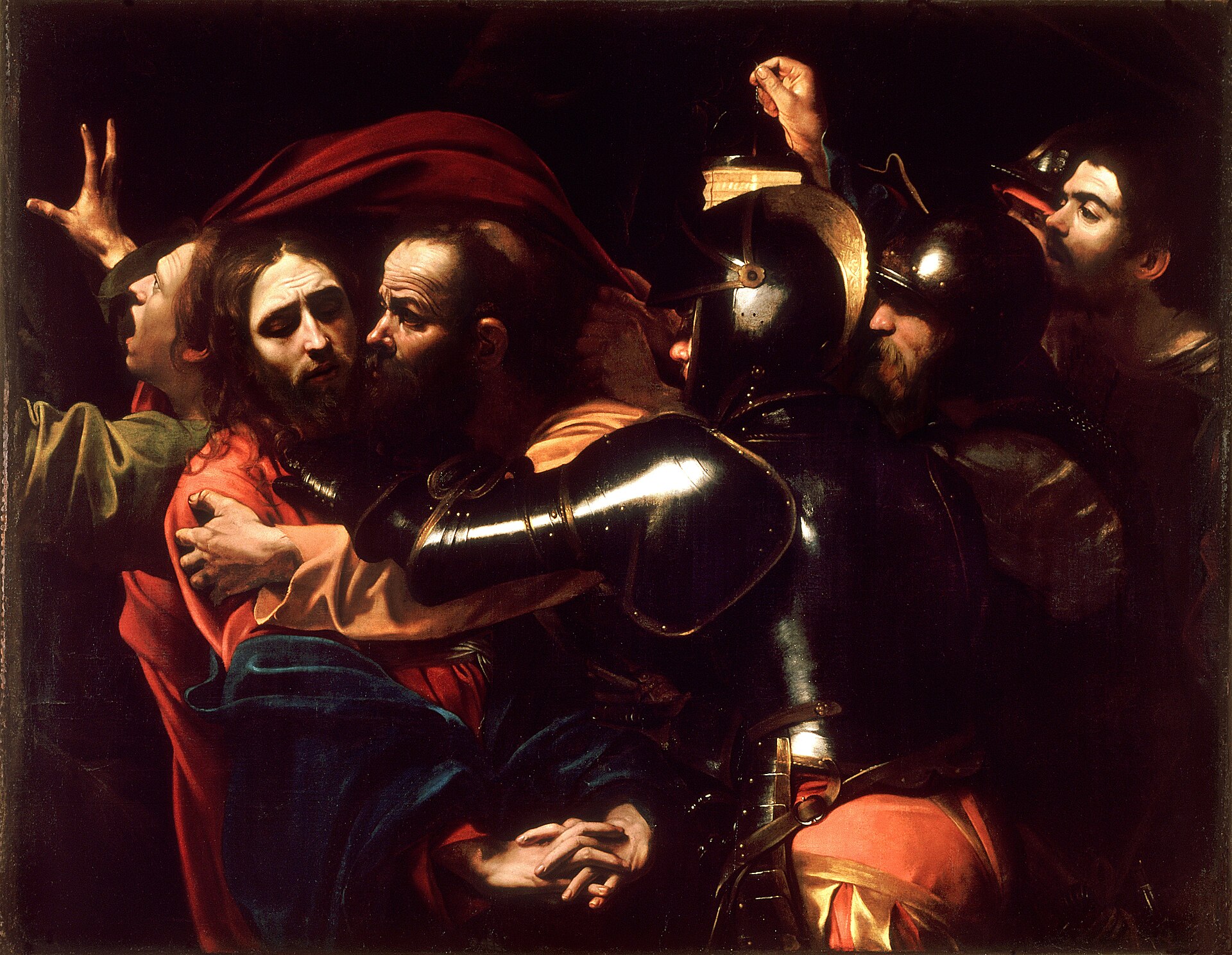
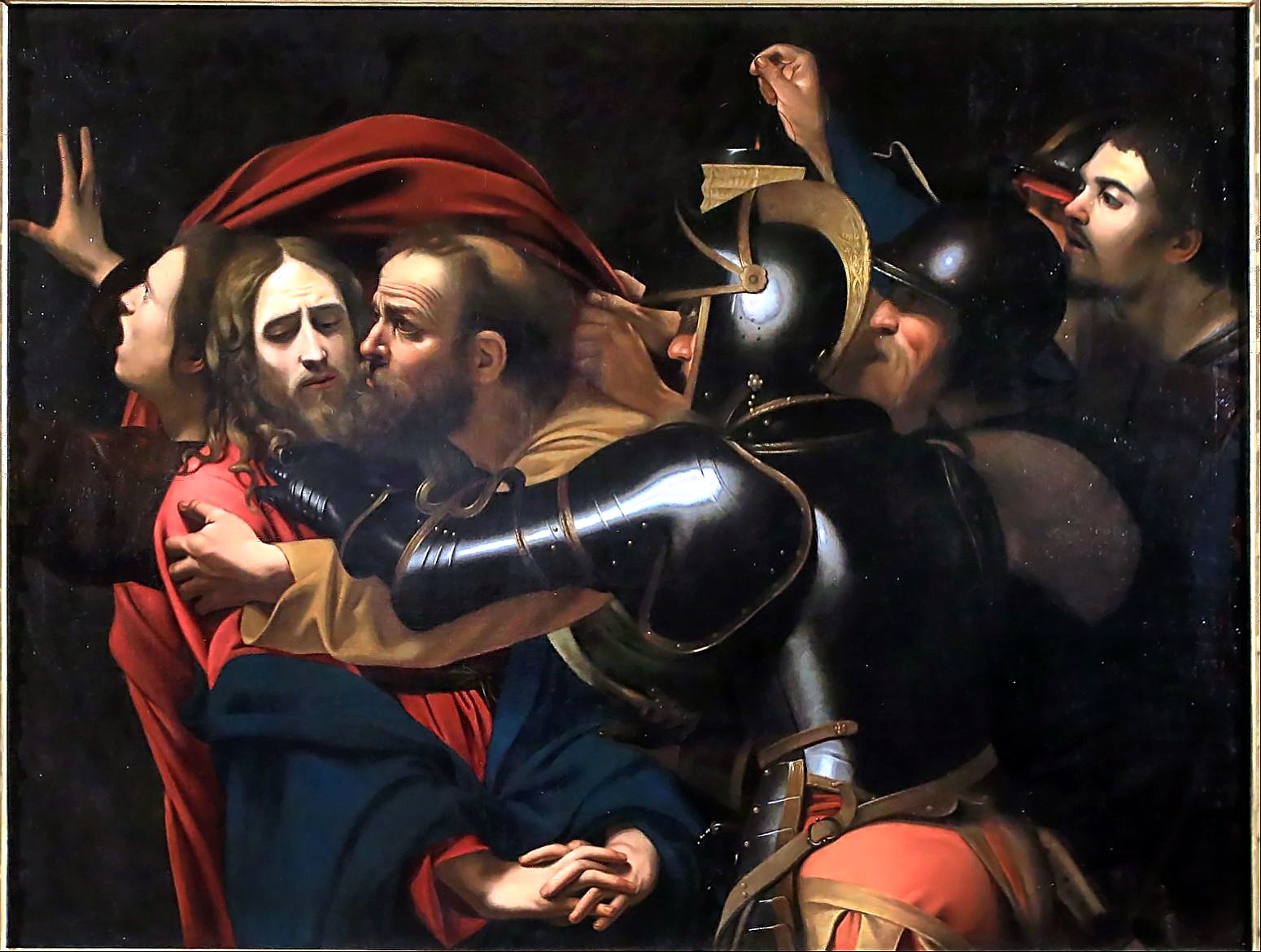
The record subject: the Dublin picture, National Gallery of Ireland, loan L.14702, owned by the Jesuit Community at Leeson Street. Oil on canvas, 135.5 x 169.5 cm, painted 1602 and paid for on 2 January 1603.
| Artist | Michelangelo Merisi da Caravaggio |
|---|---|
| Date | 1602 |
| Medium | Oil on canvas |
| Dimensions | 135.5 x 169.5 cm as catalogued by the National Gallery of Ireland. 133.5 x 169.5 cm and 134 x 170 cm are both in wide circulation; the gallery's figure is the one this record follows. |
| Where it is now | National Gallery of Ireland, Dublin. On indefinite loan from the Jesuit Community, Leeson Street, Dublin, who acknowledge the generosity of the late Dr Marie Lea-Wilson.last confirmed 31 August 2026 |
| Inventory number | L.14702 |
| Attribution | AcceptedAccepted as autograph on the combination of a payment record and a technical examination. Full note |
| Object type | Painting |
| Period | Italian, seventeenth century |
| Cases | Rediscovered |
| Inscriptions | None recorded. Caravaggio signed only one painting in his life and it is not this one. |
| Owners on record | 8 links8 documented |
| Sources | 10 cited |
About this record Last verified 31 August 2026 · 10 sources cited · Change log
On this page 11 sections
ContentsClose
A Caravaggio of 1602, paid for at 125 scudi by the Roman nobleman Ciriaco Mattei and entered in his bank book on 2 January 1603. It was sold out of the family in 1802 under the name of Gerard van Honthorst, went to Scotland, came to auction at Dowell's in Edinburgh in 1921 at eight guineas and again in 1922 at five, and was given in about 1930 to the Jesuit house at 35 Leeson Street in Dublin by a doctor whose husband had been shot dead by the IRA. It hung in the dining room for sixty years under a coat of dirt and brown varnish.
In August 1990 Sergio Benedetti, senior conservator at the National Gallery of Ireland, walked round to Leeson Street to look at the community's pictures and recognised it. Three years of examination and consultation followed. The painting was unveiled on 16 November 1993 and Benedetti published the case in The Burlington Magazine the same month, alongside a companion article with Francesca Cappelletti setting out the documentary evidence she and Laura Testa had found in the Mattei archive at Recanati.
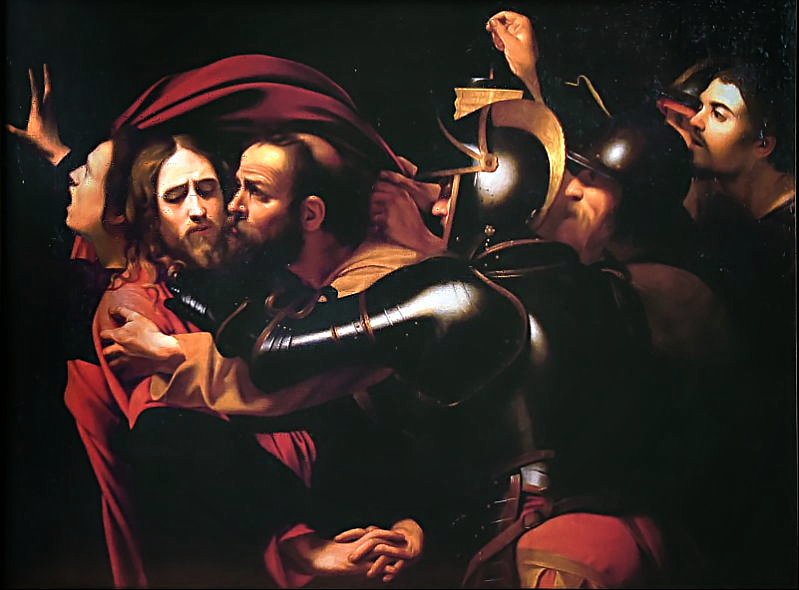
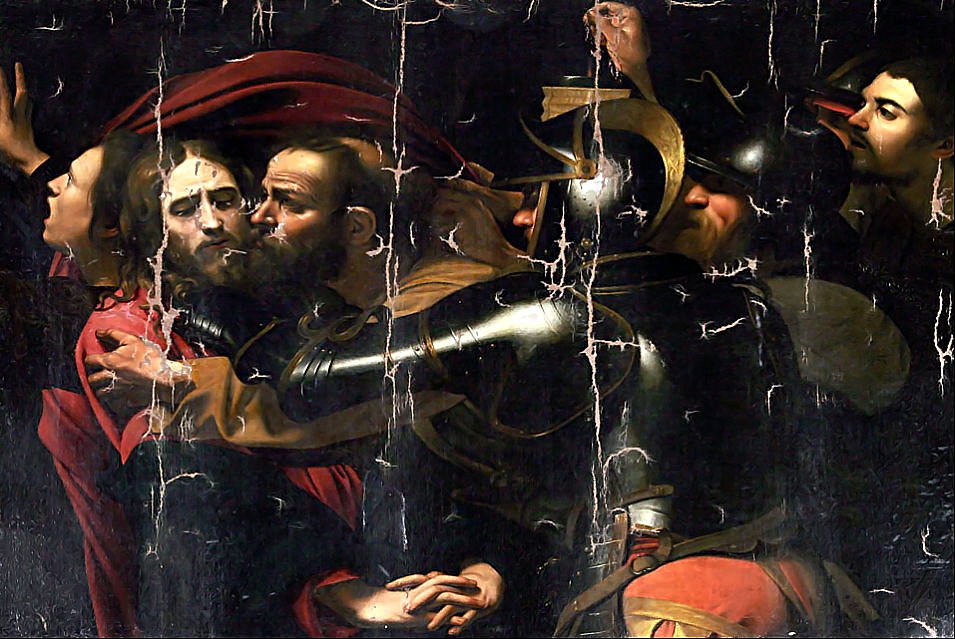
At least twelve early versions of this composition exist. One of them, in Odessa, was long argued to be the original, was itself stolen in July 2008, was recovered from a car in Berlin in 2010 with the canvas shredded, and was restored between 2018 and 2021. Every plate in this record states which version it shows.
Provenance
Each link is graded. Documented: a cited source supports it. Disputed: the identification is argued but not established. Unknown: no owner for that span, and the gap is not smoothed into a narrative. The grades in the glossary.
- 1602 - 1802Ciriaco Mattei, Rome, and the Mattei family by descentdocumented
Commissioned by Marchese Ciriaco Mattei and paid for at 125 scudi, the payment entered in his libro di rincontro del banco on 2 January 1603 for a painting with its frame of Christ taken in the garden. Found in the Mattei archive at Recanati by Francesca Cappelletti and Laura Testa and published in 1993. The picture stayed in the Palazzo Mattei di Giove by descent for two centuries. In 1786 Giuseppe Vasi catalogued it as a work of Gerard van Honthorst, and a family inventory of 1793 repeated the error.1310
- 1802 - 1920William Hamilton Nisbet and descendants, Biel House, East Lothiandocumented
Sold by Duca Giuseppe Mattei to the Scottish collector William Hamilton Nisbet in Rome on 27 January 1802, as a Honthorst, with other pictures. It hung at Biel House near Edinburgh and descended to Mrs Mary Georgiana Constance Nisbet Hamilton Ogilvy, who died in 1920. No price for the 1802 sale is recorded in the sources consulted.13
- 1921 - 1922John Kent Richardsondocumented
Dowell's, Edinburgh, 25 June 1921, lot 30, at eight guineas. A hammer price for a large seventeenth-century canvas catalogued under the name of a Dutch follower.1
- 1922 - c. 1924The Hon. Major Charles Noeldocumented
Dowell's, Edinburgh, 3 May 1922, lot 480, at five guineas. Lower than the previous year's hammer, which is what a resale looks like when the first buyer was wrong about the picture.1
- c. 1924 - c. 1930Dr Marie Lea-Wilson, Dublindocumented
Bought in Edinburgh in the early 1920s as a Honthorst and brought to Ireland. The gallery records the acquisition at 1924; the first Irish document is a receipt for GBP 20 to the Dublin cabinetmaker James Hicks for restoring the frame. Her husband, RIC District Inspector Percival Lea-Wilson, had been shot dead by the IRA at Gorey on 15 June 1920 in retribution for his treatment of republican prisoners at the Rotunda after the 1916 Rising. Whether she bought it directly from Major Charles Noel is not established.1510
- c. 1930 - presentThe Jesuit Community, 35 Leeson Street, Dublindocumented
Given by Marie Lea-Wilson to the Jesuit house of study in gratitude to Father Thomas Finlay, who had counselled her after her husband's killing. It hung in the dining room for about sixty years, still as a Honthorst. The Jesuits remain the owners; the loan to the National Gallery of Ireland transferred custody, not title.125
- 1990 - 1993The Jesuit Community; in the care of the National Gallery of Irelanddocumented
Recognised by Sergio Benedetti, senior conservator, on a visit to Leeson Street in August 1990. Three years of research, technical analysis, consultation with international specialists and cleaning followed. Published in The Burlington Magazine, November 1993, vol. 135 no. 1088, with a companion documentary article by Francesca Cappelletti and Benedetti. Unveiled to the public on 16 November 1993 in the exhibition Caravaggio: The Master Revealed.210
- 1993 - presentNational Gallery of Ireland, Dublin (custody); Jesuit Community, Leeson Street (title)documented
Loan number L.14702. The credit line reads: on indefinite loan to the National Gallery of Ireland from the Jesuit Community, Leeson St., Dublin, who acknowledge the kind generosity of the late Dr Marie Lea-Wilson, 1992. The gallery dates the acknowledgement to 1992 and the loan to 1993. Fourteen exhibitions are recorded between 1994 and 2024, including venues in London, Boston, Washington, Milan, Amsterdam, Rome and Dublin.12
Prices realised
This picture has been sold at public auction twice, both times at Dowell's in Edinburgh and both times as a Gerard van Honthorst. It has not been on the market since 1922 and is not for sale: it belongs to a religious community and is on indefinite public loan. No modern valuation, insurance figure or estimate for it has been published, and this record does not supply one. The only other price ever recorded for it is the 125 scudi Ciriaco Mattei paid Caravaggio in 1603, which included the frame.
| Date | Sale | Estimate | Result | Note |
|---|---|---|---|---|
| 25 June 1921 | Dowell's, Edinburgh Nisbet Hamilton Ogilvy property, Biel House, lot 30 | Not published in the sources consulted | Hammer GBP 8 8s (eight guineas) With premium Not applicable; buyer's premium was not charged in British salerooms in 1921 GBP | Bought by John Kent Richardson. Catalogued as a Honthorst. Eight guineas is GBP 8.40 in decimal currency. |
| 3 May 1922 | Dowell's, Edinburgh Unnamed in the source, lot 480 | Not published in the sources consulted | Hammer GBP 5 5s (five guineas) With premium Not applicable; buyer's premium was not charged in British salerooms in 1922 GBP | Bought by the Hon. Major Charles Noel, eleven months after the previous sale and three guineas lower. Still catalogued as a Honthorst. |
Hammer is the price at which the bidding stopped; with premium adds the fee the house charges the buyer on top. Hammer price and buyer's premium in the glossary.
Technical evidence
| Attribution note | Accepted as autograph on the combination of a payment record and a technical examination. Ciriaco Mattei's bank book records 125 scudi paid to the artist for a picture of Christ taken in the garden, entered on 2 January 1603; the picture was identified in Dublin in August 1990 by Sergio Benedetti and published by him in The Burlington Magazine in November 1993 after three years of examination. The attribution is close to universally held. It is not unopposed: Francesco Petrucci, working from the Ariccia version, has argued that a passage in the Dublin canvas reads as a copyist's misunderstanding rather than the master's variation, and Ukrainian scholars make a competing case for the Odessa picture. The dispute is set out in full in this record because at least twelve early versions of this composition exist and one of them was, until 1990, the leading candidate for the original. |
|---|---|
| Support | Canvas, unlined status not published in the sources consulted.1 |
| Medium | Oil on canvas.1 |
| Dimensions | 135.5 x 169.5 cm per the National Gallery of Ireland catalogue. 133.5 x 169.5 cm is given on the Wikidata-linked Commons record and 134 x 170 cm on the gallery's own colour-corrected image file. The variance is about two centimetres in height and is unresolved in the sources consulted.139 |
| Signature | None. Caravaggio signed one painting in his life, The Beheading of Saint John the Baptist in Valletta, and this is not it.7 |
| Method | Painted directly on to a dark ground from posed models, without cartoons and with almost no preparatory drawing; guidelines scored into the ground with the handle of the brush. The absence of drawings is characteristic and is one reason attribution arguments for this artist run on paint handling and incisions rather than on underdrawing.7 |
| Examination 1990-1993 | Three years of research, technical analysis and consultation with international specialists at the National Gallery of Ireland, followed by cleaning. Published by Sergio Benedetti in The Burlington Magazine, November 1993.210 |
| Condition before cleaning | Recorded by the conservator as a surface obscured by a film of dust, grease and soot with a varnish turned yellow-brown, the flesh reading tobacco-coloured and Christ's red robe reading as dead leaves. Sixty years above a refectory table.5 |
| Frame | The original frame was included in the 125 scudi paid in 1603 and does not survive. The earliest Irish document connected with the picture is a receipt for GBP 20 paid to the Dublin cabinetmaker James Hicks for restoring a frame in the 1920s.110 |
| Documented copy | In 1626 Asdrubale Mattei paid Giovanni di Attili 12 scudi to copy the picture. The commission is in the family papers and is the anchor for dating at least one member of the version group.4 |
| Comparative imaging on other versions | The Odessa version was X-rayed at the Grabar Institute in Moscow in 1951; those plates are the evidential basis of the Ukrainian claim that it is autograph. The Ariccia version has been examined with X-ray and infrared reflectography, with cinnabar red, madder lake and smalt reported as consistent with the period.46 |
Images
The record in full
Chapter 1What the picture does
Oil on canvas, 135.5 by 169.5 centimetres in the National Gallery of Ireland's catalogue.
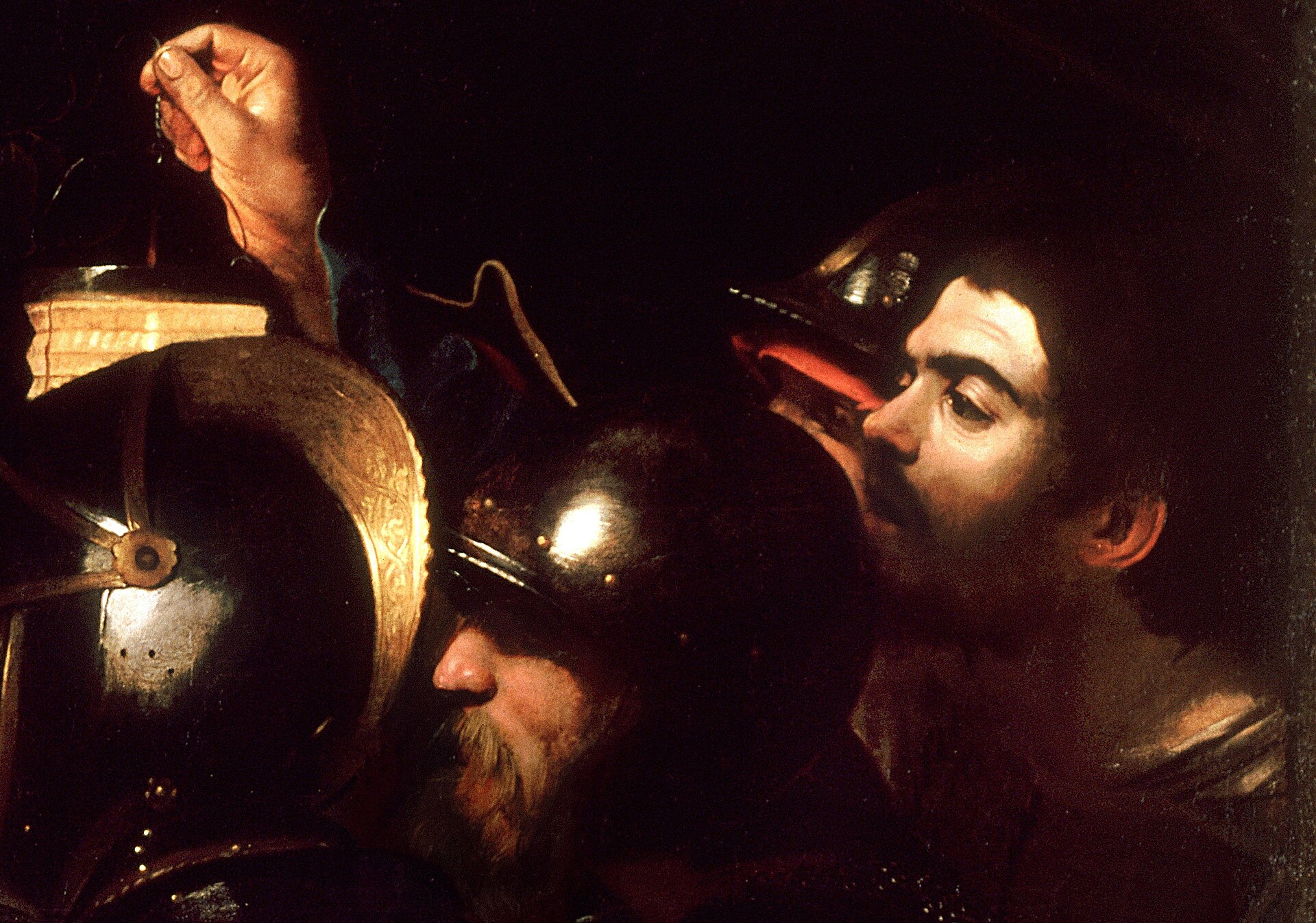
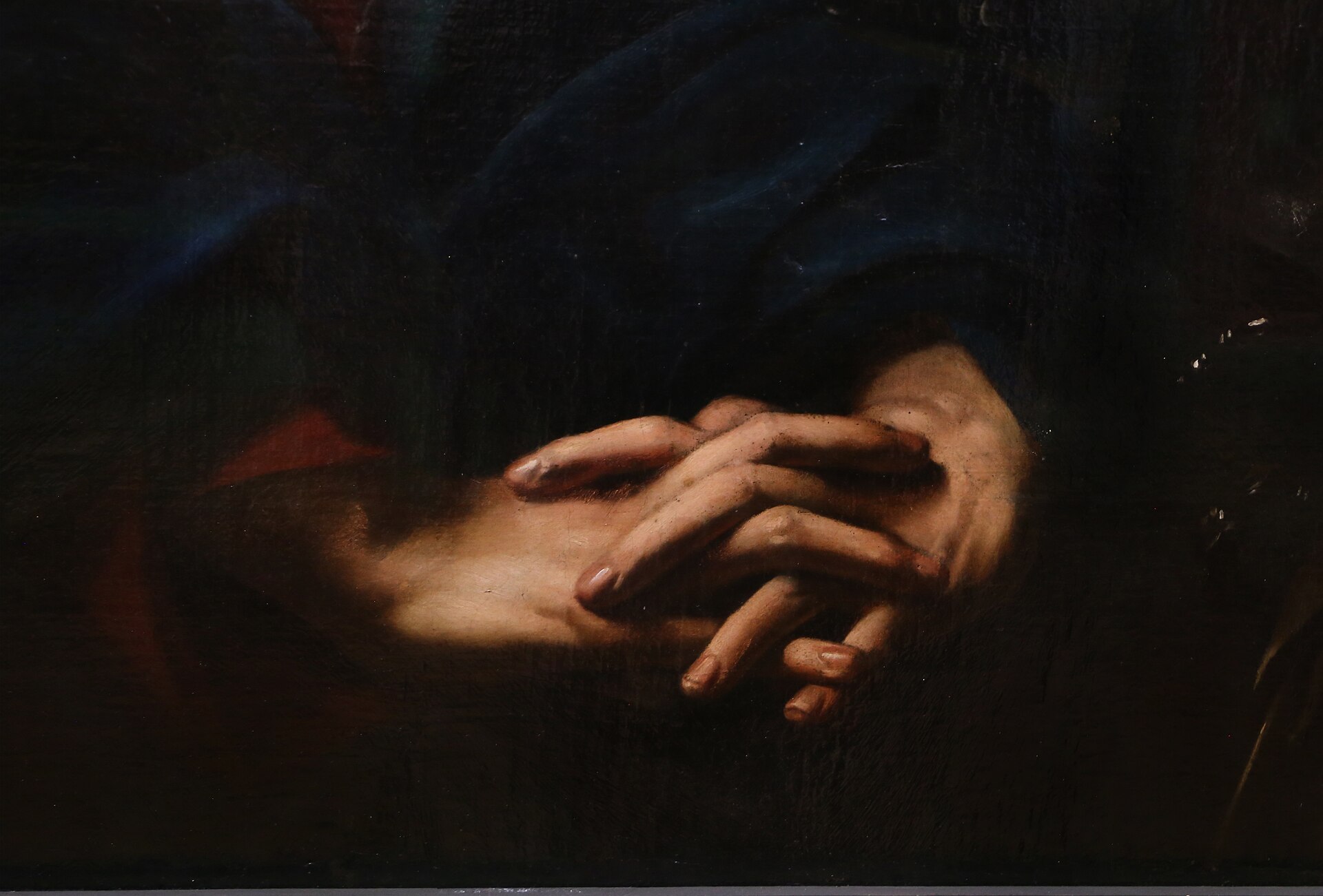
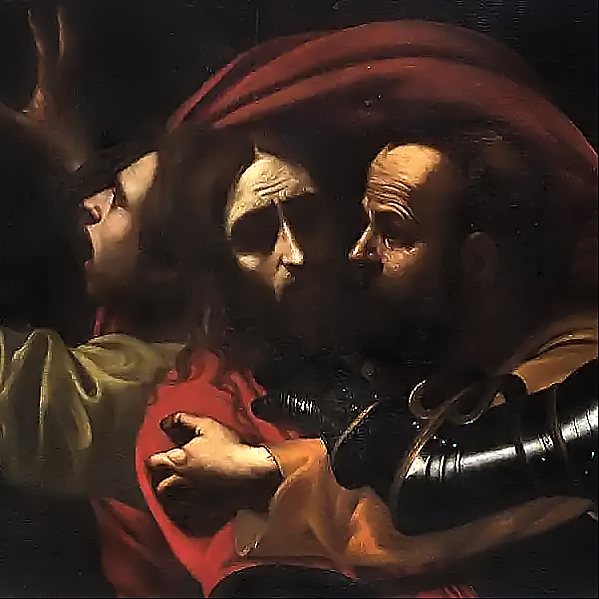
Oil on canvas, 135.5 by 169.5 centimetres in the National Gallery of Ireland's catalogue. Seven figures are pressed into a shallow, almost airless band across the front of the canvas. Judas has taken Christ by the arm and is completing the kiss. Christ's hands are locked together in front of him, fingers interlaced, in the only gesture of stillness in the picture. Two soldiers in black articulated armour drive in from the right, one with his gauntleted arm thrust across the whole composition. On the left a man in red flees with his mouth open and his arms up, the cloak streaming behind him. At the back right, holding up a lantern and straining to see over the soldiers, is a man whose face has been read since 1990 as Caravaggio's own.
There is no landscape, no sky and no middle distance. The garden of Gethsemane has been reduced to a black ground, and everything the viewer is given arrives on the light. That is the method: a dark ground, models posed in front of it, the picture built directly in paint without a cartoon and without preparatory drawings, guidelines scored into the wet ground with the handle of the brush. Caravaggio worked that way throughout, which is one of the reasons his pictures are so hard to copy convincingly and so easy to copy adequately.
The lantern is the argument of the picture. It is being held up by a man who wants to see, and it lights almost nothing. The betrayal happens under a light that fails.
Chapter 2The commission, and what 125 scudi bought
Ciriaco Mattei was one of three brothers of a Roman family with a new palace, the Palazzo Mattei di Giove, and a serious appetite for the most disturbing painter in the city.
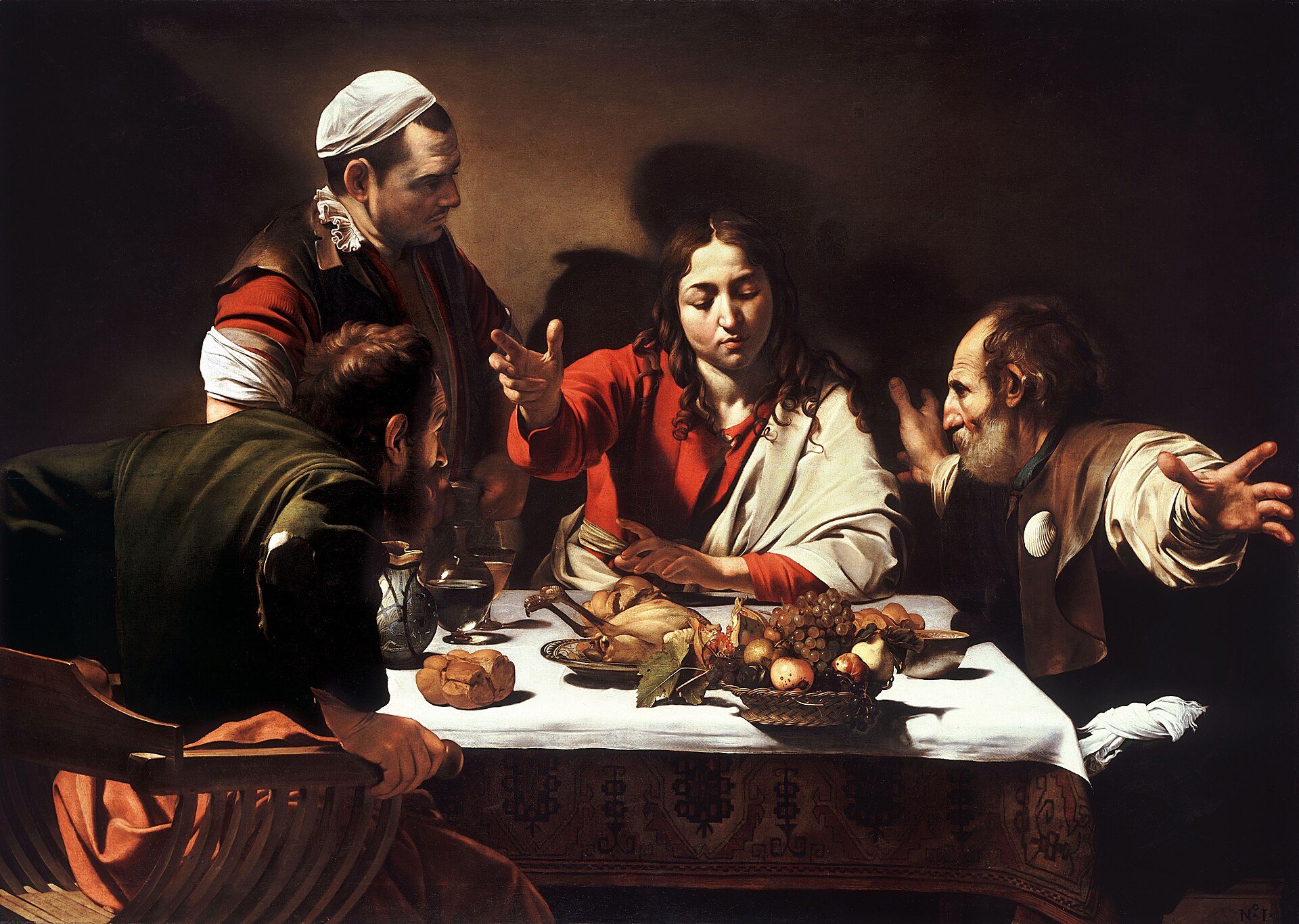
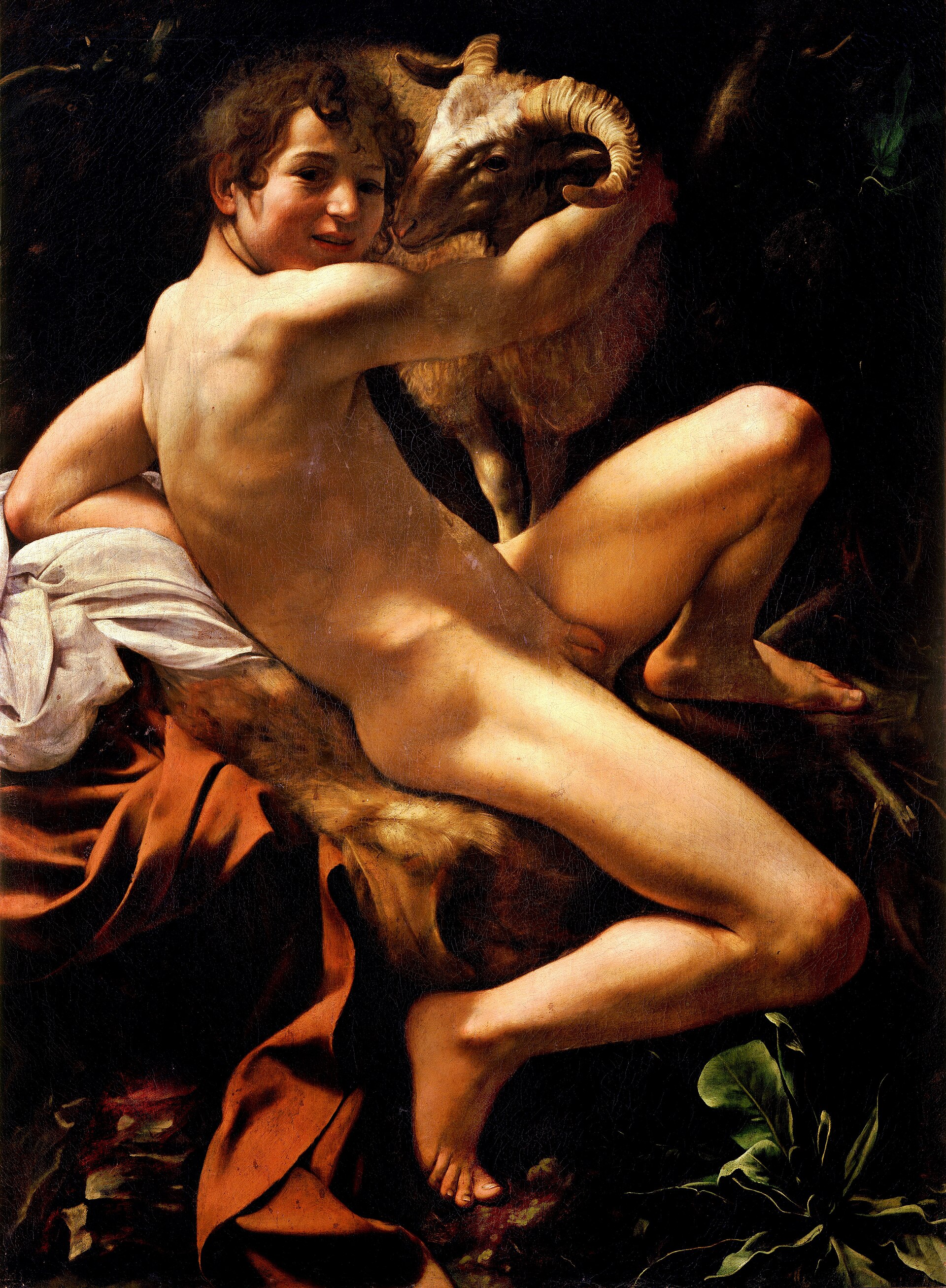
Ciriaco Mattei was one of three brothers of a Roman family with a new palace, the Palazzo Mattei di Giove, and a serious appetite for the most disturbing painter in the city. He is documented as buying three pictures from Caravaggio in a short period: The Supper at Emmaus, now in the National Gallery in London, Saint John the Baptist, now in the Pinacoteca Capitolina in Rome, and this one.
The payment for this picture appears in Ciriaco's libro di rincontro del banco, his bank reconciliation book, and it is the first documentary mention of the work in existence. It records 125 scudi paid to the artist for a painting, with its frame, of Christ taken in the garden. The entry is dated 2 January 1603, which means the picture was finished and delivered by the end of 1602.
The figure sits at the top of Caravaggio's ordinary rate for a cabinet-scale picture and it includes the frame, which is worth noticing: the frame was part of what the patron bought and part of what he paid for, and it has not survived. Set against it is a second, later payment in the same family's papers that tells you what a copy was worth. In 1626 Asdrubale Mattei paid Giovanni di Attili twelve scudi to copy this picture. The original cost slightly more than ten times the copy. That ratio is the seventeenth-century market's own estimate of the difference between a Caravaggio and a competent version of a Caravaggio, and it is a more useful number than any modern valuation of this painting, because no modern valuation exists.
Chapter 3How it was lost: a guidebook, a wrong name and a sale in 1802
The picture was never a secret. Gaspare Celio, a painter, wrote a guide to the pictures of modern Rome before 1620; it was published in Naples in 1638 and it records the Caravaggios in the Mattei...
The picture was never a secret. Gaspare Celio, a painter, wrote a guide to the pictures of modern Rome before 1620; it was published in Naples in 1638 and it records the Caravaggios in the Mattei collection at first hand. Benedetti's 1993 article opens with Celio, because Celio is the reason art historians knew a Caravaggio Taking of Christ had existed and had to be somewhere.
What removed it from view was a name. In 1786 Giuseppe Vasi catalogued the painting as a Honthorst, and a Mattei family inventory of 1793 repeated the error. Gerrit van Honthorst was a Utrecht painter who had been in Rome, absorbed Caravaggio's lighting and built a career on candlelit night scenes. He was exactly the wrong answer that looks right: a picture with a lantern in it, painted in Rome, in a dark manner, by a follower.
On 27 January 1802 Duca Giuseppe Mattei sold the picture, with others, to William Hamilton Nisbet, a Scottish collector then in Rome. It went to Biel House in East Lothian and hung there for more than a century under the Dutchman's name. When the last of that line, Mrs Mary Georgiana Constance Nisbet Hamilton Ogilvy, died in 1920, the contents came to be sold.
The point to hold on to is that nothing was hidden at any stage. The picture was in a great house, in a documented collection, with a catalogue entry. It was invisible because it was labelled.
Chapter 4Eight guineas, then five
At Dowell's in Edinburgh on 25 June 1921 the painting came up as lot 30 and was bought by John Kent Richardson for eight guineas.
At Dowell's in Edinburgh on 25 June 1921 the painting came up as lot 30 and was bought by John Kent Richardson for eight guineas. Eleven months later, at Dowell's again on 3 May 1922, it was lot 480, and this time it made five guineas, to the Hon. Major Charles Noel.
Those are hammer prices at a provincial saleroom for a picture then believed to be a Honthorst. The second is lower than the first, which is what happens when a dealer buys wrong and takes the loss. Eight guineas in 1921 is a modest sum for a large seventeenth-century canvas even by the standards of a depressed post-war market for old masters; five guineas is close to the value of the stretcher and the frame.
Every discussion of this picture reaches for a modern figure and none exists, because the work has not been on the market since 1922 and is owned by a religious community that has placed it on indefinite public loan. The only prices ever recorded for it are 125 scudi in 1603, eight guineas in 1921 and five guineas in 1922. That is the entire market history of one of the most reproduced paintings of the seventeenth century.
Chapter 5The woman who bought it
Percival Lea-Wilson was a District Inspector of the Royal Irish Constabulary.
Percival Lea-Wilson was a District Inspector of the Royal Irish Constabulary. After the surrender that ended the Easter Rising of 1916 he had charge of some two hundred and fifty republican prisoners held overnight in the grounds of the Rotunda in Dublin, and he abused and publicly humiliated them; the best-known incident is his stripping of Tom Clarke, the first signatory of the Proclamation. On 15 June 1920, aged thirty-three, he was shot dead in Gorey, County Wexford, walking home with a newspaper. A car with five men in it left the scene. The IRA claimed the killing as retribution for 1916.
His widow, Marie Lea-Wilson, commissioned a memorial window from the stained-glass artist Harry Clarke for the church at Gorey, on the subject of the martyrdom of Saint Stephen, and had it inscribed with Stephen's words: Lord, lay not this sin to their charge. She then read medicine, qualified at forty-one, and became a senior paediatrician at St Gabriel's Hospital in Dublin.
In the early 1920s, in Edinburgh, she bought a seventeenth-century picture catalogued as Gerard van Honthorst's Taking of Christ in the Garden and brought it to Ireland. The earliest Irish document connected with it is a receipt for twenty pounds paid to the Dublin cabinetmaker James Hicks for restoring its frame. In the early 1930s, in gratitude to Father Thomas Finlay of the Jesuit residence at 35 Leeson Street, who had counselled her after the killing, she gave the picture to the Jesuits.
She died in 1971. She never knew what she had given away.
Chapter 6Sixty years in a dining room
The Jesuits hung it in the dining room of the house of study on Leeson Street, where it stayed for about sixty years.
The Jesuits hung it in the dining room of the house of study on Leeson Street, where it stayed for about sixty years. It was not stored, not neglected in an attic and not forgotten: it was a large religious picture over a refectory table in a house full of educated men, and everyone who ate under it knew it as a Honthorst.
What sixty years of a working dining room did to it is on the record, in the conservator's own words. Benedetti described a surface obscured by a film of dust, grease and soot, and a varnish gone yellow-brown, so that the flesh of the faces and hands read as tobacco and the red of Christ's robe read as the colour of dead leaves. The soot and grease are the dining room. The picture was being smoked, gently, for six decades.
That is also what saved it. A dirty picture of a subject nobody was looking for, under the name of a minor Dutchman, in a religious house that was never going to sell it, is about the safest place a Caravaggio could be.
Chapter 7August 1990: what Benedetti actually did
The identification has been told as a moment of recognition and it partly was.
The identification has been told as a moment of recognition and it partly was. In August 1990 Sergio Benedetti, senior conservator at the National Gallery of Ireland and a specialist in early Italian painting, walked round to Leeson Street to look at the community's pictures at their invitation. He saw a composition he knew from copies and photographs, in a canvas whose quality he could read through the varnish, and he thought it was the lost Mattei original.
Then came three years of work, which is the part that matters and the part the story usually drops. The gallery undertook the research, the technical analysis and the consultation with international specialists. The picture was cleaned. Benedetti wrote it up and published it in The Burlington Magazine in November 1993, volume 135, number 1088, under the title Caravaggio's 'Taking of Christ', a Masterpiece Rediscovered.
In the same issue, immediately after it, ran a second article: The Documentary Evidence of the Early History of Caravaggio's 'Taking of Christ', by Francesca Cappelletti and Benedetti. Cappelletti and Laura Testa, then graduate students at the University of Rome, had gone through the Mattei family archive in a cellar in Recanati in the Marche and found the payment of 125 scudi in Ciriaco's bank book. Their work was independent of Benedetti's and it landed at the same time.
This is why the identification held. A connoisseur's recognition and a laboratory report will always be arguable. A recognition, a laboratory report and a bank entry naming the artist, the subject and the sum, published together in a peer-reviewed journal within three years, are something else. The picture was shown to the public on 16 November 1993 in an exhibition called Caravaggio: The Master Revealed, and put on indefinite loan to the National Gallery of Ireland by the Jesuits.
Chapter 8The other versions, and why they matter
At least twelve early versions of this composition are known.
At least twelve early versions of this composition are known. Some are workshop or contemporary copies, one of which is documented: in 1626 Asdrubale Mattei commissioned Giovanni di Attili to copy the picture for twelve scudi, and that copy is the reason there is a Mattei-provenance version at all. Others are later. The existence of the group is why the original could go missing in plain sight: for most of the twentieth century, anyone wanting to see the Taking of Christ could see a version of it.
Two of the versions have their own histories and both belong here.
The first is in the Odesa Museum of Western and Eastern Art in Ukraine. It surfaced at a Paris auction in 1868 among the property of the Russian collector Alexander Petrovich Basilevsky, catalogued under Caravaggio's given name. Basilevsky gave it to the Grand Duke Vladimir Alexandrovich Romanov in 1870; it was shown at the Academy of Fine Arts in St Petersburg and transferred to Odessa in 1901. It was hidden in a cathedral during the Second World War, returned to Soviet hands, and X-rayed at the Grabar Institute in Moscow in 1951. Those X-rays are still the centre of the argument about it.
The second is the fragment from the Ruffo collection, a cut-down early version whose central group survives. Its status is unsettled.
Chapter 9The Odessa picture was stolen too
In July 2008 the Odessa version was taken from the museum.
In July 2008 the Odessa version was taken from the museum. The thieves cut it roughly from its frame and shredded the canvas in the process. The museum had no alarm connection and one guard on duty.
The recovery ran through an undercover operation led by Major Denis Formichev of the Ukrainian organised crime police, working with German and Italian counterparts, with Formichev himself posing as a dealer. The painting was found in Berlin in 2010. Formichev's account is of a car boot being opened and a torch shone on to the damage. The recovery was announced jointly by Angela Merkel and Viktor Yanukovych.
Then it stalled. The canvas was taken to the National Art Restoration Centre in Kyiv and immediately impounded as evidence in the criminal case. Five men were indicted and none was convicted; Formichev has said publicly that politics and corruption are the reason. The museum's director spent years warning that the picture had gone more than five years without conservation and that the consequences would be irreversible. Restoration finally began in March 2018, after intervention by the Italian embassy, and ran to 2021.
The restored picture was shown in Kyiv in 2026, in the exhibition In the Light of Caravaggio at the National Scientific Restoration Centre and at the Saint Sophia of Kyiv National Sanctuary, its first public appearance in eighteen years. A ruling of the Podil District Court of Kyiv of 28 August 2025 ordering its return to the Odesa museum came into force after the prosecutor's appeal was dismissed. As of August 2026 the picture is in Kyiv and the war is the reason it has not gone home.
Two paintings of the same composition, both stolen. One was recovered in a Berlin car park after two years and has been on an operating table ever since. The other, in Dublin, has never been stolen at all, and its worst injury was sixty years of dinner.
Chapter 10Is the Dublin picture the original? The case against
This record does not treat the attribution as closed, for the reason that the archive exists: correcting version confusion is the whole job, and a record that reports only the winning side of a live...
This record does not treat the attribution as closed, for the reason that the archive exists: correcting version confusion is the whole job, and a record that reports only the winning side of a live dispute is doing the opposite.
The Ukrainian case for Odessa is made most fully by the art historian Natalia Chechykova and rests on the 1951 Grabar X-rays. She argues they show changes and second thoughts between a first lay-in and the final composition, notably in the position of the hand of the lantern-bearing figure and in the expression given to Christ, and that a copyist does not think again about a composition he is copying. Benedetti answered this directly. He pointed to the documented 1626 copy commission and wrote that the Odessa picture, although faithful in design, reveals its status as a copy by the evident weaknesses of its execution.
A separate line of attack comes from the Italian side. Francesco Petrucci, curator of the Ariccia version, has argued from technical examination that the Ariccia canvas shows pentimenti and period pigments consistent with Caravaggio, and that one passage in the Dublin picture reads as a copyist's error rather than an artist's variation: a pronounced scar on the left hand with which Judas grips Christ, clearly present in the Ariccia and Pitti versions, is distorted in Dublin. On that reading the Dublin canvas would revert to something like the Honthorst label it wore for two centuries.
The National Gallery of Ireland's position, put by its curator Aoife Brady, is that pentimenti alone do not settle anything, because copyists also change their minds and correct mistakes, and that the specific kinds of revision associated with Caravaggio's practice are not what the Odessa evidence shows. She has also made the point that the argument does not diminish what Odessa has.
Weighing it honestly: the Dublin attribution is the only one supported by a payment record that names the artist, the subject and the sum, published alongside the technical case in a refereed journal, and it is accepted by the overwhelming majority of Caravaggio scholarship. The dissent is real, it is published, and it is named here. It has not moved the field.
Chapter 11The man with the lantern
The figure at the back right, holding the lantern up and craning to see, is generally identified as a self-portrait.
The figure at the back right, holding the lantern up and craning to see, is generally identified as a self-portrait. It is the only face in the picture that is not doing anything to Christ, and it is the only one that is looking rather than acting.
Read against what is documented about the painter, that placement is not sentimental. Caravaggio's own life is one of the best-recorded of any artist of the period, because so much of the record is police record. On 29 May 1606 he killed Ranuccio Tomassoni in a fight in Rome and was sentenced to beheading; he spent the last four years of his life in Naples, Malta and Sicily working for a pardon that never came, and he died at Porto Ercole on 18 July 1610, aged thirty-eight. This picture was painted four years before the killing, in the middle of the best-paid and most productive stretch of his Roman career, for a patron who kept buying.
The subject was not chosen by the painter. Ciriaco Mattei ordered a Christ taken in the garden and paid for it with its frame. What the painter did with it was to remove the setting, remove the divine light, and put himself in it as a man holding up a lamp that does not reach.
Chapter 12Where it stands in 2026
The picture is in Dublin, in the National Gallery of Ireland, as loan number L.14702.
The picture is in Dublin, in the National Gallery of Ireland, as loan number L.14702. It is not the gallery's property. It belongs to the Jesuit Community at Leeson Street, who placed it on indefinite loan to the Irish public in 1993 and whose credit line acknowledges Marie Lea-Wilson by name. It has been lent out repeatedly since the rediscovery, to London, Boston, Washington, Milan, Amsterdam and Rome among others.
The Odessa version is in Kyiv, restored, exhibited in 2026 for the first time since it was cut out of its frame, and under a court order to go back to a museum in a city under bombardment. The Ruffo fragment is in Italy. The Ariccia version is the basis of a published dissent from the Dublin attribution. The 1626 copy commissioned by Asdrubale Mattei is documented in the family papers.
Marie Lea-Wilson's twenty pounds to a Dublin framemaker is the last money anyone is recorded as having spent on this object. The frame Ciriaco Mattei paid for in 1603 is gone.
The artist
Michelangelo Merisi da Caravaggio
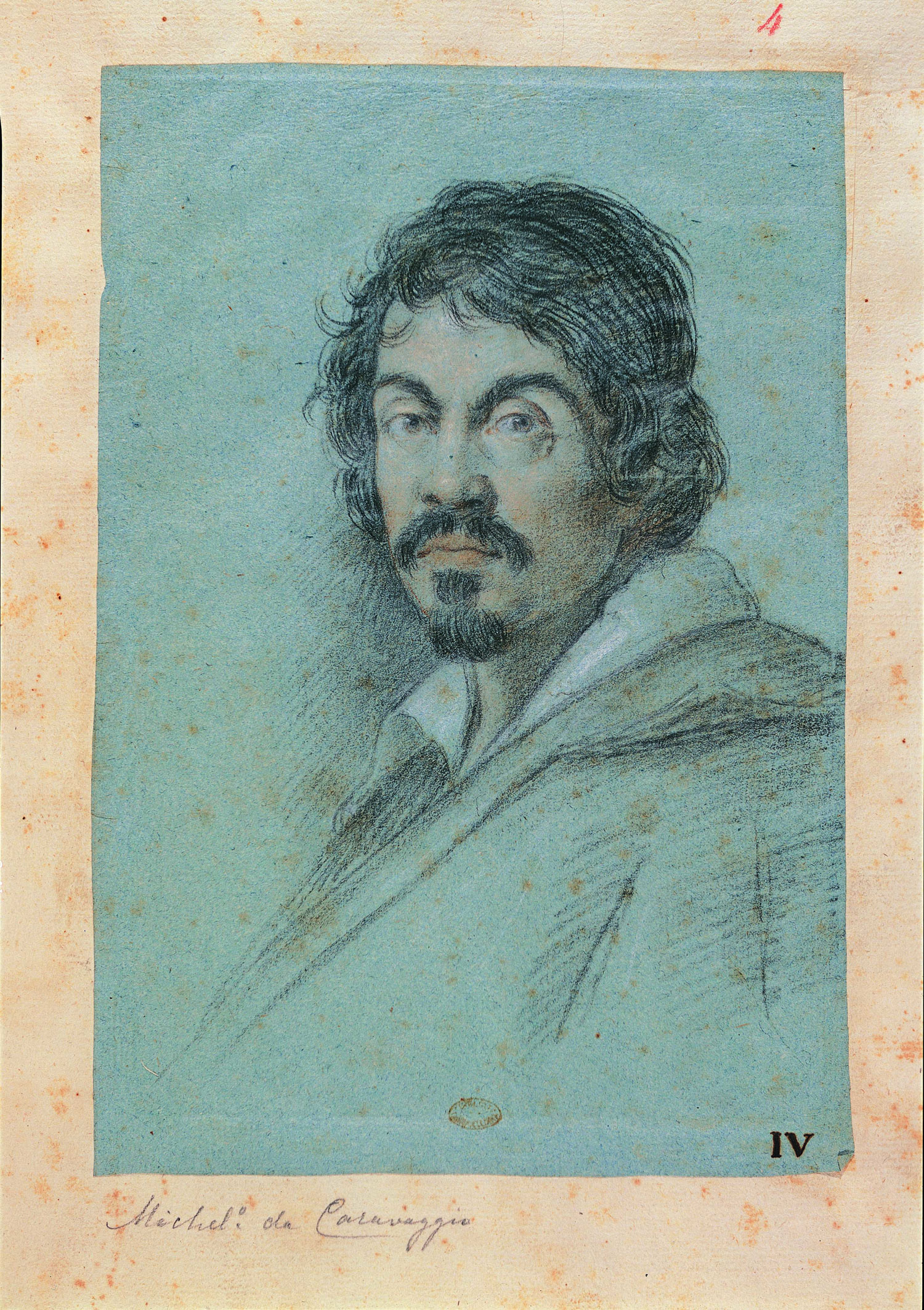
Caravaggio worked for about fifteen years, left no drawings, signed one picture, and spent the last four years of his life under a sentence of beheading. He was largely written out of the canon in the eighteenth and nineteenth centuries and put back into it in the twentieth. Because he prepared nothing on paper and painted directly on to a dark ground from posed models, his pictures are unusually easy to copy in outline and unusually hard to copy in handling, which is why his corpus is surrounded by versions and why records like this one exist.
Exhibited
- 1993Caravaggio: The Master RevealedNational Gallery of Ireland, Dublin, from 16 November 1993
- 2024National Treasures: Caravaggio in BelfastUlster Museum, Belfast, 10 May to 1 September 2024, on loan alongside The Supper at Emmaus (National Gallery, London) - the two Mattei pictures shown together for the first time since the early seventeenth century, when they were commissioned as a pair
Related works
| Work | Relation | Where it is |
|---|---|---|
| The Taking of Christ (Odesa version) Caravaggio, attributed, or a contemporary copyist | The version long argued to be the original; itself stolen and recovered Basilevsky sale, Paris, 1868; given to Grand Duke Vladimir Romanov 1870; Odessa from 1901; X-rayed at the Grabar Institute 1951; stolen July 2008 and cut from its frame; recovered in Berlin 2010; restored 2018-2021; exhibited in Kyiv 2026 under a court order to return to Odesa. | Odesa Museum of Western and Eastern Art; physically in Kyiv since 2010 |
| The Taking of Christ (Ruffo Collection) Caravaggio, attributed | A third early version, surviving as a cut-down central fragment Status unsettled. Its survival as a fragment is a reminder that early versions were routinely cut down to fit. | Italy, private |
| The Taking of Christ (Ariccia version) Caravaggio, per Francesco Petrucci | The basis of the published argument against the Dublin picture Petrucci reports pentimenti and period pigments and argues that the scar on Judas's left hand, clear in Ariccia and in the Pitti version, is distorted in Dublin in a way that indicates a copyist. | Ariccia, Palazzo Chigi, exhibition context |
| The Supper at Emmaus Caravaggio | Bought by the same patron, Ciriaco Mattei, in the same period One of three Caravaggios Ciriaco Mattei acquired around 1601 to 1602. | The National Gallery, London |
| Saint John the Baptist (Youth with a Ram) Caravaggio | Bought by the same patron Named in the Cappelletti and Benedetti documentary article as the companion Mattei purchase. | Pinacoteca Capitolina, Rome |
| The 1626 copy by Giovanni di Attili Giovanni di Attili | A documented contemporary copy of this picture Commissioned by Asdrubale Mattei for 12 scudi. Benedetti cited it against the Odessa claim. Which surviving canvas it is, if any, is not established. | Unidentified among the surviving versions |
Open questions
- Which of the surviving versions is the 1626 copy that Asdrubale Mattei commissioned from Giovanni di Attili for 12 scudi? The commission is documented; the object has not been matched to it.
- How many early versions are there exactly? At least twelve are cited, but no published census lists them all with locations and current attributions.
- Is the height 133.5, 134 or 135.5 cm? The National Gallery of Ireland, the Commons artwork record and the gallery's own colour-corrected image file give three different figures.
- Where was the picture between 1802 and 1921? It is recorded as hanging at Biel House in East Lothian, but no inventory or photograph from that century has been cited in the sources consulted.
- Where exactly did Marie Lea-Wilson buy it, and from whom? The accounts say Edinburgh in the early 1920s, which is consistent with the Dowell's sales of 1921 and 1922, but the link between Major Charles Noel's five-guinea purchase and her acquisition is not documented in the sources consulted.
- What happened to the original frame that Ciriaco Mattei paid for as part of the 125 scudi in 1603?
- Will the Odesa version go home? A Kyiv court ordered its return in August 2025 and the order is in force, but the painting was still in Kyiv when exhibited in 2026.
- Has Petrucci's Ariccia argument been answered in print by the National Gallery of Ireland or by Caravaggio specialists, beyond the curatorial comments quoted in the press?
Questions about this object
What is The Taking of Christ?
The Taking of Christ is a painting, dated 1602. Medium: Oil on canvas.
Who made The Taking of Christ, and is the attribution settled?
The attribution to Michelangelo Merisi da Caravaggio is recorded here as accepted. Accepted as autograph on the combination of a payment record and a technical examination. Ciriaco Mattei's bank book records 125 scudi paid to the artist for a picture of Christ taken in the garden, entered on 2 January 1603; the picture was identified in Dublin in August 1990 by Sergio Benedetti and published by him in The Burlington Magazine in November 1993 after three years of examination. The attribution is close to universally held. It is not unopposed: Francesco Petrucci, working from the Ariccia version, has argued that a passage in the Dublin canvas reads as a copyist's misunderstanding rather than the master's variation, and Ukrainian scholars make a competing case for the Odessa picture. The dispute is set out in full in this record because at least twelve early versions of this composition exist and one of them was, until 1990, the leading candidate for the original.
Where is The Taking of Christ now?
National Gallery of Ireland, Dublin. On indefinite loan from the Jesuit Community, Leeson Street, Dublin, who acknowledge the generosity of the late Dr Marie Lea-Wilson. Inventory number L.14702. Last confirmed 31 August 2026. Placed on indefinite loan in 1993 following the identification and cleaning; the gallery's own credit line dates the acknowledgement to 1992.
What is still unknown about The Taking of Christ?
Which of the surviving versions is the 1626 copy that Asdrubale Mattei commissioned from Giovanni di Attili for 12 scudi? The commission is documented; the object has not been matched to it.
Sources
- 1National Gallery of Ireland, online collection, object 2882, 'The Taking of Christ', loan number L.14702. The institutional catalogue record. Used for the credit line, the dimensions, and the complete provenance list including the 27 January 1802 sale to Hamilton Nisbet, the Dowell's sales of 25 June 1921 (lot 30, eight guineas, John Kent Richardson) and 3 May 1922 (lot 480, five guineas, Major Charles Noel), the Lea-Wilson gift and the fourteen recorded exhibitions 1994-2024. onlinecollection.nationalgallery.ie/objects/...
- 2National Gallery of Ireland, 'How did a masterpiece by Caravaggio end up in a Dublin dining room?', published for the 25-years-on-display exhibition. Used for the August 1990 visit, the three years of research and consultation, the 16 November 1993 unveiling in Caravaggio: The Master Revealed, and the loan terms. nationalgallery.ie/art-and-artists/...
- 3Wikipedia, 'The Taking of Christ (Caravaggio)'. Used for the 1786 Vasi misattribution and its repetition in the 1793 family inventory, the count of at least twelve known copies, and the Cappelletti and Testa find in the Recanati cellar. Tertiary; flagged for replacement with the 1993 Burlington articles themselves. en.wikipedia.org/wiki/...
- 4The Irish Times, 'The mystery of Ukraine's Caravaggio: the second Taking of Christ?', 24 December 2023. Used for the Odesa picture's provenance from the 1868 Basilevsky sale through the 1870 Romanov gift and the 1901 transfer, the 1951 Grabar Institute X-rays, the July 2008 theft and the cutting of the canvas, the Formichev undercover recovery in Berlin in 2010, the impounding as evidence and the delayed restoration from March 2018, the five indicted men and the absence of convictions, the 1626 Attili copy commission at 12 scudi, Benedetti's rebuttal, Natalia Chechykova's case and Aoife Brady's response. irishtimes.com/culture/...
- 5Journal of Art in Society, 'Murder, Caravaggio and the Taking of Christ'. Used for Percival Lea-Wilson at the Rotunda in 1916 and the treatment of Tom Clarke, the shooting at Gorey on 15 June 1920, the Harry Clarke memorial window and its inscription, Marie Lea-Wilson's medical career and death in 1971, the Edinburgh purchase and the gift to Father Thomas Finlay, and Benedetti's description of the picture's condition in 1990. artinsociety.com/murder-caravaggio-and-the-taking-of-chri...
- 6Art-Test, 'The Taking of Christ by Caravaggio, the authorship of the one in Dublin seems increasingly challenging to argue'. Used for Francesco Petrucci's argument from the Ariccia version: the X-ray and reflectographic evidence, the cinnabar red, madder lake and smalt, and the claim that the scar on Judas's left hand is distorted in the Dublin picture in a way that indicates a copyist. art-test.com/en/...
- 7Wikipedia, 'Caravaggio'. Used for the artist dossier: birth and death, Del Monte and the Contarelli Chapel, the killing of Ranuccio Tomassoni on 29 May 1606 and the capital sentence, the Malta and Sicily years, the single signed painting, and the working method of painting direct from models on a dark ground with scored guidelines and almost no drawing. Tertiary; flagged for replacement with a standard monograph. en.wikipedia.org/wiki/...
- 8Intent (Ukrainian regional media), 'Court allows return of Caravaggio painting to Odesa museum', 2026. Used for the Podil District Court of Kyiv ruling of 28 August 2025 coming into force after the prosecutor's appeal was dismissed. intent.press/en/...
- 9Wikimedia Commons file records for the Odesa version (before the theft, after recovery in 2010, and after restoration in 2026) and for the National Gallery of Ireland's colour-corrected image of the Dublin picture, with the Ministry of Culture of Ukraine release cited on the 2026 file. Used for the restoration dates of 2018 to 2021, the 2026 Saint Sophia of Kyiv display, and the dimension variants. commons.wikimedia.org/wiki/...
- 10The Burlington Magazine, November 1993, vol. 135 no. 1088, contents. Sergio Benedetti, 'Caravaggio's Taking of Christ, a Masterpiece Rediscovered', which opens with Gaspare Celio's guide to the pictures of Rome, written before 1620 and published in Naples in 1638; and Francesca Cappelletti and Sergio Benedetti, 'The Documentary Evidence of the Early History of Caravaggio's Taking of Christ', which opens on the record of payment of 125 scudi in Ciriaco Mattei's libro di rincontro del banco and names the Pinacoteca Capitolina Saint John. Contents pages and article openings retrieved; the full text is behind the magazine's paywall. burlington.org.uk/archive/...
Last verified 31 August 2026 · Published 4 August 2026
Change log
4 August 2026 - Record created at the house standard: researched narrative, technical evidence, maker dossier, graded provenance chain, prices with hammer and premium separated, related works, open questions and sources.
31 August 2026 - Re-verified. No change to location, attribution or the standing Petrucci/Odesa attribution disputes. The Odesa court position is unchanged from this record's existing open question and remains accurate: the Podil District Court's August 2025 order stands, the appeal against it has since been dismissed with no further legal obstacle to return, and the picture was still in Kyiv as of the February-April 2026 exhibition 'In the Light of Caravaggio' - added as a citation rather than a rewrite, since the question was already correctly stated. Found and added a real gap in the exhibitions field: a 2024 Ulster Museum loan (10 May-1 September 2024) reunited this picture with its Mattei-commissioned companion, The Supper at Emmaus (National Gallery, London), for the first time since the early 17th century - missed by the original research, not previously recorded. Checked all source URLs; no rot found.