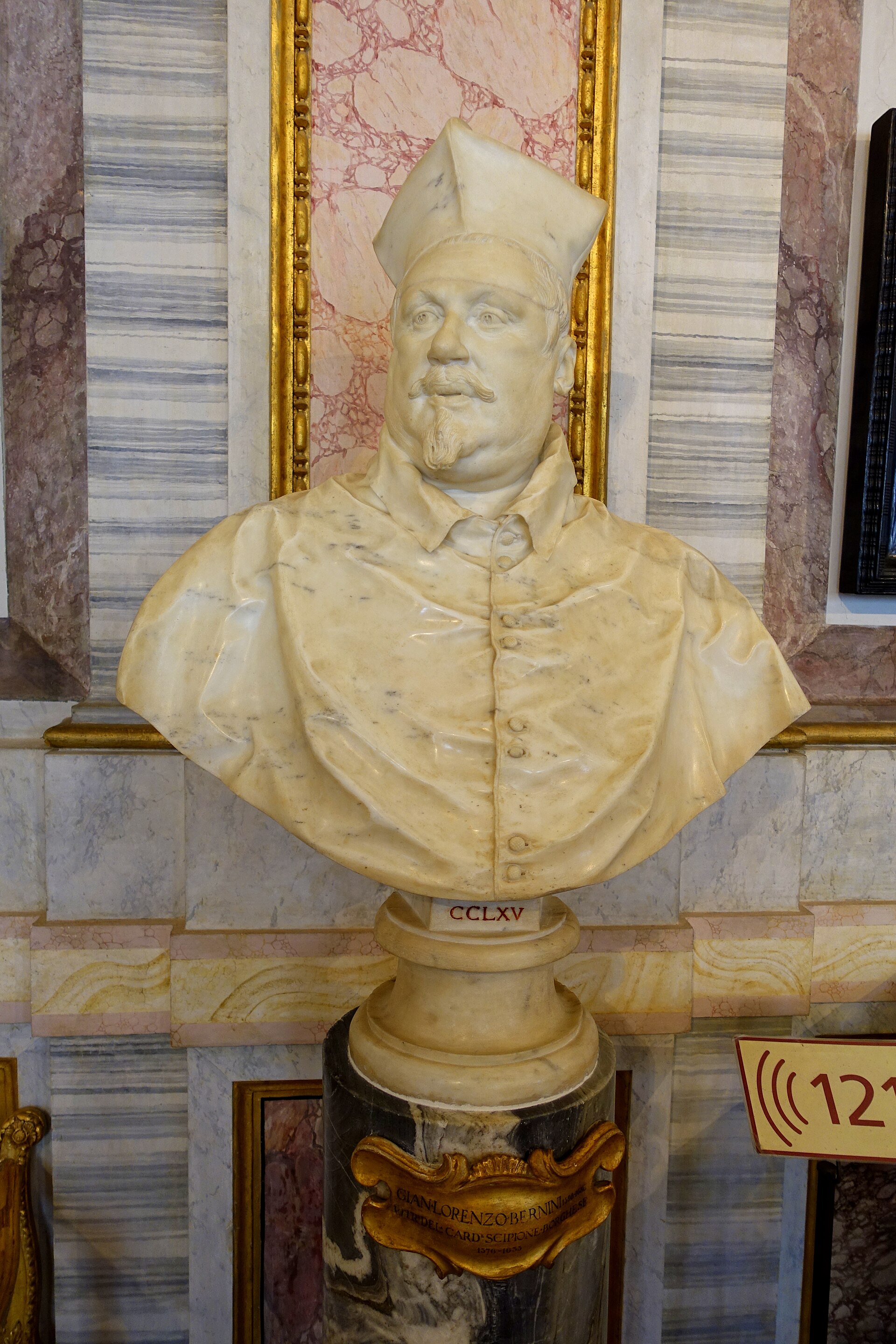
Bust of Cardinal Scipione Borghese, first version
1632 · Carrara marble
Galleria Borghese, Rome
 1598-1680
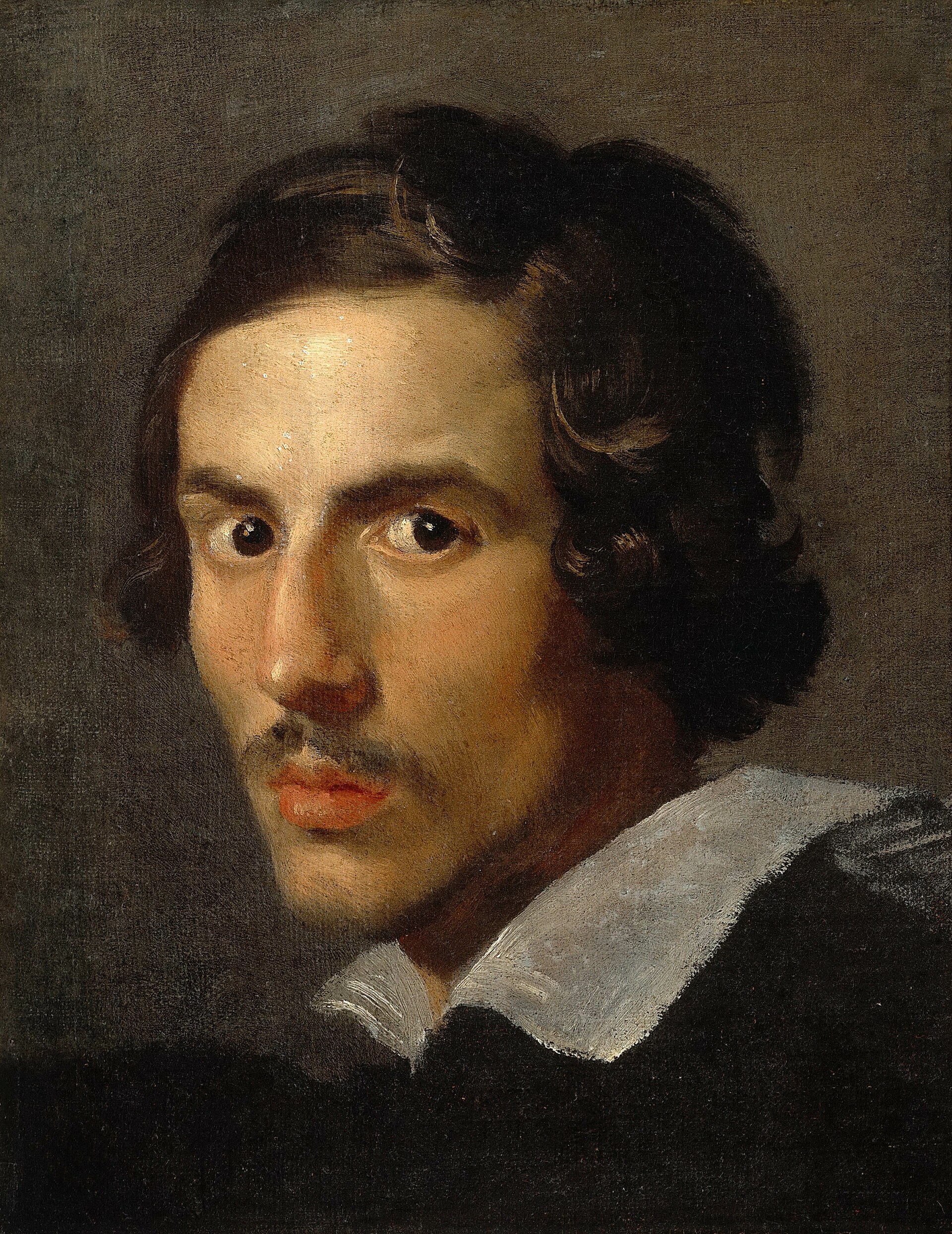
Bernini painted by himself about 1623, in his mid-twenties and in the middle of the Borghese commissions. A documented, catalogued self-portrait in the Galleria Borghese, in the same collection as the four marble groups and the two busts he made for the patron who employed him. He painted himself repeatedly; the best known of the other self-portraits was bought during his lifetime by Cardinal Leopoldo de' Medici and is in the Uffizi.
Galleria Borghese, Rome| Full name | Giovanni Lorenzo Bernini, called Gian Lorenzo or Gianlorenzo Bernini, Cavaliere Bernini |
|---|---|
| Worked as | Sculptor, Architect, Urban planner, Painter |
| Born | 7 December 1598 · Naples, then capital of the Spanish Viceroyalty of Naples |
| Died | 28 November 1680 · Rome, at his house on the Via della Mercede |
| Nationality | Italian |
| Movement | Roman Baroque |
| In this archive | 1 artwork |
| Sources | 30 cited |
| Last verified | 17 September 2026 |
About this page 1 artwork in the archive · Last verified 17 September 2026 · 30 sources cited
Bernini is the sculptor whose name is least in doubt and whose works are most in doubt. He signed almost nothing, he ran the largest sculpture workshop in seventeenth-century Europe, and he delegated on a scale that makes the question is this by Bernini a different question from is this a Bernini. Both are asked constantly, and in the last twenty years the answers have moved. A marble universally accepted as his first solo work from 1926 to 2022 has been struck out of the catalogue. A bronze bought for twenty-five million dollars and given to a public museum is regarded by the former director of the Galleria Borghese as untenable as an autograph work. A marble sold twice in Bratislava as a copy turned out to be the lost papal bust he carved at twenty-three, and went to the Getty for a reported thirty-three million.
What a reader will not find easily, and what this page leads with, is how any of that gets decided. It is not decided by signatures or documents, because there are hardly any. It is decided by fired clay: by the tool grooves, the pinched clay at the back of a figure's neck, and the fingerprints that a conservator at Harvard has spent decades cataloguing; and by marble forensics, by the struts left standing between a carved hand's fingers, by the drilled hole beside Daphne's ring-finger where he began in the wrong place, by the repaired fingers on Apollo's right hand, and by the pieced-in section of drapery on a David that the sources call a monolith.
The other thing worth knowing before anything else is how small the market is. Bernini's auction record was set in 2002 by a terracotta sketch, broken in 2021 by a marble he carved at eighteen with his father, and in between the most consequential Bernini transaction of the century was a private sale that published no hammer price at all. Fewer than a dozen public results of any consequence exist. A collector reading this page is reading nearly the whole market.
Born in Naples on 7 December, sixth of the thirteen children of the sculptor Pietro Bernini and Angelica Galante.1
Pietro Bernini receives a papal commission for the Cappella Paolina of Santa Maria Maggiore and moves the family to Rome. Gian Lorenzo leaves the city only once in his life, for five months.1
Marble portrait bust of Bishop Giovanni Battista Santoni for his tomb in Santa Prassede, the earliest securely attributed work in the 2022 sculpture catalogue.1
Carves the marble Autumn with his father for Prince Leone Strozzi, aged eighteen. It is the work that set his auction record four centuries later.14
Cardinal Maffeo Barberini commissions four marble putti from Pietro Bernini for Sant'Andrea della Valle in February; the contract stipulates that the son will assist. This is his first securely documented work.1
Commissioned to repair and complete the antique Sleeping Hermaphroditus for Cardinal Scipione Borghese.1
Carves the marble Bust of Pope Paul V, commissioned by Scipione Borghese a few months after the pope's death. He is twenty-three on the museum's account. It is his first official papal portrait.12
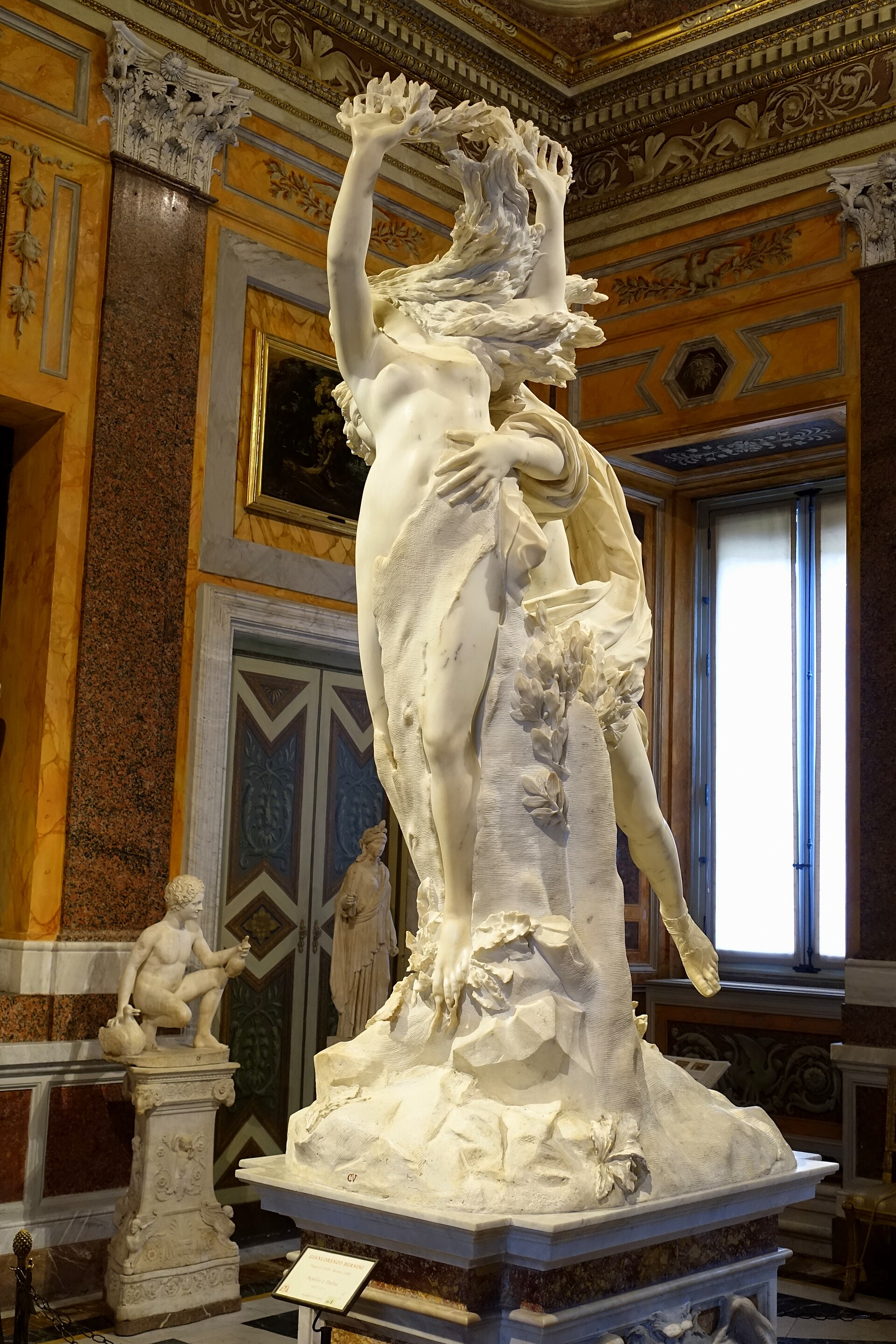
Apollo and Daphne, Carrara marble, 243 cm, for Scipione Borghese; Galleria Borghese inv. CV.2
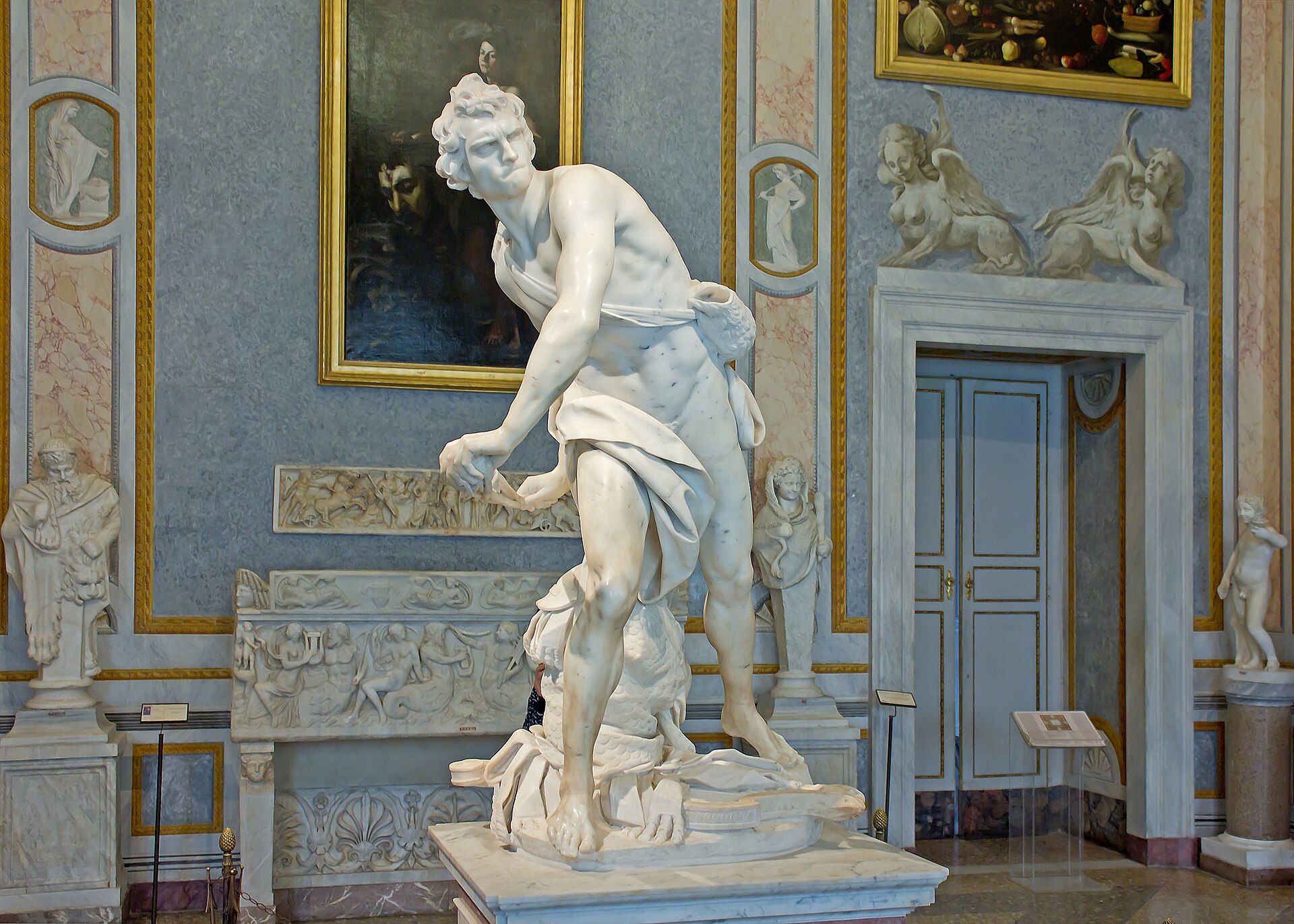
Cardinal Montalto commissions a David in March; Montalto dies in June and Scipione Borghese takes over the commission. Bernini's own face is recognisable in the finished figure.3
Maffeo Barberini is elected Urban VIII in August. Excavation for the Baldacchino foundations begins in June, before the election is a year old and before the basilica is consecrated.119
St Peter's is reconsecrated by Urban VIII on 18 November after a century of building.1
Appointed Architect of St Peter's on the death of Carlo Maderno, over the protest of older and trained architects, having had virtually no architectural training. His father Pietro dies the same year.1
The Baldacchino is gilded; the account headed Oro messo nelli bronzi survives in the archive of the Fabbrica di San Pietro and was published in 2021.6
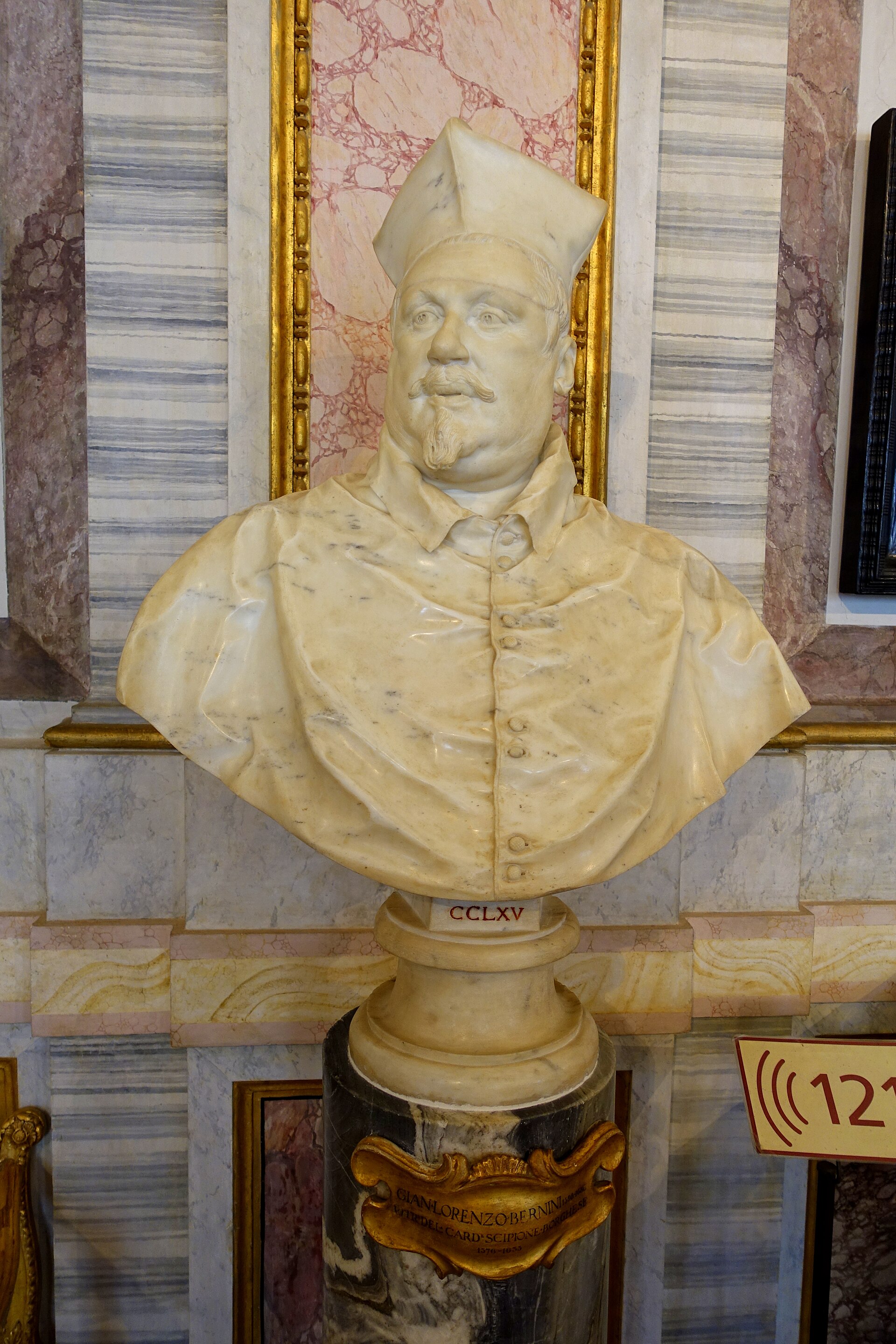
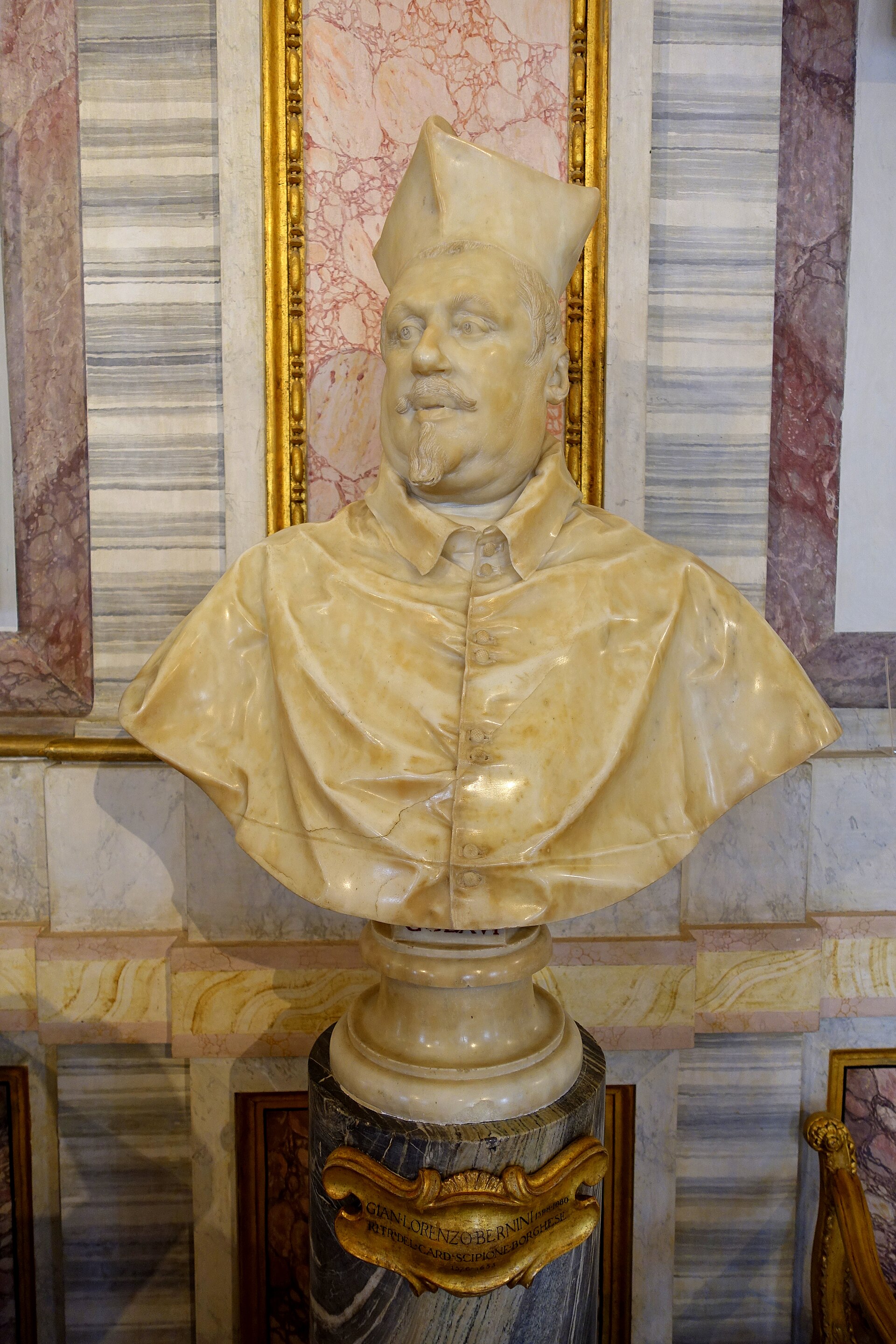
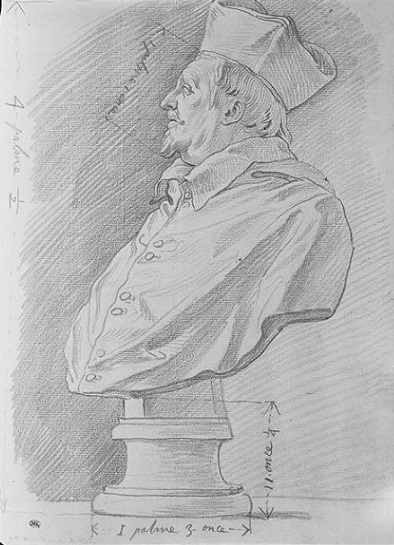
Carves two marble busts of Cardinal Scipione Borghese, the second because a fault opened across the forehead of the first. Both are autograph and both are in the Galleria Borghese.5
The bell towers of St Peter's: commissioned 1636, first tower complete and the facade cracking by 1641, work halted July 1642 when the treasury is drained by the Wars of Castro, both towers demolished on Innocent X's order in February 1646, Bernini fined.1
The affair with Costanza Bonucelli, the attempt on his brother Luigi's life, the slashing of Costanza's face by a servant on his orders, a fine of three thousand scudi remitted by Urban VIII.127
Marries Caterina Tezio in May, aged forty-one, on Urban VIII's orders. Eleven children follow, the youngest being his biographer Domenico. In the same year he buys the property on the Via della Mercede that becomes his house and studio.1
Urban VIII dies. Innocent X Pamphilj succeeds him and Bernini's private commissions dry up for four years, though he keeps every office including Architect of St Peter's.1
Commissioned in the spring to carve two statues for the nave niches of St John Lateran. He never completes them; seven drawings in Leipzig and one clay modello survive.6
Wins the Four Rivers Fountain commission after a model is placed where Innocent X will walk past it. Pasquinades that September demand bread rather than obelisks and fountains, in the middle of a famine.124
The Four Rivers Fountain is unveiled on 12 June 1651. The Cornaro Chapel, with the Ecstasy of Saint Teresa, is completed in 1652 for twelve thousand scudi paid by Cardinal Federico Cornaro.2224
Alexander VII is elected and within days commissions a coffin and a marble skull from Bernini as objects of meditation on death. The skull was identified at Dresden in 2021.6
St Peter's Square and its colonnade. The Cathedra Petri follows, 1657 to 1666, and the Scala Regia, 1663 to 1666.1
Sent to Paris under political pressure. Arrives 3 June, leaves mid-October. Three Louvre designs, all eventually refused; one marble bust of Louis XIV; a cornerstone ceremony in October and a halt to construction as soon as he is gone.125
The Louvre design is formally rejected in favour of the scheme by Le Vau, Le Brun and Claude Perrault. The elephant and obelisk in the Piazza della Minerva, executed by Ercole Ferrata to Bernini's design, is finished the same year.1
Carves the Blessed Ludovica Albertoni for San Francesco a Ripa in six months, aged seventy-five, under Clement X.1
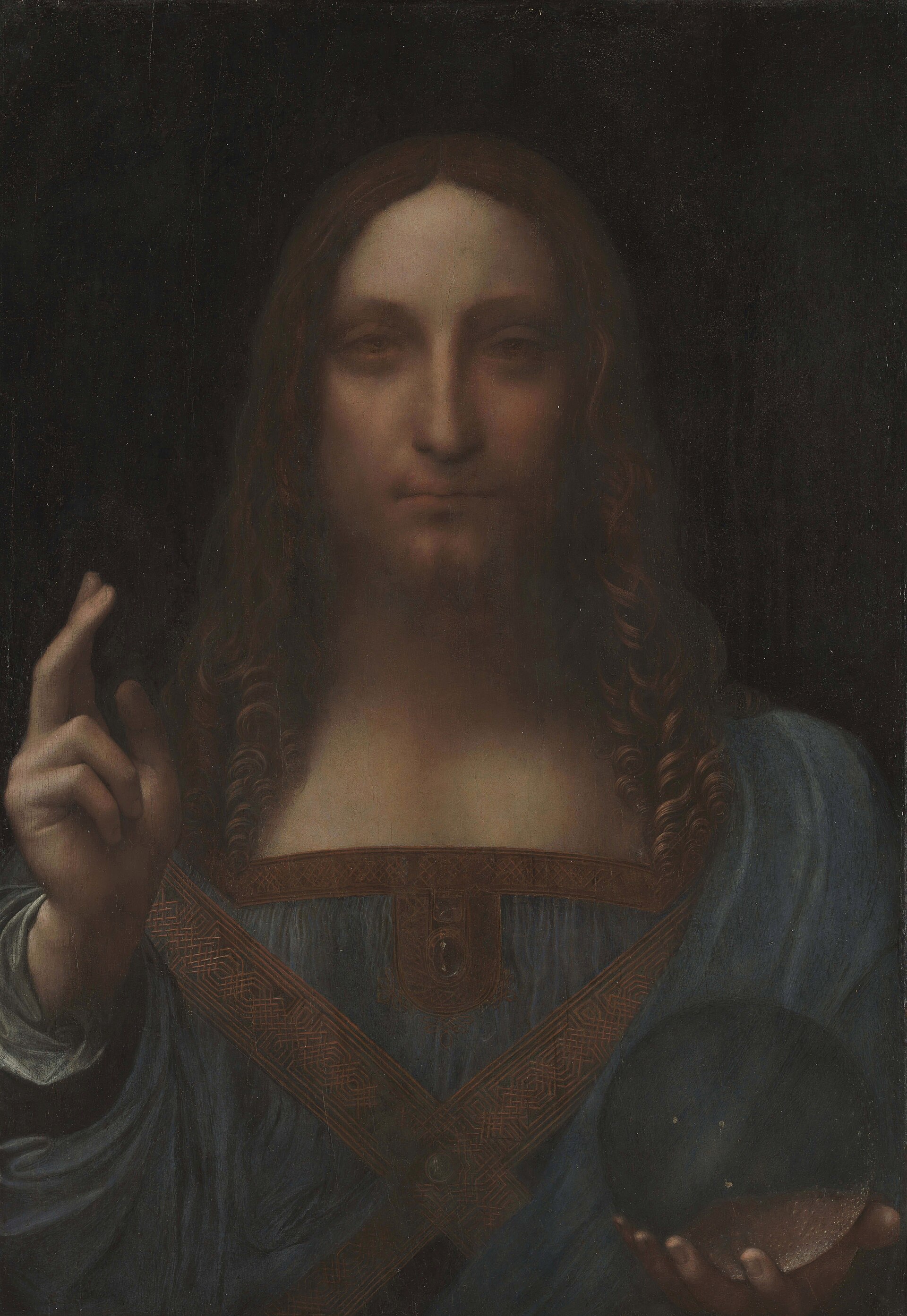
The marble Salvator Mundi, the last work in the sculpture catalogue, left in his will to Queen Christina of Sweden. Which surviving bust it is remains disputed.126
Dies in Rome on 28 November after a stroke, two weeks after stopping work, and is buried without ceremony in the family vault in Santa Maria Maggiore. The planned funerary monument is never built.1
The equestrian Louis XIV is finished four years after his death, reaches Versailles in 1685, is condemned by the king in November 1685 and recut by Girardon's assistants into Marcus Curtius by September 1687.625
Rome commemorates him publicly for the first time, with a plaque and a small bust on the front of his house in the Via della Mercede.1
The Fogg Art Museum buys twenty-seven terracottas from a local collector; fifteen turn out to be associated with Bernini, and become the basis of the modern technical study of his models.10
Rudolf Wittkower publishes Gian Lorenzo Bernini: The Sculptor of the Roman Baroque, updated in 1966 and 1981 and revised by Phaidon in 1997. It is still the spine of the sculpture catalogue.29
Bernini: Sculpting in Clay at the Metropolitan Museum and the Kimbell brings almost all the surviving terracottas together for the first time, confirms attributions and reassigns some.89
The Getty Museum announces the acquisition of the lost Bust of Pope Paul V on 17 June, reportedly for thirty-three million dollars in a private sale arranged by Sotheby's, ten months after it sold in Bratislava for twenty-four thousand euros.1213
The Galleria Borghese exhibition edited by Andrea Bacchi and Anna Coliva puts contested works side by side and moves several attributions, among them the Toronto bronze crucifix and the Goat Amalthea.6
Autumn sets a new auction record for the artist at Sotheby's New York in January; a red chalk academy drawing sets the drawings record at Acteon in Compiegne in March.1516
The Galleria Borghese Catalogo generale, edited by Anna Coliva, removes the Bernini attribution from the Goat Amalthea, held since 1926. Bernardini's two-volume sculpture catalogue appears the same year.629
The Baldacchino is restored for the first comprehensive time in 260 years and unveiled on 27 October, funded by the Knights of Columbus at about seven hundred thousand euros.18
The Rijksmuseum receives on permanent loan the terracotta Triton for the Fontana del Moro, the only Bernini sculpture in the Netherlands.17
Bernini e i Barberini at Palazzo Barberini, 12 February to 14 June, seventy works, for the four hundredth anniversary of the consecration of St Peter's.1920
The market for Bernini is tiny, illiquid and dominated by attribution rather than by condition or provenance. Almost everything he made is immovable, in a Roman church or square or in the Galleria Borghese, or is state property. Sotheby's, offering the 2021 record lot, described it as one of only a handful of sculptures by Bernini and his father remaining in private hands. There is no depth to the market, no cohort of comparables in the sense a collector of nineteenth-century pictures would recognise, and long gaps between events: the auction record stood for nineteen years between 2002 and 2021.
What the record shows is that price here is a function of who has said what in print. The Bust of Pope Paul V failed to sell at an estimate of 47,000 euros in Bratislava in 2013 and was bought at 24,000 euros in September 2014, catalogued after Bernini; ten months later the Getty acquired it for a reported 33 million dollars in a private sale arranged by Sotheby's. The multiple of roughly a thousand measures the value of an attribution and nothing about the object, which did not change. It also shows the reverse risk: Johann Kraftner, director of the Liechtenstein collections, was offered the bust and courteously declined because the provenance was inconclusive, and he was declining a genuine Bernini for exactly the reason a diligent buyer should.
Two structural cautions. First, the two largest numbers attached to Bernini in this century, the 33 million dollars for the Getty bust and the roughly 50 million dollar appraisal reported for the bronze Corpus in Toronto, are both private figures. Neither is a hammer price, neither had a public underbidder, and a private sale arranged by an auction house publishes only what it must. Second, an unattributed Bernini is cheap and a contested one is unsaleable: the Toronto bronze was described as French, late seventeenth century when it failed to reach a 200 dollar asking price at Sotheby's in 1975, and the museums approached before Murray Frum bought it declined it. The difference between those two states is a paragraph in a catalogue.
The drawings are the only part of the market with any regularity, and they behave the same way. A red chalk academy figure consigned at Compiegne in 2021 was estimated at 30,000 to 50,000 euros after being catalogued as Pierre Puget, and hammered at 1.55 million after Patrick de Bayser reattributed it. The previous drawings record was 139,000 euros in 2014.
| Date | Sale | Work | Result | Note |
|---|---|---|---|---|
| 2002 | Sotheby's, London | Il Moro, terracotta bozzetto | Hammer Not separately published in the sources consulted With premium USD 3,200,000 reported as the price USD | The auction record for Bernini for nineteen years. Sotheby's own 2020 press release and ARTnews both give the figure as 3.2 million dollars without separating hammer from premium, and both call it the current auction record. Note that a terracotta model of the Moor is also at the Kimbell Art Museum and a second, the study model, entered the Rijksmuseum on loan in 2025; this record does not establish which object the 2002 lot was. |
| 2006 | Private sale | The Crucified Christ (Corpus), bronze, attributed to Bernini | Hammer Not applicable; no auction took place With premium USD 25,000,000 reported as the purchase price USD | Bought by Murray Frum and given to the Art Gallery of Ontario in 2006, where the appraised value is reported to have risen to about 50 million dollars. Reported by Jonathan Salem-Wiseman, who also reports that no major American museum agreed to buy it. The attribution has since been argued against in print. Figures not independently confirmed. |
| 2014-09 | Auction in Bratislava; house not named in the source consulted | Bust of Pope Paul V, marble, 1621 | Hammer EUR 24,000 With premium Not published in the source consulted EUR | Sold at its pre-sale estimate of 24,000 euros (about 26,500 dollars) to an unnamed Slovak art dealer, catalogued after Bernini. Franco Mormando records that the 1893 Borghese sale had carried it as Algardi and that the 2014 catalogue read after Bernini. Johann Kraftner, director of the Liechtenstein collections, states that he was offered it and courteously declined on provenance grounds. |
| 2015-07 | Private sale arranged by Sotheby's | Bust of Pope Paul V, marble, 1621 | Hammer Not applicable; no auction took place With premium USD 33,000,000 reported as the price paid USD | Acquired by the J. Paul Getty Museum, announced 17 June 2015 and on view from 18 June. The Getty's own release names no price. The 33 million dollar figure is reported by Artnet News and repeated by Mormando. There is no hammer, no published underbidder, and the Artnet report is internally inconsistent, giving 1893 in one sentence and 1917 in another for the Viennese purchase. |
| 28 January 2021 | Sotheby's, New York | Autumn, marble, 1616, by Pietro and Gian Lorenzo Bernini | Hammer USD 7,500,000 With premium USD 8,900,000 with buyer's premium USD | Cover lot of Fearless: The Collection of Hester Diamond, estimate 8 to 12 million dollars. Bidding opened at 7 million and the hammer fell at 7.5 million, below the low estimate; the premium-inclusive total of 8.9 million nonetheless set a new auction record for the artist, beating Il Moro. Carved when Gian Lorenzo was eighteen, for Prince Leone Strozzi. Sold to a telephone bidder with Margi Schwartz, Sotheby's co-head of old master sculpture. The sale as a whole made 26.7 million dollars with 11 of 49 lots unsold. |
| 20 March 2021 | Acteon, Compiegne | Academie d'homme, red chalk drawing, c. 1630-1640 | Hammer EUR 1,550,000 With premium EUR 1,900,000 reported as the total (about 2.3 million dollars) EUR | Record for a Bernini drawing. Estimated at 30,000 to 50,000 euros. Found in a French estate by the auctioneer Philomene Wolf and initially catalogued as Pierre Puget; reattributed after review by the old master specialist Patrick de Bayser. Auctioneer Dominique Le Coent reports the buyer as anonymous and based outside France, and states that only seven other academy drawings by Bernini are known, all in museums. The previous drawings record was 139,000 euros in 2014. |
Hammer is the price at which the bidding stopped; with premium adds the fee the house charges the buyer on top. Hammer price and buyer's premium in the glossary.
| Institution | City | Holdings | Note |
|---|---|---|---|
| Galleria Borghese | Rome | Aeneas, Anchises and Ascanius; the Rape of Proserpina; Apollo and Daphne (inv. CV, Room 3); David (inv. LXXVII, Room 2); the two busts of Cardinal Scipione Borghese (inv. CCLXV and CCLXVI, Room 14); Truth Unveiled by Time; the Bust of Pope Paul V of 1618; two painted self-portraits; the Goat Amalthea, now disputed | The single indispensable visit. Everything here was made for one patron in one house and most of it is still in that house. Timed entry; the collection was purchased by the Italian state in 1902, except the two Scipione busts, which were bought separately in 1892. |
| St Peter's Basilica and the Vatican | Vatican City | The Baldacchino; the Cathedra Petri; St Longinus; the tombs of Urban VIII and Alexander VII; the Chapel of the Blessed Sacrament; the nave decoration; the Scala Regia; the Vision of Constantine; St Peter's Square and its colonnade; terracotta models in the Vatican Museums | Free to enter the basilica. The Baldacchino was restored in 2024 and is visible without scaffolding for the first time since early that year. |
| Santa Maria della Vittoria | Rome | The Cornaro Chapel with the Ecstasy of Saint Teresa, completed 1652 | A working parish church, free, in the left transept. The hidden window above the group is the whole point of the design and is only legible in daylight. |
| Santa Maria del Popolo, Sant'Andrea al Quirinale, Santa Maria sopra Minerva, San Francesco a Ripa, Ponte Sant'Angelo, Piazza Navona, Piazza Barberini | Rome | Daniel and Habakkuk; the oval Jesuit novitiate church he built without fee; the Raggi memorial and the elephant obelisk; the Blessed Ludovica Albertoni; the angels; the Four Rivers Fountain and the Fountain of the Moor; the Triton Fountain | Most of the mature work is outdoors or in churches and costs nothing. Two of the Ponte Sant'Angelo angels carved by Bernini himself are not on the bridge but inside Sant'Andrea delle Fratte. |
| Museo Nazionale del Bargello | Florence | The Bust of Costanza Bonucelli, called Bonarelli, c. 1635 | The most personal object he made and the only one carved for nobody but himself. |
| J. Paul Getty Museum | Los Angeles | Bust of Pope Paul V (1621); Boy with a Dragon (1617, with Pietro Bernini); a bronze after Neptune with Dolphin; two drawings | Free admission, paid parking. The Paul V bust went on view in the East Pavilion on 18 June 2015, the day after the acquisition was announced. |
| Harvard Art Museums | Cambridge, Massachusetts | The largest group of Bernini terracottas anywhere: fifteen associated with him in the 1937 Fogg purchase plus one modello bought in 1995; thirteen on display as of 2024 | This is where the technical method for attributing Bernini was built, in the Straus Center for Conservation. |
| Victoria and Albert Museum | London | Neptune and Triton (1620); the Bust of Thomas Baker (1638); terracottas | Free. |
| Musee du Louvre | Paris | The Bust of Cardinal Richelieu (1640-41); the Christ Child Playing with a Nail relief; drawings | The lead copy of the equestrian Louis XIV in the entrance plaza, placed by I. M. Pei in 1989, is a modern cast and not the statue itself. |
| Palace of Versailles | Versailles | The marble Bust of Louis XIV (1665), the only finished work of the Paris visit; the equestrian statue recut by Girardon's assistants into Marcus Curtius | The equestrian statue has been back inside the Orangerie since 2004 after twenty-four years in storage. |
| Metropolitan Museum of Art | New York | A Faun Teased by Children (1616-17), with Pietro Bernini | |
| The Morgan Library and Museum | New York | Portrait drawings of Scipione Borghese (IV, 176) and Sisinio Poli | The Scipione sheet is the only located preparatory drawing for the 1632 busts. |
| Rijksmuseum | Amsterdam | Terracotta study model of a standing Triton for the Fontana del Moro, 1653, 72 cm, on permanent loan from a private collector since January 2025 | The only Bernini sculpture in the Netherlands. Shown earlier in the 2020 Caravaggio-Bernini exhibition. |
| Kimbell Art Museum | Fort Worth | The more finished terracotta model of the Moor, probably made after the fountain was completed as a gift to the pope | Free permanent collection. Co-organiser of the 2012-13 terracotta exhibition. |
| Art Gallery of Ontario | Toronto | The Bust of Pope Gregory XV (1621); the bronze Corpus given by the Murray Frum family in 2006, whose attribution is disputed | The Corpus is displayed as a Bernini. Readers should know that the attribution has been argued against in print, most pointedly by Anna Coliva after the 2017 Borghese comparison with the Escorial crucifix. |
| Galleria Estense | Modena | The Bust of Francesco I d'Este (1650-51), carved from portraits without the sitter ever posing | |
| National Gallery of Art | Washington | Bust of Francesco Barberini (1626) | Free. Lent to Bernini e i Barberini in 2026 and shown in Italy for the first time in many years. |
| Chrysler Museum of Art | Norfolk, Virginia | A Bust of the Savior | One of the two or three candidates for the marble Bernini left to Queen Christina of Sweden. Francesco Petrucci noted in the 2017 Borghese catalogue that the museum itself then attributed it to a follower. Check the current label before citing it. |
| Staatliche Kunstsammlungen Dresden | Dresden | The marble skull commissioned by Alexander VII in 1655, bought from the Chigi family in 1728 for Augustus the Strong and identified in 2021 | Long displayed at Schloss Pillnitz. Franco Mormando argues the attribution should read Bernini and workshop. |
| National Gallery | London | The Apostles Andrew and Thomas, c. 1625, oil on canvas | Free. The only Bernini painting whose attribution, approximate date and provenance are all securely known. |
There is no single agreed number of works by Bernini, and the honest reason is that the boundary between his hand, his design and his workshop was never a line he had any interest in drawing.
There is no single agreed number of works by Bernini, and the honest reason is that the boundary between his hand, his design and his workshop was never a line he had any interest in drawing. The most recent full catalogue of the sculpture, Maria Grazia Bernardini's Bernini. Catalogo delle sculture, was published by Allemandi in Turin in two volumes in 2022 and reissued in a single volume in 2024. Its own publisher describes it as a catalogue that starts from Rudolf Wittkower's text of 1955 and works forward; the 2024 reissue is advertised as a more inclusive one, which is a plain statement that the boundary of the corpus is an editorial decision that can be taken again.
Four movements in the last two decades give the shape of the problem. The Goat Amalthea with the Infant Jupiter and a Faun in the Galleria Borghese was regarded from 1926 until 2022 as the earliest thing Bernini executed entirely alone; the 2022 Catalogo generale of the Galleria Borghese, edited by Anna Coliva, removes the attribution outright on stylistic, technical and documentary grounds. The marble portrait bust of Antonio Coppola, once given to the son, is now given to the father, Pietro Bernini, and only to him. Going the other way, Steven Ostrow proposed in the Burlington Magazine in July 2016 that a long-ignored portrait on the cenotaph of the canon Giovanni Angelo Frumenti, in the Baptistery of Santa Maria Maggiore, is an autograph work of about 1615 to 1617. And the two small marbles known for three centuries as the Damned Soul and the Blessed Soul were catalogued by their first documented owner as a nymph and a satyr, which is a change not of hand but of subject, and therefore of what the objects were for.
A detail worth recording, because it is the sort of thing a researcher trips over: the Galleria Borghese's own online catalogue entry for the Goat Amalthea, read on 25 August 2026, still heads the work Attributed to Bernini Gian Lorenzo and says only that some critics do not consider it autograph. The printed catalogue of 2022 and the website of the same museum do not say the same thing. Anyone citing the Borghese on this object has to say which Borghese they mean.
Pietro Bernini was a Florentine Mannerist sculptor working in Naples, where Gian Lorenzo was born on 7 December 1598, the sixth of thirteen children by Angelica Galante.
Pietro Bernini was a Florentine Mannerist sculptor working in Naples, where Gian Lorenzo was born on 7 December 1598, the sixth of thirteen children by Angelica Galante. In 1606 Pietro took a papal commission for a marble relief in the Cappella Paolina of Santa Maria Maggiore and moved the whole family to Rome, where his son stayed for the rest of his life apart from five months in Paris and short trips to Civitavecchia, Tivoli and Castelgandolfo.
The training was not a schooling followed by an independent career; it was a joint practice, and several surviving works are by general consent the work of both men. The Autumn sold at Sotheby's in 2021 is catalogued as by Pietro and Gian Lorenzo together, carved in 1616 for Prince Leone Strozzi when the son was eighteen. The first securely documented work of Gian Lorenzo's is a collaboration on his father's contract: in February 1618 Cardinal Maffeo Barberini commissioned four marble putti from Pietro for the family chapel in Sant'Andrea della Valle, and the contract stipulates that the son will assist.
This matters far beyond biography, because the father's presence is a live attribution problem and not a sentimental one. Joachim von Sandrart, writing in 1675 and still cited as an eyewitness, attributed the Aeneas, Anchises and Ascanius entirely and solely to Pietro. Andrea Bacchi's point about that, made in 2009 and quoted by Franco Mormando, is that a source who gives the Aeneas to the father alone cannot have had his information from Gian Lorenzo, who would never have conceded it; and that the same source's authority is what the Goat Amalthea attribution rested on. A single unreliable seventeenth-century sentence held a work in the corpus for ninety-six years.
Scipione Borghese was the reigning pope's nephew, the most powerful private collector in Rome, and Bernini's maker.
Scipione Borghese was the reigning pope's nephew, the most powerful private collector in Rome, and Bernini's maker. Between 1618 and 1625 the sculptor produced for him the four marble groups that are still the reason people queue at the Villa Pinciana: Aeneas, Anchises and Ascanius of 1618 to 1619; the Rape of Proserpina of 1621 to 1622; Apollo and Daphne, Galleria Borghese inventory CV, dated 1622 to 1625, Carrara marble, 243 centimetres high; and the David, inventory LXXVII, 1623 to 1624, 170 centimetres. He was between nineteen and twenty-six.
The museum's own catalogue entry for the David carries two facts that most accounts drop. The commission was not originally Scipione's: Cardinal Montalto had commissioned a David from Bernini for his villa in March 1623, the project was suspended when Montalto died unexpectedly in June, and Scipione took it over. And the figure's face is Bernini's own, as the museum puts it, according to our sources. The self-portrait is not a legend attached later; it is in the institutional record of the object.
The same entry records something a technician notices and a visitor cannot: the back of the David has unfinished areas, because Bernini expected it to stand against a wall of the Seneca Room and calculated that nobody would ever see them. It was moved in the late eighteenth century and the calculation was exposed. All four groups were designed for one dominant viewpoint even though they are carved in the round, and that is the single most useful thing to know when looking at a photograph of one: a plate shot from the wrong side is not a record of the sculpture, it is a record of the back of it.
Two further Borghese jobs are usually left out and should not be. In 1619 the young Bernini was given the restoration and completion of an antiquity, the Sleeping Hermaphroditus, and around 1622 the so-called Ludovisi Ares. Restoring antiques was ordinary studio work and it is also where a young sculptor learned to make new marble read as old marble, which is a skill with obvious consequences for anyone later trying to tell his hand from another's.
The single most productive technical account in print is Michael Cole's essay Bernini Struts, and its argument is that the famous virtuosity is legible as a sequence of practical decisions and...
The single most productive technical account in print is Michael Cole's essay Bernini Struts, and its argument is that the famous virtuosity is legible as a sequence of practical decisions and near-accidents. Anna Coliva's 2002 study of Bernini's executive technique established that the young Bernini accepted the sixteenth-century rule that a virtuoso group had to be monolithic, cut from one block, as Michelangelo, Bandinelli, Giambologna and Ippolito Scalza had done. The Raccolta di statue antiche e moderne of 1704 duly states that the Apollo and Daphne was carved for Cardinal Borghese in un solo marmo.
It was not, quite. Part of Proserpina's hair is inserted into the abduction group. A large section of drapery in the David is a separate piece, and so is the cord of the sling, whose stone is not continuous with the rest of the statue. Cole is careful that we cannot tell whether these were planned or were repairs after the marble snapped under the chisel, and that uncertainty is the honest state of the evidence. In the 1630s, with the colossal figures for the crossing of St Peter's, Bernini abandoned the rule altogether: the St Longinus of 1631 to 1638 was an example of how to hide joins with drapery, and in the chapels stucco is finished to pass for stone.
The diagnostic detail is the strut. To carve a hand with splayed fingers a sculptor drills out the spaces between the digits, hollows with a rasp and a small chisel, and leaves bridges of stone in place to brace the fragile parts while the rest of the statue is worked; the struts come off last, or not at all. In the Apollo and Daphne there is a pentimento in the stone beside Daphne's right ring-finger, a hole where Bernini began drilling before realising the gap needed to open further to one side. Apollo's right hand has broken and repaired fingers. The laurel branches running between Daphne's fingers, whatever else they are, are structurally struts that the carver did not quite dare to cut away.
Research by Coliva, Peter Rockwell and their collaborators found that the Apollo and Daphne depends more heavily on drillwork than any other early Bernini statue. The temptation is to make the drill the signature, and that is exactly the error Cole warns against: Giuliano Finelli's portrait busts show him a great master of the drill, and so do the statues of Pietro Bernini closest in date to his son's first works. Heavy drillwork places a marble in this workshop. It does not name a hand inside it. Jennifer Montagu caused a sensation by arguing that the most famous passages of the Apollo and Daphne were executed by Finelli rather than by Bernini, and the argument has never been closed.
Bernini designed in wet clay, at speed, with his fingers.
Bernini designed in wet clay, at speed, with his fingers. He is reported by Sandrart to have shown him twenty-two wax models, each about twenty-six inches high, all preparatory for the single figure of St Longinus, at a time when a sculptor normally made one or two. Not one wax by Bernini survives. What survives is fired terracotta, and the surviving terracottas are now the primary instrument of attribution for his whole output.
The method was built at Harvard. In 1937 the Fogg Art Museum bought twenty-seven terracottas from a local collector; fifteen of them, with one modello added in 1995, are associated with Bernini, and the conservator Anthony Sigel set out over three years to answer a question he stated flatly: what is it that makes a terracotta a Bernini terracotta, what technically characterises a model from his hand, his idiosyncratic personal sculptural handwriting. The tools were close visual examination and x-radiography. He poured silicone into the grooves to recreate the modelling tools that made them. The habits he isolated are specific enough to be tested against a new object: clay pinched between thumb and index finger at the back of the neck, the thumb pushing around a limb rather than along it, shoulders shaped by pulling the fingers from front to back beside the neck, with the tracks and often a fingerprint left in the mound of displaced clay at the end of the stroke. Complete fingerprints, where they survive, are inventoried.
The 2012 exhibition Bernini: Sculpting in Clay, organised by the Metropolitan Museum of Art and the Kimbell Art Museum, put this to work on almost every surviving model at once and, in the words of one review, applied techniques akin to those of forensic science to confirm attributions and to reassign some models previously believed to be by Bernini. An x-radiograph of the model for the lion of the Four Rivers Fountain showed that near the end of modelling the solid clay animal was cut in two just forward of the rear haunches and a wedge inserted to lengthen the torso by a few centimetres, which is evidence that the design was still moving while the model was being made. The fragmentary model for the Longinus unearthed in 1982 carries the same tooth-marked surface that makes the finished marble sparkle in the changing light of the crossing.
How many survive is contested and the figures should not be averaged. The Metropolitan's 2012 release describes fifteen at Harvard as the largest collection in the world and shows thirty-nine models with thirty drawings; the accompanying catalogue examines fifty-two. Harvard Magazine in 2024 reports thirteen on display as the largest such collection in the world and puts total survival at forty to fifty, against Sigel's estimate that Bernini made thousands. The count depends on where the line is drawn between the master and the assistants, which is the same question the terracottas were being used to settle.
Maffeo Barberini, Bernini's friend and former tutor, was elected pope in August 1623 and Bernini's career became, until Urban's death in 1644, close to a monopoly.
Maffeo Barberini, Bernini's friend and former tutor, was elected pope in August 1623 and Bernini's career became, until Urban's death in 1644, close to a monopoly. He was made curator of the papal art collection, director of the papal foundry at Castel Sant'Angelo and commissioner of the fountains of Piazza Navona, and in 1629, on the death of Carlo Maderno and over the protest of older and trained men, Architect of St Peter's. He had had virtually no architectural training.
The Baldacchino is the work that defined what the position meant. Excavation for the foundations began in June 1623, months after Urban's election and before the basilica was consecrated in November 1626; the canopy was finished in 1633 or 1634 depending on which terminus is counted. Its four helical bronze columns are twenty metres high, the whole structure stands about ninety-two feet, and it cost in the region of two hundred thousand Roman scudi. The helical form quotes the ancient marble columns that the Middle Ages believed Constantine had brought from the Temple in Jerusalem, eight of which still stand in pairs on the piers alongside it, so the canopy is an argument about descent and legitimacy before it is an ornament.
Three things about it are usually left out. First, the design was not entirely his: an early scheme with arches carrying a triumphant Christ proved structurally unworkable, and the volute solution that now supports the globe and cross is credited by the 2026 Palazzo Barberini exhibition to Francesco Borromini, who was then a collaborator and later the enemy. Second, the source of the bronze was a scandal in its own time. It was widely believed to have been stripped from the Pantheon; Urban's accounts state that about ninety per cent of the Pantheon bronze went to make a cannon and that the canopy's metal came from Venice, and the lampoon pinned to the statue of Pasquino, that what the barbarians did not do the Barberini did, has outlived the accounts. Third, the eight Barberini coats of arms on the four plinths run as a sequence in which a woman's face contracts, screams and is finally replaced by the head of a putto; the reading of the sequence as childbirth is not disputed, the explanation of why it is there is, with a symbolic account of the labour of the Church competing with two anecdotes about Barberini pregnancies.
A document published in 2021 by Maria Grazia D'Amelio from the archives of the Fabbrica di San Pietro, headed Oro messo nelli bronzi and dated 1633, records the gilding, and the point made from it is that the gold is not decoration but optics: it was calibrated to the light of the transept so that the spiralling columns would keep changing as the daylight changed. Bernini was designing for a moving light source, in a building, at the scale of a hundred feet.
The Ecstasy of Saint Teresa was made in the years when Bernini had no papal work, and it was paid for by a Venetian cardinal, Federico Cornaro, who had chosen an unremarkable Discalced Carmelite...
The Ecstasy of Saint Teresa was made in the years when Bernini had no papal work, and it was paid for by a Venetian cardinal, Federico Cornaro, who had chosen an unremarkable Discalced Carmelite church for his burial chapel. The ensemble was completed in 1652 at a cost of twelve thousand scudi. Teresa of Avila had been canonised in 1622, twenty-five years before Bernini began, so this is a new saint being installed, not an old cult being decorated.
The subject is taken from a text: Teresa's own account, in her autobiography, of a seraph with a golden spear tipped with fire driven repeatedly into her heart, a pain she describes as so sweet that she did not wish to be rid of it. Bernini follows the text and then supplies everything the text does not specify, including the position of her body, and Franco Mormando's judgement is that no other artist rendering the scene, before or after, dared as much in transforming the saint's appearance. The chapel's machinery is literal: natural light through a window hidden in the dome of the aedicule, gilded stucco rays, more than twenty kinds of coloured marble, and relief portraits of the Cornaro men in what read unmistakably as theatre boxes on either wall, in animated conversation about what is happening in front of them. Wittkower's reading is that the degrees of reality are differentiated on purpose, the Cornaro belonging to our space and the vision isolated in its own. Irving Lavin called the result the unified work of art, and used Bernini's own biographer's term, bel composto, for the method.
The charge of indecency is as old as the work and has never gone away. It has been called astounding and offensive by nineteenth-century critics; Anna Jameson wanted it destroyed; Simon Schama's position is that scholars tie themselves in knots trying to avoid the obvious; the counter-arguments are that Bernini followed Teresa's text, that the Church had long accepted that mystical union carried an erotic charge in its language, and that there is no nudity in the marble. This publication takes no side. What is worth saying is that the dispute is evidence about the object: an image commissioned for a burial chapel, by a cardinal, of a saint canonised in living memory, was already producing this argument in the seventeenth century, which tells you what the Counter-Reformation had licensed art to attempt.
In 1636 Urban VIII ordered Bernini to design and build the two bell towers long intended for the facade of St Peter's, on foundations Maderno had laid decades before.
In 1636 Urban VIII ordered Bernini to design and build the two bell towers long intended for the facade of St Peter's, on foundations Maderno had laid decades before. The first tower was finished in 1641 and cracks appeared in the facade. Work continued, the first storey of the second tower went up, and work stopped in July 1642 only because the papal treasury had been drained by the Wars of Castro. When Urban died in 1644 and the fiercely anti-Barberini Innocent X Pamphilj succeeded him, Bernini's enemies, Borromini among them, raised the alarm over the cracks and put the blame on him. Innocent ordered both towers demolished in February 1646, and Bernini was fined heavily for the failure.
The investigations found that the cause was Maderno's defective foundations, and a further meticulous inquiry in 1680 under Innocent XI confirmed it. By then the demolition was thirty-four years old. His son's account has him retreating into himself and carving the unfinished Truth Unveiled by Time of 1647 as a private statement that time would eventually produce the truth and clear him, which it did.
The received story of four years in the wilderness needs one correction. Innocent kept him in every office he held, including Architect of St Peter's, and the decoration of the nave went on under his direction throughout. In the spring of 1647 he was commissioned to carve two statues, of Saints Luke and Bartholomew, for the nave niches of St John Lateran, a major project involving every eminent sculptor in Rome; he never completed them, for reasons nobody has established, but seven drawings in Leipzig and a clay modello in the Museo di Roma survive from the work. The eclipse was a loss of favour and of private commissions, not an exclusion.
The Four Rivers Fountain is the work that ended the disgrace, and the way he won it is documented as an act of theatre. Innocent X had designs made by the leading architects of Rome and pointedly did not ask Bernini. Baldinucci's account is that Prince Niccolo Ludovisi, whose wife was the pope's niece, persuaded Bernini to make a model and had it installed in a room of the Palazzo Pamphilj that the pope had to walk through; the pope stopped in front of it and said that whoever does not wish to use Bernini's designs must take care not to see them. Wikipedia's account of the same episode credits the manoeuvring to the pope's sister-in-law Donna Olimpia. The two versions are not reconciled in the sources read for this page.
The fountain was unveiled on 12 June 1651 with a festival paid for by the Pamphilj. It carries four river gods for the four continents through which papal authority had spread, the Nile's head veiled because the source of the Nile was not then known, the Rio de la Plata seated on a pile of coins for the silver of the Americas, all of it in awe of an Egyptian obelisk brought to Rome by Caracalla and topped with the Pamphilj dove. It is a diagram of universal jurisdiction, and it was built at public expense during the famine of 1646 to 1648. In September 1648 protesters pinned handwritten invectives to the stone blocks of the obelisk saying that what was wanted was not obelisks and fountains but bread. Innocent had the authors arrested and put spies in plain clothes around the Pasquino statue and the piazza; the street vendors, among them the Roman Jews who had been permitted a Wednesday market for used clothing there, were driven out by the papal police because the pope thought they detracted from the magnificence of the square. The most delightful fountain in Europe has that under it, and a record that leaves it out has not described the object.
The tourist story that one of the river gods shields his eyes from Borromini's facade of Sant'Agnese is false: the fountain was finished years before the church facade was begun. It is worth repeating only because it is the single most repeated sentence about the work.
Under Fabio Chigi, elected as Alexander VII in 1655, Bernini became the principal instrument of a deliberate programme to remake Rome as a capital.
Under Fabio Chigi, elected as Alexander VII in 1655, Bernini became the principal instrument of a deliberate programme to remake Rome as a capital. The colonnade of St Peter's Square, built between 1656 and 1667, took an irregular open space and gave it two semicircular arms of plain Doric columns four rows deep, producing an arena in which a crowd could see the pope on the basilica loggia or at the palace window and carriages could still move. Inside, the Cathedra Petri in the apse, finished between 1657 and 1666, answered the Baldacchino down the length of the nave and resolved a liturgical problem that had been open for decades, the high altar of a Latin cross church sitting in the crossing rather than the chancel: the view down the nave now compresses the tomb of the first pope, his chair and his living successor into one image. The Scala Regia, 1663 to 1666, joined two irregular buildings across an even more irregular space by optical trickery.
Not everything was colossal. He built the small oval church of Sant'Andrea al Quirinale for the Jesuit novitiate entirely without fee, and it is the one work his son records him as being genuinely pleased with. The elephant carrying an obelisk in the Piazza della Minerva, commissioned in 1665, was executed by his pupil Ercole Ferrata to his design and finished in 1667; Bernini had seen two live elephants in Rome, in 1630 and 1655, and it shows. Alexander's own summary of the relationship, that if everything made by the Cavalier Bernini were removed from St Peter's the temple would be stripped bare, is the fairest thing anyone said about the scale of the intervention.
One small commission is a good measure of how the studio actually worked. Within days of his election Alexander ordered from Bernini a coffin and a marble skull to keep in his private rooms as objects of meditation on death. Both disappeared for centuries; the skull was identified in 2021 at Dresden, where it had been since 1728, bought from the Chigi family for Augustus the Strong. The Dresden curator's argument was that a commission taken three days into a pontificate by an artist who had fallen out of favour would have been made by his own hand. Mormando's rebuttal is that Alexander was favourable to Bernini from the start, that Bernini was desperately busy, and that the correct attribution is Bernini and workshop, because for small items the pope was buying a guarantee of quality from a general contractor and both parties knew it. Which of them is right is not settled; that the argument exists over a single skull is the point.
He did not want to go. At the end of April 1665 he was sent to Paris under pressure from both the French court and his own pope, to complete the east front of the Louvre for Louis XIV.
He did not want to go. At the end of April 1665 he was sent to Paris under pressure from both the French court and his own pope, to complete the east front of the Louvre for Louis XIV. He arrived on 3 June and stayed until mid-October. Louis assigned Paul Freart de Chantelou to him as companion and translator, and Chantelou's journal of the visit is the closest thing we have to a daily record of Bernini talking; Charles Perrault, then assistant to the controller-general Colbert, left a rival first-hand account.
He submitted three designs for the facade. The first, with curved wings in the Italian manner, was rejected almost at once. The second was rejected too and no image of it appears to survive. The third was praised by the king, who held a formal ceremony to lay the cornerstone in October 1665, and construction was stopped as soon as Bernini left the country; the rejection was not made formal until 1667. The story told in most books, that the designs were refused as too Italianate or too Baroque, is one Mormando has challenged directly: aesthetics are not mentioned in any of the surviving memoranda from Colbert or the court's advisers, and the explicit objections were practical, including the security of the building and the location of the latrines.
Leibniz, resident in Paris in the 1670s, wrote down Perrault's version of events, and it is the most useful hostile account we have. In it, Colbert asks the nuncio to write to Bernini and sends him the existing plan; Bernini replies not with a completion but with an entirely new building, and pleads that he cannot judge the Louvre without seeing it; he is brought over at great expense, receives great gifts and costs the treasury fifty thousand ecus; his plan is full of gross errors and would have required the existing Louvre to be razed; the Perrault brothers write a memorandum listing the errors, Colbert questions Bernini's deputy Mattia de' Rossi, and on hearing the confirmation says only: enough. Leibniz also records that Bernini despised everything he was shown in France, which the French sources say too.
The trip produced one finished object, the marble Bust of Louis XIV now at Versailles. According to Perrault it was Bernini who proposed the bust as soon as he arrived, and Perrault is the only source for that; a letter of 22 June 1665 has Perrault telling Colbert that Bernini was finding every excuse not to make a full-length statue of the king. Most of the sketching was done at Saint-Germain-en-Laye. He had brought his chief assistant in sculpture, Giulio Cartari, with him, which suggests he had come prepared to carve. The unbuilt Louvre design nevertheless circulated across Europe in engravings, and its direct influence is visible at Chatsworth.
Back in Rome, Bernini made a colossal equestrian statue of Louis XIV, cut from a single block said by his early biographers to be the largest ever seen in the city.
Back in Rome, Bernini made a colossal equestrian statue of Louis XIV, cut from a single block said by his early biographers to be the largest ever seen in the city. It was completed in 1684, four years after his death, shipped from Civitavecchia that autumn, and reached Paris in March 1685. Alexandre Maral's catalogue of Francois Girardon reconstructs what happened next almost month by month.
A rumour that it would stand near the Pont-Royal died with the king's displeasure. In August 1685 it went to Versailles and into the Orangerie. On 14 November Louis saw it and resolved to have it destroyed; Philippe de Courcillon recorded the decision. In December his closest ministers proposed removing the head and substituting a suitable one instead. In December 1686 Louvois ordered a plaster cast of the king's head so that a replacement could be modelled and tested by Girardon. What was actually done, by Girardon's assistants rather than by Girardon, was smaller and cleverer: a helmet was added to the existing head rather than the head replaced, the king's long hair became the crest of that helmet, and the rocks and military standards below the horse were recut into flames. The statue became Marcus Curtius riding into the chasm, a subject that suited the horse's contorted posture better than a portrait of a reigning monarch did. Nicodemus Tessin the Younger saw the transformed statue in September 1687 and remarked that the great reputation of Bernini had in some way been shipwrecked towards the end of his days. Girardon was paid in January 1688. Maral's verdict is that, asked to make Bernini's work tolerable, Girardon achieved it with the smallest intervention possible.
The statue was moved to the piece d'eau des Suisses in 1702, where the pool stood in for the abyss, put in storage in 1980, and returned to the Orangerie in 2004, where it is today. Two footnotes. The papal nuncio Angelo Ranuzzi, writing to Rome on 17 December 1685, reported that the statue had met with universal disapproval, and the reason the subject was still live in December is that Bernini's eldest son had been pressing the papal Secretary of State to get Louis to pay the pensions promised to his father; Ranuzzi's advice was that this was not the moment. And in 1989 I. M. Pei placed a faithful lead copy of the equestrian Louis XIV as the sole ornament of his new entrance plaza at the Louvre, so the rejected statue is now the only sculpture in front of the building it failed to be given.
In the late 1630s Bernini was involved with Costanza, the wife of his workshop assistant Matteo Bonucelli, and carved her portrait, now in the Bargello in Florence: probably the first marble portrait...
In the late 1630s Bernini was involved with Costanza, the wife of his workshop assistant Matteo Bonucelli, and carved her portrait, now in the Bargello in Florence: probably the first marble portrait of a woman who was not an aristocrat by a major artist in European history, and made for himself rather than for a patron. Sarah McPhee's archival work established that her married name was legally Bonucelli and not Bonarelli, the form under which she has been catalogued for centuries, and that she generally used her maiden name, Piccolomini.
When he discovered that his younger brother Luigi, his right hand in the studio, was also involved with her, he chased Luigi through the streets and into Santa Maria Maggiore and came close to killing him, and he sent a servant to Costanza's house to slash her face with a razor. The servant was jailed. Costanza was jailed for adultery. Bernini was fined three thousand scudi for attempted homicide against his brother and the fine was remitted by Urban VIII, who then ordered him to marry; in May 1639, aged forty-one, he married the twenty-two-year-old Caterina Tezio, by whom he had eleven children, the youngest being his biographer Domenico. Luigi brought a second scandal on the family in 1670 by raping a young workshop assistant on the site of the Constantine memorial in St Peter's. This is documented, it is in the standard literature, and it belongs on the page because the anti-hagiographic scholarship of the last fifteen years exists precisely because the early biographies suppress it.
The devotion is documented too, and it is not decoration. Judith Hook's account records that his favourite books were the Imitation of Christ of Thomas a Kempis and the Spiritual Exercises of Ignatius Loyola, that for the last forty years of his life he went to church daily and communicated twice a week, and that he was an intimate friend of the Jesuit general Gian Paolo Oliva, for the second volume of whose Prediche he designed the frontispiece. A devotional account published by the Jesuit press adds that he made the Spiritual Exercises repeatedly, carried a copy with him and heard Mass daily at the Gesu; that source is tertiary and the specifics should be checked against Domenico and Baldinucci before being relied on. It was through Bernini that his protege Giovanni Battista Gaulli got the vault of the Gesu, the Jesuit mother church, to fresco. The last work Bernardini's catalogue admits is the marble Salvator Mundi of 1679, which he kept and left in his will to Queen Christina of Sweden; Baldinucci reports that he thought of it as his most beloved child.
What is not supported is the reduction of the man to an instrument of papal doctrine. That is how the three dominant scholars of the previous generation, Wittkower, Hibbard and Lavin, can be read; Tomaso Montanari's La liberta di Bernini of 2016 and Mormando's biography of 2011 argue the opposite, that he kept a real distance from the mindset and the mores of Counter-Reformation Rome. Evonne Levy's assessment is that Montanari's achievement was to expose how much the early biographies suppressed, including his conflicts with patrons and his avowed limitations in painting and architecture.
Bernini died on 28 November 1680 after a stroke, having worked until a fortnight before the end, and was buried with almost no ceremony in the plain family vault in Santa Maria Maggiore beside his...
Bernini died on 28 November 1680 after a stroke, having worked until a fortnight before the end, and was buried with almost no ceremony in the plain family vault in Santa Maria Maggiore beside his parents. A funerary monument had been planned and was never built. Rome put nothing public up to him until 1898, when a plaque and a small bust were fixed to the front of his house on the Via della Mercede on the anniversary of his birth. Two hundred and eighteen years is a long time for a city he had substantially designed.
The reason is that the eighteenth century decided against him deliberately. Colen Campbell opened Vitruvius Britannicus in 1715 by naming Bernini and Borromini as proof that Italian building had degraded after Palladio. Johann Joachim Winckelmann, the man most responsible for the discipline of art history, held that Bernini had been corrupted by flattering the coarse and uncultivated in order to make everything more intelligible to them. Francesco Milizia, Joshua Reynolds and Jacob Burckhardt all disparaged him in print. Augustus Hare's Walks in Rome, which went through twenty-two editions between 1871 and 1925 and told the English-speaking world what to look at, described the angels of the Ponte Sant'Angelo as Bernini's breezy maniacs. Most popular guides of the period simply left him out.
Recovery began with Stanislao Fraschetti's monograph of 1900 and was consolidated by Rudolf Wittkower's Gian Lorenzo Bernini: The Sculptor of the Roman Baroque of 1955, updated in 1966 and 1981 and revised again by Phaidon in 1997. Wittkower's is still the reference point in a literal sense: the 2022 and 2024 Bernardini catalogue is built out from his text rather than replacing it. Evonne Levy's survey of the field since the 1980s, published in the 2017 Galleria Borghese exhibition catalogue edited by Andrea Bacchi and Anna Coliva, is titled after Wittkower's old oak branches, which is the honest description of where the discipline stands.
The 2017 to 2018 exhibition at the Galleria Borghese matters more than most shows because of what it physically did: it put objects beside each other. Setting the Escorial bronze crucifix next to the one in Toronto is what convinced Coliva and others that the Toronto attribution was weak. Setting the two Salvator Mundi busts face to face produced the same effect in reverse. Attribution in this field is still done by looking, and by looking at two things at once, which is why the shows change the catalogue and the catalogue does not change without the shows.
The Baldacchino was restored for the first comprehensive time in 260 years between February and October 2024.
The Baldacchino was restored for the first comprehensive time in 260 years between February and October 2024. The work was carried out by the Vatican Museums' restorers, ten to twelve of them, funded entirely by the Knights of Columbus at a cost of about seven hundred thousand euros, and unveiled on 27 October 2024 in time for the jubilee year. The head of the artistic and archaeological patrimony of St Peter's, Pietro Zander, gave the diagnosis: the whole surface carried a dark coating, and the deterioration is caused in part by the visitors themselves, up to fifty thousand a day, whose presence changes the microclimate of the basilica and drives the corrosion of the metal, the oxidation of the iron supports and the movement of the wooden parts. A conservation plan for the whole basilica is being built on the study of that microclimate.
In January 2025 the Rijksmuseum announced that it had received on permanent loan from a private collector the terracotta study model of a standing Triton for the Fontana del Moro, seventy-two centimetres high, made in 1653 and the only Bernini sculpture in the Netherlands. Its history is instructive: it stayed for centuries with the descendants of Cardinal Flavio Chigi, was hidden under a thick layer of dark paint that masked its quality, and was only recognised after the overpaint was removed in a 2018 restoration. The museum's view is that it is in all probability the modello fatto da me, the model made by myself, listed in Bernini's own invoice for the fountain in 1655; the marble was carved by his assistant Giovanni Antonio Mari. A second, more finished version of the same figure is at the Kimbell Art Museum in Fort Worth.
From 12 February to 14 June 2026 the Gallerie Nazionali di Arte Antica showed Bernini e i Barberini at Palazzo Barberini, curated by Andrea Bacchi and Maurizia Cicconi, more than seventy works, timed to the four hundredth anniversary of the consecration of St Peter's in 1626 and mounted under the patronage of the Fabbrica di San Pietro. Among the objects shown was a medal found the previous year inside the sarcophagus of Urban VIII's tomb, bearing the pope on one face and the canopy on the other, which the evidence suggests had been worn on a cord round somebody's neck before being placed in the tomb. The curator's own caution about it is the model for how this material should be handled: it is tempting to imagine Bernini left it there, and that goes beyond what the documentation can prove.
Sculptor; Architect; Urban planner; Painter; Draughtsman; Designer of fountains and tomb monuments; Theatre designer and playwright. 1598-1680.
Born 7 December 1598, Naples, then capital of the Spanish Viceroyalty of Naples; died 28 November 1680, Rome, at his house on the Via della Mercede.
The exposure on Bernini is misattribution, not forgery. No systematic forgery industry in Bernini comparable to the trade-label violin or the fake Old Master picture has been found in the sources read for this page. The recurring loss is different in kind: works that are genuinely from the workshop but not from his hand, works given to him on the authority of a single unreliable seventeenth-century sentence, and works by him that were sold as copies.
Galleria Borghese (Rome); St Peter's Basilica and the Vatican (Vatican City); Santa Maria della Vittoria (Rome); Santa Maria del Popolo, Sant'Andrea al Quirinale, Santa Maria sopra Minerva, San Francesco a Ripa, Ponte Sant'Angelo, Piazza Navona, Piazza Barberini (Rome); Museo Nazionale del Bargello (Florence); J. Paul Getty Museum (Los Angeles).
The market for Bernini is tiny, illiquid and dominated by attribution rather than by condition or provenance. Almost everything he made is immovable, in a Roman church or square or in the Galleria Borghese, or is state property.
How many sculptures are actually his? No two authorities give the same figure, the standard catalogue was reissued in 2024 as a more inclusive edition, and the boundary between autograph, designed-and-part-executed, designed-only and workshop is drawn differently by every scholar who draws it.
When the same object returns to a saleroom the price series looks like an index of the object.
8 min read
The British Museum catalogues the Qianlong Emperor as an inscriber of the Admonitions Scroll.
10 min read
Fifty-six of the 220 published records in this archive carry an exhibition history.
9 min read
The Metropolitan's own record gives one of its helmets as 11 1/4 inches and 85 centimetres in the same line.
9 min read
Six objects in this archive were offered at auction and not sold. An unsold lot is a price nobody paid and a date the object went...
10 min read
Last verified 17 September 2026
One artwork and its story every Tuesday, with the picture: who owned it, what it made, and what closes soon in the exhibition calendar. No promotion, and nothing we cannot cite.
We send one email to confirm the address and keep nothing else. Every letter carries a one-click unsubscribe. How we handle your data.