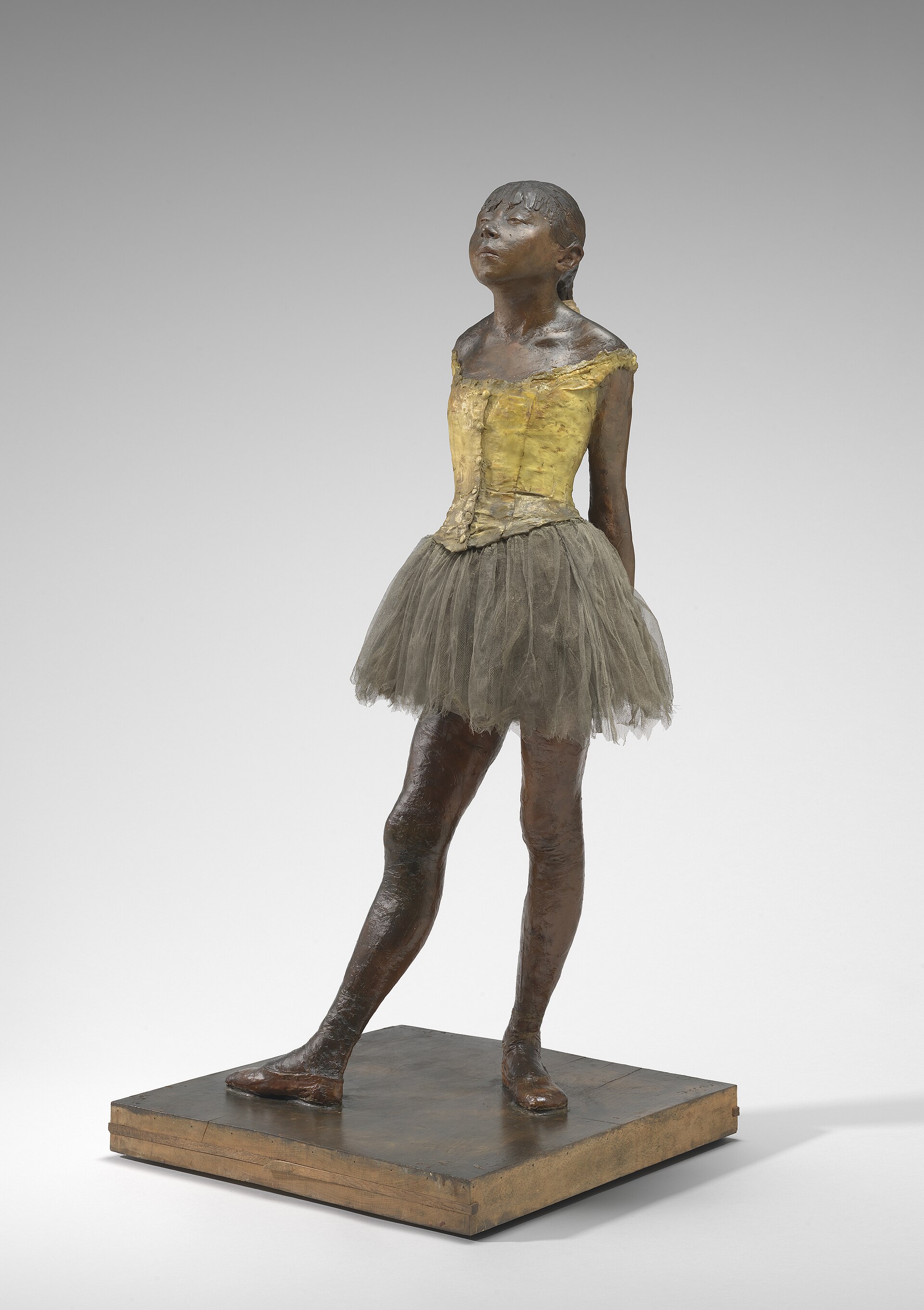
Little Dancer Aged Fourteen
1878-1881 · Pigmented beeswax
National Gallery of Art
Museum · Founded 1937
Open, admission and hours confirmed 31 August 2026 · 24 sources
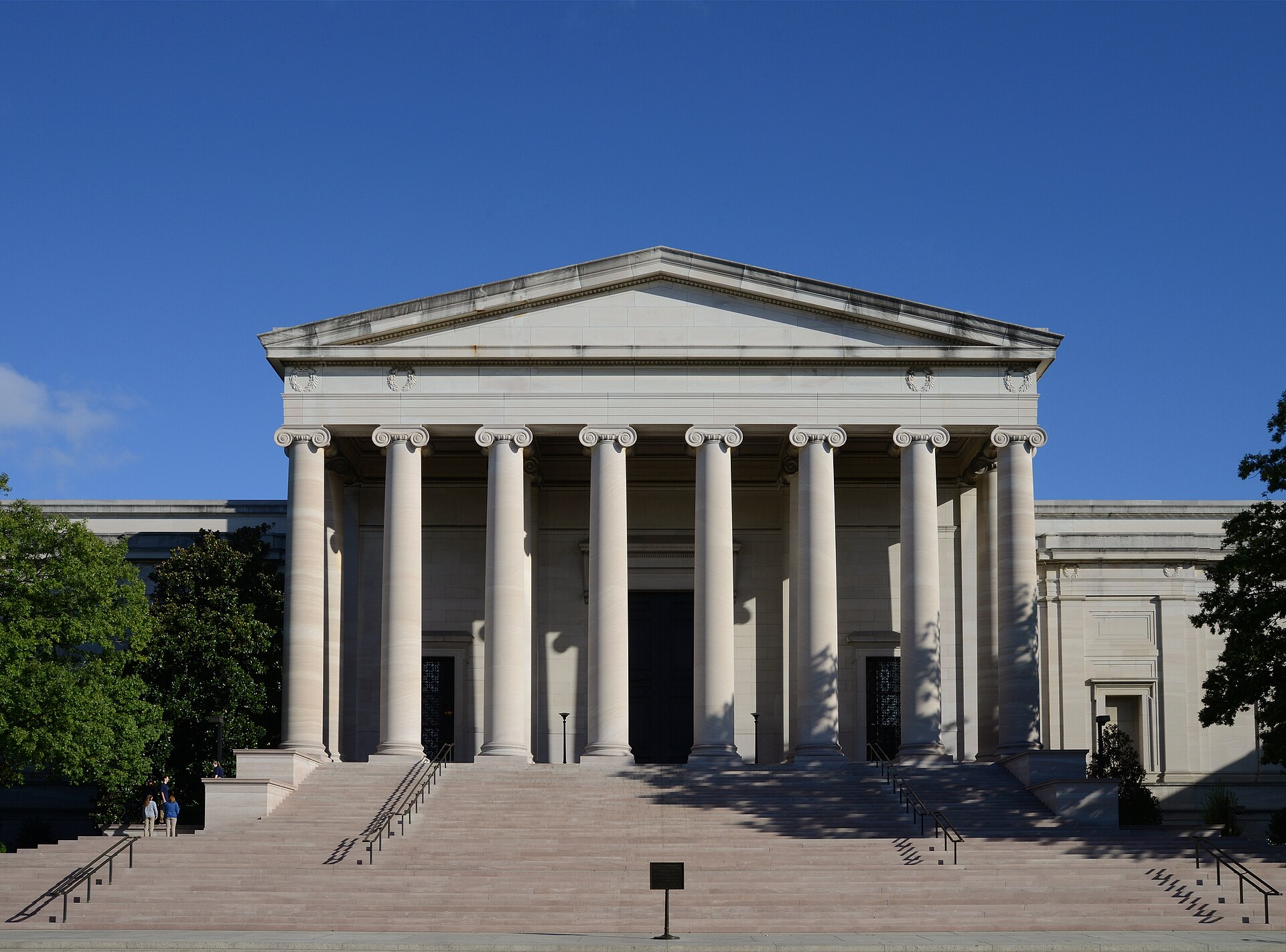
More than 160,000 works spanning the history of Western art from the classical world to the present, split across two buildings that do not overlap in period: the West Building's 11th- to early-20th-century collection against the East Building's modern and contemporary holdings. The Gallery's own count gives it the only Leonardo on public view in the Americas, one of the largest collections of Vermeer, one of the largest Impressionist collections outside Europe, the largest public collection of Mark Rothko's work anywhere (1,001 pieces, for which it is the primary study center), a major Modigliani holding, and what it states is the world's largest collection of Alexander Calder, including the largest mobile he ever made. None of it was bought or built by the institution itself in the ordinary sense: every part of it arrived as a gift, from Mellon's founding 1937 collection through the Kress, Widener, Rosenwald, Dale and Mellon family donations to, most recently, the 2023 gift of 175 works from the collection of Larry D. and Brenda A. Thompson, the largest single gift of work by Black artists it has received.
| Kind | Museum |
|---|---|
| Founded | 1937, chartered by a joint resolution of Congress and the Mellon gift; the West Building opened to the public 17 March 1941 |
| City and country |  Washington, D.C., United States Washington, D.C., United States |
| Address | Sixth Street and Constitution Avenue NW, Washington, DC 20565 (West Building entrance) |
| Website | nga.gov |
| Status | Open, confirmed 31 August 2026 |
| Record last verified | 7 August 2026 |
Prices and hours change. We take them from the institution's own pages and print the day we read them, and you can check the current position at the source we used. Confirm before you travel.
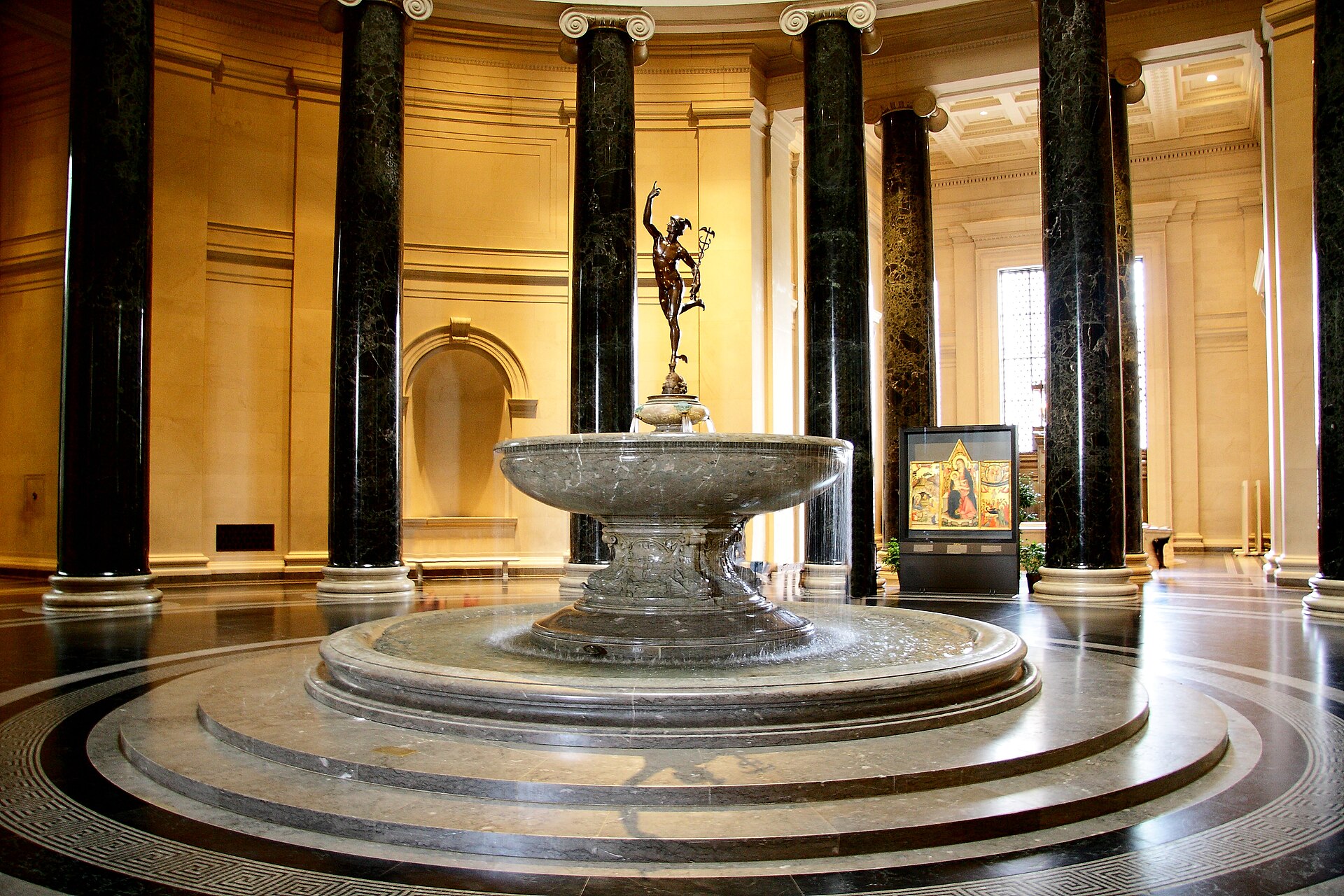
The original building, entered from 6th Street and Constitution Avenue NW, holds the collection from the 11th to the early 20th century: Italian, Netherlandish, Spanish, French and British painting, the Gallery's American art, and the sculpture and decorative arts that go with them. The domed Rotunda at its center, modeled on the interior of the Pantheon in Rome, is ringed with black marble Ionic columns and centered on a fountain topped by a bronze copy of Giambologna's Mercury, part of the original Mellon gift. The exterior is Tennessee pink marble; Pope specified skylights across almost the whole three-acre roof to light the picture galleries from above.
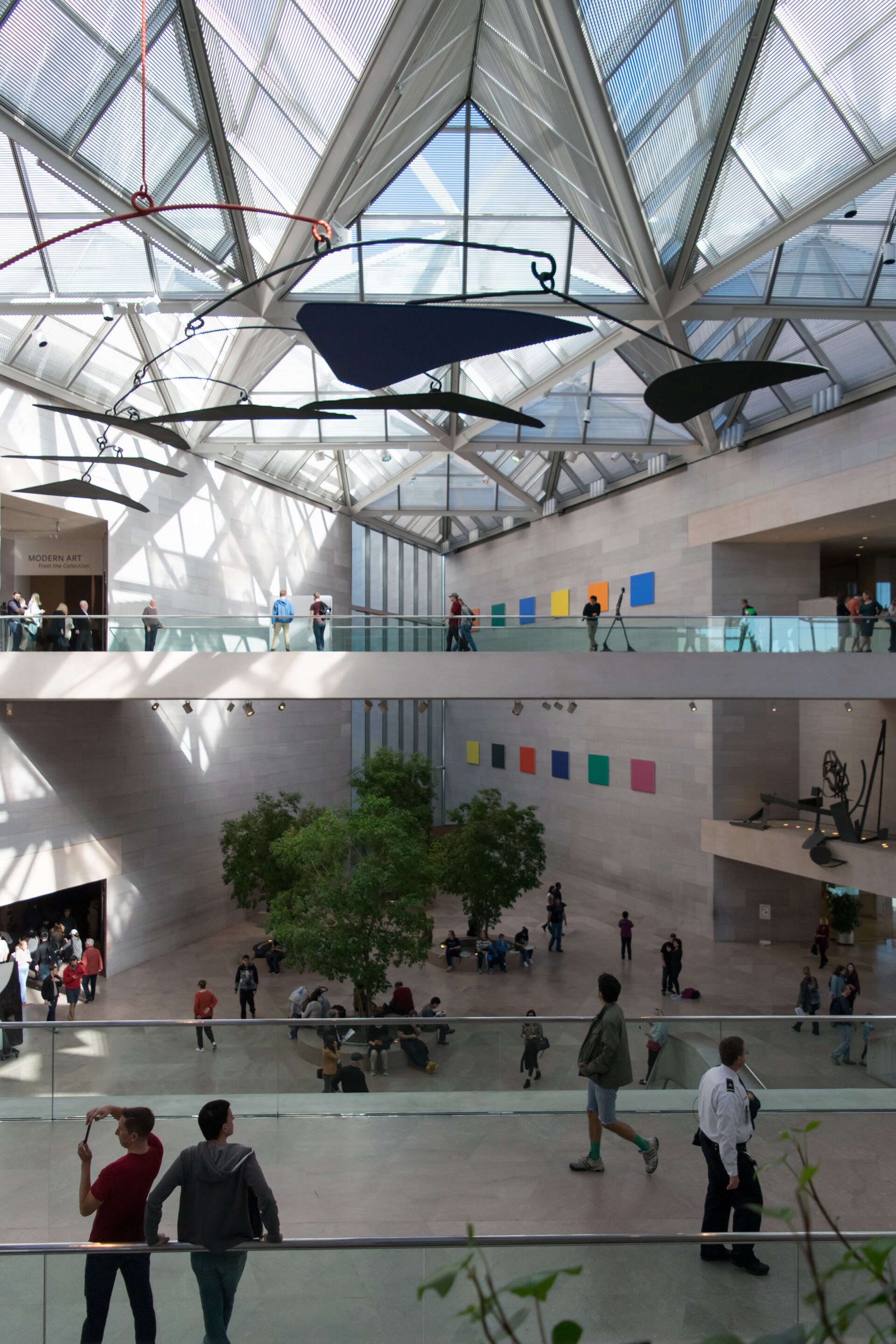
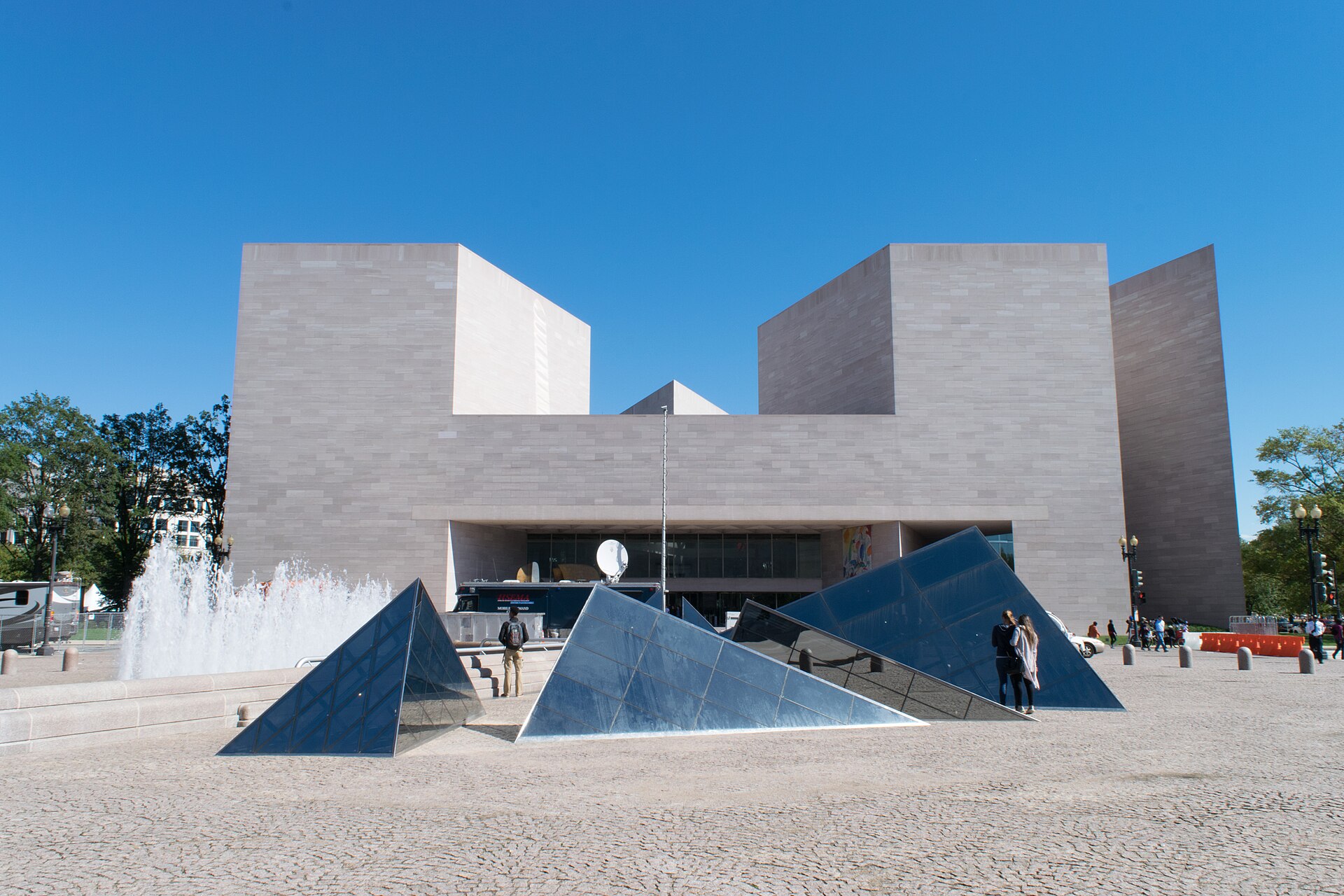
Built on a trapezoidal site between Pennsylvania Avenue and the Mall, on land Andrew Mellon had asked Congress to reserve for future expansion, the East Building holds the Gallery's modern and contemporary art. Pei split the plan into two triangles, one for galleries and one for the Center for Advanced Study in the Visual Arts and the library, and clad both in the same Tennessee pink marble as the West Building so the two would read as one campus. Alexander Calder's largest mobile, commissioned for the opening, still turns on air currents alone over the skylit Atrium; a Tower level added later carries a roof terrace looking back across the Mall.
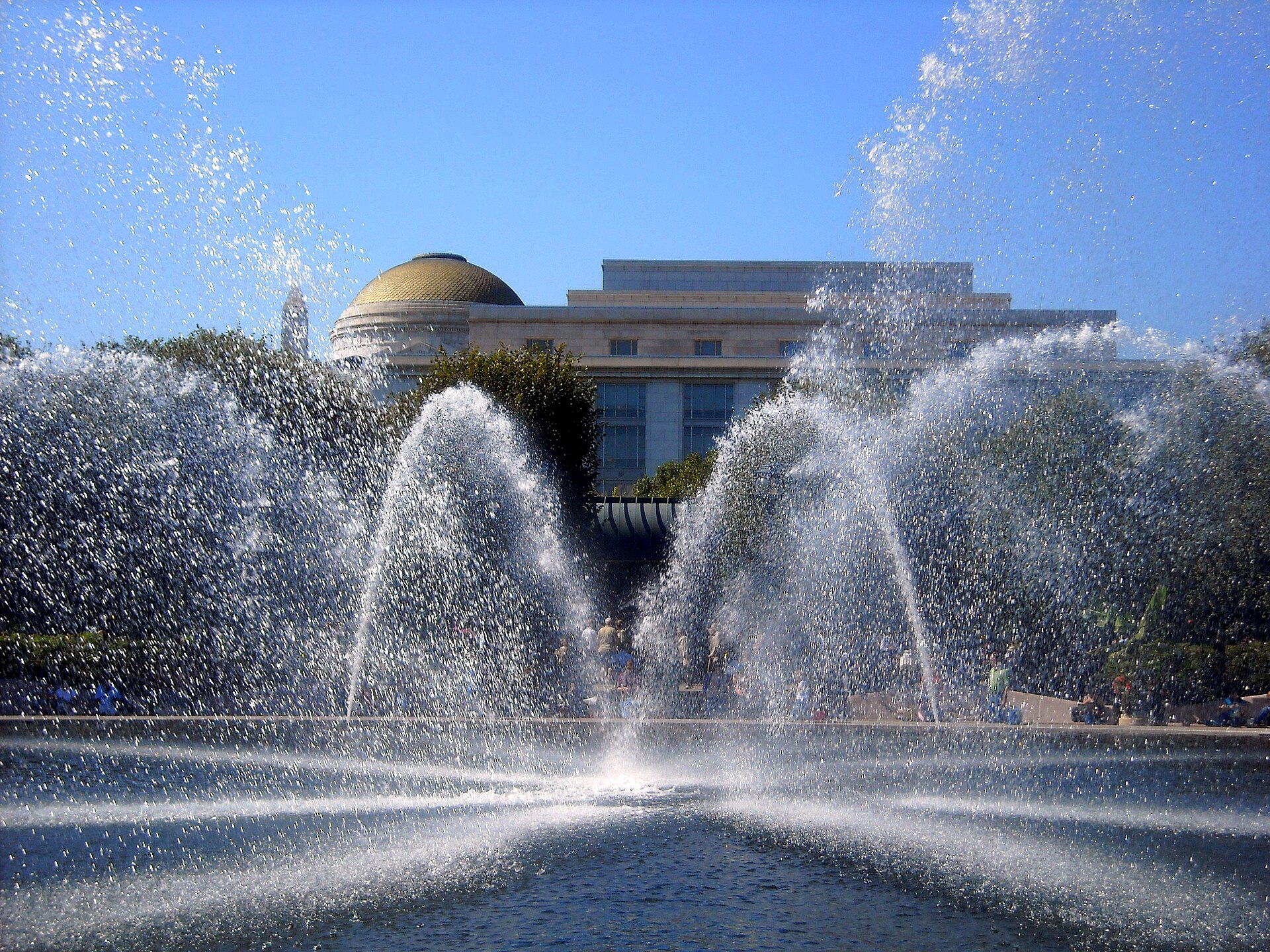
A six-acre plot between 7th and 9th Streets NW, immediately west of the West Building. Pierre L'Enfant had called for a public garden on part of this ground in his 1790s plan for the capital; the National Park Service controlled it until a 1966 agreement began the transfer to the Gallery, completed in 1991. Landscape architect Laurie Olin redesigned it around the Park Service's existing circular pool, which still doubles as a winter ice rink, and it opened on 19 May 1999 as a gift of the Morris and Gwendolyn Cafritz Foundation. It now holds more than twenty 20th- and 21st-century sculptures by artists including Louise Bourgeois, Claes Oldenburg and Coosje van Bruggen, and Barry Flanagan, with the Pavilion Cafe at its center.
An underground link, added with the East Building in 1978 and still the only way to move between the two buildings without going back outside. It carries the Cascade Cafe, two shops, and the moving walkway lit by Leo Villareal's Multiverse, thousands of programmed LEDs sweeping across the ceiling and walls of the passage.
Housed in the East Building since 1978, the Center is the Gallery's research institute, hosting roughly fifty visiting fellows a year from predoctoral students to senior professors and running about twenty-five public scholarly programs annually. The Library beside it holds more than 500,000 volumes and 16 million study images, publicly accessible rather than restricted to staff, and includes the auction-catalogue holdings the Gallery's own provenance researchers work from.
The only sculpture Degas ever exhibited publicly, and the only cast of it he made with his own hands; the bronzes seen in museums worldwide were cast from other wax figures after his death. On view West Building Ground Floor, Gallery G3.6
Full record in this archiveOne of Durer's three Meisterstiche and the subject of more scholarship than probably any other print in the Gallery's holdings. This particular sheet passed through the Paris collector Jean-Francois Gigoux before Lessing Rosenwald bought it in 1928 and gave it to the Gallery in 1943. As of this research it is recorded not on view; works on paper in the Rosenwald Collection are shown in rotation rather than permanently, so check current display before a visit made specifically to see it.7
Full record in this archiveThe only painting by Leonardo on public view anywhere in the Americas, and one of only three surviving portraits of women by his hand. Main Floor, Gallery 6.8
Part of the founding 1937 Andrew W. Mellon gift and one of twenty-one paintings Mellon bought from the Hermitage in Leningrad in 1930-1931, when the Soviet government sold major paintings abroad for hard currency. Main Floor, Gallery 39.4
Commemorates Colonel Robert Gould Shaw and the men of the 54th Massachusetts, one of the first Civil War regiments of Black soldiers raised in the North; the Gallery's own materials call it the greatest American sculpture of the 19th century. Main Floor, Gallery 66.8
A portrait of Emily Sims Motley, the artist's grandmother, born enslaved in Louisiana and painted here at eighty; hangs a few rooms from Saint-Gaudens's memorial to soldiers of her own generation's fight. Main Floor, Gallery 66.8
Commissioned for the East Building's opening and hung over the Atrium ever since; the Gallery holds the world's largest public collection of Calder's work, and this is the largest mobile he ever made. East Building, Atrium.9
Made by pouring and flinging paint over a canvas laid on the studio floor; Pollock's own handprints are visible near the top edge. East Building, Upper Level, Gallery 407.8
A 14-foot ultramarine rooster on the East Building's Tower roof terrace, which the artist has described as a deliberately playful jab at male vanity, set against a skyline of monuments built mostly to men.8
Bourgeois said the spider recalled her mother, a weaver and tapestry restorer; Sculpture Garden, Northwest Quadrant.8
1878-1881 · Pigmented beeswax
National Gallery of Art
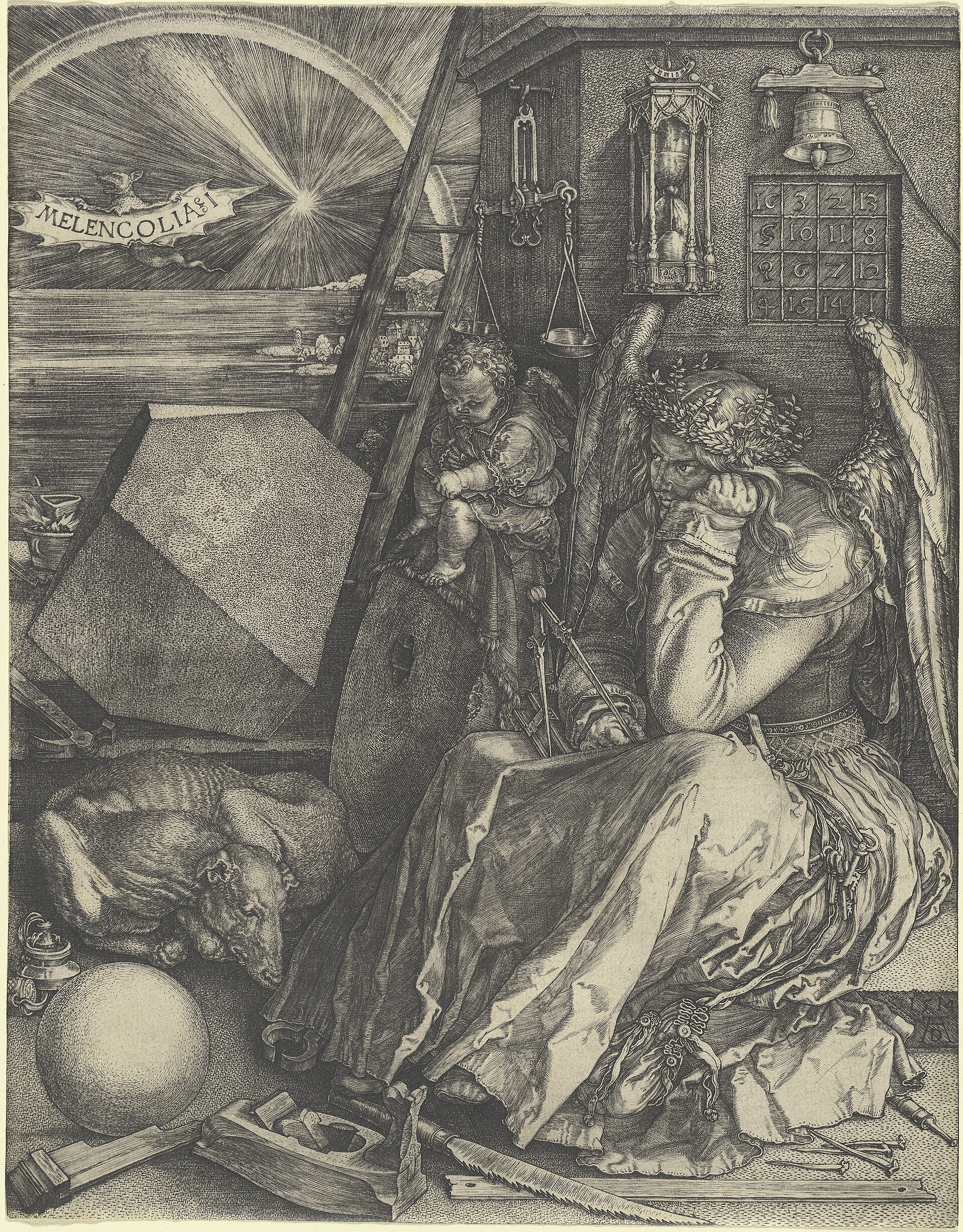
1514 · Engraving on laid paper
National Gallery of Art, Washington, D.C
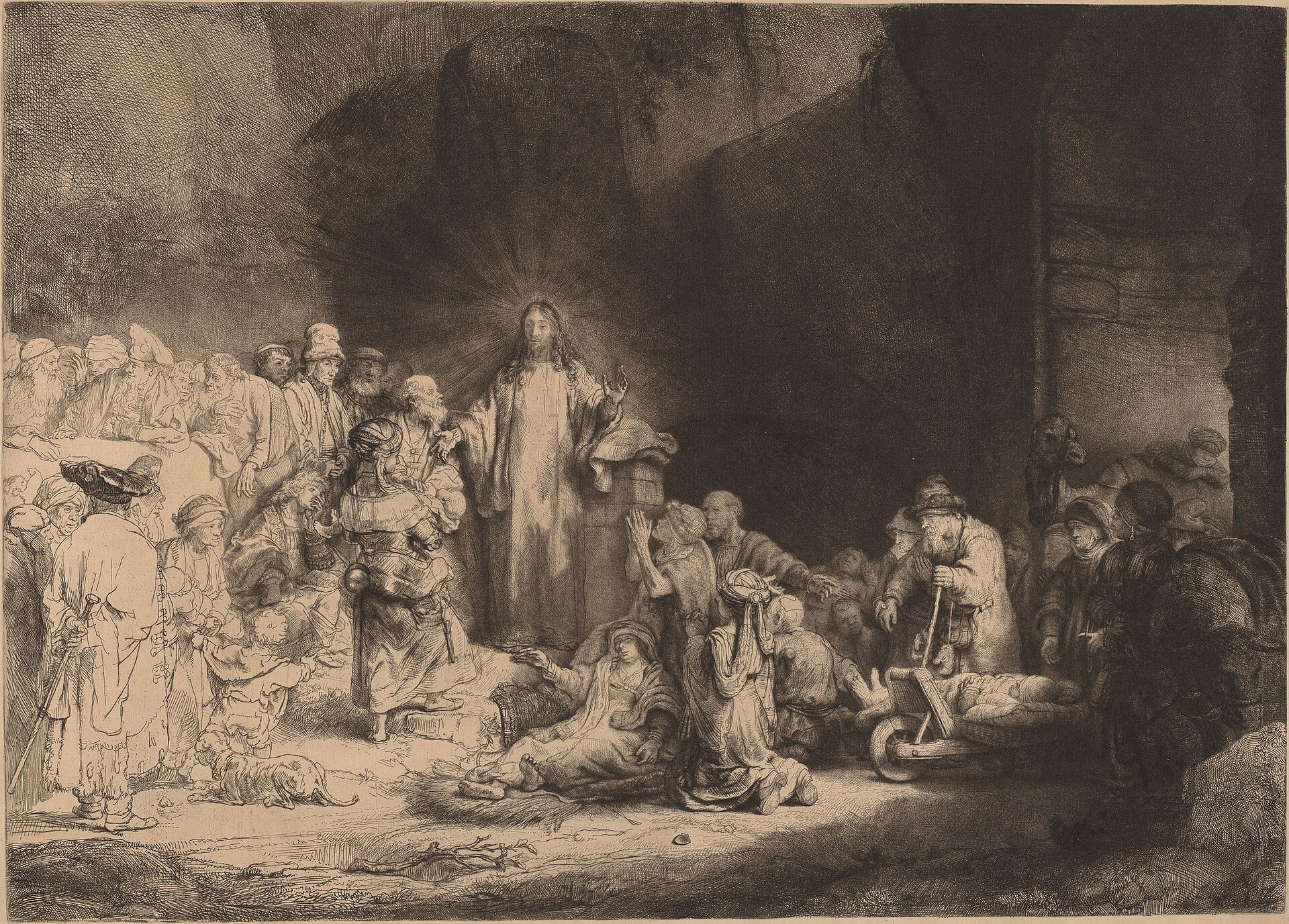
c. 1647-1649 · Etching
National Gallery of Art, Washington, D.C
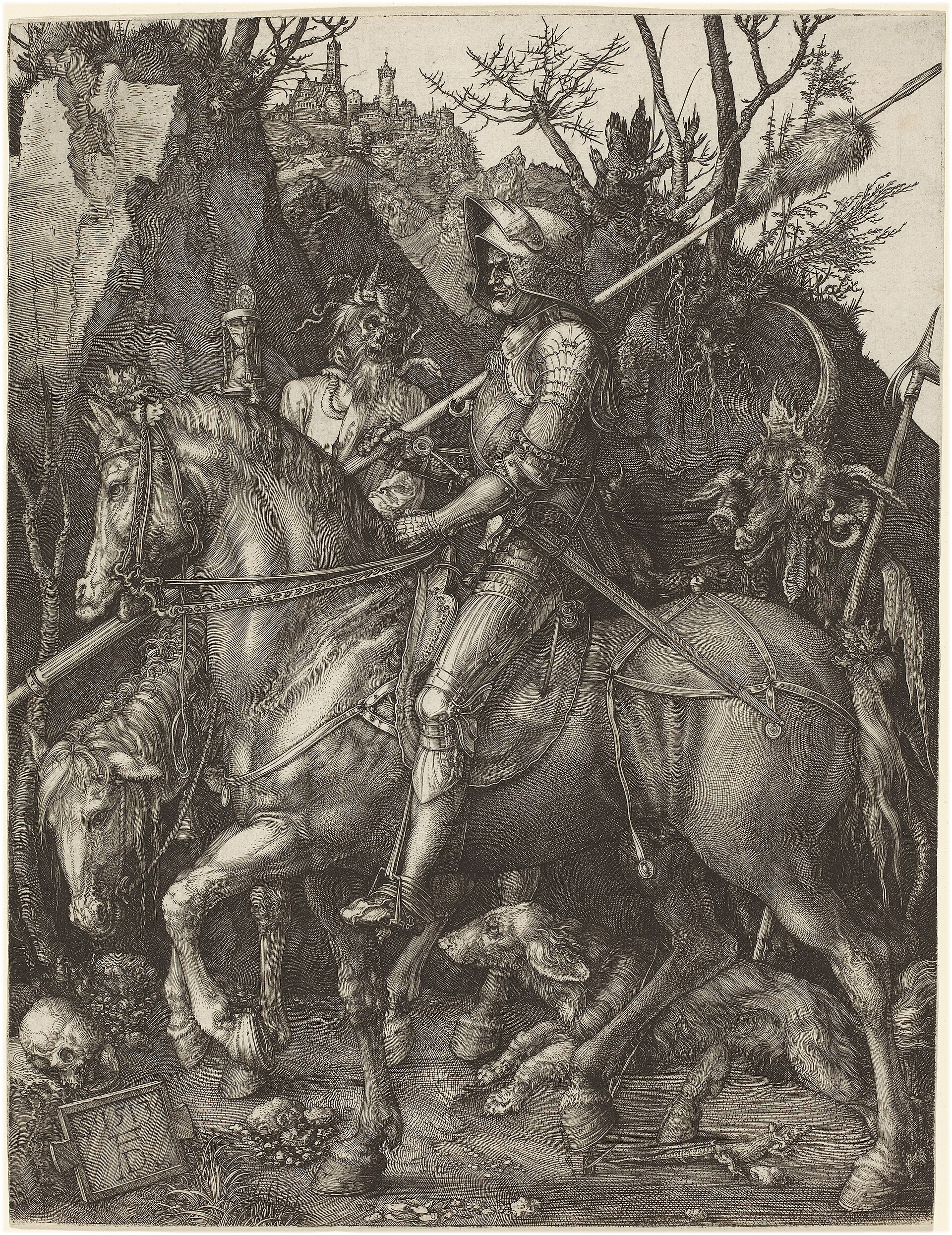
1513 · Engraving on laid paper
National Gallery of Art, Washington, D.C
The National Gallery of Art exists because a single donor made Congress a specific offer. Andrew W. Mellon, a financier who served as secretary of the Treasury under four presidents from 1921 to 1932, wrote to President Franklin D. Roosevelt in 1936 proposing to give his own collection of paintings and sculpture, and to pay for a new museum building to house it, on federal land in Washington. Roosevelt endorsed the offer and Congress accepted it in 1937 by joint resolution. Mellon chose the American architect John Russell Pope to design the building, in the same neoclassical idiom Pope had already used nearby for the National Archives and the Thomas Jefferson Memorial: Tennessee pink marble on the outside, and skylights across virtually the whole three-acre roof to light the picture galleries from above. Mellon and Pope both died within a day of each other in August 1937, shortly after excavation began, but the building went up to their plans and was dedicated on 17 March 1941, with Paul Mellon presenting his father's gift to Roosevelt on the Gallery's behalf.
Mellon's nucleus gift was 126 paintings and 26 sculptures, and he insisted the museum not carry his name, wanting it understood as a national institution that would need other donors to fill its galleries. It has been called a collection of collections ever since: Samuel H. Kress, Rush Kress, P. A. B. and Joseph Widener, Lessing J. Rosenwald, Chester Dale, Ailsa Mellon Bruce and Paul Mellon all added to it as founding benefactors, and the collection has grown past 160,000 works since, across paintings, sculpture, prints, drawings, decorative arts and photographs.
A significant part of Mellon's own founding gift did not come from a settled old family collection. Between 1930 and 1931, with the Soviet government selling major paintings abroad to raise hard currency, Mellon bought twenty-one important works out of the State Hermitage Museum in Leningrad. Jan van Eyck's Annunciation and Raphael's Saint George and the Dragon were both part of that purchase, and both entered the Gallery's collection with Mellon's 1937 gift; the Gallery's own published provenance pages for the two works record the Hermitage as a prior owner directly, rather than treating it as background. The Gallery's provenance department currently records twenty-seven works in its collection that passed through the State Hermitage Museum at some point in their history, a formal count kept and published on the Gallery's own site rather than left to outside historians to reconstruct. It is not a fact the Gallery hides: the sale sits inside its own published provenance record for the Van Eyck and the Raphael, cited here directly rather than through a secondary account.
Mellon had asked Congress to set aside an adjacent plot for future growth when the Gallery was first established, and by its 25th anniversary in 1966 the original building's galleries were full. In 1967 Paul Mellon and his sister Ailsa Mellon Bruce funded a second building, and the Gallery chose I. M. Pei to design it on the trapezoidal site between Pennsylvania Avenue and the Mall. Pei split the plan into two triangles, one for galleries and one for a library and a new research institute, the Center for Advanced Study in the Visual Arts, and clad the whole thing in the same Tennessee pink marble as the West Building so the two buildings would read as one campus rather than two eras competing. President Jimmy Carter dedicated the East Building on 1 June 1978 alongside Paul Mellon. A newly formed Collectors Committee began commissioning site-specific modern work for it immediately, starting with Alexander Calder's mobile for the Atrium and a sculpture from Henry Moore, and the committee has made annual gifts of modern art to the Gallery every year since.
The Sculpture Garden came later still, and on land with an older claim on it: Pierre L'Enfant had called for a public garden on part of this ground in his 1790s plan for the capital. The National Park Service held the site until a 1966 agreement began handing it to the Gallery, a transfer completed only in 1991. Landscape architect Laurie Olin redesigned it around the Park Service's existing circular pool, which still becomes an ice rink each winter, and First Lady Hillary Rodham Clinton dedicated the finished garden, a gift of the Morris and Gwendolyn Cafritz Foundation, on 19 May 1999.
Every account of the Gallery's free admission repeats the fact without explaining why it cannot simply change. It is not a policy the trustees set and could revise. House Joint Resolution 217, approved by Congress on 24 March 1937 to authorize the Gallery's construction, states in section 4(a) that the Gallery shall be properly maintained and its collection exhibited to the public free of charge; the Senate added that clause specifically to stop a future Gallery from charging admission. A trust indenture signed three months later by the Mellon trust, the Smithsonian Institution and the Gallery repeated the same free-of-charge obligation as a formal condition of the gift. The United States General Accounting Office confirmed in a 1999 letter to Congress that ending free admission would require both an act of Congress amending the joint resolution and the agreement of the Gallery's trustees and the Smithsonian's regents to alter the indenture, not a decision the Gallery could make alone even if it wanted to.
The Gallery's governance reflects the same federal character. Its board is chaired by a private citizen, but it carries four ex officio trustees who sit by virtue of their federal office: the Chief Justice of the United States, the Secretary of State, the Secretary of the Treasury and the Secretary of the Smithsonian Institution. That federal identity is not only ceremonial. In its most recent congressional budget request the Gallery sought more than 215 million dollars in federal funds, and when Congress failed to pass a budget on 1 October 2025 the Gallery closed its doors, first drawing down reserve funds and then shutting entirely, for 40 days, only reopening the West Building and Sculpture Garden on 14 November 2025 and the full campus the following day, after the longest government shutdown in US history ended. A survey exhibition of 175 works from the collection of Larry D. and Brenda A. Thompson, the largest single gift of work by Black artists the Gallery has ever received, closed on the shutdown's first day and never reopened to visitors for a final look. Free admission and this vulnerability are the same fact, seen from two sides.
The Gallery states plainly, on its own provenance pages, that it has paid particular attention to the ownership of works during the World War II era and describes itself as an early leader among American museums in doing so. That research has produced at least one voluntary restitution: in November 2000 the Gallery announced it would return Still Life with Fruit and Game by the Flemish painter Frans Snyders to the heirs of a Paris family whose collection had been confiscated when the Nazis occupied the city, a fact the Gallery's own curator of records confirmed directly to NPR at the time. Not every question the same research has raised is settled. In February 2023 the Art Newspaper reported that two Old Master drawings connected to Siegfried Laemmle, a Munich Jewish dealer forced by Nazi racial law to close his gallery in 1935, remained under review at the Gallery; at the time of that reporting the Gallery's head of provenance said the works were being looked into, and the dealer's heir said the Gallery had not yet been in direct contact with the family. This publication has not independently re-confirmed the status of that claim since 2023 and states only what was reported then.
Nor is the collection itself untouched by the country around it. On 27 April 2023 two climate protesters smeared red and black paint across the case protecting Little Dancer Aged Fourteen, having researched the sculpture in advance and specifically targeted it. The Gallery removed the sculpture from public view for ten days to assess and repair the case, at a cost its own officials put at more than 4,000 dollars; one of the two protesters, Joanna Smith, was sentenced in April 2024 to 60 days in prison, two years of supervised release and restitution, and barred from every museum and monument in Washington for two years. The Gallery's own conservators have said the vibration from the attack put long-term stress on a sculpture already a century past its expected working life.
Both objects this archive already holds a record for are confirmed at the National Gallery of Art, not at any of the other institutions that share part of its name. Little Dancer Aged Fourteen is the original wax, accession 1999.80.28, bequeathed by Paul Mellon in 1999 and on view now in the West Building, Ground Floor, Gallery G3; a separate painted plaster cast from the same Hebrard foundry, accession 1985.64.62, is a different object in the same collection and should not be confused with it. This engraving impression of Durer's Melencolia I, Rosenwald Collection, accession 1943.3.3523, is recorded on the Gallery's own object page, checked for this report, as not currently on view. The Rosenwald print and drawing gift runs into the tens of thousands of sheets, and works on paper of this age and fragility are shown in rotation rather than kept permanently on the wall, so a visitor who wants specifically to see this impression should check the Gallery's current display before travelling for it rather than assume it is hanging.
The Gallery has also made its own photography of its public-domain holdings freely available: under an open access policy stated on its own terms and notices page, digital images of works it believes to be in the public domain are released under a Creative Commons Zero waiver, downloadable directly from the object pages without seeking permission. That includes its own photography of both objects recorded here. It bears directly on an archive built from cited, rights-clear photography: it is one further reason the National Gallery of Art is, on the evidence gathered for this page, an unusually well-documented institution to build a record against.
We publish no visitor review prose and no aggregate score beyond the single cited platform below. Read against several hundred recent visitor accounts, what recurs is the free admission itself, treated as remarkable precisely because it is rare among the world's most visited museums; the contrast between the two buildings, the domed 19th-century Rotunda against Pei's skylit modern Atrium; and Ginevra de' Benci as the single work most visitors are directed toward on arrival. Complaints cluster around wayfinding at the East Building's south, Mall-facing entrance, which several visitors found unclear for strollers and wheelchairs, and around the tone of the security screening at the entrances, which more than one recent account described as heavier-handed than the collection or the free admission would suggest.
Tripadvisor: 4.8 from 10,042 ratings, read 7 August 2026
A platform average is a tertiary source: it moves, it is not audited, and we quote no visitor's words.
Sixth Street and Constitution Avenue NW, Washington, DC 20565 (West Building entrance).
General admission: West Building, East Building, Sculpture Garden, special exhibitions and public programs: free. As confirmed 31 August 2026.
Daily, all year (West Building, East Building, Sculpture Garden) 10:00-17:00; Wednesday-Saturday (Sculpture Garden only, seasonal) 10:00-20:00. Closed: 25 December and 1 January. The entire campus was closed for 40 days, 5 October to 14-15 November 2025, during the lapse in federal appropriations that shut the US government; the Gallery is federally funded and cannot guarantee it will not happen again in a future funding lapse. As confirmed 31 August 2026.
Metro: Archives-Navy Memorial-Penn Quarter station, a six-minute walk to the West Building; Bus: Metrobuses stop along Constitution Avenue NW; Car: No public parking garage on the campus. A limited number of spaces are set aside for vehicles bearing disability parking permits or tags, on the 4th Street Plaza outside the East Building.
Little Dancer Aged Fourteen (Edgar Degas, 1878-1881 (the original wax; accession 1999.80.28)); Melencolia I (Albrecht Durer, 1514 engraving (this impression, Rosenwald Collection, accession 1943.3.3523)); Ginevra de' Benci (Leonardo da Vinci, c. 1474/1478); The Annunciation (Jan van Eyck, c. 1434/1436); The Shaw 54th Regiment Memorial (Augustus Saint-Gaudens, patinated plaster, 1900, after the bronze monument dedicated in Boston in 1897); Portrait of My Grandmother (Archibald John Motley Jr., 1922).
1 record in this archive names National Gallery of Art as the current location.
One artwork and its story every Tuesday, with the picture: who owned it, what it made, and what closes soon in the exhibition calendar. No promotion, and nothing we cannot cite.
We send one email to confirm the address and keep nothing else. Every letter carries a one-click unsubscribe. How we handle your data.