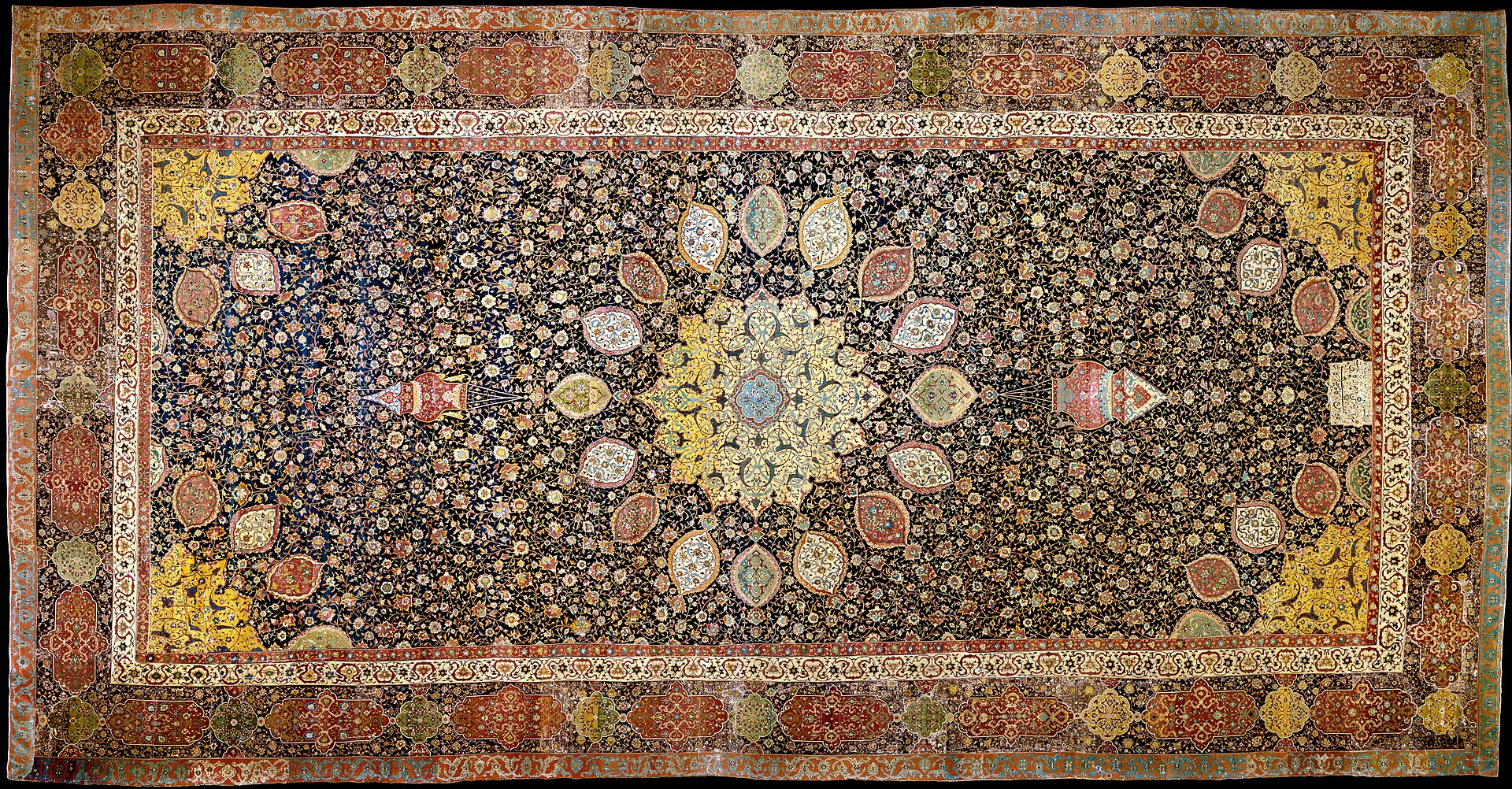
The Ardabil Carpet
Dated AH 946, equivalent to 1539-40 · Wool knotted pile on a silk warp and weft...
Victoria and Albert Museum, London, Room 42, the Jameel Gallery
Museum · Founded 1852
Open, admission and hours confirmed 4 September 2026 · 10 sources
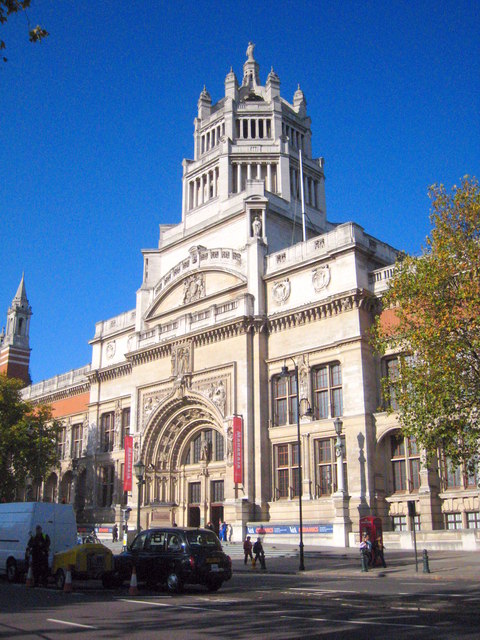
The V&A's core strength is breadth across the decorative and applied arts rather than depth in any single fine-art school: it is generally regarded as the world's leading museum of design, fashion, and decorative art, with holdings in textiles, ceramics, glass, furniture, metalwork and jewellery that few institutions anywhere attempt to match in range. Its Asian and Islamic collections, its theatre and performance archive, and its architecture and photography holdings are similarly considered among the strongest of their kind outside specialist institutions, and its Renaissance sculpture holding - anchored by the Cast Courts reproductions as much as by originals - is described by the museum itself as the largest collection of post-classical sculpture in the world.
| Kind | Museum |
|---|---|
| Founded | 1852 |
| City and country |  London, United Kingdom London, United Kingdom |
| Address | Cromwell Road, South Kensington, London SW7 2RL, United Kingdom |
| Website | vam.ac.uk |
| Status | Open, confirmed 4 September 2026 |
| Record last verified | 8 August 2026 |
Prices and hours change. We take them from the institution's own pages and print the day we read them, and you can check the current position at the source we used. Confirm before you travel.
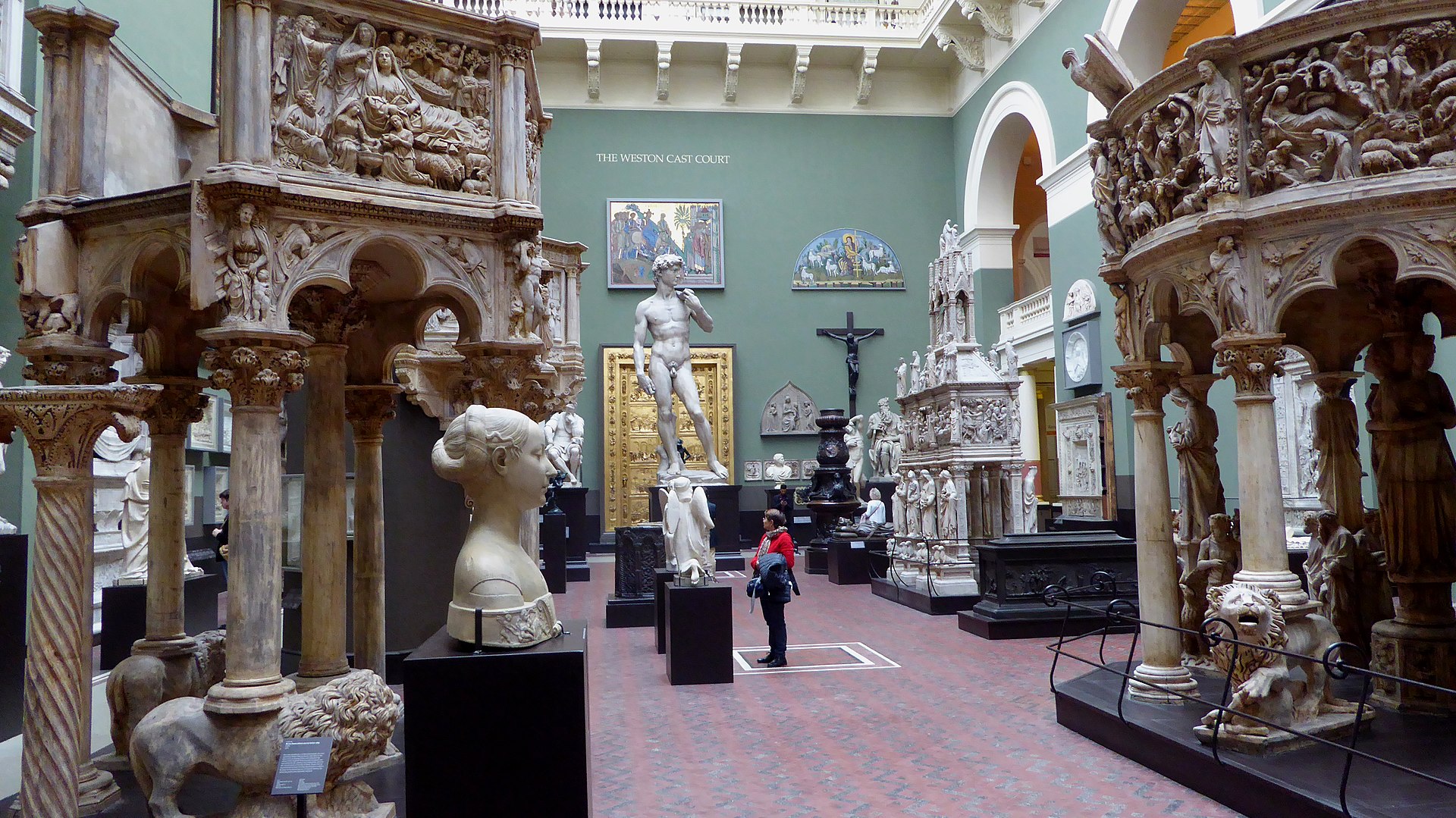
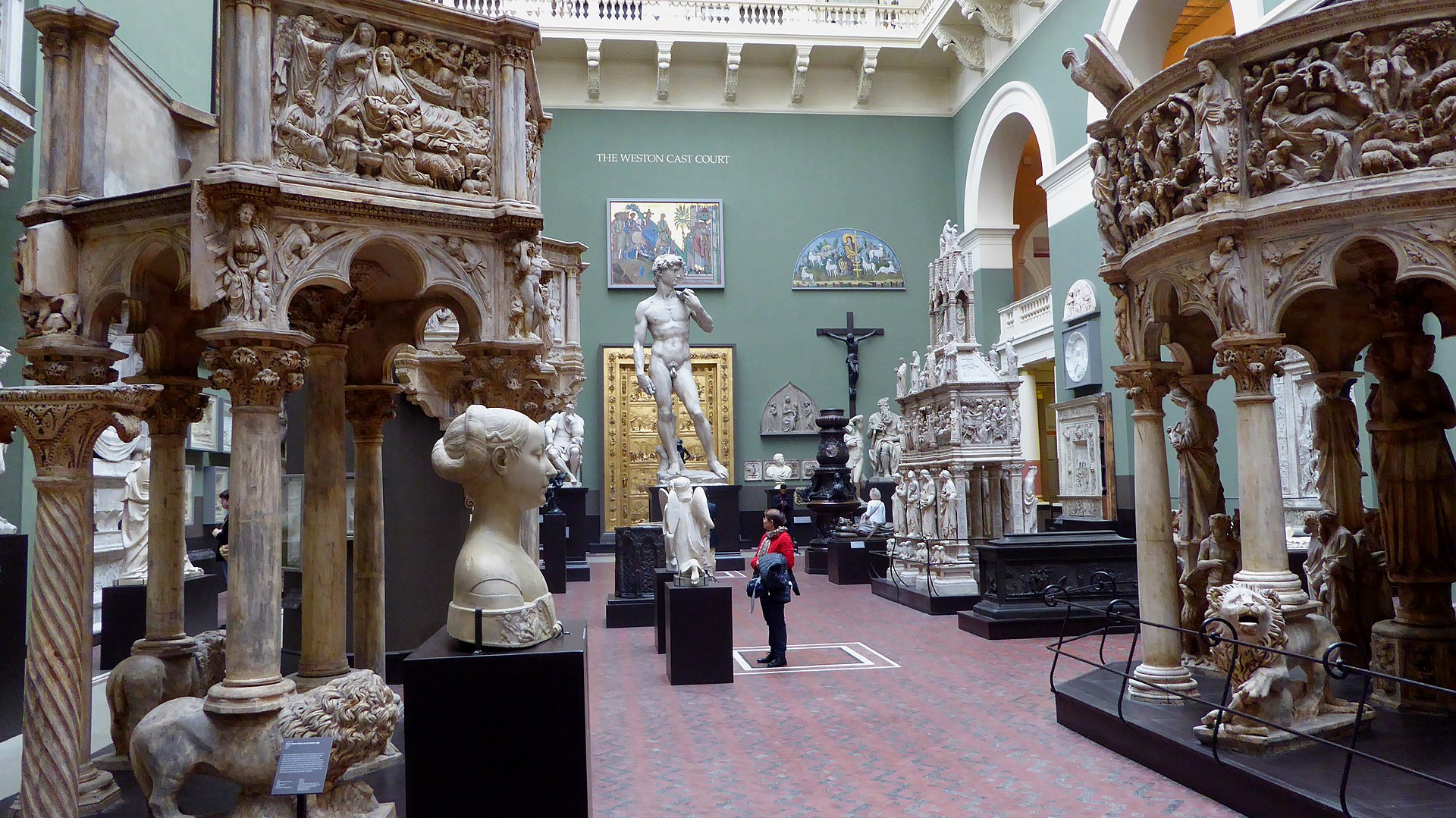
Opened in 1873, two vast galleries of plaster casts taken from Europe's most important monuments and sculpture, assembled so students who could not travel could still study them at full scale. The centrepiece is a full-size cast of Trajan's Column from Rome, cut into two sections because even this room was not tall enough for it in one piece, standing alongside a cast of Michelangelo's David complete with a detachable plaster fig leaf once used to cover the original when royalty visited.
Chronological rooms tracing British design, dress and interiors from 1500 to 1900, built around complete period rooms and set pieces including the Great Bed of Ware, an oak four-poster over eleven feet long and ten feet wide, famous enough by Shakespeare's time to be mentioned in Twelfth Night.
Around 3,000 pieces spanning roughly 3,000 years, from ancient Egyptian and Greek gold to Renaissance jewelled pendants, the Cheapside Hoard of Jacobean gems, and 20th- and 21st-century designer pieces, arranged in tall mirrored cases up a two-storey vault-like space.
Around 400 years of dress and couture drawn from a holding of more than 14,000 garments, spanning historic court dress through to Chanel, Dior and Alexander McQueen. Closed for redevelopment through autumn 2028 at the time of research, per the museum's own visitor page.
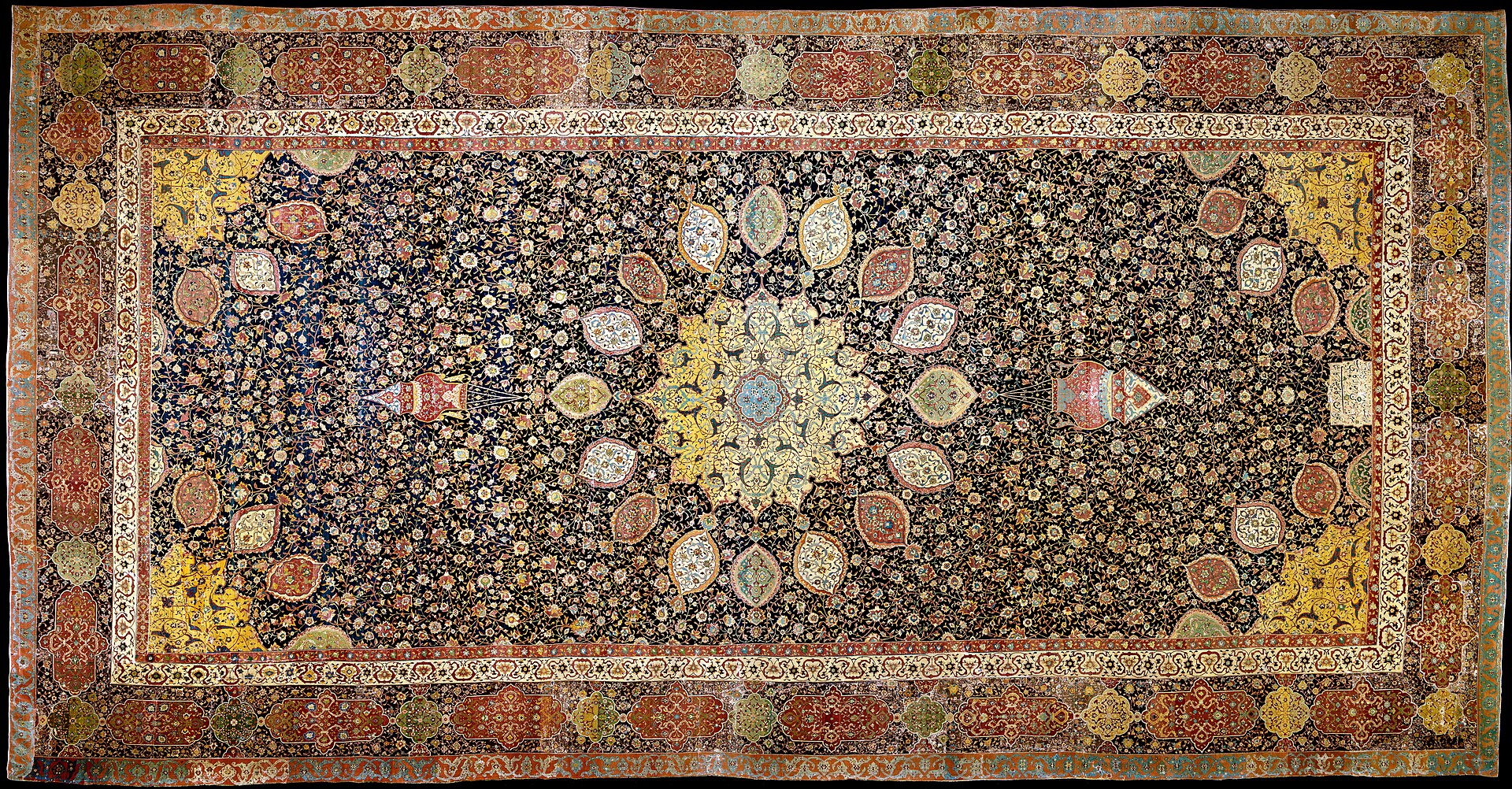
Ceramics, textiles, glass, metalwork and woodwork from the Islamic world across roughly a thousand years, centred on the Ardabil Carpet - the world's oldest complete, precisely dated carpet, woven in Safavid Iran and signed 946 in the Islamic calendar (1539-40 CE).
Seven of Raphael's ten full-scale cartoons for the Sistine Chapel tapestries, painted around 1515-16 for Pope Leo X and depicting scenes from the lives of Saints Peter and Paul. They are lent to the museum by the Crown, a loan arrangement dating back to Prince Albert's involvement in acquiring them for the nation.
The world's oldest dated carpet, signed and dated 1539-40, and one of the largest and finest Persian carpets to survive; already researched in this archive with its own full provenance record.5
Full record in this archiveFull-scale tapestry designs painted around 1515-16 for the Sistine Chapel, among the most important Renaissance works outside Italy and on public loan from the Royal Collection since the mid-19th century.6
A full-scale, two-part cast of one of the great monuments of imperial Rome, made so that students and craftsmen who could not travel to Italy could still study it close up; the centrepiece of the Cast Courts since 1873.1
A full-size reproduction that became so well known in Britain that it shaped generations of art students' idea of the original in Florence, complete with the museum's own detachable fig leaf.1
An oak four-poster bed over eleven feet long, famous enough in its own lifetime to be namechecked by Shakespeare, and one of the British Galleries' anchor objects for the story of English craftsmanship.1
A wooden mechanical organ in the shape of a tiger mauling a prostrate European soldier, built for Tipu Sultan of Mysore and seized by British forces after his defeat in 1799; one of the museum's most-discussed objects for what it represents as well as what it depicts.1
Royal regalia taken from the Asante court during the Anglo-Asante wars of 1874 and 1895, thirteen pieces of which the V&A bought at auction; in 2024 the museum agreed a three-year loan of the pieces back to the Manhyia Palace Museum in Kumasi, the first time most of them had been seen in Ghana in 150 years.7
Dated AH 946, equivalent to 1539-40 · Wool knotted pile on a silk warp and weft...
Victoria and Albert Museum, London, Room 42, the Jameel Gallery
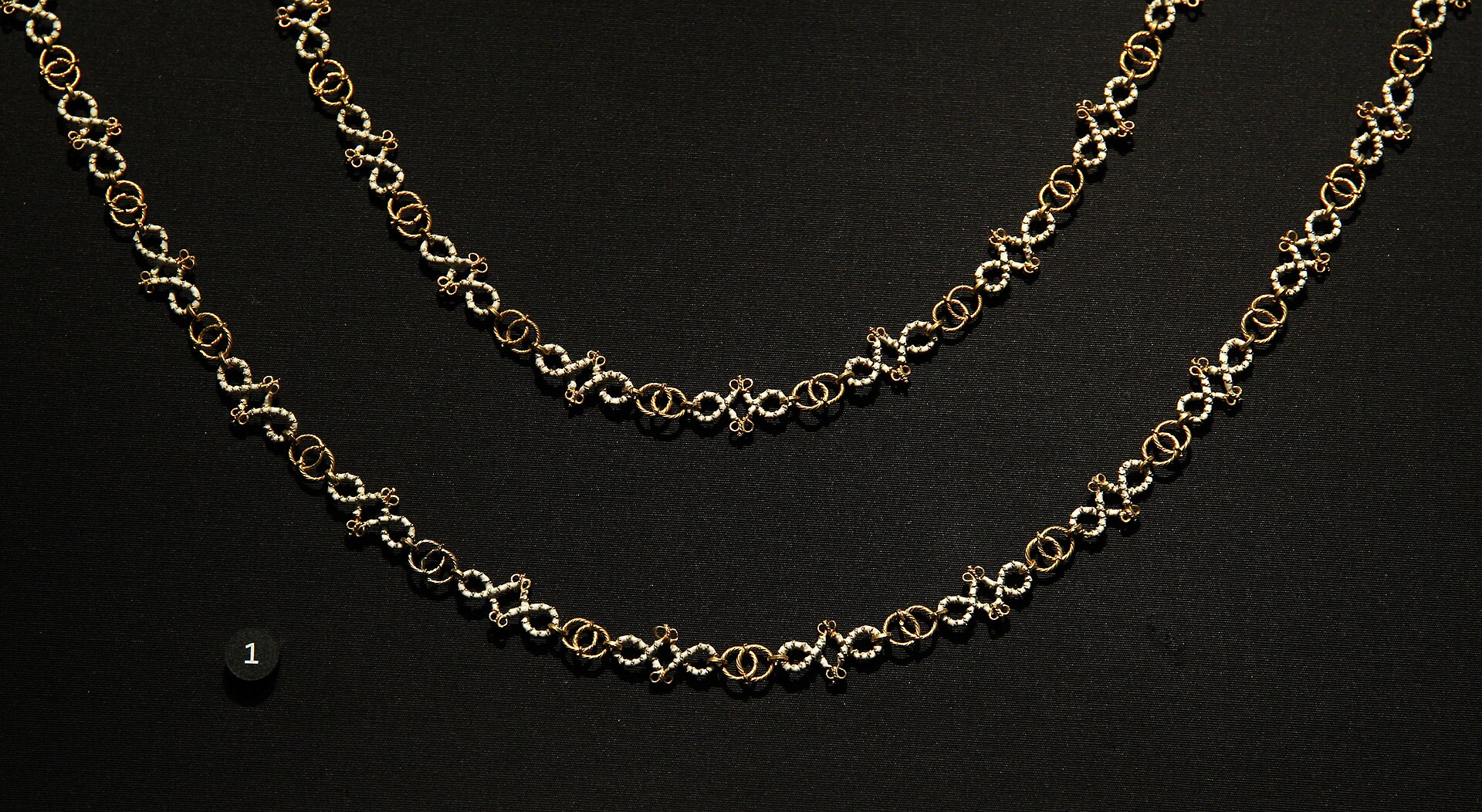
1590-1620 · Gold
Victoria and Albert Museum, London, Jewellery Gallery
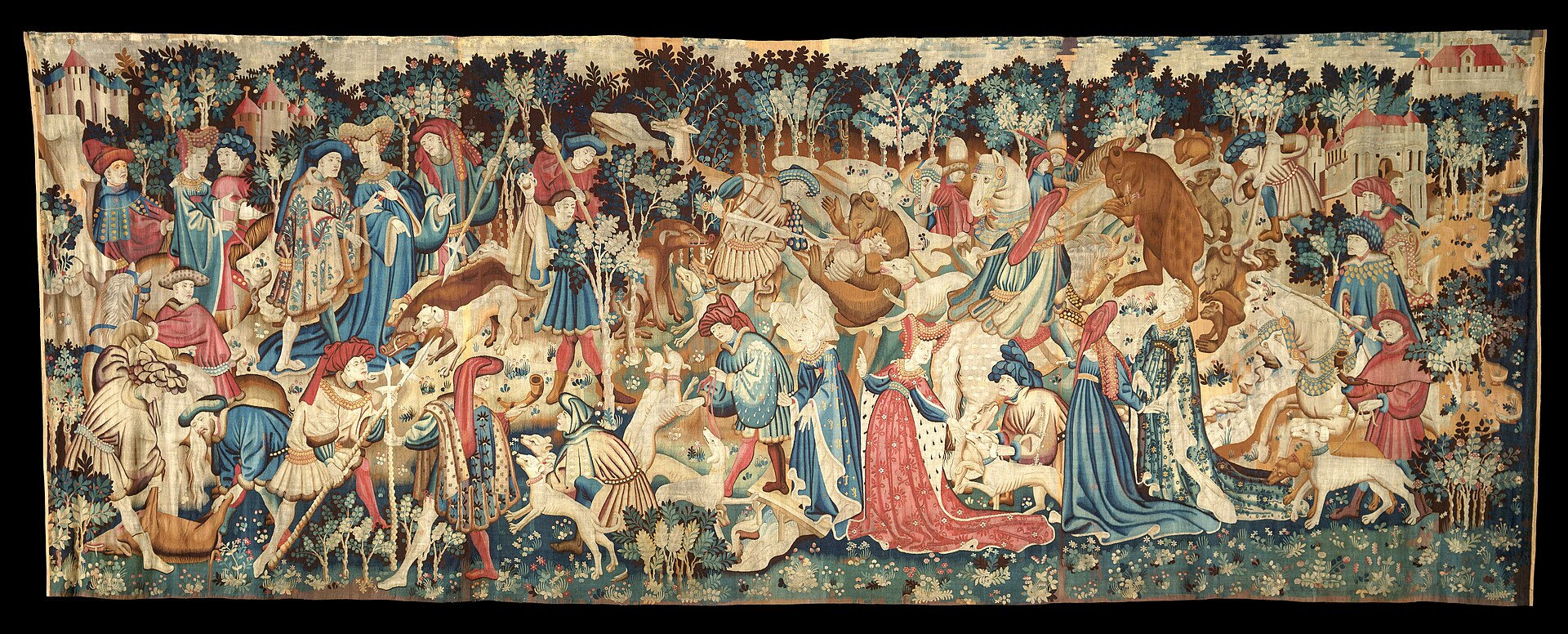
c. 1425-1450 · Wool
Victoria and Albert Museum, London
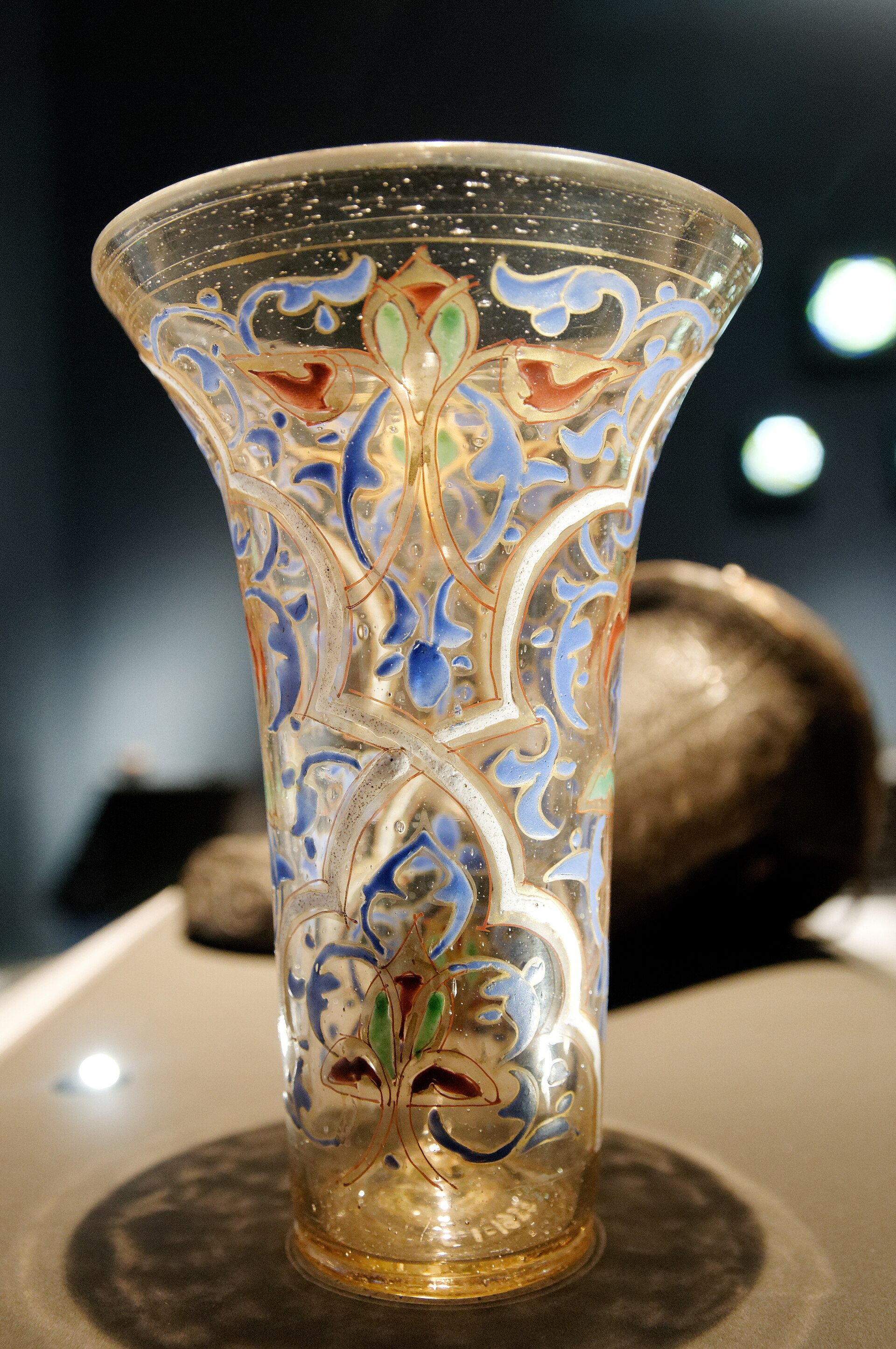
Beaker: circa 1350. Case: circa 1400-1500 · Beaker
Victoria and Albert Museum, London, Medieval and Renaissance...
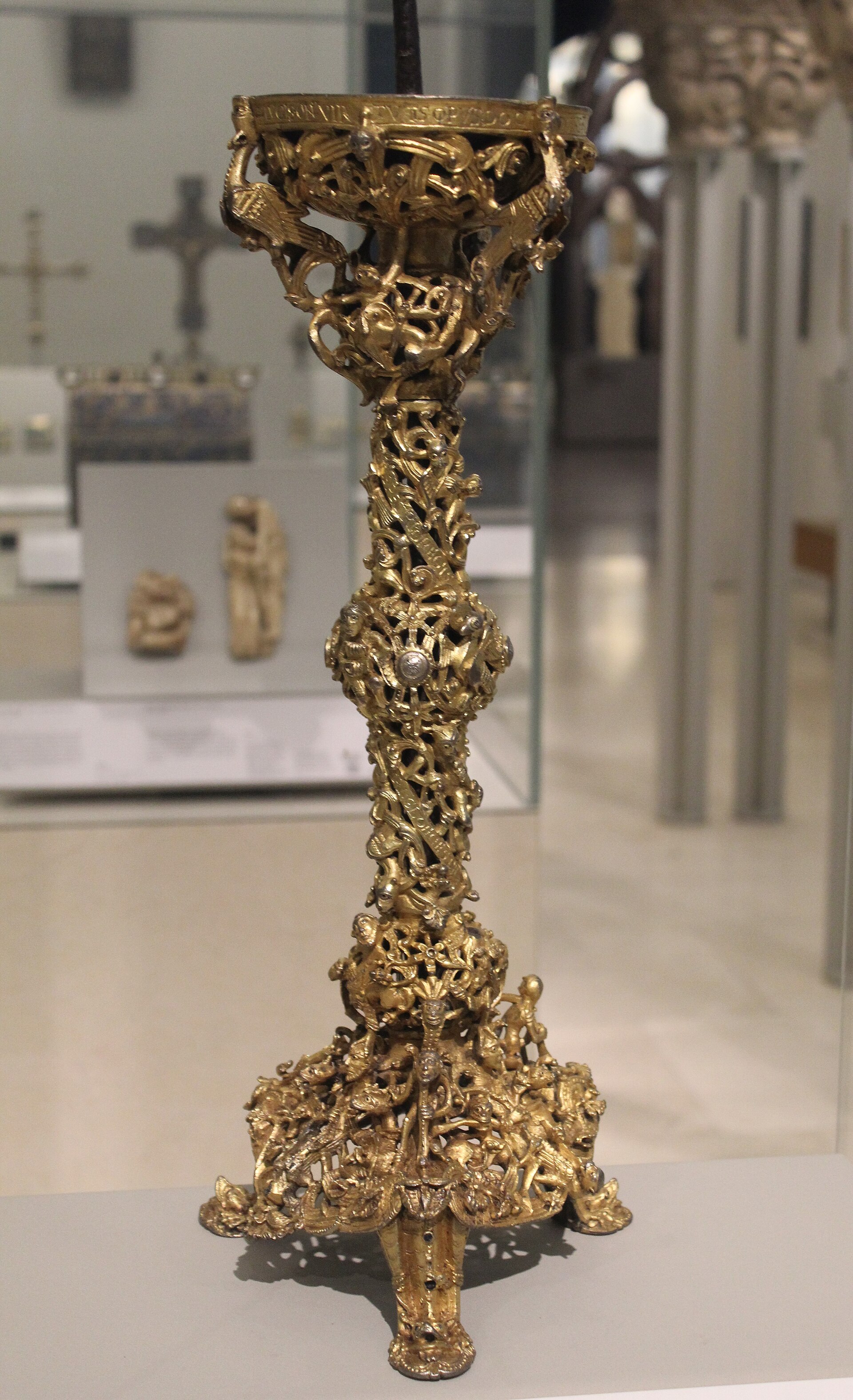
1107-1113 · Gilt copper alloy
Victoria and Albert Museum, London. On display, Medieval and...
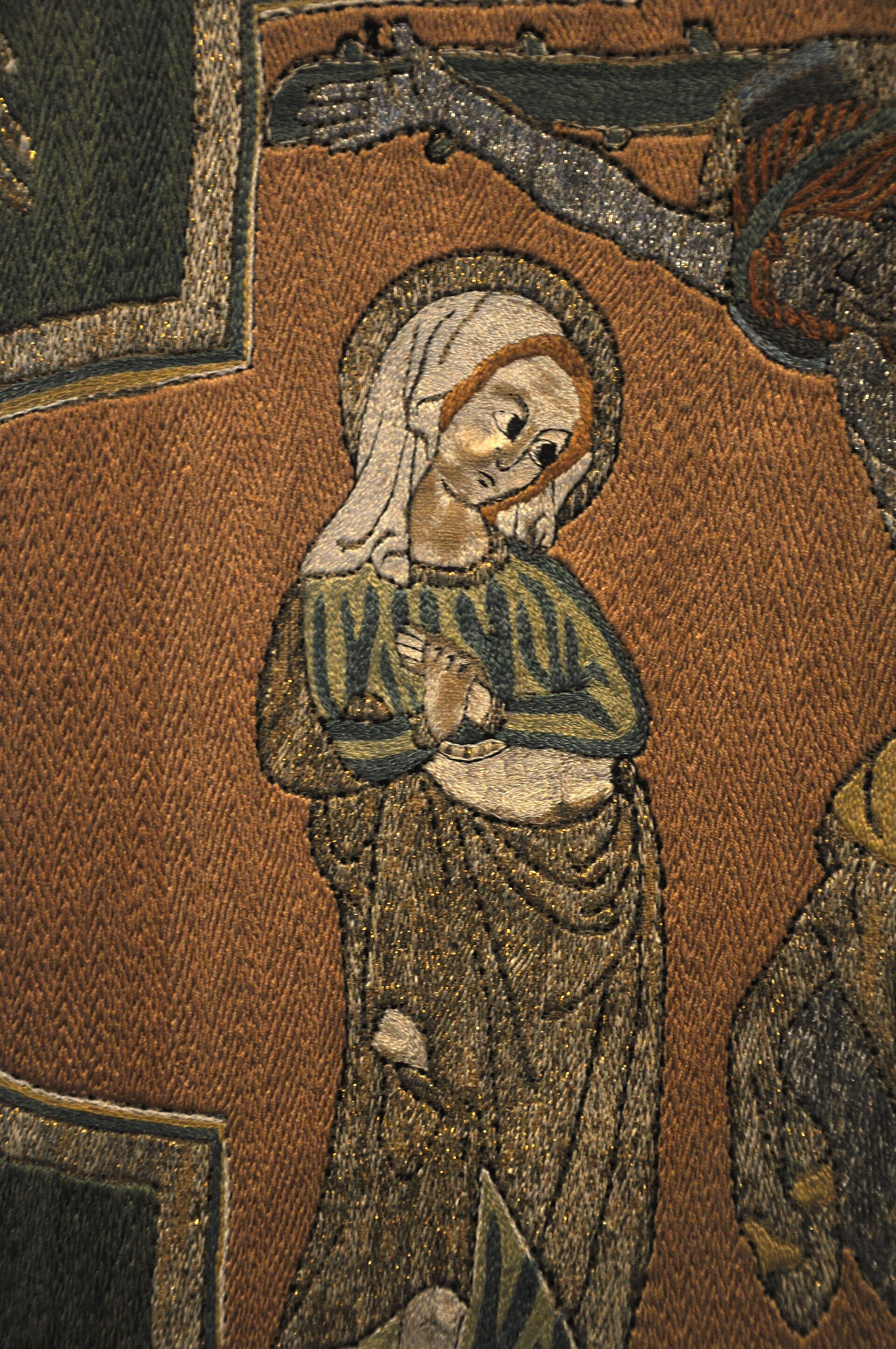
c. 1300-1320 · Linen ground
The Victoria and Albert Museum began, in May 1852, as the Museum of Manufactures, housed at Marlborough House and built directly out of the profits and the ambitions of the Great Exhibition of 1851. Its first director, Henry Cole, wanted an institution that would raise the standard of British design and manufacturing by putting good and bad examples side by side for makers and the public to compare - and that would draw a genuinely wide audience, including, in his own words, offering evening opening hours as 'a powerful antidote to the gin palace'. The collection moved to Somerset House later the same year, was renamed the Museum of Ornamental Art in 1853, and in 1857 relocated to its permanent site in South Kensington, on land bought with Great Exhibition proceeds, where it operated for over forty years as the South Kensington Museum.
The museum did not take its present name, or its present building, until the end of that period. In 1899, Queen Victoria laid the foundation stone for a new, purpose-built home designed by the architect Aston Webb, and the institution was renamed the Victoria and Albert Museum in honour of Albert's role in founding it. The building - a long Portland stone facade on Cromwell Road behind a domed entrance tower, wrapping around courtyards and interconnecting galleries - opened in 1909. It has grown since: a 2017 addition on Exhibition Road, the Sackler Courtyard, gave the museum a second, contemporary entrance and an underground exhibition space without disturbing Webb's original front. Today the museum's buildings occupy some twelve acres in South Kensington and contain, by the museum's own description, seven miles of galleries across roughly 145 rooms.
The V&A holds around 2.8 million objects, spanning some 5,000 years and virtually every decorative art and design discipline: furniture, fashion and textiles, ceramics and glass, metalwork, jewellery, sculpture, photography, theatre and performance, architecture, and Asian and Islamic art, with only a fraction on display at any time. It is, deliberately, not organised the way a picture gallery is organised by school and period; its rooms are as often arranged by material or technique - the Cast Courts for monumental sculpture reproduction, the Ceramics galleries, the Glass Gallery - as by geography or era, a structure that goes back to Cole's founding idea of a teaching collection for working designers rather than a chronological survey for connoisseurs.
The results range from the intimate to the monumental. The Jewellery Gallery packs three thousand years of goldsmiths' work into a compact, mirrored vault of a room; a floor away, the Cast Courts hold a full-size, two-part plaster cast of Trajan's Column, made in the 1860s so that students who would never see Rome could still study Roman relief carving close up. The Raphael Cartoons - full-scale designs for the Sistine Chapel tapestries, on loan from the Crown since the mid-19th century - hang in a room built specifically to hold them. The Islamic Middle East galleries house the Ardabil Carpet, the world's oldest precisely dated carpet, displayed under carefully controlled, dimmed light to protect its fragile 16th-century dyes.
A museum built out of a mid-Victorian empire has, inevitably, a collection shaped by that empire, and the V&A has faced sustained scrutiny over how openly its galleries acknowledge that. Critics writing on the museum's Global South holdings have pointed out that displays on 19th-century trade discuss the British Empire as an economic system while individual object labels - the museum's Algerian Amazigh pottery has been cited as one example - often do not mention the colonial context in which the pieces were acquired, a pattern read as a celebratory framing that separates named collectors and scholars from the imperial structures that gave them access to what they collected.
That tension came into sharper public focus in January 2024, when the V&A and the British Museum jointly agreed to loan seventeen and fifteen pieces respectively of 19th-century Asante gold and silver regalia to the Manhyia Palace Museum in Kumasi, Ghana - objects taken during the Anglo-Asante wars of 1874 and 1895, some of which the V&A had bought at auction in the same period. The three-year loan let most of the regalia be seen in Ghana for the first time in a century and a half, timed to the Asantehene's silver jubilee. It also drew academic criticism for its framing: writing in The Conversation, the historian Georgios Giannakopoulos argued that the museums' preferred language of a 'renewable cultural partnership', rather than repatriation, was a deliberate way of working around the National Heritage Act 1983 - which bars UK national museums from permanently deaccessioning most of their collections - and that a fixed-term loan leaves Ghana's underlying claim to ownership exactly where it was rather than resolving it. The museum has not, as of this research, announced any change to the objects' ownership status beyond the loan.
General admission to the permanent collection is free and has been since 2001, when the last UK government charge on national museums was abolished; the V&A charges only for its special, ticketed exhibitions, which run on a timed-entry system and are priced individually - a major fashion or design show in 2026, such as the Schiaparelli retrospective in the Sainsbury Gallery, runs GBP 28 on a weekday and GBP 30 at the weekend, with concessions available and members admitted free. No booking is required to walk in and see the permanent galleries.
Both entrances - the original Cromwell Road facade and the 2017 Exhibition Road Sackler Courtyard entrance - are step-free, and the museum lends wheelchairs and walking aids with a day's notice. Given the size of the building, the museum's own advice, and the experience reported by most visitors, is not to try to see everything: picking two or three departments and using the museum's gallery map to route between them is the difference between an enjoyable afternoon and an exhausting one. The central John Madejski Garden, a courtyard with a shallow reflecting pool between the original building's wings, is where most visitors end up resting partway through, with a cafe on each side of it.
Reader and visitor reaction converges on the same two points from very different angles. The free permanent collection is repeatedly cited as the museum's single best feature, precisely because it removes the pressure to see everything in one go - a visitor can come back for the Cast Courts alone, or the Jewellery Gallery alone, without weighing the cost of another full ticket. Against that, almost every account of a first visit mentions being overwhelmed by scale: seven miles of galleries is not a figure invented for marketing, and finding a specific gallery without the map, or realising partway through a room that an adjoining wing has been missed entirely, is a common complaint. A smaller but recurring thread of criticism concerns some of the museum's longer-standing galleries, whose display cases and interpretive text are seen as dated next to recently rehung spaces like the Cast Courts conservation work or the Photography Centre - a contrast the museum itself has acknowledged by rehanging galleries department by department rather than all at once.
Paid special exhibitions draw a separate strand of comment. Popular shows built around a single designer or theme - fashion retrospectives in particular - are consistently described as worth the higher ticket price for the density and quality of loaned material assembled in one room, but visitors also warn that the most in-demand slots sell out weeks ahead and that the exhibition price sits on top of, not instead of, the free general admission most people expect walking in. Families and repeat local visitors most often mention V&A membership as the way the arithmetic works out over a year rather than paying per show.
Visitors consistently single out the free general admission and the sheer range of the collection - decorative arts, fashion, sculpture, jewellery, ceramics, theatre and design under one roof - as the museum's strongest draw, alongside the Victorian building itself and the John Madejski Garden courtyard as a place to sit partway through a visit. The recurring complaint is scale: seven miles of galleries and roughly 145 rooms are widely described as impossible to see properly in one visit, with some sections read as old-fashioned in their display cases compared to recently rehung galleries, and popular ticketed exhibitions selling out or requiring booking well ahead.
Cromwell Road, South Kensington, London SW7 2RL, United Kingdom.
General admission (permanent collection): free; Special exhibitions, example: Schiaparelli: Fashion Becomes Art (Sainsbury Gallery, 28 Mar-8 Nov 2026): GBP 28. As confirmed 4 September 2026.
Monday-Thursday, Sunday 10:00-17:45; Friday 10:00-22:00. Closed: 24, 25 and 26 December. As confirmed 4 September 2026.
Underground: South Kensington station (Circle, District, Piccadilly lines), about 5 minutes' walk via the subway; Underground: Gloucester Road station, about 10 minutes' walk; Underground: Knightsbridge station, about 14 minutes' walk, with step-free access; Bus: Multiple London bus routes serve Cromwell Road and Exhibition Road; TfL journey planner recommended for specifics.
The Ardabil Carpet (Unknown workshop, Safavid Iran); The Raphael Cartoons (Raphael); Plaster cast of Trajan's Column (Cast workshop, 1860s, after the Roman original); Plaster cast of Michelangelo's David (Cast workshop, after Michelangelo); The Great Bed of Ware (Unknown maker, 1590s); Tipu's Tiger (Workshop of Tipu Sultan, Mysore, 1790s).
One artwork and its story every Tuesday, with the picture: who owned it, what it made, and what closes soon in the exhibition calendar. No promotion, and nothing we cannot cite.
We send one email to confirm the address and keep nothing else. Every letter carries a one-click unsubscribe. How we handle your data.


