Bust of Cardinal Scipione Borghese, first version
Gian Lorenzo Bernini · 1632
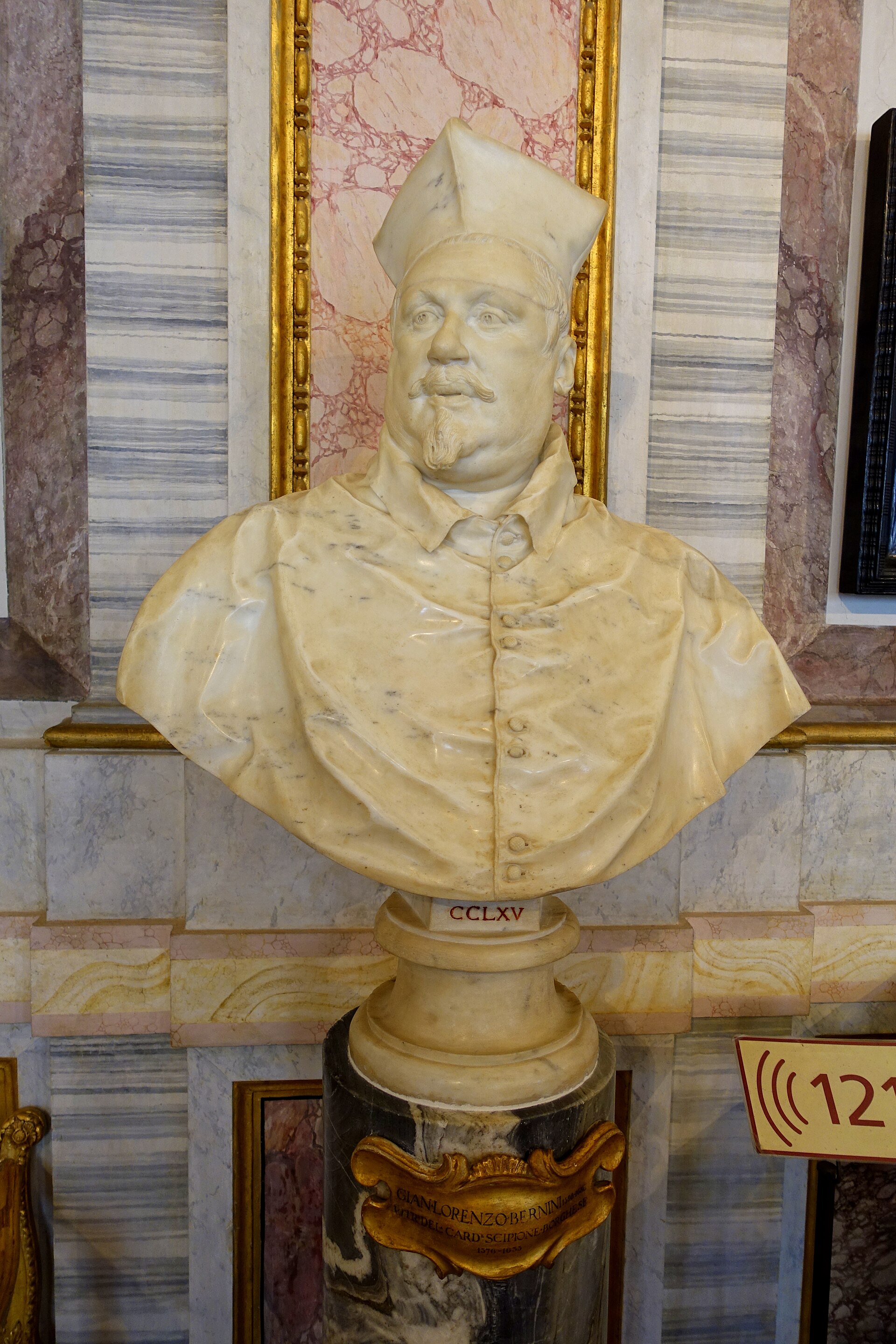
The object in this record. Verified as the FIRST version by two independent tests visible in the photograph: the socle is painted CCLXV in red, and the fault runs across the forehead rather than across the mozzetta. Carrara marble, 1632, 77.2 cm, Galleria Borghese. This is the bust Scipione Borghese kept in the Room of the Emperors.
| Artist | Gian Lorenzo Bernini |
|---|---|
| Date | 1632 |
| Medium | Carrara marble |
| Dimensions | Height 77.2 cm. The second version, inv. CCLXVI, is given by the museum at 78 cm. |
| Where it is now | Galleria Borghese, Romelast confirmed 19 August 2026 |
| Inventory number | CCLXV |
| Attribution | AcceptedAutograph and undisputed. Full note |
| Object type | Sculpture |
| Period | Italian Baroque, seventeenth century |
| Cases | Restituted or repatriated |
| Inscriptions | The socle carries the Borghese fideicommissary inventory number CCLXV, painted in red, legible in plate 1. The gilt cartouche on the pedestal below names Gian Lorenzo Bernini and the sitter. Nothing on the marble is by the sculptor's hand. |
| Owners on record | 4 links4 documented |
| Sources | 9 cited |
About this record Last verified 19 August 2026 · 9 sources cited · Change log
On this page 12 sections
ContentsClose
In 1632 Bernini carved a marble bust of Cardinal Scipione Borghese, the patron who had made him. As the work was being finished a fault opened in the stone and ran across the sitter's forehead. Bernini carved the whole thing again from a fresh block. Both busts survive, both are autograph, both are in the Galleria Borghese, and they are within a centimetre of each other in height.
The detail that no summary carries is what the cardinal did next. He put the DAMAGED bust in the Room of the Emperors, among the busts of the Caesars, and the flawless replacement upstairs in the villa gallery. The object with the fault got the better room. Two further facts are almost never printed: the replacement block was flawed as well, and the commission was placed not by Scipione but by the reigning pope, Urban VIII.
Both busts were sold at auction. On 28 March to 9 April 1892 the firm of Giacomini and Capobianchi held the first sale of Borghese works that had been EXCLUDED from the family entail, and the pair went as lot 341 to the Italian state. They then sat in the Accademia in Venice until 1908. This is the sharpest version case in the archive: two objects made by the same hand in the same year of the same man, told apart by a fissure running up a brow and a Roman numeral painted in red on a socle.
Provenance
Each link is graded. Documented: a cited source supports it. Disputed: the identification is argued but not established. Unknown: no owner for that span, and the gap is not smoothed into a narrative. The grades in the glossary.
- 1632 - 1633Cardinal Scipione Borghese, Villa Borghese Pinciana, Romedocumented
Carved in 1632 and in the cardinal's collection in that year. The Galleria Borghese states the portrait was commissioned to Bernini by Pope Urban VIII, not by the sitter. Scipione himself paid Bernini 500 scudi in December 1632 (Vatican Secret Archive, Borghese Archive, Registro dei Mandati, fol. 252, no. 491, published by Hibbard, 1961); the Estense archive separately reports a papal recompense of 500 zecchini and a diamond worth 150 scudi. The cardinal displayed this bust, the first version with the crack across the forehead, in the Room of the Emperors among the busts of the Caesars, and the flawless second version in the gallery on the first floor. He died in 1633.15
- 1633 - 1892The Borghese family, Romedocumented
The bust remained in the Villa Borghese Pinciana and passed down the Borghese line. It was recorded in the Room of the Moor in the 1762 inventory and in Room 9, the Portrait Room, in the nineteenth century. Crucially, it was among the Borghese works EXCLUDED from the fideicommissum, the entail that protected the rest of the collection from dispersal. No individual family owner in this stretch is named in the sources consulted.12
- 1892 - 1908The Italian state; the pair held at the Accademia, Venicedocumented
Both busts were sold as lot 341 at Giacomini and Capobianchi, Rome, 28 March to 9 April 1892, at the first sale of the Borghese works excluded from the fideicommissum, and were bought by the Italian state. They were then conserved at the Accademia in Venice until 1908. This link corrects the widespread claim that the busts have never been on the market and that they entered the state collections with the rest of the Borghese material in 1902; that 1902 transaction, the acquisition of the fideicommissary collection with the villa and park for 3.6 million lire, is a different one ten years later.12
- 1908 - presentThe Italian state; Galleria Borghese, Romedocumented
Returned to the Villa Pinciana in 1908. Conservation treatments recorded in 1911 by M. Eugenio and in 1997 by C.B.C. Coop. a.r.l. Exhibited in Rome in 1930 at the Istituto di Studi Romani, at the Galleria Borghese in 1998, at Palazzo Venezia in 1999 and at the Galleria Borghese again in 2017-2018. Now displayed in Room 14, the Lanfranco Loggia.1
Prices realised
AN EARLIER VERSION OF THIS RECORD STATED THAT NEITHER BUST HAD EVER BEEN AT AUCTION. THAT WAS WRONG AND IT IS CORRECTED HERE. Both busts were sold in a Rome saleroom in 1892 with a lot number, because they lay outside the Borghese entail. The correction was found by re-reading the museum's own catalogue entry, which carries the sale in a single clause. The second and third rows below are for a DIFFERENT Bernini marble, the Bust of Pope Paul V of 1621, which portrays this sitter's uncle; they are given because they are the best-documented modern market history of an autograph Bernini portrait bust.
| Date | Sale | Estimate | Result | Note |
|---|---|---|---|---|
| 28 March 1892 | Giacomini and Capobianchi, Rome | not published | Hammer not published in the sources consulted With premium not published in the sources consulted ITL | Lot 341, the pair of Bernini busts of Cardinal Scipione Borghese, in the first sale of the Borghese works excluded from the fideicommissum, held 28 March to 9 April 1892. Bought by the Italian state. The museum publishes the house, the dates and the lot number and no figure, which is the normal condition of a nineteenth-century Roman sale; there is no reason to assume a buyer's premium existed. This is the only recorded market transaction for either bust. |
| 2014-09 | Auction in Bratislava, house not named in the source consulted | EUR 24,000 | Hammer EUR 24,000 With premium not published in the source consulted EUR | A DIFFERENT OBJECT: Bernini's Bust of Pope Paul V, 1621, consigned misattributed by the heirs of the Slovak painter Ernest Zmetak, unsold at an estimate of 47,000 euros in 2013 and sold here at its pre-sale estimate to an unnamed Slovak art dealer. Johann Kraftner, director of the Liechtenstein collections, states that he was offered the bust and courteously declined because its provenance was inconclusive. That is the most instructive refusal in this record: an institution with the money and the expertise passed on a genuine Bernini for exactly the reason this archive exists. |
| 2015-07 | Private sale arranged by Sotheby's | not published | Hammer not applicable; no auction took place With premium USD 33,000,000 reported as the price paid USD | A DIFFERENT OBJECT: the J. Paul Getty Museum acquired the Bust of Pope Paul V, reported in July 2015. There is no hammer price because there was no auction, and a private sale arranged by an auction house publishes nothing it is not obliged to publish; no underbidder is known. Against the 24,000 euros paid ten months earlier, the multiple measures what an attribution is worth, not what the object had become. Note that the reporting is internally inconsistent, giving 1893 for the Viennese purchase in one sentence and 1917 in another. |
Hammer is the price at which the bidding stopped; with premium adds the fee the house charges the buyer on top. Hammer price and buyer's premium in the glossary.
Technical evidence
| Attribution note | Autograph and undisputed. So is the other one. That is the whole problem this record exists to handle: Bernini carved TWO marble busts of Scipione Borghese in 1632, both by his own hand, both in the Galleria Borghese, both about 78 cm high, and the second exists only because the first developed a fault. Attribution here is never the question. Identification is. A photograph of one of these busts is worthless as evidence unless it shows either the crack across the forehead or the inventory number painted on the socle. |
|---|---|
| Object and inventory | Marble portrait bust, Galleria Borghese inventory CCLXV, painted in red on the socle. It is a Borghese collection number and it is the most reliable identification mark on the object, but it is NOT a fideicommissary inventory mark: the museum states that these two busts were among the Borghese works EXCLUDED from the fideicommissum and sold in 1892.1 |
| Dimensions | Height 77.2 cm for this bust. The museum gives the second version, inv. CCLXVI, at 78 cm. The difference of eight millimetres is not a usable identification test in a photograph.12 |
| Material | Carrara marble.1 |
| The fault | A crack, called by Baldinucci a hair, opened in the block as the work was being completed and shows across the cardinal's forehead. The museum states it is still visible today. This is the defect that caused the second bust to exist. It identifies the first bust only when its POSITION is specified, because the second bust has a crack as well.1 |
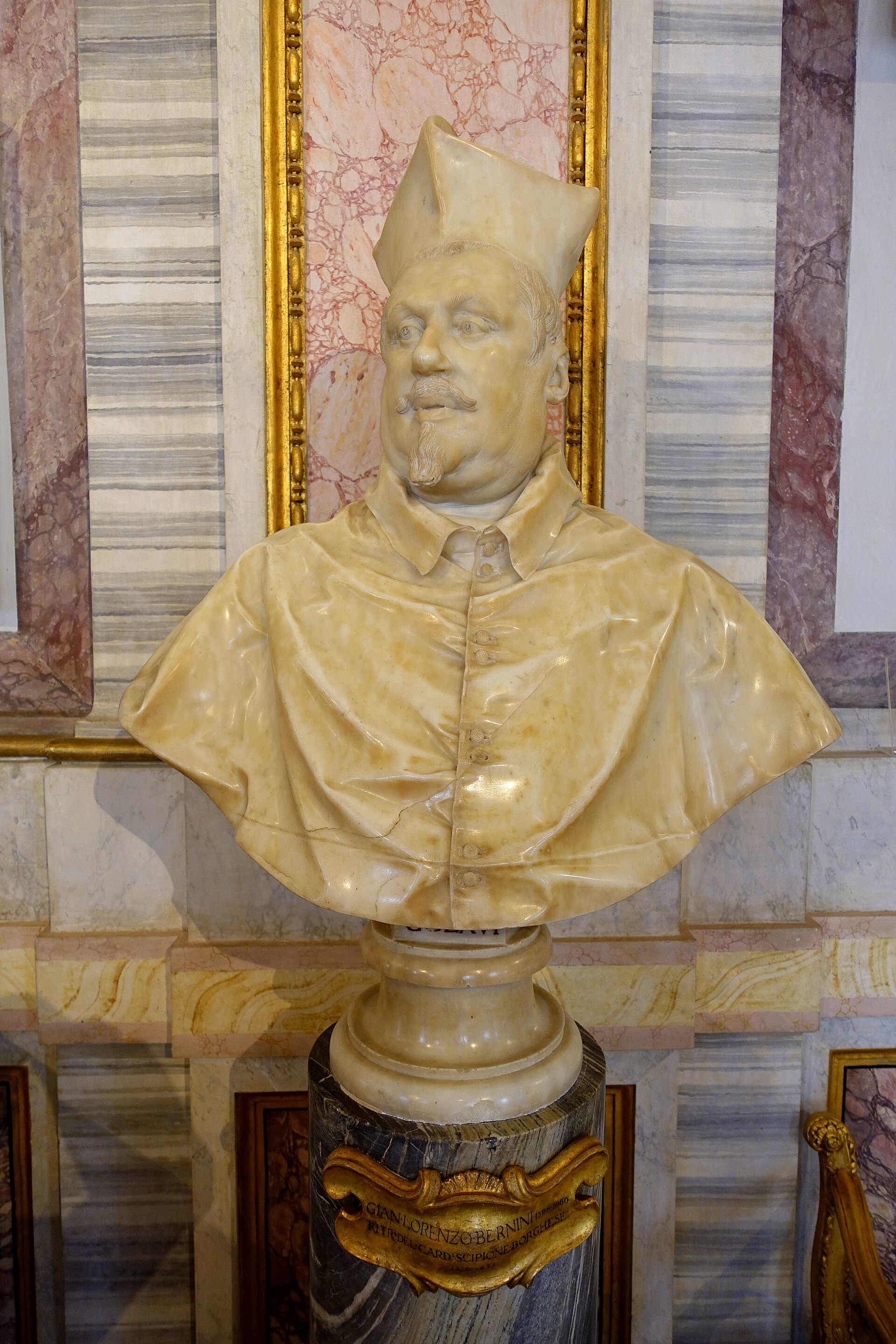
| The second bust's own fault | Inventory CCLXVI also carries a crack: a slight fissure that begins in the lower right portion of the mozzetta, crosses through the centre and reaches the upper left. The replacement block was flawed as well, in a place that does not cross a face.2 |
| Differences between the two | The second bust has squarer shoulders, a more uniform polish, and a horizontal fold crossing between the last pair of buttons. None of these is reliably legible in a low-resolution reproduction.2 |
| Pose | Head turned somewhat to the observer's left, mouth slightly open, in the museum's words as if someone had interrupted him during a conversation. The museum treats the bust as the point at which Bernini's portraiture becomes the talking portrait.1 |
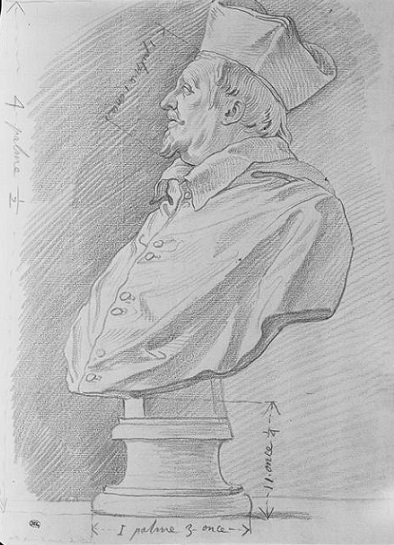
| Preparatory drawing | One survives: Morgan Library and Museum IV, 176, red chalk over graphite on laid paper, 253 x 184 mm, about 1632. The Morgan catalogues it as possibly a study for the marble in the Borghese Gallery. The claim that it is the only surviving exemplar of the many drawings the sculptor probably made for this project is the Galleria Borghese's, not the Morgan's.13 |
| Conservation | Treated in 1911 by M. Eugenio and in 1997 by C.B.C. Coop. a.r.l., on the museum's record.1 |
| Documented payment | Two documents, and they are not the same transaction on the evidence available. Scipione Borghese paid Bernini 500 SCUDI in December 1632, recorded in the Vatican Secret Archive, Borghese Archive, Registro dei Mandati dell'Eminentissimo Cardinale Scipione Borghese, fol. 252, no. 491, published by Hibbard in 1961. Separately, a report in the Estense archive, cited by Fraschetti in 1900, records that Bernini, commissioned by the pope, had made a marble bust of Cardinal Borghese and had been recompensed 500 ZECCHINI and a diamond worth 150 scudi.15 |
| Room history | Displayed by Scipione Borghese in the Room of the Emperors among the busts of the Caesars; recorded in the Room of the Moor in the 1762 inventory; in Room 9, the Portrait Room, in the nineteenth century; in Room 14, the Lanfranco Loggia, today. The second bust was placed by the cardinal in the gallery on the first floor.12 |
Images
The record in full
Chapter 1Two busts, and the record has to say which one it is describing
The object described here is the marble bust of Cardinal Scipione Borghese carved by Gian Lorenzo Bernini in 1632 and catalogued by the Galleria Borghese as inventory CCLXV, height 77.2 centimetres...
The object described here is the marble bust of Cardinal Scipione Borghese carved by Gian Lorenzo Bernini in 1632 and catalogued by the Galleria Borghese as inventory CCLXV, height 77.2 centimetres, Carrara marble. It is the first of the two. It hangs today in Room 14, the Lanfranco Loggia, not in the room the cardinal put it in.
The second, inventory CCLXVI, is also by Bernini, also 1632, and the museum gives it at 78 centimetres. It stands in the same museum. It shows the same man in the same mozzetta and biretta, turned the same way, with the same open mouth. Photographs of the two are routinely captioned interchangeably, including on Wikimedia Commons, where the file description text of one of the two photographs used in this record names the wrong inventory number while the filename names the right one. That is not an unusual error and it is exactly why this publication reads the object rather than the label.
Two features separate them and both are visible in a good photograph. The first bust carries the fault: a fissure that runs across the forehead, which is why the second exists. The second bust carries its own fault in a different place, a slight crack that begins at the lower right of the mozzetta, crosses the centre and reaches the upper left. And each socle is painted with its Borghese inventory number in red, CCLXV and CCLXVI, so that a photograph including the base is self-identifying. Every plate in this record was matched by those two tests, on the object itself, before it was used. Note that the position of the crack alone is not a test unless the position is specified, because both busts have one.
Chapter 2What the object is
A portrait bust in Carrara marble, 77.2 centimetres high, cut to the shoulders and set on a turned marble socle.
A portrait bust in Carrara marble, 77.2 centimetres high, cut to the shoulders and set on a turned marble socle. The cardinal wears the biretta and the buttoned mozzetta of his office over a rochet, and the whole lower two thirds of the sculpture is drapery: heavy cloth thrown into folds that catch light in ridges and go dark in the troughs, so that the fabric reads as moving even though the head is what the eye goes to.
The head is turned somewhat to the observer's left and the mouth is slightly open, in the museum's own description as if someone had interrupted him during a conversation. The Galleria Borghese treats this as the moment Bernini's portrait practice changes: the bust introduces what is now called the talking portrait, an intimate psychological reading of the sitter that does not give up the official dignity of the office. Everything about the object is designed to be caught in the middle of something.
It is worth registering how modest the material claim is. This is not a monument, not a tomb figure, not a papal commission for a basilica. It is a piece of furniture for a room, made for one man to keep among his antiquities, and it is one of the two or three most influential portrait sculptures made in Europe.
Chapter 3The sitter, and how he got the money to pay for it
Scipione Caffarelli was born in 1577, the son of the sister of Camillo Borghese.
Scipione Caffarelli was born in 1577, the son of the sister of Camillo Borghese. When his uncle became Pope Paul V in 1605 the nephew was made a cardinal, took the Borghese name and arms, and became the cardinal-nephew: the pope's chief of staff, gatekeeper and beneficiary. He died in 1633, the year after this bust was carved.
The collection he built is the reason his name is known, and the methods are documented. In 1607 Paul V confiscated a collection of paintings from the Cavaliere d'Arpino over an unpaid tax bill and gave it to his nephew; the seizure carried into the Borghese collection two early works now attributed to Caravaggio, the Boy with a Basket of Fruit and the picture usually called the Sick Bacchus. In 1608 Raphael's Deposition was taken from the Baglioni chapel in the convent of San Francesco al Prato in Perugia, lowered over the town walls in the night between 18 and 19 March, and afterwards declared the cardinal's private property by the pope.
These are not colourful anecdotes attached to a patron. They are the acquisition history of the collection this bust belongs to, and a record that describes the sitter as a discerning patron of the arts without them has described half of him. The man Bernini carved with his mouth open, in the act of speaking, had taken an altarpiece off a wall in another city by night with his uncle's authority behind him.
Chapter 4He also made Bernini, and the pope paid for the portrait
Scipione was Bernini's first great patron.
Scipione was Bernini's first great patron. Between roughly 1618 and 1625 the sculptor produced for him the four marble groups that are still the reason people queue for the Galleria Borghese: Aeneas, Anchises and Ascanius, the Rape of Proserpina, Apollo and Daphne, and the David. Bernini was in his early twenties for most of that run.
The bust of 1632 comes a decade later, when Bernini was the dominant sculptor in Rome, working full time for Urban VIII in St Peter's, and Scipione was in the last year of his life and long out of power, his uncle dead since 1621 and the Barberini in the Vatican.
The commission was not Scipione's. The Galleria Borghese states it plainly: the cardinal waited until 1632, a decade after his uncle's death, to add to his collection a portrait of himself commissioned to Gian Lorenzo Bernini BY POPE URBAN VIII. A report in the Estense archive, cited by Fraschetti, records that Bernini, commissioned by the pope, had made a marble bust of Cardinal Borghese and had been recompensed 500 zecchini and a diamond worth 150 scudi. Separately, the Borghese household accounts show Scipione himself paying 500 scudi in December 1632.
Read together, those two documents describe a reigning pope commissioning and rewarding a portrait of his predecessor's nephew, and the sitter paying the sculptor as well. That is not a private likeness. It is a Barberini courtesy to a Borghese at the end of his life, and the standard account of a patron commissioning his own portrait from his favourite sculptor is, on the museum's own evidence, wrong.
Chapter 5How Bernini built a likeness
One preparatory drawing survives, and it is in New York.
One preparatory drawing survives, and it is in New York. The Morgan Library and Museum holds a red chalk study over graphite on laid paper, 253 by 184 millimetres, catalogued as IV, 176 and dated about 1632. The Morgan itself describes it cautiously, as possibly a study for the marble in the Borghese Gallery. It is the Galleria Borghese that calls it the only surviving exemplar of the many drawings the sculptor probably made for this project, and the distinction between those two statements is worth keeping.
The Morgan's own reading of the sheet states the method: the cardinal's animated expression bears witness to Bernini's preference that his sitters move and speak rather than pose stiffly, and the sculptor is particularly interested in the silhouette of the profile, following the outline of the forehead and the nose. That is a working procedure, not a temperament. Bernini did not sit a man down and copy him. He watched a man be himself and then cut the marble from what he had understood.
The drawing has a chain of its own worth setting down, because it is better documented than the bust. It was owned by Jonathan Richardson the elder, who wrote on the back of the lining that the bust is in the Villa Borghese and was made when Bernini was very young, but is nevertheless much esteemed. Richardson was wrong about the age; Bernini was thirty-three. The sheet then passed to Sir Thomas Lawrence, then to Charles Fairfax Murray, and was bought by Pierpont Morgan in 1909.
Chapter 6The fault, and the fortnight
The account comes from Filippo Baldinucci: with the work all but finished, a crack, which he calls a hair, had opened in the marble and showed on the cardinal's forehead, where it is still visible...
The account comes from Filippo Baldinucci: with the work all but finished, a crack, which he calls a hair, had opened in the marble and showed on the cardinal's forehead, where it is still visible today. Bernini began again on a fresh block.
How long the second bust took is the most repeated fact about this object. Fifteen nights, according to Baldinucci. Three days, according to the sculptor's son Domenico. The Galleria Borghese gives it that way and so does the scholarly summary of the two primary lives, citing Baldinucci's 1682 life at pages 18 to 20 and Domenico's of 1713 at page 11. Some commercial guide sites reverse the attribution; they are wrong, and the reversal is not a scholarly dispute.
The two lives do differ on how the cardinal found out. In Baldinucci's version the second bust was carved in secret and produced as a surprise: the cardinal is shown the flawed bust, is pleased with it, conceals his disappointment at the fault, and Bernini then uncovers the unblemished replacement. In Domenico's the cardinal saw the unfinished bust, was delighted, and asked that it be completed and shown to the pope, and the fault was discovered afterwards.
Both accounts name that pope as Paul V, who died in 1621, eleven years before the bust was carved. The anachronism is in the biographies themselves, not in later retelling, and it is the strongest reason to treat the whole anecdote with suspicion. What is documented is a payment in December 1632, a report of a papal commission, and two finished marbles.
Chapter 7The replacement block was flawed too
This is the detail that almost never appears in print, and it is in the museum's own catalogue.
This is the detail that almost never appears in print, and it is in the museum's own catalogue. The second bust, inventory CCLXVI, also has a crack. It begins in the lower right portion of the mozzetta, crosses through the centre and reaches the upper left.
So the rescue was not clean. Bernini recarved a portrait in a fortnight, or three days, because the marble had failed him, and the marble failed him again in the replacement, only in a place that did not cross a face. That is what working in a natural material at speed actually looks like, and it puts the famous anecdote in proportion: the second bust is a triumph of nerve and hand speed, and it is also a second flawed block that happened to fault below the collar.
The other differences the museum records are the kind a conservator notices and a visitor does not: the second bust has squarer shoulders and a more uniform polish, and a horizontal fold crossing between the last pair of buttons. None of that is visible in a low-resolution reproduction, which is why the position of the fissure and the socle number remain the only practical identification tests.
Chapter 8The cardinal preferred the damaged one
The Galleria Borghese records where each bust went.
The Galleria Borghese records where each bust went. Scipione put the first version, the one with the crack across the forehead, in the Room of the Emperors, among the busts of the Caesars. He put the second, the flawless one, in the gallery on the first floor of the villa.
Read the placement. The Room of the Emperors was the room in which a Roman cardinal's own portrait was made to keep company with the rulers of antiquity; it is the most loaded position in the house. He gave it to the object with the fault in its face.
The museum draws the obvious conclusion, that this reveals his preference for the flawed original. It is worth being precise about what that preference implies. Bernini's second bust is the same portrait executed at emergency speed from a standing start. The first is the one made in the ordinary way, over months, with the sitter available. The patron who had watched both being made chose the one that had taken the time, and lived with a line across his own forehead for the rest of his life rather than give it up.
Neither bust is in that room now. The museum's own room history takes this one from the Room of the Moor in the 1762 inventory, to Room 9, the Portrait Room, in the nineteenth century, to Room 14, the Lanfranco Loggia, today.
Chapter 9Both busts were sold at auction, and almost nobody says so
The standard sentence about these objects is that they have been in the Borghese collection since 1632 and are Italian state property.
The standard sentence about these objects is that they have been in the Borghese collection since 1632 and are Italian state property. The first half is true. The second half conceals a saleroom.
The Borghese entail, the fideicommissum, protected part of the collection from dispersal. These two busts were NOT inside it. When the Borghese sold off the works excluded from the entail, the busts went with them: Giacomini and Capobianchi, Rome, 28 March to 9 April 1892, lot 341. The buyer was the Italian state.
Two consequences follow. First, the date. The much-repeated 1902 acquisition of the Borghese collection, villa and park for 3.6 million lire is a different transaction ten years later; these busts were bought in 1892 at the earlier sale, which is why the museum's own provenance line says 1892 and why treating that as a typographical error would have been a mistake. Second, the inventory number. The Roman numeral painted on the socle is a Borghese collection number, and this record no longer describes it as a fideicommissary mark, because the objects it is painted on were outside the fideicommissum.
And they left Rome. After the sale the pair was conserved at the Accademia in Venice until 1908, when they returned to the Villa Pinciana. Sixteen years in another city, in another institution, in the middle of a provenance that is usually written as three centuries of stillness.
Chapter 10The other man who carved Scipione, and what he had to prove
Within months of Bernini's two busts, a third marble portrait of the same cardinal was made in Rome by Giuliano Finelli.
Within months of Bernini's two busts, a third marble portrait of the same cardinal was made in Rome by Giuliano Finelli. It is dated 1631 to 1632, it is 81.9 by 78.4 by 40.6 centimetres, and it is now in the Metropolitan Museum of Art, accession 53.201, bought in 1953 with the Louisa Eldridge McBurney Gift.
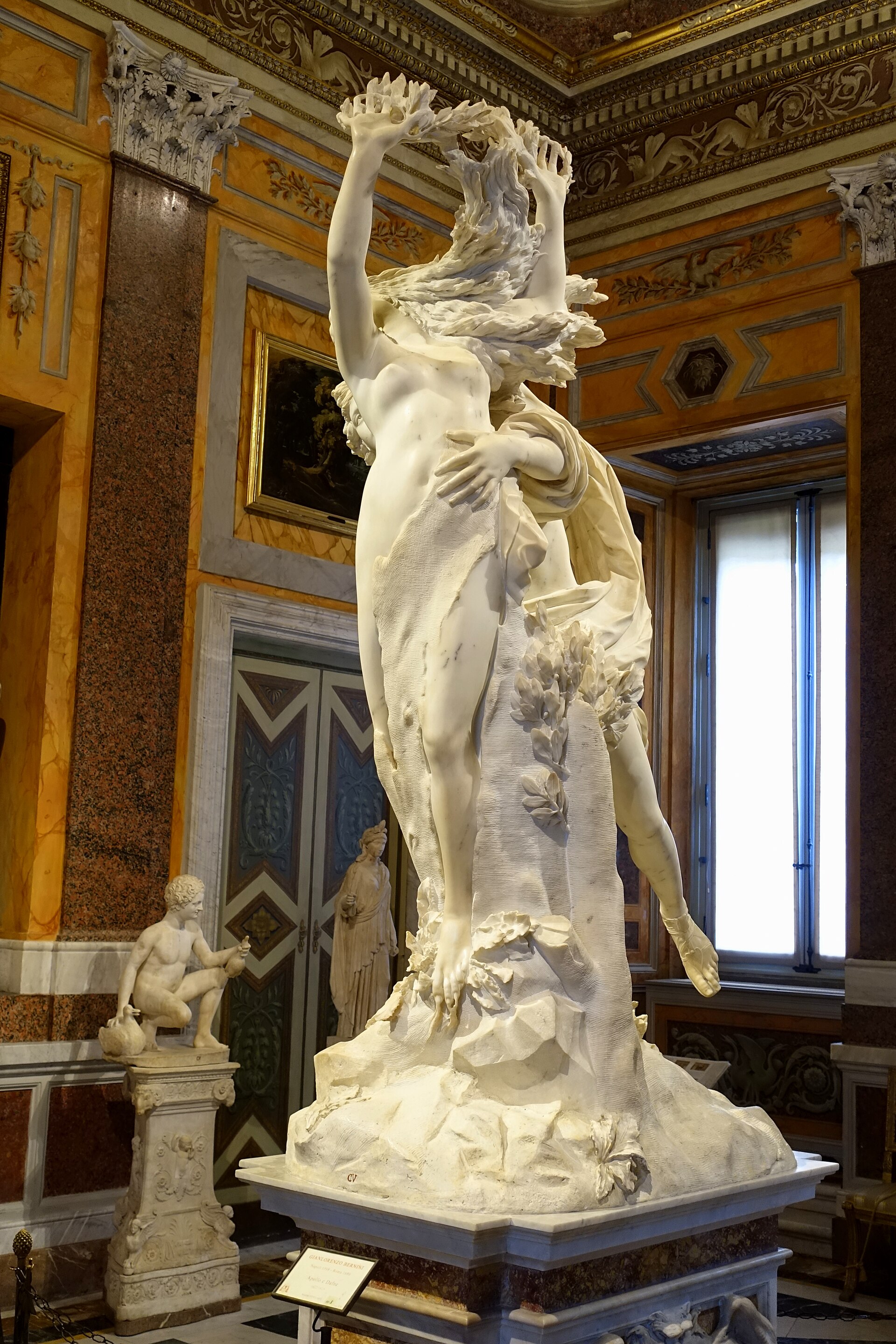
Finelli had been Bernini's assistant. He is widely held to have carved the leaves, the tendrils and the bark of Daphne's transformation in the Apollo and Daphne that Bernini made for this same cardinal, and to have been denied recognition for it; the claim is reported in the literature as an attribution rather than as a documented fact, and this record reports it the same way. What is not in doubt is that he broke with Bernini in 1629 after the commission for the Saint Helena in the crossing of St Peter's went to Andrea Bolgi instead of to him, and set up independently.
So the sequence is this. A sculptor whose most virtuoso passages are believed to be inside somebody else's masterpiece leaves the studio over a commission he did not get, and then carves the patron's head himself. Finelli's bust is habitually described as more meticulous in small detail and less psychologically alive than Bernini's, and that judgement is usually delivered as if it settled something. It is more useful as evidence of what a workshop specialist could do when he was finally allowed to sign the whole object.
Chapter 11The critics have never stopped ranking them
Because both busts survive and both are autograph, the literature has spent a century deciding which is better, which is a question the objects themselves do not raise.Howard Hibbard praised the...
Because both busts survive and both are autograph, the literature has spent a century deciding which is better, which is a question the objects themselves do not raise.
Howard Hibbard praised the first version for a new dimension of reality. Rudolf Wittkower held that the second lacks the animation and vitality of the first. Charles Avery went the other way and called the second one of the greatest portraits of all time in any medium. These are three of the most authoritative Bernini scholars of the twentieth century, reaching flatly opposed conclusions about two objects that a visitor sees in the same afternoon. This record takes no position and does not average them.
What the disagreement demonstrates is worth more than any of the three verdicts. The difference between these busts is small enough that expert judgement inverts on it. That is precisely the condition under which version confusion happens in the market and in publication, and it is why the caption discipline on this page is stricter than on any other record in the archive.
Chapter 12What a Bernini marble does in the market, and what it did to one dealer
The Borghese busts last changed hands in 1892 and have been Italian state property since.
The Borghese busts last changed hands in 1892 and have been Italian state property since. The comparandum below is given because it shows what an autograph Bernini portrait bust is worth once it is loose, and because it involves this cardinal's uncle.
Bernini carved a marble Bust of Pope Paul V in 1621, when he was in his early twenties. It was bought by a Viennese collector at auction in 1893, disappeared, and was presumed destroyed across two world wars. It resurfaced in Bratislava, where the heirs of the Slovak painter Ernest Zmetak consigned it, misattributed, to auction in 2013 with an estimate of 47,000 euros. It failed to sell. In September 2014 it was offered again and bought by an unnamed Slovak dealer at its pre-sale estimate of 24,000 euros. In July 2015 it was reported that the J. Paul Getty Museum had paid 33 million dollars for it in a private sale arranged by Sotheby's.
Two details in that chain matter more than the multiple. Johann Kraftner, director of the Liechtenstein collections, was offered the bust and, in his own account, courteously declined because the provenance was inconclusive. An institution with the money and the expertise passed on a genuine Bernini for the reason this publication exists. And the 33 million dollar figure is not a hammer price, because there was no auction; a private sale arranged by an auction house publishes nothing it is not obliged to publish, and the underbidder, if there was one, is unknown.
The artist
Gian Lorenzo Bernini
Bernini is the rare case where the documentary problem is not scarcity but partisanship. Two early lives exist, one by Filippo Baldinucci and one by the sculptor's own son Domenico, and almost every famous anecdote about him, including the fortnight in which he is supposed to have recarved this bust, comes from one or both of them. They disagree with each other, they are not neutral, and on this object both of them name a pope who had been dead for eleven years. Reading Bernini means reading two interested witnesses and saying which one is speaking.
Exhibited
- 1930Title not given in the museum's exhibition listIstituto di Studi Romani, Rome
- 1998Title not given in the museum's exhibition listGalleria Borghese, Rome
- 1999Title not given in the museum's exhibition listPalazzo Venezia, Rome
- 2017-2018Title not given in the museum's exhibition listGalleria Borghese, Rome
Literature
- Filippo Baldinucci, Vita del Cavaliere Gio. Lorenzo Bernino, pp. 18-20. The account of the crack described as a hair, and the fifteen nights. NOT CONSULTED IN THE ORIGINAL for this record; cited via the Galleria Borghese catalogue and the scholarly summary. (1682)
- Domenico Bernini, Vita del Cavalier Gio. Lorenzo Bernino, p. 11. The three-day version and the account in which the cardinal asks for the bust to be shown to the pope. NOT CONSULTED IN THE ORIGINAL. (1713)
- Stanislao Fraschetti, Il Bernini, p. 106ff, publishing the Estense archive report of the papal commission and the payment of 500 zecchini and a diamond worth 150 scudi. Cited by the Galleria Borghese; NOT CONSULTED IN THE ORIGINAL. (1900)
- Howard Hibbard, 'Un nuovo documento sul ritratto di Scipione Borghese del Bernini', pp. 101, 105. Publishes the December 1632 Borghese payment of 500 scudi and is the source of the museum's provenance line. NOT CONSULTED IN THE ORIGINAL. (1961)
- Michael Hill, 'Cardinal Dying: Bernini's Bust of Scipione Borghese', Australian Journal of Art 14, pp. 9-24. Listed in the Morgan Library's bibliography for the preparatory drawing. NOT CONSULTED; this is the first thing a researcher should read next. (1998)
Related works
| Work | Relation | Where it is |
|---|---|---|
| Bust of Cardinal Scipione Borghese, second version, inv. CCLXVI Gian Lorenzo Bernini | The other autograph bust of the same commission, carved because this one failed Marble, 1632, 78 cm. Carries its own crack across the mozzetta. Scipione placed it in the gallery on the first floor of the villa, not in the Room of the Emperors. Sold with its twin as lot 341 in 1892. | Galleria Borghese, Rome |
| Portrait of Cardinal Borghese, IV, 176 Gian Lorenzo Bernini | The only located preparatory drawing for the bust Red chalk over graphite on laid paper, 253 x 184 mm, about 1632. Richardson, Lawrence, Fairfax Murray, then bought by Pierpont Morgan in 1909. | The Morgan Library and Museum, New York |
| Cardinal Scipione Borghese, 53.201 Giuliano Finelli | A rival marble portrait of the same sitter by Bernini's former assistant Marble, 1631-32, 81.9 x 78.4 x 40.6 cm. Purchase, Louisa Eldridge McBurney Gift, 1953. Finelli left Bernini's studio in 1629 after being passed over for the Saint Helena in St Peter's. | Metropolitan Museum of Art, New York |
| Apollo and Daphne Gian Lorenzo Bernini, with Giuliano Finelli | The earlier Borghese commission whose most virtuoso passages are attributed to Finelli Marble, 1622-25. The leaves, tendrils and bark of the metamorphosis are attributed to Finelli in the literature on the basis of style and of his own grievance, not on a document. | Galleria Borghese, Rome |
| Bust of Pope Paul V Gian Lorenzo Bernini | Portrait of the sitter's uncle; the market comparandum for an autograph Bernini bust Marble, 1621. Sold at auction in 1893 to a Viennese collector and then lost; resurfaced misattributed in Bratislava, sold at 24,000 euros in 2014, acquired by the Getty for a reported 33 million dollars in 2015. | J. Paul Getty Museum, Los Angeles |
| David Gian Lorenzo Bernini | One of the four Borghese marble groups made for the same patron Marble, 1623-24, made for Scipione Borghese while Bernini was twenty-five. | Galleria Borghese, Rome |
Open questions
- Are the 500 scudi paid by Scipione Borghese in December 1632 and the 500 zecchini plus a diamond reported in the Estense archive one payment described twice, or two payments from two payers? The first is a Borghese household mandate; the second describes a papal recompense. Nothing consulted reconciles them, and the difference matters because it decides who actually paid for the object.
- If Urban VIII commissioned the bust, why? A reigning Barberini pope commissioning a portrait of the previous pope's nephew, in the last year of that nephew's life, is a political act, and no source consulted explains it.
- What did the Italian state pay for the two busts at the Giacomini and Capobianchi sale of 28 March to 9 April 1892? The lot number, 341, is published; the price is not.
- Why were these two busts excluded from the Borghese fideicommissum when so much else was inside it? Exclusion is what put them in a saleroom, and the sources consulted do not explain the classification.
- Why were both busts held at the Accademia in Venice until 1908, and under what arrangement? Sixteen years in another city is unexplained in the museum's own provenance note.
- Has either bust been examined technically? No published report of surface analysis, ultraviolet examination or three-dimensional scanning of either marble was found. For an object whose identity question turns on two fissures, the absence of a published condition study on the cracks themselves is a real gap.
- How many preparatory drawings were made? The Galleria Borghese describes the Morgan sheet as the only survivor of many; nothing establishes how many.
- What became of the diamond worth 150 scudi reported as part of Bernini's recompense?
Questions about this object
What is Bust of Cardinal Scipione Borghese, first version?
Bust of Cardinal Scipione Borghese, first version is a sculpture, dated 1632. Medium: Carrara marble.
Who made Bust of Cardinal Scipione Borghese, first version, and is the attribution settled?
The attribution to Gian Lorenzo Bernini is recorded here as accepted. Autograph and undisputed. So is the other one. That is the whole problem this record exists to handle: Bernini carved TWO marble busts of Scipione Borghese in 1632, both by his own hand, both in the Galleria Borghese, both about 78 cm high, and the second exists only because the first developed a fault. Attribution here is never the question. Identification is. A photograph of one of these busts is worthless as evidence unless it shows either the crack across the forehead or the inventory number painted on the socle.
Where is Bust of Cardinal Scipione Borghese, first version now?
Galleria Borghese, Rome. Inventory number CCLXV. Last confirmed 19 August 2026. Museum collection catalogue entry; Italian state property since the acquisition of the Borghese fideicommissary collection.
What is still unknown about Bust of Cardinal Scipione Borghese, first version?
Are the 500 scudi paid by Scipione Borghese in December 1632 and the 500 zecchini plus a diamond reported in the Estense archive one payment described twice, or two payments from two payers? The first is a Borghese household mandate; the second describes a papal recompense. Nothing consulted reconciles them, and the difference matters because it decides who actually paid for the object.
Sources
- 1Galleria Borghese, online collection catalogue, entry for Bust of Scipione Borghese, inventory CCLXV. The museum's own record, re-read verbatim for this correction: 1632, Carrara marble, height 77.2 cm; 'commissioned to Gian Lorenzo Bernini by Pope Urban VIII'; the payment of 500 scudi in December 1632 with its Vatican archive citation via Hibbard 1961; the crack described by Baldinucci as a hair; fifteen nights per Baldinucci against three days per Domenico; the Room of the Emperors; 'purchased by the Italian state in 1892 on the occasion of the first sale of the Borghese works that were excluded from the fideicommissum (Giacomini & Capobianchi, Rome, 28 March - 9 April 1892, no. 341)'; 'It was then conserved at the Accademia in Venice until 1908, when it returned to Villa Pinciana'; the room history to Room 14, Lanfranco Loggia; the conservation record; and the four exhibitions. collezionegalleriaborghese.it/en/...
- 2Galleria Borghese, online collection catalogue, entry for Bust of Scipione Borghese, inventory CCLXVI. The second version: 1632, marble, height 78 cm, squarer shoulders, more uniform polish, the horizontal fold between the last pair of buttons, the crack running from the lower right of the mozzetta through the centre to the upper left, and the pair's stay at the Accademia in Venice before returning to the Villa Pinciana in 1908. collezionegalleriaborghese.it/en/...
- 3The Morgan Library and Museum, Drawings Online, Gianlorenzo Bernini, Portrait of Cardinal Borghese, IV, 176. Red chalk over graphite on laid paper, 253 x 184 mm, about 1632, catalogued as 'possibly a study for the marble in the Borghese Gallery'; the exhibition label on Bernini's portrait method; the Richardson verso inscription; the Richardson, Lawrence and Fairfax Murray provenance and the 1909 Morgan purchase; and the bibliography, which lists Michael Hill, 'Cardinal Dying: Bernini's Bust of Scipione Borghese', Australian Journal of Art 14 (1998), 9-24. Fetched via the in-app browser after the site returned a bot challenge. themorgan.org/drawings/...
- 4Metropolitan Museum of Art, collection record for Giuliano Finelli, Cardinal Scipione Borghese (1577-1633), accession 53.201, retrieved from the museum's public collection API. Marble, 1631-32, 81.9 x 78.4 x 40.6 cm, Purchase, Louisa Eldridge McBurney Gift, 1953, gallery 618, public-domain image status. metmuseum.org/art/...
- 5Wikipedia, 'Two Busts of Cardinal Scipione Borghese'. TERTIARY, but it cites the two early lives by page (Baldinucci 1682, pp. 18-20; D. Bernini 1713, p. 11) and it is the source for the observation that BOTH biographies name Pope Paul V, who died in 1621, and that both accounts should therefore be treated with suspicion. Also the source for the Estense archive report of 8 January 1633 and for the Hibbard, Wittkower and Avery assessments. Flagged for replacement with Andrea Bacchi and Anna Coliva's Borghese catalogue and with the Hill article listed under source 3. en.wikipedia.org/wiki/...
- 7Wikipedia, 'Giuliano Finelli'. TERTIARY. Used for Finelli's break with Bernini in 1629 over the Saint Helena commission awarded to Andrea Bolgi. Note that on the Apollo and Daphne foliage this source is hedged: Finelli 'is purported to have been slighted by failure to be recognized as the detail master' behind the group. This record follows that hedge. Flagged for replacement with Giovanni Battista Passeri's life of Finelli and with Jennifer Montagu on Roman baroque sculptural practice. en.wikipedia.org/wiki/...
- 8Through Eternity Tours, 'Scipione Borghese: Cardinal and Collector'. TERTIARY. Used for the 1607 confiscation from the Cavaliere d'Arpino and its transfer to Scipione including the two early Caravaggios, and for the removal of Raphael's Deposition from San Francesco al Prato in Perugia on the night of 18 to 19 March 1608 and its subsequent declaration as the cardinal's private property. Flagged for replacement with the Galleria Borghese catalogue entries for those pictures. througheternity.com/travel-guide/...
- 9Artnet News, 27 July 2015, 'Slovakian Dealer Makes a Fortune with Resale of $33 Million Bernini Bust To Getty Museum'. The Bust of Pope Paul V: the 1893 auction, the Zmetak heirs' 2013 consignment at EUR 47,000 unsold, the September 2014 sale at EUR 24,000, the USD 33 m private sale to the Getty arranged by Sotheby's, and Johann Kraftner's refusal on provenance grounds. The article contains an internal inconsistency, giving 1893 for the Viennese purchase in one sentence and 1917 in another. Fetched via the in-app browser after the site returned HTTP 403 to a direct fetch. news.artnet.com/art-world/...
- 11Wikimedia Commons file pages for the two Daderot photographs used as plates 1 and 2, wikitext read directly. Both are released cc-zero by the photographer with the underlying sculpture PD-old-100. The description text of the CCLXVI file wrongly repeats CCLXV; the filename is correct. The identification used in this record was made from the object itself, from the painted socle number and the position of the crack, not from the file metadata. commons.wikimedia.org/wiki/...

Last verified 19 August 2026 · Published 4 August 2026
Change log
2 August 2026 - Record deepened to the house standard: narrative sections, technical evidence, artist dossier, related works and open questions added; provenance chain and auction results replaced with the researched versions; sources rebuilt.
4 August 2026 - Record created at the house standard: researched narrative, technical evidence, maker dossier, graded provenance chain, prices with hammer and premium separated, related works, open questions and sources.
19 August 2026 - 2026-08-19: Re-verified. Current location, display rooms and conservation history confirmed unchanged against the museum own catalogue (the CCLXVI entry shows a January 2024 text update with no substantive change); no new attribution or which-bust-is-which scholarship, no new restoration or technical study, and no litigation or ownership dispute found; the 2026 Palazzo Barberini Bernini exhibition was confirmed to exclude the Borghese busts; all cited sources still resolve, with the Morgan, Met and Artnet URLs continuing to show the same bot-block or rate-limit behavior already noted in the record. No factual change to the record.