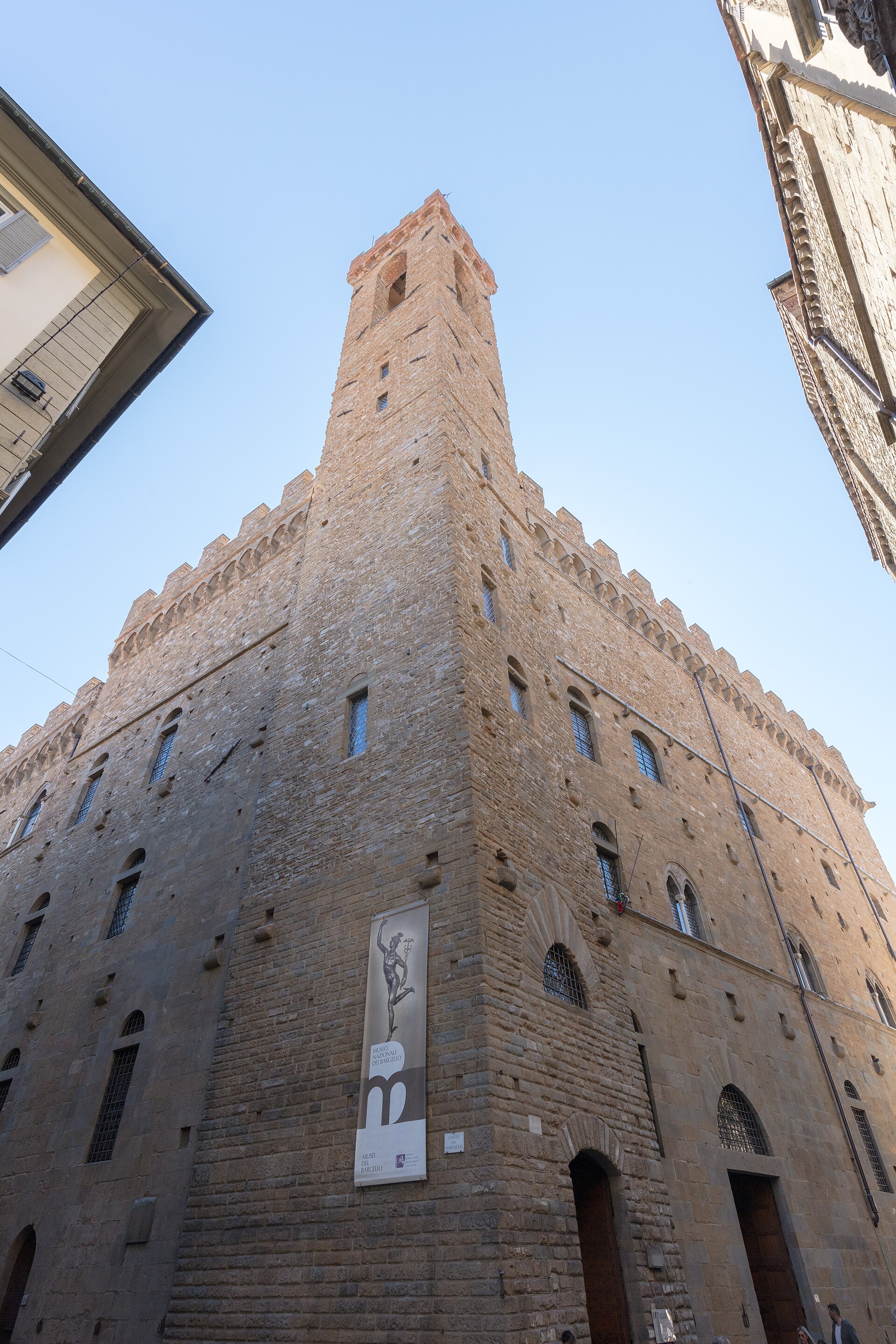
The medieval crenellated tower and facade on Via del Proconsolo, with the Museo Nazionale del Bargello banner visible on the corner of the building.
Photograph by Diego Delso, CC BY-SA 4.0Museo Nazionale del Bargello
Museum · Founded 1865
Open, admission and hours confirmed 22 August 2026 · 11 sources
On this page 14 sections
ContentsClose
The Bargello holds what is generally reckoned the single most important collection of Italian Renaissance sculpture anywhere, concentrated in a medieval building that was never designed to be a gallery. Its core is fifteenth-century Florentine bronze and marble - Donatello above all, but also Verrocchio, the Della Robbia family and Bertoldo di Giovanni - extended forward into the sixteenth century with major Michelangelo and Cellini and outward into decorative arts that rarely get equal billing at a sculpture-focused museum: ivories, maiolica, textiles, seals, arms and armour, and a nine-hundred-year-old liturgical fan, the Flabellum of Tournus, among the oldest objects in the building. The collection was assembled from scratch after the museum's 1865 founding, so almost nothing here has been in the building longer than about a century and a half; what makes the collection cohere is curatorial choice rather than an unbroken original commission, unlike, say, a family palace preserved with its original contents.
| Kind | Museum |
|---|---|
| Founded | 1865 as a museum; the palace itself was begun in 1255 |
| City and country |  Florence, Italy Florence, Italy |
| Address | Via del Proconsolo, 4, 50122 Firenze, Italy |
| Website | bargellomusei.it |
| Status | Open, confirmed |
| Record last verified |
Visiting
- Hours
- Tuesday to Sunday08:15 to 18:50Unified across all Musei del Bargello / GAMB sites since 15 March 2026. Last admission 50 minutes before closing
- MondayClosed
- Extraordinary evening openings: 5, 12, 19, 26 October 202617:00 to 21:00Newly listed on the museum's own site this pass, not previously recorded
- Extraordinary evening opening: 30 November 2026 (Festa della Toscana)17:15 to 21:00Daytime extraordinary opening for the Tuscany regional holiday; newly listed on the museum's own site this pass, not previously recorded
- Closed
- Monday.
- Admission
- Standard, Museo Nazionale del Bargello onlyEUR 12Unchanged since raised from EUR 10 on 1 February 2026, ahead of the 15 March 2026 unification of tickets and hours across the group
- Combined, 72 hours, all five GAMB sitesEUR 38Galleria dell'Accademia di Firenze, Museo Nazionale del Bargello, Museo delle Cappelle Medicee, Complesso di Orsanmichele and Museo di Palazzo Davanzati, on one ticket over three consecutive days
- Combined, 48 hours, Accademia + Bargello onlyEUR 26Reservation is optional, EUR 4.00 if booked, per the museum's own ticket notice
Free entry: The national #domenicalmuseo scheme: free entry to the Bargello and the other GAMB state sites on selected Sundays through the year; the museum's own site currently lists the first Sunday of every month, plus 25 April, 2 June and 4 November as free-entry days, with bookings and educational activities suspended on those days. Reduced and free admission categories set by Italian state museum regulation (which typically includes free entry for EU citizens under 18 and reduced entry for EU citizens 18 to 25) are stated on the museum's own site to be unchanged by the March 2026 price and hours reform, but the exact current reduced figure was not itself read on a page fetched for this record- Tickets
- bargellomusei.it/biglietti The museum's own ticket page.
- Do I need to book?
- Not required for individual visitors on the evidence read here, though tickets for all group sites are sold through one official booking channel (B-Ticket, via the Ministry of Culture's concessionaire)
- Address
- Via del Proconsolo, 4, 50122 Firenze, Italy MapOn foot In the historic centre, a few minutes' walk from the Duomo and from Piazza della Signoria; most of the surrounding streets are pedestrianised or heavily restricted to traffic
Rail Firenze Santa Maria Novella station is roughly a 15 to 20 minute walk - Website
- bargellomusei.it
- Telephone
- +39 055 0649440
- [email protected]
Before you go how long, access, photography, bags, eating, shop
- How long to allow
- Not stated in the sources read for this page
- Access
- The museum publishes a dedicated tactile booklet for the Salone di Donatello for visually impaired and blind visitors, introduced alongside the hall's 2025 reopening
- Photography
- Not stated in the sources read for this page
- Bags
- Not stated in the sources read for this page
- Eating
- Il Barroccio Antica Osteria operates on the ground floor of the museum building, on Google's own listing for the site
- Shop
- A small museum gift shop is on site, referenced in visitor accounts
Prices and hours change. We take them from the institution's own pages and print the day we read them, and you can check the current position at the source we used. Confirm before you travel.
What is inside
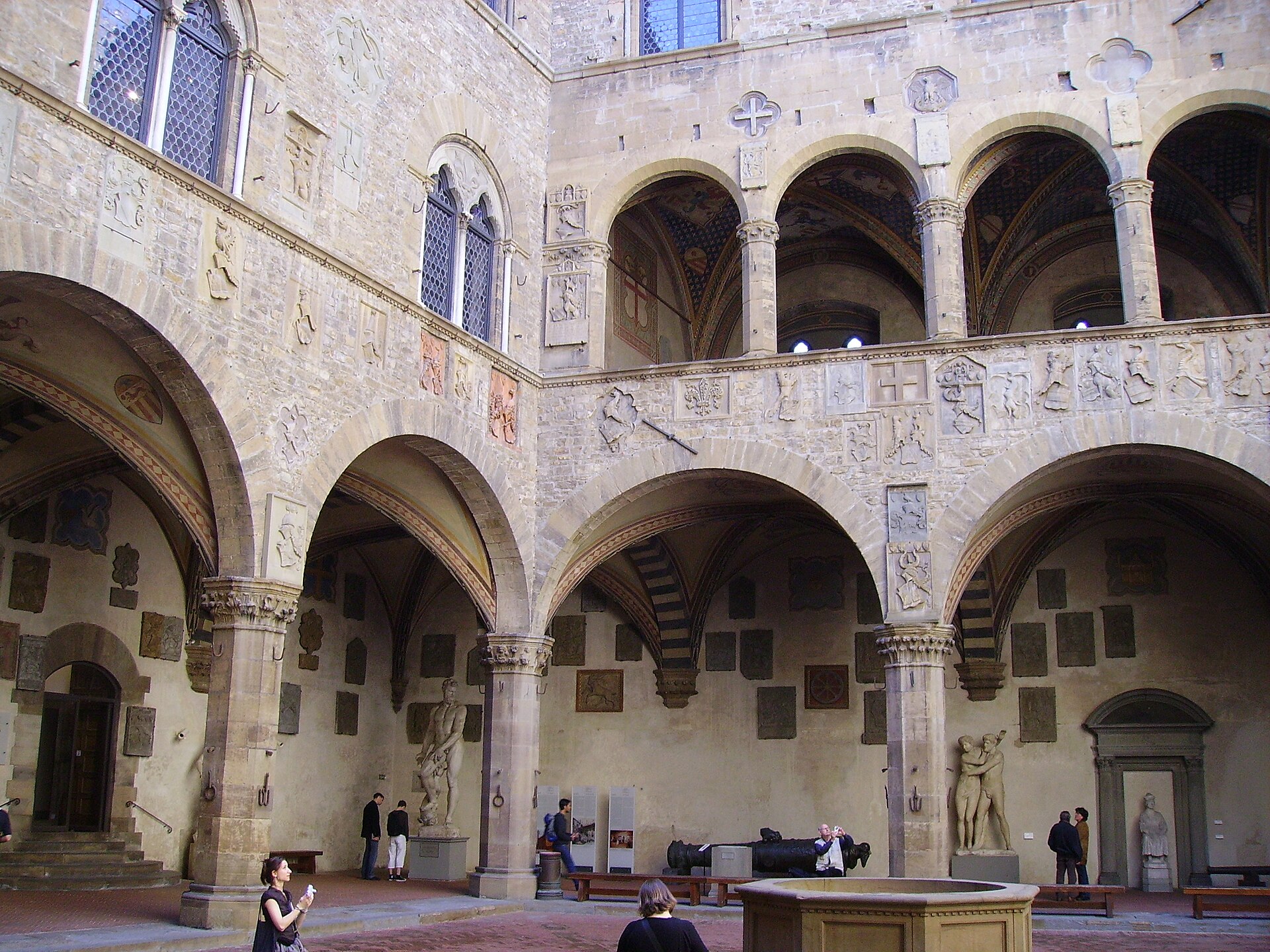
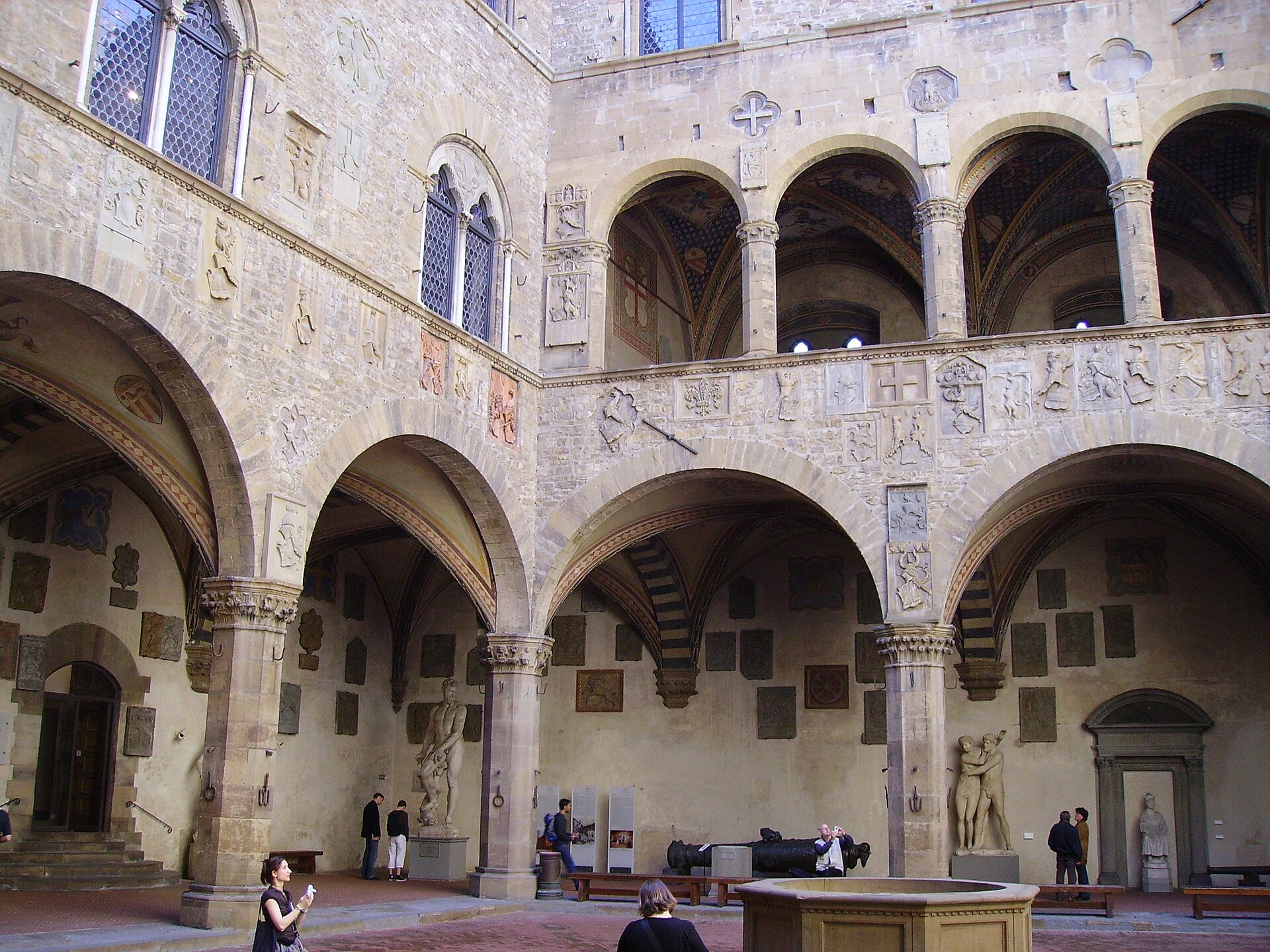
Photograph by Yair-haklai · CC BY-SA 4.0 Cortile (courtyard)
The medieval arcaded courtyard, its walls set with the carved stone coats of arms of successive Podesta (chief magistrates) who held office in the palace, alongside Renaissance and later bronze cannon and outdoor sculpture including Vincenzo Gemito's Pescatorello.
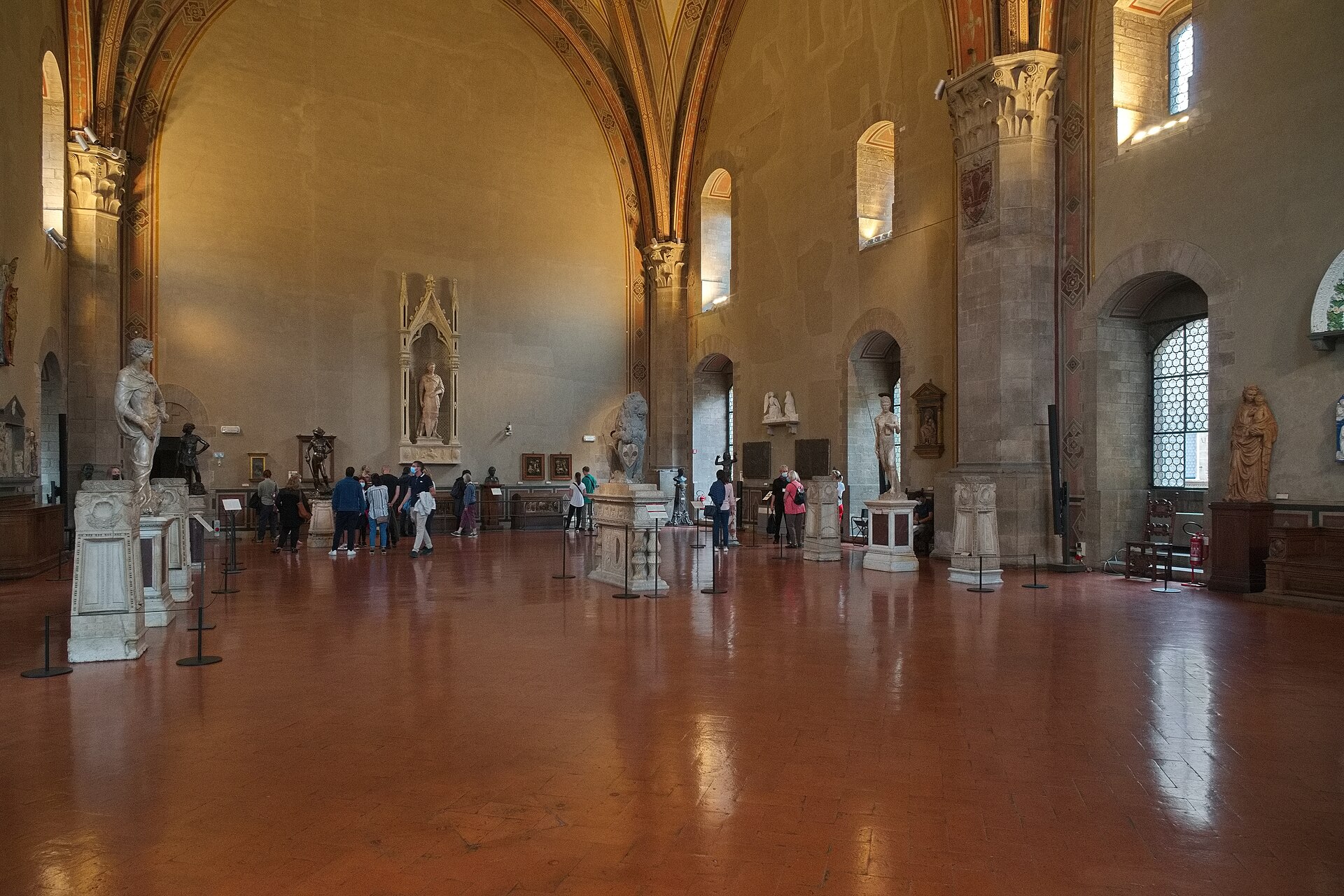
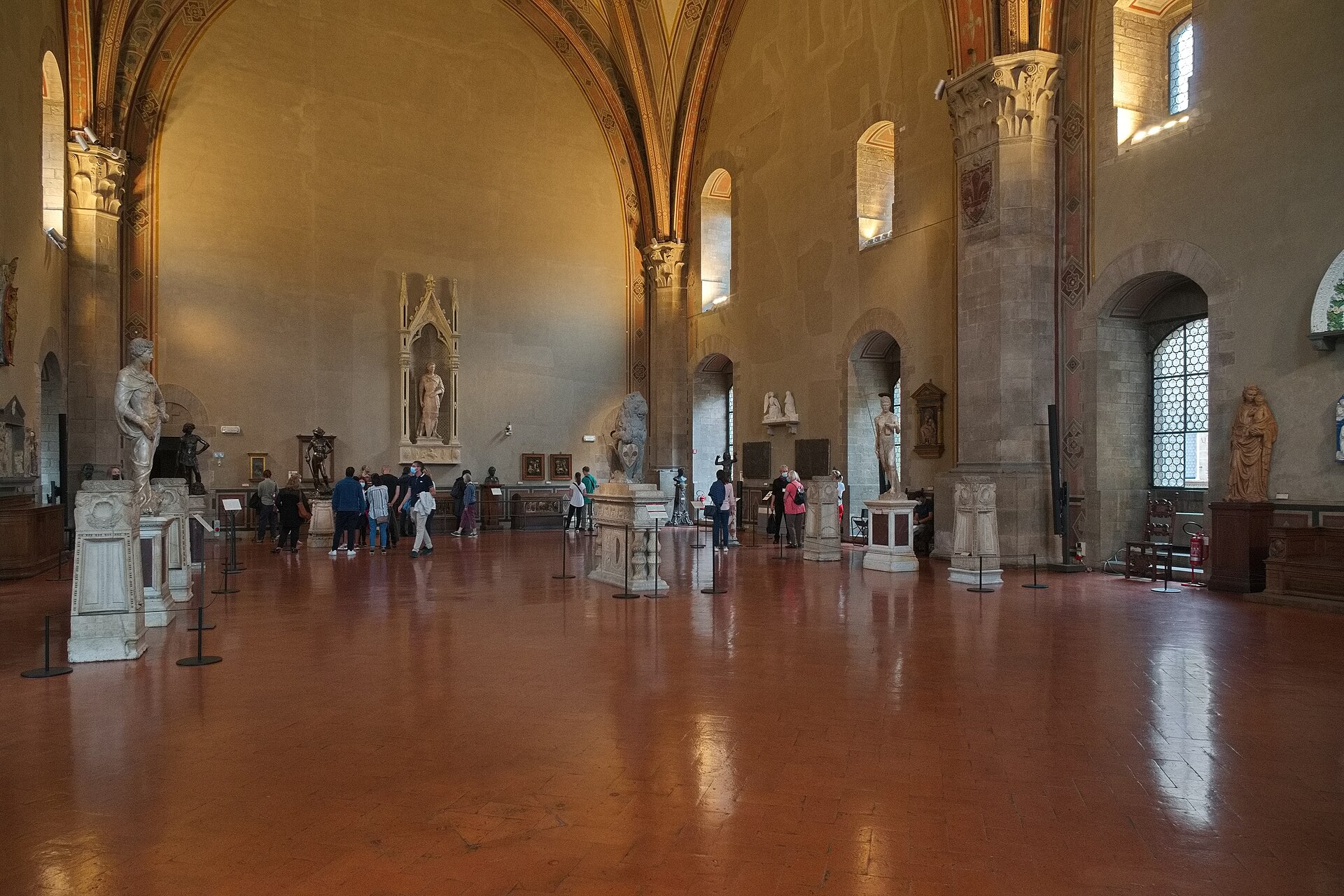
Photograph by MenkinAlRire · CC BY-SA 4.0 Salone di Donatello (also called the Sala del Consiglio Generale)
The great hall of early Florentine Renaissance sculpture, closed for restoration and reinstallation from June 2024 to April 2025 and now displaying, by the museum's own account, 67 masterpieces including Donatello's bronze and marble David, his Marzocco, Verrocchio's David, and both competing Sacrifice of Isaac panels from the 1401 Baptistery doors competition.
Sala di Michelangelo (sixteenth-century sculpture)
Michelangelo's Bacchus and the statue known as his Apollo or David (the identification is disputed), alongside Michelangelo's Brutus, sculptures by Giambologna, and Benvenuto Cellini's bronze bust of Cosimo I de' Medici.
Cappella della Maddalena (chapel)
The palace's former chapel, used as a holding cell in the building's prison period, with fresco decoration attributed to Giotto and his workshop that includes a much-discussed early portrait of Dante Alighieri at the foot of a Paradise scene.
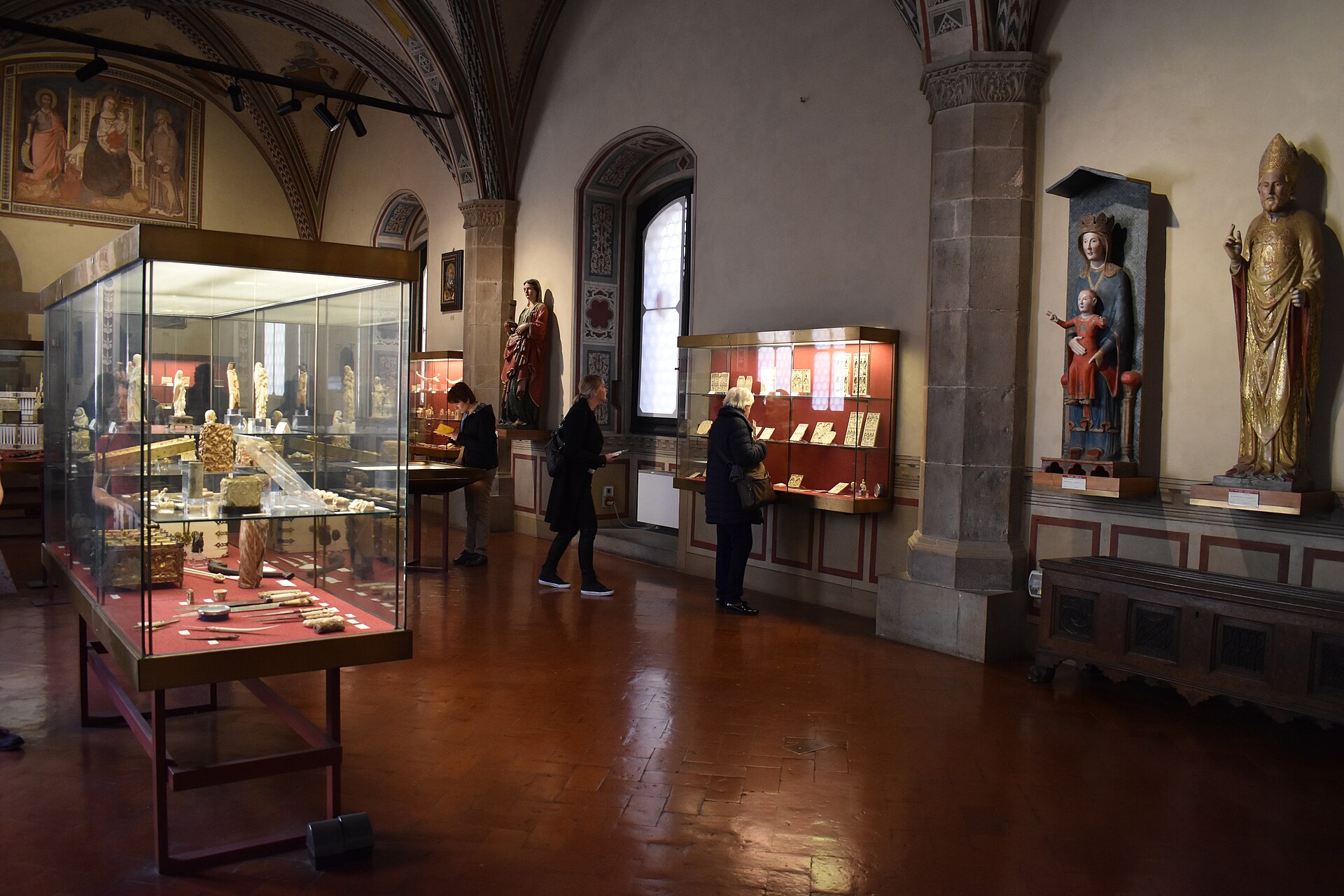
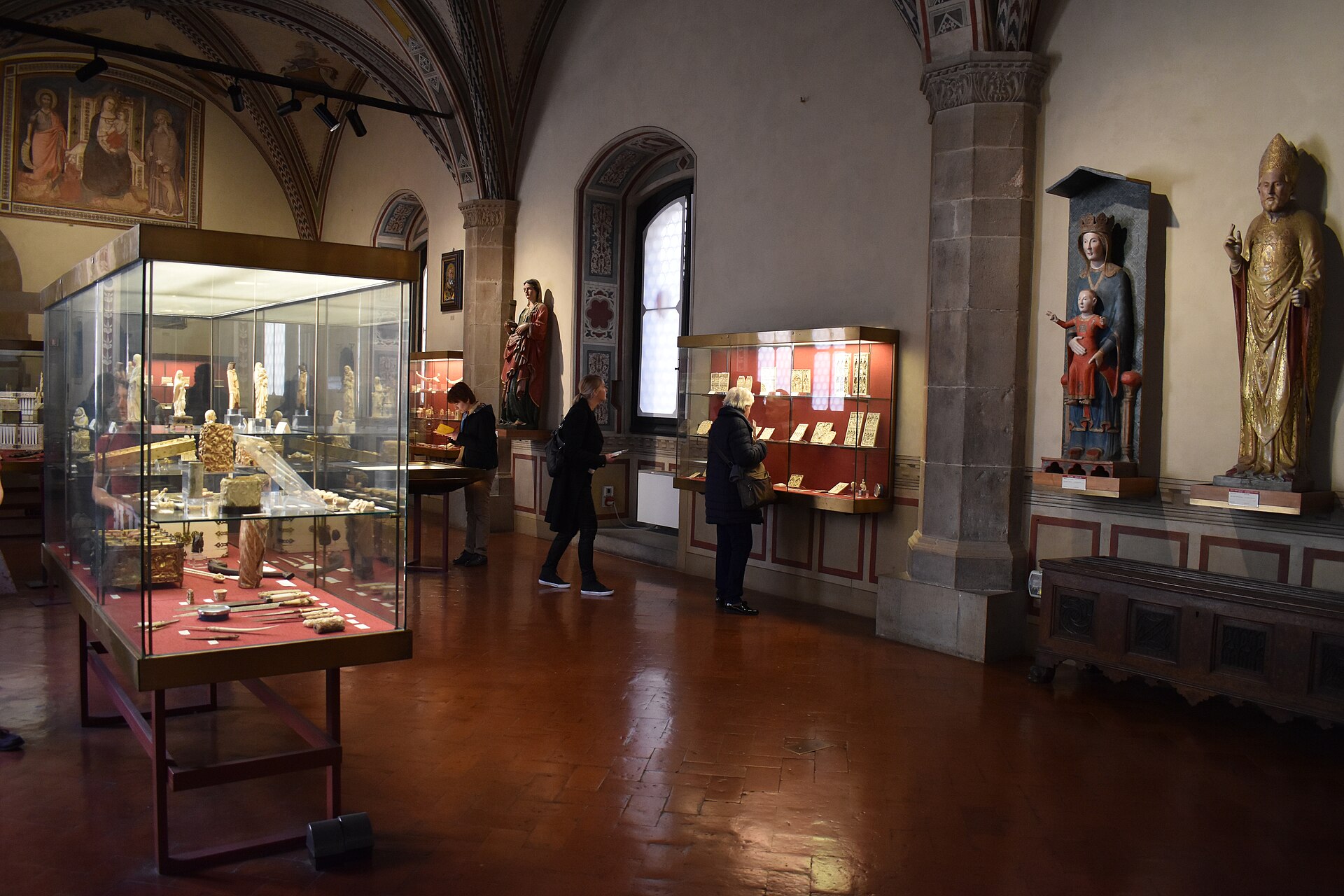
Photograph by Nicola Quirico · CC BY-SA 4.0 Sala degli Avori (ivories room)
One of the world's richer collections of carved ivory objects, from late antique consular diptychs to Gothic devotional carvings, shown in wall and table cases alongside related decorative arts.
What to see first
David (bronze)
Donatello, probably 1440sFamous as the first unsupported freestanding bronze cast of the Renaissance and the first freestanding nude male sculpture since antiquity. Its creation is entirely undocumented: most scholars assume a Medici commission, but the date is disputed across a forty-year range from the 1420s to the 1460s.9
David (marble)
Donatello, 1408-1409Three decades earlier and far more conventional than the bronze that shares its subject and its room, this early marble David shows how far Donatello's own treatment of the same story moved across his career.6
Sacrifice of Isaac (competition panels)
Lorenzo Ghiberti and Filippo Brunelleschi, 1401-1402The two surviving trial panels from the competition for the Florence Baptistery's second bronze doors, both still showing the same set subject. The jury could not choose between them and proposed the two artists work jointly; Brunelleschi's pride sent him to Rome instead, leaving the 21-year-old Ghiberti the commission alone, though Ghiberti's own memoir later claimed he had won outright, without a single dissenting vote.8
Bacchus
Michelangelo, c. 1497One of Michelangelo's first Roman commissions and his earliest surviving large-scale statue, showing the wine god visibly unsteady on his feet, a naturalistic touch of drunkenness rare in classicising sculpture of the period.1
Apollo, or David
Michelangelo, c. 1530The museum's own image captions give both names for this unfinished late statue, reflecting a genuine, unresolved disagreement over whether it depicts the god or the biblical king.1
Bust of Cosimo I de' Medici
Benvenuto Cellini, 1546-1547A bronze state portrait of the reigning Medici duke by the sculptor and goldsmith better known for the Perseus in the Loggia dei Lanzi; the Bargello holds one of the models Cellini made in preparation for that same bronze Perseus.1
Marzocco
Donatello, 1418-1420The heraldic seated lion holding the Florentine shield, made for a different public site in the city and later moved into the museum: one of the most recognisable civic symbols of Florence, now indoors under the museum's care rather than exposed to weather in the open air.1
Past exhibitions here
- Closed12 May to 5 Sep 2026Confirmed · check before you travel
A magistrate's palace, then a prison, then Italy's first national museum
The palace was begun in 1255 as the first purpose-built public building of medieval Florence, and the museum's own account calls it a monument of real fascination in its own right, independent of what it now holds. It served as the seat of the Podesta, the city's chief magistrate, a role recorded today in the carved coats of arms set into the courtyard walls, each one marking an office-holder's term. From the second half of the sixteenth century the building's function changed entirely: it became a prison, headed by the city's chief of police, the bargello, whose title the building and later the museum still carry. The Cappella della Maddalena, the palace's former chapel, was used as a holding cell during this period, which sits oddly against the Giotto workshop frescoes and the portrait of Dante still visible on its walls.
The building reopened in 1865 as the first National Museum of the Kingdom of Italy, dedicated to the art of the Middle Ages and the Renaissance, a status distinct from a Grand Ducal or ecclesiastical collection repurposed for public display: this was a museum built by the new Italian state specifically to hold what it collected after unification, in a building that had itself been a prison a few years before.
1401: a competition Ghiberti says he won outright, and evidence that says otherwise
Both surviving entries from the 1401-1402 competition to design the Florence Baptistery's second bronze doors are in the Bargello: Sacrifice of Isaac panels by Lorenzo Ghiberti and by Filippo Brunelleschi, made to identical specifications, brass tables issued to each competitor with a year to complete a relief of the same subject and the same size. Seven semi-finalists were narrowed to two, Ghiberti and Brunelleschi, and the judging panel could not separate them: the recorded proposal was that the two work on the doors together. Brunelleschi's pride would not allow it. He left for Rome to study architecture instead, and the twenty-one-year-old Ghiberti went on to make the doors alone over the next two decades. Ghiberti's own later autobiography claims he won the competition outright, without a single dissenting voice among the judges - a claim the joint-commission story, which comes down through other sources, does not support. The two panels are also technically different: Brunelleschi cast his figures as separate pieces bolted onto the bronze backing, where Ghiberti cast his figures, other than Isaac himself, in one hollow piece, a lighter and more efficient method some historians credit as part of why the commission went his way.
Two Davids, four decades apart, neither one documented
Donatello made two versions of David for two different contexts, and both now stand in the same room. The marble David of 1408-1409 is a comparatively conventional early work. The bronze David, probably from the 1440s though the exact date has been argued across a forty-year range from the 1420s to the 1460s, is anything but conventional: nude but for boots and a laurel-topped hat, one foot resting on Goliath's severed head, with a physique art historians have called startlingly androgynous, sometimes traced to classical images of Antinous. No contract, payment record or commission document for the bronze survives; the near-universal assumption that Cosimo de' Medici commissioned it for the new Medici palace rests on circumstance, not paperwork. What is not disputed is its historical weight: it is the first unsupported freestanding bronze cast since antiquity, and the first freestanding male nude of the Renaissance.
The Salone di Donatello, closed for a year and only recently reopened
The Salone di Donatello, the hall built to hold precisely this kind of sculpture, closed for restoration and reinstallation on 5 June 2024 and did not reopen until 18 April 2025, a closure the museum's own updates describe as taking 13 of the room's 67 normal masterpieces temporarily off view. On reopening, the museum's Director General of Museums, Massimo Osanna, called it the returned 'temple of fifteenth-century Italian sculpture,' now presented in a renewed and more accessible form; a new tactile guide booklet for visually impaired and blind visitors was introduced alongside the reopening. A year without its single most important room is a real gap in what the museum could show, even if the renovation itself is now complete.
One museum among seven, and a fight over what a David can be used for
Since a 2025-2026 reorganisation, the Bargello has been governed jointly with the Galleria dell'Accademia di Firenze and three smaller Florentine house-museums (Palazzo Davanzati, Casa Martelli and the Orsanmichele complex) under a single director, Andreina Contessa, and a shared administration (GA-AFI-MN-BAR in the group's own email addresses). From 15 March 2026 the group unified opening hours across all sites to Tuesday-Sunday, 8:15am to 6:50pm, and introduced two combined tickets spanning multiple sites, alongside standard ticket prices that had already risen across the group on 1 February 2026 - the Bargello's own standalone ticket going from EUR 10 to EUR 12. The stated goal, in the director's own words, was to turn what had been a fragmented set of sites into one coherent cultural project rather than a simple sum of separate museums.
That shared governance put the Bargello's name on a controversy that is not, strictly, about anything the Bargello itself owns. In April 2026, after a political movement used an image of Michelangelo's David - the giant marble at the Accademia, not the Bargello's own Davids by Donatello - in political campaign material, the joint Galleria dell'Accademia di Firenze e Musei del Bargello administration issued a public statement asserting that Italian cultural-heritage law treats such works as collective property that cannot be appropriated for private, commercial or political ends. It is a reminder that a museum's name and imagery now function as a kind of public trademark the institution has to actively defend, a task with little to do with conservation or cataloguing.
What visitors say
We publish no visitor review prose and cite no single review as representative. Google's aggregate sits at a strong 4.7. Visitors consistently describe the Bargello as a calmer, far less crowded alternative to the Uffizi and the Accademia for seeing major Renaissance sculpture, several noting they had rooms largely to themselves even in peak season. The recommended route is usually described as three floors organised by theme (arms, ceramics and tiles, sculpture, tapestries among them).
What is praised, what is criticised
- Praised: the low crowds relative to Florence's other major museums, repeatedly described as the museum's biggest single advantage
- Praised: the range of the collection beyond sculpture alone: arms and armour, ceramics, ivories and tapestries as well as the Renaissance marbles and bronzes
- Praised: the building itself, a medieval fortress-palace with an arcaded courtyard, rather than a purpose-built gallery
- Praised: clear, bilingual room texts, called out specifically in visitor accounts
- Criticised: some visitors have found the room-by-room layout across three floors hard to navigate without a guide or a clear plan
- Criticised: the Salone di Donatello's closure for restoration from June 2024 to April 2025 meant the museum's single most important room, and 13 of its normal 67 masterpieces on the museum's own account, were unavailable to visitors for nearly a year
- Criticised: the standard ticket price rose twenty per cent, from EUR 10 to EUR 12, on 1 February 2026, shortly before the museum was folded into a group-wide combined-ticket system
- Criticised: in April 2026 the museum and its sibling institution, the Galleria dell'Accademia di Firenze, had to issue a public statement after a political movement used the image of Michelangelo's David (held at the Accademia, not at the Bargello) in political campaigning, arguing that state-owned cultural heritage cannot be appropriated for partisan use - a live illustration of the pressures a museum director now has to manage that goes well beyond conservation and cataloguing
Ratings on other platforms
Google: 4.7 from 9,042 ratings, read 7 August 2026
A platform average is a tertiary source: it moves, it is not audited, and we quote no visitor's words.
Questions about Museo Nazionale del Bargello
Where is Museo Nazionale del Bargello?
Via del Proconsolo, 4, 50122 Firenze, Italy.
How much does it cost to visit?
Standard, Museo Nazionale del Bargello only: EUR 12; Combined, 72 hours, all five GAMB sites: EUR 38; Combined, 48 hours, Accademia + Bargello only: EUR 26. As confirmed 22 August 2026.
When is it open?
Tuesday to Sunday 08:15-18:50; Monday closed; Extraordinary evening openings: 5, 12, 19, 26 October 2026 17:00-21:00; Extraordinary evening opening: 30 November 2026 (Festa della Toscana) 17:15-21:00. Closed: Monday. As confirmed 22 August 2026.
How do you get there?
On foot: In the historic centre, a few minutes' walk from the Duomo and from Piazza della Signoria; most of the surrounding streets are pedestrianised or heavily restricted to traffic; Rail: Firenze Santa Maria Novella station is roughly a 15 to 20 minute walk.
What should you see first?
David (bronze) (Donatello, probably 1440s); David (marble) (Donatello, 1408-1409); Sacrifice of Isaac (competition panels) (Lorenzo Ghiberti and Filippo Brunelleschi, 1401-1402); Bacchus (Michelangelo, c. 1497); Apollo, or David (Michelangelo, c. 1530); Bust of Cosimo I de' Medici (Benvenuto Cellini, 1546-1547).
What we could not confirm
- The precise reduced-admission figure for EU citizens aged 18 to 25 under the March 2026 pricing reform was not read on a page fetched for this record; the museum states the category is unchanged but does not repeat the euro figure on the page consulted.
- Whether the joint GAMB administration's April 2026 statement on the political use of Michelangelo's David image has led to any further action (legal, regulatory or otherwise) is not established from a source read for this page.
- The exact identification of the late Michelangelo statue the museum itself captions as 'Apollo, or David' remains genuinely unresolved in the scholarship and is not settled by this page.
- Whether the Bargello holds any objects with unresolved Nazi-era or wartime provenance gaps was not addressed in any source read for this page and is not established either way.
Images
Sources
- 1Musei del Bargello, official site: Museo Nazionale del Bargello landing page - history, address, today's hours, named highlight works illustrated in the museum's own image gallery (Marzocco, Bacchus, Apollo/David, Cellini's Cosimo I bust, Cappella della Maddalena, Sala degli Avori). Read 7 August 2026. bargellomusei.it/musei/museo-nazionale-del-bargello/
- 2Musei del Bargello, official site, news item: 'Dal 15 marzo 2026 nei nostri Musei: biglietti cumulativi e orari unificati', 11 March 2026, on the unified hours, combined tickets, and 1 February 2026 price increases across the GAMB group. bargellomusei.it/dal-15-marzo-2026-nei-nostri-musei-biglietti-cumulativi-e-orari-unificati/
- 3Musei del Bargello, official site: Contatti page, listing the museum's address, phone, email, director and named department heads. Read 7 August 2026. bargellomusei.it/contatti/
- 4Musei del Bargello, official site, news item: '#Domenicalmuseo | Ingresso gratuito nei nostri Musei', 5 June 2026, confirming the free-Sunday admission scheme across GAMB sites including the Bargello. bargellomusei.it/domenicalmuseo-ingresso-gratuito-nei-nostri-musei/
- 5Google Maps listing, Museo Nazionale del Bargello: aggregate rating 4.7 from 9,042 ratings, address, phone, on-site restaurant. google.com/maps/search/Museo+Nazionale+del+Bargello+Firenze
- 6Musei del Bargello, official site search results for 'concorso del 1401', including 'Il Salone di Donatello chiude per restauri e riallestimento' (30 September 2024) and 'Museo Nazionale del Bargello: riapre al pubblico il Salone di Donatello' (18 April 2025), confirming the Donatello hall's closure dates and the 67/13-masterpiece figures. bargellomusei.it/?s=concorso+del+1401
- 7Musei del Bargello, official site, news item: 'Il David non fa propaganda: il patrimonio culturale non puo e non deve essere piegato a interessi politici', 15 April 2026, joint statement of the Galleria dell'Accademia di Firenze and Musei del Bargello on the political use of Michelangelo's David image, quoting director Andreina Contessa. bargellomusei.it/il-david-non-fa-propaganda-il-patrimonio-culturale-non-puo-e-non-deve-essere-piegato-a-interessi-politici/
- 8English Wikipedia, 'Lorenzo Ghiberti': account of the 1401-1402 Baptistery doors competition, the jury's proposed joint commission, Brunelleschi's departure for Rome, and confirmation that both original Sacrifice of Isaac panels are displayed in the Bargello. en.wikipedia.org/wiki/Lorenzo_Ghiberti
- 9English Wikipedia, 'David (Donatello, bronze)': dating dispute (1420s-1460s), undocumented commission, and description as the first freestanding nude bronze since antiquity. en.wikipedia.org/wiki/David_(Donatello,_bronze)
- 10Wikidata, Q388448, Bargello National Museum: identity, coordinates, instance-of. wikidata.org/wiki/Q388448
- 11Musei del Bargello, official site search results for 'Ghiberti', confirming a 2023 exhibition pairing Ghiberti's San Giovanni Battista with Verrocchio's Incredulity of St Thomas, and the same Salone di Donatello closure/reopening history as source 6. bargellomusei.it/?s=Ghiberti