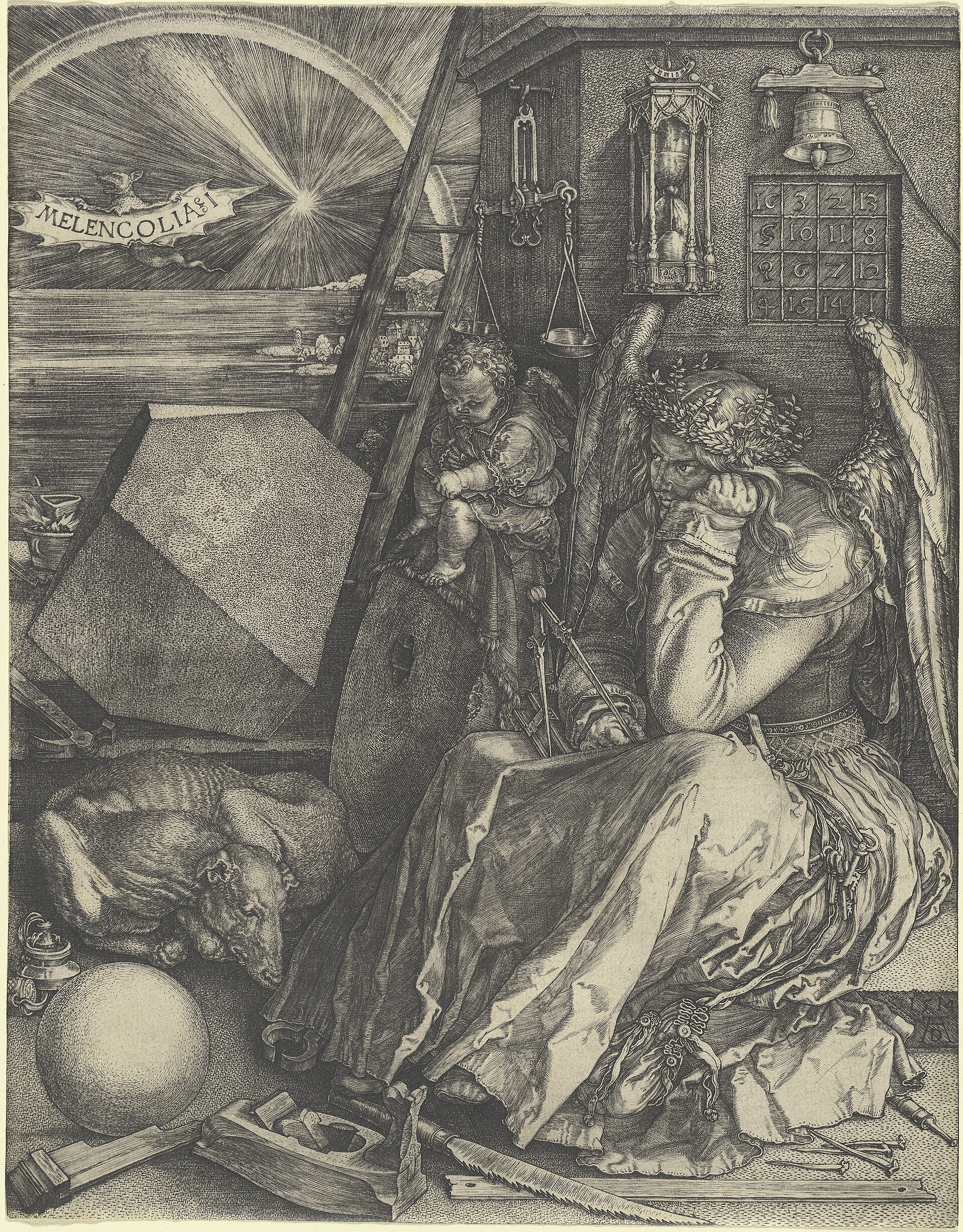
Melencolia I
1514 · Engraving on laid paper
National Gallery of Art, Washington, D.C
 German, Nuremberg · 1471-1528
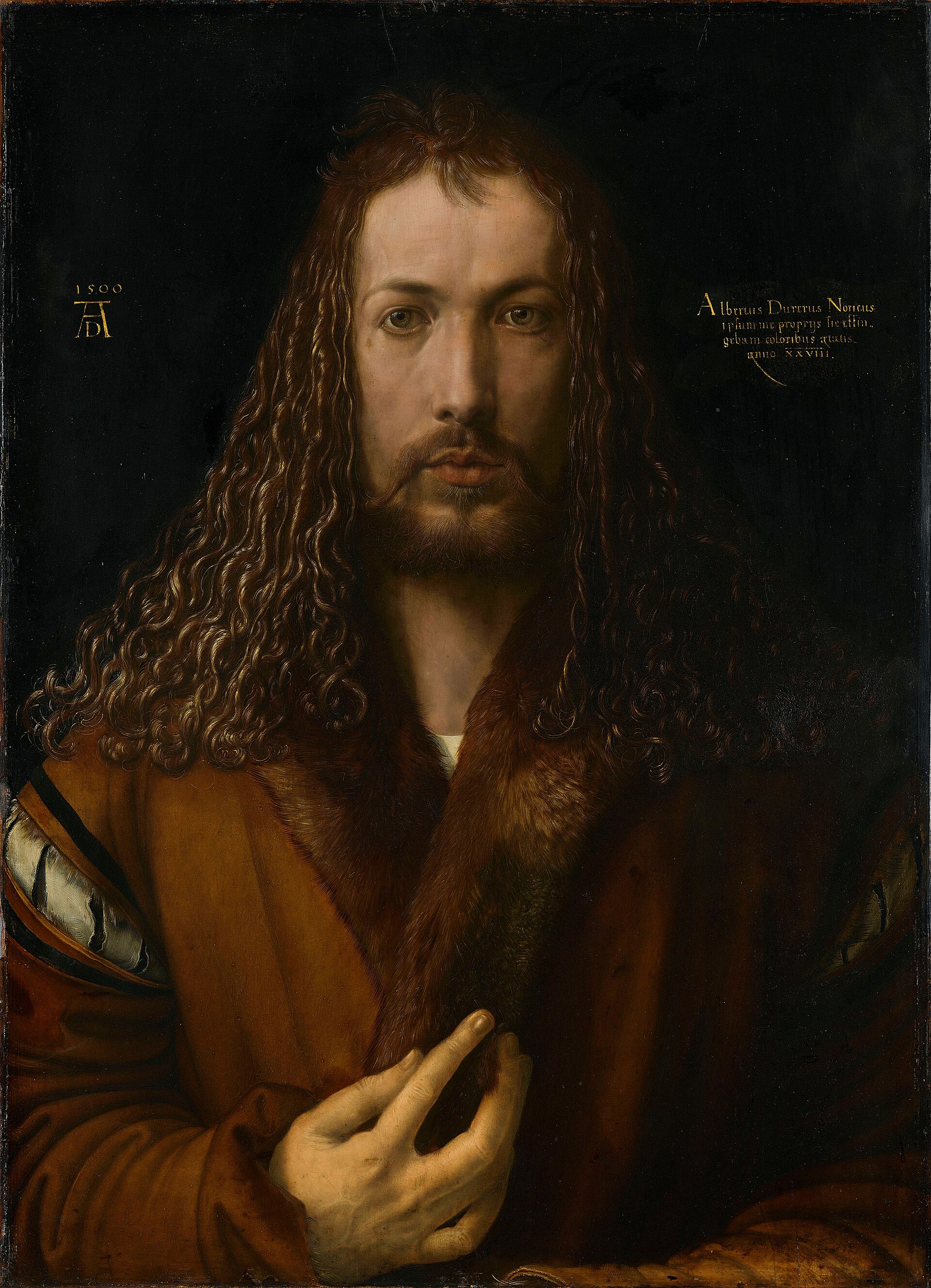
Albrecht Durer, Self-Portrait, 1500, oil on limewood panel, Alte Pinakothek, Munich. The attribution is not in question. The panel carries the AD monogram in gold on black at the left, at the height of the sitter's eyes, and an inscription in Latin at the right recording that Albrecht Durer of Nuremberg painted himself in his own colours at the age of twenty-eight. Nuremberg sold it in 1805 and it was heavily cleaned and repaired during the nineteenth century. One qualification belongs in the caption: in 2008 Philipp Zitzlsperger argued from Nuremberg's sumptuary law that the marten fur shown here was reserved for men eligible for the city council, a status Durer reached only in 1509, and concluded that a later falsification of the date and signature cannot be ruled out. That is a minority position about the date, not about the painter. Licence verified per file from Wikimedia Commons extmetadata: LicenseShortName, Public domain.
Bayerische Staatsgemaldesammlungen, Alte Pinakothek, Munich| Full name | Albrecht Durer the Younger. The family name is a German translation of the Hungarian Ajtosi, from Ajtos near Gyula, and... |
|---|---|
| Worked as | Engraver, Woodcut designer, Publisher, Painter |
| Born | 21 May 1471 · Nuremberg, Free Imperial City of the Holy Roman Empire |
| Died | 6 April 1528 · Nuremberg, aged fifty-six |
| Nationality | German, Nuremberg |
| Movement | Northern Renaissance |
| In this archive | 3 artworks |
| Sources | 80 cited |
| Last verified | 17 September 2026 |
About this page 3 artworks in the archive · Last verified 17 September 2026 · 80 sources cited
Albrecht Durer is not principally a painter. He is the maker of about a hundred engravings, some three hundred and forty-six woodcuts, six etchings on iron and three drypoints, and those objects, not the panels, are what carry his name through the market and through most museum collections. The distinction matters more than it sounds. A painting is one object. A print is a plate or a block, and every impression pulled from it is a separate physical thing with its own date, its own paper, its own degree of wear and its own price. Two impressions of one Durer engraving have carried published figures between about GBP 6,000 for three sheets in a single lot and a CHF 800,000 hammer for one, and nothing that separates them is visible in a reproduction.
The single most useful thing to know about Durer is therefore how an impression is dated and ranked. The apparatus is a stack of catalogues. Adam Bartsch numbered the compositions in Le Peintre graveur from 1803. Joseph Meder renumbered them in the Durer-Katalog of 1932 and, critically, graded the successive printings of each plate with letters running from a upward. Rainer Schoch, Matthias Mende and Anna Scherbaum recatalogued the whole printed work in three volumes between 2001 and 2004. A lot description reading B. 74; M., Holl. 75 is naming the composition. A lot description reading a fine Meder a impression is naming the object in front of you, and it is the second phrase that sets the price. The plate tells you what was cut. The sheet tells you when it was pulled.
Durer also fought two documented actions over his own mark, and the one everybody cites is the one that may never have happened. The Venetian case against Marcantonio Raimondi, in which the Signoria is said to have allowed the copying to continue on condition that the AD monogram was removed, comes to us only from Vasari, writing sixty years later; he gives no date, and Moritz Thausing reported in 1882 that he had searched the Venetian archives for it in vain. The case that is actually on the record is in Nuremberg, and it is dated 3 January 1512. That is the outcome that shaped everything since. The image was not protected. The mark was. Every copyist from Marcantonio to Hans Hoffmann to the nineteenth-century photogravure houses worked in the space that ruling left open, and a print room today still begins by asking not whether the composition is Durer's, which is settled, but whether this particular sheet is telling the truth about when it was made.
1514 · Engraving on laid paper
National Gallery of Art, Washington, D.C
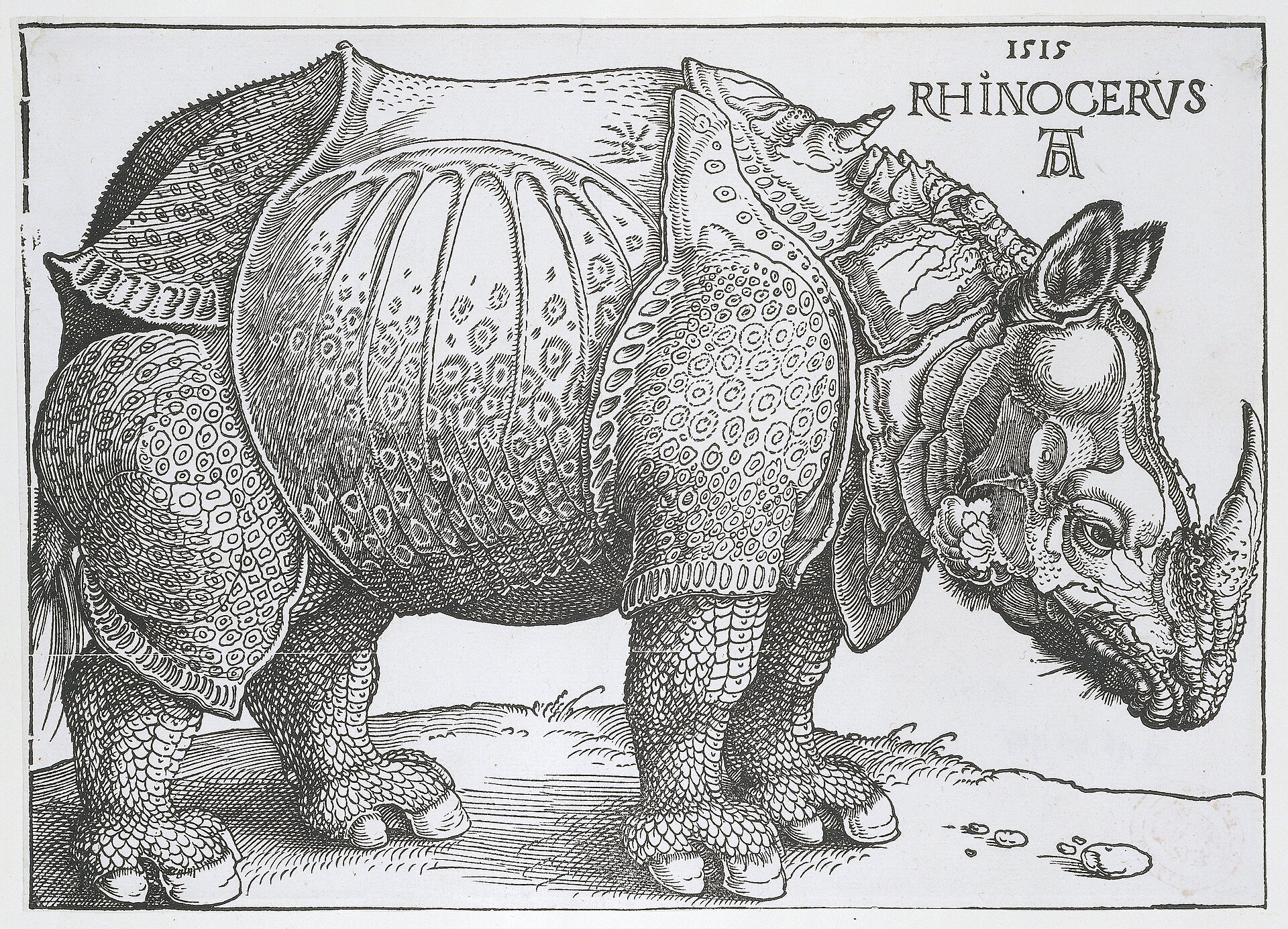
1515 · Woodcut on paper
Rijksmuseum, Amsterdam
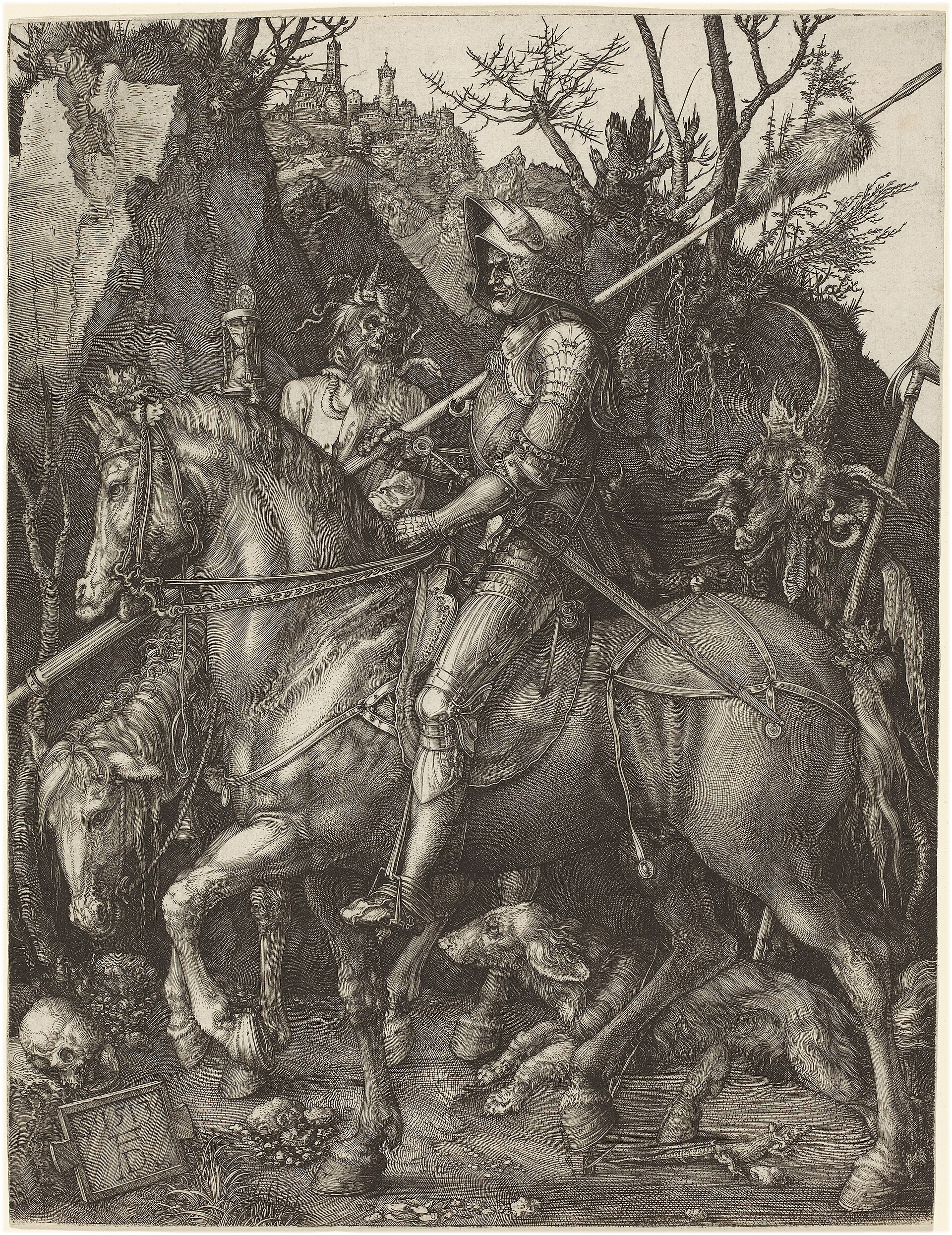
1513 · Engraving on laid paper
National Gallery of Art, Washington, D.C
Born 21 May in Nuremberg, third of eighteen children of Albrecht Durer the Elder, a goldsmith who had come from Ajtos near Gyula in Hungary by 1455, and Barbara Holper. His godfather is Anton Koberger, one of the greatest printers in Europe.1
Apprenticed at fifteen to Michael Wolgemut, whose Nuremberg workshop occupied several buildings and supplied woodcuts to Koberger. He had already trained in his father's goldsmith's shop, where marks on metal were a guarantee of quality and of payment.15
The Wanderjahre. Colmar in 1492, Basel and Strasbourg in 1493. In Basel he works inside a woodcut industry organised by division of labour, as a designer rather than a cutter, and observes at Mainz the example of Erhard Reuwich, the first artist to act as his own publisher.15
Returns to Nuremberg and marries Agnes Frey on 7 July. The marriage was arranged and there were no children. Within months he leaves for Italy.15
First Italian journey, to Venice and its territory.1
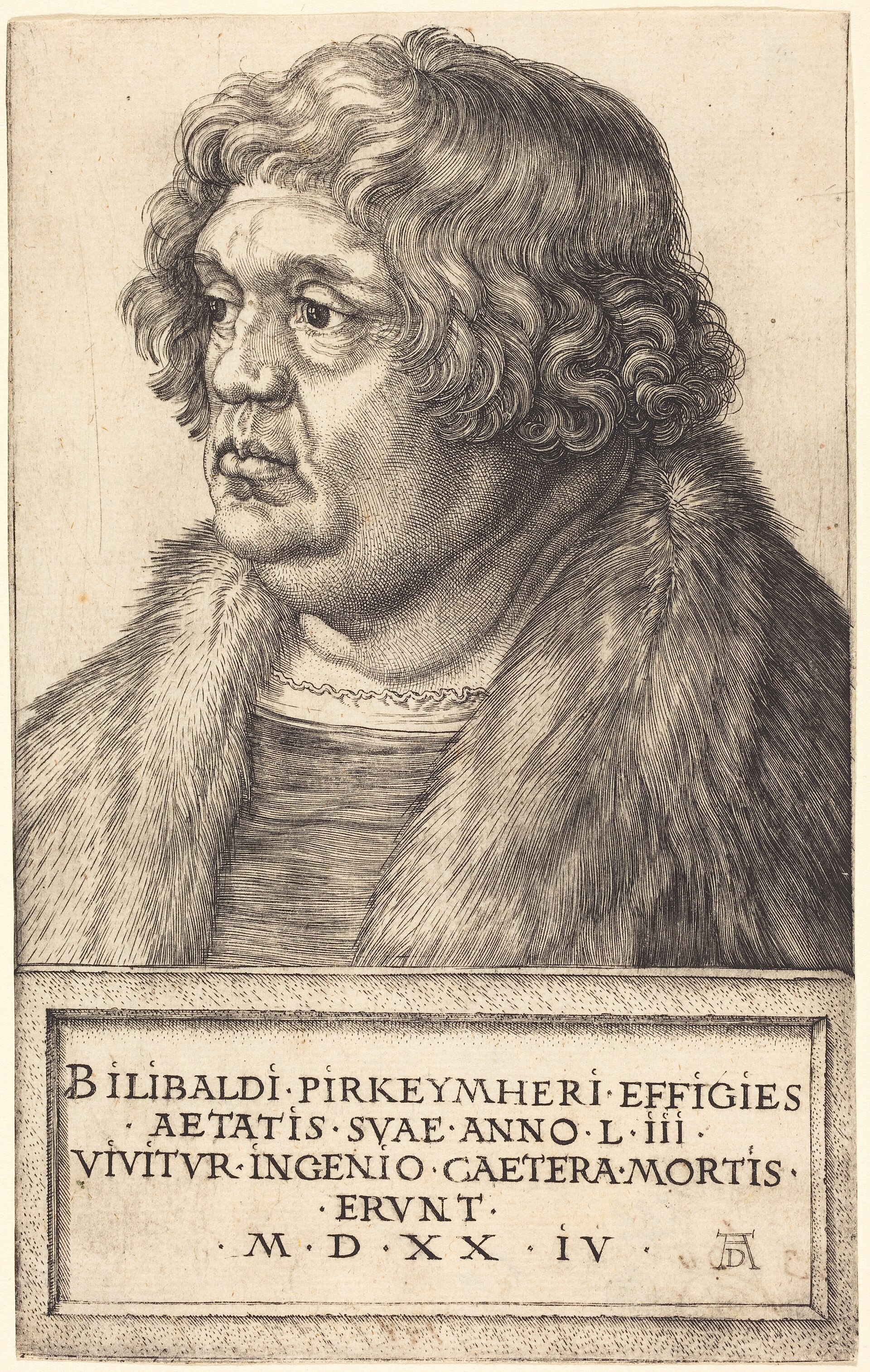
Meets Willibald Pirckheimer, who becomes his closest friend, his tutor in classical learning and, later, his creditor.1
Two surviving contracts engage itinerant agents to sell his prints from town to town at a set weekly wage equal to a skilled craftsman's, requiring them to sell eagerly and energetically and to avoid frivolity. One sets a minimum price per print; the other simply requires the highest price obtainable.5
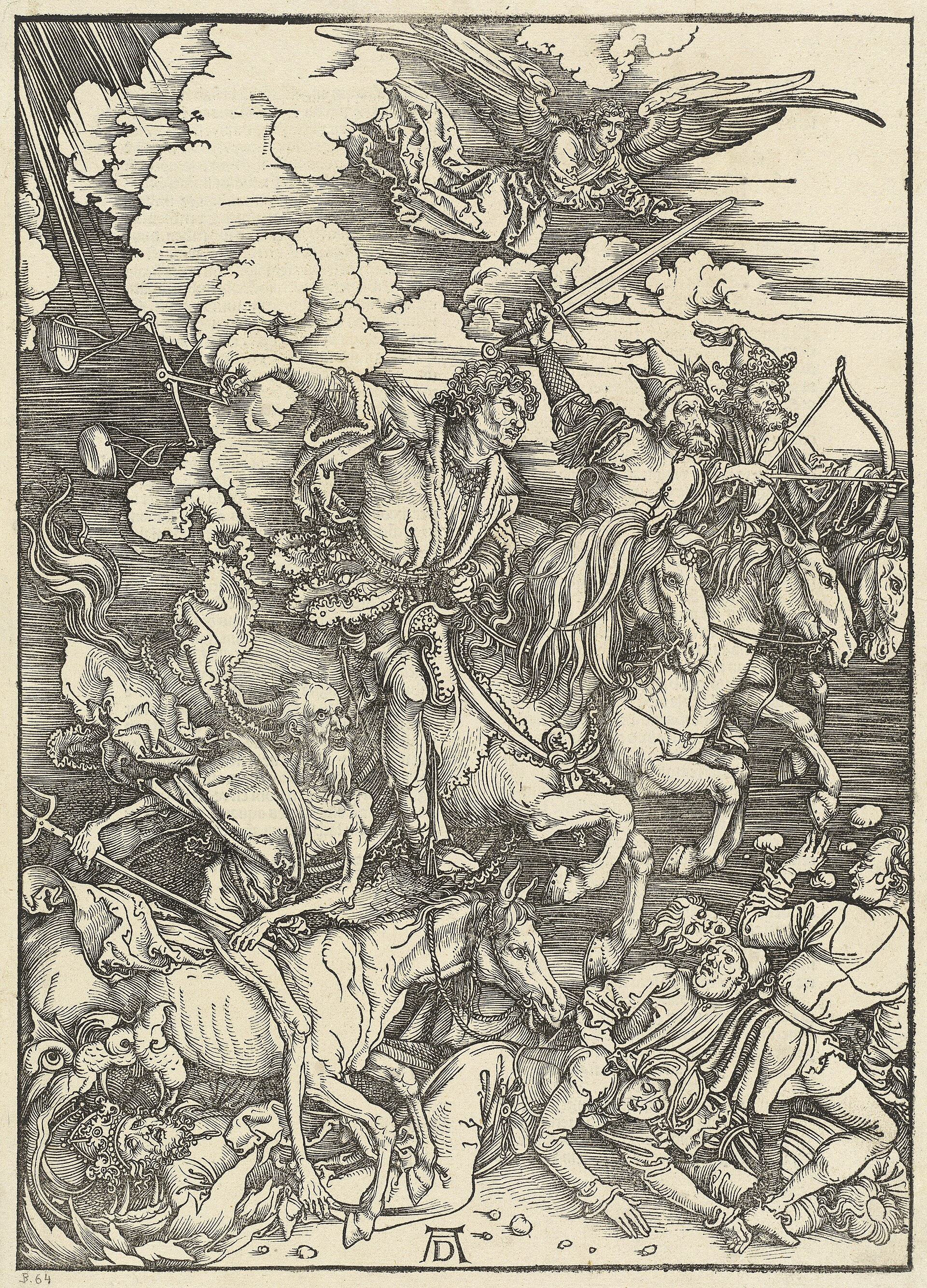
Publishes the Apocalypse, fifteen woodcuts and a title page, in German and Latin editions, printed and issued on his own account. He was following Erhard Reuwich, whose Peregrinatio of 1486 makes Reuwich the first artist to act as his own publisher; what is new in Durer is the scale and the fact that he kept the matrices.1
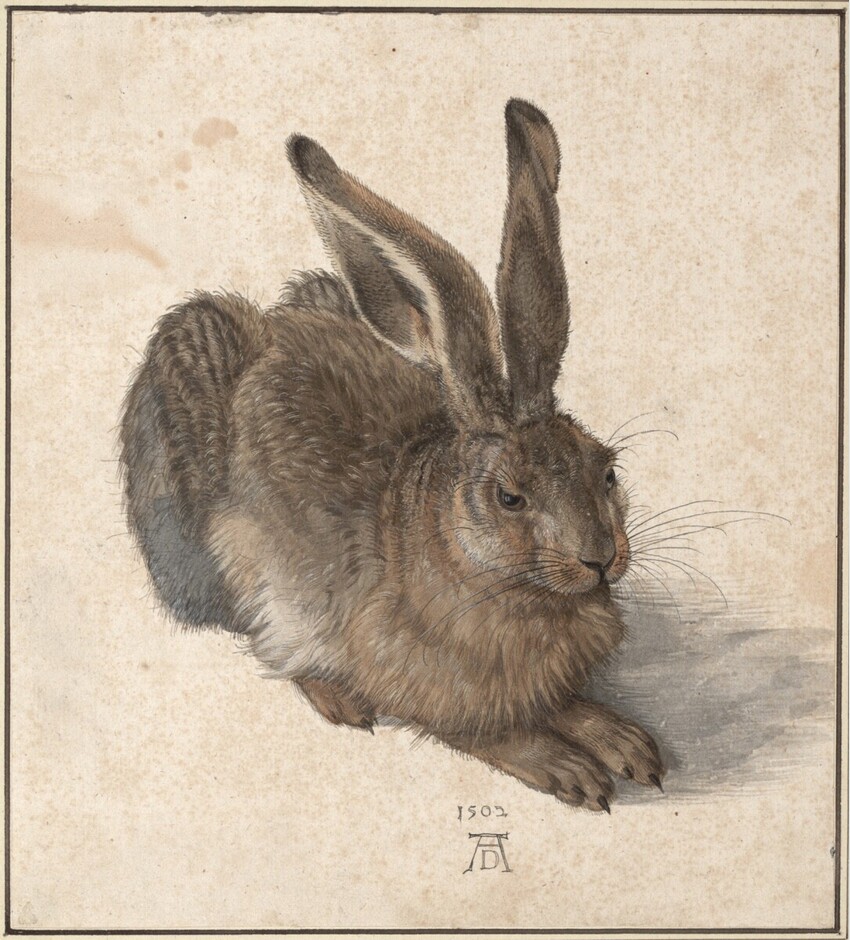
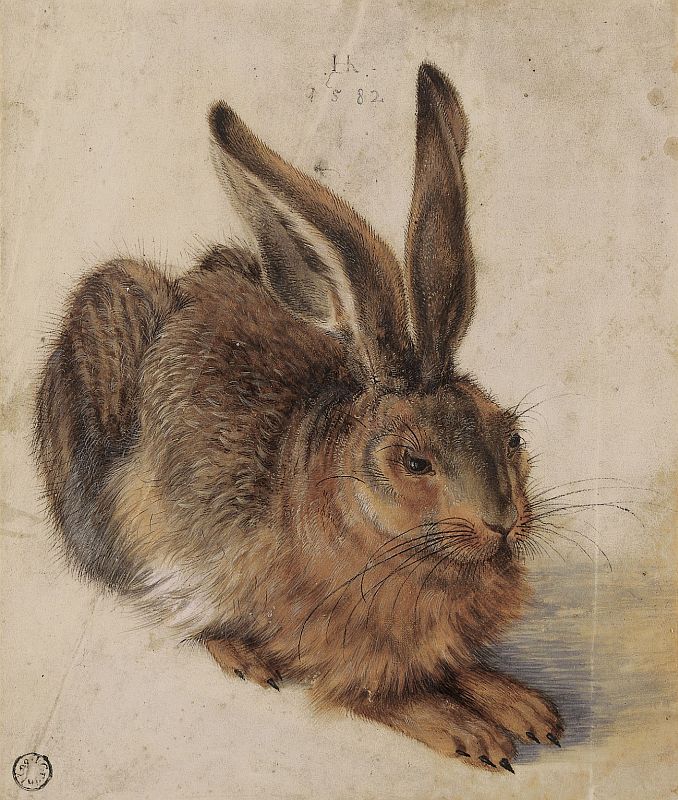
Paints the watercolour and bodycolour study of a hare, now Albertina inventory 3073. At least twelve early copies of it are known.2263
Makes the Great Piece of Turf, now Albertina inventory 3075.14
The first seventeen sheets of the Life of the Virgin are in circulation as single sheets. These are the woodcuts Marcantonio Raimondi copied in engraving, complete with the AD monogram; Vasari's claim that the offending series was the Small Passion is demonstrably wrong.5
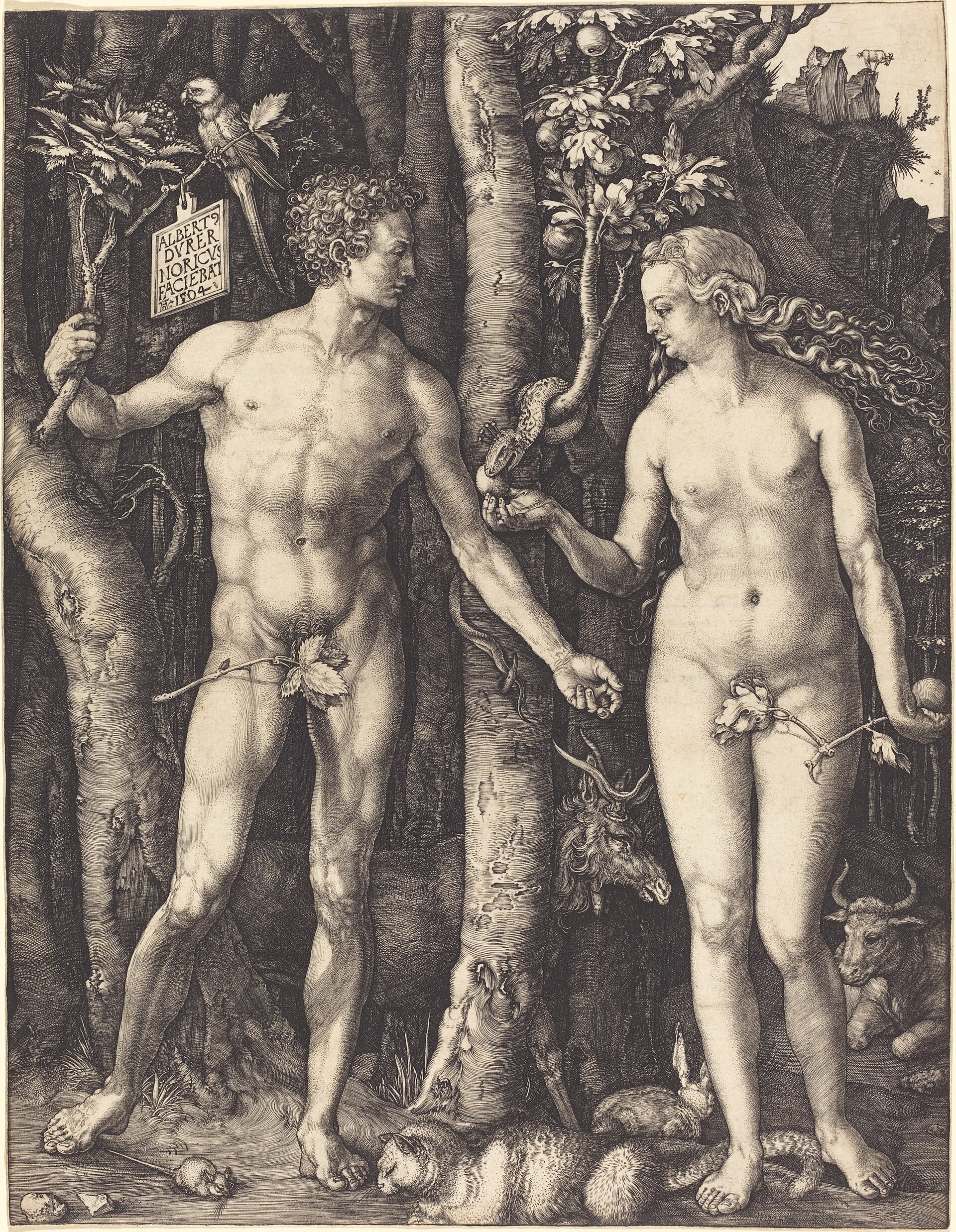
Engraves Adam and Eve, the plate that would later carry the market's clearest state ladder.59
Begins the Salvator Mundi, now in the Metropolitan Museum, shortly before leaving for Italy, and completes only the drapery. Its unfinished face and hands leave the underdrawing and the first thin paint layers permanently visible.36
Second Italian journey. In Venice from early 1506 until spring 1507; ten letters to Pirckheimer survive from it. He paints the Feast of the Rose Garlands for the German merchants of the Fondaco dei Tedeschi and, in five days by his own inscription, Christ Among the Doctors.137
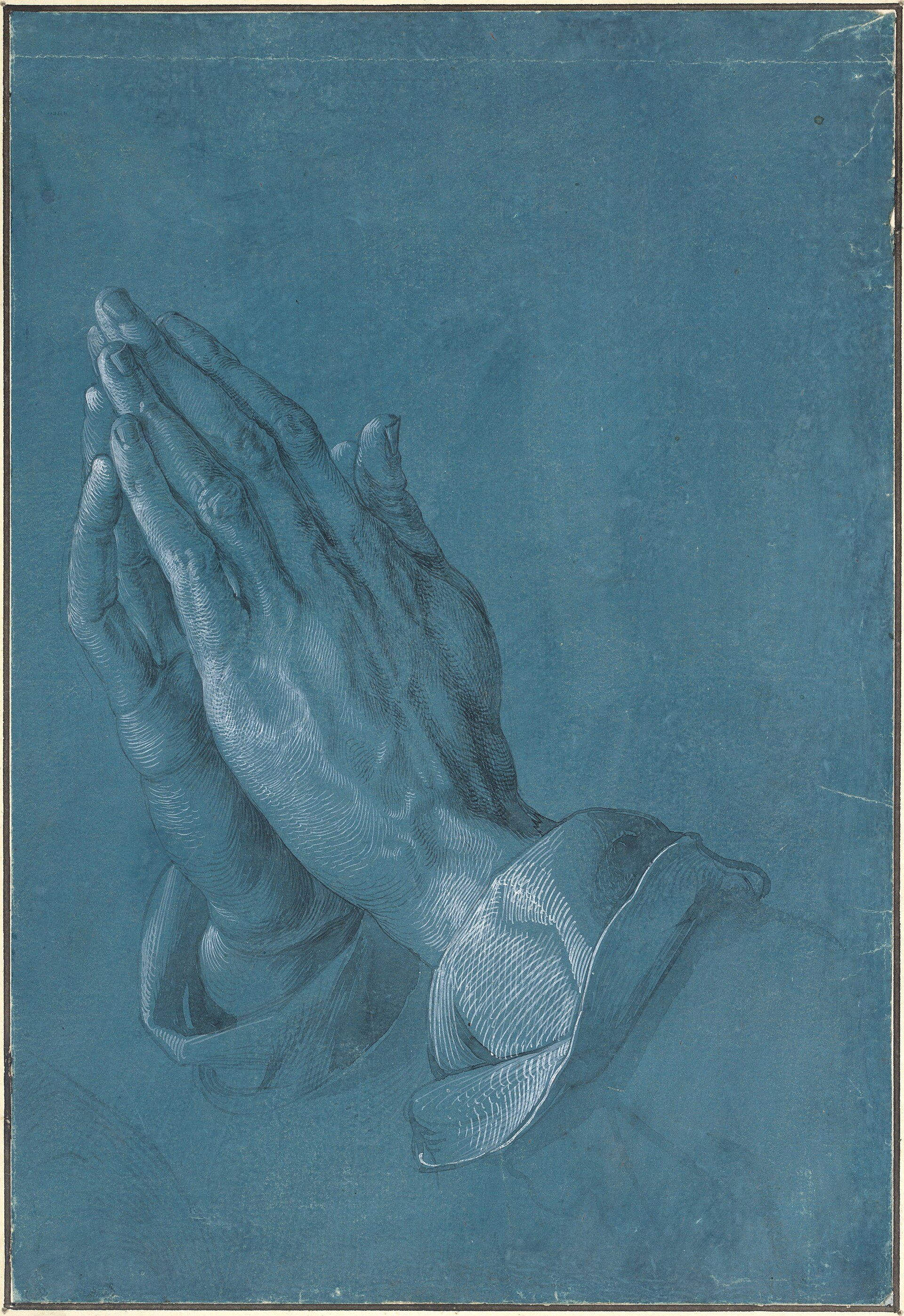
Paints the Heller Altarpiece for the Frankfurt merchant Jakob Heller; Matthias Grunewald paints the exterior wings in grisaille. The Praying Hands of 1508, Albertina 3113, is a study for an apostle in the central panel.3513
Writes that for the next year he will produce such a pile of ordinary pictures that nobody will believe one man could do it, and that this is the way to make some money. In the same year he becomes eligible for Nuremberg's city council.533
Reissues the Apocalypse, the Large Passion, the Life of the Virgin and the Small Passion in book form with a printed Latin warning to copyists, beginning Heus tu insidiator, under an imperial privilege from Maximilian. The privilege itself does not survive; it is known only from Durer's quotation of it on his own sheets. In the same year Raimondi engraves the Small Passion, and his copies no longer carry Durer's monogram.56768
Delivers the Landauer Altarpiece, the Adoration of the Trinity, commissioned in 1508 by Matthaus Landauer for the Zwolfbruderhaus chapel. The panel is now in the Kunsthistorisches Museum in Vienna; the carved frame, designed by Durer and executed by Veit Stoss, remained in Nuremberg and is in the Germanisches Nationalmuseum, so the two halves of one commission are in two cities and Vienna shows a copy of the frame.30
3 January: the Council of Nuremberg records, under the heading Albrecht Durer's art stolen, that a foreigner selling prints in front of the town hall, some carrying Durer's monogram and fraudulently copied from him, must remove the monograms on oath and sell none of the marked sheets in the city, on pain of having them confiscated as counterfeit. This is the only one of Durer's two mark disputes that survives in an official record.5
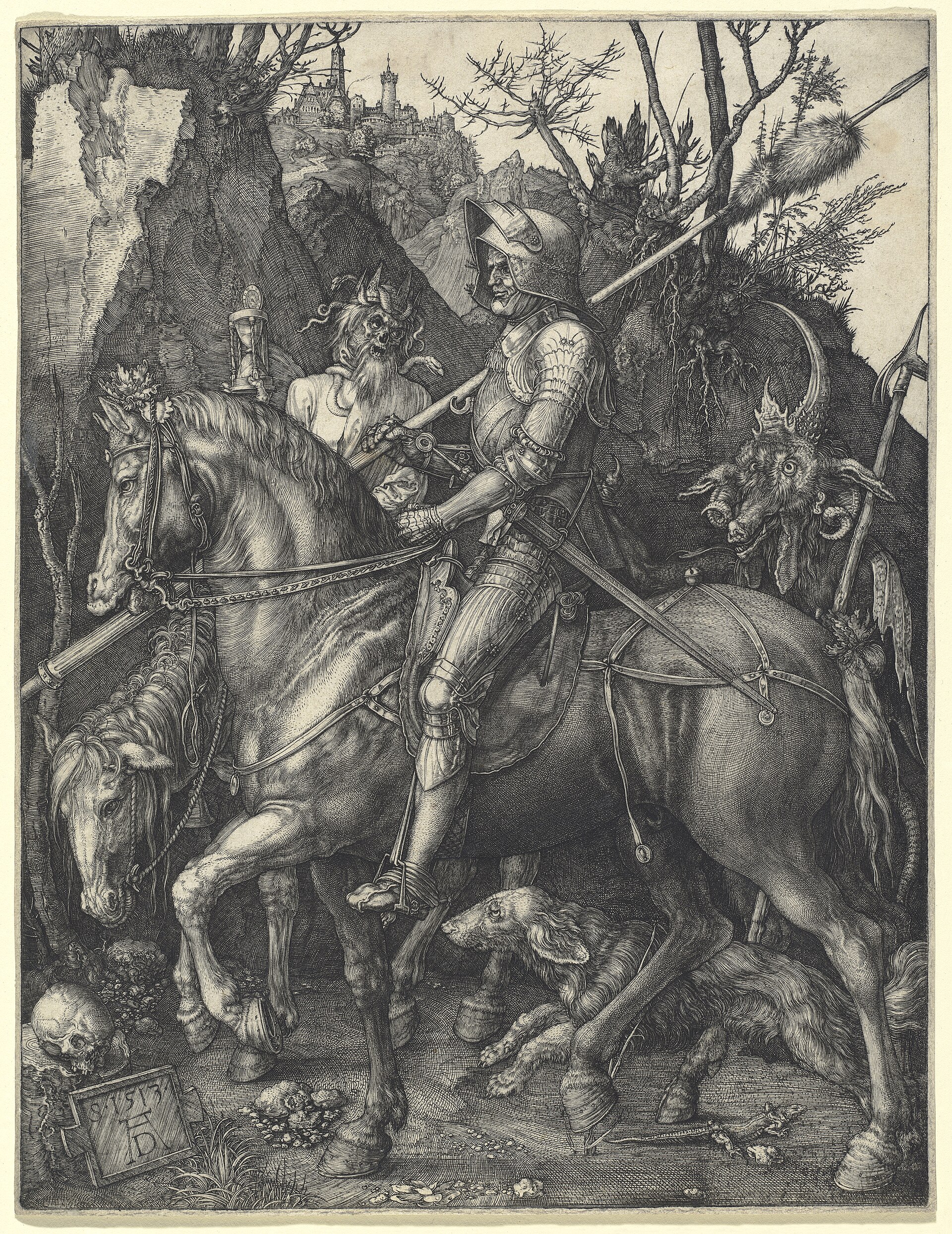
Engraves Knight, Death and the Devil, probably grounded in Erasmus's Handbook of a Christian Knight; the first of the three plates the nineteenth century grouped as the Meisterstiche.158
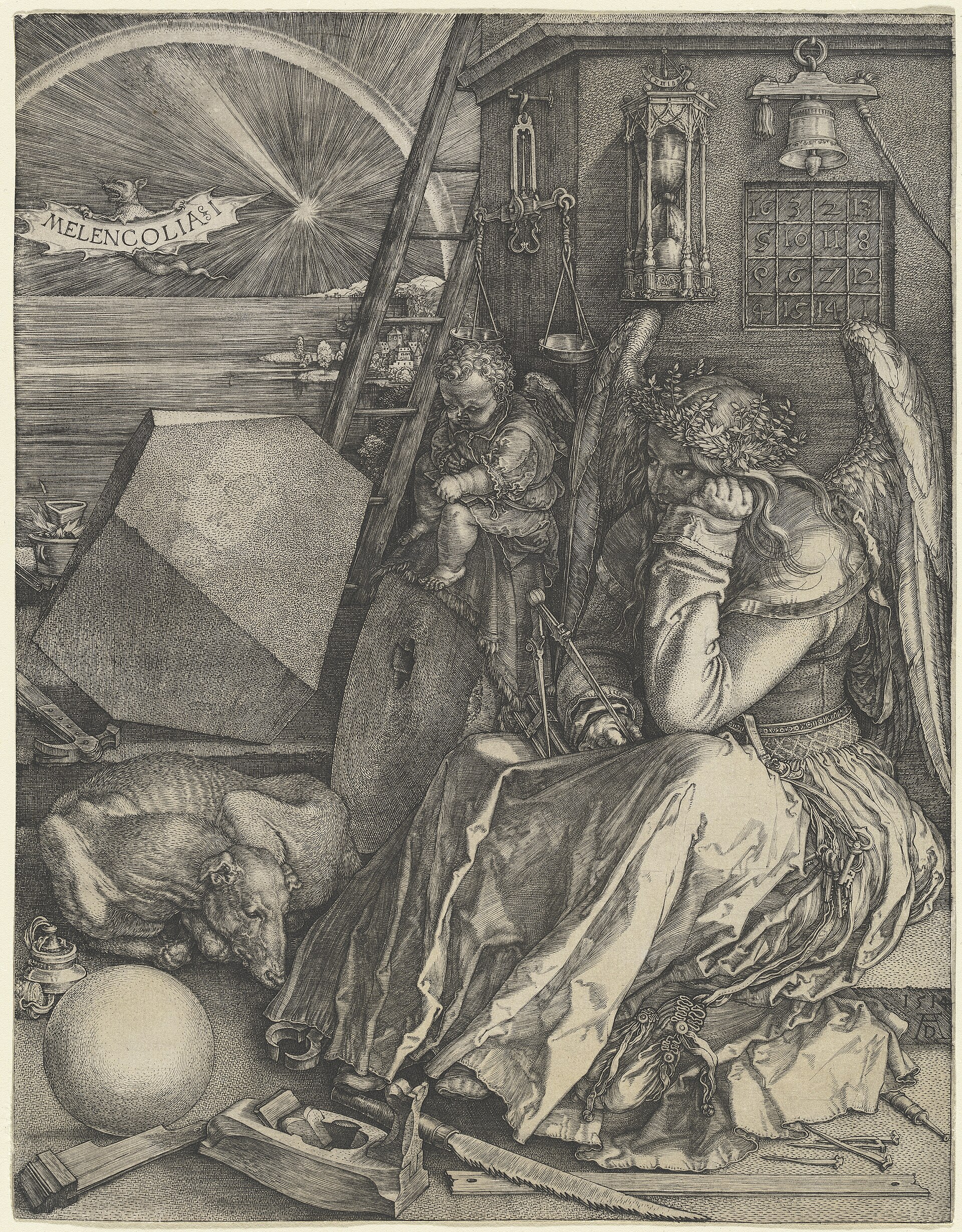
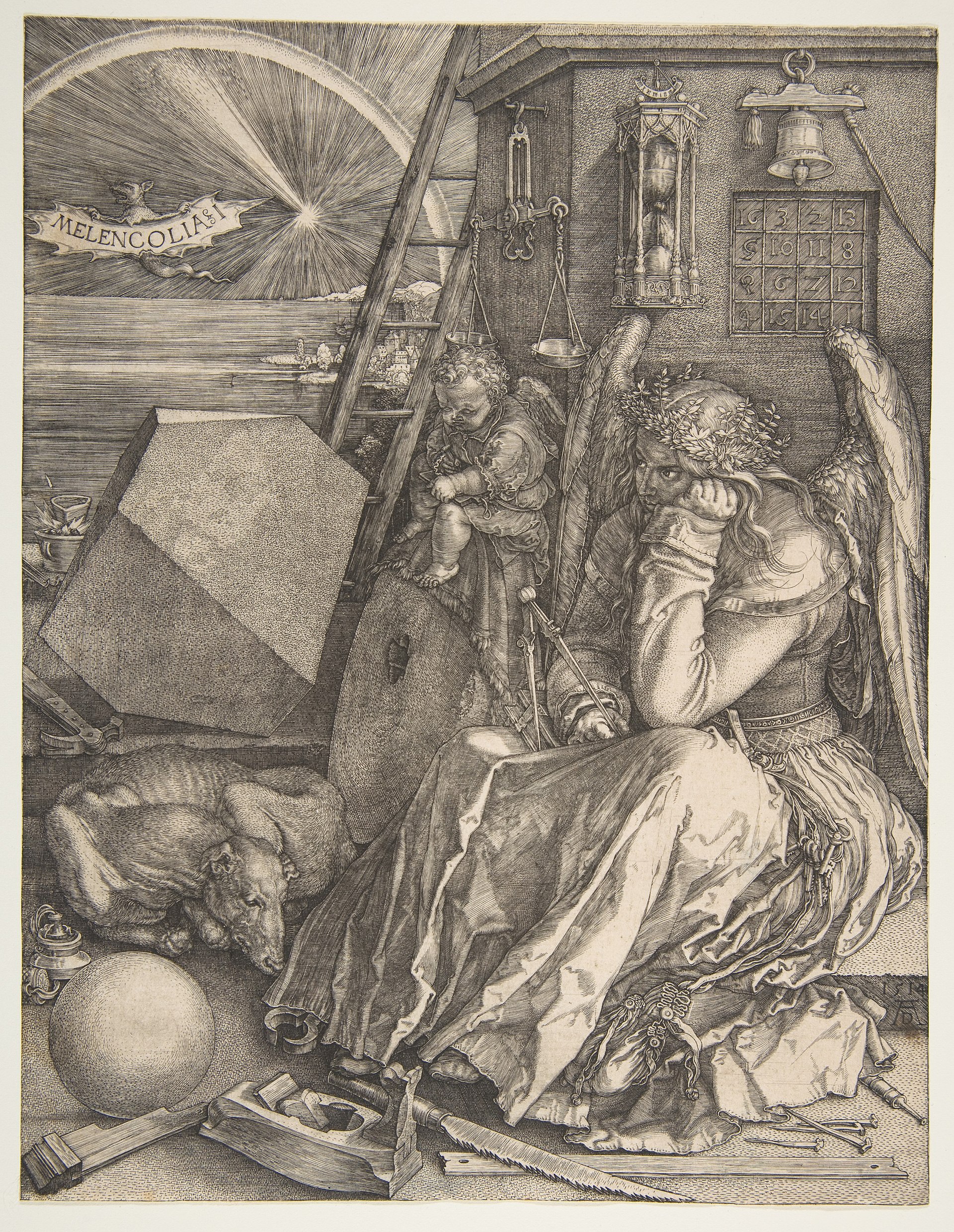
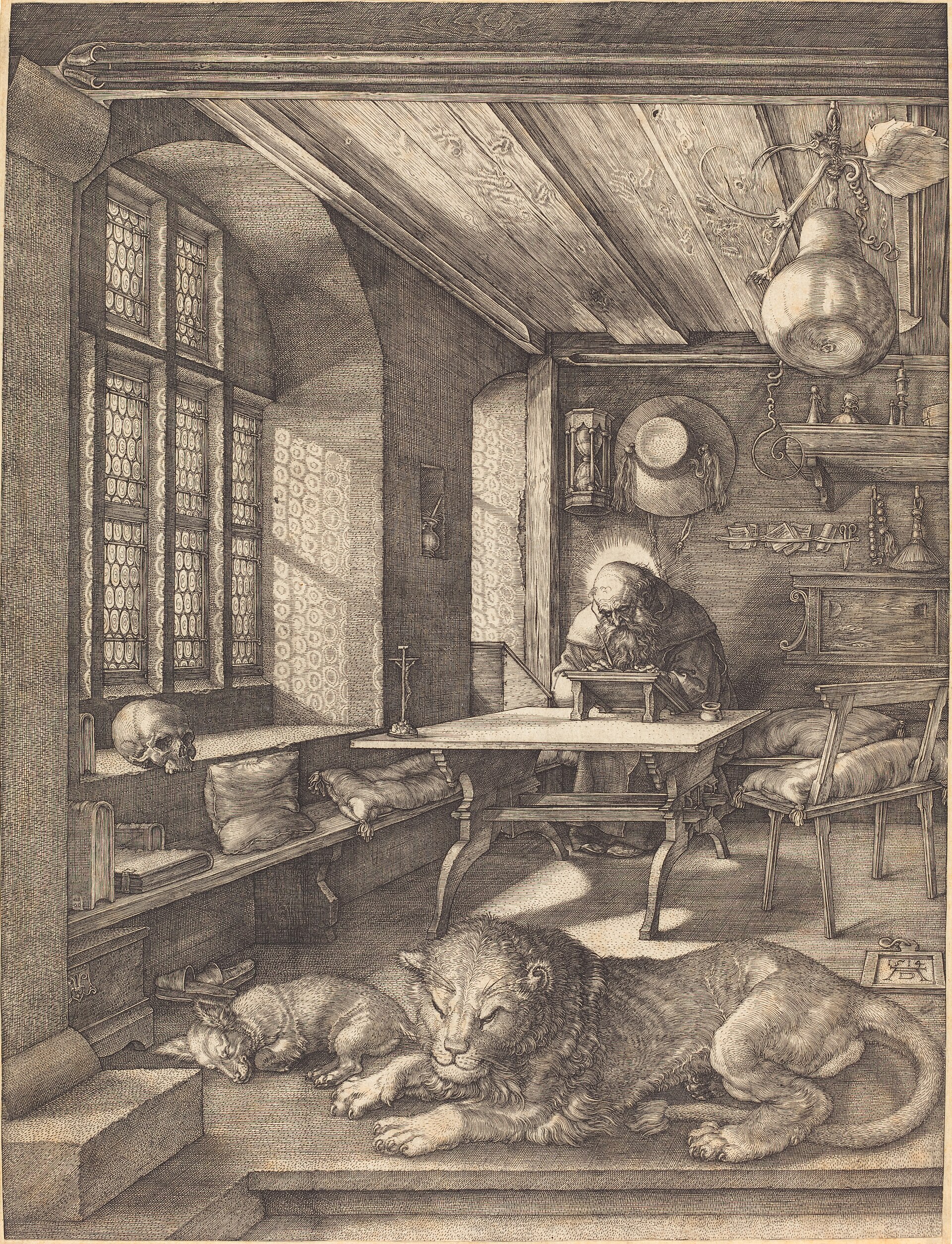
Engraves Saint Jerome in his Study and Melencolia I. His mother Barbara dies on 17 May, two months after he drew her portrait. The magic square in Melencolia I is the first printed in Europe and carries the year in the two central cells of its bottom row.210
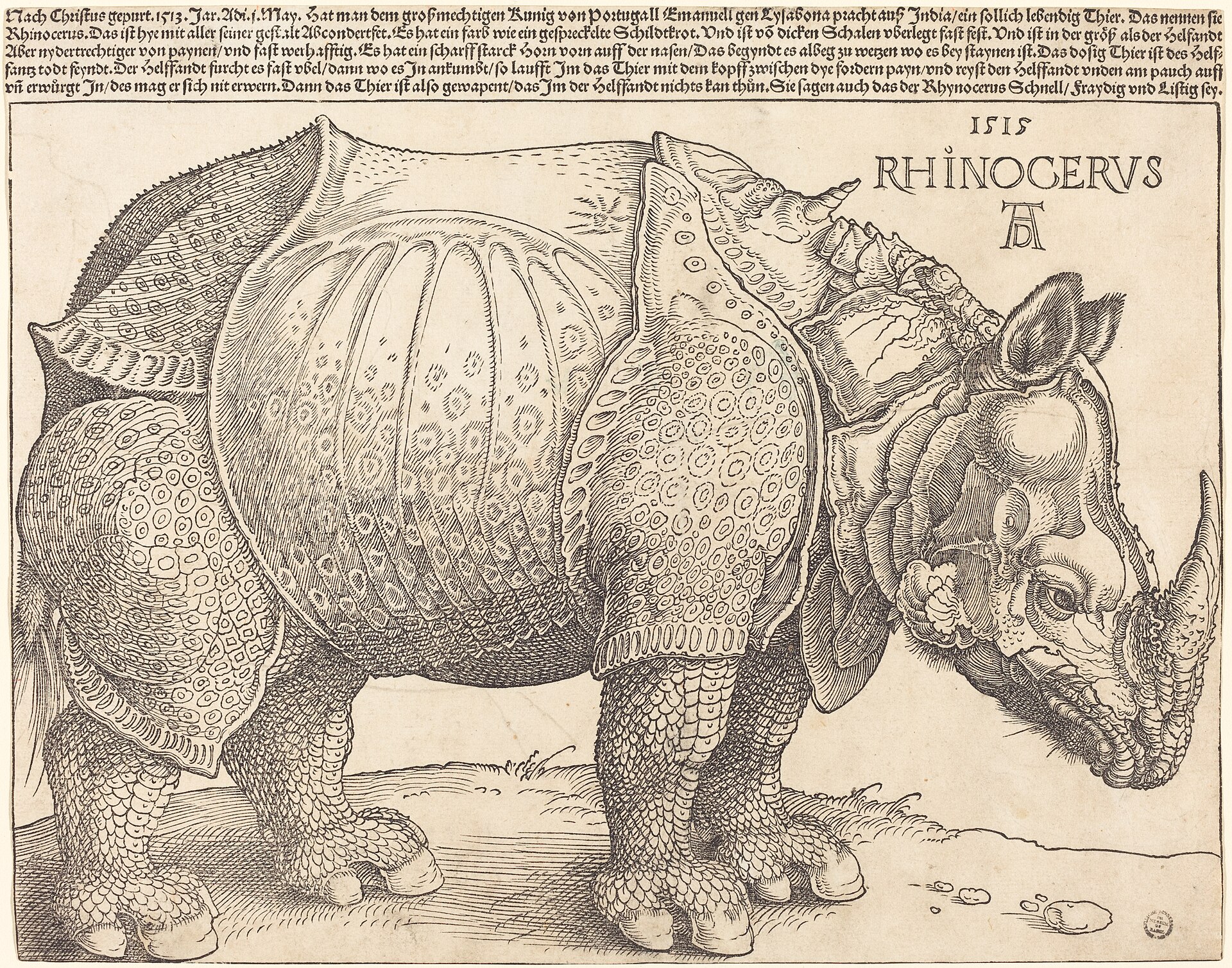
Makes the woodcut of a rhinoceros from a written description and a sketch of an animal he never saw, and, with the court astronomer Johannes Stabius, the first printed celestial hemispheres and a solid-sphere world map.169
Works for Maximilian I, including the Triumphal Arch, printed from 192 separate blocks.1
Travels in the Netherlands from July to July with Agnes, keeping a diary that records what he sold, gave and exchanged, notes Roman columns at Aachen made truly according to Vitruvius, and records buying a tract of Luther's and the Condemnation of Luther at Cologne in November 1520. The pictures from this period onward are on oak rather than limewood.4130
At Antwerp, on false news that Luther had been seized and killed after the Diet of Worms, writes a long lament asking who will henceforth expound the Holy Gospel so clearly, and calls on Erasmus to guard the truth and win the martyr's crown. Luther was in fact in protective custody arranged by Frederick the Wise.41
Engraves the portrait of Willibald Pirckheimer. Writes to Nicholas Kratzer that because of their Christian faith they must stand in scorn and danger, reviled and called heretics.162
Publishes Underweysung der Messung mit dem Zirckel und Richtscheyt in Nuremberg, the first book on mathematics for adults written in German, later cited by Galileo and Kepler. In its second book he prefers Ptolemy's methods to Euclid's.1
Paints the Four Apostles, two lindenwood panels each about 215 by 76 centimetres, and gives them unsolicited to the city of Nuremberg with a letter saying he has bestowed more trouble on them than on any other painting. The fourth figure was altered from Saint Philip to Saint Paul.38
Publishes Etliche underricht zu befestigung der Stett, Schloss und flecken, on fortification, probably printed by Hieronymus Andreae. Reprinted at Arnhem in 1603 and translated into Latin at Paris in 1535.1
Dies on 6 April in Nuremberg, aged fifty-six. Vier Bucher von menschlicher Proportion is published immediately afterwards; its aesthetics essay rejects Alberti's single objective standard of beauty for a relativist notion founded on variety. His will leaves the printing blocks and plates to his brother Endres, and they go on being printed.15
Willibald Pirckheimer dies, leaving his library and much of his art to his grandson Willibald Imhoff. He had written that in the beginning he believed in Luther, like our Albert of blessed memory.174
Imhoff acquires the contents of the Durer workshop itself from the heir of Durer's brother. The drawings had been kept together since 1528.1514
Imhoff inventories the collection, and again in 1580, the year of his death. A further inventory is drawn up by his heirs in 1588. These lists are the earliest documentary traces of most of the drawings.15
Hans Hoffmann makes a watercolour of a hare after Durer's study of 1502, signed with his own monogram Hh and dated, 216 by 183 millimetres. Other copies by him carry Durer's monogram and a false date of 1528.6422
Rudolf II brings Hoffmann from Munich to Prague as court painter and uses him as an adviser on acquiring Durer. In the same year Hieronymus Wierix publishes an engraved Mass of Saint Gregory after Durer in Antwerp, still carrying Durer's monogram on the stone beneath the altar.2324
The Imhoff family sells the Durer holding to Rudolf II. It goes to Prague and into the imperial collections.1413
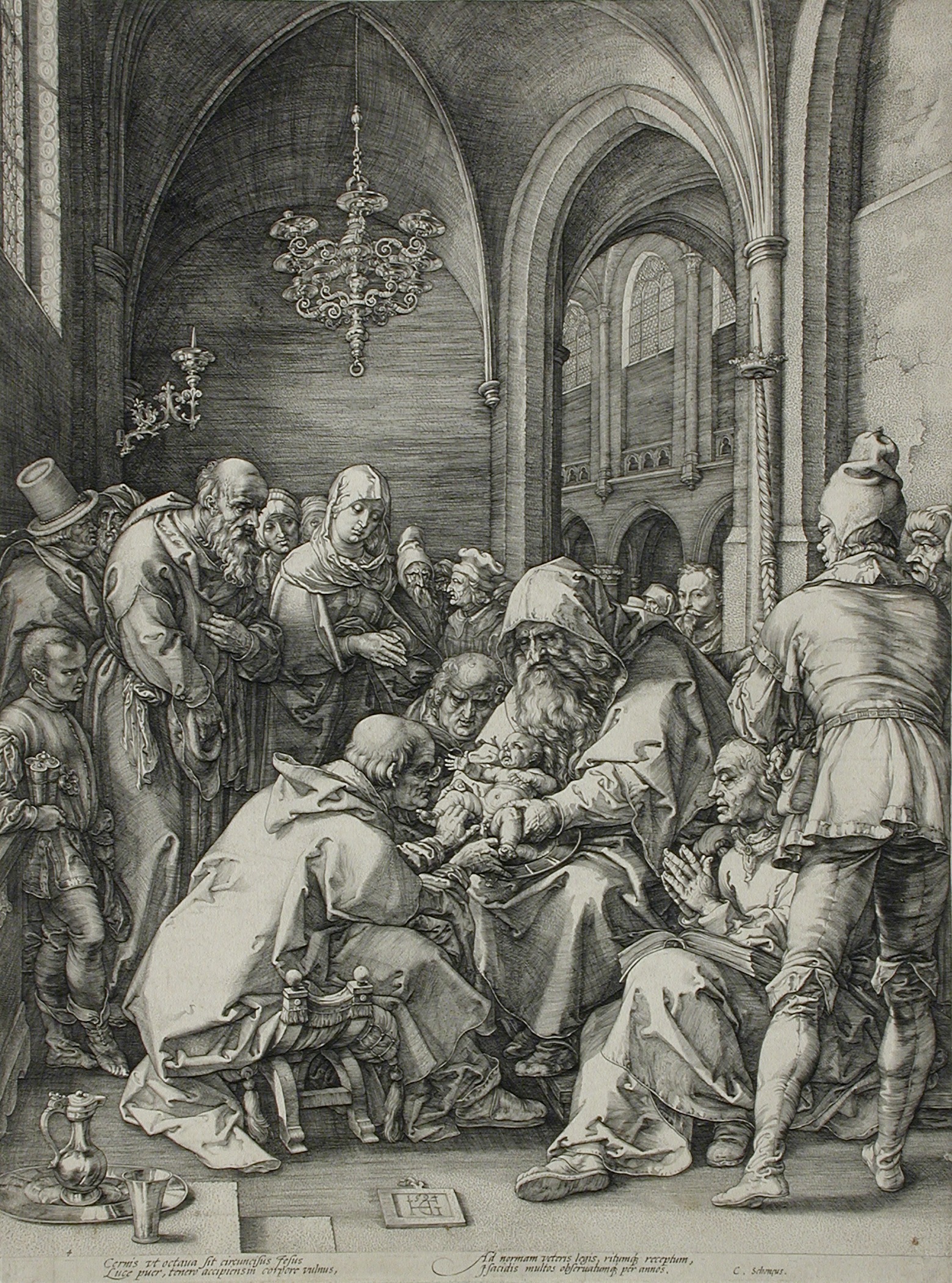
Hendrick Goltzius engraves six large prints on the early life of the Virgin, each in the manner of a different master. Karel van Mander records that collectors bought the Durer sheet as an original Durer until Goltzius's hidden self-portrait, set in the church of Saint Bavo in Haarlem, gave the game away.25
The central panel of the Heller Altarpiece, the only part by Durer's own hand, is sold to Maximilian I of Bavaria and replaced in Frankfurt by a copy made the same year by Jobst Harrich.35
Thomas Howard, Earl of Arundel, visits Nuremberg on an embassy to Ferdinand II. The city presents a pair of portraits of Durer and his father as a gift to Charles I, received by 18 March 1637. On the same visit Arundel buys the Pirckheimer library.1517
Swedish troops sack Prague Castle from 26 July and take the best of Rudolf's paintings. A Swedish inventory of 1652 lists 472 paintings as having come from Prague. The pick went into exile with Queen Christina and later formed the core of the Orleans Collection.19
The Durer drawings move from Prague to Vienna, four decades after the sack.22
The central panel of the Heller Altarpiece is destroyed by fire in Munich. Durer's most ambitious painting survives only in Harrich's copy, in the correspondence and in the preparatory drawings.35
Parliament accepts Sir Hans Sloane's bequest of over 71,000 objects on payment of 20,000 pounds to his executors, creating the British Museum.43
The imperial drawings pass from the treasury into the Imperial Court Library in Vienna.13
Duke Albert of Saxe-Teschen receives the Durer drawings from the Court Library. His collection becomes the Albertina, which now holds about 140 Durer drawings.1314
Adam Bartsch begins publishing Le Peintre graveur in Vienna. His numbers for Durer's compositions are still the universal identifier.55
Nuremberg sells the 1500 Self-Portrait; the panel enters the Bavarian collections and is now in the Alte Pinakothek, Munich. It was heavily cleaned and repaired during the nineteenth century.6633
The British Museum's Department of Prints and Drawings is formally constituted. It now holds 138 Durer drawings, 99 engravings, 6 etchings and most of his 346 woodcuts.16
The Kupferstichkabinett in Berlin is founded. It acquires more than thirty-five Durer drawings around 1877 from the Firmin-Didot and Posonyi-Hulot sales in Paris, among them the Portrait of the Artist's Mother of 1514.7172
Moritz Thausing publishes that he has searched the Venetian archives in vain for any trace of the lawsuit Vasari described, and that this is not surprising given the gaps in the surviving documents. The date 1506, universally attributed to Vasari, is in fact Thausing's inference from Durer's travels.5
The National Gallery in London buys The Painter's Father as a Durer. It now catalogues the panel as after Durer, on the ground that the background and the application of the paint in one thick layer are not typical of him.32
Joseph Meder publishes the Durer-Katalog in Vienna: 294 entries covering the engravings, etchings and woodcuts, their states, editions and watermarks, with 190 illustrations and fifty-two plates of watermarks. It is the book that makes an impression datable.34
Friedrich Winkler publishes Die Zeichnungen Albrecht Durers in four volumes, continuing a project begun by Friedrich Lippmann in 1883. It is the catalogue of the drawings, not of the paintings, and is frequently miscited as though it settled the painted corpus.76
The Soviet officer Viktor Baldin removes two paintings and 362 drawings, Durer among them, from the Kunsthalle Bremen's evacuated collection at Karnzow Castle. They surface publicly in 1989 and move to the Hermitage in 1991; the restitution question is still open.2021
The National Gallery of Victoria acquires 326 Durer prints from Sir Thomas Dunham Barlow, the core of a collection now numbering about 451 items.6
Fedja Anzelewsky publishes Albrecht Durer: Das malerische Werk, revised in two volumes in 1991. It remains the authoritative catalogue of the paintings, and its numbering includes works surviving only as copies, lost works and workshop pictures, so a catalogue number is not a count of autograph panels.3031
Walter L. Strauss publishes The Complete Drawings of Albrecht Durer in six volumes, numbering the sheets by year. It is more inclusive than Winkler and is used as a finding aid alongside him rather than in place of him.13
The National Gallery of Victoria beta-radiographs its watermarked Durer sheets, recording approximately 200 separate watermarks.6
Rainer Schoch, Matthias Mende and Anna Scherbaum publish Albrecht Durer: Das druckgraphische Werk in three volumes, the modern catalogue of the printed work, cited as SMS.12
Philipp Zitzlsperger argues from Nuremberg's sumptuary law that the marten fur worn in the 1500 Self-Portrait was reserved for men eligible for the city council, which Durer became only in 1509, and concludes that a later falsification of the date and signature cannot be ruled out.33
The Der fruhe Durer project at the Germanisches Nationalmuseum, led by Daniel Hess, publishes infrared examination of the early paintings, finding loose brush underdrawing in some passages of the 1500 Self-Portrait and a far more cautious treatment of the face.3430
Christie's New York, 30 January: The Rhinoceros makes a reported USD 866,500, the artist record having been reported broken three times within the one-hour sale. Jochen Sander re-ascribes The Miraculous Salvation of a Drowned Boy in Bregenz to Durer in the Stadel exhibition catalogue.4530
The National Gallery of Victoria publishes about 160 of its Durer watermarks as an online research database. The Germanisches Nationalmuseum makes the Diehl collection, 106 engravings and etchings and 37 woodcuts assembled by Karl Diehl from the 1960s, publicly accessible in April.670
Galerie Kornfeld sells an Adam and Eve of the second state at CHF 800,000 hammer, CHF 955,000 with premium, against a CHF 400,000 estimate, on 17 September in Bern, and records it as an artist auction record. In November and December a drawing bought for USD 30 at a 2016 estate sale in Concord, Massachusetts is published as a Durer by Christof Metzger and Giulia Bartrum and as a Hans Baldung by Fritz Koreny.4739
Angela Campbell publishes her study of microscopic plate scratches on the three Meisterstiche, giving a chronology of impressions independent of paper evidence.8
An impression of Knight, Death and the Devil bought at an English household refuse site sells at Rare Book Auctions in Lichfield on 19 September: hammer GBP 26,500, GBP 33,390 with premium. On 6 December Sotheby's offers a Meder a Saint Jerome in his Study at GBP 150,000 to 250,000.5649
The Durer print market prices a sheet, not a picture, and the whole apparatus of the trade exists to describe the sheet. The composition is a given; anyone can see it. What is being paid for is how early in the life of the plate this impression was pulled, what paper it is on, whether it keeps its plate mark, and what has been done to it since.
The consequence is a price ladder inside a single composition that has no equivalent in the painting market. Saint Jerome in his Study at Meder c, trimmed inside the plate, made GBP 32,500 with premium at Bonhams in 2014; the same engraving at Meder a carried a GBP 150,000 to 250,000 estimate at Sotheby's in 2024, and both sheets are recorded as having no watermark, so the entire gap is grade and condition. Adam and Eve in the second state made CHF 800,000 hammer at Kornfeld in 2021; the same engraving at Meder IIIb-c carried a GBP 15,000 to 25,000 estimate at Sotheby's in 2019. A collector who reads only the title of the lot is reading the wrong field.
Reporting on this market is poor in one specific and correctable way: the houses and the press almost never separate hammer from premium. The figures quoted for the record, USD 866,500 for the Rhinoceros at Christie's in New York on 30 January 2013, are reported as prices achieved and not as bids; the split is not published in any source reached here, and the figure must be quoted as a reported total. It may also no longer be the record: Kornfeld's own house chronology records its September 2021 Adam and Eve at CHF 955,000 and calls it an artist record, which at the rates of the day is materially more. Where a hammer is genuinely published, as at Kornfeld in 2021, at Bonhams in December 2014 and at Lichfield in 2024, this record says so. Where it is not, it says that too, rather than presenting a premium-inclusive figure as a bid.
Two structural points a buyer should carry away. Supply is not fixed by scarcity of design but by survival at grade, and nobody has published a census of surviving impressions of any Durer plate, so the depth of the market at Meder a is unknown to everyone including the houses. And a grade does not only appreciate: the Melencolia I deaccessioned by the Clark Art Institute in 2013 was re-offered in 2020 at an estimate below its earlier result.
| Date | Sale | Work | Result | Note |
|---|---|---|---|---|
| 30 January 2013 | Christie's, New York | The Rhinoceros, woodcut, 1515, first edition | Hammer Not separately published in any source reached With premium USD 866,500 reported as the price achieved USD | Estimate USD 100,000 to 150,000. Sale 2778, lot 50. Universally quoted as the auction record for a Durer print, and correct as of the 2013 sale, in which the artist record was reported broken three times in one hour. Kornfeld's CHF 955,000 for Adam and Eve in September 2021 is described by that house as an artist record and is larger at the exchange rates of the day; the two have not been reconciled in any published source located. Reported as a sale price by the press covering the sale; hammer and buyer's premium are not separated anywhere located, so this must be quoted as a reported total and never as a bid. Christie's own result pages are a hard bot block to direct fetching and were not reachable for this record. |
| 30 January 2013 | Christie's, New York | Saint Eustace, engraving, c. 1501, Meder b impression | Hammer Not separately published With premium USD 722,500 reported USD | Sold in the same sale, in which the artist record was reported broken three consecutive times within an hour. This figure rests on the secondary tabulation at source 46 and does not appear in the Art Observed report at source 45. |
| 30 January 2013 | Christie's, New York | Melencolia I, engraving, 1514 | Hammer Not separately published With premium USD 530,500, reported USD | Estimate USD 400,000 to 600,000. From a secondary tabulation of the sale, not verified against Christie's own records, which are not reachable by direct fetch. Reported as a price achieved and not split into hammer and premium. Quoted for the shape of the ladder within one sale, not as primary evidence. |
| 30 January 2013 | Christie's, New York | Adam and Eve, engraving, 1504 | Hammer Not separately published With premium USD 662,500, reported USD | Estimate USD 300,000 to 500,000. From a secondary tabulation of the sale, not verified against Christie's own records, which are not reachable by direct fetch. Reported as a price achieved and not split into hammer and premium. Quoted for the shape of the ladder within one sale, not as primary evidence. |
| 30 January 2013 | Christie's, New York | Saint Jerome in his Study, engraving, 1514 | Hammer Not separately published With premium USD 362,500, reported USD | Estimate USD 300,000 to 500,000. From a secondary tabulation of the sale, not verified against Christie's own records, which are not reachable by direct fetch. Reported as a price achieved and not split into hammer and premium. Quoted for the shape of the ladder within one sale, not as primary evidence. |
| 17 September 2021 | Galerie Kornfeld, Bern | Adam and Eve, engraving, 1504, second state of three, before the gap in the bark | Hammer CHF 800,000 With premium CHF 955,000. Kornfeld's own house chronology records CHF 955,000 for the 2021 Durer and describes it as breaking an auction record for the artist; CHF 800,000 at the house premium rate of 19.375 per cent gives CHF 955,000 exactly, which ties the two figures together CHF | Estimate CHF 400,000, so twice the estimate on the hammer alone. Provenance given as the Liphart collection, C. G. Boerner in Leipzig in 1876 at 2,000 Goldmark, and a Swiss private collection since 2005. The cleanest published hammer for a major Durer engraving located for this record. The sheet is recorded as light beige laid paper carrying the full watermark 'Ochsenkopf mit Dreieck und Blume', Meder watermark 63, which the house describes as the mark wanted for the earliest printings of this plate, and it measures 25 by 19.3 centimetres to the border line and 25.4 by 19.5 centimetres overall, so it retains a margin. Watermark, state and margin all point the same way, which is what a CHF 800,000 hammer is actually buying. A search summary asserting this sale took place on 17 September 2019 at USD 858,000 is contradicted by Kornfeld's own lot page and is not adopted. |
| 4 May 2010 | Bonhams, San Francisco | Adam and Eve, engraving, 1504, Meder IIc impression | Hammer Not separately published With premium USD 122,000, the lot page stating the figure includes premium USD | Condition recorded as creasing, repaired tears and a repaired corner. A mid-grade impression with condition problems, and a useful floor for the composition. |
| 9 April 2025 | Bonhams, Los Angeles | Adam and Eve, engraving, 1504, third and final state, Meder a of d | Hammer Not separately published With premium USD 114,800, the lot page stating the figure includes premium USD | Online sale, The Passionate Collector, closing 9 April 2025. An early impression of a late state, which is the combination that most often confuses a buyer reading only one of the two fields. At the exchange rates of the day USD 114,800 with premium is roughly a ninth of the CHF 955,000 the Kornfeld sheet made with premium in 2021, which is the honest way to set the two against each other: total against total, in one currency, not a hammer against a premium. |
| 15 July 2014 | Bonhams, London | Saint Jerome in his Study, engraving, 1514, Meder c impression, before the curved scratch on the ceiling, trimmed just inside the plate, no watermark | Hammer Not separately published With premium GBP 32,500, the lot page stating the figure includes premium GBP | Lot 4. The direct comparison to the Sotheby's Meder a impression: same plate, same absence of a watermark, roughly an order of magnitude apart. Note the descriptive phrase before the curved scratch on the ceiling, which is a plate-wear marker used as a dating criterion in exactly the way Angela Campbell's microscopic study formalises. |
| 9 December 2014 | Bonhams, London | The Small Passion, 35 of 37 woodcuts, mixed early sheets and Mommard copies, bound in a vellum volume | Hammer Not published. The lot page states GBP 13,750 including premium and gives no hammer With premium GBP 13,750, the lot page stating the figure includes premium GBP | Lot 1. The collation is published in full and matters more than the price: 35 of the 37 woodcuts, comprising seven with the Latin text of 1511, twenty-two without the Latin text, and six copies by Johannes Mommard including the title woodcut. Acknowledged later copies bound in among genuine sheets is the ordinary condition of a Durer book-form series on the market, and the title woodcut being one of the copies is the kind of fact a price alone conceals. |
| 19 September 2024 | Rare Book Auctions, Lichfield | Knight, Death and the Devil, engraving, 1513 | Hammer GBP 26,500 With premium GBP 33,390 GBP | The impression was bought at a household refuse site in England. Sold to a German collector. No Meder grade is stated in the coverage located. The interest is the split, not the price: this is one of very few Durer results in the public record where hammer and premium-inclusive total are both published. The BBC URL carrying the figures now returns 404 and the numbers have never been verified against a live page. Re-verify against the auction house's own published result before republication. |
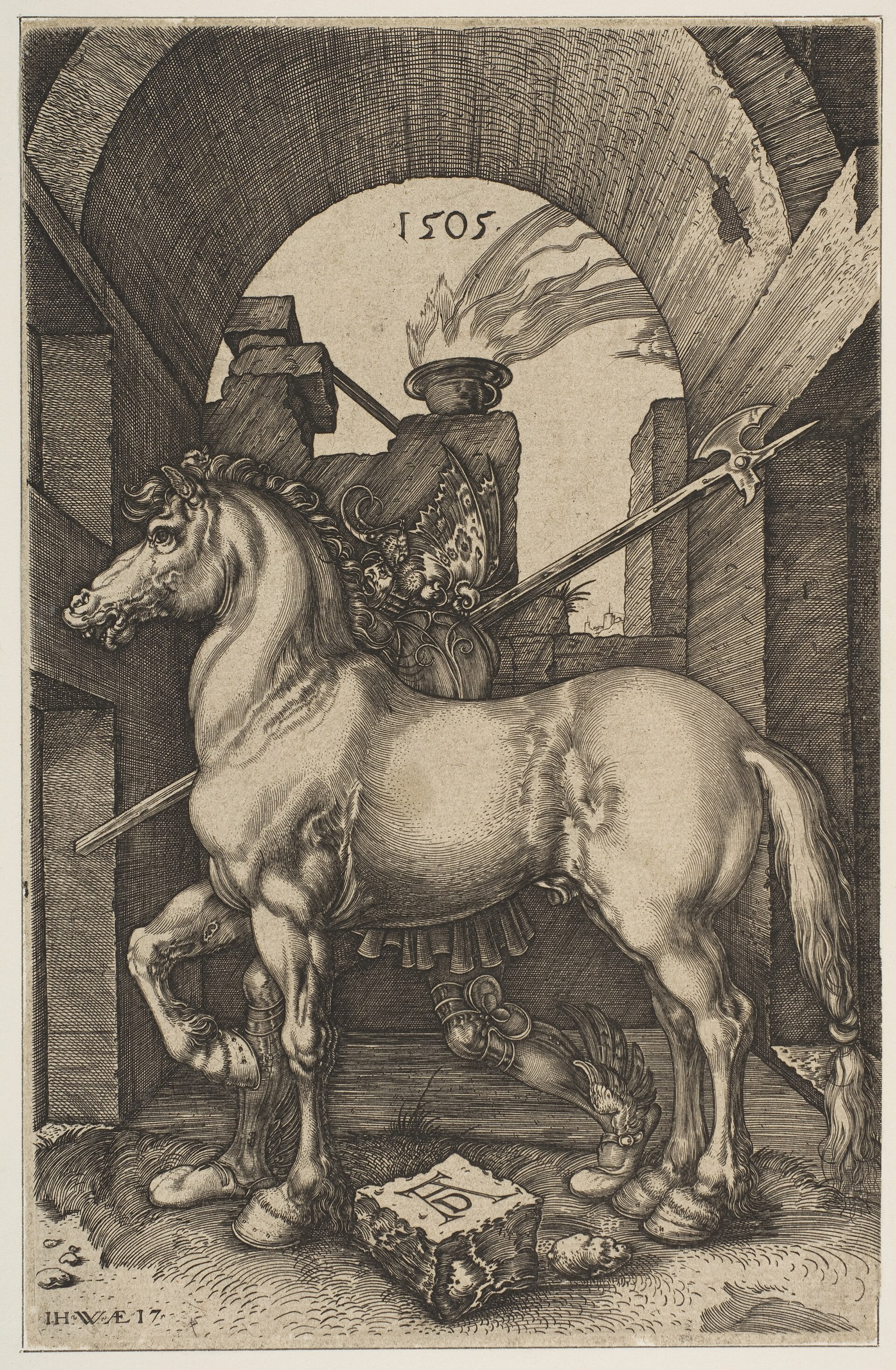
| 18 December 2018 | Bonhams, London, New Bond Street | A group of three engravings sold as one lot: The Large Horse, 1505, Meder b/c, on laid paper without watermark, irregularly trimmed on or just inside the plate mark with corner repairs; The Small Horse, 1505, Meder d, backed onto wove; and Coat of Arms with a Lion and Rooster, c. 1500, Meder f/g | Hammer Not published With premium GBP 6,000, the lot page stating the figure includes premium GBP | Prints and Multiples, lot 12. Three Durer engravings sold together for GBP 6,000 with premium, which is where the bottom of this market actually sits. Included above all for the vocabulary: three grades from three different periods of printing described in one lot, with the paper and the backing recorded for each. It is a fair picture of what circulates under Durer's name and of how a competent cataloguer says so. The Large Horse is catalogued B. 97; M., Holl. 94; SMS 43 and The Small Horse B. 96; M., Holl. 93; SMS 42. |
Hammer is the price at which the bidding stopped; with premium adds the fee the house charges the buyer on top. Hammer price and buyer's premium in the glossary.
| Institution | City | Holdings | Note |
|---|---|---|---|
| Albertina | Vienna | About 140 Durer drawings and watercolours, including the Young Hare of 1502 (inv. 3073), the Great Piece of Turf of 1503 (inv. 3075) and the Praying Hands of 1508 (inv. 3113) | The most important holding of the drawings and the one with the cleanest provenance: the Durer workshop's own stock, bought by Willibald Imhoff in 1560, sold to Rudolf II in 1588, to Vienna in 1691, the Imperial Court Library from 1783, Duke Albert of Saxe-Teschen in 1796. Press accounts round the museum's figure to 130. The watercolours are shown rarely because their light budget is finite. |
| Alte Pinakothek | Munich | The Self-Portrait of 1500 and the Four Apostles of 1526 | The two panels on which any account of Durer as a painter rests. The Self-Portrait was bought from Nuremberg in 1805 and heavily cleaned and repaired in the nineteenth century; the Four Apostles were Durer's unsolicited gift to the city of Nuremberg. Their technical literature is Goldberg, Heimberg and Schawe, Albrecht Durer: Die Gemalde der Alten Pinakothek, 1998, prepared with the Doerner Institut. |
| National Gallery of Art | Washington | The Rosenwald Collection of prints, including Melencolia I (1943.3.3522), Knight, Death and the Devil (1943.3.3519), Saint Jerome in his Study (1943.3.3524), Adam and Eve (1943.3.3492), Nemesis (1943.3.3485) and The Rhinoceros (1964.8.697), with the 1498 Apocalypse title page and Four Horsemen (2008.109.1 and 2008.109.5) and Wierix copies after Durer (1943.3.3540) | Open access: the gallery has released these images under CC0, so specific impressions can be studied at high resolution without a licence, which for a printmaker is the single most useful thing a museum can do. Lessing Rosenwald gave 8,000 old master and modern prints in 1943 and almost 14,000 more between 1943 and 1979. The Rosenwald Durers are recorded as trimmed to the plate mark, which is normal for sheets of this date and quality. |
| British Museum | London | 138 Durer drawings, 99 engravings, 6 etchings and most of his 346 woodcuts | The Department of Prints and Drawings was constituted in 1808 on a collection founded by Sir Hans Sloane's bequest, accepted by Parliament in 1753 on payment of 20,000 pounds to his executors, and built up by Cracherode, Payne Knight, Malcolm, Dodgson, de Hauke and Tomas Harris. How much of the Durer material is Sloane's specifically is not established here. The museum's own pages are behind bot protection and were not directly reachable for this record. |
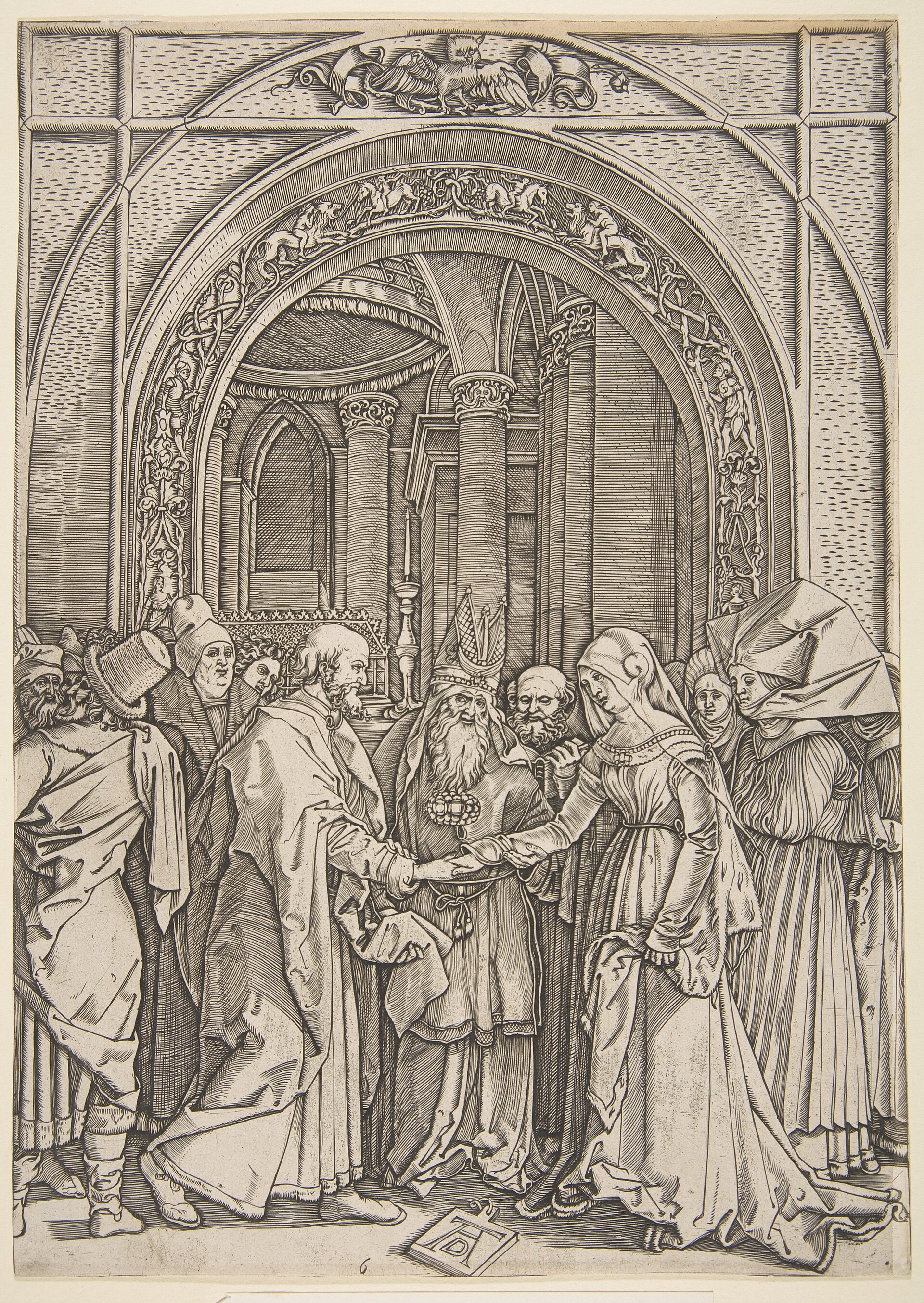
| Metropolitan Museum of Art | New York | A large print holding including Melencolia I (1984.1201.18), the unfinished Salvator Mundi, a small Virgin and Child, and catalogued sixteenth-century copies after Durer including The Betrothal of the Virgin (47.100.1255), The Visitation (18.17.2-40) and The Little Horse (17.3.3137) | Useful precisely because it holds originals, an unfinished picture and catalogued copies side by side, with SMS and Hollstein references carrying the qualifier (copy). Its collection API publishes accession numbers, media, dimensions and credit lines in machine-readable form, which makes it the easiest major collection to cite accurately. |
| National Gallery of Victoria | Melbourne | About 451 Durer prints, of which 326 came from Sir Thomas Dunham Barlow in 1956-57 | The most useful public resource anywhere on Durer's paper. Its watermarked sheets were beta-radiographed in 1993 and 1994, recording approximately 200 watermarks, of which about 160 were published as an online research database in 2016. Anyone arguing a grade should look here before quoting Meder from memory. |
| Germanisches Nationalmuseum | Nuremberg | Durer material in his own city, including the Diehl collection of 106 engravings and etchings and 37 woodcuts assembled by Karl Diehl from the 1960s and made publicly accessible in April 2016, and Christ Among the Doctors preparatory drawings on Venetian blue paper | Home of the Der fruhe Durer research project led by Daniel Hess, which published the infrared and support studies of the early paintings. Nuremberg is also where the blocks were cut, the books printed, and the council record of 3 January 1512 was made. |
| Kunsthistorisches Museum | Vienna | Paintings from the imperial collections, including the Landauer Altarpiece, the Adoration of the Trinity of 1511 | The frame is not here. Durer designed it and Veit Stoss carved it, and it stayed in Nuremberg: the original is in the Germanisches Nationalmuseum and Vienna shows a modern copy, so one commission is now two objects in two cities. Original frames are routinely separated from their pictures and this is the textbook case. The Habsburg descent from Rudolf II is why Vienna holds both the paintings here and, through the Albertina, the drawings. |
| Kupferstichkabinett, Staatliche Museen zu Berlin | Berlin | A major holding of Durer prints and drawings, including the Portrait of the Artist's Mother of 1514 | Founded 1831. More than thirty-five Durer drawings were acquired around 1877 from the Firmin-Didot and Posonyi-Hulot sales in Paris. Its 2023 exhibition Durer for Berlin showed 120 works, described by the museum as only a portion of its Durer holdings; no aggregate figure is published. |
| Museo Nacional Thyssen-Bornemisza | Madrid | Christ Among the Doctors, 1506, oil on poplar, 64.3 by 80.3 centimetres, inscribed opus quinque dierum | The picture Durer inscribed as the work of five days, painted in Venice. Panofsky described the handling as almost impromptu, a thin coat of colour in broad fluid strokes utterly unlike his usual meticulous brushwork. Four preparatory brush drawings on Venetian blue paper survive elsewhere, so the five days cannot include the preparation. |
| Historisches Museum Frankfurt | Frankfurt | Jobst Harrich's 1615 copy of the central panel of the Heller Altarpiece, with the surviving wings | A copy, and the only visual record of Durer's most ambitious painting, whose original burned in Munich in 1729. The inner wings executed by Durer's workshop are here; two of Grunewald's grisaille outer wings are at the Staatliche Kunsthalle Karlsruhe and two are shown at the Stadel on loan from this museum. Anyone citing this altarpiece should check which museum holds which panel and by whom, because the standard English accounts get it wrong and this record inherited the error before correcting it. |
| Museo Nacional del Prado | Madrid | The Self-Portrait of 1498 and Adam and Eve, 1507, on pine | The 1498 self-portrait reached Spain through the dispersal of Charles I's collection: it was among the pictures the city of Nuremberg gave to Charles through the Earl of Arundel's embassy in 1636, and it was bought by the Spanish ambassador Alonso de Cardenas. The route from a Nuremberg civic gift to Madrid runs through an English regicide. |
| Kunsthalle Bremen | Bremen | Durer material, and a claim to more | Two paintings and 362 drawings, Durer among them, were removed from the collection's wartime store at Karnzow Castle in 1945 by the Soviet officer Viktor Baldin, disclosed in 1989 and moved to the Hermitage in 1991. A 1990 treaty, the 1993 Bremen Protocol, Russia's 1998 law on displaced cultural valuables and a written ministerial commitment of February 2003 have not produced a return, and in 2005 a Russian culture minister said it was out of the question. |
A collector buying a Durer painting buys an object.
A collector buying a Durer painting buys an object. A collector buying Saint Jerome in his Study buys one sheet out of an unknown number pulled from a copper plate over a century and a half, and the difference between the best of those sheets and the worst is the difference between a six-figure sum and a lot of three engravings that made GBP 6,000 with premium at Bonhams in December 2018.
The plate is the constant. Durer cut the copper, and what he cut is fixed except where he went back into it. The variables are everything else: how much of the plate's crispness survived at the moment of printing, how the sheet was inked and wiped, what paper it was pulled on, whether the printer was Durer's own shop in Nuremberg or someone working the same plate ninety years later, and what has happened to the sheet in the five centuries since.
This is why the vocabulary of the print room is not decorative. An impression is the individual sheet. A state is a change made to the plate or block itself, so that every sheet pulled after the change differs from every sheet pulled before it. An edition or printing is a batch pulled at one time, usually identifiable by its paper. A print can be a late impression of an early state, or an early impression of a late state, and a catalogue entry that records only the state has told you half of what you need. Bonhams sold an Adam and Eve in Los Angeles in April 2025 described as the third and final state and a Meder a of d, which is exactly that combination: the last version of the design, pulled early in that version's life.
Durer complicates the picture in one specific way. He was an unusually careful craftsman who rarely revised a finished plate, so most of his engravings exist in a single state. The variation that separates one impression from another is therefore almost never a state change and almost always a matter of wear, paper and printing, which is precisely the kind of evidence a photograph cannot carry and a catalogue has to describe in words.
Four names appear in almost every Durer print description and they do different jobs.Bartsch.
Four names appear in almost every Durer print description and they do different jobs.
Bartsch. Adam Bartsch's Le Peintre graveur, published in Vienna from 1803, gave each composition a number that has never been superseded as an identifier. B. 74 is Melencolia I and always will be. It says nothing about the sheet.
Meder. Joseph Meder's Durer-Katalog: ein Handbuch uber Albrecht Durers Stiche, Radierungen, Holzschnitte, deren Zustande, Ausgaben und Wasserzeichen, Vienna, 1932, is the book that made the market legible. Its subtitle is its argument: states, editions and watermarks. Meder ran to 294 entries, treated the physical evidence of each successive printing, and carried 190 illustrations and fifty-two plates of watermarks. Meder is where the letter grades come from, and it is the reason a Durer lot reads differently from a lot by almost any other old master printmaker.
Hollstein. German Engravings, Etchings and Woodcuts, the standard series for northern prints, adopted Meder's numbering for Durer, which is why lot descriptions write M., Holl. 75 as one reference rather than two.
Schoch, Mende and Scherbaum. Albrecht Durer: Das druckgraphische Werk, three volumes, 2001 to 2004, cited as SMS. It is the modern catalogue of the printed work and the reference that decides what is by Durer and what is a copy. The Metropolitan Museum's record for its engraved Betrothal of the Virgin reads Hollstein VII 156.194 copy; Schoch, Mende, and Scherbaum 172 (copy), which is the apparatus doing exactly what it is for. It names the composition, and then says that this sheet is not by the man who designed it. A print room does not give a copy its own number. It gives it the original's number with a qualifier.
A complete Durer reference therefore has three parts. The Bartsch number identifies the design, the Meder number confirms it, and the Meder letter, with any state, identifies the sheet.
Meder's letters are the most consequential piece of notation in the Durer market and the part general accounts leave out entirely.For each plate or block Meder set out the successive printings he...
Meder's letters are the most consequential piece of notation in the Durer market and the part general accounts leave out entirely.
For each plate or block Meder set out the successive printings he could distinguish, in chronological order, and lettered them from a upward. a is the earliest recorded printing: the impressions closest to the moment the plate was finished, usually on paper carrying watermarks in use in Durer's lifetime, printing with the full depth of the burin work and none of the softening that comes from use. b is the next distinguishable printing. Later letters run on through the sixteenth and seventeenth centuries as the plate was printed and reprinted on later paper. A catalogue that says Meder f/g is telling you the sheet was pulled well over a century after the plate was cut. Bonhams has offered a single lot of three Durer engravings graded, respectively, Meder b/c, Meder d and Meder f/g, which is a fair picture of what actually circulates.
The letters are not states. A state is a change to the matrix; Meder's letters are a chronology of printings distinguished largely by paper and by the condition of the plate. Two impressions graded Meder a and Meder d can be identical in every line, because nothing was ever cut into the plate between them. What changed is the metal, the ink and the sheet. Auction descriptions also use compound grades, Meder a-b or Meder b/c, which mean the cataloguer places the sheet between two of Meder's printings and is saying so rather than rounding.
The price consequence is brutal and demonstrable on one composition. Galerie Kornfeld sold an Adam and Eve of the second state, before the gap in the bark, in Bern on 17 September 2021 at a hammer of CHF 800,000 against an estimate of CHF 400,000. Sotheby's offered an impression of the same engraving in London on 17 September 2019, graded Meder IIIb-c, at an estimate of GBP 15,000 to 25,000. Bonhams sold a Meder IIc impression with creasing and repaired tears in San Francisco in May 2010 for USD 122,000 including premium. One plate, one design, and a spread of well over an order of magnitude decided by nothing a reproduction can show.
The same pattern holds for Saint Jerome in his Study, and there the comparison is unusually clean because both sheets are recorded as having no watermark at all. Bonhams sold a Meder c impression, trimmed just inside the plate, in London on 15 July 2014 for GBP 32,500 including premium. Sotheby's offered a Meder a impression, described as fine, bright and warm, in London on 6 December 2024 at an estimate of GBP 150,000 to 250,000. The composition is identical, the paper evidence is equally absent in both, and the letter is the price.
Because Durer revised so little, the states that do exist matter disproportionately.Melencolia I, engraved in 1514 and measuring roughly 24 by 18.8 centimetres, exists in two states.
Because Durer revised so little, the states that do exist matter disproportionately.
Melencolia I, engraved in 1514 and measuring roughly 24 by 18.8 centimetres, exists in two states. In the first, the digit nine in the four by four magic square on the wall behind the winged figure is reversed. In the second, and far commoner, state it has been corrected to a nine that still looks slightly odd. That single character is the whole difference between a sheet pulled before Durer went back to the plate and every sheet pulled after. It is also the only Durer state question that can be settled from a photograph, which is why it is the one everyone knows.
The square itself is the first magic square printed in Europe. Every row, column and diagonal sums to thirty-four, and the two central cells of the bottom row read 15 and 14, the year of the engraving. It is a piece of design, a date and a correction site at once.
Adam and Eve of 1504 is the other engraving where the state ladder is quoted routinely in the saleroom. Three states are recognised, and the trade's shorthand for the transition, before the gap in the bark, marks the point that separates the early impressions from the rest. Kornfeld's 2021 lot was catalogued as the second state of three, and its CHF 800,000 hammer is the best evidence available of what an early state is worth when it is also an early impression.
For the great majority of Durer's plates there is no state to argue about at all. The plate was cut, it was printed, and the only chronology available is the one Meder built out of paper and wear, and the one Angela Campbell is now building out of the metal itself.
Iconotheca has published separately on how a sheet of early modern paper is read: the mould's chain and laid lines, the watermark as the mill's identifier, mould-mates, the chemical failure of...
Iconotheca has published separately on how a sheet of early modern paper is read: the mould's chain and laid lines, the watermark as the mill's identifier, mould-mates, the chemical failure of nineteenth-century wood pulp and the light budget that governs display. All of that applies to Durer, and none of it is repeated here. What is specific to him is that the method was built on his work first, and that the reference apparatus already exists.
Meder did not merely mention watermarks. He compiled them, and the 1932 catalogue carries fifty-two plates of them keyed to individual printings. That is what turns a watermark from a curiosity into a dating tool for this artist in particular, because the work of establishing which marks appear in which printings has already been done. A watermark that Meder records only in late impressions places the sheet in a late printing whatever the plate shows.
The named marks recur, and a large collection lets you see the families. The National Gallery of Victoria holds about 451 Durer prints, of which 326 came from Sir Thomas Dunham Barlow in 1956 and 1957. During a cataloguing campaign in 1993 and 1994 its paper conservation studio beta-radiographed every watermarked sheet and recorded approximately two hundred separate watermarks, of which about 160 were published online as a research database from 2016. The families are the ones a specialist expects: the High Crown in several variants, the Bull's Head with a caduceus, a cross, a star or a flower above it, the Imperial Orb or Reichsapfel, the Fish Bladder, the Two Towers or City Gate, the Anchor in a Circle, the Scales in a Circle surmounted by a Star, the Crowned Tower with a Flower, and the Double-Headed Eagle with a Crown. The gallery's own account of the purpose is exact: the marks assist with dating and authenticating Durer prints, and they give a picture of what paper was actually available in Germany in the late fifteenth and early sixteenth centuries. Its findings are also a warning against generalising about him. Durer used laid paper from both German and Italian sources throughout his career and printed on both the wire and the felt side of the sheet.
Beta-radiography is what made the exercise practicable at collection scale. A thin plastic sheet impregnated with carbon-14 is laid against the paper and emits beta particles that register on film in proportion to thickness, so the watermark, the chain lines and the variations in pulp dispersion are recorded without the printed image interfering. On a Durer engraving, where the ink is dense and the design covers most of the sheet, transmitted light alone is often not enough. The technique records more than the mark: areas of variable pulp dispersion, inclusions such as splinters of wood, and damage accumulated across the life of the print.
Two cautions belong here and are routinely skipped. A watermark dates the sheet, not the plate and not the image; it sets an earliest bound and nothing more, and its real force comes from grouping mould-mates, sheets formed on the same physical mould, which came from one batch and were therefore used inside a bounded period. And a great many Durer impressions carry no watermark at all, because the mark fell outside the retained area or the sheet was trimmed. Both of the Saint Jerome impressions quoted above, at ten times the difference in value, are recorded as without watermark. Absence of a watermark is not evidence of anything.
The newest layer of evidence under an impression is microscopic, and it belongs to the plate rather than to the paper.Angela Campbell's study of the three Meisterstiche, published as a chapter in...
The newest layer of evidence under an impression is microscopic, and it belongs to the plate rather than to the paper.
Angela Campbell's study of the three Meisterstiche, published as a chapter in Reassessing Epistemic Images in the Early Modern World in 2022, sets out the mechanism. Every time a copper plate is inked and wiped, hard fragments of burr residue left by the burin and hard inclusions in the carbon-based ink are dragged across the surface. Over hundreds of impressions the metal declines, and it declines in a way that is not random. It accumulates specific, individual, microscopic scratches, and each scratch has a moment at which it first appears.
That gives a sequencing method independent of paper. If a scratch is present on one impression and absent on another, the one without it was pulled first, whatever the watermarks say. Campbell applied this to Knight, Death and the Devil of 1513, Saint Jerome in his Study of 1514 and Melencolia I of 1514, digitally recording and comparing wear patterns to reconstruct a chronology of impressions.
The trade had been doing a coarse version of this for a century without naming it. Bonhams catalogued its 2014 Saint Jerome as a Meder c impression before the curved scratch on the ceiling: a single accidental mark on the copper, used as a dating criterion. Campbell's method is that practice made systematic and pushed down to a scale the eye cannot reach.
The practical significance is that Meder's letters are no longer the last word. They are an early twentieth-century connoisseur's ordering, built on paper and on the eye, and they are now testable against a physical record that was always present in the sheets and was simply too small to see. Where the two disagree, the scratches ought to be the harder evidence, because they are a physical record rather than a judgement. Whether they do disagree on any named sheet is not established: the method is published, the impression-by-impression findings are not.
The examination has an order, and it does not begin with the image.The sheet is unframed by a paper conservator, not by the owner, and looked at first in transmitted light to find the chain lines...
The examination has an order, and it does not begin with the image.
The sheet is unframed by a paper conservator, not by the owner, and looked at first in transmitted light to find the chain lines, establish the orientation of the mould and locate any watermark. If the mark is obscured by the printing, beta-radiography records it. It is then matched against Meder's plates and, where necessary, against Briquet's Les Filigranes, and the result is a date range for the paper. Where several sheets share a mould state, they are mould-mates and belong to one campaign of printing.
The platemark is next. An intaglio plate is forced into damp paper under pressure and leaves an embossed rectangle slightly larger than the design. Its presence, its sharpness and its position are all evidence, and a sheet trimmed to or inside it has lost information and, in the market, value. Many fine early impressions have been trimmed, which is why lot descriptions say so explicitly and why catalogue dimensions distinguish the platemark measurement from the sheet measurement. The National Gallery of Art's Rosenwald Melencolia I and its Knight, Death and the Devil are both recorded as trimmed to the plate mark.
Then raking light, which reveals surface texture, the depth of the platemark and repairs invisible in flat light, and then magnification of the inked line itself. A hand-cut line has an organic, slightly irregular edge and, on an engraving, a swelling and tapering character that comes from the v-section of the burin cut. A photomechanically reproduced line does not, and where a screen or an aquatint grain was used it is visible. On a drypoint the question is burr: the raised metal thrown up on either side of the scored line holds extra ink and prints velvety, and it collapses quickly, so the quantity of surviving burr is a direct measure of how early the impression was pulled.
Then the printing overall: whether the fine cross-hatching in the shadows still reads as separate strokes or has begun to fill and grey, whether the plate edges print crisply, whether plate tone, the deliberate veil of ink left on the surface for effect, is present and intended rather than accumulated. This is where the Meder letter is assigned, and it is a judgement made against remembered comparisons rather than against a rule.
Only then does the specialist look for a state, and finally at condition, which is a separate axis and the one most often conflated with quality. Princeton's Knight, Death and the Devil, described by the museum as perhaps the strongest of its three Meisterstiche for its rich darks and high contrasts, also carries eighteenth-century restoration: a strip about half an inch wide along the right edge and a section of the top centre, professionally redrawn. That is a fine impression and a made-up sheet at the same time, and both facts belong on the record.
Durer's prints are priced today as rare objects.
Durer's prints are priced today as rare objects. They were made as a volume business, and the documentation of that business is unusually good.
He sold woodcuts as single sheets and in book form, and the great series were often sold sheet by sheet for years before being gathered into books. Single sheets were cheap enough for an ordinary buyer, and Nuremberg, a commercial capital of the empire with fairs, markets, shooting contests and religious festivals, delivered a stream of out-of-town customers to sell them to. It also supplied the inputs: fine paper, mechanics who could build and maintain presses, and copper for plates.
Durer stockpiled deliberately. In a letter of 1509 he wrote that for the next year he would produce such a pile of ordinary pictures that nobody would believe one man could do it, and that this was the way to make some money. Because he kept the blocks and plates, he could reprint anything that sold out, which is a print-on-demand model four centuries early. It is also the reason the corpus has a long tail of later impressions: the matrices stayed in the family, and his will left them to his brother Endres.
The distribution was more ambitious still. He put his mother and his wife Agnes to work selling prints at markets at home and abroad, and beyond the family he retained independent contract agents to sell in other cities. Two contracts of 1497 survive. They pay an itinerant agent a set weekly wage equivalent to a skilled craftsman's, require him to sell eagerly and energetically and to avoid frivolity, and in one case set a minimum price per print while allowing the agent to go higher if he can, and in the other simply require him to obtain the highest price he can get. That is a period wage attached to a print-selling job, and it is the most concrete answer available to the question of what these objects were worth when they were new.
The arrangement lost money as often as it made it. One of his agents died in Rome and Durer lost every print in his possession, after which he began demanding more security from the others. The point is not that he was a good businessman in every particular. It is that mass production, retention of the matrices, stockpiled inventory, distribution through agents, shipment of marked goods far beyond the local market and reputation as an asset were all in place by about 1500, in one workshop, and that the disputes over his monogram follow from the commercial system rather than from wounded pride.
The AD monogram is treated today as a signature.
The AD monogram is treated today as a signature. It was not one, and the difference is the whole legal story.
German artists before Durer had been marking work with initials, a habit that grew out of the practice of stonemasons and goldsmiths, who applied their marks so that they would be paid and, in metal, to guarantee the quality of the material. Martin Schongauer, an engraver from a goldsmith's background, adopted the same practice, and Joseph Koerner has pointed out that he applied it to his prints and not to his paintings, as part of a strategy for making mechanical reproductions pay in a market where the artist is absent from the community that buys the image. That is the origin of the mark: a warranty attached to a manufactured good that travels without its maker.
Durer began signing with his initials at about fourteen and was using the AD monogram on woodblocks and engraving plates by his early twenties. On a print the monogram is cut into the matrix, so it is not applied to a finished object at all; it is part of the design, and every impression from that plate carries it. This is precisely why the remedies granted in his disputes took the form they did. Ordering a copyist to stop using the mark meant ordering him to alter his plate.
The 1500 Self-Portrait in Munich puts the two things side by side. The panel is inscribed in Latin to the right recording that Albrecht Durer of Nuremberg painted himself in his own colours at the age of twenty-eight, and to the left, at the same height as his eyes, sits the AD monogram in gold on black. Durer scholars read the frontal, Christ-like composition as the artist proposing himself as origin. Read commercially, the panel carries the trade mark of the workshop at eye level, on the most public object the workshop produced.
The most cited episode in Durer's career is also the one where the evidence is thinnest, and the honest version is far more useful than the confident one.Everything the world knows about the Venetian...
The most cited episode in Durer's career is also the one where the evidence is thinnest, and the honest version is far more useful than the confident one.
Everything the world knows about the Venetian dispute comes from Giorgio Vasari, in his life of Marcantonio Raimondi, published in the second edition of the Lives in 1568, at least forty years after Durer's death, and after events he does not date. Vasari's account is this. Raimondi saw Durer's woodcuts for sale on the Piazza San Marco, spent nearly all his money on the set, and set about engraving near-identical copper copies, with engraving as strong as the woodcuts, including the AD monogram. The copies were so good that they were bought and sold as Durer's own. Durer heard of it while in Flanders, flew into a rage, went to Venice and complained before the Signoria, and, in Vasari's words, could obtain no other satisfaction but this, that Marcantonio should no longer use the name or the signature of Albrecht on his works.
Now the problems, and they are serious. Vasari gives no date. The 1506 that appears in every popular account was worked out in the nineteenth century by the Viennese art historian Moritz Thausing from what he knew of Durer's travels, and it is regularly and wrongly attributed to Vasari himself. No Venetian record of the suit or the judgment has ever been produced. Thausing himself wrote in 1882 that he had searched the Venetian archives in vain for any trace of the lawsuit, adding that this was not to be wondered at given the gaps in the surviving documents. Lisa Pon, whose Raphael, Durer, and Marcantonio Raimondi of 2004 is the standard study, states that there is no archival evidence supporting Vasari's claim that Durer sought a resolution before the Venetian Senate, and describes Vasari's chapter as riddled with inaccuracies and self-contradictions. Christopher Witcombe adds that Durer held no Venetian privilege that such a suit would ordinarily have invoked, and notes that the 1506 date inscribed on some of Raimondi's prints was itself added in the eighteenth century.
Vasari also gets a fact wrong that can be checked. He says the offending series was the Small Passion. Raimondi's version of the Small Passion dates from 1511, more than four years after Durer's last trip to Italy, and, tellingly, no longer carries Durer's initials. What Raimondi copied earlier, and what any dispute must have concerned, is the first seventeen sheets of the Life of the Virgin.
Against all that sits one piece of physical evidence that is not narrative at all. Early Raimondi copies after Durer reproduce the AD monogram on a cartellino, a painted or engraved faux-stone tablet, in the lower corner, exactly as Durer's own sheets do. Later Raimondi copies leave the same cartellino conspicuously blank. Something changed, in the right direction, at roughly the right time. It does not prove Vasari's courtroom scene, but it is consistent with a ruling, a complaint, or both.
One further complication belongs on the record because it cuts the other way. Pon found that on at least one Raimondi sheet the AD monogram is absent from an early proof and present only in the published state, alongside Raimondi's own monogram and the publisher's mark. Her reading is that copying Durer's monogram was not a plagiarist's blunder but a publisher's acknowledgement of the model used. If that is right, the man who put Durer's mark on the copies may not have been the engraver at all.
There is a documented case, it is not the famous one, and it is better than the famous one in every respect that matters to a record.The archives of the Council of Nuremberg carry a terse official...
There is a documented case, it is not the famous one, and it is better than the famous one in every respect that matters to a record.
The archives of the Council of Nuremberg carry a terse official entry dated 3 January 1512, filed under the heading Albrecht Durer's art stolen. In Joseph Koerner's translation it reads: the foreigner, who sold prints before the town hall, some with Albrecht Durer's monogram, hanndzaichen, that were fraudulently copied from him, shall be bound by oath to remove all the said monograms and sell none of them here; and if he refuses, all his said prints shall be confiscated as counterfeit, ain falsch, and taken into the hands of the council.
Read it slowly, because every clause is doing work. The defendant is not from Nuremberg and is not named. He was selling copies openly, in public, in front of the town hall, at the end of 1511. The objects are prints. They carry Durer's monogram. The copying is described as fraudulent, but the order is not that he stop copying. The order is that he remove the monograms, on oath, and that he may not sell the marked sheets in Nuremberg. The alternative is confiscation, and the word used for the objects is falsch: false, counterfeit.
That is the whole regime in one paragraph. The composition is free. The mark is not. The remedy is territorial, running only to sales in Nuremberg. And the offence is not against a right in the image but against the truthfulness of a mark applied to goods in commerce, which is a recognisably modern trademark logic arrived at four centuries before the concept had a name.
Durer had not waited for it. The book editions of his print series issued in 1511 carry a printed warning to copyists, under an imperial privilege from Maximilian. In Koerner's translation: beware, you envious thieves of the work and invention of others, keep your thoughtless hands from these works of ours; we have received a privilege from the famous Emperor of Rome, Maximilian, that no one shall dare to print these works in spurious forms, nor sell such prints within the boundaries of the empire. The Latin opens Heus tu insidiator. The privilege itself is lost; it is known only from Durer's own quotation of it on his own sheets, and Jeffrey Ashcroft dates it to 1511. Surviving leaves of the colophon are held in public collections, including one in Oslo printed by Hieronymus Holtzel and dated 1511.
So the sequence is: a printed threat in 1511, a Nuremberg ruling in January 1512, and, at some point, an episode in Venice that we know only because Vasari wrote it down. A page that presents the Venetian story as the first copyright case in Europe has repeated the least reliable part of the record and dropped the most reliable.
Durer kept his blocks and plates, which was the commercial point of the operation, and he left them in his will to his brother Endres.
Durer kept his blocks and plates, which was the commercial point of the operation, and he left them in his will to his brother Endres. They went on printing.
That single fact generates most of what a print room deals with today. A Durer plate that survived into the later sixteenth and seventeenth centuries could be printed by whoever held it, on whatever paper was current, as often as the metal would stand. The resulting sheets are not forgeries. They are genuine impressions from a genuine plate, and they are worth a small fraction of an early one. Meder's later letters exist to name them.
The woodblocks tell the same story more brutally, because wood decays in ways copper does not. Impressions pulled from surviving original blocks long after Durer's death print grey and blotchy, because the relief edges have softened, the block has split and insects have eaten into it. Wormholes are now a dating tool in their own right: a study led by Blair Hedges measured 3,263 individual wormholes across 473 European prints spanning 1462 to 1899 and showed that the diameter separates the common furniture beetle of northeastern Europe from the Mediterranean furniture beetle of the southwest, which means a hole in a printed image can carry information about where the block was sitting when the beetle got to it. The authors present it as a proposed technique rather than routine practice, and no Durer case study is attached to it, but the principle is sound and the direction of travel is clear.
The commonest misrepresentation in this market is therefore not a forgery at all. It is a late impression described as an early one. The detection is paper first, matched against Meder, then the state of the matrix: filled and greying cross-hatching, softened plate edges, a weak or absent plate mark. A description that gives a Bartsch number and no Meder letter has told you about the design and nothing about the object.
The copyists after Durer's death fall into three groups that are detected in three different ways.The first is the working copy for a market that wanted the image and could not get an impression.
The copyists after Durer's death fall into three groups that are detected in three different ways.
The first is the working copy for a market that wanted the image and could not get an impression. The Metropolitan Museum holds sheets catalogued exactly this way: an engraved Betrothal of the Virgin after the woodcut, accession 47.100.1255, recorded as Hollstein VII 156.194 copy and Schoch, Mende and Scherbaum 172 (copy); a woodcut copy of The Visitation, accession 18.17.2-40; and a small engraved Little Horse, accession 17.3.3137, catalogued as after Durer by Johannes Wierix. The Antwerp Wierix brothers, Jan, Hieronymus and Antonie, learned their trade on Durer: Hieronymus is recorded as having copied Durer's Saint George at twelve and his Saint Jerome at thirteen, and Jan Durer's Fall of Man at sixteen. Their copies were not covert. The Rijksmuseum's Mass of Saint Gregory by Hieronymus Wierix, dated 1585 and published in Antwerp by Adriaen Huybrechts, still carries Durer's monogram on the stone beneath the altar, seventy-three years after the Nuremberg council had ordered a man to file such marks off, and in a jurisdiction that ruling never touched.
The second group is the virtuoso pastiche, and it is a different problem because it was made to be admired rather than to deceive, and deceived anyway. In 1593 and 1594 Hendrick Goltzius engraved a set of six large prints on the early life of the Virgin, each executed in the manner of a different master: Durer, Lucas van Leyden, Raphael, Parmigianino, Bassano, Barocci. The Durer sheet, The Circumcision, reworks the composition of Durer's own woodcut of the subject but is engraved rather than copied line for line, in Durer's engraving idiom. Karel van Mander, who knew Goltzius, records that collectors bought impressions as original Durers, and that the game was given away by a self-portrait Goltzius had hidden in the crowd, standing in the church of Saint Bavo in Haarlem rather than anywhere in Judaea.
The third group is the Durer Renaissance, and it is the one that still moves attributions. Rudolf II was an obsessive Durer collector; he brought Hans Hoffmann from Munich to Prague as court painter in 1585 and used him as an adviser on acquiring Durer. Hoffmann specialised in versions of Durer's nature studies. He is recorded as having made at least two copies of each subject, signing one with his own monogram and one with Durer's, and as having given some of his versions a false date: one of his copies of the Young Hare carries the AD monogram and the date 1528, the year Durer died and roughly two years before Hoffmann was born. At least twelve early copies of the Young Hare are known. Because the Nuremberg collector Paulus Praun assembled more than a hundred works by Hoffmann and the collection stayed together into the early nineteenth century, Hoffmann is unusually well documented as an artist in his own right, and several works that passed as Durer into the twentieth century now trade, at high prices, as genuine Hoffmanns.
Hoffmann is the reason an unsigned nature study in Durer's manner is a question and not an attribution. He worked from the originals, with access to them, in the same technique, at a very high level. The separations that have been made rest on paper and watermark evidence placing a sheet after 1528, on signatures and dates where they exist, and on the internal evidence of a copyist's hand: a version made from a finished drawing has no searching in it, because there was nothing left to search for.
The nineteenth century reproduced Durer industrially, and those reproductions have now aged into objects that pass at a glance.
The nineteenth century reproduced Durer industrially, and those reproductions have now aged into objects that pass at a glance. They are the most common thing brought to a print room as a discovery.
The most accomplished producer was Charles Amand-Durand, active in France in the second half of the century, who made photogravure facsimiles of old master prints including many Durers. The process was not lazy. The image was photographically transferred to a sensitised copper plate, then compared by hand against an original impression in a major collection and retouched until the tone and detail matched, and each sheet was then inked, wiped and printed like a genuine intaglio print. Amand-Durand sheets carry an identifying stamp on the verso, which is the good news; the bad news is that dealers have removed the stamp to pass them as originals, so its presence proves a facsimile and its absence proves nothing.
Electrotyping, developed in the same period, does the equivalent for relief: an exact metal shell facsimile of a woodblock, an engraved plate or a forme of type, allowing a fragile original block to be duplicated and distributed without being worn out. Period technical writers considered electrotypes not difficult to distinguish from originals, partly because the fresh electrotyped surface is conspicuously bright until it acquires a patina.
The detection is structural rather than connoisseurial, and it is decisive. A photomechanical reproduction has no true plate mark unless one has been faked, and a faked one does not match the design. Under magnification the line has the character of a photographic transfer rather than of a burin: it does not swell and taper, and where a screen or an aquatint grain was used it is visible as a regular reticulation that no cut line has. The paper is the second test and usually the quicker one, because nineteenth-century stock differs from sixteenth-century rag in fibre, in sizing and in how it has aged, and because the watermark, if any, will not be in Meder. Ink is the third: modern printing inks differ chemically and optically, in sheen and in ultraviolet response, from hand-mixed sixteenth-century ink.
This record has not been able to reach a documented individual prosecution or published case study for a nineteenth-century Durer facsimile passed as an original, and says so rather than illustrating the class with an anecdote it cannot cite. The best-known Durer forgery story in circulation, that of the Neapolitan painter Luca Giordano acquitted around 1653 on the ground that painting a convincing Durer proved him Durer's equal, traces to a popular history whose handling of the Raimondi episode has been criticised by name in the scholarly literature, and is not adopted here.
The paintings are the part of Durer's output where the arguments are loudest and, more surprisingly, where there is no agreed total at all.
The paintings are the part of Durer's output where the arguments are loudest and, more surprisingly, where there is no agreed total at all. That absence is itself the finding.
The authoritative catalogue is Fedja Anzelewsky's Albrecht Durer: Das malerische Werk, published in Berlin in 1971 and revised in two volumes in 1991, and cited in the German literature simply as A. But an Anzelewsky number is not a vote for autograph status. His catalogue runs through the painted work including things that are not autograph paintings and in some cases not paintings at all, coded in his own apparatus: K for a work surviving only as a copy, V for one lost and known only from written sources, Z for one known only through a surviving drawing, W for a workshop picture. A catalogue number in the 180s therefore does not mean 180 surviving autograph panels, and anyone quoting a headline figure derived from the numbering has misread the book.
The other authorities do not fill the gap, because they are catalogues of something else. Friedrich Winkler's four volumes of 1936 to 1939 are the drawings. Schoch, Mende and Scherbaum is the prints. Neither is a painting catalogue, and both are regularly miscited as though they settled the painted corpus. This record has not located a post-1991 scholarly statement of a total, and declines to quote one of the several incompatible figures that circulate online. What can be said is that the movement has gone in both directions rather than in one.
Downward, the documented demotions are specific. The National Gallery in London bought The Painter's Father in 1904 as a Durer and now catalogues it as after Durer, on technical grounds it publishes: the background colour and the application of the paint in one thick layer rather than several thinner ones are not typical of the artist, and the picture is probably a later sixteenth-century copy of a lost original. The support, lime, is right; the handling is not. The central panel of the Dresden Altarpiece is recognised only as a copy. A Portrait of a Clergyman in Washington was proposed as nineteenth-century work by Colin Eisler in 1977. A portrait of Endres Durer in Budapest is excluded by Anzelewsky. And on the largest scale, Matthias Grunewald was obscure until the late nineteenth century in part because a body of his paintings had been filed inside the Durer corpus.
Upward, there are reinstatements. Jochen Sander re-ascribed The Miraculous Salvation of a Drowned Boy in Bregenz to Durer as a work of shortly after 1490 in the Stadel exhibition catalogue of 2013, on the underdrawing and the painting style compared with the Portrait of Barbara Durer, whose reverse, a rocky landscape with a dragon, was itself believed lost until it was recovered in 1977. The Metropolitan Museum's small Virgin and Child was doubted by Gustav Gluck, by Hans Tietze and Erica Tietze-Conrat and by Erwin Panofsky, largely because of heavy overpaint, and survived cleaning in the 1930s under Max Friedlander and again in the 1940s to remain in the museum's Durer holdings.
Two objects define the outer limits of what the painted corpus can tell you. The Heller Altarpiece, commissioned by the Frankfurt merchant Jakob Heller and executed between 1507 and 1509, had a central panel by Durer's own hand and exterior grisaille wings by Grunewald. The central panel was sold in 1615 to Maximilian I of Bavaria and replaced in Frankfurt by a copy made the same year by the Durer copyist Jobst Harrich; the original burned in Munich in 1729. Everything known about Durer's most ambitious painting rests on Harrich's copy, now in the Historisches Museum in Frankfurt, on the correspondence, and on the preparatory drawings, one of which is the Praying Hands. The most reproduced drawing in Europe is a study for an apostle in a picture that no longer exists. At the other limit, the Metropolitan's Salvator Mundi was begun about 1505 and left with only the drapery completed, so the underdrawing of the face and neck and the first thin layers over it are visible without any instrument at all. It is the corpus's own cross-section.
The wood comes first, and on Durer it is unusually informative because his supports track his movements.The Nuremberg pictures are on limewood, the local material: the 1500 Self-Portrait, the...
The wood comes first, and on Durer it is unusually informative because his supports track his movements.
The Nuremberg pictures are on limewood, the local material: the 1500 Self-Portrait, the Portrait of Elsbeth Tucher, the Portrait of Hieronymus Holzschuher, the Four Apostles. The Venetian and Venice-adjacent pictures are on poplar: the Madonna with the Siskin, the Portrait of a Young Venetian Woman, Christ Among the Doctors. Fir and pine appear on the Paumgartner Altarpiece and the Prado Adam and Eve. Spruce appears on the Glim Lamentation. And the pictures from and after the Netherlands journey of 1520 and 1521 are on oak, which is Netherlandish panel-making convention rather than German. He also used parchment mounted on panel as an alternative to a gessoed ground, which had the practical advantage that the preparatory drawing could be transferred before mounting.
Under infrared the underdrawing is variable even within one picture. The Der fruhe Durer project led by Daniel Hess at the Germanisches Nationalmuseum in Nuremberg found on the 1500 Self-Portrait both a loose, free brush underdrawing in some passages and a much more cautious, less summary treatment of the face, with fine strokes and dense hatching. In the paint, the unfinished Salvator Mundi shows bright colour laid in first and then attenuated by thin intricate layers, with pulverised glass added to the medium for translucency.
Where all of this leads is a question about the single most famous panel of the sixteenth century, and it deserves stating plainly because it is almost never mentioned. The 1500 Self-Portrait in Munich is signed with the monogram, dated 1500, and inscribed in Latin recording that Albrecht Durer of Nuremberg painted himself in his own colours at the age of twenty-eight. It was heavily cleaned and repaired in the nineteenth century. In 2008 Philipp Zitzlsperger argued from Nuremberg's sumptuary law that the marten fur Durer wears was legally reserved for men eligible for the city council, a status he did not attain until 1509, and concluded that it cannot be ruled out that the date and the signature are a later falsification and that the picture was painted as late as 1509. That is a named scholar making a citable argument about the date and signature of the panel that this page uses as its portrait, and it belongs on the page. It is not the consensus, the attribution to Durer is not in question, and the date remains the one the panel carries. But a reader entitled to the state of the argument should have it.
The monogram, on panels, is not evidence on its own, and there are documented cases in both directions. A Sebald Beham woodcut of about 1520 based on Durer's Christ imagery carries a very large Durer monogram that appears to have been added to the block several decades later, and it was accepted by most experts as a Durer until the nineteenth century: three hundred years of a false mark doing its work. On the Portrait of Elsbeth Tucher, a picture nobody doubts, Anzelewsky notes that the barely legible monogram above the hand may be by another hand. The Berlin Portrait of Frederick the Wise is coded in the standard apparatus as carrying a monogram added later by someone else. This record has not found a case documented explicitly as a monogram added to raise a sale price; the published cases are argued in terms of attribution, and that distinction is kept here rather than smoothed.
The Durer drawings have the cleanest early provenance chain in northern European art, and it runs through a merchant family that simply bought the studio.Willibald Pirckheimer, the Nuremberg humanist...
The Durer drawings have the cleanest early provenance chain in northern European art, and it runs through a merchant family that simply bought the studio.
Willibald Pirckheimer, the Nuremberg humanist Durer met in 1495 and drew and engraved repeatedly, died in 1530 leaving his library and much of his art to his grandson Willibald Imhoff. Imhoff then acquired the contents of the Durer workshop itself, in 1560, from the heir of Durer's brother. He inventoried the holding in 1573 and 1574 and again in 1580, the year he died; a further inventory was drawn up in 1588 by his heirs, and those lists are the earliest documentary trace of most of the drawings. What Imhoff had was not an assembled collection in the connoisseur's sense; it was an ordered body of studio material that had been kept together since 1528.
In 1588 the Imhoff family sold it to Rudolf II, and it went to Prague. The Albertina's Praying Hands carries the whole chain in its own record: Imhoff's Kunstbuch, described in the 1588 list as Christ together with two hands, in grey; sold in 1588 to Rudolf II; the imperial treasury; the Imperial Court Library from 1783; and Duke Albert of Saxe-Teschen in 1796, whose collection became the Albertina. The Albertina's own figure for its Durer drawings is about 140; press accounts round it to 130.
What happened to the rest of Rudolf's collection is the standard cautionary tale about survival. Most of the paintings were crated to Vienna; what stayed in Prague was looted by Swedish troops who sacked the castle from 26 July 1648, and a Swedish inventory of 1652 lists 472 paintings as having come from Prague. The best went into exile with Queen Christina, were dispersed after her death in 1689, formed the core of the Orleans Collection and were sold in London after the French Revolution, which is why so many of Rudolf's pictures are now in Britain. What Joseph II did not sell off piecemeal in 1782 is in Vienna. The drawings appear to have escaped that: the Albertina material is recorded as moving to Vienna in 1691, four decades after the sack.
The English collections come from a different route and a different decade. Thomas Howard, fourteenth Earl of Arundel, died in 1646 owning seven hundred paintings besides sculpture, books, prints and drawings, including drawings by Durer. In November 1636, on an embassy to the Emperor Ferdinand II, he was at Nuremberg, where the city presented a pair of portraits of Durer and his father as a gift to Charles I; the pictures reached the king by 18 March 1637, went through the dispersal of the royal collection, and were bought by the Spanish ambassador Alonso de Cardenas, which is how the 1498 self-portrait came to be in the Prado. On the same 1636 visit Arundel bought the Pirckheimer library, which passed to the Royal Society in 1678 and was then broken up, partly to Bernard Quaritch in 1873 and partly through Sotheby's in 1925. Arundel's own Durer drawings scattered after his death, many reaching the Royal Library at Windsor or Chatsworth; this record has not found a published count of how many, and says so.
Sir Hans Sloane collected over 71,000 objects and left them to the nation on condition that Parliament pay his executors 20,000 pounds, which it did by act of 1753, creating the British Museum. The museum's print room, formally constituted in 1808 and built up further by Cracherode, Payne Knight, Malcolm, Dodgson, de Hauke and Tomas Harris, now holds 138 Durer drawings and a near-complete run of the prints: 99 engravings, 6 etchings and most of the 346 woodcuts. How much of that came from Sloane specifically is not established here.
The twentieth century added one chapter that is still open. In 1945 the Soviet officer Viktor Baldin found the Kunsthalle Bremen's evacuated collection in the cellar of Karnzow Castle and removed two paintings and 362 drawings, including Durer material, in a suitcase. He handed them to a Moscow museum, disclosed their existence to Bremen in 1989, and the group was moved to the Hermitage in 1991. A German-Soviet treaty of 9 November 1990 committed both states to return unlawfully transferred art, the Bremen Protocol of 1993 proposed terms, Russia's 1998 law on displaced cultural valuables cut across it, a Russian culture minister gave a written commitment to return the collection in February 2003 and the Duma refused, and in 2005 a later minister said return was out of the question. It remains unresolved.
Durer is the only major printmaker of his century who also published mathematics, and the two activities are not separable.Underweysung der Messung mit dem Zirckel und Richtscheyt, Nuremberg, 1525...
Durer is the only major printmaker of his century who also published mathematics, and the two activities are not separable.
Underweysung der Messung mit dem Zirckel und Richtscheyt, Nuremberg, 1525, is the first book on mathematics for adults written in German. Its first book handles linear geometry, including helices, conchoids and epicycloids, drawing on Apollonius and on Johannes Werner. Its second handles plane geometry and regular polygons, and here Durer explicitly prefers Ptolemy's methods to Euclid's, which is a choice and not an accident. Its third applies geometry to architecture, engineering and typography, and cites Vitruvius while working out his own classical designs and columns. Its fourth handles solids, including the five Platonic and seven Archimedean semi-regular polyhedra. Galileo and Kepler both cited it. Etliche underricht zu befestigung der Stett, Schloss und flecken followed in 1527, on fortification, probably printed by Hieronymus Andreae, reprinted at Arnhem in 1603 and translated into Latin at Paris in 1535. Vier Bucher von menschlicher Proportion appeared in 1528, immediately after his death; its first book builds on Vitruvius and on Durer's own measurement of, in his phrase, two to three hundred living persons, and an appended essay on aesthetics rejects Alberti's idea of a single objective standard of beauty in favour of a relativist notion founded on variety. He read the theorists and disagreed with them in print.
The intellectual company is documented rather than inferred. He met Pirckheimer in 1495 and was tutored by him in classical learning; he corresponded with Erasmus; he worked in Maximilian's circle alongside the court astronomer Johannes Stabius, with whom he produced the first printed celestial hemispheres and a solid-sphere world map in 1515, and alongside Konrad Peutinger and Conrad Celtes. Knight, Death and the Devil is probably grounded in Erasmus's Handbook of a Christian Knight. His own Netherlands diary records him noting Roman columns at Aachen made truly according to Vitruvius's writings, and buying a tract of Luther's and the Condemnation of Luther at Cologne in November 1520.
The religion is documented too, and it is documented as unresolved. In 1520 he wrote that God might help him to go to Doctor Martin Luther and make a careful portrait of him. In 1521 at Antwerp, on false news that Luther had been seized and perhaps killed after the Diet of Worms, he wrote a long lament asking who would henceforth expound the Holy Gospel so clearly, and calling on Erasmus to ride on beside the Lord Jesus, guard the truth and win the martyr's crown. Luther had in fact been taken into protective custody by Frederick the Wise, which Durer did not know. In 1524 he wrote to Nicholas Kratzer that because of their Christian faith they had to stand in scorn and danger, reviled and called heretics. Pirckheimer wrote in 1530 that in the beginning he had believed in Luther, like our Albert of blessed memory. From 1525 the scholarship reads Durer as distancing himself from the movement, and whether he ever formally left the Catholic Church is not established. He also gave the Four Apostles to the city of Nuremberg unsolicited in 1526, with inscriptions warning against human misguidance for the Word of God, and altered the fourth figure from Saint Philip to Saint Paul to fit; at the Bavarian court, later, Jesuit advisers had part of the inscribed text removed.
That is the background against which Melencolia I has to be read, and it is where the interpretative literature has to be handled with discipline. Erwin Panofsky, with Fritz Saxl from 1923 and in his own book of 1943, argued that the print fuses the iconography of melancholy with that of geometry, both governed by Saturn, that the magic square works as a talisman of Jupiter against Saturn's influence, and that the numeral in the title points to the first of Cornelius Agrippa of Nettesheim's three grades of melancholic genius, the melancholia imaginativa that governs artists; behind it stands Ficino's proposition that black bile raises thought to the comprehension of the highest.
Those are facts about Panofsky. There is very little contemporary documentation of what Durer meant. Martin Buchsel reads the print as a negation of Ficino's positive account rather than an illustration of it. Joseph Leo Koerner argued in 1993 that the engraving is deliberately obscure and built to generate multiple and contradictory readings. Patrick Doorly argued in 2004 that the subject is beauty rather than melancholy and that the text behind it is Plato's Hippias Major. Mitchell Merback proposed in 2017 a reading as a work of consolation. Each of those is attributable, and none of them is Durer.
What is not in dispute is the equipment. The polyhedron, the sphere, the compasses, the scales, the hourglass, the plane and the magic square are the instruments and objects of a man who published on measurement and who preferred Ptolemy to Euclid on a specific problem in plane geometry. Whatever the winged figure is brooding about, the things around her are the tools of Durer's second profession, and the square on the wall is the first of its kind printed in Europe. That is as far as the evidence goes, and it goes further than most accounts admit.
Engraver; Woodcut designer; Publisher; Painter; Draughtsman; Theorist. 1471-1528.
Born 21 May 1471, Nuremberg, Free Imperial City of the Holy Roman Empire; died 6 April 1528, Nuremberg, aged fifty-six; buried in the Johannisfriedhof.
Marcantonio Raimondi, Venice, and the case that rests on Vasari. Raimondi, working in Venice, made engraved copies of Durer's woodcuts, reproducing both the compositions and the AD monogram on a cartellino in the lower corner. These are not forgeries in the modern sense; they are competing editions of the same image, in a different technique, sold into the same market and carrying the mark of the man who designed the original.
Albertina (Vienna); Alte Pinakothek (Munich); National Gallery of Art (Washington); British Museum (London); Metropolitan Museum of Art (New York); National Gallery of Victoria (Melbourne).
The Durer print market prices a sheet, not a picture, and the whole apparatus of the trade exists to describe the sheet. The composition is a given; anyone can see it.
Is there any surviving Venetian document of Durer's complaint against Marcantonio Raimondi? Thausing searched in 1882 and found nothing; Pon reports no archival evidence in 2004.
Of 35 objects this archive has researched but does not publish, 27 already carry licensed photographs.
9 min read
The British Museum catalogues the Qianlong Emperor as an inscriber of the Admonitions Scroll.
10 min read
Fifty-six of the 220 published records in this archive carry an exhibition history.
9 min read
Documentation in a provenance chain rises from 63 per cent at the earliest links to 96 per cent at the most recent.
10 min read
Last verified 17 September 2026
One artwork and its story every Tuesday, with the picture: who owned it, what it made, and what closes soon in the exhibition calendar. No promotion, and nothing we cannot cite.
We send one email to confirm the address and keep nothing else. Every letter carries a one-click unsubscribe. How we handle your data.

_MET_DP816155.jpg)


_MET_DP815429.jpg)
.jpg)