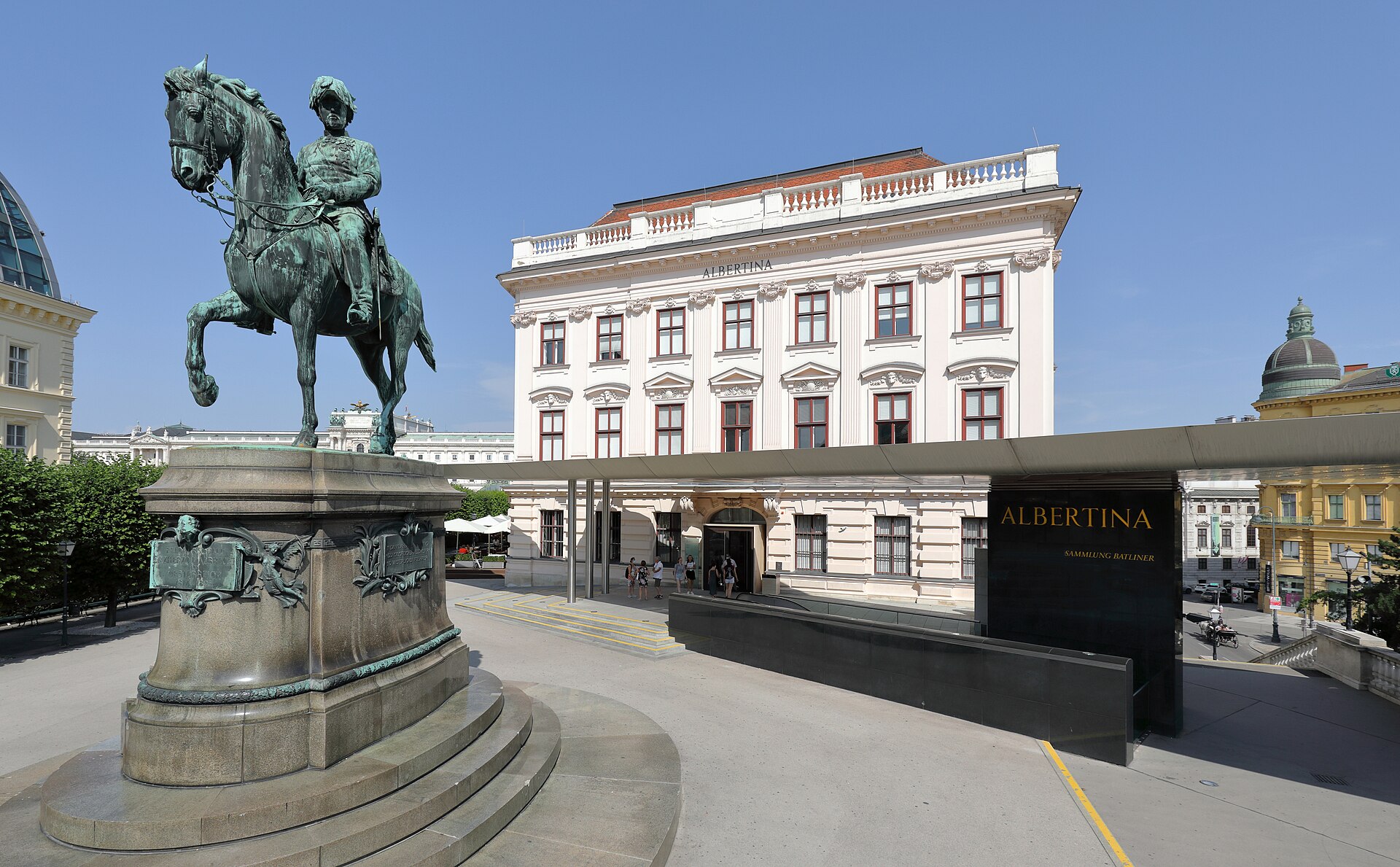
The Albertina's facade on Albertinaplatz, with the Archduke Albrecht Monument in front, as verified on the file's own Wikimedia Commons description
C.Stadler/Bwag, CC BY-SA 4.0On this page 16 sections
ContentsClose
The Albertina's strength is depth in works on paper rather than a single trophy object: more than a million drawings and prints spanning six centuries, a photography collection that is the largest of its kind in Austria, and an architecture collection running from Bernini to Zaha Hadid. Its one large standing painting display, the Batliner Collection, is a modern art collection on loan rather than an owned holding, which is why the museum's own descriptions consistently separate it from the graphic arts core. The building itself, as the restored Habsburg State Rooms make explicit, is also part of the collection.
| Kind | Museum |
|---|---|
| Founded | 1776 |
| City and country |  Vienna, Austria Vienna, Austria |
| Address | Albertinaplatz 1, 1010 Vienna, Austria |
| Website | albertina.at |
| Status | Open, confirmed |
| Record last verified |
Visiting
- Hours
- Daily10:00 to 18:00
- Wed and Fri10:00 to 21:00
- Admission
- AdultEUR 20.90Albertina main museum only
- Senior 65 plus, or under 26EUR 17.50
- Under 19Freefree
- Visitors with disabilitiesEUR 7
- Combined ticket, all three Albertina sitesEUR 29.90covers the Albertina, Albertina Modern and Albertina Klosterneuburg
- Combined ticket, reducedEUR 24.90senior 65 plus or under 26
- Tickets
- albertina.at/en/visit/tickets The museum's own ticket page.
- Do I need to book?
- Not required; the museum's own site recommends buying timed tickets online in advance to avoid the desk line
- Address
- Albertinaplatz 1, 1010 Vienna, Austria MapU-Bahn U1, U2, U4 Karlsplatz/Oper; U3 Stephansplatz
Tram Lines 1, 2, D, 62, 71 and the Lokalbahn Wien-Baden, stop Karntner Ring/Oper
Bus Line 2A, stop Albertina - Website
- albertina.at
- Telephone
- +43 1 534 83 0
Before you go how long, access, photography, bags, eating, shop
- How long to allow
- Two to three hours for the Batliner Collection and the Habsburg State Rooms alone; longer whenever a graphic arts special exhibition is running
- Access
- Not established from an accessibility statement on the museum's own site for this page. Visitor reviews describe the building's escalator running only in the up direction and a backup lift reported out of service, which some reviewers say forces stairs on visitors who cannot use them; this is a visitor report, not a museum-published policy
- Photography
- Not stated in the sources consulted for this page
- Bags
- Not stated in the sources consulted for this page
- Eating
- A museum cafe and restaurant operate on site; visitor reviews single out the pastries, supplied by the Vienna confectioner Demel
- Shop
- An online and on-site museum shop operates alongside the ticket desk
Prices and hours change. We take them from the institution's own pages and print the day we read them, and you can check the current position at the source we used. Confirm before you travel.
What is inside
Graphic Arts Collection (Drawings and Prints)
The founding collection and still the largest: more than a million drawings and prints running from the late Gothic period to the present, including Albrecht Durer's watercolour The Young Hare (1502), his engraving Melencolia I (1504) and his study Praying Hands (1508), alongside Michelangelo, Raphael, Rembrandt, Rubens, Klimt, Schiele and Picasso. Because works on paper this age cannot tolerate constant light, almost none of it is on permanent view; it is shown in rotating special exhibitions instead.
Photography Collection
By the museum's own description, the largest and most important collection of artistic photography in Austria: around 100,000 works spanning portrait, architecture, landscape and street photography from the medium's beginnings to the present, including prints by Helmut Newton, Robert Frank, Lisette Model, Rudolf Koppitz and Heinrich Kuhn.
Architecture Collection
More than 40,000 plans, studies and models running from the late Gothic to living architects, including work by Bernini, Borromini, Otto Wagner, Adolf Loos, Hans Hollein and Zaha Hadid, with particular depth in buildings along Vienna's Ring Road.
Habsburg State Rooms
Twenty restored apartments that were the actual residence of Archduchess Marie Christine and Archduke Carl for close to a century, including the Study of Archduke Carl, furnished in part with original pieces and decorated in the yellow, green and turquoise schemes original to their Habsburg use.
Batliner Collection (Monet to Picasso)
Around 500 paintings and works on paper covering French Impressionism and Pointillism through Fauvism, the German Expressionist groups Die Brucke and Der Blaue Reiter, the Russian avant-garde, and a substantial run of Picasso, from early Cubism to the 1940s and a set of his prints. On permanent loan from the collector Herbert Batliner since 2007 and displayed on an ongoing basis rather than rotated away.
What to see first
The Young Hare
Albrecht DurerA 1502 watercolour and bodycolour study, among the most reproduced drawings of the Northern Renaissance and part of the graphic arts collection's founding strength; shown only in rotating exhibitions because of its light sensitivity, not on permanent display8
Praying Hands
Albrecht DurerA 1508 study sheet held in the same graphic arts collection, one of the most widely copied and reproduced drawings the museum holds8
Study for the Last Supper
Leonardo da VinciA drawing of about 1495 connected to Leonardo's mural in Milan, cited by reference sources as among the graphic arts collection's Renaissance holdings14
Monet to Picasso: the Batliner Collection
Various, including Monet, Degas, Cezanne, Toulouse-Lautrec, Kirchner, Kandinsky, Malevich and PicassoRoughly 500 works of Impressionist through mid-century modernist painting, on permanent loan since 2007, that the museum credits with much of the more than a million visitors it now records each year11
Big Nude XI, Verina
Helmut NewtonA 1993 photograph held in the roughly 100,000-item photography collection, the largest collection of artistic photography in Austria9
House Josephine Baker, model
Adolf LoosA 1927 architectural model in the more than 40,000-item architecture collection, one of the best-known unbuilt Vienna Modernist designs12
The Habsburg State Rooms
Louis Montoyer, architect of the extension; decorated for the Habsburg archdukesTwenty restored rooms that were the actual residence of Archduchess Marie Christine and Archduke Carl, the closest thing the building offers to seeing the palace rather than the museum built inside it13
Rhinoceros
Hans BurgkmairThe sole surviving impression of a rival 1515 woodcut of the same rhinoceros Albrecht Durer made famous, more anatomically accurate than Durer's print because it keeps the animal's shackles and chain and drops Durer's invented plating. This archive's own record on Durer's Rhinoceros (durer-the-rhinoceros) documents this Albertina-held impression as the comparison piece against the Durer version held at the British Museum17
Full record in this archive
Exhibitions on now
- On now18 Sep 2026 to 31 Jan 2027Confirmed , 7 weeks ago
Past exhibitions here
A palace before it was a museum
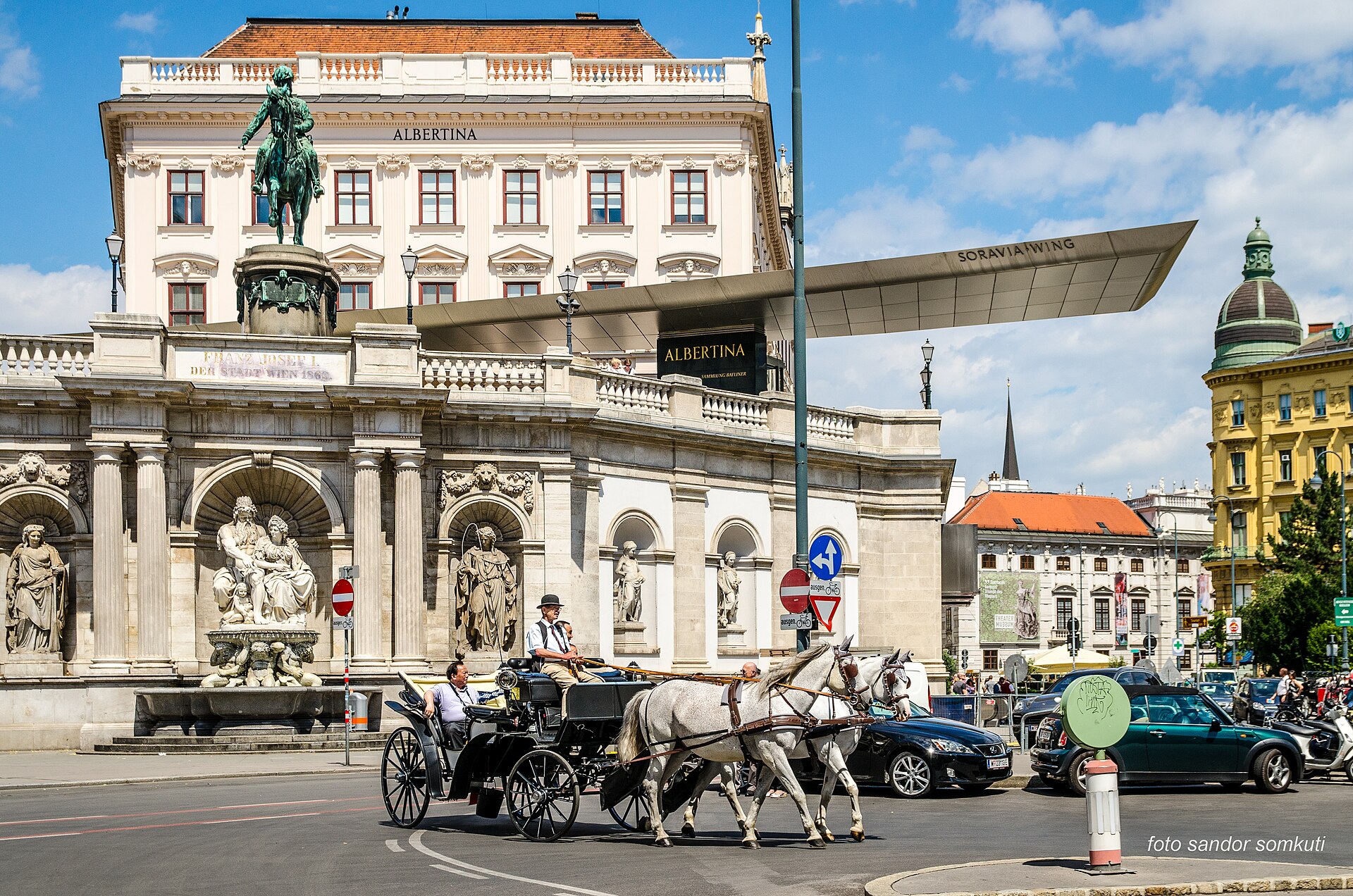
The building on Albertinaplatz began as the Habsburg court's Hofbauamt, the office that ran imperial construction projects, on a site raised above the old Augustinian city bastion. In 1744 its director, Emanuel Teles Count Silva-Tarouca, converted the office building into a residence for himself, and it was known for decades as the Palais Tarouca. Duke Albert Casimir of Saxe-Teschen, husband of Archduchess Marie Christine, the favourite daughter of Empress Maria Theresa, later acquired the palace as his own residence and had it extended by the architect Louis Montoyer. Duke Albert lived there from 1794 until his death in 1822, and it was in these rooms that he built the graphic arts collection that still gives the building its identity today.
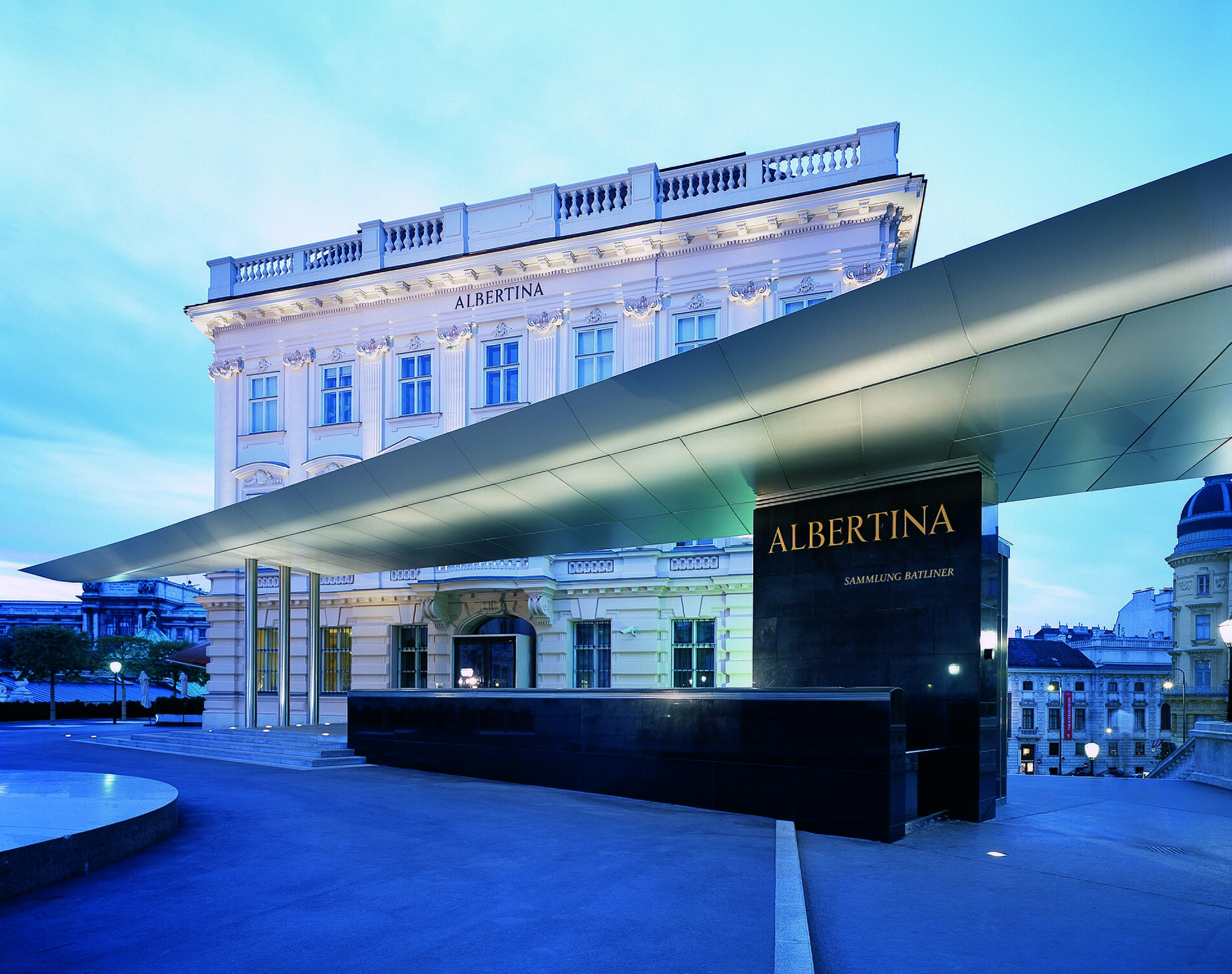
The Habsburg archdukes who inherited the palace kept it as a private residence for close to a century. That ended with the collapse of the monarchy: in early 1919 the new Austrian republic confiscated the building and its collection from Archduke Friedrich without compensation. The palace and its holdings passed into state ownership, and in 1921 the building was renamed the Albertina, after Duke Albert. The palace was heavily damaged by United States Army Air Forces bombing in March 1945, and postwar repair took years before the building matched its prewar state. A further renovation, carried out between 1998 and 2003 under the architect Hans Hollein and rebuilding the entrance and roof, reopened the building to visitors; the graphic arts collection itself, closed for the longest stretch of that work, reopened in 2008.
The graphic arts collection Duke Albert built
The collection did not start empty. On 4 July 1776 the Austrian imperial envoy in Venice, Giacomo Durazzo, gave Duke Albert and Marie Christine a group of prints he had commissioned two years earlier, close to a thousand sheets. Duke Albert kept building on that gift for the rest of his life, between 1770 and 1822, on an encyclopaedic and explicitly educational plan that matched the Enlightenment thinking of his era. By the time he died in 1822 the collection held about 14,000 drawings and roughly 200,000 prints, already of a quality and range with few equals anywhere in Europe.
His nephew and adopted son, Archduke Carl, and Carl's son Albrecht kept expanding the holdings after Albert's death. The next heir, Archduke Friedrich, made further acquisitions, most of which were lost to the family when the collection passed to the Austrian state in 1919. The state merged the ducal collection with the copperplate holdings of the former imperial court library in December 1920. Under the director Alfred Stix, acquisitions made between 1923 and 1934 filled gaps in French and German nineteenth-century drawing that the ducal collection had never covered. After the second world war, a line of directors running through Otto Benesch, Walter Koschatzky, Konrad Oberhuber and, from 2000, Klaus Albrecht Schroder kept adding to the collection, weighting new acquisitions toward Austrian modernism and international contemporary work. Schroder led the museum for twenty five years before stepping down at the end of 2024.
Seven collections, and where each one actually lives
The Albertina today organises its holdings into distinct collections rather than one undifferentiated gallery. The Graphic Arts collection is the core and the largest, and almost none of its million-plus drawings and prints are on permanent view for the light-sensitivity reasons described above; it is shown instead in a changing programme of special exhibitions, so a visitor cannot assume any single named drawing will be on the wall on a given day. Photography is a separate department and, by the museum's own account, the largest and most important collection of artistic photography in Austria, holding around 100,000 works from the medium's earliest decades to the present. Architecture is a third department, with more than 40,000 plans, studies and models running from the late Gothic to living architects. A fourth preserves the palace's own Habsburg State Rooms, the twenty restored apartments that were the actual residence of Archduchess Marie Christine and Archduke Carl, furnished with original pieces and opened to visitors as part of the museum route.
The Batliner Collection of modern painting is the fifth department, and unlike the graphic arts it is displayed on an ongoing basis rather than rotated away, discussed on its own below. A sixth department, Contemporary Art, and the Essl Collection of 1,323 works acquired in 2018, are not in this palace at all. They are shown at Albertina Modern, a separate museum about a kilometre away in the former Kunstlerhaus building on Karlsplatz, which opened on 27 May 2020. A third site at Klosterneuburg holds further contemporary works as a walk-in depot. The Albertina, Albertina Modern and the Klosterneuburg site are one institution with one general director, but they are three separate buildings on three separate addresses, and a fact about what hangs in one does not describe the other two.
What is actually on permanent view: the Batliner rooms
Herbert Batliner, a Liechtenstein-based lawyer and collector who began buying art in the 1960s, placed his collection with the Albertina as a permanent loan in 2007, and the museum's own account of the gift calls it a turning point that gave the Albertina its first large standing display. The roughly 500 works move from French Impressionism and Pointillism through Fauvism, the German Expressionist groups Die Brucke and Der Blaue Reiter, the Russian avant-garde, and a substantial run of Picasso, from his early Cubist pictures to work from the 1940s and a set of his prints. Named artists in the display include Monet, Degas, Cezanne, Toulouse-Lautrec, Gauguin, Kirchner, Kandinsky, Nolde, Goncharova, Malevich and Chagall, alongside the New Objectivity painters Wacker, Sedlacek and Hofer and the Austrian artists Kokoschka and Egger-Lienz. The museum credits this single collection with much of the more than a million visitors it now records each year.
The twenty Habsburg State Rooms sit alongside the modern painting, a deliberate contrast the museum makes no secret of: a visitor can walk from Duke Albert's Rococo and Neoclassical apartments, including the Study of Archduke Carl, straight into the Batliner galleries. The rooms were restored as part of the 1998 to 2003 rebuilding and remain furnished in part with pieces original to their Habsburg use, in the yellow, green and turquoise schemes original to the rooms.
The Nazi period and what came after
The Anschluss reached the museum's own staff within months. Josef Bick, the director, was deposed in 1938 over his Jewish origin and later interned at Dachau. Otto Benesch, then a curator, was dismissed in October 1938 because his wife, the research assistant Eva Benesch, was classified as a half-Jew under Nazi racial law. The collection itself did not pass through the period clean: the Lexikon der Provenienzforschung records that some of the museum's acquisitions during these years were taken from the assets of Jewish collectors, and that the Nazi administration in Vienna also directed miniatures to be acquired from Jewish collectors who had fled the country.
Benesch returned from exile in 1947 and, despite having been a victim of the same persecution, worked afterward to stop the export of works that had already been restituted from collections expropriated between 1938 and 1945. Restitution accelerated much later: since Austria's Art Restitution Act took effect in 1998, the museum has returned works to the heirs of roughly eighty collectors on the recommendation of the country's Art Restitution Advisory Board, according to the Lexikon der Provenienzforschung's account of the museum's history. The sources consulted for this page describe the museum's provenance research into the 1938 to 1945 acquisitions as ongoing rather than closed.
A new director since January 2025
The Austrian culture ministry named Ralph Gleis as Klaus Albrecht Schroder's successor in mid 2023, choosing him from a field of twenty candidates according to the ministry's own statement reported by The Art Newspaper, and Gleis took over as general director on 1 January 2025 after Schroder's twenty five years in the post. Gleis had run the Alte Nationalgalerie in Berlin since 2017 and had already worked in Vienna as a curator at the Wien Museum from 2009 to 2016. Austrian press coverage of the handover has framed his tenure as a chance to widen who the museum's programming speaks to, though the sources consulted for this page do not describe any specific change yet made to the permanent displays covered above; the graphic arts collection, the photography and architecture departments, the Habsburg State Rooms and the Batliner Collection are all described in the terms the museum itself currently uses.
What visitors say
Visitor reviews consistently place the Albertina among Vienna's essential museum stops, driven above all by the Batliner Collection's modern paintings and by the restored Habsburg state rooms, which read to visitors as a residence rather than a converted gallery. The recurring complaints are the admission price set against the nearby Kunsthistorisches Museum, and physical accessibility, with more than one review reporting a broken escalator or lift on the day of their visit.
What is praised, what is criticised
- Praised: the depth and condition of the Batliner Collection's Impressionist and modernist paintings, especially the Monet and Picasso rooms
- Praised: the restored Habsburg state rooms, furnished closely enough to their original use that reviewers describe walking through a residence rather than a gallery
- Praised: the museum cafe, whose pastries are supplied by the Vienna confectioner Demel
- Criticised: an admission price near 21 EUR that visitors compare unfavourably to the Kunsthistorisches Museum a short walk away
- Criticised: physical access for visitors who cannot use stairs, after reviewers reported the building's escalator running only upward and a backup lift out of service
- Criticised: curatorial labelling that at least one reviewer said skips uncomfortable biography, naming the Albertina's display of Franz Sedlacek's work without noting his Wehrmacht service beside Wilhelm Thony's biography without noting his flight from Nazi persecution
Ratings on other platforms
TripAdvisor: 4.5 from 7,184 ratings, read 21 August 2026
A platform average is a tertiary source: it moves, it is not audited, and we quote no visitor's words.
Questions about Albertina
Where is Albertina?
Albertinaplatz 1, 1010 Vienna, Austria.
How much does it cost to visit?
Adult: EUR 20.9; Senior 65 plus, or under 26: EUR 17.5; Under 19: free; Visitors with disabilities: EUR 7; Combined ticket, all three Albertina sites: EUR 29.9. As confirmed 21 August 2026.
When is it open?
Daily 10:00-18:00; Wed and Fri 10:00-21:00. As confirmed 21 August 2026.
How do you get there?
U-Bahn: U1, U2, U4 Karlsplatz/Oper; U3 Stephansplatz; Tram: Lines 1, 2, D, 62, 71 and the Lokalbahn Wien-Baden, stop Karntner Ring/Oper; Bus: Line 2A, stop Albertina.
What should you see first?
The Young Hare (Albrecht Durer); Praying Hands (Albrecht Durer); Study for the Last Supper (Leonardo da Vinci); Monet to Picasso: the Batliner Collection (Various, including Monet, Degas, Cezanne, Toulouse-Lautrec, Kirchner, Kandinsky, Malevich and Picasso); Big Nude XI, Verina (Helmut Newton); House Josephine Baker, model (Adolf Loos).
What we could not confirm
- Whether the museum's continuing Nazi-era provenance research, described by the Lexikon der Provenienzforschung as covering roughly eighty collectors so far, extends to works now on the Batliner or photography displays specifically, or remains focused on the historic graphic arts holdings, is not stated in the sources consulted for this page.
- The museum's own site does not give a firm date for when Duke Albert's palace apartments were first opened to the public as a museum, as distinct from the 1921 renaming of the collection itself.
- New director Ralph Gleis's stated plans for the permanent collection, beyond the framing reported by Austrian press at his appointment, had not been confirmed on the museum's own site at the time of research.
Images
Sources
- 1The ALBERTINA Museum Vienna, Opening Hours (official visit page) albertina.at/en/visit/opening-hours/
- 2The ALBERTINA Museum Vienna, Tickets (official prices page) albertina.at/en/visit/tickets/
- 3The ALBERTINA Museum Vienna, Visit (official overview page) albertina.at/en/visit/
- 4The ALBERTINA Museum Vienna, Contact Us (official page) albertina.at/en/contact-us/
- 5The ALBERTINA Museum Vienna, Reaching Us (official transport page) albertina.at/en/visit/reaching-us/
- 6The ALBERTINA Museum Vienna, Imprint (official legal page, entity, VAT and responsible director) albertina.at/en/imprint/
- 7The ALBERTINA Museum Vienna, History of the Drawings and Prints Collection (official research page) albertina.at/en/research/drawing-print/history/
- 8The ALBERTINA Museum Vienna, Drawings and Prints collection page (official) albertina.at/en/collections/drawings-prints/
- 9The ALBERTINA Museum Vienna, Photography collection page (official) albertina.at/en/collections/photography/
- 10The ALBERTINA Museum Vienna, Organization Profile (official page, three locations) albertina.at/en/organization/profile/
- 11The ALBERTINA Museum Vienna, Monet to Picasso: the Batliner Collection (official exhibition page) albertina.at/en/exhibitions/monet-to-picasso/
- 12The ALBERTINA Museum Vienna, Architecture collection page (official) albertina.at/en/collections/architecture/
- 13The ALBERTINA Museum Vienna, State Rooms (official exhibition/visit page) albertina.at/en/exhibitions/state-rooms/
- 14Wikipedia, Albertina (building history, WWII damage, restitution overview, Essl Collection acquisition) en.wikipedia.org/wiki/Albertina
- 15Lexikon der Provenienzforschung, Albertina entry (Nazi-era history and restitution) lexikon-provenienzforschung.org/en/albertina
- 16The Art Newspaper, 'Austria appoints Ralph Gleis to run the Albertina', 5 July 2023 theartnewspaper.com/2023/07/05/austria-appoints-ralph-gleis-to-run-the-albertina
- 17Wikipedia, Durer's Rhinoceros (Hans Burgkmair's rival woodcut and its unique surviving impression) en.wikipedia.org/wiki/D%C3%BCrer%27s_Rhinoceros
- 18TripAdvisor, Albertina, Vienna, aggregate rating and reviews (read 2026-08-21) tripadvisor.com/Attraction_Review-g190454-d244507-Reviews-Albertina-Vienna.html
- 19TripAdvisor, user jkinggnikj, review of the Albertina, 25 September 2019 tripadvisor.com/ShowUserReviews-g190454-d244507-r712891932-Albertina-Vienna.html
- 20Wikimedia Commons, File:Wien - Albertina.JPG (license and description) commons.wikimedia.org/wiki/File:Wien_-_Albertina.JPG
- 21Wikimedia Commons, Category:Albertina, Vienna (image listing) commons.wikimedia.org/wiki/Category:Albertina,_Vienna
