The Rhinoceros
Albrecht Durer · 1515 (Durer's design and the block's first printing, in his lifetime); this sheet printed c. 1618-1622, the sixth of eight editions taken from the same woodblock
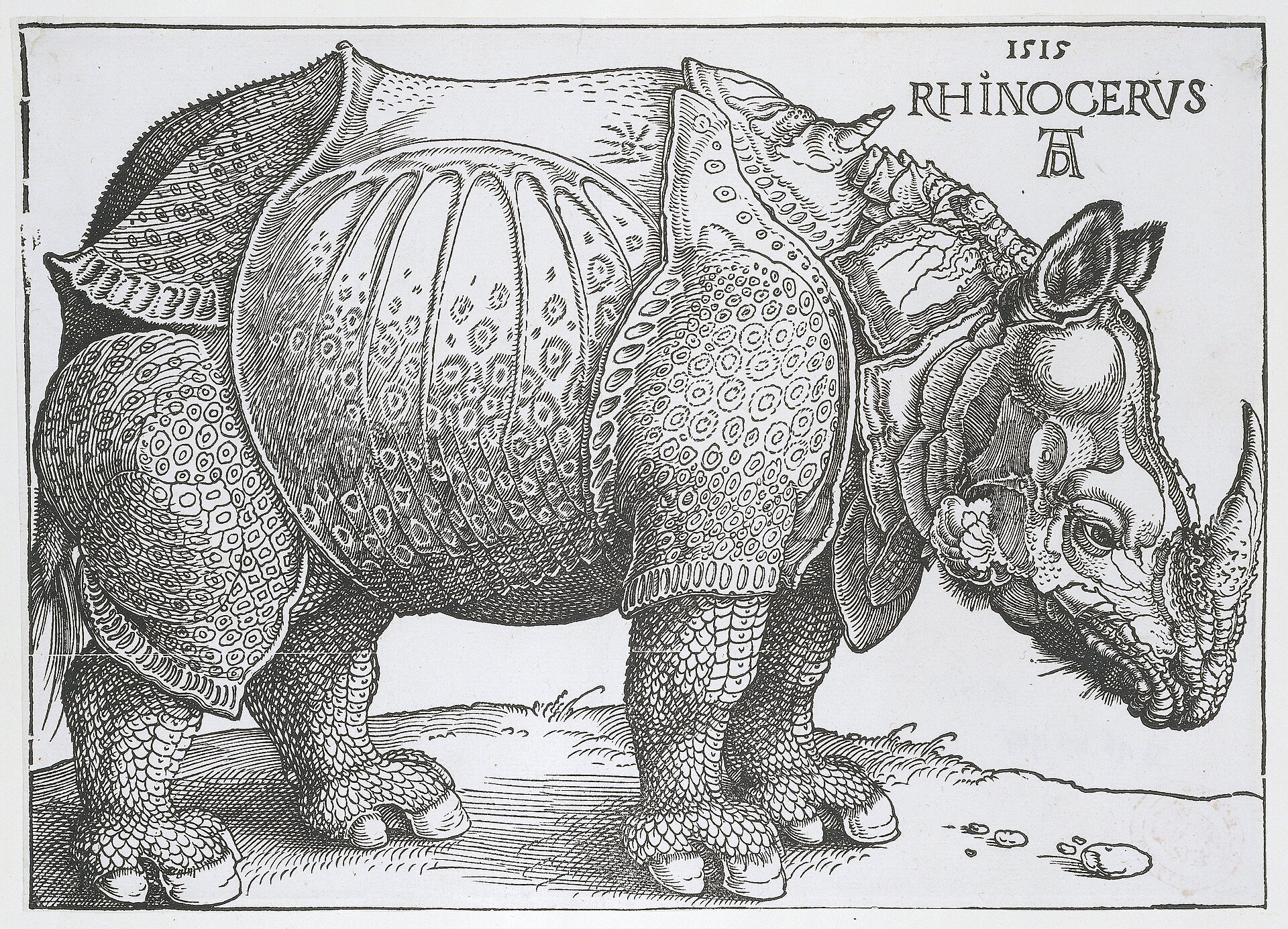
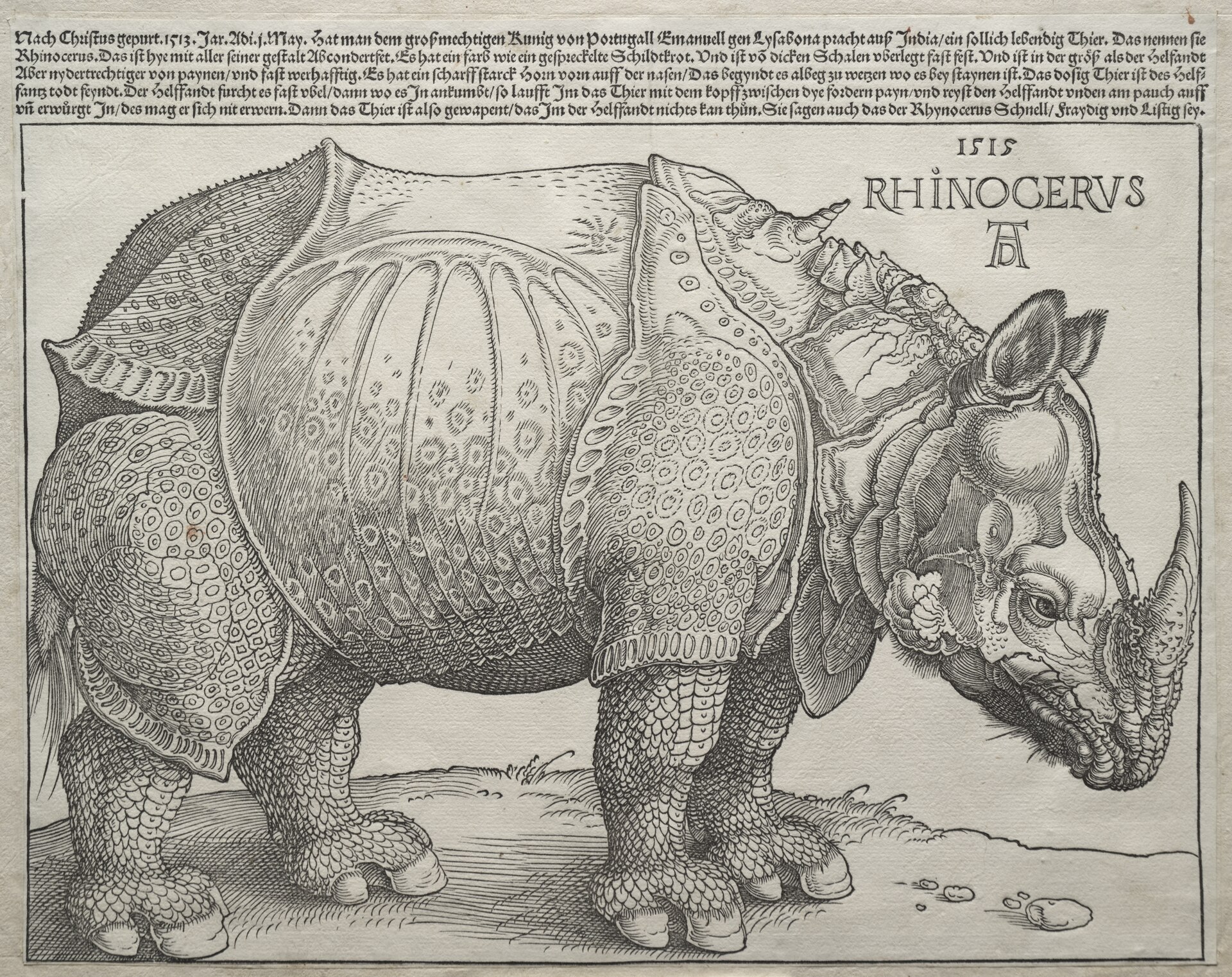
The sheet at the center of this record: Meder 273-6(8), printed c. 1618-1622 by the publisher Hendrick Hondius the Elder in The Hague from Durer's original 1515 block, with new Dutch text that corrects the print's long-standing wrong arrival date but wrongly claims Durer drew the animal from life.
| Artist | Albrecht Durer |
|---|---|
| Date | 1515 (Durer's design and the block's first printing, in his lifetime); this sheet printed c. 1618-1622, the sixth of eight editions taken from the same woodblock |
| Medium | Woodcut on paper, with accompanying letterpress text; the text on this sheet is in Dutch, reset for this edition by its publisher |
| Dimensions | Sheet 212 x 299 mm (8 3/8 x 11 3/4 in) |
| Where it is now | Rijksmuseum, Amsterdamlast confirmed |
| Inventory number | RP-P-OB-1473 |
| Attribution | AcceptedThe design is Durer's: the block carries his AD monogram and the date 1515, and no source consulted disputes his authorship of the composition. Full note |
| Object type | |
| Period | German, early sixteenth century (Northern Renaissance); this impression Dutch, early seventeenth century |
| Cases | Has a provenance gap |
| Inscriptions | In the block: the date 1515 and Durer's AD monogram, with the title RHINOCERVS. The Dutch letterpress text on this sheet, added by the publisher Hendrick Hondius the Elder, corrects the arrival date given on earlier editions (1513) to the correct year, 1515, but introduces a new error, stating that Durer drew the animal from life. A collectors' stamp catalogued as Lugt 240 appears on the sheet; the collector has not been identified in the sources consulted. |
| Owners on record | 5 links2 documented, 3 unknown |
| Sources | 20 cited |
About this record Last verified · 20 sources cited · Change log
On this page 10 sections
ContentsClose
In 1515 Albrecht Durer drew and cut a woodcut of an animal he never saw, working from a written description and a rough sketch that had traveled from Lisbon to Nuremberg describing an Indian rhinoceros sent as a diplomatic gift to the Portuguese crown. The print is wrong in specific, documented ways - an extra twisted horn on the shoulder, hide rendered as riveted armor plate - and it became the standard European image of a rhinoceros for two centuries anyway, reprinted from Durer's own woodblock long after his death.
This sheet is one of those later reprints: the sixth of eight editions pulled from the block, printed roughly a century after Durer cut it by the Hague publisher Hendrick Hondius the Elder, with the original German text replaced by Dutch. The new text corrects an error present on every earlier edition, the wrong arrival year, and in the same breath commits a new one, telling readers Durer drew the animal from life. He did not. That single sheet, now in the Rijksmuseum, carries the whole problem this print poses in miniature: a documented factual correction sitting next to a documented new fabrication, both printed from a block that was, by then, a hundred years into a working life that would run for at least a century more.
Provenance
Each link is graded. Documented: a cited source supports it. Disputed: the identification is argued but not established. Unknown: no owner for that span, and the gap is not smoothed into a narrative. The grades in the glossary.
- 1515 -Albrecht Durer, Nuremberg (the woodblock and its first printing)documented
Durer cut the block and printed its first edition in 1515, working from a written description and a secondhand sketch that had reached Nuremberg from Lisbon. The block remained his property and, after his death in 1528, presumably that of his estate or workshop successors, though no source consulted names an owner for the block in the decades immediately after his death.24
- 1528 - c. 1618Unrecorded intermediariesunknown
The block was used for at least four further editions between the 1540s and the late sixteenth century, and so was in active commercial use somewhere in German- or Dutch-speaking Europe throughout this span, but no source consulted names who owned or operated it at any point in this century-long interval before it reached Hendrick Hondius.2
- c. 1618 - c. 1622Hendrick Hondius the Elder, The Hague (the woodblock, for this printing)documented
Hondius published the sixth edition from Durer's original block, replacing the earlier German text with new Dutch text that corrected the arrival date to 1515 but introduced the false claim that Durer had drawn the animal from life. This is the printing event that produced the specific sheet described in this record. The Rijksmuseum's own catalogue entry is the source for the publisher and this date range.18
- Unidentified collector (mark catalogued as Lugt 240)unknown
The sheet carries a stamped collectors' mark catalogued by Frits Lugt as number 240. The Rijksmuseum's own online entry does not identify the collector to whom this mark belonged, and this record has not been able to establish the identity or a date from the sources consulted.1
- - presentRijksmuseum, Amsterdamunknown
The sheet is held today in the Rijksmuseum's print collection under object number RP-P-OB-1473. The museum's own online catalogue entry does not state the date or source of acquisition, and this record does not supply one it cannot document.1
Prices realised
| Date | Sale | Estimate | Result | Note |
|---|---|---|---|---|
| 30 January 2013 | Christie's New York | USD 100,000 - 150,000 | Hammer Not separately stated in the sources consulted With premium Not separately stated in the sources consulted USD | A first-edition impression, printed in Durer's own lifetime with the original German text, described as in excellent condition. Sold for a total of 866,500 dollars, the auction record for any work by Durer at the time. Sources consulted give only the combined total; this record does not back-calculate a hammer price from a general premium schedule not stated as applying to this specific lot. |
| 31 October 2006 | Swann Auction Galleries New York, sale 2091, lot 18, lot 18 | USD 15,000 - 20,000 | Hammer USD 10,000 With premium USD 2,250 USD | A fourth-edition impression, described in the auction listing as evenly printed, carrying a crowned-shield-and-three-fleur-de-lys watermark. Hammer price and buyer's premium are both independently documented for this sale, giving a total price realized of 12,250 dollars. |
| 18 February 2020 | Freeman's Philadelphia | USD 12,000 - 18,000 | Hammer Not separately stated in the sources consulted With premium Not separately stated in the sources consulted USD | A sixth-edition impression - the same edition as the Rijksmuseum sheet described in this record, though a different physical sheet - sold for a total of 81,250 dollars. The source consulted gives only the combined total. |
Hammer is the price at which the bidding stopped; with premium adds the fee the house charges the buyer on top. Hammer price and buyer's premium in the glossary.
Technical evidence
| Attribution note | The design is Durer's: the block carries his AD monogram and the date 1515, and no source consulted disputes his authorship of the composition. What this record grades instead is the individual sheet. The original block stayed in commercial use for roughly a century after Durer cut it, passing through at least two later publishers, so any single surviving impression must be placed within that print history before anything can be said about it. This sheet is documented by its holding institution as the sixth of eight editions pulled from the block, printed about a century after Durer's death by the Hague publisher Hendrick Hondius the Elder, not by Durer or his own workshop. |
|---|---|
| Support | Paper, with letterpress text on the same sheet as the woodcut image.3 |
| Medium | Woodcut, printed in black ink from a single carved block for the image; the accompanying text was set separately in movable type and reset in a new language for later editions, including this one.13 |
| Dimensions (this sheet) | 212 x 299 mm. Comparable editions elsewhere are recorded at slightly different measurements: the British Museum's first-edition woodcut area is given as 212 x 296 mm on a 248 x 317 mm sheet; the Museum's seventh-edition chiaroscuro impression as 214 x 300 mm; the Metropolitan Museum's first-edition sheet as 213 x 295 mm image on a 238 x 299 mm sheet.1347 |
| Catalogue numbers | Meder 273, state or edition 6 of 8 (cited by the Rijksmuseum as Meder 273-6(8)); Bartsch 136.1 |
| Publisher of this edition | Hendrick Hondius the Elder (1573-1650), print publisher and mapmaker, The Hague, c. 1618-1622.18 |
| Block inscriptions | 1515 and Durer's AD monogram, cut into the block, with the title RHINOCERVS.23 |
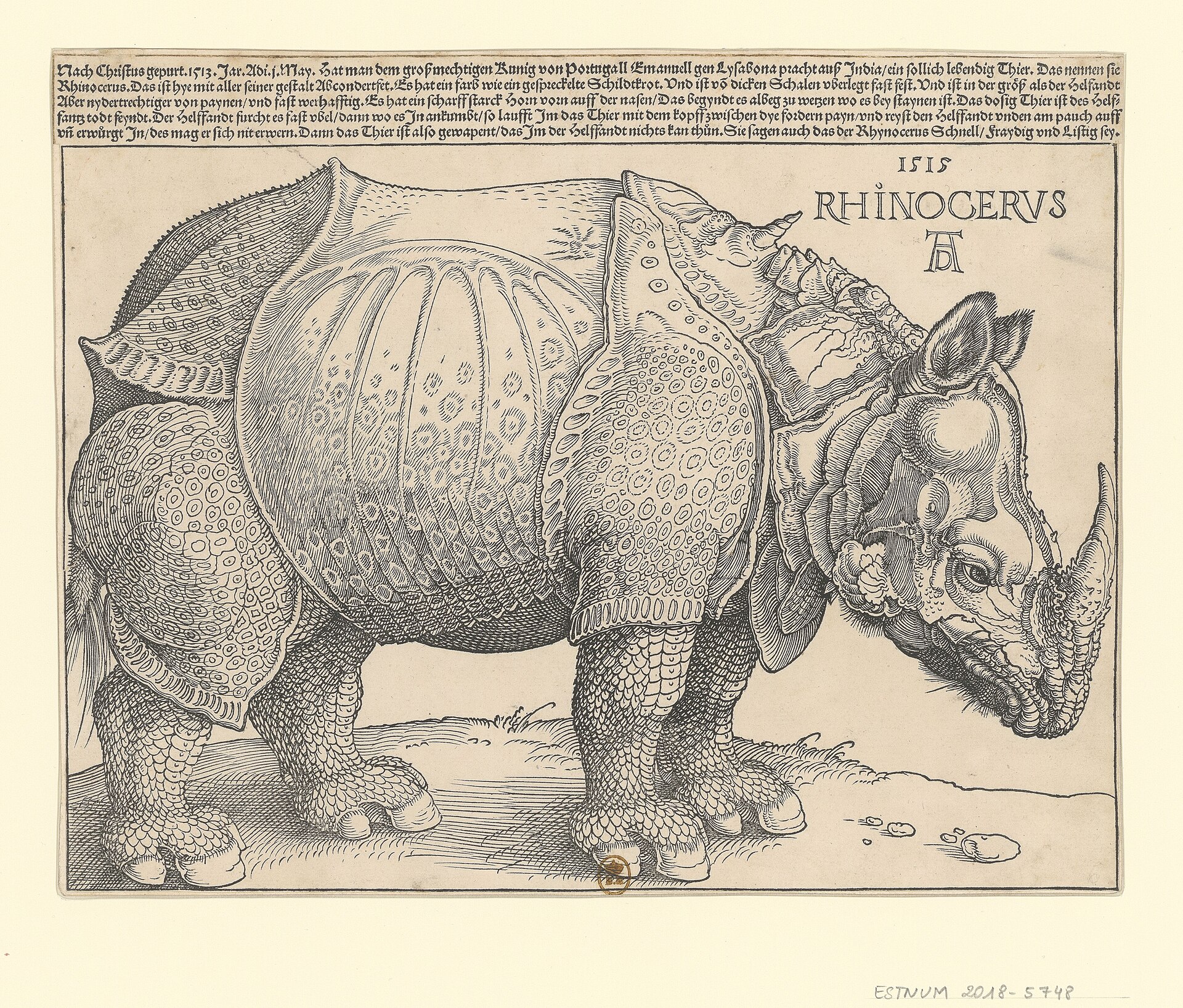
| Text on this sheet | Dutch letterpress, reset for the Hondius edition. Corrects the arrival date from 1513 (given on all earlier editions) to 1515, and states, incorrectly, that Durer drew the animal from life.18 |
| Collectors' mark | A stamp catalogued as Lugt 240 appears on the sheet. The Rijksmuseum's own online entry does not identify the collector, and this record has not been able to independently confirm the identity from the sources consulted.1 |
| Condition of the block by this printing | Not separately assessed for this specific sheet in the source consulted; by the time of the later, seventh edition the block is independently documented as chipped at the borders, worm-holed, and cracked from the animal's hind leg toward its snout, which places a physical floor under how worn the block already was by this, the sixth, printing.2 |
Images
The record in full
Chapter 1What the object is
The print shows a rhinoceros in profile, facing right, rendered in the fine continuous black line of a woodcut rather than the softer tonal range of an engraving.
The print shows a rhinoceros in profile, facing right, rendered in the fine continuous black line of a woodcut rather than the softer tonal range of an engraving. Its hide is drawn as a series of hard, overlapping plates, riveted at the seams like armor, with a gorget at the throat and a breastplate across the chest. Scaled, saw-toothed legs support it, and a small, twisted second horn juts from its shoulder, above and behind the true nasal horn. None of that is how an actual Indian rhinoceros looks. Above the image, on the sheet examined here, five lines of Dutch letterpress text give the animal's arrival date, its origin, and a claim about how the image was made.
The sheet itself measures 212 by 299 millimeters, close to the dimensions recorded for the print's other surviving editions across institutions, though not identical to any of them; sheets were trimmed differently by different owners over four centuries, and small variations in recorded measurement are themselves part of the print's evidentiary record rather than noise to be smoothed away.
Chapter 2Why a rhinoceros was in Lisbon at all
The animal existed in Europe because of a failed piece of Portuguese imperial diplomacy.
The animal existed in Europe because of a failed piece of Portuguese imperial diplomacy. In 1514 Afonso de Albuquerque, governor of Portuguese India, sent ambassadors to Sultan Muzaffar Shah II, ruler of Gujarat and known in Portuguese sources as the Sultan of Cambay, seeking permission to build a fort at Diu on the Gujarati coast. The request was refused. In the exchange of gifts that accompanied the failed negotiation, the Sultan gave Albuquerque an Indian rhinoceros, known locally as ganda.
The animal sailed from Goa in January 1515 aboard the Nossa Senhora da Ajuda, a voyage of some four months around the Cape of Good Hope, with stops at Mozambique, Saint Helena, and the Azores, arriving in Lisbon on 20 May 1515. King Manuel I kept it at his menagerie at the Ribeira Palace, where, according to the accounts that survive, he staged a fight between the rhinoceros and a young elephant to test Pliny the Elder's ancient claim that the two species were natural enemies; the elephant fled before contact.
Chapter 3The gift to the Pope, and the shipwreck
Manuel decided to send the rhinoceros on to Pope Leo X, partly, on the account given in the sources consulted, to reinforce the papal grants that gave Portugal exclusive claim to the territories it...
Manuel decided to send the rhinoceros on to Pope Leo X, partly, on the account given in the sources consulted, to reinforce the papal grants that gave Portugal exclusive claim to the territories it was opening in the East. Fitted with a collar of green velvet decorated with flowers, the animal was put aboard a ship bound for Rome in December 1515. The vessel wrecked in a storm off the Ligurian coast near Porto Venere, close to La Spezia and not far from Genoa. Chained on deck, the rhinoceros could not swim free and drowned.
Its carcass was recovered near Villefranche-sur-Mer and the hide was sent back to Lisbon to be prepared as a taxidermy mount. Some accounts report that the stuffed skin eventually reached Rome by February 1516; what became of it after that is not established in the sources consulted, which offer only two competing possibilities: that the mount passed into Medici hands and was later moved to Florence, or that it was lost in the Sack of Rome in 1527. This record does not resolve that question and lists it as open below.
Chapter 4How the report reached Durer
Durer never saw a living rhinoceros; he was in Nuremberg the entire time the animal was alive in Europe.
Durer never saw a living rhinoceros; he was in Nuremberg the entire time the animal was alive in Europe. What reached him was paper. Valentim Fernandes, an ethnic German printer from Moravia who had lived and worked in Lisbon since 1495, saw the rhinoceros shortly after it arrived and wrote an account of it in a letter sent to correspondents in Nuremberg in June 1515. The original German text of that letter has not survived; only an Italian transcript, held today at the Biblioteca Nazionale Centrale in Florence, is known.
A second letter, of unknown authorship, was sent from Lisbon to Nuremberg at around the same time enclosing a sketch of the animal by an unnamed artist. It was this second letter and its sketch, rather than Fernandes's account directly, that Durer is recorded as having seen and used; he had existing contacts among the Portuguese merchant community trading through Antwerp, which is the likeliest channel by which both documents crossed from Lisbon. From the sketch Durer made two pen-and-ink drawings. One of them, now in the British Museum, survives with an inscription giving the animal's arrival date as 1513 - two years wrong. The same wrong date was carried onto the finished woodcut. Durer worked from a written account and a secondhand drawing, and he reproduced an error present in his source material rather than correcting it himself; there is no reason to read the mistake as his own invention.
Chapter 5The armor, the extra horn, and what they might mean
The print's inaccuracies are specific enough to argue about, and scholars have argued about them without reaching a settled answer.
The print's inaccuracies are specific enough to argue about, and scholars have argued about them without reaching a settled answer. The plated, riveted hide is the most visible departure from the real animal. One proposal, floated by the historian Glynis Ridley, is that Durer was depicting armor genuinely made for the Lisbon rhinoceros ahead of its staged fight with Manuel's elephant; the standard scholarly account of the episode, Silvio Bedini's The Pope's Elephant, does not mention any such armor, which leaves the idea unconfirmed rather than refuted. A second, more conservative explanation is that the plating is Durer's graphic solution for rendering the heavy, overlapping skin folds that a real Indian rhinoceros does have, translated into the vocabulary of a print medium built from cut lines rather than tonal shading. A third possibility raised in the sources consulted is more mundane: the animal may have developed a skin condition after four months of close confinement aboard ship, and Durer's informants may have been describing diseased skin rather than natural hide.
The small extra horn on the shoulder has no comparably developed rival explanations in the material reviewed here; it appears to be either an artifact of a poor original sketch or an invention filling a gap in a written description that did not specify where the animal's single horn actually sat. What is not in dispute is that the print's German text draws heavily on Pliny the Elder's ancient Natural History for its zoological claims, meaning Durer's image reflects a classical textual authority layered on top of a garbled contemporary report, rather than either source alone.
Chapter 6The block's long working life: eight editions
Durer's own printing, in 1515, was only the first of what is now documented as eight separate editions pulled from the same block over roughly the next century and beyond.
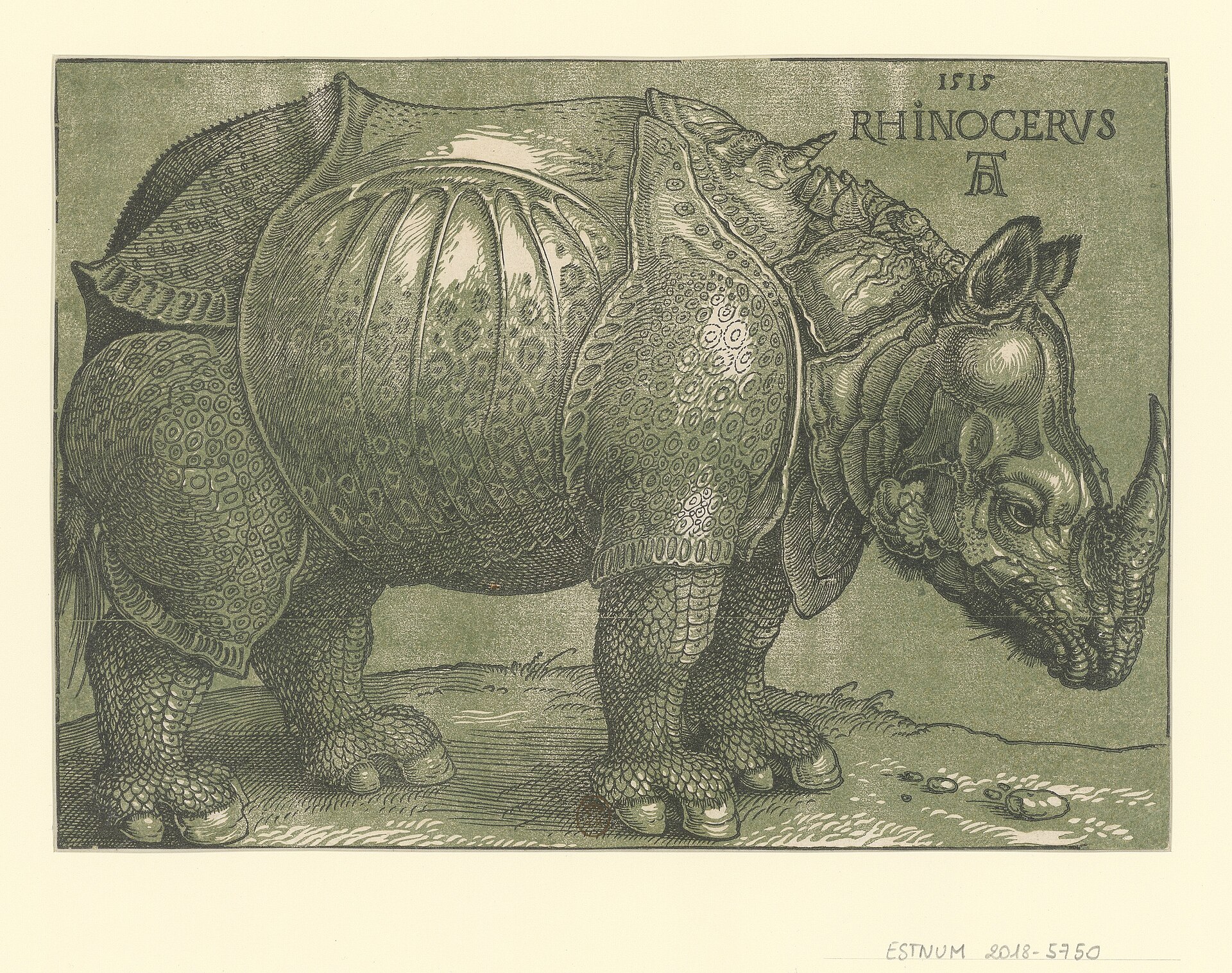
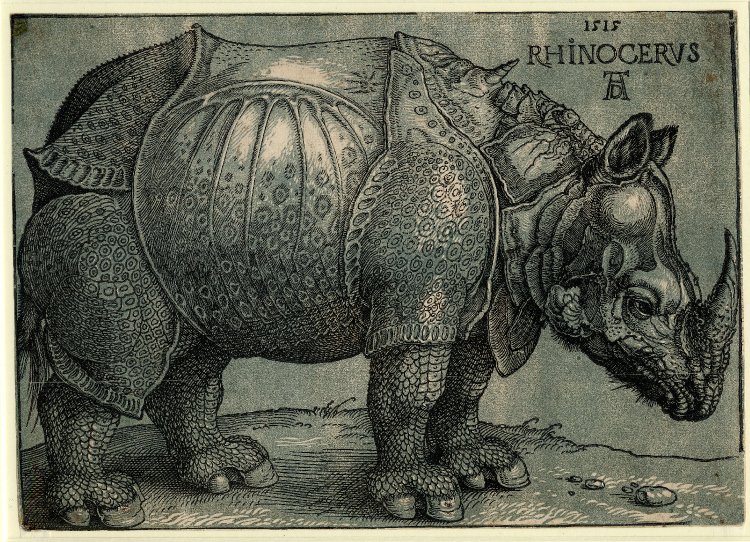
Durer's own printing, in 1515, was only the first of what is now documented as eight separate editions pulled from the same block over roughly the next century and beyond. Sources consulted here are not able to give firm dates for every edition in the sequence, but the outline is clear: the first edition appeared in 1515, in Durer's lifetime; two further editions followed in the 1540s and two more in the late sixteenth century, all after his death in 1528; a sixth edition, discussed below, was published by Hendrick Hondius the Elder in The Hague around 1618-1622; a seventh edition, a chiaroscuro reissue with an added tone block, was published after 1620 by the Amsterdam printer and cartographer Willem Janszoon, commonly known as Willem Blaeu; and an eighth edition followed the seventh, without further detail available in the sources consulted.
The physical evidence of that century of use is legible on the block's own later impressions. By the time of the seventh, chiaroscuro edition, the border lines had chipped, the block carried numerous woodworm holes, and a pronounced crack had opened running from the animal's tail and hind leg across toward its snout. The scholar Jesse Feiman has argued, in a study of the print's successive states, that these accumulating physical changes did more than degrade the image: each reprinting carried its own audience, its own accompanying text, and in some cases its own claimed authorship, so that the object's meaning changed together with its condition rather than staying fixed while only the paper wore.
Chapter 7This sheet: the sixth edition, Hondius, The Hague
The Rijksmuseum catalogues this specific sheet under the reference Meder 273-6(8): Meder's catalogue number 273 for the composition, state or edition six of the eight known.
The Rijksmuseum catalogues this specific sheet under the reference Meder 273-6(8): Meder's catalogue number 273 for the composition, state or edition six of the eight known. Its own entry dates the sheet to 1618-1622 and names Hendrick Hondius the Elder, working in The Hague, as publisher. Hondius was primarily known as a mapmaker and print publisher rather than as a Durer specialist, and the edition he issued kept Durer's original block but replaced the earlier German letterpress text with new text in Dutch.
That new text did two things at once. It corrected the wrong arrival date that every earlier edition had carried, changing 1513 to the correct 1515. And it introduced a claim that appears nowhere in Durer's own lifetime editions: that Durer had drawn the rhinoceros from life. He had not; he was in Nuremberg throughout, working from a secondhand sketch and a written account, as set out above. A century after the print was first made, its own publisher was correcting one documented error while manufacturing a new one, on the same sheet, in the same short block of text. That is the single most concrete, sheet-specific fact this record can establish about the object in front of it, and it is the reason this record exists in the form it does rather than as a generic account of Durer's rhinoceros image.
Chapter 8The preparatory drawing
Durer's own working drawing for the print survives.
Durer's own working drawing for the print survives. It is a pen-and-ink study, in the British Museum, showing the rhinoceros in profile with an inscription that gives the same wrong arrival date, 1513, later carried onto the printed block. The sheet entered the British Museum as part of the Sloane collection: the physician and collector Sir Hans Sloane's bequest, which formed the museum's founding collection when it was established in 1753. The drawing is therefore documented in a public collection more than two and a half centuries before the Rijksmuseum sheet examined in this record was catalogued, and it is the closest surviving physical link to Durer's own working process, one step removed from the lost original sketch sent from Lisbon.
Chapter 9A rival image: Hans Burgkmair's more accurate rhinoceros
Durer was not the only German artist to make a rhinoceros print from the 1515 reports.
Durer was not the only German artist to make a rhinoceros print from the 1515 reports. Hans Burgkmair, working in Augsburg at roughly the same time, produced a second woodcut of the animal that omitted Durer's armor plating and extra horn and included the shackles and chain that had restrained the real animal. On the available evidence, Burgkmair's image is the more accurate of the two. It is also, commercially and historically, the loser: only a single impression of Burgkmair's print is known to survive, held by the Albertina in Vienna, while Durer's version was reprinted across eight editions over more than a century and became the image nearly all of Europe actually saw. Accuracy did not determine which picture won; distribution did.
Chapter 10Two centuries as the only rhinoceros Europe knew
Durer's image did not just circulate widely in its own right; it was copied directly into the emerging natural history literature as though it were observational fact.
Durer's image did not just circulate widely in its own right; it was copied directly into the emerging natural history literature as though it were observational fact. Princeton's own impression of the print, a different sheet from the one discussed in this record, is catalogued with the note that the image was reproduced in Johann Jonston's Historiae Naturalis, a major illustrated natural history published in 1657, and that it remained one of the standard European depictions of the animal for a further century after that.
The correction, when it came, is itself documented and datable. In 1743 the physician James Parsons read a paper before the Royal Society, published as A Letter to Martin Folkes, Esq., President of the Royal Society, Containing the Natural History of the Rhinoceros, drawing on a living animal that had by then been exhibited in London. According to the scholar Emma Hanson's 2010 study of the episode, Parsons's plates were a real improvement on Durer's, but even Parsons kept some of Durer's inventions, including the scaled legs, showing how deeply the two-century-old print had lodged itself in the available visual vocabulary for the animal even as its errors were being corrected point by point. Durer's rhinoceros lost its authority only in the second half of the eighteenth century, as more living rhinoceroses were brought to Europe and could simply be looked at directly.
Chapter 11The market for other impressions
The Rijksmuseum sheet has no auction history in the sources consulted; nothing in the museum's own catalogue entry indicates it was ever sold at public auction, and this record does not supply a sale...
The Rijksmuseum sheet has no auction history in the sources consulted; nothing in the museum's own catalogue entry indicates it was ever sold at public auction, and this record does not supply a sale it cannot document. Other impressions of the print, from other editions, have a documented market that shows what state and condition are worth in practice.
The record price for any work by Durer at auction was set on 30 January 2013, when Christie's New York sold a first-edition impression - printed, that is, within Durer's own lifetime, with its original German text intact and in what was reported as excellent condition - for a total of 866,500 US dollars against a pre-sale estimate of 100,000 to 150,000 dollars. The sources consulted report only that combined total and do not separately state the hammer price and the buyer's premium; this record does not attempt to back-calculate one from the other. At the other end of the same market, Swann Galleries in New York sold a fourth-edition impression, carrying a crowned-shield-and-three-fleur-de-lys watermark, at its sale of 31 October 2006 (sale 2091, lot 18) for a hammer price of 10,000 dollars, a buyer's premium of 2,250 dollars, and a total price realized of 12,250 dollars, against an estimate of 15,000 to 20,000 dollars - a rare case in this print's market where hammer and premium are both independently stated and can be given separately, as the rules of this record require. In February 2020, Freeman's in Philadelphia sold a sixth-edition impression, from the same edition as the Rijksmuseum sheet in this record though a physically different sheet, for 81,250 dollars against an estimate of 12,000 to 18,000 dollars; the source consulted states that total figure without separating a hammer price from it. The specialist quoted in that sale's coverage put the 2013 Christie's result as the third-highest price ever realized at auction for any work by Durer, in any medium, and noted that some 26 separate auction appearances of Rhinoceros impressions had been recorded since 1990 alone - a figure that almost certainly counts some sheets more than once, as impressions are bought, later reoffered, and sold again, but that nonetheless indicates how liquid a market this single print supports compared with most of Durer's other work.
Chapter 12Reproduction, later use, and the image's afterlife
The print's later life runs well past its documented eight editions.
The print's later life runs well past its documented eight editions. The seventh edition's chiaroscuro reissue, printed in olive-green, dark green, and blue-grey from an added tone block after 1620, turned a hundred-year-old scientific illustration into a decorative object in its own right, sold and collected as much for its color as for its content; impressions survive at the British Museum and elsewhere. Salvador Dali, who had a reproduction of Durer's rhinoceros hanging in his childhood home, returned to the image repeatedly in his own work in the twentieth century, an afterlife entirely disconnected from the print's original claim to zoological accuracy. The image's staying power is itself now a documented subject of scholarship rather than an incidental fact: Jesse Feiman's account of the print's changing states treats the object's popularity, rather than its correctness, as the thing that needs to be explained.
The artist
Albrecht Durer
Durer made this print at the height of a career he had built, deliberately, around the print trade rather than around painting alone. He was the son of a goldsmith, trained in a workshop that supplied woodcut illustrations for printed books, and by 1515 he was already Europe's most commercially successful printmaker, running what amounted to the continent's first large-scale print publishing business. The Rhinoceros belongs to that business as much as it belongs to natural history: an eye-catching subject, cut quickly from secondhand information, printed in an edition large enough to travel faster than the animal it depicted ever could.
Related works
| Work | Relation | Where it is |
|---|---|---|
| Preparatory drawing for The Rhinoceros Albrecht Durer | Durer's own working drawing, made from the lost Lisbon sketch, from which the woodblock was cut Carries the same wrong arrival date, 1513, later printed on the block. Entered the British Museum in 1753 as part of Sir Hans Sloane's founding bequest. | British Museum, London (Sloane collection, registration SL,5218.161) |
| Rhinoceros Hans Burgkmair | A rival woodcut of the same animal, made independently at roughly the same date, and more accurate than Durer's Only a single impression is known to survive. Omits Durer's armor plating and extra horn, and shows the animal's real shackles and chain; it lost the field commercially to Durer's far more widely printed version. | Albertina, Vienna |
| The Rhinoceros, first edition Albrecht Durer | The first of the eight editions taken from the same block, printed in 1515 in Durer's own lifetime with the original German text Acquired by the Museum in 1895, gift of William Mitchell. Printed before the block acquired the wear and the crack documented on later editions, and before the Hondius edition examined in this record corrected the arrival date and introduced the false claim that Durer worked from life. | British Museum, London (registration 1895,0122.714) |
| The Rhinoceros, seventh edition (chiaroscuro) Albrecht Durer, block; Willem Janszoon (Blaeu), publisher | A later reissue of the same worn block, published after 1620 with an added tone block printed in color and the letterpress text dropped entirely By this edition the block carried a crack running from the animal's hind leg toward its snout, documented physical evidence of a century of printing that had already begun by the sixth, Hondius edition discussed in this record. | British Museum, London (registration 1913,1015.110); a further impression at the Metropolitan Museum of Art, New York (accession 22.10.8) |
| The Rhinoceros, sixth edition, a further impression Albrecht Durer, block; Hendrick Hondius the Elder, publisher | A different surviving sheet of the same sixth edition as the object described in this record Confirms that the sixth, Hondius edition survives in more than one example in more than one country; this sheet and the Rijksmuseum sheet are the same edition but physically different objects, each with its own provenance. | Bibliotheque nationale de France, Paris (Departement des Estampes et de la Photographie, reference btv1b532163188) |
Open questions
- What happened to the taxidermied rhinoceros hide after it was reportedly returned to Rome by February 1516? The sources consulted offer only two undocumented possibilities, a later move to Florence with the Medici or destruction in the 1527 Sack of Rome, and do not resolve between them.
- Who wrote the second Lisbon letter that enclosed the sketch Durer actually worked from, and was its author connected to Valentim Fernandes or independent of him? The sources consulted describe the letter's author as unknown.
- Whose collectors' mark, catalogued as Lugt 240, is stamped on the Rijksmuseum sheet examined in this record? Not identified in the sources consulted.
- When and from whom did the Rijksmuseum acquire this sheet? Not stated in the museum's own online catalogue entry.
- Was the armor-like plating on the rhinoceros's hide meant to depict real ceremonial armor made for its staged fight with Manuel I's elephant, the animal's own heavy skin folds, or a skin condition from months of shipboard confinement? Named scholars have proposed each explanation and the sources consulted do not resolve between them.
- What are the precise dates and any surviving provenance for the second, third, fourth, and fifth editions of the print, printed between the 1540s and the late sixteenth century? The sources consulted describe their existence but not their individual publishers, print runs, or dates more precisely than by decade.
- Was the hammer price of the record 866,500-dollar Christie's sale of 30 January 2013 ever published separately from the buyer's premium? Not found in the sources consulted.
Questions about this object
What is The Rhinoceros?
The Rhinoceros is a print, dated 1515 (Durer's design and the block's first printing, in his lifetime); this sheet printed c. 1618-1622, the sixth of eight editions taken from the same woodblock. Medium: Woodcut on paper, with accompanying letterpress text; the text on this sheet is in Dutch, reset for this edition by its publisher.
Who made The Rhinoceros, and is the attribution settled?
The attribution to Albrecht Durer is recorded here as accepted. The design is Durer's: the block carries his AD monogram and the date 1515, and no source consulted disputes his authorship of the composition. What this record grades instead is the individual sheet. The original block stayed in commercial use for roughly a century after Durer cut it, passing through at least two later publishers, so any single surviving impression must be placed within that print history before anything can be said about it. This sheet is documented by its holding institution as the sixth of eight editions pulled from the block, printed about a century after Durer's death by the Hague publisher Hendrick Hondius the Elder, not by Durer or his own workshop.
Where is The Rhinoceros now?
Rijksmuseum, Amsterdam. Inventory number RP-P-OB-1473. Last confirmed 11 August 2026. Held in the Rijksmuseum's print collection (Rijksprentenkabinet). The museum's own online catalogue entry does not state when or from whom the sheet was acquired.
What has The Rhinoceros sold for?
Hammer Not separately stated in the sources consulted; with premium, Not separately stated in the sources consulted. Christie's, 2013-01-30.
What is still unknown about The Rhinoceros?
What happened to the taxidermied rhinoceros hide after it was reportedly returned to Rome by February 1516? The sources consulted offer only two undocumented possibilities, a later move to Florence with the Medici or destruction in the 1527 Sack of Rome, and do not resolve between them.
Sources
- 1Rijksmuseum, Amsterdam, catalogue entry for Rhinocerus (Neushoorn), object number RP-P-OB-1473. rijksmuseum.nl/en/...
- 2Wikipedia, 'Durer's Rhinoceros'. Clarke, The Rhinoceros from Durer to Stubbs (Sotheby's Publications, 1986), the standard scholarly monograph on this print and its later history. en.wikipedia.org/wiki/...
- 3Metropolitan Museum of Art, New York, collection object page for The Rhinoceros, accession 19.73.159. metmuseum.org/art/...
- 4British Museum, London, collection object page for the preparatory drawing for The Rhinoceros, registration SL,5218.161. britishmuseum.org/collection/...
- 5'The Making of Durer's Rhinoceros', Doing History in Public (2025), on the transmission of the Lisbon report to Nuremberg via Valentim Fernandes. doinghistoryinpublic.org/2025/...
- 6Wikipedia, 'Valentim Fernandes', for his biography and career as a printer in Lisbon. en.wikipedia.org/wiki/...
- 7British Museum, London, collection object page for The Rhinoceros, first edition, registration 1895,0122.714. britishmuseum.org/collection/...
- 8Library of Congress, Preservation Directorate, 'Technical Examination and Conservation of Durer's Rhinoceros', on the Hendrick Hondius sixth edition, its Dutch text, and its combined date correction and new error about Durer working from life. loc.gov/preservation/...
- 9JSTOR Daily, 'Durer's Rhinoceros and the Birth of Print Media', summarizing Jesse Feiman's research on the print's changing states. daily.jstor.org/durers-rhinoceros-and-the-birth-of-print-...
- 10Jesse Feiman, 'The Matrix and the Meaning in Durer's Rhinoceros', Art in Print, vol. 2, no. 4 (November-December 2012). artinprint.org
- 11Princeton University Art Museum, collection object page for The Rhinoceros, accession 2010-149. artmuseum.princeton.edu/art/...
- 12James Parsons, 'A Letter to Martin Folkes, Esq., President of the Royal Society, Containing the Natural History of the Rhinoceros', Philosophical Transactions of the Royal Society 42 (1743): 523-541. doi.org/10.1098/...
- 13Emma Hanson, 'Representing the Rhinoceros: The Royal Society between Art and Science in the Eighteenth Century', Journal for Eighteenth-Century Studies 33, no. 3 (2010). onlinelibrary.wiley.com/doi/...
- 14Wikipedia, 'Albrecht Durer'. en.wikipedia.org/wiki/...
- 15Wikipedia entry for Durer's Rhinoceros, section on the preparatory drawing and its 1513 inscription date, cross-checked against the British Museum's own object record (source 4). en.wikipedia.org/wiki/...
- 16British Museum, London, collection object page for The Rhinoceros, first edition, registration 1895,0122.714, for the letterpress text's dependence on Pliny. britishmuseum.org/collection/...
- 17Bloomberg, 'Durer 'Rhino' Sells for Record $866,500 at Christie's NYC', 29 January 2013. bloomberg.com/news/...
- 18The Hot Bid, 'Albrecht Durer's The Rhinoceros Could Fetch $18,000 at Freeman's' (updated 19 February 2020). thehotbid.com/2020/...
- 19Swann Auction Galleries, New York, catalogue entry for Albrecht Durer, Rhinoceros, sale 2091, lot 18, 31 October 2006. swanngalleries.com/auction-lot/...
- 20Albrecht Durer, Netherlands travel diary, entry for 27 August 1520, on Aztec objects seen in Brussels, as transcribed in National Humanities Center primary source materials. nationalhumanitiescenter.org/pds/...
Last verified · Published
Change log
11 August 2026 - Record created at the house standard: researched narrative, technical evidence, maker dossier, graded provenance chain, prices with hammer and premium separated, related works, open questions and sources.