Melencolia I
Albrecht Durer · 1514 (the plate; this sheet's own place within the plate's long printing history is not established by the sources consulted)
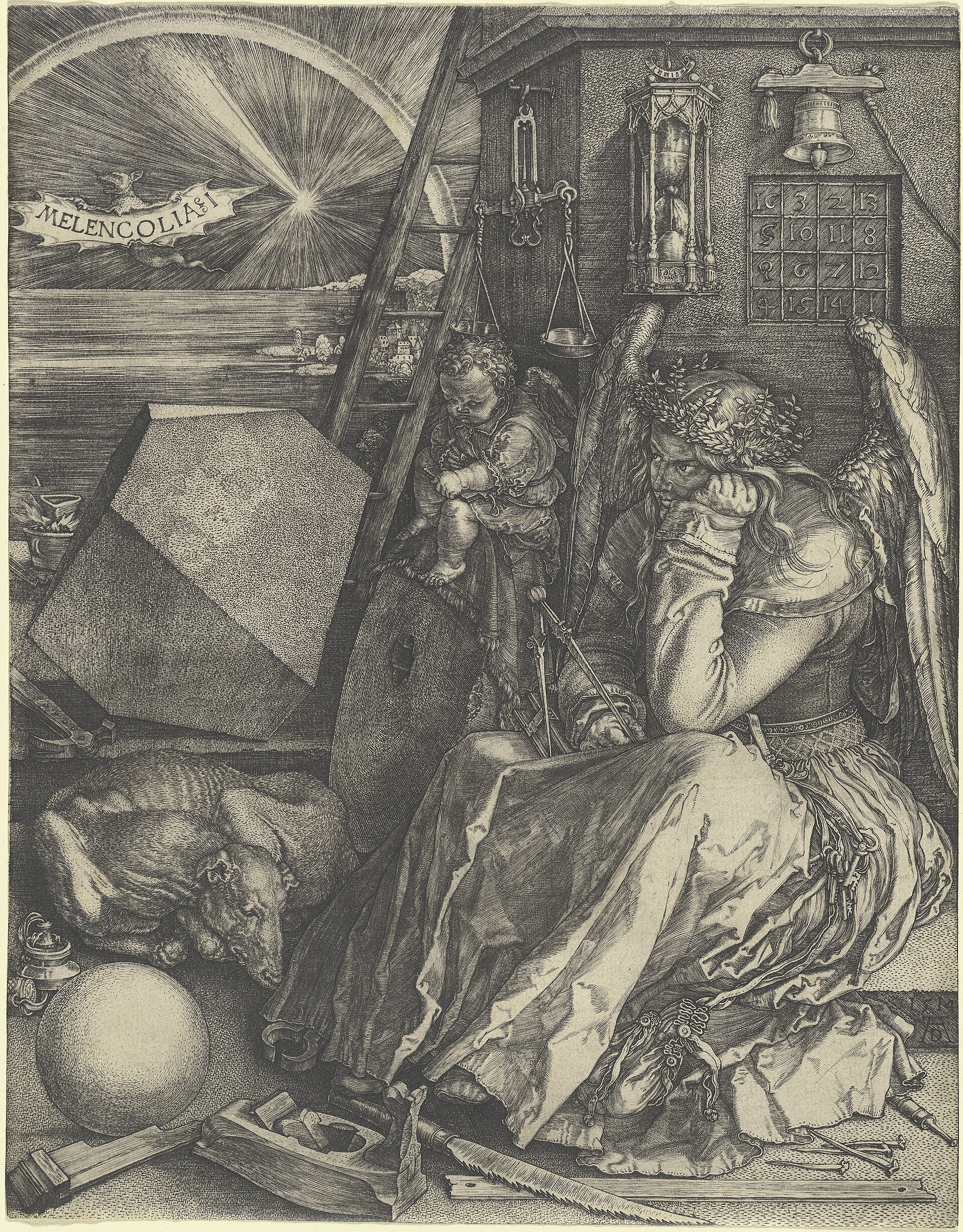
This impression of Melencolia I, National Gallery of Art inventory 1943.3.3523, Rosenwald Collection, gift of Lessing J. Rosenwald, 1943.
| Artist | Albrecht Durer |
|---|---|
| Date | 1514 (the plate; this sheet's own place within the plate's long printing history is not established by the sources consulted) |
| Medium | Engraving on laid paper, no watermark on this sheet |
| Dimensions | Sheet, trimmed to image: 23.7 x 18.6 cm (9 5/16 x 7 5/16 in) |
| Where it is now | National Gallery of Art, Washington, D.C.last confirmed 5 August 2026 |
| Inventory number | 1943.3.3523 |
| Attribution | AcceptedThe design is signed and dated in the plate itself, lower right: 1514 and Durer's AD monogram. Full note |
| Object type | |
| Period | German, early sixteenth century (Northern Renaissance) |
| Cases | Has a provenance gap |
| Inscriptions | Signed and dated in the plate, lower right: 1514 / AD monogram. Two collectors' stamps on the sheet: Jean-Francois Gigoux (Lugt 1164) and Lessing J. Rosenwald (Lugt 1760b and 1932d). |
| Owners on record | 6 links4 documented, 2 unknown |
| Sources | 17 cited |
About this record Last verified 27 August 2026 · 17 sources cited · Change log
On this page 9 sections
ContentsClose
This engraving is one of several hundred known surviving impressions of Melencolia I, the plate Albrecht Durer completed in 1514 and one of the three prints later grouped as his Meisterstiche, or master engravings. This particular sheet is a second-state impression, without a watermark, that carries two collectors' stamps: one belonging to the Paris illustrator and print collector Jean-Francois Gigoux (1806-1894), the other to the American collector Lessing J. Rosenwald, who bought it in 1928 and gave it, with the rest of his print collection, to the National Gallery of Art in Washington in 1943.
Between Gigoux's ownership and Rosenwald's purchase lies an undocumented gap of at least several decades, recorded here as unknown rather than bridged with a guess. What the sheet's own physical evidence can and cannot prove - a corrected numeral in its magic square, the absence of a watermark, two stamped marks and no others - is set out below against the wider print's documented market, its rarer first-state relatives, and a century of scholarly argument over what the image is actually about.
Provenance
Each link is graded. Documented: a cited source supports it. Disputed: the identification is argued but not established. Unknown: no owner for that span, and the gap is not smoothed into a narrative. The grades in the glossary.
- 1514 -Albrecht Durer, Nuremberg (the copper plate)documented
The design is signed and dated in the plate: 1514 and Durer's AD monogram, lower right. The plate remained in use for printing long after Durer's death in 1528. Because this sheet carries no watermark and is a second-state, more common impression, no date narrower than printed at some point after the plate reached its second state can be assigned to this specific pull from the evidence available.110
- Unlocatedunknown
No owner or location is documented for this sheet between its printing and its appearance, at an undetermined date, in the collection of the Paris painter, illustrator, and collector Jean-Francois Gigoux (1806-1894), whose mark it carries. Whether the sheet was pulled within Durer's lifetime or afterward from the surviving plate is not established by the sources consulted.1
- Jean-Francois Gigoux (1806-1894), Parisdocumented
Gigoux's collector's mark, catalogued by Frits Lugt as Lugt 1164, is stamped on this sheet. Gigoux was a history painter and illustrator, best known for several hundred woodcuts supplied for an 1835 Paris edition of Lesage's Gil Blas, and an active collector of Old Master prints and drawings. At his death in 1894 he bequeathed the bulk of his holdings, more than 3,000 drawings and 460 paintings by one account, to the museum of his native Besancon; this engraving is not part of that bequest, so it left his collection by another route at a date this record cannot establish.111
- - 1928Unrecorded intermediaryunknown
The National Gallery of Art's own provenance note moves directly from Gigoux to Rosenwald's 1928 acquisition without naming a dealer or intermediate owner. Since Gigoux died in 1894, at least one undocumented change of hands intervenes.1
- 1928 - 1943Lessing J. Rosenwald (1891-1979), Jenkintown, Pennsylvaniadocumented
Acquired by Rosenwald in 1928, the same year he bought his impression of Durer's Knight, Death and the Devil (now National Gallery of Art 1943.3.3519) at a C.G. Boerner sale in Leipzig. Rosenwald, who succeeded his father Julius Rosenwald as chairman of Sears, Roebuck in 1932, kept his growing collection at his private Alverthorpe Gallery in Jenkintown. His own collector's marks (Lugt 1760b and 1932d) are stamped on this sheet alongside Gigoux's. The price he paid in 1928 is not published in the sources consulted.1312
- 1943 - presentNational Gallery of Art, Washington, D.C.documented
Rosenwald pledged his print and drawing collection to the National Gallery of Art (and his rare books, separately, to the Library of Congress) in 1943, having already been a founding donor when the Gallery opened in 1941. He retained physical custody of most of the collection at Alverthorpe during his lifetime, transferring it in stages. This sheet carries the accession number 1943.3.3523 and the Rosenwald Collection credit line. The full Rosenwald print and drawing gift eventually totaled on the order of twenty-two to twenty-seven thousand sheets, sources consulted differ on the exact figure.112
Prices realised
This impression of Melencolia I has never appeared at public auction. It was purchased by the collector Lessing J. Rosenwald in 1928, with no purchase price disclosed in the sources consulted, and entered the National Gallery of Art in 1943 as part of the Rosenwald gift, credited on the museum's own object record as Rosenwald Collection. Impressions of this engraving from other collections do come up at auction regularly, but a price for a different impression is not given here so it cannot be mistaken for a price achieved by this object.
Technical evidence
| Attribution note | The design is signed and dated in the plate itself, lower right: 1514 and Durer's AD monogram. No attribution dispute exists over the authorship of the print. What this record grades is not the artist but the individual impression: which pull from the surviving copper plate this particular sheet is, established from its Meder state (state ii/ii, the numeral 9 in the magic square corrected), the absence of a watermark, and the two collectors' stamps it carries. |
|---|---|
| Support | Laid paper. No watermark is present on this sheet; the sheet is trimmed to the image, so a watermark, had one been present in that part of the full sheet, would in any case have been cut away.1 |
| Medium | Engraving, cut with a burin into a copper plate and printed in black ink.110 |
| Dimensions (this sheet) | 23.7 x 18.6 cm, trimmed to the image; larger, full-platemark impressions of the same print elsewhere run to roughly 24 x 19 cm.1 |
| State and catalogue numbers | Meder no. 75, state ii/ii (Bartsch 74; Hollstein 75): the state in which the reversed numeral 9 in the third row of the magic square, present in the rare first state, has been corrected.110 |
| Plate inscriptions | Signed and dated in the plate, lower right: 1514, with Durer's AD monogram.1 |
| Collectors' marks on the sheet | Jean-Francois Gigoux's stamp (Lugt 1164) and two marks belonging to Lessing J. Rosenwald (Lugt 1760b and 1932d).1 |
| Credit line and accession | Rosenwald Collection, National Gallery of Art, Washington, accession 1943.3.3523.1 |
| Plate-wear chronology | Recent technical scholarship sequences impressions objectively by matching microscopic scratches accumulated in the copper across successive printings, superseding the older, subjective vocabulary of silvery, rich, or worn impressions. This sheet has not been reported as having been examined by that method.14 |
The record in full
Chapter 1What the object is
Melencolia I is a copper engraving of 1514, one of three prints later grouped as Durer's Meisterstiche, alongside Knight, Death and the Devil (1513) and Saint Jerome in His Study (1514).
Melencolia I is a copper engraving of 1514, one of three prints later grouped as Durer's Meisterstiche, alongside Knight, Death and the Devil (1513) and Saint Jerome in His Study (1514). All three are close in size, roughly 24 by 19 centimeters on the full sheet, and all three carry the same fine, continuous engraved line and the same AD monogram and date cut into the plate.
The print shows a winged female figure seated among the tools of geometry and craft: a compass, a plane, a saw, nails, a hammer, scales on the wall, an hourglass, a bell. She rests her head on one hand, in the pose long associated with melancholy, and looks past the objects rather than at them. Beside her a putto sits on a millstone, writing or scratching at a tablet, the only figure in the scene shown working. An emaciated dog sleeps curled at her feet. Behind her looms a large, irregular stone polyhedron, now generally called Durer's solid, and on the wall behind it hangs a four-by-four magic square in which every row, column, and diagonal sums to 34, with the date 1514 worked into the bottom row. Overhead a bat-like creature carries a banner lettered MELENCOLIA I; beyond it sit a comet or distant light and a rainbow over a flooded landscape. A ladder leans against the building, its top and bottom both cut off by the frame.
Chapter 2The three Meisterstiche as a group
Melencolia I is usually discussed together with Knight, Death and the Devil and Saint Jerome in His Study, and a scheme proposed by the nineteenth-century scholar Friedrich Lippmann reads the three...
Melencolia I is usually discussed together with Knight, Death and the Devil and Saint Jerome in His Study, and a scheme proposed by the nineteenth-century scholar Friedrich Lippmann reads the three as a set illustrating the scholastic classification of virtues: the Knight standing for moral virtue and the active Christian life, Saint Jerome for theological virtue and the contemplative life, and Melencolia I for intellectual virtue, the secular genius at work in science and art.
Erwin Panofsky, who did more than anyone to build this reading, nonetheless noted that the three prints have no appreciable compositional relationship to one another and should not be treated as literal companion pieces, even if they form what he called a spiritual unity. No source consulted for this record documents Durer himself grouping the three prints or referring to them collectively; in his own Netherlands travel journal he refers to each as a single sheet. The grouping and its virtue scheme are a later scholarly framework placed on the three prints, not a program stated by the artist.
Chapter 3The intellectual programme, and who has argued for it
The print's meaning has been argued over for a century, and the argument is now nearly as much a part of the object's history as the plate itself.
The print's meaning has been argued over for a century, and the argument is now nearly as much a part of the object's history as the plate itself. The most influential account was built by Erwin Panofsky, working first with Fritz Saxl in a 1923 study and later with Raymond Klibansky in the 1964 book Saturn and Melancholy. Panofsky read the figure as a fusion of two traditions usually kept separate: the melancholic temperament, one of the four humors and traditionally the least desirable of them, and the personification of Geometry, one of the liberal arts. In the astrology Durer inherited, both were governed by the planet Saturn.
Panofsky's textual argument holds that Durer drew on the Florentine philosopher Marsilio Ficino, who in a 1489 treatise had reversed the old verdict on melancholy and argued it was the necessary companion of unusual intellectual gifts, and on the scholar Cornelius Agrippa von Nettesheim, whose De Occulta Philosophia divided melancholic inspiration into three ascending grades: the imagination of the artist, the reason of the scientist, and the intuition of the theologian. On this reading, the Roman numeral in the title Melencolia I marks the print as an image of the first and lowest of the three, melancholia imaginativa. This is Panofsky's argument, not a documented statement by Durer. Agrippa's text is known to have circulated in manuscript from around 1510, several years before the engraving, but no letter, inventory, or note in Durer's own hand ties him to that manuscript, and the connection remains an inference from thematic parallel rather than a paper trail.
Later scholarship has treated the print's meaning as deliberately unresolved rather than a puzzle with one correct key. Joseph Leo Koerner argued that the engraving was built to generate multiple and contradictory readings at once, making interpretation itself part of the work's subject. Patrick Doorly proposed in 2004 that the print is fundamentally about beauty rather than melancholy, tracing its argument to Plato's Hippias Major. Mitchell Merback, writing in 2017, read it as a therapeutic image meant to calm the passions it depicts rather than to diagnose them. None of these later readings displaces Panofsky's account; they stand beside it as competing, named arguments, which is the honest state of the scholarship.
Chapter 4What is documented about Durer's own connection to melancholy
Durer's clearest personal connection to melancholy is medical rather than iconographic, and it is a document rather than an inference.
Durer's clearest personal connection to melancholy is medical rather than iconographic, and it is a document rather than an inference. In a small self-portrait now in the Kunsthalle Bremen, dated by one scholarly account to somewhere between about 1509 and 1520, Durer drew himself bare to the waist, pointing with one finger to a yellow patch on his side, with a note in his own hand: there, where the yellow spot is, and where I point my finger, there it hurts. The sheet is generally read as a diagnostic aid sent to a physician Durer could not visit in person. The organ in question, the spleen, was in the medicine of the period the seat of black bile and so of melancholy itself; whether Durer intended the drawing as a statement about his temperament as well as his body is not something the sheet itself says, but the coincidence of subject with the later print is exact.
The year of the engraving, 1514, was also the year Durer's mother died. Beyond that coincidence of date, this record has found no documented statement by Durer connecting his mother's death to the print's subject, and none is asserted here.
Durer's intellectual life is better documented on its Reformation side than its occult side. His 1520 travel diary records, in his own words, that he hoped God would help him meet Dr. Martin Luther and that he intended to make a portrait of him, and a list of sixteen Luther pamphlets from 1517 to 1520, in Durer's own hand, survives in the British Museum. Whether that list is an inventory of pamphlets he owned or a reading list he compiled is not established by the sources consulted, but it is Durer's own paper, and it documents a Nuremberg engraver following the reform movement as it happened, several years after this print was made.
Chapter 5How it was made
Melencolia I is an engraving: the design was cut directly into a copper plate with a burin, rather than bitten with acid as in etching or cut in relief as in a woodcut.
Melencolia I is an engraving: the design was cut directly into a copper plate with a burin, rather than bitten with acid as in etching or cut in relief as in a woodcut. Engraving rewards exactly the controlled, continuous line the print shows in the folds of the figure's robe and the fur of the putto's wing, and it is unforgiving of correction: an engraved line, once cut, cannot be erased, only reworked or lived with.
The plate wore with use, as every engraved copper plate does. Joseph Meder's 1932 catalogue of Durer's prints divides Melencolia I into two states, distinguished by a single detail: in the rare first state the numeral 9 in the third row of the magic square is cut backward; in the far more common second state it has been corrected. Later connoisseurship subdivided the second state further, by eye, into a rough sequence running from silvery and sharp to worn and grey as the plate's finest lines lost their edge. That subjective vocabulary has recently been supplemented by an objective method: analysis of microscopic scratches accumulated in the plate's copper across successive printings, used to build a chronology of surviving impressions from physical wear rather than descriptive impression. This sheet has not been reported, in the sources consulted, as having been examined by that method.
Chapter 6This impression
The sheet at the center of this record is a second-state impression, Meder no.
The sheet at the center of this record is a second-state impression, Meder no. 75, Bartsch 74, state ii/ii, trimmed to the image and measuring 23.7 by 18.6 centimeters, smaller than the full platemark seen on wider-margined examples. It carries no watermark. Two collectors' stamps appear on it: Jean-Francois Gigoux's mark, catalogued by Frits Lugt as Lugt 1164, and two marks belonging to Lessing J. Rosenwald, Lugt 1760b and 1932d. It has been at the National Gallery of Art in Washington since 1943, catalogued as accession 1943.3.3523, with the Rosenwald Collection credit line.
Because the sheet is a second-state impression without a watermark, and because no scientific plate-wear study of it is on record, it cannot be placed with precision inside the print's long production run. Second-state impressions were pulled across a span that plausibly runs from later in Durer's own lifetime, he died in 1528, through further posthumous printings from the surviving plate; the state alone rules out only the rarer first-state group, of which the British Museum's Ruskin-provenance sheet, discussed below, is one of very few known examples.
Chapter 7Jean-Francois Gigoux
The earliest documented owner of this specific sheet is Jean-Francois Gigoux, born in Besancon in 1806 and trained at the Ecole des Beaux-Arts in Paris under Theodore Gericault and...
The earliest documented owner of this specific sheet is Jean-Francois Gigoux, born in Besancon in 1806 and trained at the Ecole des Beaux-Arts in Paris under Theodore Gericault and Jean-Baptiste-Camille Corot. Gigoux made his name as an illustrator: several hundred woodcuts he supplied for a Paris edition of Alain-Rene Lesage's Gil Blas in 1835 established his reputation. He went on to teach students including Henri Baron and Leopold Flameng, and was named a Chevalier of the Legion of Honour in 1842.
Gigoux was also a substantial collector of drawings and prints, and his mark, catalogued by Frits Lugt in Les Marques de Collections de Dessins et d'Estampes as Lugt 1164, is stamped on this sheet. At his death in Paris in 1894 he left the bulk of his holdings, more than 3,000 drawings and 460 paintings by one account, to the museum of his native Besancon, making him one of that museum's four principal historic donors. This engraving is not part of the Besancon bequest, which means it left Gigoux's collection by some other route, whether a sale during his lifetime or a private disposal, at a date this record cannot establish from the sources consulted. No auction catalogue naming this specific sheet has been identified.
Chapter 8The gap, and Lessing Rosenwald
Between Gigoux and the sheet's next documented owner lies an unrecorded interval of at least several decades: Gigoux died in 1894, and the print resurfaces in the historical record only in 1928, when...
Between Gigoux and the sheet's next documented owner lies an unrecorded interval of at least several decades: Gigoux died in 1894, and the print resurfaces in the historical record only in 1928, when it was acquired by the American collector Lessing J. Rosenwald. No dealer, auction, or intermediate private owner is named in the National Gallery of Art's own provenance note for this sheet, and this record does not supply one it cannot document.
Rosenwald, born in Chicago in 1891, was the son of Julius Rosenwald, who built Sears, Roebuck and Company into a national retailer and later funded the Rosenwald Fund's support for Black artists, writers, and rural schools in the American South. Lessing Rosenwald himself ran the company's Philadelphia operations from 1920, succeeded his father as Sears' chairman in 1932, and stepped back from the business in 1939 to collect full time, working from a private gallery, Alverthorpe, built at his home in Jenkintown, Pennsylvania.
1928 was an active year for Rosenwald's acquisition of Durer's master engravings specifically: his impression of Knight, Death and the Devil, also now in the National Gallery of Art, was bought that same year at a C.G. Boerner sale in Leipzig. Whether the Melencolia I sheet came from a comparable dealer sale is not stated in the source consulted for its provenance, and the price Rosenwald paid for it in 1928 is not published there either.
Chapter 9The 1943 gift
Rosenwald had already been a founding donor when the National Gallery of Art opened in Washington in 1941.
Rosenwald had already been a founding donor when the National Gallery of Art opened in Washington in 1941. In 1943 he pledged the core of his growing print and drawing collection to the Gallery, and his rare-book collection, separately, to the Library of Congress. He kept physical custody of most of the material at Alverthorpe during his lifetime, sending selections to Washington for exhibition and completing the formal transfer over time; the print and drawing gift eventually totaled on the order of twenty-two to twenty-seven thousand sheets, sources consulted differ on the exact figure, making it one of the largest single gifts in the Gallery's history. This engraving carries the accession number assigned within that gift, 1943.3.3523, and has been shown, according to the Gallery's own exhibition record for the object, in more than a dozen exhibitions between 1929 and 2003 at venues including Baltimore, Philadelphia, Miami, Portland, and Minneapolis.
Chapter 10A rarer relative: the British Museum's first-state impression
Not every surviving impression of Melencolia I is a second-state sheet like this one.
Not every surviving impression of Melencolia I is a second-state sheet like this one. The British Museum holds an impression, registration 1912,1220.2, that its own curators describe as the only first-state example in the Museum's collection: the state in which the numeral 9 in the magic square is still reversed, before the correction present on this sheet and on the great majority of survivors. That sheet carries an unidentified collector's stamp dated 1602, was later owned by the critic and draughtsman John Ruskin, passed from him as a gift to a Miss Helps, and reached the British Museum in 1912 with support from the National Art Collections Fund, the Durer Society, and sixteen private subscribers.
The contrast is instructive. A first-state impression, closer to the very start of the plate's working life and rarer for it, sits against this sheet's second-state, undated pull: two different kinds of physical evidence, an uncorrected numeral against a stamped date, doing two different kinds of dating work, neither of them able on its own to fix an exact year of printing.
Chapter 11The market for other impressions
This sheet has no auction history in the sources consulted; it moved from Gigoux to Rosenwald by private transaction and from Rosenwald to the Gallery by gift.
This sheet has no auction history in the sources consulted; it moved from Gigoux to Rosenwald by private transaction and from Rosenwald to the Gallery by gift. Other impressions of the same print, however, have a documented market record that shows what connoisseurship of state and condition is worth in practice.
One impression, formerly in the collection of the Old Master dealer and connoisseur Tomas Harris, passed through the London dealer Colnaghi to the Sterling and Francine Clark Art Institute in Williamstown, Massachusetts, in 1968. Deaccessioned by the Clark in 2013, it was sold at Christie's London that December, reported in the sources consulted as achieving 218,500 pounds sterling, though those sources do not specify whether that figure is the hammer price or the total including buyer's premium. The same impression, described as a fine second-state, silvery sheet, was reoffered at Sotheby's London on 19 March 2020 with an estimate of 150,000 to 200,000 pounds; the result of that later sale is not available in the source consulted.
A separate impression carries a different, equally documented chain. Deaccessioned as a duplicate by the Albertina in Vienna, it was sold at C.G. Boerner in Leipzig on 3 May 1932 to Henry de Nanteuil de la Norville (1876-1941) in Paris, and remained with his descendants when a Christie's specialist catalogued it as an early, unwatermarked impression of notable clarity. No sale price for that specific offering is stated in the source consulted.
At a more modest level of the same market, Swann Galleries in New York sold an early, little-worn second-state impression, described in the auction house's own listing as printed before the scratch on the sphere at lower left and the scratches on the nails at lower right, on 3 November 2022 for a total of 55,000 dollars against an estimate of 25,000 to 35,000 dollars. Swann's listing states that total inclusive of a 30 percent buyer's premium without separately publishing a hammer figure; back-calculating from the stated premium gives an implied hammer near 42,300 dollars. Taken together, these results show a range across a single print running from the tens of thousands to several hundred thousand dollars, driven almost entirely by state, plate condition, and provenance rather than by any doubt about authorship.
Chapter 12Copies and early circulation
The design was copied within a century of its making.
The design was copied within a century of its making. The British Museum holds an engraved copy after Durer's composition, made in 1602 by the Flemish engraver Johannes Wierix, in which, according to the Museum's own cataloguing, Wierix's own signature was scratched out of the plate, leaving Durer's monogram and date as the only signature visible. It is a small physical trace of how much the composition still mattered to other engravers three generations after Durer's death, and of how directly a copyist could appropriate an original master's signature along with the design.
Chapter 13Reception afterward
The print's later admirers cut across genre and period.
The print's later admirers cut across genre and period. Tertiary summaries of the secondary literature, consulted here pending replacement with the underlying monographs, record its influence on printmakers including Lucas Cranach the Elder and Hans Sebald Beham within a generation of its making, and its later appeal to Romantic-era artists including Henry Fuseli and Caspar David Friedrich, for whom the print's unresolved, melancholic mood mattered as much as its Renaissance mathematics. Even the magic square has had a life independent of the print itself: the same sources note its influence, rotated and adjusted, on the numerical scheme of the Passion facade of the Sagrada Familia in Barcelona.
The artist
Albrecht Durer
Durer is the rare Northern Renaissance artist whose own hand left behind an unusually thick paper trail: travel diaries, account books, theoretical treatises, and even a small self-diagnostic sketch of his own ailing body. That documentary record is what allows this print's intellectual context to be argued about with real evidence rather than pure conjecture, even where, as with Melencolia I's specific philosophical sources, the evidence stops short of proof.
Related works
| Work | Relation | Where it is |
|---|---|---|
| Knight, Death and the Devil Albrecht Durer | Sibling Meisterstich, engraved a year earlier Also acquired by Rosenwald in 1928, bought that year at a C.G. Boerner sale in Leipzig; entered the Gallery in the same 1943 gift. | National Gallery of Art, Washington (accession 1943.3.3519) |
| Saint Jerome in His Study Albrecht Durer | Third of the Meisterstiche, engraved the same year Entered the Gallery in the same 1943 Rosenwald gift; its pre-Rosenwald provenance is not documented in the sources consulted here. | National Gallery of Art, Washington (accession 1943.3.3524) |
| Melencolia I, first-state impression Albrecht Durer | The rare first state of the same plate, before the magic-square numeral was corrected Owned by John Ruskin, given to a Miss Helps, acquired by the Museum in 1912 with support from the National Art Collections Fund; described by the Museum's own curators as its only first-state impression. | British Museum, London (registration 1912,1220.2) |
| Melencolia I, Gallatin impression Albrecht Durer | A second impression of the same print in the same institution, with an entirely different ownership chain State i/ii per the Gallery's own cataloguing; bought from Knoedler and Co. by R. Horace Gallatin in 1924, given to the Gallery in 1949. | National Gallery of Art, Washington (accession 1949.1.17) |
| Melencolia I, ex Tomas Harris and ex Clark Art Institute Albrecht Durer | A comparable second-state impression with a documented recent market history Passed from Tomas Harris via Colnaghi to the Sterling and Francine Clark Art Institute in 1968, deaccessioned in 2013, and sold at Christie's London that December for a reported 218,500 pounds sterling, hammer and premium not separated in the source consulted. | Last recorded in a private collection, offered Sotheby's London, 19 March 2020 |
| Melencolia I, ex Albertina and ex Nanteuil de la Norville Albrecht Durer | A separate documented market chain, showing an Albertina duplicate entering the trade Deaccessioned by the Albertina, Vienna, sold at C.G. Boerner, Leipzig, 3 May 1932, to Henry de Nanteuil de la Norville (1876-1941); still with his descendants when catalogued. Fetched 3,000 Reichsmarks at the 1932 sale, described there as an impression of greatest beauty. | Descended in the Nanteuil de la Norville family; catalogued by Christie's |
Open questions
- Where was this sheet, and in whose hands, between its printing and its appearance in Jean-Francois Gigoux's collection at an undetermined date in the nineteenth century? No owner is documented for that span.
- How and when did the sheet leave Gigoux's collection? It is not part of the bequest he left to the Besancon museum at his death in 1894, so it must have been sold or otherwise dispersed at an earlier or separate point that no source consulted here identifies.
- Who was the intermediate owner or dealer, if any, between Gigoux and Rosenwald's 1928 purchase? The National Gallery of Art's own provenance note moves directly from one to the other.
- What did Rosenwald pay for the sheet in 1928? Not published in the sources consulted.
- Was this specific impression printed during Durer's own lifetime, before his death in 1528, or afterward from the surviving plate? Its second state alone does not resolve this, and it has not been reported as subjected to the microscopic scratch-chronology method that could in principle narrow the answer.
- What was the result of the 19 March 2020 Sotheby's sale of the comparable Harris and Clark Art Institute impression? The estimate is documented but the hammer price and premium are not available in the source consulted.
Questions about this object
What is Melencolia I?
Melencolia I is a print, dated 1514 (the plate; this sheet's own place within the plate's long printing history is not established by the sources consulted). Medium: Engraving on laid paper, no watermark on this sheet.
Who made Melencolia I, and is the attribution settled?
The attribution to Albrecht Durer is recorded here as accepted. The design is signed and dated in the plate itself, lower right: 1514 and Durer's AD monogram. No attribution dispute exists over the authorship of the print. What this record grades is not the artist but the individual impression: which pull from the surviving copper plate this particular sheet is, established from its Meder state (state ii/ii, the numeral 9 in the magic square corrected), the absence of a watermark, and the two collectors' stamps it carries.
Where is Melencolia I now?
National Gallery of Art, Washington, D.C. Inventory number 1943.3.3523. Last confirmed 5 August 2026. Gift of Lessing J. Rosenwald, 1943 (Rosenwald Collection).
What is still unknown about Melencolia I?
Where was this sheet, and in whose hands, between its printing and its appearance in Jean-Francois Gigoux's collection at an undetermined date in the nineteenth century? No owner is documented for that span.
Sources
- 1National Gallery of Art, Washington, object page for Melencolia I, accession 1943.3.3523 (Rosenwald Collection). nga.gov/artworks/...
- 2National Gallery of Art, Washington, object page for Melencolia I, accession 1949.1.17 (Gallatin gift, comparanda impression). nga.gov/collection/...
- 3National Gallery of Art, Washington, object page for Knight, Death and Devil, accession 1943.3.3519. nga.gov/artworks/...
- 4National Gallery of Art, Washington, object page for Saint Jerome in His Study, accession 1943.3.3524. nga.gov/artworks/...
- 5British Museum, collection object page for Melencolia I, registration 1912,1220.2. britishmuseum.org/collection/...
- 6British Museum, collection object page for a print after Durer by Johannes Wierix, 1602, registration 1845,0809.527. britishmuseum.org/collection/...
- 7Christie's, Melencolia I, Live Auction 21481, Old Master and 19th Century Prints, lot 27 (Albertina and Nanteuil de la Norville provenance). christies.com.cn/en/...
- 8Sotheby's, Albrecht Durer, Melencolia I, Prints and Multiples, 19 March 2020, lot 11 (Harris and Clark Art Institute provenance). sothebys.com/en/...
- 9Swann Auction Galleries, Albrecht Durer, Melencolia I, lot 46, sale of 3 November 2022. swanngalleries.com/auction-lot/...
- 10Wikipedia, Melencolia I. Tertiary source, flagged for replacement with Meder's Durer-Katalog and Klibansky, Panofsky and Saxl's Saturn and Melancholy directly. en.wikipedia.org/wiki/...
- 11Wikipedia, Jean Gigoux. Tertiary source, flagged for replacement with the Besancon museum's own catalogue of the Gigoux bequest. en.wikipedia.org/wiki/...
- 12Wikipedia, Lessing J. Rosenwald. Tertiary source, flagged for replacement with the National Gallery of Art's own Rosenwald archive finding aid. en.wikipedia.org/wiki/...
- 13Wikipedia, Albrecht Durer. Tertiary source, flagged for replacement with a scholarly biography. en.wikipedia.org/wiki/...
- 14Angela Campbell, 'Meticulous Matrices: Building a Chronology of Albrecht Durer's Meisterstiche Impressions through the Analysis and Documentation of Microscopic Scratches in His Engraved Plates,' in Reassessing Epistemic Images in the Early Modern World (Amsterdam University Press). cambridge.org/core/...
- 15G. D. Schott, 'The Sick Durer - a Renaissance prototype pain map,' BMJ 329 (2004): 1492. pmc.ncbi.nlm.nih.gov/articles/...
- 16Art UK, 'What is there that he cannot express in black lines alone? Durer's genius on paper' (for the Erasmus tribute). artuk.org/discover/...
- 17Wikipedia, Meisterstiche. Tertiary source, flagged for replacement with Panofsky's own published account of the grouping. en.wikipedia.org/wiki/...
Last verified 27 August 2026 · Published 5 August 2026
Change log
2 August 2026 - Record deepened to the house standard: narrative sections, technical evidence, artist dossier, related works and open questions added; provenance chain and auction results replaced with the researched versions; sources rebuilt.
5 August 2026 - Record created at the house standard: researched narrative, technical evidence, maker dossier, graded provenance chain, prices with hammer and premium separated, related works, open questions and sources.
27 August 2026 - Re-verified: no change to this impression's custody (NGA 1943.3.3523, Rosenwald Collection, Meder state ii/ii), the interpretive record, or print-state scholarship. Two citation corrections: the 1932 C.G. Boerner sale of the Albertina/Nanteuil de la Norville impression did state a price (3,000 Reichsmarks) previously recorded as absent; the Campbell plate-wear-chronology chapter is published by Amsterdam University Press, not Cambridge University Press as originally cited.