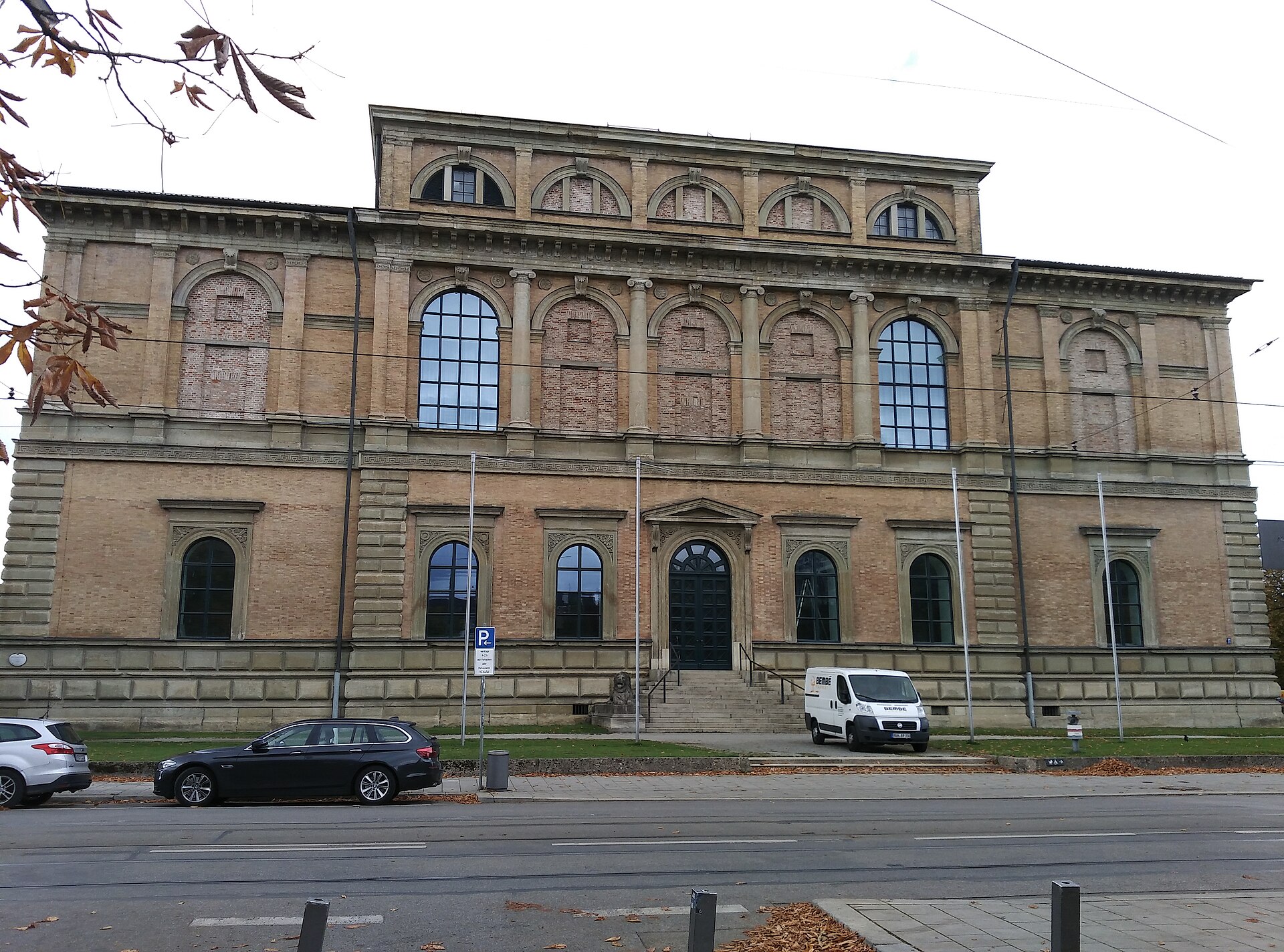
The Alte Pinakothek's long south facade on Theresienstrasse, showing Hans Doellgast's postwar brickwork replacing the decorative stonework lost in the Second World War.
Photograph by ArticCynda, released CC0On this page 15 sections
ContentsClose
The Alte Pinakothek's strength is unmatched depth in Rubens and a genuinely comprehensive survey of German painting from the Gothic period onward, anchored by the single Leonardo the country's museums hold between them. Few museums combine that range of major names - Duerer, Leonardo, Rubens, Rembrandt - inside one building without any of them being a single-work stopover.
| Kind | Museum |
|---|---|
| Founded | 1836 |
| City and country |  Munich, Germany Munich, Germany |
| Address | Barer Strasse 27, entrance Theresienstrasse, 80333 Munich, Germany |
| Website | pinakothek.de/besuch/alte-pinakothek |
| Status | Open, confirmed |
| Record last verified |
Visiting
- Hours
- MonClosed
- Tue10:00 to 20:00
- Wed10:00 to 20:00
- Thu10:00 to 18:00
- Fri10:00 to 18:00
- Sat10:00 to 18:00
- Sun10:00 to 18:00
- Closed
- Monday.
- Admission
- AdultEUR 9
- ReducedEUR 6
- Under 18FreeFree admission at all Bavarian State Painting Collections houses
- Tickets
- pinakothek.de/besuch/alte-pinakothek The museum's own ticket page.
- Do I need to book?
- Not stated as required in the sources consulted for this page
- Address
- Barer Strasse 27, entrance Theresienstrasse, 80333 Munich, Germany MapTram Lines 27 and 28, stop Pinakotheken
U-Bahn U2 to Koenigsplatz or Theresienstrasse; U3/U6 or U4/U5 to Odeonsplatz; U3/U6 to Universitaet
Bus Museumslinie 100 or CityRing 58, stop Pinakotheken - Website
- pinakothek.de/besuch/alte-pinakothek
- Telephone
- +49 89 23805 216
- [email protected]
Before you go how long, access, photography, bags, eating, shop
- How long to allow
- More than three hours for the full collection
- Access
- Not detailed in the sources consulted for this page
- Photography
- Not detailed in the sources consulted for this page
- Bags
- Not detailed in the sources consulted for this page
- Eating
- Cafe Klenze, on site
- Shop
- Museum shop, on site
Prices and hours change. We take them from the institution's own pages and print the day we read them, and you can check the current position at the source we used. Confirm before you travel.
What is inside
Early German and Netherlandish painting
German and early Netherlandish panel painting from the late Gothic period through the early 16th century, including Albrecht Duerer's 1500 self-portrait and Albrecht Altdorfer's Battle of Alexander at Issus, a battle scene famously later owned briefly by Napoleon.
Photograph by Erik Drost · CC BY 2.0 Flemish Baroque and Rubens
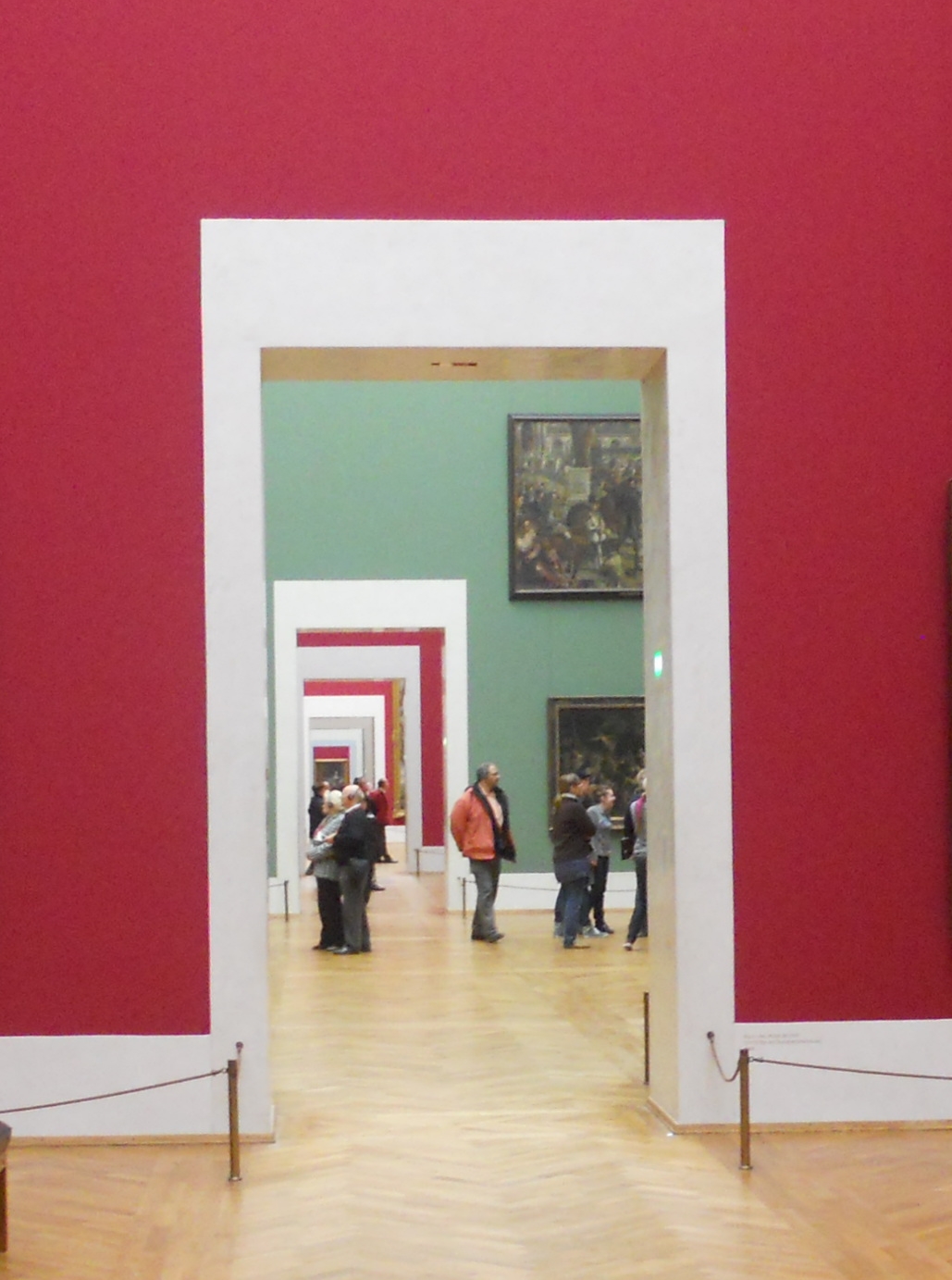
The largest collection of Peter Paul Rubens paintings anywhere, some 70-plus works spanning his career, shown alongside Flemish contemporaries including Jan Brueghel the Elder and Adam Elsheimer.
Italian Renaissance painting
The only work by Leonardo da Vinci in a German museum, the Madonna of the Carnation, shown with Sandro Botticelli's Lamentation and other Florentine and Venetian Renaissance painting.
CC0 Dutch 17th-century painting
Dutch Golden Age painting including a 1629 Rembrandt self-portrait, one of the artist's earliest, and Pieter Bruegel the Elder's The Land of Cockaigne.
What to see first
Self-Portrait with Fur-Trimmed Robe
Albrecht DuererPainted in 1500 when Duerer was 28, a frontal, almost Christ-like self-portrait that is one of the most reproduced images in German art and, by the museum's own description, arguably the best-known painting it owns.9
Madonna of the Carnation
Leonardo da VinciThe only painting by Leonardo da Vinci held by any German museum, from around 1475, making the Alte Pinakothek the sole reason a visitor to Germany can see an autograph Leonardo without leaving the country.9
The Fall of the Damned
Peter Paul RubensA large, violently composed Last Judgement scene of about 1621, part of a Rubens holding so extensive - the largest collection of his work anywhere - that the Alte Pinakothek is effectively a second home institution for the artist.9
The Battle of Alexander at Issus
Albrecht AltdorferA 1529 battle panorama that dissolves Alexander's victory over Darius into a vast landscape seen almost from orbit; owned briefly by Napoleon, who took it back to Paris before it was restored to Munich.9
The Land of Cockaigne
Pieter Bruegel the ElderA satirical vision of a land of gluttonous idleness from 1567, where a roast bird lies down ready-carved and the buildings are made of food; one of Bruegel's most widely reproduced allegorical paintings.9
Self-Portrait
Rembrandt van RijnAn early self-portrait from 1629, painted when Rembrandt was in his early twenties in Leiden, before the confident bravura of his later self-portraits set in.9
Exhibitions on now
- On now29 Sep 2026 to 31 Jan 2027Confirmed , 6 weeks ago
- On now13 Oct 2026 to 31 Jan 2027Confirmed , 6 weeks ago
- Opening soon26 Nov 2026 to 4 Apr 2027Confirmed , 6 weeks ago
Past exhibitions here
- Closed24 Mar to 4 Oct 2026Confirmed · check before you travel
- Closed5 Jun 2025 to 13 Sep 2026Confirmed · check before you travel
A gallery built to be walked through in daylight
The Alte Pinakothek was designed from the start as a public art gallery rather than adapted from a palace or a former royal collection room, which was still an unusual approach when Leo von Klenze began work on it after his 1816 appointment to the Bavarian court. Klenze's design put picture galleries on the upper floor lit by skylights, a solution that became standard for museum architecture across Europe for the next century. The foundation stone was laid on 7 April 1826, chosen deliberately for Raphael's birthday, and after a decade of construction the Pinakothek opened on 16 October 1836 with 1,269 paintings on its walls - a scale and a level of organisation that made it one of the first museums anywhere built specifically to display a picture collection to the public rather than to a court.
Bombed, and rebuilt as a scar rather than a repair
Allied bombing raids during the Second World War left the Alte Pinakothek gutted by fire and stripped of much of its original architecture. When postwar reconstruction began, the architect Hans Doellgast made a decision that still defines how the building looks and reads today: rather than reconstructing the lost decorative stonework to match the original, he rebuilt the missing sections in plain, unornamented brick, using salvaged brick of a visibly different colour taken from the ruins of nearby barracks on Tuerkenstrasse. The result leaves the war damage legible in the building's own walls rather than concealed behind a faithful restoration - the south facade in particular reads almost like a diagram of what survived and what did not. The rebuilt museum reopened to the public in 1957, and Doellgast's approach has since become an internationally cited reference point for how to rebuild a bombed historic building without pretending the bombing did not happen.
What is still being checked, work by work
The Bavarian State Painting Collections, which run the Alte Pinakothek, have operated a systematic programme of Nazi-era provenance research since 1999, covering every work acquired or catalogued from 1933 onward whose ownership history before that date is unclear. Since 2018 the results have been made public in a free online database, publishing the full chain of owners for each examined work rather than only a conclusion, in the collections' own account of meeting the transparency standard set by the 1998 Washington Principles. Proactive research completed between 2017 and 2022 covered around 6,000 works, and 595 objects from the wider Bavarian state collections are currently listed on the public Lost Art database as works whose Nazi-era loss through persecution cannot be ruled out, open for potential heirs to come forward. The collections' own history gives this work weight beyond routine due diligence: after the war, American forces returned thousands of works looted under the Nazi regime to the Bavarian state and its museums, and Bavarian officials went on to sell some of that returned art back, at reduced prices, to the families of the same senior Nazi officials who had profited from the original seizures - a postwar failure this generation of provenance researchers is working, painting by painting, to identify and correct.
How a Bavarian duke ended up owning this much Rubens
The collection predates the building by three centuries, and the Rubens holding specifically was not bought as art history - it was bought as court decoration, in bulk, by successive Wittelsbach rulers who happened to have both the money and the connections to buy well. Duke Wilhelm IV started the pattern in the early 16th century by commissioning history paintings directly from living artists, including Albrecht Altdorfer's Battle of Alexander at Issus. Elector Maximilian I went further, commissioning hunting scenes directly from Rubens in 1616 and acquiring Duerer's Four Apostles from the city of Nuremberg in 1627 under enough political pressure that the city had little practical choice but to hand them over. The decisive purchase for the Rubens collection came later still, when Maximilian II Emanuel served as governor of the Spanish Netherlands and bought Flemish paintings on the spot: in 1698 alone he acquired twelve Rubens paintings and thirteen Van Dycks in a single Antwerp transaction with the dealer Gisbert van Colen.
The collection grew again by inheritance rather than purchase in 1777, when Bavaria's union with the Palatinate under a single ruler brought the electoral galleries of Mannheim, Duesseldorf and Zweibruecken to Munich, partly moved there deliberately to keep them safe from the wars that followed the French Revolution. What the Alte Pinakothek shows today is substantially the result of those two centuries of court acquisition, assembled before the museum that would eventually house it had even been designed.
A single building, four centuries of painting
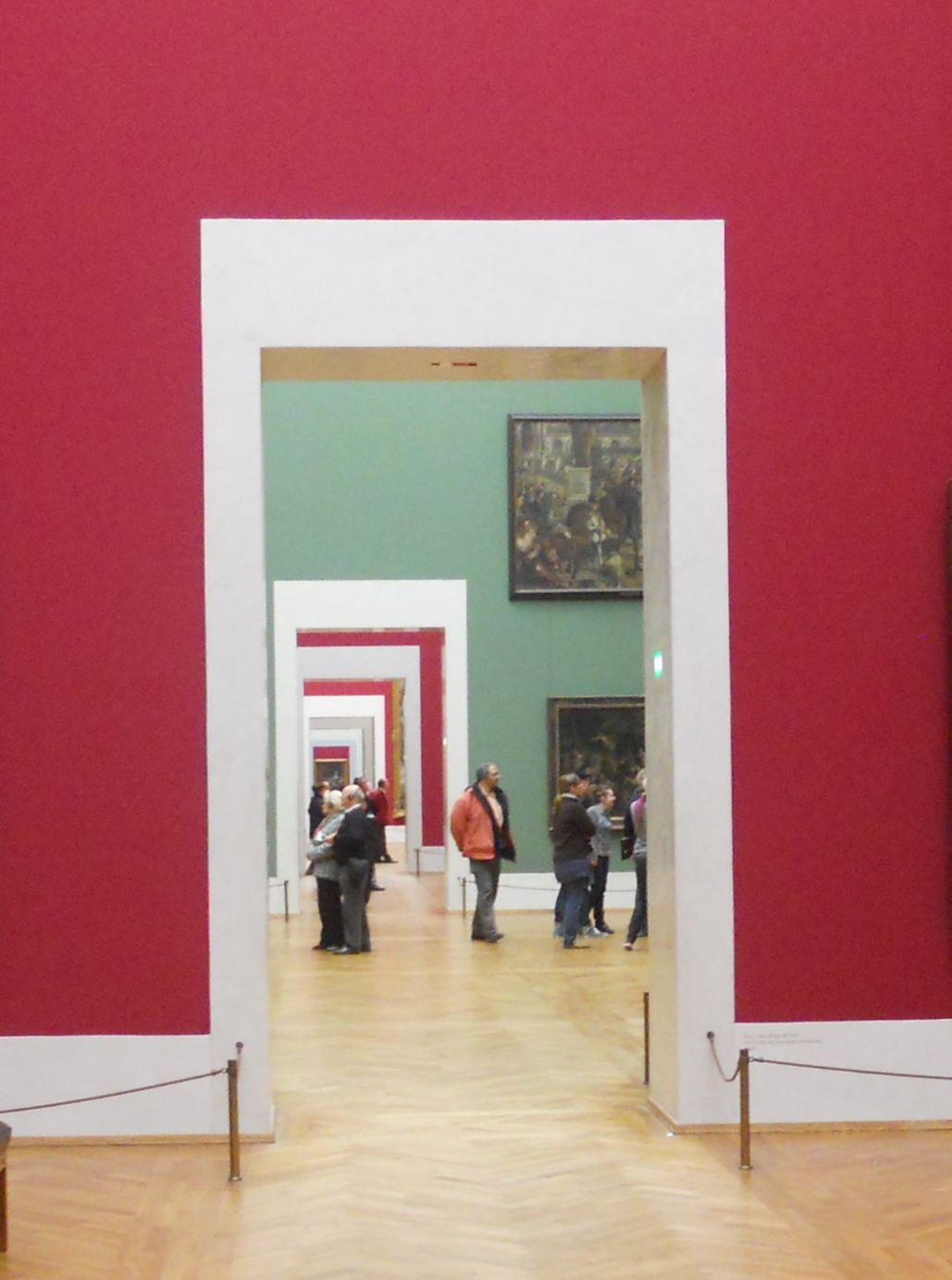
Inside, the collection runs from the German and Netherlandish Gothic through the Italian and Northern Renaissance to the Dutch and Flemish Baroque, without a significant gap in any of those four centuries. Duerer's 1500 self-portrait and Leonardo's Madonna of the Carnation, the only Leonardo in a German museum, sit at one end of that run; at the other, Rubens is represented so extensively - more paintings than any other single collection holds - that curators treat the Alte Pinakothek as close to a second home institution for him, alongside Antwerp. Rembrandt, Bruegel and Altdorfer fill out a collection that a visitor can walk in roughly chronological order, room by room, from around 1400 to the threshold of the 19th century.
What visitors say
Visitors rate the Alte Pinakothek among the strongest old-master collections in Europe, and consistently mention the range of major names on view in one building - Duerer, Leonardo, Rubens, Rembrandt - as much as any single painting. The building itself, especially the scarred, unrestored brickwork of the postwar facade, draws its own comment from visitors who notice it.
What is praised, what is criticised
- Praised: the breadth and quality of the collection across German, Flemish, Italian and Dutch schools in a single visit
- Praised: the scale of the Rubens holding specifically, described by visitors as unmatched elsewhere
- Praised: manageable crowd levels compared with the most famous museums in Paris, London or Florence
- Criticised: the building's plain, unornamented postwar facade surprises some visitors expecting a more conventionally grand exterior
- Criticised: several visitors note that a single visit is not enough time to take in the collection properly and recommend returning
Ratings on other platforms
Tripadvisor: 4.5 from 2,789 ratings, read 7 August 2026
A platform average is a tertiary source: it moves, it is not audited, and we quote no visitor's words.
Questions about Alte Pinakothek
Where is Alte Pinakothek?
Barer Strasse 27, entrance Theresienstrasse, 80333 Munich, Germany.
How much does it cost to visit?
Adult: EUR 9; Reduced: EUR 6; Under 18: free. As confirmed 21 August 2026.
When is it open?
Mon closed; Tue 10:00-20:00; Wed 10:00-20:00; Thu 10:00-18:00; Fri 10:00-18:00; Sat 10:00-18:00; Sun 10:00-18:00. Closed: Monday. As confirmed 21 August 2026.
How do you get there?
Tram: Lines 27 and 28, stop Pinakotheken; U-Bahn: U2 to Koenigsplatz or Theresienstrasse; U3/U6 or U4/U5 to Odeonsplatz; U3/U6 to Universitaet; Bus: Museumslinie 100 or CityRing 58, stop Pinakotheken.
What should you see first?
Self-Portrait with Fur-Trimmed Robe (Albrecht Duerer); Madonna of the Carnation (Leonardo da Vinci); The Fall of the Damned (Peter Paul Rubens); The Battle of Alexander at Issus (Albrecht Altdorfer); The Land of Cockaigne (Pieter Bruegel the Elder); Self-Portrait (Rembrandt van Rijn).
What we could not confirm
- The exact number of paintings from the Alte Pinakothek's own holdings still under active Nazi-era provenance investigation, as opposed to the wider Bavarian State Painting Collections total of roughly 6,000 works examined and 595 currently listed on Lost Art, was not broken out separately in the sources consulted for this page.
- Sunday or reduced-rate pricing beyond the standard adult and concession tiers was referenced in secondary sources but could not be confirmed on the museum's own prices page as read for this entry, and is left out rather than guessed at.
Images
Sources
- 1Pinakothek, Alte Pinakothek visit page (hours, prices, address, phone) pinakothek.de/besuch/alte-pinakothek
- 8Pinakothek, Alte Pinakothek visit page (transport directions and parking) pinakothek.de/besuch/alte-pinakothek
- 9Pinakothek, Alte Pinakothek highlight works pinakothek.de/en/alte-pinakothek
- 10Pinakothek, Happy Birthday Alte Pinakothek (founding, WWII bomb damage, Doellgast reconstruction) pinakothek.de/en/happy-birthday-alte-pinakothek
- 11Pinakothek, Provenance research at the Bavarian State Painting Collections pinakothek.de/en/the-museums/research/provenance-research
- 12Wikidata, Alte Pinakothek (Q154568) wikidata.org/wiki/Q154568
- 13Tripadvisor, Alte Pinakothek, Munich, overall rating and review count, read 7 August 2026 tripadvisor.com/Attraction_Review-g187309-d194174-Reviews-Alte_Pinakothek-Munich_Upper_Bavaria_Bavaria.html
- 14Wikipedia, Alte Pinakothek (formation of the Wittelsbach collection: Maximilian I, Maximilian II Emanuel, and the 1777 Mannheim/Duesseldorf/Zweibruecken gallery consolidations) en.wikipedia.org/wiki/Alte_Pinakothek