National Gallery of Victoria
Museum · Founded 1861
Open, admission and hours confirmed 7 September 2026 · 23 sources
On this page 15 sections
ContentsClose
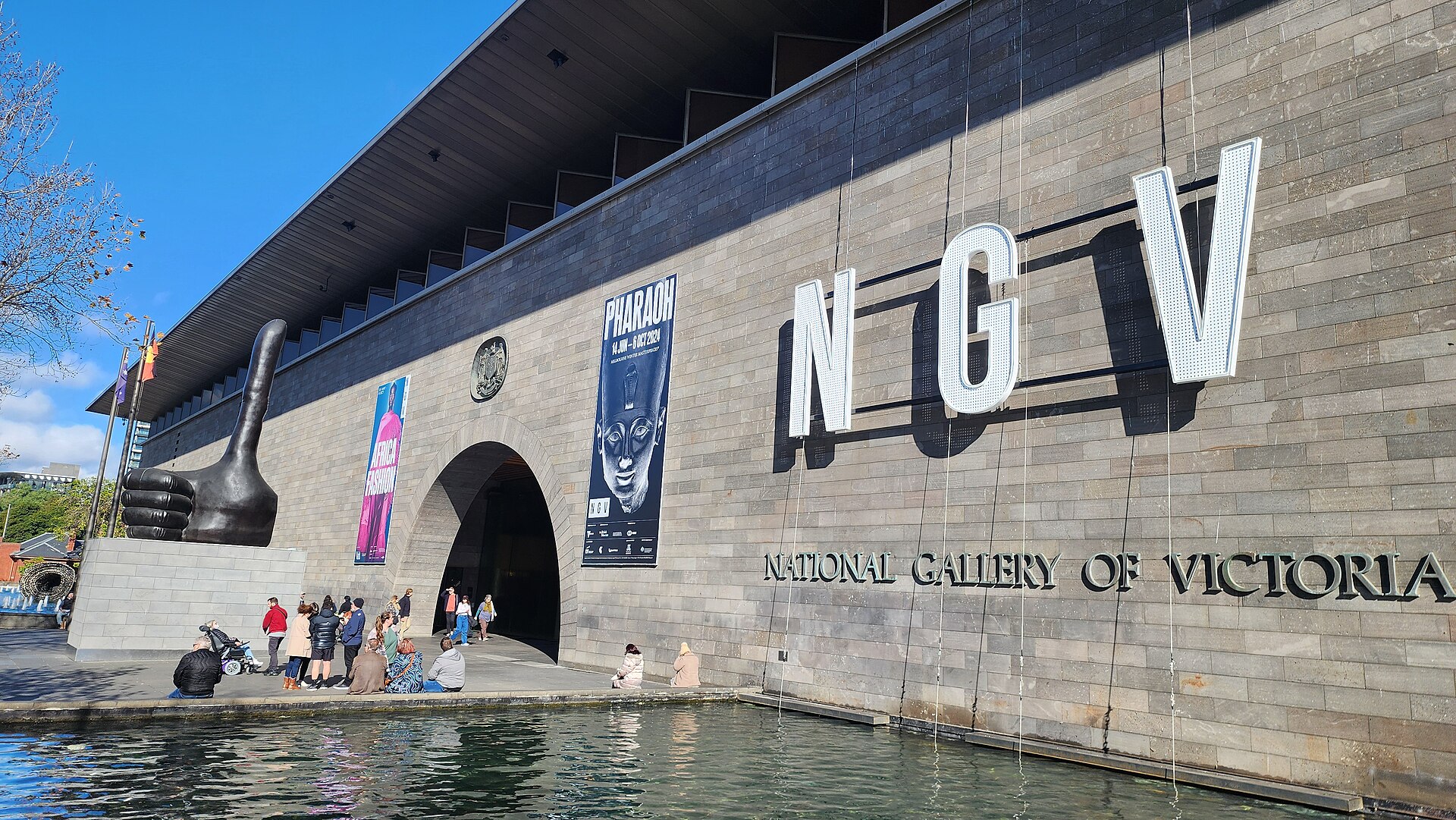
The NGV's declared strength is breadth rather than a single specialism: more than 76,000 works split across two buildings, with no equivalent scale anywhere else in Australia. NGV International carries the international collection - European Old Master and nineteenth-century painting bought heavily through the Felton Bequest from 1904 onward, a substantial Asian art collection that began in 1862, one year after the Gallery's own founding, with a donation of two Chinese plates, and grew through later purchases including the Felton Bequest's 1909 Hokusai prints, decorative arts, fashion and textiles, prints and drawings, and contemporary art and design. The Ian Potter Centre carries the entire Australian collection on its own, more than 20,000 works, Indigenous and non-Indigenous, colonial to contemporary, including the paintings most associated with a national school of the 1880s-1890s. The division is real rather than curatorial dressing: a reader who wants both has to plan two visits to two buildings a kilometre apart.
| Kind | Museum |
|---|---|
| Founded | 1861 |
| City and country |  Melbourne, Australia Melbourne, Australia |
| Address | 180 St Kilda Road, Melbourne VIC 3006, Australia |
| Website | ngv.vic.gov.au |
| Status | Open, confirmed 7 September 2026 |
| Record last verified | 7 September 2026 |
Visiting
- Hours
- Daily, both buildings10:00 to 17:00ANZAC Day (25 April): opens 1pm rather than the usual 10am.
- Closed
- Christmas Day (25 December).
- Admission
- Permanent collection, both buildingsFreeFree every day at NGV International and at The Ian Potter Centre: NGV Australia. This is the whole of the permanent collection; only ticketed special exhibitions carry a charge.
- CARTIER (current ticketed exhibition, NGV International, 12 Jun-4 Oct 2026), AdultAUD 43Timed entry. Concession $39 (seniors card discount Wednesdays only), child 5-15 $19, family (2 adults + 3 children) $99, member adult $38, member family $93, member child $15, premium member free, flexible exhibition entry $85. Ticketed exhibition pricing changes with each show; this is the figure for the exhibition running now, not a standing price. Re-confirmed unchanged 11 August 2026 direct from the exhibition page (source 3).
- Ragnar Kjartansson: Mercy (current ticketed exhibition, NGV International, 26 Jun-4 Oct 2026), AdultAUD 25Timed entry, running concurrently with CARTIER at NGV International. Concession $22, child 5-15 $11, family (2 adults + 3 children) $60, member adult $20, member child $10, member family $50. A joint ticket with CARTIER costs $10 extra per person when both are bought together, valid to 4 Oct 2026. This second concurrent ticketed exhibition was not documented on this record before this run; the permanent collection at both buildings remains free regardless. Ticketed exhibition pricing changes with each show; this is the figure for the exhibition running now, not a standing price.
Free entry: Every day - the permanent collection carries no charge at either building; there is no separate concept of a free day because there is no standing admission fee to waive- Do I need to book?
- No for the permanent collection at either building. Timed tickets are required for ticketed exhibitions such as CARTIER.
- Address
- 180 St Kilda Road, Melbourne VIC 3006, Australia MapTram, NGV International Routes 1, 3, 5, 6, 16, 64, 67 and 72 stop at the Arts Precinct accessible stop directly outside the St Kilda Road entrance
Tram, The Ian Potter Centre Routes 1, 3, 5, 6, 16, 64, 67 and 72 stop at Federation Square/Swanston St; routes 35, 70 and 75 stop at Swanston St/Flinders St and Russell St/Flinders St
Train Flinders Street Station: about 500 m walk to NGV International, or a one-stop tram ride; about 250 m through Federation Square to The Ian Potter Centre
Car Paid parking at Arts Centre Melbourne and Australian Ballet Centre for NGV International; paid parking at Fed Square via Russell Street or Batman Avenue for The Ian Potter Centre. Accessible spaces at both, 2.1 m height restriction at Fed Square
Bicycle On-street bicycle hoops on St Kilda Road outside NGV International, and on Flinders Street near the Russell Street extension for The Ian Potter Centre - Website
- ngv.vic.gov.au
- Telephone
- +61 3 8620 2242
- [email protected]
Before you go how long, access, photography, bags, eating, shop
- How long to allow
- The two buildings are about a kilometre apart across the Yarra; seeing both in one visit is a full day rather than a couple of hours. Most visitors treat NGV International and The Ian Potter Centre as separate trips.
- Access
- Wheelchair access throughout both buildings including auditoriums, studios, education theatres and toilets; free wheelchair hire at both NGV International and The Ian Potter Centre, free motorised scooter hire at NGV International only; a lift from the Arts Centre Melbourne car park reaches NGV International; Companion Card and Carer Card both recognised; audio description tours, digital audio descriptions, large-print labels and Braille/raised-letter wayfinding for visually impaired visitors; Auslan-led tours, interpretation on request and hearing loops for hearing-impaired visitors; relaxed sessions for a quieter visit
- Photography
- Permitted in most areas without flash, tripod or selfie stick
- Bags
- Backpacks, large bags and umbrellas must be cloaked before entering gallery spaces; free cloaking on arrival
- Eating
- Multiple dining options at both buildings, from casual to fine dining
- Shop
- NGV Design Store at both locations, open daily 10am-5pm
Prices and hours change. We take them from the institution's own pages and print the day we read them, and you can check the current position at the source we used. Confirm before you travel.
What is inside
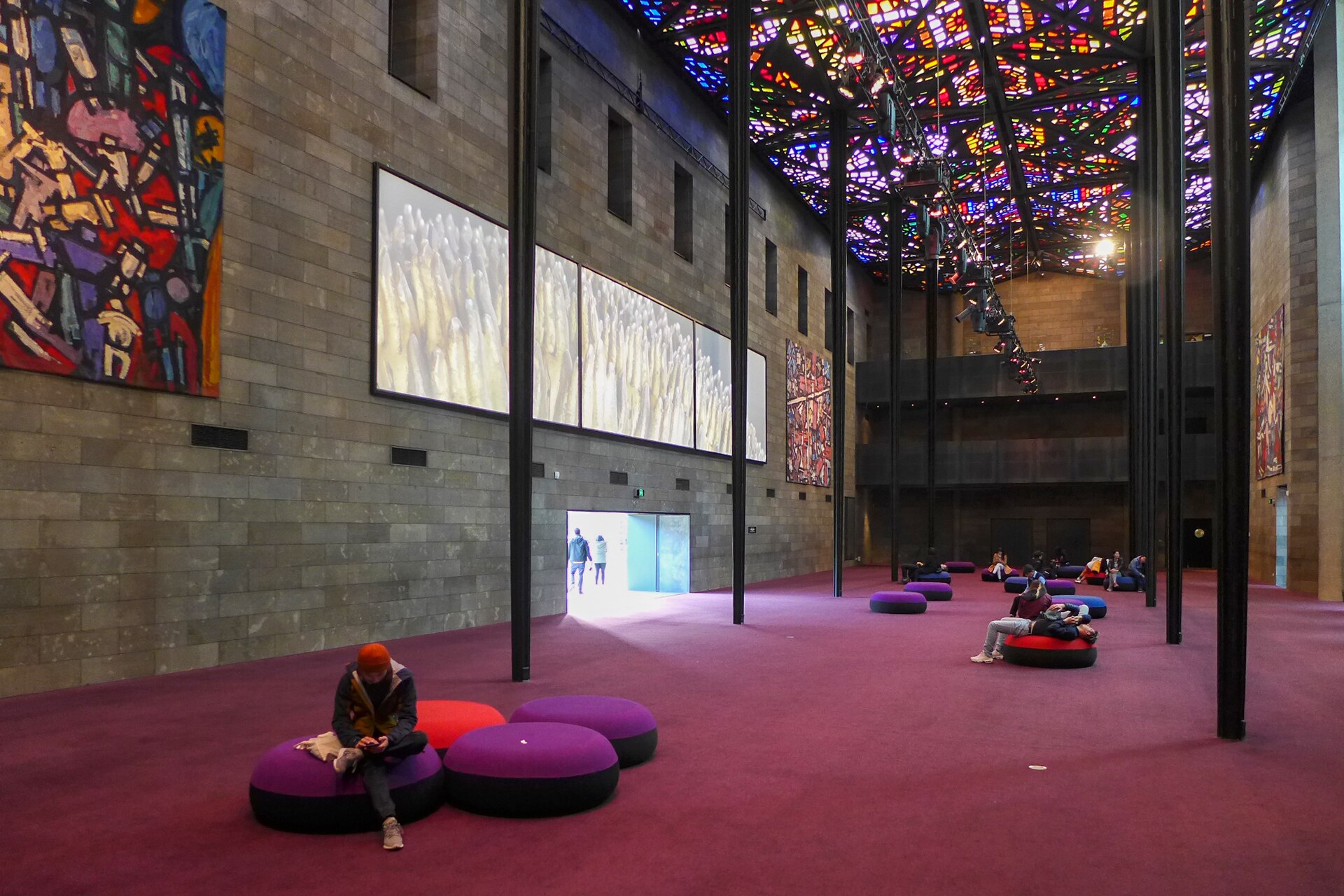
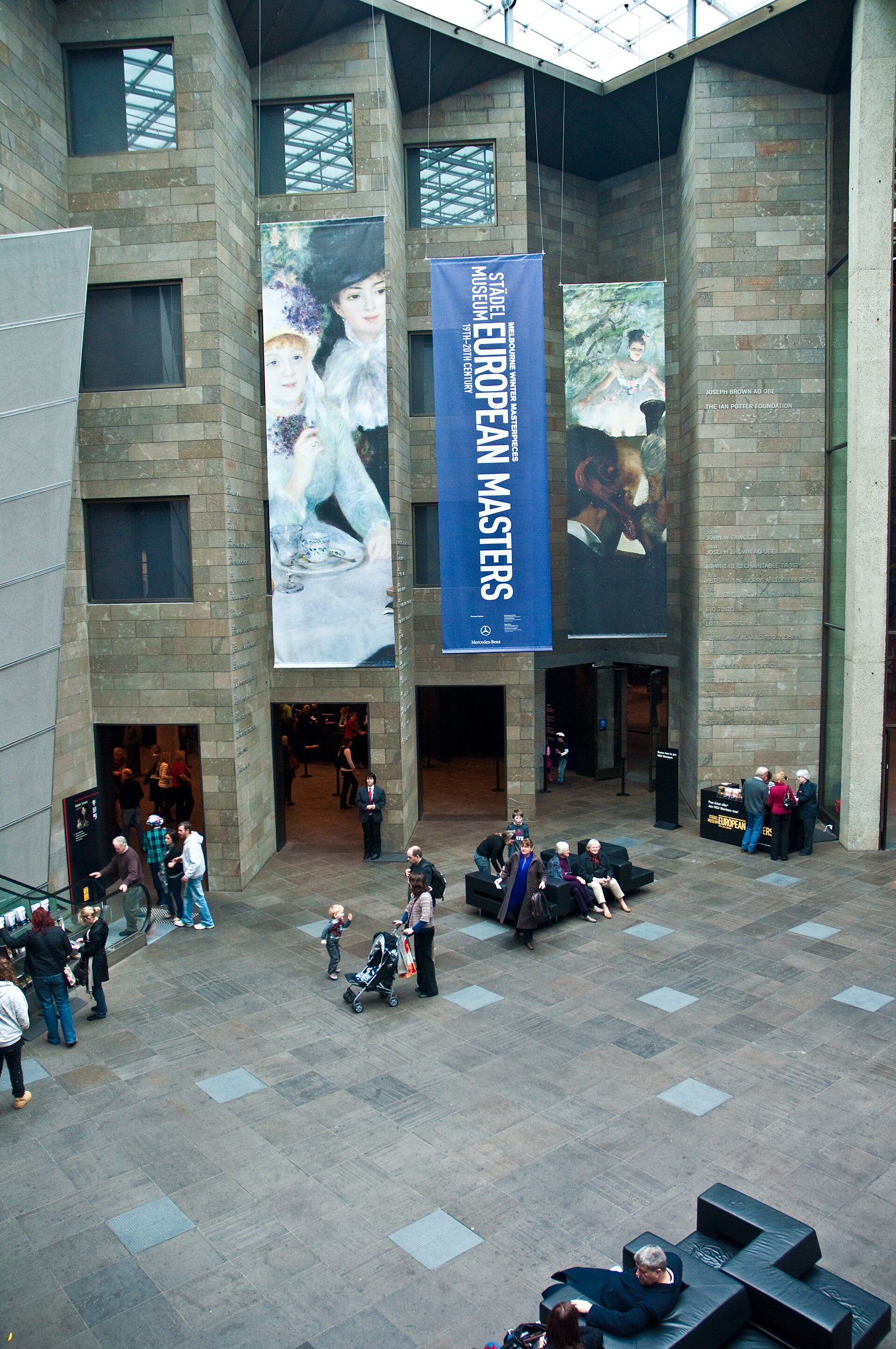
Photograph by Wpcpey · CC BY-SA 4.0 The Great Hall (NGV International, St Kilda Road)
The room visitors pass through first inside the water-wall entrance, roofed by Leonard French's stained-glass ceiling: 16,000-odd pieces of hand-split French and Belgian glass over about 51 by 15 metres, made between 1963 and 1967 and unveiled with the building in August 1968. It is not a gallery of hung works so much as the building's own set piece, and it is where large banners for the current ticketed exhibition hang.
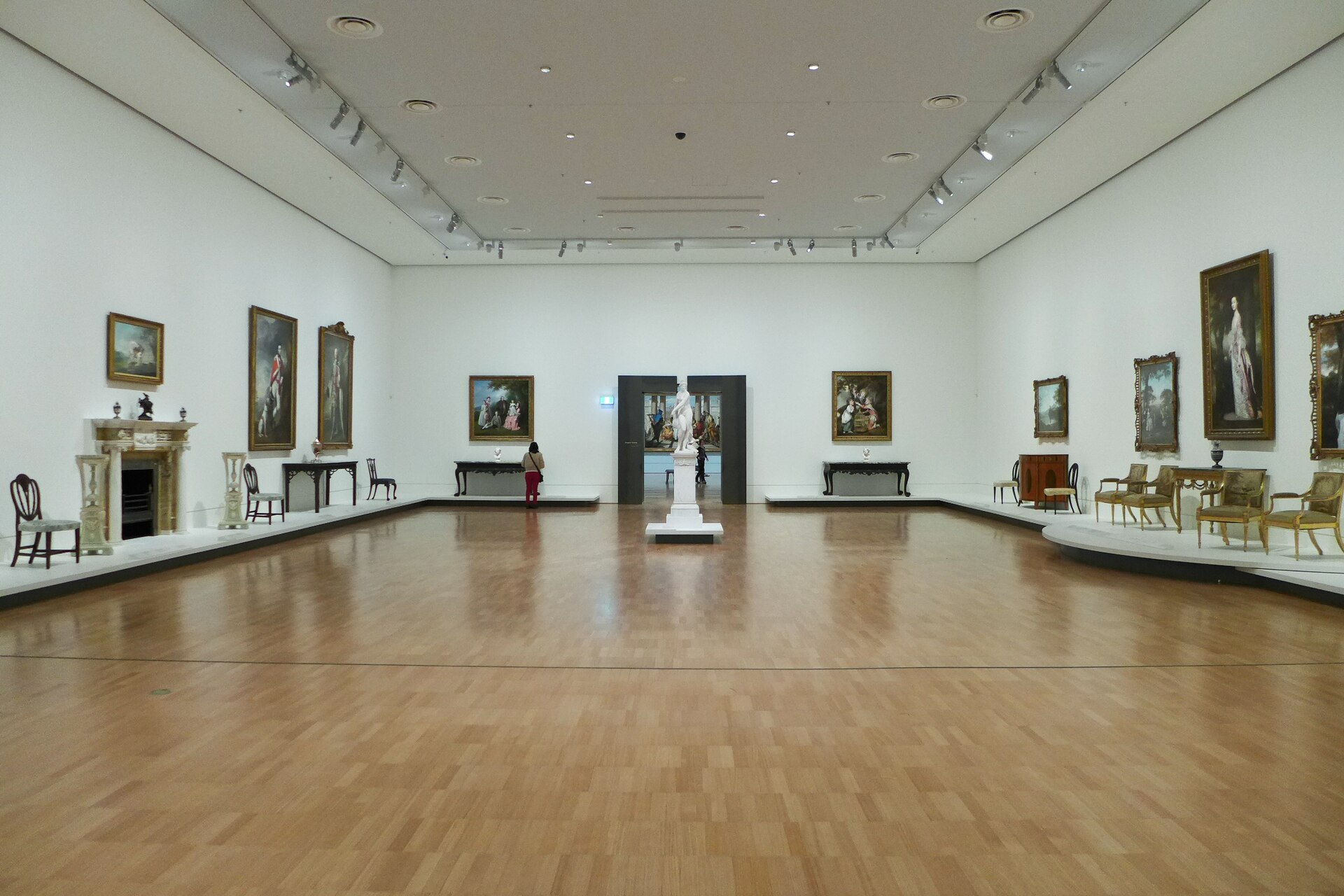
Photograph by Wpcpey · CC BY-SA 4.0 British and European art, 17th-19th century (NGV International, St Kilda Road)
Period-hung rooms of British and European portraiture, history painting and decorative furniture, including the Tiepolo, Rembrandt and van Dyck holdings bought for the collection under the Felton Bequest from the 1900s onward. The rooms are dressed with contemporary furniture and fireplaces rather than left as plain white boxes.
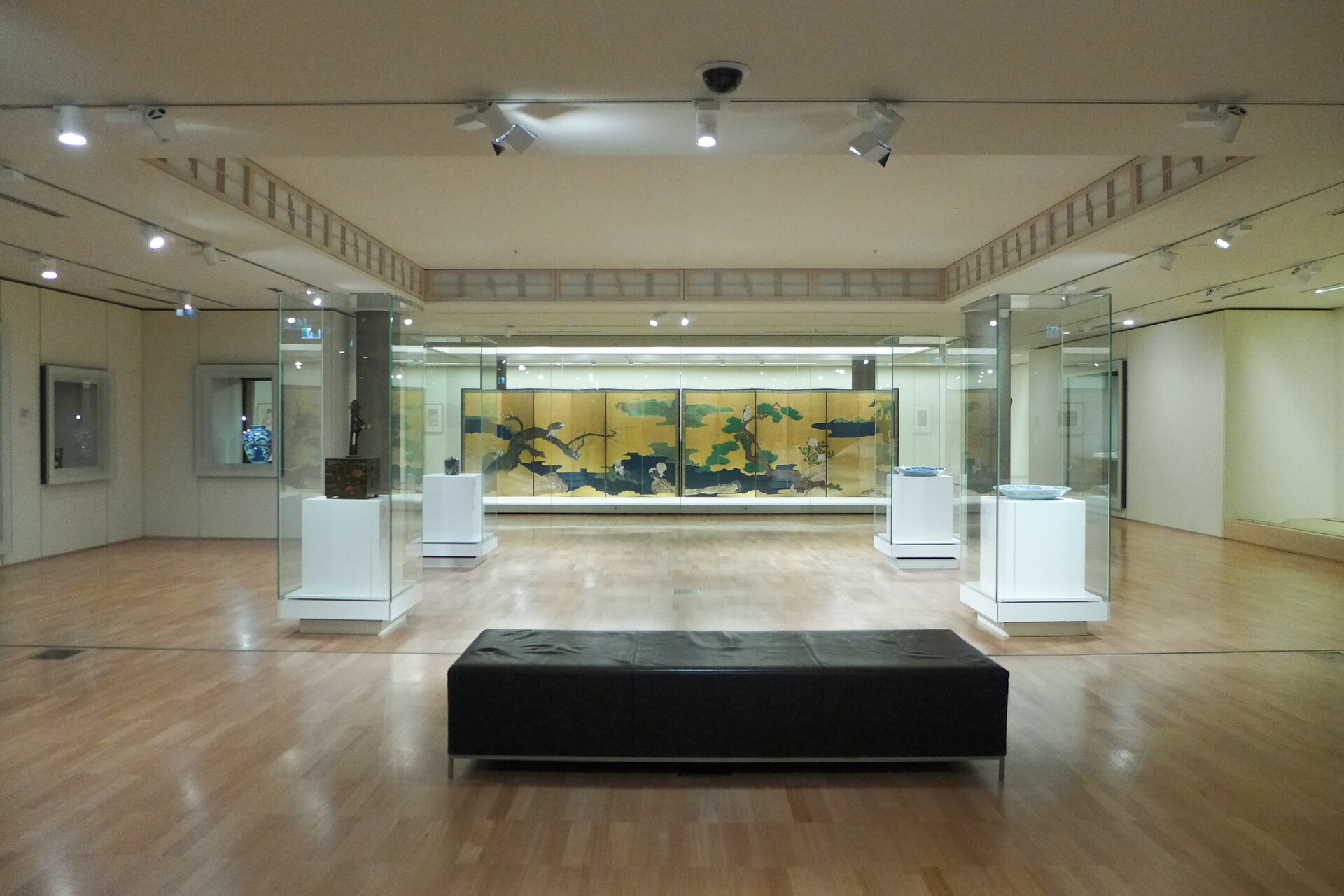
Photograph by Wpcpey · CC BY-SA 4.0 Asian art (NGV International, St Kilda Road)
Chinese, Japanese, Indian, Korean and South-East Asian holdings across ceramics, screens, sculpture, prints and textiles, including the Japanese woodblock print collection bought from 1909 that holds Hokusai's The Great Wave off Kanagawa.
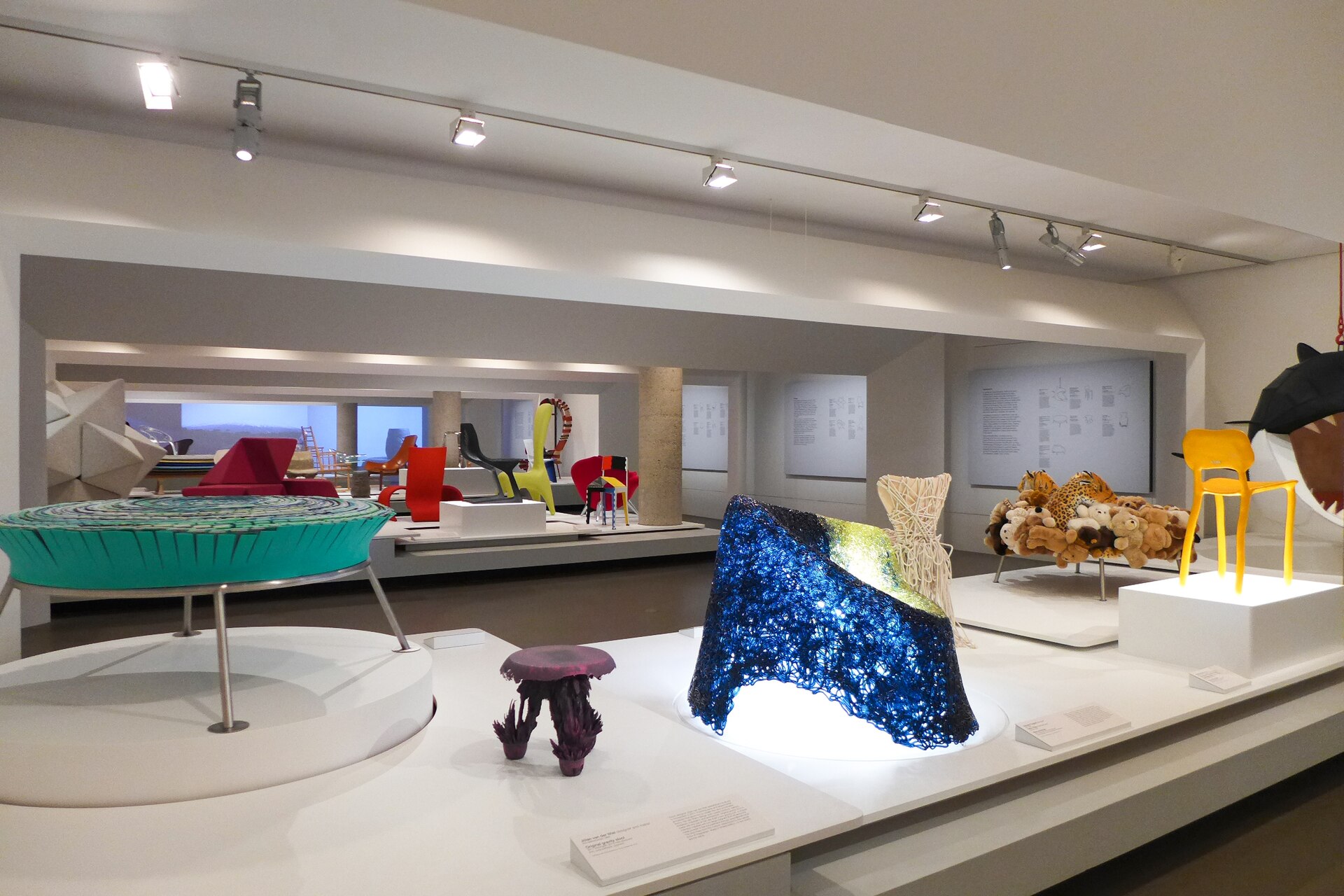
Photograph by Wpcpey · CC BY-SA 4.0 Contemporary Art and Design, Level 3 (NGV International, St Kilda Road)
Contemporary painting, sculpture and design objects, the collecting area that also stages the NGV Triennial and rotating design and fashion displays.
Decorative arts, fashion and textiles (NGV International, St Kilda Road)
European and Asian ceramics, glass, silver and metalwork, and a fashion and textiles collection that runs from historical dress to contemporary haute couture, shown in rotating rather than permanent displays.
19th and 20th-century Australian art, including the Joseph Brown Collection (The Ian Potter Centre: NGV Australia, Federation Square)
This is NGV's other building, about a kilometre north across the Yarra from NGV International, and it holds none of the international collection: it is Australian art only, more than 20,000 works from colonial painting to the present, including Tom Roberts's Shearing the Rams and Frederick McCubbin's The Pioneer.
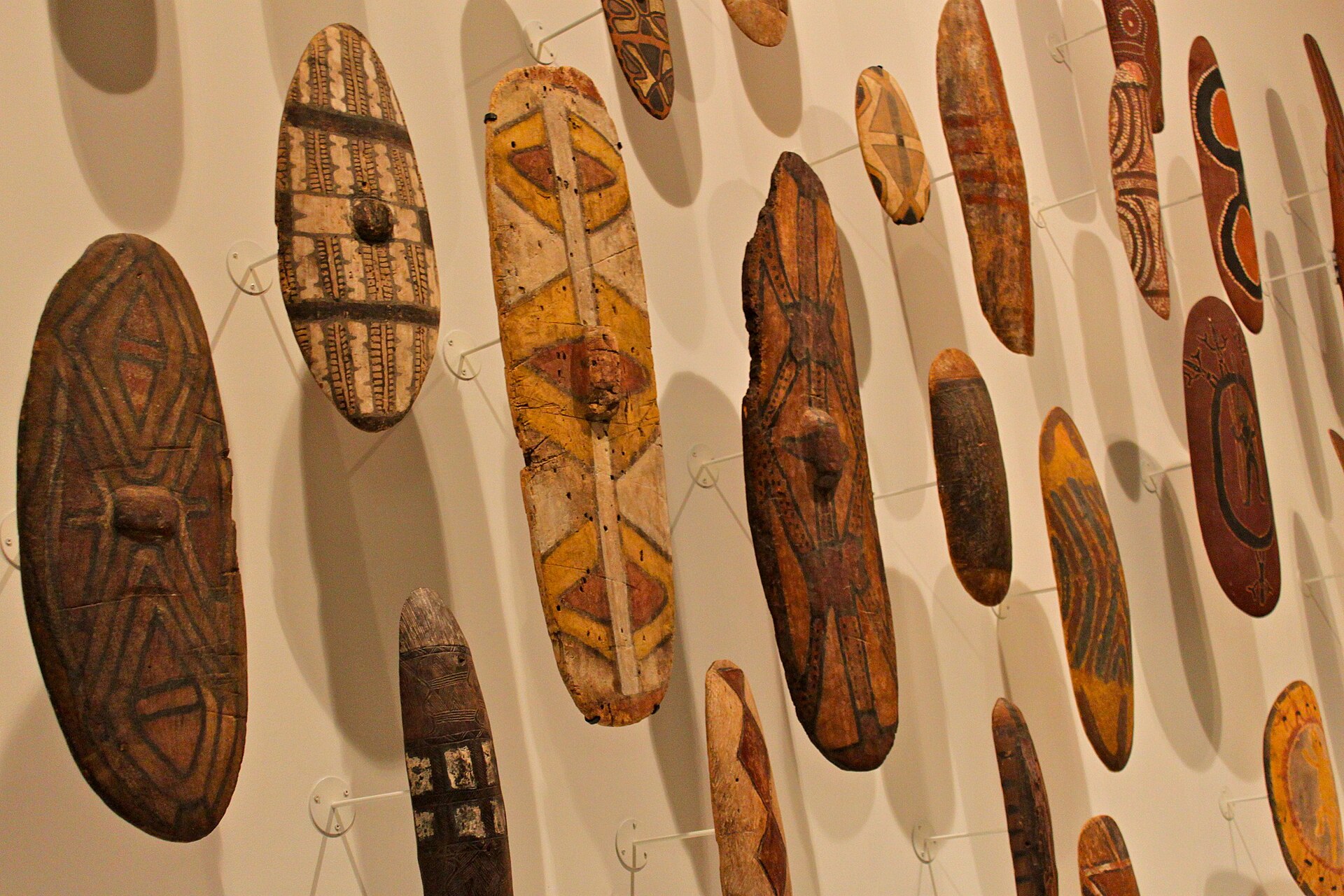
Photograph by Travis from Sydney, NSW, Australia · CC BY 2.0 Aboriginal and Torres Strait Islander art (The Ian Potter Centre: NGV Australia, Federation Square)
Bark paintings, works on paper, weapons and objects including shields, alongside works by named artists such as the Wurundjeri elder William Barak, whose 1898 drawing Ceremony has been in the collection since 1962. This is the gallery most directly bound up with the acquisition-history questions raised in Reception below.
What to see first
The Banquet of Cleopatra
Giambattista Tiepolo, 1743-1744A 250 by 357 cm ceiling-scaled history painting bought from Augustus III's Dresden collection by way of the Hermitage: Soviet authorities sold it to the NGV in the early 1930s and it entered the collection through the Felton Bequest in 1933. It is the single largest and most expensive Old Master the Bequest ever bought, and it still hangs in the British and European rooms at NGV International.5
Shearing the Rams
Tom Roberts, 1890Painted over three shearing seasons at Brocklesby Station near Corowa from 1888, it is the founding image of the Heidelberg School's national subject matter and hangs at The Ian Potter Centre, not at NGV International. Bought through the Felton Bequest in 1932.4
The Pioneer
Frederick McCubbin, 1904A three-panel narrative painting, 225 by 296 cm, on the same nationalist settler subject matter as Shearing the Rams and hung in the same building. Bought through the Felton Bequest in 1906.6
Weeping Woman
Pablo Picasso, 1937Bought in 1985 for A$1.6 million, then the highest price an Australian gallery had paid for a work of art, and stolen from the gallery's own wall on 2 August 1986 by a group calling itself the Australian Cultural Terrorists, who demanded more state arts funding and threatened to burn it. It was found unharmed in a station locker seventeen days later; the theft has never been solved.11
The Great Hall ceiling
Leonard French, 1963-1967Not a collection object in the ordinary sense but a commissioned architectural work: about 16,000 pieces of hand-split French and Belgian glass over roughly 51 by 15 metres, French's first work in the medium, unveiled with the St Kilda Road building in August 1968 and kept in place through the building's Mario Bellini redevelopment, proposed in 1997 and reopened in December 2003.9
Ceremony
William Barak, 1898A pencil, wash and earth-pigment drawing of a Wurundjeri corroboree by William Barak, the last traditional ngurungaeta (elder) of the Wurundjeri-willam clan. Bought by the gallery in 1962 and held at The Ian Potter Centre.7
The Great Wave off Kanagawa
Katsushika Hokusai, c. 1830One of the five prints from the Thirty-six Views of Mount Fuji series bought under the Felton Bequest in 1909, decades after the Asian art collection began in 1862 with a donated pair of Chinese plates; among the most reproduced images in the collection.8
Exhibitions on now
- On now25 Sep 2025 to 15 Nov 2026Confirmed 31 Aug 2026, 3 weeks ago
- On now15 Nov 2025 to 8 Nov 2026Confirmed 31 Aug 2026, 3 weeks ago
- On now12 Jun to 4 Oct 2026Confirmed 31 Aug 2026 · check before you travel
- On now26 Jun to 4 Oct 2026Confirmed 31 Aug 2026 · check before you travel
- Opening soon30 Oct 2026 to 14 Jun 2027Confirmed 31 Aug 2026, 3 weeks ago
- Opening soon13 Dec 2026 to 11 Apr 2027Confirmed 31 Aug 2026, 3 weeks ago
Past exhibitions here
- Closed20 Mar to 13 Sep 2026Confirmed 31 Aug 2026 · check before you travel
- Closed28 Feb to 30 Aug 2026Confirmed 31 Aug 2026 · check before you travel
- Closed18 Apr to 30 Aug 2026Confirmed 31 Aug 2026 · check before you travel
From a room in the Public Library to two buildings
The National Gallery of Victoria was founded on 24 May 1861, when Melbourne was flush with gold-rush money and had no purpose-built home for art at all. Its first works, plaster casts and British paintings, went into the Melbourne Public Library building on Swanston Street, sharing the site with what became the State Library of Victoria and a museum, all run under a single 1869 Act. The first purpose-built exhibition space, the McArthur Gallery, opened within that same complex on 24 May 1874. What changed the scale of the institution was a single bequest: when the businessman Alfred Felton died in 1904, his will split his estate between charity and the purchase of art for the Gallery, and the Felton Bequest is still buying for the collection today. It paid for The Pioneer in 1906, Shearing the Rams in 1932, and The Banquet of Cleopatra in 1933, and it remains the single biggest reason the collection looks the way it does.
The Gallery outgrew the library site by the mid-twentieth century and moved into a new building of its own on St Kilda Road, designed by Roy Grounds and opened in August 1968. That building, now called NGV International, was substantially rebuilt in a redevelopment proposed in 1997 under the Italian architect Mario Bellini and reopened in December 2003, with the water wall retained and Leonard French's Great Hall ceiling kept in place. In 2002, the Australian collection split off into a second, purpose-built home: The Ian Potter Centre: NGV Australia at Federation Square, named for its principal donor. The two buildings are about a kilometre apart across the Yarra River and are run as one institution with one director, but they do not share a collection: international art stays on St Kilda Road, Australian art moves to Federation Square. A reader planning one visit for both is planning two.
Roy Grounds's wall and the water in front of it
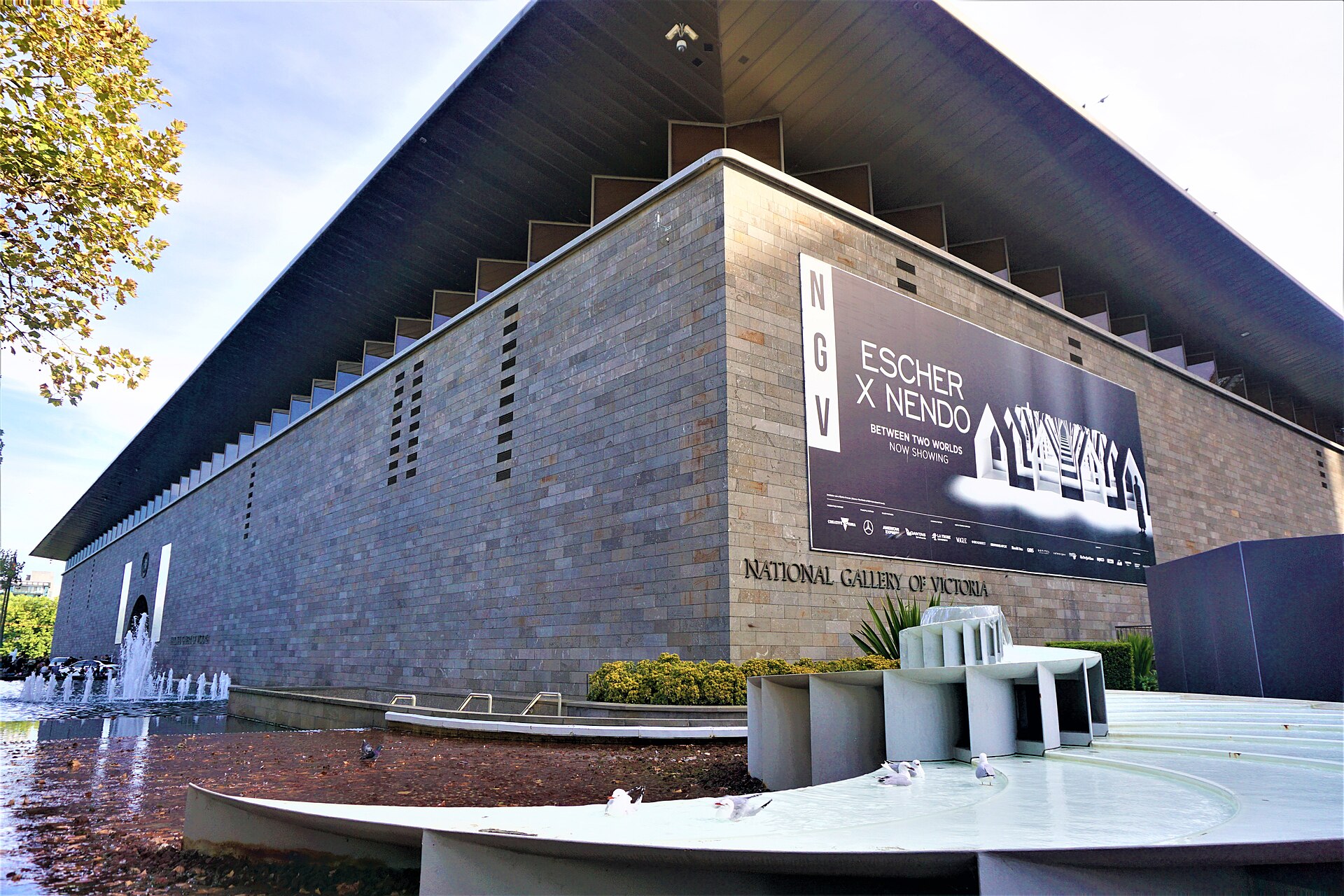
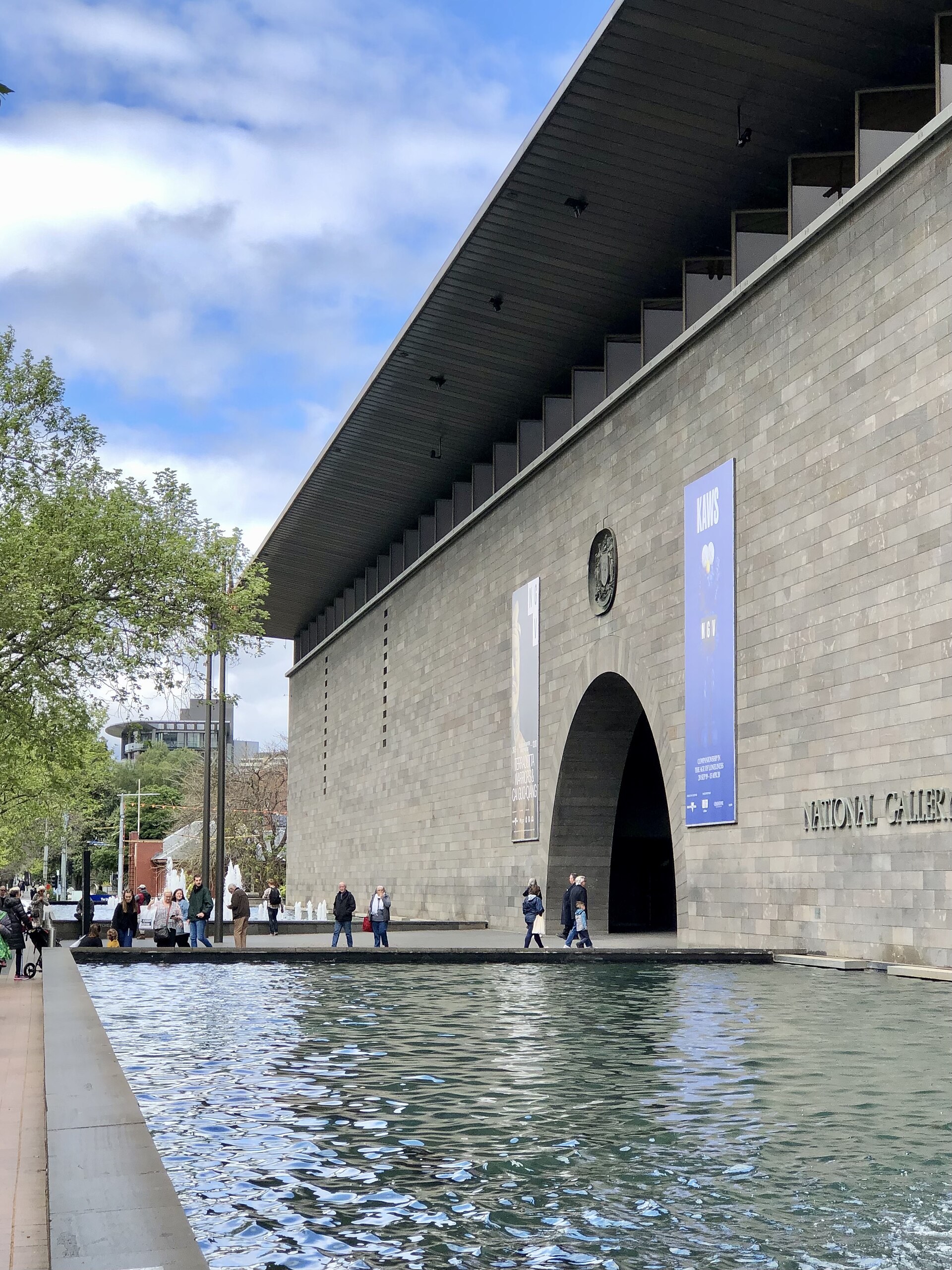
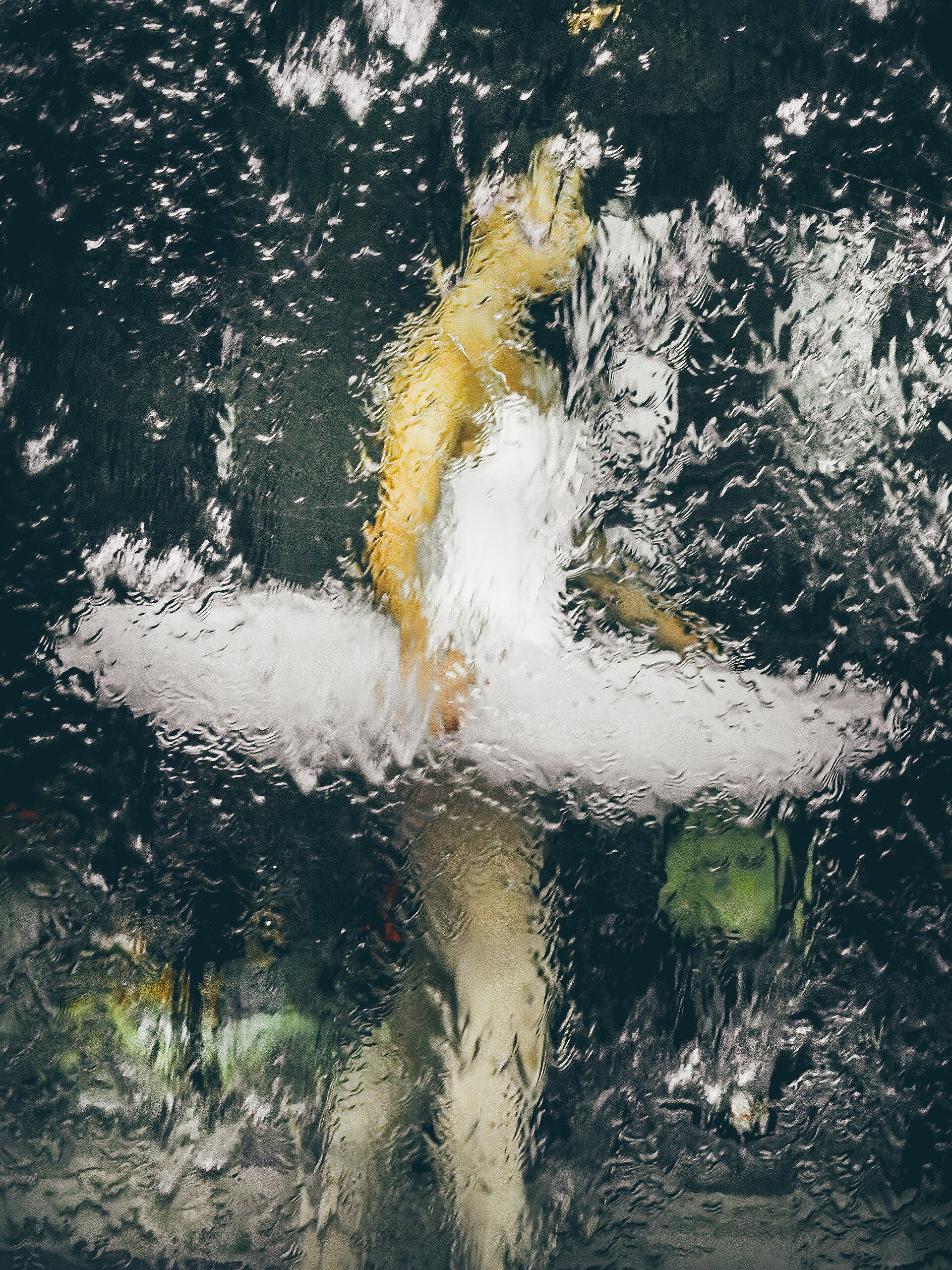
NGV International gives almost nothing away from the street. Grounds's building is a long, low bluestone wall along St Kilda Road, windowless at eye level, with a single arched opening cut through the middle and a moat running along its foot; visitors cross the water on a paved apron and walk under the arch rather than up any steps. The best-known feature of the building is not a room but a surface: a sheet of water run down the glass beside the entrance, the water wall, which visitors press their hands against on the way in and which turns the street view of the lobby into something distorted and moving. Inside, the entrance opens directly into the Great Hall, roofed by Leonard French's stained-glass ceiling, made by hand between 1963 and 1967 from around 16,000 pieces of French and Belgian glass split with an anvil and hammer, and unveiled with the building in 1968. It remains one of the largest suspended stained-glass ceilings in the world and it is the one element of the original building that both the 2003 redevelopment and every later change to the interior have left in place.
Federation Square and the building with no international art in it
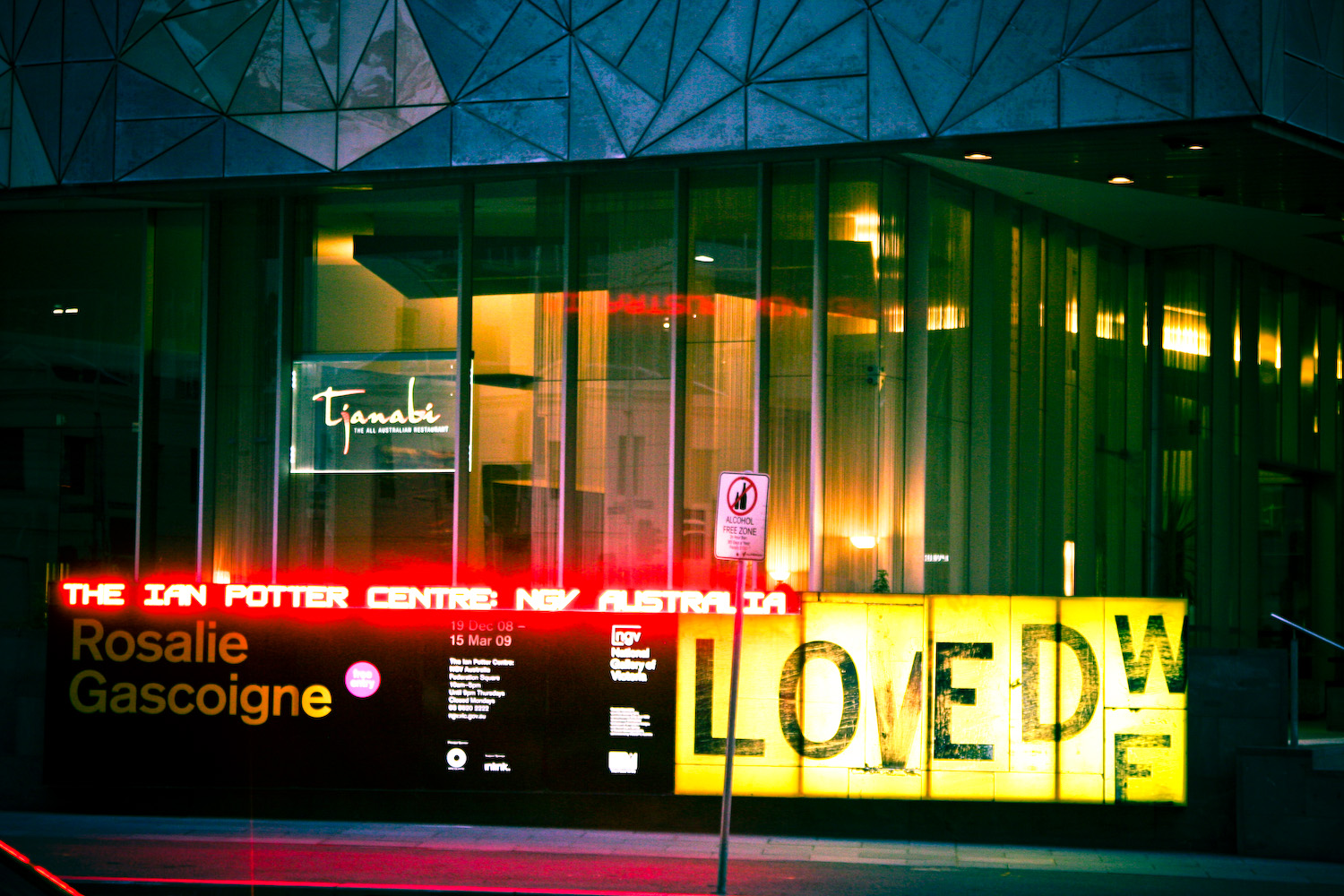
The Ian Potter Centre sits inside Federation Square, the faceted, deliberately jagged public square completed in 2002 on the corner of Flinders and Russell Streets, and its architects, Lab Architecture Studio with Bates Smart, designed everything from the building envelope to the gallery interiors and the wayfinding typeface as one job. Unlike NGV International, this building holds nothing from outside Australia: more than 20,000 works of Australian art, historical and contemporary, Indigenous and non-Indigenous, including the Joseph Brown Collection of nineteenth- and twentieth-century Australian painting given to the Gallery by the dealer and collector in 2004. Tom Roberts's Shearing the Rams and Frederick McCubbin's The Pioneer, the two paintings most often reproduced as the founding images of an Australian national art, both hang here rather than at St Kilda Road, alongside bark paintings, weapons and works on paper by Aboriginal and Torres Strait Islander artists including the Wurundjeri elder William Barak. A visitor who has only been to NGV International, however many times, has not seen this collection at all.
A theft, a return, and two disputes over who worked the doors
The Gallery's most famous single incident has nothing to do with acquisition. On 2 August 1986, Pablo Picasso's Weeping Woman, bought the year before for A$1.6 million, then the highest price an Australian gallery had paid for any work of art, was unscrewed from its wall mounting with a specialised screwdriver not available to the public and the canvas removed from its frame. A group calling itself the Australian Cultural Terrorists claimed responsibility, demanded more state funding for the arts and threatened to burn the painting; it turned up seventeen days later, undamaged, in a locker at Spencer Street railway station. Nobody has ever been charged, and the case is formally unsolved.
A newer and less comfortable episode closed only in October 2025, when the Gallery returned Gerard ter Borch's Lady with a Fan to the descendants of Henry and Bertha Bromberg, a German Jewish couple whose collection was subject to a forced sale under Nazi pressure in the late 1930s. The family had been pursuing the claim for twenty years; the NGV rejected it for most of that time and reversed its position only after receiving what it described to a journalist as new documentary evidence, without saying what the evidence was or who supplied it. It is only the second time an Australian museum has restituted a Nazi-era work, after the NGV's own return of Head of a Man in 2014 - both cases involving this Gallery and no other Australian institution. The painting is no longer in the collection and this record does not list it as a highlight for that reason.
The Gallery's employment record has also drawn scrutiny twice. In 2017 the NGV's Wilson Security contract became a target of sustained protest after revelations that Wilson Security staff had been implicated in abuse of asylum seekers at Australia's offshore detention centres on Nauru and Manus Island; artists in the 2017 NGV Triennial renamed or altered their own works in solidarity with the campaign, and the Gallery dropped Wilson in favour of SecureCorp in early 2018. Separately, ArtsHub and Australasian Leisure Management reported in March 2017 that guards supplied to the Gallery through the subcontractors BRI Security, Java Security and National Security Group were paid in cash below award rates, one guard naming a flat $22.50 an hour against an award minimum that rose to $39.78 on Sundays; the contractors denied the allegations, the Victorian Department of Treasury and Finance ordered a KPMG audit that was referred to the Fair Work Ombudsman, and United Voice, the union representing the guards, called on the state government to end BRI's contract. Both episodes concern who the Gallery hired to guard its rooms, not what hangs in them, but a page that only described the art would be leaving out a real part of the institution's recent history.
Free forever, ticketed sometimes, crowded on the big shows
The permanent collection at both buildings has no admission charge and never has had one in living memory; the Gallery's own case for this, made in its visitor material, is that the collection belongs to the state of Victoria and access to it should not depend on ability to pay. What is not free is the programme of large loan exhibitions the Gallery stages several times a year under names like the Melbourne Winter Masterpieces series, and the pricing for these moves with each show: the CARTIER exhibition running at NGV International from June to October 2026 charges A$43 for an adult ticket with timed entry, against A$38 for a Gallery member and nothing for a premium member. The NGV Triennial, a free exhibition held roughly every three years across the whole of NGV International, has become the Gallery's single biggest attendance event: its first edition in 2017-2018 drew 1,231,000 visits, the most of any exhibition in the institution's history at the time, and the 2023-2024 edition drew 1,063,675, one of the most-attended shows in the Gallery's history. The 2024-2025 Yayoi Kusama retrospective, a ticketed show, drew 570,537 attendees on capacity-limited entry into individual infinity rooms, which by design means visitors queue for a matter of minutes to spend thirty seconds inside. None of this touches the permanent galleries described above, which a visitor can walk at their own pace on any day the Gallery is open.
What visitors say
We publish no visitor review prose and cite no single platform as authoritative; the pattern below is drawn from the aggregate figures, the Gallery's own published material, and named criticism. Visitors consistently single out that both buildings are free to enter for the permanent collection, treat the Great Hall and the water wall as attractions in their own right rather than mere entrances, and rate the Ian Potter Centre's Australian collection as a distinct and worthwhile second trip rather than a lesser annex to St Kilda Road. The recurring complaint is not about the art but about volume: attendance on the big ticketed and free blockbuster shows runs into the hundreds of thousands to over a million, and capacity-limited installations such as Kusama's infinity rooms are queued for by design.
What is praised, what is criticised
- Praised: free entry to the entire permanent collection at both buildings, with no conditions
- Praised: the Great Hall and Leonard French's stained-glass ceiling, and the water wall at the St Kilda Road entrance, both treated by visitors as destinations rather than just approach architecture
- Praised: the Ian Potter Centre as a genuinely separate and worthwhile collection of Australian art, not a smaller version of the international building
- Criticised: the Gallery's own security and employment record: a 2017-2018 contractor boycott over Wilson Security's asylum-seeker detention work, and separate March 2017 reporting by ArtsHub and Australasian Leisure Management alleging security guards supplied through the subcontractors BRI Security, Java Security and National Security Group were paid in cash below award rates
- Criticised: a twenty-year delay before the Gallery accepted a documented Nazi-era restitution claim on Lady with a Fan, resolved only in October 2025
Ratings on other platforms
Tripadvisor: 4.6 from 5,680 ratings, read 6 August 2026
A platform average is a tertiary source: it moves, it is not audited, and we quote no visitor's words.
Questions about National Gallery of Victoria
Where is National Gallery of Victoria?
180 St Kilda Road, Melbourne VIC 3006, Australia.
How much does it cost to visit?
Permanent collection, both buildings: free; CARTIER (current ticketed exhibition, NGV International, 12 Jun-4 Oct 2026), Adult: AUD 43; Ragnar Kjartansson: Mercy (current ticketed exhibition, NGV International, 26 Jun-4 Oct 2026), Adult: AUD 25. As confirmed 7 September 2026.
When is it open?
Daily, both buildings 10:00-17:00. Closed: Christmas Day (25 December). As confirmed 7 September 2026.
How do you get there?
Tram, NGV International: Routes 1, 3, 5, 6, 16, 64, 67 and 72 stop at the Arts Precinct accessible stop directly outside the St Kilda Road entrance; Tram, The Ian Potter Centre: Routes 1, 3, 5, 6, 16, 64, 67 and 72 stop at Federation Square/Swanston St; routes 35, 70 and 75 stop at Swanston St/Flinders St and Russell St/Flinders St; Train: Flinders Street Station: about 500 m walk to NGV International, or a one-stop tram ride; about 250 m through Federation Square to The Ian Potter Centre; Car: Paid parking at Arts Centre Melbourne and Australian Ballet Centre for NGV International; paid parking at Fed Square via Russell Street or Batman Avenue for The Ian Potter Centre. Accessible spaces at both, 2.1 m height restriction at Fed Square.
What should you see first?
The Banquet of Cleopatra (Giambattista Tiepolo, 1743-1744); Shearing the Rams (Tom Roberts, 1890); The Pioneer (Frederick McCubbin, 1904); Weeping Woman (Pablo Picasso, 1937); The Great Hall ceiling (Leonard French, 1963-1967); Ceremony (William Barak, 1898).
What we could not confirm
- The NGV told The Jewish Independent in October 2025 that new evidence supported the Bromberg family's claim to Lady with a Fan but declined to say what the evidence was, who supplied it, or exactly when the painting was returned; none of that has been made public as of this record.
- No public, object-level account of what in the Aboriginal and Torres Strait Islander collection was acquired under what circumstances (purchase, gift, or otherwise) was located in the sources consulted for this record; the Gallery's own collection pages give acquisition dates for individual works but not a consolidated account of the collecting history.
- The outcome of the March 2017 guard-underpayment reporting - what the KPMG audit ordered by the Victorian Department of Treasury and Finance found, and what action, if any, the Fair Work Ombudsman took after the audit was referred to it - was not located in the sources consulted for this record.
- Whether The Fox: NGV Contemporary, announced by the Gallery as a future third building, has a confirmed opening date was not established; NGV's own site describes it only as forthcoming.
Images
Sources
- 1NGV, Plan Your Visit (hours, admission, phone, accessibility, photography, bags, cafe, shop) ngv.vic.gov.au/plan-your-visit/
- 2NGV, Directions & Parking ngv.vic.gov.au/plan-your-visit/directions-parking/
- 3NGV, CARTIER exhibition page (current ticketed exhibition pricing, read 6 August 2026) ngv.vic.gov.au/exhibition/cartier/
- 4NGV Collection, Shearing the rams, Tom Roberts, 1890 (accession 4654-3, Felton Bequest 1932) ngv.vic.gov.au/explore/collection/work/2920/
- 5NGV Collection, The Banquet of Cleopatra, Giambattista Tiepolo, 1743-1744 (accession 103-4, Felton Bequest 1933) ngv.vic.gov.au/explore/collection/work/4409/
- 6NGV Collection, The pioneer, Frederick McCubbin, 1904 (accession 253-2, Felton Bequest 1906) ngv.vic.gov.au/explore/collection/work/5990/
- 7NGV Collection, Ceremony, William Barak, 1898 (accession 1215B-5, purchased 1962) ngv.vic.gov.au/explore/collection/work/30762/
- 8NGV Collection, The Great Wave off Kanagawa, Katsushika Hokusai, c. 1830 (accession 426-2, Felton Bequest 1909) ngv.vic.gov.au/explore/collection/work/22076/
- 9Wikipedia, National Gallery of Victoria - tertiary, used for institutional history and building chronology only en.wikipedia.org/wiki/National_Gallery_of_Victoria
- 10Wikipedia, Ian Potter Centre: NGV Australia - tertiary, used for building history and architects only en.wikipedia.org/wiki/Ian_Potter_Centre:_NGV_Australia
- 11Wikipedia, Theft of The Weeping Woman from the National Gallery of Victoria - tertiary, used for the 1986 theft and recovery dates en.wikipedia.org/wiki/Theft_of_The_Weeping_Woman_from_the_National_Gallery_of_Victoria
- 12Frieze, "National Gallery of Victoria Cuts Security Company After Abuse Claims", 2 March 2018 frieze.com/article/national-gallery-victoria-cuts-security-company-after-abuse-claims
- 13The Jewish Independent, Michael Visontay, "Australian gallery returns Nazi-looted artwork to Jewish family", published 16 October 2025 thejewishindependent.com.au/exclusive-australian-gallery-returns-nazi-looted-artwork-to-jewish-family
- 14The Conversation, Sasha Grishin, "The amazing NGV Triennial 2023 makes us question our world and forces us to see it differently", 4 December 2023 theconversation.com/the-amazing-ngv-triennial-2023-makes-us-question-our-world-and-forces-us-to-see-it-differently-207295
- 15Tripadvisor, National Gallery of Victoria listing, read 6 August 2026 tripadvisor.com/Attraction_Review-g255100-d256558-Reviews-National_Gallery_of_Victoria-Melbourne_Victoria.html
- 16Wikidata Q1464509 - tertiary, used for identity confirmation, coordinates and founding date only wikidata.org/wiki/Q1464509
- 17NGV, About (founding, collection size, two-building structure) ngv.vic.gov.au/about/
- 18ArtsHub, "NGV accused of underpaying its guards", 8 March 2017 artshub.com.au/news/news/ngv-accused-of-underpaying-its-guards-253322-2355567/
- 19Australasian Leisure Management, "Security Guards paid illegally at National Gallery of Victoria", 11 March 2017 ausleisure.com.au/news/security-guards-paid-illegally-at-national-gallery-of-victoria
- 20NGV, Access (wheelchair access, Companion Card, Auslan, hearing loops, Braille and large-print labels) ngv.vic.gov.au/plan-your-visit/access/
- 21Wikipedia, William Barak - tertiary, used only for his status as the last traditional ngurungaeta (elder) of the Wurundjeri-willam clan en.wikipedia.org/wiki/William_Barak
- 22NGV, Ragnar Kjartansson: Mercy exhibition page (current ticketed exhibition pricing, read 11 August 2026) ngv.vic.gov.au/exhibition/ragnar-kjartansson-mercy/
- 23NGV, Contact (general customer-service phone number and hours, read 11 August 2026) ngv.vic.gov.au/contact/