7 August 2026 · The Provenance Record
Iconotheca
The Provenance Record
Museum · Madrid, Spain

Museo Nacional Thyssen-Bornemisza

Founded 1992 as a museum, opened to the public 8 October 1992; the Palacio de Villahermosa itself was rebuilt to its present neoclassical form in 1805-1807

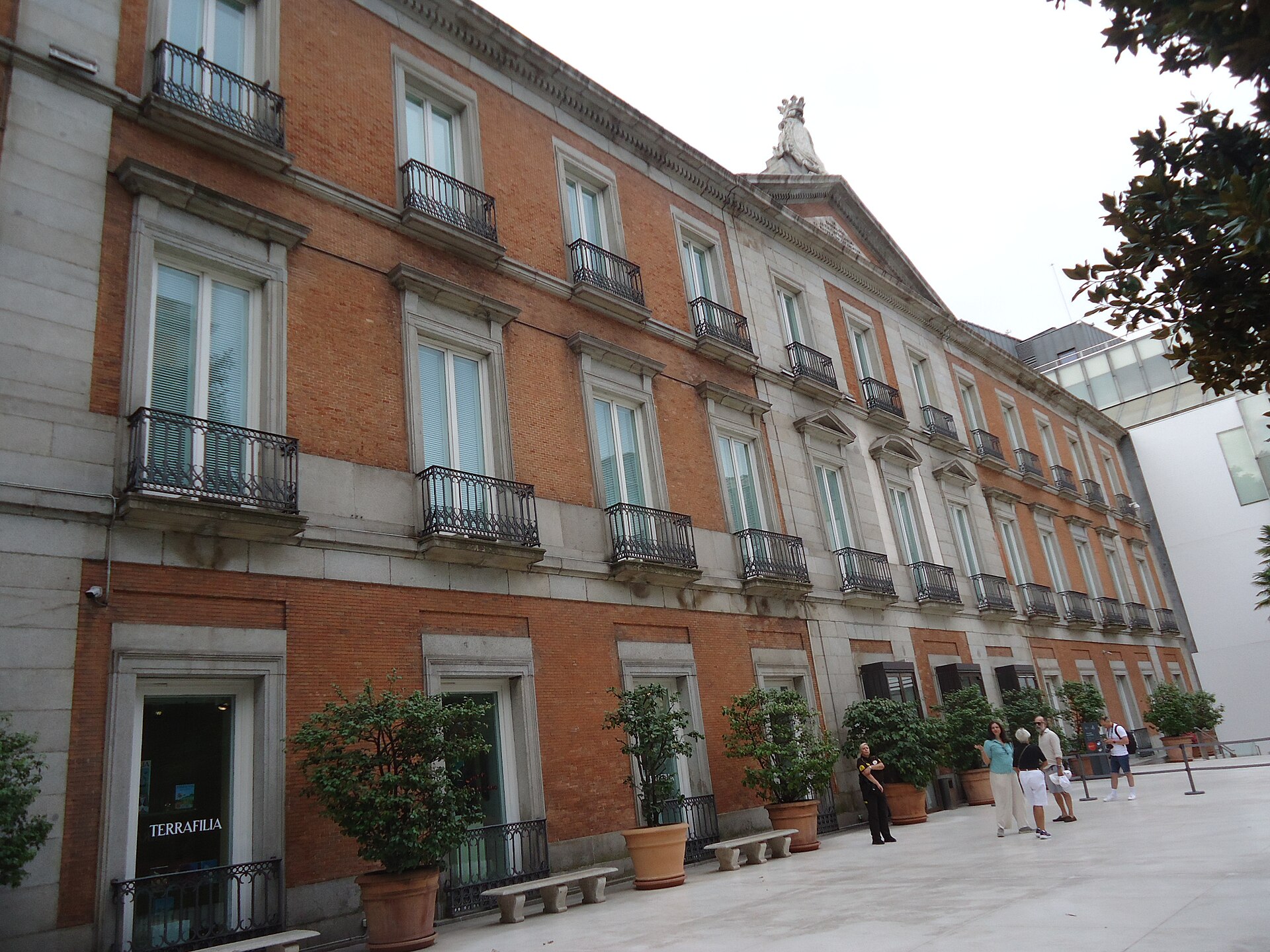
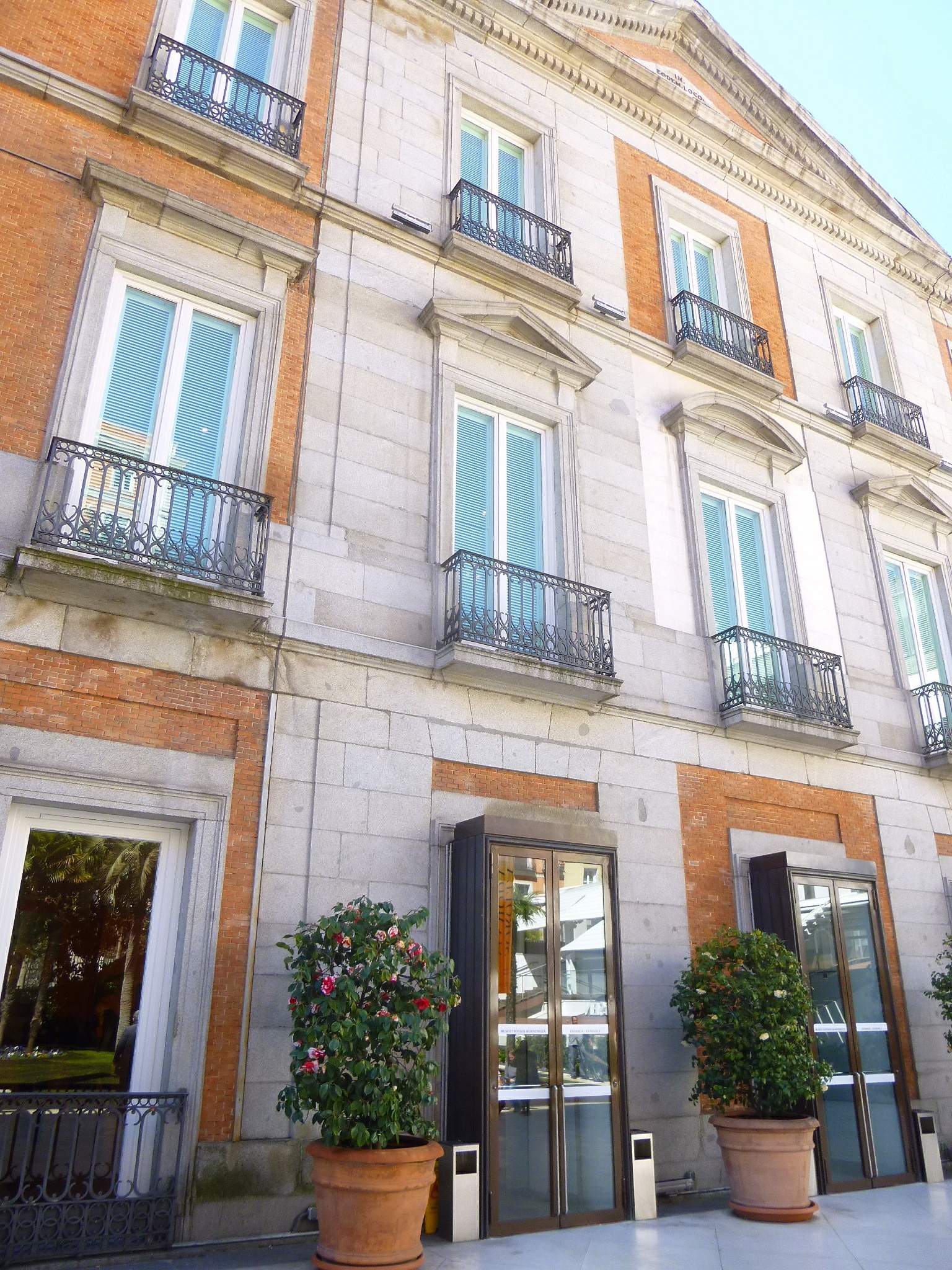
The Villahermosa palace at its Paseo del Prado corner
The neoclassical corner of the Palacio de Villahermosa where the Paseo del Prado meets the Carrera de San Jeronimo, with MUSEO THYSSEN BORNEMISZA lettered above the door and a Jardines Impresionistas exhibition banner hung from the facade.Photograph by Luis García (Zaqarbal) · CC BY-SA 3.0

Around 700 paintings assembled by two generations of one family between the late 1920s and the 1980s, spanning the late 13th to the 20th century in a single continuous chronological hang - Duccio to Pollock and de Kooning under one roof. Its particular strength, by the museum's own account, is coverage that Spain's other state collections do not otherwise have in depth: German and Northern Renaissance portraiture, 17th-century Dutch genre painting, and above all the movements that arrived in Spain only through this collection - Impressionism, Post-Impressionism, German Expressionism, and the American painting of Hopper, O'Keeffe and their contemporaries. Leased alongside it, but legally separate, are the roughly 328 works of the Carmen Thyssen Collection, extending the range with further 19th- and 20th-century painting the Baroness assembled in her own right after 1993.

Visiting

What it costs and when it is openConfirmed 6 August 2026
Admission
  • General EUR 14 Permanent Collection, Carmen Thyssen Collection and any temporary exhibition on at the time
  • Reduced - over 65s and pensioners EUR 10 Valid proof required at the desk or on entry
  • Reduced - students EUR 10
  • Group, 7 or more visitors EUR 12 Per person
  • Free admission by status Free Friends of the Museum; under 18s; the unemployed; visitors with a disability rating of 33% or more
  • Ticket plus audio guide EUR 5.50 Added to the ticket price
  • Ticket plus set menu at the museum restaurant EUR 24.50 Added to the ticket price; Art and Food combination
  • Paseo del Arte joint pass EUR 32.80 One visit each to the Museo Thyssen-Bornemisza, the Museo del Prado and the Museo Reina Sofia within one year of purchase
Free entry: Every Monday, 12.00 to 16.00, free thanks to Mastercard sponsorship - no ticket required. Every Saturday, 21.00 to 23.00, free access to the temporary exhibitions on the ground floor and level -1 as part of 'Thyssen Nights with Uber' - no ticket required. Visitors presenting the 'Soy de la Mutua' Mutua Madrilena member card may collect up to two free same-day tickets at the desk, subject to availability. One companion enters free with a paying visitor any day of the week under conditions set by sponsor Fundacion Mutua Madrilena
Hours
Monday (all year) 12:00 to 16:00 Free entry, Mastercard-sponsored
Tuesday to Friday and Sunday, 1 September to 30 June (winter schedule) 10:00 to 19:00
Tuesday to Friday and Sunday, 1 July to 31 August (summer schedule) 10:00 to 21:00 The schedule in force on the date this record was written
Saturday (all year) 10:00 to 23:00 Free access 21.00-23.00 to the temporary exhibitions on the ground floor and level -1
24 and 31 December 10:00 to 15:00 Reduced hours
Also note
1 January, 1 May and 25 December, closed all day. Last admission is 30 minutes before closing.
Booking
No timed slot for the Permanent Collection or the Carmen Thyssen Collection. A timed slot applies only to the temporary exhibition on the ground floor, which has limited capacity
Address
Paseo del Prado 8, 28014 Madrid, Spain
Getting there
Metro: Banco de Espana station, line 2, is the nearest stop named by the museum
Cercanias (train): Atocha and Recoletos stations, both named by the museum as the nearest
Bus: Lines 1, 2, 5, 9, 10, 14, 15, 20, 27, 34, 37, 41, 51, 52, 53, 74 and 146 and 150
Bicycle: BiciMAD docking station no. 29 at Marques de Cubas 25
Car: The museum names no car park of its own; the nearest public one it points visitors to is Las Cortes
Website
museothyssen.org/en
Telephone
+34 91 791 13 70
Email
[email protected]
How long
About 2 hours 30 minutes by the museum's own estimate; add roughly 50 minutes if also seeing the ground-floor temporary exhibition
Access
Holds AENOR's universal accessibility certificate and a Tourism Quality certificate; a dedicated accessibility phone line and map of accessible spaces are published; only assistance and emotional-support animals are admitted, on presentation of a medical certificate
Photography
Photography and filming are allowed without flash, except where a work is individually marked otherwise - a more permissive rule than the Prado's blanket ban next door
Bags
Not itemised on the pages fetched for this record beyond the general locker and cloakroom service at the entrance
Eating
Restaurant-Cafeteria on site; Monday 12.00-16.00, Tuesday to Sunday 10.00-19.00
Shop
Shop-Bookshop on site; Monday 12.00-16.30, Tuesday to Saturday 10.00-19.30, Sunday 10.00-19.10; a separate online shop also trades

Prices and hours change. We take them from the institution's own pages and print the day we read them, and you can check the current position at the source we used. Confirm before you travel.

What is inside

5 spaces, 3 photographed
  • The terracotta-walled entrance hall, with white marble Rodin sculptures on plinths and a large old-master painting on the end wall
    Photograph by Jean-Pierre Dalbéra · CC BY 2.0

    The entrance hall

    The ground-floor lobby of the Palacio de Villahermosa, terracotta-walled beneath a long glazed skylight, hung with a large Venetian old-master canvas and set with white marble sculptures from the four Rodin groups August Thyssen, the family patriarch, commissioned between 1905 and 1911 - the piece that started the family's habit of collecting, now part of the Carmen Thyssen Collection. A large 1686 view of the Carrera de San Jeronimo and the Paseo del Prado, attributed to Jan van Kessel III and showing this same corner of Madrid before the palace stood on it, also hangs here.

  • A top-lit gallery with terracotta walls hung with small gold-ground Italian panel paintings, a visitor seated on a central bench
    Photograph by Francesco Bini · CC BY-SA 4.0

    The Old Masters galleries, second floor

    Since the museum's 2021 reinstallation the visit begins here: a top-lit run of rooms opening with gold-ground Italian paintings of the 13th and 14th centuries and continuing through the Renaissance, the German and Netherlandish schools, and 17th-century Dutch and Flemish painting - the galleries built around the works Baron Heinrich Thyssen-Bornemisza bought in the 1930s.

  • The modern masters galleries, first floor

    The museum's own account of the 2021 rehang describes the first floor as continuing the visit in reverse chronological order: 18th-century Italian vedutism, French Impressionism and Post-Impressionism, and 20th-century German Expressionism and the avant-garde, ending near the top of the building's date range with Pop Art and American painters such as Hopper and O'Keeffe. No free-licence photograph of this specific floor's galleries was found and verified for this record, so it is described in text only.

  • The Carmen Thyssen Collection, ground floor

    A chronological run from 17th-century Dutch painting to 20th-century art, installed since 2004 in the adjoining Goyeneche and Guaqui palaces with its own entrance off the main hall. It is not part of the 1993 state purchase: it is the Baroness's own collection, leased to the museum rather than owned by it. No free-licence interior photograph of this specific wing was found and verified for this record.

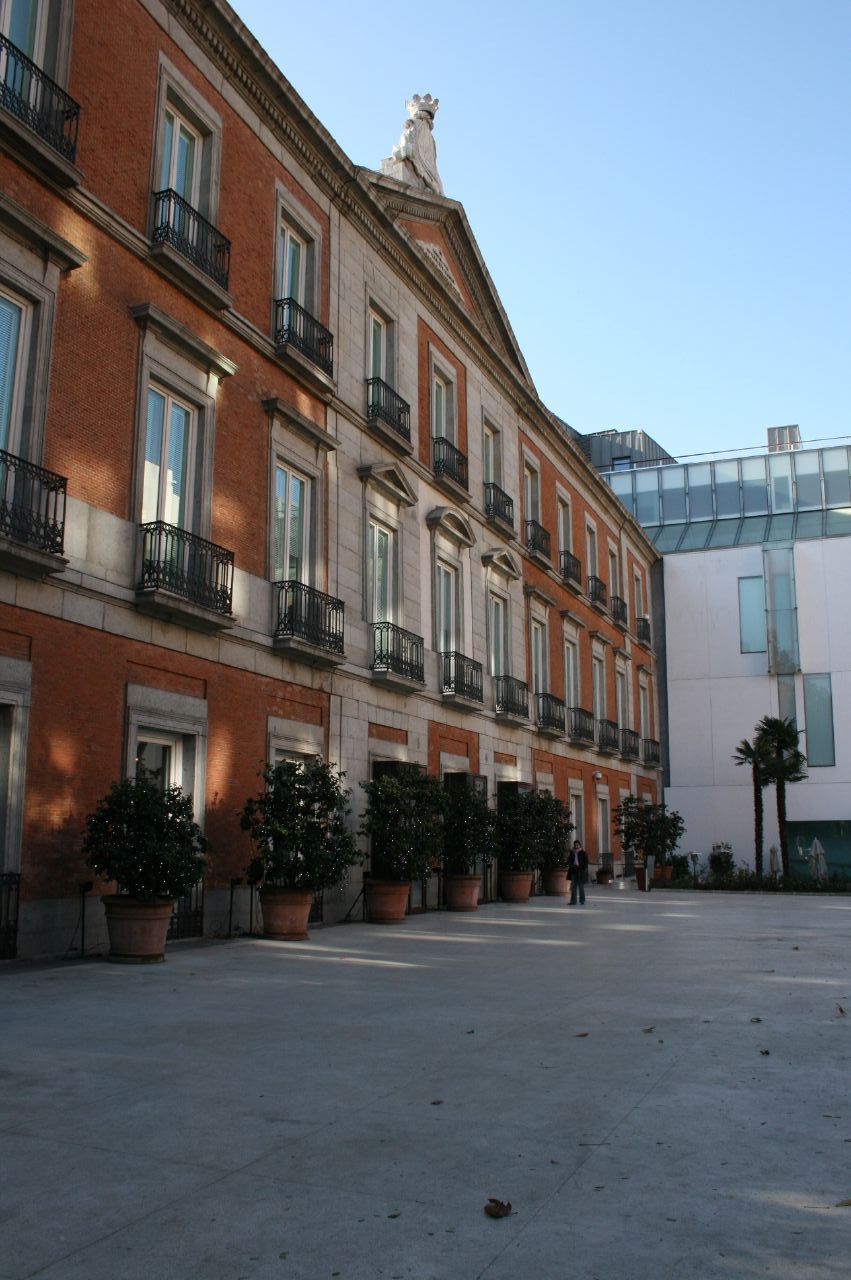
  • The rear courtyard of the palace, its brick and stone facade with a balustraded pediment set against the plain glazed wall of the modern extension behind it
    Photograph by Hywell Martínez · CC BY 2.0

    The courtyard and the Moneo and BOPBAA extensions

    Rafael Moneo's 1989-1992 conversion of the former bank building gave the palace a large central courtyard and reoriented circulation toward the palace's main facade on the Calle Zorrilla; the BOPBAA studio's 2004 addition, absorbing the neighbouring Goyeneche and Guaqui palaces, is visible behind it as a plain glazed volume distinct from the brick and stone of the historic palace.

What to see first

  • Christ and the Samaritan Woman

    Duccio di Buoninsegna, 1310-1311

    The oldest painting in the collection and the work that opens the chronological route through the Old Masters floor; one of the museum's own listed masterpieces.9

  • Portrait of Giovanna degli Albizzi Tornabuoni

    Domenico Ghirlandaio, 1489-1490

    One of the paintings Baron Heinrich Thyssen-Bornemisza bought between 1933 and 1935 while assembling the core Old Master holdings later shown at Villa Favorita, by the museum's own account of the collection's history.6

  • Portrait of Henry VIII of England

    Hans Holbein the Younger, ca. 1537

    Another of the same mid-1930s acquisitions, bought through the Baron's advisor Rudolf J. Heinemann while the Villa Favorita gallery was being built.6

  • Saint Catherine of Alexandria

    Caravaggio, ca. 1598-1599

    The picture the museum itself uses to illustrate the interior of its Old Masters floor, and one of the same 1930s Heinemann-assisted purchases.6

  • The Grand Canal from San Vio, Venice

    Canaletto, ca. 1723-1724

    One of the museum's thirty-two listed masterpieces and the anchor of its 18th-century Venetian vedute holdings.9

  • Franzi in front of Carved Chair

    Ernst Ludwig Kirchner, 1910

    From the German Expressionist purchases Hans Heinrich Thyssen-Bornemisza began making in 1961, mostly through the dealer Roman Norbert Ketterer - the pivot that took the collection from his father's Old Masters into 20th-century art.7

  • Hotel Room

    Edward Hopper, 1931

    One of the museum's own thirty-two listed masterpieces and part of the 19th- and 20th-century American painting the museum states is not found in any other European state collection.9

  • Dream Caused by the Flight of a Bee around a Pomegranate a Second before Waking

    Salvador Dali, 1944

    One of the museum's own listed masterpieces and the best-known Spanish 20th-century picture in the building.9

  • Mata Mua (In Olden Times)

    Paul Gauguin, 1892

    Part of the Carmen Thyssen Collection rather than the 1993 state purchase; the museum's own page on that collection illustrates it as a highlight of what the Baroness leases to the museum rather than what the museum owns outright.10

  • Self-portrait wearing a hat and two chains

    Rembrandt van Rijn, ca. 1642-1643

    One of the museum's thirty-two listed masterpieces, from the Dutch Golden Age holdings on the Old Masters floor.9

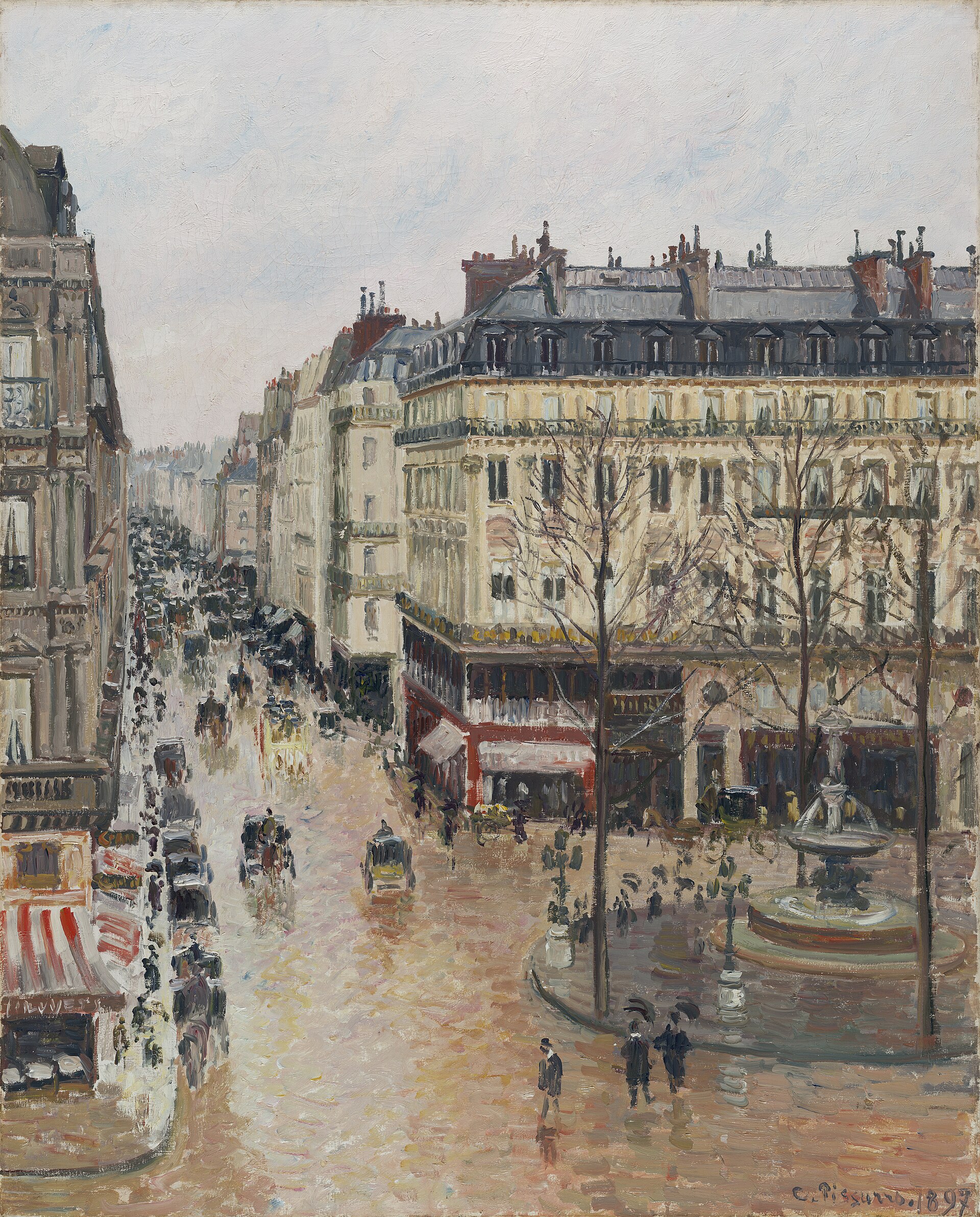
  • Rue Saint-Honore in the Afternoon. Effect of Rain

    Camille Pissarro, 1897

    The subject of Cassirer v. Thyssen-Bornemisza Collection Foundation, the Nazi-looted-art case that has run in the United States federal courts since 2005, reached the Supreme Court twice, and remains undecided - see the narrative below. This archive holds a full record of the painting.15

    Full record in this archive
  • The Annunciation

    Jan van Eyck, 1434-1436

    The earliest of the headline 1933-1935 Heinemann-assisted purchases named in the museum's own account of how the collection was formed. It is not one of the museum's own listed masterpieces: that list has no Van Eyck on it, and its only Annunciation is a separate, later picture by El Greco, ca. 1576.6

A palace built twice, on a corner watched by kings

The site the Museo Nacional Thyssen-Bornemisza now occupies, on the Paseo del Prado at its junction with the Carrera de San Jeronimo, has been prominent since Philip II moved the Spanish court to Madrid permanently in 1561 and ordered the old Prado promenade improved the following year. Aristocratic families took the surrounding plots through the seventeenth century - the Duke of Lerma nearby, the Count of Villalonga on this corner - and after a series of forced sales, inheritances and lawsuits the land passed in 1746 to Leonor Pio de Saboya, Dowager Duchess of Atri, who married the Abbe Alejandro Pico della Mirandola shortly afterwards and with him built a new palace here in the Italian style. On her death in 1760 the mansion passed to her husband the Abbe, who sold it in 1771 to its new owner, Juan Pablo de Azlor-Aragon, Duke of Villahermosa - though the Abbe went on living there another decade at a modest rent. Azlor-Aragon had the first alterations made around 1785, but the palace's present form dates from after his death in 1790, when his widow Maria Manuela Pignatelli commissioned a major rebuilding. The architect Antonio Lopez Aguado, appointed in 1805, gave the building the sober neoclassical facades it still has today; the duchess moved into the new rooms in 1807, only to be forced to abandon them within months when the Peninsular War broke out in 1808 and French troops pillaged the palace.

A large 1686 painting attributed to Jan van Kessel III, showing this same corner of Madrid crossed by a procession of carriages before any of these palaces stood on it, hangs today in the museum's own entrance hall - a small joke of provenance, since the picture predates the building it now furnishes.

From carnival balls to a failed bank, and a near-miss with the Prado next door

After the Peninsular War drained the family's finances, the Villahermosa heirs rented out part of the palace to cover its upkeep, and through the 1840s it hosted some of Madrid's most fashionable carnival balls. It also had a genuine cultural life: the Literary and Artistic Lyceum used the building for years, and Franz Liszt performed there in 1844. During the First World War the former ducal stables on the site were sold off and became the neighbouring Guaqui and Goyeneche palaces - the buildings the museum would absorb nine decades later. After the Spanish Civil War, part of the neoclassical palace was let first to the National Fuel Union and then to a bank, the Banco Comercial Transatlantico; in 1971 the whole building was bought by another bank, the Banca Lopez Quesada, which commissioned a full refurbishment from the architect Fernando Moreno Barbera. That bank went bankrupt a few years later, and the palace passed into Spanish state ownership. The state's first plan was to use it as an extension of the Museo Nacional del Prado across the street. Instead, it was offered to Baron Hans Heinrich Thyssen-Bornemisza for his collection.

Rafael Moneo carried out the conversion between 1989 and 1992, reorienting the building's circulation toward its main facade on the Calle Zorrilla and giving it a large central courtyard around which the picture galleries run - keeping the palatial character of the rooms while fitting them for museum use. The limited size of even this enlarged building, and the need to house the Carmen Thyssen Collection once a loan agreement was signed with the Baroness in 1999, drove a further extension: the BOPBAA architects' studio converted the adjoining Goyeneche and Guaqui palaces into museum space, completed in 2004.

Two generations of one family's eye, and a Baroness's persuasion

The habit of collecting in this family began with August Thyssen, who built the German steel business the Thyssen fortune rests on and who commissioned seven sculptural groups from Auguste Rodin between 1905 and 1911; four of the marbles still greet visitors in the museum's entrance hall today. His son Heinrich, who took a chemistry doctorate at Heidelberg and adopted the Bornemisza name on his 1906 marriage into a Hungarian baronial family, made his first serious purchases only after his father's death in the late 1920s, aiming - by the museum's own account - to build a collection as broad as those of the great German museums, Munich's Alte Pinakothek above all. A first public showing at Munich's Neue Pinakothek in July 1930, under the name the Rohoncz Castle Collection, drew criticism over a handful of doubtful attributions, which the Baron then sold. He bought the Villa Favorita in Lugano in 1932 and built a private gallery there, and between 1933 and 1935, working with his advisor Rudolf J. Heinemann, assembled the run of purchases that still anchors the Old Masters floor today: Van Eyck's Annunciation, Carpaccio's Young Knight in a Landscape, Frans Hals's Family Group in a Landscape, Caravaggio's Saint Catherine of Alexandria, Durer's Jesus among the Doctors, Holbein's Portrait of Henry VIII, and Ghirlandaio's Portrait of Giovanna degli Albizzi Tornabuoni among them. The Villa Favorita gallery opened in September 1936, but only to the Baron's own guests.

His son Hans Heinrich inherited most of the collection and fortune on Heinrich's death in 1947, opened the Villa Favorita gallery to the public, and spent years buying back pictures his siblings had put up for auction. Guided at first by his father's taste in Old Masters, he turned to modern art only in 1961, prompted by collector friends such as Stavros Niarchos and David Rockefeller, buying German Expressionist paintings - Heckel, Kirchner, Pechstein, Nolde, Schmidt-Rottluff - mostly through the dealer Roman Norbert Ketterer, and then extending into twentieth-century avant-garde movements through the 1980s. By the 1980s the Villa Favorita could no longer hold or show the whole collection, and the Baron sought a bigger, permanent home, weighing offers from the United Kingdom, the Getty Foundation and several German cities. It was, by the museum's own account, the influence of his fifth wife, the Spanish former beauty queen Carmen Cervera, that decided him on Spain. In 1988 the Baron and the Spanish state signed a contract loaning 775 works with a view to their eventual sale; a foundation was created to run the collection, and Rafael Moneo was commissioned to convert the Villahermosa palace to receive it. The Museo Thyssen-Bornemisza opened to the public on 8 October 1992, and on 21 June 1993 - barely eight months later - the loaned works were formally sold to the Spanish state for 350 million dollars.

Held here under litigation: the Cassirer Pissarro

One of this archive's own held records, Camille Pissarro's Rue Saint-Honore in the Afternoon. Effect of Rain (1897), is on display in this building and is also, as this page is written, the subject of the longest-running Nazi-looted-art claim still active in the United States federal courts. In 1939 Lilly Cassirer Neubauer, fleeing Berlin, was forced to hand the painting to a Nazi-appointed art appraiser for 900 Reichsmarks she was never allowed to collect, in order to obtain her family's exit visas. In 1958 the West German government paid her 120,000 Deutschmarks in postwar restitution for the loss - compensation she accepted without waiving her family's right to recover the painting itself, should it ever surface. It did: sold on through a Beverly Hills dealer in 1951 and a Missouri dealer in 1952, the picture was bought in New York in 1976 by Baron Hans Heinrich Thyssen-Bornemisza, whose collection - the painting among it - was acquired by Spain in 1993.

Lilly's grandson Claude Cassirer found the painting on display in Madrid in 2000, petitioned the Spanish state for its return in 2001, was refused, and sued in the United States in 2005. The case reached the Supreme Court twice. The first decision, unanimous and written by Justice Elena Kagan in April 2022, settled only which jurisdiction's choice-of-law rules a federal court must apply when a foreign state is sued, and sent the case back to the Ninth Circuit. On remand, the Ninth Circuit ruled in January 2024 that Spanish law governed and that the foundation had acquired good title by adverse possession, since it had held the painting publicly and, the court found, without actual knowledge of the theft, for years before the claim was filed - a result Circuit Judge Consuelo Callahan, concurring, said Spain should have avoided by returning the painting voluntarily, even as she agreed the law compelled the opposite outcome. A district judge had made much the same point in 2019, finding for the museum on the law while criticising Spain's refusal to honour the 1998 Washington Principles on Nazi-Confiscated Art, which Spain itself had signed.

The Cassirers' request for rehearing was denied. California then changed the rules under them: Assembly Bill 2867, signed by Governor Gavin Newsom on 16 September 2024, requires California courts to apply California property law - under which a thief cannot pass good title to a later buyer - to claims over Holocaust-looted art, and applies retroactively to cases still open on appeal. On 10 March 2025 the Supreme Court granted, vacated and remanded the Ninth Circuit's January 2024 judgment for reconsideration under the new statute. The foundation's lawyer, Thaddeus Stauber, told The Art Newspaper the statute was an unconstitutional, retroactive, extraterritorial reach into a dispute whose history and location are European, and noted Germany had already compensated Lilly Cassirer Neubauer. The Cassirer family's lawyers called the reversal grounds for confidence that, after twenty years, the case would finally end in the painting's return. The Ninth Circuit remanded the case to the district court on 30 April 2025, and on 17 November 2025 California's Attorney General, Rob Bonta, filed a motion to intervene in the case - now pending in the United States District Court for the Central District of California - specifically to defend AB 2867 against the constitutional challenge Stauber had signalled. No court had ruled on the merits under the new statute as this page was written. The painting has not moved; it remains on public display in Madrid, exactly where it has hung since 1992.

Free for twenty-two years, now on a state-paid lease: the Carmen Thyssen Collection

Carmen Cervera married Hans Heinrich Thyssen-Bornemisza in 1985 and began building a collection of her own, distinct from the family holdings the Spanish state bought in 1993. It was shown publicly for the first time in 1996, in an exhibition at this museum titled From Canaletto to Kandinsky, and then toured internationally - China, Japan, Mexico, Switzerland, Belgium, Germany and several Spanish cities among the stops - before settling into the 2004 extension. From 1999 the Baroness lent it to the museum without charge. That arrangement grew strained after her husband's death in 2002 left her, by her own account, bearing the cost of keeping the collection in Spain while receiving nothing for it; in 2015 she delayed renewing the loan while weighing paid offers to move the collection temporarily to Barcelona, the United States or Russia, before deciding to keep it in Madrid. In 2017 the loan lapsed again, and prolonged negotiation with the Spanish Ministry of Culture followed. It ended in June 2021 with a 15-year lease, running from February 2022, at an annual rent of 6.5 million euros adjusted each year to inflation, with an option for the state to buy the collection outright when the lease ends, and a separate commitment to help open a future Thyssen museum in Sant Feliu de Guixols on the Costa Brava. The Baroness told the Spanish press at the time that thirteen years of lending the collection for nothing had become untenable for her personally. The museum's own history page compresses this two-decade dispute into a single sentence about the change from loan to lease; the public record built up in the Spanish and international press is considerably more contentious than that sentence lets on.

A museum built to be finished, on the third corner of a UNESCO landscape

The museum reorganised its permanent display in 2021, restricting it to the top two floors and giving it, for the first time, a single continuous route: the second floor holds the Old Masters in chronological order from the Duccio onward, and the first floor continues in reverse chronological order through the eighteenth to the twentieth century, ending near Pop Art. The ground floor, with its own entrance off the main hall, now belongs to the Carmen Thyssen Collection and the temporary exhibition programme. Set against its two larger neighbours on the same street, the museum trades encyclopaedic range for compactness: about two and a half hours, by its own estimate, to see a chronological run that the Prado and the Reina Sofia between them need two separate buildings and two separate stories to cover, and - alone among the three - no timed-entry requirement for its permanent collection and no blanket ban on photography in the galleries.

On 25 July 2021 UNESCO inscribed the Paseo del Prado and the Buen Retiro gardens as a World Heritage Site under the name Paseo del Prado y Buen Retiro, Paisaje de las Artes y las Ciencias - a designation that names the wider Enlightenment-era landscape the Prado, the Reina Sofia and this museum all sit inside, rather than any one of the three institutions individually. The Museo Nacional Thyssen-Bornemisza is the youngest and smallest of Madrid's Golden Triangle, built from a single family's purchases rather than three centuries of royal or state acquisition, and its own directors have made a point on the museum's public pages of naming, rather than smoothing over, both what that origin gave the collection and what it still costs the Spanish state to keep whole.

What visitors say

We publish no visitor review prose and treat any platform score as a cited tertiary datum only, so what follows draws on the museum's own published figures, its own framing of the collection, and named journalism. Visitors and guidebooks consistently set the museum against its two larger neighbours on the same street: a single continuous chronological hang of thirteenth- to twentieth-century painting that can be walked in one visit, with no timed-entry requirement for the permanent collection and, unlike the Prado next door, a photography policy that allows non-flash pictures in the galleries. The institution is also, on its own telling, unusually candid: it names the Nazi-era theft behind one of its best-known pictures on its own catalogue page rather than leaving the fact to litigation documents, and it has published, without being compelled to, the terms on which it now pays the Baroness Carmen Thyssen-Bornemisza to keep her collection in the building the public spent two decades seeing for free.

Consistently

  • Praised: the size and pace of a visit: about two and a half hours to see the collection the museum itself calls a comprehensive overview of seven centuries of Western art, without the crowd pressure or timed-ticket requirement of the Prado a few hundred metres away
  • Praised: the breadth of movements represented that are otherwise thin in Spain's state collections - Impressionism, German Expressionism, and nineteenth-century American painting among them, on the museum's own account of its holdings
  • Praised: a more permissive photography policy than its Prado neighbour: non-flash photography is allowed throughout the galleries rather than banned outright
  • Praised: free admission on Monday afternoons and Saturday nights, both sponsor-funded and requiring no advance ticket
  • Criticised: the Thyssen-Bornemisza Collection Foundation continues to hold a painting it does not dispute was taken from Lilly Cassirer Neubauer by the Nazi regime in 1939, and has not returned it despite Spain's own signature on the 1998 Washington Principles on Nazi-Confiscated Art; a US district judge said as much in a 2019 ruling that nonetheless found the museum the legal owner under Spanish law, and a Ninth Circuit judge repeated the point in a 2024 concurrence that called on Spain to relinquish the picture voluntarily even while ruling that the law did not require it
  • Criticised: the Carmen Thyssen Collection, on public display in the building since 1996 and lent free of charge from 1999, now costs the Spanish state EUR 6.5 million a year under a 15-year lease finalised in 2021 after the Baroness twice threatened to move the collection out of the country over money - a governance history the museum's own foundation page summarises only briefly
Reported the Supreme Court's 10 March 2025 order vacating the Ninth Circuit's January 2024 judgment for reconsideration under California's new AB 2867, and set out on the record the opposing positions of the foundation's lawyer, who called the statute an unconstitutional retroactive and extraterritorial imposition on a European dispute, and the Cassirer family's lawyers, who welcomed the reversal after twenty years of litigation.The Art Newspaper, Martha Lufkin, 18 March 2025 [15]
Reported the 2019 district court ruling that the museum was the painting's legal owner under Spanish law, while recording that the judge found the museum should have recognised 'red flags' over the picture's history when the Baron bought it in 1976, and criticised Spain for not honouring the Washington Principles it had signed; also carried the museum's own on-the-record response welcoming the ruling.Museums Journal (Museums Association), Eleanor Mills, 8 May 2019 [17]
Reported the Ninth Circuit's January 2024 ruling for the foundation and Circuit Judge Consuelo Callahan's concurrence, which said Spain should have voluntarily relinquished the painting as a mark of its stated commitment to returning Nazi-looted art, even though the law compelled a different result.ArtDependence, unsigned, 7 August 2026 [18]
Reported the Spanish Ministry of Culture finalising the 15-year, EUR 6.5 million-a-year lease for the Carmen Thyssen Collection, and quoted the Baroness on the record describing thirteen years of lending the collection without payment as unsustainable for her.ARTnews, Shanti Escalante-De Mattei, 29 June 2021 [19]

Aggregate ratings, tertiary

TripAdvisor: 4.6 from 17,072 ratings, read 6 August 2026
A platform average is a tertiary source: it moves, it is not audited, and we quote no visitor's words.

Open questions

  • Cassirer v. Thyssen-Bornemisza Collection Foundation remains undecided: no court has yet ruled on the merits under California's AB 2867, which the Ninth Circuit was directed to apply on 10 March 2025 and which California's Attorney General moved to defend on 17 November 2025. The painting's title is not settled.
  • Whether the constitutional challenge to AB 2867 signalled by the foundation's lawyer, Thaddeus Stauber, has actually been filed and argued in the District Court for the Central District of California was not established in the sources fetched for this record.
  • Whether the future Thyssen museum in Sant Feliu de Guixols, promised as part of the 2021 Carmen Thyssen lease settlement, has since opened, broken ground, or been abandoned was not established in the sources fetched for this record.
  • The current room numbering for individual paintings after the 2021 reinstallation was not independently verified against a source in this file; this archive's own record of the Pissarro cites room 33 as of 4 August 2026, a fact carried from that record rather than confirmed here.

Images

3 plates
The garden entrance
The garden entranceA flagpole reading MUSEO THYSSEN-BORNEMISZA above the palm garden at the museum's side entrance, with the Palace Hotel visible beyond.CC0
The Paseo del Prado facade
The Paseo del Prado facadeThe long brick and stone flank of the palace along the Paseo del Prado, hung with banners for the museum's Modigliani exhibition; the PASEO DEL PRADO street sign is visible at lower left.Photograph by Adal-Honduras · CC BY 2.0
Bust of Baron Hans Heinrich Thyssen-Bornemisza
Bust of Baron Hans Heinrich Thyssen-BornemiszaA bronze portrait bust of the Baron, inscribed with his name, standing among palms in the museum's garden.CC0

Sources

  1. 1Museo Nacional Thyssen-Bornemisza, Opening hours and prices: the winter and summer schedules, admission tiers, free-admission windows, closing days, and visit-duration FAQ. Fetched 6 August 2026; the page displayed the museum as open that day from 10.00 to 21.00. museothyssen.org/en/visit/opening-hours-prices
  2. 2Museo Nacional Thyssen-Bornemisza, Contact: departmental phone numbers and emails including the visitor information and ticketing line, the general switchboard, and the restaurant and shop hours; the 'Getting here' transport panel embedded on the same page. museothyssen.org/en/contact
  3. 3Museo Nacional Thyssen-Bornemisza, The Thyssen-Bornemisza Collection Foundation: its 1988 creation, governance by a twelve-member board of trustees, and the 1993 state purchase and 2004/2022 Carmen Thyssen Collection arrangements. museothyssen.org/en/about-us/history/foundation
  4. 4Museo Nacional Thyssen-Bornemisza, History of the building - Introduction: the site's ownership chain from Pedro Franqueza through the Villahermosa dukes, the 1805-1807 rebuilding, the Peninsular War, the Lyceum and Liszt, the 20th-century bank tenancies, the state's initial plan to extend the Prado here, Rafael Moneo's 1989-1992 conversion, and the 2004 BOPBAA extension. museothyssen.org/en/about-us/history-building/introduction
  5. 5Museo Nacional Thyssen-Bornemisza, History of the building I - The site until the middle of the 18th century: the sixteenth- and seventeenth-century ownership of the plot, and the 1686 Jan van Kessel III painting of the site now in the museum's own lobby. museothyssen.org/en/about-us/history-building/site-until-middle-18th-century
  6. 6Museo Nacional Thyssen-Bornemisza, History of the Collection I: August Thyssen's Rodin commissions, Heinrich Thyssen-Bornemisza's biography and 1930 Munich showing, the 1932 Villa Favorita purchase, and the 1933-1935 acquisitions of the Van Eyck, Carpaccio, Hals, Caravaggio, Durer, Holbein and Ghirlandaio paintings. museothyssen.org/en/collection/history-collection-I
  7. 7Museo Nacional Thyssen-Bornemisza, History of the Collection II: Hans Heinrich Thyssen-Bornemisza's inheritance and rebuilding of the collection, his 1961 turn to German Expressionism and modern art, the 1988 loan contract, the October 1992 opening, and the June 1993 sale to the Spanish state for 350 million dollars. museothyssen.org/en/collection/history-collection-I/II
  8. 8Museo Nacional Thyssen-Bornemisza, Permanent collection: the roughly 700-work count, the 2021 reinstallation onto the second and first floors, and the chronological and reverse-chronological hang. museothyssen.org/en/collection/permanent-collection
  9. 9Museo Nacional Thyssen-Bornemisza, Masterpieces: the museum's own list of thirty-two works it names as its defining highlights, with maker and date for each; work count verified by counting the page's unique linked-artwork entries at fetch time. museothyssen.org/en/collection/masterpieces
  10. 10Museo Nacional Thyssen-Bornemisza, Carmen Thyssen Collection: the 2021 lease terms (15 years, EUR 6.5 million a year), the collection's 1996 debut exhibition and international tour, its 2004 installation, and Mata Mua illustrated as a highlight of the loan. museothyssen.org/en/collection/carmen-thyssen
  11. 11Museo Nacional Thyssen-Bornemisza, Getting here: metro, bicycle, train, bus and car access. museothyssen.org/en/visit/get-museum
  12. 12Museo Nacional Thyssen-Bornemisza, Accessibility and quality: the AENOR universal accessibility certificate, the accessibility phone line, and the animal-admission policy. museothyssen.org/en/visit/accessibility
  13. 13Museo Nacional Thyssen-Bornemisza, homepage: the Paseo del Prado 8, 28014 Madrid address as printed in the page footer. museothyssen.org/en
  14. 14Wikidata, Museo Nacional Thyssen-Bornemisza / Thyssen-Bornemisza Museum (Q176251): instance-of art museum and museum, country Spain, located in Madrid, coordinates 40.416041/-3.694925, official website museothyssen.org, inception 1992; used as the machine identity and cross-checked against the museum's own site. wikidata.org/wiki/Q176251
  15. 15The Art Newspaper, Martha Lufkin, 'US Supreme Court reopens lawsuit over Nazi-looted Pissarro painting', 18 March 2025: the 10 March 2025 grant-vacate-remand order, the foundation lawyer Thaddeus Stauber's on-the-record position, the Cassirer family lawyers' joint statement, and the painting's ownership chain from 1939 to 1993. theartnewspaper.com/2025/03/18/us-supreme-court-revives-nazi-loot-pissarro-claim
  16. 16California Department of Justice, Office of the Attorney General, press release 'Attorney General Bonta Steps Up to Defend California Law Helping Holocaust Survivors Recover Stolen Art', 17 November 2025: the motion to intervene filed that day in the U.S. District Court for the Central District of California, and the case's procedural history from the 2005 filing through the 2022 and 2025 Supreme Court actions. The release states only that the Cassirer family 'later received monetary compensation' from the German government - no year, currency or figure; the 1958 payment of 120,000 Deutschmarks is sourced at n=17. oag.ca.gov/news/press-releases/attorney-general-bonta-steps-defend-california-law-helping-holocaust-survivors
  17. 17Museums Journal (Museums Association), Eleanor Mills, 'Court rules museum legally owns Nazi-looted artwork', 8 May 2019: the 2019 district court ruling, the judge's criticism of Spain's non-compliance with the Washington Principles, the museum's own on-the-record response from managing director Evelio Acevedo, and the 1958 West German federal government restitution payment of 120,000 Deutschmarks to Lilly Cassirer Neubauer. museumsassociation.org/museums-journal/news/2019/05/08052019-pissarro-thyssen-bornemisza-museum/
  18. 18ArtDependence, 'Madrid's Thyssen-Bornemisza Museum may keep Pissarro Painting looted by Nazis' (report on the Ninth Circuit's January 2024 ruling): Circuit Judge Consuelo Callahan's concurrence calling on Spain to relinquish the painting voluntarily, and the painting's 1993 acquisition by the Spanish state. The article does not mention 1976; that purchase date is sourced at n=15 and n=17. artdependence.com/articles/madrids-thyssen-bornemisza-museum-may-keep-pissarro-painting-looted-by-nazis/
  19. 19ARTnews, Shanti Escalante-De Mattei, 'Spain Finalizes Agreement to Pay to Keep Baroness Thyssen's Collection in Madrid', 29 June 2021: the finalised 15-year, EUR 6.5 million-a-year lease, the Baroness's on-the-record account of thirteen unpaid years of lending the collection, the 2015 threat to move it abroad, and the 2017 lapse. artnews.com/art-news/news/baroness-thyssen-collection-deal-1234597239/
  20. 20La Moncloa (Government of Spain), 'UNESCO declares El Paseo del Prado and El Buen Retiro in Madrid a World Heritage Site', 25 July 2021: the inscription of 'Paseo del Prado y Buen Retiro, Paisaje de las Artes y las Ciencias' on the World Heritage List that day. lamoncloa.gob.es/lang/en/gobierno/news/Paginas/2021/20210725_unesco.aspx
  21. 21TripAdvisor, Museo Nacional Thyssen-Bornemisza listing: aggregate rating 4.6 of 5 from 17,072 reviews, ranked second of 1,594 things to do in Madrid, read 6 August 2026. tripadvisor.com/Attraction_Review-g187514-d198867-Reviews-Museo_Nacional_Thyssen_Bornemisza-Madrid.html
  22. 22Wikimedia Commons, Category:Villahermosa Palace, Madrid and Category:Museo Thyssen-Bornemisza and their subcategories: the plates used on this page, each licence verified per file at fetch time from extmetadata.LicenseShortName. commons.wikimedia.org/wiki/Category:Villahermosa_Palace,_Madrid
  23. 23Government of California, Office of Governor Gavin Newsom, 'Governor Newsom signs legislation to help Holocaust survivors recover art stolen by the Nazis', 16 September 2024: the Governor's signing of Assembly Bill 2867 that day at the Holocaust Museum LA, with Assemblymember Jesse Gabriel and the Cassirer family in attendance. gov.ca.gov/2024/09/16/governor-newsom-signs-legislation-to-help-holocaust-survivors-recover-art-stolen-by-the-nazis/
  24. 24CourtListener/RECAP, U.S. Court of Appeals for the Ninth Circuit docket No. 19-55616, David Cassirer et al. v. Thyssen-Bornemisza Collection Foundation: docket entry of 30 April 2025 granting the Cassirer plaintiffs' motion to remand the case to the district court for proceedings consistent with the Supreme Court's 10 March 2025 opinion; docket shows 'Date Terminated: April 30, 2025'. courtlistener.com/docket/66631148/david-cassirer-v-thyssen-bornemisza-collection/
Last verified 7 August 2026Open, confirmed 6 August 2026Wikidata Q176251