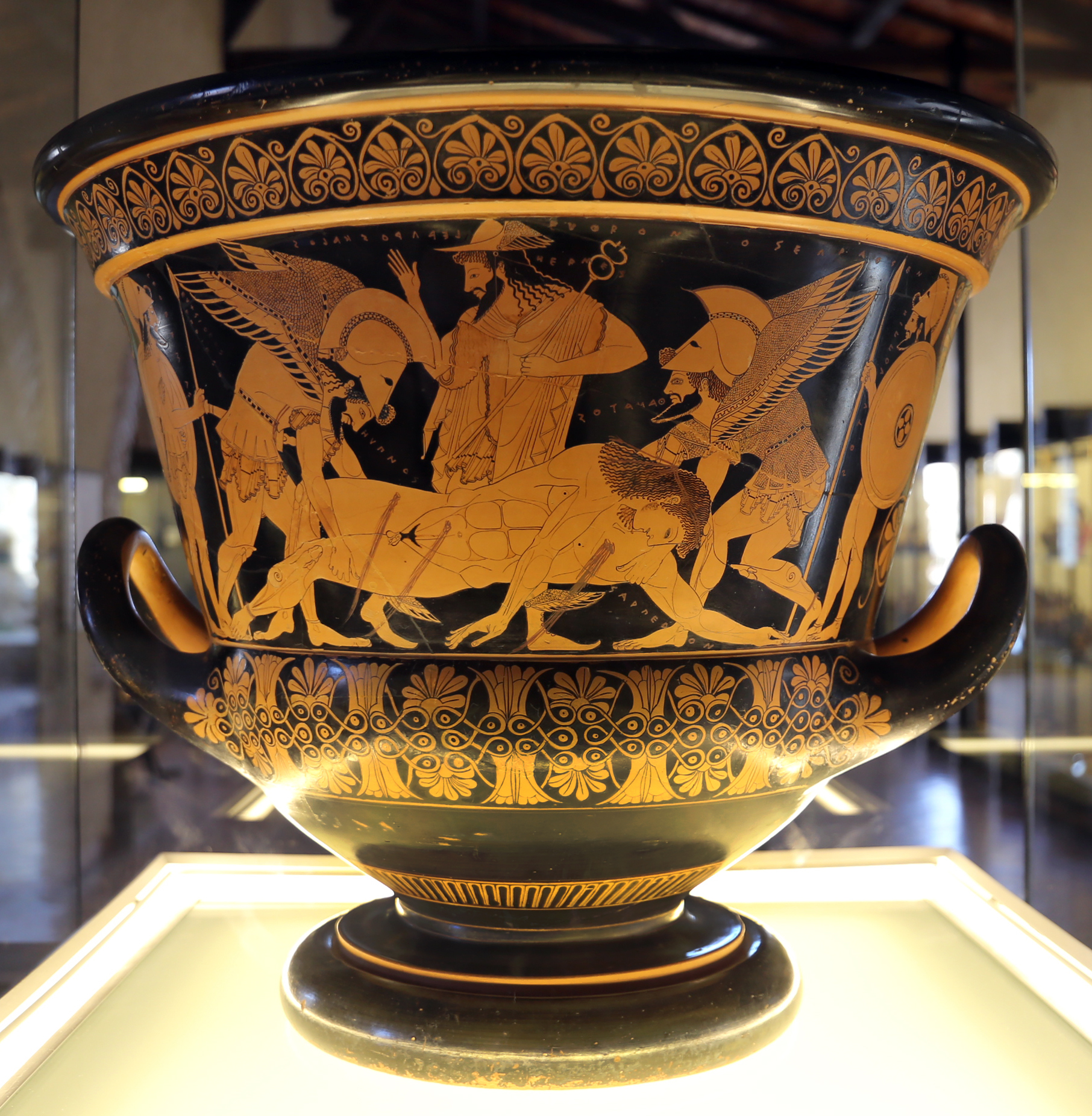
The Euphronios Krater
c. 515 BC · Terracotta
Museo Archeologico Nazionale Cerite
 Athenian · active 520 BC-470 BC
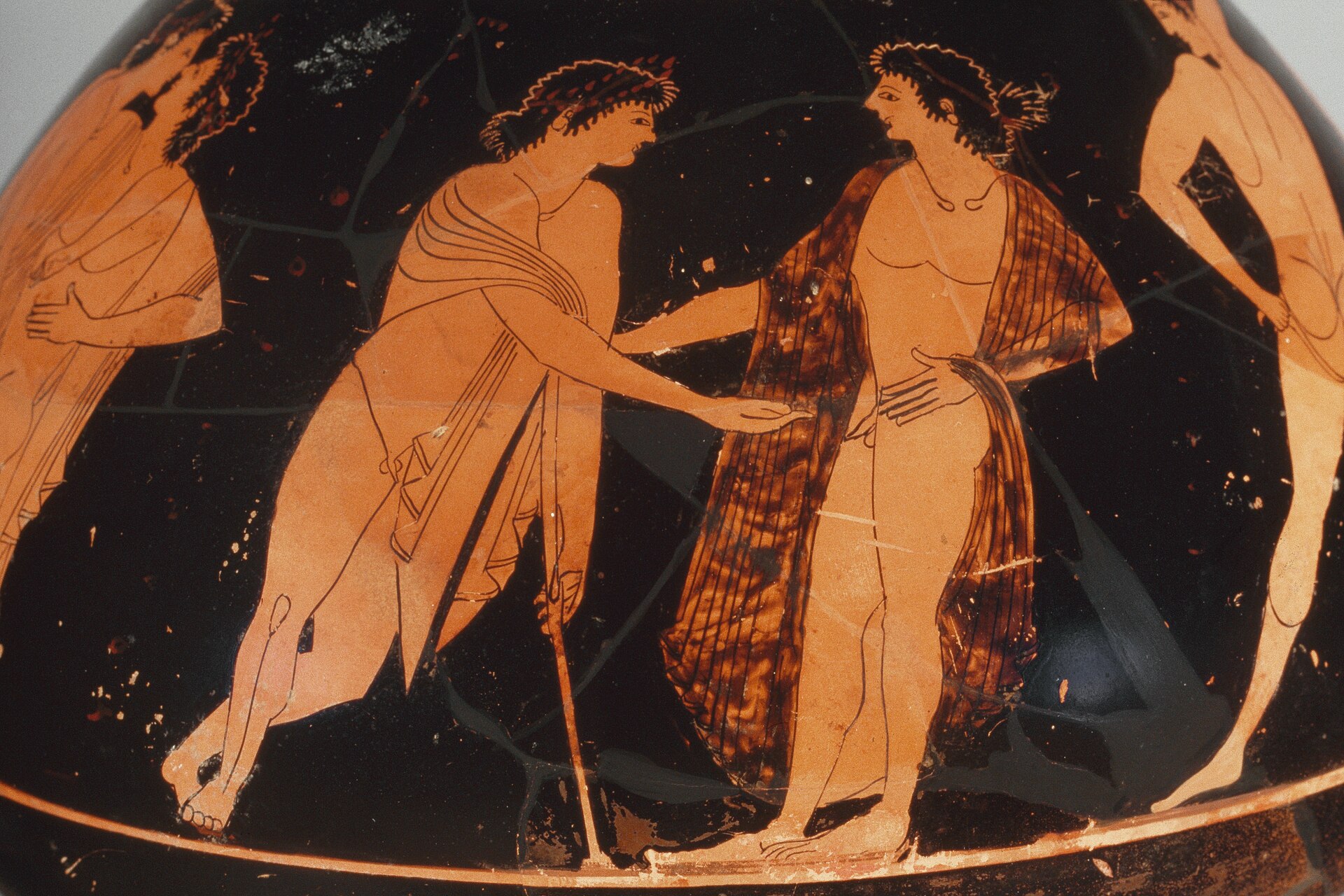
There is no portrait of Euphronios. No likeness of him was made, none survives, and none ever will. What is shown instead is the only surviving ancient image that carries his name as a person rather than as a maker: the courtship group on an Attic psykter of about 510 BC attributed to Smikros, J. Paul Getty Museum 82.AE.53, on which the draped youth reaching for the boy's chin is labelled EUPHRONIOS and the acclamation LEAGROS KALOS is inscribed nearby. This is not a likeness. Guy Hedreen has argued that Smikros is a fiction invented by Euphronios himself, in which case the picture is a craftsman writing himself into an aristocratic scene he could not have entered; the Getty's own commentary calls it surprising and suggests it may be a fantasy or a joke. Recorded provenance begins in 1972 with the Geneva dealer Nicolas Koutoulakis and ends with his donation to the museum in 1982.
The J. Paul Getty Museum, Los Angeles (82.AE.53)| Full name | Euphronios of Athens. No patronymic and no deme are recorded, so there is no fuller form of the name. |
|---|---|
| Worked as | Vase painter, Potter, Workshop proprietor |
| Born | c. 535 BC, inferred from the vases and not recorded anywhere · Athens, assumed rather than documented |
| Died | after c. 470 BC, the latest date given to a vase he potted · Unknown |
| Nationality | Athenian |
| Movement | Attic red-figure |
| In this archive | 1 artwork |
| Sources | 33 cited |
| Last verified | 17 September 2026 |
About this page 1 artwork in the archive · Last verified 17 September 2026 · 33 sources cited
No ancient author mentions Euphronios. Greek writing on the arts is copious and it is about sculptors and panel painters; the Kerameikos, the potters' quarter where the whole surviving corpus of Athenian figured pottery was made, is passed over in silence. Everything known about this man has therefore been reconstructed from the pots themselves, and the reconstruction only became possible in the nineteenth century, when scholars worked out that the names painted on Greek vases were the names of the people who made them.
What makes him worth a page rather than a paragraph is that he signed, and that he signed with two different verbs. Egraphsen means he drew or painted it. Epoiesen means he made it, which in the Athenian trade means he threw and fired the vessel. Both appear on vases bearing his name, at different points in his life, and the shift between them is the only career change documented for any Greek craftsman of the archaic period. It is also the single most misread thing in the field, because a large modern literature has argued that epoiesen does not mean what it appears to mean at all.
The site has until now labelled him Euphronios, painter; Euxitheos, potter, because the New York calyx-krater carries both signatures. That label describes an object correctly and a person incorrectly. Euphronios and Euxitheos were two men in two trades who collaborated on at least three surviving vases. This page is about Euphronios. It covers Euxitheos properly, as the potter he was, and it recommends that the two be separated in the record.
He is also, by a distance, the maker whose name does the most work in a due-diligence file. One vase he painted forced the Metropolitan Museum of Art to hand back title to a foreign government and rewrote the rules under which American museums buy antiquities. It is not the only piece of his with a hole in the ground where its findspot should be. At least five separate Euphronios objects have been the subject of a restitution, a seizure, a repatriation or an unresolved question about how they left Italy, and the Beazley Archive still lists one of them in a collection that gave it back sixteen years ago.
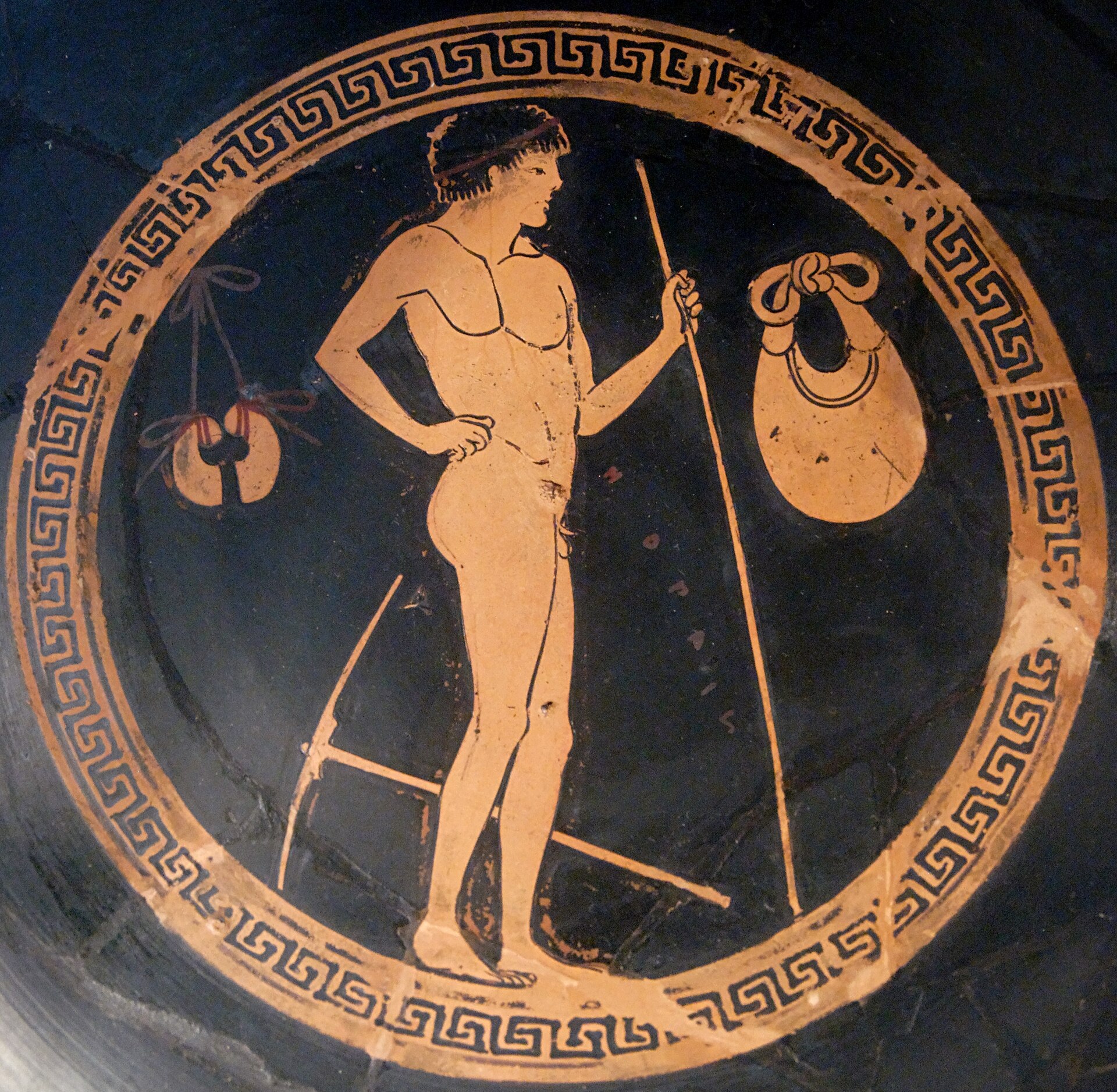
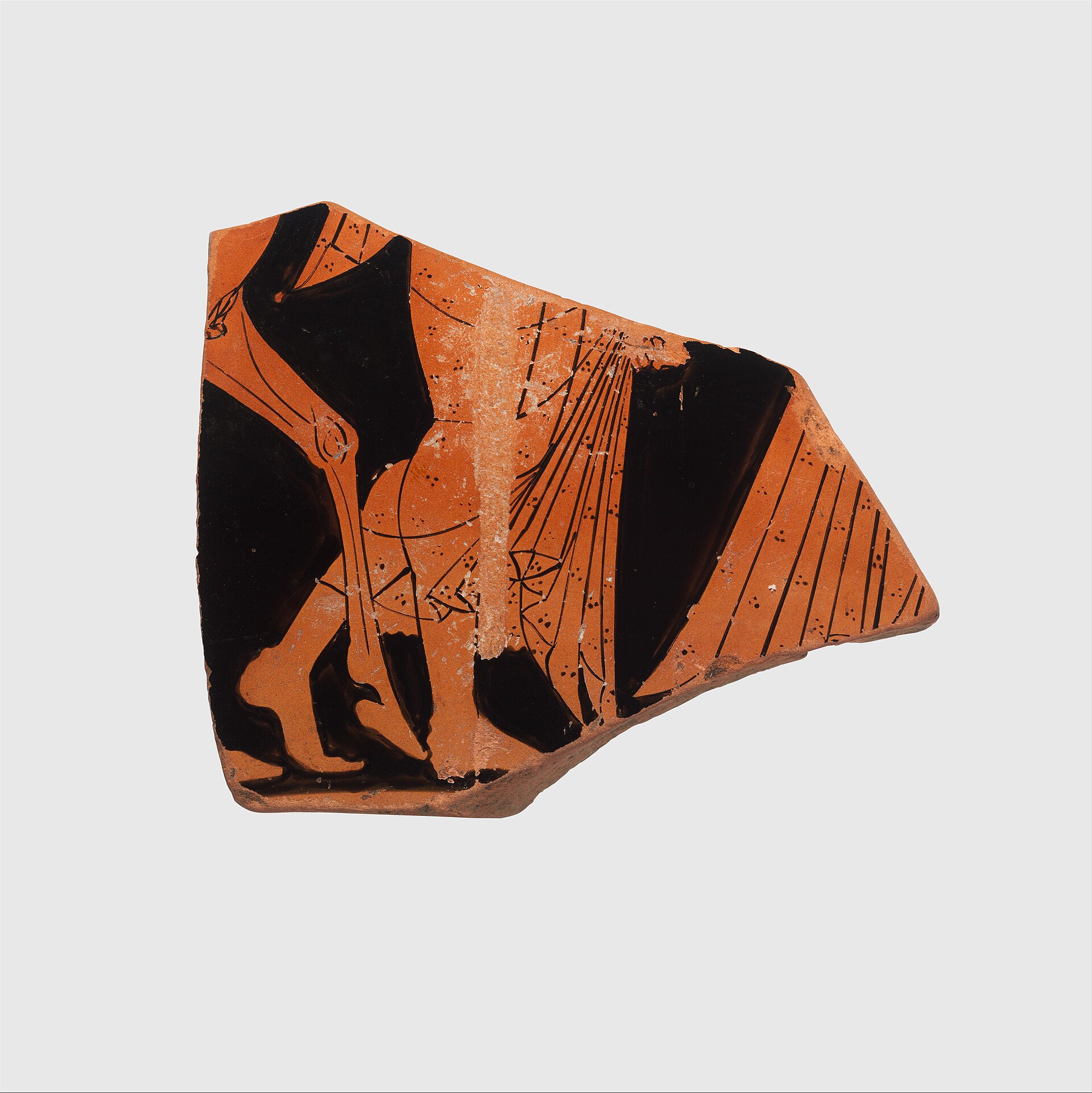
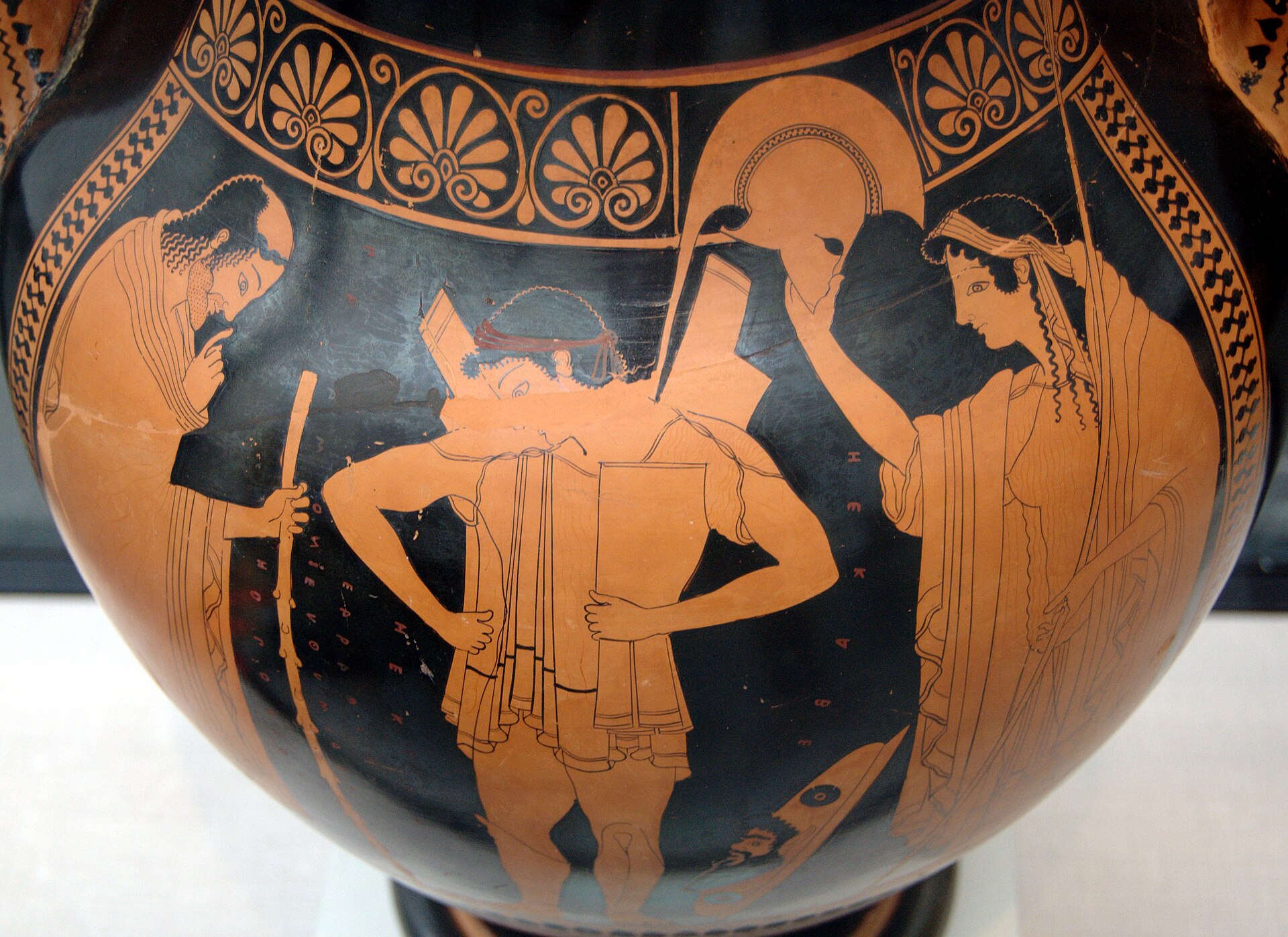
Born, on the usual estimate. There is no record of his birth, his parents, his deme or his legal status. The date is worked backwards from the vases.611
Begins painting, probably under Psiax. A cup fragment in the Metropolitan is described by the museum as one of his earliest preserved works and as clearly reflecting Psiax's influence.1133
Works in the workshop of the potter Kachrylion under the painter Oltos. Munich 2620, the large cup with Herakles and Geryon, is potted by Kachrylion and painted by Euphronios.1133
The vogue for LEAGROS KALOS. Roughly a dozen vases by or given to Euphronios carry the acclamation; nearly seventy are known from other painters. It is the dating instrument for this phase of his work.118
Paints the psykter now in the State Hermitage, Beazley Archive number 200078, signed EUPHRONIOSEGRAPHSEN, with four named hetairai and the kottabos toast tin tande latasso Leagre.433
The calyx-krater Munich 8935, potted by Euxitheos, painted by Euphronios, naming Thodemos, Melas, Syko, Smikros and Ekphantides at a symposium, with Ekphantides' song written retrograde. The dating within the range is Emily Vermeule's.8
Enters the workshop of the potter Euxitheos. The three calyx-kraters signed by both men, the Sarpedon krater, Munich 8935 and Louvre G 33, belong to this partnership.118
The psykter now Getty 82.AE.53, attributed to Smikros, paints a figure labelled Euphronios reaching for the chin of a boy, with LEAGROS KALOS inscribed. It is the only surviving ancient image that carries his name as a person rather than as a maker.21
Euthymides inscribes HOS OUDEPOTE EUPHRONIOS in purple slip along the left edge of the revellers on his amphora Munich 2307. The earliest surviving instance of one maker naming a rival on his own work.109
The signatures change from egraphsen to epoiesen. He takes over a pottery workshop, concentrates on cups, and hires Onesimos, Douris, the Antiphon Painter, the Triptolemos Painter and the Pistoxenos Painter to decorate them.116
The latest activity given to him, as a potter. Nothing records his death.116
A fragmentary votive base from the Athenian Acropolis, IG I3 824, carries his name and the word hygieia. It is the only object outside the pottery trade that may name him, and it is the evidence for the failing-eyesight argument.1133
Lucien Bonaparte digs the Euthymides amphora out of the Tomb of the Cuccumella at Vulci. The Etruscan cemeteries that hold almost every surviving Euphronios vase begin to be worked systematically.10
Wilhelm Klein publishes Euphronios: eine Studie zur Geschichte der griechischen Malerei, the first monograph, with outline drawings that are still the clearest published record of some of the vases.33
Paul Hartwig gives the painting of the Troilos cup, which is signed only EUPHRONIOS EPOIESEN, to the hand now called Onesimos. The Euphronios problem, the separation of the signer from the drawer, begins here.13
Beazley's lecture Potter and Painter in Ancient Athens sets out the two readings of epoiesen and comes down for the literal one, concluding that Euphronios epoiesen means Euphronios fashioned the vase himself.11
R. M. Cook argues in JHS 91 that epoiesen implies ownership of the workshop rather than manufacture; Martin Robertson replies in JHS 92 that the evidence is contradictory; Michael Eisman adds a further note in JHS 94.1415
Axel Seeberg returns to the question in JHS 114 under the title Epoiesen, egrapsen, and the organization of the vase trade, reframing the signatures as evidence about how an Athenian pottery business was structured rather than about who held a tool.16
The Sarpedon krater is dug out of a tomb at Greppe Sant'Angelo, Cerveteri. Hecht's seized memoir puts the Sarpedon cup in the same clandestine excavation and records buying it from Giacomo Medici for 25,000 dollars.25
The Metropolitan Museum buys the Sarpedon krater for a reported one million dollars, a record for an antiquity.7
Hecht offers the Sarpedon cup to the Metropolitan for 70,000 dollars. The museum declines.25
The Getty acquires the Euphronios and Onesimos cup in fragments, paying the Zurich dealer Frieda Tchacos 180,000 dollars for about forty per cent of it, with further pieces via the Hydra Gallery in Geneva and a fabricated Zbinden Collection provenance.22
Sotheby's New York, sale 6042, disperses the Hunt collections. The Sarpedon cup makes 742,500 dollars and the Kyknos calyx-krater 1.76 million. Both prices are reported without a hammer and premium split.72526
The Euphronios exhibitions at Arezzo, at the Louvre from 18 September to 31 December 1990, and at Berlin-Dahlem from 20 March to 26 May 1991. Three catalogues in three languages; the French volume runs to 270 pages with sixty-two works in colour.3011
Vickers and Gill publish Artful Crafts, arguing that Attic pottery imitates silver and that the signatures name metalworkers. Boardman, Cook and Robertson had already attacked the thesis in print.17
At the conference Antichita senza provenienza at Viterbo University, Maria Rizzo presents evidence that the Getty's Euphronios and Onesimos cup came out of the Cerveteri necropolis and asks Marion True, present in the room, to return it.22
The Getty returns the cup to Italy, with a Mithras torso and a Diadoumenos head. Some Italian accounts date the return to 1998.22
Richard Neer's Style and Politics in Athenian Vase-Painting reads the Pioneers' self-referential inscriptions and potter-portraits as social positioning during the Kleisthenic reforms rather than as documentary record.19
Medici returns two further fragments of the Onesimos cup. Daniele Maras publishes his argument that Euphronios was already potting during his painting years, which would dissolve the career-change question.2313
The Sarpedon krater is on view at the Metropolitan through Sunday 13 January; three Italian loans go up on 16 January, among them a cup signed by Euxitheos as potter and Oltos as painter, from Tarquinia. Shelby White and Francesco Rutelli announce the return of ten objects.2726
The AAMD guidelines on archaeological material take effect, replacing the rolling ten-year test with the fixed 1970 UNESCO threshold and creating the Object Registry.28
A further fragment of the Onesimos cup, showing Talthybius, is found at Cerveteri.23
Dietrich von Bothmer dies, leaving the Metropolitan a private collection of as many as fifteen thousand vase fragments assembled alongside his curatorial job.24
The Kyknos calyx-krater is returned to Italy, the last of the ten objects in the White agreement. The Beazley Archive still lists its last recorded collection as Shelby White and Leon Levy.262
The AAMD adopts strengthened guidelines at its mid-winter meeting in Kansas City, making Registry posting part of the Code of Ethics. The revised guidelines are dated 29 January on their face and 30 January in the association's press release.28
The Object Registry holds some 579 objects from sixteen institutions, about 358 of them from the Walters Art Museum. David Gill records both the honourable and the cosmetic uses being made of it.29
The krater and the Onesimos cup are transferred from Villa Giulia to the Museo Nazionale Archeologico Cerite at Cerveteri, four kilometres from the necropolis. The Ministry of Culture's own page for the museum now names both as its iconic objects.31
Guy Hedreen proposes that Smikros is not a vase painter but a fiction invented by Euphronios, an alter ego on the model of the personae of archaic iambic poetry. Beazley had called Smikros an imitator of Euphronios and a bad draughtsman, a judgement made against the rest of the Pioneers rather than against the trade.1812
The Sarpedon cup is shown at the Museo Nazionale Cerite in the exhibition L'Ospite: l'eroe, l'artista, la pieta, standing for the first time beside the krater that carries the same scene.31
There is effectively no market. Every signed Euphronios vessel is in a public collection, and the two that were in private hands within living memory both went back to Italy. What follows is a closed historical record rather than a price guide.
The pattern in it is the one a collector should take away. An object with no findspot and a dealer's assurance sold for a record price in 1972 and cost the buyer its title in 2006. Two objects from the same clandestine excavation passed through a dealer at 25,000 dollars, were refused by a museum at 70,000, made 742,500 and 1.76 million at auction eighteen years later, and are now Italian state property. The prices went up at every stage and the ownership went to zero.
None of the auction figures is published anywhere located with the hammer separated from the premium. Both 1990 results are almost certainly premium-inclusive, which is how Sotheby's reports. The implied hammers given below are this record's arithmetic on the then-standard rate and are flagged as such.
| Date | Sale | Work | Result | Note |
|---|---|---|---|---|
| 19 June 1990 | Sotheby's, New York | Type B cup with Hypnos and Thanatos carrying Sarpedon, signed EUPHRONIOS EGRAPH[SEN]. Beazley Archive 7043 | Hammer not published; 675,000 implied With premium 742,500 reported total USD | Sale 6042, the Nelson Bunker Hunt and William Herbert Hunt collections. Reported as 742,500 dollars by Vernon Silver and as 742,000 by Suzan Mazur. The buyer was recorded by Sotheby's as a European dealer; Mazur reports that he was Giacomo Medici. Hecht's seized memoir records buying the cup from Medici in the early 1970s for 25,000 dollars and offering it to the Metropolitan in 1973 for 70,000, which was refused. The implied hammer assumes the ten per cent buyer's premium then standard at that level and is this record's inference, not a published figure. The cup was recovered in the Geneva Freeport seizures and is now recorded at Villa Giulia; it was shown at Cerveteri in July 2024. |
| 19 June 1990 | Sotheby's, New York | Fragmentary calyx-krater with Herakles fighting Kyknos, signed EUPHRONIOS EGRAPHSEN, inscribed LEAGROS KALOS. Beazley Archive 7501 | Hammer not published; 1,600,000 implied With premium 1,760,000 reported total USD | Same sale, Hunt collection number 6, previously on loan to the Getty. Bought by Shelby White at what was reported as an unprecedented price for a Greek vase, and lent to the Metropolitan. Also reported as 1.7 million. Returned to Italy in 2010 under the agreement she and Francesco Rutelli announced in January 2008. The implied hammer is this record's arithmetic on a ten per cent premium and is not published. One account describes her Euphronios krater as showing Ganymede and Herakles; the Beazley Archive, reading the inscriptions, records Kyknos, Athena, Ares, Aphrodite and Artemis. |
Hammer is the price at which the bidding stopped; with premium adds the fee the house charges the buyer on top. Hammer price and buyer's premium in the glossary.
| Institution | City | Holdings | Note |
|---|---|---|---|
| Museo Archeologico Nazionale Cerite | Cerveteri | The Sarpedon calyx-krater and the Euphronios and Onesimos cup, both taken illegally from the Cerveteri necropolis and both returned by American museums. | In the Ruspoli castle on Piazza Santa Maria, administered by the Parco Archeologico di Cerveteri e Tarquinia, an autonomous institute of the Ministry of Culture; director Vincenzo Bellelli. The ministry's own page names the two vases as among the museum's iconic objects and dates their arrival to 2015. Closed Mondays; Tuesday to Sunday 9.00 to 19.30, ticket office to 18.30. This is four kilometres from where the krater was dug up. |
| Museo Nazionale Etrusco di Villa Giulia | Rome | The Sarpedon cup, Beazley Archive 7043, recorded here after its recovery. The Kyknos calyx-krater returned in 2010. | The museum held the Sarpedon krater from 2008 to 2014 and no longer does. Its own website does not list any Euphronios among its headline objects, which are the Pyrgi tablets, the Sarcophagus of the Spouses, the Apollo of Veii, the Leucothea head and the Castellani gold. Confirm current display before travelling; the Sarpedon cup was at Cerveteri in the summer of 2024. |
| Musee du Louvre | Paris | The largest single holding. G 103 (Herakles and Antaios), G 110 (Herakles and the Nemean lion, signed EUPHRONIOS EGRAPHSEN TADE), G 33 (Dionysos and his thiasos, signed by Euxitheos as potter), G 106 (Scythian archer, partial signature), G 104 and G 105 (cups potted by Euphronios and painted by Onesimos), G 30, G 34, and the neck-amphora Cp 11187 to which fifteen Metropolitan fragments join. | The Louvre hosted the 1990 exhibition and its catalogue remains the reference. G 34 is given to Euphronios by the museum and to the Magnoncourt Painter by Beazley, which is a useful demonstration that institutional labels and the standard lists do not always agree. |
| Staatliche Antikensammlungen | Munich | 2620, the large cup with Herakles and Geryon, potted by Kachrylion and painted by Euphronios, from Vulci; 8935, the calyx-krater with the named symposiasts, potted by Euxitheos; 8953; and 2307, the Euthymides amphora that carries the taunt. | The best single stop for the Pioneer Group. The Euphronios cup and the Euthymides amphora are in the same building, which lets a visitor test Richter's reading of the taunt against both painters at once. |
| Antikensammlung, Staatliche Museen zu Berlin | Berlin | 2180, the calyx-krater with athletes in the palaistra, found at Capua; 1980.7. | Berlin held the third leg of the 1990-91 exhibition. The date of 2180 is argued: the shape suggests a late work, black-figure carry-overs an early one. |
| State Hermitage Museum | St Petersburg | The psykter with four named hetairai at their own symposium, Beazley Archive 200078, signed EUPHRONIOSEGRAPHSEN, from Cerveteri. | The kottabos toast to Leagros is written flying out of Smikra's hand. Klein's outline drawings of 1886 remain the clearest published record of the whole frieze and are free online. |
| The Metropolitan Museum of Art | New York | Fragments only. Nine separate Euphronios-related donations from Dietrich von Bothmer are catalogued, including eleven fragments of a cup showing Helen carried off by Theseus (1989.382.1) and fifteen neck-amphora fragments that join the Louvre's Cp 11187 (1985.228.8a-o). | The museum has held no complete Euphronios since January 2008. Dozens of fragments from the von Bothmer bequest have gone back to Italy, some of them matching vases other American museums had already returned. |
| J. Paul Getty Museum | Los Angeles | Fragments, including 77.AE.20, 77.AE.86, 79.AE.17, 86.AE.313 and material from 81.AE.214; and the psykter 82.AE.53 attributed to Smikros, which names Euphronios. | The psykter's recorded provenance begins in 1972 with the Geneva dealer Nicolas Koutoulakis and ends with his donation to the museum in 1982. There is nothing before 1972. The Getty publishes an open IIIF manifest for it, so the inscriptions can be read at full resolution without leaving a desk. |
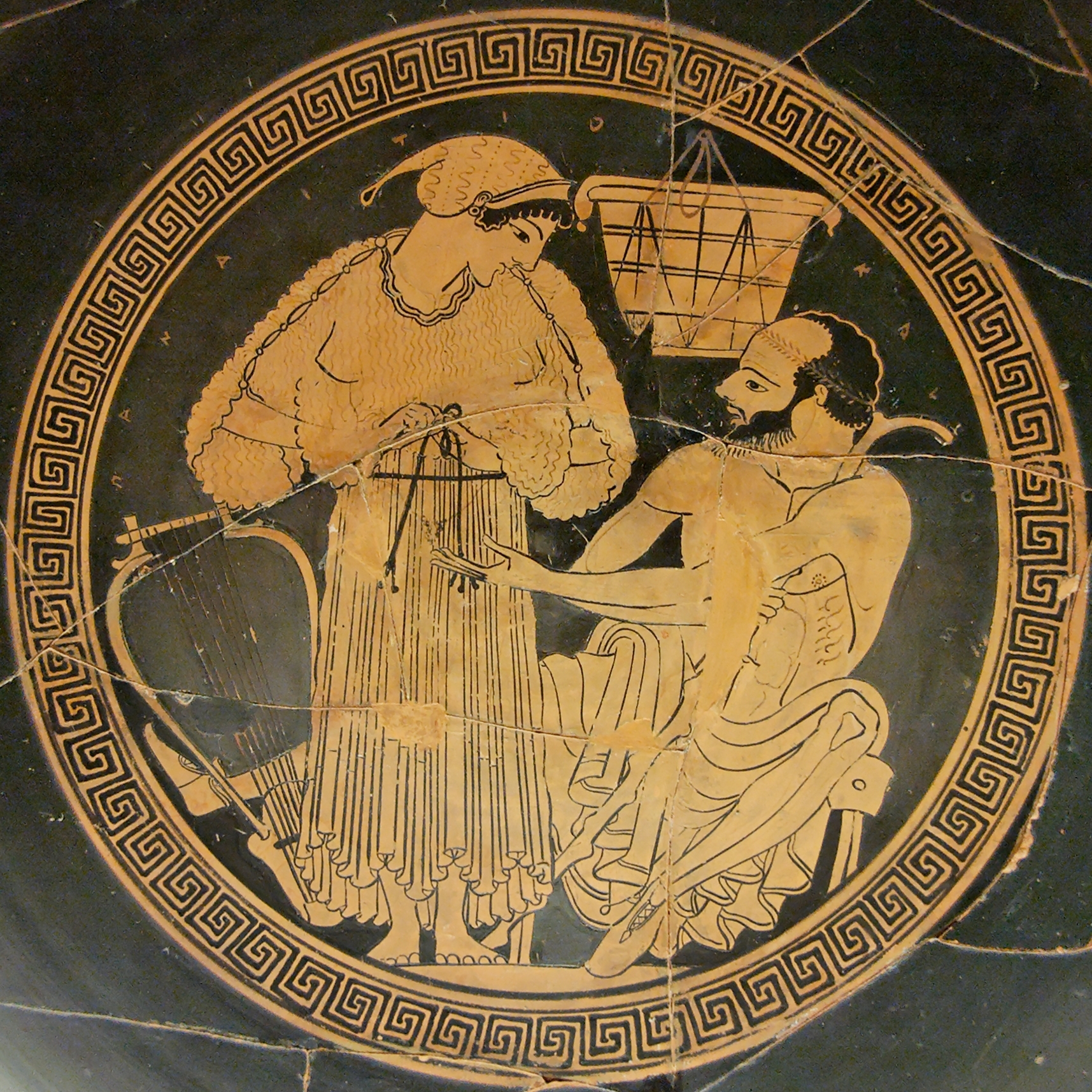
| The British Museum | London | E 44, a cup signed by Euphronios as potter and painted by Onesimos, from Vulci; E 41. | The tondo of E 44 shows a musician tying her himation while an older client watches, which is the everyday end of the symposium subject matter. |
| Petit Palais, Musee des Beaux-Arts de la Ville de Paris | Paris | A cup signed by Euphronios as potter and attributed to Onesimos, about 490 BC, from Tarquinia, 9 cm high and 29 cm wide, inscribed HO PAIS on each face and HO PAIS KALOS in the interior tondo. | Bequeathed by Auguste and Eugene Dutuit in 1902, which makes it one of the few Euphronios objects with a documented western European ownership history reaching back before the modern trade. Paris Musees publishes the photographs as CC0. |
| Museo Archeologico Nazionale Gaio Cilnio Mecenate | Arezzo | 1465, the volute-krater with Herakles, Telamon and the Amazons, a late work. | Arezzo hosted the first leg of the 1990 exhibition. The vase is one of the very few large Euphronios vessels never to have been the subject of a provenance dispute. |
| Museo Archeologico Nazionale Tarquiniese | Tarquinia | RC 6848, the cup signed by Euxitheos as potter and Oltos as painter, about 515-510 BC, 52 cm across, with the gods on Olympos named and an Etruscan dedication to Castor and Pollux scratched under the foot. | Not by Euphronios, and that is the point: it is the object that shows Euxitheos was a maker in his own right. Lent to the Metropolitan for four years from January 2008 as part of the exchange for the Sarpedon krater, under loan number L2008.1.1. |
| Epigraphic Museum | Athens | The base of the votive dedication of the potter Euphronios, IG I3 824. | The only object outside the pottery trade that may carry his name. Fragmentary. It is the entire physical basis of the failing-eyesight argument, and it is one line of stone. |
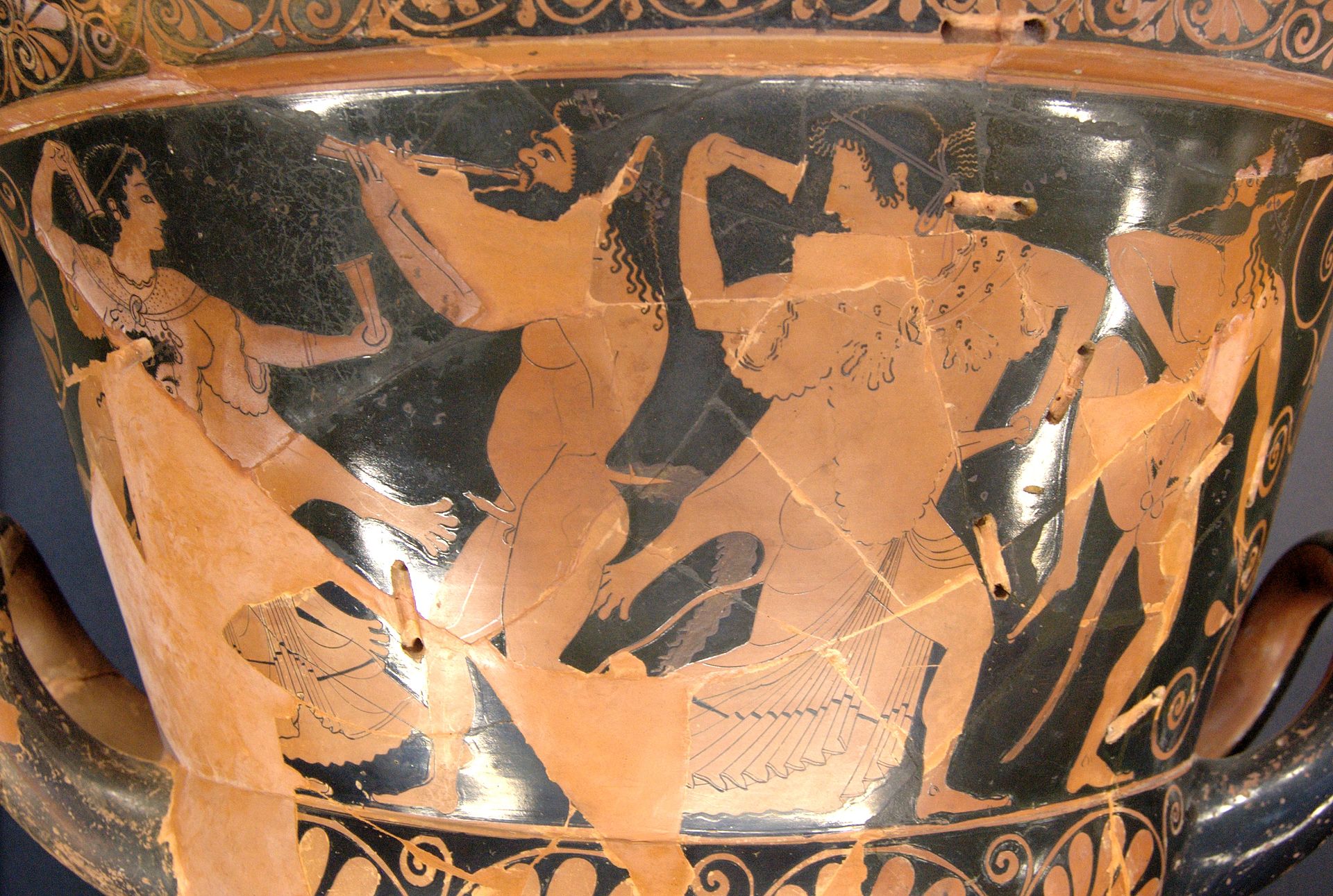
On the obverse of the calyx-krater now at Cerveteri two inscriptions run beside the figures: EUXITHEOS EPOIESEN and EUPHRONIOS EGRAPHSEN.
On the obverse of the calyx-krater now at Cerveteri two inscriptions run beside the figures: EUXITHEOS EPOIESEN and EUPHRONIOS EGRAPHSEN. Euxitheos made it. Euphronios painted it. They are two names because they are two people, and they are two verbs because throwing a pot and drawing on it were separate trades practised by separate men in the same workshop.
The Classical Art Research Centre in Oxford, which runs the Beazley Archive, states the rule as flatly as it can be stated: egraphsen must mean painted, and where epoiesen appears alongside an egraphsen signature it most likely means potted. The archive's own example is the Francois Vase formula, Kleitias painted me and Ergotimos potted me. Occasionally one man claims both, and the Greek says so explicitly: Exekias wrote egraphsen kapoiesen me, painted and potted me, in a single breath. Euphronios never wrote that. He wrote one verb at a time.
The practical consequence for this archive is that a maker credit reading Euphronios, painter; Euxitheos, potter is a description of a joint signature, not the name of an artist. It cannot be a person page, because there is no such person. It also silently subordinates Euxitheos, who has an independent body of work, to a painter he happened to collaborate with. The Metropolitan Museum's own press office, announcing the loans that replaced the krater in 2008, described Euxitheos as an artist known chiefly for his collaboration with Euphronios as painter, and then went straight on to describe a cup Euxitheos potted for a completely different painter.
The recommendation set out at the end of this file is that the two be split into separate entries, and that the object record carry Euphronios as its artist with Euxitheos named as the potter in the attribution rather than welded into the artist's name.
The comfortable reading is that epoiesen names the man whose hands shaped the clay.
The comfortable reading is that epoiesen names the man whose hands shaped the clay. John Beazley, who did more than anyone to make Attic vase painting a subject at all, set out both possibilities in his lecture Potter and Painter in Ancient Athens in 1944: either epoiesen names the potter who fashioned the vase, or it merely names the owner of the establishment. He recorded that he had once preferred the second explanation and had come to believe the first, and he applied it to this maker by name, concluding that Euphronios epoiesen meant Euphronios fashioned the vase with his own hands.
That did not settle it. R. M. Cook argued in the Journal of Hellenic Studies in 1971 that the weight of the evidence goes against the hands-on reading and in favour of workshop ownership. Martin Robertson replied in the same journal the following year that the evidence is difficult and appears self-contradictory, and declined to concede. Michael Eisman added a further note in 1974. Axel Seeberg returned to the question in 1994 under the title Epoiesen, egrapsen, and the organization of the vase trade, which is the frame the argument has kept: the verbs are evidence about how a business was structured, not only about who held a tool.
The Beazley Archive's own teaching page gives the strongest single argument for the sceptical reading, and it is physical rather than philological. Where the epoiesen signatures of one man are manifestly written by different hands, that man cannot have been holding the brush; in those cases epoiesen could refer to the potter or to the workshop owner. Nikosthenes is the standing example.
The most radical position was taken by Michael Vickers and David Gill in Artful Crafts in 1994. Their thesis is that Athenian painted pottery was cheap, that it copied vessels in silver and gold, that black glaze replicates silver and red-figure replicates gold figures on a silver ground, and that the egraphsen and epoiesen inscriptions name the metalworkers who made the precious originals rather than the potters who imitated them. In the reviewer Susan Rotroff's summary, that removes the creative act from the world of the potter altogether and hands it to the silversmith. The thesis has been attacked by John Boardman, R. M. Cook and Martin Robertson, and the vase-painting establishment has not adopted it; it is recorded here because a reader who meets a confident claim about what a Greek signature means should know that the confidence is not universal.
Daniele Maras, writing in the Rivista di Archeologia in 2005, put a different pressure on the same evidence and did it specifically on Euphronios. His problem is a good one: if Euphronios changed trades in mid-career, where is the apprenticeship? Nobody becomes a competent thrower of forty-five-litre kraters overnight. Maras proposes that some of the egraphsen signatures imply potting as well, the painter claiming the whole object while advertising the prestige of the new red-figure technique, and points to an early red-figure krater signed by Euphronios and also by a second painter, possibly Smikros, where Euphronios did the principal side and probably potted the vessel while the other man took the reverse. On that reading Euphronios was already a skilled potter in the sixth century and simply thought only his painting worth signing for.
None of these positions is settled and this record does not arbitrate between them. What a reader should take away is narrower and firmer: on a vase carrying both verbs, the two names are two people. Everything beyond that is argued.
There is no agreed number, and the numbers in circulation count different things.The figure most often repeated is eight vases signed by him as painter and at least twelve as potter, with the painter...
There is no agreed number, and the numbers in circulation count different things.
The figure most often repeated is eight vases signed by him as painter and at least twelve as potter, with the painter signatures clustering early and the potter signatures late. Kerameikos.org, the linked-data authority for Greek pottery, gives eight as painter and twenty-four as potter. Vernon Silver, writing about the 1990 sale of a signed Euphronios cup, put it from the other end: scholars knew of just eight other vases painted and signed by Euphronios, and only five of those were even close to being intact. Nigel Spivey notes that Beazley's early work identified nine signed pieces and that later scholarship enlarged the figure.
The Beazley Archive Pottery Database gives a fourth answer and it is much larger. A painter-and-potter search on Euphronios returns 139 records in the results listing, against a count of 141 on the summary screen. That number is not a count of vases in any ordinary sense. The great majority of the entries are fragments: single sherds in Malibu, Oxford, Athens, Delphi, Palermo, Berlin, Cambridge Massachusetts and half a dozen private collections, many of them pieces of the same broken cup catalogued separately because they arrived separately. Three of the 139 records still carry the name Euxitheos in their inscription fields; the various spellings of Euphronios signing as painter account for six records and the spellings of him signing as potter for another six, with the bare name Euphronios appearing in thirty-four.
Set against those figures, the total of about twenty-seven vases attributed to him as painter, the figure carried in the object record for the New York krater, is a count of reconstructed vessels rather than of surviving pieces of clay. All four figures are defensible. Anyone quoting one of them without saying which unit is being counted is quoting a number that cannot be checked.
The other thing to understand about the corpus is its physical state. Exactly one vase painted by Euphronios survives entire, and it is the Sarpedon krater at Cerveteri. Everything else by his brush is fragmentary or partially restored. That is the ordinary condition of Greek pottery and it is why the New York purchase of 1972 was worth a record price: not because the painting is better than his other painting, but because there is no other complete example of it.
The awkwardness in the signatures was noticed early and has a name.
The awkwardness in the signatures was noticed early and has a name. In 1893 Paul Hartwig took the Troilos cup, which carries the single signature Euphronios epoiesen and nothing else, and gave its painting to a different hand, the painter now called Onesimos. That move separated the man who signed from the man who drew, and it turned a straightforward inscription into a question. Maras describes the problem as having been considerably extended and modified since, with dispassionate stylistic analysis tending more and more to separate potter from painter in most of the well-known workshops.
The consequence is that a vase signed only Euphronios epoiesen tells you nothing about who painted it until somebody attributes the painting, and the attribution is opinion. A vase signed only Euphronios egraphsen tells you nothing about who potted it. The single object in the corpus where both questions are answered by the object itself is the New York krater, which is one more reason it dominates the literature out of all proportion to its share of the surviving material.
There is a second, blunter version of the problem that this record has to state and cannot resolve: whether the painter and the potter are the same man at all. The consensus is that they are, on the strength of the chronology, the shared workshop connections and the absence of any second Euphronios in the record. But the consensus rests on the assumption that one Athenian craftsman of that name was working in the Kerameikos across half a century, and no document supports it. Nothing outside the pots names him.
Signing was the exception. The overwhelming majority of Attic vases are anonymous, which is why the standard reference names in the field are inventions: the Berlin Painter, the Antimenes Painter...
Signing was the exception. The overwhelming majority of Attic vases are anonymous, which is why the standard reference names in the field are inventions: the Berlin Painter, the Antimenes Painter, the Painter of the Berlin Dancing Girl, each christened after a museum, a subject or a collector. Attributing those hands to individuals is the work of one man's method, and it is worth being precise about what the method is and what it can carry.
Beazley adapted the technique developed by Giovanni Morelli for Italian paintings: attribution by the small, unconscious, repeated habits of drawing that an artist does not think about and therefore does not vary. Morelli looked at ears and hands. Beazley looked at ankles, clavicles, the drawing of a knee, the way a fold of drapery terminates, the shape of a palmette. He described the method explicitly in two articles of 1922 and 1927 defining the Berlin and Antimenes Painters, and he never once named Morelli as its source. He catalogued tens of thousands of vases and sherds, and his three great lists remain the spine of the subject.
What the method settled is narrower than it looks. It groups objects by hand with a consistency that has largely survived a century of testing; only a small proportion of Beazley's attributions have been vacated. What it cannot do is tell you that a hand corresponds to a person, or that a person corresponds to a name. Beazley's own generation was comfortable with the slippage; later scholars have not been. James Whitley attacked the framework in 1997 and John Oakley defended it in 1998, in what remains the standard exchange, and both were arguing partly against the more radical scepticism of Gill and Vickers, who question whether the whole enterprise of naming vase painters describes anything real about ancient production.
For Euphronios the method's limits are visible in a way they are not for most painters, because here the signatures give an independent control. Where a signature and a stylistic attribution agree, connoisseurship has passed a test. Where the corpus grows by attribution beyond the signed core, from roughly eight signed pieces to roughly twenty-seven attributed ones, every step beyond the eighth is somebody's judgement. This record treats it that way.
He appears to have begun painting around 520 BC, probably under Psiax, and then to have worked in the workshop of the potter Kachrylion under the painter Oltos.
He appears to have begun painting around 520 BC, probably under Psiax, and then to have worked in the workshop of the potter Kachrylion under the painter Oltos. A cup fragment in the Metropolitan Museum, one of the earliest pieces given to him, is described by the museum as clearly reflecting the influence of Psiax, which is as close to documentary evidence of a teacher as this subject offers. Around 510 BC he moved to the workshop of Euxitheos.
Three technical habits are credited to him, and they are the reason his name means something to people who have never heard of the looting case. The first is the relief line: a raised, glossy contour of thick slip, standing proud of the surface, laid with a fine instrument and used to carry the drawing of an outline or a muscle. The second is the systematic use of diluted slip, which fires anywhere between light yellow and dark brown depending on how thickly it is laid, and which converts a two-colour technique into one with a workable tonal range. The third is what he did with the first two: anatomy that reads as a body under strain rather than a pattern of contours, and figures set at angles that the black-figure technique could not carry, because a brush can turn a shoulder in a way that an incising tool cannot.
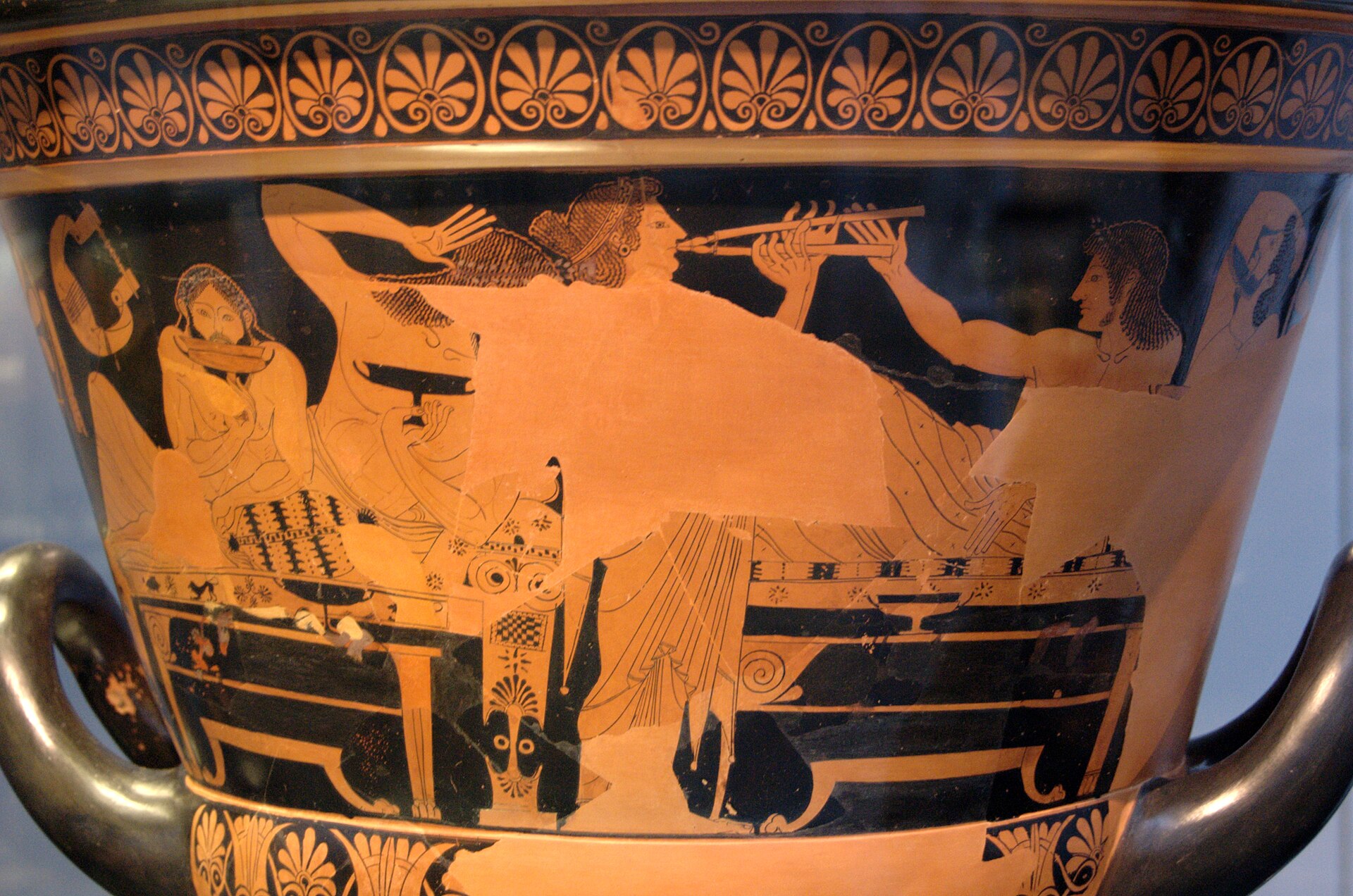
The Munich symposium krater shows the toolkit in one object. The Perseus catalogue records relief dots in the hair of the outer revellers, dilute glaze under dark strands to give two figures blond hair, and two preserved faces where the pupil and the outer edge of the iris are drawn separately so that the eyes read as blue. That is a painter using a two-colour ceramic process to record what light does to hair and to an iris. It is also, incidentally, a painter who has decided that the drinkers at a party are worth that much attention.
The Pioneer Group is a modern label for a handful of painters working in Athens in the last quarter of the sixth century who were, on the evidence of their own vases, aware of each other as...
The Pioneer Group is a modern label for a handful of painters working in Athens in the last quarter of the sixth century who were, on the evidence of their own vases, aware of each other as competitors. Beazley designated roughly a dozen. The names that signed are Euphronios, Euthymides and Phintias; Smikros, Hypsis and the Dikaios Painter are attached to the group, with Oltos and Epiktetos in looser association. What they have in common is technical adventurousness in the drawing of the body, and an unusual willingness to write on their pots about themselves.
The most famous inscription in Greek vase painting is on an amphora by Euthymides in Munich, inventory 2307, about sixty centimetres high, dug out of the Tomb of the Cuccumella at Vulci by Lucien Bonaparte in March 1829. One side shows Hector arming between Priam and Hecuba. The other shows three drunk men dancing at a komos, two of them labelled Eudemos and Teles, the leader labelled komarchos. Along the left edge of the dancers, in purple slip, Euthymides wrote HOS OUDEPOTE EUPHRONIOS. As never Euphronios.
Three readings of those three words are in print and they are not compatible. Beazley took it as a light-hearted challenge thrown at a colleague. A second tradition reads it as an envious outburst by an ageing artist. A third, developed by G. Neumann and H. Engelmann and reported by Jenifer Neils, takes the boast as being not about drawing at all but about the party: Euphronios never revelled like us, an in-joke about the three komasts on that side of the vase. Gisela Richter's reading, that the claim is specifically about the three-quarter views Euthymides used and Euphronios did not, is the one that has entered general accounts. Richard Neer's book on the politics of the craft takes the whole habit of self-reference among these painters as a social manoeuvre rather than a technical one.
It is worth being exact about what the words do and do not say. There is no verb. Hos oudepote Euphronios is a comparison with a missing predicate, and every reading of it consists of supplying the predicate the reader prefers. The sentence is famous for being the first time in surviving Western art that one maker writes a rival's name on his own work in order to beat it. What he claims to have beaten him at is genuinely unknown.
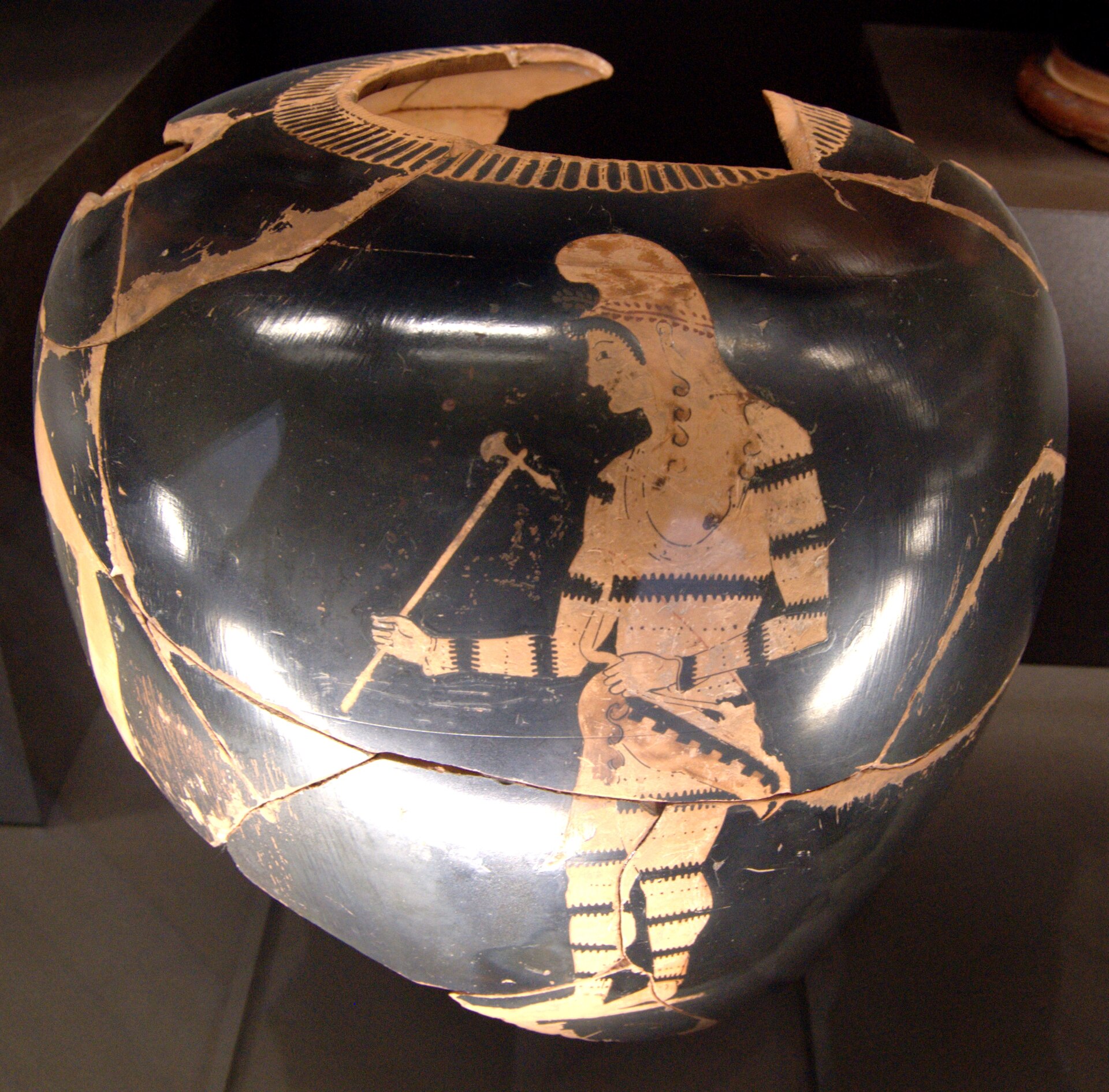
Phintias wrote his colleague into a picture instead. A hydria by him, known from a nineteenth-century line drawing, shows four figures: a bearded man leaning on a stick at the left, a seated youth playing the lyre labelled Euthymides, a boy named Tlempolemos, and a seated man named Smikythos. A vase painter has painted another vase painter having a music lesson. Whatever the Pioneers were, they were a group who expected their customers to recognise each other's names.
Smikros signed vases. Beazley called him an imitator of Euphronios and, more damningly, a bad draughtsman, a judgement he made in comparison with the rest of the Pioneers rather than against the...
Smikros signed vases. Beazley called him an imitator of Euphronios and, more damningly, a bad draughtsman, a judgement he made in comparison with the rest of the Pioneers rather than against the trade at large. The standard account has him as a pupil whose early work copies his master closely enough to have caused attribution trouble that has never entirely gone away.
Two objects complicate that account and a third demolishes it, if you accept the argument.
The first is a stamnos in Brussels, Musees Royaux d'Art et d'Histoire A 717, signed by Smikros, showing a banquet. In the composition a figure throws his head back with his arm over it, and Smikros labels that figure as himself. The Perseus record on the Munich calyx-krater notes that the Brussels composition is strikingly similar to the Munich vase and that the head-thrown-back figure occupies the same position as the man Euphronios labelled Ekphantides.
The second is the Munich krater itself, Antikensammlungen 8935, a calyx-krater potted by Euxitheos and painted by Euphronios, dated about 520 to 505 BC and placed by Emily Vermeule toward the end of his painting career, around 513 to 508. One side is a drinking party with five participants, all named: Thodemos, Melas, Syko, Smikros and Ekphantides. Ekphantides is singing, and the words of his song, a scholion to Apollo, are painted retrograde beside his mouth. The other side shows a youth and a servant flanking a mixing bowl on a stand, and over the bowl Euphronios wrote that Leagros is beautiful. So Euphronios put Smikros at a party, in a picture, by name.
The third is a psykter in the J. Paul Getty Museum, object number 82.AE.53, attributed to Smikros, about 510 BC, thirty-three centimetres high. Its inscriptions, as the Getty records them, name Ambrosios, Euthydikos, Melas, Antias, Euphronios, Andriskos, and two acclamations, that Leagros is beautiful and that Hegerthos is beautiful. The figure labelled Euphronios is a draped youth leaning on a staff who reaches for the chin of the boy in front of him, which is the standard gesture of courtship in Athenian painting. Smikros, in other words, painted Euphronios chatting up Leagros, the most conspicuously fashionable young man in Athens and the boy whose name Euphronios himself wrote on vase after vase.
Guy Hedreen's book of 2016 takes this material and proposes that Smikros is not a vase painter at all but a fiction: an invented persona through which Euphronios wrote himself into his own product, in the way that Archilochos and Hipponax speak through invented first-person narrators. On that reading the Getty psykter is Euphronios painting himself under an assumed name, doing something a craftsman could not have done in life. The Getty's own commentary points in the same direction without going as far, noting that it is surprising to see an artisan attempting to seduce one of the most sought-after noble youths in Athens and that scholars have suggested the scene is a fantasy, perhaps a joke.
Hedreen's reviewer Nadia Koch accepts the force of the argument for Smikros and balks at how far he extends the technique, warning that treating epigraphically attested craftsmen as fictions risks dissolving the ground archaeological method stands on. That is the state of the question. It matters here for a reason beyond biography: if a signature can be a persona, then the identity of a named Greek painter is a literary problem as well as an archaeological one, and the difference between an attribution and a person becomes very hard to police.
Roughly a dozen of the vases Euphronios signed or is given carry the acclamation LEAGROS KALOS, Leagros is beautiful, and the name recurs across his work at a density that is unusual even in a period...
Roughly a dozen of the vases Euphronios signed or is given carry the acclamation LEAGROS KALOS, Leagros is beautiful, and the name recurs across his work at a density that is unusual even in a period when the practice was normal. Nearly seventy such inscriptions to Leagros are known from other hands. Because the vogue for a particular name burns out, the Leagros acclamations function as a dating instrument, conventionally placing the vases that carry them in the years around 520 to 510 BC. On the New York krater it is the only dating evidence there is.
Whether these inscriptions are declarations of desire, advertisements, or something between the two is disputed. What is not disputed is that they are a record of one social world talking to itself: an aristocratic circle of drinkers, athletes and boys, on vessels bought to be used in front of exactly those people.
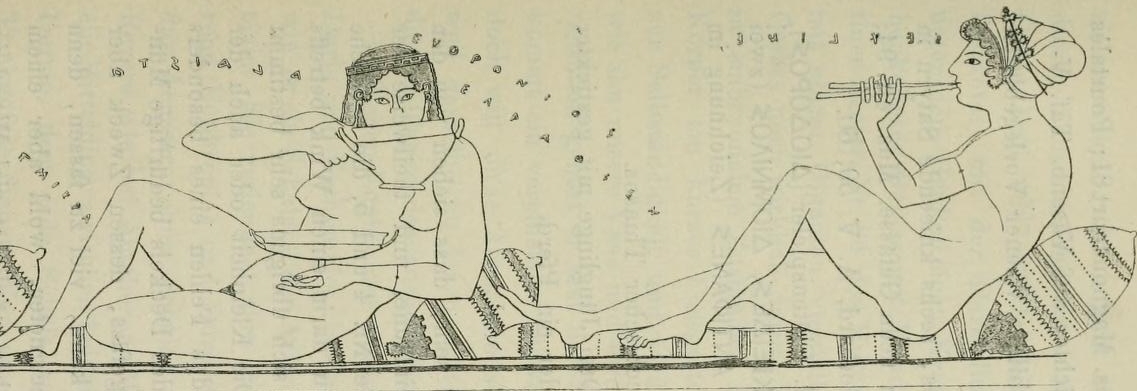
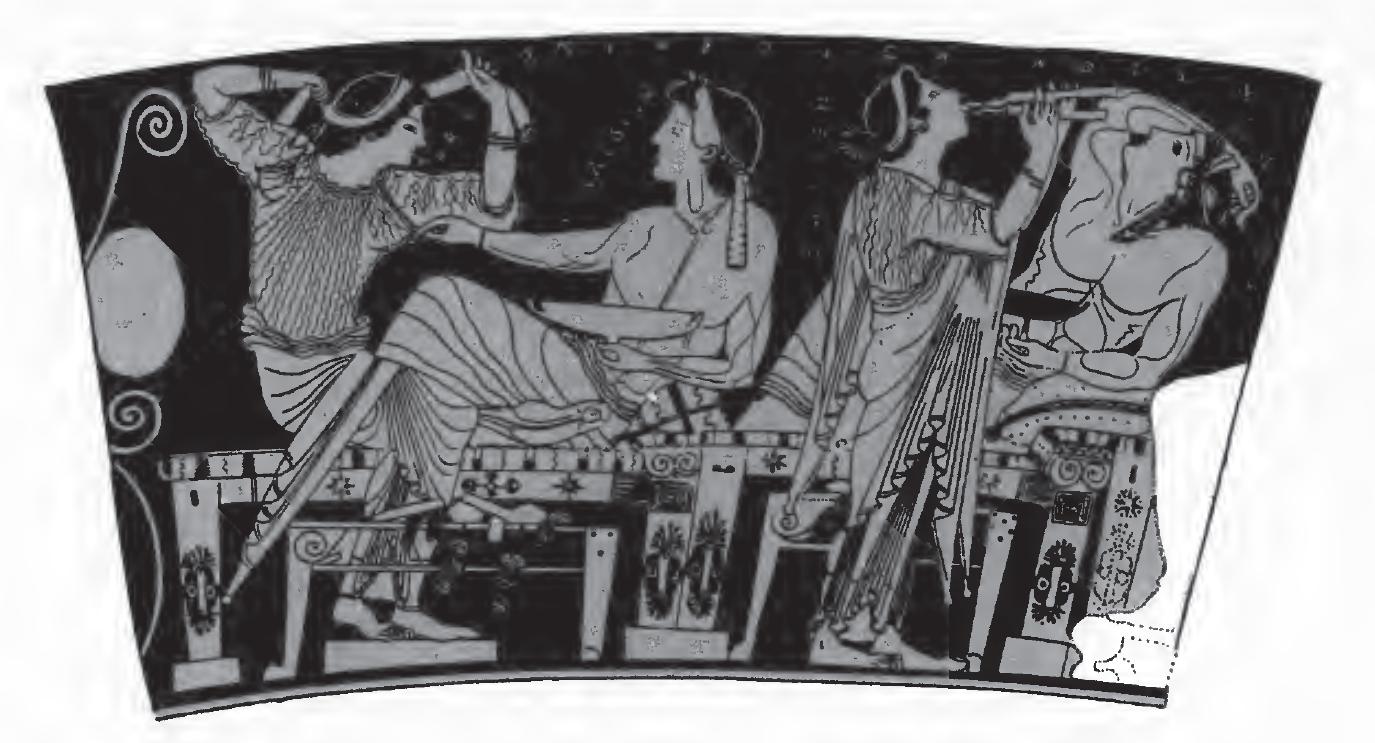
The best single object for seeing that world is a psykter in the State Hermitage, Beazley Archive number 200078, signed EUPHRONIOSEGRAPHSEN in a single unbroken string, and known to English readers chiefly through the outline drawings published by Wilhelm Klein in his monograph of 1886. It shows four hetairai, named Smikra, Palaisto, Sekline and Agape, reclining at their own symposium with cups, a skyphos and pipes. Smikra is flicking the wine-dregs at the kottabos target, and the arc of letters flying from her hand records what she says as she does it: tin tande latasso Leagre. This one I toss for you, Leagros.
Three things are packed into that. Women were not normally the ones making a kottabos toast, so the picture is at least partly a joke. The toast names the same Leagros who is acclaimed on the krater and courted on the Getty psykter. And the woman making it is called Smikra, the feminine of Smikros. Euphronios put his colleague's name, in the feminine, in the mouth of a courtesan flirting with the boy the whole trade was writing about. Whether that is affection, mockery or self-portraiture under another name depends entirely on which of the arguments in the previous section a reader finds convincing.
Euxitheos was a potter. Nothing is known of him beyond his signatures and the vessels that carry them, which is the normal condition for an Athenian craftsman and is exactly why the record should not...
Euxitheos was a potter. Nothing is known of him beyond his signatures and the vessels that carry them, which is the normal condition for an Athenian craftsman and is exactly why the record should not let his name be absorbed into somebody else's.
Three surviving vases carry his signature alongside Euphronios as painter and all three are major objects. The calyx-krater with the death of Sarpedon, now at Cerveteri, is the one everybody knows. The calyx-krater in Munich, 8935, with the named drinkers and the singing Ekphantides, is the second. The calyx-krater in the Louvre, G 33, with Dionysos and his thiasos, is the third. Euphronios is thought to have joined his workshop about 510 BC, and the partnership produced the best-known objects of both careers.
He also worked with other painters, and the proof of it went on public display in New York in the very galleries the Sarpedon krater had just left. Among the three vases Italy lent the Metropolitan in exchange for the krater, on view from January 2008 for a four-year term, was a cup from the Museo Nazionale in Tarquinia, inventory RC 6848, signed by Euxitheos as potter and Oltos as painter and dated about 515 to 510 BC. It is fifty-two centimetres across, which is very large for a drinking cup and, in the museum's own assessment, unwieldy for actual use at a symposium; it may have been made as an offering rather than as tableware. The outside carries an assembly of the gods on Olympos with virtually every figure named, and a long graffito in Etruscan letters on the underside of the foot records a dedication to the sons of Zeus, Castor and Pollux.
That cup is the argument for splitting the entries, made by an object. It is a first-rank vase, it is signed by Euxitheos, and Euphronios has nothing to do with it. The Metropolitan's press office wrote that Euxitheos is known chiefly for his collaboration with Euphronios and then described a masterpiece he potted for somebody else in the next paragraph.
What Euxitheos actually contributed is not decoration but form. The calyx-krater is a relatively new shape in his lifetime, its lower body flaring from the foot like a flower calyx, and the three Euphronios collaborations are all calyx-kraters. A potter who gives a painter a new field to draw on is not a technician executing somebody else's design. The literature that treats potters as the junior partners in these pairs is reading a modern hierarchy of art over craft back into a trade that ordered itself differently, which is the substance of Maras's article on the relative prestige of the two arts.
Around 500 BC the signatures change. Euphronios stops writing egraphsen and starts writing epoiesen, and for the rest of his working life, which ran to about 470 BC, he appears as a potter and not as...
Around 500 BC the signatures change. Euphronios stops writing egraphsen and starts writing epoiesen, and for the rest of his working life, which ran to about 470 BC, he appears as a potter and not as a painter. No other Athenian craftsman is documented making that move.
What he potted was cups. That is itself a decision worth noticing, because the cup had been the shape given to weaker painters, and he raised it by hiring the best draughtsmen of the next generation to decorate what he threw: Onesimos above all, and also Douris, the Antiphon Painter, the Triptolemos Painter and the Pistoxenos Painter. The famous vessels of his second career are not his pictures. They are his shapes carrying somebody else's pictures, and he signed them.
Two explanations are on offer for the change and they are not mutually exclusive.
The material explanation is the one scholarship generally prefers. Potters appear to have been independent proprietors while painters were employees, so moving from the brush to the wheel was a move from wages to ownership. It is the explanation that fits everything else known about the trade, and it fits the fact that he began hiring painters rather than merely joining another workshop.
The medical explanation rests on a single stone. A fragmentary votive base found on the Athenian Acropolis, catalogued as IG I3 824 and now in the Epigraphic Museum in Athens, carries the name Euphronios and the word hygieia, health. The reading offered is that a man whose eyesight was failing dedicated a thank-offering, and that a fine-line painter losing his near vision in his forties would have to stop painting whether he wanted to or not. The argument has its own literature: a paper in Greece and Rome is titled Euphronios Epoiesen: Portrait of the Artist as a Presbyopic Potter, presbyopia being the age-related loss of near focus that arrives, for almost everybody, somewhere around forty-five. Spivey allows the possibility. The general view is that the material explanation is sufficient and the stone is suggestive rather than probative.
Maras disputes the premise of the whole discussion. If Euphronios was already potting during his painting years and simply chose to sign as a painter because that was the prestigious claim, then nothing changed around 500 BC except what he thought worth writing down. On that account there is no career change to explain, and both the economic and the ophthalmic arguments are answers to a question that does not arise.
The dedication carries a second implication that is easy to miss. A craftsman who can put a marble votive on the Acropolis is not poor. There are at least three such offerings from the Acropolis by men who styled themselves kerameus, potter, and the best known of them, by Nearchos, was carved by Antenor, the sculptor of the Antenor Kore. The Athenian pottery trade produced men wealthy enough to commission first-rank sculpture and to place it in the most conspicuous sacred space in the city. Euphronios was one of them.
Almost everything Euphronios made belongs to one occasion.
Almost everything Euphronios made belongs to one occasion. A calyx-krater is where wine is mixed with water; a psykter sits inside it to cool the mixture; a cup is what you drink from; a stamnos stores. These are the furniture of the symposium, the drinking party at which Athenian men of a certain class conducted a large part of their social and political lives, and the pictures on them are overwhelmingly about that room and the people in it: drinkers, pipe-players, hetairai, athletes, boys, and the heroes those men liked to think they resembled.
It is a closed circuit. The Munich krater shows a symposium and was used at symposia. The Hermitage psykter shows women at a drinking party and sat in the wine at a drinking party. The kalos inscriptions name the actual boys of the actual circle. Nothing here was made for a temple or a tomb.
And yet almost every surviving example was found in a tomb, and the tombs are in Etruria. The Munich Geryon cup came from Vulci; the Euthymides amphora came from Vulci; the Berlin athletes krater came from Capua; the Petit Palais cup came from Tarquinia; the Sarpedon krater came from Cerveteri. Athenian figured pottery of this quality was largely an export product, and the Etruscans bought it, used it and buried it with their dead. The Tarquinia cup carries an Etruscan dedication scratched on its foot, which is a second-hand object being given a second purpose in a second language.
The consequences run right through this page. It is why the Italian state, and not the Greek, is the government with a claim on these objects. It is why the archaeological information that would tell us who owned a Euphronios vase in antiquity is buried in Etruscan chamber tombs. And it is why the illicit trade in Attic pottery has been an Italian problem: the pots are in Italian ground, on land that is often privately owned, in cemeteries whose extent has been known for two centuries.
The Sarpedon krater has its own record in this archive and the case is set out there.
The Sarpedon krater has its own record in this archive and the case is set out there. What that record cannot show, because it is about one object, is that the krater is not an isolated incident in this maker's corpus. It is the largest item in a pattern.
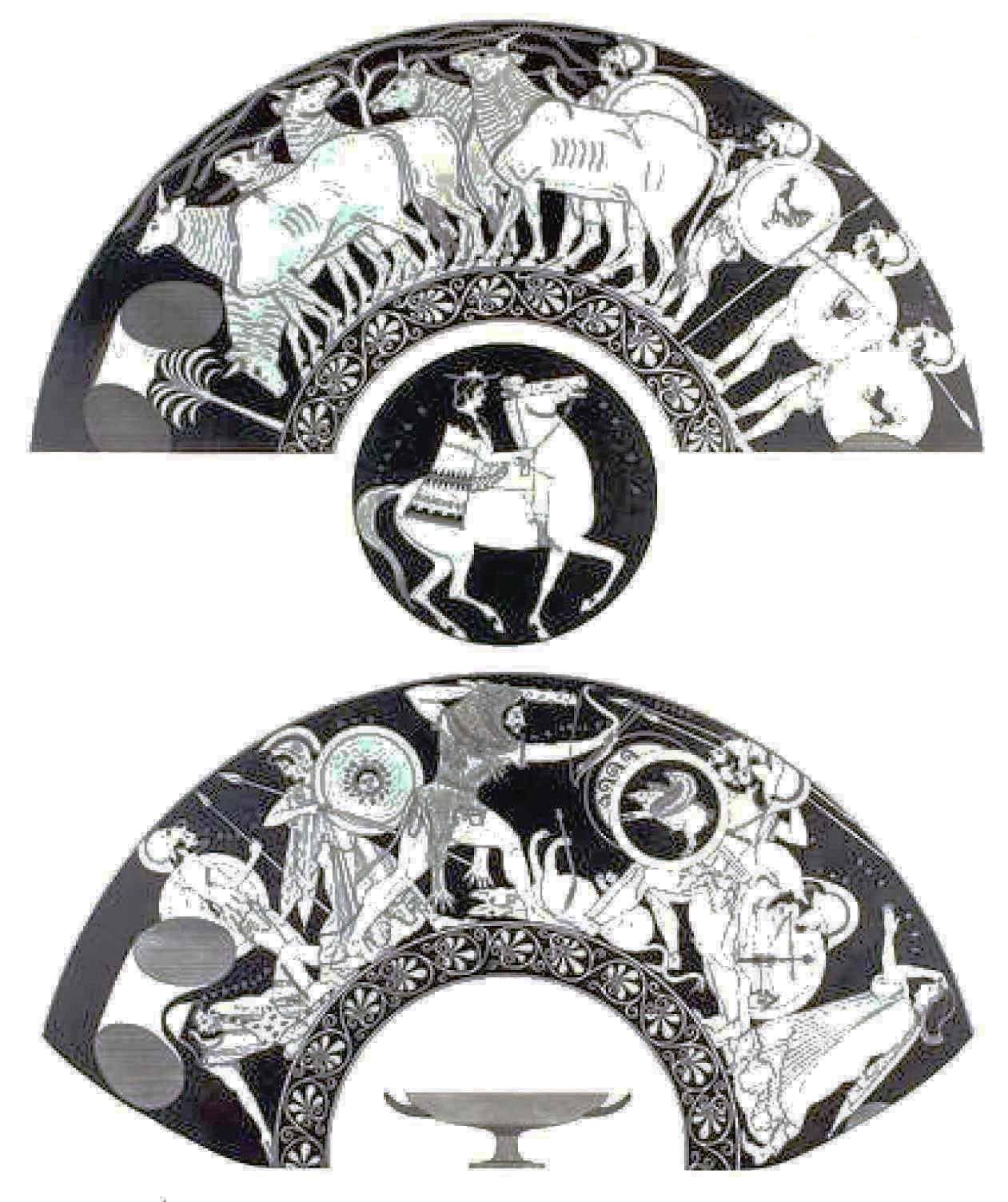
The Onesimos cup at Cerveteri. A red-figure cup signed by Euphronios as potter and painted by Onesimos, with scenes of the sack of Troy, acquired by the J. Paul Getty Museum in fragments between 1983 and 1985. Roughly forty per cent of it came from the Zurich dealer Frieda Tchacos for 180,000 dollars; further pieces came through the Geneva Hydra Gallery, run by Christian Boursaud and suspected of fronting for Giacomo Medici, and through the Schweitzer collection, with an invented Zbinden Collection supplied as provenance. Dietrich von Bothmer of the Metropolitan donated a fragment he had bought from Robert Hecht in 1968. At a conference at Viterbo University in 1997 the archaeologist Maria Rizzo presented evidence that the cup had been illegally excavated from the Cerveteri necropolis and asked the Getty's curator Marion True, in the room, for its return. The Getty returned it on 5 February 1999, together with a torso of Mithras stolen from the Giustiniani collection and a Diadoumenos head stolen from an excavation store at Venosa. Its findspot is the sanctuary of Hercle at Cerveteri, which was not properly excavated until 1993; the cup's foot carries an Etruscan dedication to Hercle. Medici returned two more fragments of it in 2005, and a further fragment showing Talthybius, Agamemnon's herald, was found at Cerveteri in June 2008. The date of the Getty's return is given as 1999 in the Trafficking Culture case file and as 1998 in some Italian reporting.
The Sarpedon cup. Beazley Archive number 7043: a Type B cup signed EUPHRONIOS EGRAPH[SEN], showing Hypnos and Thanatos carrying Sarpedon, with Akamas, all four named, and on the reverse a pyrrhic dance. It is the same subject as the New York krater by the same painter, and it is earlier. Its recorded ownership runs backwards from Villa Giulia in Rome through an unknown private collection, Sotheby's Parke Bernet in New York, the Hunt collection in Texas as number 5, and a loan at the Getty. According to Hecht's own seized memoir he bought it from Medici in the early 1970s for 25,000 dollars after it came out of an Etruscan tomb near Rome in December 1971, and offered it to the Metropolitan in 1973 for 70,000 dollars, which the museum declined. It went through the dealer Bruce McNall to Nelson Bunker Hunt. It sold at Sotheby's on 19 June 1990 and then vanished; Vernon Silver's book of 2009 is an account of the search for it and reports that nobody had seen it in public since the sale. Suzan Mazur, writing in 2005, reported that the buyer, listed at the time as a European dealer, was Medici, and that the cup was found shattered in the Geneva raid on his warehouses and ended up in a cardboard box at Villa Giulia. The Beazley Archive now records it at Villa Giulia, which is consistent with Mazur. In July 2024 it travelled to the Museo Nazionale Cerite at Cerveteri for the exhibition L'Ospite: l'eroe, l'artista, la pieta, where for the first time it stood beside the krater showing the same scene.
The Kyknos krater. Beazley Archive number 7501: a fragmentary calyx-krater signed EUPHRONIOS EGRAPHSEN, with Herakles fighting Kyknos while Athena, Ares, Aphrodite and Artemis look on, all named, and LEAGROS KALOS inscribed. Same route: Hunt collection number 6, Getty loan, Sotheby's Parke Bernet. Shelby White bought it in 1990 for 1.76 million dollars and lent it to the Metropolitan. It was returned to Italy in 2010, as the tenth object under an agreement she and the Italian culture minister Francesco Rutelli announced in January 2008 covering ten pieces, nine of which went back immediately. The Beazley Archive still lists its last recorded collection as Shelby White and Leon Levy, sixteen years after it left them. One published account describes her Euphronios krater as showing Ganymede and Herakles; the database, which reads the inscriptions, says Kyknos.
The von Bothmer fragments at the Metropolitan. Dietrich von Bothmer, the Metropolitan's curator of Greek and Roman art and the man who bought the Sarpedon krater for the museum, assembled a private collection of as many as fifteen thousand vase fragments alongside his official duties, and left it to the museum when he died in October 2009. David Gill has enumerated nine separate Euphronios-related donations from him to the Met before that bequest: three cup fragments attributed to Onesimos and signed by Euphronios as potter (1977.192.3a-c); a neck-amphora fragment (1983.524.2); two cup fragments potted by Kachrylion and attributed to Euphronios (1983.524.3a-b); two further cup fragments (1983.524.4 and 1983.524.5); fifteen neck-amphora fragments that join a vase in the Louvre (1985.228.8a-o); another cup fragment (1988.233.1); eleven fragments of a cup showing Helen carried off by Theseus (1989.382.1); and a fragment with Nessos and Deianeira (1989.382.2). Gill's questions about them are the right ones and remain unanswered: where were they found, who handled them before Bothmer, and what do they join. Dozens of fragments from the bequest have since gone back to Italy, some of them matching vases American museums had already returned, including the Getty's Onesimos cup.
Five objects, one collection of fragments, one pattern. A buyer looking at anything by this maker should assume that the question of how it left the ground is live until it is answered, and should expect the answer to be difficult.
The Metropolitan transferred title to the Sarpedon krater in February 2006 and handed it over in January 2008.
The Metropolitan transferred title to the Sarpedon krater in February 2006 and handed it over in January 2008. The museum's own announcement, dated 22 January 2008, is worth reading for its tone: the krater would remain on view through Sunday 13 January, the replacement loans went up on Wednesday 16 January, and Philippe de Montebello's quoted statement described the krater as having introduced the world to a great ancient master while the new loans illuminated the achievements of his contemporaries. Nothing in the press release says the object was looted.
The policy change came four months later. The Association of Art Museum Directors adopted new guidelines on archaeological material and ancient art with effect from 4 June 2008, deleting the old rolling ten-year provenance test and replacing it with a fixed threshold: a member museum should not normally acquire an object without documentation that it left its country of modern discovery before 17 November 1970, the date of the UNESCO Convention, or was lawfully exported after it. Where a museum acquires something that fails that test, it must publish the object on the AAMD Object Registry, created at the same time.
The guidelines were strengthened again at the AAMD mid-winter meeting in Kansas City in January 2013. The adoption date is given as 30 January 2013 in the association's own press release and as 29 January 2013 on the face of the revised guidelines. The 2013 revision made posting to the Registry part of the AAMD Code of Ethics, required museums to publish all known provenance information and a specific statement of how the acquisition meets the standard, and added guidance for promised gifts and bequests arranged before 2008.
The criticism is as important as the rule. By early 2013 the Registry held some 579 objects from sixteen institutions, of which about 358 came from a single museum, the Walters in Baltimore. David Gill's reading of that pattern is that the Registry can be used two ways: as a genuine instrument of review, which is what Maxwell Anderson did at Dallas when he used it to re-examine earlier acquisitions and send pieces back to Italy, or as a formality. He quotes Lee Rosenbaum's objection directly, that museums keep paying for pieces with problematic pasts and use publication on a registry as a pretext to skirt the very guidelines they profess. Some museums post nothing but a vague provenance and no justification at all.
What actually changed, then, is the burden. Before 1972 a museum needed a reason to refuse an unprovenanced antiquity. After 2008 it needs a documented reason to accept one, and if it cannot produce one it has to say so in public. That is a real shift and this maker's work caused it. What did not change is that the guidelines are voluntary, that they bind only member institutions, that private collectors are outside them entirely, and that a documentary threshold can be met by a good enough forgery of documents. The Beirut ownership story attached to the Sarpedon krater in 1972 was precisely such a forgery, and it would satisfy a 1970 test on its face.
There is no Euphronios market. There are two sale events in the modern era and both are now historical rather than indicative, because every object involved has either passed into state ownership or...
There is no Euphronios market. There are two sale events in the modern era and both are now historical rather than indicative, because every object involved has either passed into state ownership or has been returned to Italy.
The first is the Metropolitan's private treaty purchase of the Sarpedon krater in 1972. It was a negotiated sale, so there is no hammer and no premium to separate. Vernon Silver gives the figure as one million dollars; a figure of 1.2 million with a date of 10 November 1972 also circulates, and that date is identical in form to the museum's accession number. The object record for the krater declines to choose between them and so does this page.
The second is Sotheby's New York on 19 June 1990, the dispersal of the Nelson Bunker Hunt and William Herbert Hunt collections, sale number 6042. Two Euphronios pieces were in it. The Sarpedon cup made 742,500 dollars, reported by one source as 742,000. The Kyknos calyx-krater made 1.76 million dollars, reported elsewhere as 1.7 million. Neither figure is published anywhere located as a hammer price, and both are almost certainly premium-inclusive, which is how Sotheby's reports results. If the buyer's premium then standard on lots at that level was ten per cent, the implied hammer prices are 675,000 and 1.6 million dollars respectively; that arithmetic is this record's inference and not a published split, and it should be checked against the marked catalogue before it is repeated.
Two prices from the trade are more informative than either auction result, because they show the mark-up on an object with no papers. Robert Hecht, according to his own seized memoir, bought the Sarpedon cup from Giacomo Medici in the early 1970s for 25,000 dollars and offered it to the Metropolitan in 1973 for 70,000, which the museum turned down. Seventeen years later the same cup made more than ten times the price the Met had refused to pay.
For anyone valuing a comparable today the honest answer is that the cohort has been withdrawn from the market. The signed pieces are in Cerveteri, Rome, Paris, Munich, Berlin, St Petersburg, London and New York, and the two that were privately held in living memory both went back to Italy. What remains tradeable is fragments, and a fragment of an Attic vase with no findspot is now the hardest category of antiquity to sell to an institution in the United States.
This is an unusually checkable artist for a reader without library access, and the reason is that the primary evidence is inscriptions on objects that are photographed and catalogued.The Beazley...
This is an unusually checkable artist for a reader without library access, and the reason is that the primary evidence is inscriptions on objects that are photographed and catalogued.
The Beazley Archive Pottery Database at Oxford is free and holds records of more than 130,000 pots with 250,000 images. Searching painter or potter for Euphronios returns the whole file; each record gives shape, date, inscriptions, named figures, the attribution and the basis for it, the chain of previous collections, and a publication list running to dozens of entries. The database will tell a reader in one line that vase 7501 is attributed to Euphronios by signature rather than by opinion. It will also show that its collection data can be years out of date, which is itself worth knowing before relying on it.
Kerameikos.org provides the same material as linked open data with stable identifiers, which is the version to use for anything computational. The Corpus Vasorum Antiquorum, the international catalogue of vase collections begun in 1922, is digitised and is where a specific vessel's full publication history lives.
For the provenance side, the Trafficking Culture encyclopaedia at the University of Glasgow maintains case files on the dealers and the objects, and David Gill's Looting Matters is the running record of who returned what and when, with accession numbers.
For the corpus itself the reference remains the material generated by the 1990 and 1991 exhibitions at Arezzo, Paris and Berlin, which brought his painted work together for the first and so far only time: the French catalogue Euphronios, peintre a Athenes au VIe siecle avant J.-C., 270 pages, published by the Reunion des musees nationaux for the Louvre showing of 18 September to 31 December 1990, with sixty-two works illustrated in colour; the Italian Capolavori di Euphronios: un pioniere della ceramografia attica for Arezzo; and the German Euphronios, der Maler for Berlin-Dahlem, 20 March to 26 May 1991, with a colloquium volume published the following year. Reviewing the French catalogue, Gerard Siebert called the exhibition one of the major archaeological and museological events of recent years and said the catalogue would from then on sit in every library whose users care about Greek vase painting. It is the closest thing to a catalogue raisonne this maker has.
And for the historiography, Wilhelm Klein's Euphronios: eine Studie zur Geschichte der griechischen Malerei, the first monograph on him, is scanned in full and free. Its outline drawings are still the clearest published record of the Hermitage psykter, which is a fair measure of how slowly this field replaces its tools.
Vase painter; Potter; Workshop proprietor. active c. 520 - c. 470 BC.
Born c. 535 BC, inferred from the vases and not recorded anywhere, Athens, assumed rather than documented; died after c. 470 BC, the latest date given to a vase he potted, Unknown.
No forged Euphronios vase is recorded in the sources consulted. None of the case files, databases or scholarly reviews consulted records a fake Euphronios. The absence is a finding and it follows from the economics.
Museo Archeologico Nazionale Cerite (Cerveteri); Museo Nazionale Etrusco di Villa Giulia (Rome); Musee du Louvre (Paris); Staatliche Antikensammlungen (Munich); Antikensammlung, Staatliche Museen zu Berlin (Berlin); State Hermitage Museum (St Petersburg).
There is effectively no market. Every signed Euphronios vessel is in a public collection, and the two that were in private hands within living memory both went back to Italy.
Were the painter and the potter the same man? The consensus says yes, on chronology and workshop connections, but nothing outside the pots names Euphronios at all, and the Euphronios problem opened by Hartwig in 1893 has never been closed.
One object in this archive was displayed under a British Museum number for 135 years before the Museum bought it, and the...
11 min read
Of 204 published records in this archive, 85 state that no price for the object exists.
9 min read
In this archive the person who authenticated, acquired or won back an object is repeatedly the person who owned it, named it or...
8 min read
A restitution settles title. It does not settle custody. The masterpiece of the Lydian Hoard went home in 1993 and left again in...
8 min read
Eight records in this archive carry a museum or a state as the seller. The Bodleian sold its First Folio as a duplicate and paid...
11 min read
Last verified 17 September 2026
One artwork and its story every Tuesday, with the picture: who owned it, what it made, and what closes soon in the exhibition calendar. No promotion, and nothing we cannot cite.
We send one email to confirm the address and keep nothing else. Every letter carries a one-click unsubscribe. How we handle your data.