The Euphronios Krater
Euphronios · c. 515 BC; a late Archaic date of c. 510 BC is also published, and the Leagros kalos inscription places it in the range 520-510 BC
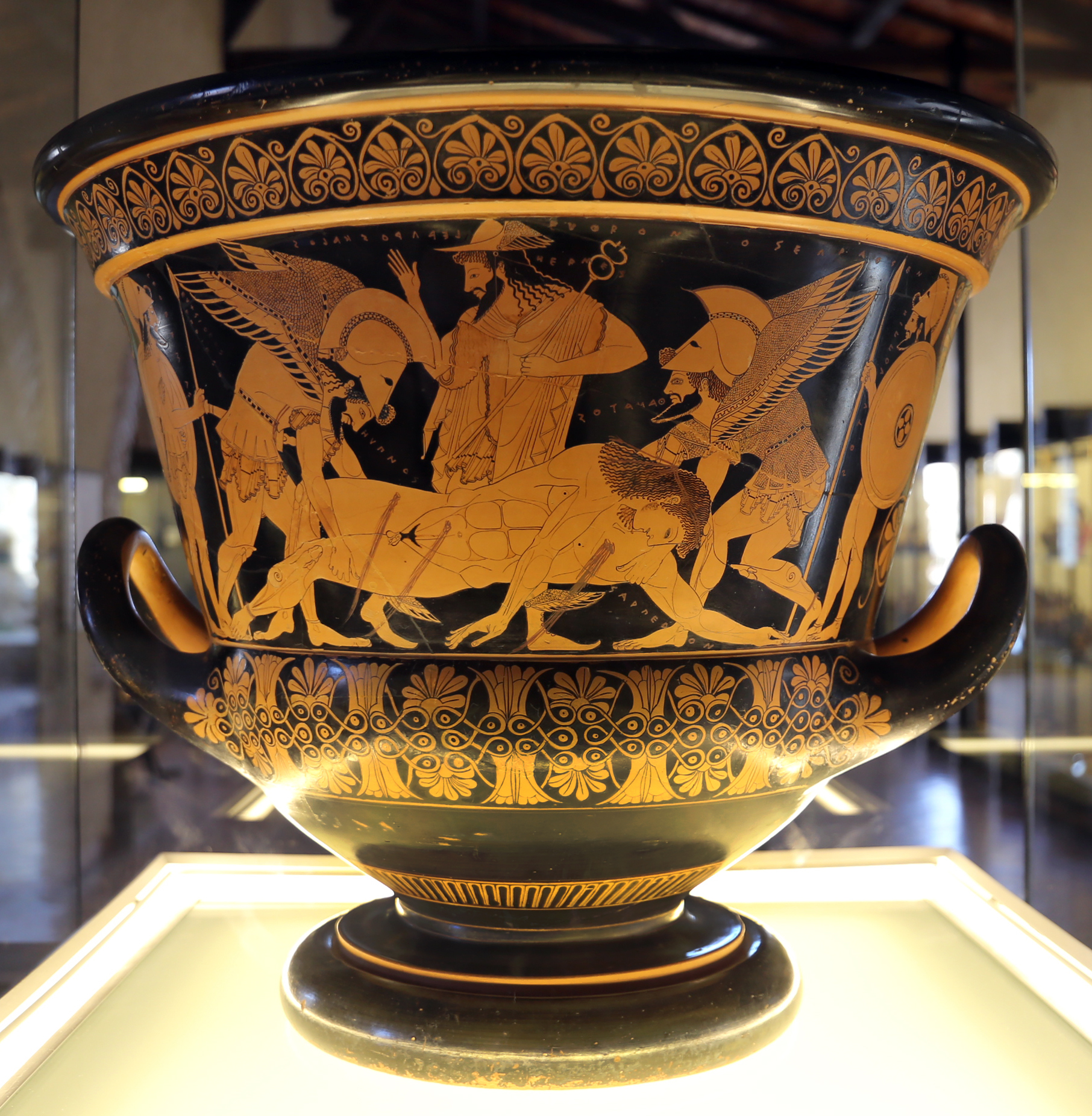
The record subject, entire: the Attic red-figure calyx-krater signed by Euxitheos as potter and by Euphronios as painter, about 515 BCE, on its plinth in the National Archaeological Museum at Cerveteri. Side A carries the death of Sarpedon, the body lifted by the winged figures of Hypnos and Thanatos with Hermes standing between them and the names painted beside the figures. Photographed in the museum by a visitor and released under a free licence by the photographer, not by the museum.
Museo Archeologico Nazionale Cerite, Cerveteri; photograph by Sailko, via Wikimedia Commons · CC BY 3.0| Artist | Euphronios |
|---|---|
| Date | c. 515 BC; a late Archaic date of c. 510 BC is also published, and the Leagros kalos inscription places it in the range 520-510 BC |
| Medium | Terracotta, Attic red-figure, with relief line and diluted slip |
| Dimensions | Height 45.7 cm; diameter 55.1 cm; capacity approximately 45 litres |
| Where it is now | Museo Archeologico Nazionale Cerite, Cerveteri, administered within the Parco Archeologico di Cerveteri e Tarquinia |
| Inventory number | No current Italian inventory number located. Beazley Archive Pottery Database 187. Former Metropolitan Museum accession 1972.11.10; Metropolitan loan number L.2006.10 after title passed to Italy. |
| Attribution | AcceptedBoth makers signed the vase on the obverse: EUXITHEOS EPOIESEN (Euxitheos made it) and EUPHRONIOS EGRAPHSEN (Euphronios painted it). Full note |
| Potter | Euxitheos Signed EUXITHEOS EPOIESEN, Euxitheos made it, on the obverse. |
| Object type | Antiquity |
| Period | Late Archaic, 530-480 BC |
| Cases | Has a provenance gap · Seized, looted or confiscated · Restituted or repatriated |
| Culture | Greek, Attic |
| Genre | mythological narrative |
| Inscriptions | Signatures: EUXITHEOS EPOIESEN, EUPHRONIOS EGRAPHSEN. Kalos inscription LEAGROS KALOS on both sides. Side A names: HYPNOS, HERMES, SARPEDON, THANATOS, HIPPOLYTOS. Side B names: HYPEROCHOS, HIPPASOS, MEDON, AKASTOS, AXIPPOS. All in Attic letters. |
| Owners on record | 9 links5 documented, 3 disputed, 1 unknown |
| Sources | 17 cited |
About this record Last verified 25 August 2026 · 17 sources cited · Change log
On this page 10 sections
ContentsClose
An Attic red-figure calyx-krater of about 515 BC, signed by Euxitheos as potter and by Euphronios as painter, showing the body of the Lycian prince Sarpedon lifted from the field of Troy by Sleep and Death while Hermes looks on. It is the only vase painted by Euphronios that survives complete, and by common consent one of the finest Greek vases in existence.
It is also the most consequential provenance case in the history of the antiquities market. Dug out of an Etruscan tomb at Cerveteri in December 1971 by tomb robbers, it passed through Giacomo Medici to the dealer Robert Hecht and reached the Metropolitan Museum of Art in 1972 at a record price for an antiquity, carrying a Beirut ownership story that had been lifted off a different vase. A New York Times reporter attacked the story within months. It took another thirty-five years, a raid on a Geneva freeport warehouse, four thousand seized Polaroids and a dealer's own handwritten memoir to finish the argument.
The Metropolitan transferred title to Italy in February 2006 and handed the krater over in January 2008. It went first to Villa Giulia in Rome and then, in a decision that most accounts of the case still have not caught up with, to the small municipal museum at Cerveteri, four kilometres from the tomb it was taken from. The rules that now govern how American museums buy antiquities were written because of this pot.
Provenance
Each link is graded. Documented: a cited source supports it. Disputed: the identification is argued but not established. Unknown: no owner for that span, and the gap is not smoothed into a narrative. The grades in the glossary.
- c. 515 BC -Workshop of Euxitheos, Athensdocumented
Thrown by Euxitheos and painted by Euphronios in the Athenian Kerameikos, both signing on the obverse. Euphronios is thought to have joined the Euxitheos workshop around 510 BC, and this vase is normally regarded as the peak of the partnership. The signatures are the documentation; there is no external record of the commission or the first owner.78
- 6th century BC - December 1971Unknown; deposited in a tomb at Caere (Cerveteri)unknown
Exported from Athens to Etruria in antiquity, as the great majority of surviving Attic figured pottery was, and buried as a grave good in the necropolis at Greppe Sant'Angelo. Nothing whatever is documented about the intervening twenty-five centuries: not the tomb's occupant, not the rest of the assemblage, not whether the chamber had been entered before. The ancient repairs on the vessel indicate it was used and mended before it went into the ground.78
- December 1971 - 1971 or 1972Tombaroli, then Giacomo Medicidisputed
Italian court records place the illegal excavation in December 1971 at Greppe Sant'Angelo, on private land. The diggers are reported to have sold the krater to the dealer Giacomo Medici for something in the region of 88,000 dollars. In February 1973 one of the group, Armando Cenere, told the New York Times he had acted as lookout and had been shown a fragment painted with a bleeding man, which corresponds to the Sarpedon figure and its three wounds. The 88,000 figure is a reported one and the currency in which it was actually paid is not established here. Medici contested the case throughout.125
- 1971 or 1972 - August 1972Robert E. Hechtdisputed
Medici is reported to have smuggled the vase into Switzerland and sold it to the American dealer Robert E. Hecht for around 350,000 dollars. Hecht had it restored in Zurich by Fritz Buerki before offering it to the Metropolitan. Hecht denied this account for thirty years. The handwritten memoir seized from his Paris apartment on 16 February 2001 contains two accounts of the acquisition, one naming Medici and a 1971 illegal excavation, one repeating the Sarrafian story. Graded disputed because the two versions are both in Hecht's own hand and no court ever adjudicated between them: his trial ended without a verdict on 16 January 2012 when the limitation period expired.1211
- 1920 (claimed) - 1972 (claimed)Dikran Sarrafian and family, Beirut (claimed)disputed
The provenance offered to the Metropolitan at the time of purchase. Hecht said he was acting on ten per cent commission for the Lebanese dealer Dikran Sarrafian, whose father had bought the vase in London in 1920. Sarrafian supplied letters dated 10 July 1971 and 9 September 1972. The Metropolitan's own defensive investigation after the 1973 press attacks produced a record of 909,000 dollars paid to Sarrafian in Swiss francs on 25 October 1971, before the alleged December excavation, plus affidavits from the restorer Buerki, a Basel photographer and the collector Muriel Newman. The story failed on its own terms: Sarrafian repeatedly described what he owned as a hatbox of fragments, and the Metropolitan's vase is intact and far too large. By 1993 Hoving had concluded that Hecht had transferred the documents of a genuine but fragmentary Sarrafian krater onto this one. That second, poorer krater surfaced with Nelson Bunker Hunt, was acquired by Leon Levy and Shelby White in 1990, and was returned to Italy in 2010. Sarrafian died in a car crash in 1977 and was never questioned.110
- August 1972 - February 2006The Metropolitan Museum of Art, New Yorkdocumented
Hecht notified curator Dietrich von Bothmer of the vase in February 1972; von Bothmer, director Thomas Hoving and deputy director Theodore Rousseau inspected it in Zurich in June; the museum agreed to buy in August 1972 and the krater reached the United States on 31 August. Accession 1972.11.10. The price is reported both as one million dollars, a record for any antiquity, and as 1.2 million dollars with a date of 10 November 1972; that date is identical in form to the accession number, which this record flags rather than resolves. It was a private treaty sale, so there is no hammer and no premium. The museum funded the purchase by deaccessioning its coin collection through Sotheby's, realising close to 2.3 million dollars.123
- February 2006 - January 2008The Italian Republic; on loan to the Metropolitan Museum of Artdocumented
Agreement announced 3 February 2006 and signed in Rome on 21 February 2006 by Philippe de Montebello and the Italian culture minister Rocco Buttiglione. Title to twenty antiquities passed to Italy, the krater and the Morgantina silver among them. Italy waived civil and criminal action against the museum over the restituted pieces and undertook a forty-year cooperation programme including rotating four-year loans of objects of equivalent quality. The krater remained physically in New York under loan number L.2006.10 until after the museum's new Greek and Roman galleries opened. De Montebello, who had opened negotiations demanding incontrovertible evidence, stated that it was highly probable the vase had been taken from an Etruscan tomb.3410
- January 2008 - December 2014Museo Nazionale Etrusco di Villa Giulia, Romedocumented
The krater arrived in Italy and was unveiled in Rome on 18 January 2008, joining the exhibition Nostoi. Capolavori ritrovati at the Palazzo del Quirinale, which ran from 21 December 2007 to 24 March 2008 with sixty-seven to sixty-eight recovered objects from American museums and private collectors. It was then displayed at Villa Giulia, described in contemporary reporting as its permanent home.21216
- December 2014 - presentMuseo Archeologico Nazionale Cerite, Cerveteridocumented
Sent to Cerveteri in December 2014 for a temporary display marking ten years of UNESCO World Heritage listing for the Banditaccia necropolis. Visitor numbers at the museum rose about seventy-five per cent; 23,075 visitors in the first nine months of 2015 against 22,164 for the whole of 2014. On 7 November 2015 the Ministry of Culture announced that the regional museum directorate for Lazio had signed the act definitively transferring the krater and the Euphronios kylix from Villa Giulia to Cerveteri. No 2026 primary confirmation of display status was obtained for this record.6213
Prices realised
| Date | Sale | Estimate | Result | Note |
|---|---|---|---|---|
| 1972-08 | Robert E. Hecht, antiquities dealer, sold privately to the Metropolitan Museum of Art, New York Private dealer purchase, not an auction | Not applicable | Hammer Not applicable; no auction took place With premium USD 1,000,000 by one account, USD 1,200,000 by another; the two published figures are not reconciled in the sources consulted (see note) USD | This was a private purchase from a dealer, not an auction result. The Metropolitan agreed to buy the krater from Hecht in August 1972, after negotiations conducted by director Thomas Hoving, curator of Greek and Roman art Dietrich von Bothmer, and deputy director Theodore Rousseau, who had viewed the piece in Zurich that June; the museum's own accession number, 1972.11.10, records formal accession in November. Two purchase figures are in circulation and neither this record nor its sources reconciles them. USD 1,000,000 appears in Neil Brodie's Trafficking Culture case study, citing Thomas Hoving's own 2001 account of the negotiation, and is repeated in Peter Watson and Cecilia Todeschini's book The Medici Conspiracy, where it is described as the figure most associated with the sale. USD 1,200,000 appears in the Wikipedia entry for the krater, sourced there to New York magazine of 7 December 1981, and in the University of Geneva Art-Law Centre's ArThemis case note on the Italy-Metropolitan dispute. The price was not disclosed at the time of sale; it became public only when reporter Nicholas Gage named a figure in the New York Times of 19 February 1973, which set off the provenance controversy recorded elsewhere in this record. The museum did not pay cash outright: it funded the purchase by consigning its Ward and Durkee collections of ancient coins and medals to Sotheby Parke Bernet, which advanced 1.5 million dollars against the sale and ultimately returned the museum close to 2.3 million dollars in total proceeds. This transaction predates the krater's 2008 return to Italy, which is recorded in the provenance chain above; this row records only what was paid to acquire it, not what it was later found to be worth returning. |
Hammer is the price at which the bidding stopped; with premium adds the fee the house charges the buyer on top. Hammer price and buyer's premium in the glossary.
Technical evidence
| Attribution note | Both makers signed the vase on the obverse: EUXITHEOS EPOIESEN (Euxitheos made it) and EUPHRONIOS EGRAPHSEN (Euphronios painted it). Attribution therefore rests on autograph inscription rather than on connoisseurship, which is the reverse of the normal situation in Attic vase painting, where the overwhelming majority of pieces are unsigned and are grouped into hands by stylistic analysis. This is the only vase painted by Euphronios that survives entire. |
|---|---|
| Object type | Attic red-figure calyx-krater, a vessel for mixing wine with water. Made in Athens. Ancient repairs are present.72 |
| Dimensions | Height 45.7 cm (18 in.); diameter 55.1 cm (21 11/16 in.); capacity approximately 45 litres.2 |
| Technique | Red-figure: the ground is covered in black slip and the figures reserved in the clay colour. Euphronios uses the relief line and diluted slip fired to a range of yellow-to-brown tones to model anatomy, both techniques he was among the first to deploy systematically. The handles, foot and lower body are painted black, deliberately restricting the field available to the figure scene.82 |
| Potter's signature | EUXITHEOS EPOIESEN, on the obverse.7 |
| Painter's signature | EUPHRONIOS EGRAPHSEN, on the obverse.7 |
| Name inscriptions, side A | HYPNOS, HERMES, SARPEDON, THANATOS, HIPPOLYTOS. Explanatory texts as well as names are present. All in Attic letters.72 |
| Name inscriptions, side B | HYPEROCHOS, HIPPASOS, MEDON, AKASTOS, AXIPPOS. One published transcription of the inscriptions gives the third name as MEGON; the reading MEDON is the one used in the museum's own image captions. Not resolved here.7 |
| Kalos inscription | LEAGROS KALOS on both sides. Leagros was the fashionable Athenian youth of the period and the vogue for his name in kalos inscriptions is dated 520-510 BC. This is the dating evidence for the vase; there is no other.72 |
| Date | Usually given as c. 515 BC. A late Archaic date of c. 510 BC is also published. The kalos inscription supports 520-510 BC. The three figures are not in conflict but are frequently reported as though only one existed.27 |
| Condition | Complete. It is the only vase painted by Euphronios to have survived in its entirety; the roughly twenty-seven others attributed to him as painter are fragmentary or partial.28 |
| Findspot | Cerveteri, necropolis of Greppe Sant'Angelo, on private land. No excavation record exists: the tomb was opened clandestinely and its plan, associated grave goods and skeletal material were never recorded.71 |
| Catalogue references | Beazley Archive Pottery Database 187. Metropolitan Museum accession 1972.11.10, later loan number L.2006.10 after title passed to Italy. Published as cat. 4 in the Berlin exhibition catalogue Euphronios. Der Maler, Milan 1991.7 |
The record in full
Chapter 1The best surviving Greek vase was found by men working at night with a spade
The object is a calyx-krater: a bowl for mixing wine with water at a symposium, its lower body flaring out from the foot like the calyx of a flower.
The object is a calyx-krater: a bowl for mixing wine with water at a symposium, its lower body flaring out from the foot like the calyx of a flower. It stands 45.7 centimetres high, measures 55.1 centimetres across the mouth, and holds about forty-five litres. It is terracotta, decorated in the red-figure technique, in which the background is covered with a black slip and the figures are reserved in the colour of the clay, their interior detail drawn in with a raised relief line and washes of diluted slip.
Two things make it exceptional even among the finest Greek pottery. The first is that both men who made it put their names on it. The second is that it is intact. Euphronios is credited with something in the order of twenty-seven painted vases; every other one survives as fragments or as a partial reconstruction. This is the only complete one.
Everything else that can be said about how it came to be a known object begins in December 1971, on private land in the Greppe Sant'Angelo sector of the Etruscan cemetery at Cerveteri, ancient Caere, about forty kilometres north-west of Rome. There is no excavation record, no tomb plan, no inventory of what else was in the chamber and no photograph of the vase in the ground, because the people who took it out were not archaeologists.
Chapter 2Two signatures on one pot is a statement, not a formality
On the obverse the vase carries EUXITHEOS EPOIESEN and EUPHRONIOS EGRAPHSEN: Euxitheos made it, Euphronios painted it.
On the obverse the vase carries EUXITHEOS EPOIESEN and EUPHRONIOS EGRAPHSEN: Euxitheos made it, Euphronios painted it. The verbs matter. Epoiesen claims the throwing and firing of the vessel, egraphsen the drawing on it. The two roles were separate trades in the Athenian Kerameikos and were usually held by different men.
Painters signed occasionally, and normally only their best work. Potters signed less often still. Having both names on the same piece is close to a joint declaration that the two of them considered this the top of their output. It is the single most useful fact in the record, because it means the attribution of this object does not depend on the judgement of any modern scholar. For almost every other Attic vase it does.
The vase also carries, on both sides, the acclamation LEAGROS KALOS, Leagros is handsome. Leagros was the fashionable young Athenian of his moment, and the vogue for his name in these inscriptions is conventionally dated to the years 520 to 510 BC. That inscription, not any stylistic argument, is what dates the krater. Published dates cluster at about 515 BC, with about 510 BC also in the literature.
Chapter 3The picture is a state funeral for a foreign prince
The obverse shows the death of Sarpedon, son of Zeus and Laodameia, king of the Lycians and the most distinguished of Troy's allies, killed by Patroclus in the sixteenth book of the Iliad.
The obverse shows the death of Sarpedon, son of Zeus and Laodameia, king of the Lycians and the most distinguished of Troy's allies, killed by Patroclus in the sixteenth book of the Iliad. Zeus cannot save him from fate, so he sends Apollo to lift the body out of the fighting, wash it, anoint it and hand it to Sleep and Death to carry home to Lycia for burial.
Euphronios paints exactly that transfer. Hypnos and Thanatos, winged and armoured, take the weight of the corpse between them; Hermes stands upright behind, in his function as conductor of the dead; two Trojan hoplites flank the group staring straight out, apparently unaware of what is happening between them. Every figure is labelled. Sarpedon's body is turned toward the viewer and blood runs from three wounds, in the left chest, the abdomen and the right thigh.
The reverse shows something else entirely: four youths arming and a bearded man already in full armour, five named Athenians contemporary with the painter and his customers, named but not heroic. The pairing is deliberate and it is the reason the vase has held its reputation for a century and a half. The mythological scene is drawn in the same idiom as the everyday one. Sarpedon was a youth like these, and Sleep and Death will come for them too. The reverse is also visibly quicker work, painted as the clay of a very large vessel dried and stiffened under the brush.
Chapter 4The Metropolitan paid a record price for an object that had been above ground for eight months
In February 1972 Robert E. Hecht, an American dealer resident in Rome, told Dietrich von Bothmer, the Metropolitan Museum's curator of Greek and Roman art, that the vase existed.
In February 1972 Robert E. Hecht, an American dealer resident in Rome, told Dietrich von Bothmer, the Metropolitan Museum's curator of Greek and Roman art, that the vase existed. In June, von Bothmer, the director Thomas Hoving and the deputy director Theodore Rousseau went to Zurich to look at it. It had been restored there by Fritz Buerki. In August, after some haggling, the museum agreed to buy.
The price is the first thing this record has to be careful about. The figure most often reported as agreed in August 1972 is one million United States dollars, a record for any antiquity. A second figure, 1.2 million dollars, circulates widely, attached to a date of 10 November 1972. That date is also, exactly, the museum's accession number for the object: 1972.11.10. This record does not treat either figure as settled and does not convert them. It was a private treaty purchase, not an auction; there is no hammer price and no buyer's premium to separate, and any dollar figure quoted elsewhere in inflation-adjusted terms is a derived number, not a historical one.
The museum did not pay out of general funds. It raised the money by deaccessioning its coin collection through Sotheby's, ultimately receiving close to 2.3 million dollars from the coin sales. The krater arrived in the United States on 31 August 1972 and was unveiled to the public in November.
Chapter 5The Beirut ownership story was a document transplant
Asked how he had come by it, Hecht said he was not the owner.
Asked how he had come by it, Hecht said he was not the owner. He was acting on a ten per cent commission for a Lebanese dealer in Beirut, Dikran Sarrafian, whose father had acquired the vase in London in 1920 and who had sent it to Switzerland for restoration. Sarrafian supplied two letters, one of 10 July 1971 undertaking to deliver and expecting a million dollars, one of 9 September 1972 setting out the family history.
The story had a defensible shape and the museum defended it hard. After the press attacks of 1973 it produced a bank record showing that Sarrafian had been paid 909,000 dollars in Swiss francs on 25 October 1971, weeks before the December date the Italians gave for the dig. It gathered affidavits: the restorer Buerki said he had received fragments in August 1971, a Basel photographer said he had seen them in September 1971, and the Chicago collector Muriel Newman swore she had been shown fragments by Sarrafian in Beirut in 1964. Hoving, roughly six months after the purchase, sent a private detective to Zurich to firm the account up.
The problem was in the paperwork itself. Sarrafian repeatedly described what he had as a hatbox of fragments. The Metropolitan's krater is a complete vessel; nothing about it fits in a hatbox. By 1993 Hoving had reached the conclusion that there had been two Euphronios kraters, that Sarrafian's really existed and was a poor fragmentary thing, and that Hecht had detached its documents and fastened them to the intact vase from Cerveteri. The lesser krater subsequently surfaced with the Texas oil heir Nelson Bunker Hunt, was bought by Leon Levy and Shelby White in 1990, and was returned to Italy in 2010. Sarrafian himself died in a car crash in 1977 and was never questioned.
Hoving's private reaction on first seeing the invoice, as reported by Peter Watson and Cecilia Todeschini, was that he laughed and said he bet Sarrafian did not exist. He also knew, and later wrote, that Beirut was the standard cover address for smuggled Italian material.
Chapter 6A reporter had it right within four months
On 19 February 1973 Nicholas Gage published in the New York Times an account of how the Metropolitan had acquired what it was calling the finest Greek vase there is.
On 19 February 1973 Nicholas Gage published in the New York Times an account of how the Metropolitan had acquired what it was calling the finest Greek vase there is. It was the first of a series that took the museum's official version apart on its internal inconsistencies. On 24 February Gage interviewed Armando Cenere, who said he had stood lookout for a group of tombaroli digging illegally at Cerveteri in late 1971, and who remembered being shown a fragment from the dig painted with the figure of a bleeding man.
That detail is worth pausing on. The distinguishing feature of the Sarpedon on this vase, the thing a lookout with no Greek and no art history would actually retain, is that the corpse bleeds from three wounds. Cenere described the picture without describing the picture.
It was not enough. There was no seized documentation, no cooperating dealer, no physical exhibit, and Italy at that point had no mechanism for pursuing a foreign museum that declined to be persuaded. The vase stayed in New York for another thirty-five years, and Hoving's own private nickname for it, the hot pot, became the chapter title in his memoirs.
Chapter 7The case was won in a warehouse, not a courtroom
On 13 September 1995 the Carabinieri art squad and the Swiss federal police raided a five-room storage unit of about two hundred square metres in the Geneva Freeport, registered to a company called...
On 13 September 1995 the Carabinieri art squad and the Swiss federal police raided a five-room storage unit of about two hundred square metres in the Geneva Freeport, registered to a company called Editions Services. One room was a cleaning and restoration laboratory; another was fitted out as a showroom. The unit belonged to Giacomo Medici.
It contained roughly 3,800 whole or fragmentary objects, more than 4,000 photographs and 35,000 sheets of paper. The photographs were largely Polaroids of objects that appeared to have come straight out of the ground, often in several states as restoration progressed. That archive is the reason dozens of repatriations happened over the following two decades: it let investigators match a piece on a museum plinth to a photograph of the same piece dirty and in pieces. Two of the images, apparently from May 1987, show Medici and Hecht standing beside the Euphronios krater in the Metropolitan Museum itself.
On 16 February 2001 the Carabinieri raided Hecht's apartment in Paris and took away a handwritten memoir. It contained two versions of how he had obtained the krater. In one he had it from Sarrafian, as he had always said. In the other he had it from Medici, out of a clandestine excavation of 1971. In June 2001 Marion True of the Getty told Italian investigators under oath that von Bothmer had once pointed out the location of the looted tomb on an aerial photograph; von Bothmer denied it.
The criminal outcomes were thin. Medici was convicted on 12 May 2005 and sentenced to ten years and a fine of ten million euros, the heaviest penalty ever imposed in Italy for antiquities offences; on appeal in July 2009 the trafficking count fell to the limitation period, the receiving and conspiracy convictions stood, and the sentence came down to eight years. True's trial ended without a verdict in October 2010 on limitation. Hecht's trial in Rome ended the same way on 16 January 2012, after six years and at the age of 91; he died three weeks later. The prosecutor Paolo Ferri said publicly that cases of this complexity could not be settled inside the limitation periods the law allowed.
The evidence never had to convince a judge about this vase. It only had to convince a museum board.
Chapter 8Italy did not sue. It made an offer the Metropolitan could not refuse
Philippe de Montebello, by then the Metropolitan's director, met Italian officials in November 2005 and initially held that the evidence was inconclusive; his stated standard was incontrovertible...
Philippe de Montebello, by then the Metropolitan's director, met Italian officials in November 2005 and initially held that the evidence was inconclusive; his stated standard was incontrovertible proof. He gave that standard up within months, remarking that he was not a lawyer and that even murder cases were not tried to that bar, and moved to a test of substantial or highly probable illegality. Of the krater he then said it was highly probable that it had been stolen from an Etruscan tomb.
The agreement was announced on 3 February 2006 and signed in Rome on 21 February by de Montebello and the Italian culture minister Rocco Buttiglione. The Metropolitan transferred title to twenty antiquities, the krater and a hoard of Hellenistic silver believed taken from Morgantina in Sicily among them. Italy waived civil and criminal action against the museum over the restituted objects and committed to a forty-year programme of cultural cooperation: rotating four-year loans of archaeological objects of equivalent quality, plus exchanges of students and staff and joint work on excavation, conservation and research.
Italy's legal position rested on a patrimony statute of 1939 vesting state ownership in objects of artistic, historical, archaeological or ethnological interest found in the ground, which makes their export without licence unlawful at the moment of discovery. The lever that actually moved the museums, though, was the threat of losing access to Italian loans altogether. The krater stayed on view in New York until early 2008, after the museum's new Greek and Roman galleries opened, which was itself part of the bargain.
Chapter 9It has gone home twice, and the second move is the one nobody reports
The krater arrived in Italy on 18 January 2008 and was unveiled in Rome the same day.
The krater arrived in Italy on 18 January 2008 and was unveiled in Rome the same day. It joined Nostoi. Capolavori ritrovati, an exhibition of sixty-seven or sixty-eight recovered objects at the Palazzo del Quirinale, inaugurated on 18 December 2007 by President Giorgio Napolitano and the culture minister Francesco Rutelli and open to the public from 21 December 2007 to 24 March 2008. It drew about seventy thousand visitors in its first fifty days and was extended. From there the krater went to the Museo Nazionale Etrusco di Villa Giulia in Rome, and press coverage of the period describes Villa Giulia as its permanent home.
It is not there. In December 2014 the krater was sent to the Museo Nazionale Cerite at Cerveteri for a temporary display marking ten years of UNESCO World Heritage listing for the Banditaccia necropolis. Attendance at that small museum rose by about seventy-five per cent; in the first nine months of 2015 it took 23,075 visitors against 22,164 for the whole of 2014, and the necropolis itself went from 49,770 for 2014 to 69,255 in nine months of 2015. On 7 November 2015 the culture minister Dario Franceschini announced that the regional museum directorate for Lazio had signed the act definitively transferring both the krater and the Euphronios kylix from Villa Giulia to Cerveteri, on the principle that the strength of Italy lies in the link between museums and their territory.
So the vase now sits in a castle-museum in the town it was stolen from, a few kilometres from the necropolis, next to a second Euphronios vessel that the Getty gave back in 1999. Any account that leaves it at Villa Giulia, or at the Metropolitan, is out of date by a decade or more.
Chapter 10What the case changed
Before this vase, an American museum could buy an unprovenanced antiquity on a dealer's assurance and treat the assurance as diligence.
Before this vase, an American museum could buy an unprovenanced antiquity on a dealer's assurance and treat the assurance as diligence. The Metropolitan did exactly that in 1972, in public, at a record price, with the director's own private suspicions on the record decades later.
The Association of Art Museum Directors adopted new guidelines on archaeological material with effect from 4 June 2008, abandoning an earlier rolling ten-year test in favour of a fixed threshold: a museum should acquire an object only where it can be documented outside its country of origin by 1970, the year of the UNESCO Convention on illicit import, export and transfer of ownership of cultural property. Where a member museum acquires something whose history after November 1970 is incomplete, it must post the object publicly to the AAMD Object Registry, which was created alongside the guidelines so that source countries, scholars and claimants can see what has been bought. Thousands of objects have been posted since.
The guidelines are voluntary, they bind only member institutions, and they set a documentary standard that a competent forger of provenance can still meet, as Hecht's document transplant demonstrates in advance. But the burden has moved. In 1972 a museum needed a reason to refuse an object. Since 2008 it needs a reason to accept one. The archives that produced this outcome, the Medici Polaroids and the later Becchina and Symes-Michaelides seizures, are themselves still closed, held in Rome, disclosed selectively through a handful of authorised researchers, with the AAMD asking that they be opened and Medici asserting copyright over his own photographs.
The vase is worth looking at for its own sake, and it repays it. But it earns its place in this archive because it is the object that made provenance a condition of purchase rather than a courtesy.
The artist
Euphronios of Athens, painter, later potter; with Euxitheos, potter
No ancient writer mentions a vase painter. The copious Greek literature on the arts deals with sculptors and panel painters and passes over the Kerameikos in silence, so everything known about Euphronios has been reconstructed from the pots themselves. The reconstruction became possible only in 1838, when the first signature of Euphronios was identified and it became clear that individual hands could be named at all. What follows is therefore a biography assembled from inscriptions and brushwork, and it is unusually solid for a Greek vase painter precisely because he signed.
Exhibited
- 2026Ispirazioni. Vite italiane dell arte grecaAcropolis Museum, Athens (touring to Museo Archeologico Nazionale di Reggio Calabria, Oct-Dec 2026)
Related works
| Work | Relation | Where it is |
|---|---|---|
| Calyx-krater with Herakles and Antaios Euphronios, painter | The other work generally named as his masterpiece Restoration revealed an original outline sketch showing that Euphronios struggled with the dying giant's outstretched arm before resolving it in paint. | Musee du Louvre, Paris, G 103 |
| Fragmentary calyx-krater with Herakles and the Nemean lion Euphronios, painter | Same shape, same workshop period, unique signature formula Signed EUPHRONIOS EGRAPHSEN TADE, Euphronios painted these things, a formula found nowhere else. The reverse carries a bold double komos composition thought to be why he signed it at all. | Musee du Louvre, Paris, G 110 |
| Calyx-krater with athletes in the palaistra Euphronios, painter | Another complete-looking Euphronios calyx-krater, frequently confused with this one in reproduction Dating debated. The vase shape suggests a late work but black-figure carry-overs such as the ivy garland below the mouth argue for an earlier phase. | Antikensammlung, Berlin, 2180; found at Capua |
| Kylix with scenes from the Ilioupersis Euphronios, potter; Onesimos, painter | The other Euphronios vessel looted from Cerveteri and repatriated; now displayed alongside the krater Excavated illegally from the Cerveteri necropolis between 1983 and 1985 and sold in fragments to the Getty Museum, which returned it to Italy in 1999. It shows Euphronios in his later role as potter rather than painter. | Museo Archeologico Nazionale Cerite, Cerveteri |
| The second, fragmentary Euphronios krater Euphronios, painter | The vase whose ownership documents were reportedly transplanted onto this one Identified by Hoving in 1993 as the genuine Sarrafian object. It later passed to Nelson Bunker Hunt, then to Leon Levy and Shelby White in 1990, and went back to Italy when evidence of illegal excavation emerged. | Returned to Italy in 2010 |
| Amphora known as the Revellers Vase Euthymides | Bears the earliest recorded boast of one artist over another in Western art, and the boast names Euphronios Inscribed hos oudepote Euphronios, as never Euphronios. Read variously as a claim about foreshortening or as a jibe at Euphronios's social standing. | Staatliche Antikensammlungen, Munich |
| The Morgantina silver Unknown, Hellenistic | Transferred to Italy under the same February 2006 agreement A hoard of sixteen Hellenistic silver pieces believed taken from Morgantina, returned alongside the krater as part of the twenty-object settlement. | Sicily |
Open questions
- Was the purchase price one million dollars or 1.2 million, and on what date did title actually pass? The widely repeated date of 10 November 1972 is identical in form to the museum's accession number 1972.11.10, which is a coincidence that ought to be checked against the Metropolitan's own acquisition minutes before either figure is repeated again.
- Which tomb at Greppe Sant'Angelo, and what else was in it? No plan, no assemblage record and no skeletal evidence exist, so the archaeological context of the single most famous Greek vase is permanently lost. The number of people buried, the date of the burial and whether other vessels left the chamber at the same time are all unknown.
- Did a genuine second, fragmentary Sarrafian krater exist, and is the object returned to Italy in 2010 from the Levy-White collection the same vessel? Hoving asserted the identification in 1993; no independent confirmation was located for this record.
- Was Dietrich von Bothmer shown the location of the looted tomb on an aerial photograph? Marion True testified under oath in June 2001 that he was; von Bothmer denied it; neither account was tested at trial.
- What did Italy actually lend the Metropolitan in exchange, and is the rotating four-year loan programme agreed in 2006 still running in 2026? The forty-year cooperation term runs to 2046 and its performance appears never to have been publicly audited.
- Where are the Medici Polaroids now and will they be opened? Roughly 4,000 images plus the later Becchina and Symes-Michaelides seizures, possibly more than 100,000 items in total, are held in Rome and released only through a small number of authorised researchers. Medici asserts copyright in his own photographs.
- Is the krater still on display at Cerveteri as of 2026? The last primary confirmation located is the ministerial act announced on 7 November 2015. No current Italian inventory number for the object was found.
Questions about this object
What is The Euphronios Krater?
The Euphronios Krater is an antiquity, dated c. 515 BC; a late Archaic date of c. 510 BC is also published, and the Leagros kalos inscription places it in the range 520-510 BC. Medium: Terracotta, Attic red-figure, with relief line and diluted slip.
Who made The Euphronios Krater, and is the attribution settled?
The attribution to Euphronios is recorded here as accepted. Both makers signed the vase on the obverse: EUXITHEOS EPOIESEN (Euxitheos made it) and EUPHRONIOS EGRAPHSEN (Euphronios painted it). Attribution therefore rests on autograph inscription rather than on connoisseurship, which is the reverse of the normal situation in Attic vase painting, where the overwhelming majority of pieces are unsigned and are grouped into hands by stylistic analysis. This is the only vase painted by Euphronios that survives entire.
Where is The Euphronios Krater now?
Museo Archeologico Nazionale Cerite, Cerveteri, administered within the Parco Archeologico di Cerveteri e Tarquinia. Inventory number No current Italian inventory number located. Beazley Archive Pottery Database 187. Former Metropolitan Museum accession 1972.11.10; Metropolitan loan number L.2006.10 after title passed to Italy..
What has The Euphronios Krater sold for?
Hammer Not applicable; no auction took place; with premium, USD 1,000,000 by one account, USD 1,200,000 by another; the two published figures are not reconciled in the sources consulted (see note). Robert E. Hecht, antiquities dealer, sold privately to the Metropolitan Museum of Art, New York, 1972-08.
What is still unknown about The Euphronios Krater?
Was the purchase price one million dollars or 1.2 million, and on what date did title actually pass? The widely repeated date of 10 November 1972 is identical in form to the museum's accession number 1972.11.10, which is a coincidence that ought to be checked against the Metropolitan's own acquisition minutes before either figure is repeated again.
Sources
- 1Neil Brodie, 'Euphronios (Sarpedon) Krater', Trafficking Culture encyclopedia, University of Glasgow. Primary secondary source for the looting, the dealer chain, prices, the Sarrafian letters, the Metropolitan's 1973 defensive investigation and the 2006 agreement. traffickingculture.org/encyclopedia/...
- 2Wikipedia, 'Euphronios Krater'. TERTIARY. Used for the physical description, the iconographic reading, the kalos dating argument and the Villa Giulia to Cerveteri move. Flagged for replacement with the Berlin 1991 exhibition catalogue Euphronios. Der Maler and with Nigel Spivey's monograph on the vase. en.wikipedia.org/wiki/...
- 3ArThemis case note, 'Euphronios Krater and Other Archaeological Objects - Italy and Metropolitan Museum of Art', Art-Law Centre, University of Geneva. Used for the terms of the 2006 agreement, the Italian statutory basis and the negotiation chronology. plone.unige.ch/art-adr/...
- 4The Art Newspaper, 'Metropolitan to return antiquities to Italy', 1 March 2006. Used for the signing date and place, the signatories and the object count. theartnewspaper.com/2006/...
- 5Neil Brodie, 'Giacomo Medici', Trafficking Culture encyclopedia. Used for the Geneva Freeport raid of 13 September 1995, the contents of the storerooms, Editions Services, and the conviction and appeal record. traffickingculture.org/encyclopedia/...
- 6Ministero della Cultura, press release of 7 November 2015, 'Franceschini, il cratere di Eufronio restera a Cerveteri'. PRIMARY. The ministerial announcement of the definitive transfer, with the visitor figures. cultura.gov.it/comunicato/...
- 7Wikimedia Commons, catalogue description by ArchaiOptix accompanying photographs of the krater at Cerveteri. Used for the full inscription readings, both signatures, the findspot, the Beazley Archive Pottery Database number 187, the former Metropolitan accession and loan numbers, and the Berlin 1991 catalogue reference. commons.wikimedia.org/wiki/...
- 8Wikipedia, 'Euphronios'. TERTIARY. Used for the artist dossier: training, the Pioneer Group, technical innovations, the 1838 signature identification, Beazley and Morelli, the shift to potting, the Acropolis votive base, and the workshop painters. Flagged for replacement with Euphronios und seine Zeit (Berlin 1992) and Beazley, Attic Red-Figure Vase-Painters, 2nd edn 1963. en.wikipedia.org/wiki/...
- 9Association of Art Museum Directors, 'New Acquisitions of Archaeological Material and Works of Ancient Art', guidelines effective 4 June 2008 and the AAMD Object Registry. PRIMARY for the 1970 threshold and the publication requirement. aamd.org/object-registry/...
- 10Peter Watson and Cecilia Todeschini, The Medici Conspiracy, epilogue 'On Fifth Avenue'. Used for de Montebello's shift of evidentiary standard and his quoted remarks, and for Hoving's recorded reaction to the Sarrafian invoice. erenow.org/common/...
- 11Center for Art Law, 'Italian Trial of Robert Hecht Concludes with No Verdict', 23 January 2012. Used for the trial outcome of 16 January 2012, the limitation ruling, Hecht's age and prosecutor Paolo Ferri's comment. itsartlaw.org/2012/...
- 12Ministero della Cultura, 'Nostoi. Capolavori ritrovati in mostra al Quirinale'. PRIMARY. Used for the exhibition dates, venue, object count, inaugurators and attendance. cultura.gov.it/comunicato/...
- 13Wikipedia, 'National Archaeological Museum of Cerveteri'. TERTIARY. Used for the museum's Italian name, its location in the Ruspoli castle, its 1967 foundation and its administration. Flagged for replacement with the Parco Archeologico di Cerveteri e Tarquinia's own catalogue. en.wikipedia.org/wiki/...
- 14ANSA, 'Euphronios kylix on show after return from Getty', 8 May 2014. Used for the kylix: Euphronios as potter, Onesimos as painter, the 1983-1985 looting at Cerveteri, the Getty's 1999 return and the 2014 Cerveteri display. ansa.it/english/...
- 15The Art Newspaper, 'Calls to open looted-art archives grow louder', 2 June 2015. Used for the current status of the Medici, Becchina and Symes-Michaelides archives, their inaccessibility, and the AAMD's request that they be opened. theartnewspaper.com/2015/...
- 16Italy Magazine, 'Euphronios chalice gets permanent home'. Used only as evidence of the state of the record before 2014, when Villa Giulia was reported as the krater's permanent home. Retained deliberately to show what the outdated version of this story looks like. italymagazine.com/featured-story/...
- 17Wikipedia, 'Euthymides'. TERTIARY. Used for the Revellers Vase inscription hos oudepote Euphronios, its Greek text and the competing scholarly readings by Gisela Richter and others. Flagged for replacement with the Munich Corpus Vasorum entry. en.wikipedia.org/wiki/...

Last verified 25 August 2026 · Published 2 August 2026
Change log
2 August 2026 - Record deepened to the house standard: narrative sections, technical evidence, artist dossier, related works and open questions added; provenance chain and auction results replaced with the researched versions; sources rebuilt.
2 August 2026 - Record created at the house standard: researched narrative, technical evidence, maker dossier, graded provenance chain, prices with hammer and premium separated, related works, open questions and sources.
25 August 2026 - Re-verified. Attribution (Euxitheos/Euphronios via the signed inscriptions) re-confirmed unchallenged, no new litigation or claim found. One substantive update: the krater is currently on a temporary loan to the Acropolis Museum, Athens (Ispirazioni. Vite italiane dell arte greca, mid-June-30 August 2026), then scheduled for the Museo Archeologico Nazionale di Reggio Calabria (Oct-Dec 2026); permanent custody remains Cerveteri and this is recorded as a loan note plus an exhibitions entry, not a change to the permanent location. Note: a 1:1 ceramic replica of the krater was donated to the Met in 2023 for teaching use - a copy, not the original, no record change warranted. One source (cultura.gov.it) could not be re-checked this run due to a network-level connection failure in the research environment, not a confirmed dead link; flagged for retry.