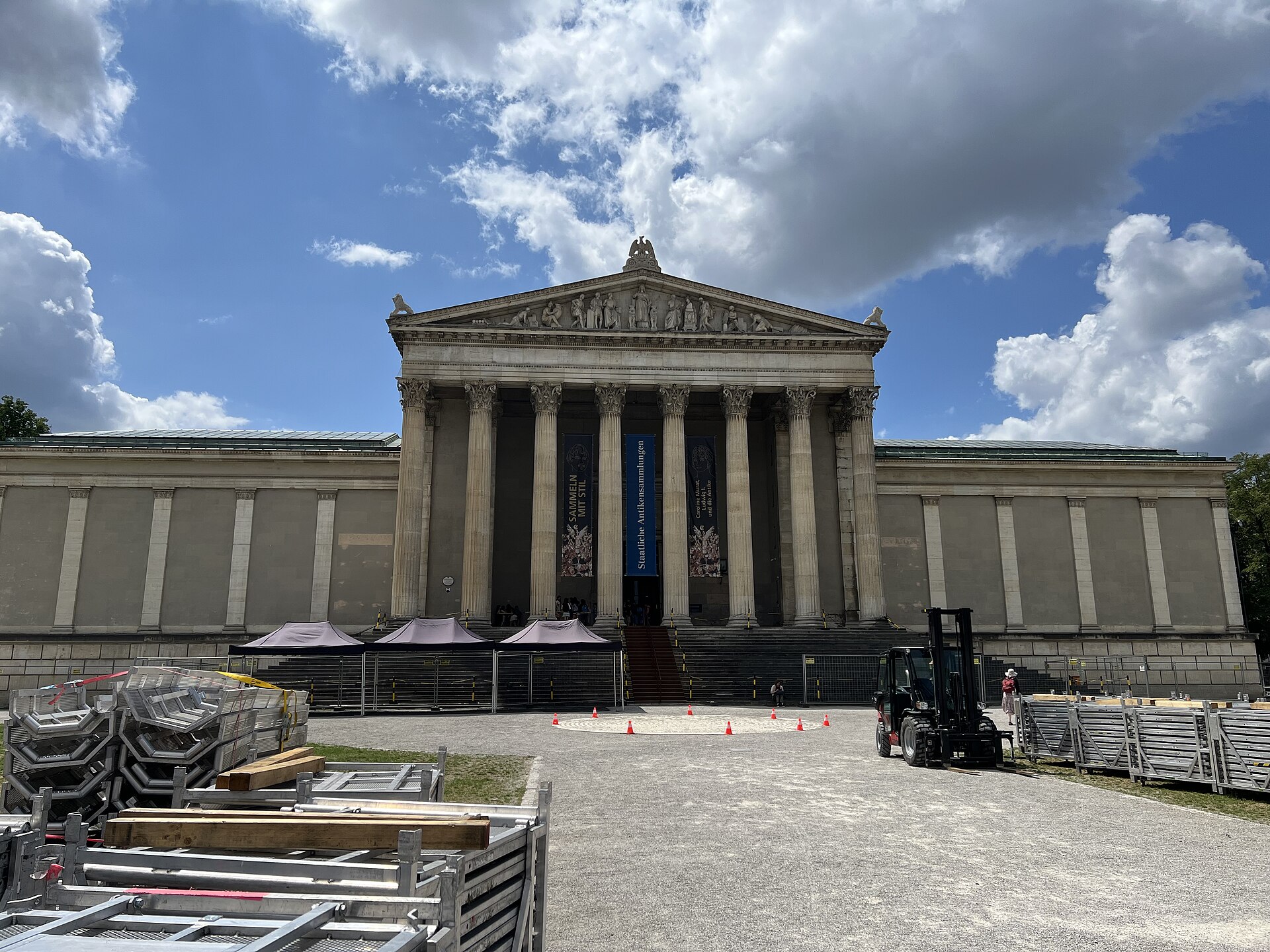
The Corinthian temple front of the Staatliche Antikensammlungen on Koenigsplatz, photographed 23 July 2026 with banners for the special exhibitions Sammeln mit Stil and Caroline Murat, Ludwig I. und die Antike hung between the columns - confirmed as this building by its own banners naming the museum.
Photograph by MaplesyrupSushi, released CC BY-SA 4.0Staatliche Antikensammlungen
Museum · Staatliche Antikensammlungen Muenchen · Founded 1848
Open, admission and hours confirmed 31 August 2026 · 13 sources
On this page 15 sections
ContentsClose
The Antikensammlungen's case rests on being the deliberate other half of a split its own founder made: where the Glyptothek took Ludwig I's monumental sculpture, this museum took everything else the ancient Mediterranean made in miniature - the vase collection alone is judged against the Louvre and the British Museum, and it is set beside gold, glass, gems and bronzes deep enough that most of it can only be shown in rotation. Because it collects Kleinkunst rather than showpieces, the museum's strength is less about any single object than about density: named vase painters across two centuries of Athenian workshop history, an unbroken run from Cycladic figurines to late-antique tableware, and a live, unresolved restitution dispute sitting in its own galleries rather than in an archive.
| Local name | Staatliche Antikensammlungen Muenchen |
|---|---|
| Kind | Museum |
| Founded | 1848 |
| City and country |  Munich, Germany Munich, Germany |
| Address | Koenigsplatz 1, 80333 Munich, Germany |
| Website | antike-am-koenigsplatz.mwn.de/veranstaltungsort/staatliche-antikensammlungen |
| Status | Open, confirmed |
| Record last verified |
Visiting
- Hours
- MonClosed
- Tue-Sun10:00 to 17:00
- Wed10:00 to 20:00Extended Wednesday evening opening
- Closed
- Monday.
- Admission
- Day ticket, regularEUR 6One ticket covers both the Staatliche Antikensammlungen and the Glyptothek on the same day
- Day ticket, reducedEUR 4Joint ticket, both museums
- Sunday rateEUR 1Charged per museum on Sundays, not as a joint ticket
- Annual pass, regularEUR 20Covers both museums for one year
- Annual pass, reducedEUR 15Covers both museums for one year
- Under 18FreeFree entry for children and young people under 18
- Tickets
- antike-am-koenigsplatz.mwn.de/besucherinforma... The museum's own ticket page.
- Do I need to book?
- Not required. Tickets are sold at the museum desks or online through Muenchen Ticket, where the online price carries an extra fee. A single day ticket admits to both the Antikensammlungen and the Glyptothek.
- Address
- Koenigsplatz 1, 80333 Munich, Germany MapU-Bahn U2, station Koenigsplatz
Tram Tram 27, stop Karolinenplatz
Bus Museum line 100, stop Koenigsplatz - Website
- antike-am-koenigsplatz.mwn.de/veranstaltungsort/staatliche-antikensammlungen
- Telephone
- +49 89 289 27502
- [email protected]
Before you go how long, access, photography, bags, eating, shop
- How long to allow
- Not detailed in the sources consulted for this page
- Access
- The museum's own visitor information states plainly that the Antikensammlungen's collection, spread across three exhibition levels, is not step-free: reaching the building means climbing the stairs at the main entrance, there is no lift connecting the three exhibition floors inside, and the toilets are also not accessible. The operator says closing these gaps depends on a full renovation of the building that it is actively pushing for. Its sister museum the Glyptothek, across Koenigsplatz, has step-free access at its north entrance and is fully wheelchair-accessible inside; portable folding stools are offered at both houses for visitors with limited mobility, and blind visitors may request gloves at the Glyptothek to touch the sculptures on request.
- Photography
- Not detailed in the sources consulted for this page
- Bags
- Not detailed in the sources consulted for this page
- Eating
- A shared Museumscafe for both the Antikensammlungen and the Glyptothek operates in the Glyptothek's inner courtyard and in Saal VIII, serving Italian coffee, a Franconian museum wine, panini and cake. A day pass for the cafe costs 1 EUR and an annual cafe pass 2.50 EUR, separate from museum admission.
- Shop
- Not detailed in the sources consulted for this page
Prices and hours change. We take them from the institution's own pages and print the day we read them, and you can check the current position at the source we used. Confirm before you travel.
What is inside
Greek vase galleries
The core of the collection and the reason it exists at all: a run of Greek pottery from the Geometric period into the Hellenistic age that the museum's own literature and independent sources alike describe as rivalled only by the Louvre and the British Museum in scale and quality. Named painters and potters represented include Exekias, the Amasis Painter, the Andokides Painter and the Berlin Painter, spanning the invention of the red-figure technique out of the older black-figure style.
Etruscan collection
Etruscan bronzes, mirrors and painted terracottas, including the unique Etruscan head vessel modelled as the death-demon Charun, tattooed and hook-nosed, with a silen-like creature from Dionysus's retinue on its reverse. The Etruscan holdings sit alongside the Greek and Roman material rather than in a separate building, part of the museum's original brief to cover Greece, Etruria and Rome together.
Gold and jewellery
Greek and Etruscan goldwork, including a funerary wreath from Armento in southern Italy and a diadem from the Black Sea region, plus more than 700 engraved gems from the Helmut Hansmann collection. This is minor art in the technical sense the museum's own history page uses the word - Kleinkunst, small-scale decorated objects rather than monumental sculpture - but it is where the collection's material value and craftsmanship are most concentrated.
Glass and bronzes
Roman glass, including network cage cups (Diatretglas) of the kind found in a Cologne grave, cut from a single blank so that an outer cage of glass loops floats free of the inner cup, connected only by short glass struts left intentionally unbroken - one of the technically hardest objects Roman craftsmen ever produced. Bronze statuettes and mirrors in the same rooms include pieces from banker James Loeb's donated collection.
Roman terracottas and terra sigillata
Roman red-gloss tableware (terra sigillata) drawn substantially from a donation by Professor Klaus Wilhelm, alongside terracotta figurines from archaeologist Paul Arndt's collection, one of the museum's founding 20th-century donations. The material runs the collection's chronological range out to late antiquity, around the 5th century AD.
What to see first
Dionysus Cup (Exekias kylix, inv. 2044)
Exekias, Attic black-figure, about 530 BCAn eye-cup whose interior shows Dionysus reclining in a ship as the pirates he has turned to dolphins circle him in the sea - the earliest known Athenian depiction of the god sailing to Athens set inside the bowl of a drinking cup, on a coral-red ground, by the potter and painter widely ranked the finest of the black-figure period.5
Belly Amphora by the Andokides Painter (Munich 2301)
Andokides Painter, about 520-510 BCA bilingual vase: the same scene of Herakles reclining at a symposium with Athena is painted twice on the one pot, once in the old black-figure technique and once in the new red-figure technique the Andokides Painter is credited with inventing, making it a rare side-by-side demonstration of a technical revolution rather than a report of one.6
Kopfgefaess Charun - head vessel of the Etruscan death-demon
Etruscan, about 400-350 BCA drinking vessel shaped as the tattooed, hook-nosed face of Charun, the Etruscan demon who struck the dying with a hammer rather than ferrying them like his Greek namesake Charon - a unique surviving object and one of the clearest single images of how Etruscan religion imagined death differently from its Greek neighbours.9
Cage cup (Diatretglas) from Cologne, inscribed BIBE MULTIS ANNIS
Roman, Cologne workshop, about AD 300-350A drinking vessel cut from a single thick glass blank so an openwork cage, here spelling out the toast Drink for many years around the rim, floats free of the inner cup on short glass struts - a technique so exacting that only a small number of intact examples survive worldwide, and this one has never been broken since it was buried.8
Funerary wreath (Garland) from Armento
Greek South Italian, 4th century BC, goldA gold wreath of the kind laid on the dead in Greek burials of southern Italy, delicate enough that most surviving examples anywhere have been damaged or reconstructed; it stands for a category of ancient goldwork that rarely survives intact at all.4
Gold diadem from the Black Sea region
Hellenistic, about 150 BC, goldA diadem from the Greek colonial world on the Black Sea's northern shore, part of the same holding of ancient goldwork as the Armento wreath and a marker of how far Greek luxury craftsmanship travelled from the Aegean.4
Marble base of the Discobolus Palombara
17th-century Roman base for a 2nd-century AD Roman marble copy of a lost Greek bronze originalThe one surviving half of a pairing history split apart: Hitler bought the Discobolus Palombara statue from its Italian owner in 1938 under pressure from Mussolini, the Allies restituted the statue itself to Italy in 1948, and the base stayed in Munich. In December 2023 the Antikensammlungen's counter-request for the statue itself, after Rome's National Roman Museum asked for the base back, was flatly refused by Italy's culture minister - an open, unresolved dispute sitting inside the museum's own galleries rather than in a footnote about them.10
Exhibitions on now
- On now8 Jul 2026 to 17 Jan 2027Confirmed , 6 weeks ago
A temple built for trade fairs, not for antiquities
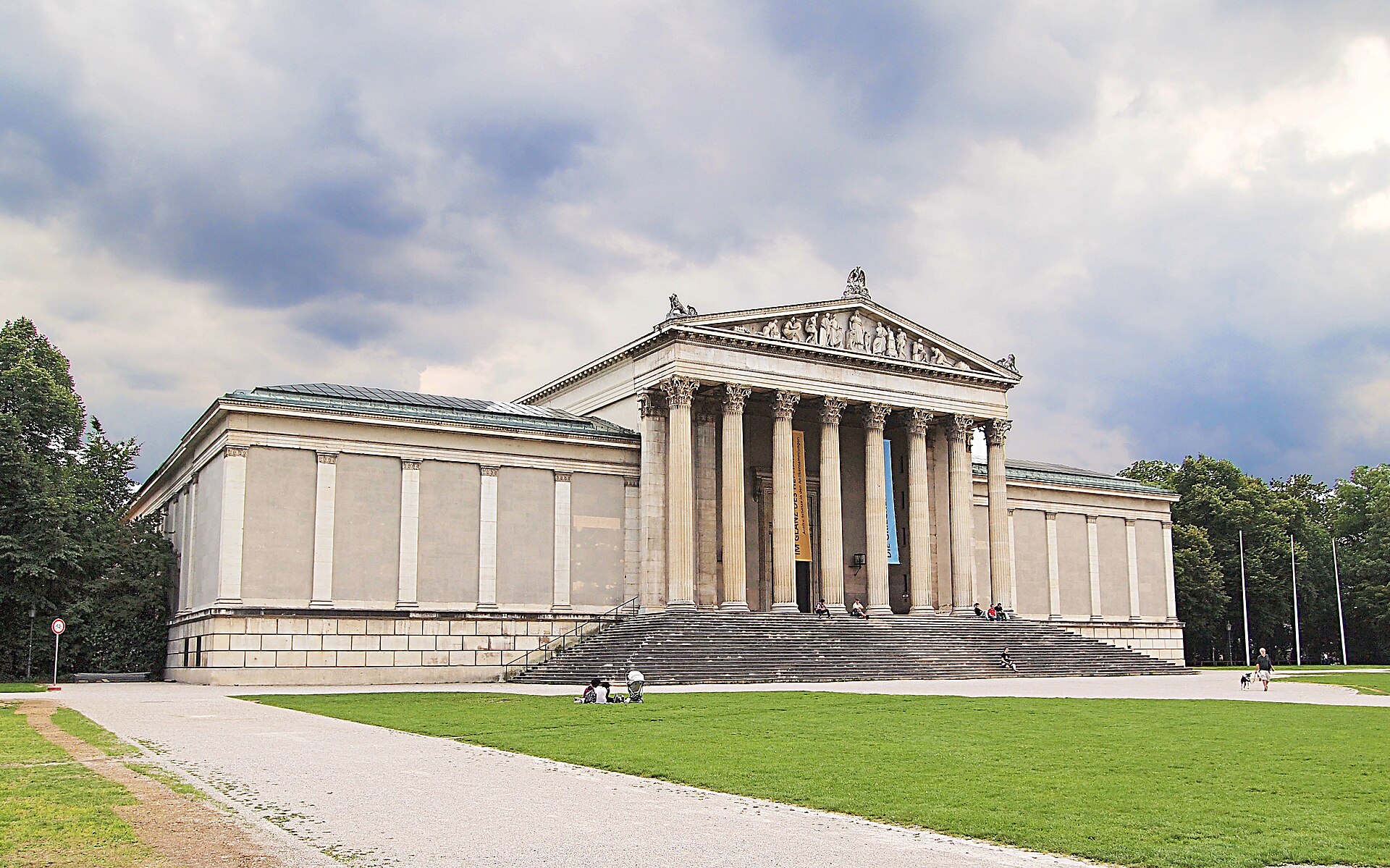
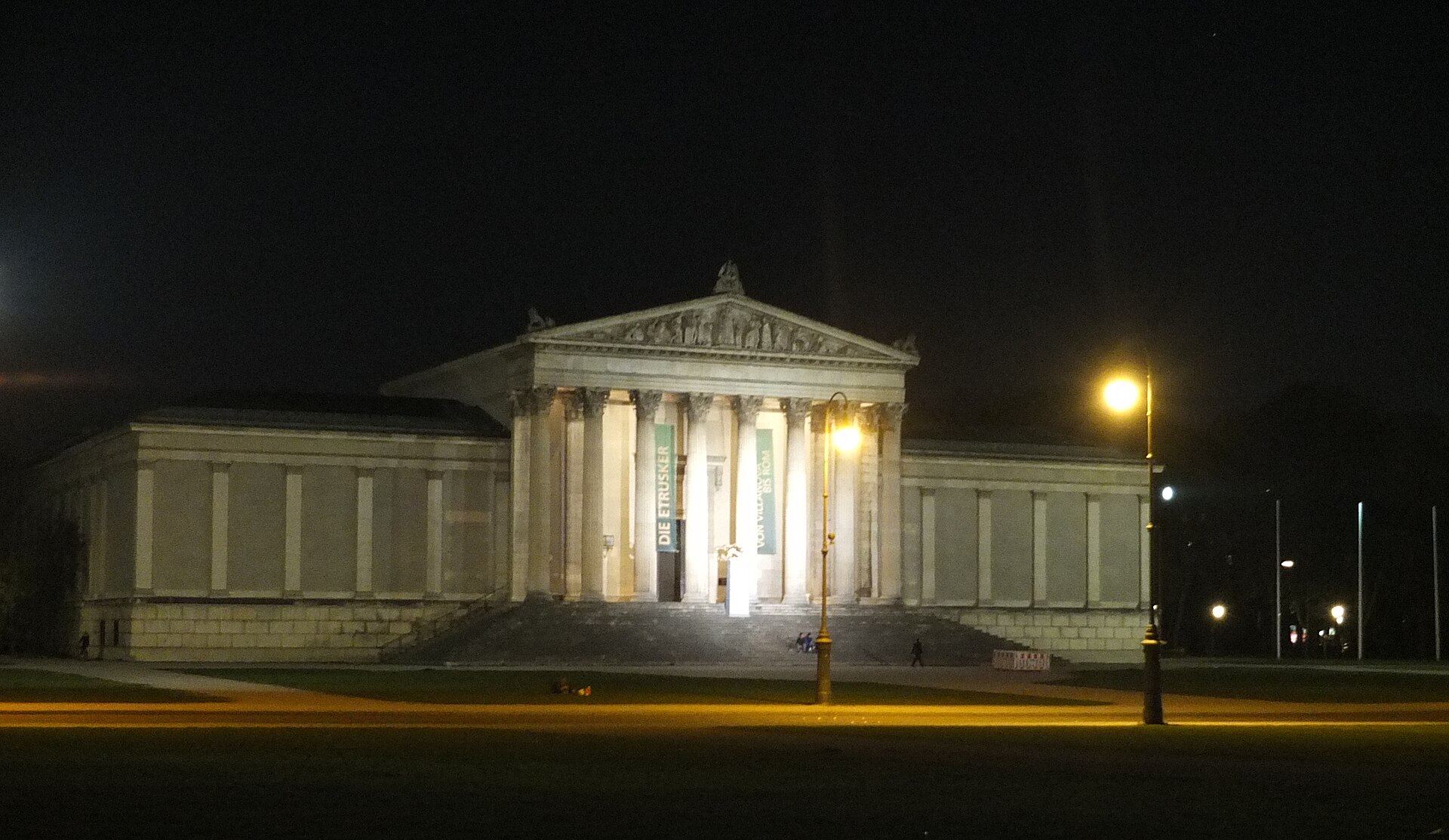
The building at Koenigsplatz 1 was not designed to hold the Staatliche Antikensammlungen's collection at all. Georg Friedrich Ziebland built it between 1838 and 1848 for King Ludwig I as a Kunst- und Industrie-Ausstellungsgebaeude, an art and industry exhibition hall in the form of a Corinthian temple, raised alongside the abbey and basilica of St Bonifaz that Ziebland built at the same time immediately to its south. It fulfilled that original purpose for only eight years. From 1856 the building passed through a string of unrelated occupants: the royal Antiquarium from 1869 to 1872, the Munich Secession from 1897, and after the First World War the Neue Staatsgalerie, a gallery of contemporary painting with no connection to antiquity at all.
The Second World War came close to erasing the building rather than merely repurposing it again. It was heavily damaged, chiefly inside, and postwar reconstruction gutted and rebuilt the interior rather than restoring it piece by piece. It reopened only in 1967, under the name it carries today, as the Staatliche Antikensammlungen - meaning the museum a visitor walks into now has occupied its temple front for less than sixty of the building's roughly 190 years, a fact the banners hung between Ziebland's Corinthian columns do not mention.
Ludwig's vases, kept apart from Ludwig's marbles
The collection itself is older than the building and older than the museum's various 19th-century occupants. Its earliest holdings trace to Duke Albrecht V of Bavaria in the mid-16th century, but the collection that matters for what is on the walls today was assembled by Ludwig I, beginning while he was still crown prince and continuing as king, with a stated preference for quality over quantity in his purchases of Greek vases from Italian excavations. Ludwig split his antiquities collecting institutionally as well as physically: the Glyptothek, opposite on Koenigsplatz, was built to hold his marbles and bronzes of monumental sculpture, while what became the Antikensammlungen held everything else - vases, jewellery, glass, terracottas, small bronzes - the category art history calls Kleinkunst, small-format decorated objects, to distinguish it from architecture, sculpture and painting. A visitor who has seen the Glyptothek and assumes its neighbour is more of the same has misunderstood what the two buildings were built to divide between them: one holds the figures, the other holds almost everything they used, wore, drank from and were buried with.
What three floors of Kleinkunst actually cover
The permanent collection, spread across three exhibition levels inside the building, runs from Cycladic art of the third millennium BC through to late antiquity around the 5th century AD - a chronological span of roughly three and a half thousand years inside one Neoclassical shell. Greek vase painting is the collection's largest and best-known holding, described in the museum's own material and independently by reference sources as comparable in scale and importance only to the Louvre and the British Museum, running from the earliest Geometric abstraction through the invention of red-figure technique to the naturalism of the Hellenistic period. Etruscan bronzes, mirrors and terracottas sit alongside it, Roman glass and terra sigillata tableware extend the range into the imperial period, and a separate holding of gold jewellery and more than 700 engraved gems - largely the gift of collector Helmut Hansmann - covers material that rarely survives in this condition anywhere. Twentieth-century donors shaped large parts of what is now on view: archaeologist Paul Arndt's terracottas, banker James Loeb's bronzes and jewellery, and as recently as 2025 a further gift of Greek vases from the Schneider collection, meaning the museum's holdings are still actively growing rather than fixed at some point in the 19th century.
One pot painted twice, to prove a new technique worked
Two vases in the Greek galleries carry more art-historical weight than their modest size suggests. The Dionysus Cup, an eye-cup signed by the potter and painter Exekias around 530 BC, sets its main scene inside the bowl rather than on the outer wall: Dionysus reclining in a ship as dolphins - the pirates he has just transformed - circle him in painted sea, against a coral-red ground rather than the usual plain clay. It is the earliest known Athenian image of the god's voyage to Athens placed where only a drinker looking down into an emptying cup would see it, by a painter widely regarded as the most technically accomplished of the black-figure period. A generation later, the Andokides Painter used a different vase, the Munich 2301 belly amphora, to make an argument rather than tell a myth: the same scene, Herakles reclining at a symposium as Athena hands him a flower, is painted twice on the same pot, once in the old black-figure technique and once in the red-figure technique the painter is credited with inventing. Bilingual vases of this kind are rare specifically because they were not made to be sold as art in the modern sense - they were technical demonstrations, and Munich holds one of the clearest surviving examples of a working potter proving a new method beside the old one rather than simply replacing it.
A statue that went home in 1948, and the base that stayed
The museum's most active piece of unfinished business is not a vase but an empty plinth. The Discobolus Palombara, a 2nd-century AD Roman marble copy of a lost Greek bronze discus-thrower, was unearthed at a Roman villa in 1781 and later became one of the objects Adolf Hitler personally acquired for Munich in 1938, buying it from its private Italian owner under direct pressure from Mussolini and against the objections of Italy's own education ministry and heritage officials. After the war the statue was restituted to Italy in 1948 as looted Nazi-era property and now stands in Rome's National Roman Museum. What did not travel back was its base, a 17th-century marble support that had been added to the ancient sculpture long before Hitler bought it, and which has remained in the Antikensammlungen's holdings in Munich ever since.
The dispute over that split resurfaced in December 2023, when the National Roman Museum's director asked Munich to send the base back to reunite it with the statue. The Antikensammlungen responded not by agreeing but by asking for the entire Discobolus Palombara instead, arguing the 1948 transfer of the statue to Italy had itself been improper. Italy's culture minister rejected the German counter-request outright, describing the statue as part of Italy's national heritage and the German claim as inadmissible. Neither side has since reported a resolution. The base sits in Munich's galleries today exactly as it did before the request was made - a rare case of a live restitution argument that a visitor can stand in front of, rather than read about after it has already been settled.
One ticket, two temples, and a building that cannot fully welcome its own visitors
The Antikensammlungen has never sold itself as a stand-alone stop. Its day ticket, at 6 EUR regular and 4 EUR reduced, admits to the Glyptothek as well on the same day, a joint-ticket model the two museums have run for years under their shared operating name, Antike am Koenigsplatz. Sunday pricing breaks the two houses apart again, charging 1 EUR per museum rather than one combined fee, and under-18s enter both museums free at any time. The arrangement reflects an administrative reality a visitor planning a single day should know before arriving: the Antikensammlungen and the Glyptothek are separately built, separately collected and separately staffed, but have not been separately priced for years.
What the shared ticketing does not smooth over is a difference in physical access between the two buildings. The Glyptothek's north entrance is step-free and its galleries are fully wheelchair-accessible; the Antikensammlungen's own visitor information states, without qualification, that its building is not - the only way in is the stairway at the main entrance, there is no lift connecting its three internal exhibition levels, and its toilets are not accessible either. The museum's own text attributes this to the building's history as a converted exhibition hall rather than a purpose-built museum, and says the gap can only be closed by a full building renovation it says it is pushing for. Until that happens, a shared ticket buys equal access to one museum and unequal access to the other.
What visitors say
Visitor commentary treats the Antikensammlungen as the less-visited, more specialist half of the Koenigsplatz pair, consistently discussed alongside the Glyptothek rather than on its own, and repeatedly singles out the vase and gold collections as more important than the crowds suggest. The Neoclassical Ziebland building and its position facing the Glyptothek across the square draw as much comment as anything inside. The most concrete visitor complaints are practical rather than about the collection itself - cloakroom and belongings storage came up unprompted in more than one account - and the museum's own published accessibility statement confirms a real structural limitation rather than a matter of opinion.
What is praised, what is criticised
- Praised: the depth and quality of the Greek vase collection, named by visitors among the most important holdings of its kind outside Greece and Italy
- Praised: the Ziebland Neoclassical building itself and its setting on Koenigsplatz, facing the Glyptothek
- Praised: the low Sunday admission of 1 EUR per museum, noted favourably against the price of Munich's larger state museums
- Criticised: the organisation of the visitor cloakroom and belongings storage, called out by name in more than one visitor account as poor even where the collection itself was praised
- Criticised: the building's accessibility: the operator's own visitor information states the Antikensammlungen has no lift between its three exhibition floors and is reached only by the stairs at the main entrance, unlike the step-free Glyptothek opposite
Ratings on other platforms
Trip.com: 4 from 30 ratings, read 31 August 2026
A platform average is a tertiary source: it moves, it is not audited, and we quote no visitor's words.
Questions about Staatliche Antikensammlungen
Where is Staatliche Antikensammlungen?
Koenigsplatz 1, 80333 Munich, Germany.
How much does it cost to visit?
Day ticket, regular: EUR 6; Day ticket, reduced: EUR 4; Sunday rate: EUR 1; Annual pass, regular: EUR 20; Annual pass, reduced: EUR 15. As confirmed 31 August 2026.
When is it open?
Mon closed; Tue-Sun 10:00-17:00; Wed 10:00-20:00. Closed: Monday. As confirmed 31 August 2026.
How do you get there?
U-Bahn: U2, station Koenigsplatz; Tram: Tram 27, stop Karolinenplatz; Bus: Museum line 100, stop Koenigsplatz.
What should you see first?
Dionysus Cup (Exekias kylix, inv. 2044) (Exekias, Attic black-figure, about 530 BC); Belly Amphora by the Andokides Painter (Munich 2301) (Andokides Painter, about 520-510 BC); Kopfgefaess Charun - head vessel of the Etruscan death-demon (Etruscan, about 400-350 BC); Cage cup (Diatretglas) from Cologne, inscribed BIBE MULTIS ANNIS (Roman, Cologne workshop, about AD 300-350); Funerary wreath (Garland) from Armento (Greek South Italian, 4th century BC, gold); Gold diadem from the Black Sea region (Hellenistic, about 150 BC, gold).
What we could not confirm
- The Antikensammlungen's December 2023 counter-request for the return of the Discobolus Palombara statue, after Italy asked for the marble base back, does not appear to have been resolved in the sources consulted for this page; the base's current legal and diplomatic status was not established beyond the original refusal by Italy's culture ministry.
- The sources consulted describe the permanent collection as arranged across three exhibition levels but do not publish a room-by-room or floor-by-floor plan, so a precise account of which departments sit on which floor was not established.
- Tripadvisor's own aggregate rating and review count for the museum could not be read directly - the platform returned a bot block on every fetch attempt tried for this page - so the rating cited here is Trip.com's aggregation rather than Tripadvisor's own score.
Images
Sources
- 1Antike am Koenigsplatz, Besucherinformationen (opening hours, admission prices, contact, accessibility, cafe) antike-am-koenigsplatz.mwn.de/besucherinformationen/
- 2Antike am Koenigsplatz, venue page for the Staatliche Antikensammlungen antike-am-koenigsplatz.mwn.de/veranstaltungsort/staatliche-antikensammlungen/
- 3Antike am Koenigsplatz, Staatliche Antikensammlungen - ein Museum von Weltruhm (history and collection scope) antike-am-koenigsplatz.mwn.de/en/state-collections-of-antiquities-a-museum-of-world-renown/
- 4Wikipedia, Staatliche Antikensammlungen en.wikipedia.org/wiki/Staatliche_Antikensammlungen
- 5Wikipedia, Exekias (Dionysus Cup, Staatliche Antikensammlung inv. 2044) en.wikipedia.org/wiki/Exekias
- 6Wikipedia, Belly Amphora by the Andokides Painter (Munich 2301) en.wikipedia.org/wiki/Belly_Amphora_by_the_Andokides_Painter_(Munich_2301)
- 7Wikidata, Staatliche Antikensammlungen (Q707981) wikidata.org/wiki/Q707981
- 8bavarikon, Diatretglas (Roman cage cup, Cologne, about AD 300-350) bavarikon.de/object/bav:SAG-OBJ-000000000NI12129?lang=de
- 9bavarikon, Kopfgefaess Charun (Etruscan head vessel) bavarikon.de/object/bav:SAG-DDD-00000B3D00000139
- 10The Times of Israel, Italy refuses German request to return ancient Roman statue bought by Hitler, 3 December 2023 timesofisrael.com/liveblog_entry/italy-refuses-german-request-to-return-ancient-roman-statue-bought-by-hitler/
- 11Trip.com, Staatliche Antikensammlungen attraction page, rating and review count, read 31 August 2026 us.trip.com/travel-guide/attraction/munich/staatliche-antikensammlungen-13522660/
- 12Wikimedia Commons, Category:Staatliche Antikensammlungen - Building commons.wikimedia.org/wiki/Category:Staatliche_Antikensammlungen_-_Building
- 13muenchenwiki.de, Staatliche Antikensammlungen (building history: 1838-1848 construction, WWII damage, 1967 reopening) - live site unreachable 2026-08-31 (connection reset, not a bot-wall), cited via Wayback Machine snapshot dated 2025-06-13 which was fetched and verbatim-checked web.archive.org/web/20250613032947/https://www.muenchenwiki.de/wiki/Staatliche_Antikensammlungen