The Sale That Broke the Object
In this archive the commonest reason an object is in pieces is not war, time or accident. It is a sale. Breaking a thing up paid better than keeping it whole, and it destroyed the evidence too.
Records in this piece: The Beauvais Missal, Emperor Xiaowen and his entourage worshipping the Buddha, The Mocking of Christ, The Aldobrandini Tazze, The Cheapside Hoard, The Amaravati Collection, The Archimedes Palimpsest, Krishna Lifting Mount Govardhan, The Benin Bronzes, The Unicorn Tapestries, The Warwick Vase
On this page 7 sections
ContentsClose
In short
- Philip Duschnes bought the Beauvais Missal whole for 1,000 dollars in October 1942 and began selling its leaves at 25 to 40 dollars each within a month. The codex had 309 leaves.
- The leaf carrying the 1356 ownership inscription, the document that fixed the missal's earliest known owner, was lost in the dismemberment.
- Otto Ege published a defence of book breaking in the March 1938 issue of Avocations, four years before the missal reached him, arguing that scattering leaves put originals into many more hands.
- The Binyang Central Cave reliefs were removed piecemeal in repeated illicit excavations by local looters selling to an international market; the Metropolitan's panel is now largely plaster infill.
- Dismemberment corrupts the record as well as the object: of the six Aldobrandini Tazze that passed through the dealer Frederic Spitzer, three were mismatched when sold in 1893, one tazza in the set today is a wholly nineteenth-century composite, and the manuscript describing the set's scenes has been missing since that year.
The commonest cause of a broken object in this archive is a sale
Where a record in this archive describes an object that survives in pieces, the event that broke it is more often a transaction than a catastrophe. Fire, flood, iconoclasm and war are all present in the corpus, and they account for less of the damage than the moment somebody worked out that the parts would fetch more than the whole. That calculation recurs across four centuries, three continents and every material this publication covers.
The arithmetic is not subtle. A bound manuscript sells once, to one buyer, at one price. Three hundred leaves sell three hundred times. A wall relief is unsaleable and unshippable; a crate of fragments is neither. A set of twelve matching cups has one market; twelve separated cups have twelve.
The consequence that matters for research is second-order. Breaking an object up does not only scatter it. It destroys the parts of it that carried the evidence of what it was, and it makes the eventual reassembly wrong in ways nobody records. Both of those are visible in these records, and both are traceable to the sale.
The Beauvais Missal was worth more as leaves than as a book
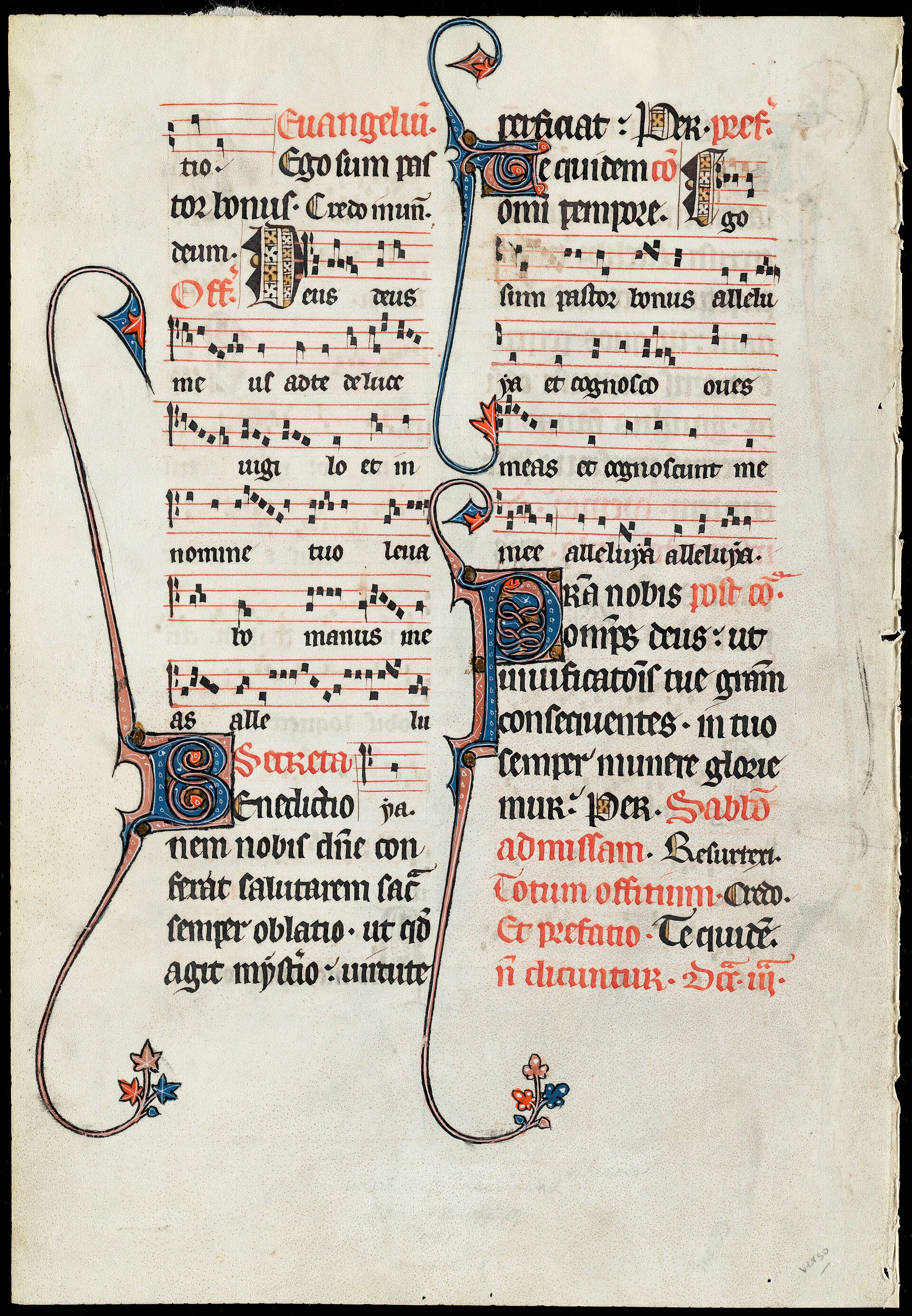
A thirteenth-century missal from Beauvais Cathedral was bought whole for 1,000 dollars in October 1942 and taken apart within the month. The manuscript had been given to the cathedral by Robert de Hangest, a canon, in September 1356, in exchange for an annual obit, and it stayed in the cathedral library for roughly 450 years. It was sold at Sotheby's on 4 May 1926, lot 161, for 970 pounds to the dealer William Permain, acting as agent for William Randolph Hearst. Hearst held it for sixteen years and sold it through Gimbel Brothers to the New York dealer Philip C. Duschnes.
Less than a month after that purchase Duschnes was offering single pages at 25 to 40 dollars apiece, priced by the quantity of gold on the page. The codex had 309 leaves. Many of the remaining leaves passed to Otto F. Ege, and the missal became number 15 in the portfolio Fifty Original Leaves from Medieval Manuscripts, several dozen sets of which were assembled and distributed by Ege's widow Louise after his death in 1951.
Ege had already published his justification. In the March 1938 issue of Avocations, four years before this book reached him, he declared himself a biblioclast and argued that letting a thousand people hold an original leaf was reason enough to scatter fragments. He set out rules for it, including an undertaking not to break a unique or complete museum piece.
The missal has been reconstructed virtually by Lisa Fagin Davis and hosted by Fragmentarium. As of the December 2023 state of that reconstruction, 122 of the 309 leaves had been located, across more than a hundred institutional and private collections including Harvard, the Morgan, the Beinecke, Cleveland, Boston Public Library, Oberlin, Waseda, Oslo Cathedral School and the Australian National University.
The dismemberment destroyed the document that proved the ownership
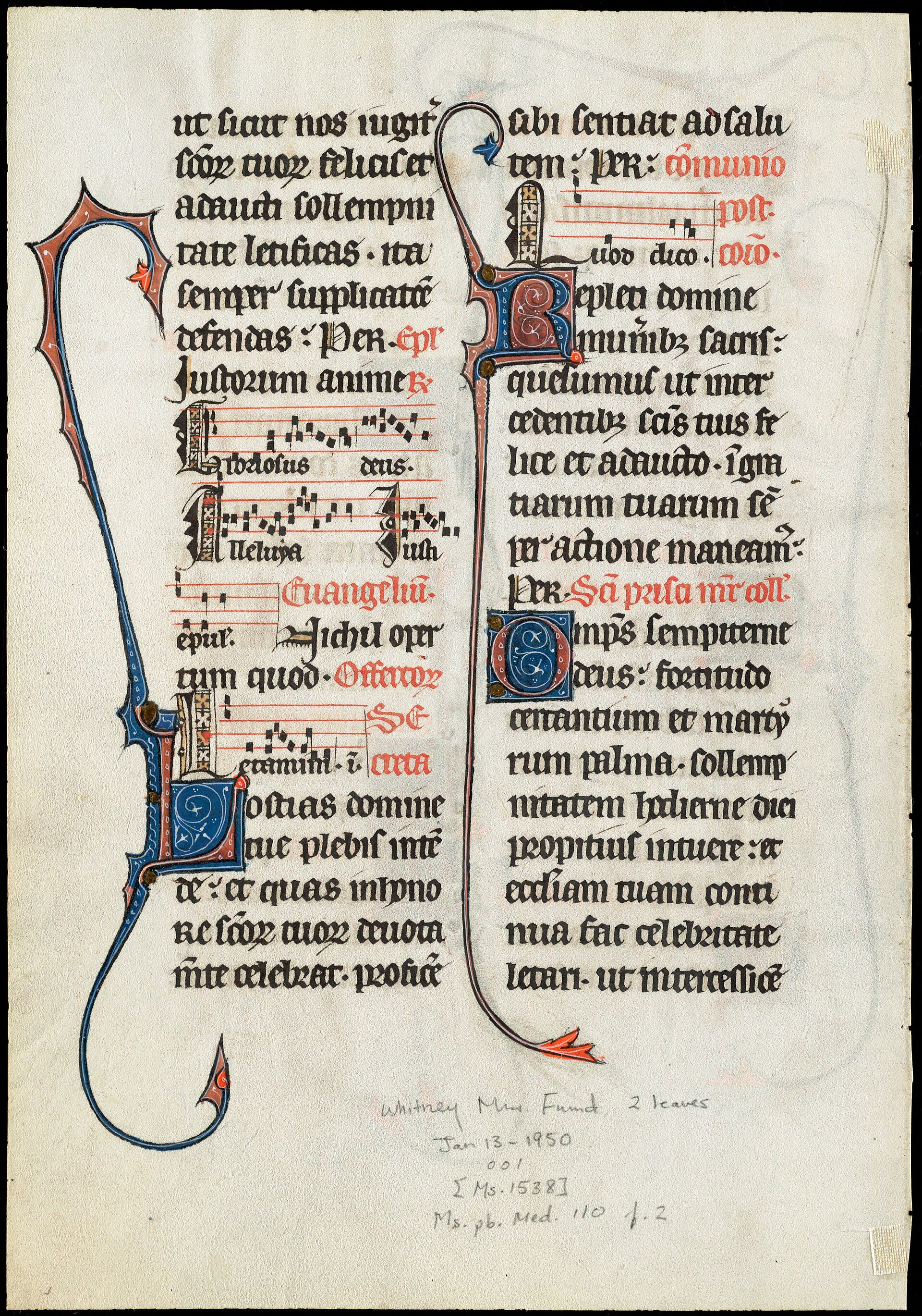
The leaf carrying the 1356 inscription that named the missal's earliest known owner did not survive the breaking. That inscription, on the blank recto of the first leaf of the calendar, was the record of Robert de Hangest's gift, and it is known now only because it was transcribed in the 1926 Sotheby's catalogue and independently in later transcripts of the Beauvais registers.
This is the pattern worth generalising. The evidence that establishes what an object is and where it has been tends to sit on its edges and its endpapers: the flyleaf inscription, the collector's mark, the shelfmark, the binding, the inventory number, the frame, the back of the panel. Those are precisely the parts that a break discards as unsaleable, because they carry no picture and no gold.
The Beauvais Missal is therefore a case where the provenance survives the object rather than the reverse, and it survives only because a dealer's cataloguer happened to write the inscription out sixteen years before the book was destroyed. Where no such transcription exists, the loss is total and silent, and no amount of later scholarship recovers it.
At Longmen the demand commissioned the chisels
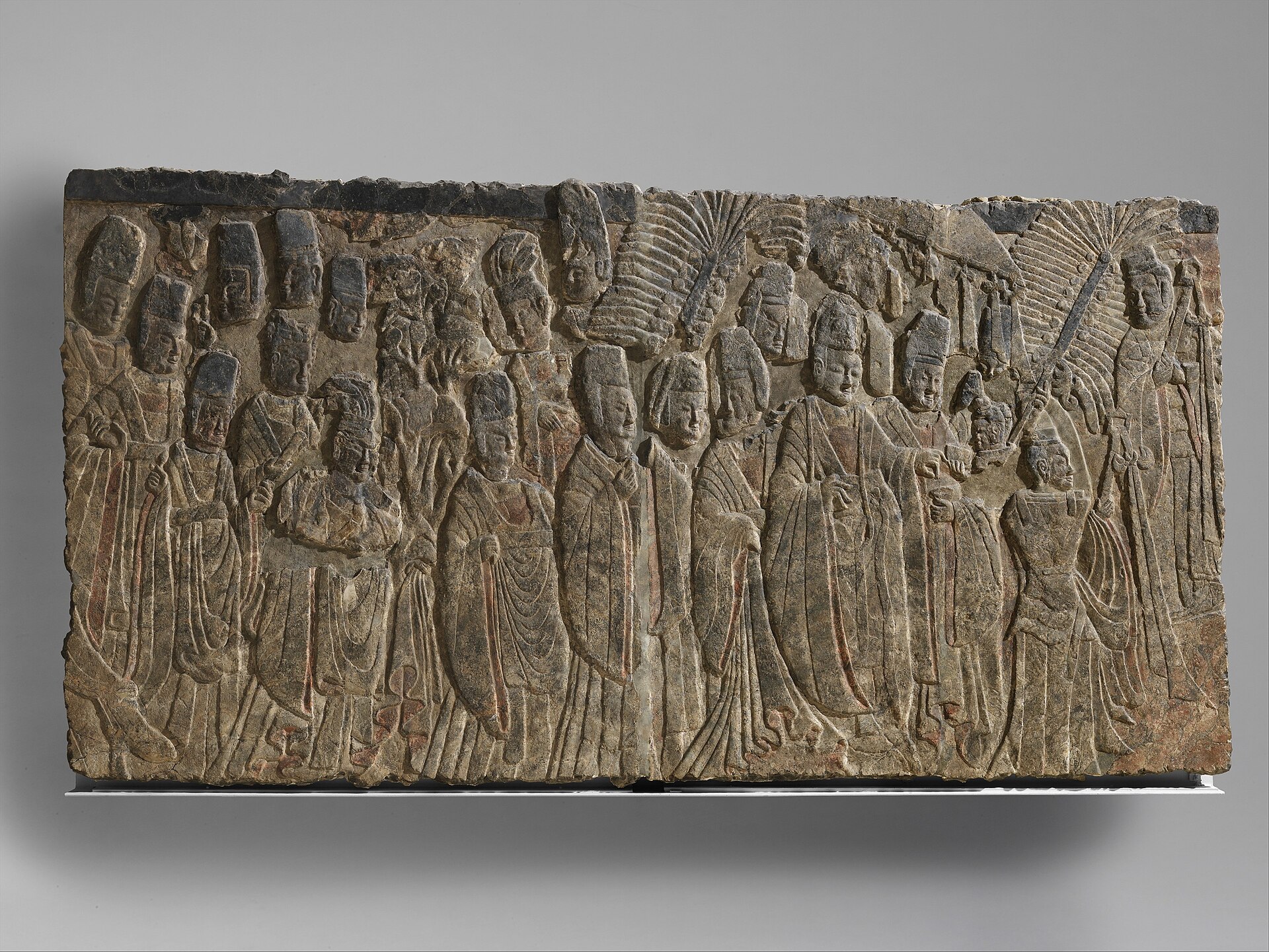
The two imperial donor processions carved into the Binyang Central Cave at Longmen were removed piecemeal, in repeated illicit excavations, by local looters selling into an international market. The cave was cut for the Northern Wei emperor Xuanwu in honour of his father Xiaowen, and the processions occupied the second register on either side of the doorway of the exit wall. Both registers are now missing from the cave. The emperor's procession is in the Metropolitan Museum of Art, catalogued as Emperor Xiaowen and his entourage worshipping the Buddha, object number 35.146, Fletcher Fund, 1935, and displayed in Gallery 206. The empress's procession is at the Nelson-Atkins Museum of Art in Kansas City.
The reliefs were not lifted out and shipped. They were reduced to fragments in situ, and the faces were collected separately by different buyers. What hangs in New York is largely plaster infill holding salvaged pieces in position; the Kansas City panel is more intact. The reconstructed registers are flat, so they do not reproduce the way the originals wrapped around the corners onto the adjacent walls.
The Harvard account of the cave puts the causation the right way round: a local network of looters was selling into a Western market whose demand for illicitly acquired objects created the conditions that turned local economic need into systematic destruction. The chisels were downstream of the buyers. That is the same mechanism as the Beauvais leaves, operating on limestone instead of vellum.
One further note belongs on the record. Read on 23 August 2026, the Metropolitan's published entry for object 35.146 gives the object's date, medium, dimensions and credit line, and its provenance section carries no ownership history at all. No dealer, agent or consignor is named for an object the museum's own catalogue text describes as having been removed from a named cave.
A dealer cut the Cimabue apart for a better return on the pieces
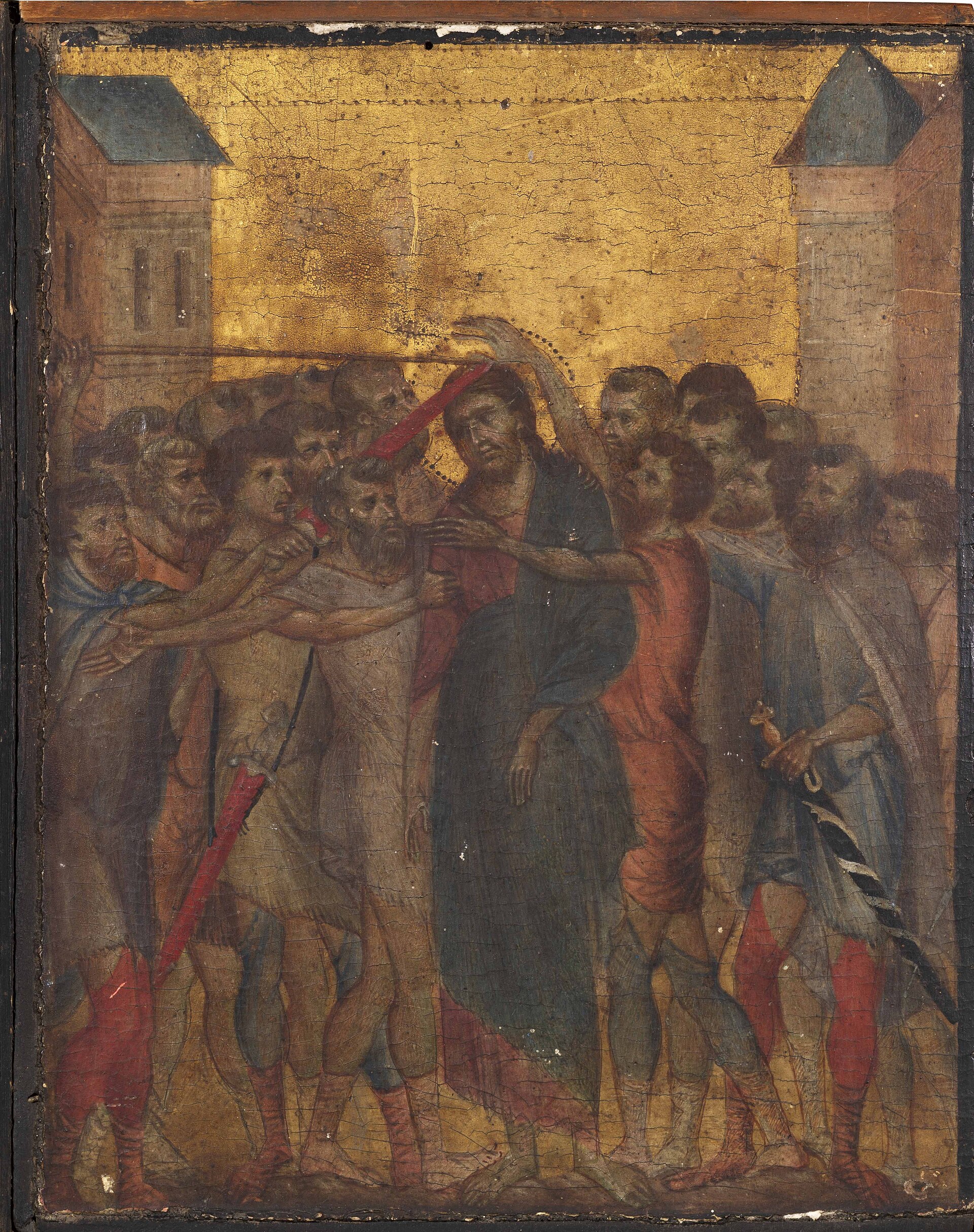
The Louvre's Mocking of Christ is one compartment of a single painted plank that was sawn into separate saleable pictures. Radiography at the C2RMF has established that this panel and the National Gallery's Virgin and Child with Two Angels were painted on the same piece of poplar, with the Mocking directly below the Virgin. The Frick Collection's Flagellation of Christ came from the same object, immediately to the right. The whole is reconstructed by Miklos Boskovits and Dillian Gordon as a two-wing diptych of eight scenes, although the Louvre's own conservation service allows that it may instead have been a dossal, an altar frontal or an altarpiece.
No owner, location or transaction is recorded for the object for roughly six centuries. It was cut apart and its scenes sold separately, probably in the nineteenth century, and on the trade's own account by a dealer who expected a better return on the pieces than on the whole. Three of the probable eight scenes have been identified.
The Mocking then sat unrecognised in a house at Compiegne and sold at Senlis on 27 October 2019 for 19.5 million euros excluding fees. The market that broke the object in the nineteenth century paid that figure for a single scene of it in the twenty-first, which is the clearest available measure of how badly the original calculation was made.
Breaking a set corrupts the record of what the set was
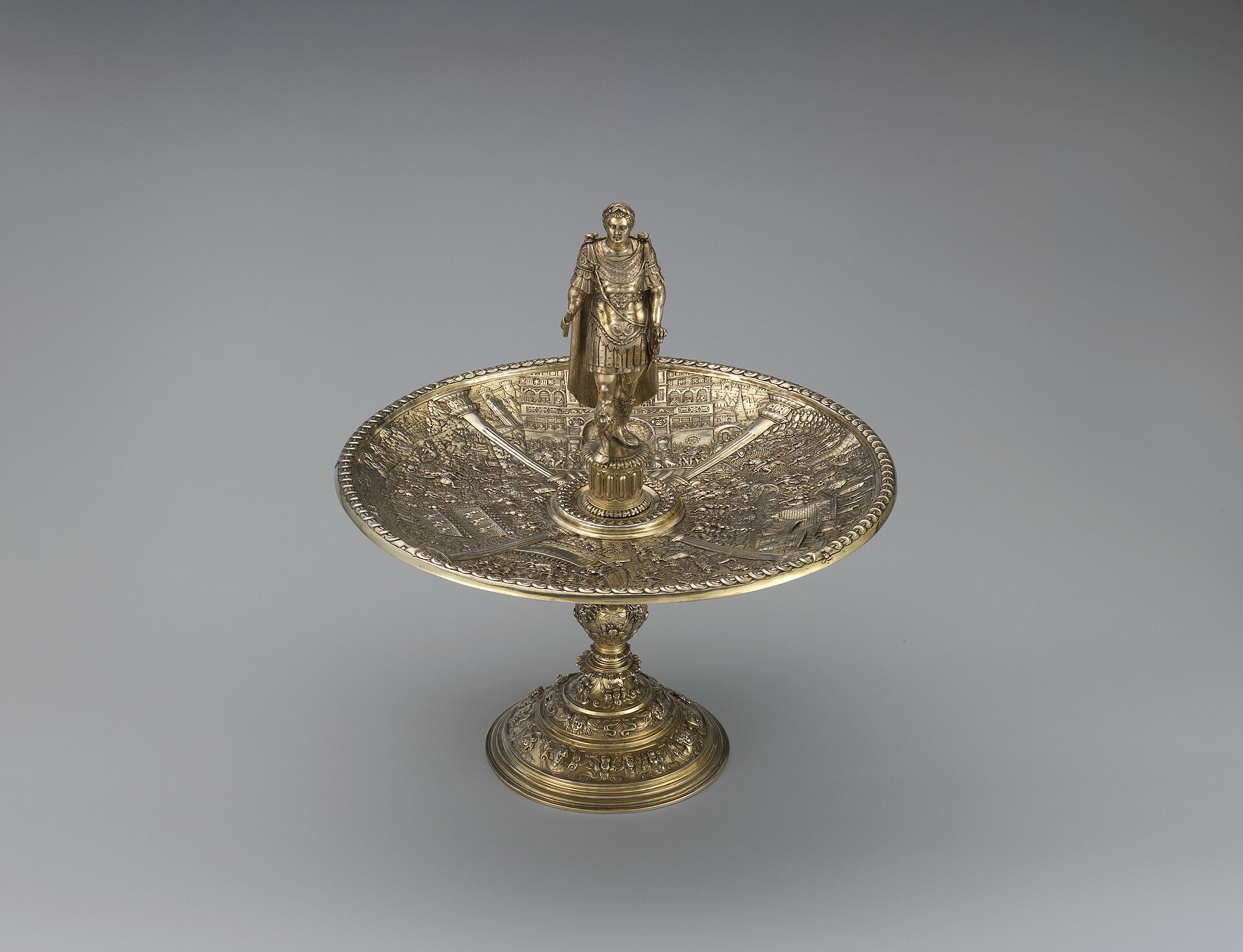
The twelve Aldobrandini Tazze were dispersed, and in the dispersal they were reassembled wrongly. Each tazza is a shallow dish on a stem, surmounted by a standing figure of a Roman emperor, and the scenes on the dishes correspond to the emperors above them. Payment for six of them is registered in Cardinal Aldobrandini's accounts on 26 March 1602, and all twelve appear in his silver inventory of 1603.
After the set left Italy the pieces were traded individually. The London dealer Richard Attenborough bought at the Scarisbrick sale at Christie's in 1861 and lent two to the loan exhibition at the South Kensington Museum the following year. Six passed to the Paris dealer Frederic Spitzer, who replaced their fluted feet with elaborate substitutes. Three of those six were mismatched when sold in 1893, and one tazza in the set today is a wholly nineteenth-century composite. The forty-nine-page manuscript describing the scenes has been missing since 1893.
The result is that several tazze are now catalogued under names that record the error rather than the object, such as a Domitian figure standing on a Tiberius dish. The set is spread across seven countries, with two at the Metropolitan Museum of Art and the others in Madrid, London, Lisbon, Toronto, Minneapolis and four private collections.
| Object | State before the sale | What the sale produced | Located now |
|---|---|---|---|
| Beauvais Missal | Bound codex, 309 leaves | Broken up within a month in 1942; leaves at 25 to 40 dollars | 122 of 309 leaves, December 2023 |
| Binyang Central Cave, emperor's procession | Carved into the cave's exit wall | Removed piecemeal in repeated illicit excavations | One panel, largely plaster infill, Metropolitan 35.146 |
| Cimabue, Mocking of Christ | One compartment of a single poplar plank | Plank sawn apart, scenes sold separately | 3 of a probable 8 scenes |
| Aldobrandini Tazze | Set of 12, dishes matched to figures | Traded individually, refooted, figures swapped | 12 in 7 countries; 1 a modern composite |
| Cheapside Hoard | Single buried stock of a working goldsmith | Split between institutions from 1914 | Mostly reunited 1976; counts still disputed |
What to do with a record that begins in fragments
An object described as fragmentary should be researched on the assumption that a transaction did the fragmenting until something else is proved. That reverses the usual reflex, which reaches for the sack of a city or the dissolution of a monastery, and it is better supported by the records collected here. It also changes what to look for: not a date of destruction but a date of sale, a dealer, a price list and a buyer who wanted a portion.
Three practical consequences follow. First, dealer records and priced catalogues are primary evidence for the physical history of the object, not merely for its ownership. Duschnes's price range of 25 to 40 dollars a leaf is a fact about how the Beauvais Missal came to be in the state it is in. Second, the transcription of an inscription may outlive the leaf that carried it, so the earliest catalogue description of a broken object should be read as a survey of evidence now destroyed. Third, a reassembled object is a hypothesis. The Aldobrandini Tazze prove that a set can be put back together confidently and wrongly, and that the error can then be catalogued for a century.
The Cheapside Hoard makes the institutional version of the same point. A single buried stock of a working goldsmith was divided between museums from 1914 onward, and the published counts of how many pieces went where have never agreed. The London Museum and the Guildhall Museum merged in 1976 and reunited the two main portions, which is why the discrepancy is now recoverable at all.
Questions
It was legal, and in the middle of the twentieth century it was ordinary trade practice. Otto Ege published a defence of it in Avocations in March 1938 and set out rules he considered honourable, including not breaking a unique or complete museum piece. Philip Duschnes, a New York dealer, bought the Beauvais Missal whole in October 1942 and was selling its leaves within a month. Neither man was operating outside the norms of the market he worked in, which is the point: the destruction was a business model, not a crime.
Because the evidence of an object's identity and history sits disproportionately on the parts with no resale value. Flyleaf inscriptions, collectors' marks, shelfmarks, bindings, inventory numbers, frames and panel backs are what establish where a thing has been, and they are the first things discarded in a break. The Beauvais Missal's 1356 ownership inscription was on a leaf that did not survive; it is known only from a 1926 auction catalogue transcription.
Sometimes physically, rarely with confidence about the original configuration. Radiography reunited two Cimabue panels by proving they came from one plank, which is strong evidence. The Aldobrandini Tazze show the failure mode: dealers separated dishes from figures, replaced feet, and recombined the pieces incorrectly, and the manuscript that described the original scheme has been missing since 1893. Treat any reassembly as a documented hypothesis and record which parts of it rest on physical evidence.
Sources
- 1The Story of the Beauvais Missal, Reconstructing the Beauvais Missal, giving the 1926 Sotheby's sale at 970 pounds to Permain for Hearst, the 1,000 dollar sale through Gimbel Brothers to Duschnes in October 1942, and the 25 to 40 dollar price per leaf. brokenbooks2.omeka.net/exhibits/...
- 2Beauvais Missal, virtual reconstruction, Fragmentarium F-4ihz. fragmentarium.ms/overview/...
- 3Beauvais Missal, Fragmentarium description, recording the dispersal through Duschnes and Ege and the portfolio distribution. fragmentarium.ms/description/...
- 4Manuscript Road Trip: Reconstructing the Beauvais Missal, Lisa Fagin Davis, on the 309-leaf codex and the progress of the reconstruction. manuscriptroadtrip.wordpress.com/2015/...
- 5Tearing Books for Education's Sake: Otto Ege and His Manuscript Leaves, Medieval Art and the American Public, Fordham University, on the March 1938 Avocations article and Ege's stated rules. medievalartus.ace.fordham.edu/exhibits/...
- 6Emperor Xiaowen and his entourage worshipping the Buddha, object number 35.146, Fletcher Fund 1935, Metropolitan Museum of Art collection record. Read 23 August 2026. metmuseum.org/art/...
- 7Longmen Binyang Central Cave, Whose Culture?, Harvard University, on the piecemeal removal of the two donor processions, the plaster infill of the emperor's panel, and the market demand that drove the destruction. whoseculture.hsites.harvard.edu/longmen-binyang-central-cave
- 8Longmen caves, Luoyang, Smarthistory, on the commissioning of the Central Binyang Cave and the present locations of the two imperial procession reliefs at the Metropolitan Museum of Art and the Nelson-Atkins Museum of Art. smarthistory.org/longmen-caves-luoyang
- 9Otto F. Ege Collection finding aid, Beinecke Rare Book and Manuscript Library, Yale University. ead-pdfs.library.yale.edu/11062.pdf
- 10Beinecke Library acquires treasure trove of medieval manuscripts from a famed book breaker, Yale News, 15 November 2015. news.yale.edu/2015/...
More in Collectors and Collections
The partThe credit line names the collector, and the accession number tells you what happened
Morgan died in March 1913, and the Metropolitan credits him with gifts made in 1917. The credit line names the collector.
The Longest Ownership Links Here Belong to Owners That Were Not People
The 28 longest institutional ownership links in this archive run 7,434 years between them. Three end in a completed sale.
The Name in the Buyer's Column Is Often an Employee
Across 126 years of sales in this archive the winning bidder is repeatedly not the owner.