The Archimedes Palimpsest
Ioannes Myronas, scribe, over an unnamed tenth-century copyist · Archimedes undertext second half of the tenth century; euchologion completed by April 1229
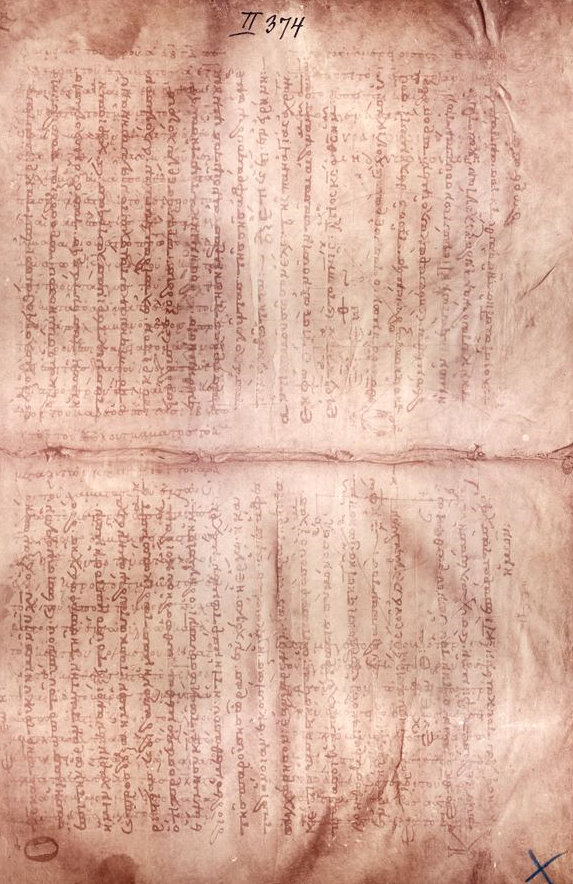
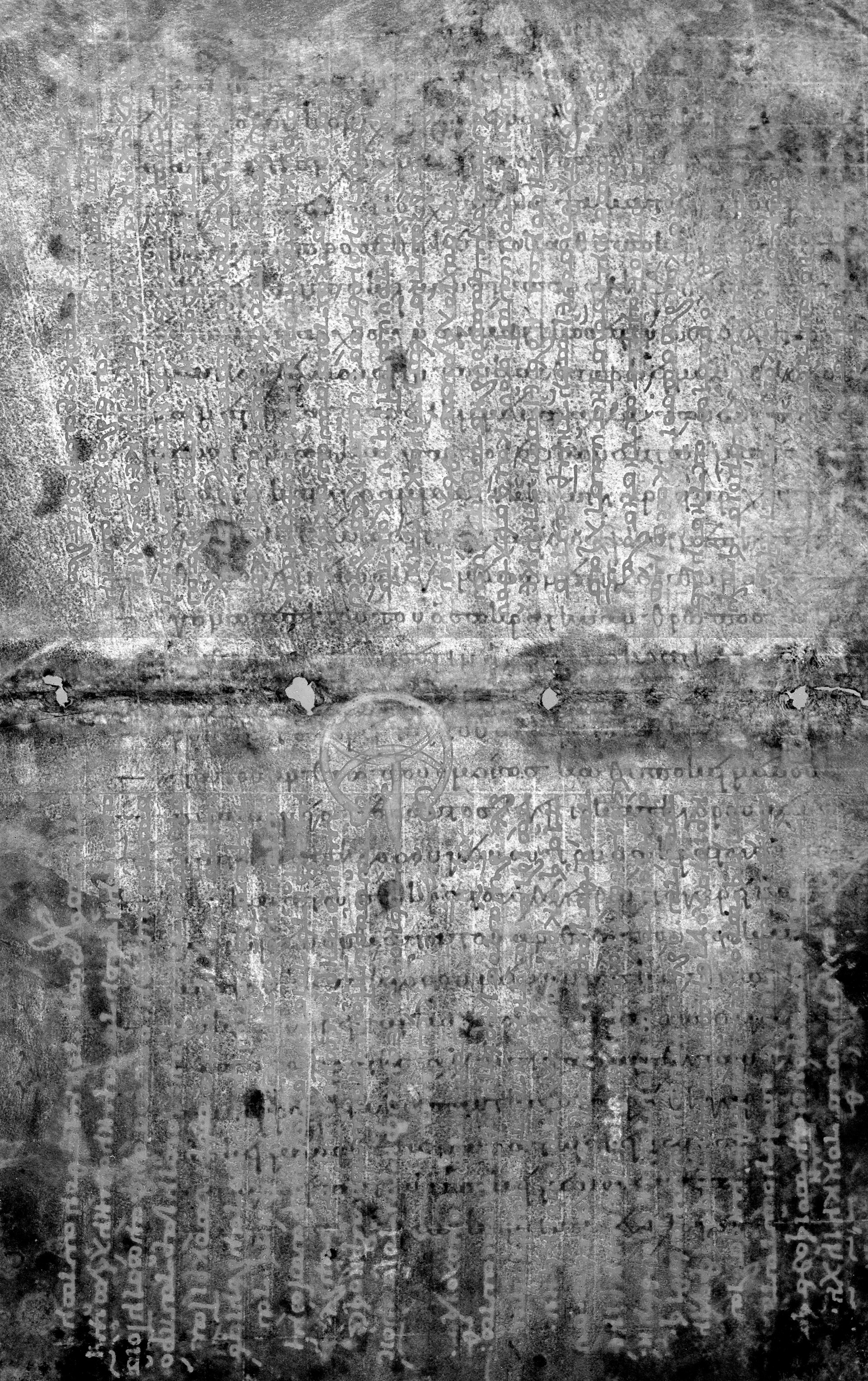
A page of this manuscript, released by the project that conserved and imaged it. There is only one Archimedes Palimpsest, so no question of version arises: this is the object.
The Walters Art Museum, CC BY 3.0 · Photograph by The Walters Museum| Artist | Ioannes Myronas, scribe, over an unnamed tenth-century copyist |
|---|---|
| Date | Archimedes undertext second half of the tenth century; euchologion completed by April 1229 |
| Medium | Iron gall ink on parchment, palimpsest, with later paintings in body colour and gold |
| Dimensions | 174 folios. No measured dimensions are given by the holding project or the museum, and none is asserted here |
| Where it is now | Private collection, on deposit at the Walters Art Museum, Baltimore, since January 1999. Folio 123 at the Musee des beaux-arts de Blois; one leaf at Cambridge University Librarylast confirmed 4 August 2026 |
| Inventory number | Blois inv. 73.7.52; Cambridge University Library MS Add. 1879.23; the main codex has no public inventory number, and is catalogued at OPenn as Private Collection A |
| Attribution | DocumentedThe prayer book is attributed to the scribe Johannes Myronas and dated to 1229 by the project that conserved and imaged the manuscript. Full note |
| Object type | Manuscript |
| Period | Byzantine, tenth and thirteenth centuries |
| Cases | Has a provenance gap · Rediscovered |
| Inscriptions | A colophon dating the prayer book to 1229 and naming the scribe. Four added paintings of the Evangelists over the text; a fifth, of Daniel between two lions, on the detached folio 123 |
| Owners on record | 10 links7 documented, 2 disputed, 1 unknown |
| Sources | 10 cited |
About this record Last verified 1 September 2026 · 10 sources cited · Change log
On this page 10 sections
ContentsClose
A Byzantine prayer book of 174 parchment folios, finished by April 1229 and probably made in Jerusalem, written on parchment recycled from at least five older books. One of them was a tenth-century copy of Archimedes. Three of the treatises underneath exist in no other copy anywhere: On Floating Bodies in Greek, The Method of Mechanical Theorems, and the Stomachion. Ten further folios carry the orator Hyperides, previously known only from papyrus scraps.
It was catalogued in Constantinople in 1899 as an unremarkable service book, recognised by Johan Ludvig Heiberg in 1906, photographed by him, and then lost for most of a century. In the meantime a leaf had already been removed by Constantine Tischendorf and sold to Cambridge, four forged Evangelist portraits had been painted over the text to raise the price, and three folios had been cut out. It was sold at Christie's New York at 2pm on 29 October 1998 for a hammer price of USD 2,000,000, USD 2.2 million with the premium, over an injunction sought by the Greek government and the Greek Orthodox Patriarchate of Jerusalem. The underbidder was the Greek consul general, at USD 1.9 million.
The anonymous buyer put it on deposit at the Walters Art Museum, paid for a decade of conservation and imaging including X-ray fluorescence work at a synchrotron, and on the tenth anniversary of the sale released the entire data set under a Creative Commons Attribution licence. In March 2026 one of the three missing folios was identified in a museum store at Blois, where it had sat unrecognised since 1973.
Provenance
Each link is graded. Documented: a cited source supports it. Disputed: the identification is argued but not established. Unknown: no owner for that span, and the gap is not smoothed into a narrative. The grades in the glossary.
- second half of the tenth century - before 1229Unrecorded, probably a Constantinopolitan librarydocumented
Dated on palaeography. The project associates the copying of Archimedes texts in this period with the circle of Leo the Geometer.12
- by April 1229 - sixteenth centuryUnrecorded monastic usedocumented
The prayer book destroyed the readable text and preserved the parchment. Without the recycling nothing would survive.1
- sixteenth century - c. 1840The monastery of Mar Saba, Judaean desertdocumented
When the palimpsest reached Mar Saba is not known; that it was there in the sixteenth century is clear.2
- c. 1840 - after 1908Metochion of the Holy Sepulchre, Constantinopledocumented
Heiberg's photographs are in the Royal Danish Library and remain the only record of three folios that have since gone missing.28
- early 1840s - 1876Constantine Tischendorf, then his estatedocumented
Now Cambridge University Library MS Add. 1879.23. Not recognised as part of this manuscript until Nigel Wilson identified it in 1968.2
- after 1908 - 1920sNot establishedunknown
The Greek Orthodox Patriarchate of Jerusalem alleged theft from a convent library in the 1920s. The project states that how it left is not known.
- by about 1942 - 1940sSalomon Guerson (argued)disputed
This account is not the one the selling family gave and is not in the project's own history. It is recorded here because it is made by the scholar who identified the Blois leaf, in a signed publication.8
- mid twentieth century - 29 October 1998Marie Louis Sirieix, then his daughter Anne Guersan, Francedisputed
The family claimed ownership since the 1920s. The court records establish presence in the French collection at least since the 1960s. The 1999 opinion records little evidence surrounding the acquisition.267
- 29 October 1998 - presentAnonymous private collector, Americandocumented
The owner has never been publicly identified. He released the entire imaging data set under a Creative Commons Attribution licence on the tenth anniversary of the purchase.245
- 1973 - presentMusee des beaux-arts de Bloisdocumented
Inventory 73.7.52. How Frank acquired it is not known.8
Prices realised
This manuscript has been at auction once. The reported figures are routinely conflated: USD 2,000,000 is the hammer given by the Archimedes Palimpsest Project, and USD 2.2 million is the sum reported in the press. The relationship between them, a ten per cent buyer's premium, matches the Christie's New York scale of the period but is not stated in those terms by any source consulted here, and is therefore DERIVED.
| Date | Sale | Estimate | Result | Note |
|---|---|---|---|---|
| 29 October 1998 | Christie's, New York | Hammer 2,000,000 With premium 2,200,000 USD | Sold at 2pm to an anonymous American collector. The underbidder was Greece's consul general in New York, who bid to USD 1.9 million before dropping out. The pre-sale estimate could not be verified from a fetchable source and is deliberately left blank rather than repeated from secondary summaries. The project's history page dates the sale to 28 October and its digital page to 29 October; 29 October is supported by the contemporary press. |
Hammer is the price at which the bidding stopped; with premium adds the fee the house charges the buyer on top. Hammer price and buyer's premium in the glossary.
Technical evidence
| Attribution note | The prayer book is attributed to the scribe Johannes Myronas and dated to 1229 by the project that conserved and imaged the manuscript. The Archimedes undertext is dated to the second half of the tenth century on palaeography and localised to Constantinople; its copyist is unnamed. |
|---|---|
| Present form | Byzantine euchologion, a prayer book, of 174 parchment folios; completed by April 1229 and probably made in Jerusalem. Now disbound into separate leaves.13 |
| Undertext, principal | At least seven treatises of Archimedes, copied in the second half of the tenth century, almost certainly at Constantinople.1 |
| Texts unique to this manuscript | On Floating Bodies, the only surviving copy in Greek; The Method of Mechanical Theorems and the Stomachion, of which no version survives in any language elsewhere.1 |
| Other undertexts | Ten folios from a codex of the Attic orator Hyperides, previously known only from papyri and quotation; further folios from a commentary on Aristotle's Categories; further folios from books still unidentified.1 |
| How it was reused | Leaves of the older books were washed, scraped, cut and turned so that the earlier text runs through the gutter of the new binding. This is why the manuscript had to be disbound before it could be imaged.13 |
| Later additions | Four Byzantine-style paintings of the Evangelists added over the prayer book text, shown by John Lowden to postdate 1929 because they copy plates in Manuscrits Grecs de la Bibliotheque Nationale of that year. A fifth painting, Daniel between two lions, is on the detached folio 123 at Blois.28 |
| Condition | Severe mould damage; areas legible in Heiberg's 1906 photographs are now lost. Collagen reasonably sound overall and disintegrating in the mouldy areas, per analysis by the Canadian Conservation Institute.23 |
| Conservation | Disbound by Abigail Quandt at the Walters Art Museum between February 2000 and November 2004. A modern adhesive similar to wood glue, applied to part of the spine in the second half of the twentieth century, proved tougher than the parchment and was the principal obstacle.3 |
| Imaging | Multispectral imaging in visible, ultraviolet and infrared bands with pseudocolour processing; X-ray fluorescence mapping of the iron in the original ink, carried out at the Stanford Linear Accelerator Center, to read pages under the forged paintings. Imaging produced by the Rochester Institute of Technology, Equipoise Imaging and Boeing LTS.9 |
| Data and licence | Full data set released 29 October 2008 under Creative Commons Attribution 3.0 Unported, with a request that publications based on it be sent to the Curator of Manuscripts at the Walters Art Museum.45 |
| Detached leaves | Cambridge University Library MS Add. 1879.23, removed by Constantine Tischendorf and sold from his estate in 1876, identified by Nigel Wilson in 1968. Musee des beaux-arts de Blois, inv. 73.7.52, folio 123, identified by Victor Gysembergh in October 2025. Two further folios photographed by Heiberg remain missing.28 |
Images
The record in full
Chapter 1It is a prayer book, and calling it the Archimedes Palimpsest is a little confusing
The object is a medieval parchment manuscript of 174 folios which is, as it now stands, a Byzantine prayer book written in Greek, technically a euchologion.
The object is a medieval parchment manuscript of 174 folios which is, as it now stands, a Byzantine prayer book written in Greek, technically a euchologion. It was completed by April 1229 and was probably made in Jerusalem. The project that has studied it for a quarter of a century says in its own first sentence that calling it the Archimedes Palimpsest is a little confusing, and that is the correct place to start.
To make the prayer book, the scribes took parchment from books that already existed, washed and scraped off the writing, cut the leaves, turned them ninety degrees and folded them into new quires. One of the books they cannibalised contained at least seven treatises by Archimedes, copied in the second half of the tenth century, almost certainly at Constantinople. The prayer book is therefore both the destroyer of the older text and the sole reason it survived at all: nobody kept tenth-century mathematics for its own sake, and everybody kept a service book.
The economics are worth stating plainly. Parchment was expensive. The scholar who identified the manuscript's lost folio 123 puts the material cost of a codex of this size at the skins of about fifty animals. Recycling was not vandalism; it was accountancy.
Chapter 2Three of the treatises underneath exist nowhere else on earth
The Archimedes undertext carries The Equilibrium of Planes, Spiral Lines, The Measurement of the Circle, Sphere and Cylinder, On Floating Bodies, The Method of Mechanical Theorems and the Stomachion.
The Archimedes undertext carries The Equilibrium of Planes, Spiral Lines, The Measurement of the Circle, Sphere and Cylinder, On Floating Bodies, The Method of Mechanical Theorems and the Stomachion. Of these, three matter beyond measure. There is no other surviving copy of On Floating Bodies in Greek, the language Archimedes wrote in. There is no version in any language, anywhere, of The Method of Mechanical Theorems or of the Stomachion.
The Method is the text in which Archimedes explains how he found his results before he proved them, which is the one thing the rest of the ancient mathematical corpus never tells you. It is also, by roughly four hundred years, the earliest surviving Archimedes manuscript, and the most important evidence for the diagrams he actually drew.
The Archimedes book supplied most of the pages. Others were used too. Ten folios come from a codex of the fourth-century BC Attic orator Hyperides, who before this discovery was known only from papyrus fragments and from quotations in other writers. Further folios carry a commentary on Aristotle's Categories, and more come from books that have still not been identified.
Chapter 31846: the first person to take a leaf out of it was a scholar
The manuscript was at the monastery of Mar Saba in the Judaean desert by the sixteenth century, and had moved to the Metochion of the Holy Sepulchre in Constantinople by about 1840.
The manuscript was at the monastery of Mar Saba in the Judaean desert by the sixteenth century, and had moved to the Metochion of the Holy Sepulchre in Constantinople by about 1840. The Biblical scholar Constantine Tischendorf visited the Metochion in the early 1840s and published his Travels in the East in 1846, reporting that he had found nothing of particular interest there except a palimpsest containing some mathematics.
He found it interesting enough. One leaf of the Archimedes Palimpsest was sold to Cambridge University Library in 1876 out of Tischendorf's estate. It is now Cambridge University Library MS Add. 1879.23, and it was not recognised as belonging to this manuscript until Nigel Wilson identified it in 1968, a hundred and twenty years after it was removed.
Tischendorf did not know the book contained Archimedes. Neither did anybody else. He took the leaf because it was an old palimpsest, and the theft is only visible now because the scholarship caught up with it.
Chapter 4A catalogue entry in 1899, and a Danish philologist who knew what he was reading
In 1899 A. Papadopoulos-Kerameus catalogued the library of the Metochion.
In 1899 A. Papadopoulos-Kerameus catalogued the library of the Metochion. The palimpsest is MS 355 in that catalogue, and he transcribed a few lines of the undertext without knowing whose they were. Those lines reached Johan Ludvig Heiberg of Copenhagen, the world authority on Archimedes, who recognised them as coming from Sphere and Cylinder.
Heiberg went to Constantinople in 1906, read what he could with the naked eye and a magnifying glass, and had the manuscript photographed under white and ultraviolet light. He established that it carried seven treatises, including the unique witnesses. He incorporated the results into his new edition of the complete works of Archimedes, published between 1910 and 1915, in which this manuscript is Codex C. His photographs are now in the Royal Danish Library and for most of a century they were the only documentary trace of the book.
Heiberg last studied it in 1908. After that it left the Metochion, and how it left is not known.
Chapter 5The missing decades, and an owner the family did not name
It reappeared in a French private collection.
It reappeared in a French private collection. The Greek Orthodox Patriarchate of Jerusalem alleged that it had been stolen from a convent library in the 1920s. The selling family's account was that it had belonged to them since the 1920s; the court records establish only that it was in the French collection at least since the 1960s. The project's own history page says flatly that it is not known how the manuscript left the Metochion.
There is now a further name in the frame. Victor Gysembergh, writing in 2026 about the leaf he identified at Blois, states that the illumination on it was executed around 1942 at the instigation of its owner Salomon Guerson, in a desperate attempt to raise its value in order to sell it and escape antisemitic persecution. That is an account of a specific person holding the book, or parts of it, in occupied France, and it sits at odds with the simpler version in which the manuscript passes quietly from Marie Louis Sirieix to his daughter Anne Guersan.
This record does not adjudicate between those accounts. It records that the chain between 1908 and the 1960s is not established by documents, that a court found in 1999 that there was little evidence of the original acquisition, and that the person who put the object on the market in 1998 was Anne Guersan.
Chapter 6Four Evangelists, painted onto the book after 1929 to raise its price
Sometime in the twentieth century, four paintings of the Evangelists in Byzantine style were added to the manuscript, over the prayer book text and therefore over the Archimedes text beneath it.
Sometime in the twentieth century, four paintings of the Evangelists in Byzantine style were added to the manuscript, over the prayer book text and therefore over the Archimedes text beneath it. John Lowden showed they were made after 1929, because they were copied from a publication of that year, Manuscrits Grecs de la Bibliotheque Nationale.
They are forgeries in the most damaging possible sense. They were painted to make a scruffy prayer book look like an illuminated one, and each of them destroyed a page of the only surviving copy of the text underneath. The Blois leaf, recovered in 2026, carries a fifth such painting, the prophet Daniel between two lions. That leaf was one of three that Heiberg had photographed and that had since gone missing, which means the pages were removed and decorated to be sold separately.
The counterfeiter's calculation was correct on its own terms. An illuminated Byzantine manuscript was worth more in 1942 than a palimpsest of unreadable mathematics. It took multispectral imaging and a synchrotron to reverse the transaction.
Chapter 72pm, 29 October 1998, and the figure everybody quotes is the wrong one
The manuscript was sold at Christie's in New York.
The manuscript was sold at Christie's in New York. The project's own account is precise: at 2pm on 29 October 1998 the book was sold to an anonymous collector for USD 2,000,000. The press reported USD 2.2 million; that is the figure in Archaeology magazine and in the Washington Post headline of 30 October 1998.
Both numbers are right, and they are not the same number. USD 2,000,000 is the price at which the lot was knocked down. USD 2.2 million is what the buyer paid including the buyer's premium. The gap is exactly ten per cent, which matches the premium Christie's New York was charging, but no source consulted here states the split in those words, so the identification of USD 2.2m as the premium-inclusive total is DERIVED and labelled as such. Anyone writing that the Archimedes Palimpsest made 2.2 million dollars at hammer is repeating a rounding of a rounding.
One more caution about the date. The project's own history page says the sale was on 28 October and its digital page says 2pm on 29 October. The same institution's website carries both. The catalogue and the contemporary press support 29 October.
There was an underbidder, and it was a government. Greece's consul general in New York bid up to USD 1.9 million before dropping out. After the sale the Greek culture minister Evangelos Venizelos said he was 'very proud and moved because my country raised a great amount of money to buy a treasure which was stolen'. An underbid at 1.9 against a hammer of 2.0 is the tightest possible measure of what the object was worth: one more increment and the Hellenic Republic would have owned it.
Chapter 8The injunction failed, and so did the case, on a point of choice of law
The day before the sale the Greek government and the Greek Orthodox Patriarchate of Jerusalem sought an injunction against Christie's, arguing the book was stolen.
The day before the sale the Greek government and the Greek Orthodox Patriarchate of Jerusalem sought an injunction against Christie's, arguing the book was stolen. Judge Kimba Wood ruled just hours before the auction that the French sellers had clear title, and the sale went ahead. Christie's position, stated at the time by its spokeswoman Vredy Lytsman, was that it had checked the history of ownership and concluded the French family had legal title.
The litigation continued. Greek Orthodox Patriarchate of Jerusalem v. Christie's, Inc., No. 98 Civ. 7664 (KMW), 1999 WL 673347 (S.D.N.Y. 30 August 1999), ended in summary judgment for the defendants. The court held that French law applied to the action. Its observations on laches were made in the alternative, and one of them is worth quoting for what it says about diligence: the court noted that the Patriarchate had retained counsel to prevent the Christie's auction, which showed it could have obtained help to search for the palimpsest at any point in the preceding seventy years.
That is the reasoning that decides most of these cases, and it is why a claimant's silence is more dangerous to its title than a possessor's bad faith. The opinion is unreported; it exists on Westlaw and Lexis and in the docket, not in the Federal Supplement.
Chapter 9Mould, and glue tougher than the parchment it was protecting
The buyer deposited the manuscript at the Walters Art Museum in Baltimore in January 1999 for conservation, imaging and study, and has funded the work ever since.
The buyer deposited the manuscript at the Walters Art Museum in Baltimore in January 1999 for conservation, imaging and study, and has funded the work ever since. The conservator was Abigail Quandt, Senior Conservator of Rare Books and Manuscripts.
The book had to be taken apart, because the undertext runs through the gutter: the older leaves were bound so that the Archimedes text disappears into the spine. Disbinding began in February 2000 and finished in November 2004. Part of the spine had been glued in the second half of the twentieth century with a modern adhesive similar to wood glue, which is tougher than the parchment it was applied to and extremely difficult to remove. That single intervention, made by somebody trying to hold the book together, is the reason the disbinding took nearly five years.
The other damage is mould. The Canadian Conservation Institute took a core sample the size of a pinhead and found that the parchment collagen is reasonably sound in general and disintegrating where the mould has been at work. Comparison with Heiberg's 1906 photographs shows whole areas of text that were legible then and are gone now. The manuscript that reached Baltimore was in materially worse condition than the one a Danish professor read with a magnifying glass ninety years earlier.
Chapter 10Ultraviolet, pseudocolour, and finally a synchrotron
The imaging campaign ran for years and used everything available.
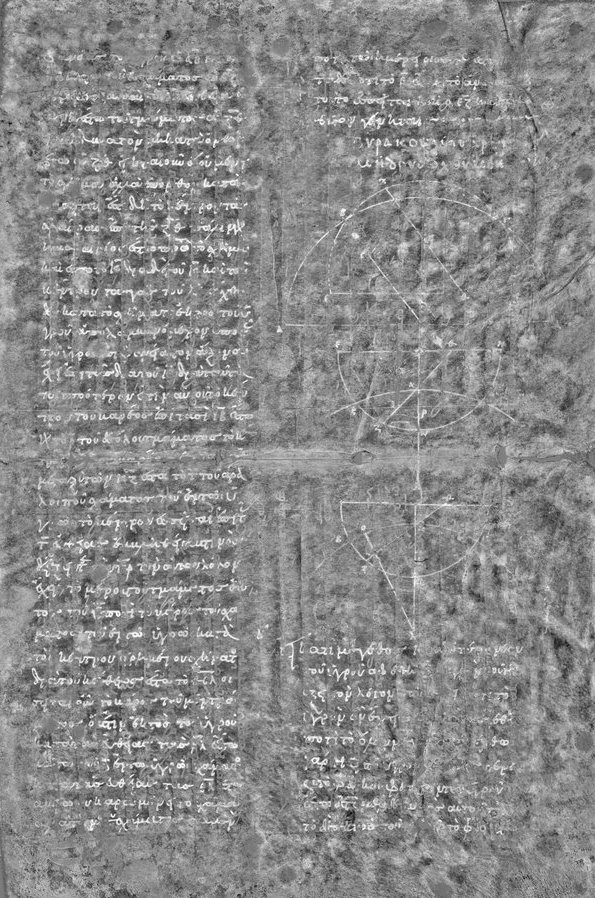
The imaging campaign ran for years and used everything available. Multispectral photography in visible, ultraviolet and infrared bands, processed into pseudocolour composites that separate the two inks, recovered most of the text. Where a forged painting sat on top of the page, no optical method could help, because the paint is opaque.
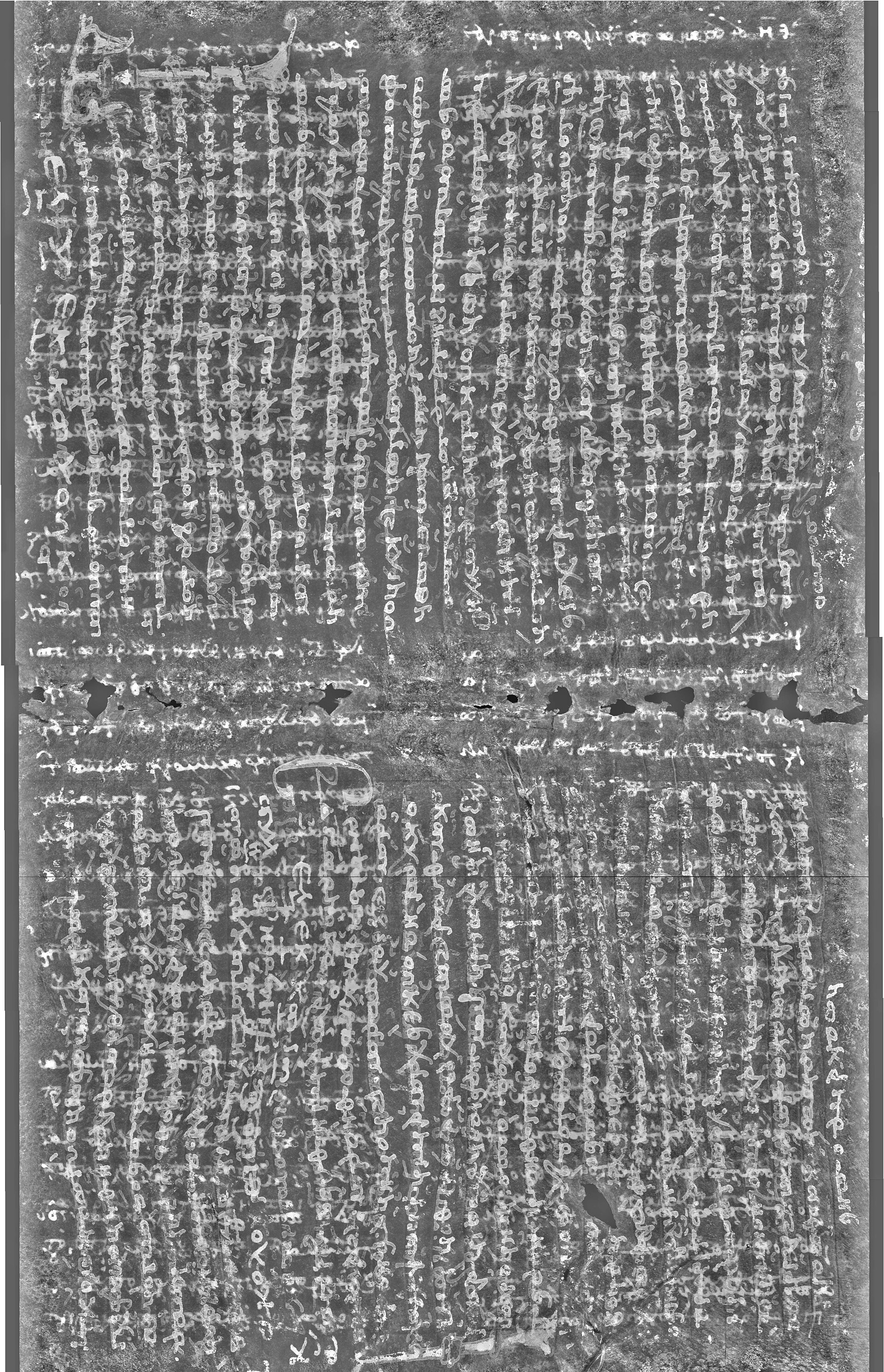
X-ray fluorescence solved that. Mapping the iron in the original ink lets the undertext be read through the illumination, because the metal in a thirteenth-century ink is still there under the twentieth-century paint. The X-ray fluorescence work was done at the Stanford Linear Accelerator Center. The imaging as a whole was produced by the Rochester Institute of Technology, Equipoise Imaging and Boeing LTS, with the synchrotron work at SLAC.
Gysembergh notes that these methods are now substantially better than they were at the start of the 2000s, and that a new campaign on the Blois leaf might also recover passages that the Baltimore project could not read.
Chapter 11On the tenth anniversary of the sale, the owner gave everything away
At 2pm on 29 October 2008, ten years to the hour after he bought it, the anonymous owner released the core data of the project on the web.
At 2pm on 29 October 2008, ten years to the hour after he bought it, the anonymous owner released the core data of the project on the web. The release is deliberately not a website: no graphical interface, no proprietary software, standards-conformant files, images with embedded metadata and checksums, and transcriptions spatially mapped onto the images. The stated reasoning is that interfaces come and go and an archive should not depend on one.
The licence is stated in the release documentation: the data is released for use under Creative Commons Attribution 3.0 Unported. The only thing asked in return is that copies of any published articles based on the data be sent to the Curator of Manuscripts at the Walters Art Museum. The project's own note on the licence reads: take it, courtesy of the private owner whose generosity is only exceeded by his desire to remain anonymous.
That is why this record can be illustrated at all. A privately owned manuscript, bought at auction over the objection of two governments, is the most freely reproducible object in this archive, because its owner decided it should be.
Chapter 12March 2026: folio 123 turns up in a museum store in Blois
Three of the folios Heiberg photographed had gone missing and were treated as lost.
Three of the folios Heiberg photographed had gone missing and were treated as lost. In October 2025 Victor Gysembergh, discussing with colleagues the fact that Blois had once housed part of the French royal libraries, typed the words into Arca, the digital library of the Institut de recherche et d'histoire des textes, more or less as a joke. A record appeared: a parchment in the Musee des beaux-arts de Blois, inventory 73.7.52. The script looked familiar, one face carried a geometrical figure, and the legible text was a passage of On the Sphere and the Cylinder. Set against Heiberg's photographs, the match was conclusive. It is folio 123, carrying propositions 39 to 41 of the first book.
The leaf had been bequeathed to the museum in 1973 by the collector Andre Frank. How he acquired it is not known. The museum had catalogued and digitised it without knowing what it was, which is precisely why it could be found. Its other face carries the painting of Daniel between two lions.
Two folios are still missing. Gysembergh's argument is that all three were probably cut out in France around 1942, that one survived in a provincial museum store and was identified in seconds by a database search, and that the other two may well have taken comparable routes. He plans multispectral imaging and X-ray fluorescence mapping on the Blois leaf.
Chapter 13The owner has never been named, and that is the last open item
The buyer of 1998 has never been identified.
The buyer of 1998 has never been identified. He is described in the project's own material only as the private owner, and the widely circulated identifications rest on a first initial and an industry. This record does not repeat them.
What is documented is the behaviour, and the behaviour is unusual enough to state without a name attached. He bought a book that two governments had tried to stop being sold, placed it immediately on deposit at a public museum, paid for a decade of conservation and imaging, and then released the entire dataset under a licence that lets anybody, including a commercial publisher, use it for anything. The manuscript is still on deposit at the Walters.
The artist
Ioannes Myronas, scribe of the euchologion, and the unnamed tenth-century copyist of the Archimedes codex
Two makers stand behind this object and they are working against each other. One is the anonymous tenth-century Constantinopolitan scribe who copied Archimedes onto fresh parchment. The other is the man who erased him. The project's own account names the second: the prayer book was written over the older text by Johannes Myronas in 1229. Everything the modern world knows about the first is what the second failed to remove.
Related works
| Work | Relation | Where it is |
|---|---|---|
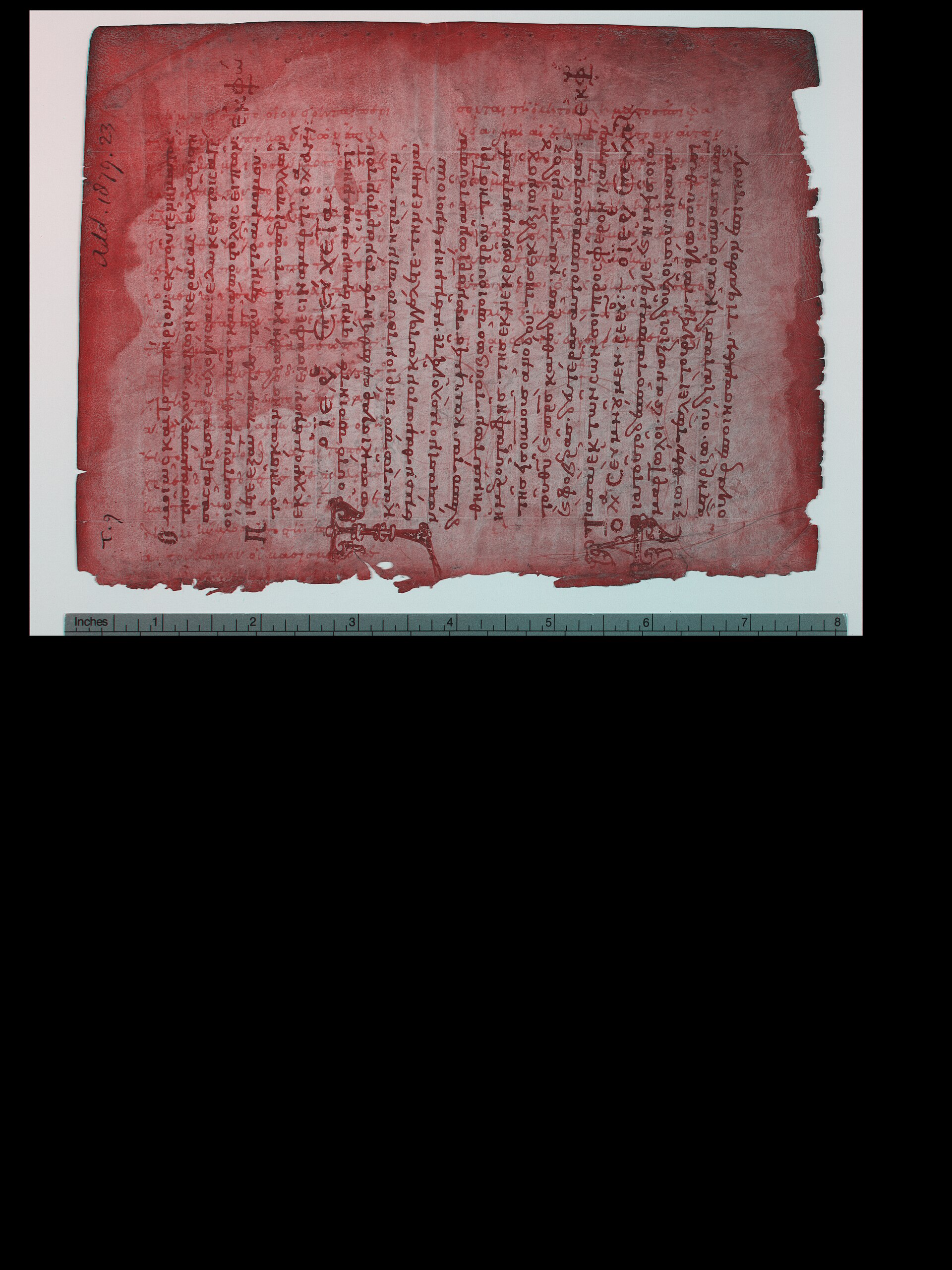
| Cambridge University Library MS Add. 1879.23 Ioannes Myronas (overtext); unnamed tenth-century copyist (undertext) | A leaf of this manuscript, removed in the 1840s Removed by Constantine Tischendorf, sold from his estate in 1876, and identified as part of this manuscript by Nigel Wilson only in 1968. | Cambridge University Library |
| Folio 123 of the Archimedes Palimpsest Ioannes Myronas (overtext); unnamed tenth-century copyist (undertext) | A leaf of this manuscript, detached probably about 1942 Bequeathed in 1973 by Andre Frank, catalogued unidentified, and recognised by Victor Gysembergh in October 2025. Carries propositions 39 to 41 of Sphere and Cylinder I, and a painting of Daniel between two lions. | Musee des beaux-arts de Blois, inv. 73.7.52 |
| Heiberg's photographs of 1906 Commissioned by Johan Ludvig Heiberg | The only record of the manuscript's state before a century of mould, and the only record of three folios that later went missing Used by Heiberg for his 1910-1915 edition, in which this manuscript is Codex C, and used in 2025 to confirm the identification of the Blois leaf. | Royal Danish Library, Copenhagen |
| Archimedis opera omnia, ed. J. L. Heiberg, 1910-1915 Johan Ludvig Heiberg | The edition built on this manuscript The apparatus designation Codex C for this manuscript comes from here. | Widely held |
| The Hyperides speeches in the undertext Unnamed copyist | A second unique text carried by the same recycled parchment Before this manuscript was read, Hyperides survived only in papyrus fragments and in quotation by other authors. | Within this manuscript, ten folios |
Open questions
- How did the manuscript leave the Metochion of the Holy Sepulchre after 1908? The holding project states plainly that it is not known, and the 1999 litigation did not establish it.
- Did Salomon Guerson own the manuscript, and when? Victor Gysembergh states that the illumination on folio 123 was made about 1942 at Guerson's instigation. That account is not reflected in the project's own history and has not been reconciled with the Sirieix and Guersan chain.
- Where are the other two folios photographed by Heiberg and now missing? One of the three has been found in a provincial French museum store; the other two are unlocated.
- What was the Christie's pre-sale estimate in 1998? The figure circulating in secondary summaries could not be confirmed against any source reachable from this desk, and is deliberately not repeated here.
- Who owns the manuscript? The buyer of 1998 has never been publicly identified, and the archive at OPenn catalogues the collection as Private Collection A.
- Why does the Archimedes Palimpsest Project's own website give two different dates for the sale, 28 and 29 October 1998, on two of its pages?
- What will multispectral and X-ray fluorescence imaging of the Blois leaf recover, and can the improved techniques now read passages the Baltimore campaign could not?
Questions about this object
What is The Archimedes Palimpsest?
The Archimedes Palimpsest is a manuscript, dated archimedes undertext second half of the tenth century; euchologion completed by April 1229. Medium: Iron gall ink on parchment, palimpsest, with later paintings in body colour and gold.
Who made The Archimedes Palimpsest, and is the attribution settled?
The attribution to Ioannes Myronas, scribe, over an unnamed tenth-century copyist is recorded here as documented. The prayer book is attributed to the scribe Johannes Myronas and dated to 1229 by the project that conserved and imaged the manuscript. The Archimedes undertext is dated to the second half of the tenth century on palaeography and localised to Constantinople; its copyist is unnamed.
Where is The Archimedes Palimpsest now?
Private collection, on deposit at the Walters Art Museum, Baltimore, since January 1999. Folio 123 at the Musee des beaux-arts de Blois; one leaf at Cambridge University Library. Inventory number Blois inv. 73.7.52; Cambridge University Library MS Add. 1879.23; the main codex has no public inventory number, and is catalogued at OPenn as Private Collection A. Last confirmed 4 August 2026. Bought at Christie's New York, 29 October 1998; deposited at the Walters in January 1999.
What is still unknown about The Archimedes Palimpsest?
How did the manuscript leave the Metochion of the Holy Sepulchre after 1908? The holding project states plainly that it is not known, and the 1999 litigation did not establish it.
Sources
- 1The Archimedes Palimpsest Project, 'About the Archimedes Palimpsest', giving the folio count, the seven treatises and the texts unique to this manuscript. archimedespalimpsest.org/about
- 2The Archimedes Palimpsest Project, 'The History of the Archimedes Manuscript'. archimedespalimpsest.org/about/...
- 3The Archimedes Palimpsest Project, 'The Conservation of the Archimedes Palimpsest', on the disbinding, the modern adhesive and the Canadian Conservation Institute analysis. archimedespalimpsest.org/about/...
- 4The Archimedes Palimpsest Project, 'The Digital Palimpsest', on the release of the data set on 29 October 2008. archimedespalimpsest.org/digital
- 5Mike Toth and Doug Emery, 'Archimedes Palimpsest Digital Release README Document', 29 October 2008, stating the licence terms. archimedespalimpsest.net/0_ReadMe.html
- 6Spencer P. M. Harrington, 'Archimedes Manuscript Sold', Archaeology 52:1, January/February 1999. archive.archaeology.org/9901/...
- 7Rita M. Graefe, 'The Conflicting Obligations of Museums Possessing Nazi-Looted Art', Boston College Law Review 51 (2010), 473, citing at note 110 Greek Orthodox Patriarchate of Jerusalem v. Christie's, Inc., No. 98 Civ. 7664 (KMW), 1999 WL 673347, at *7 (S.D.N.Y. Aug. 30, 1999). Text extracted from the PDF at this address. lootedart.com/web_images/...
- 8Victor Gysembergh, 'Palimpseste d'Archimede: comment une page perdue a refait surface a Blois', The Conversation, 8 April 2026. First-person account by the scholar who identified the leaf. theconversation.com/palimpseste-darchimede-comment-une-pa...
- 9Wikimedia Commons file metadata for the Archimedes Palimpsest imaging data released by the project, licensed CC BY 2.0 and CC BY 3.0, with the imaging credited to the Rochester Institute of Technology, Equipoise Imaging, Boeing LTS and the Stanford Linear Accelerator Center. commons.wikimedia.org/wiki/...
- 10Wikipedia, 'Archimedes Palimpsest'. Tertiary, consulted only for orientation; nothing in this record rests on it. Flagged for replacement with Netz, Noel, Tchernetska and Wilson (eds.), The Archimedes Palimpsest, 2 vols, Cambridge University Press for the Walters Art Museum, 2011. en.wikipedia.org/wiki/...
.jpg)
Last verified 1 September 2026 · Published 4 August 2026
Change log
4 August 2026 - Record created at the house standard: researched narrative, technical evidence, maker dossier, graded provenance chain, prices with hammer and premium separated, related works, open questions and sources.
1 September 2026 - Re-verified. No change to current location, ownership or the folio-123 Blois discovery already recorded (the March 2026 identification predates this record, created 2026-08-04, and was already correctly incorporated at creation). All 10 sources re-checked and resolve. No new developments found since last check.