The Unicorn Tapestries
Unknown designers, cartoons French, woven in the southern Netherlands · c. 1495-1505
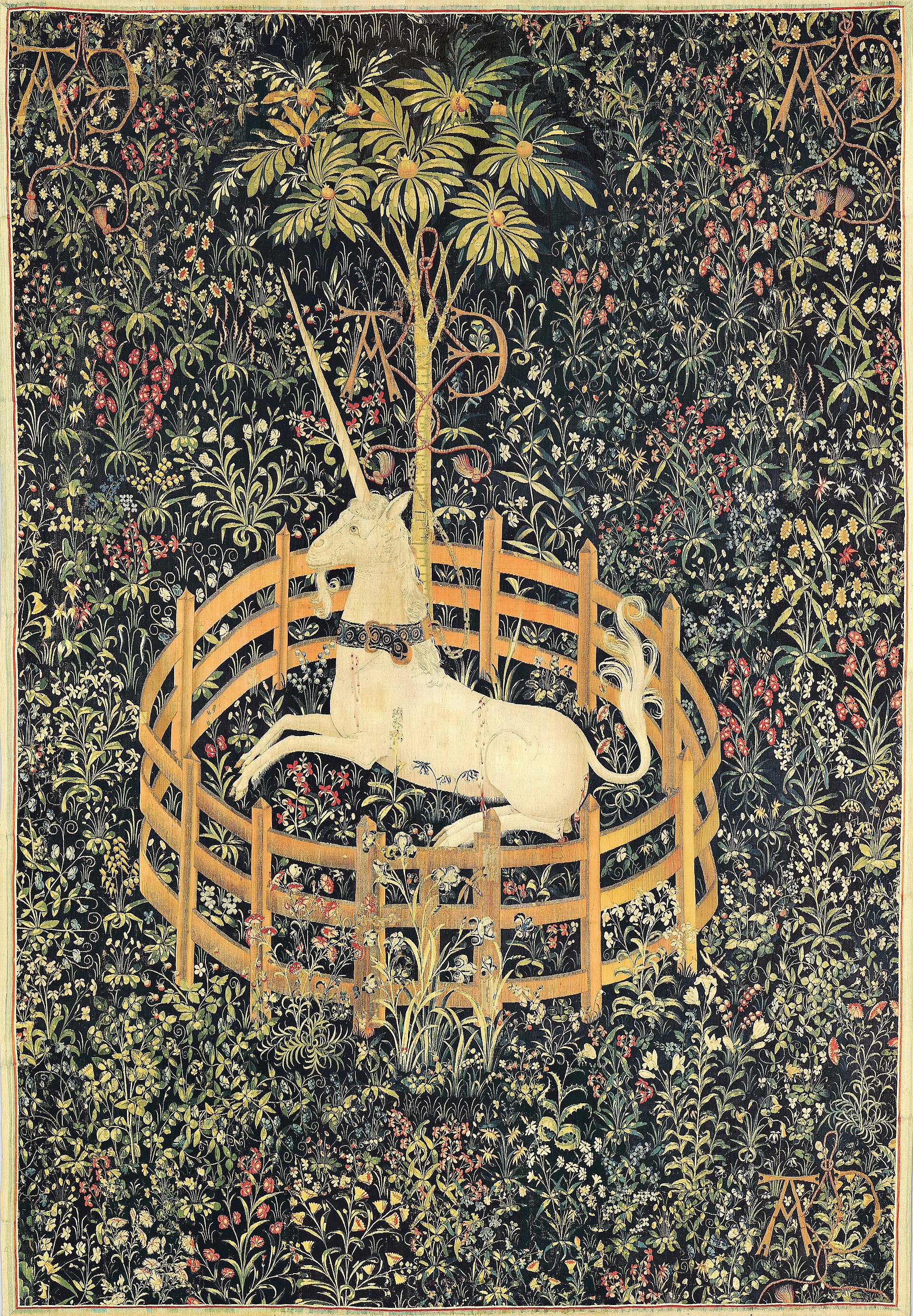
Hanging seven of seven, Met accession 37.80.6, catalogued today as The Unicorn Rests in a Garden and known everywhere else as The Unicorn in Captivity. 368 x 251.5 cm, the narrowest of the set. Photographed flat and face-on by the Met, which makes it a faithful reproduction rather than a photograph of a three-dimensional object. Licence checked at fetch time: LicenseShortName Public domain.
| Artist | Unknown designers, cartoons French, woven in the southern Netherlands |
|---|---|
| Date | c. 1495-1505 |
| Medium | Wool warp with wool, silk, silver and gilt wefts |
| Dimensions | Seven hangings across eight accession numbers. 37.80.1, 368.3 x 315 cm; 37.80.2, 368.3 x 378.5 cm; 37.80.3, 368.3 x 426.7 cm; 37.80.4, 368.3 x 401.3 cm; 37.80.5, 368.3 x 388.6 cm; 37.80.6, 368 x 251.5 cm; and the two fragments 38.51.1, 168.9 x 64.8 cm, and 38.51.2, 198.1 x 64.8 cm, which are remains of a single seventh hanging. |
| Where it is now | The Met Cloisters, New York, Gallery 17last confirmed 3 August 2026 |
| Attribution | UnknownNo designer, workshop or weaver is documented. Full note |
| Object type | Textile |
| Period | South Netherlandish, late fifteenth century |
| Cases | Has a provenance gap |
| Inscriptions | The knotted cipher A and E, tied with a cord, appears on every hanging. On 37.80.4 a hunter's scabbard carries the inscription AVE REGINA C[OELI]. |
| Owners on record | 8 links5 documented, 3 unknown |
| Sources | 5 cited |
About this record Last verified 18 August 2026 · 5 sources cited · Change log
On this page 12 sections
ContentsClose
Seven hangings woven in the southern Netherlands around 1500, of which one survives only as two narrow fragments. They were given to the Metropolitan Museum by John D. Rockefeller Jr. in 1937 and 1938 and they are the reason the Cloisters looks the way it does.
They are also a set whose titles have changed. The Met now calls the last one The Unicorn Rests in a Garden; the world calls it The Unicorn in Captivity. Six of the seven are catalogued under names different from the ones in most books. Anyone citing a plate has to say which accession number they mean.
Provenance
Each link is graded. Documented: a cited source supports it. Disputed: the identification is argued but not established. Unknown: no owner for that span, and the gap is not smoothed into a narrative. The grades in the glossary.
- c. 1495-1505 -Unknown patronunknown
No commission document is known. The AE cipher on every hanging is the only evidence of ownership at the point of manufacture and the Met records it as unidentified.
- c. 1505 - 1680Unrecordedunknown
Roughly 175 years with no documented owner. The Met states that no documentation sheds light on the early history of the tapestries, including either their commission or their sequence of hanging.
- 1680 - 1728Francois VI de La Rochefoucauld, Parisdocumented
The earliest documentary trace of the set. The Met records that the tapestries are first documented in 1680, when they hung in the Paris home of Francois VI de La Rochefoucauld, the author of the Maximes. This is a record of possession, not of acquisition: how the family came by them is unknown.1
- 1728 - 1793The La Rochefoucauld family, Chateau de Verteuil, western Francedocumented
By 1728 the set had moved to the family chateau at Verteuil, where five of the hangings decorated a bedroom. The other two are not located by the Met's summary at this date.1
- 1793 - 1850sLost. Looted during the French Revolutiondocumented
The Met states that the tapestries were looted during the French Revolution and recovered in the 1850s. Where they were in the intervening decades is not documented by the museum. The widely repeated story that they were used in a barn to cover vegetables or to protect fruit trees from frost is family tradition and is deliberately not asserted in this record.1
- 1856 - 1922The La Rochefoucauld family, Chateau de Verteuildocumented
By 1856 the tapestries had been restored and rehung in the chateau's salon. They remained with the family until the sale to Rockefeller in the early 1920s.1
- c. 1922 - 1937John D. Rockefeller Jr., New Yorkunknown
Rockefeller acquired the set in the early 1920s and gave it to the Metropolitan Museum in 1937. The purchase date, the price, the dealer and the identity of the selling family member are not stated on the Met object records and are not cited here. Figures circulate in secondary writing; none is carried in this record.
- 1937 - presentThe Metropolitan Museum of Art, The Cloistersdocumented
Six hangings, 37.80.1 to 37.80.6, gift of John D. Rockefeller Jr., 1937. The two fragments of the seventh, 38.51.1 and 38.51.2, gift of John D. Rockefeller Jr., 1938. All eight are in Gallery 17 and all eight are flagged public domain in the museum's open access data.1235
Prices realised
The set has never been sold at public auction. It passed by private sale to John D. Rockefeller Jr. and by gift to the Metropolitan Museum. Any price attached to it in print is a reported private figure, not a hammer and not a premium, and this record carries none until one is cited to a source.
Technical evidence
| Attribution note | No designer, workshop or weaver is documented. The Met catalogues the culture line as French (cartoon) / South Netherlandish (woven), with the geography given as Southern Netherlands (woven), and gives no artist name on any of the eight accession numbers. The set is dated on costume, style and technique, not on a contract. |
|---|---|
| Warp | Wool.1 |
| Wefts | Wool, silk, silver and gilt. The metal wefts are the reason sets of this quality were routinely burned for their bullion.1 |
| Culture | The Met's culture line reads French (cartoon) / South Netherlandish (woven); the geography line reads Southern Netherlands (woven). Design and weaving were separate trades in separate places.1 |
| Height | Every complete hanging is 145 inches, 368.3 cm, within a centimetre. 37.80.6 is given as 368 cm.12 |
| Widths | 37.80.1, 315 cm; 37.80.2, 378.5 cm; 37.80.3, 426.7 cm; 37.80.4, 401.3 cm; 37.80.5, 388.6 cm; 37.80.6, 251.5 cm.12 |
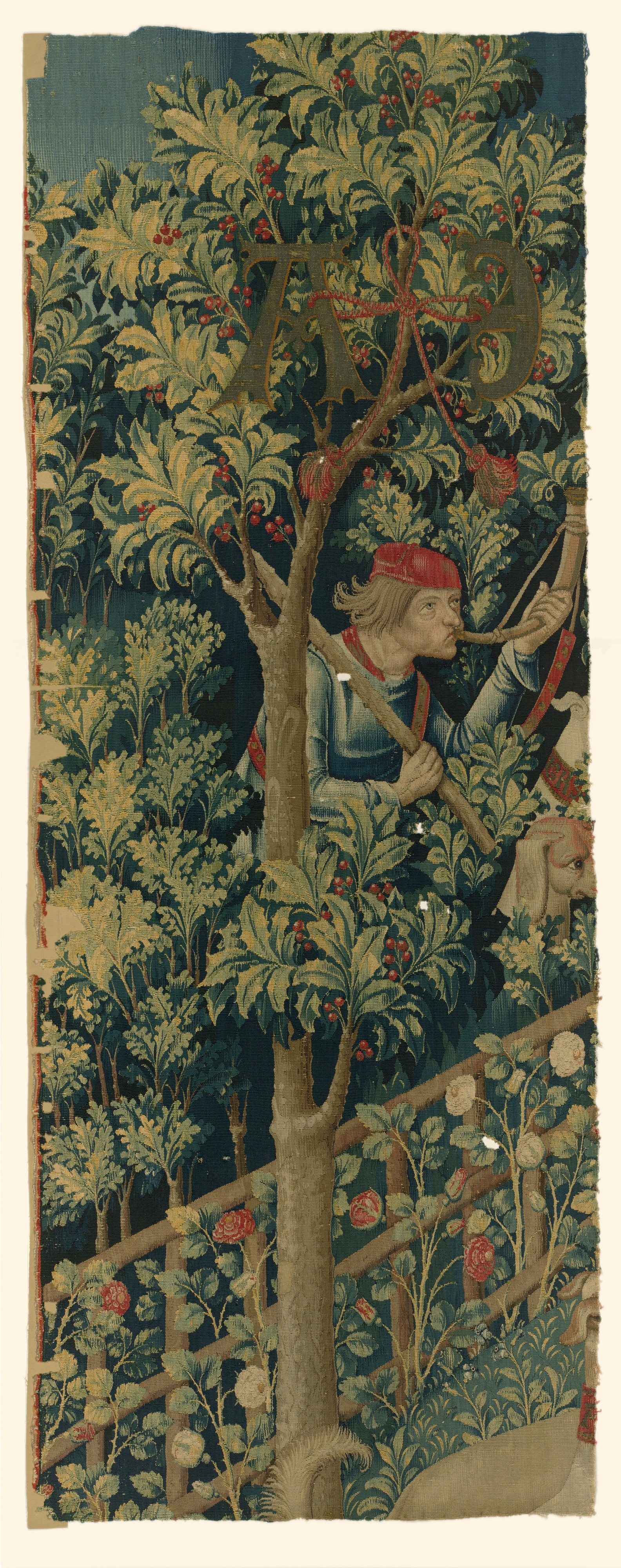
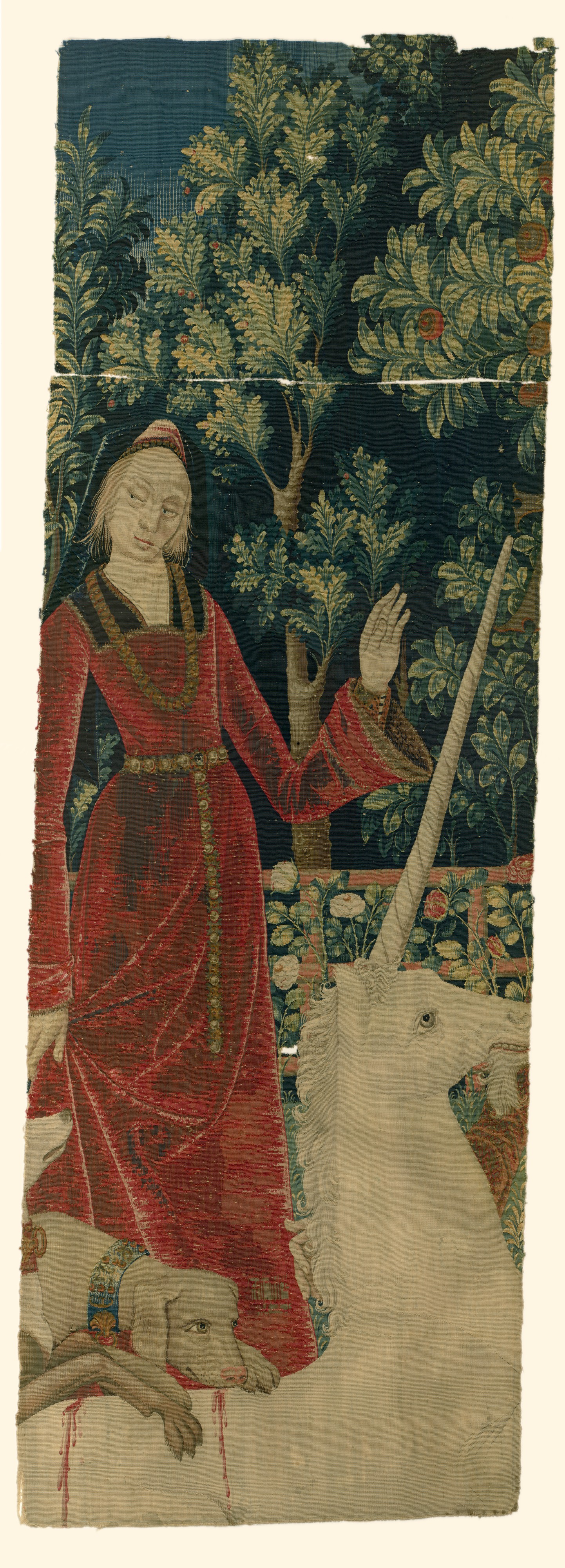
| The fragments | 38.51.1, 168.9 x 64.8 cm, and 38.51.2, 198.1 x 64.8 cm. Two narrow strips, the same width, all that survives of the seventh subject. Most of the maiden's figure is lost.3 |
| Cipher | The letters A and E tied with a knotted cord appear on all seven hangings. Unidentified in the Met's records.1 |
| Inscription | AVE REGINA C[OELI] on a hunter's scabbard in 37.80.4.4 |
| Classification and department | Textiles-Tapestries. Curatorial department Medieval Art and The Cloisters. All eight objects are flagged public domain in the Met's open access data.15 |
| Geography | Made in Paris, France (cartoon); Made in Southern Netherlands (woven). The Met's prose narrows the weaving further: probably designed in Paris but woven in Brussels.1 |
| Dyes | Chemical analysis has confirmed three vegetal dyes behind the whole palette: weld (yellow), madder (red) and woad (blue), combined by the weavers to produce every other colour. All three are grown in the Bonnefont Cloister garden at the museum.1 |
| Flora | 101 species of plants are represented; 85 have been identified on the Met's object page, while the audio guide on the same page says over 85 per cent, which is a different and larger claim (85 of 101 is 84.2 per cent). Identified examples on 37.80.1 include a cherry tree and a date palm.1 |
| Ground | 37.80.1 and 37.80.6 are set against a millefleurs ground, a field of dark green spangled with blossoming trees and flowers, which is one of the differences that separates them from the middle hangings.12 |
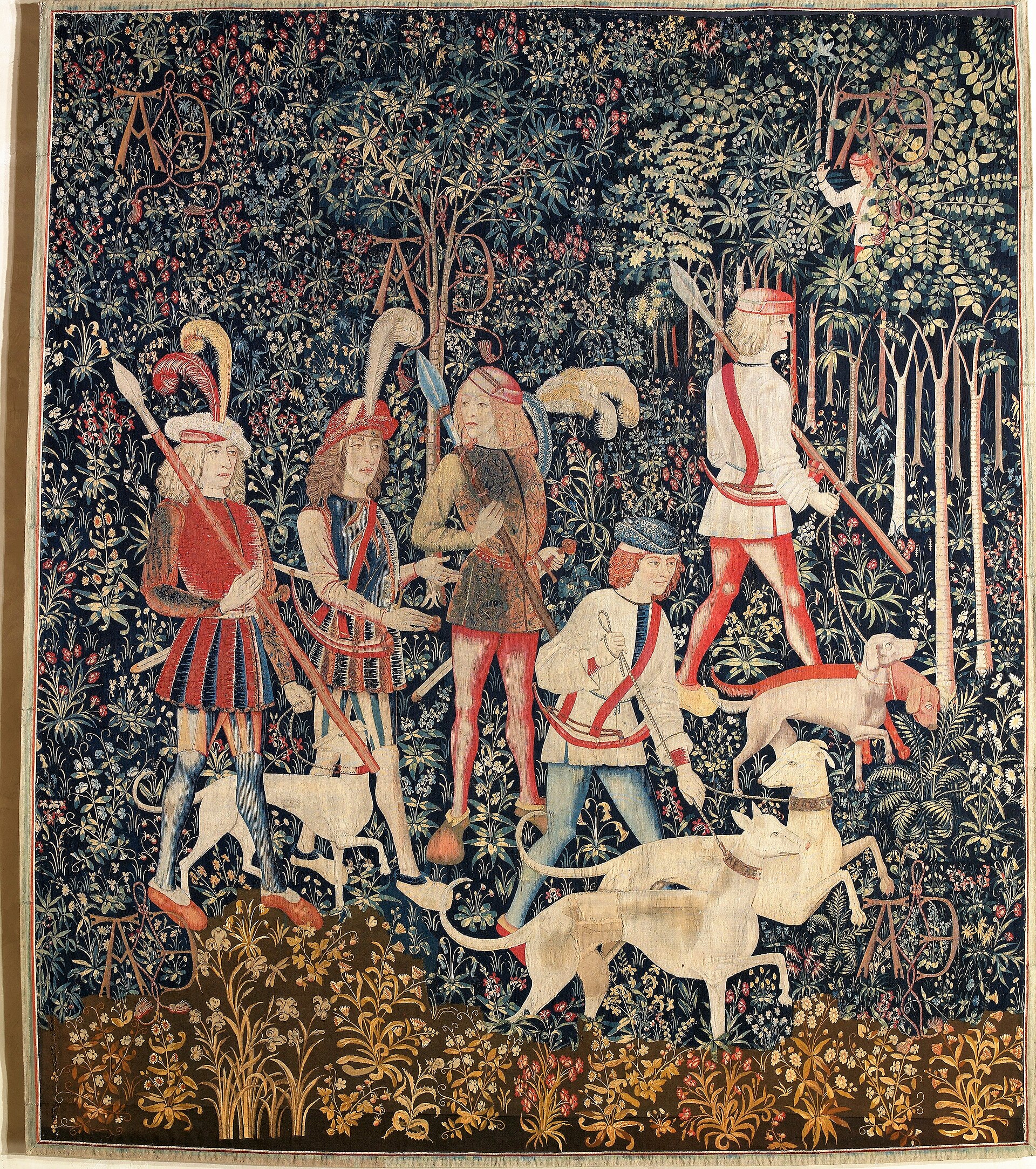
| Cipher count | The AE cipher is repeated five times on 37.80.1 alone.1 |
Images
The record in full
Chapter 1Seven hangings, eight accession numbers
The set is usually described as seven tapestries.
The set is usually described as seven tapestries. The Metropolitan Museum holds them under eight accession numbers, because the seventh subject survives only as two separated fragments.
The six complete hangings are 37.80.1 through 37.80.6, all of them a gift of John D. Rockefeller Jr. in 1937. The two fragments are 38.51.1 and 38.51.2, given the following year. All eight are in Gallery 17 at the Met Cloisters and all eight carry the same medium line: wool warp with wool, silk, silver and gilt wefts.
They are close to a uniform height. Every complete hanging is 145 inches tall, 368.3 centimetres, within a centimetre or two. The widths vary a great deal: from 251.5 centimetres for the last one to 426.7 for the third. The last hanging is both the narrowest and, on the Met's reading, possibly not part of the same series at all.
Chapter 2The Met has renamed them, and the old titles are still everywhere
Anyone working from published literature on these tapestries is working from a naming system the museum no longer uses, and the mismatch is a live cause of citation error.The current Met titles are...
Anyone working from published literature on these tapestries is working from a naming system the museum no longer uses, and the mismatch is a live cause of citation error.
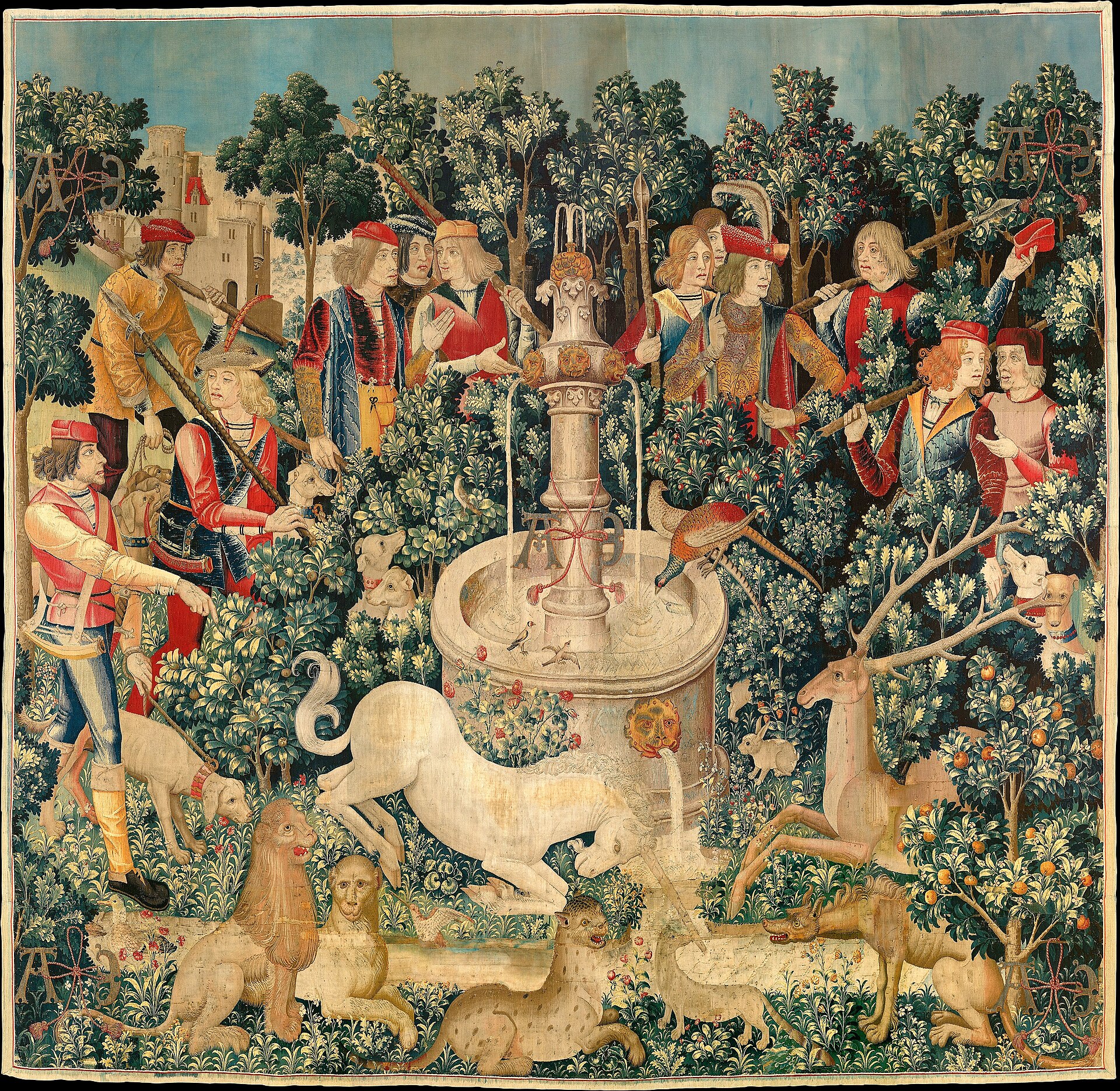
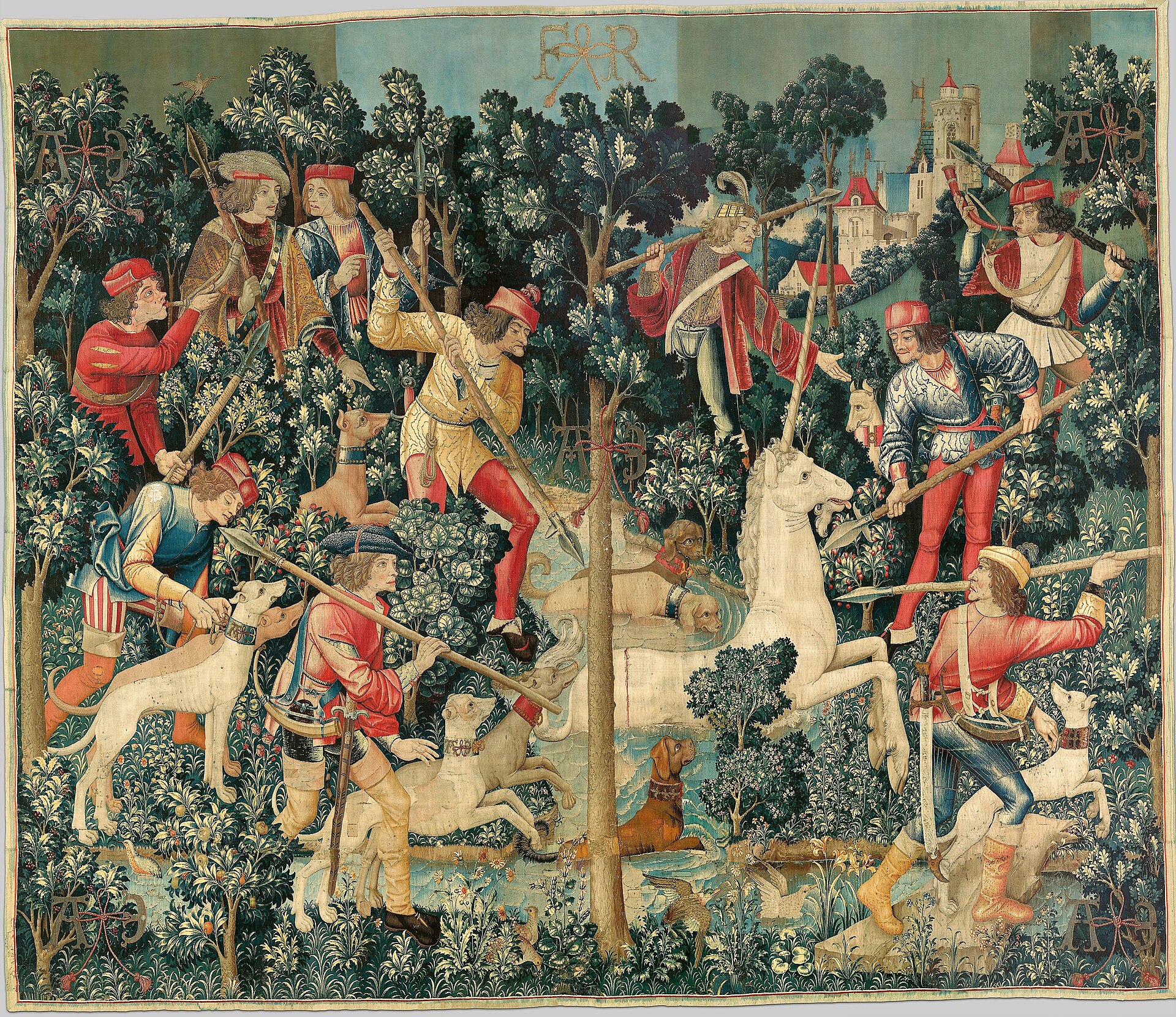
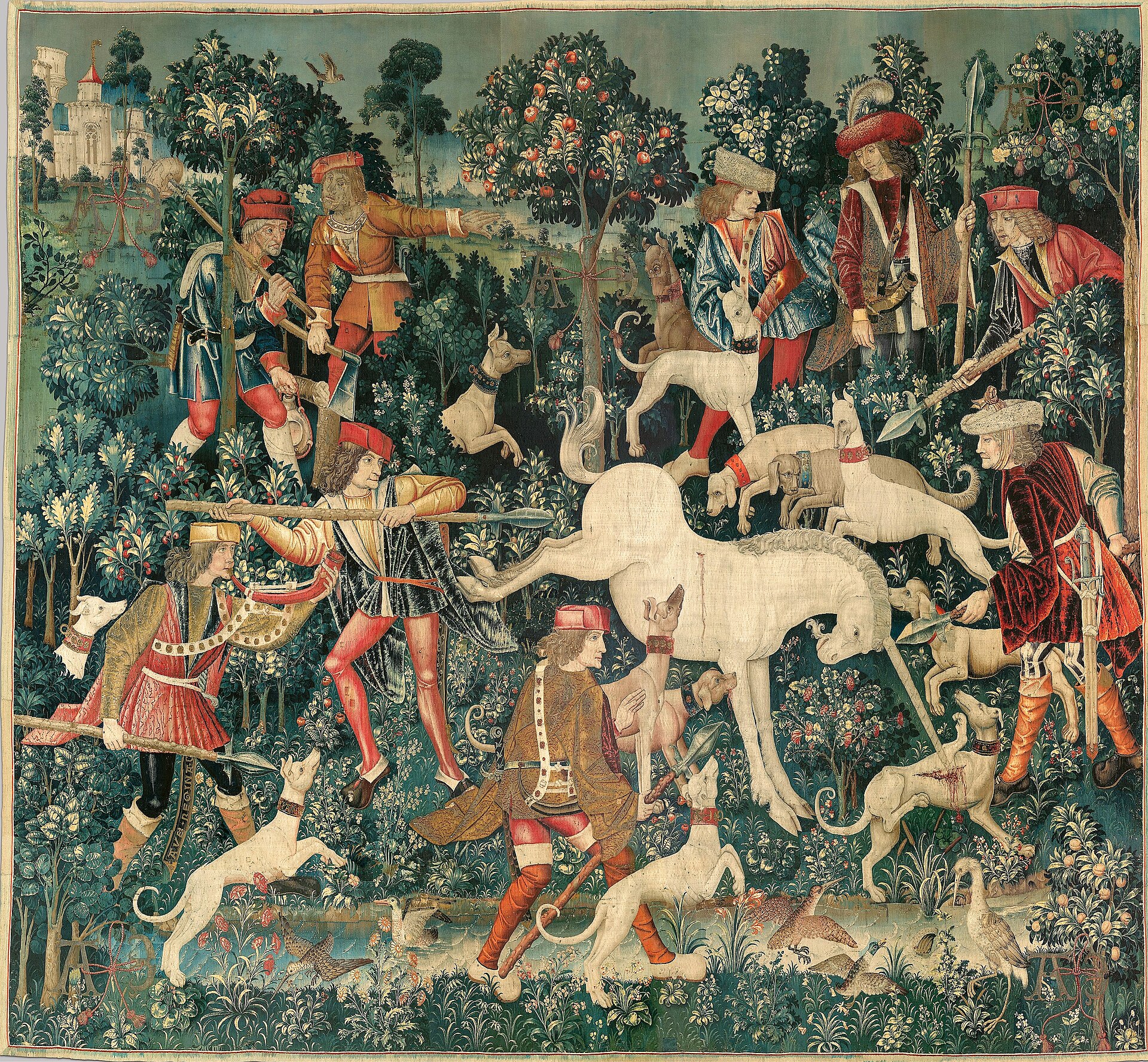
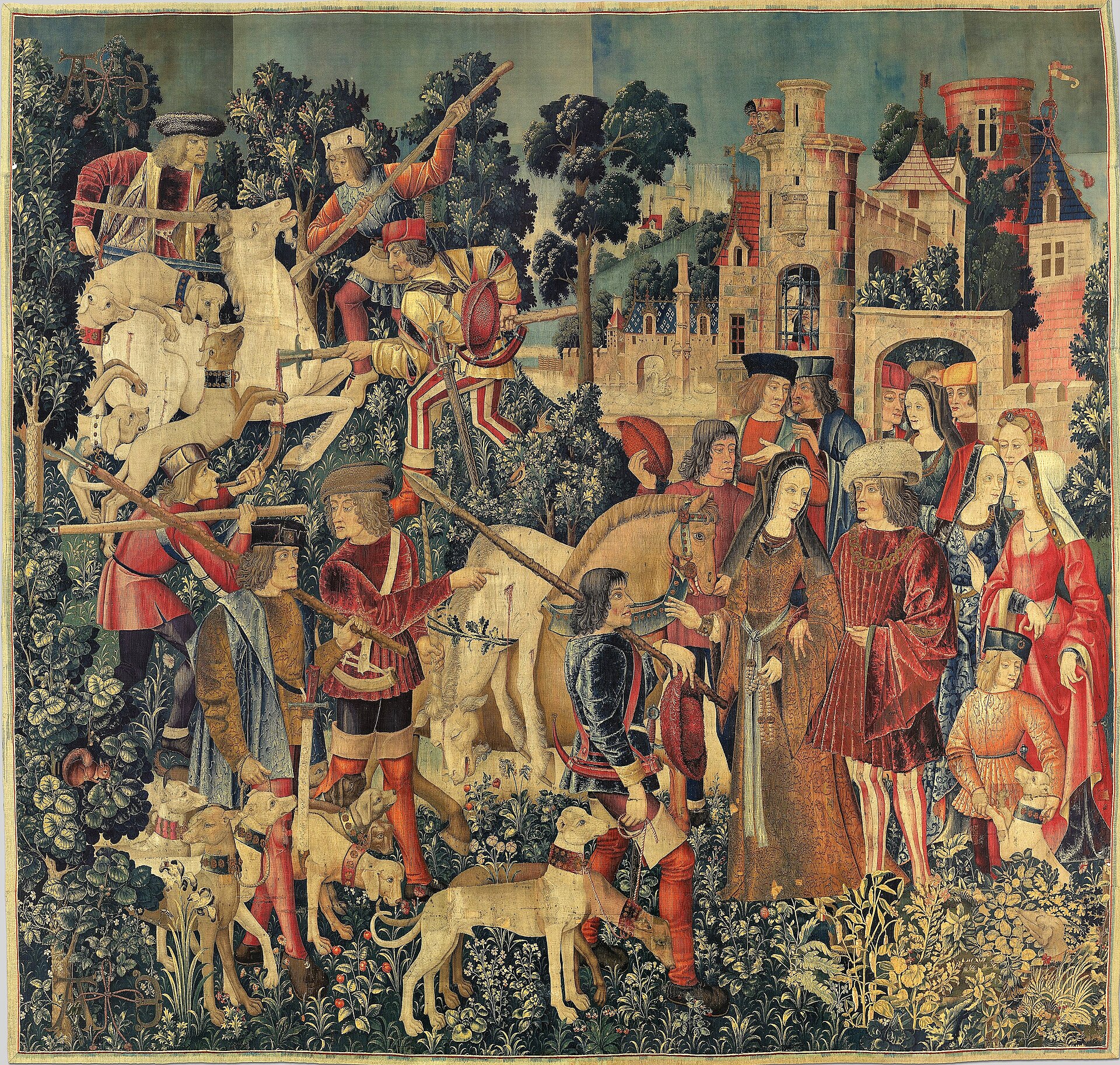
The current Met titles are: The Hunters Enter the Woods (37.80.1); The Unicorn Purifies Water (37.80.2); The Unicorn Crosses a Stream (37.80.3); The Unicorn Defends Himself (37.80.4); The Unicorn Surrenders to a Maiden (38.51.1 and 38.51.2); The Hunters Return to the Castle (37.80.5); and The Unicorn Rests in a Garden (37.80.6).
The names used in most of the twentieth-century literature and in almost every reproduction are different: The Start of the Hunt, The Unicorn is Found, The Unicorn is Attacked, The Unicorn Defends Itself, The Mystic Capture of the Unicorn, The Unicorn is Killed and Brought to the Castle, and The Unicorn in Captivity. The last of those is the most reproduced image in the set and the museum no longer calls it that.
Two of the changes are more than cosmetic. The Unicorn is Killed and Brought to the Castle became The Hunters Return to the Castle, which drops the killing from the title of a hanging that shows it. The Mystic Capture became The Unicorn Surrenders to a Maiden, which drops the theological reading. Titles are arguments, and these titles changed because the argument did.
The Wikimedia Commons files still carry the old names, so a plate captioned The Unicorn is Attacked is in fact 37.80.3, The Unicorn Crosses a Stream. Every plate in the gallery below names the accession number as well as the title, because the title alone no longer identifies the object.
Chapter 3What they are made of
The warp is wool. The wefts are wool, silk, silver and gilt.
The warp is wool. The wefts are wool, silk, silver and gilt. Silver and gilt wefts are metal wound on a silk core, and they are the reason a set like this was a statement of wealth rather than a wall covering: the raw material was literally precious metal, and tapestries were burned for their metal content when they had ceased to be fashionable.
That is the first thing to understand about the survival of these seven. Late Gothic tapestry sets of this quality were destroyed at a rate that makes an intact narrative set exceptional, and the usual cause was not neglect but the deliberate recovery of the silver.
The Met's culture line records a division of labour that the popular account collapses. The cartoons are given as French, the weaving as South Netherlandish. Two countries, two trades, and no name attached to either.
Chapter 4The AE cipher
A cipher of the letters A and E, tied together with a knotted cord, appears on every hanging in the set, five times over on The Hunters Enter the Woods alone.
A cipher of the letters A and E, tied together with a knotted cord, appears on every hanging in the set, five times over on The Hunters Enter the Woods alone. It is the single strongest clue to who commissioned them and it has never been resolved. The Met's formula is exact and worth quoting for what it concedes: the cipher alludes to their original owners, who remain unknown.
Its presence on all seven is what holds the group together as a group. Its meaning is what the literature has argued about for a century, and the proposals have been made and withdrawn in print more than once. No identification currently commands agreement, and the museum does not endorse one.
Chapter 5One hanging carries a written prayer
On The Unicorn Defends Himself, 37.80.4, a hunter at the lower left blows a horn and wears a scabbard inscribed AVE REGINA C[OELI]: Hail, Queen of Heaven.It is a Marian antiphon on the belt of a man...
On The Unicorn Defends Himself, 37.80.4, a hunter at the lower left blows a horn and wears a scabbard inscribed AVE REGINA C[OELI]: Hail, Queen of Heaven.
It is a Marian antiphon on the belt of a man helping to kill an animal. Whatever the hunt is about at the level of story, the object is not shy about carrying religious language into the middle of it, and any reading of the set has to account for a prayer to the Virgin embroidered on a hunter's equipment.
Chapter 6The last hanging may not belong to the hunt
The Met's own catalogue entry for The Unicorn Rests in a Garden, 37.80.6, says that it may have been created as a single image rather than as part of a series.The internal evidence supports it.
The Met's own catalogue entry for The Unicorn Rests in a Garden, 37.80.6, says that it may have been created as a single image rather than as part of a series.
The internal evidence supports it. The unicorn is tethered to a pomegranate tree inside a low round fence, wearing a collar and a chain, and the red marks on his flank do not correspond to any wound: the Met reads them as juice from the bursting pomegranates above him. The tree is a medieval emblem of fertility and marriage, and the plants around him, wild orchid, bistort, thistle, were held to aid conception in both men and women. The frog among the violets at the lower right was cited by medieval writers for its noisy mating.
Read that way, the picture is not the end of a hunt. It is a marriage image, and the unicorn is a bridegroom in a fence low enough to jump.
Chapter 7The animal has a textual history older than the tapestries
The Met dates the unicorn's literary life from the Greek physician Ctesias in the fourth century BC, and describes the animal as known in the Middle Ages for two things: its supposed invincibility...
The Met dates the unicorn's literary life from the Greek physician Ctesias in the fourth century BC, and describes the animal as known in the Middle Ages for two things: its supposed invincibility and the therapeutic property of its horn.
The second belief is the commercially significant one. Powdered horn was sold as an antidote to poison, and the horns sold as unicorn were narwhal tusks. A hunt cycle about capturing a unicorn was made for people who believed the animal existed and that its horn had a market price.
Chapter 8The chain begins in 1680, in a house in Paris
The first documentary trace of these tapestries is not a commission, an inventory of a workshop or a payment.
The first documentary trace of these tapestries is not a commission, an inventory of a workshop or a payment. It is a set of hangings on a wall in Paris, roughly one hundred and eighty years after they were woven.
The Met puts it precisely: they are first documented in 1680, when they hung in the Paris home of Francois VI de La Rochefoucauld. That is the author of the Maximes, one of the most quoted writers in French, and the first securely recorded owner of the most famous tapestries in America.
Everything before 1680 is blank. The museum states it without hedging: no documentation sheds light on the early history of the tapestries, including either their commission or their sequence of hanging. Nearly two centuries of the object's life are not merely undocumented in this record; they are undocumented anywhere.
Chapter 9Verteuil, and five of them in a bedroom
By 1728 the set had moved from Paris to the family's chateau at Verteuil in western France, and the Met records a detail that says more about how such objects were actually treated than any amount of...
By 1728 the set had moved from Paris to the family's chateau at Verteuil in western France, and the Met records a detail that says more about how such objects were actually treated than any amount of iconography: five of them decorated a bedroom.
Not a state hall. A bedroom. The most celebrated Gothic tapestries in existence spent the eighteenth century as furnishing in a country house, which is precisely how they survived. Objects that stay in use in a private family stay out of the market, out of fashion cycles, and out of the hands of people who burn tapestries for their silver.
Chapter 10Looted in the Revolution, recovered in the 1850s
The Met's account of the Revolution is short and it is careful, and this record does not go beyond it.
The Met's account of the Revolution is short and it is careful, and this record does not go beyond it. The tapestries were looted during the French Revolution. They were recovered in the 1850s. By 1856 they had been restored and rehung in the chateau's salon.
That is the documented shape of the episode: a loss, a gap of roughly sixty years, a recovery, and a restoration. Around it has grown a body of family tradition about what happened in the missing decades, most commonly that peasants used the hangings in a barn, to cover vegetables or to protect fruit trees from frost. Those stories are repeated everywhere and they are not in the museum's account of the object.
This record therefore states the loss and the recovery, and declines to state the barn. A tapestry that spent sixty years as agricultural sacking would be a remarkable fact about its condition, and a record that asserts it without a citation is asserting the most interesting thing it says on no evidence at all.
Chapter 11How they reached New York
The set was bought by John D. Rockefeller Jr.
The set was bought by John D. Rockefeller Jr. and given to the Metropolitan Museum of Art in two instalments: the six complete hangings in 1937, the two fragments in 1938. The credit line on all eight reads Gift of John D. Rockefeller Jr.
They are the anchor of the Cloisters, which opened in 1938, and they have been in the same gallery since. The price Rockefeller paid, the year he paid it and the member of the La Rochefoucauld family who sold are not stated on the Met's object records, and no figure appears in this record until one is cited.
Chapter 12The museum is not certain this is one set
The seven hangings are catalogued together, hung together and reproduced together, and the Met itself questions whether they belong together.Its wording is that striking differences in dimension and...
The seven hangings are catalogued together, hung together and reproduced together, and the Met itself questions whether they belong together.
Its wording is that striking differences in dimension and composition have prompted scholars to question whether the hangings constitute one set or are, in fact, from multiple sets. The differences are on the record above: a constant height of 368.3 centimetres against widths running from 251.5 to 426.7, and one hanging, The Unicorn Rests in a Garden, that the museum separately says may have been created as a single image.
The AE cipher is the counter-argument, because it appears on every one of them, five times over on The Hunters Enter the Woods alone. But the Met says the cipher alludes to their original owners, who remain unknown, so what it proves is common ownership at some point, not a single commission.
Chapter 13The plants, and a number the museum gives twice
The tapestries are famous for a flora that can be identified to species, and the Met's object page gives the count: of the 101 species of plants represented, 85 have been identified.
The tapestries are famous for a flora that can be identified to species, and the Met's object page gives the count: of the 101 species of plants represented, 85 have been identified. Named examples on The Hunters Enter the Woods include the cherry tree behind the hunters and the date palm in front of the sniffing hound, and the museum grows some of the others, such as lady's mantle and butcher's broom, in the gardens at the Cloisters.
The audio guide on the same page gives the figure differently: 101 species, of which over 85 per cent have been identified. Eighty-five of a hundred and one is 84.2 per cent, so the two statements on one museum page do not agree, and the audio version is the one that rounds in the museum's favour. It is a small thing and it is exactly the kind of small thing that gets copied.
The dyes are better settled. The Met states that chemical analysis has confirmed three vegetal dyes behind the whole palette: weld, madder and woad, giving yellow, red and blue, combined by the weavers to make everything else. All three grow in the Bonnefont Cloister garden downstairs from the tapestries.
The artist
The designers and weavers of the Unicorn Tapestries, French cartoons, South Netherlandish weaving, c. 1495-1505
Nobody knows who designed these, who wove them, or who paid for them. That is not a gap in this record; it is the state of the scholarship. The Metropolitan Museum catalogues all eight pieces with no artist name and dates them on costume and technique. What can be said about the makers is said from the objects themselves and from what is known about how the Netherlandish tapestry trade worked around 1500.
Exhibited
- 1938-presentPermanent display, Gallery 17The Met Cloisters, New York
Literature
- A Blessing of Unicorns: The Paris and Cloisters Tapestries. Metropolitan Museum of Art. Listed by the Met against this object and free to download. It treats the Cloisters set together with the Musee de Cluny Lady and the Unicorn, which is the comparison most often made badly. (2020)
- The Cloisters: Medieval Art and Architecture. Metropolitan Museum of Art, free to download. The standard museum handbook for the building the tapestries anchor. (n.d.)
- Creating the Cloisters. Metropolitan Museum of Art, free to download. The account of how Rockefeller's gifts became the museum. (n.d.)
Related works
| Work | Relation | Where it is |
|---|---|---|
| The Unicorn Surrenders to a Maiden, fragments Unknown, French cartoon, South Netherlandish weaving | The seventh subject of this same set, surviving only as strips Given by Rockefeller a year after the other six. Most of the maiden is gone. | The Met Cloisters, 38.51.1 and 38.51.2 |
| The Lady and the Unicorn Unknown, designed in Paris, woven in the southern Netherlands | The other great unicorn set, contemporary and constantly confused with this one Six hangings, a different subject and a different collection. A large share of the images captioned Unicorn Tapestries online are these. | Musee de Cluny, Paris |
| The Hunt of the Unicorn, Stirling Castle replicas Modern hand-weavers, West Dean and Stirling | Modern hand-woven replicas of the Cloisters set, made for the palace restoration Replicas, not versions. Photographs of them circulate captioned as the Cloisters originals. No free-licence photograph of them was usable here: the available Commons image is CC BY-SA 3.0 and fails the public-domain-or-CC0 rule. | Stirling Castle, Scotland |
Open questions
- Who commissioned the set? The AE cipher appears on every hanging and the Met says it alludes to original owners who remain unknown.
- Is this one set or several? The Met records that striking differences in dimension and composition have prompted scholars to question whether the hangings constitute one set or are from multiple sets.
- Was The Unicorn Rests in a Garden made for this series at all? The Met records the possibility that it was a single image.
- Who designed the cartoons, and in which workshop were they woven? The Met gives Paris for the design and the southern Netherlands, probably Brussels, for the weaving, and no names.
- How did the La Rochefoucauld family come to own them? The 1680 Paris record is one of possession, not of acquisition, and nothing earlier is documented anywhere.
- Where were the tapestries between the Revolutionary looting and the recovery in the 1850s? The barn stories are family tradition and the museum does not carry them.
- What happened to the rest of the seventh hanging? Two strips survive out of a hanging that would have been comparable in size to the others.
- What did Rockefeller pay, in which year, and to which member of the La Rochefoucauld family? Figures and dates circulate; this record carries none until one is cited.
- How many plant species have actually been identified? The Met's object page says 85 of 101; the audio guide on the same page says over 85 per cent, and the two do not agree.
Questions about this object
What is The Unicorn Tapestries?
The Unicorn Tapestries is a textile, dated c. 1495-1505. Medium: Wool warp with wool, silk, silver and gilt wefts.
Who made The Unicorn Tapestries, and is the attribution settled?
The attribution to Unknown designers, cartoons French, woven in the southern Netherlands is recorded here as unknown. No designer, workshop or weaver is documented. The Met catalogues the culture line as French (cartoon) / South Netherlandish (woven), with the geography given as Southern Netherlands (woven), and gives no artist name on any of the eight accession numbers. The set is dated on costume, style and technique, not on a contract.
Where is The Unicorn Tapestries now?
The Met Cloisters, New York, Gallery 17. Last confirmed 3 August 2026. Gift of John D. Rockefeller Jr., 1937 and 1938.
What is still unknown about The Unicorn Tapestries?
Who commissioned the set? The AE cipher appears on every hanging and the Met says it alludes to original owners who remain unknown.
Sources
- 1The Metropolitan Museum of Art, collection record for The Hunters Enter the Woods (from the Unicorn Tapestries), accession 37.80.1, object 467637. Carries the medium, dimensions, date, culture line, credit line and gallery. metmuseum.org/art/...
- 2The Metropolitan Museum of Art, collection record for The Unicorn Rests in a Garden (from the Unicorn Tapestries), accession 37.80.6, object 467642. Carries the museum's reading of the pomegranate, the plants, the red marks and the possibility that this hanging was a single image. metmuseum.org/art/...
- 3The Metropolitan Museum of Art, collection records for The Unicorn Surrenders to a Maiden, accessions 38.51.1 and 38.51.2, objects 467653 and 467654. The two fragments, their dimensions, and the 1938 credit line. metmuseum.org/art/...
- 4The Metropolitan Museum of Art, collection record for The Unicorn Defends Himself, accession 37.80.4, object 467640. Records the AVE REGINA COELI scabbard inscription. metmuseum.org/art/...
- 5The Metropolitan Museum of Art public collection API, object records 467637, 467638, 467639, 467640, 467641, 467642, 467653 and 467654. Queried directly for this record: it is the source of the accession numbers, current titles, dimensions, culture line, gallery number and the public domain flag on all eight objects. collectionapi.metmuseum.org/public/...
Last verified 18 August 2026 · Published 4 August 2026
Change log
2 August 2026 - Record deepened to the house standard: narrative sections, technical evidence, artist dossier, related works and open questions added; provenance chain and auction results replaced with the researched versions; sources rebuilt.
4 August 2026 - Record created at the house standard: researched narrative, technical evidence, maker dossier, graded provenance chain, prices with hammer and premium separated, related works, open questions and sources.
18 August 2026 - Re-verified (record-desk moat pass). Gallery 17 placement at The Met Cloisters confirmed current against the Met's own object page. Checked two open questions for new material: (1) the Rockefeller purchase price/date/dealer - a figure of 1.1 million dollars circulates on secondary and tertiary sites (blogs, Wikipedia) but no primary or museum-published source was found to carry it, so this record's deliberate omission stands unchanged, correctly; (2) candidate identities for the AE cipher - secondary sites name Anne of Brittany or an Adam-and-Eve reading, but the Met's own object page (already this record's source 1), re-read in full today, states only that the initials 'allude to their original owners, who remain unknown' and names no candidate - this record's existing, uncommitted wording matches the museum's own primary language and is left as-is rather than adding a weakly sourced theory. No litigation, deaccession, attribution change or new scholarship found. All four cited source URLs re-checked and resolve (metmuseum.org 429'd on direct fetch, confirmed via browser - bot block, not a dead link).