Krishna Lifting Mount Govardhan
Unrecorded sculptor of Phnom Da, Angkor Borei · c. 600
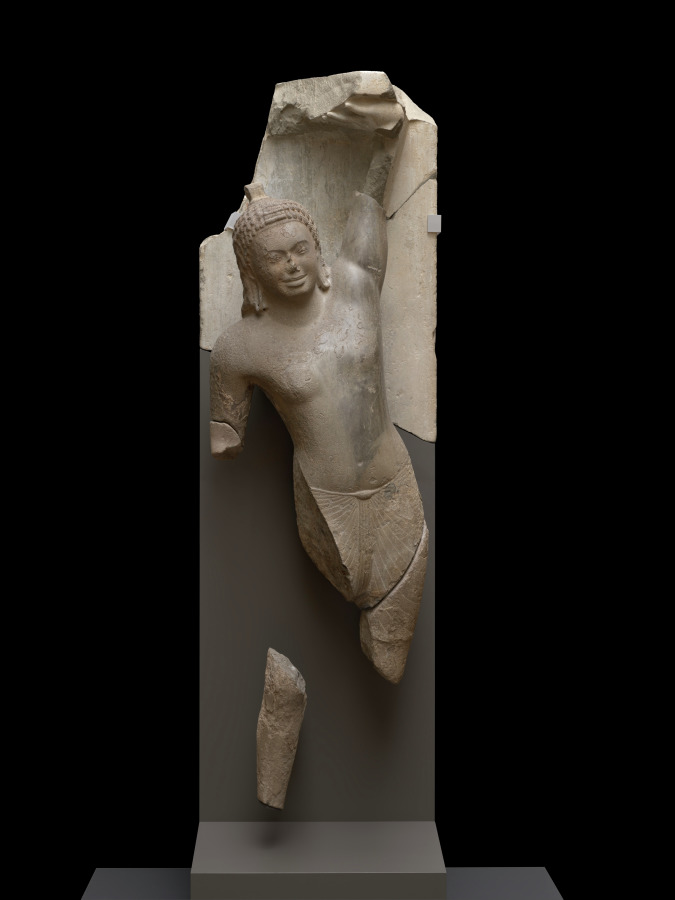
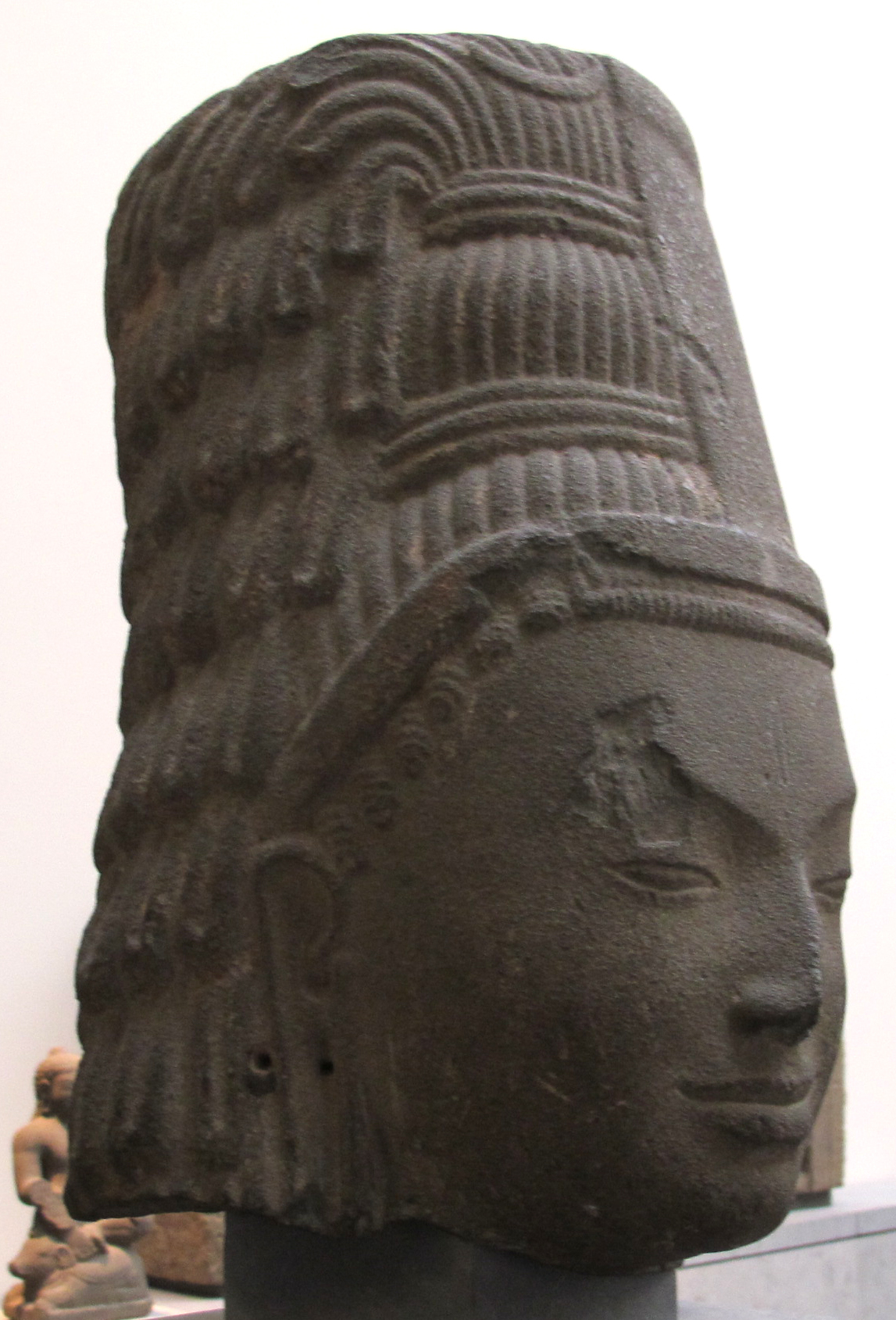
The record subject, in its present state. Sandstone, about 600, from Phnom Da in Takeo province. The figure no longer stands on its own legs: the thigh, calves and feet fitted in 1978 belonged to a different sculpture and were taken off between 2018 and 2021.
| Artist | Unrecorded sculptor of Phnom Da, Angkor Borei |
|---|---|
| Date | c. 600 |
| Medium | Sandstone |
| Dimensions | Overall 203.1 x 68 x 55.5 cm. Torso (1973.106.a) 143.5 x 66 x 50.2 cm; upper stele with hand (1973.106.b) 104.8 x 69.2 x 10.8 cm. The body and upper section together weigh about 830 pounds |
| Where it is now | Cleveland Museum of Art, Cleveland, Ohiolast confirmed 4 August 2026 |
| Inventory number | 1973.106 |
| Attribution | WorkshopNo maker is named. Full note |
| Object type | Sculpture |
| Period | Pre-Angkorian Khmer, about 600 |
| Inscriptions | None on the sculpture. The sanctuaries of Phnom Da are dated by separate Khmer and Sanskrit inscriptions to the reign of King Rudravarman, 514 to 539. |
| Owners on record | 7 links6 documented, 1 disputed |
| Sources | 8 cited |
About this record Last verified 24 August 2026 · 8 sources cited · Change log
On this page 12 sections
ContentsClose
A larger than life sandstone Krishna carved about 600 for a man-made cave on the mountain of Phnom Da in southern Cambodia, cut down on site in the early 1900s to be reused as the armature of a Buddha, sold in Paris in 1920 by the Cubist dealer Leonce Rosenberg to Adolphe Stoclet, and displayed in the music hall of the Palais Stoclet in Brussels for nearly fifty years under the name the dancing prince.
Fragments dug up at Phnom Da in 1935 were shipped to Brussels, failed to fit, and were thrown into a neighbour's garden, where they held up a water cistern and edged a flower bed until a Cleveland curator recognised the pleats of a Phnom Da sampot carved into a thigh in 1977. Cleveland used eight of them to build a nearly complete figure in 1978 and sent nine to Phnom Penh in 2005, where six were attached to a different Krishna.
Almost all of that was wrong. Between 2014 and 2018 conservators in Cambodia, France and Ohio established by three-dimensional scanning and petrography that six pieces in Cleveland belonged to the Phnom Penh statue and two pieces in Phnom Penh belonged to the Cleveland one. Cambodia transferred a hand, strut and panel to Cleveland in 2015; Cleveland took its own 1978 restoration apart; and both sculptures now stand with fewer limbs and the right ones.
Provenance
Each link is graded. Documented: a cited source supports it. Disputed: the identification is argued but not established. Unknown: no owner for that span, and the gap is not smoothed into a narrative. The grades in the glossary.
- c. 600 - c. 1300Sanctuary on Phnom Da, Takeo provincedocumented
Carved about 600 for a sanctuary on Phnom Da, one of eight monumental Hindu figures at the earliest monumental Hindu temple complex recorded in Cambodia, whose foundation inscriptions date to the reign of Rudravarman, 514 to 539. Surviving evidence indicates active worship for about seven hundred years.26
- c. 1300 - c. 1910None; the site abandoneddocumented
Around 1300, when Thai forces took southern Cambodia, the eight sculptures were toppled from their pedestals, most probably to reach the consecration gold and gems set beneath them. The site was largely abandoned; a French civil servant visited the caves in the 1880s. In the first decade of the 1900s a Buddhist community from Vietnam settled at the site and reused the temples and broken sculpture.26
- c. 1910 - 1920Removed from Cambodia; Leonce Rosenberg, Parisdisputed
Henri Parmentier of the Ecole francaise d'Extreme-Orient recorded his visit in June 1911; the report published that year indicates the head and body section had been taken to France the previous year. Before removal the torso was already being cut down for use as a body armature for a new seated Buddha. Who removed it, and under what colonial authority, is not documented. The Cleveland Museum of Art's own list places Leonce Rosenberg in Paris from about 1910 to 1920 as the first named holder.1256
- 1920 - 1949Adolphe Stoclet (1871-1949) and Suzanne Stoclet, Palais Stoclet, Brusselsdocumented
Bought from Leonce Rosenberg in 1920 and displayed on a stage in the music hall of the Palais Stoclet, where the couple called it their dancing prince. Published soon after purchase and praised internationally by the late 1920s. In 1935 Henri Mauger of the Ecole francaise d'Extreme-Orient found further fragments at Phnom Da; they were shipped to Brussels on the belief that they completed this figure, and after failed attempts by the sculptor Marcel Wolfers to attach them they were abandoned in his garden.1256
- 1949 - 1967Michele Leon-Stoclet (1932-1967), Brussels and Barcelonadocumented
Inherited from her grandparents. Her sudden death in 1967 put the sculpture on the market. Sherman E. Lee, director of the Cleveland Museum of Art, worked for eight years to secure it.12
- 1967 - 1973The Stoclet estatedocumented
The museum bought the head and torso section from the Stoclet estate in 1973 through the John L. Severance Fund. No purchase price has been published and there was no auction.126
- 1973 - presentThe Cleveland Museum of Art, Cleveland, Ohiodocumented
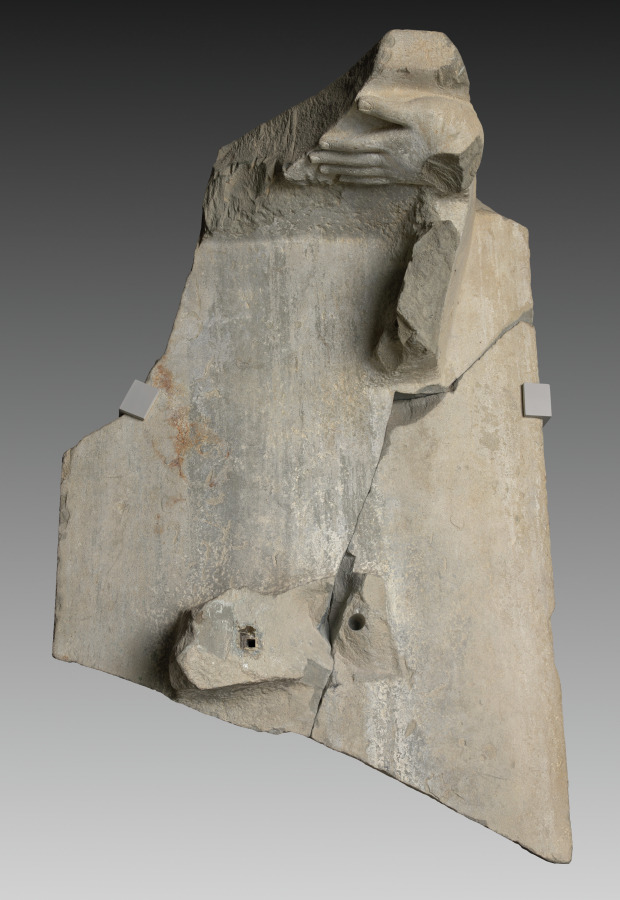
Seventeen fragments were recovered from the Wolfers garden in Brussels by the curator Stanislaw Czuma and sent to Cleveland in 1977; eight were attached in 1978-79. Nine unused fragments were transferred to the National Museum of Cambodia in 2005 and further fragments in 2020. On 30 October 2015 the Ministry of Culture and Fine Arts of Cambodia authorised the transfer to Cleveland of a fragment comprising a hand, strut and supporting panel, after petrographic analysis matched it to this sculpture. The legal form of that transfer, whether gift, loan or exchange, has not been published.12456
Prices realised
This sculpture has been sold twice and neither sale was at auction, so no hammer price and no buyer's premium exist for it. The 1920 sale from Leonce Rosenberg to Adolphe Stoclet was a private dealer transaction and no price has been published. The 1973 purchase from the Stoclet estate by the Cleveland Museum of Art was likewise private and the figure has not been published. Sources describing the sculpture as arriving on the European auction block in 1920 conflict with the accounts naming Rosenberg as the seller in a private sale; this record follows the museum's own provenance list and the Art Newspaper account, and records the conflict rather than choosing.
Technical evidence
| Attribution note | No maker is named. The sculpture is attributed to the workshops of Angkor Borei on the evidence of style, stone and site: it is one of eight monumental Hindu figures recovered from the mountain of Phnom Da in Takeo province, all carved from monolithic blocks in the manner that defines what art historians call the Phnom Da style. Attribution here is to a place and a generation of carvers, not to a hand. Petrographic analysis of the stone, not connoisseurship, is what has settled which fragments belong to which of these figures. |
|---|---|
| Material | Sandstone, carved from a single monolithic block with a supporting stele behind the figure.12 |
| Dimensions | Overall 203.1 x 68 x 55.5 cm. Torso 143.5 x 66 x 50.2 cm; upper stele with hand 104.8 x 69.2 x 10.8 cm.1 |
| Weight | Body and upper section together about 830 pounds, suspended on a purpose-built mount.3 |
| Condition at acquisition | Acquired in 1973 as a fragment: head and torso only, with no arms and no legs.2 |
| 1978-79 reconstruction | Eight fragments attached to the torso with steel rods set in epoxy in newly drilled holes; missing sections of the legs filled with epoxy putty and metal casings. Documented with photographs and step-by-step notes.35 |
| 2018-21 reconstruction | The 1978 materials excavated, exposing original stone for the first time since 1978. A thigh, two calves and the feet were removed; the upper stele with the left hand was added. Four stone pieces are kept physically separate and suspended to read as one figure, using epoxy and steel combinations tested for reversibility.35 |
| Analytical methods | Three-dimensional laser scanning and photogrammetry, medical computed tomography, industrial X-ray, full-scale and 1:4 three-dimensional prints, and petrographic analysis of stone samples.346 |
| Petrographic result | The largest fragment held in Phnom Penh and the Cleveland sculpture were carved from the same block of stone. Overall, two pieces in Phnom Penh belonged to Cleveland and six pieces in Cleveland belonged to the Phnom Penh Krishna.46 |
| Original setting | Probably a man-made cave part way up the northern slope of Phnom Da, so that the figure appears to support the mountain it stands inside.27 |
| Comparanda by measurement | Phnom Penh Krishna, National Museum of Cambodia Ka.1641, c. 600, 188 cm without a 43 cm tenon. Wat Koh Krishna, Ka.1625, c. 700, 161 cm without a 27 cm tenon. Balarama, Ka.1640, c. 600, 185.5 cm without a 49 cm tenon. Paris Harihara, Guimet MG 14910, c. 600, 173 cm.2 |
Images
The record in full
Chapter 1A god who is the mountain he lifts
The subject is a single episode. In the Harivamsha and the Vishnu Purana, the boy Krishna persuades his cow-herding village to divert the annual offerings from Indra, god of rain, to the nearby Mount...
The subject is a single episode. In the Harivamsha and the Vishnu Purana, the boy Krishna persuades his cow-herding village to divert the annual offerings from Indra, god of rain, to the nearby Mount Govardhan, on the ground that the mountain is what actually feeds them. Indra sends a storm; Krishna lifts the mountain like an umbrella and holds it over the village and its cattle for seven days until Indra concedes.
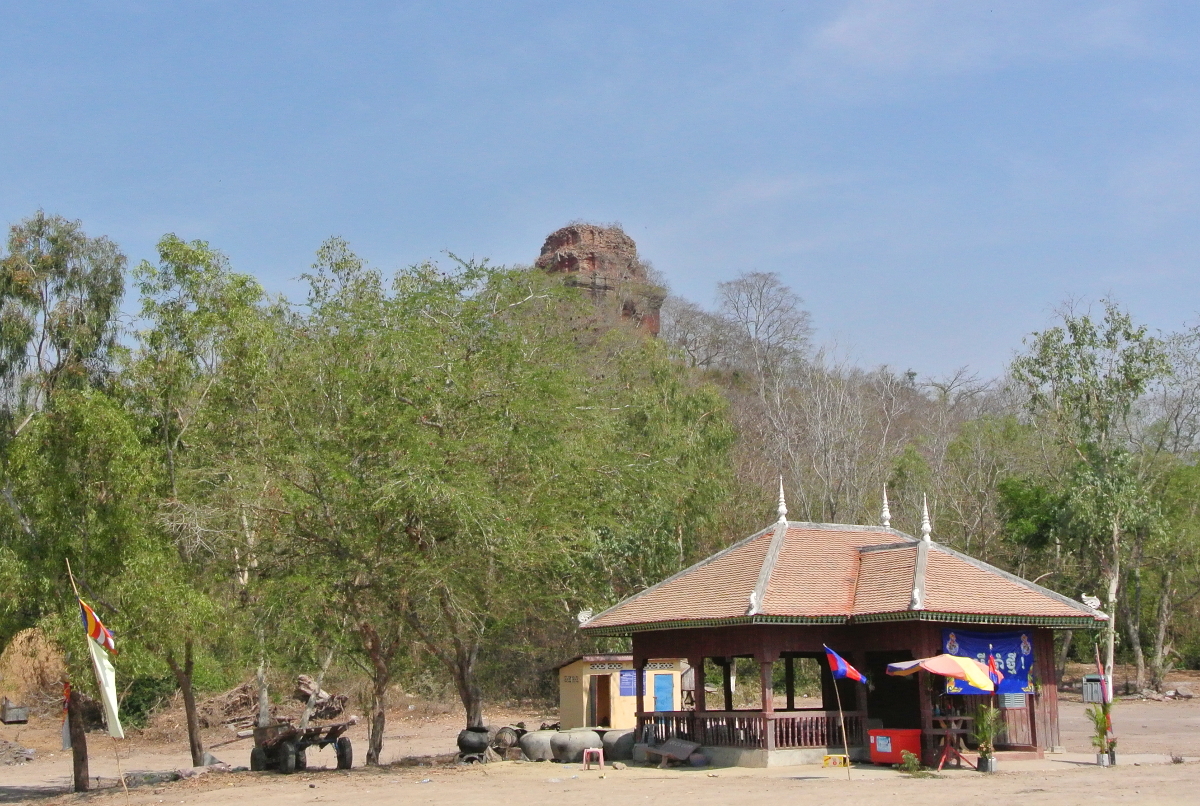
What makes the Cleveland figure more than an illustration is where it stood. It appears to have been installed in a man-made cave part way up the northern slope of Phnom Da, so that the god held up the mountain he was carved inside. Phnom Da rises out of the flood plain of the Mekong delta, a landscape of rice fields and thousands of miles of canals whose whole economy is the management of too much water and too little. A congregation walking into that cave in the year 600 was walking under the shelter in the story.
Chapter 2Carved from one block, and the consequences of that
The Phnom Da figures are monolithic: each was cut from a single block, with an arch or stele of stone left behind the figure to carry the weight and, in several cases, a long tenon below the feet to...
The Phnom Da figures are monolithic: each was cut from a single block, with an arch or stele of stone left behind the figure to carry the weight and, in several cases, a long tenon below the feet to seat it in a pedestal. The Phnom Penh Krishna has a 43 centimetre tenon, the Wat Koh Krishna a 27 centimetre one, and their catalogued heights are given twice for that reason, with and without the tenon.
Monolithic carving is why this object exists as a problem. A figure with free-standing arms carved from the same block as its body will break at the arms, and every one of the eight gods of Phnom Da has been found in pieces. It is also why the fragments are interchangeable at a glance and not in fact: five heroic two-armed figures carved in the same stone, in the same workshop, at the same moment, produce arms and legs that look like each other and belong to exactly one of them.
Chapter 3Eight gods, and how the site was emptied
The sanctuaries of Phnom Da are the earliest monumental Hindu temple complex recorded in Cambodia, dated by inscriptions to the reign of Rudravarman between 514 and 539, and the site holds the...
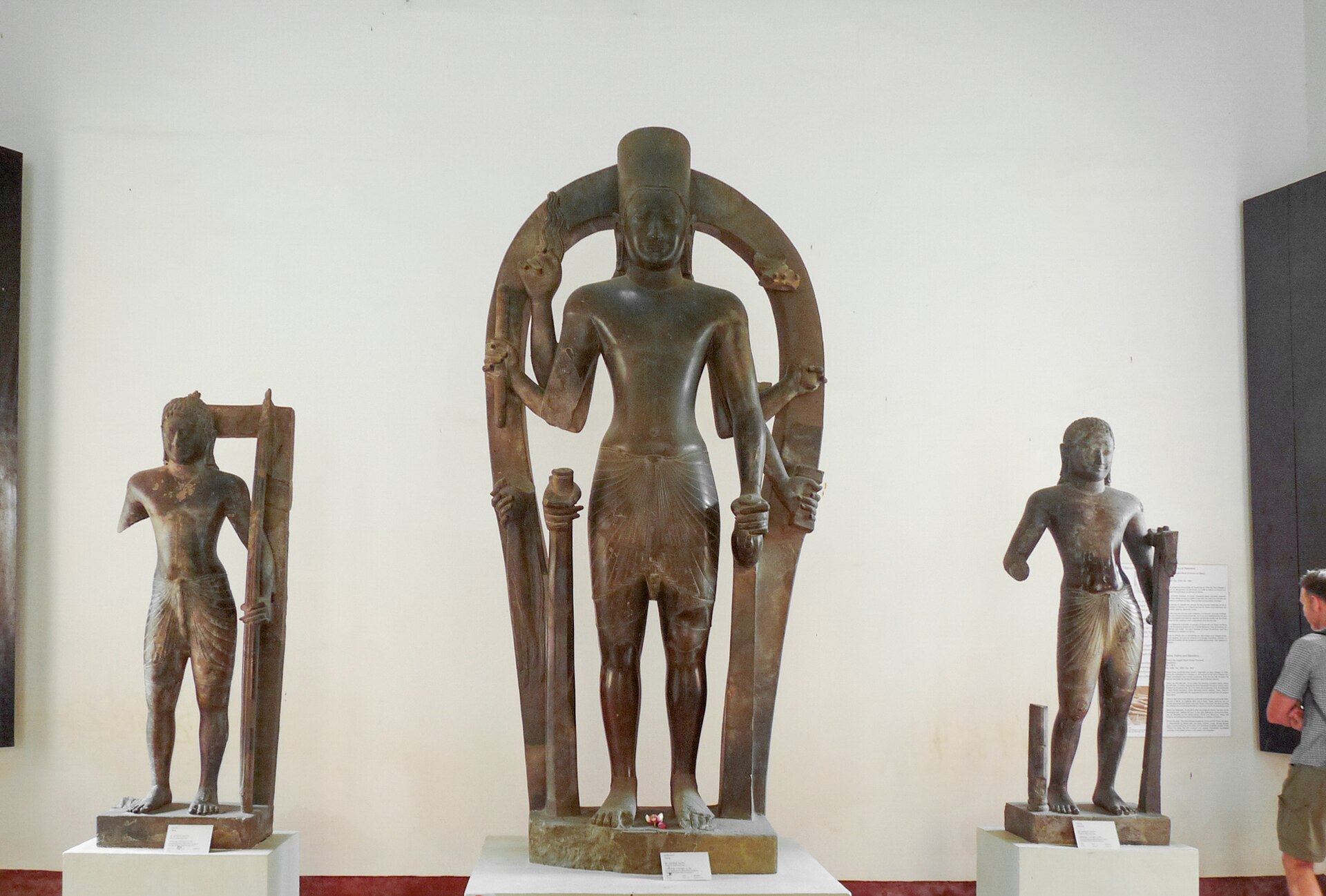
The sanctuaries of Phnom Da are the earliest monumental Hindu temple complex recorded in Cambodia, dated by inscriptions to the reign of Rudravarman between 514 and 539, and the site holds the earliest surviving Khmer stone temple. Eight monumental sculptures of Hindu deities have been recovered from it: two Krishnas lifting Mount Govardhan, Krishna's brother Balarama, Rama, Vishnu, the dual god Harihara, and others. Every one was found broken.
The evidence is that the Cleveland Krishna was actively worshipped for about seven hundred years. Around 1300, when Thai forces took southern Cambodia, the eight figures were toppled from their pedestals, most probably by people who wanted the consecration gold and gems buried beneath them. The site was then largely abandoned. Veneration did not stop everywhere: gold was applied to the face of the Harihara now in Paris in a ritual of renewal no earlier than the 1500s.
The caves were visited by a French civil servant in the 1880s. The archaeologist Henri Parmentier of the Ecole francaise d'Extreme-Orient recorded his own visit in June 1911. By then a Buddhist community from Vietnam had settled at the site in the first decade of the century and was reusing the temples and the broken sculpture, and the report published in 1911 indicates that the head and body section had been taken to France the previous year. It also records the detail that matters most and is quoted least: before removal the torso was already being cut down to serve as the body armature for a new seated Buddha. The object was saved from destruction by being stolen, and both halves of that sentence are true.
Chapter 4Rosenberg, Stoclet, and the dancing prince
The head and torso reached Paris and were sold in 1920 by Leonce Rosenberg to Adolphe Stoclet, a Brussels financier, and his wife Suzanne.
The head and torso reached Paris and were sold in 1920 by Leonce Rosenberg to Adolphe Stoclet, a Brussels financier, and his wife Suzanne. Rosenberg is remembered for something else entirely: he was the dealer of the Cubists, the man who took on Picasso, Braque, Leger and Gris at the Galerie de l'Effort Moderne. A pre-Angkorian Khmer torso passing through his hands in 1920 is a fact about how the Paris market of that decade worked, in which the newest European painting and the oldest Asian sculpture were traded by the same people to the same clients.
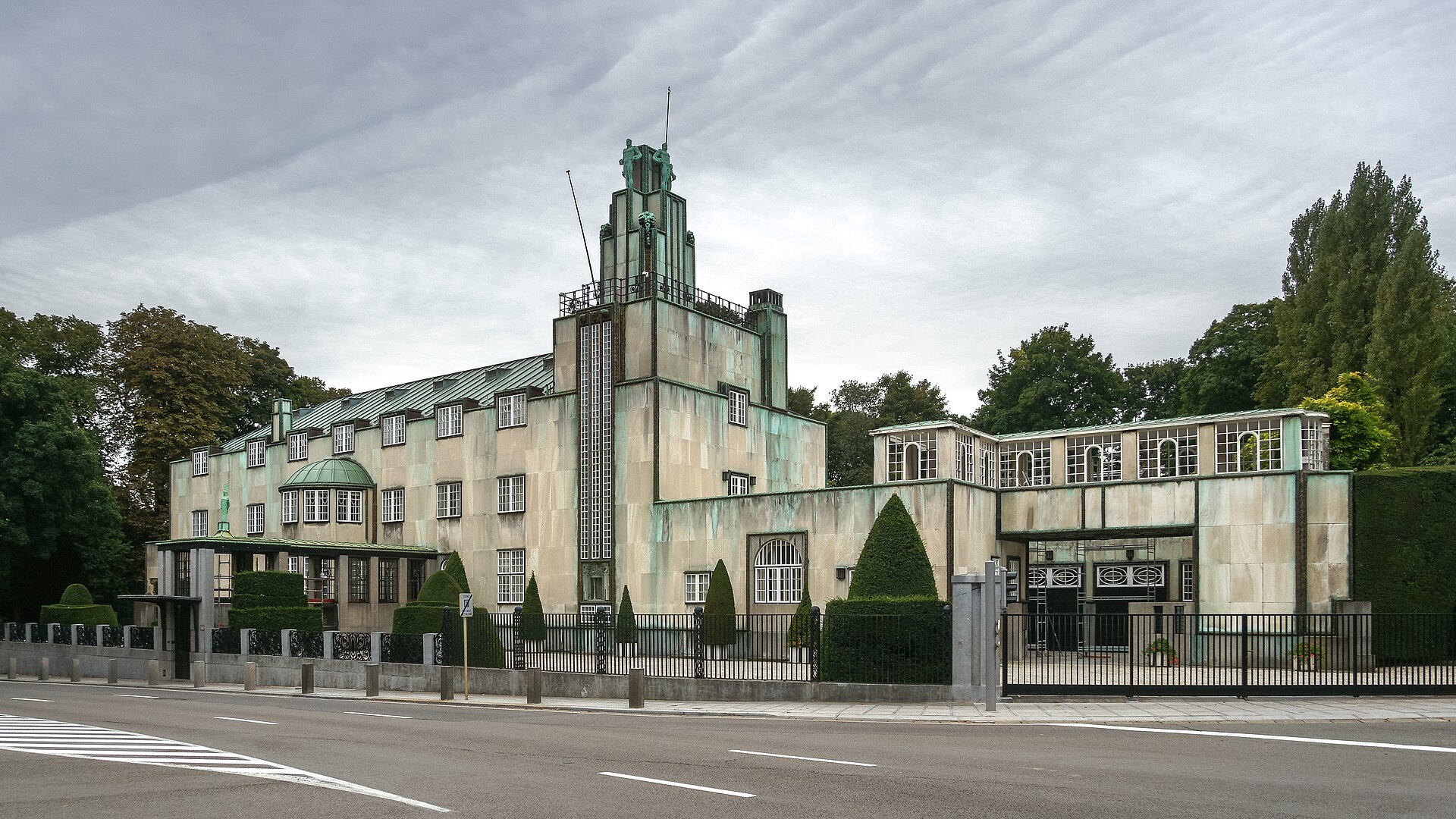
The Stoclets put it on a stage in the music hall of the Palais Stoclet, the Josef Hoffmann and Wiener Werkstatte house on the Avenue de Tervueren that also holds Klimt's Stoclet Frieze, and called it their dancing prince. It was published soon after the purchase, and by the late 1920s art historians internationally were describing the quality of what survived of the carving. The sculpture's reputation was made while it was in a private drawing room, by scholars who were invited in.
Chapter 5The fragments in the flower bed
In 1935 Henri Mauger of the Ecole francaise d'Extreme-Orient found further sandstone fragments, arms, legs, feet and a hand, near the caves at Phnom Da.
In 1935 Henri Mauger of the Ecole francaise d'Extreme-Orient found further sandstone fragments, arms, legs, feet and a hand, near the caves at Phnom Da. On the belief that they would complete the Stoclet torso they were shipped to Brussels; the museum's account puts the arrival in 1937 and counts seventeen fragments belonging to four different sculptures, while a published account of the find gives fourteen pieces recovered in 1935. Those numbers have not been reconciled in print and this record does not reconcile them either.
The Stoclets asked their neighbour, the sculptor Marcel Wolfers, to attach them. After several attempts the result did not satisfy Stoclet and the project was abandoned; the pieces were left in the Wolfers villa's garden. New residents, who did not know what they were, used them to support the installation of an underground water cistern and used one to edge a flower bed.
Michele Leon-Stoclet, who had inherited the sculpture from her grandparents, died suddenly in 1967. Sherman E. Lee, then director in Cleveland, spent eight years securing the torso, which the museum bought from the estate in 1973 as a fragment with no arms and no legs. In 1977 the curator of Indian and Southeast Asian art, Stanislaw Czuma, went to Brussels after hearing of the forgotten pieces and recognised the distinctive pleats of a Phnom Da sampot carved into a thigh lying at the edge of the flower bed. Seventeen pieces were dug out of the garden with the owners' consent and sent to Cleveland.
Chapter 6The 1978 restoration, which was excellent and wrong
In 1978 and 1979 Cleveland's conservators attached eight of the seventeen pieces to the torso, producing the impression of a nearly whole figure standing on two feet.
In 1978 and 1979 Cleveland's conservators attached eight of the seventeen pieces to the torso, producing the impression of a nearly whole figure standing on two feet. They drilled new holes in the fragments and set steel rods in epoxy; missing sections of the legs were filled with epoxy putty and metal casings. That reconstruction stood in the galleries for about forty years and is the version of this sculpture that a generation of visitors and textbooks knew.
It was done to the best standard of its moment and it was documented properly. The museum's present conservator has said the department has good documentation from that time, including photographs and notes on each step. What the 1978 team did not have was any means of testing whether a leg that fitted was the right leg. Nine pieces were left over because they seemed to belong to two other sculptures from Phnom Da in the National Museum of Cambodia, and in 2005 Cleveland sent those nine to Phnom Penh, where conservators attached six of them to a second, limbless Krishna Lifting Mount Govardhan that had been brought from Phnom Da in 1944.
So by 2005 two museums on opposite sides of the world each had a plausible, published, photographed Krishna, and each was wearing parts of the other.
Chapter 7How the mistake was caught
From 2014, as communication between the two conservation departments increased, Bertrand Porte of the Ecole francaise d'Extreme-Orient and Sok Soda of the National Museum of Cambodia concluded that...
From 2014, as communication between the two conservation departments increased, Bertrand Porte of the Ecole francaise d'Extreme-Orient and Sok Soda of the National Museum of Cambodia concluded that the fragments had been distributed wrongly. The instrument that settled it was not the eye. It was three-dimensional scanning, medical computed tomography, and petrographic analysis of the stone.
Petrography established that the largest of the pieces sent to Phnom Penh in 2005, a hand with a strut and a section of supporting panel, had been carved from the same block as the Cleveland torso. High-resolution three-dimensional scans of both the sculpture in Ohio and the fragment in Cambodia were then produced and compared. The final count is exact and unflattering to both earlier campaigns: two of the pieces held in Phnom Penh belonged to the Cleveland Krishna, and six of the pieces held in Cleveland belonged to the Phnom Penh Krishna.
This is a rare thing in provenance work. Almost every attribution dispute in this archive is argued from documents, style or absence. Here the question of what belongs to what was answered by the rock.
Chapter 8The transfer, and what kind of transfer it was
On 30 October 2015 the Ministry of Culture and Fine Arts of the Kingdom of Cambodia and the Cleveland Museum of Art announced that the Ministry had authorised the transfer to Cleveland of the...
On 30 October 2015 the Ministry of Culture and Fine Arts of the Kingdom of Cambodia and the Cleveland Museum of Art announced that the Ministry had authorised the transfer to Cleveland of the fragment with the hand, strut and supporting panel. Kong Vireak, director of the National Museum, said that reuniting the fragment with the Cleveland Krishna would present a new and enhanced opportunity for the public in the United States to see one of the great artistic accomplishments of the Khmer people. William Griswold, Cleveland's director, described the transfer as another aspect of the museum's cultural cooperation with Cambodia.
Neither statement says whether the fragment was given, lent, exchanged or transferred outright, and the press release does not name signatories. That is not a small omission. It is the difference between Cambodia lending Cleveland a piece of Cambodian state property and Cambodia ceding title to it, and a reader doing diligence on this object cannot settle it from the published record. The transfer operates under a cultural cooperation agreement between the museum and the Ministry whose terms have not been published either.
What is clear is the direction of travel in both directions. Cleveland sent nine fragments to Phnom Penh in 2005 and more in 2020; Cambodia sent one back in 2015. In a field where the word restitution normally means a one-way transfer after a dispute, this is something else: an exchange conducted between conservation departments to put objects back together, with the ownership question left in the background.
Chapter 9Taking a restoration apart
The sculpture left the galleries in November 2017 and was in the objects conservation laboratory for almost exactly four years.
The sculpture left the galleries in November 2017 and was in the objects conservation laboratory for almost exactly four years. The full project ran more than seven, and the museum notes the symmetry that the 1978 reconstruction was exactly forty years before the team returned to it in earnest in 2018.
Removing the 1978 work meant excavating epoxy putty, brass and steel until the original stone surfaces appeared for the first time in four decades. What went back is less, not more: the figure lost a thigh, two calves and the feet that had been added in 1978 and 1979, so it no longer stands on its own legs. What it gained is the large upper section carrying the left hand and the top of the stone niche, which is the part that actually shows the god holding the mountain.
The engineering problem this created was substantial. Body and upper section together weigh about 830 pounds and had to be aligned and suspended with the four stone pieces kept physically separate while reading as one sculpture. Case Western Reserve University's engineering department helped test epoxy and steel combinations strong enough to carry the load while keeping the intervention as reversible as possible, and the work drew in the Cleveland Clinic for medical computed tomography, an industrial X-ray facility, structural engineers and a steel fabricator.
The reversibility is the point. The 1978 campaign drilled into ancient stone. The 2021 campaign was designed on the assumption that it too will be found to be wrong.
Chapter 10What the exhibition did with it
Revealing Krishna: Journey to Cambodia's Sacred Mountain ran at the Cleveland Museum of Art from 14 November 2021 to 30 January 2022.
Revealing Krishna: Journey to Cambodia's Sacred Mountain ran at the Cleveland Museum of Art from 14 November 2021 to 30 January 2022. It showed the two restored Krishnas together for the first time, with Balarama from the National Museum of Cambodia and the Harihara from the Musee national des arts asiatiques-Guimet in Paris, both lent for the first time, plus five sculptures from Angkor Borei. The four sculptures that travelled are four of the eight gods of Phnom Da; the rest were too fragile to move.
All eight were then reunited in the only way now possible, as life-size three-dimensional models built from photogrammetry and lidar scanning and projected on individual scrims. Visitors wearing Microsoft HoloLens 2 headsets were taken through a mixed-reality reconstruction ending inside the cave temple, with the sculpture restored to its original appearance including gold jewellery. A final gallery ran an audio-visual timeline of the eight sculptures' dispersal, narrated by Angelina Jolie and Loung Ung. A different version of the exhibition, focused on the Cleveland sculpture, was shown at the Smithsonian's National Museum of Asian Art in Washington from 30 April to 18 September 2022.
It is worth naming what the digital work is doing here, because it is not decoration. Every one of the eight gods is in a different place and several cannot be moved. A three-dimensional model is currently the only form in which the group that stood together on one mountain can be seen together, and it is also the instrument that proved which limb belonged to which body. The same technology that reunites them virtually is what dismembered the 1978 fiction.
Chapter 11What has never been published
The museum's own provenance list runs Leonce Rosenberg, Paris, about 1910 to 1920; Adolphe Stoclet, Palais Stoclet, Brussels, 1920 to 1949; Michele Leon-Stoclet, Brussels and Barcelona, 1949 to 1967...
The museum's own provenance list runs Leonce Rosenberg, Paris, about 1910 to 1920; Adolphe Stoclet, Palais Stoclet, Brussels, 1920 to 1949; Michele Leon-Stoclet, Brussels and Barcelona, 1949 to 1967; the Cleveland Museum of Art, 1973 to the present. The sequence numbers in that list are not consecutive, which suggests entries between Rosenberg and Stoclet and between Michele Leon-Stoclet and the museum that are not shown.
What Cleveland paid the Stoclet estate in 1973 has not been published, and there was no auction, so there is no hammer and no premium. Who carried the torso from Phnom Da to France about 1910, and under what authority, is not documented; accounts describe an anonymous removal and one popular account attributes it to a French sailor, which this record treats as unsupported. No French colonial export permit has been published, and the Ecole francaise d'Extreme-Orient's own archaeologist recorded the removal only after the fact.
The object is not the subject of a claim. Cambodia has recovered a great many sculptures from American collections in the last decade, mostly through litigation and criminal investigation, and this is not one of them. It is the case where the two museums simply worked on the problem together, which is why it belongs in this archive: it is the counter-example that the restitution debate rarely produces.
The artist
The sculptors of Angkor Borei and Phnom Da
Nobody knows who carved this. No Khmer sculptor of the sixth or seventh century is named in an inscription in connection with a surviving statue, and the pre-Angkorian record names kings, priests and donors instead. What can be reconstructed is a workshop: a group of carvers at or near Angkor Borei, the city adjacent to Phnom Da, working in local sandstone within a century of the medium becoming the standard for monumental Cambodian sculpture, and producing a manner distinctive enough that art historians named a style after the mountain. The dossier below is about that workshop and about how its output is identified, because that is the only maker this object has.
Exhibited
- 2021-2022Revealing Krishna: Journey to Cambodia's Sacred MountainCleveland Museum of Art, 14 November 2021 to 30 January 2022
- 2022Revealing Krishna: Journey to Cambodia's Sacred Mountain (a different version, focused on this sculpture)Smithsonian National Museum of Asian Art, Washington, 30 April to 18 September 2022
Literature
- Sonya Rhie Mace, 'The Cleveland Krishna', Cleveland Art, Fall 2021.
- Beth Edelstein, 'Conserving Krishna', Cleveland Art, Fall 2021.
- Revealing Krishna: Journey to Cambodia's Sacred Mountain, exhibition catalogue, Cleveland Museum of Art, containing the conservators' account of the 1978-79 joining method. Cited here from secondary reporting; not read. (2021)
Related works
| Work | Relation | Where it is |
|---|---|---|
| Krishna Lifting Mount Govardhan (the Phnom Penh Krishna) Unrecorded sculptor of Phnom Da | The other Krishna from the same mountain; six fragments were wrongly attached to it from Cleveland in 2005 and two of its fragments were wrongly held in Cleveland c. 600, 188 cm without a 43 cm tenon, sandstone with remains of lacquer and gilding. Brought from Phnom Da in 1944. Restored in parallel with the Cleveland figure and shown beside it in 2021. | National Museum of Cambodia, Phnom Penh, Ka.1641 |
| Krishna Lifting Mount Govardhan (the Wat Koh Krishna) Unrecorded Khmer sculptor | The third sculpture of this exact form c. 700, 161 cm without a 27 cm tenon, from the island sanctuary of Wat Koh north of Angkor Borei, probably 50 to 100 years later. | National Museum of Cambodia, Phnom Penh, Ka.1625 |
| Balarama Unrecorded sculptor of Phnom Da | Krishna's brother, from the same group of eight c. 600, 185.5 cm without a 49 cm tenon. Lent to Cleveland in 2021 for the first time. | National Museum of Cambodia, Phnom Penh, Ka.1640 |
| Harihara Unrecorded sculptor of Phnom Da | The dual god Shiva-Vishnu, from the same group of eight c. 600, 173 cm, sandstone with gilding. Gold was applied to the face in a ritual of renewal no earlier than the 1500s, evidence that veneration at the site did not stop when it was abandoned. Lent to Cleveland in 2021 for the first time. | Musee national des arts asiatiques-Guimet, Paris, MG 14910 |
| Stoclet Frieze Gustav Klimt | In the same house, commissioned by the same collector Included because it fixes what kind of collector Adolphe Stoclet was: the Khmer torso stood in the music hall of a building whose dining room Klimt decorated. | Palais Stoclet, Brussels (dining room); cartoons in the Museum fur angewandte Kunst, Vienna |
Open questions
- What is the legal form of the 2015 transfer from Phnom Penh to Cleveland? The press release says the Ministry authorised the transfer and does not say whether title passed, and the cultural cooperation agreement it operates under has not been published.
- How many fragments were found at Phnom Da in 1935, and how many reached Brussels? The museum counts seventeen belonging to four sculptures arriving in 1937; a published account of the excavation gives fourteen found in 1935. The discrepancy has not been resolved in print.
- Who removed the head and torso from Phnom Da about 1910, and under what colonial authority? The 1911 report records the removal after the fact. No export permit has been published.
- What did the Cleveland Museum of Art pay the Stoclet estate in 1973, and what did Adolphe Stoclet pay Leonce Rosenberg in 1920? Neither figure has been published, and neither sale was at auction.
- The museum's provenance list carries non-consecutive sequence numbers, which implies unpublished entries between Rosenberg and Stoclet and between Michele Leon-Stoclet and the museum. Who are they?
- Where are the remaining pieces of the seventeen? Five belong to the Cleveland Krishna and the rest went to Phnom Penh in 2005 and 2020; a piece-by-piece account of the final disposition has not been published.
- Did the 1978-79 drilling destroy break surfaces that would have answered the fragment question earlier? New holes were drilled in ancient stone and filled with steel and epoxy.
Questions about this object
What is Krishna Lifting Mount Govardhan?
Krishna Lifting Mount Govardhan is a sculpture, dated c. 600. Medium: Sandstone.
Who made Krishna Lifting Mount Govardhan, and is the attribution settled?
The attribution to Unrecorded sculptor of Phnom Da, Angkor Borei is recorded here as workshop. No maker is named. The sculpture is attributed to the workshops of Angkor Borei on the evidence of style, stone and site: it is one of eight monumental Hindu figures recovered from the mountain of Phnom Da in Takeo province, all carved from monolithic blocks in the manner that defines what art historians call the Phnom Da style. Attribution here is to a place and a generation of carvers, not to a hand. Petrographic analysis of the stone, not connoisseurship, is what has settled which fragments belong to which of these figures.
Where is Krishna Lifting Mount Govardhan now?
Cleveland Museum of Art, Cleveland, Ohio. Inventory number 1973.106. Last confirmed 4 August 2026. Purchased 1973 from the Stoclet estate, John L. Severance Fund; reassembled 2018-2021 with a fragment transferred from the National Museum of Cambodia in 2015.
What is still unknown about Krishna Lifting Mount Govardhan?
What is the legal form of the 2015 transfer from Phnom Penh to Cleveland? The press release says the Ministry authorised the transfer and does not say whether title passed, and the cultural cooperation agreement it operates under has not been published.
Sources
- 1Cleveland Museum of Art, collection record 1973.106, Krishna Lifting Mount Govardhan. Tombstone, measurements, credit line and the museum's provenance list naming Leonce Rosenberg, Adolphe Stoclet and Michele Leon-Stoclet. clevelandart.org/art/...
- 2Sonya Rhie Mace, 'The Cleveland Krishna', Cleveland Art, Fall 2021, published 1 December 2021. The curator's own account of the myth, the site, the toppling around 1300, the 1911 report, the 1920 auction purchase, the 1937 shipment of seventeen fragments, the cistern and the flower bed, and Sherman Lee's eight-year pursuit. clevelandart.org/articles/...
- 3Beth Edelstein, 'Conserving Krishna', Cleveland Art, Fall 2021, published 2 December 2021. The conservator's account of the seven-year project, the removal of the 1978 epoxy, brass and steel, the 830 pounds, the reversible mount and the collaborating institutions. clevelandart.org/articles/...
- 4Cleveland Museum of Art press release, 30 October 2015, 'Ministry of Culture and Fine Arts of the Kingdom of Cambodia and the Cleveland Museum of Art Announce the Transfer from Phnom Penh to Cleveland of an Important Fragment'. The petrographic match, the 2005 transfer of nine pieces, and the statements of Kong Vireak and William Griswold. clevelandart.org/about/...
- 5Nancy Kenney, 'Ancient Krishnas are reunited with their body parts', The Art Newspaper, 12 November 2021. The 1920 Rosenberg sale, the dancing prince, Czuma's recognition of the sampot pleats, the 1978-79 joining method, and the removal of a thigh, two calves and the feet. theartnewspaper.com/2021/...
- 6'Krishna Govardhana: A Journey to Cambodia', Asian Art Newspaper, 26 November 2021. Rudravarman's dates, the 1880s and June 1911 visits, Henri Mauger's 1935 find of fourteen fragments, Marcel Wolfers, the 1944 removal of the Phnom Penh Krishna, and the Porte and Sok Soda reassessment of 2014 to 2018. asianartnewspaper.com/krishna-govardhana-journey-to-cambodia
- 7Cleveland Museum of Art, exhibition page for Revealing Krishna: Journey to Cambodia's Sacred Mountain, 14 November 2021 to 30 January 2022, including the cave-temple reconstruction, the eight three-dimensional models and the Washington showing. clevelandart.org/exhibitions/...
- 8Cleveland Museum of Art press release for Revealing Krishna, naming Sonya Rhie Mace, Beth Edelstein, Colleen Snyder, Bertrand Porte and Chea Socheat, the Angkor Borei Museum and the funding. clevelandart.org/about/...
Last verified 24 August 2026 · Published 4 August 2026
Change log
2 August 2026 - Record deepened to the house standard: narrative sections, technical evidence, artist dossier, related works and open questions added; provenance chain and auction results replaced with the researched versions; sources rebuilt.
4 August 2026 - Record created at the house standard: researched narrative, technical evidence, maker dossier, graded provenance chain, prices with hammer and premium separated, related works, open questions and sources.
24 August 2026 - Re-verification pass: current location (Cleveland Museum of Art, accession 1973.106, on view Gallery 243), attribution, and 5 of 8 cited sources directly re-fetched and confirmed unchanged. Checked specifically against the active Cambodian repatriation wave (Latchford-network and Koh Ker returns through 2026) - this object is not named in any claim; its documented pre-1970 Rosenberg/Stoclet/Cleveland chain remains the record.