Emperor Xiaowen and his entourage worshipping the Buddha
Northern Wei imperial carvers, Binyang Central Cave, Longmen · ca. 522-23
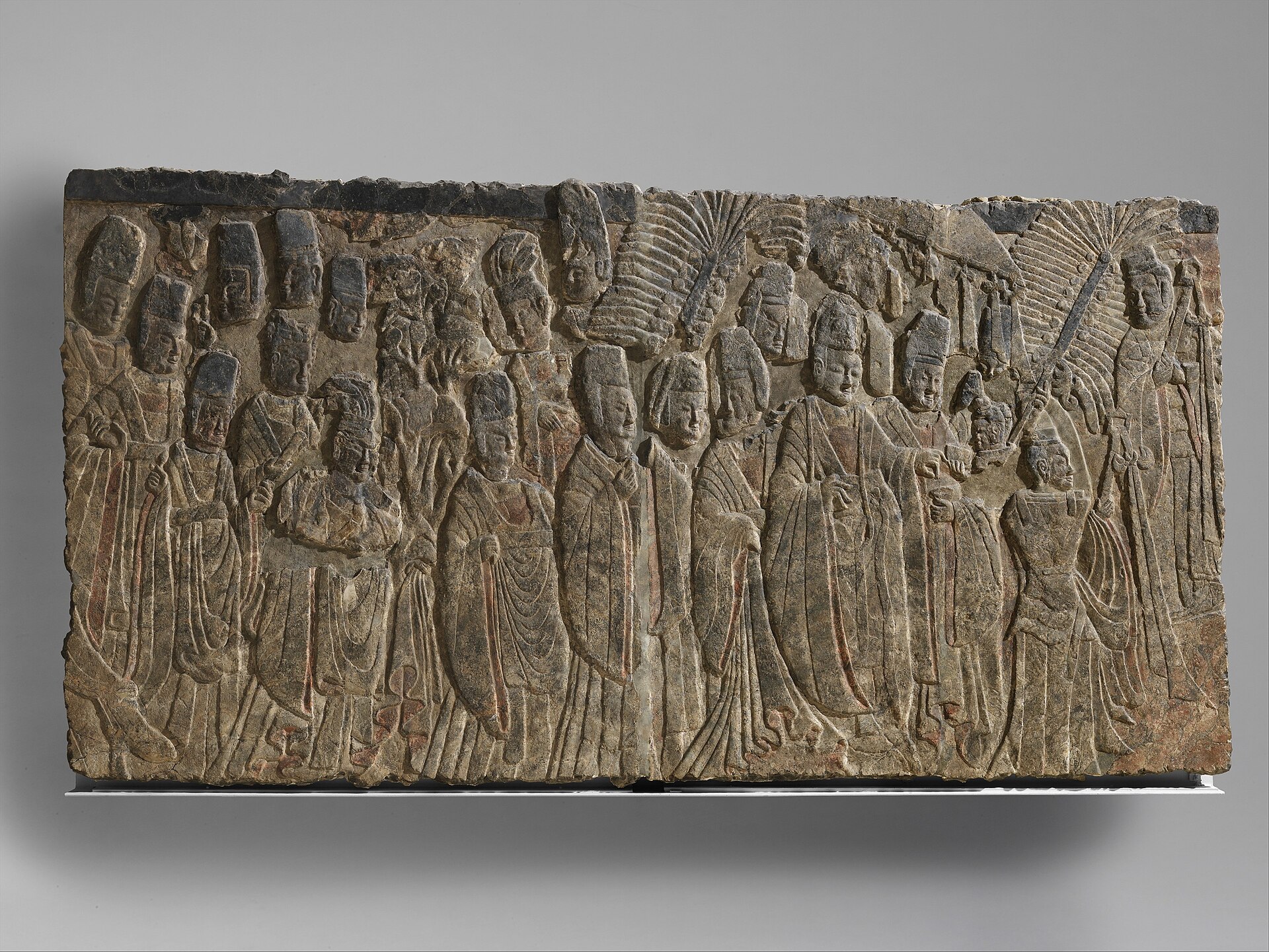
The record subject. The Metropolitan Museum's own photograph of relief panel 35.146, image reference DP170138, released CC0 by the museum. Limestone with traces of pigment, 208.3 x 393.7 cm.
| Artist | Northern Wei imperial carvers, Binyang Central Cave, Longmen |
|---|---|
| Date | ca. 522-23 |
| Medium | Limestone with traces of pigment, reassembled from fragments with plaster infill |
| Dimensions | 208.3 x 393.7 cm (H. 82 in.; W. 12 ft. 11 in.) |
| Where it is now | The Metropolitan Museum of Art, New York, Gallery 206last confirmed 4 August 2026 |
| Inventory number | 35.146 |
| Attribution | AcceptedNo individual carver is named. Full note |
| Object type | Sculpture |
| Period | Chinese, Northern Wei dynasty |
| Inscriptions | None on the panel itself. The Binyang campaign is dated by dynastic-history and inscriptional evidence rather than by a mark on the relief. |
| Owners on record | 4 links4 documented |
| Sources | 7 cited |
About this record Last verified 26 August 2026 · 7 sources cited · Change log
On this page 10 sections
ContentsClose
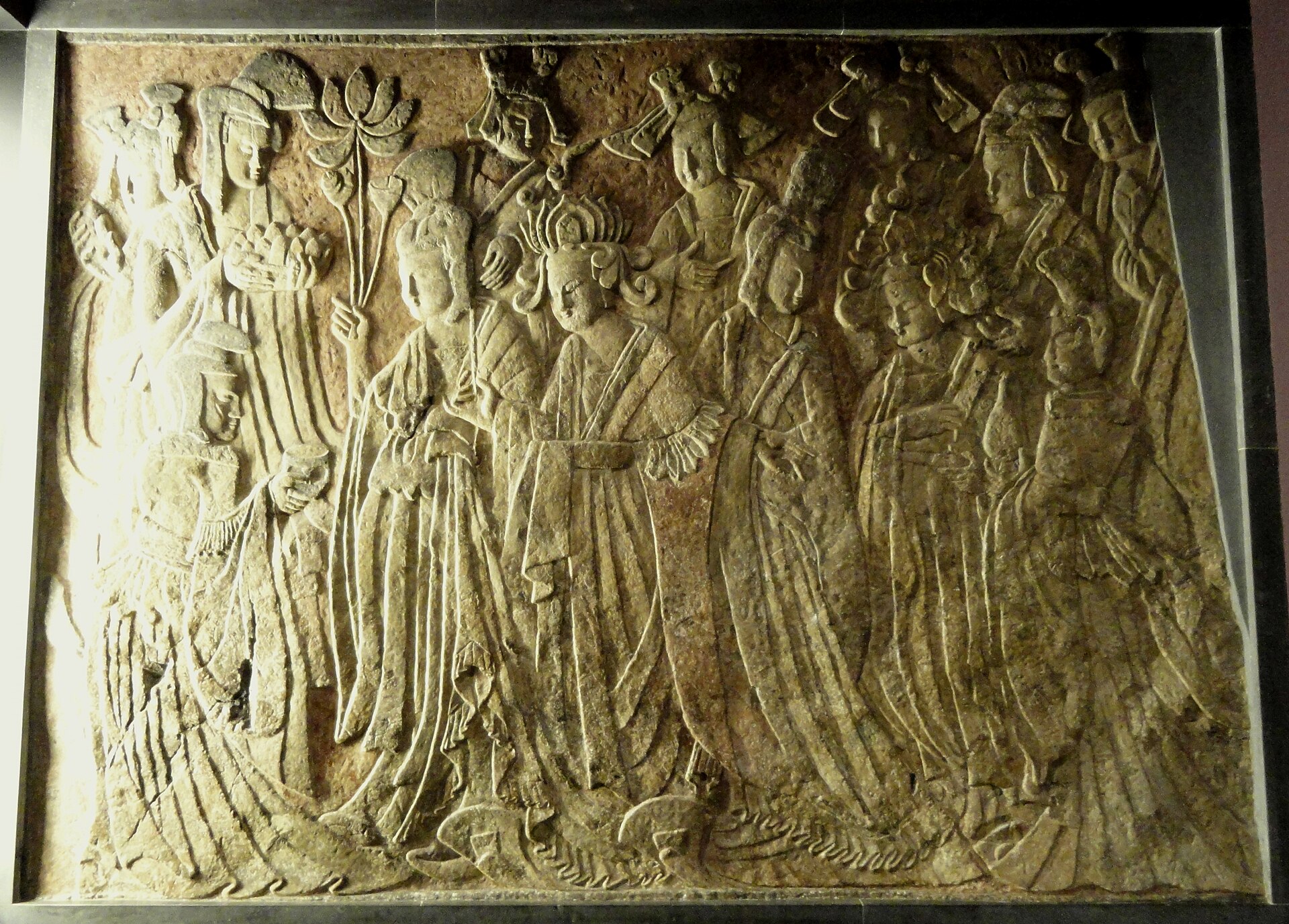
A limestone procession relief, nearly four metres wide, that was cut out of the wall of the Central Binyang Cave at Longmen in the 1930s and reassembled in New York. It shows the Northern Wei emperor Xiaowen and his court carrying offerings towards the Buddha; its companion, the empress and her court, is in Kansas City. The pair were chiselled into more than six thousand fragments on the orders of a Beijing dealer named Yue Bin, working to instructions from buyers abroad, and about four thousand of those fragments reached the United States.
The Metropolitan Museum's published provenance for the panel is one line long. It names the cave. It names nothing and nobody between the cave and the museum's own purchase in 1935. When a Chinese documentary team asked the museum for its restoration records in the course of work broadcast in May 2026, the account they published says very little was provided.
Roughly 2,300 fragments of the two reliefs never left China and are still in the storerooms of the Longmen Grottoes Research Institute. In 2026 that institute matched a fragment to the wall of the cave, by 3D scanning and printing, at a reported 93.3 per cent fit: the face of Emperor Xiaowen.
Provenance
Each link is graded. Documented: a cited source supports it. Disputed: the identification is argued but not established. Unknown: no owner for that span, and the gap is not smoothed into a narrative. The grades in the glossary.
- ca. 522-23 - 1930sCentral Binyang Cave, Longmen Grottoes, Luoyang, Henandocumented
Carved into the northeast wall of the cave as part of an imperial commission begun by Emperor Xuanwu in 500 and completed in 523. This single line is also the whole of the provenance the Metropolitan Museum publishes for the object.125
- 1930s - 1930sYue Bin, antiquities dealer, Beijingdocumented
Organised the systematic chiselling of the two donor processions into more than 6,000 fragments, working on orders from buyers overseas. About 4,000 fragments left for the United States; roughly 2,300 remained and are held by the Longmen Grottoes Research Institute. Records of Yue Bin's confession, cited in a 2026 documentary, state that genuine fragments were deliberately mixed with fakes to inflate the price.4
- 1932 - 1939The Chinese art marketdocumented
The Nelson-Atkins Museum gives this window for its companion panel, describing the relief as vandalised and sold in fragments. The Metropolitan publishes no equivalent step for its panel; no dealer, agent or consignor is named in the museum's own provenance field.13
- 1935 - presentThe Metropolitan Museum of Art, New Yorkdocumented
Purchased on the Fletcher Fund, 1935; accession 35.146. Reassembled from fragments with plaster infill. No purchase price has been published. On view in Gallery 206 and released as open access.12
Prices realised
Never on public auction. The relief was acquired by purchase, not gift: the Metropolitan's own object record gives the credit line as Fletcher Fund, 1935 for accession 35.146, confirming a museum fund paid for it rather than the panel arriving as a donation. No purchase price, dealer or seller is published anywhere in the sources consulted, including the Metropolitan's own object and provenance pages, which name no intermediary between the Longmen cave wall and the museum's 1935 accession. The absence of a published figure is not evidence that none was paid; it is recorded here as a gap, not filled with a guess.
Technical evidence
| Attribution note | No individual carver is named. The cave is an imperial commission of the Northern Wei court, begun in 500 under Emperor Xuanwu and finished in 523; the two donor processions are dated by the Metropolitan Museum to about 522-23, at the very end of the campaign. What is disputed is not who carved it but how much of what hangs in New York is carved at all: the panel was chiselled off the wall in fragments in the 1930s and reassembled abroad with plaster infill, and the proportion of original stone to modern restoration has never been published by the museum. |
|---|---|
| Material | Limestone with traces of pigment. The Nelson-Atkins describes the stone of the companion panel as fine, dark-grey limestone.13 |
| Dimensions | 208.3 x 393.7 cm (82 in. x 12 ft. 11 in.). The companion empress panel at the Nelson-Atkins is 203.2 x 278.13 cm, appreciably narrower.13 |
| Original architectural position | Northeast wall of the Central Binyang Cave (Cave 3), between a register of protective semidivinities above and a narrative debate scene below. The carved trees mark where the composition turned the corner from the north wall onto the east wall.12 |
| Condition and restoration | Reassembled from fragments. Published scholarship states that the faces of both processions were salvaged piecemeal and that the remainder of this, the emperor procession, is mostly plaster infill; the empress procession in Kansas City is more intact. Neither museum publishes a measured breakdown of original stone against restoration.234 |
| Geometry lost in reassembly | The relief originally wrapped around an internal corner of the cave. It is displayed as a single flat panel, so the architectural depth of the original is not recoverable from the object as it now exists.2 |
| Fragment count | The two panels were chiselled into more than 6,000 fragments. About 4,000 reached the United States and were divided between the Metropolitan Museum and the Nelson-Atkins; roughly 2,300 remain in the storerooms of the Longmen Grottoes Research Institute.4 |
| Digital record | The Metropolitan's object page offers a 3D view of the panel alongside its open-access image and a download. The Longmen Grottoes Research Institute has carried out full-cave digital scanning of the Central Binyang Cave and 3D-prints candidate fragments to test them against the wall.14 |
| Rights status of the photograph | The Metropolitan's own photograph of the panel (image reference DP170138) is released CC0 and is available both through the museum's Open Access API and on Wikimedia Commons. Verified against the museum's isPublicDomain flag on 4 August 2026.16 |
Images
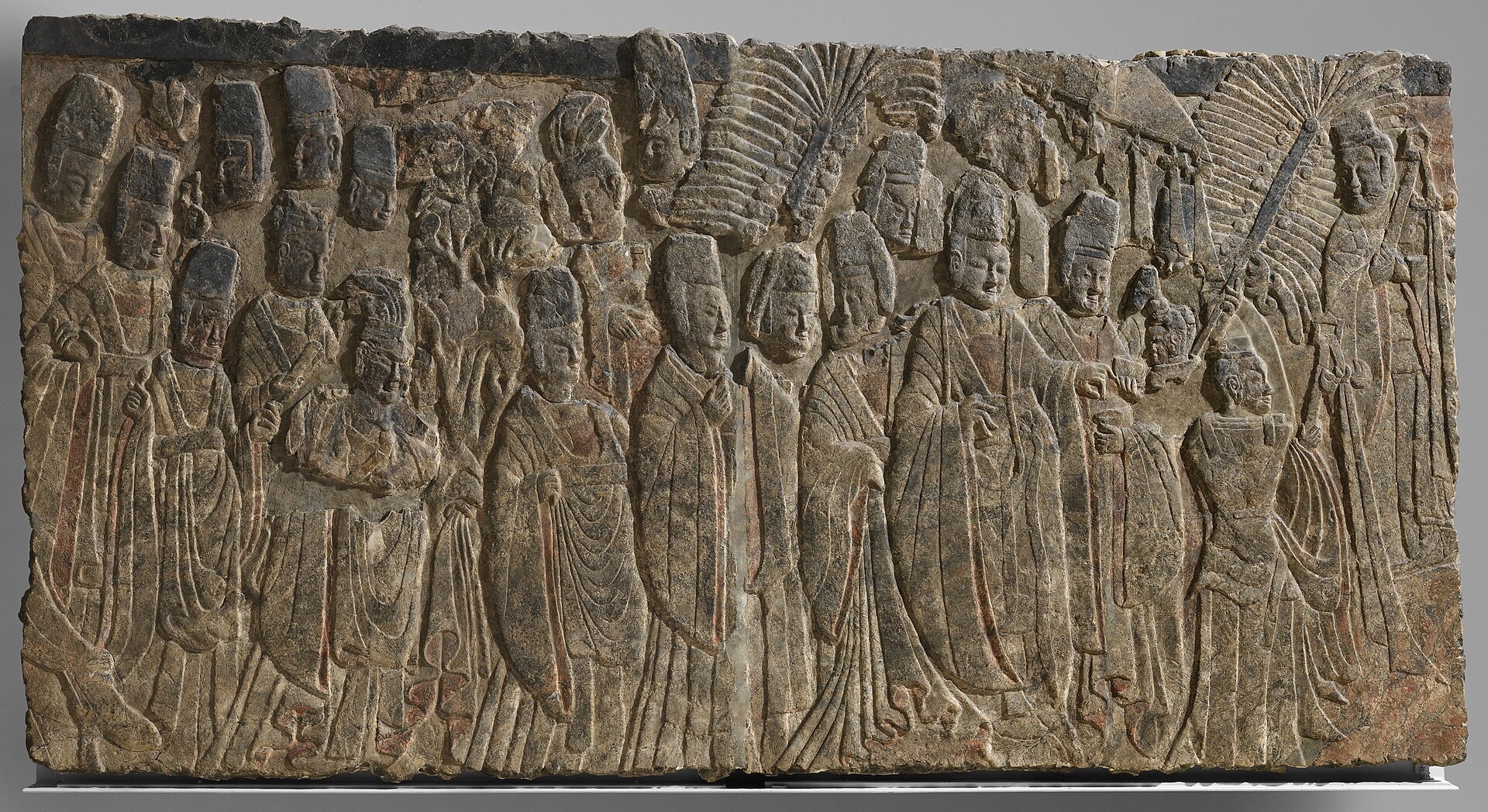
The record in full
Chapter 1What it is, and where the wall it came from still stands
The object is a limestone relief panel 208.3 cm high and 393.7 cm wide, with traces of the pigment that once coloured it.
The object is a limestone relief panel 208.3 cm high and 393.7 cm wide, with traces of the pigment that once coloured it. It shows a procession: a figure in court robes holding a tasselled baton leads, followed by a smaller armoured attendant and another bearing an incense burner, and behind them the emperor with his entourage, several of whom carry lotuses and other offerings. The Metropolitan Museum reads the whole procession as an act of merit-making directed at the Buddhas inside the cave, an offering intended to continue in perpetuity and to improve the future lives of the people shown making it.
It is not a free-standing sculpture and was never meant to be looked at as a panel. It was carved into the northeast wall of the Central Binyang Cave at Longmen, twelve kilometres south of Luoyang, positioned between a register of protective semidivinities above and a narrative debate scene below. The trees carved into it mark the point at which the procession turned a corner, from the north wall onto the east wall. It wrapped around masonry. What is in New York is flat, because the corner was cut off and the two planes were flattened into one when the fragments were put back together. The wall it was cut from is still there, and it is still empty.
Chapter 2An imperial commission with a documented labour cost
Emperor Xuanwu of the Northern Wei ordered the excavation of three caves at Binyang from 500, in honour of his father Xiaowen, who reigned from 471 to 499, and his mother, the dowager whom the...
Emperor Xuanwu of the Northern Wei ordered the excavation of three caves at Binyang from 500, in honour of his father Xiaowen, who reigned from 471 to 499, and his mother, the dowager whom the Metropolitan's catalogue names as Wenzhou and dates to 494. The emperor and empress in the two reliefs are understood to represent those two people. Only the central cave was finished within the Northern Wei campaign, in 523; work on the north and south caves stopped and they were brought to completion only under later dynasties.
The carving of the Binyang group ran for twenty-four years and is recorded as having involved over 800,000 workers. Figures of that kind almost never survive for an object of this age, and it belongs on the page: this is one of the very few works of art in any museum whose commissioning cost is expressed in human labour rather than in money. Note that the number is a total for the three-cave campaign, not for this panel, and that the more precise figure of 802,366 which circulates in the literature is not carried by the source cited here.
Chapter 3The relief is a political document about clothes
Xiaowen is the emperor who moved the Northern Wei capital from Pingcheng to Luoyang in 494 and drove through a programme of sinicisation: the Xianbei ruling elite were required to adopt Chinese...
Xiaowen is the emperor who moved the Northern Wei capital from Pingcheng to Luoyang in 494 and drove through a programme of sinicisation: the Xianbei ruling elite were required to adopt Chinese surnames, Chinese speech at court, and Chinese dress. The Binyang commission is explicitly commemorative of that reign and those reforms.
So the costume in this relief is the argument, not the decoration. The court that files across the panel wears the long robes and wide sleeves of Chinese officialdom, not the riding coats and trousers of the steppe from which the dynasty came. A Northern Wei emperor is shown to posterity dressed as a Chinese emperor, performing a Buddhist devotion in a cave paid for by his son. The offering is real piety and the clothing is real policy, and the panel does both at once. That is what a viewer standing in Gallery 206 in New York is not told, and it is among the most important things about the image.
Chapter 4How it was taken off the wall
The two donor processions were destroyed in the 1930s, in the sense that they were reduced to rubble on purpose so that the rubble could be sold.
The two donor processions were destroyed in the 1930s, in the sense that they were reduced to rubble on purpose so that the rubble could be sold. A Beijing antiquities dealer named Yue Bin organised the systematic chiselling of the two panels into more than six thousand fragments, working on orders from buyers overseas. Around four thousand pieces went to the United States. Roughly 2,300 stayed in China and are held in the storerooms of the Longmen Grottoes Research Institute.
The looting was not confined to these panels. The wider modern despoliation of Longmen concentrated on heads and faces, which is itself evidence of who the market was: in the visual culture of Chinese Buddhism the hands and their mudras carry the doctrinal weight, and a severed head is a Western collecting preference, not a local one. Chinese looters removed the parts that Western buyers would pay for.
Historical records of Yue Bin's confession, cited in a 2026 Chinese documentary on the reliefs, add a detail that matters for every fragment now in a museum: the looters deliberately mixed genuine pieces with fakes in order to inflate the count and the price. Nobody could then say with certainty which fragments were authentic, and that uncertainty was manufactured at the point of sale.
Chapter 5The reassembly, and how much of this object is plaster
The fragments were bought abroad and put back together abroad.
The fragments were bought abroad and put back together abroad. At the Nelson-Atkins Museum in Kansas City, the curator Laurence Sickman, assisted by the Peking-based dealer Otto Burchard, acquired large numbers of pieces of the empress panel; the fragments were reassembled by Sickman with the sculptor Wallace Rosenbauer, and the gaps were filled with plaster. That panel went on public display in 1941. The Nelson-Atkins bought it in 1940 and gives its own provenance as the Binyang Cave until the 1930s, then the Chinese art market between 1932 and 1939, where the relief was, in the museum's own words, vandalised and sold in fragments.
The Metropolitan's emperor panel came earlier, in 1935, on the Fletcher Fund. It is the more heavily restored of the two. Scholarship summarised by Harvard's Whose Culture? project states plainly that the faces of both processions were salvaged and collected piecemeal, and that the remainder of the Metropolitan's emperor procession is mostly plaster infill, while the Nelson-Atkins empress procession is more intact.
That is a striking sentence to find nowhere on the museum's own label. A visitor is shown a Northern Wei imperial relief; a reader of the scholarship is told that much of the surface in front of them is twentieth-century filler. When a documentary team from China asked the Metropolitan for its restoration records while making a film broadcast in May 2026, their published account is that very little was provided. This record does not assert that the museum holds records it is withholding; it records that the request was made, that the answer was thin, and that the museum has published no breakdown of original stone against restoration.
Chapter 6The provenance the museum publishes is one line long
Read the Metropolitan's own provenance field for object 35.146 and this is the whole of it: Binyang Cave, Longmen, Luoyang, Henan Province.
Read the Metropolitan's own provenance field for object 35.146 and this is the whole of it: Binyang Cave, Longmen, Luoyang, Henan Province. There is no dealer. There is no date of removal. There is no intermediate owner, no consignor, no agent, no port of entry. The panel appears in the museum's history in 1935 as a purchase on the Fletcher Fund and has no recorded life between the sixth century and that year.
For most objects a one-line provenance is a gap. Here it is the story. Everything documented about how this relief travelled - Yue Bin, the six thousand fragments, the market of 1932 to 1939, the confession about salted fakes - is documented outside the museum that owns it, mostly by the Chinese institution that guards the empty wall. The companion museum in Kansas City publishes a chain for its half of the same act of destruction: the cave until the 1930s, the Chinese art market between 1932 and 1939, the acquisition of fragments by Sickman through the dealer Otto Burchard, and the purchase of 1940. The Metropolitan publishes one line.
Chapter 7The claim, and why it has not become a case
There is no litigation over this panel and, in the sources consulted, no formal restitution demand from the Chinese state naming it.
There is no litigation over this panel and, in the sources consulted, no formal restitution demand from the Chinese state naming it. That absence is worth stating precisely, because it is often assumed the other way round.
China's cultural-property claims run into a hard chronological problem: the 1970 UNESCO Convention and the 1995 UNIDROIT Convention are not retroactive, and a removal of the early 1930s falls outside both, as it falls outside almost every national limitation period that might otherwise apply. What China has instead is scholarship, publicity and patience - and, increasingly, scanning equipment. The Longmen Grottoes Research Institute's strategy has not been to sue for the stone. It has been to prove, fragment by fragment, exactly what was taken and exactly where each piece belongs, and to publish the result.
Chen Yi's documentary How I Miss Her, broadcast on China Central Television's documentary channel in May 2026, is that strategy made public. In it a researcher holds a 3D-printed fragment against the weathered wall of the Central Binyang Cave and it seats into a groove cut fifteen centuries earlier; the data are reported as a 93.3 per cent match. The fragment is the face of Emperor Xiaowen. Work of this kind used to take years for a single head; this took fourteen months.
The reunification, if it comes, is likelier to be digital than physical. That is not a lesser outcome for scholarship and it is a significantly lesser one for the source community, and both things are true at once.
Chapter 8The man who has been sorting the fragments since 1965
Wen Yucheng joined a three-person team investigating the looting of Longmen in 1965, shortly after graduating in archaeology from Peking University.
Wen Yucheng joined a three-person team investigating the looting of Longmen in 1965, shortly after graduating in archaeology from Peking University. He was still at it sixty years later, appearing in the 2026 documentary as honorary director of the Longmen Grottoes Research Institute at the age of eighty-seven.
That is the labour side of the provenance chain, and it almost never appears in a catalogue entry. Against the reassembly of the empress panel in Kansas City, completed for its display in 1941, stand six decades of one archaeologist's cataloguing in Henan. A record of this object that lists only the museums that own it has described the smaller half of the effort.
Chapter 9What a reader should not confuse this with
Three things are routinely run together in writing about this relief and they are three different objects.The first is the companion panel.
Three things are routinely run together in writing about this relief and they are three different objects.
The first is the companion panel. The empress procession is not in New York and never has been; it is at the Nelson-Atkins Museum of Art in Kansas City, accession 40-38, 203.2 by 278.13 cm, bought in 1940. Text and photographs of the two are frequently swapped. The Metropolitan holds the emperor; Kansas City holds the empress.
The second is the rubbing. The Metropolitan also holds object 68.166.1, catalogued as a twentieth-century rubbing of the relief and titled almost identically - Emperor Xiaowen with his entourage worshipping the Buddha. It is a different accession, it is not in the public domain, and the museum publishes no image of it. A rubbing taken from the wall is a document of what the carving looked like at the moment the ink was pressed onto it, which makes it potentially the best comparison material there is for judging the restoration. It should never be cited as a photograph of the panel.
The third is the wall. Photographs captioned as this relief sometimes show the northeast wall of the Central Binyang Cave as it is now, with the register missing. That is a picture of an absence, and the absence is the point, but it is not a picture of the object.
Chapter 10What it is worth, and why no figure exists
There is no auction record for this panel, no insurance value in the public domain, and no purchase price published by the Metropolitan for the 1935 Fletcher Fund acquisition.
There is no auction record for this panel, no insurance value in the public domain, and no purchase price published by the Metropolitan for the 1935 Fletcher Fund acquisition. The Nelson-Atkins publishes no figure for 1940 either. Both museums bought fragments, not a finished object, which means that even a recorded outlay would not correspond to the thing now on the wall.
The absence is structural rather than accidental. Objects removed from monuments do not have market histories in the ordinary sense: they are assembled from many small purchases, they are almost never resold, and their value is never tested. Anyone doing diligence on a comparable piece should note the consequence. A Longmen fragment with a clean pre-1930 photograph attached is a different asset from one without, and the photographic record held in Chinese and American university archives is what separates them.
The artist
The imperial carving workshops of the Northern Wei at Longmen, Binyang campaign, 500-523
Nobody knows the name of a single person who cut this stone. What is known instead is the institution that employed them, the dynasty that paid, the number of units of labour the work consumed, the man who managed the project until he died, and the political programme the carving was designed to commemorate. That is an unusual amount of context and an unusual absence of individuals, and the imbalance is characteristic of Chinese cave-temple sculpture: the merit accrued to the donor, whose name was recorded, not to the carver, whose name was not.
Related works
| Work | Relation | Where it is |
|---|---|---|
| Offering Procession of the Empress as Donor with Her Court Northern Wei imperial carvers, Binyang Central Cave | The companion panel from the opposite side of the same doorway About 522. Fine dark-grey limestone, 203.2 x 278.13 cm. Purchased 1940 with William Rockhill Nelson Trust funds; reassembled by Laurence Sickman and the sculptor Wallace Rosenbauer with plaster infill and displayed from 1941. Held to be the more intact of the two. | The Nelson-Atkins Museum of Art, Kansas City, accession 40-38 |
| Emperor Xiaowen with his entourage worshipping the Buddha Unknown | Twentieth-century rubbing taken from the relief Catalogued by the Met as a twentieth-century rubbing of a Northern Wei stele. Not in the public domain and no image is published. Potentially the best surviving control on how much of the New York panel is original, and it is not on public view. | The Metropolitan Museum of Art, accession 68.166.1 |
| The northeast wall of the Central Binyang Cave as it now stands Northern Wei imperial carvers | The findspot, still in situ, with the register missing Documented photographically by the Center for the Art of East Asia at the University of Chicago and scanned in full by the Longmen Grottoes Research Institute. The scar is the primary evidence for the panel's original geometry. | Longmen Grottoes, Luoyang, Henan |
| The Binyang jataka and Vimalakirti registers Northern Wei imperial carvers | The surrounding scheme the panel was cut out of The debate of Manjusri and Vimalakirti, the Prince Sudana jataka and the Mahasattva jataka above; spirit kings below. None of this context is reproduced around the panel in New York. | In situ, Central Binyang Cave, Longmen |
| Dunhuang wall paintings removed by Langdon Warner Anonymous, Mogao caves | The same collecting network, a decade earlier Warner taught Sickman. The Dunhuang removals are the standard Chinese reference point for American cave-temple collecting and are named in the same breath as Longmen in Chinese accounts. | Harvard Art Museums and elsewhere |
Open questions
- What proportion of the Metropolitan's panel is original Northern Wei stone and what proportion is twentieth-century plaster and other restoration material? No measured figure has been published by the museum.
- What restoration records does the Metropolitan hold for the 1935 reassembly? A documentary team reported in 2026 that very little was supplied on request; whether that reflects thin records or a thin response is not established.
- Who bought the fragments for the Metropolitan, and from whom? The museum's published provenance names no dealer, agent or consignor between the cave and the 1935 purchase.
- Which fragments in New York and Kansas City are genuine? Yue Bin's confession, as cited in the 2026 documentary, states that fakes were deliberately mixed with genuine pieces to inflate the sale, and no museum has published a fragment-by-fragment authentication.
- Can the surviving 2,300 fragments in Longmen and the 4,000 in the United States be reconciled into a single virtual object, and would either museum supply scan data to allow it?
- Where does the Metropolitan's twentieth-century rubbing (68.166.1) sit in the sequence - was it taken before or after the panel was removed from the wall? If before, it is a primary record of the pre-looting state.
- Did any Chinese authority make a formal restitution demand for these panels, and if so when? The sources consulted record scholarship, film and scanning, but no filed claim.
Questions about this object
What is Emperor Xiaowen and his entourage worshipping the Buddha?
Emperor Xiaowen and his entourage worshipping the Buddha is a sculpture, dated ca. 522-23. Medium: Limestone with traces of pigment, reassembled from fragments with plaster infill.
Who made Emperor Xiaowen and his entourage worshipping the Buddha, and is the attribution settled?
The attribution to Northern Wei imperial carvers, Binyang Central Cave, Longmen is recorded here as accepted. No individual carver is named. The cave is an imperial commission of the Northern Wei court, begun in 500 under Emperor Xuanwu and finished in 523; the two donor processions are dated by the Metropolitan Museum to about 522-23, at the very end of the campaign. What is disputed is not who carved it but how much of what hangs in New York is carved at all: the panel was chiselled off the wall in fragments in the 1930s and reassembled abroad with plaster infill, and the proportion of original stone to modern restoration has never been published by the museum.
Where is Emperor Xiaowen and his entourage worshipping the Buddha now?
The Metropolitan Museum of Art, New York, Gallery 206. Inventory number 35.146. Last confirmed 4 August 2026. Museum purchase, Fletcher Fund, 1935; on view and published as open access.
What is still unknown about Emperor Xiaowen and his entourage worshipping the Buddha?
What proportion of the Metropolitan's panel is original Northern Wei stone and what proportion is twentieth-century plaster and other restoration material? No measured figure has been published by the museum.
Sources
- 1The Metropolitan Museum of Art, collection record for 'Emperor Xiaowen and his entourage worshipping the Buddha', accession 35.146. Catalogue entry, curatorial description and the museum's complete published provenance, which reads in full: 'Binyang Cave, Longmen, Luoyang, Henan Province'. Read 4 August 2026. metmuseum.org/art/...
- 2Whose Culture? (Harvard University), 'Longmen Binyang Central Cave'. Account of the cave's registers, the removal of the two donor processions, the plaster reconstruction of the Metropolitan's panel, and the critique of the Warner and Sickman collecting narrative. whoseculture.hsites.harvard.edu/longmen-binyang-central-cave
- 3The Nelson-Atkins Museum of Art, collection record for 'Offering Procession of the Empress as Donor with Her Court', accession 40-38, with the four-step provenance and the note that the relief was vandalised and sold in fragments between 1932 and 1939. art.nelson-atkins.org/objects/...
- 4Yang Feiyue, 'The hunt for an emperor's face', China Daily, 22 May 2026. Reports Yue Bin's organisation of the looting, the 6,000-plus fragments, the 4,000 sent to the United States and the 2,300 retained at Longmen, Yue Bin's confession about mixed fakes, Sickman's plaster reconstruction, the Metropolitan's response to a request for restoration records, Wen Yucheng's six decades of fragment cataloguing, and the 93.3 per cent match identifying the face of Emperor Xiaowen. global.chinadaily.com.cn/a/...
- 5Chinatripedia, 'Binyang Caves in Longmen Grottoes', for the 500 start date, the twenty-four-year campaign, the labour figure of over 800,000 workers, the completion of only the central cave within the Northern Wei campaign, and the commemorative purpose relating to Xiaowen's move of the capital and sinicisation reforms. TERTIARY: to be replaced with the Wei shu passage and the Longmen Grottoes Research Institute's own publication. chinatripedia.com/binyang-caves-in-longmen-grottoes
- 6The Metropolitan Museum of Art Open Access API, object 42707, returning isPublicDomain true and primaryImage DP170138.jpg. Queried and verified 4 August 2026. collectionapi.metmuseum.org/public/...
- 7Center for the Art of East Asia, University of Chicago, digital archive of the Longmen Binyang Central Cave, including photographs of the northeast wall showing the removed donor relief. caea.lib.uchicago.edu/dcadp/...
Last verified 26 August 2026 · Published 4 August 2026
Change log
26 August 2026 - Re-verified: no changes needed. Confirmed via live Met object page that the panel remains on view at The Met Fifth Avenue, Gallery 206, accession 35.146, credit line Fletcher Fund 1935 - unchanged from record. No new scholarship, re-attribution, or re-dating found. No litigation or formal repatriation claim found naming this object; the digital-reunification approach (3D scanning at Longmen) described in the record remains the current state of that effort, with no new development since the record was written. All 7 source URLs still resolve; two (metmuseum.org main page and the Harvard Whose Culture page) returned bot-block codes (429 and 403) on a plain fetch but loaded correctly in a browser, so both are live and were not replaced.
2 August 2026 - Record deepened to the house standard: narrative sections, technical evidence, artist dossier, related works and open questions added; provenance chain and auction results replaced with the researched versions; sources rebuilt.
4 August 2026 - Record created at the house standard: researched narrative, technical evidence, maker dossier, graded provenance chain, prices with hammer and premium separated, related works, open questions and sources.