The Aldobrandini Tazze
Unrecorded goldsmiths, probably working in the Habsburg Netherlands · c. 1587-1599
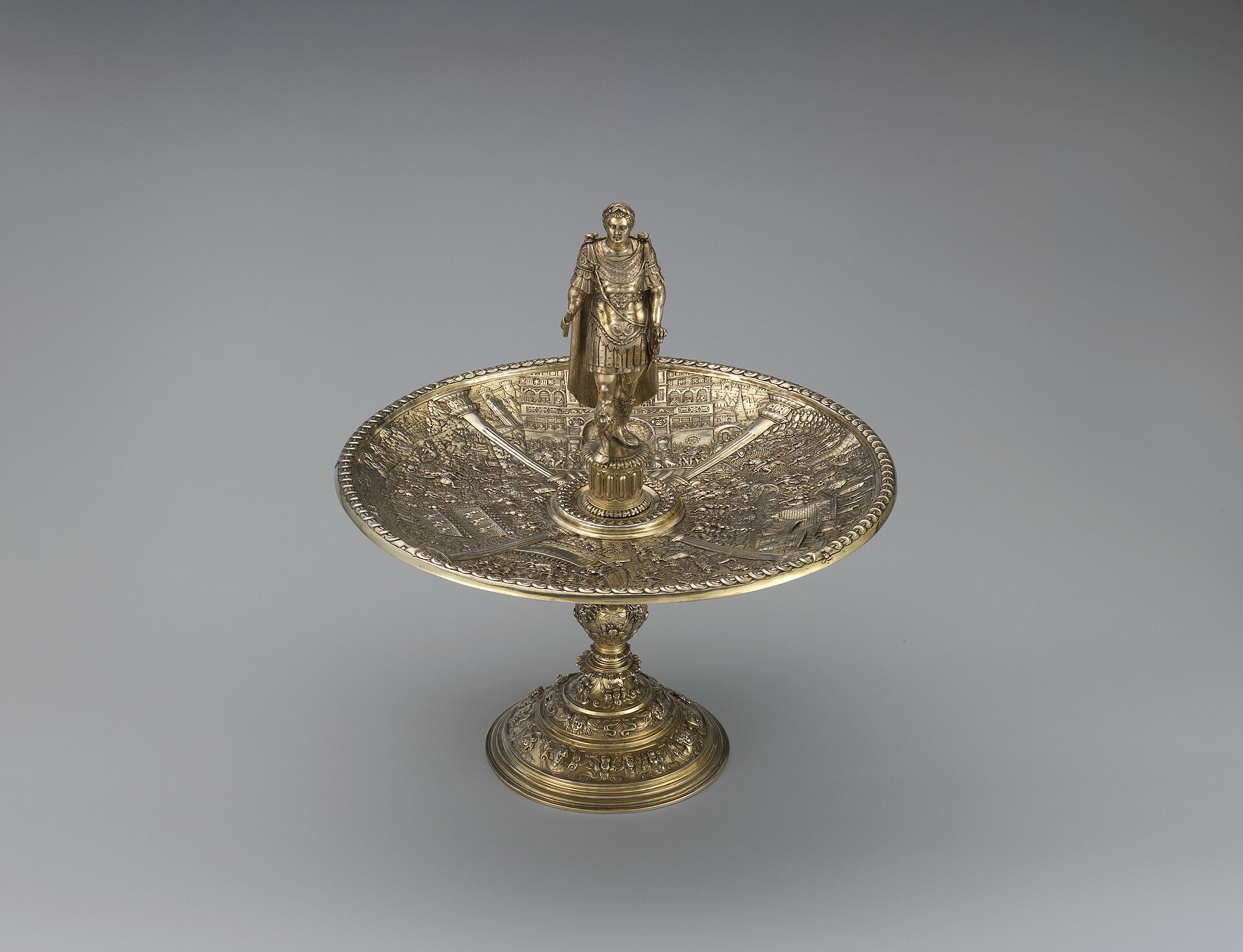
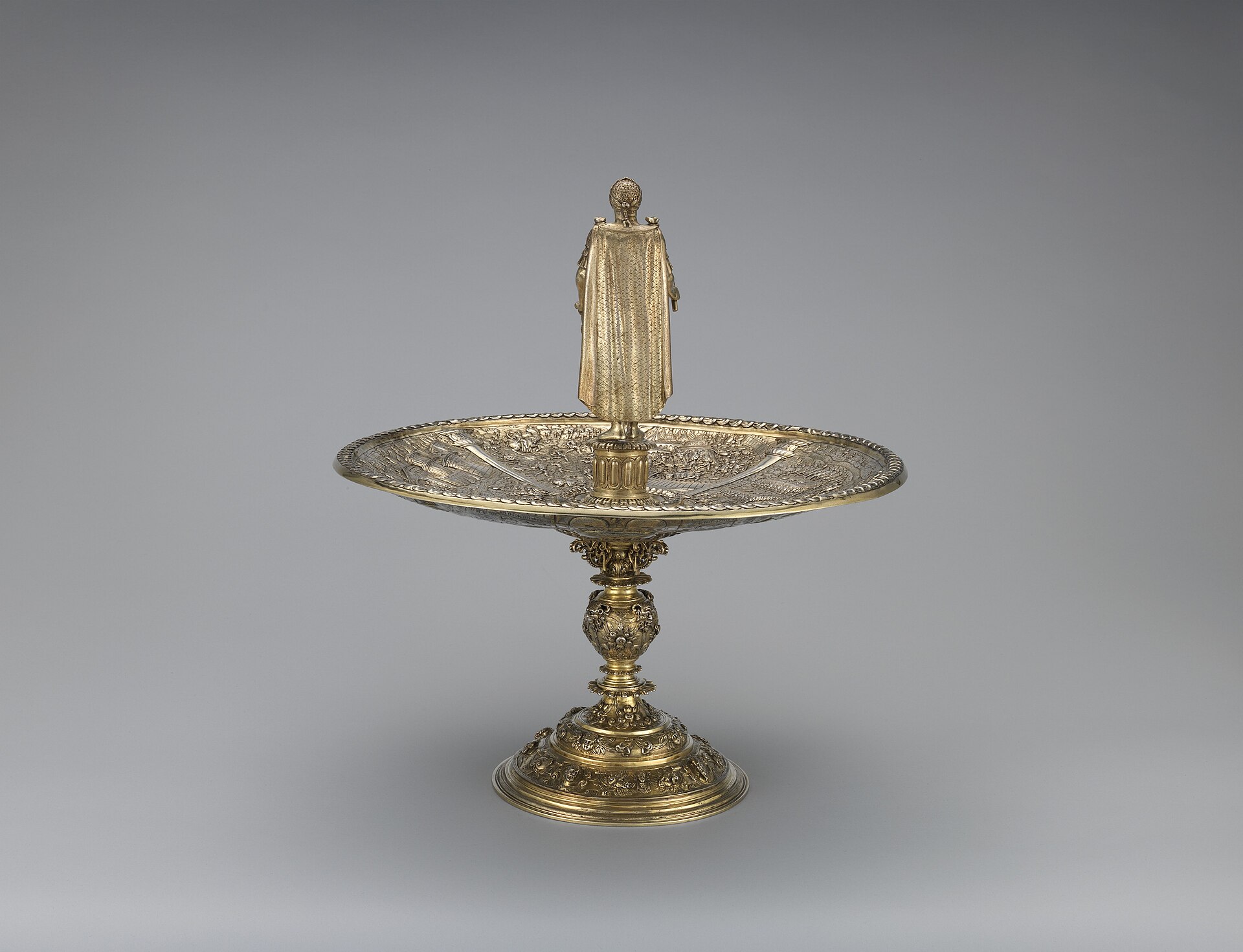
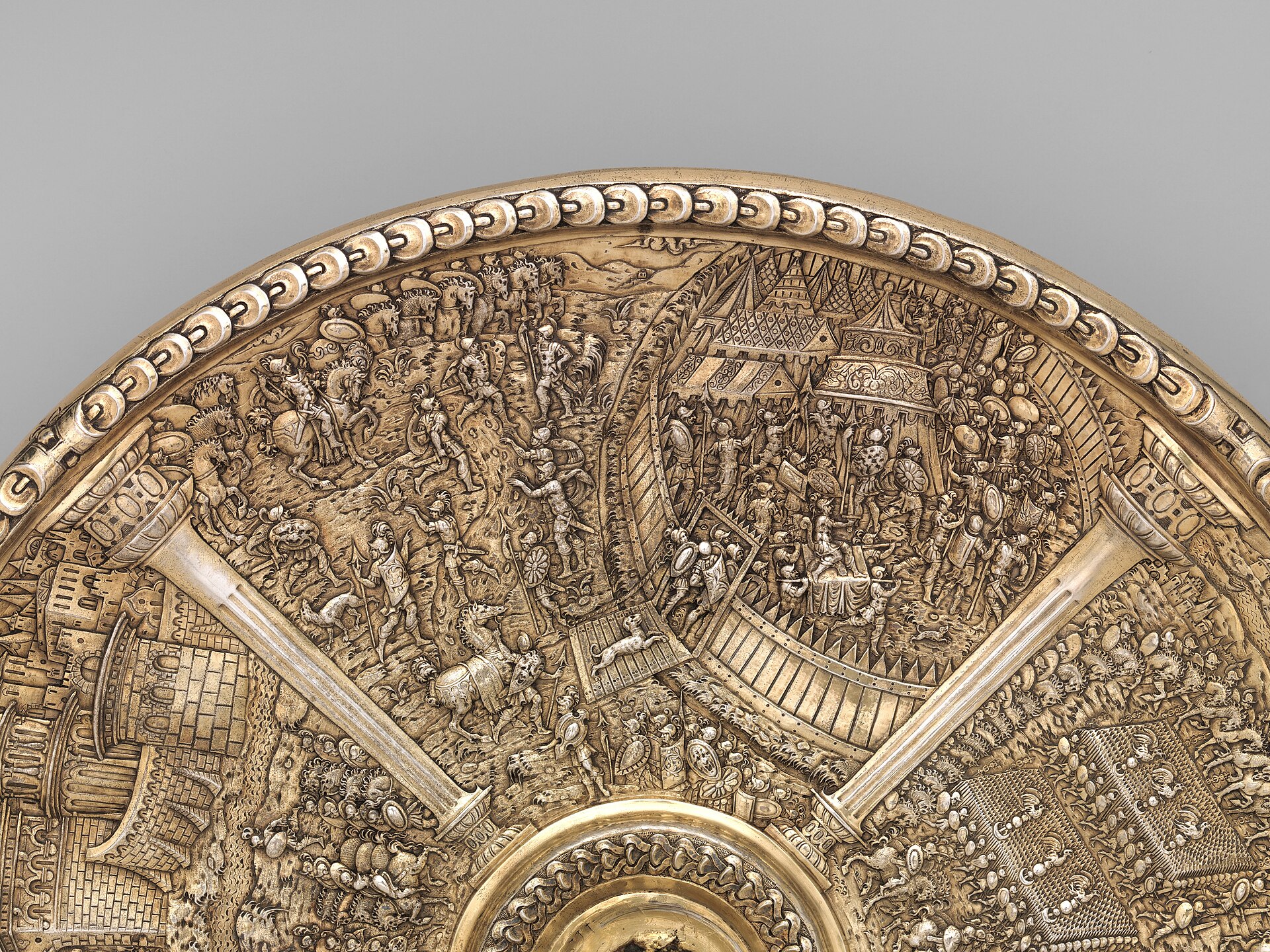
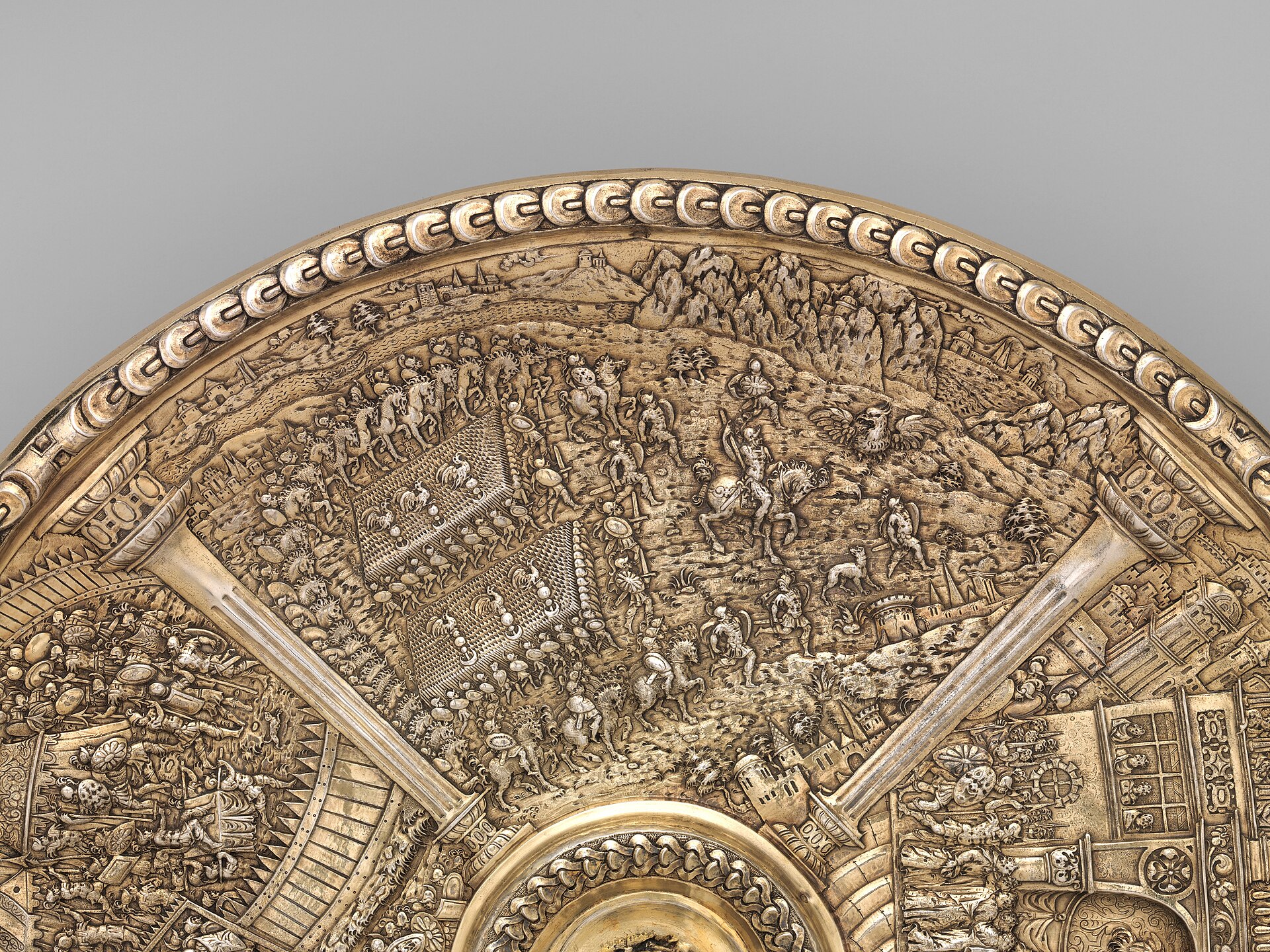
This plate shows the VITELLIUS tazza and no other. It is one of the twelve that make up this record's subject, in the Metropolitan Museum of Art since 1945 as accession 45.60.58a-h, and it is one of only five whose emperor stands on his own dish. The gilding was applied between 1862 and 1872 and the foot is a replacement added after the middle of the nineteenth century.
| Workshop | Unrecorded goldsmiths, probably working in the Habsburg Netherlands |
|---|---|
| Date | c. 1587-1599 |
| Medium | Silver, chased in relief and cast, gilded in the nineteenth century |
| Dimensions | Between 38.5 and 45 cm high as now assembled; individual weights between 2,701 and 2,982 grams, except the wholly replaced Titus tazza at 3,313.8 g and the Titus dish alone at 1,060.7 g |
| Where it is now | Dispersed across seven countries. Two are in the Metropolitan Museum of Art, New York; the others are in Madrid, London, Lisbon (two), Toronto, Minneapolis and four private collections.last confirmed 3 August 2026 |
| Attribution | DisputedAnonymous. Full note |
| Object type | Silver |
| Period | Northern European, late sixteenth century |
| Cases | Disputed attribution · Has a provenance gap |
| Owners on record | 11 links9 documented, 1 disputed, 1 unknown |
| Sources | 13 cited |
About this record Last verified 11 August 2026 · 13 sources cited · Change log
On this page 12 sections
ContentsClose
Twelve silver standing cups, each carrying a statuette of one of the Twelve Caesars above a dish chased with four scenes from that emperor's life. Forty-eight scenes, each traceable to a specific passage of Suetonius. They were made in the 1590s, probably in the Habsburg Netherlands, by goldsmiths whose names are not known, and they are the most important surviving set of Renaissance silver.
They were broken up in the mid-nineteenth century. Because the emperors unscrew from the dishes, and because each statuette carries its own name incised on its pedestal while the dishes do not, the figures got put back on the wrong dishes. By the end of the nineteenth century only two tazze of the twelve were correctly assembled. Most are still wrong today. Mary Beard noticed the problem at the Victoria and Albert Museum, where the Domitian statuette stands over a dish about Tiberius.
In June 2014 all twelve were brought together at the Metropolitan Museum of Art, correctly reassembled for the first time in more than a century, photographed and scientifically tested, and then taken apart again and sent home. The reconstruction is a book, not an object. Since that reunion, three of the four privately held pieces have themselves moved: the Vespasian tazza sold at Sotheby's in 2013 and is now identifiable as the Al Thani Collection; the Nero-Augustus tazza left the Zilkha Collection in a private sale in early 2025 after its owner's death; and the Caligula-Galba tazza went on public loan to a new gallery in Bath in September 2025. The set stays exactly as scattered as it was in 1893. Only the addresses keep changing.
Provenance
Each link is graded. Documented: a cited source supports it. Disputed: the identification is argued but not established. Unknown: no owner for that span, and the gap is not smoothed into a narrative. The grades in the glossary.
- c. 1587-99 - 1599Unknown; possibly the Archduke Albert of Austriadisputed
No record of the commission has been found. Julia Siemon proposes manufacture in the Habsburg Netherlands in the 1590s, possibly with the Austrian archdukes in view, and that Archduke Albert brought the set to Ferrara in autumn 1598 for his wedding to Isabella Clara Eugenia. Three letters of 1599 from the agent de' Cervi record the tazze being offered to the Duke of Mantua, who declined, and establish that the Este of Ferrara never owned them. No later publication revises this or names a maker.113
- 1602 - 1621Cardinal Pietro Aldobrandini (1571-1621), Romedocumented
Documents in the cardinal's accounts, found by Stefanie Walker, register payment on 26 March 1602 for SIX tazze bought by his agents in Milan. All twelve appear in his silver inventory of 1603, also found by Walker; his accounts contain no record of buying the other six. He is the source of the set's name and was not its patron.1
- 1621 - 1769The cardinal's sister and her descendants: Borghese, Pamphilj and Doria Pamphiljdocumented
Bequeathed by the cardinal to his sister and thereafter part of a family legacy passing among her descendants. The last record of the set in Italy is a document of 1769 marking the return of ownership to the Borghese family.1
- 1769 - 1826Unknownunknown
Undocumented for fifty-seven years. The set was most likely sold out of Italy before 1792. Salomon notes that in the late eighteenth century most noble silver collections in Rome were destroyed by papal and Napoleonic campaigns to reclaim precious metal, so export is probably what saved it.1
- 1826 - 1861The London trade, then Charles Scarisbrick of Scarisbrick Hall, Lancashiredocumented
The tazze reappear in 1826 in the shop of a London dealer and silversmith. No reference to them has been found in the Scarisbrick archives, so the date he acquired them and the way he displayed them are unknown. Between 1862 and 1872 the set was gilded; electrotype copies of the dishes and bronze copies of the figures were made in the same period.1
- 1861 - 1893Richard Attenborough, London, then Frederic Spitzer, Paris, and othersdocumented
Bought at the Scarisbrick sale at Christie's in 1861 by Richard Attenborough, a London dealer who was also a pawnbroker, goldsmith, silversmith, diamond and pearl merchant and appraiser. He lent two to the loan exhibition at the South Kensington Museum in 1862. Six passed to the Paris dealer Frederic Spitzer, who replaced their fluted feet with elaborate substitutes; a photograph of about 1890 shows two of them in his study. Three of Spitzer's six were mismatched when sold in 1893. The forty-nine-page manuscript describing the scenes has been missing since that year.1
- 1893 - presentDispersed across public and private collections in seven countriesdocumented
Present holders, re-checked August 2026: Museo Lazaro Galdiano, Madrid (Julius Caesar); Victoria and Albert Museum, London, M.247-1956, Hildburgh Bequest 1956 (Domitian on Tiberius dish); Casa-Museu Medeiros e Almeida, Lisbon, FMA 1182 (Galba on Caligula dish); Metropolitan Museum of Art 2024.436 (Claudius) and 45.60.58a-h (Vitellius, Fletcher Fund 1945); private collection on loan to the Metropolitan, L.1999.62.2 (Tiberius on Nero dish); Royal Ontario Museum, Toronto, 997.158.151, from Viscount and Viscountess Lee of Fareham, given in trust by the Massey Foundation (Otho); Museu Nacional de Arte Antiga, Lisbon, 1018 Our (Titus dish alone); Minneapolis Institute of Art, 75.54 (Augustus on Domitian dish); and the wholly nineteenth-century composite Titus in a private collection not further traced. Three holders have changed status since this record was first drafted and are detailed in the entries below: the Vespasian tazza (now identifiable as the Al Thani Collection, London), the Nero figure on the Augustus dish (no longer in the Zilkha Collection), and the Caligula figure on the Galba dish (now on public loan from the Schroder family estate).1231213
- 1982 - 2013Vespasian tazza: descent from the Morgan Collection sale to the Al Thani Collection, Londondocumented
Sold at Christie's New York, 26 October 1982, lot 68 of the Morgan Collection, estimate 400,000-800,000 USD (price not distinguished as hammer or premium in the source consulted). Sold again at Sotheby's New York, Masterworks sale, 1 February 2013, lot 10, 'The Morgan Aldobrandini Tazza: Vespasian', for 1,426,500 USD against the same 400,000-800,000 USD estimate; the source gives this as the price achieved and does not itemise hammer separately. The piece was lent as 'The Al Thani Collection' to the 2017-18 Met/Waddesdon exhibition; whether that collection was the 2013 buyer or a later acquirer is not established in the sources consulted.78
- 2000 - 2025Nero figure on the Augustus dish: Selim and Mary Zilkha, Los Angeles, then withdrawn to a private saledocumented
Bought from the Wernher collection in 2000 for 1 million pounds. Selim Zilkha died 16 September 2022. Christie's catalogued the tazza as the top lot of 'Global Treasury: The Life and Collection of Selim & Mary Zilkha', New York, 6 February 2025, estimate 2,000,000-3,000,000 USD, but the Italian trade press reported it sold privately ahead of the auction, with neither buyer nor price disclosed. The overall Zilkha sale realised about 6.63 million USD on an 82 per cent sell-through rate for the lots that did go under the hammer.910
- 2019 - presentCaligula figure on the Galba dish: the estate of Bruno Schroder, on loan to the Holburne Museum, Bathdocumented
Bruno Schroder, the banker whose family collection includes this piece, died 20 February 2019; ownership remains with his estate, now administered by his daughter Leonie Schroder and family. On 11 September 2025 the Holburne Museum opened a new, purpose-built Schroder Gallery, and the family's Renaissance silver, including this tazza, went on long-term loan and public display there for the first time as a complete group. Previously described only as 'the Schroder Collection, London'; the piece is now on public view in Bath, still under the family's ownership.11
- 2014 - 2018Reunited on loan, not in ownershipdocumented
All twelve brought to the Metropolitan Museum of Art on 18-19 June 2014 for a symposium, a photographic campaign and scientific testing, and correctly reassembled for the first time in over a century - temporarily. Shown at the Metropolitan Museum 12 December 2017 to 11 March 2018 and at Waddesdon Manor 18 April to 21 July 2018. The components went home in the configurations they arrived in. No further reunion, in whole or in part, has been found since 2018.1
Prices realised
Read the rows below as prices for INDIVIDUAL tazze at different dates, not as a price series for one object and not as a value for the set. Between the first and the last, the set was gilded, six feet were replaced by a forger, and the emperors were shuffled on to the wrong dishes.
| Date | Sale | Estimate | Result | Note |
|---|---|---|---|---|
| 1861 | Christie's | Not recorded | Hammer GBP 1,280 With premium None. Christie's charged no buyer's premium in 1861; the buyer's premium was introduced in 1975. The reported figure IS the hammer and there is no second figure behind it. GBP | The posthumous sale of Charles Scarisbrick of Scarisbrick Hall. For the whole set, still together. It was the most expensive lot in the sale by a wide margin, making more than twice the price of any of Scarisbrick's pictures. Bought by the London dealer Richard Attenborough. |
| 1982 | Christie's, New York | USD 400,000-800,000 (Vespasian; the Morgan Collection sale estimate) | Hammer Not distinguished in the source With premium Not distinguished in the source USD | The Vespasian tazza, still carrying its Vasters foot, is reported at 231,000 US dollars, sold from the Morgan Collection. The source does not say whether this is the hammer or the price with premium, and after 1975 those are different numbers, so neither field is filled. The catalogue links the rise between 1960 and 1982 partly to Hayward's 1970 demonstration that the elaborate Spitzer feet are not original. |
| 2000 | Not stated in the source consulted | Not stated | Hammer Not distinguished in the source With premium Not distinguished in the source GBP | The Wernher collection sale. The Nero figure on the Augustus dish is reported to have made 1 million pounds. Again the source does not distinguish hammer from premium. The object is a mismatched pairing and was sold as one. |
| 1 February 2013 | Sotheby's, New York | USD 400,000-800,000 | Hammer Not itemised separately in the source consulted With premium Not itemised separately in the source consulted USD | Masterworks sale, lot 10, 'The Morgan Aldobrandini Tazza: Vespasian'. Price achieved: 1,426,500 USD, well above estimate. This sale did not appear in this record before August 2026; it belongs between the 1982 Christie's sale and the piece's current identification as part of the Al Thani Collection. |
| 6 February 2025 | Christie's, New York | USD 2,000,000-3,000,000 | Hammer No sale at auction; withdrawn ahead of the sale With premium No sale at auction; withdrawn ahead of the sale USD | 'Global Treasury: The Life and Collection of Selim & Mary Zilkha', catalogued lot for the Nero figure on the Augustus dish, described by Christie's as the first Aldobrandini tazza to be offered at auction since the 2017 exhibition. It was sold privately before the sale date; the buyer and the price are not public. Recorded here as a market event even though no hammer exists, because the estimate and the fact of the private sale are themselves informative and because the object should no longer be listed as being in the Zilkha Collection. |
Hammer is the price at which the bidding stopped; with premium adds the fee the house charges the buyer on top. Hammer price and buyer's premium in the glossary.
Technical evidence
| Attribution note | Anonymous. No goldsmith's mark, town mark or date letter identifies the maker; the only struck mark on any of the thirteen components published in the 2017 catalogue is a star over the letter M within a shield, on the threaded baluster stem of two of them. The set has been given to Italy and to Germany in turn and is now placed in the Habsburg Netherlands in the 1590s, on the chasing, on the printed sources behind the imagery, and on the documented movements of the Archduke Albert of Austria. Julia Siemon proposes that each dish was chased by a single hand and that several different hands are discernible across the set. |
|---|---|
| Form | A standing cup: a shallow dish on a baluster stem and spreading foot, with a separately cast statuette of an emperor on a pedestal at the centre of the dish. The components unscrew and are interchangeable across all twelve.1 |
| Material | Silver, chased in relief and cast. Described everywhere as silver-gilt or gilded silver; the gilding was applied between 1862 and 1872 and is not original.1 |
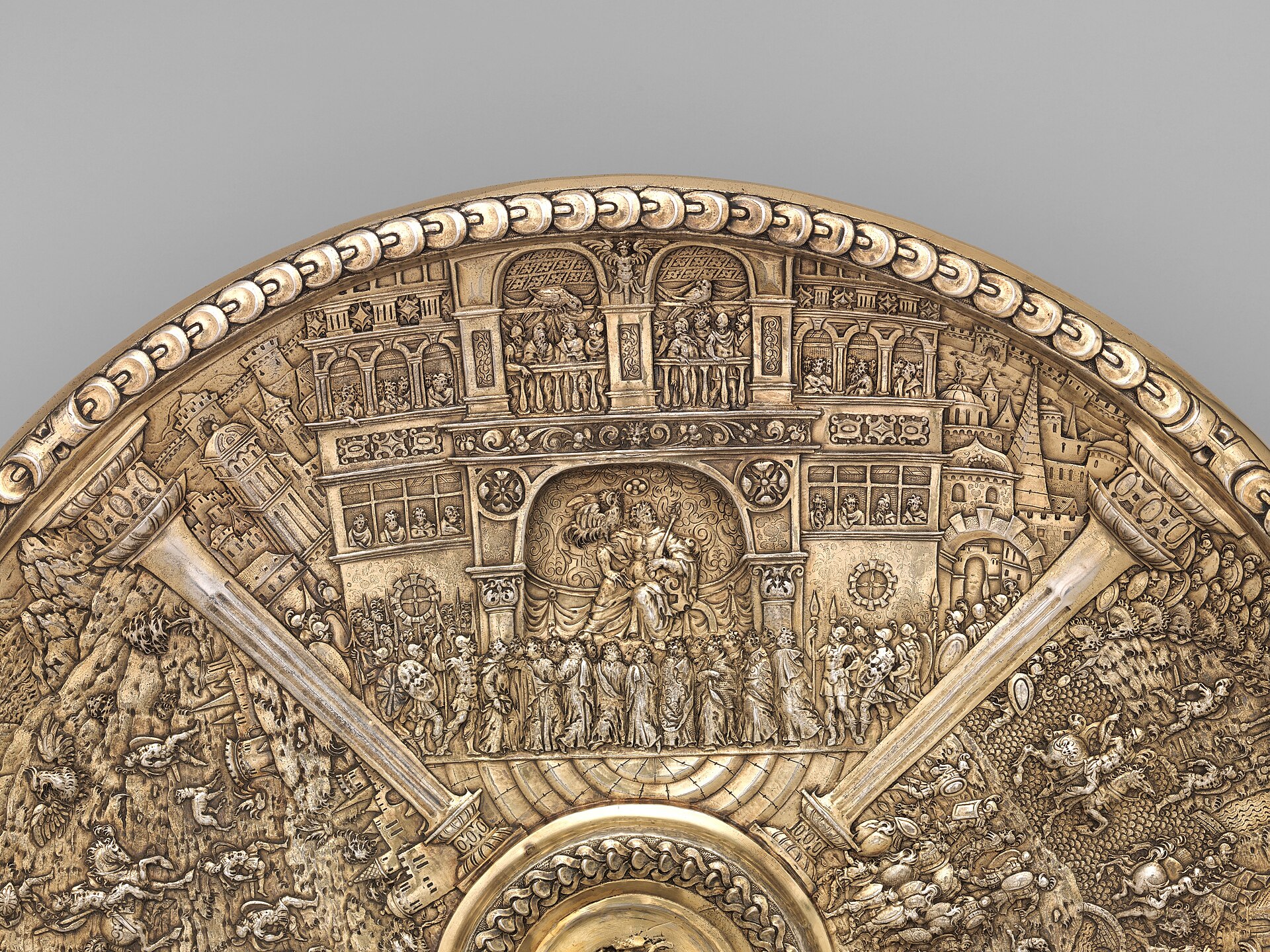
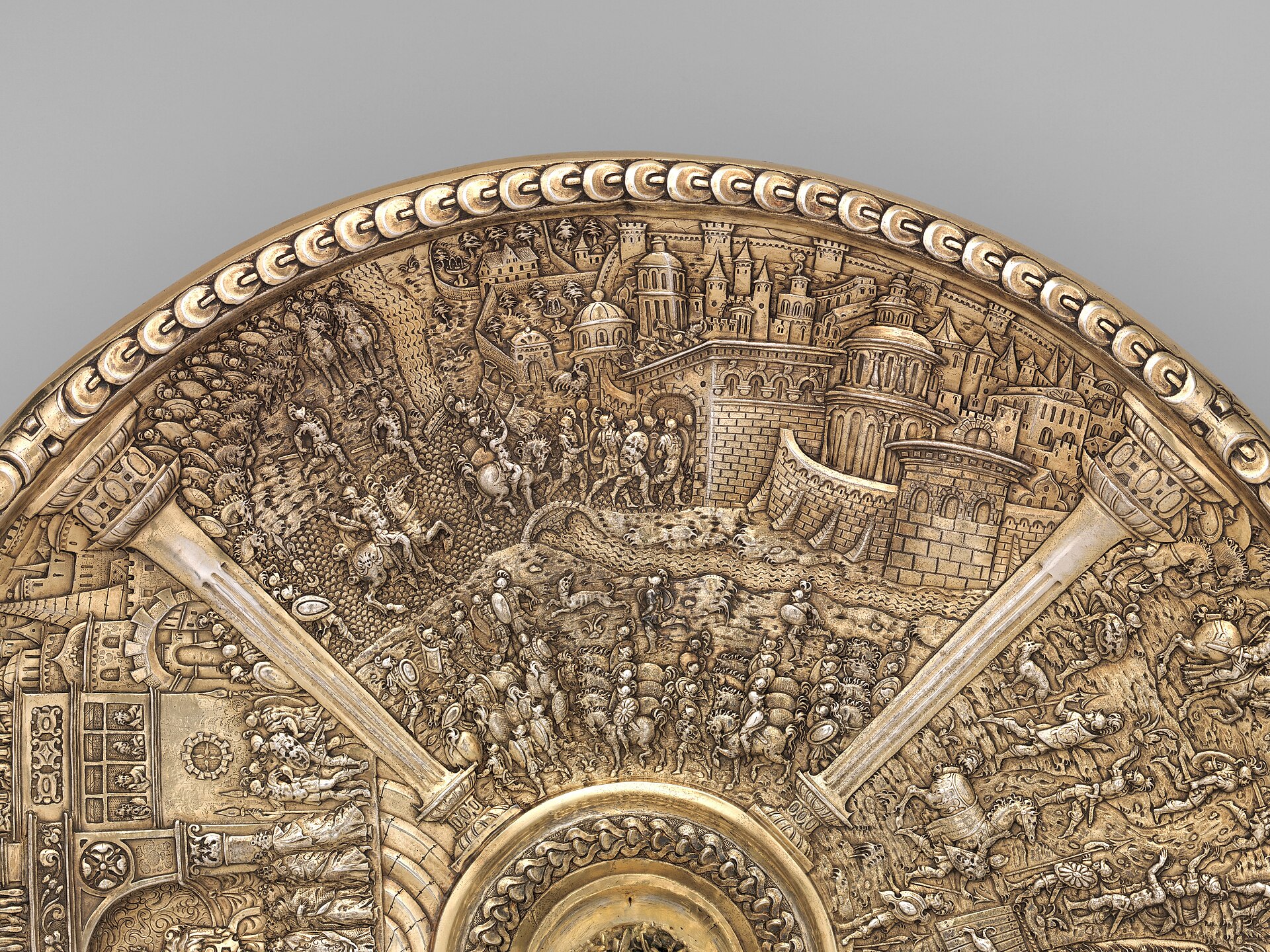
| Decoration | Four scenes chased in relief in the concave well of each dish, forty-eight across the set, each traceable to a specific passage of Suetonius. Julia Siemon finds that each dish appears to have been chased by a single hand, with several different hands discernible across the set, and that none of the imagery shows firsthand knowledge of Rome or of Italy.1 |
| Heights | 38.5 cm (Vespasian) to 45 cm (Julius Caesar) as currently assembled. Height varies partly because the feet are not all the same age or design.1 |
| Weights | Between 2,701.1 g (Claudius) and 2,982 g (Galba figure on Caligula dish) for the ten complete original tazze. The Titus dish alone weighs 1,060.7 g. The wholly nineteenth-century composite Titus weighs 3,313.8 g, more than any original.1 |
| Maker's, town and date marks | NONE of the period of manufacture. The only struck mark published is a star over the letter M within a shield, on the threaded surface of the baluster stem of the Vitellius tazza and of the composite Titus. It is not identified.1 |
| Nineteenth-century control marks | Present on nearly every component. These are genuine assay evidence, and they date the objects' passage through the nineteenth-century trade, not their manufacture.1 |
| Emperor labels | Each statuette has its name incised on the top of its pedestal cap. The N is reversed in DOMITIANVS and VESPASIANVS; the Tiberius figure reads TIWERIVS. The catalogue notes the labels may not be original but finds no reason to doubt them.1 |
| Scratched dish names | Eight dishes carry names scratched on the underside in a hand compatible with the nineteenth century, possibly earlier. Three are wrong: the Domitian dish is scratched Vespasian, the Caligula dish Domitian, the Vespasian dish Caligula.1 |
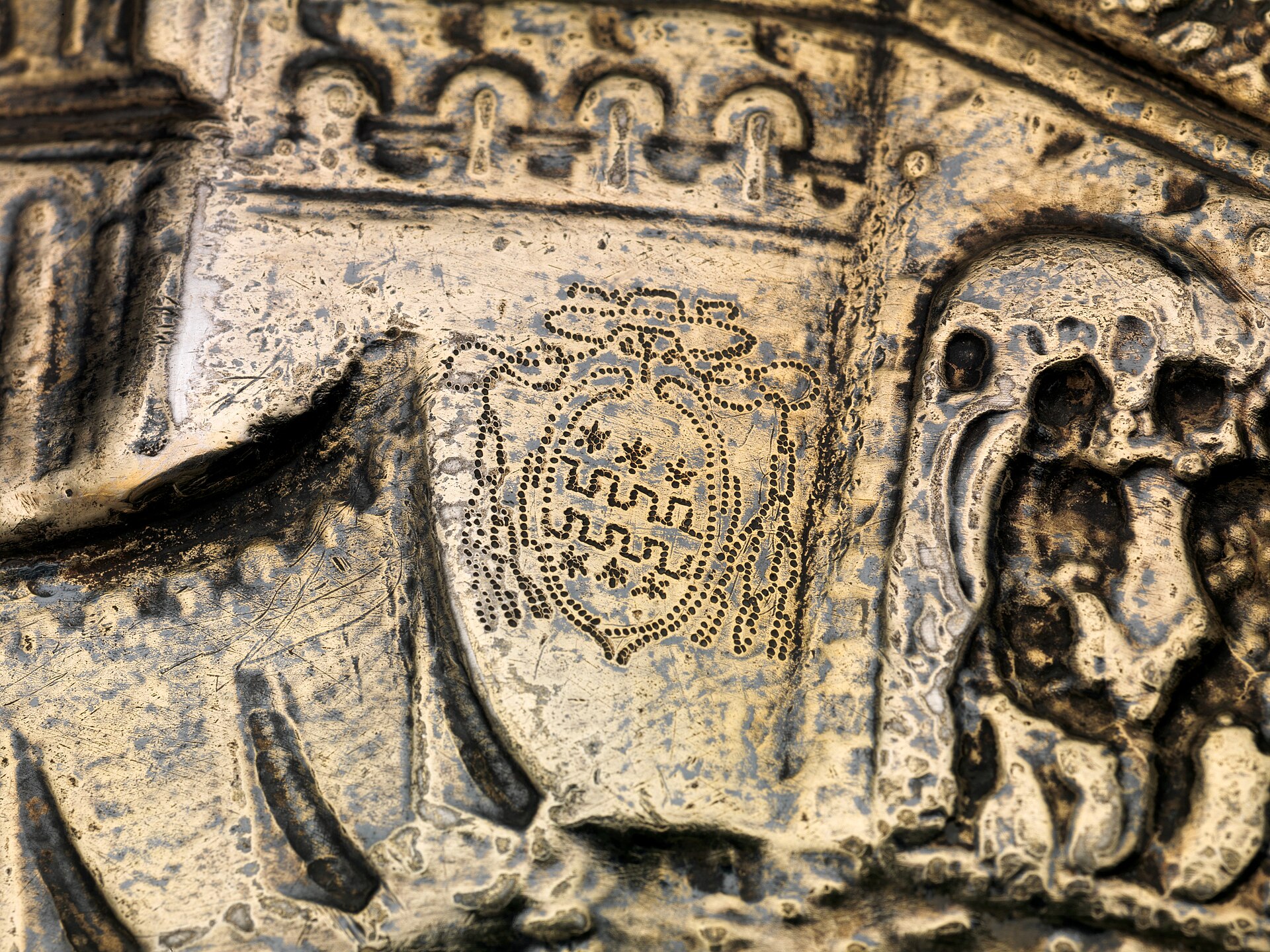
| Aldobrandini arms | Pricked - punched as a line of separate dots - on the underside of five dishes, and engraved on the upper surface of the Titus dish in Lisbon. An owner's addition to a finished object.1 |
| Feet | Three classes. Five retain fluted feet of the original type. Several carry plain replacements added after the mid-nineteenth century. Six, those that passed through Frederic Spitzer, were given elaborate substitutes; Hayward showed in 1970 that these are not original, and the catalogue calls the one on the Vespasian tazza a Vasters foot.15 |
| The electrotype Titus dish | Made in five panels, four for the narrative band and one for the centre. The reverse is smooth and lacks the nodules left by electrolytic deposition, suggesting a very heavy deposit later filed down. Elkington's later electrotypes are much lighter and thinner, which points to an early production.1 |
| Scientific examination | Metal composition testing and X-ray radiography, carried out on the reunited set in 2014 and published by Linda Borsch, Federico Caro and Mark T. Wypyski. The radiographs reveal areas of alteration and evidence of the mode of manufacture.1 |
| Metropolitan Museum record, Vitellius | Accession 45.60.58a-h, Fletcher Fund 1945; catalogued 'ca. 1587-99, foot added after mid-19th century'; gallery 520.2 |
| Metropolitan Museum record, Claudius | Accession 2024.436, Wrightsman Fund 2024; maker 'Unknown, Flemish, Antwerp ?, late 16th c.'; 40.6 by 38.1 by 38.1 cm; 2.95 kg; gallery 520.3 |
| Victoria and Albert Museum record, Domitian figure on Tiberius dish | Accession M.247-1956, Dr W. L. Hildburgh Bequest; catalogued as made in the southern Netherlands, c. 1587-99, with a later foot possibly Spanish (1550-1600) or added c. 1850-90; on display in Room 69. Re-checked directly against the museum's own online catalogue in August 2026; unchanged.12 |
Images
The record in full
Chapter 1Twelve objects that were designed to be one
A tazza is a shallow dish on a stemmed foot.
A tazza is a shallow dish on a stemmed foot. These twelve are large ones, standing between about 38 and 45 centimetres, each with a small statuette of a Roman emperor on a pedestal at the centre of the dish and four scenes from that emperor's life chased in relief in the concave well beneath him.
The set covers the Twelve Caesars of Suetonius, from Julius Caesar to Domitian, and across the twelve dishes the forty-eight scenes run through nearly a century and a half of Roman history. The scenes are not generic. Each of the forty-eight has been matched to a specific passage of Suetonius, and Mary Beard translated those forty-eight passages afresh for the 2017 catalogue so that they could be printed against the images.
That is the fact that governs everything else about this object. A set of twelve is an argument that only works complete, and the imagery on each dish is keyed to the emperor standing above it. Separate the pieces and you do not get twelve smaller works of art. You get a broken sentence.
Chapter 2The emperors are labelled and the dishes are not
Every statuette has its emperor's name incised on the top of its pedestal cap: IVLIVS, NERO, GALBA, CLAVDIVS, CALIGVLA, OTHO, VITELLIVS, AVGVSTVS.
Every statuette has its emperor's name incised on the top of its pedestal cap: IVLIVS, NERO, GALBA, CLAVDIVS, CALIGVLA, OTHO, VITELLIVS, AVGVSTVS. Two are cut by someone whose Latin was better than his letter-cutting, with the N reversed in DOMITIANVS and VESPASIANVS, and the Tiberius figure is incised TIWERIVS. The catalogue notes that these labels may not be original but that no reason has been found to doubt them.
The dishes carry no such thing. To know which emperor a dish belongs to you have to read the four scenes on it and identify the episodes in Suetonius. That is a research task, not a glance.
And the tazze come apart. They were built to be dismantled for storage and travel, and the components are interchangeable across the set: any emperor will screw on to any dish. A labelled figure, an unlabelled dish and a standard thread are the three conditions for exactly the disaster that followed.
Chapter 3How wrong it got
By the end of the nineteenth century only two of the twelve were correctly assembled: Julius Caesar and Claudius.
By the end of the nineteenth century only two of the twelve were correctly assembled: Julius Caesar and Claudius. Every other emperor was standing over somebody else's life.
The confusion is datable in places. A description of 1872 shows the Augustus figure already screwed into the Domitian dish. About a decade later a tazza carrying the Nero figure on the Titus dish was sold in Germany. Three of the six tazze owned by the Paris dealer Frederic Spitzer were mismatched when they were sold in 1893.
Somebody had tried to sort it out before. Eight of the dishes have names scratched on to them in a hand the catalogue dates as compatible with the nineteenth century, though possibly earlier. Some of those scratched names are right. Three are wrong, and wrong in a way that propagated: the Domitian dish is scratched Vespasian, the Caligula dish is scratched Domitian, and the Vespasian dish is scratched Caligula. An early attempt at identification became the authority for later mistakes.
So the underside of these dishes carries a layer of scholarship as well as a layer of ownership, and some of it is false. That is worth stating plainly because scratch inscriptions on silver are routinely read as evidence rather than as opinion.
Chapter 4Mary Beard, in a gallery, noticing
The modern unravelling began with a visit to the Victoria and Albert Museum.
The modern unravelling began with a visit to the Victoria and Albert Museum. Mary Beard looked at what the museum showed as the Domitian tazza and saw that the dish beneath the Domitian statuette was chased with scenes from the life of Tiberius.
That single observation led to a trail of similar misidentifications across the set. It is a good illustration of what this kind of error costs and how it survives: the object had been in a national museum since 1956, catalogued, published and displayed, and the mistake was visible to anyone who could read the pictures. Most people cannot, because reading them requires Suetonius.
The V&A tazza is still Domitian above Tiberius. It is plate 3 of the catalogue, given by Dr W. L. Hildburgh in 1956 and accessioned M.247-1956.
Chapter 5June 2014: twelve in one room
On 18 and 19 June 2014 the Metropolitan Museum of Art assembled all twelve tazze in New York, with an international group of specialists, for a symposium made possible by the Schroder Foundation...
On 18 and 19 June 2014 the Metropolitan Museum of Art assembled all twelve tazze in New York, with an international group of specialists, for a symposium made possible by the Schroder Foundation, Selim K. Zilkha and an anonymous donor. Among the speakers and chairs were Ellenor Alcorn, Denise Allen, Mary Beard, Michele Bimbenet-Privat, Linda Borsch, Ian Campbell, Federico Caro, Wolfram Koeppe, Ernst-Ludwig Richter, Xavier F. Salomon, Timothy Schroder, William Stenhouse, Luke Syson, Pierre Terjanian, Ubaldo Vitali, Stefanie Walker and Mark T. Wypyski.
Three things happened that could not have happened any other way. The figures and dishes were unscrewed and put back in their correct pairings for the first time in over a century. The whole set was photographed by Joseph Coscia Jr and Juan Trujillo of the museum's imaging department in a campaign that made the forty-eight scenes legible in detail for the first time. And scientific testing was run across objects that are normally thousands of miles apart.
Then the tazze were dismantled again and went back to their owners in the configurations they arrived in. This is the point most accounts miss. The 2014 reunion corrected the set on paper and in photographs. It did not correct the objects. The catalogue says so in as many words: most of the emperors still stand above another ruler's history.
Chapter 6The exhibition, and what it was not
The exhibition that followed, The Silver Caesars: A Renaissance Mystery, ran at the Metropolitan Museum of Art from 12 December 2017 to 11 March 2018 and at Waddesdon Manor in Buckinghamshire from 18...
The exhibition that followed, The Silver Caesars: A Renaissance Mystery, ran at the Metropolitan Museum of Art from 12 December 2017 to 11 March 2018 and at Waddesdon Manor in Buckinghamshire from 18 April to 21 July 2018. The catalogue was edited by Julia Siemon and published by the museum in 2017.
A reader should be clear about what the twelve were doing in those two rooms. They were together, which for a dispersed set is the whole event. They were not reunited in the sense of being reassembled into one object with one owner, and nothing about the exhibition changed the ownership of anything. No exhibition, sale process or reunion attempt has been found since 2018 that brought the set together again, in whole or in part.
Chapter 7Where they actually are
The set is now in seven countries. The Metropolitan Museum of Art holds two: the Vitellius, bought with the Fletcher Fund in 1945, and the Claudius, which was a private loan in 2017 and which the...
The set is now in seven countries. The Metropolitan Museum of Art holds two: the Vitellius, bought with the Fletcher Fund in 1945, and the Claudius, which was a private loan in 2017 and which the museum bought outright with the Wrightsman Fund in 2024. Both are in gallery 520.
The others: the Julius Caesar tazza at the Museo Lazaro Galdiano in Madrid; the Domitian figure on the Tiberius dish at the Victoria and Albert Museum; the Galba figure on the Caligula dish at the Casa-Museu Medeiros e Almeida in Lisbon; the Titus dish, alone and with no figure, at the Museu Nacional de Arte Antiga in Lisbon; the Otho tazza at the Royal Ontario Museum in Toronto, from the collection of Viscount and Viscountess Lee of Fareham and given in trust by the Massey Foundation; the Augustus figure on the Domitian dish at the Minneapolis Institute of Art. All six were re-checked directly against their holding institutions in August 2026 and none has moved.
Four pieces sit outside public museum ownership, and this is where the set has moved since the 2017-18 exhibition. The Vespasian tazza is in the Al Thani Collection, London, which lent it under that name to the Met and Waddesdon showings in 2017-18; before that, it was sold at Sotheby's New York on 1 February 2013 for 1,426,500 US dollars against an estimate of 400,000 to 800,000 dollars, consigned from the Morgan family descent that had held it since 1982. That 2013 sale is documented but had dropped out of this record's account of the object; whether the Al Thani Collection was the buyer at that 2013 sale or acquired it afterward is not established in the sources consulted. The Nero figure on the Augustus dish, the set's price record at 1 million pounds in 2000, was in the Zilkha Collection in Los Angeles until early 2025: Selim Zilkha died in September 2022, and Christie's catalogued the tazza as the top lot of the sale of his and his wife Mary's collection, 'Global Treasury: The Life and Collection of Selim & Mary Zilkha', on 6 February 2025, at an estimate of 2 million to 3 million dollars - but it was withdrawn and sold privately ahead of the auction, and the buyer and the price are not public. It should no longer be described as being in the Zilkha Collection. The Caligula figure on the Galba dish remains the property of the family of the banker Bruno Schroder, who died in 2019; since 11 September 2025 it has been on long-term loan and on public display in the new Schroder Gallery at the Holburne Museum in Bath, rather than sitting undisplayed in private London hands as earlier accounts of the set had it. The Tiberius figure on the Nero dish is unchanged: still on loan to the Metropolitan Museum as L.1999.62.2. A thirteenth object, wholly nineteenth-century, is also in private hands and its location has not been traced in this or the prior pass.
Chapter 8The thirteenth tazza is a fake, and it is part of the set
The catalogue prints thirteen plates for twelve tazze, and the reason is the best single story in the object's history.The original Titus statuette is lost.
The catalogue prints thirteen plates for twelve tazze, and the reason is the best single story in the object's history.
The original Titus statuette is lost. The original Titus dish survives, but it is in Lisbon on its own. So the thing that stands in for the Titus tazza today is made entirely of nineteenth-century replacements: a figure that is a copy of the Julius Caesar statuette, incised TITVS, standing on an electrotype copy of the Titus dish, on a replaced foot. It weighs 3,313.8 grams, appreciably more than any of the originals, which run between 2,701 and 2,982 grams.
The electrotype gives itself away under examination. It was made in five panels, four for the narrative band and one for the centre, where a mature electrotype would be a single deposit. Its reverse is smooth and lacks the nodules that electrolytic deposition leaves, which suggests it was left in the solution until a very heavy layer had built up and was then filed down. Elkington's later electrotypes are much lighter and thinner. The construction suggests an early production, made in pieces because the technology had not been mastered.
The composite Titus is not a forgery in the sense of something made to deceive a modern buyer. It is a Victorian repair of a gap, and it is now itself a historical object. But it means that any statement of the form 'all twelve survive' is false, and this record does not make it.
Chapter 9The gold on it is Victorian
Everyone calls these objects silver-gilt, and the Metropolitan catalogues its two as gilded silver.
Everyone calls these objects silver-gilt, and the Metropolitan catalogues its two as gilded silver. The gilding was applied between 1862 and 1872, before the set was dispersed. It is not sixteenth-century.
This is the kind of fact that quietly rewrites an impression. A reader looking at a photograph of a tazza is looking at a gold surface that was put on around the time of the second Reform Act, over relief that was chased under Philip II. The object's most immediately striking visual quality is the newest thing about it.
It was not the only improvement. Electrotype copies of the dishes were made and the emperor figures were replicated in bronze, so nineteenth-century copies of these objects circulate independently of the originals.
Chapter 10Six of the feet were made by a forger
The Parisian dealer Frederic Spitzer acquired six of the tazze and had their fluted feet replaced with more elaborate substitutes.
The Parisian dealer Frederic Spitzer acquired six of the tazze and had their fluted feet replaced with more elaborate substitutes. For decades those elaborate feet were widely regarded as original, and were admired as such.
In 1970 the silver scholar John F. Hayward published an article demonstrating that they are not. The catalogue calls the replacement on the Vespasian tazza a Vasters foot, which places it with Reinhold Vasters, the Aachen goldsmith whose designs for pastiche Renaissance goldsmiths' work were identified only after a folio of his drawings reached the Victoria and Albert Museum, and whose hand is now recognised in Renaissance collections across Europe and America.
So the feet on this set fall into three classes and a record has to keep them apart: original fluted feet, still on five of them; plain replacements added after the middle of the nineteenth century; and the elaborate Spitzer feet, at least one of which is given to Vasters. The Metropolitan states the replacement in the date field of its own Vitellius record rather than burying it in a condition note, which is the right way round.
Chapter 11What the marks actually say
Silver is normally dated and placed by assay marks, which is why silver is one of the best-documented classes of object in the decorative arts and also the most forged.
Silver is normally dated and placed by assay marks, which is why silver is one of the best-documented classes of object in the decorative arts and also the most forged. This set has almost none of that, and what it does have is mostly about the nineteenth century.
There is no maker's mark, no town mark and no date letter of the period of manufacture. A star over the letter M within a shield is struck on the threaded surface of the baluster stem of the Vitellius tazza and of the composite Titus, and it is not identified.
Nearly every component carries nineteenth-century control marks. Those are real hallmark evidence, and they date the set's passage through the nineteenth-century trade rather than its manufacture. An assay mark on this object is testimony about Spitzer's Paris, not about the workshop.
The other inscriptions are owners' and cataloguers' additions: the emperors' names incised on the pedestal caps, the names scratched on the undersides of eight dishes, and the Aldobrandini coat of arms, pricked on the underside of five dishes and engraved on the upper surface of the Titus dish in Lisbon. Pricking is a line of separate punched dots rather than a cut line, and it is an owner's mark added to a finished object.
Chapter 12The name is wrong, or at least late
The set is named after Cardinal Pietro Aldobrandini, 1571 to 1621, nephew of Pope Clement VIII.
The set is named after Cardinal Pietro Aldobrandini, 1571 to 1621, nephew of Pope Clement VIII. He did not commission it.
Stefanie Walker found documents in the cardinal's accounts registering payment for six tazze on 26 March 1602, bought by his agents in Milan. In 1603 all twelve appear in the inventory of his silver, the first known reference to the complete set, also found by Walker. His accounts show no purchase of the other six at any point. Three letters from an agent named de' Cervi, of 1599, record the tazze being offered to the Duke of Mantua, who declined, and establish that they were never owned by the Este of Ferrara.
Julia Siemon proposes an origin that fits the gap: that the tazze were made in the Habsburg Netherlands in the 1590s, possibly with the Austrian archdukes in mind, and that Archduke Albert of Austria brought them to Ferrara in the autumn of 1598 for his wedding to Isabella Clara Eugenia, Infanta of Spain, presenting six to his host, Cardinal Pietro. That is a proposal argued from documents and comparanda, and this record reports it as one. No publication since the 2017-18 exhibition has been found that revises or names a maker for this proposal; it remains the standing scholarly position.
What is settled is the negative: the man the set is named after was not its patron, and the name records a collector who acquired it in halves, at least one half on the open market in Milan, fifteen years or so after it was made.
Chapter 13Out of Italy, into the London trade
The cardinal left the tazze to his sister, and they descended through her family, passing among the Borghese, Pamphilj and Doria Pamphilj.
The cardinal left the tazze to his sister, and they descended through her family, passing among the Borghese, Pamphilj and Doria Pamphilj. The last record of them in Italy is a document of 1769 returning ownership to the Borghese.
Then they leave, and the most likely reading is that they were sold out of Italy before 1792. The context matters: in the late eighteenth century most noble silver collections in Rome were destroyed by papal and Napoleonic campaigns to reclaim precious metal. A set of twelve large silver dishes surviving that period at all is a piece of luck, and being sold abroad is very probably what saved it.
There is then a gap of more than fifty years. The tazze reappear in 1826 in the shop of a London dealer and silversmith. Nothing is documented in between.
Chapter 14The market, in figures a century and more apart
The tazze belonged to Charles Scarisbrick of Scarisbrick Hall in Lancashire, who rebuilt his house in the Gothic style and collected classical gems, intaglios and cameos and the canvases of John...
The tazze belonged to Charles Scarisbrick of Scarisbrick Hall in Lancashire, who rebuilt his house in the Gothic style and collected classical gems, intaglios and cameos and the canvases of John Martin. No reference to the tazze has been found in the Scarisbrick archives and it is not known when he bought them or how he showed them.
At his posthumous sale at Christie's in 1861 they were the most expensive lot by a distance, making 1,280 pounds, more than twice the price of any of his pictures. That figure needs one piece of context that catalogues rarely supply: Christie's charged no buyer's premium in 1861, the premium having been introduced in 1975, so 1,280 pounds is a hammer price and there is no second figure hiding behind it.
The buyer was Richard Attenborough, a London dealer who was also a pawnbroker, goldsmith, silversmith, diamond and pearl merchant and appraiser, and who lent two of the tazze to the landmark loan exhibition at the South Kensington Museum the following year. Frederic Spitzer had six by the time of his sale in 1893; a photograph of about 1890 shows two of them on a table in his study in Paris.
Individual pieces have gone on selling ever since, on a scale the set's fame as a broken-up curiosity understates. In 1982 the Vespasian tazza, still on its Vasters foot, made 231,000 US dollars at Christie's New York in the sale of the Morgan Collection. In 2000 the Nero figure on the Augustus dish was sold from the Wernher collection for 1 million pounds. Neither source distinguishes hammer from premium for those two, and after 1975 those are different numbers, so this record does not enter either as a hammer. The Vespasian tazza sold again on 1 February 2013, at Sotheby's New York, for 1,426,500 US dollars against an estimate of 400,000 to 800,000 dollars; the source consulted gives this as the price achieved and does not itemise a separate hammer figure. The Nero-Augustus tazza was catalogued for sale a third time, at Christie's New York on 6 February 2025 as part of 'Global Treasury: The Life and Collection of Selim & Mary Zilkha', at an estimate of 2 million to 3 million dollars, but was withdrawn and sold privately before the sale; no hammer, premium or buyer is public for that transaction.
Chapter 15The missing book
A manuscript once travelled with the set, credited with describing all the scenes.
A manuscript once travelled with the set, credited with describing all the scenes. It had forty-nine pages, which is very close to the forty-eight images chased on the dishes, and the arithmetic is the reason it is thought to have been the key to reading them.
It has been lost since 1893, the year of the Spitzer sale.
That is the sharpest single loss in this object's history. The forty-eight scenes had to be identified again in the twenty-first century, passage by passage, out of Suetonius, because the guide that came with them went missing at the moment the set was broken up. A finding aid and the thing it describes were separated by the same event.
The artist
Unrecorded goldsmiths, probably working in the Habsburg Netherlands, c. 1587-1599
There is no name, no mark and no contract. What survives instead is unusually rich circumstantial evidence about the shop: that several different chasers worked on the set, that each dish appears to be the work of one of them, that whoever designed the scenes had access to a serious antiquarian library and to prints, coins and books, and that nobody involved appears ever to have seen Rome. For an anonymous workshop that is a great deal more than most anonymous workshops leave behind.
Exhibited
- 1862Special Loan Exhibition; two tazze lent by the dealer Richard AttenboroughSouth Kensington Museum, London
- 2014Symposium and photographic campaign, 18-19 June; all twelve reunited and temporarily reassembled correctlyThe Metropolitan Museum of Art, New York
- 2017-2018The Silver Caesars: A Renaissance Mystery, 12 December 2017 to 11 March 2018The Metropolitan Museum of Art, New York
- 2018The Silver Caesars: A Renaissance Mystery, 18 April to 21 July 2018Waddesdon Manor, Buckinghamshire
Literature
- Julia Siemon (ed.), 'The Silver Caesars: A Renaissance Mystery', The Metropolitan Museum of Art, New York, 2017, distributed by Yale University Press. ISBN 978-1-58839-639-6. The standard reference and the publication of the 2014 reunion. Contains Mary Beard's new translations of the forty-eight Suetonian passages, Stefanie Walker's transcription of the 1603 Aldobrandini silver inventory, and the technical report by Borsch, Caro and Wypyski.
- John F. Hayward, on the Aldobrandini Tazze, 1970, at pages 669 and 674. Demonstrated that the elaborate feet supplied to the six Spitzer tazze are not original. NOT CONSULTED DIRECTLY; cited here from source 1, which does not give the journal title in the pages read.
Related works
| Work | Relation | Where it is |
|---|---|---|
| Vitellius tazza Anonymous, Netherlandish? | One of the twelve; correctly paired Fletcher Fund, 1945. Plate 9. Replaced foot. Carries the star-over-M mark on the baluster stem and the Aldobrandini arms pricked on the underside of the dish. | Metropolitan Museum of Art, New York, 45.60.58a-h |
| Claudius tazza Anonymous, Netherlandish? | One of the twelve; correctly paired Plate 5 of the 2017 catalogue, then a private collection on loan; bought by the museum with the Wrightsman Fund in 2024. One of only two that were still correctly assembled at the end of the nineteenth century. | Metropolitan Museum of Art, New York, 2024.436 |
| Domitian figure on the Tiberius dish Anonymous, Netherlandish? | One of the twelve; MISMATCHED, and the one that started the unravelling Dr W. L. Hildburgh Bequest. Mary Beard saw here that the dish under the Domitian statuette is chased with the life of Tiberius. Still displayed in the wrong pairing. Confirmed unchanged against the V&A's own catalogue, August 2026. | Victoria and Albert Museum, London, M.247-1956 |
| Titus dish Anonymous, Netherlandish? | One of the twelve; the dish survives with no figure at all 1,060.7 g. The Aldobrandini arms are engraved on its upper surface rather than pricked underneath. Its emperor is lost. | Museu Nacional de Arte Antiga, Lisbon, 1018 Our |
| Composite Titus tazza Anonymous nineteenth-century copyists | Not one of the twelve: a wholly nineteenth-century stand-in for the missing Titus A copy of the Julius Caesar figure incised TITVS, on an electrotype copy of the Titus dish, on a replaced foot. 3,313.8 g. Location not traced beyond the 2017 catalogue in this re-check. | Private collection |
| Nero figure on the Augustus dish Anonymous, Netherlandish? | One of the twelve; mismatched; the set's most recorded market history Sold from the Wernher collection in 2000 for 1 million pounds; source does not say whether that is hammer or with premium. Selim Zilkha died in September 2022. Christie's catalogued the tazza as the top lot of 'Global Treasury: The Life and Collection of Selim & Mary Zilkha', New York, 6 February 2025, estimate 2,000,000-3,000,000 USD, but it was withdrawn and sold privately before the auction; buyer and price undisclosed. No longer accurately described as the Zilkha Collection. | Private collection, undisclosed (formerly the Zilkha Collection, Los Angeles) |
| Vespasian tazza Anonymous, Netherlandish? | One of the twelve; correctly paired Descended in the Morgan family from 1901; Christie's New York, Morgan Collection sale, 26 October 1982, lot 68, estimate 400,000-800,000 USD; sold again at Sotheby's New York, Masterworks sale, 1 February 2013, lot 10 ('The Morgan Aldobrandini Tazza: Vespasian'), for 1,426,500 USD against the same estimate range. Lent by the Al Thani Collection to the 2017-18 Met/Waddesdon exhibition. This later sale and the collection name were both absent from the record prior to August 2026. | The Al Thani Collection, London |
Open questions
- Who made the set? No maker's mark, town mark or date letter of the period of manufacture exists on any of the thirteen components. The star over M within a shield on two baluster stems is unidentified.
- Who commissioned it? Cardinal Pietro Aldobrandini, whose family gives the set its name, demonstrably did not: he bought six on the Milan market in 1602. The Netherlandish and Habsburg origin proposed by Julia Siemon is an argument from documents and comparanda, not a record of a commission. No later publication has named a maker.
- How did Cardinal Pietro get the other six? His accounts record the purchase of six in March 1602 and show no purchase of a second group at any time, yet all twelve are in his 1603 inventory.
- Where were they between 1769 and 1826? The last Italian record is a document of 1769; they reappear in a London shop in 1826, and the intervening fifty-seven years are undocumented.
- Where is the forty-nine-page manuscript that described all the scenes? Lost since 1893, the year of the Spitzer sale.
- Where is the original Titus statuette? Lost. The figure standing in for it is a nineteenth-century copy of the Julius Caesar statuette.
- Who made the elaborate Spitzer feet? Hayward showed in 1970 that they are not original and the catalogue names Vasters for the one on the Vespasian tazza, but the derivation of the group is given as unknown.
- Will the set ever be reassembled correctly in fact? The 2014 reunion corrected the pairings only for the duration of the photography. Most of the emperors went home standing over another ruler's life.
- For the 1982 sale at 231,000 US dollars, the 2000 sale at 1 million pounds, and the 2013 sale at 1,426,500 US dollars, is the figure the hammer or the price with premium in each case? None of the sources consulted distinguishes, and after 1975 those are different numbers.
- Who bought the Nero-Augustus tazza in the private sale that preceded its scheduled 6 February 2025 appearance at Christie's, and for how much? The sale was reported as private in the trade press within weeks of the auction date; neither buyer nor price has since been made public.
- Was the Al Thani Collection the buyer at the February 2013 Sotheby's sale of the Vespasian tazza, or did it acquire the piece in a later, unrecorded transaction before the 2017-18 exhibition? The sources consulted establish both facts (the 2013 sale and the 2017-18 Al Thani lender credit) but not the link between them.
Questions about this object
What is The Aldobrandini Tazze?
The Aldobrandini Tazze is a silver, dated c. 1587-1599. Medium: Silver, chased in relief and cast, gilded in the nineteenth century.
Who made The Aldobrandini Tazze, and is the attribution settled?
The attribution to Unrecorded goldsmiths, probably working in the Habsburg Netherlands is recorded here as disputed. Anonymous. No goldsmith's mark, town mark or date letter identifies the maker; the only struck mark on any of the thirteen components published in the 2017 catalogue is a star over the letter M within a shield, on the threaded baluster stem of two of them. The set has been given to Italy and to Germany in turn and is now placed in the Habsburg Netherlands in the 1590s, on the chasing, on the printed sources behind the imagery, and on the documented movements of the Archduke Albert of Austria. Julia Siemon proposes that each dish was chased by a single hand and that several different hands are discernible across the set.
Where is The Aldobrandini Tazze now?
Dispersed across seven countries. Two are in the Metropolitan Museum of Art, New York; the others are in Madrid, London, Lisbon (two), Toronto, Minneapolis and four private collections. Last confirmed 3 August 2026. The 2017 Metropolitan Museum catalogue, updated for the museum's 2024 purchase of the Claudius tazza.
What is still unknown about The Aldobrandini Tazze?
Who made the set? No maker's mark, town mark or date letter of the period of manufacture exists on any of the thirteen components. The star over M within a shield on two baluster stems is unidentified.
Sources
- 1Julia Siemon (ed.), 'The Silver Caesars: A Renaissance Mystery', The Metropolitan Museum of Art, New York, 2017, distributed by Yale University Press, ISBN 978-1-58839-639-6. Essays by Mary Beard, Julia Siemon, Wolfram Koeppe, Michele Bimbenet-Privat, Stefanie Walker, Xavier F. Salomon, Ellenor Alcorn and Timothy Schroder, and Linda Borsch, Federico Caro and Mark T. Wypyski. Read in full. The single indispensable source; every figure, pairing, owner and date below that is not attributed elsewhere comes from it. archive.org/details/...
- 2Metropolitan Museum of Art, collection API record for object 199659, the Vitellius Tazza, accession 45.60.58a-h. Source for the Fletcher Fund credit line of 1945, the date 'ca. 1587-99, foot added after mid-19th century', and gallery 520. Re-checked August 2026, resolves. collectionapi.metmuseum.org/public/...
- 3Metropolitan Museum of Art, collection API record for object 210764, the Claudius Tazza, accession 2024.436, Wrightsman Fund 2024. Source for the maker line 'Unknown, Flemish, Antwerp ?, late 16th c.', the dimensions and the weight of 2.95 kg. This acquisition post-dates the 2017 catalogue, in which the Claudius tazza is plate 5, a private collection on loan to the museum. Re-checked August 2026, resolves. collectionapi.metmuseum.org/public/...
- 4Wikimedia Commons, raw wikitext of the Metropolitan Museum image files for accession 45.60.58a-h, in two upload generations. The earlier files carry 'probably Italian', 'ca. 1580' and 'Silver-gilt'; the later files carry 'Netherlandish?', 'ca. 1587-99, foot added after mid-19th century'. Read as wikitext, not as an API summary. Re-checked August 2026, resolves. commons.wikimedia.org/wiki/...
- 5John F. Hayward, 'The Aldobrandini Tazze', The Burlington Magazine, vol. 112, no. 811 (October 1970), pp. 669-676. Demonstrates that the elaborate feet supplied to the six Spitzer tazze are not original. Full journal citation identified via secondary reference in August 2026 (not previously given in this record); the article itself remains NOT CONSULTED DIRECTLY, cited here from source 1 at pages 669 and 674. The JSTOR link is bot-blocked to command-line fetching (HTTP 403); this is consistent with JSTOR's routine blocking of non-browser requests and is not evidence the article is unavailable. Replace with the printed article when a subscription copy can be read. jstor.org/stable/...
- 6Metropolitan Museum of Art, public object page for the Vitellius Tazza. Bot-blocked to command-line fetching (Vercel security checkpoint, HTTP 429); the collection API at source 2 returns the same record and was used instead. Re-tested August 2026: still 429-blocked to curl and to WebFetch under the same Vercel checkpoint. metmuseum.org/art/...
- 7Sotheby's, Masterworks sale, New York, lot 10, 'The Morgan Aldobrandini Tazza: Vespasian', 1 February 2013. Gives the full provenance chain for this specific tazza from Cardinal Pietro Aldobrandini's 1603 inventory through the Christie's 1982 Morgan Collection sale, and the 2013 estimate of USD 400,000-800,000. Fetched August 2026. sothebys.com/en/...
- 8'At Auction: Recapping Old Masters at Sotheby's', Enfilade (18th-century studies blog), 7 February 2013. Reports the price achieved for the Morgan Aldobrandini Tazza (Vespasian) at the 1 February 2013 Sotheby's Masterworks sale as USD 1,426,500 against the USD 400,000-800,000 estimate. Independent confirmation of the figure given by source 7's own sale listing. Fetched August 2026. enfilade18thc.com/2013/...
- 9Christie's, 'Inside the silver collection of Selim and Mary Zilkha', specialist feature published ahead of 'Global Treasury: The Life and Collection of Selim & Mary Zilkha', New York, 6 February 2025. Describes the Nero-Augustus Aldobrandini tazza as the sale's top lot, estimate USD 2,000,000-3,000,000, and states it is the first Aldobrandini tazza to be offered at auction since the 2017 exhibition. Fetched August 2026. christies.com.cn/en/...
- 10'Vendute l'82% delle opere di Selim e Mary Zilkha', Il Giornale dell'Arte, February 2025. States directly, quoted here in the original Italian: 'e stato pero venduto privatamente prima dell'asta e ancora non si conosce ne l'acquirente ne il prezzo pagato' (it was sold privately before the auction and neither the buyer nor the price paid is yet known). Also gives the overall sale result of about USD 6.63 million at an 82 per cent sell-through rate. Fetched August 2026. ilgiornaledellarte.com/Articolo/...
- 11The Holburne Museum, 'The Schroder Gallery: Now Open!', museum news page, September 2025. Confirms the new Schroder Gallery opened to the public on 11 September 2025 and states that the Renaissance silver on display, including the Aldobrandini tazza, is 'a loan to the Holburne from the Estate of the late British banker Bruno Schroder, by his daughter Leonie and her family'. Fetched August 2026. holburne.org/the-schroder-gallery-now-open
- 12Victoria and Albert Museum, online catalogue record for 'The Aldobrandini Tazza', accession M.247-1956. Primary museum source for the Domitian-on-Tiberius tazza, added in August 2026 to strengthen sourcing beyond the 2017 catalogue and the Met's own two accession records; confirms no change in this holding. Fetched August 2026. collections.vam.ac.uk/item/...
- 13Wikipedia, 'Aldobrandini Tazze'. Tertiary source; used in August 2026 only to cross-check the twelve-piece holder list against the 2017 catalogue and to flag pieces whose status might have changed since 2018 for independent, primary verification. Not relied on as the sole basis for any fact in this record; every claim drawn from it above is independently confirmed by a museum, auction house or press source. Should be replaced with primary citations as the record is further developed. en.wikipedia.org/wiki/...

Last verified 11 August 2026 · Published 4 August 2026
Change log
11 August 2026 - Re-verification pass found three real changes to the dispersed set since first published: the tazza depicting Nero left the Zilkha Collection, Los Angeles, sold privately in early 2025 ahead of a scheduled Christie's auction (buyer and price undisclosed); the Vespasian tazza is now identified in the Al Thani Collection, London, with a previously unrecorded February 2013 Sotheby's sale at USD 1,426,500; and the Caligula/Galba tazza, still Schroder family property, went on public loan to the new Schroder Gallery at the Holburne Museum, Bath, in September 2025. The other nine holdings and the 2017 attribution to unrecorded Habsburg Netherlands goldsmiths are unchanged.
11 August 2026 - Record deepened to the house standard: narrative sections, technical evidence, artist dossier, related works and open questions added; provenance chain and auction results replaced with the researched versions; sources rebuilt.
2 August 2026 - Record deepened to the house standard: narrative sections, technical evidence, artist dossier, related works and open questions added; provenance chain and auction results replaced with the researched versions; sources rebuilt.
4 August 2026 - Record created at the house standard: researched narrative, technical evidence, maker dossier, graded provenance chain, prices with hammer and premium separated, related works, open questions and sources.