The Cheapside Hoard
Unrecorded London goldsmiths and jewellers, with imported and reused stones · Objects range from the first century BC to about 1640; the assemblage was buried between 1640 and 1666
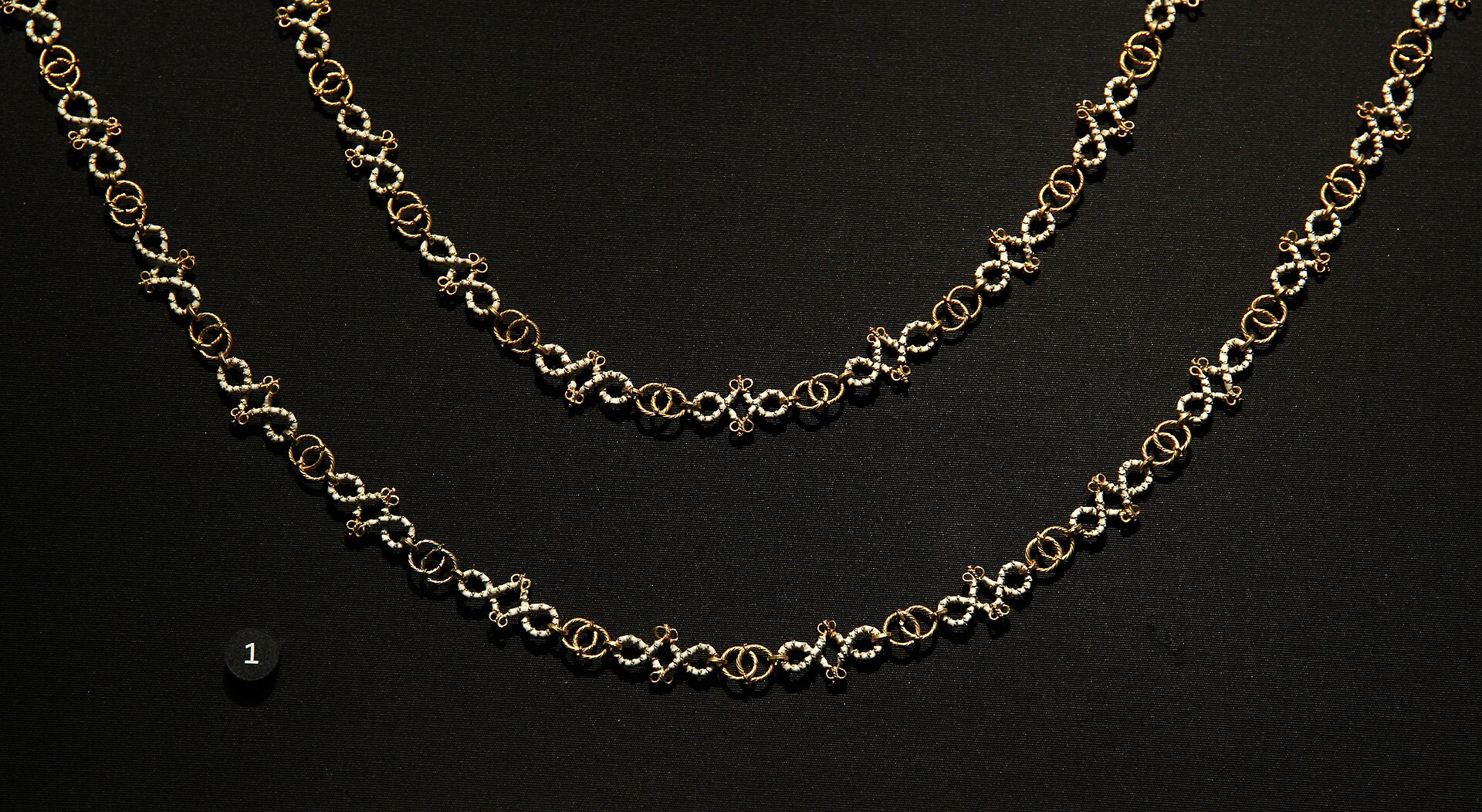
A Cheapside Hoard chain of enamelled gold lovers' knots, displayed at the Victoria and Albert Museum and photographed there on 11 April 2019. Thirty chains survive from the hoard, a survival rate without parallel for English jewellery of this period, because chains are the first thing a jeweller melts.
| Workshop | Unrecorded London goldsmiths and jewellers, with imported and reused stones |
|---|---|
| Date | Objects range from the first century BC to about 1640; the assemblage was buried between 1640 and 1666 |
| Medium | Enamelled gold, silver, and set and unset gemstones: Colombian emerald, Indian diamond, Sri Lankan and Burmese sapphire, ruby and spinel, Persian turquoise, amethyst, garnet, peridot, opal, agate, carnelian, chalcedony, rock crystal and pearl |
| Dimensions | Approximately 500 objects; individual pieces range from finger rings to enamelled chains over a metre long |
| Where it is now | London Museum (formerly the Museum of London); the collection has been in storage since the Barbican site closed in December 2022 and is not currently on public display. A dedicated Goldsmiths' Gallery at the museum's new Smithfield site is scheduled to open 28 November 2026 with, per the museum's own announcement, the fullest display of the hoard ever assembled. A small number of pieces remain held by the British Museum and the Victoria and Albert Museum. |
| Attribution | UnknownNo maker is named on any piece and no owner has ever been identified. Full note |
| Object type | Goldsmith's work |
| Period | Elizabethan and Jacobean, c. 1560-1650 |
| Cases | Has a provenance gap |
| Inscriptions | No maker's mark, assay mark or owner's inscription has been published from any piece in the sources consulted. The single inscribed object that carries the dating argument is a chipped carnelian intaglio engraved with the heraldic badge of a peer created in 1640. |
| Owners on record | 7 links5 documented, 1 disputed, 1 unknown |
| Sources | 5 cited |
About this record Last verified 15 August 2026 · 5 sources cited · Change log
On this page 10 sections
ContentsClose
On 18 June 1912 workmen breaking up a cellar floor at the corner of Cheapside and Friday Street in the City of London struck a decayed wooden box holding roughly five hundred pieces of late Elizabethan and Jacobean jewellery and unset gemstones. It is the largest hoard of its kind known anywhere, and it is the only surviving body of English jewellery of that period that was never broken up and refashioned.
It is also, in provenance terms, the purest problem this archive has recorded. The finders are unnamed. No inventory was taken at the find spot. No coroner's inquest was held and the hoard was never declared treasure trove, so no legal process produced a document. The material reached the museum in parcels and handkerchiefs over the following weeks, bought from the workmen by a pawnbroker who paid in cash and beer. Nobody knows who owned it, why it went into the ground, or why it was never taken out again.
A hoard with no owner tests every method this publication uses. There is no chain of title to grade, so the evidence has to come from the objects themselves: a chipped intaglio bearing a badge that did not exist before 1640, fire damage that puts the burial no later than 1666, and roughly four thousand missing pearls that rotted in the soil and are now recorded only as empty settings.
Provenance
Each link is graded. Documented: a cited source supports it. Disputed: the identification is argued but not established. Unknown: no owner for that span, and the gap is not smoothed into a narrative. The grades in the glossary.
- 1st century BC to c. 1640 - between 1640 and 1666Unidentified. Probably a working jeweller or syndicate of jewellers in Cheapsideunknown
No owner has ever been identified. The assemblage was formed over an unknown period and includes Ptolemaic, Byzantine and Renaissance material alongside jewels of the 1630s. The freehold of the site belonged to the Goldsmiths' Company, but the properties were let, sublet and sub-sublet, in large part to immigrant craftsmen, and the occupancy cannot be reconstructed.12
- between 1640 and 1666 - 1912None. In the grounddocumented
Buried in a wooden box in a brick-lined cellar beneath a chalk floor. The dating window is fixed at its lower end by the Stafford intaglio of 1640 and at its upper end by fire damage associated with the Great Fire of 1666. The site was rebuilt in brick from about 1670. Nobody returned for it, and no contemporary record of the loss has been found.12
- 18 June 1912 - 1912Unnamed demolition workmendocumented
Found by a workman clearing the cellar of tenement houses 30 to 32 Cheapside during demolition. The finder was never named and gave no account. Fellow workmen are reported to have pocketed material at the find spot. No inventory, plan or photograph of the deposit was made.12
- 1912 - 1912George Fabian Lawrence, known as Stony Jack, pawnbroker and antiquities dealerdocumented
Lawrence bought the material from the workmen under a standing arrangement in which he paid cash or beer for finds. It reached him piecemeal in parcels and handkerchiefs over the following weeks. He had been appointed inspector of excavations at the London Museum in the same year. No purchase figure for the Cheapside material is published in the sources consulted, and no coroner's inquest was held, so no sworn record of the transfer exists.12
- 1914 - 1976London Museum, Guildhall Museum and British Museumdisputed
The hoard was split between institutions and the published counts do not agree. Forsyth records 20 items going to the British Museum in 1914, with the bulk divided between the London Museum and the Guildhall Museum in 1916. The London Museum's own published account gives 25 pieces at the British Museum and 5 at the Victoria and Albert Museum. Both figures are carried here. The London Museum and Guildhall Museum merged in 1976 to form the Museum of London, reuniting the two main portions.12
- 1976 - presentMuseum of London, renamed the London Museum, with pieces in the British Museum and the Victoria and Albert Museumdocumented
The great majority of the hoard is held by the London Museum. At least one object, an enamelled gold chain of lovers' knots, is displayed at the Victoria and Albert Museum as Cheapside Hoard material. Items said to be from the hoard have continued to surface: Lawrence's son presented two undocumented fancy-cut amethysts to the museum in 1927.12
- 2022 - 28 November 2026 (scheduled)London Museumdocumented
The Museum of London's Barbican site, which displayed the hoard, closed in December 2022 for the institution's move to a new site at Smithfield's former General Market. The London Museum and the Worshipful Company of Goldsmiths announced in 2026 that the hoard will be the centrepiece of a new, Goldsmiths'-funded 'Goldsmiths' Gallery' at the Smithfield site, opening 28 November 2026, described by the museum as the fullest display of the hoard ever assembled. The Goldsmiths' Foundation has pledged GBP 10 million toward the new museum; this figure is for the museum project as a whole, not the gallery alone, and no separate gallery-specific figure was found.45
Prices realised
No object from the Cheapside Hoard has been offered at public auction. The hoard passed from the finders to a dealer and from the dealer to museums, and it has been in institutional hands since 1914. No purchase price, insurance value or probate valuation for the hoard or any part of it is published in the sources consulted. Any figure a reader encounters for what the Cheapside Hoard is worth is an estimate made without a market test.
Technical evidence
| Attribution note | No maker is named on any piece and no owner has ever been identified. The hoard is attributed to the London goldsmithing trade of the late sixteenth and early seventeenth centuries on the evidence of its find spot, in a cellar under tenement houses on the Goldsmiths' Company's own Cheapside freehold, and on the evidence of its composition, which mixes finished jewels of the latest fashion with unset stones, older material and at least one deliberate fake. Hazel Forsyth, senior curator at the Museum of London, holds that it was most probably the working stock of a jeweller or a syndicate of jewellers, while allowing that a wealthy collector or a receiver of stolen goods cannot be excluded. That is where the evidence stops. |
|---|---|
| Number of objects | Approximately 500, described as nearly 500 by the Museum of London and its curators and as more than 400 in earlier accounts. No single agreed count exists, because material continued to arrive after 1912.12 |
| Container | A decayed wooden box or casket, described in newspaper accounts of 1914 and in the 1928 London Museum catalogue. It had disintegrated; soil contamination on some pieces is consistent with the contents having been gradually enveloped by the surrounding earth.1 |
| Find context | A brick-lined cellar beneath a chalk floor, under tenement houses 30 to 32 Cheapside at the corner of Friday Street, City of London. No archaeological record of the deposit was made.12 |
| Terminus post quem | 1640, from a chipped carnelian intaglio bearing the heraldic badge of William Howard, created Viscount Stafford in that year on his marriage to Mary Stafford.12 |
| Terminus ante quem | 1666. Fire damage recorded in the Cheapside excavations places the burial no later than the Great Fire; the site was rebuilt in brick from about 1670.1 |
| Missing pearls | Hazel Forsyth calculates from the empty settings that the hoard originally contained on the order of 4,000 pearls, and possibly more in loose form, almost all of which decayed in the soil. One large pearl survives on a pendant with a Byzantine sapphire cameo.1 |
| Emerald watch | A verge watch housed in a hollowed hexagonal Colombian emerald crystal, about 42 mm deep and 20 mm wide, with champleve enamel at the centre of the dial. Dated by Forsyth to the 1600s and, on other accounts, to about 1600 to 1610.12 |
| Table-cut diamond ring | Enamelled gold ring set with a table-cut diamond measuring 8.4 by 8.0 mm and estimated at 3 to 4 carats, with a modified scissor-cut pavilion. Most stones of this cut were recut by about 1700, which makes the survival unusual.1 |
| Chains | Thirty enamelled chains survive, incorporating turquoise, beryl, amethyst, corundum and spinel. Chains of this delicacy almost never survive, because they are the easiest element of a jewel to melt down.1 |
| The counterfeit | A quench-crackled rock crystal pendant dyed red, probably with cochineal, to imitate a balas ruby, that is, a red spinel. The Goldsmiths' Company investigated one of its own members for making these in 1610. The dye has faded to pale pinkish orange.1 |
| The oldest objects | A banded agate cameo of a Ptolemaic queen in the guise of Isis, wearing a vulture headdress, and a pale blue sapphire cameo of the Incredulity of Saint Thomas of Byzantine date, about the sixth or seventh century.12 |
| Toadstones | Fourteen toadstones among the loose gems. Believed at the period to detect and neutralise poison; in fact the fossilised palatal teeth of the Jurassic fish Lepidotes.1 |
Images
The record in full
Chapter 1The find, and what is actually recorded about it
A trio of adjoining houses on the north side of Cheapside, numbered 30 to 32, was scheduled for demolition in the summer of 1912.
A trio of adjoining houses on the north side of Cheapside, numbered 30 to 32, was scheduled for demolition in the summer of 1912. On 18 June a workman clearing a brick-lined cellar under a chalk floor struck through it with a pickaxe and exposed what the Museum of London's 1928 catalogue describes as a decayed wooden box or casket. The gems spilled onto the cellar floor.
That is very nearly the whole of the primary record of the discovery. The workman's own account was never taken. His fellow labourers are said to have filled their pockets. No archaeologist was present, no plan was drawn, and no photograph was made of the deposit in the ground. Everything that has since been argued about the hoard has had to be argued from the objects, because the context in which they were found was destroyed within minutes of being opened.
The site sits at the corner of Cheapside and Friday Street, a short walk from St Paul's Cathedral and a few steps from St Mary-le-Bow. The freehold of the tenement houses belonged to the Goldsmiths' Company. That fact is the strongest single piece of circumstantial evidence about the hoard, and it is also, on its own, worth almost nothing, because the Company let the properties out and the leases were sublet and sub-sublet, in large part to foreign craftsmen. Forsyth and Mitchell both note that the chain of occupancy cannot be reconstructed. The building the hoard was under cannot be tied to a named tenant.
Chapter 2Stony Jack, and why the hoard exists at all
George Fabian Lawrence, 1861 to 1939, was a pawnbroker and antiquities dealer who had built a standing arrangement with the navvies and demolition men digging up London.
George Fabian Lawrence, 1861 to 1939, was a pawnbroker and antiquities dealer who had built a standing arrangement with the navvies and demolition men digging up London. He paid them in cash or in beer for anything they turned up, and he taught them what was worth keeping. The Daily Herald quoted him near the end of his life: every scrap of metal, pottery, glass or leather that has been lying under London may have a story to tell the archaeologist, and is worth saving.
In 1912, the year of the find, Lawrence was appointed inspector of excavations at the newly established London Museum. Over his career he is reported to have obtained some fifteen thousand objects, sixteen hundred of them in his first six months in the post. The Cheapside material came to him not as a hoard but as a trickle: parcels and handkerchiefs of jewellery arriving at his office over the following weeks, each from a different pair of hands.
The consequence is exact and it is permanent. The hoard was reassembled from the pockets of men who were never named, at an unknown number of removes from the ground, with no way of knowing what did not arrive. Items said to be from the hoard have continued to surface for a century; Lawrence's own son presented two fancy-cut amethysts to the museum in 1927, undocumented, and they may or may not be two amethysts now in the collection. What is called the Cheapside Hoard is therefore a reconstruction, not a deposit, and the honest description of its provenance is that the object group and the find group are not the same thing.
Chapter 3Why there was no inquest, and why that matters
In 1912 the relevant law was the common-law doctrine of treasure trove.
In 1912 the relevant law was the common-law doctrine of treasure trove. It turned on intent: gold and silver deliberately hidden by an owner who meant to come back for it belonged to the Crown, while goods lost or abandoned did not. A hoard buried for safekeeping is the textbook case of treasure trove, and a coroner's inquest was the mechanism that decided it.
No inquest was held. The Goldsmiths' Company, as freeholder, did not assert a claim. The absence of both is the reason the material could be bought from workmen in a pawnshop and sold on to a museum without any legal process intervening, and it is also the reason there is no sworn record of who found what. Under the Treasure Act 1996, which replaced the common-law doctrine in England and Wales, a find of this kind would be reportable, an inquest would follow, the finders and the landowner would be identified in the report, and a valuation committee would set a reward. Every one of those documents would now exist. In 1912 none of them was created.
This record grades the whole ownership question unknown rather than disputed, because a dispute requires two positions and there has never been a claimant.
Chapter 4What is in it
Nearly five hundred objects, spanning a chronological range far wider than the burial date.
Nearly five hundred objects, spanning a chronological range far wider than the burial date. There are finger rings, pendants, hat ornaments, buttons, earrings, scent bottles, fan holders, chains, loose stones and a small number of objects whose function is still not agreed.
The single most reproduced piece is a pocket watch set inside a hollowed hexagonal Colombian emerald crystal, of about 1600, roughly forty-two millimetres deep and twenty wide, with the crystal sliced to make a hinged cover and the removed material worked into the mount. A gold and enamel salamander hat ornament set with cabochon Colombian emeralds and table-cut diamonds in the tail is the other emblem of the collection. There is a gold scent bottle enamelled white and set with carved chalcedony leaves, rubies, pink sapphires, spinels and diamonds. Thirty enamelled chains survive, a survival rate without parallel, because chains are the first thing a jeweller melts.
The chronological spread is the part that is easiest to miss. A banded agate cameo of a Ptolemaic queen in the guise of Isis, wearing a vulture headdress, is Egyptian and predates the rest by more than sixteen centuries. A pale blue sapphire cameo of the Incredulity of Saint Thomas is Byzantine, of about the sixth or seventh century. A chalcedony cameo resembles the profile portraits made in the Medici workshops in Florence. Fourteen toadstones, believed at the time to sweat in the presence of poison and in fact the fossilised palatal teeth of a Jurassic fish, were among the loose stones.
Chapter 5How the burial is dated
The dating of the deposit does not rest on style.
The dating of the deposit does not rest on style. It rests on one small, chipped, visually unimpressive carnelian intaglio.
The intaglio carries the heraldic badge of William Howard, who was created Viscount Stafford in 1640 on his marriage to Mary Stafford. The badge did not exist before that year, so the stone cannot have been engraved before 1640, and the hoard cannot have gone into the ground before it. That is the terminus post quem, and it was only established when the intaglio was identified by Forsyth and her colleagues in the run-up to the 2013 exhibition. Before that identification the hoard was routinely dated to about 1600 to 1615.
The upper limit comes from the site. Fire damage recorded in the Cheapside excavations places the burial no later than the Great Fire of September 1666, which destroyed the buildings above the cellar and, after the rebuilding of about 1670, sealed it under brick for two and a half centuries.
A third strand narrows nothing but confirms the range: an agate cameo of Elizabeth I whose costume points to a carving date after about 1575, closely comparable to the Armada Jewel that Nicholas Hilliard made and that was given to Sir Thomas Heneage in 1588. The hoard therefore contains objects made across at least sixteen centuries and was buried inside a window of twenty-six years.
Chapter 6Whose stock was it
This is the question the hoard exists to pose and it has never been answered.
This is the question the hoard exists to pose and it has never been answered. Four explanations are in circulation and the evidence for each can be stated precisely.
A working jeweller's stock in trade. The strongest reading, and Forsyth's. The hoard mixes finished jewels of the latest fashion with older pieces, with stones removed from settings as if awaiting repair or reuse, and with material of every price level down to a chipped intaglio nobody would wear. That is what a workshop holds, not what a person owns. Cheapside and Goldsmiths' Row were the centre of the London trade, and before commercial banking a hole in the floor was where a jeweller kept his stock. Forsyth has put the possibility plainly: it could be that the jeweller did this regularly, that he had a hole in the floor where he kept his stock in trade.
A syndicate rather than an individual. Forsyth allows this too, and the sheer breadth of the material supports it. Almost sixty per cent of the jeweller goldsmiths working in London in this period were immigrant craftsmen, who travelled and who worked in partnership.
A collector. The ancient and Byzantine cameos and the antiquarian oddities point at a cabinet rather than a shop. Against it: a collector does not hold fourteen toadstones and a batch of unset garnets.
A fence. Among the pieces is a counterfeit balas ruby made by quench-crackling cheap rock crystal and running a red dye, probably cochineal, into the fissures. In 1610 the Goldsmiths' Company investigated one of its own members for making exactly these. The dye has now faded to a pale pinkish orange. A deliberate fake in a working stock is ordinary; it is also the single object in the hoard that raises the possibility that the owner was not straight.
No name has ever been attached to any of these readings. That is the finding.
Chapter 7The four thousand pearls that are not there
Pearls are organic. Buried in London soil for two and a half centuries, they dissolve.
Pearls are organic. Buried in London soil for two and a half centuries, they dissolve. Forsyth has worked out from the empty settings that the hoard originally held on the order of four thousand pearls, perhaps more in loose form, and that almost all of them rotted away.
That single figure changes what the object is. What survives is not the hoard; it is the mineral fraction of the hoard. The proportions a visitor sees, emerald and diamond and enamelled gold, are an artefact of differential survival, and the assemblage as it went into the ground would have looked substantially more like the pearl-heavy jewellery of the portraits of the period than the collection looks today.
One large pearl survives, on a pendant with the Byzantine sapphire cameo, and the breakdown of its nacre layers is visible.
Chapter 8What the stones say about the world in 1640
The gem sources in this cellar are a map of the first global economy, and the hoard is one of the few places that map survives as physical material rather than as a customs ledger.The emeralds are...
The gem sources in this cellar are a map of the first global economy, and the hoard is one of the few places that map survives as physical material rather than as a customs ledger.
The emeralds are Colombian. Spanish forces under Jimenez de Quesada seized the emerald-bearing country of what is now Colombia in 1537, and by the late sixteenth century the stones were crossing Europe in quantity and eclipsing the ancient Egyptian workings. The diamonds are Indian, most likely from the Golconda field, reaching Europe in far greater volume after the sea route around the Cape opened around 1500. Sapphires, rubies and spinels come from Sri Lanka and Burma. Turquoise is Persian. Peridot is Egyptian. Garnets are European or Indian. Amethysts came from Russia or Brazil. Pearls came from the Persian Gulf and the Gulf of Mannar, and possibly from Scotland, the Caribbean and the Comoros.
A single London workshop, on a leasehold owned by the Goldsmiths' Company, was drawing on Spanish South America, Mughal India, Ceylon, Burma, Safavid Persia and the Ottoman Levant simultaneously. The hoard is not evidence that London was a large market in 1640. It is evidence that it was a global one.
Chapter 9Where the hoard went, and the counts that do not agree
The material did not stay together. Twenty items went to the British Museum in 1914, on the account Forsyth gave in 2013.
The material did not stay together. Twenty items went to the British Museum in 1914, on the account Forsyth gave in 2013. The bulk was divided in 1916 between the London Museum and the Guildhall Museum, which merged in 1976 to form the Museum of London, at which point the two halves came back together.
The counts in circulation do not reconcile. The London Museum's own published account states that five pieces are at the Victoria and Albert Museum and twenty-five at the British Museum. Forsyth, quoted in 2013, gives twenty to the British Museum in 1914 and does not mention the V and A in that context. This record carries both figures and does not average them, because the difference is exactly the kind of drift that a hoard reassembled from pockets produces, and because at least one Cheapside Hoard object is on public display at the V and A under that name.
The hoard was first shown in a single glass case in 1914, at the London Museum's opening. An illustrated catalogue followed in 1928. It was shown complete, for the first time in a century, at the Museum of London from 11 October 2013 to 27 April 2014, in an exhibition curated by Hazel Forsyth alongside her book of the same year.
Chapter 10The folklore, and who published it
Three stories attach to this hoard and none of them is evidence.The first is that the owner was a jeweller who died in the Great Plague of 1665, or fled it, and never came back.
Three stories attach to this hoard and none of them is evidence.
The first is that the owner was a jeweller who died in the Great Plague of 1665, or fled it, and never came back. This is a reasonable-sounding inference that has hardened into a statement through repetition. The plague and the Civil War are both inside the 1640 to 1666 window and both are plausible reasons to bury a stock; neither is attached to this deposit by any document. Forsyth's own published position lists a calamity, a planned journey abroad and simple routine practice alongside each other, without choosing.
The second is the picturesque literature around Lawrence himself, the pints of beer, the pockets full of Roman glass, the parcels and handkerchiefs. Most of it is true and it is well sourced to his own statements and to museum records, but it functions in retellings as an origin myth that conceals the actual problem, which is that a documented chain of custody was never created.
The third is the recurring claim that the hoard was pronounced treasure trove. It was not, and the absence of an inquest is more informative than the presence of one would have been.
Separating these from the record is not pedantry. A reader who takes the plague story as fact will read the burial as a single desperate act by one man. A reader who holds to the evidence will see a twenty-six-year window, an unreconstructable tenancy, and a strong probability that the deposit was routine rather than dramatic.
The artist
The London goldsmiths' trade of Cheapside and Goldsmiths' Row, c. 1560-1650
This record has no maker to name, and that is a fact about the trade rather than a gap in the research. English goldsmiths of this period rarely signed their work, the Goldsmiths' Company's marking system applied to plate rather than to jewels, and the men who actually made the objects were frequently not the men whose names appear in the Company's books. Roughly sixty per cent of the jeweller goldsmiths working in London in these decades were immigrant craftsmen, many of them Protestant refugees from the Low Countries and France, working under English freemen or subletting workshop space on Company property. The Cheapside Hoard is, among other things, the largest surviving body of their work, and not one piece of it can be given a name.
Related works
| Work | Relation | Where it is |
|---|---|---|
| The Armada Jewel Nicholas Hilliard | Dating comparandum for the hoard's cameo of Elizabeth I Gold locket with an image of Elizabeth I, given to Sir Thomas Heneage in 1588. The agate cameo in the hoard is closely comparable and is dated after about 1575 on costume evidence. | Victoria and Albert Museum, London |
| Enamelled gold chain of lovers' knots Unrecorded, London | Cheapside Hoard object held outside the London Museum On display at the V and A as Cheapside Hoard material. One of the small number of pieces that left the main body of the hoard. | Victoria and Albert Museum, London |
| The Colombian emerald verge watch Unrecorded, probably a Swiss or French movement in an English-mounted case | The single most reproduced object in the hoard A hexagonal emerald crystal hollowed to make a watch case, about 42 by 20 mm, of about 1600. | London Museum |
| The Fishpool Hoard Unrecorded | English hoard of comparable status found by workmen and divided Found in Nottinghamshire in 1966, of the fifteenth century. Included here because the modern treasure regime that governs finds like it did not exist in 1912. | British Museum, London |
| Third Imperial Easter Egg House of Faberge | Iconotheca's other record in this object type, and the opposite provenance case An object whose identification rests on four surviving documents, against a hoard for which no document was created at all. | Private collection |
Open questions
- Who owned the hoard? No name has ever been proposed on documentary evidence, and the occupancy of 30 to 32 Cheapside cannot be reconstructed because of successive subletting.
- Why was it buried, and why was it never recovered? The 1640 to 1666 window contains the Civil War, the Great Plague and the Great Fire, and no document links the deposit to any of them.
- How many objects were taken at the find spot and never reached Lawrence? Fellow workmen are reported to have pocketed material, and items have continued to surface for a century.
- What did Lawrence pay for the hoard, and what did the museums pay him? No figure is published in the sources consulted.
- Why was no coroner's inquest held in 1912? Under the common-law doctrine of treasure trove a deliberately concealed hoard of gold and silver was Crown property, and the freeholder, the Goldsmiths' Company, did not assert a claim either.
- Do the published counts of pieces at the British Museum and the Victoria and Albert Museum reconcile? Published figures of 20 and 25 for the British Museum, and 5 for the V and A, sit unreconciled in the literature.
- Is the hoard on public display now, and where? The Museum of London closed its London Wall site and is reopening as the London Museum at West Smithfield; the display status of the hoard at the time of writing is not confirmed in the sources consulted.
Questions about this object
What is The Cheapside Hoard?
The Cheapside Hoard is a goldsmith's work, dated objects range from the first century BC to about 1640; the assemblage was buried between 1640 and 1666. Medium: Enamelled gold, silver, and set and unset gemstones: Colombian emerald, Indian diamond, Sri Lankan and Burmese sapphire, ruby and spinel, Persian turquoise, amethyst, garnet, peridot, opal, agate, carnelian, chalcedony, rock crystal and pearl.
Who made The Cheapside Hoard, and is the attribution settled?
The attribution to Unrecorded London goldsmiths and jewellers, with imported and reused stones is recorded here as unknown. No maker is named on any piece and no owner has ever been identified. The hoard is attributed to the London goldsmithing trade of the late sixteenth and early seventeenth centuries on the evidence of its find spot, in a cellar under tenement houses on the Goldsmiths' Company's own Cheapside freehold, and on the evidence of its composition, which mixes finished jewels of the latest fashion with unset stones, older material and at least one deliberate fake. Hazel Forsyth, senior curator at the Museum of London, holds that it was most probably the working stock of a jeweller or a syndicate of jewellers, while allowing that a wealthy collector or a receiver of stolen goods cannot be excluded. That is where the evidence stops.
Where is The Cheapside Hoard now?
London Museum (formerly the Museum of London); the collection has been in storage since the Barbican site closed in December 2022 and is not currently on public display. A dedicated Goldsmiths' Gallery at the museum's new Smithfield site is scheduled to open 28 November 2026 with, per the museum's own announcement, the fullest display of the hoard ever assembled. A small number of pieces remain held by the British Museum and the Victoria and Albert Museum.
What is still unknown about The Cheapside Hoard?
Who owned the hoard? No name has ever been proposed on documentary evidence, and the occupancy of 30 to 32 Cheapside cannot be reconstructed because of successive subletting.
Sources
- 1Robert Weldon and Cathleen Jonathan, 'The Museum of London's Extraordinary Cheapside Hoard', Gems and Gemology, Fall 2013, Vol. 49, No. 3. Includes extended quotation of Hazel Forsyth and Sharon Ament, and personal communications from Forsyth dated 2013. gia.edu/gems-gemology/...
- 2London Museum (formerly Museum of London), 'The Cheapside Hoard', collections and London Stories page. londonmuseum.org.uk/collections/...
- 3Hazel Forsyth, London's Lost Jewels: The Cheapside Hoard (London: Philip Wilson Publishers, 2013). Cited here at second hand through the Gems and Gemology account and museum publicity; TERTIARY USE, to be replaced with direct citation from the printed volume. londonmuseum.org.uk/collections/...
- 4London Museum, press release, 'London Museum in Smithfield will open its doors on 28 November 2026', confirming the Goldsmiths' Gallery display of the Cheapside Hoard. londonmuseum.org.uk/about/...
- 5The Worshipful Company of Goldsmiths, 'Goldsmiths' Gallery will bring the Cheapside Hoard to new audiences at London Museum from 28 November', confirming a GBP 10 million pledge from the Goldsmiths' Foundation toward the new museum. thegoldsmiths.co.uk/company-news/...
Last verified 15 August 2026 · Published 4 August 2026
Change log
2 August 2026 - Record deepened to the house standard: narrative sections, technical evidence, artist dossier, related works and open questions added; provenance chain and auction results replaced with the researched versions; sources rebuilt.
4 August 2026 - Record created at the house standard: researched narrative, technical evidence, maker dossier, graded provenance chain, prices with hammer and premium separated, related works, open questions and sources.
15 August 2026 - Re-verified: current location and display status checked with fresh sources. Finding: the hoard has been in storage, not on public display, since the Barbican site closed in December 2022 - the record previously implied ongoing display without stating this gap. Added the confirmed, dated future development: a new Goldsmiths' Gallery at the London Museum's Smithfield site opens 28 November 2026 with the fullest display of the hoard ever assembled, funded in part by a GBP 10 million Goldsmiths' Foundation pledge to the museum project. No change to attribution, findspot or the graded ownership chain before 2022.