The Warwick Vase
Unknown Roman workshop (ancient carving); restored 1772-1774 by Jean-Baptiste-Antoine Guillaume Grandjacquet to designs attributed to Giovanni Battista Piranesi · 2nd century AD (ancient carving); restored 1772-1774
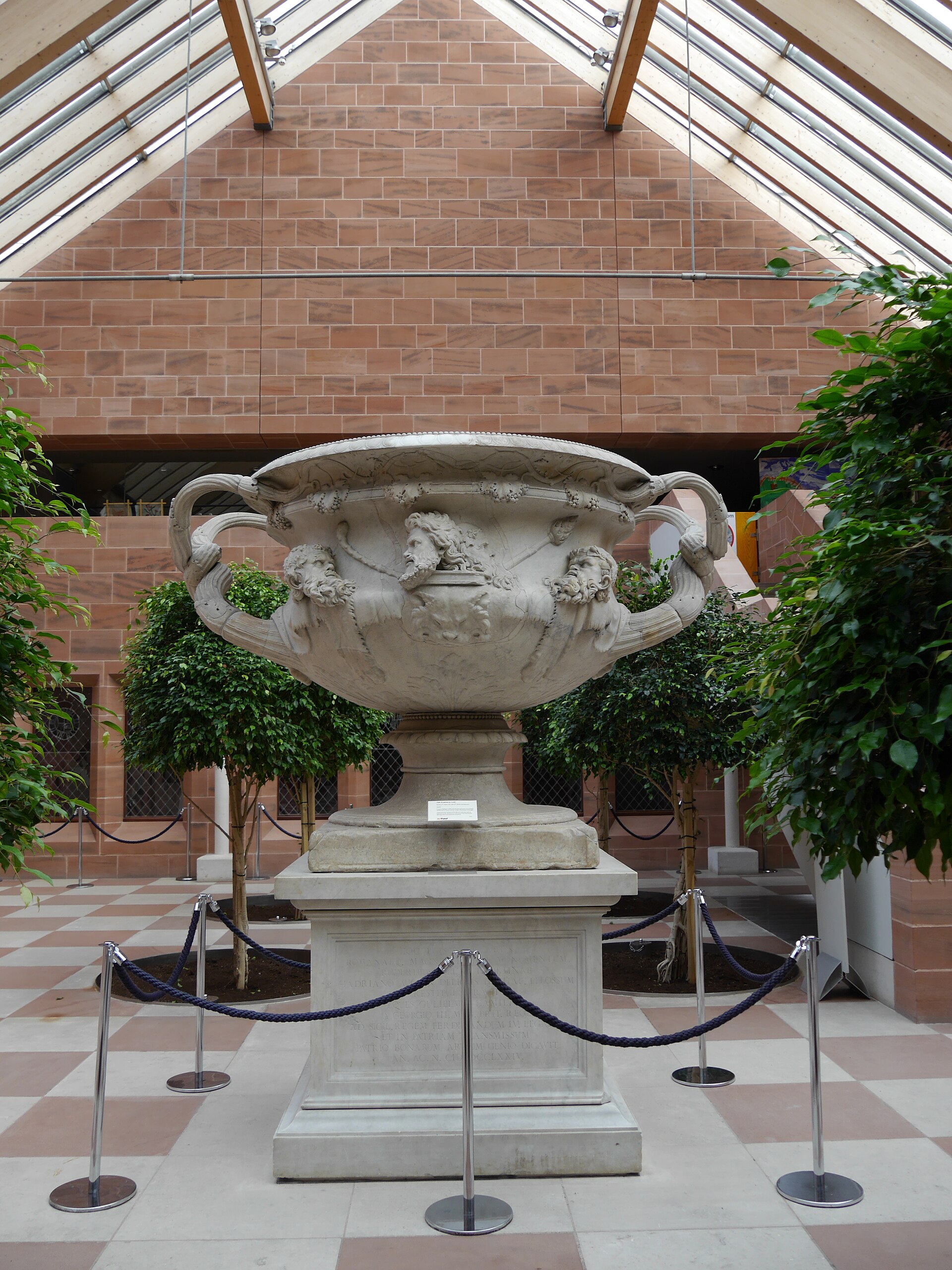
The vase as displayed today in the courtyard of the Burrell Collection, Glasgow, on its original 18th-century pedestal. Photographed 2014.
Photograph by Edwardx, via Wikimedia Commons, CC BY-SA 3.0| Artist | Unknown Roman workshop (ancient carving); restored 1772-1774 by Jean-Baptiste-Antoine Guillaume Grandjacquet to designs attributed to Giovanni Battista Piranesi |
|---|---|
| Date | 2nd century AD (ancient carving); restored 1772-1774 |
| Medium | White marble (ancient core), with 18th-century Carrara marble additions supplying the missing foot, base and other losses |
| Dimensions | 294 x 195 x 195 cm (height x width x depth), per the Burrell Collection's own catalogue record |
| Where it is now | The Burrell Collection, Glasgow (Glasgow Museums / Glasgow Life, City of Glasgow)last confirmed 16 September 2026 |
| Inventory number | 42.20 |
| Attribution | AcceptedThe vase's ancient core is accepted as Roman work of the 2nd century AD on the basis of style and findspot; no ancient signature, inscription or workshop mark survives. Full note |
| Object type | Antiquity |
| Period | Roman Imperial, 2nd century AD; restored and displayed as a Grand Tour trophy from 1774 |
| Cases | Has a provenance gap |
| Inscriptions | None is recorded on the marble itself in the sources consulted for this record. |
| Owners on record | 8 links6 documented, 2 unknown |
| Sources | 16 cited |
About this record Last verified 16 September 2026 · 16 sources cited · Change log
On this page 10 sections
ContentsClose
A colossal marble drinking-vessel, nearly three metres high, assembled by a Scottish painter-dealer out of fragments dredged from a silted pond at Hadrian's Villa in 1769-70, then rebuilt into something more complete than anything actually found. Roughly two-thirds of what stands in Glasgow today is 18th-century Carrara marble carved to fill the gaps; only a scholarly monograph, not consulted for this record, could say exactly how much. It stood at Warwick Castle for two centuries as one of the single most famous objects Grand Tour Britain ever brought home, known to people who never saw the original only through Piranesi's engravings and through a wave of 19th-century silver, silver-gilt, bronze and porcelain copies that royal and private patrons commissioned to sit on their own sideboards.
In 1977 the family that had owned it since 1774 sold it into a chain that was heading for New York, and a British export bar built the fundraising window that kept it in the country. It was not returned to Warwick Castle. It was bought outright in 1979 for the Burrell Collection in Glasgow, a different city and a different kind of institution from the one it had occupied for two hundred years, and it has never left.
This record follows both halves of the story: the marble original's excavation, restoration and two changes of home, and the parallel industry of full-scale and reduced silver, silver-gilt and bronze reproductions that its fame generated, followed here through one specific and fully traceable example rather than treated as an undifferentiated tradition.
Provenance
Each link is graded. Documented: a cited source supports it. Disputed: the identification is argued but not established. Unknown: no owner for that span, and the gap is not smoothed into a narrative. The grades in the glossary.
- 2nd century AD -Unknown Roman patron, possibly associated with the villa complex at Tivoliunknown
Carved as a large Bacchic marble krater in the Roman Imperial period. No inscription, patron's name or original setting is recorded; its findspot in a pond within Hadrian's Villa's grounds establishes only where it ended up, not necessarily where it was first displayed.12
- 2nd century AD - 1769Unrecordedunknown
No owner, location or event is documented for roughly sixteen centuries. Hadrian's Villa was extensively spoliated for building stone and sculpture long before Hamilton's excavation, and how the vase's fragments came to rest in the Pantanello pond specifically is not explained in the sources consulted.16
- 1769 - 1770Gavin Hamilton (excavator and dealer)documented
Found in fragments, missing its foot, base and at least one head, while Hamilton dug the drained bed of the Pantanello at the Villa Tiburtina (Hadrian's Villa), Tivoli.36
- c. 1770 - 1774Sir William Hamilton, British Envoy at Naplesdocumented
Purchased the fragments from Gavin Hamilton and commissioned their restoration, completed 1772-1774, using a newly cut block of Carrara marble to supply the missing parts. The Burrell Collection credits the carving to Jean-Baptiste-Antoine Guillaume Grandjacquet to designs by Piranesi; other accounts credit James Byres instead. A commonly repeated figure of 300 pounds for the combined purchase and repair could not be verified against a primary source.1234
- c. 1774 - 1778George Greville, 2nd Earl of Warwickdocumented
Given, not sold, by his uncle Sir William Hamilton, after Hamilton failed to sell the restored vase to the British Museum. First recorded standing in the Earl's purpose-built conservatory at Warwick Castle in 1778.25
- 1778 - 1977Earls of Warwick, Warwick Castledocumented
Remained on view at Warwick Castle for approximately two centuries, becoming one of the best-known fixed points of British Grand Tour collecting and the direct source of the 19th-century reproduction industry covered in this record's narrative.25
- 1977 - 1978A consortium of London dealers, then the Metropolitan Museum of Art, New Yorkdocumented
Sold in 1977 by David Greville, then styled Lord Brooke (who did not become 8th Earl of Warwick until his father's death in 1984), to a consortium of London dealers, who resold it in 1978 to the Metropolitan Museum. The UK's Reviewing Committee on the Export of Works of Art judged the vase to meet the Waverley criteria for national importance and deferred the export licence, opening a window for a British institution to raise matching funds. No sale price at either 1977 or 1978 stage was found in the sources consulted.567
- 1979 - presentBurrell Collection (Glasgow Museums / Glasgow Life, City of Glasgow)documented
Purchased outright by the Burrell Trustees in 1979 with grant aid from the National Art Collections Fund, the Scottish Heritage Fund and two anonymous charities, after the British Museum declined right of first refusal on grounds of insufficient archaeological importance. Owned by the City of Glasgow since, not on loan, displayed on its original pedestal in the Burrell Collection courtyard under inventory number 42.20. The purchase price is not confirmed in any source this record could independently verify.167
Prices realised
| Date | Sale | Estimate | Result | Note |
|---|---|---|---|---|
| 1977-1979 | Private treaty (no public auction) Sequential private sales: Lord Brooke to a dealer consortium (1977); the consortium to the Metropolitan Museum of Art (1978); the Burrell Trustees' matching purchase after the UK export bar (1979) | Hammer Not applicable - the marble original was never sold at public auction at any stage of its 1977-1979 departure from Warwick Castle. With premium Not applicable GBP | No purchase figure for any of the three 1977-1979 transactions was found in the sources consulted for this record, despite an extensive search. This is recorded as a gap rather than filled with an unverified figure. | |
| 26 April 1967 | Christie's, London, lot 98 | Hammer Not found in the sources consulted for this record. With premium Not found in the sources consulted for this record. GBP | Sale of Paul Storr's silver-gilt full-size Warwick Vase replica (hallmarked 1814-1815), made for Sir James McGrigor and descended in his family. Bought at this sale by Sir Arthur Gilbert; the piece passed to the Victoria and Albert Museum in 1996 as part of the Gilbert Collection gift. This is a different object from the marble original and from the Art Institute of Chicago's 1823-24 Storr vase; its 1967 hammer price is not published in the sources consulted here. |
Hammer is the price at which the bidding stopped; with premium adds the fee the house charges the buyer on top. Hammer price and buyer's premium in the glossary.
Technical evidence
| Attribution note | The vase's ancient core is accepted as Roman work of the 2nd century AD on the basis of style and findspot; no ancient signature, inscription or workshop mark survives. The 18th-century restoration is documented but its internal division of labour is not settled: the Burrell Collection's own catalogue credits execution to the French sculptor-restorer Jean-Baptiste-Antoine Guillaume Grandjacquet working to designs supplied by Piranesi, while several popular and dealer accounts instead credit the Grand Tour dealer James Byres alongside or in place of Grandjacquet, and do not mention Grandjacquet at all. This record treats the restoration's authorship as an open question rather than resolving it by preference. |
|---|---|
| Ancient material | White marble, of undetermined geological source; no petrographic or isotopic sourcing study for this specific piece was found in the sources consulted.12 |
| Restoration material | A block of Carrara marble, cut specifically for the 1772-1774 restoration and hollowed out to receive and support the ancient fragments, per Sir William Hamilton's own account.2 |
| Dimensions | 294 x 195 x 195 cm (height x width x depth), per the Burrell Collection's own catalogue record.1 |
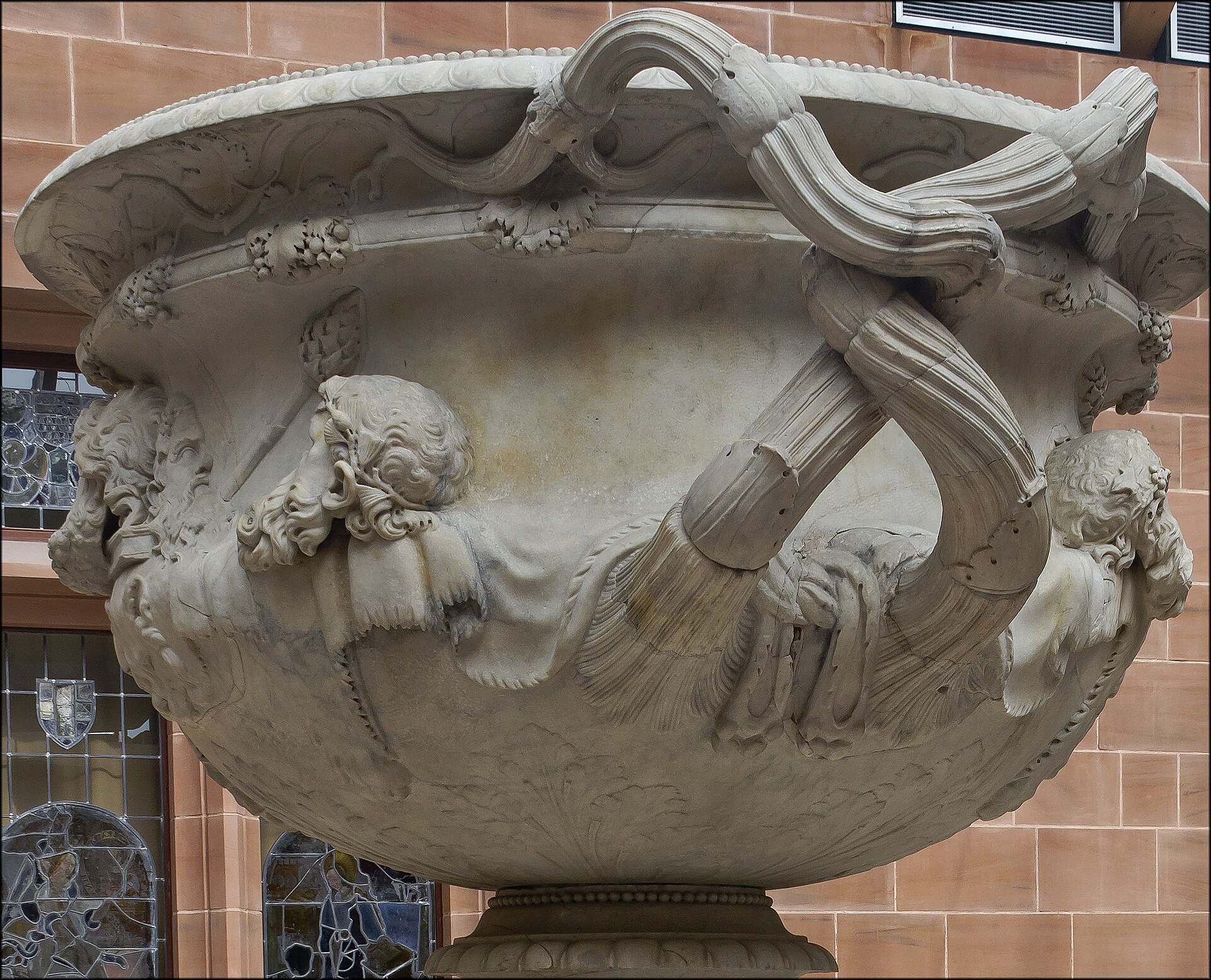
| Form | A colossal two-handled krater of Bacchic type, handles rising as intertwined vine branches with the pelt of the Nemean lion tied between them, continuing around the underside of the rim.29 |
| Decorative programme | A continuous frieze of Bacchic masks, satyrs, vine tendrils, grape clusters and panther or lion pelts, in the standard repertoire of Dionysiac garden and villa ornament in the high Roman Empire.915 |
| Findspot | The Pantanello, a silted pond within the grounds of the Villa Tiburtina (Hadrian's Villa), Tivoli, near Rome.16 |
| Condition at discovery | Found in fragments, missing its foot, its base, and at least one carved head.3 |
| Restoration date and attribution | Restored 1772-1774; the Burrell Collection's own catalogue credits execution to Jean-Baptiste-Antoine Guillaume Grandjacquet, to designs attributed to Giovanni Battista Piranesi. Other, non-museum sources instead credit James Byres alongside or in place of Grandjacquet.134 |
| Mount | Displayed on its original 18th-century marble pedestal, moved with the vase from Warwick Castle to the Burrell Collection.16 |
| Inventory number | 42.20, Burrell Collection, Glasgow Museums.1 |
Images
The record in full
Chapter 1A drinking-vessel built to be looked at, not used
The Warwick Vase is a two-handled marble krater of Bacchic form, 294 by 195 by 195 centimetres, standing today on its 18th-century pedestal in the courtyard of the Burrell Collection in Glasgow.
The Warwick Vase is a two-handled marble krater of Bacchic form, 294 by 195 by 195 centimetres, standing today on its 18th-century pedestal in the courtyard of the Burrell Collection in Glasgow. It is among the largest ancient marble vases to survive from antiquity, and its scale is the first fact worth holding onto: this is not tableware in any practical sense. It is a display object, cut to a size that only a wealthy household or an imperial villa could accommodate and only a mason's yard could move.
Its surface carries a continuous Bacchic frieze: masks, satyrs, vine tendrils, bunches of grapes and the pelts of panthers and lions worked around a body whose handles rise as intertwined vine branches, the pelt of the Nemean lion tied between them at the rim. It is decoration built entirely from the visual vocabulary of Dionysiac feasting, the standard repertoire for garden and villa ornament in the high Roman Empire, and there is nothing in the surviving carving, the findspot or the scholarship consulted for this record to suggest a funerary or cult function beyond that ordinary villa use. Where a record elsewhere on this site can point to a krater whose imagery marks it as an object about the passage of the dead, this one cannot honestly be pushed further than what it plainly is: a very large, very showy piece of Roman garden furniture, built to advertise its owner's wealth and taste through the imagery of wine and revelry. That is not a lesser finding. It is the finding.
Chapter 2Found broken in a drained pond
The vase was found in fragments between 1769 and 1770 by Gavin Hamilton, a Lanarkshire-born painter who had reinvented himself in Rome as an antiquarian, excavator and dealer to the Grand Tour trade.
The vase was found in fragments between 1769 and 1770 by Gavin Hamilton, a Lanarkshire-born painter who had reinvented himself in Rome as an antiquarian, excavator and dealer to the Grand Tour trade. Hamilton was digging in the silted bed of the Pantanello, a marshy pond within the grounds of the Villa Tiburtina, Hadrian's Villa at Tivoli, having obtained excavation rights and drained the water to work the mud beneath it. His dig through that single pond eventually yielded some forty-five marbles and a large quantity of fragments; the vase was among them.
What Hamilton pulled out was incomplete. The vase arrived without its foot, without its base, and missing at least one of its carved heads. It was, in the plain sense, a ruin, and it would remain one until someone was prepared to pay to make it whole again.
Chapter 3Making the vase whole again
Hamilton sold the fragments to Sir William Hamilton (no relation), the British envoy at the court of Naples and one of the most serious collectors of antiquities of his generation.
Hamilton sold the fragments to Sir William Hamilton (no relation), the British envoy at the court of Naples and one of the most serious collectors of antiquities of his generation. It was Sir William who paid for the restoration, and his own account of the work survives in his words: "I was obliged to cut a block of marble at Carrara to repair it, which has been hollowed out and the fragments fixed on it, by which means the vase is as firm and entire as the day it was made." That sentence is worth reading twice. Sir William is not describing conservation in the modern sense of stabilising what survives. He is describing reconstruction: a new block of Carrara marble, cut specifically for the purpose, hollowed to take the ancient fragments and built up around them until the object reads, to the eye, as complete.
The restoration campaign is dated 1772-1774. The Burrell Collection's own catalogue record credits the actual carving to the French sculptor-restorer Jean-Baptiste-Antoine Guillaume Grandjacquet, working to designs supplied by Giovanni Battista Piranesi, whose workshop and showroom on the Piazza di Monte d'Oro sat at the centre of Rome's trade in restored antiquities for the British market. Several other accounts of the vase, aimed at a dealer or collecting audience rather than a museum catalogue, instead credit the antiquarian and dealer James Byres as Piranesi's collaborator on the restoration and do not mention Grandjacquet at all. This record has not been able to resolve which account is correct, or whether both restorers worked on the piece at different stages; it is recorded here as an open question rather than smoothed into a single confident name.
No source consulted for this record states what fraction of the vase now standing in Glasgow is ancient marble against 18th-century Carrara addition. The characterisations available are impressionistic rather than quantified: one dealer account calls the finished object "a largely 18th-century work with a few ancient portions inserted here and there." That is a real authenticity question, genuinely open, and this record declines to convert an impression into a percentage it cannot source.
Chapter 4Piranesi's advertisement
Piranesi published two etchings of the completed vase in 1778, in his Vasi, candelabri, cippi, sarcofagi, tripodi, lucerne, ed ornamenti antichi, the folio of antique furnishing designs he produced...
Piranesi published two etchings of the completed vase in 1778, in his Vasi, candelabri, cippi, sarcofagi, tripodi, lucerne, ed ornamenti antichi, the folio of antique furnishing designs he produced largely for a British clientele passing through Rome on the Grand Tour. The plates show the vase from the front and in profile, mounted on an elaborate pedestal, captioned in the florid Italian typical of the series and dedicated, in one plate, to Hamilton himself.
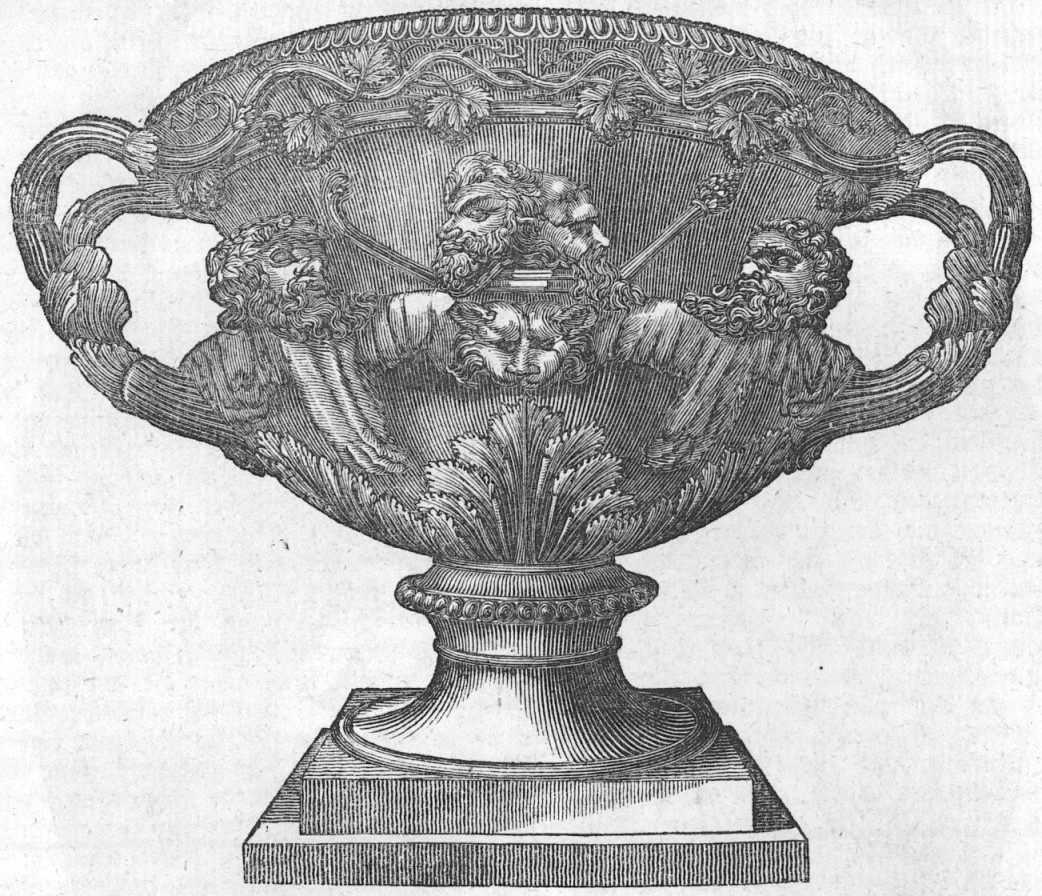
The publication did real work. Most people who came to know the Warwick Vase, in the 18th century and for long afterward, never stood in front of it. They knew it from Piranesi's prints, and later from encyclopaedia engravings such as the one that appeared in the German Bilder-Conversations-Lexikon in 1837, nearly sixty years after the original etchings and a full continent away from Tivoli or Warwickshire. A vase's fame, like a painting's, can be manufactured by its reproduction in print long before, or entirely apart from, anyone seeing the object itself; this is one of the cleaner documented cases of it on this site, because the print predates by decades the industrial-scale copying in metal and ceramic that followed once the vase reached England.
Chapter 5Two centuries at Warwick Castle
Sir William Hamilton first offered the restored vase to the British Museum, which declined it.
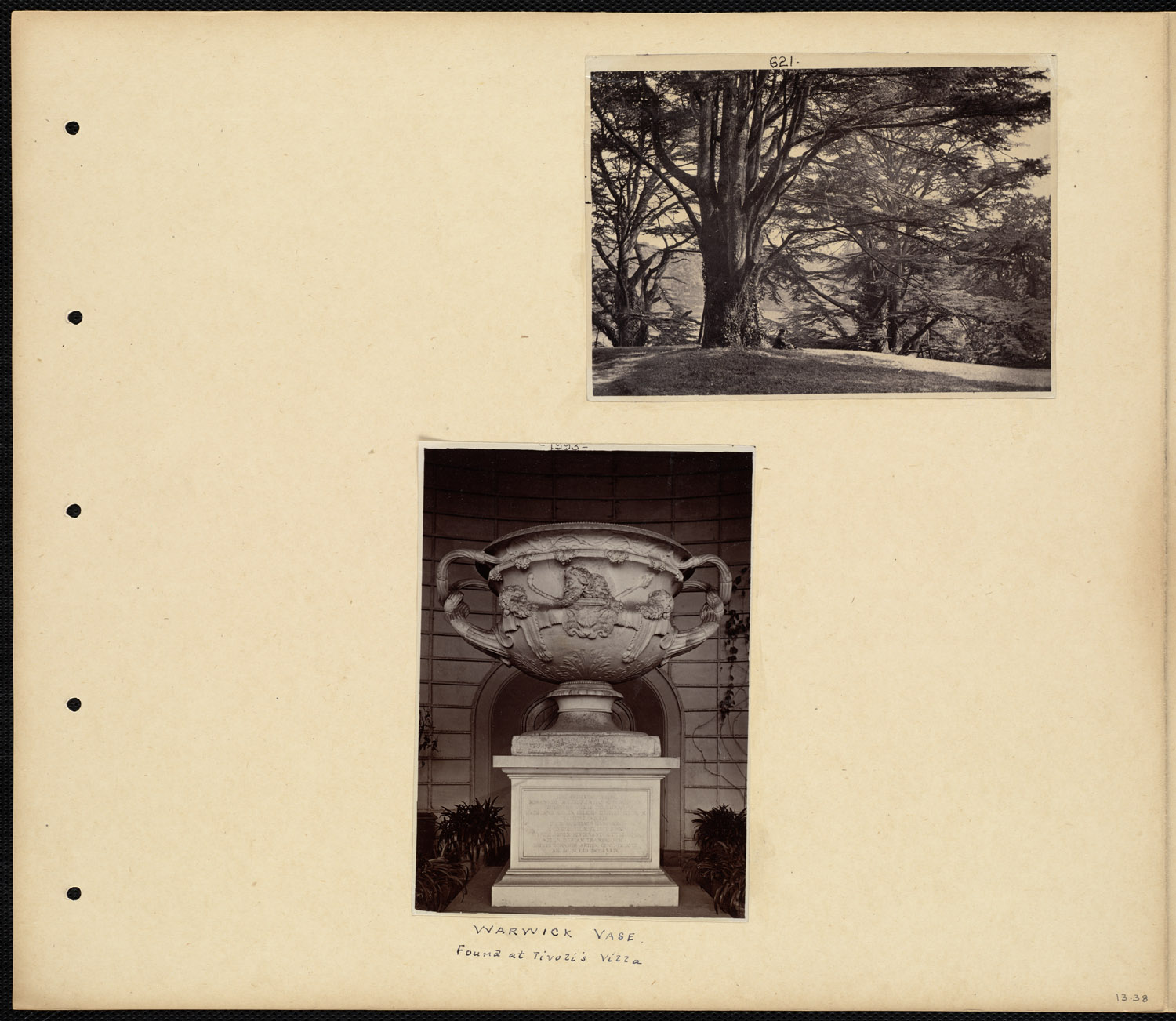
Sir William Hamilton first offered the restored vase to the British Museum, which declined it. He then gave it, rather than sold it, to his nephew George Greville, 2nd Earl of Warwick, who was engaged in an expensive remodelling of Warwick Castle. The Earl built a Gothic-windowed conservatory to hold it, in his own words: "I built a noble greenhouse... I placed in it a vase, considered as the finest remains of Grecian art extant." The vase is first recorded standing there in 1778.
The Earl's description of a Roman marble vase as "Grecian art" is not a slip this record needs to correct so much as note: 18th-century antiquarian taste routinely used "Grecian" as a general term of highest praise for classical sculpture, without the archaeological precision a modern reader would expect, and the vase's actual date and Roman findspot were never in serious dispute among the people who handled it.
The vase then remained at Warwick Castle for approximately two hundred years, becoming, alongside the castle's paintings and armour, one of the fixed points of the aristocratic country-house display culture that the Grand Tour generation had built, and that the reproduction industry described below existed to imitate at second hand.
Chapter 6Why everyone wanted a copy
The Earl of Warwick permitted no copies of the vase to be made until 1808, when he agreed, at the particular request of Lord Lonsdale, to allow moulds to be taken so that a full-size replica could be...
The Earl of Warwick permitted no copies of the vase to be made until 1808, when he agreed, at the particular request of Lord Lonsdale, to allow moulds to be taken so that a full-size replica could be cast in silver. The sculptor William Theed the Elder, working for the royal goldsmiths Rundell, Bridge and Rundell, was put in charge of the mould-making. Once that door opened, it did not close. Rundell, Bridge and Rundell, silversmiths to George III, George IV and their court, produced silver-gilt wine coolers to the Warwick Vase's form for the Prince Regent between 1812 and 1816. In 1822 George IV bought a reduced bronze replica, cast in Paris to William Theed's moulds by the sculptor Charles Crozatier, for 1,470 pounds; it stands today at Windsor Castle, and a second cast from the same moulds is at the Fitzwilliam Museum, Cambridge.
From there the form spread across materials and price points in a way that says something specific about early 19th-century British taste: reduced and full-size copies in solid silver and silver-gilt by makers including Paul Storr; porcelain versions by the Rockingham and Worcester manufactories; garden ornaments in cast iron and in Coade artificial stone that continued to be produced across the century; and, later, silver-plated and electroplated versions aimed at a wider buying public than the original silver trade could reach. A single 2nd-century Roman garden vase, restored by a Frenchman to an Italian's designs for a Neapolitan diplomat's Warwickshire nephew, ended up as the template for a Prince Regent's wine cooler, a king's garden ornament, a provincial jeweller's presentation piece and eventually, in the 20th century, the model for the Norman Brookes Challenge Cup, the men's singles trophy of the Australian Open, first awarded in 1934 and traced back to a silver trophy in the Warwick Vase form made in 1906. Owning, or at least displaying, a piece of the antique past, at whatever scale a patron could afford, was exactly what a great deal of 19th-century decorative silver was for. The Warwick Vase's fame made it one of the most efficient vehicles for that impulse that the century produced.
Chapter 7One silver Warwick Vase, followed to the end - and two others it must not be confused with
Because so many different objects share this one name, this record follows a single silver example all the way through its own ownership chain, rather than gesturing at the tradition in the abstract...
Because so many different objects share this one name, this record follows a single silver example all the way through its own ownership chain, rather than gesturing at the tradition in the abstract, and flags clearly where two other genuine but separate silver Warwick Vases sit so that a reader does not conflate the three.
The example with a fully traceable history is a silver-gilt full-size replica of the vase by Paul Storr, hallmarked 1814-1815, made for Sir James McGrigor, Inspector General of Army Hospitals, whose coat of arms and a Latin inscription honouring him are engraved on its square plinth. It descended in the McGrigor family to Sir Charles McGrigor, was sold at Christie's, London, on 26 April 1967 as lot 98, and was bought by the collector Sir Arthur Gilbert. It passed to the Victoria and Albert Museum in 1996 as part of the Gilbert Collection, the gift of silver, gold boxes and micromosaics that Arthur and Rosalinde Gilbert donated to Britain that year, and it is on display today in the V&A's silver galleries under the loan number LOAN:GILBERT.829:2-2008. No hammer price for the 1967 Christie's sale was found in the sources consulted for this record.
This is a different object from a second silver Warwick Vase, also marked by Paul Storr, dated 1823-24, now in the Art Institute of Chicago (accession recorded via the museum's own open-access catalogue, gift of Eugene R. Pike). It is a different commission, a different date, and a different ownership history; nothing in the sources consulted links the two Storr vases beyond their shared maker and their shared debt to the same original form. It is also a different object again from the reduced bronze replica George IV bought from Rundell, Bridge and Rundell in 1822, cast by Charles Crozatier to William Theed's 1808 moulds, now at Windsor Castle, and from the silver-gilt wine coolers the Prince Regent commissioned from the same firm between 1812 and 1816 - four separate pieces of silver and bronze, four separate commissions, one shared source form. Treating any of these as interchangeable, or attributing one's provenance or sale history to another, would be exactly the kind of error this publication exists to prevent.
Chapter 8Leaving Warwick Castle
In 1967 Charles Guy Fulke Greville, 7th Earl of Warwick, transferred Warwick Castle and its estates to his son David, then styled Lord Brooke, as a measure against future death duties.
In 1967 Charles Guy Fulke Greville, 7th Earl of Warwick, transferred Warwick Castle and its estates to his son David, then styled Lord Brooke, as a measure against future death duties. The transfer did not settle the family's disagreements about the castle's future. In 1978 Lord Brooke sold Warwick Castle itself to the Tussauds Group for 1.3 million pounds, a decision he later explained by saying he believed a Labour government would confiscate the castle; the sale caused an open and public rift with his father. He also sold the family's art collection separately, including the Warwick Vase, and sold several tons of the family's papers to Warwickshire County Council. He became 8th Earl of Warwick himself only in 1984, on his father's death.
The vase itself moved slightly ahead of the castle transaction. It was sold by Lord Brooke in 1977 to a consortium of London dealers, who in turn sold it in 1978 to the Metropolitan Museum of Art in New York. No purchase price at any stage of this 1977-78 chain was found in the sources consulted for this record.
Chapter 9The export bar and the Burrell Collection
A sale to the Metropolitan Museum required a UK export licence, and that licence was not granted automatically.
A sale to the Metropolitan Museum required a UK export licence, and that licence was not granted automatically. The vase was referred to the Reviewing Committee on the Export of Works of Art, the body that judges proposed exports against the Waverley criteria: whether an object is closely connected with the country's history and national life, whether it is of outstanding aesthetic importance, and whether it is of outstanding significance for the study of some branch of art, learning or history. The committee found the vase met that bar and deferred the export licence, opening the standard window in which a British institution could raise funds to match the agreed price and keep the object in the country.
The British Museum, offered first refusal, judged the vase not of sufficient archaeological importance for its own collection. The Burrell Collection in Glasgow made the counter-offer instead, and the Burrell Trustees completed the purchase in 1979 with grant aid from the National Art Collections Fund, the Scottish Heritage Fund and two anonymous charitable donors. No purchase figure for this 1979 acquisition was found in a source this record could independently verify.
This settles the ownership question this record was set to check. The vase is not on loan to Glasgow and was never returned to Warwick Castle. It was bought outright by the Burrell Trustees in 1979, it is owned by the City of Glasgow, and it stands today, under inventory number 42.20, on its original 18th-century pedestal in the Burrell Collection's courtyard.
Chapter 10What the imagery meant, and what it did not need to mean
The Bacchic frieze around the vase's body - masks, satyrs, vine, panther and lion pelts - belongs to the standard decorative vocabulary that Roman villa culture used for garden and dining furniture...
The Bacchic frieze around the vase's body - masks, satyrs, vine, panther and lion pelts - belongs to the standard decorative vocabulary that Roman villa culture used for garden and dining furniture across the empire, signalling wine, leisure and cultivated pleasure rather than any specific cult or funerary programme. Nothing in the vase's carving, its findspot in a drained garden pond at an imperial villa, or the scholarship consulted for this record supports reading a hidden or specific religious programme into it. Where another object on this site, a krater carrying Sarpedon carried by Sleep and Death, is unmistakably about the passage of the dead, this vase's imagery reads as exactly what a Roman patron would have wanted his guests to see over dinner: abundance, wine and a display of wealth large enough to require its own building two thousand years later. Recording that plainly, rather than manufacturing a mystery the evidence does not support, is itself the correct finding here.
The 18th- and 19th-century afterlife of the design is a different and better-documented kind of meaning. A British aristocrat's decision to build a conservatory around a fragmentary Roman antiquity, and a wave of British silversmiths' decision to reproduce that antiquity's exact form for princes, generals and provincial patrons alike, is a documented case of a society using the physical form of the classical past to signal its own taste, wealth and continuity with antiquity. That the same silhouette ended up, a century later, as an Australian tennis trophy is not a debasement of that impulse so much as its logical continuation into a new kind of status object.
Chapter 11What is still unresolved
Two genuine authenticity and attribution questions remain open after this research: the exact fraction of ancient marble against 18th-century restoration, and the precise division of restoration...
Two genuine authenticity and attribution questions remain open after this research: the exact fraction of ancient marble against 18th-century restoration, and the precise division of restoration labour between Piranesi, Grandjacquet and, in some accounts, James Byres. Neither was resolved by any source consulted here, and a smoothed answer to either would be a worse record than an honest gap. Beyond those two, several factual questions about price - what Sir William Hamilton actually paid for the fragments and their repair, and what changed hands in 1978-79 to secure the vase for Glasgow - could not be confirmed against a primary source and are recorded as open below rather than repeated from unverified secondary accounts.
The artist
The Warwick Vase's ancient carvers are unrecorded; its restoration circle comprised Jean-Baptiste-Antoine Guillaume Grandjacquet (1731-1801), sculptor and restorer, working to designs attributed to Giovanni Battista Piranesi (1720-1778), within a Grand Tour antiquities trade that also included the excavator-dealer Gavin Hamilton (1723-1798) and, in some accounts, the dealer James Byres.
No name attaches to the vase's ancient carving; it is Roman work identified only by style and findspot, in a trade where that was normal rather than exceptional. Its modern identity, however, is entirely a product of named 18th-century hands: an excavator who found it broken, a diplomat-collector who paid to rebuild it, a restorer whose actual share of the rebuilding is disputed, and a printmaker whose engravings did more to make the finished object famous than the object itself, sitting in an English county, ever could. This dossier covers that restoration and dealing circle rather than a single artist, because that circle, not any ancient sculptor, is who this record can actually document.
Related works
| Work | Relation | Where it is |
|---|---|---|
| Wine Cooler (one of a set of four) Paul Storr, for Rundell, Bridge and Rundell | Reduced silver-gilt reproduction of the Warwick Vase form, made for use rather than as a full-scale display replica Hallmarked 1809-1810; a wine-cooler-scale adaptation of the vase, not a full-size replica. | Victoria and Albert Museum, London (M.48C-1982, from the Ormonde Collection) |
| Replica of the Warwick Vase (McGrigor vase) Paul Storr | Full-size silver-gilt replica of the Warwick Vase Hallmarked 1814-1815; made for Sir James McGrigor; sold Christie's, London, 26 April 1967, lot 98; bought by Sir Arthur Gilbert; given to the V&A in 1996. This is the reproduction followed in full in this record's own narrative. | Victoria and Albert Museum, London (Gilbert Collection, LOAN:GILBERT.829:2-2008) |
| Warwick Vase Paul Storr | A separate full-size silver replica of the Warwick Vase, distinct from the 1814-1815 McGrigor piece Dated 1823-24. Not to be confused with the V&A's McGrigor vase; different commission, different date, no known link between the two beyond the shared maker and source form. | Art Institute of Chicago (gift of Eugene R. Pike) |
| Replica of the Warwick Vase Charles Crozatier, cast in Paris from William Theed's 1808 moulds | Reduced bronze replica Bought by George IV around 1822 for 1,470 pounds. A second bronze cast from the same moulds is at the Fitzwilliam Museum, Cambridge. | Royal Collection, Windsor Castle (RCIN 71434) |
| Vermeil wine coolers in the Warwick Vase form Rundell, Bridge and Rundell | Silver-gilt reproductions commissioned for royal use Commissioned by the Prince Regent (later George IV) between 1812 and 1816. Royal Collection Trust's own online catalogue page for this object could not be directly verified during this record's research (access blocked); details here are drawn from indexed summaries of that page and should be checked against it directly. | Royal Collection (RCIN 71431 and related pieces) |
| Norman Brookes Challenge Cup W. J. Sanders (current presentation trophy); design tradition traced to a 1906 silver trophy | 20th-century sporting trophy modelled on the Warwick Vase's silhouette First awarded in this form in 1934, to Fred Perry. A late, purely decorative descendant of the vase's silhouette rather than a scholarly reproduction. | Tennis Australia; awarded annually to the Australian Open men's singles champion |
Open questions
- What precise fraction of the marble now on display is ancient Roman carving as against 18th-century Carrara restoration? No source consulted gives a percentage; the only characterisation found is the impressionistic 'a few ancient portions inserted here and there.'
- Who actually carried out the 1772-1774 restoration? The Burrell Collection's own catalogue names Grandjacquet working to Piranesi's designs; several other, non-museum accounts instead credit James Byres alongside or instead of Grandjacquet, and do not mention Grandjacquet at all.
- What did Sir William Hamilton actually pay for the fragments and their restoration? A figure of 300 pounds for purchase and repair appears in some dealer accounts of the vase but could not be verified against a primary source or the Wikipedia and Burrell Collection accounts consulted here.
- What price was agreed for the vase at each stage of its 1977-1979 departure from Warwick Castle - the 1977 sale to a consortium of London dealers, the 1978 resale to the Metropolitan Museum, and the 1979 purchase by the Burrell Trustees? No figure for any of these three transactions was found in the sources consulted.
- Is there a published petrographic or isotopic study identifying the geological source of the ancient marble, comparable to the sourcing studies that exist for other major Roman decorative marbles? None was found in the sources consulted for this record.
- Did Elkington and Co., whose electrotype reproductions of other antique metalwork are extensively documented, ever produce an electrotype specifically of the Warwick Vase? No source consulted confirms this, and this record does not claim that one exists.
- What became of the ancient head reported missing at the time of discovery? It is not established whether any head on the vase today is ancient, or whether all visible heads are 18th-century additions.
Questions about this object
What is The Warwick Vase?
The Warwick Vase is an antiquity, dated 2nd century AD (ancient carving); restored 1772-1774. Medium: White marble (ancient core), with 18th-century Carrara marble additions supplying the missing foot, base and other losses.
Who made The Warwick Vase, and is the attribution settled?
The attribution to Unknown Roman workshop (ancient carving); restored 1772-1774 by Jean-Baptiste-Antoine Guillaume Grandjacquet to designs attributed to Giovanni Battista Piranesi is recorded here as accepted. The vase's ancient core is accepted as Roman work of the 2nd century AD on the basis of style and findspot; no ancient signature, inscription or workshop mark survives. The 18th-century restoration is documented but its internal division of labour is not settled: the Burrell Collection's own catalogue credits execution to the French sculptor-restorer Jean-Baptiste-Antoine Guillaume Grandjacquet working to designs supplied by Piranesi, while several popular and dealer accounts instead credit the Grand Tour dealer James Byres alongside or in place of Grandjacquet, and do not mention Grandjacquet at all. This record treats the restoration's authorship as an open question rather than resolving it by preference.
Where is The Warwick Vase now?
The Burrell Collection, Glasgow (Glasgow Museums / Glasgow Life, City of Glasgow). Inventory number 42.20. Last confirmed 16 September 2026. Purchased outright by the Burrell Trustees in 1979 with grant aid from the National Art Collections Fund, the Scottish Heritage Fund and two anonymous charities. It is owned by the City of Glasgow, on permanent display in the Burrell Collection courtyard on its 18th-century pedestal; it is not on loan.
What has The Warwick Vase sold for?
Hammer Not applicable - the marble original was never sold at public auction at any stage of its 1977-1979 departure from Warwick Castle.; with premium, Not applicable. Private treaty (no public auction), 1977-1979.
What is still unknown about The Warwick Vase?
What precise fraction of the marble now on display is ancient Roman carving as against 18th-century Carrara restoration? No source consulted gives a percentage; the only characterisation found is the impressionistic 'a few ancient portions inserted here and there.'
Sources
- 1Glasgow Museums Collections Online, catalogue record for the Warwick Vase (id 40016), Burrell Collection. collections.glasgowmuseums.com/mwebcgi/...
- 2Wikipedia, 'Warwick Vase'. Tertiary source; flagged for replacement with the Burrell Collection's own published monograph (Richard Marks and Brian J. R. Blench, The Warwick Vase, Burrell Collection) or with Sir William Hamilton's original correspondence. en.wikipedia.org/wiki/...
- 3The Johnston Collection, Melbourne, 'The Warwick Vase'. johnstoncollection.org/THE-WARWICK-VASE~68548
- 4Koopman Rare Art, 'The Warwick Vase: Hamilton's Dig for Treasure'. Dealer account; flagged for replacement with an academic source on the Grandjacquet/Byres restoration question. koopman.art/blog-detail/...
- 5Wikipedia, 'David Greville, 8th Earl of Warwick', for the 1967 transfer of Warwick Castle, the 1978 sale to the Tussauds Group, and the separate sale of the family art collection including the Warwick Vase. en.wikipedia.org/wiki/...
- 6Glasgow's Cultural History, 'Gavin Hamilton (1723-98) and the Warwick Vase'. glasgowsculturalhistory.com/the-fine-arts/...
- 7Art & the Country House, 'Saving Country Houses and their Collections in the Twentieth and Twenty-First Centuries', for the export-bar mechanism and the Burrell Collection's counter-offer. artandthecountryhouse.com/essays/...
- 8Royal Collection Trust, catalogue entries for the Rundell, Bridge and Rundell Warwick Vase reproductions and the Crozatier bronze replica (RCIN 71431 and RCIN 71434). Direct access to these pages was blocked during this record's research; details are drawn from indexed summaries of the pages' own text and should be verified directly against rct.uk before further reliance. rct.uk/collection/...
- 9Victoria and Albert Museum, Explore the Collections, 'Replica of the Warwick Vase', Paul Storr, LOAN:GILBERT.829:2-2008. collections.vam.ac.uk/item/...
- 10Victoria and Albert Museum, Explore the Collections, 'Wine Cooler', Paul Storr for Rundell, Bridge and Rundell, M.48C-1982. collections.vam.ac.uk/item/...
- 11Wikimedia Commons, File:The Warwick Vase. Etching by G.B. Piranesi, ca. 1770. Wellcome L0021594.jpg, extmetadata (license CC BY 4.0). commons.wikimedia.org/wiki/...
- 12Wikimedia Commons, File:Warwick Vase Brockhaus 1837.jpg, extmetadata (license PD-Art). commons.wikimedia.org/wiki/...
- 13Wikimedia Commons, File:Warwick vase.jpg, William Vaughn Tupper scrapbook, 1891 (public domain, CC0 mark). commons.wikimedia.org/wiki/...
- 14Wikimedia Commons, File:Burrell Collection 20.JPG, photograph by Edwardx, 2014 (license CC BY-SA 3.0). commons.wikimedia.org/wiki/...
- 15Wikimedia Commons, File:The Warwick Vase (Side view) (6847758132).jpg, photograph by dun_deagh via Flickr, 2012 (license CC BY-SA 2.0). commons.wikimedia.org/wiki/...
- 16The Art Institute of Chicago, public API record for 'Warwick Vase', Paul Storr, 1823-24 (object 55512), used only to distinguish this piece from the V&A's 1814-1815 McGrigor vase; not used as an image source for this record. api.artic.edu/api/...


_(6847758132).jpg)
Last verified 16 September 2026 · Published 6 August 2026
Change log
6 August 2026 - Record created at the house standard: researched narrative, technical evidence, maker dossier, graded provenance chain, prices with hammer and premium separated, related works, open questions and sources.
16 September 2026 - Re-verification pass: confirmed directly against Glasgow Museums' own collections database (accession 42.20) that the vase remains in the Burrell Collection courtyard, acquisition credit unchanged (purchased by the Burrell Trustees 1979 with grant aid from the National Art Collections Fund, the Scottish Heritage Fund and two anonymous charities), on permanent display, not on loan. No change to attribution, ownership or display status found; no new litigation or restitution activity found in fresh searches.