The Mocking of Christ
Cenni di Pepo, called Cimabue · c. 1280
Last verified 10 August 2026 · 34 sources cited · Change log
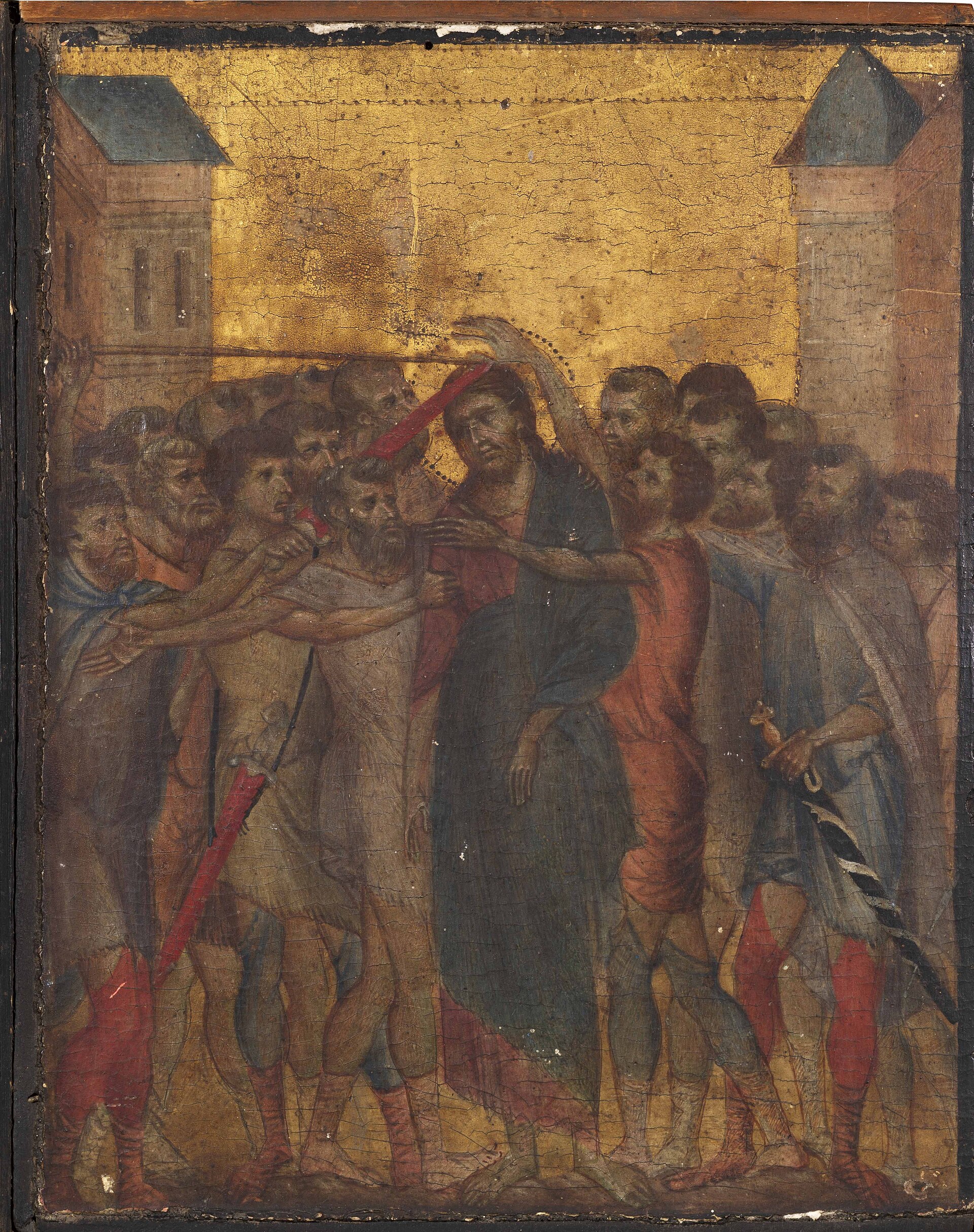
This IS the picture described in this record. Egg tempera and gold leaf on poplar, 25.8 x 20.3 cm overall, painted surface 24.6 x 19.6 cm. Musee du Louvre, RFML.PE.2023.33.1. Reproduced before the 2022-2024 restoration, which removed four layers of varnish and the repaint over Christ's eyes.
| Artist | Cenni di Pepo, called Cimabue |
|---|---|
| Date | c. 1280 |
| Medium | Egg tempera and gold leaf on poplar panel |
| Dimensions | 25.8 x 20.3 x 1.2 cm |
| Where it is now | Musee du Louvre, Paris, RFML.PE.2023.33.1last confirmed 5 August 2026 |
| Attribution | acceptedAttributed to Cimabue on the basis of infrared examination of the underdrawing by Eric Turquin and colleagues, and on matching woodworm tunnels shared with two other panels of the same dismembered diptych. Full note |
| Object type | Painting |
| Period | Italian Duecento, 1200-1300 |
| Cases | Has a provenance gap · Rediscovered · Export restricted |
| Culture | Italian, Florentine |
| Genre | religious narrative |
- Where it is now
- Musee du Louvre, Parislast confirmed 5 August 2026
- Attribution
- accepted
- Provenance
- 5 links4 documented, 1 unknown
- At auction
- Hammer EUR 19,500,000, 27 October 2019
- Sources
- 34 cited
- Last verified
- 10 August 2026Change log
On this page 12 sections
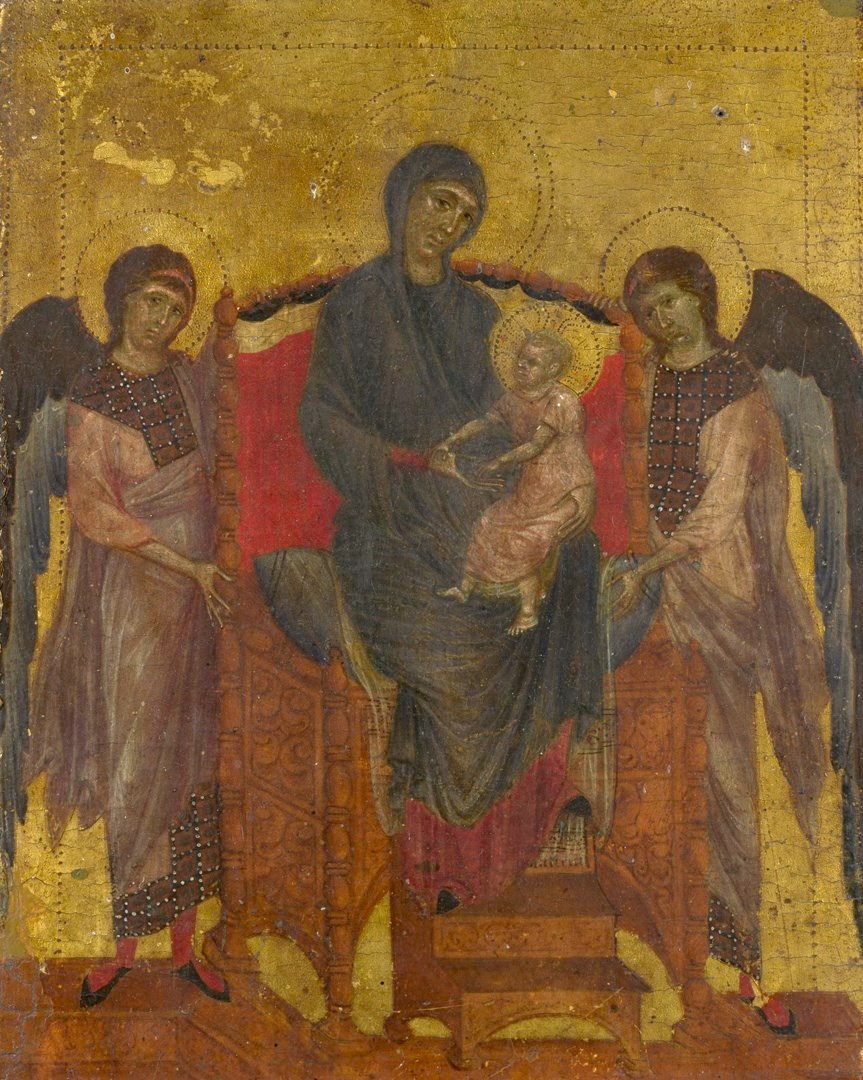
A panel the size of a sheet of writing paper, painted in egg tempera and gold on poplar in Florence or Pisa around 1280, found in June 2019 hanging beside the hotplate of a kitchen in Compiegne and sold four months later for the highest price ever paid at public auction for a work made before 1500. It is one of three surviving scenes from an object that was cut up for the trade, probably in the nineteenth century: radiography at the Louvre's laboratory has since proved that this panel and the National Gallery's Virgin and Child were sawn from the same plank of poplar, with this scene sitting directly beneath the Virgin.
The French state refused it an export certificate on 20 December 2019 and classed it a national treasure, freezing it in France for thirty months. The Louvre did not complete the purchase until 25 October 2023, nearly four years after the sale and more than a year after the freeze had run out. The museum paid with income from the Louvre Abu Dhabi brand licence, a final million euros from the Societe des Amis du Louvre and a gift from two American patrons; the price has never been officially published.
Conservation between 2022 and 2024 then changed the picture itself. Under a nineteenth-century repaint, Christ's open eyes turned out not to be Cimabue's: beneath them lay a white cloth band across the eyes. The scene is therefore not the mocking by Pilate's soldiers that every account of the sale described, but the earlier mocking before the high priest. The object was first shown to the public in January 2025. As of the Louvre's own online record it is not on display.
Provenance
Each link is graded. Documented: a cited source supports it. Disputed: the identification is argued but not established. Unknown: no owner for that span, and the gap is not smoothed into a narrative. The grades in the glossary.
- c. 1280 -One of eight scenes on a single object, maker's handsdocumented
Painted in egg tempera and gold on a poplar plank, as one scene of a larger object divided into compartments by painted red and black fillets and enclosed by an engaged frame. Radiography at the C2RMF proves this panel and the National Gallery's Virgin and Child were painted on the same plank, this scene directly below the Virgin. That the object was a two-wing diptych of eight scenes is a reconstruction argued by Miklos Boskovits and Dillian Gordon from a later series by the Maestro di San Martino alla Palma; the Louvre's own conservation service also allows a dossal, an altar frontal or an altarpiece. Dated c. 1280 by the Louvre's catalogue entry and c. 1285-1290 in its 2025 exhibition material.17891011
- c. 1280 - 1871Not recordedunknown
No owner, location or transaction is recorded for roughly six centuries. The object was cut apart and its scenes sold separately, probably in the nineteenth century and, on the trade's own account, by a dealer seeking a better return on the pieces than the whole; the panels were also thinned at that point. Neither the date of the dismemberment nor the identity of whoever ordered it is documented. How this scene reached northern France is unknown.815
- by 1871 - 2019Private collection, Compiegnedocumented
The Louvre's catalogue entry states: Compiegne, private collection since at least 1871 and until 2019. The INHA's Repertoire des tableaux italiens repeats the wording. The evidence for the 1871 date has not been published in any source consulted here, and it sits oddly beside the contemporaneous press accounts, in which the family did not know where the picture came from and thought it a Russian or Greek icon. The house in which it was found was built in the 1960s, so the family, not the building, carries the continuity.12331
- 27 October 2019 - 25 October 2023Alana Collection (Alvaro Saieh and Ana Guzman), United Statesdocumented
Bought at the Acteon sale in Senlis for 19.5 million euros excluding fees, 24.18 million with fees, by the Alana Collection of Italian painting; the winning bid was made in the room by Francesco Ortenzi of the London gallery Moretti on behalf of a client who was anonymous at the time. The Louvre's own object history names the Alana Collection as the buyer. On 20 December 2019 the French state refused an export certificate and classed the panel a national treasure for thirty months. The panel remained in France throughout and was studied at the C2RMF in 2019 and 2022 while in this ownership.147121314
- 25 October 2023 - presentFrench State, held by the Musee du Louvre, Departement des Peinturesdocumented
Purchase by the State for the Louvre. Louvre acquisitions committee 12 April 2023; artistic council of the national museums 10 May 2023; decision, assignment and inscription in the inventory all 25 October 2023; announced by the minister of culture and the museum's president-director on 3 November 2023. Funded from Louvre Abu Dhabi brand-licence income, a final million euros from the Societe des Amis du Louvre and a gift from a couple who are members of the American Friends of the Louvre, named by the museum as Harry and Linda Fath. The price paid has never been published; The Art Newspaper understood that the Louvre matched the 24.1 million euro sale price. The acquisition was completed some sixteen months after the thirty-month freeze had expired.1261323
Prices realised
| Date | Sale | Estimate | Result | Note |
|---|---|---|---|---|
| 27 October 2019 | Acteon (Dominique Le Coent-de Beaulieu and Philomene Wolf) Marche Ordener, Senlis, lot Not recorded in the sources consulted | EUR 4,000,000 - 6,000,000; opened at EUR 3,000,000 | Hammer EUR 19,500,000 With premium EUR 24,180,000 with fees EUR | The first work by Cimabue ever offered at public auction and the highest price paid at auction for any work made before 1500; by the auctioneer's reckoning the eighth most expensive Old Master of any date. Seven or eight bidders depending on the account, three of them in the room. Giovanni Sarti bid for a client to about EUR 15m; the last two were a contemporary art gallery from Brussels and Francesco Ortenzi of the Moretti gallery, London, who won for the Alana Collection. The Louvre attended and could not pre-empt for lack of funds. The Art Newspaper rounds the total to EUR 24.1m; French sources give EUR 24.18m. Dollar figures of 26, 26.6 and 26.8 million are conversions on different days, not separate prices. A figure of EUR 300,000-400,000 is widely repeated as the auctioneer's first view before expertise; no primary source consulted here carries it. |
Hammer is the price at which the bidding stopped; with premium adds the fee the house charges the buyer on top. Hammer price and buyer's premium in the glossary.
Technical evidence
| Attribution note | Attributed to Cimabue on the basis of infrared examination of the underdrawing by Eric Turquin and colleagues, and on matching woodworm tunnels shared with two other panels of the same dismembered diptych. No work by Cimabue is signed; the corpus of about a dozen paintings is itself a reconstruction by connoisseurship. |
|---|---|
| Support | Thin poplar plank with a vertical grain, thinned at some later date and prepared with a gesso ground. The three surviving panels of the group are all the same thickness, which indicates they were cut from the original object and thinned in a single operation, perhaps in the eighteenth or nineteenth century.78 |
| Dimensions | Overall 25.8 x 20.3 cm; painted surface 24.6 x 19.6 cm; present thickness 1.2 cm. The Louvre records height 0.258 m and width 0.203 m and gives no thickness.114 |
| Medium | Egg tempera on a gold ground. The Louvre's own materials line reads: detrempe sur fond d'or sur bois (peuplier).17 |
| Gilding and tooling | Gold leaf laid on a bole in the background, with an incised and punched border. The upper part of the ground carries punch marks the size of a pinhead worked into a frieze of volutes, the same tooling that ornaments Christ's halo and that appears on the Louvre Maesta.78 |
| Palette | X-ray fluorescence and microscopy identified an abundance of lapis lazuli and red lake, with vermilion, ochres, green earth, orpiment and lead white, and possibly minium.7 |
| Radiography | Elisabeth Ravaud compared the radiograph of this panel with that of the National Gallery's Virgin and Child and confirmed that both compositions come from the same plank of poplar, with the Mocking positioned below the Virgin.78 |
| Barbes | The gesso ends in a barbe along the bottom and left sides, the ridge that forms where preparation meets an applied frame; gilding from that lost frame was found under the paint layer on the same two sides. The top and right sides carry no barbe.710 |
| Painted borders | On the right edge, X-ray fluorescence found vermilion beneath a black repaint, the remains of a painted red fillet, which argues for continuity with the Frick Flagellation. Each scene in the original object was bordered on some sides by a painted line, vermilion red or black.78 |
| Underdrawing | Infrared reflectography revealed the underdrawing; a reflectogram was published in the Acteon sale catalogue in 2019 alongside preliminary technical analysis.10 |
| Worm tunnels and grain | Before the sale, the auction house matched the grain and worm tunnels of this panel against a photograph of the reverse of the London picture, which established their relative positions. The 2019 dossier included a photomontage of the backs of all three panels.101215 |
| Later frame | Strips of wood had been nailed against the grain around all four sides to give the fragment the appearance of a small independent icon. They were removed during the 2022-2024 restoration by Jonathan Graindorge-Lamour.8 |
| Varnish and repaint | A thick grey-brown opacified varnish had substantially altered the colour. Solubility tests found four superimposed varnish layers above the original paint, treated selectively under a progressive cleaning approved by the follow-up committee.78 |
| Christ's eyes | Scientific imaging and microscopy established that the eyes of Christ are not autograph. They are a repaint laid over a band of white cloth across the eyes, which changes the iconography of the scene.8 |
| Condition | An exceptionally thin and worn paint layer with numerous repaints and losses of legibility, and lifting of original material, which is what prompted a fundamental restoration.78 |
| Restoration | Studied at the C2RMF in 2019 and 2022 and restored there between 2022 and 2024 at the Flore site. C2RMF project lead Clarisse Delmas; paint layer Audrey Bourriot; support Jonathan Graindorge-Lamour; curators Sebastien Allard and Thomas Bohl. Published in Techne no. 58 (2025), pp. 62-77.18 |
| Perspective | The architecture framing the scene is built in Byzantine reverse perspective, treated as simple volumes; the gold ground carries no depth, and the spatial suggestion is carried entirely by the buildings and by the modelling of the bodies.1415 |
| Inventory | RFML.PE.2023.33.1, Musee du Louvre, Departement des Peintures. Owned by the French State, held by the Louvre. Registered in the inventory on 25 October 2023.123 |
Images
The record in full
It is a fragment, and everything about it says so
The panel measures 25.8 by 20.3 centimetres overall and is 1.2 centimetres thick in its present state. The painted surface is smaller than the board: 24.6 by 19.6 centimetres. That gap between panel and picture is the first piece of evidence, because it means the paint was laid down inside something, against edges that are no longer there.
The support is a thin poplar plank with a vertical grain, prepared with a gesso ground, gilded over a bole in the background and painted in egg tempera. The gold is not plain. Its upper border carries punch marks the size of a pinhead, worked into a frieze of volutes, and the same tooling runs through the ornament of Christ's halo. The Louvre's laboratory notes that the identical degree of refinement appears in the monumental Maesta at the other end of the museum's Cimabue holding.
Along the bottom and the left side the gesso ends in a barbe, the small ridge of ground that forms where preparation meets an applied frame. Under the microscope, gilding from that lost frame survives beneath the paint layer on exactly those two sides. On the right edge, X-ray fluorescence found vermilion under a black repaint: the remains of a painted red fillet. The top and right sides carry no barbe at all. So the panel was gilded and painted inside an engaged frame that ran along its bottom and left, and was divided from a neighbouring scene on its right by a painted red line.
When it reached the Paris trade it did not look like a fragment. Strips of wood had been nailed against the grain around all four sides to give it the profile of a small independent icon, which is precisely how the family in Compiegne understood it. Those strips were taken off in the recent restoration. The panel has also been thinned; so have the two panels in London and New York, and all three are now the same thickness, which is the argument that they were cut apart and planed down in a single operation, perhaps in the eighteenth or nineteenth century.
The plank, not the style, is what proves the group
Attribution by eye is arguable for ever. Carpentry is not. In 2019 the auction house established that the National Gallery's Virgin and Child had sat directly above this scene by matching the grain and the worm tunnels of the new panel against a photograph of the back of the London picture. Eric Turquin, whose firm authenticated the painting, put it flatly before the sale: it is the same poplar panel, and that is objective proof.
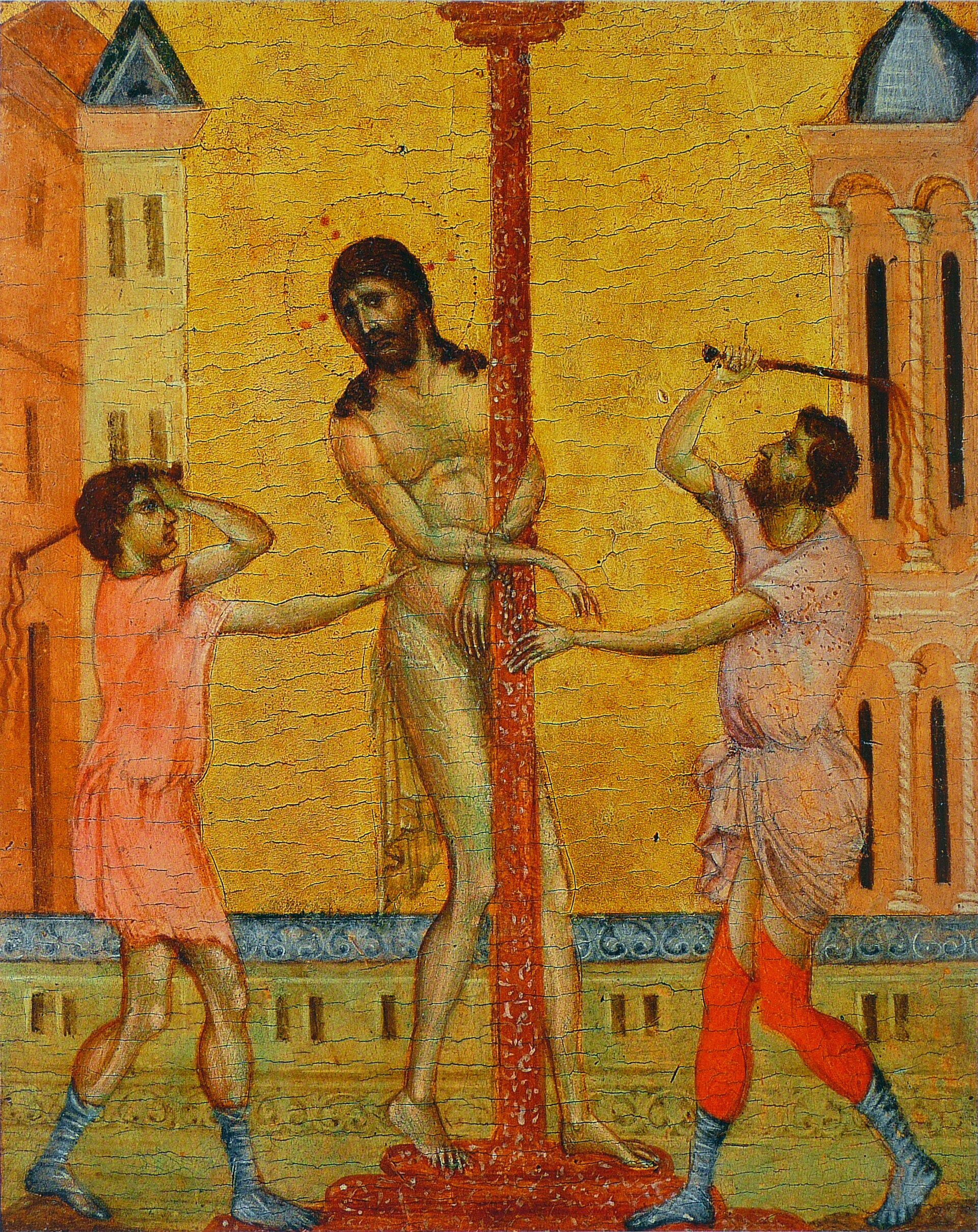
The photographic match has since been replaced by something harder. At the Centre de recherche et de restauration des musees de France, Elisabeth Ravaud radiographed the panel and set the plate beside the radiograph of the London Virgin and Child. The two compositions came from the same plank of poplar, with the Mocking positioned below the Virgin. The vermilion fillet found under repaint on this panel's right edge points the same way towards the Frick Flagellation, which carries a painted border on its left. The laboratory's conclusion was that the material characteristics of all three small pictures agree and support their belonging to a single object.
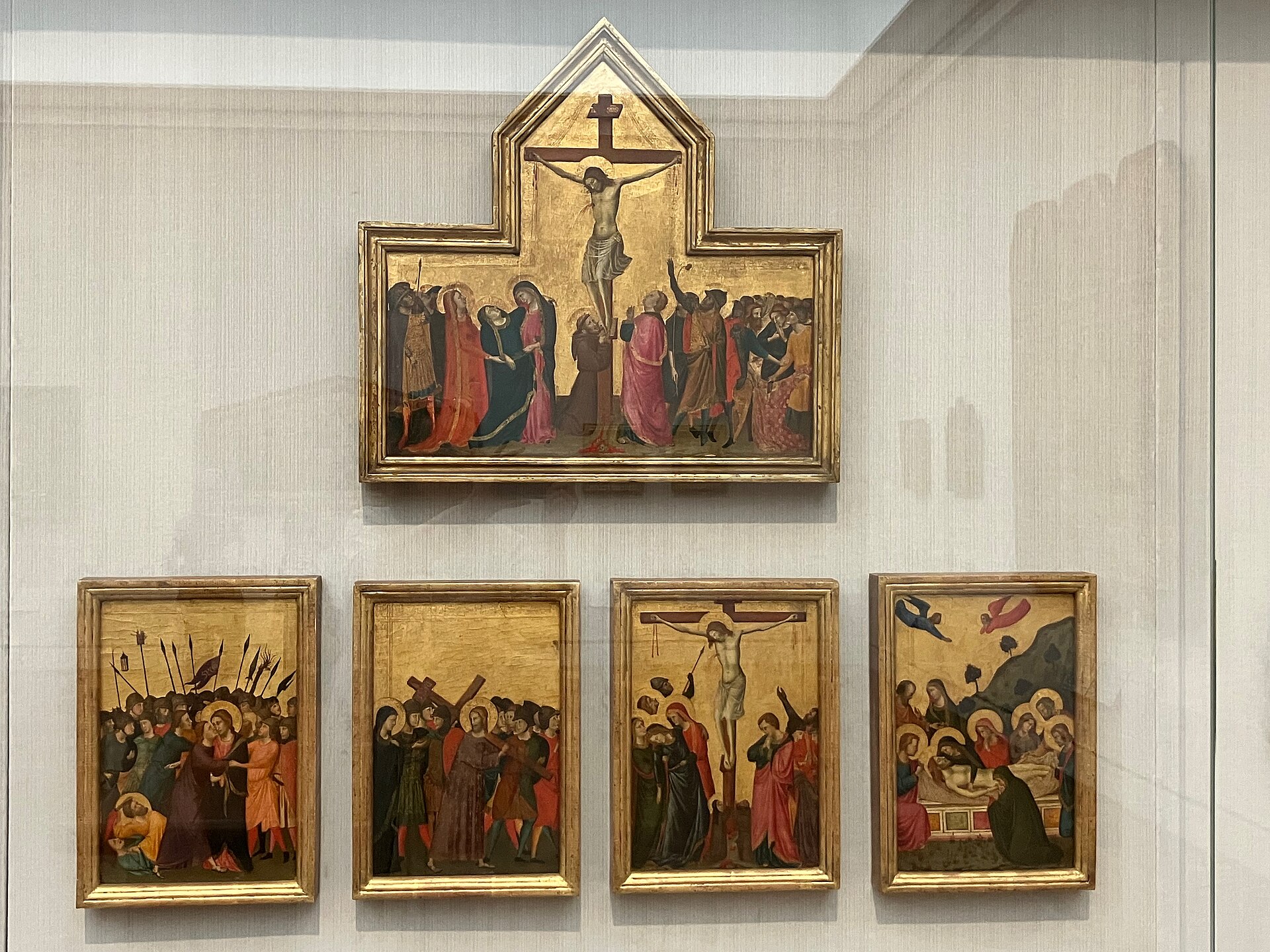
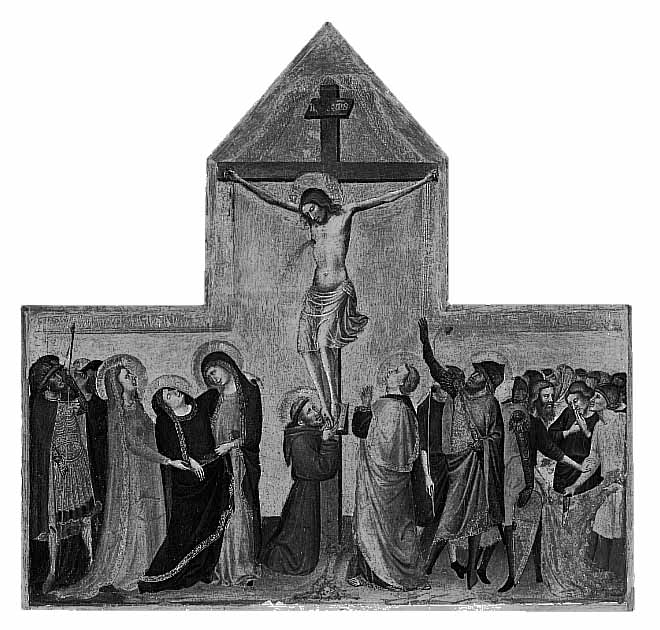
What that object was is less settled than the press coverage suggests. The reconstruction that has held since 2003 comes from Miklos Boskovits, published by Dillian Gordon in Apollo: a series of eight scenes arranged as two wings of four, on the model of a set of eight panels by the anonymous Maestro di San Martino alla Palma of about 1320 which Boskovits had reconstructed as a diptych. Gordon went further and proposed that the later painter had used Cimabue's object itself as his model. All three known Cimabue scenes belong to the left wing, and the barbes place them precisely: the Virgin and Child upper left, the Mocking below it, the Flagellation to the right of the Mocking. The missing fourth scene of that wing would be a Betrayal, the Kiss of Judas. The four scenes of the right wing, extrapolated from the later series, would be the Way to Calvary, the Crucifixion, the Entombment and the Last Judgement.
The Louvre's own conservation department declines to close the question. Its published note allows that the original may have been a diptych, following the auctioneer's 2019 publication, or a horizontal dossal, or an altar frontal, or an altarpiece. The Frick describes the parent object as probably eight scenes mounted as a diptych. The National Gallery's catalogue entry is the most cautious of the three, offering a single devotional panel or a dossal before it reaches the word diptych. A reader who wants one answer should note that the museums that own the pieces do not give one.
The restoration changed what the picture is of
Every account written between 2019 and 2024 describes a Christ with his eyes uncovered, and treats that as the point of the picture. Donal Cooper, writing in Apollo a fortnight before the sale, made the observation carefully: Cimabue's standing Christ follows Byzantine precedent, whereas some of his Tuscan contemporaries had already adopted the seated, blindfolded Christ familiar from Northern European stained glass and manuscript illumination, a development traced by Anne Derbes in her analysis of thirteenth-century Passion imagery.
Scientific imaging and microscopy during the 2022 to 2024 restoration established that Christ's eyes are not autograph. They are a repaint laid over a band of white cloth. The blindfold is Cimabue's; the open eyes are somebody else's.
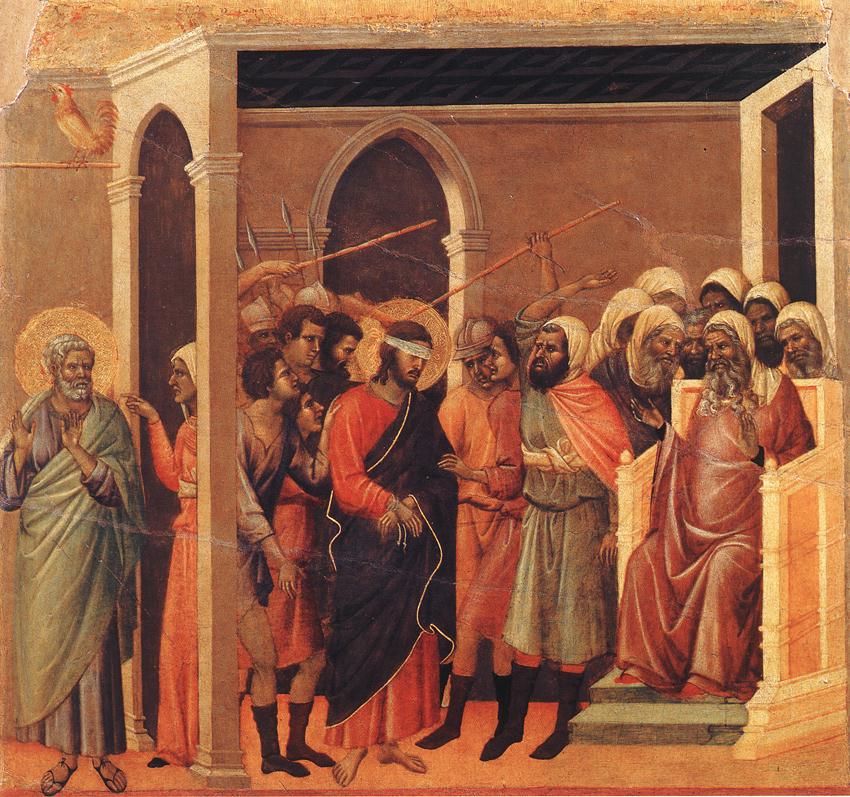
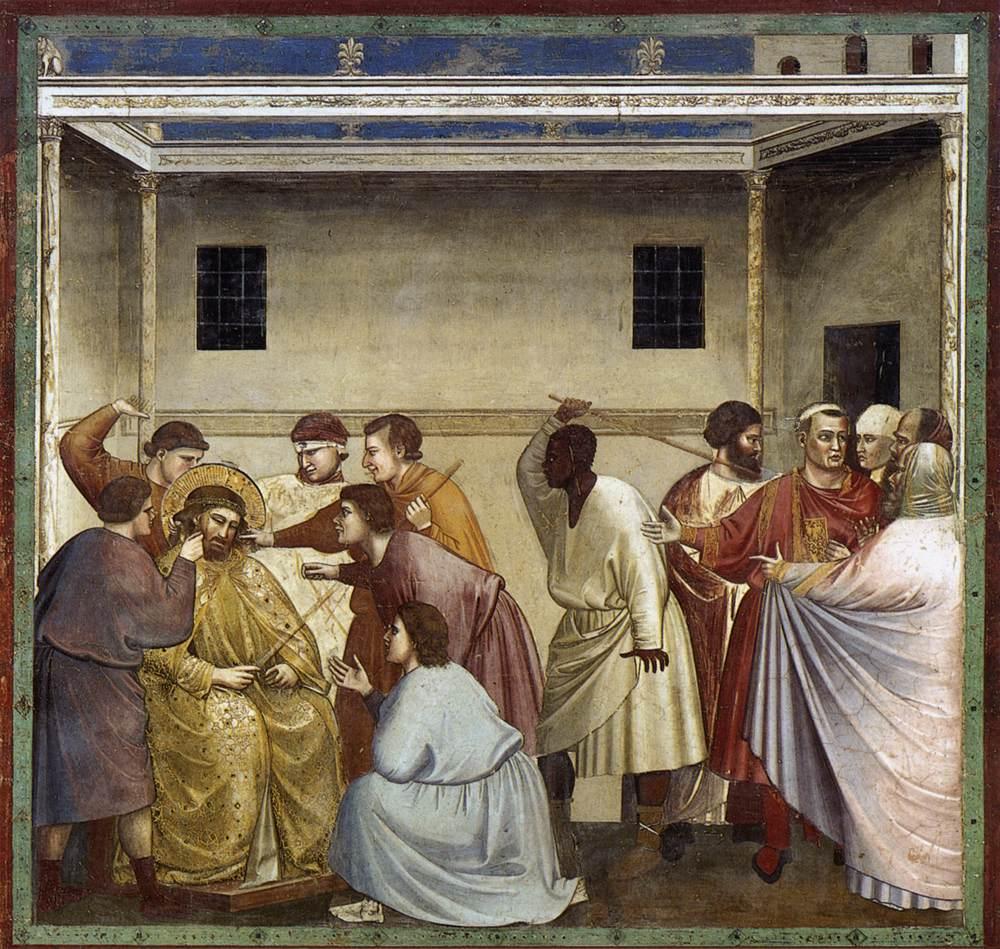
That single finding moves the subject. The Louvre's laboratory records that the presence of the white band indicates the scene is not the derision by Pilate's soldiery but the earlier episode before the religious assembly led by the high priest, and cites Mark 14, verse 65, where those around Jesus cover his face, strike him and demand that he prophesy. The blindfold is not decoration in that passage. It is the mechanism of the taunt: the man who claims to see is made to guess who hit him. Duccio painted the same moment a generation later on the back of the Siena Maesta, with Christ blindfolded and bound before the seated high priest and the cock of Peter's denial on the column behind. The title under which this panel was sold, catalogued and reported, and under which it still stands here, describes the wrong hour of the Passion.
The rest of the reading survives the change. Cooper described a deliberately confusing chain of limbs, two sheathed swords set symmetrically to left and right, a hand that seems to pull the halo away from Christ's head and the hard edge of a sword striking his temple; Stephane Pinta of the Cabinet Turquin described the two compact groups pressing in like the pans of a balance, faces reduced to grimacing masks, and against them a Christ who lets his arms hang. The Louvre's own summary adds what makes the panel unusual for its date: Cimabue rooted the scene in the daily life of his time and dressed his figures in the clothes of his own century.
Who it was made for, and what it was for
No contract, inventory or church record for this object survives. What exists is an argument built on the later series, and it is a good one.
In the Crucifixion from the Maestro di San Martino alla Palma set, now in the Gemaldegalerie in Berlin, Saint Francis and Saint Clare kneel at the foot of the cross. Gordon and Boskovits read that as a commission for a house of Clarissan nuns; Richard Offner had already suggested in 1947 that the Berlin Crucifixion and its companions were painted for one of the two Clarissan convents of Florence, Monticelli, founded in 1260, or Montedomini, founded outside the Porta San Gallo in 1311. The Maestro di San Martino worked only in Florence and its immediate surroundings, which shortens the list. Cooper's reconstruction of the sequence runs: a Clarissan house commissioned an updated version of an older object it knew, and that older object was Cimabue's.
The alternative is Pisan. Cimabue painted the Maesta now in the Louvre for the Franciscan church of Pisa, Vasari records a small Crucifixion painted for the same friars, and Cimabue died in Pisa in 1302. Gordon cautiously identified the London Virgin and Child with a small Madonna di Cimabue recorded in 1829 among the pictures of Carlo Lasinio, keeper of the Camposanto in Pisa, and Pisa had an early and important Clarissan community at Ognissanti. Lasinio, however, gathered pictures into Pisa from across Tuscany, so the Pisan record does not settle a Pisan origin.
What the object was for is clearer than where it hung. Eight scenes of equal weight with no central image give the viewer no natural focus and no hierarchy; the arrangement obliges an eye to work through every compartment in turn. Holly Flora, who curated the 2006 Frick exhibition that first reunited two of the panels and wrote the most recent monograph on the artist, reads the sequence as the visual parallel to the Meditations on the Life of Christ, the immersive Passion handbook composed at almost the same moment for a Clarissan convent at San Gimignano and the most widely copied devotional text of the later Middle Ages. The Louvre put the most richly illustrated surviving copy of the Meditations in its 2025 exhibition to make the point, and programmed a public lecture by Flora on Cimabue and the Franciscans alongside it. This is a Franciscan instrument for a practice of imagining the Passion scene by scene, at arm's length, in a cell.
The material choices belong to the same argument. On a board twenty centimetres wide the laboratory found an abundance of lapis lazuli and red lake, alongside vermilion, ochres, green earth, orpiment and lead white. Ultramarine ground from lapis was the most expensive pigment available and had to be bought before it could be used. Cimabue's contemporary Duccio was made to promise, in the contract of 15 April 1285 for the Rucellai Madonna, that he would pay for the ultramarine and the gold himself. Whoever ordered this object was not economising, and did not intend a private, portable devotion to be a cheap one.
What such an object cost when it was made
Nothing is documented about the price of this panel, or the object it came from, and that is the honest starting point. Two figures from the same decades give the order of magnitude.
The Compagnia dei Laudesi, a lay confraternity attached to the Dominican church of Santa Maria Novella in Florence, commissioned Duccio in 1285 to paint the picture now called the Rucellai Madonna, at 450 by 290 centimetres the largest panel painting known from the thirteenth century. The contract, dated 15 April 1285 and generally described as the earliest surviving Italian document of its kind, set the fee at 150 lire and required Duccio to paint the whole thing himself, to take no other work until it was finished, and to supply the ultramarine and gold at his own cost.
The only payments documented to Cimabue are from the end of his life. The records of Pisa cathedral show him paid ten soldi a day between 2 September 1301 and 19 February 1302 for executing the figure of Saint John the Evangelist in the apse mosaic. A Florentine lira ran to twenty soldi, so 150 lire is 3,000 soldi, and Cimabue's documented daily rate at Pisa would have taken three hundred working days to earn it. That arithmetic is ours, from the two cited figures, and it compares a lump-sum commission for materials and labour with a day rate paid to a mosaicist twenty years later in another city. It is a scale, not an equivalence.
What it establishes is the distance to be crossed. The 19.5 million euros paid in a saleroom in Senlis in 2019 has no relation to what the object cost the people who ordered it, and any modern equivalent quoted for a 1285 sum will differ by an order of magnitude depending on whether it is calculated from prices, wages or share of output. The useful comparison is not to 1280 but to the market the panel was actually sold into, and that is a different section.
Ten works, or twelve, or fifteen, or forty
Cimabue is not a documented artist with an attributed fringe. He is an attributed artist with one documented work.
He is first recorded in Rome in 1272, described as a Florentine painter. The only surviving work documented as his in his lifetime is the mosaic figure of Saint John the Evangelist in the apse of Pisa cathedral, paid for between September 1301 and February 1302; he died in February or March 1302, and the mosaic was finished by Vincino da Pistoia in 1320 and restored at least six times afterwards. Nothing he painted is signed. Every panel given to him, including this one, is an attribution.
The size of the corpus is therefore a matter of where a given scholar draws the line, and the published counts move. At the sale in 2019 the Cabinet Turquin's specialist Stephane Pinta said ten works were known worldwide, all of them in public collections; Anna Brady reported the same figure in The Art Newspaper. The Louvre's own press material for the 2025 exhibition says some fifteen works have come down to us. A reviewer of that exhibition put the number of securely attributed works at twelve. Looser counts that include workshop and disputed pictures run to about forty. This record uses the range and does not pick a number.
That is the frame in which the 2019 discovery has to be read. A new work by Cimabue is not one more picture on a long list. It is a ten to fifteen per cent addition to everything that is known to survive, and the only devotional object of private scale to be added to it.
The attribution, and who has doubted it
The attribution of this panel rests on an attribution to its siblings, and the siblings took fifty years to sort out.
The Frick Collection bought the Flagellation in 1950 through Knoedler in Paris. Scholars agreed at once that it was an important thirteenth-century picture and disagreed about who made it: the choice was between Cimabue and the Sienese Duccio di Buoninsegna. Millard Meiss published it in 1951 as Duccio. The Frick's own account says the doubt persisted for half a century and was ended by the reappearance of the London Virgin and Child in 2000, which was attributed to Cimabue on comparison with the Louvre Maesta and then tied to the Frick panel by carpentry: the grain of the wood, the thickness of the two thinned panels, the pattern of craquelure, the worm holes, and a punched border of two rows of pinprick punches around a scroll of tiny punch marks common to both.
By the time the Compiegne panel surfaced, the framework existed to test it against. Cooper, writing before the sale, called it a clear-cut case and noted that if it were somehow an intelligent fake, technical investigation would quickly say so. He also recorded what he called predictable grumblings in the press over the authenticity, without a named scholar behind them. The specialists he canvassed by email were on the other side: Holly Flora, who expected the discovery to deepen understanding of Cimabue's part in the development of narrative devotional painting; Andrea De Marchi, who observed that this was the first time Cimabue's crowded, choral narration, so evident in the Assisi frescoes, could be seen at small scale on panel; Joanna Cannon of the Courtauld, who described the interweaving gestures and exchanged looks as masterly.
The French state then put the question to a formal body. The Commission consultative des tresors nationaux considered the export application on 20 November 2019 and recorded a remarkable unpublished work by Cimabue, with the attribution supported by unanimous agreement among specialists and by consistent architectural elements, gold decoration, types of halo and identical pigment composition on matching poplar. No named scholar has published a dissent in any source consulted for this record. What follows from that is narrower than it sounds: the panel belongs beyond argument to the same physical object as the Frick and National Gallery pictures, and the name attached to that object is a connoisseur's reconstruction that has held since 2000.
How it was found
In June 2019 a woman in her nineties near Compiegne, in the Oise, was leaving the house she had lived in and called in a local auctioneer to say whether anything in it was worth selling. What was not worth selling was going to be thrown out. The auctioneer, Philomene Wolf, then thirty-two and in partnership with Dominique Le Coent-de Beaulieu at Acteon, had a week to go through the contents and clear the building. The panel was hanging on the wall of the kitchen beside the hotplate of an open-plan kitchen unit, among ordinary objects of no particular interest. The trade press was blunt about how close it came: it escaped the tip by very little.
The family knew the picture was old and considered it an icon. Accounts of what kind of icon differ; the owner is variously reported as thinking it Russian or Greek, and as not knowing where it had come from. Wolf's own recollection, given to The Art Newspaper before the picture was shown to the press, was that the family thought it special but thought it an icon.
The panel went to the Cabinet Turquin in Paris, the firm most closely associated in France with the technical examination of disputed old master pictures, where the specialist in charge was Stephane Pinta. Infrared examination produced an underdrawing consistent with the small body of work given to Cimabue, and the carpentry and punchwork did the rest. It was, Pinta said, the oldest painting the firm had ever examined. The picture was presented to the press in Paris on Tuesday 24 September 2019; the discovery had been announced the day before.
What the auctioneer thought it was worth before that examination is the one figure in this story that no primary source consulted here carries. Tertiary accounts state that Wolf's first working view was 300,000 to 400,000 euros, and the figure is widely repeated. It is recorded here as unverified. What is documented is the published estimate once the attribution was in hand, 4 to 6 million euros, and the opening bid on the day, 3 million.
The sale, bidder by bidder
Acteon offered the panel on Sunday 27 October 2019 at the marche Ordener in Senlis, in a room that seats up to nine hundred people and was full. Dominique Le Coent-de Beaulieu took the bidding. No work by Cimabue had ever been offered at public auction, which meant there was no price history for the artist at all; Le Coent said as much before he started, calling it the first opportunity to give the artist a market value.
The lot opened at 3 million euros against an estimate of 4 to 6 million. The trade press counted eight bidders, three of them in the room; The Art Newspaper counted seven registered bidders, three in the room, and identified them as Italian dealers from Paris and London and a contemporary art gallery from Brussels. The Paris dealer Giovanni Sarti bid for a client to around 15 million and stopped, leaving the Brussels contemporary gallery against Francesco Ortenzi of the London gallery Moretti, who was bidding for an anonymous private collector. Ortenzi won.
The hammer fell at 19.5 million euros. The total with buyer's fees was 24.18 million euros, which The Art Newspaper and most English-language coverage rounded to 24.1 million. Dollar equivalents of 26, 26.6 and 26.8 million circulated depending on the day of conversion and are not additional prices. The two euro figures are the real ones and there are two of them.
Turquin's reading of the bidding was that interest came mainly from museums or people close to museums, with new interest from buyers out of the contemporary art world. Sarti, who had dropped out at 15 million, thought it could have gone higher, and set it against the Madonna and Child by Duccio bought by the Metropolitan Museum of Art for 45 million dollars in 2004 in a private transaction: comparable in his view, and by the father rather than the son.
One bidder present did not bid. The Louvre attended the sale and, for want of sufficient funds, could not exercise its right of pre-emption, the mechanism under which a French public museum may step into a saleroom result at the hammer price. Everything that followed for the next four years was the consequence of that.
What 19.5 million euros meant in that market
The result made the panel the most expensive work made before 1500 ever sold at public auction, and by the auctioneer's own reckoning on the day the eighth most expensive Old Master of any date. The seven above it were Leonardo's Salvator Mundi in 2017, Rubens's Massacre of the Innocents in 2002, Rubens's Lot and his Daughters in 2016, Pontormo's Portrait of Cosimo de' Medici in 1989, Rembrandt's Portrait of a Woman in 2000, Raphael's Portrait of Lorenzo de' Medici in 2007 and Canaletto's Grand Canal in 2005.
That list explains the size of the number better than the estimate does. Pictures of this date effectively do not come to auction, so there is no cohort to price against; the closest comparanda are not sales at all. The Metropolitan's Duccio Madonna, bought privately in 2004 for a reported 45 million dollars, is the benchmark for the period and never went under a hammer. The National Gallery's Virgin and Child, the panel that sat immediately above this one on the same plank, never reached a saleroom either: it was destined for Sotheby's and was instead taken by the state, and its credit line records it as accepted by the British government in lieu of inheritance tax and allocated to the National Gallery in 2000. The Art Newspaper reported the transaction differently, as a private treaty sale for around 7.2 million pounds; both accounts involve tax relief and neither is a market price. Whichever is right, the London panel cost the British public purse a fraction of what its neighbour made nineteen years later.
The other way to read the number is as the price of certainty. Between June and late September 2019 the object did not change; the evidence about it did. The published estimate that resulted, 4 to 6 million, was itself an attribution discount: it priced a Cimabue that scholars might yet reject. The room paid more than three times the top estimate because the carpentry argument removed the risk that the estimate was pricing. The lesson a collector can take from this record is not that attic finds are worth sixty times an initial guess. It is that in a market with no comparables, technical evidence, not connoisseurship, is what the money responds to.
The export machinery, in the order it actually ran
The application for an export certificate was filed on 14 October 2019, thirteen days before the sale. Under the Code du patrimoine, a cultural object above certain thresholds cannot leave France permanently without a certificate, and a certificate can be refused only on the ground that the object is a national treasure.
The Commission consultative des tresors nationaux, chaired by Edmond Honorat, examined the application on 20 November 2019 and advised refusal, finding a remarkable unpublished work whose rediscovery was of major significance to the national heritage. The minister of culture, Franck Riester, signed the refusal on 20 December 2019; it was published in the Journal officiel on 22 December, and the ministry announced it on 23 December. The refusal carried national treasure status for thirty months from the date the decision was notified to the owner, expressly to allow public collections time to raise the money and to let the panel join the Cimabue Maesta already in the Louvre.
Those dates matter because the Louvre's own catalogue entry gets them wrong. Its object history states that the panel was classed a national treasure on 20 November 2019, which is the date the commission gave its opinion, not the date of the arrete. The INHA's Repertoire des tableaux italiens repeats the Louvre's wording. The decision is dated 20 December 2019 and the official text says so.
What the thirty months actually oblige the state to do is less than the phrase saved for the nation implies. Under article L121-1 the administrative authority may present an offer to buy in the interest of public collections; it is not required to. If it does, the price must reflect prices practised on the international market, and if the owner rejects it, each side appoints an expert at its own cost, the experts report jointly within three months, and a third expert settles any disagreement. Once the valuation is in, the state has two months to make an offer at that figure. If no offer is made, the refusal of the certificate cannot be renewed and the object is free to go. The freeze is a right of first refusal with a clock on it, not an expropriation.
The clock here ran out. Thirty months from a decision notified at the end of December 2019 expires in the middle of 2022. The purchase was registered on 25 October 2023, forty-six months after the refusal. No published source consulted for this record records a formal purchase offer under L121-1, and no notice appealing for corporate patronage under article 238 bis-0 A of the tax code, the mechanism that gives a company a 90 per cent tax reduction for funding a national treasure acquisition, has been found for this object. The panel was bought, in the end, in a negotiation with an owner who by then was legally entitled to take it away.
Who owned it in the meantime, and how the Louvre paid
The buyer at Senlis was anonymous on the day and remained officially anonymous through the export dispute. The Louvre's own catalogue entry now names it: acquired for 19.5 million euros excluding fees by the Alana Collection. The Alana Collection is the collection of Italian painting formed by the Chilean financier Alvaro Saieh and Ana Guzman, based in Delaware, and at the time of the sale a large part of it was on public view in Paris at the Musee Jacquemart-Andre. Ortenzi of the Moretti gallery bid for it. Several accounts of the sale, including this record in its previous state, named Fabrizio Moretti as the bidder; the contemporaneous report names Francesco Ortenzi of that gallery, and that is what is recorded here.
Early reporting on the buyer was worse than anonymous. The BBC told its readers the panel had been sold to an anonymous buyer from northern France, and the Associated Press reported a buyer near Chantilly. Both were wrong, and both remain online.
The seller did not live to see the consequences. The elderly owner of the picture died two days after the sale, leaving three heirs. Nothing has been published about the settlement of her estate, the tax paid on the proceeds, or what the family received.
The Louvre's internal process ran through 2023: the acquisitions committee on 12 April, the artistic council of the national museums on 10 May, and the decision, assignment and inscription in the inventory all on 25 October. The work is owned by the French State and held by the Louvre's Department of Paintings under the number RFML.PE.2023.33.1. The minister of culture, Rima Abdul Malak, and the museum's president-director, Laurence des Cars, announced it on 3 November 2023 together with a second national treasure, a Victor Hugo drawing.
The money came from three places and none of them was the public purse in the ordinary sense. A Louvre statement quoted at the time says the museum used part of the income from the brand licence for the Louvre Abu Dhabi; the Societe des Amis du Louvre contributed the final million euros that made the acquisition possible; and a couple who are members of the American Friends of the Louvre also contributed. Des Cars named Harry and Linda Fath, American property developers, and the Societe des Amis du Louvre as the patrons behind the two acquisitions; the society's own president attached its gift to the Hugo drawing, funded from a bequest, which by elimination puts the Fath contribution against the Cimabue, though no statement says so in terms. The Art Newspaper understood that the Louvre matched the 24.1 million euro sale price. The museum has never published the figure it paid.
The contrast with the museum's other national treasure campaign of the same period is instructive. Chardin's Basket of Wild Strawberries sold at Artcurial in March 2022 for 24.3 million euros with fees to the Kimbell Art Museum through the dealer Adam Williams; the export was blocked; and the Louvre completed the purchase in March 2024 with about 15 million from LVMH, about 7.8 million from the Societe des Amis du Louvre and more than 1.6 million from nearly ten thousand individual donors giving an average of 165 euros each. Two objects of almost identical price under the same law in the same year, one bought with a national subscription and a luxury group's money, the other with Gulf brand-licence income and a private American gift, and only one of them ever asked the public.
Four years in a laboratory
The panel that made the headlines was not the panel that now hangs. Photographs put out in 2019 were, as the Louvre's own conservation service records with some asperity, often virtually brightened to increase their impact; the real condition of the painting was not so flattering.
It came to the C2RMF for laboratory study in 2019 and again in 2022, and was restored there between 2022 and 2024 in the painting studios of the Flore site. Clarisse Delmas led for the C2RMF; the paint layer was restored by Audrey Bourriot and the support by Jonathan Graindorge-Lamour; Sebastien Allard, head of the Department of Paintings, and Thomas Bohl, curator of Italian paintings, were the responsible curators. Elisabeth Ravaud led the technical study.
The paint film is exceptionally thin and worn, and had been repainted in several places. A surface clean showed that the dull brown appearance was not simply dirt, and solubility tests found four superimposed varnishes above the thirteenth-century paint. A committee approved a progressive cleaning, treating each layer selectively. The nailed strips came off. The false eyes came off. As of the published account of November 2024 the cleaning of the gold ground was still under way and the final varnishing and retouching had not been settled.
The work has been published where a student can reach it. The C2RMF put out two illustrated accounts, of the study and of the restoration; the technical results appear in TechnE number 58, in an article by Audrey Bourriot and Elisabeth Ravaud running to sixteen pages, in an issue devoted to Cimabue and Tuscany at the end of the thirteenth century and edited by Bohl, the late Marco Ciatti and Ravaud. The Louvre's catalogue entry lists nine bibliographic references and its collection database serves a machine-readable record. The museum's own photography of the object, by Gabriel de Carvalho, is not free of copyright, which is why the plate at the head of this record comes from a different reproduction.
Where it has been shown
The exhibition history of this object is four years old and can be given in full.
Before the sale it was shown to the press in Paris on 24 September 2019 and, according to French accounts, to the public at the town hall of Compiegne on Wednesday 23 October 2019, where somewhat over four hundred people came to see it in the days before the auction. That public showing is recorded here from a tertiary source and has not been confirmed against a primary one.
Between the sale and the acquisition it was not exhibited at all. It was in the laboratory in 2019 and from 2022, and under restoration until 2024. The Louvre presented it in a lunchtime lecture in the Michel Laclotte auditorium on 13 November 2024, given by Thomas Bohl in the museum's Oeuvre en scene series, two months before the exhibition opened.
Its first public presentation as a museum object was A New Look at Cimabue: At the Origins of Italian Painting, at the Louvre from 22 January to 12 May 2025, in room 717, the Salle Rosa, on the first floor of the Denon wing. The show was curated by Thomas Bohl, brought together some forty works, and reunited the three surviving panels of the group for the first time; the catalogue, published with Silvana Editoriale, gives the panel as catalogue number 38. The exhibition was sponsored by Lusis. Its internal Louvre title differs from the one on the posters: the collection database records it as Cimabue. Aux origines de la peinture moderne en Occident.
It then travelled, once. From 6 June to 19 October 2025 it was lent to the Musee du Petit Palais in Avignon, the museum that has held a deposit of 320 Italian primitive paintings from the Louvre since 1976, for the exhibition La jeunesse de la peinture. Cimabue ouvre la voie. The loan was announced as the first result of a strengthened partnership between the Louvre and the city of Avignon.
The siblings have their own loan histories, which are short. The National Gallery panel went to New York for the Frick's exhibition Cimabue and Early Italian Devotional Painting, 3 October to 31 December 2006, coordinated by Holly Flora with Denise Allen, which put it beside the Flagellation for the first time in America; it was at the Ferens Art Gallery in Hull in 2017; and it went to Paris for the 2025 exhibition. The Frick has never lent its panel out of New York in the period covered by the sources consulted here, and it lent it to Paris in 2025.
As of the Louvre's own online record, consulted on 3 August 2026, the panel is not on display.
Three near misses
Objects of this age survive by accident, and this one has a documented record of accidents.
The first is the house clearance. The auctioneer had a week; the contents that were not worth selling were to be thrown away; the panel was hanging next to a hotplate, which is to say in the worst environment in the building for a thin poplar board with a gesso ground. Nothing about the picture announced itself. The auction trade's own account of the sale describes it as having narrowly escaped the tip.
The second is a hailstorm. On Saturday 3 May 2025, nine days before the Cimabue exhibition closed, a violent storm over central Paris drove water through the glazing above the Salle Rosa. Drops fell on the base of the Three Acolytes by the studio of Nicola Pisano, on loan from the Bargello, and about a metre from Duccio's Madonna of the Franciscans, lent by the Pinacoteca Nazionale in Siena and fortunately in a case. The Louvre closed the room within half an hour, firefighters inspected the roof, a damaged glass seal was replaced and the show reopened the next morning. No work was damaged. The Maesta, unglazed and painted on wood, was a short distance from where the water came in.
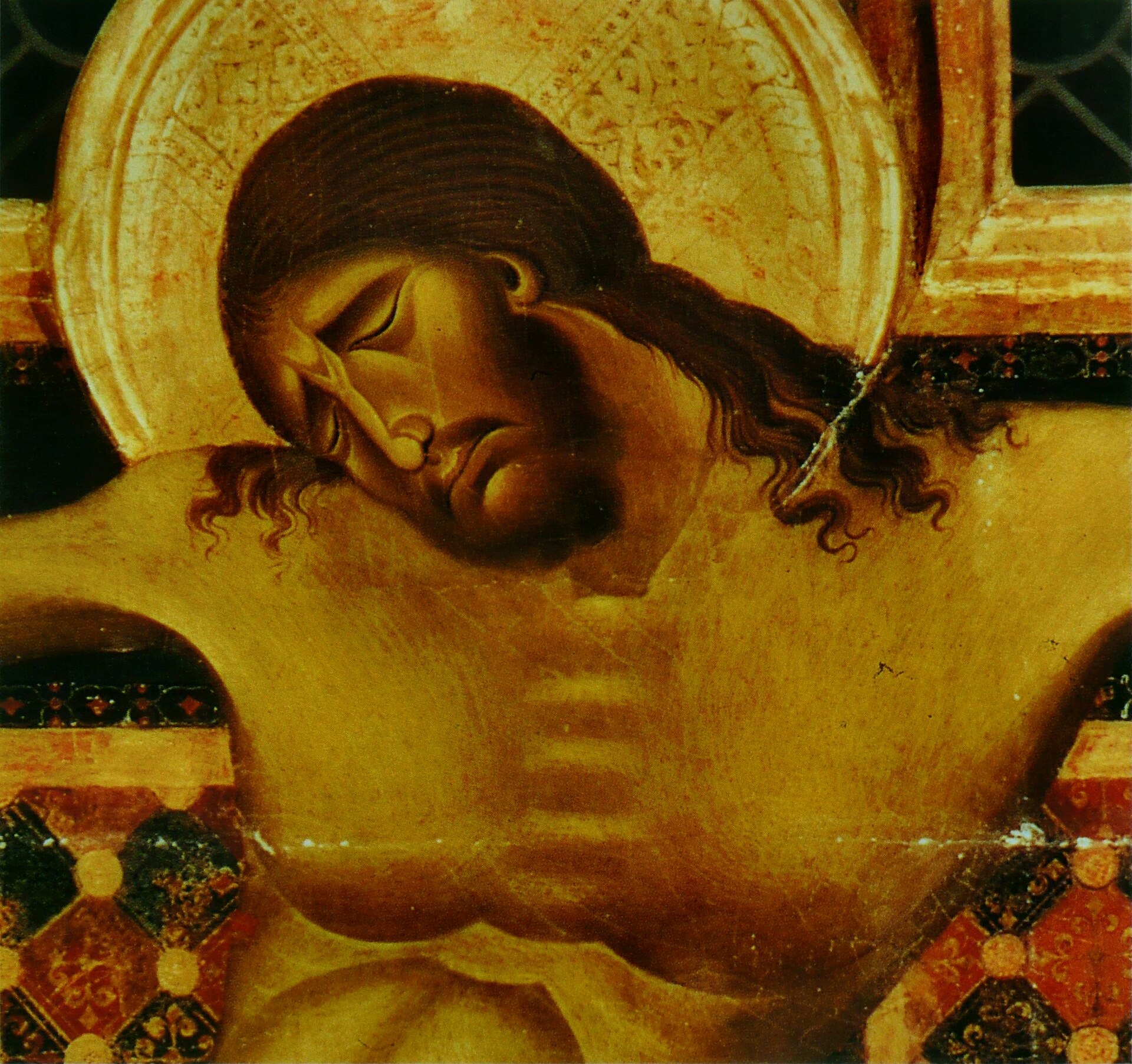
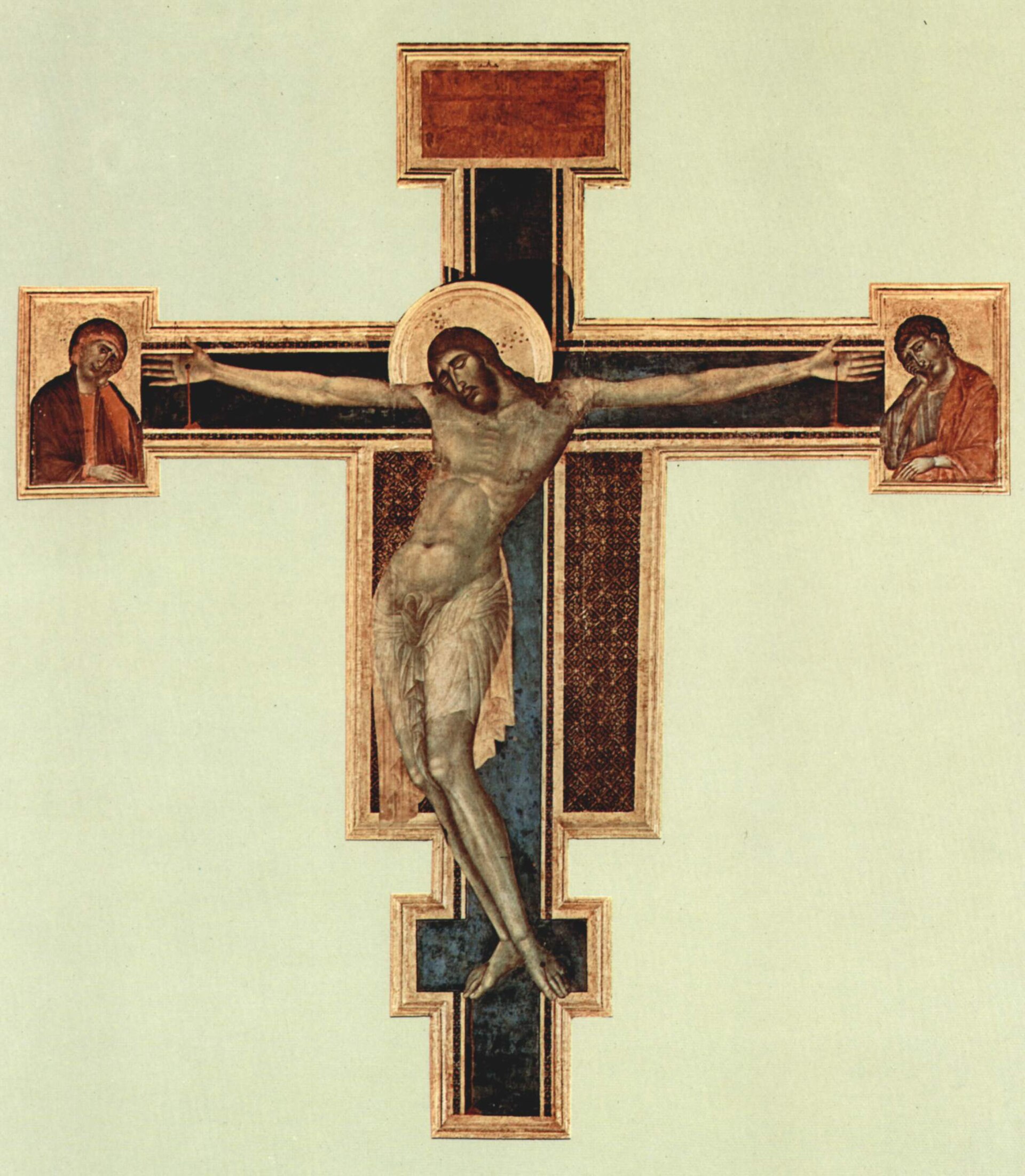
The third is the one that already happened. The eight-scene series by the Maestro di San Martino alla Palma that made the reconstruction of this object possible has itself been broken up, and the panel from it that corresponds to this Mocking of Christ entered the Barlow Collection in Lancashire and was destroyed in the bombing of Manchester during the Second World War. It survives as a black and white photograph. Cimabue's own Crucifix in Santa Croce spent the same war propped against a wine cask in the cellar of the Castello di Oliveto outside Florence, came back in 1948, and was submerged by the Arno in November 1966.
The artist
Cenni di Pepo, called Cimabue
Cimabue is an attributed artist with one documented work. He is first recorded in Rome in 1272, described as a Florentine painter, and the only surviving work documented as his in his lifetime is a mosaic figure in the apse of Pisa cathedral, paid for in the last six months of his life. Nothing he painted is signed. The published counts of his surviving work range from ten to about fifteen, and looser counts that admit workshop and disputed pictures reach about forty. An attribution to Cimabue is therefore an attribution to a reconstructed hand, and that is the correct frame for every claim on this page, including the one in its title.
Exhibited
- 2019Press presentation of the rediscovery, at which the attribution was made public.Paris, 24 September 2019; the discovery had been announced the previous day.
- 2019Pre-sale public showing, one day only, four days before the auction.Hotel de ville, Compiegne, 23 October 2019; somewhat over four hundred people are reported to have seen it. Recorded from a tertiary source and not confirmed against a primary one.
- 2024La Derision du Christ de Cimabue, L'Oeuvre en scene. A lecture presentation by Thomas Bohl rather than a display, two months before the exhibition opened.Auditorium Michel Laclotte, Musee du Louvre, Paris, 13 November 2024.
- 2025, 22 January to 12 MayRevoir Cimabue. Aux origines de la peinture italienne, shown in English as A New Look at Cimabue: At the Origins of Italian Painting. Curated by Thomas Bohl; some forty works; catalogue number 38; sponsored by Lusis. The first public presentation of the panel after its acquisition, and the first time the three surviving panels of the group were brought together. The museum's own collection database records the exhibition under a different title, Cimabue. Aux origines de la peinture moderne en Occident.Musee du Louvre, Paris, Denon wing, first floor, room 717, the Salle Rosa.
- 2025, 6 June to 19 OctoberLa jeunesse de la peinture. Cimabue ouvre la voie. An exceptional loan from the Louvre, announced as the first result of a strengthened partnership between the museum and the city of Avignon, whose Petit Palais has held a Louvre deposit of 320 Italian primitive paintings since 1976.Musee du Petit Palais - Louvre en Avignon.
Literature
- Acteon, Senlis, sale catalogue and expertise for the sale of 27 October 2019, by Dominique Le Coent-de Beaulieu with the Cabinet Turquin (Stephane Pinta). The first publication of the panel: preliminary technical analysis, an infrared reflectogram of the underdrawing and a photomontage of the reverses of all three surviving panels. Cited by the C2RMF as Le Coent 2019. Not seen for this record.
- Cooper, Donal, A long-lost Cimabue has emerged, and the first light of painting now burns brighter than ever, Apollo, 14 October 2019. The first scholarly assessment, published before the sale: the barbes and painted borders, the position of the panel within the ensemble, the Boskovits and Gordon reconstruction, the Clarissan argument, and statements from Holly Flora, Andrea De Marchi and Joanna Cannon.
- Gordon, Dillian, The Virgin and Child by Cimabue at the National Gallery, Apollo, June 2003. The first full publication of the London panel, carrying Miklos Boskovits's reconstruction of the Maestro di San Martino alla Palma panels as a two-wing diptych of eight scenes, which is the framework into which this panel was later fitted. Not seen for this record; cited from Cooper 2019 and 2025.
- Gordon, Dillian, National Gallery Catalogues: The Italian Paintings before 1400, London, National Gallery, 2011. The standard catalogue entry for the sibling panel NG6583, and the source of its published provenance. Not seen for this record; cited from the National Gallery's own online entry. (entry for NG6583)
- Meiss, Millard, 1951, the first publication of the Frick panel, as a work by Duccio. Not seen for this record; cited from Cooper 2025.
- Offner, Richard, 1947, proposing that the Berlin Crucifixion and its related scenes were painted for one of the two Clarissan houses of Florence, Monticelli or Montedomini. Not seen for this record; cited from Cooper 2019.
- Paintings in The Frick Collection: French, Italian and Spanish, volume II, New York, The Frick Collection, 1968. The source of the Frick's published collection history for the Flagellation: M. Rolla, G. Rolla, E. Moratilla in Paris, Knoedler, and the Frick in 1950. Not seen for this record; cited from the Frick's own online entry.
- Flora, Holly, Cimabue and the Franciscans, Renovatio Artium volume 4, London, Harvey Miller and Brepols, 2018, iv and 287 pages, ISBN 978-1-912554-01-0; awarded the 2020 Premio San Francesco by the Pontificia Universita Antonianum, Rome. The standing monograph on the artist and on the Franciscan reading of his work, including a chapter on his use of white and one on the Franciscan Maesta. Publisher's description consulted; the book itself not seen for this record.
- Flora, Holly, The Devout Belief of the Imagination: the Paris Meditationes Vitae Christi and Female Franciscan Spirituality in Trecento Italy, Brepols, 2009. The background to the argument that this panel and its companions parallel the Meditations on the Life of Christ as an instrument of Clarissan devotion. Not seen for this record.
- Bohl, Thomas, Un Tresor national entre les collections: La Derision du Christ de Cimabue, Grande Galerie, le journal du Louvre, number 65, winter 2023-2024. The curator's first published account of the acquisition. From the Louvre's own bibliography for the object; not seen for this record. (pp. 20-24, illustrated)
- Allard, Sebastien, L'actualite des primitifs: dix ans d'acquisitions, Grande Galerie, le journal du Louvre, number 65, winter 2023-2024. Places the purchase in a decade of Louvre acquisitions of early Italian painting. From the Louvre's own bibliography; not seen for this record. (pp. 25-26, illustrated)
- Bohl, Thomas, Cimabue, XIIIe siecle. Aux origines de la peinture, Grande Galerie, le journal du Louvre, number 69, winter 2024. From the Louvre's own bibliography; not seen for this record. (pp. 26-45, illustrated)
- Bohl, Thomas (editor), Cimabue. Aux origines de la peinture italienne, exhibition catalogue, Paris, Musee du Louvre, 2025, Milan, Silvana Editoriale and Musee du Louvre Editions, 2025. 256 pages, 170 illustrations, 42 euros; published in French only. The panel is catalogue number 38. (pp. 35, 39, 79, 213-225, 240, 241, cat. 38)
- Bourriot, Audrey, and Ravaud, Elisabeth, La Derision du Christ de Cimabue. Etude, restauration, comparaison, Techne, number 58, 2025, an issue devoted to Cimabue and Tuscany at the end of the thirteenth century, edited by Thomas Bohl, the late Marco Ciatti and Elisabeth Ravaud, published by the C2RMF. The full technical and restoration publication. Cited from the Louvre's bibliography and the exhibition press kit; the article itself not seen for this record. (pp. 62-77)
- Bohl, Thomas, Tresors nationaux et oeuvres d'interet patrimonial majeur: departement des peintures, 2, Cimabue, La Derision du Christ, La Revue des musees de France. Revue du Louvre, 2025-2. From the Louvre's own bibliography; not seen for this record. (p. 6, fig. 2)
- Bohl, Thomas, Un Tresor national prete au Petit Palais a Avignon, Grande Galerie, le journal du Louvre, number 71, summer 2025. On the Avignon loan. From the Louvre's own bibliography; not seen for this record. (p. 10, illustrated)
- Cooper, Donal, The Louvre restores Cimabue to his rightful place, Apollo, February 2025 issue, published online 3 February 2025. The fullest account in English of the reconstruction after restoration, of the Napoleonic provenance of the Louvre Maesta, and of the digital reconstruction of the screen at San Francesco in Pisa by Piergiuseppe Rechichi, Donal Cooper, Lucas Giles and Marco Giorgio Bevilacqua.
- Aimi, Francesca, A new look at Cimabue: At the Origins of Italian Painting, The Burlington Magazine, number 1466, May 2025. Exhibition review. From the Louvre's own bibliography; not seen for this record. (pp. 487, 489)
- Fileti Mazza, Miriam, Cimabue, Pisa, Pacini Editore, 2024. From the Louvre's own bibliography; not seen for this record. (pp. 120-126, illustrated p. 123)
- C2RMF, La derision du Christ de Cimabue: Etude de l'oeuvre, 2 October 2024, and Restauration, 7 November 2024. Two illustrated technical accounts published by the laboratory, and the only freely accessible full statement of the material evidence.
- Cimabue and Early Italian Devotional Painting, The Frick Collection, New York, 2006, with an accompanying publication supported by Lawrence and Julie Salander; exhibition coordinated by Holly Flora with Denise Allen. The occasion on which the Frick and National Gallery panels were first shown together. Publication not seen for this record.
- De Cimabue a Giotto, la revolution des corps, documentary film directed by Juliette Garcias, 2024, 52 minutes, co-produced by the Musee du Louvre, CFRT and ARTE, first broadcast on ARTE on 16 March 2025. Not a text, but the widest circulation the object has had.
Related works
| Work | Relation | Where it is |
|---|---|---|
| The Flagellation of Christ Cimabue | Scene from the same object, immediately to the right of this one Tempera on panel, 24.8 x 20 cm. Acquired by the Frick in 1950 through Knoedler in Paris, after the dealers G. Rolla and E. Moratilla; the 1968 Frick catalogue traces it to M. Rolla at the end of the nineteenth century. Published by Millard Meiss in 1951 as Duccio; the attribution to Cimabue was settled only in 2000. | The Frick Collection, New York, 1950.1.159 |
| The Virgin and Child with Two Angels Cimabue | Scene from the same object, immediately above this one on the same plank Egg tempera on wood, probably poplar, 25.6 x 20.8 cm. Possibly in the Douce collection 1830-1834; Gooch collection, Benacre Hall, Suffolk, by 1933 as Old Italian School; discovered under a staircase in 2000 and accepted by the British government in lieu of inheritance tax and allocated to the gallery that year. Catalogued by Dillian Gordon, 2011. | National Gallery, London, NG6583 |
| The Betrayal, or Kiss of Judas Cimabue | Missing fourth scene of the same wing Not a located object. The subject is extrapolated from the corresponding position in the later series by the Maestro di San Martino alla Palma. Joanna Cannon has observed that the composition of the Mocking may itself echo the jostling crowd of a Betrayal. | Unlocated |
| Way to Calvary, Crucifixion, Entombment, Last Judgement Cimabue | Hypothesised four scenes of the second wing Nothing survives and nothing is recorded. The subjects are extrapolated from the Maestro di San Martino alla Palma series. If the reconstruction is right, five of the eight scenes are lost. | Unlocated |
| Crucifixion, with four scenes of the Passion Maestro di San Martino alla Palma | The later series on which the reconstruction of this object rests About 1320-1330, scenes 29.2-31.4 x 21-21.5 cm against 25.2-25.8 x 20.3-20.5 cm for the Cimabue group. Boskovits reconstructed eight scenes as a two-wing diptych; Gordon proposed that the anonymous painter used Cimabue's object as his model. Saint Francis and Saint Clare kneel at the foot of the Berlin cross, which is the evidence for a Clarissan commission. The panel corresponding to this Mocking was destroyed in the bombing of Manchester in the Second World War. | Gemaldegalerie, Berlin (Crucifixion, 1428); further panels in Berlin and elsewhere |
| Eight Scenes from the Life of Christ Venetian, about 1300 | An intact diptych of comparable format Six Passion scenes with a Last Judgement and a Virgin and Child flanked by Saint Francis and Saint Clare. Cited by Cooper as the best surviving guide to how Cimabue's object would have looked and worked. | Virginia Museum of Fine Arts, Richmond; accession number not published in the sources consulted |
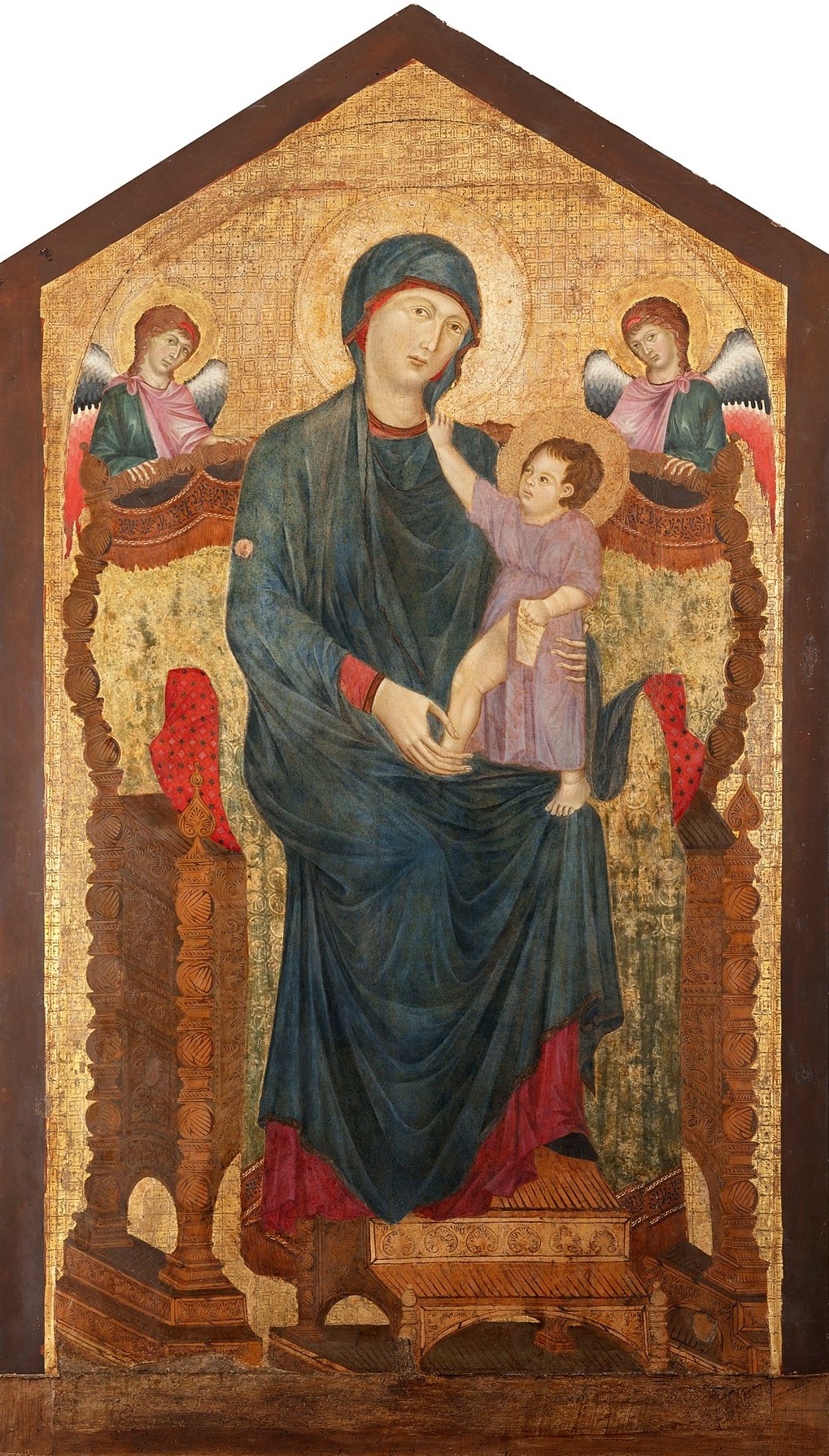
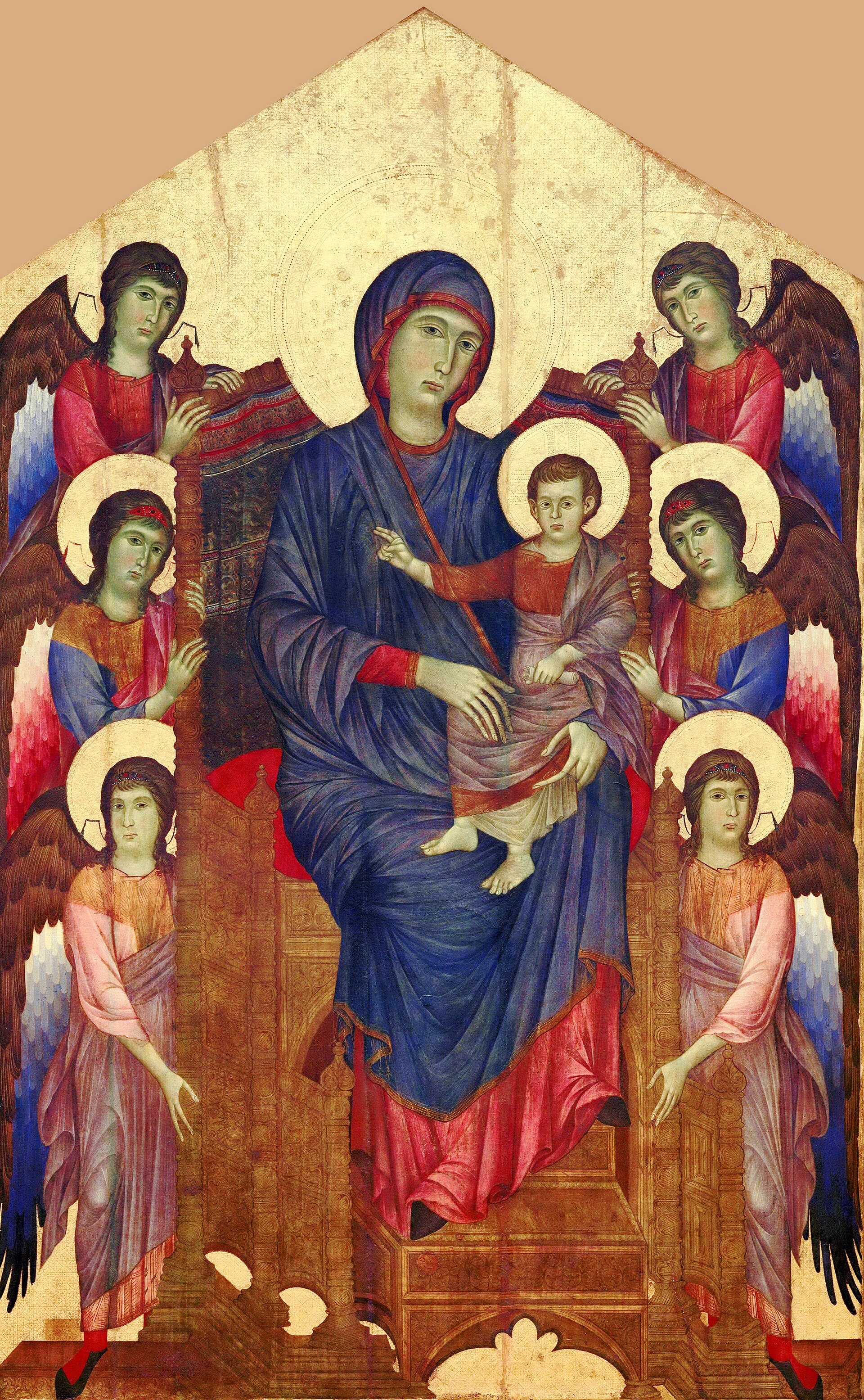
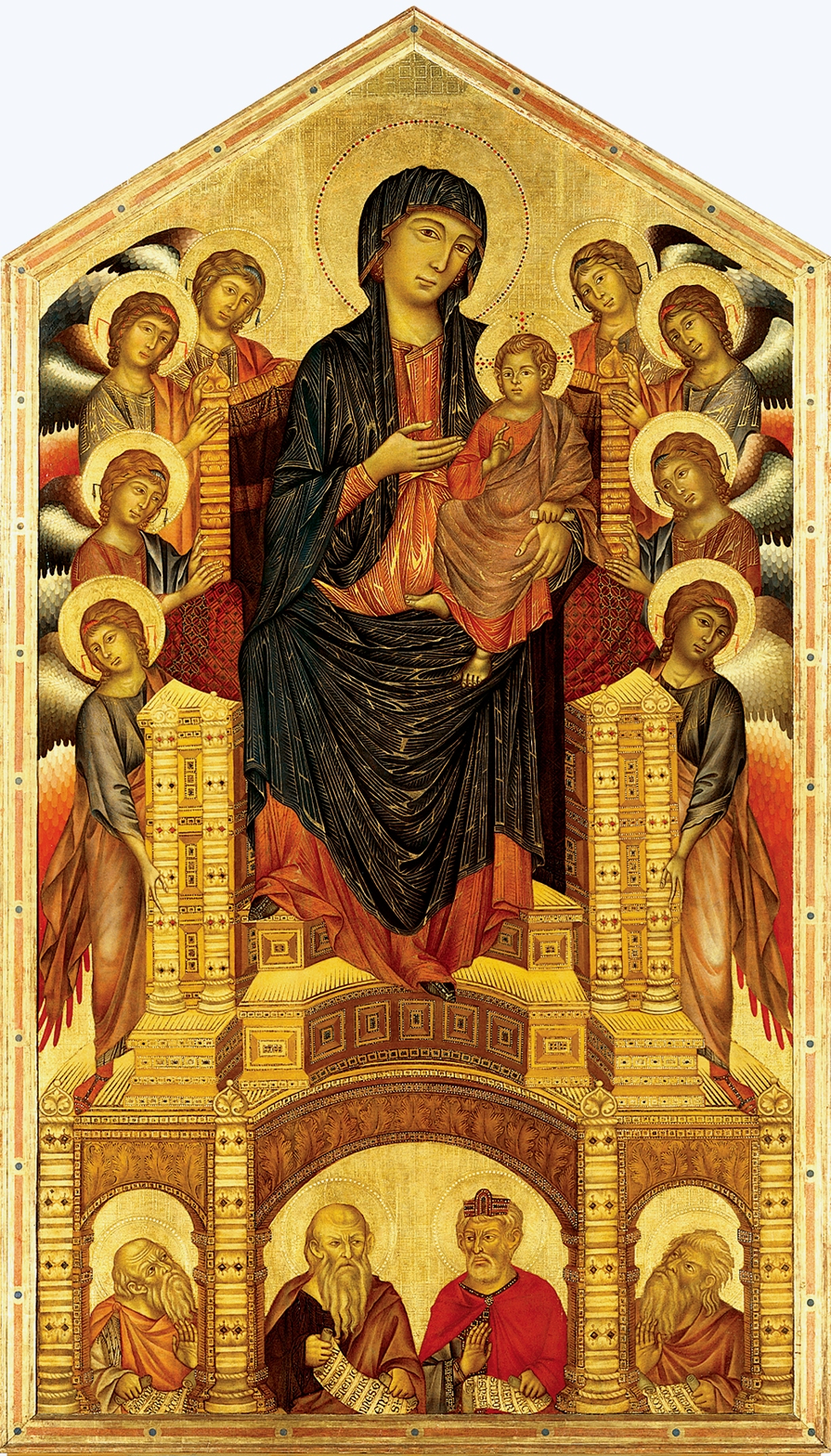
| Maesta (The Virgin and Child in Majesty surrounded by six angels) Cimabue | The museum's other Cimabue; the scale opposite of this panel About 1280-1290, 424 x 276 cm and 288 kg after being thinned in the 1840s. Painted for the Franciscan church of San Francesco in Pisa; selected by Vivant Denon in 1811, shipped from Pisa on 24 October 1812 and in Paris by early 1813. Tuscan commissioners came in 1815 to reclaim looted works and left it behind as mediocre and too heavy to crate. Restored 2019-2024, revealing pseudo-Arabic inscriptions on the red border. | Musee du Louvre, Paris |
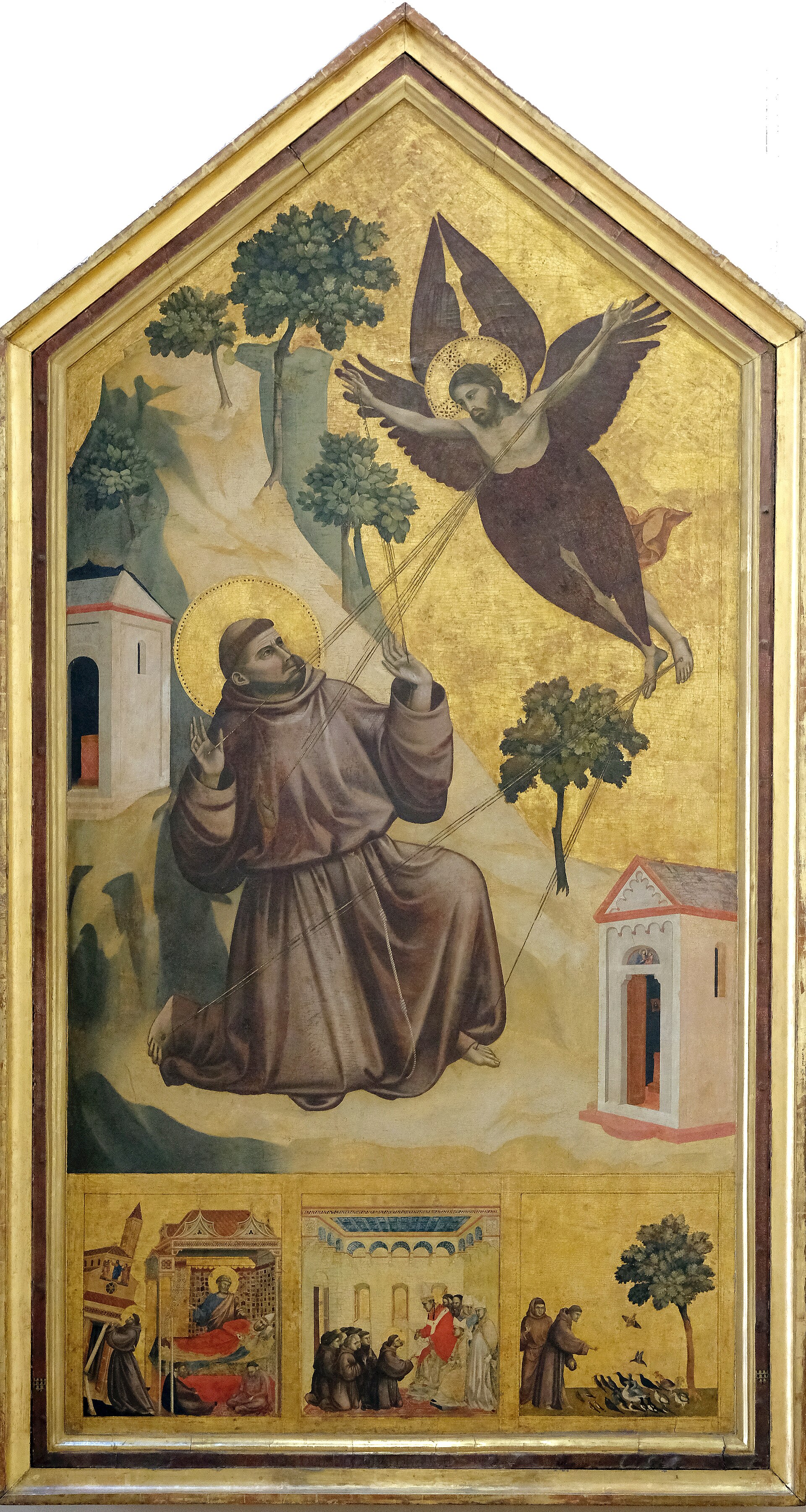
| Saint Francis Receiving the Stigmata Giotto | From the same Pisan church as the Louvre Maesta, and hung with it Signed, and taken from Pisa by Denon in the same operation. Cooper's reconstruction places it with the Maesta on a screen structure inside San Francesco. | Musee du Louvre, Paris, INV 309 |
| Christ Mocked, from the Maesta Duccio di Buoninsegna | The same episode, one generation later 1308-1311. Christ blindfolded and bound before the seated high priest, with the cock of Peter's denial behind. The iconographic type the Louvre's laboratory recovered under repaint on the Cimabue panel. | Museo dell'Opera del Duomo, Siena; accession number not published in the sources consulted |
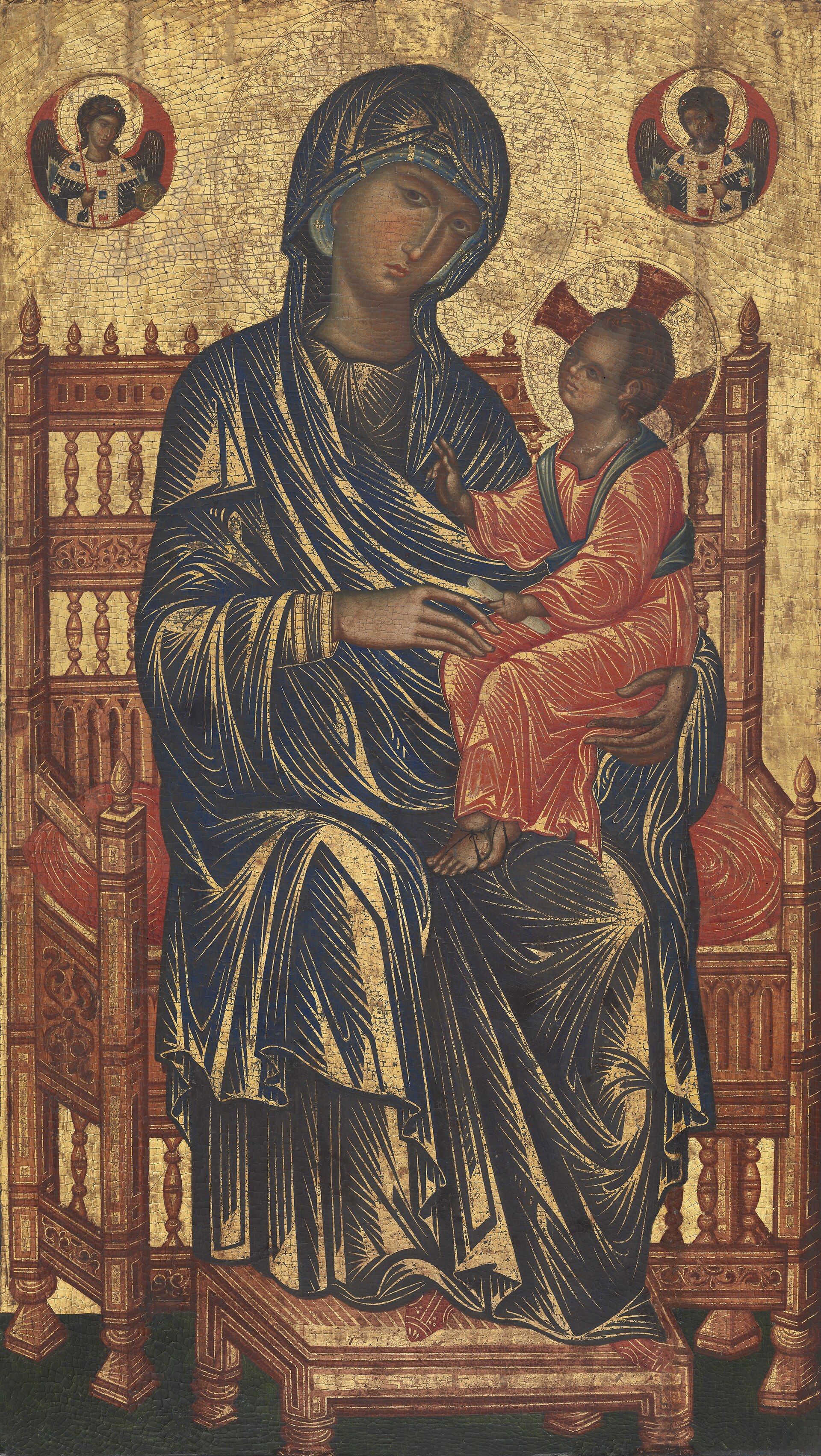
| Enthroned Madonna and Child, known as the Kahn Madonna Byzantine, thirteenth century, possibly Constantinople | The prototype against which Cimabue's departure is measured About 1250-1275, tempera on poplar. Shown in the Louvre's 2025 exhibition as one of the icons whose conventional deformations Cimabue set out to break. | National Gallery of Art, Washington, 1949.7.1 |
Open questions
- Where was the object between about 1280 and the nineteenth century? Nothing is recorded for the whole of that period for any of the three surviving panels.
- What is the evidence for the Louvre's statement that the panel was in a private collection in Compiegne since at least 1871? The date appears in the museum's catalogue entry and in the INHA repertoire without a published basis, and press accounts of the discovery say the family did not know where the picture came from.
- Which house owned it? The argument for a Clarissan convent is strong but the candidates are open: Monticelli or Montedomini in Florence, or Ognissanti in Pisa.
- Was the parent object a diptych at all? The Louvre's conservation service also allows a horizontal dossal, an altar frontal or an altarpiece, and the National Gallery's catalogue entry does the same.
- Do any of the five missing scenes survive? Only the subject of the fourth scene of this wing, a Betrayal, is even extrapolated; the four scenes of the second wing are entirely hypothetical.
- What did the Louvre pay in 2023? No figure has been published by the museum or the ministry. The Art Newspaper understood that the museum matched the 24.1 million euro sale price.
- Did the state ever make a formal purchase offer under article L121-1 within the thirty months, and on what basis did the sale proceed after the freeze expired in mid-2022? No published source consulted records either.
- What was the auctioneer's valuation before expertise? The figure of 300,000 to 400,000 euros is repeated everywhere and appears in no primary source consulted here.
- Who was the underbidder at the close? The last competing bidder is identified in the trade press only as a contemporary art gallery from Brussels.
- What happened to the proceeds? The owner died two days after the sale leaving three heirs; no probate, tax or settlement figure has been published.
- Why is the panel not on display? The Louvre's own record gives its location as not exhibited, with no reason stated, after the Avignon loan closed in October 2025.
Questions about this object
What is The Mocking of Christ?
The Mocking of Christ is a painting, dated c. 1280. Medium: Egg tempera and gold leaf on poplar panel.
Who made The Mocking of Christ, and is the attribution settled?
The attribution to Cenni di Pepo, called Cimabue is recorded here as accepted. Attributed to Cimabue on the basis of infrared examination of the underdrawing by Eric Turquin and colleagues, and on matching woodworm tunnels shared with two other panels of the same dismembered diptych. No work by Cimabue is signed; the corpus of about a dozen paintings is itself a reconstruction by connoisseurship.
Where is The Mocking of Christ now?
Musee du Louvre, Paris, RFML.PE.2023.33.1. Last confirmed 5 August 2026. Acquired November 2023 following a national treasure export ban.
What has The Mocking of Christ sold for?
Hammer EUR 19,500,000; with premium, EUR 24,180,000 with fees. Acteon (Dominique Le Coent-de Beaulieu and Philomene Wolf), 2019-10-27.
What is still unknown about The Mocking of Christ?
Where was the object between about 1280 and the nineteenth century? Nothing is recorded for the whole of that period for any of the three surviving panels.
Sources
- 1Musee du Louvre, collections online, La Derision du Christ, inv. RFML.PE.2023.33.1, Departement des Peintures. HTML record and machine-readable record at the same ark, both consulted 3 August 2026. Carries the object history, the acquisition dates, nine bibliographic references and the exhibition history. collections.louvre.fr/en/...
- 2Musee du Louvre, press release, Deux Tresors nationaux pour le musee du Louvre, 3 November 2023, with statements by Laurence des Cars and Louis-Antoine Prat. presse.louvre.fr
- 3Ministere de la Culture, press release, Un panneau peint par Cimabue vers 1280, representant La Derision du Christ, reconnu tresor national, 23 December 2019. culture.gouv.fr/presse/...
- 4Arrete du 20 decembre 2019 refusant le certificat prevu a l'article L. 111-2 du code du patrimoine, NOR MICC1935802A, Journal officiel 22 December 2019. legifrance.gouv.fr/jorf/...
- 5Avis n. 2019-14 de la Commission consultative des tresors nationaux, on the export certificate application filed 14 October 2019 for the Cimabue panel, published in the Journal officiel 22 December 2019. legifrance.gouv.fr/jorf/...
- 6Code du patrimoine, articles L121-1 to L121-4, on the acquisition of cultural goods refused an export certificate: the thirty-month period, the purchase offer, the expert valuation procedure and the consequence of no offer being made. legifrance.gouv.fr/codes/...
- 7C2RMF, La derision du Christ de Cimabue - Etude de l'oeuvre, published 2 October 2024. Technical study led by Elisabeth Ravaud; radiography, X-ray fluorescence, microscopy; materials, gilding, barbes, painted borders and condition. c2rmf.fr/actualite/...
- 8C2RMF, La derision du Christ de Cimabue - Restauration, published 7 November 2024. Restoration 2022-2024; nailed strips, four varnish layers, the repaint over the blindfold, the punchwork, and the caution that the parent object may have been a dossal, an altar frontal or an altarpiece rather than a diptych. c2rmf.fr/actualite/...
- 9Musee du Louvre, press kit, A New Look at Cimabue: At the Origins of Italian Painting, 22 January to 12 May 2025 (PDF). Curator, catalogue, Techne issue, documentary film, the eight-panel diptych section and the Franciscan reading. presse.louvre.fr/wp-content/...
- 10Donal Cooper, A long-lost Cimabue has emerged, and the first light of painting now burns brighter than ever, Apollo, 14 October 2019. The barbes, the borders, the Boskovits and Gordon reconstruction, the Clarissan argument and quotations from Holly Flora, Andrea De Marchi and Joanna Cannon. apollo-magazine.com/cimabue-mocking-christ
- 11Donal Cooper, The Louvre restores Cimabue to his rightful place, Apollo, 3 February 2025. The eight scenes in two wings of four, all three known panels from the left wing; Meiss 1951; the Manchester bombing; the Napoleonic history of the Maesta. apollo-magazine.com/cimabue-louvre-mocking-of-christ-rest...
- 12Anna Brady, Kitchen Cimabue sells for 24.1m euros, The Art Newspaper, 27 October 2019. Hammer and premium, bidders, Ortenzi, Sarti, Turquin's worm-track argument and the National Gallery comparison. theartnewspaper.com/news/...
- 13Gareth Harris, Cimabue kitchen painting placed under export ban ends up at the Louvre, The Art Newspaper, 6 November 2023. The funding statement, the Fath and Societe des Amis du Louvre gifts, the Alana Collection and the death of the owner two days after the sale. theartnewspaper.com/2023/...
- 14Diane Zorzi, Un panneau de Cimabue s'envole a 24,2 millions d'euros a Senlis, Le magazine des encheres (Interencheres), 27 October 2019. Opening bid, bidder count, room capacity, the ranking of dearer Old Masters, Pinta's description and the exact dimensions of panel and painted surface. Read through the Internet Archive; the publisher's server returns HTTP 403 to direct requests. magazine.interencheres.com/art-mobilier/...
- 15Diane Zorzi, Le musee du Louvre acquiert Le Christ moque de Cimabue vendu a Senlis, Le magazine des encheres (Interencheres), 2 November 2023. The dismemberment of the object in the nineteenth century, Gordon's reconstruction, and the Louvre's inability to pre-empt at the sale for lack of funds. Read through the Internet Archive; the publisher's server returns HTTP 403 to direct requests. magazine.interencheres.com/art-mobilier/...
- 16National Gallery, London, Cimabue, The Virgin and Child with Two Angels, NG6583. Catalogue entry with provenance from Dillian Gordon, National Gallery Catalogues: The Italian Paintings before 1400, London 2011, acquisition credit, exhibition history and bibliography. nationalgallery.org.uk/paintings/...
- 17National Gallery, London, artist page, Cimabue (documented 1272, died 1302). nationalgallery.org.uk/artists/...
- 18The Frick Collection, The Flagellation of Christ, accession 1950.1.159, with collection history from Paintings in The Frick Collection: French, Italian and Spanish, volume II, New York 1968, and the curatorial commentary on the Cimabue and Duccio debate. Read through the Internet Archive; collections.frick.org returned HTTP 418 to two direct requests with different browser headers, and in-app browser navigation to the host was refused. collections.frick.org/objects/...
- 19The Frick Collection, past exhibition, Cimabue and Early Italian Devotional Painting, 3 October to 31 December 2006, coordinated by Holly Flora with Denise Allen; the technical comparison of the Frick and National Gallery panels. Read through the Internet Archive; frick.org returned HTTP 418 to direct requests. frick.org/exhibitions/...
- 20Martin Bailey, Water leaks into the Louvre's Cimabue exhibition, landing close to the master's greatest early painting, The Art Newspaper, 5 May 2025. theartnewspaper.com/2025/...
- 21Musee du Louvre, press release, Musee du Petit Palais - Louvre en Avignon: La jeunesse de la peinture. Cimabue ouvre la voie, pret exceptionnel de La Derision du Christ, 5 June 2025. presse.louvre.fr
- 22Daniel Larkin, Will the Real Cimabue Please Stand Up?, Hyperallergic, 8 May 2025. Review of the Louvre exhibition; twelve securely attributed works, the pseudo-Arabic inscriptions, the Meditations manuscript and the Franciscan reading. hyperallergic.com/will-the-real-cimabue-please-stand-up
- 23AGORHA, Institut national d'histoire de l'art, Repertoire des tableaux italiens dans les collections publiques francaises (RETIF), record for La Derision du Christ, compiled by Clemence Raccah, consulted 3 August 2026. agorha.inha.fr/ark:/...
- 24Musee du Louvre, event listing, La Derision du Christ de Cimabue, L'Oeuvre en scene, auditorium Michel Laclotte, 13 November 2024. louvre.fr/expositions-et-evenements/...
- 25Galleria degli Uffizi, Virgin and Child enthroned, surrounded by angels, known as the Rucellai Madonna, Duccio di Buoninsegna, about 1285, 450 x 290 cm, commissioned by the Compagnia dei Laudesi. uffizi.it/en/...
- 26Cavallini to Veronese, Cimabue. Secondary reference site; used for the Pisa cathedral payment records of 2 September 1301 to 19 February 1302 at ten soldi a day, the wartime storage of the Santa Croce Crucifix and the reading of the nickname. Flagged for replacement with the published Pisan cathedral archive. cavallinitoveronese.co.uk/cimabue
- 27Associated Press report carried by Courthouse News Service, Cimabue Masterpiece Found in Kitchen Sells for 26.6 Million, 27 October 2019, with the AP photograph of Stephane Pinta presenting the panel in Paris on 24 September 2019. courthousenews.com/cimabue-masterpiece-found-in-kitchen-s...
- 28BBC News, Cimabue painting found in French kitchen sets auction record, 27 October 2019. Cited for the record framing and for its statement that the buyer was an anonymous buyer from northern France, which the Louvre's own record has since contradicted. bbc.com/news/...
- 29The Art Newspaper, Louvre acquires Chardin's Strawberries painting thanks to 10,000 individual donors, 6 March 2024. The comparison case: 24.3 million euros at Artcurial in March 2022, export blocked, funded by LVMH, the Societe des Amis du Louvre and a public subscription. theartnewspaper.com/2024/...
- 30Wikipedia, La Derision du Christ (Cimabue), French edition. Tertiary source, used only for the pre-sale public showing at the Compiegne town hall on 23 October 2019, the naming of Stephane Pinta as the expert, and Alvaro Saieh's reported resignation from the board of the Metropolitan Museum of Art in order to bid. Flagged for replacement with contemporaneous French press. fr.wikipedia.org/wiki/...
- 31Wikipedia, The Mocking of Christ (Cimabue), English edition. Tertiary source, used only to record the widely repeated figure of 300,000 to 400,000 euros as the auctioneer's first view, which no primary source consulted here carries. Flagged for replacement. en.wikipedia.org/wiki/...
- 32Wikimedia Commons file page for the National Gallery of Art's Enthroned Madonna and Child, Byzantine thirteenth century, accession 1949.7.1, gift of Mrs Otto H. Kahn, released CC0 by the museum. Used to verify the licence and the accession number of that plate. commons.wikimedia.org/wiki/...
- 33Wikipedia, Rucellai Madonna, English edition. Tertiary source, used only for the terms of the contract of 15 April 1285: 150 lire, no workshop assistance, and ultramarine and gold at the painter's expense. Flagged for replacement with the published contract. en.wikipedia.org/wiki/...
- 34Brepols, publisher's page for Holly Flora, Cimabue and the Franciscans, Renovatio Artium volume 4, Harvey Miller, 2018, with pagination, ISBN, chapter titles and the 2020 Premio San Francesco. brepols.net/products/...
,_Enthroned_Madonna_and_Child,_c._1250-1275,_NGA_37004.jpg)
Last verified 10 August 2026 · Published 2 August 2026
Change log
2 August 2026 - Record deepened to the house standard: narrative sections, technical evidence, artist dossier, related works and open questions added; provenance chain and auction results replaced with the researched versions; sources rebuilt.
5 August 2026 - Re-verified. Location, attribution and source URLs re-checked against fresh searches and the Louvre collections database: no change to location (still Musee du Louvre, still non expose / not on public display, consistent with the open question already on record), no change to attribution. Added the Louvre inventory number RFML.PE.2023.33.1 from collections.louvre.fr, which the record previously lacked.
2 August 2026 - Eight plates added (six public domain, one CC0 reconstruction diagram, one CC BY-SA detail), all self-hosted and credited. Artist dossier added covering the name, the single lifetime document, the unsigned corpus, Vasari, the Assisi oxidation and the 1966 flood, with the Dante passage.
2 August 2026 - Record deepened: diptych reconstruction and sibling panels added, technical evidence (infrared underdrawing, matching woodworm tunnels, frame damage) added, hammer separated from premium at EUR 19.5 m against c. EUR 24 m, buyer and export-ban chronology added, five open questions recorded.
2 August 2026 - Record created. Post-sale outcome (export ban, Louvre acquisition 2023) recorded, which most press coverage of the 2019 sale does not carry.
10 August 2026 - Re-checked. No change to attribution or ownership. The Louvre's own collections database lists the panel as currently 'non expose' (in reserve, not on the gallery walls); it had a temporary loan to the Petit Palais, Avignon, 6 June - 19 October 2025, since returned. This is a display status, not a change of custody or location. No new litigation, export dispute or attribution challenge found. No reunification news involving the other two panels of the same diptych (Frick Flagellation, National Gallery Virgin and Child). One cited source on an unrelated 2025 roof-leak incident at the Louvre's Cimabue exhibition (no painting damaged) now sits behind a paywall gate.