The Benin Bronzes
Igun Eronmwon, the royal brass-casters guild of Benin City · Plaques probably 1500 to mid-1600s; commemorative heads, figures, regalia and ivories from at least the 1500s and continuing to 1897
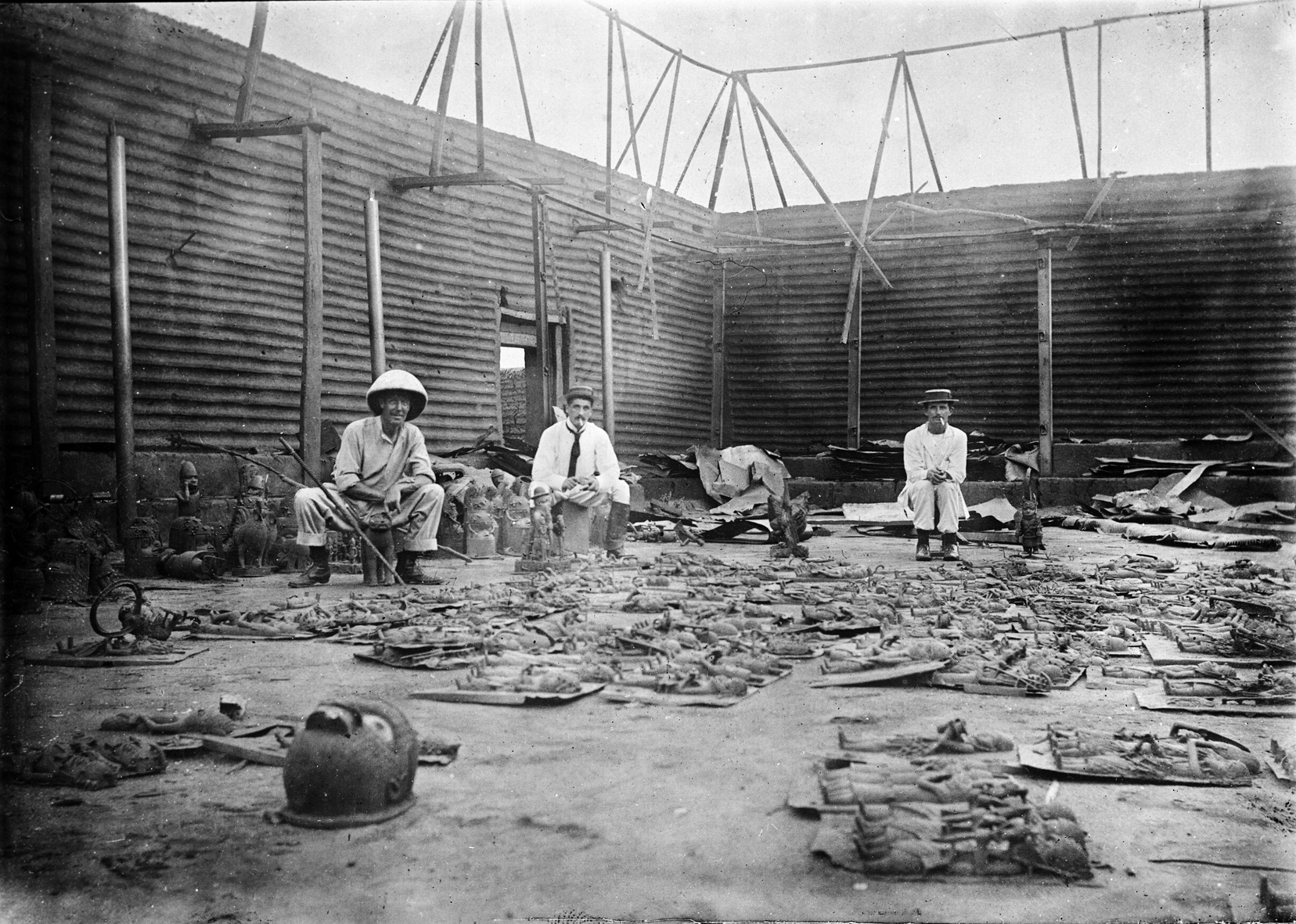
The objects in this record, at the moment they became loot. Photographed in the Oba's compound in Benin City during the expedition of 9 to 18 February 1897 by Reginald Kerr Granville, with cast brass plaques lying in the foreground and three British soldiers behind them. No individual plaque visible here has been matched to a museum accession number in the sources consulted, and this record does not claim otherwise. The photograph is the last image of these objects before the point at which their documented history begins.
| Artist | Igun Eronmwon, the royal brass-casters guild of Benin City |
|---|---|
| Date | Plaques probably 1500 to mid-1600s; commemorative heads, figures, regalia and ivories from at least the 1500s and continuing to 1897 |
| Medium | Cast leaded brass, with some true bronze; also carved ivory, wood, iron, coral and red stone |
| Dimensions | Varies by object. The relief plaques generally run about 35 to 50 cm high; Metropolitan Museum 1991.17.26 is 39.4 cm, 1991.17.21 is 37.5 cm |
| Where it is now | Dispersed. Digital Benin recorded 5,246 objects across 131 institutions in 20 countries at its launch in November 2022. The largest single holding is the British Museum, which states that it cares for over 900 objects from the historic Kingdom of Benin. Since 2021 title to more than 1,400 objects has been transferred to Nigeria by institutions in Germany, the Netherlands, the United Kingdom and the United States, and a substantial share of those remain physically in Europe and America on loan.last confirmed 4 August 2026 |
| Inventory number | Multiple; see technical and narrative |
| Attribution | WorkshopNot attributable to a named hand. Full note |
| Object type | Sculpture |
| Period | West African, sixteenth to nineteenth century |
| Cases | Seized, looted or confiscated · Has a provenance gap |
| Inscriptions | None. The objects carry no maker's marks, signatures or dates. Every accession number, label and inventory mark they now bear was applied in Europe or America after 1897. |
| Owners on record | 8 links6 documented, 1 disputed, 1 unknown |
| Sources | 26 cited |
About this record Last verified 8 August 2026 · 26 sources cited · Change log
On this page 10 sections
ContentsClose
A corpus, not a single object. The Benin Bronzes are the several thousand cast brass, carved ivory and wooden works taken from the palace of the Oba of Benin by a British naval brigade in February 1897, and dispersed from London into museums and private collections across Europe and North America. They are mostly brass rather than bronze, the brass came from Europe, and they were made by a hereditary court guild whose descendants still cast in Benin City.
This record exists because three different things are routinely reported as one. A transfer of TITLE moves ownership. A transfer of CUSTODY moves the object. A LOAN moves neither. Germany signed a framework declaration covering 1,130 objects in July 2022 and then moved ownership museum by museum, Berlin's 512 on 25 August 2022; twenty objects were physically handed over in Abuja that December. Cambridge transferred title to 116 in February 2026 and kept 17 on loan. The Horniman transferred title to 72 in November 2022 and sent six. Even the Netherlands, whose 119-object return in June 2025 is the largest physical repatriation to date, kept four on loan. Almost every headline count published since 2021 conflates at least two of the three.
The record also sets out the gap that no museum register bridges. Most Benin accession entries name a donor, a dealer or a bequest, and go silent between the palace and the sale room. That silence is not a research failure. It is the shape of the event: an army took the objects, the Foreign Office sold what it did not give away, and the paperwork that would connect a numbered plaque to the room it was taken from was never made.
Provenance
Each link is graded. Documented: a cited source supports it. Disputed: the identification is argued but not established. Unknown: no owner for that span, and the gap is not smoothed into a narrative. The grades in the glossary.
- c. 1500 - 1897The Oba of Benin and the royal court, Benin Citydocumented
Commissioned by and for the court and made by the Igun Eronmwon guild under royal monopoly, from quarters inside the palace grounds. The plaques were fixed to pillars in the palace compounds and later stored in a room within the palace; the commemorative heads stood on the ancestral altars of past Obas and Queen Mothers. Oba Ovonramwen was the reigning owner in 1897.11819
- 1897-02-18 - 1897British naval brigade under Rear-Admiral Harry Rawsondocumented
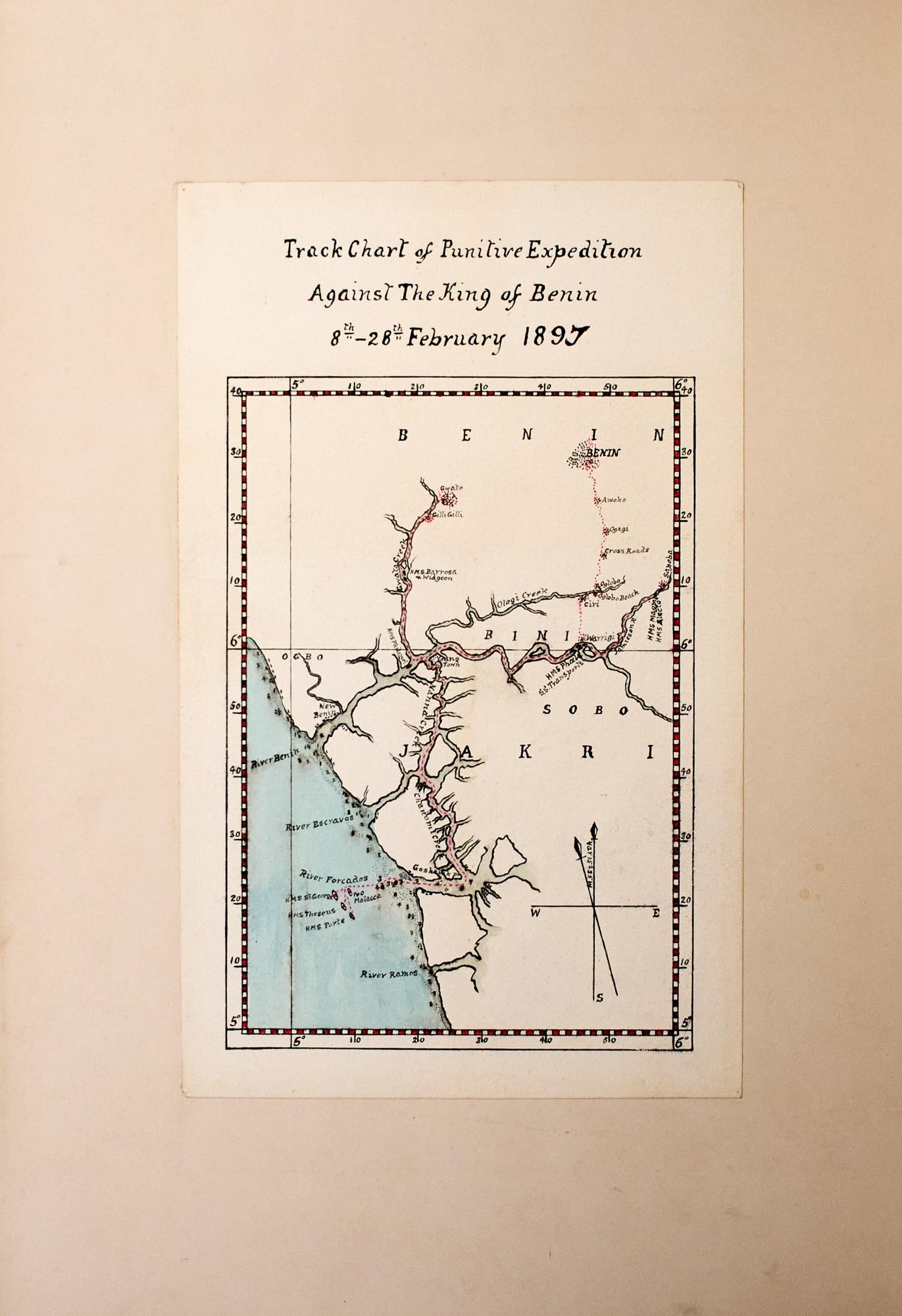
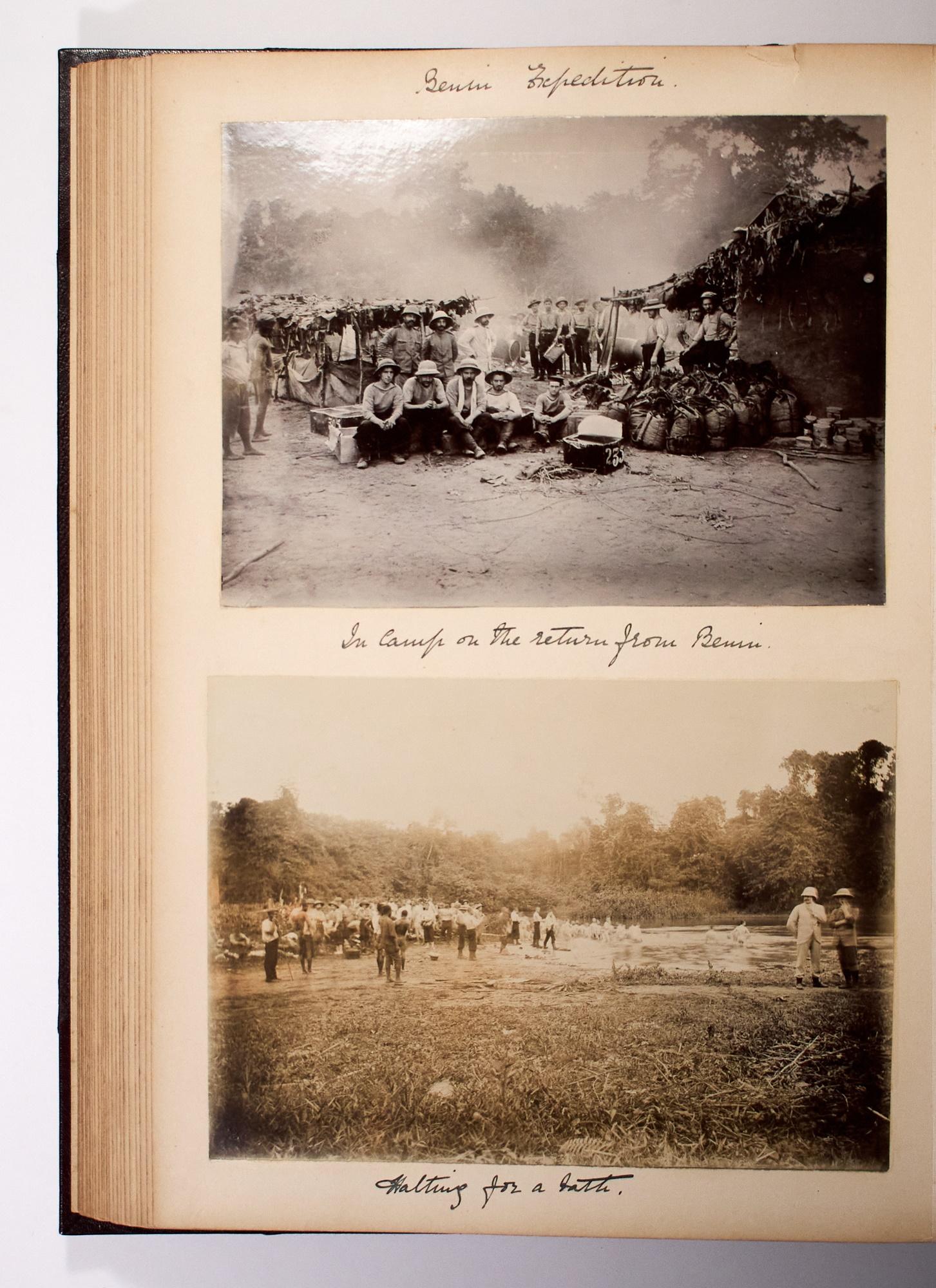
Benin City was taken on 18 February 1897 after an advance begun on 9 February by a force of about 1,200. The palace was burned and partly destroyed and its shrines and compounds looted. In the British Museum's own words, thousands of objects were taken to the UK as official spoils of war or distributed among members of the expedition according to their rank. Two channels, both official: a state consignment and distribution to individual officers and men. The Oba was captured and exiled; several chiefs were executed.121
- 1897 - 1898Secretary of State for Foreign Affairs, Londondocumented
In autumn 1897 the British Museum displayed 304 Benin plaques on loan from the Secretary of State for Foreign Affairs and then petitioned successfully to receive 203 of them as a donation, completed in 1898. Most of the remaining plaques were sold to museums in the United Kingdom and Germany and to private dealers; a few were retained by the Foreign Office. The proceeds are the reason the corpus is in Berlin, Hamburg, Leiden, Vienna and Chicago as well as London.1
- 1897 -Members of the expedition, and the London dealer tradeunknown
THIS IS THE GAP AND IT IS THE FINDING. Objects distributed to individual officers and men entered the market immediately and without documentation connecting a given object to a given room, altar or seizure. Where a route is recorded at all it is recorded by the buyer, not the taker: Frederick Horniman bought ivories and a wooden frame from W. J. Hider of the Royal Navy in March 1897, one month after the city fell, Hider having accompanied the force and, in the Horniman's words, been personally involved in the looting; Richard Quick, the Horniman's first curator, bought two plaques, a hip ornament and a key from the King's House on 4 October 1899 from James Tingley of Forest Hill, and how Tingley acquired them is unclear. Sir Ralph Moor took the pair of ivory arm-cuffs now in the British Museum. For the great majority of objects in Western collections no equivalent step exists at all, and no museum register bridges it.12
- 1898 - presentBritish Museum, London, and other public collections in Europe and North Americadocumented
The British Museum's holding reached its present size of over 900 objects only through the acquisition of the Harry Beasley collection in 1944, the William Oldman collection in 1949 and the Sir Henry Wellcome collection in 1954. German museums bought heavily from 1897 onward, producing the 1,130 objects later covered by the 2022 framework declaration. Digital Benin recorded 5,246 objects in 131 institutions in 20 countries at its November 2022 launch.11022
- 1950 - 1972British Museum deaccessionsdocumented
In 1950 and 1951 the British Museum deaccessioned 29 Benin plaques as duplicates, an understanding the museum now states further research has shown to be incorrect; lost-wax casting produces no duplicates. Twenty-five were sold, exchanged or given to the Colony and Protectorate of Nigeria and later accessioned by museums in Lagos and Benin City; the Metropolitan Museum's account of two of them implies twenty-six, and the discrepancy is unresolved. One was sold in 1954 to the colonial government of the Gold Coast and is now in the National Museum, Accra. Eight were sold to or exchanged with private dealers and collectors between 1952 and 1972; their present holders are not named in the sources consulted.13
- 1950 - 2021National Museum, Lagos, then the international market, then Klaus and Dolly Perls, then the Metropolitan Museum of Artdisputed
Two of the plaques transferred to Lagos left that museum without ever being deaccessioned by it. The Met states they entered the international art market at an unknown date and under unclear circumstances and were acquired by a New York collector, the modern-art dealer Klaus Perls, who with his wife Dolly gave his Benin collection to the Met in 1991. The removal from Lagos is the disputed link: the Met records it as a fact and no party has published how it happened.3
- 2021 - presentNigeria: the National Commission for Museums and Monuments, and from 2023 the Oba of Benindocumented
Met, 9 June 2021, two plaques and an Ife head deaccessioned, with physical delivery to follow. Jesus College Cambridge and the University of Aberdeen, October 2021. Germany, framework declaration 1 July 2022 covering 1,130 objects, with ownership moving under separate museum-by-museum agreements: Berlin's 512 on 25 August 2022, Mannheim's 29 approved 29 July 2025; two objects handed over in Berlin in July 2022 and twenty in Abuja on 20 December 2022. Smithsonian National Museum of African Art, 11 October 2022, 29 objects, eight returned at the ceremony. Horniman Museum, 28 November 2022, 72 objects with 6 travelling. Stanley Museum of Art, University of Iowa, 15 July 2024, the first US institution to return directly to the royal family. Netherlands, signed 19 February 2025, 113 from the national collection plus 6 from Rotterdam, handed over in Lagos on 21 June 2025 with 4 remaining on loan in the Wereldmuseum. Museum of Fine Arts Boston, 27 June 2025, two works vested in Oba Ewuare II with custody through the NCMM and the Nigerian embassy. University of Cambridge Museum of Archaeology and Anthropology, 8 February 2026, 116 objects with 17 retained on loan for an initial three years. The Nigerian presidential declaration of 23 March 2023, gazetted 28 March 2023, vested ownership and custody in the Oba of Benin, changing the recipient mid-process. Switzerland, agreement signed March 2026 covering 28 objects in total; first tranche handed over at the National Museum, Lagos, 30 June 2026: 14 from the Ethnographic Museum at the University of Zurich, 2 from Museum Rietberg Zurich and 2 from the Musee d'Ethnographie de Geneve (18 of the 28 agreed), alongside a bronze bracelet and four archaeological monoliths from the Niger Delta region.234567823252625
Prices realised
THIS RECORD COVERS A CORPUS OF SEVERAL THOUSAND OBJECTS, ALMOST NONE OF WHICH HAS BEEN AT AUCTION. The results below are for individual named objects and are given because they measure what this material does in the market and what the market will not disclose. A price achieved by one Benin object is not evidence about another: the corpus runs from unique royal altar heads to modern castings from the same street in Benin City. Note also that the largest transactions of the last twenty years have been private, and that the most publicised sale of the period was cancelled and then happened privately anyway.
| Date | Sale | Estimate | Result | Note |
|---|---|---|---|---|
| 1951-12 | Glendining and Co., London | not published | Hammer GBP 230 With premium not published; UK buyer's premium did not exist in 1951 GBP | An early Benin memorial head bought by the London dealer Ernest Ohly. He placed it in a safe deposit box in 1953 and instructed his children that it was not to be sold unless there was another Holocaust; his father William Ohly was Jewish and had fled Nazi Germany. The same head was sold privately in 2016. The 1951 figure is the most useful period datum in this record: it is what a London trade sale thought a royal Benin head was worth fifty-four years after the seizure. |
| 17 May 2007 | Sotheby's, New York | USD 1,000,000 - 1,500,000 | Hammer not published in the sources consulted With premium USD 4,740,000 USD | Commemorative head of an Oba, dated about 1575 to 1625, deaccessioned and consigned by the Albright-Knox Art Gallery, Buffalo, New York. Reported as the auction record for a Benin work. The reported figure is premium-inclusive; the hammer is not published, and any account quoting the 4.74 million figure as a hammer price is wrong. |
| 20 December 2010 | Sotheby's, London | GBP 3,500,000 - 4,500,000 | Hammer no sale; the lots were withdrawn before the auction With premium none GBP | A sixteenth-century Benin ivory pendant mask, read by scholars as a portrait of Idia, the first Queen Mother of Benin, offered with five other Benin objects by descendants of Lieutenant-Colonel Sir Henry Lionel Gallwey, later Galway, who took part in the 1897 expedition. Announced on 20 December 2010 for a sale on 17 February 2011 and cancelled four days after the announcement, following an online campaign led by the Nigeria Liberty Forum; Sotheby's stated that it did so at the request of the consignors. There is no price. The mask nevertheless changed hands afterwards: it is now in the Al-Thani Collection in Paris, owned by Sheikh Hamad bin Abdullah Al Thani, and Sotheby's was not involved in the subsequent sale. The withdrawal did not prevent the transaction; it removed it from public view, which is the effect the episode had on this market. |
| 2016 | Woolley and Wallis, Salisbury, private treaty in association with Entwistle, London | not published | Hammer not applicable; no auction took place With premium not published. The auctioneer's chairman Paul Viney described it only as a substantial seven-figure sum believed to be a record price for any Benin work of art; press reporting gives GBP 10 m, which is an EIGHT-figure number and cannot be reconciled with the seller's own description GBP | An early Benin memorial head, the Ohly head, placed with a private collector by private treaty through the dealer Lance Entwistle. This is the highest reported figure for any Benin object and it is NOT an auction result: a private treaty sale publishes no hammer, no premium and no buyer. The buyer has not been named publicly; the trade account of the sale states that he was the same collector who bought the 2007 Sotheby's head. The 10 million pound figure is press reporting, not a published price, and this record does not treat it as one. |
Hammer is the price at which the bidding stopped; with premium adds the fee the house charges the buyer on top. Hammer price and buyer's premium in the glossary.
Technical evidence
| Attribution note | Not attributable to a named hand. The castings were made by Igun Eronmwon, the hereditary brass-casters guild of the royal court at Benin City, working under the Oba and living in a designated quarter of the city. The guild is the maker in the sense that matters: membership was inherited, the technique was taught inside families, and casting for the court was a royal monopoly. No individual caster of the plaque period is named in any contemporary document. Where a Western catalogue prints an artist field for one of these objects it is printing a convention, not evidence. |
|---|---|
| Material | Predominantly cast leaded brass, a copper-zinc alloy, described by the British Museum as made of brass and bronze. True tin bronze occurs but is not the norm. The collective title Benin Bronzes is a nineteenth-century European convention and is inaccurate for most of the corpus.19 |
| Source of the metal | Imported European trade brass in the form of manillas. Lead isotope and trace element analysis of 67 manillas from five Atlantic shipwrecks and three land sites, published in PLOS ONE on 5 April 2023 by Tobias Skowronek and colleagues, matches the tacoais manilla type to lead-zinc ores of Germany's Rhineland and identifies the same signature in Benin castings. The study's claim is that the Rhineland was the principal source at the opening of the Portuguese trade and that the tacoais type was an exclusive product of the Rhenish industries, with other European manufacturers entering the trade in the eighteenth century.9 |
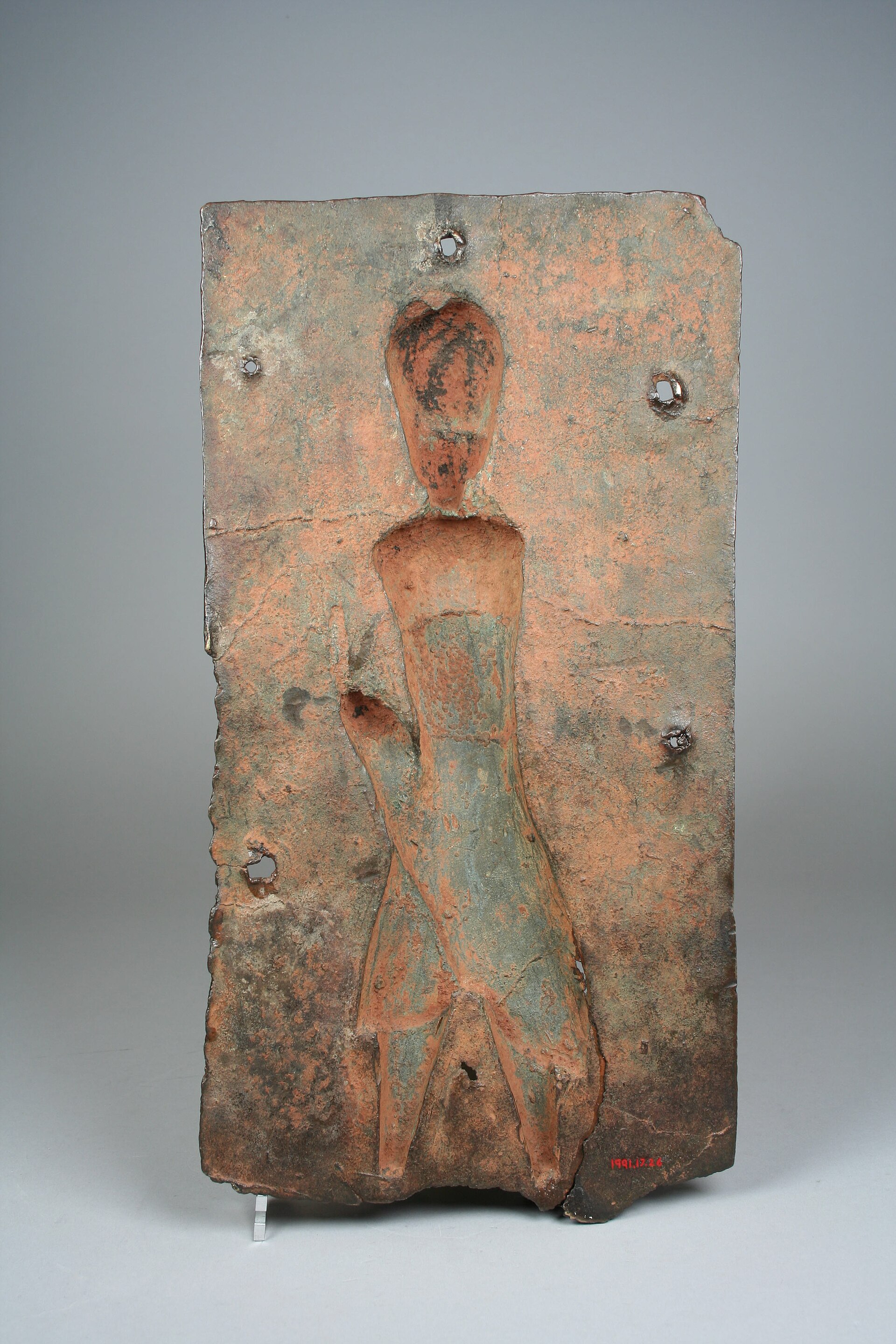
| Technique | Lost-wax casting over a clay core, practised by the Igun Eronmwon guild. The investment mould is destroyed to release the casting, so every piece is unique and no edition, cast number or foundry mark exists. There is no equivalent here of the numbering and foundry evidence that identifies a bronze in a Western edition.1819 |
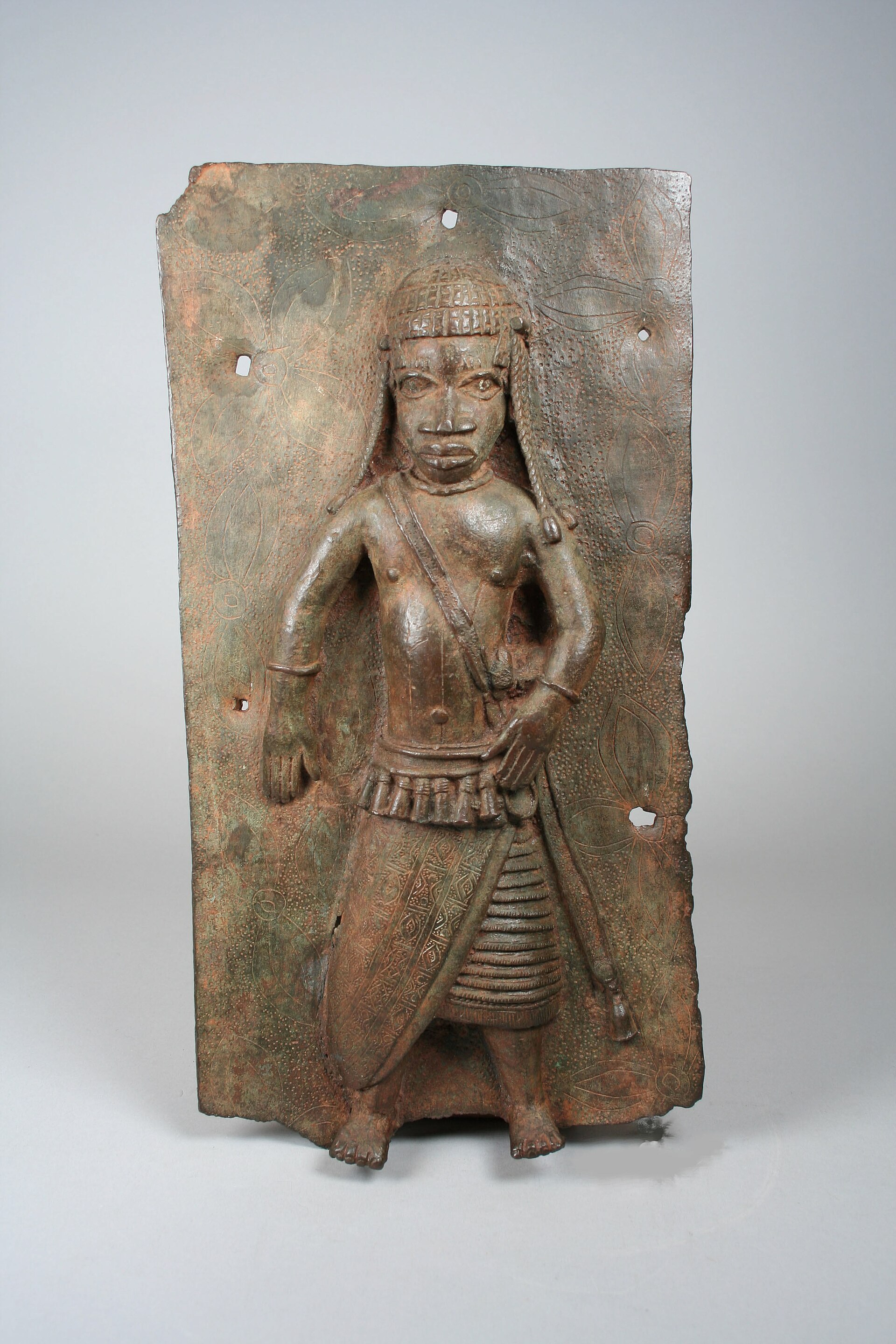
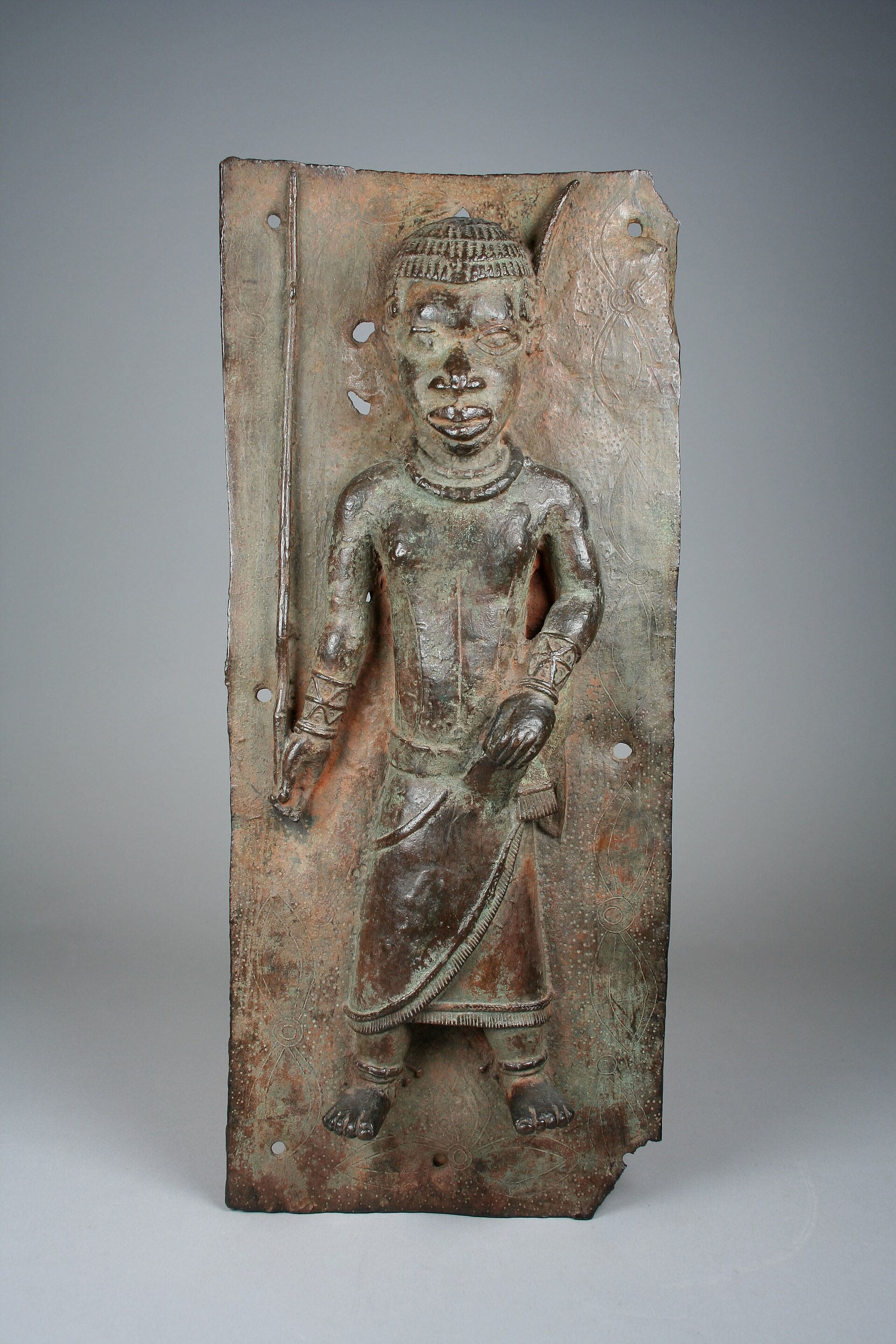
| The plaques | More than 900 cast brass relief plaques were found in a storage room in the palace in 1897, probably dating 1500 to the mid-1600s. They had been fixed to pillars in the palace compounds and retain the fixing holes. Typical heights run about 35 to 50 cm: Metropolitan Museum 1991.17.26 is 39.4 cm, 1991.17.21 is 37.5 cm, both dated by the Met to about 1540 to 1570.116 |
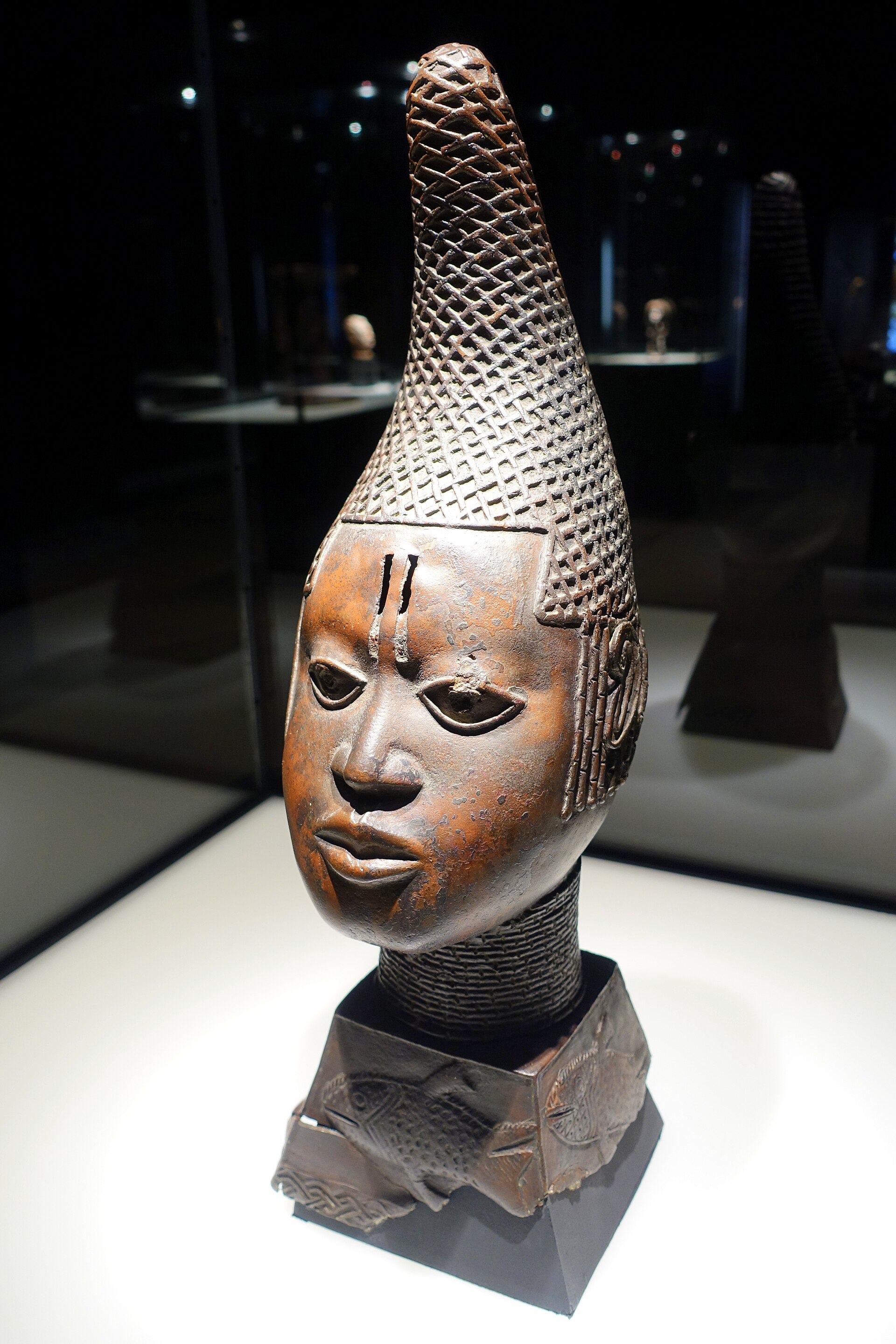
| The other principal groups | Commemorative brass heads of past Obas and Queen Mothers made for ancestral altars, with carved ivory tusks set into the open crowns; brass and ivory figures, animals, bells and hip ornaments; regalia and personal ornaments; carved ivory arm cuffs and staffs of office; wooden objects.12 |
| Size of the corpus | Digital Benin recorded 5,246 objects held by 131 institutions in 20 countries at its launch in November 2022. That is museum holdings only and excludes private collections, so it is a floor rather than a total. Contemporary estimates of the number of objects removed in 1897 run into the thousands; no audited figure exists.1022 |
| Largest single holding | The British Museum, which states that over 900 objects from the historic Kingdom of Benin are in its care, with more than 100 on rotating display. A figure of 928 is reported in the press. Its plaque holding derives from a donation of 203 plaques by the Secretary of State for Foreign Affairs in 1898, out of 304 first shown on loan in autumn 1897.17 |
| Marks and inscriptions | None original. The objects carry no signatures, dates or maker's marks. All inventory numbers, labels and collection marks now on them were applied after 1897 by European and American holders.116 |
| Modern castings | Roughly 120 members of the Igun Eronmwon guild continue to cast on Igun Street in Benin City using the same lost-wax method. The guild's quarters lay within the palace grounds until 1897; artisans fled during and after the invasion and began returning after the restoration of the throne to Oba Eweka II in 1914, at which point casters populated what became Igun Street. Modern Benin City castings are made and sold openly and are a recurring source of misdescription in the lower market. Age is not readable from technique, because the technique did not change.1819 |
Images
The record in full
Chapter 1The name is wrong in three separate ways
They are mostly not bronze. The British Museum, which holds the largest group, describes them in its own words as made of brass and bronze, and the analytical literature is consistent: the great...
They are mostly not bronze. The British Museum, which holds the largest group, describes them in its own words as made of brass and bronze, and the analytical literature is consistent: the great majority of the castings are leaded brass, a copper-zinc alloy, not the copper-tin alloy that bronze means. The term stuck because nineteenth-century European curators used it loosely and because it has been printed on labels for more than a century.
They are not all castings. The Kingdom of Benin supported guilds working in ivory, wood, leather, coral and red stone, and textiles, and the phrase Benin Bronzes is habitually stretched to cover objects in all of those materials. The Horniman group transferred to Nigeria in 2022 contained twelve brass plaques and also an ivory staff of office, an ivory arm cuff and a carved wooden box frame. A count of Benin Bronzes and a count of Benin objects are not the same count, and published figures rarely say which they are.
And they are not from the country now called Benin. The Kingdom of Benin was an Edo state whose capital, Benin City, sits in what is now Edo State in southern Nigeria. The Republic of Benin, on the other side of Nigeria, was called Dahomey until 1975 and has no connection to these objects. The confusion is not hypothetical: the twenty-six royal objects France returned in 2021 came from the palaces of Abomey in Dahomey, and they are regularly folded into Benin Bronze totals by writers who have read the word Benin and stopped.
Chapter 2A hereditary guild, a royal monopoly, and a craft that was broken and resumed
The castings were made by Igun Eronmwon, the brass-casters guild of the royal court.
The castings were made by Igun Eronmwon, the brass-casters guild of the royal court. Court oral history places the introduction of lost-wax casting in the thirteenth century, under Oba Oguola, by a caster brought from Ife who is named in different tellings as Iguegha or Ahammangiwa. Oba Esigie, in the sixteenth century, is credited with consolidating the guild's monopoly and its quarter. Membership passed from father to son and casting for the court was reserved to the guild.
Where the guild lived is part of the story of 1897 and is usually got wrong. The Metropolitan Museum's account is specific: the Igun Eronmwon quarters remained WITHIN the palace grounds until the British invasion of 1897, during and after which many court artisans fled the capital. After the restoration of the throne to Oba Eweka II in 1914 guild members began returning, and brass-casting specialists populated what became known as Igun Street. The street that now carries the guild's name is therefore a post-1914 address, and the tradition it houses was broken by the expedition and then resumed, not carried through unaltered.
The technique is lost wax over a clay core. A model is built in wax on a shaped core, invested in clay, heated until the wax runs out, and filled with molten metal; the mould is broken to release the casting, so every piece is unique by construction. There is no edition, no cast number and no foundry mark to read, and the entire apparatus by which a Rodin or a Degas bronze is placed in its edition does not exist here. The only external evidence a Benin casting carries is its metal and its museum paperwork.
Roughly 120 guild members work on Igun Street today, casting by the same method. Their existence creates a category this record has to keep separate from the historic corpus: modern Benin City castings, sold openly, which look like the old ones and appear constantly in the lower reaches of the market described as antique. Age is not readable from technique, because the technique did not change.
Chapter 3The brass came from the Rhineland, and that is now measurable
The metal was imported. From the late 1400s Benin traded with Portugal and later with other European powers, and the standard currency of that trade on the West African coast was the manilla, a...
The metal was imported. From the late 1400s Benin traded with Portugal and later with other European powers, and the standard currency of that trade on the West African coast was the manilla, a horseshoe-shaped brass bracelet made in Europe in enormous quantities and exchanged for pepper, ivory, cloth and people. Benin's casters worked European trade metal.
Until recently that was an inference from trade records. In April 2023 Tobias Skowronek of the Technische Hochschule Georg Agricola and colleagues published in PLOS ONE the results of lead isotope and trace element analysis on 67 manillas recovered from five Atlantic shipwrecks and three land sites in Europe and Africa, dated between the sixteenth and nineteenth centuries. The lead isotope signatures of the earliest type, the tacoais manillas, match lead-zinc ores mined in Germany's Rhineland, and the same signature appears in the Benin castings. The study's claim is precise and narrower than it is usually reported: the Rhineland was the principal source of the manillas at the opening of the Portuguese trade, and the tacoais type was an exclusive product of the Rhenish industries, with other European manufacturers entering the trade in the eighteenth century.
Read what that does to the object. A Benin plaque of about 1550 is a West African sculpture made from German metal that reached the Bight of Benin as trade currency in an economy whose principal export was, for much of the period, enslaved people. The British Museum states the point about that trade plainly in its own account, including the participation of Benin and other African kingdoms in supplying it, while noting that the extent of that participation remains debated. The metal is not a neutral technical fact. It is the trade itself, solidified.
Chapter 4What the plaques were, and what they were for
The best-known group is the cast brass relief plaques.
The best-known group is the cast brass relief plaques. More than 900 of them were found in a storage room inside the palace in 1897, probably dating between 1500 and the mid-1600s. They had previously been fixed to the pillars of the palace compounds, and the nail and suspension holes are still in them. They show the Oba, chiefs, warriors, court officials, Portuguese traders and mercenaries, and ceremonial acts, and they are the closest thing the kingdom produced to a systematic visual record of its own dynastic and social history.
The other principal groups are commemorative brass heads of past Obas and Queen Mothers, made for ancestral altars and paired with carved ivory tusks set into their open crowns; figures, animals and bells; and regalia and personal ornaments. These were not decoration. They were the working equipment of a court religion in which the reigning Oba's authority was validated through his ancestors, and objects were commissioned for named altars and used in specific rites to honour them. An altar head removed from its altar is not simply a sculpture that has changed rooms; the object was made to do something in a place, and it stopped.
Chapter 5January 1897: the Phillips mission
By the 1890s British commercial and political control of the Niger coast was close to complete, and the Kingdom of Benin's trading conditions were an obstacle to it.
By the 1890s British commercial and political control of the Niger coast was close to complete, and the Kingdom of Benin's trading conditions were an obstacle to it. In January 1897 a British party under the acting consul-general James Phillips advanced on Benin City after being told not to enter during a religious festival. It was ambushed on the road.
The British Museum's account gives seven British delegates and 230 of the mission's African carriers killed, and describes the mission as allegedly peaceful but clearly provocative. Other accounts give six British dead and about 200 carriers. This record reports the divergence rather than picking a number, because the two counts come from different traditions of reporting and neither is a primary muster roll consulted here. What is not in dispute is the ratio. The overwhelming majority of the dead in the incident that triggered the expedition were African.
Chapter 6February 1897: the expedition, and looting as policy
The retaliatory expedition sailed within weeks.
The retaliatory expedition sailed within weeks. A naval brigade of about 1,200 men under Rear-Admiral Harry Rawson advanced from 9 February and took Benin City on 18 February 1897. The Oba's palace was burned and partly destroyed, and its shrines and compounds were stripped.
The British Museum's own wording on how the objects left is worth setting down exactly, because it forecloses the euphemism: thousands of objects of ceremonial and ritual value were taken to the UK as official spoils of war or distributed among members of the expedition according to their rank. That is two distinct channels, both official. One produced a consignment to the Foreign Office. The other put objects into the hands of individual officers and men, and it is the second channel that generated most of the objects now in private hands and a great many of those in museums. No source consulted quantifies how many private holdings that produced, and this record does not estimate.
No figure exists for how many people of Benin City were killed. Several chiefs were executed after the occupation. Oba Ovonramwen was captured and sent into exile at Calabar. There was no Oba between 1897 and 1914, when Eweka II was installed. The independent kingdom ended.
Chapter 7How the market was made, in one autumn
The dispersal was fast and it was administered.
The dispersal was fast and it was administered. In the autumn of 1897 the British Museum displayed 304 Benin plaques on loan from the Secretary of State for Foreign Affairs, then petitioned successfully to receive 203 of them as a donation. Most of the remaining plaques were sold to museums in the United Kingdom and Germany and to private dealers; a few were kept by the Foreign Office. Objects from the private channel entered the trade immediately.
The Horniman Museum's published account of two of its own acquisitions shows the private channel operating at street level. Frederick Horniman, the museum's founder, bought ivory objects and a carved wooden frame from W. J. Hider of the Royal Navy in March 1897, one month after the city fell; Hider had accompanied Rawson's force and, in the Horniman's words, was personally involved in the looting. Richard Quick, the museum's first curator, bought two plaques, a brass hip ornament and a key from the King's House on 4 October 1899 from James Tingley, a resident of Forest Hill near the museum. How Tingley got them is unclear. That sentence, in the holder's own publication, is the ordinary condition of this material.
Berlin bought heavily, which is why Germany held over a thousand pieces a century later. British and American collections went on absorbing private holdings for another half-century: the British Museum itself only reached its present size through the acquisition of the Harry Beasley collection in 1944, the William Oldman collection in 1949 and the Sir Henry Wellcome collection in 1954.
Chapter 8The British Museum sold plaques it wrongly called duplicates
In 1950 and 1951 the British Museum deaccessioned 29 of the Benin plaques in its collection, on the understanding that they were duplicates of plaques it was keeping.
In 1950 and 1951 the British Museum deaccessioned 29 of the Benin plaques in its collection, on the understanding that they were duplicates of plaques it was keeping. The museum now states that further research has shown that understanding to be incorrect. There are no duplicates. Each plaque is a unique lost-wax casting and the mould was destroyed to release it.
Twenty-five of the 29 were sold, exchanged or given to the Colony and Protectorate of Nigeria and later accessioned by the new museums in Lagos and Benin City. One was sold in 1954 to the colonial government of the Gold Coast and is now in the National Museum in Accra. A further eight were sold to or exchanged with private dealers and collectors between 1952 and 1972.
Two of those plaques did not stay in Lagos. The Metropolitan Museum of Art states that the plaques it returned to Nigeria in 2021, Warrior Chief and Junior Court Official, were transferred by the British Museum to the National Museum in Lagos in 1950 to 1951 WITH 24 OTHERS, were never deaccessioned by that museum, entered the international art market at an unknown date and under unclear circumstances, and were acquired by a New York collector who gave his Benin collection to the Met in 1991. That collector was the modern-art dealer Klaus Perls, with his wife Dolly. Note that the two institutions do not quite agree on the arithmetic: the British Museum says twenty-five went to Nigeria, the Met describes its two plus twenty-four others, which makes twenty-six. Neither reconciles the other and this record does not average them.
What is certain is the shape of the route. A plaque taken from the palace in 1897, given to the British Museum by the Foreign Office in 1898, sold out of London as a duplicate it was not, sent to Lagos, and removed from Lagos without a record, arrived in New York as a gift and was deaccessioned back to Nigeria in 2021. Every step of that is documented except the one that matters.
Chapter 9Title, custody and loan are three different things
This is the section the reporting collapses.
This is the section the reporting collapses. Read each transfer for what it actually moved.
Germany. The joint declaration signed in Berlin on 1 July 2022, with the German foreign minister Annalena Baerbock and Nigeria's information and culture minister Lai Mohammed among the signatories, covered all 1,130 Benin objects in German public museums. It was a FRAMEWORK, not a conveyance: its own text provides that the NCMM and the respective German museums will sign transfer agreements, including transfer of ownership. The transfers then happened institution by institution. The largest was Berlin: on 25 August 2022 Hermann Parzinger for the Stiftung Preussischer Kulturbesitz and Abba Isa Tijani for the NCMM signed over 512 objects, which the SPK called the most extensive transfer of ownership of museum objects from a colonial context to date, with about a third remaining on loan in Berlin for an initial ten years, renewable, and exhibited in the Humboldt Forum. The process was not finished in 2022: the Reiss-Engelhorn-Museen in Mannheim obtained council approval to restitute its 29 objects only on 29 July 2025. Two objects were physically handed over at the Berlin signing in July 2022, and twenty more at the foreign ministry in Abuja on 20 December 2022, in a ceremony led by Baerbock with the culture minister of state Claudia Roth. A visitor to Berlin in 2026 who sees a Benin head sees a Nigerian object on loan, and the label is the only thing that says so.
The Horniman Museum, London. Trustees agreed in July 2022; ownership of 72 objects passed to the NCMM at a ceremony on 28 November 2022. Six objects, selected with the NCMM as representative, travelled. The other 66 stayed in London on loan, with a second phase of physical repatriation to follow. The Horniman was the first public UK institution to restitute its Benin collection.
The Smithsonian. On 11 October 2022 the National Museum of African Art transferred ownership of 29 Benin objects to the NCMM, following a 2021 provenance evaluation that identified those 29 as removed in the 1897 raid. The museum's own release records eight of the 29 as returned at the ceremony that day. The widely reported split of twenty travelling and nine remaining on loan is press reporting and is not in the release.
The Netherlands. On 19 February 2025 at the Wereldmuseum in Leiden the Dutch culture minister Eppo Bruins and the NCMM director-general Olugbile Holloway signed the transfer of 113 objects from the Dutch national collection, with the municipality of Rotterdam giving back six more. Total 119. The handover took place at the National Museum in Lagos on 21 June 2025. This is the largest physical return to date and the objects did go, with one qualification the Dutch government states in the same notice: four items remain on display in the Wereldmuseum under a loan agreement.
Cambridge. The Museum of Archaeology and Anthropology transferred legal title to 116 objects to the NCMM on 8 February 2026, authorised by the Charity Commission and supported by the university council. Seventeen remain in Cambridge on loan for an initial three years; the rest are to travel during 2026. The NCMM operates under a management agreement with the Benin Royal Palace. Its director-general Olugbile Holloway put the case for the whole programme in one sentence: the return of cultural items, for us, is not just the return of the physical object, but also the restoration of the pride and dignity that was lost when these objects were taken.
Boston. On 27 June 2025 the Museum of Fine Arts transferred two works, a terracotta and iron commemorative head of the sixteenth or seventeenth century and a sixteenth-century relief plaque showing two officials with raised swords. Title went to Oba Ewuare II. Custody did not go to him directly: the museum's own release states that the National Commission for Museums and Monuments, working with the Embassy of Nigeria in Washington, will take possession of the two works and coordinate their handling, care, transit to Nigeria, and delivery to the Oba of Benin. Even the transfer that is reported as bypassing the state ran through the state agency.
Chapter 10Nigeria changed the recipient in 2023
On 23 March 2023 President Muhammadu Buhari made a presidential declaration recognising Oba Ewuare II as owner and custodian of the objects looted in 1897, covering both those already repatriated and...
On 23 March 2023 President Muhammadu Buhari made a presidential declaration recognising Oba Ewuare II as owner and custodian of the objects looted in 1897, covering both those already repatriated and those still to come, and providing that the federal government and the Oba jointly superintend safety and security while the Oba is free to engage with national and international institutions. It was published in the official gazette as Notice No. 25 in Gazette No. 57, Volume 110, beginning at page A245; the gazette itself is dated 28 March 2023. Buhari left office on 29 May, so this was among the last acts of his presidency rather than a deathbed signature days before departure.
Every European and American transfer up to that point had been negotiated with, and made to, the National Commission for Museums and Monuments, a federal agency. Barnaby Phillips, the author of Loot: Britain and the Benin Bronzes, said the declaration had blindsided the NCMM. Museums that had spent two years constructing agreements with a government body found that the objects had been vested in a traditional ruler who had not been a party to them.
The position as it now stands is a compromise of practice rather than of law. Cambridge transferred title in 2026 to the NCMM, which operates under a management agreement with the Benin Royal Palace. The MFA in Boston vested title in the Oba and left custody with the NCMM. The University of Iowa's Stanley Museum of Art had already become, on 15 July 2024, the first institution IN THE UNITED STATES to return Benin works directly to the royal family. A museum deciding today whom to give a Benin object to is choosing between a federal agency and a monarch, and the choice is being made differently by different institutions in the same year.
Chapter 11The British Museum has not moved, and cannot easily
The British Museum holds the largest collection of Benin material in the world.
The British Museum holds the largest collection of Benin material in the world. Its own page says over 900 objects from the historic Kingdom of Benin, with more than 100 on rotating display in the Africa galleries; press accounts in 2025 put the figure at 928.
In October 2021 the museum received a written request for the return of Nigerian antiquities from Nigeria's Federal Ministry of Information and Culture, and representatives of the Benin Royal Palace repeated the request at a Benin Dialogue Group meeting the museum hosted the same month. The museum asked for clarifications; Lai Mohammed visited in July 2022 and provided them.
The obstacle usually named for the British Museum is statutory. The British Museum Act 1963 bars it from deaccessioning objects from its collection except in narrow circumstances, so a transfer of title of the kind Cambridge and the Horniman made is not available to it without an Act of Parliament. It is worth being exact about who is saying this: the Act is cited in press coverage and by commentators, and the museum's own Benin page, read in full for this record, does not mention it. The distinction is also real and convenient at once: the Horniman, Cambridge and Oxford are charities governed by different instruments, which is why they were able to move first. The director Nicholas Cullinan has ruled out pursuing restitution during his tenure and favours long-term loans and partnership. In August 2018 the then director Hartwig Fischer had an audience with Oba Ewuare II, who repeated the request for return and also acknowledged that the objects serve as cultural ambassadors for Benin culture when displayed internationally. That second clause is quoted by the museum, and it is the only place in this record where the claimant's own words can be read as supporting a case for retention.
Chapter 12Where the returned objects are supposed to go, and the night that stopped
The building meant to receive them is the Museum of West African Art in Benin City, designed by Adjaye Associates and long trailed as the destination for repatriated material.
The building meant to receive them is the Museum of West African Art in Benin City, designed by Adjaye Associates and long trailed as the destination for repatriated material. Its opening was set for 11 November 2025.
On 9 November 2025, during a preview attended by more than 250 invited guests, a group of protesters in red hats broke into the main building. The director Phillip Ihenacho told Agence France-Presse that they entered and began vandalising part of the reception pavilion and then stormed the exhibition area. Reports linked the protest to the Oba's displeasure over funding and over the restitution and safekeeping of the objects; the protesters' identities were not confirmed. The public opening was postponed on 17 November. The day after the protest the governor of Edo State, Monday Okpebholo, announced that he was revoking the certificate of occupancy for the land the museum stands on, citing overriding public interest and doubts about ownership and governance.
No Benin object had been transferred to the site. Ihenacho's own formulation is the flattest statement anyone involved has made: we are not a receptacle for the Benin Bronzes, we do not have an entitlement to Benin Bronzes. The Oba's position is that the objects should be displayed at the palace they were taken from. Repatriated material returning to Nigeria is currently going into NCMM storage, including a facility at the National Museum in Benin City named for Oba Ovonramwen.
This account is current to 17 November 2025 and no further. Developments in the dispute during 2026 have not been verified for this record, and a reader acting on the present state of the museum should check what has happened since.
Chapter 13The market, and what it will not publish
These objects have a long auction record and it is ethically live, which makes the hammer-and-premium discipline worth applying carefully.The auction record was set in 2007, when Sotheby's New York...
These objects have a long auction record and it is ethically live, which makes the hammer-and-premium discipline worth applying carefully.
The auction record was set in 2007, when Sotheby's New York sold a commemorative head of an Oba dated about 1575 to 1625 for a premium-inclusive 4.74 million dollars. The consignor was the Albright-Knox Art Gallery in Buffalo, New York, which deaccessioned it. The hammer figure is not published in the sources consulted, and the reported figure includes buyer's premium.
The highest reported price for any Benin work was not made at auction at all. In 2016 Woolley and Wallis of Salisbury, working with the London dealer Lance Entwistle, placed an early memorial head by private treaty with a private collector. Paul Viney, the auctioneer's chairman, described it as a substantial seven-figure sum which the firm believed to be a record price for any Benin work of art. Press reporting gives 10 million pounds. Those two figures are not compatible: ten million is an eight-figure number, and the only statement the seller stands behind is the seven-figure one. There is no hammer price because there was no auction, and a private treaty sale publishes nothing it is not obliged to publish. The consignors were the children of the London dealer Ernest Ohly, who had bought the head at Glendining's in December 1951 for 230 pounds and put it in a safe deposit box in 1953; his instruction to his family was that it was not to be sold unless there was another Holocaust. Ohly's father William was Jewish and had fled Nazi Germany. The buyer has not been named publicly; the trade account of the sale states that he was the same collector who bought the 2007 Sotheby's head.
The most consequential sale of recent decades is the one that was called off. On 20 December 2010 Sotheby's announced for 17 February 2011 a sixteenth-century Benin ivory pendant mask, read by scholars as a portrait of Idia, the first Queen Mother of Benin, with five other Benin objects, estimated at 3.5 to 4.5 million pounds. The consignors were descendants of Lieutenant-Colonel Sir Henry Lionel Gallwey, later Galway, who took part in the 1897 expedition. Four days after the announcement, following an online campaign led by the Nigeria Liberty Forum, Sotheby's cancelled, stating that it did so at the request of the consignors. No auction, no hammer, no premium. But the mask did change hands: it is now in the Al-Thani Collection in Paris, owned by Sheikh Hamad bin Abdullah Al Thani, and Sotheby's was not involved in the subsequent sale. The withdrawal did not stop the transaction. It moved it out of public view, and that is the effect the episode actually had on this market.
Chapter 14The gap is the finding
A conventional provenance chain runs owner to owner with dates.
A conventional provenance chain runs owner to owner with dates. For most Benin objects that chain has a documented beginning, a documented end, and nothing usable in between, and the missing stretch is always the same stretch: from the palace compound in February 1897 to the first named European owner.
The reason is structural. The objects were removed by an army, in numbers, from a burning building, and then divided among the men who removed them by rank. Nobody made a list that maps an object to a room, and no such list has been found. When a museum register says purchased from a dealer in 1899 or bequeathed in 1944, that entry is accurate and it is also the point at which the record begins. It does not connect the object to the seizure, and it is not evidence that the object was not seized.
Digital Benin is the first serious attempt to make the corpus legible as a whole. Led by the Museum am Rothenbaum in Hamburg, funded at about 1.5 million euros by the Ernst von Siemens Kunststiftung, and launched in November 2022, it brought together records for 5,246 objects from 131 institutions in 20 countries, with photographs, Edo-language object names and oral histories alongside the museum documentation. It is the single most useful thing a researcher, a curator or a buyer can consult on this material, and it exists because no holder's own catalogue could answer the question of what there is and where it is.
What Digital Benin cannot supply is the missing link, because the link was never written. On this material an ungraded provenance step is not a defect in the research. It is the finding, and the correct response to it is to say so in the register rather than to write the word acquired.
The artist
Igun Eronmwon, the guild of brass-casters of the royal court of Benin
The maker of a Benin casting is a guild, not a person, and that is a fact about the object rather than a gap in the scholarship. Igun Eronmwon was one of up to fifty guilds attached to the palace of the Oba and the highest ranked of them. Its quarters lay inside the palace grounds until 1897, membership was inherited from father to son, and it held a monopoly on casting for the court. No caster active in the plaque period is named in any contemporary document, European or Edo. Western catalogues that print an artist field for these objects are filling a form.
Related works
| Work | Relation | Where it is |
|---|---|---|
| Plaque with court official, 1991.17.26 Igun Eronmwon guild, Benin City | A named example of the plaque group, still in the Metropolitan Museum Brass, about 1540 to 1570, 39.4 cm. Gift of Mr. and Mrs. Klaus G. Perls, 1991. From the same 1991 gift as the two plaques the Met deaccessioned and returned to Nigeria in 2021, and still recorded as in the Met collection. | Metropolitan Museum of Art, New York |
| Warrior Chief and Junior Court Official Igun Eronmwon guild, Benin City | The two plaques the Metropolitan Museum deaccessioned in 2021 Removed from the palace in 1897; British Museum 1898 to 1950; transferred to the National Museum in Lagos in 1950 to 1951 with 24 others; left Lagos without deaccession at an unknown date; acquired by Klaus and Dolly Perls; given to the Met in 1991; deaccessioned by the Met on 9 June 2021, at which date the museum stated they awaited delivery to the NCMM director-general's care. | Nigerian National Collections |
| Benin ivory pendant mask, read as Idia Benin court ivory carvers guild | The most contested Benin object type; the 2010 sale withdrawal Five are on public display and none is in Nigeria. The sixteenth-century example consigned by descendants of Sir Henry Gallwey was withdrawn by Sotheby's in December 2010 against a 3.5 to 4.5 million pound estimate after public protest, and later passed privately to Sheikh Hamad bin Abdullah Al Thani; Sotheby's was not involved in that sale. | Al-Thani Collection, Paris; British Museum; Metropolitan Museum; Linden-Museum Stuttgart; Seattle Art Museum |
| Memorial bust of a Queen Mother, iyoba Igun Eronmwon guild, Benin City | An example of the altar head group, in a collection whose title passed to Nigeria in 2022 Early sixteenth century. Berlin's Benin holdings are among the 512 objects whose ownership the Stiftung Preussischer Kulturbesitz transferred to the NCMM on 25 August 2022; about a third of that group remains in Berlin on loan for an initial ten years. | Ethnological Museum, Berlin |
| The royal treasures of Abomey Dahomey court workshops | The objects most often confused with these, in print Twenty-six objects taken from the palaces of Abomey in 1892 and returned by France in 2021. They are Dahomean, not Edo, and have no connection to Benin City. Counts of Benin Bronzes are routinely inflated by including them. | Republic of Benin |
| Ife brass head from the Wunmonije Compound Ife court casters | The third work the Met returned in 2021, and the wider West African brass tradition Fourteenth century. The Met brokered its return after determining that a seller offering it had been mistaken in believing the NCMM had granted legal title. | Nigerian National Collections |
Open questions
- For most Benin objects in Western collections, by whose hand did the object leave the palace in February 1897, and through whose hands did it pass before the first named owner in the register? No list mapping objects to rooms or to individual members of the expedition has been found, and this gap is the normal condition of the corpus rather than the exception.
- Did twenty-five or twenty-six plaques go to Lagos in 1950 to 1951? The British Museum says twenty-five of the twenty-nine it deaccessioned; the Metropolitan Museum describes its two plus twenty-four others. Neither institution addresses the other's figure.
- What are the accession numbers of the two plaques the Metropolitan Museum deaccessioned in June 2021, and when did they physically reach Nigeria? The museum names them as Warrior Chief and Junior Court Official and stated in June 2021 that they awaited collection. The numbers are not published in the sources consulted, and other plaques of similar title from the same 1991 gift remain in the collection.
- How and when did those two plaques leave the National Museum in Lagos? The Met's own statement says they were never deaccessioned by that museum and entered the market at an unknown date under unclear circumstances. Nothing published resolves it.
- Where are the eight plaques the British Museum sold to or exchanged with private dealers and collectors between 1952 and 1972? The museum records the transactions but the sources consulted do not name the buyers or the present holders.
- How many of the 1,130 objects covered by the German framework declaration have actually had their ownership transferred, and how many have physically moved? Berlin's 512 are documented and Mannheim's 29 were approved only in July 2025. No public register tracks the physical position against the title position across all the German holders.
- After the March 2023 declaration, is a transfer of title to the NCMM legally effective as a transfer to the Oba, or does it depend on the management agreement between them? Institutions in 2025 and 2026 have vested title in both, and the sources consulted do not establish which route is dispositive.
- Where will the repatriated objects be displayed? The Museum of West African Art has no Benin objects and disclaims entitlement to them, its opening was postponed after the November 2025 protest, and the Edo State governor moved to revoke its certificate of occupancy. This record's account stops on 17 November 2025 and developments during 2026 have not been verified here.
- What did the 2016 private treaty head actually sell for? The auctioneer published only a substantial seven-figure sum; the 10 million pound figure is press reporting and is an eight-figure number, so the two cannot both be right. The buyer has not been named, though the trade account states he was the same collector who bought the 2007 Sotheby's head.
- How many of the 29 Smithsonian objects have physically reached Nigeria? The museum's release records eight returned at the October 2022 ceremony; the widely repeated split of twenty travelling against nine on loan is press reporting and is not in the release.
Questions about this object
What is The Benin Bronzes?
The Benin Bronzes is a sculpture, dated plaques probably 1500 to mid-1600s; commemorative heads, figures, regalia and ivories from at least the 1500s and continuing to 1897. Medium: Cast leaded brass, with some true bronze; also carved ivory, wood, iron, coral and red stone.
Who made The Benin Bronzes, and is the attribution settled?
The attribution to Igun Eronmwon, the royal brass-casters guild of Benin City is recorded here as workshop. Not attributable to a named hand. The castings were made by Igun Eronmwon, the hereditary brass-casters guild of the royal court at Benin City, working under the Oba and living in a designated quarter of the city. The guild is the maker in the sense that matters: membership was inherited, the technique was taught inside families, and casting for the court was a royal monopoly. No individual caster of the plaque period is named in any contemporary document. Where a Western catalogue prints an artist field for one of these objects it is printing a convention, not evidence.
Where is The Benin Bronzes now?
Dispersed. Digital Benin recorded 5,246 objects across 131 institutions in 20 countries at its launch in November 2022. The largest single holding is the British Museum, which states that it cares for over 900 objects from the historic Kingdom of Benin. Since 2021 title to more than 1,400 objects has been transferred to Nigeria by institutions in Germany, the Netherlands, the United Kingdom and the United States, and a substantial share of those remain physically in Europe and America on loan. Inventory number Multiple; see technical and narrative. Last confirmed 4 August 2026. Institutional statements and published transfer agreements, verified against each holder's own publication where one exists.
What is still unknown about The Benin Bronzes?
For most Benin objects in Western collections, by whose hand did the object leave the palace in February 1897, and through whose hands did it pass before the first named owner in the register? No list mapping objects to rooms or to individual members of the expedition has been found, and this gap is the normal condition of the corpus rather than the exception.
Sources
- 1The British Museum, 'Benin Bronzes', in the Contested objects from the collection series. Read in full via the in-app browser after the site returned HTTP 403 to curl and to a direct fetch. Source for the 1897 expedition, the 304 plaques shown on loan in autumn 1897 and the 203 donated in 1898, the Beasley, Oldman and Wellcome acquisitions, the 1950-51 deaccession of 29 plaques as duplicates and the disposal of 25, one and eight, the January 1897 casualty figures, and the museum's present position. NOTE: the page does NOT mention the British Museum Act 1963; the statutory obstacle is cited in press coverage, not by the museum here. britishmuseum.org/about-us/...
- 2Horniman Museum and Gardens press release, 28 November 2022, 'Six objects to return to Nigeria as Horniman formally transfers ownership of Benin Bronzes'. Names W. J. Hider, James Tingley, Richard Quick and Frederick Horniman, and separates the transfer of ownership of 72 objects from the physical return of six. horniman.ac.uk/story/...
- 3The Metropolitan Museum of Art press release, 9 June 2021. The primary source for the Lagos transfer of 1950-51 with 24 others, the undocumented removal from Lagos, the Perls gift of 1991, and the museum's statement that the deaccessioned plaques awaited delivery to the NCMM director-general when he could travel to New York. metmuseum.org/press-releases/...
- 4The Art Newspaper, 26 April 2023, on the Nigerian presidential declaration of 23 March 2023 vesting ownership and custody in the Oba of Benin, and its effect on museums that had negotiated with the NCMM. Quotes Barnaby Phillips. theartnewspaper.com/2023/...
- 5Museums Association, Museums Journal, February 2026, 'Cambridge University transfers ownership of 116 Benin bronzes to Nigeria'. The 8 February 2026 date, the Charity Commission authorisation, the 17 objects retained on loan for three years, the NCMM's management agreement with the Benin Royal Palace, and the Olugbile Holloway quotation used in this record. museumsassociation.org/museums-journal/...
- 6The Art Newspaper, 20 February 2025, 'The Netherlands to return 113 Benin Bronzes to Nigeria'. The 19 February 2025 signing, the 113 from the Dutch national collection and 6 from Rotterdam, and the legal transfer of ownership by the culture minister Eppo Bruins. theartnewspaper.com/2025/...
- 7Artnet News, 2 July 2025, 'Why the Benin Bronzes Are Being Returned - and Who Gets Them'. The MFA Boston transfer, the 21 June 2025 Lagos handover, the Stanley Museum of Art return, the British Museum figure of 928, and the state-versus-Oba question. Read via the in-app browser after HTTP 403. Note that this source calls the Stanley Museum the first institution to return directly to the royal family without the qualifier 'in the United States' that every other account carries; this record uses the qualified form. news.artnet.com/art-world/...
- 8Government of the Netherlands, 18 June 2025, 'Benin Bronzes from the Netherlands returning home to Nigeria'. Read verbatim: 119 objects, 6 given back by the Municipality of Rotterdam, the official handover on 21 June at the National Museum in Lagos, and '4 items will remain on display in the Wereldmuseum on a loan agreement'. government.nl/latest/...
- 9Tobias Skowronek and others, 'German brass for Benin Bronzes: geochemical analysis insights into the early Atlantic trade', PLOS ONE, 5 April 2023. Lead isotope and trace element analysis of 67 manillas from five Atlantic shipwrecks and three land sites, matching the tacoais type to Rhineland lead-zinc ores as the principal source at the opening of the Portuguese trade. journals.plos.org/plosone/...
- 10Digital Benin, the union catalogue of Benin objects in institutional collections worldwide, led by the Museum am Rothenbaum (MARKK), Hamburg, and launched November 2022. digital-benin.org
- 12The Art Newspaper, 10 November 2025, 'Opening of Museum of West African Art in Nigeria delayed after protests'. The 9 November protest, the 250 invited guests, the 17 November postponement, and Phillip Ihenacho's statement that the museum is not a receptacle for the Benin Bronzes. theartnewspaper.com/2025/...
- 13Duende Art Projects, 'The Ohly Benin head - not to be sold, unless there was another Holocaust'. TRADE BLOG, a tertiary source summarising BBC reporting; to be replaced with the BBC piece and with Woolley and Wallis's own announcement. Source for the December 1951 Glendining's purchase at GBP 230, the safe deposit box in 1953, the family instruction, the 2016 private treaty sale through Lance Entwistle, and the statement that the 2016 buyer was the collector who had bought the 2007 Sotheby's head. duendeartprojects.com/blog/...
- 14Artforum, 'After Protests, Sotheby's Withdraws African Mask from Sale'. The withdrawal of the Idia ivory pendant mask and five other Benin lots consigned by the Gallwey descendants, at the request of the consignors, against a GBP 3.5-4.5 m estimate, announced 20 December 2010 for a sale scheduled 17 February 2011 and cancelled four days after the announcement. artforum.com/news/...
- 15Smithsonian Institution press release, 'Smithsonian Returns 29 Benin Bronzes to the National Commission for Museums and Monuments in Nigeria', 11 October 2022. The 2021 provenance evaluation that identified 29 objects as removed in the 1897 raid, the transfer of ownership to the NCMM, and a caption recording eight of the 29 as returned on the day. The frequently reported split of twenty travelling against nine on loan is NOT in the release and is treated here as press reporting. si.edu/newsdesk/...
- 16Metropolitan Museum of Art collection records for 1991.17.26 (object 316498), 1991.17.21 (316493) and 1991.17.22 (316494), retrieved from the museum's public collection API. Confirms title, date about 1540-70, medium brass, credit line 'Gift of Mr. and Mrs. Klaus G. Perls, 1991' and public-domain image status for each, and that all three remain in the collection. metmuseum.org/art/...
- 17Wikimedia Commons file page for the Granville photograph of the burnt palace compound, 18 February 1897. Wikitext read directly: photographer Reginald Kerr Granville (d. 1912), source De Montfort University PhotoCLEC, licence PD-old-auto-1923 and PD-Nigeria. commons.wikimedia.org/wiki/...
- 18The Metropolitan Museum of Art, Perspectives, 'Bronze Casters of Igun Street, Benin City, Nigeria'. Source for the guild's quarters lying within the palace grounds until 1897, the flight of court artisans during and after the invasion, their return after Oba Eweka II was installed in 1914, and the settlement of casting specialists on what became Igun Street. metmuseum.org/perspectives/...
- 19Smarthistory, 'Igun Eronmwon (brass-caster's guild)'. TERTIARY teaching resource, to be replaced with Barbara Plankensteiner's Benin Kings and Rituals catalogue and with Paula Ben-Amos. Source for the guild's rank among the palace guilds, the royal monopoly consolidated under Oba Esigie, and the Oguola-Iguegha origin tradition. smarthistory.org/artist/...
- 20The Art Newspaper, 4 November 2022, on the Benin ivory pendant masks: five are on public display and none is in Nigeria, and the mask withdrawn from Sotheby's by the Gallwey descendants is now in the Al-Thani Collection in Paris, owned by Sheikh Hamad bin Abdullah Al Thani, Sotheby's having had no part in the subsequent sale. theartnewspaper.com/2022/...
- 21Wikipedia, 'Benin Expedition of 1897'. TERTIARY, used only for the force strength of about 1,200 under Rear-Admiral Harry Rawson and the dates of the advance. Flagged for replacement with the Admiralty despatches and with Robert Home, City of Blood Revisited. en.wikipedia.org/wiki/...
- 22Museums Association, Museums Journal, November 2022, 'Digital Benin project unveils online platform'. The figures of 5,246 objects, 131 institutions and 20 countries, the two-year duration, the EUR 1.5 m budget and the Ernst von Siemens Kunststiftung funding. museumsassociation.org/museums-journal/...
- 23Joint Declaration between the Federal Republic of Nigeria and the Federal Republic of Germany on the return of Benin Bronzes and bilateral museum cooperation, signed in Berlin on 1 July 2022, published by the German Minister of State for Culture. Its text provides that the NCMM and the respective German public museums and institutions holding Benin Bronzes WILL SIGN transfer agreements, including transfer of ownership. It is a framework, not itself a conveyance, and the first version of this record wrongly described it as transferring ownership of the whole group. kulturstaatsminister.de/fileadmin/...
- 24Antiques Trade Gazette, 2017, 'Benin bronze helps Woolley and Wallis retain lead in regional sales league', reporting the 2016 private treaty sale and Paul Viney's 'substantial seven-figure sum', and citing the 2007 Sotheby's New York record of a premium-inclusive USD 4.74 m for an Oba head deaccessioned by the Albright-Knox Art Gallery against an estimate of USD 1-1.5 m. The site is behind a SUBSCRIPTION PAYWALL, not a bot block as the first version of this record stated; the figures are taken from the indexed text and should be re-verified against the printed issue. antiquestradegazette.com/news/...
- 25Stiftung Preussischer Kulturbesitz press release, 25 August 2022, '512 Berliner Benin-Bronzen wieder nigerianisches Eigentum'. The transfer of ownership of 512 objects, signed by Hermann Parzinger and Abba Isa Tijani, described as the most extensive transfer of ownership of museum objects from a colonial context to date, with about a third remaining on loan in Berlin for an initial ten years, renewable by mutual consent, exhibited in the Humboldt Forum. preussischer-kulturbesitz.de/en/...
- 26Museum of Fine Arts, Boston, press release, 'MFA Boston Returns Two Works of Art to Oba of Benin', Friday 27 June 2025. Read verbatim: the terracotta and iron Commemorative Head of the 16th or 17th century and the 16th-century bronze Relief Plaque Showing Two Officials with Raised Swords; title to His Royal Majesty Omo N'Oba Ewuare II; and 'The National Commission for Museums and Monuments, working with the Embassy of Nigeria in Washington, D.C., will take possession of these two works and coordinate their handling, care, transit to Nigeria, and delivery to the Oba of Benin.' mfa.org/press-release/...
- 26Switzerland returns 18 looted Benin Bronzes to Nigeria, Euronews euronews.com/culture/...

Last verified 8 August 2026 · Published 4 August 2026
Change log
2 August 2026 - Record deepened to the house standard: narrative sections, technical evidence, artist dossier, related works and open questions added; provenance chain and auction results replaced with the researched versions; sources rebuilt.
4 August 2026 - Record created at the house standard: researched narrative, technical evidence, maker dossier, graded provenance chain, prices with hammer and premium separated, related works, open questions and sources.
8 August 2026 - Re-verification pass. Added the Swiss restitution: a March 2026 agreement to transfer 28 objects, of which 18 were physically handed over 30 June 2026 by three institutions (University of Zurich Ethnographic Museum, Museum Rietberg Zurich, Musee d'Ethnographie de Geneve) at the National Museum, Lagos. This was missing from the provenance chain despite falling before the record's prior last_verified stamp. No other change to attribution or location; remaining source URLs re-checked and resolve.