The Amaravati Collection
Sculptors of the Amaravati school, Andhra · c. 200 BCE to c. 250 CE, with later pieces of about the 7th to 8th centuries
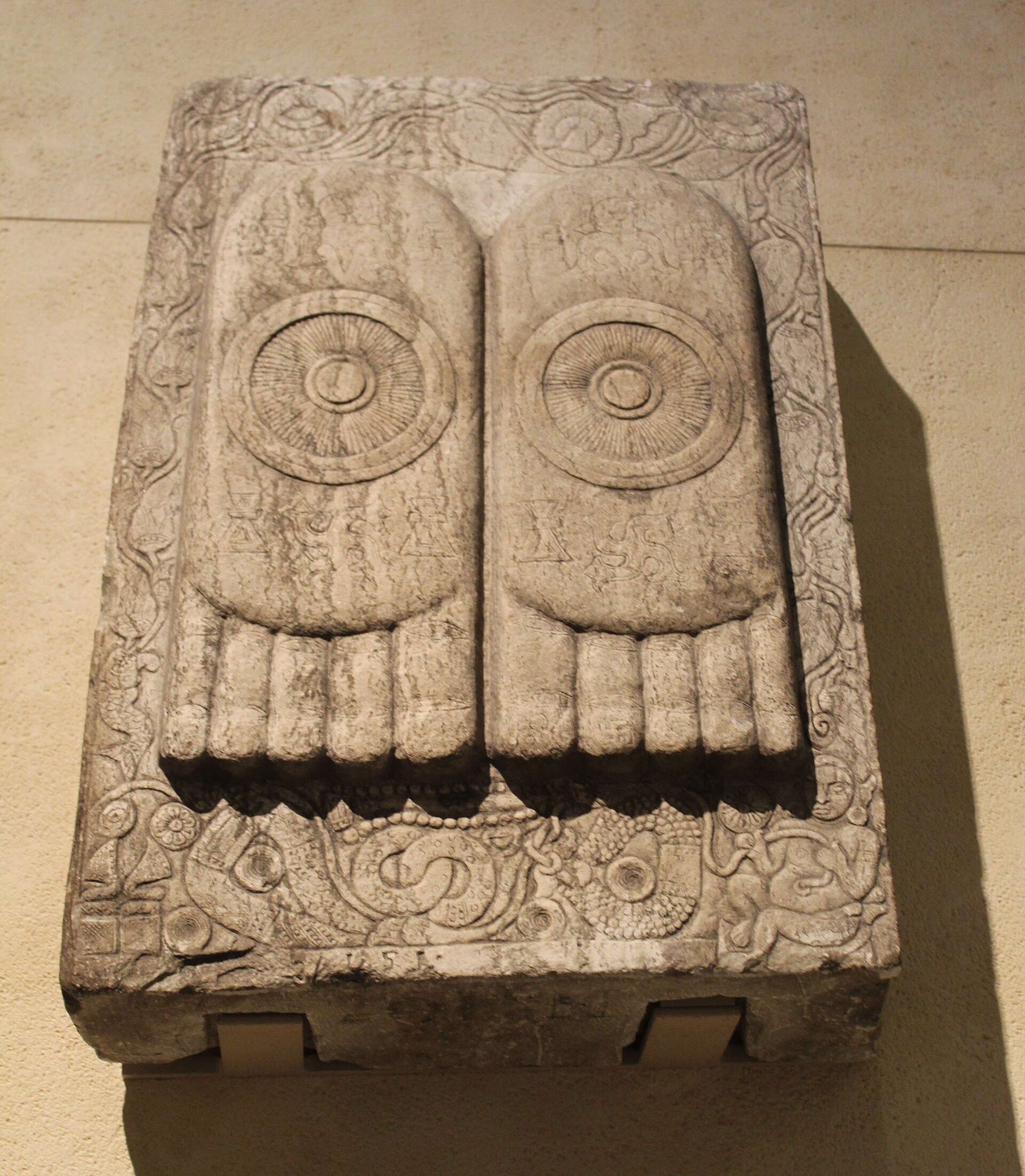
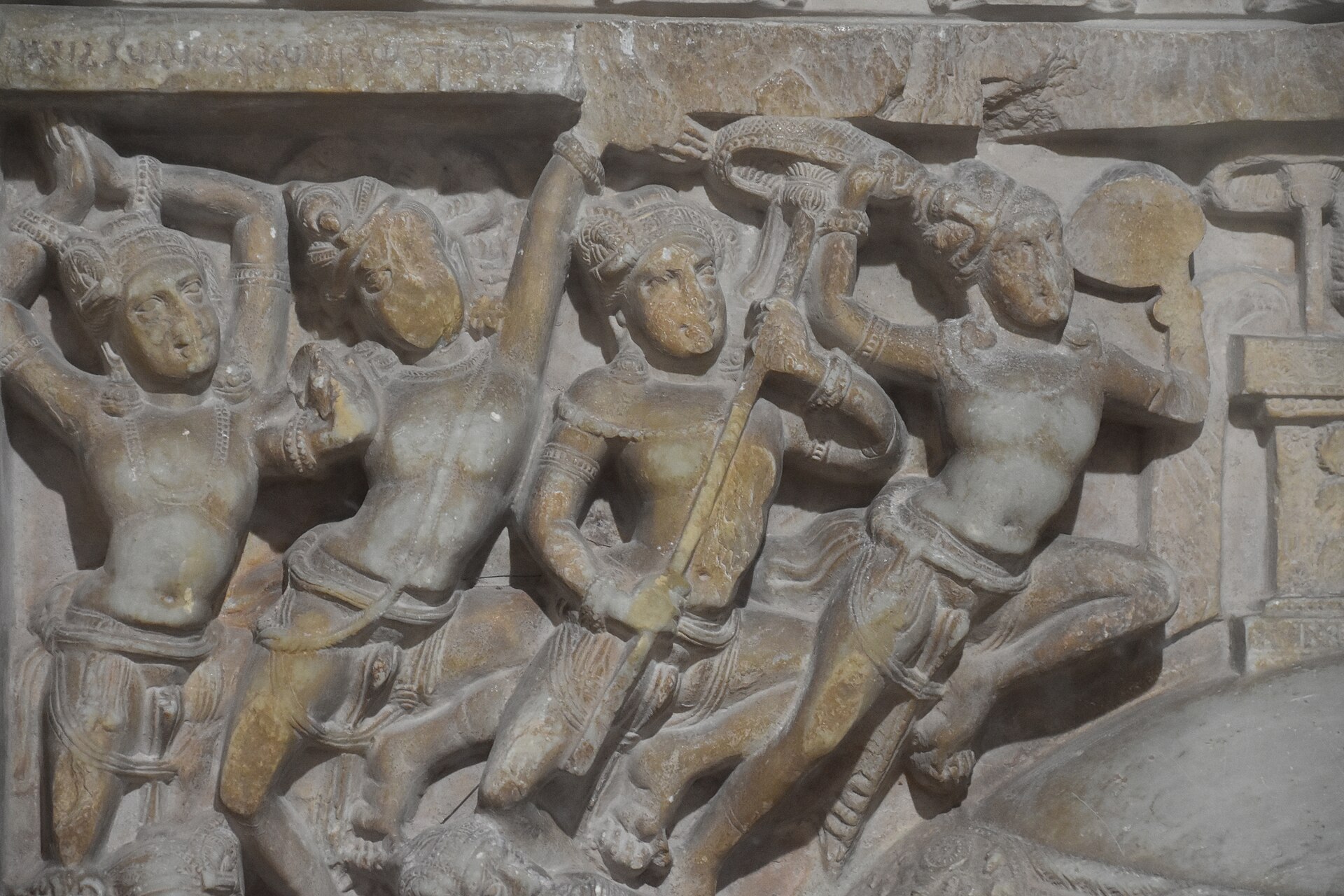
The record subject: a carved Palnad limestone slab from the Great Stupa at Amaravati, in the British Museum. Its face carries a pair of feet, each sole marked with a wheel, set within a decorated border - a Buddhapada, the Buddha represented by his footprints rather than by a figure. Palnad limestone is not marble, despite the collection's popular name. The Commons uploader, a visitor rather than the Museum, describes the stone as one of the large panels from the lower part of the dome; the Museum's own classification of this particular slab has not been established here. Photographed by a visitor and released CC0 by the photographer, not by the Museum.
| Artist | Sculptors of the Amaravati school, Andhra |
|---|---|
| Date | c. 200 BCE to c. 250 CE, with later pieces of about the 7th to 8th centuries |
| Medium | Carved limestone known as Palnad marble; it is not marble, and the Palnad quarry source is not decisively proven |
| Dimensions | Over 120 pieces. A typical drum slab is about 124 x 86 x 12.5 cm. About 70 objects are displayed. |
| Where it is now | The British Museum, London, Room 33a, the Asahi Shimbun Gallery of Amaravati Sculpture, adjoining the Sir Joseph Hotung Gallerylast confirmed 4 August 2026 |
| Inventory number | Transferred from the India Museum in 1880; over 120 pieces, about 70 on display |
| Attribution | AcceptedNo sculptor is named. Full note |
| Object type | Sculpture |
| Period | Indian, Satavahana and later |
| Cases | Has a provenance gap |
| Inscriptions | The collection includes inscriptions as well as sculptures. Ancient inscriptions at the site call the monument a mahacetiya, a great sanctuary, and not a stupa. |
| Owners on record | 6 links4 documented, 1 disputed, 1 unknown |
| Sources | 6 cited |
About this record Last verified 8 August 2026 · 6 sources cited · Change log
On this page 10 sections
ContentsClose
Over 120 carved limestone panels, railings, pillars and inscriptions from the great Buddhist monument at Amaravati in Andhra Pradesh, held by the British Museum since 1880 and displayed in a humidity-controlled room paid for by a Japanese newspaper. They were dug out by Sir Walter Elliot of the Madras Civil Service in 1845, left on open ground in Madras, shipped to London at the end of the 1850s, and moved between four unsuitable buildings before a museum would take them.
They are called the Amaravati Marbles and they are not marble. They are also called the Elliot Marbles, a nineteenth-century coinage made in deliberate imitation of the Elgin Marbles, and the man the name honours is not the first person to have taken the monument apart: that was a local landholder, thirty years earlier, whose workmen fed the stone into local house-building.
Indian calls for their return are live and unresolved, and the retention rests on British statute, not on any argument about the objects. The best collection of Amaravati sculpture anywhere is in Chennai, not in London.
Provenance
Each link is graded. Documented: a cited source supports it. Disputed: the identification is argued but not established. Unknown: no owner for that span, and the gap is not smoothed into a narrative. The grades in the glossary.
- c. 200 BCE - c. 250 CEThe Amaravati Mahacetiya, Dharanikota, Andhradocumented
Carved in phases for the great Buddhist monument, with the exterior wholly renewed in a late campaign beginning around 50 BCE. Earlier slabs were turned, recarved on their backs and remounted. Later pieces of about the 7th to 8th centuries are also in the group.12
- c. 13th century - 1797Unrecorded; the monument buried and forgottenunknown
Amaravati remained active to about the thirteenth century, and a fourteenth-century Sri Lankan inscription records repairs. After that the site was neglected, buried under rubble and grass, and forgotten. Nothing is recorded of the sculptures for roughly five centuries.2
- c. 1797 - 1816Vasireddy Venkatadri Nayudu, zamindardocumented
Colin Mackenzie first saw the site in 1797. By his return in 1816, indiscriminate excavations by the local zamindar had destroyed much of what remained, and stone and brick had been reused to build local houses. Mackenzie excavated further, recorded what he saw and drew the plan, labelling the monument deepaladimma, the hill of lights.2
- 1845 - 1858Sir Walter Elliot, Madras Civil Service, and the Madras museumdocumented
Excavated near the west gate of the railing in 1845 and the sculptures removed to Madras, where they were placed on the greens in front of the college and later shifted to a less exposed position in front of the museum. Elliot's excavation notes and sketches were largely lost getting back to England. In 1853 the curator Dr Edward Balfour reported that they were deteriorating; drawings by P. Murugasa Moodaliar (1855), photographs by Dr A. J. Scott and a further series by Linnaeus Tripe (1858) were made to inform the decision in London.12
- 1858 - 1880The East India Company and its successors; the India Museumdisputed
Shipped on the orders of the Court of Directors; the sailing is given as 1858 in one account and 1859 in another, which is why this link is graded disputed. Stored at Beale's Wharf, Southwark, then Fife House, Whitehall, where the Indian collections opened to the public in July 1861 and where the pieces sustained weather damage. After the Fife House lease expired in 1869 the sculpture went to the India Office Stores in Lambeth. The India Museum was dissolved in 1880.1
- 1880 - presentThe British Museum, Londondocumented
Transferred in 1880 in the break-up of the India Museum, following Birdwood's dispersal plan of 1879 - an internal reorganisation of British imperial institutions, not a purchase or a gift. Displayed on the main stairwell, removed for safekeeping in the Second World War, returned in the 1950s, moved to an air-conditioned basement in 1959, and given Room 33a, the Asahi Shimbun Gallery, in 1992.1
Prices realised
No public sale is recorded for the Amaravati sculptures and none is claimed here: every step in the record is an excavation or a transfer between government bodies, not a purchase. Sir Walter Elliot excavated the pieces at the Amaravati stupa in 1845 under East India Company authority and moved them to Fort St George, Madras; in 1858 the Court of Directors of the East India Company ordered a group of them shipped on to the India Museum in London, and when that museum was abolished in 1879 its holdings were divided in 1880 between the British Museum and the South Kensington Museum. The British Museum's own accession record for the group (museum number 1880,0709.51 and the surrounding series) states only 'Transferred from: India Museum,' dated 1880, with the acquisition note naming the Museum's abolition and the partition of its contents as the sole cause; no purchase, donation sum or price appears anywhere in the sources consulted.
Technical evidence
| Attribution note | No sculptor is named. The material is attributed to the Amaravati or Andhra school, one of the three great styles of early Indian sculpture alongside Mathura and Gandhara. What is genuinely unsettled is the chronology rather than the hand: the phases were reordered by Akira Shimada in work published in 2013 that supersedes the earlier attempts, and the British Museum's own group spans several rebuildings between roughly the first century BCE and the eighth century CE. A nineteenth-century strand of interest in the site rested on the mistaken belief that it held early evidence of Christianity in India, and some early dating followed from that error. |
|---|---|
| Material | Limestone known as Palnad marble. It is not marble, and the attribution of the stone to the Palnad quarry is not decisively proven.1 |
| Extent | Over 120 sculptures and inscriptions in the British Museum, of which about 70 are displayed in Room 33a. Nearly all come from Elliot's 1845 removal to Madras.1 |
| Types of object | Railing pillars, crossbars and coping stones, gateway elements, drum slabs from the stone facing of the mound, two guardian lions, inscriptions and miscellaneous later pieces.1 |
| Typical drum slab | About 124 cm high, 86 cm wide, 12.5 cm thick. One two-sided example in the British Museum is dated by the museum to the 1st century BCE on its obverse face alone.1 |
| Reuse and recarving | In the late building phase, earlier carved slabs were turned round, recarved on their previously plain backs and remounted with the new work outward. The earlier reliefs then faced into the monument and were often badly abraded. Broken slabs, statues and pillars were also used as fill behind the outer rail and under the paving of the processional path.12 |
| Scale of the monument | Burgess estimated the late railings at about 3 m tall and 59 m in diameter, with 136 pillars and 348 crossbars, running 803 feet in total; the final railing diameter is elsewhere given as 192 feet with uprights some 9 feet high. These do not reconcile - a circle 192 feet across has a circumference near 603 feet, not 803 - and the discrepancy is recorded rather than smoothed.2 |
| Display environment | Room 33a, the Asahi Shimbun Gallery of Amaravati Sculpture, opened 1992 with controlled humidity and air conditioning, adjoining the Sir Joseph Hotung Gallery (Room 33). Before that: the museum stairwell, wartime storage, the stairwell again, and an air-conditioned basement from 1959 for over thirty years.1 |
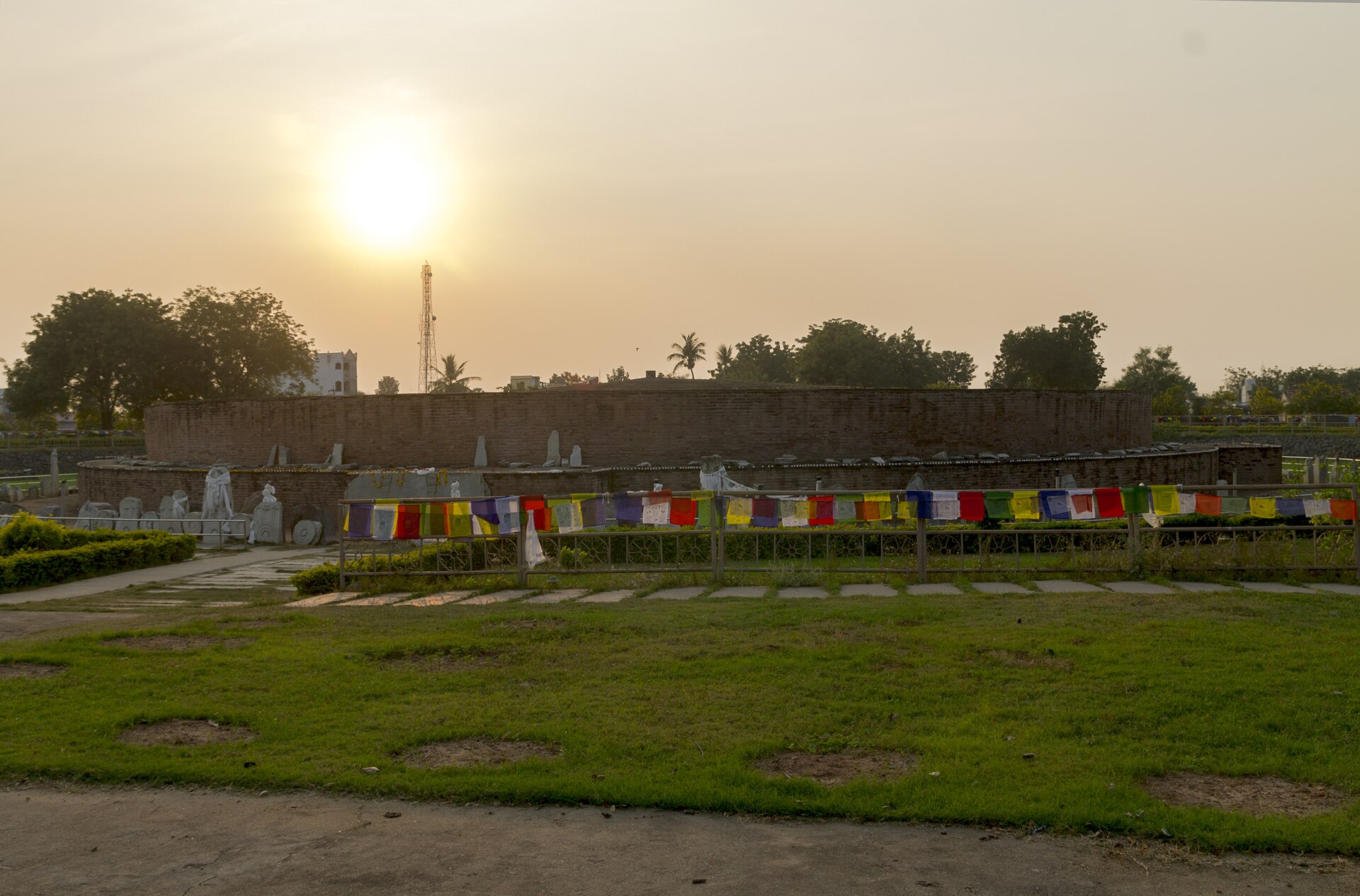
| Rights status of the photographs | Photographs of the British Museum pieces are available on Wikimedia Commons under CC0; the site photograph and the Chennai comparison are CC BY-SA 4.0 and CC BY 2.0 respectively and require attribution. Verified per file against extmetadata LicenseShortName on 4 August 2026.5 |
Images
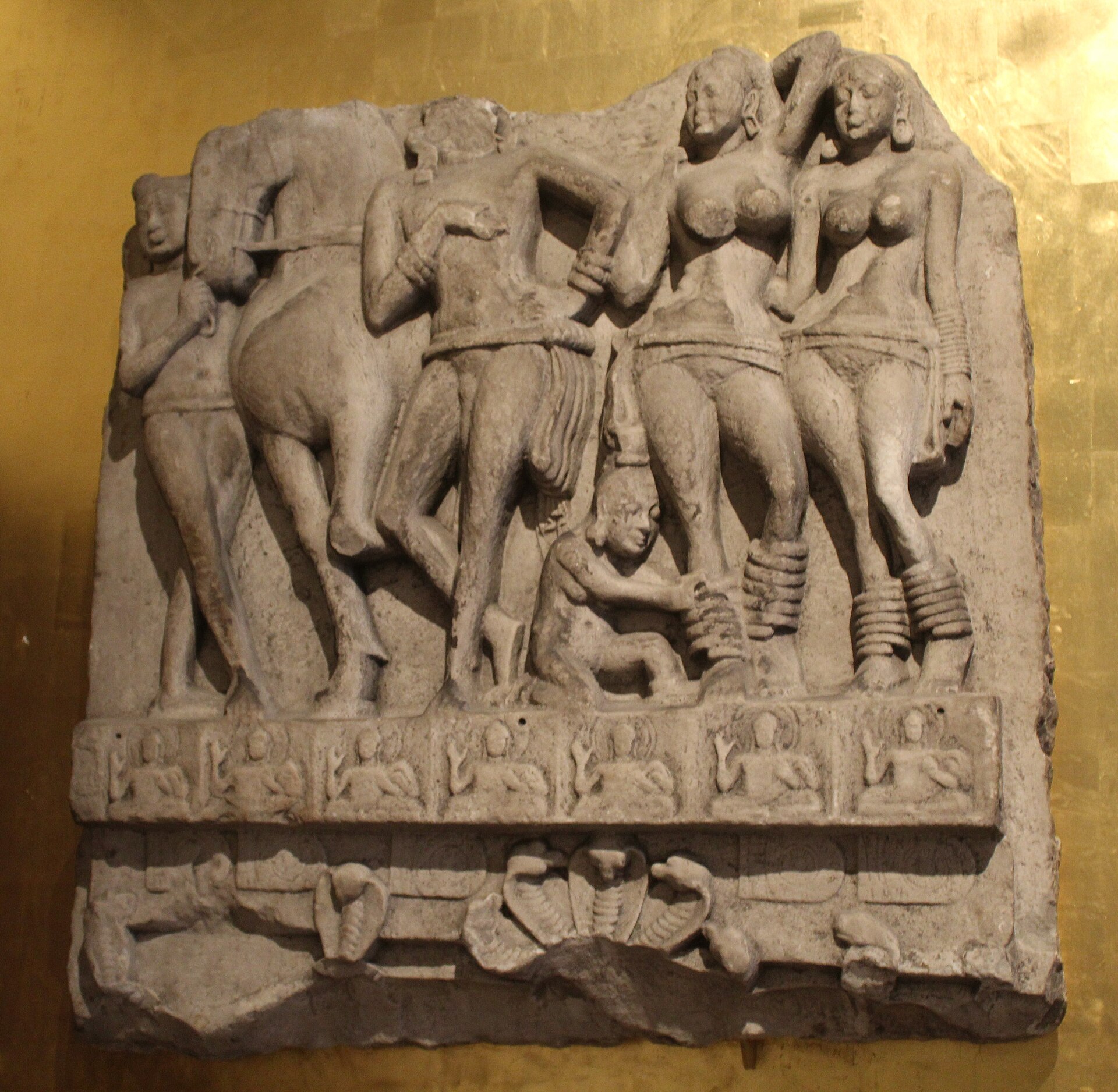
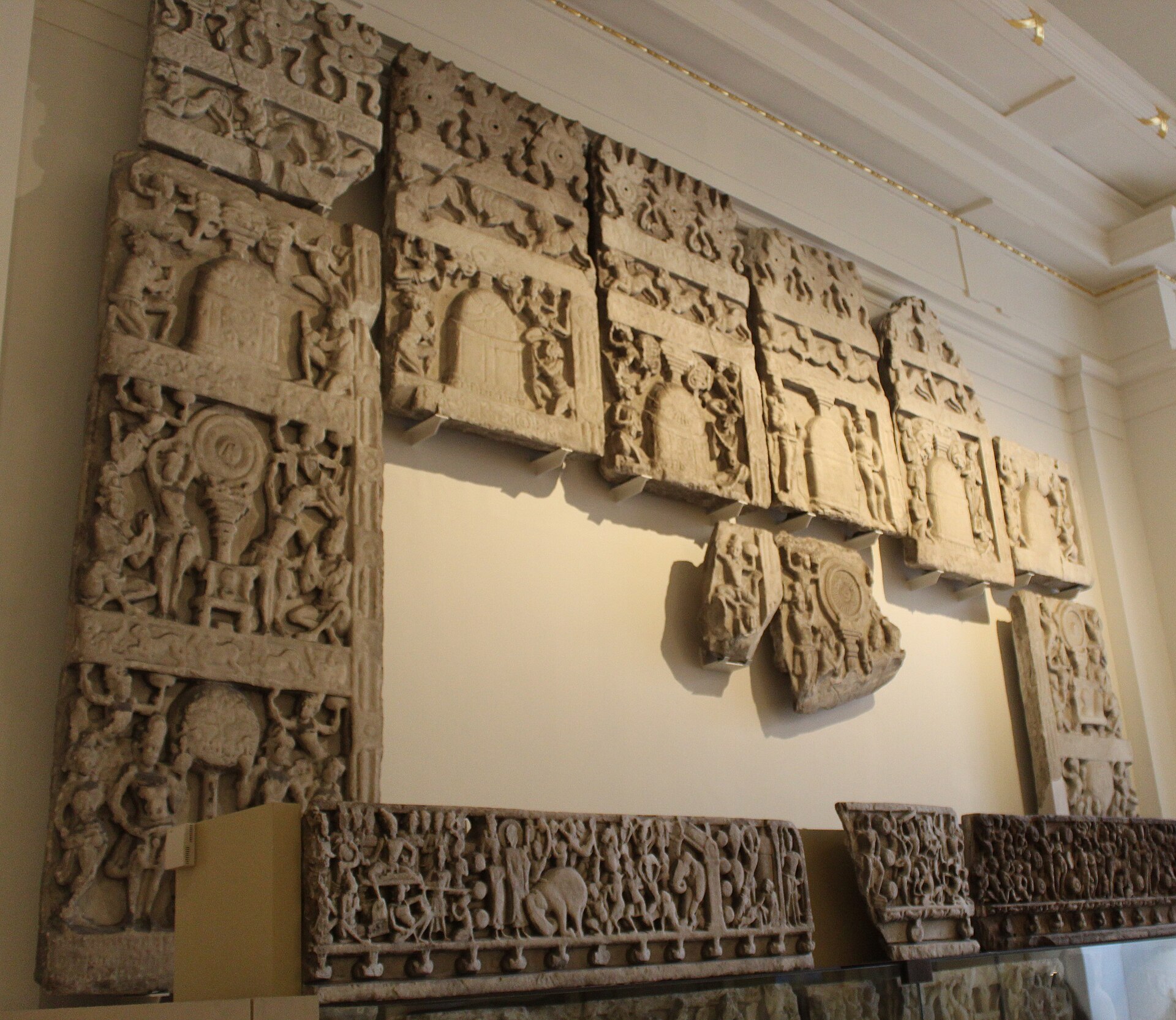
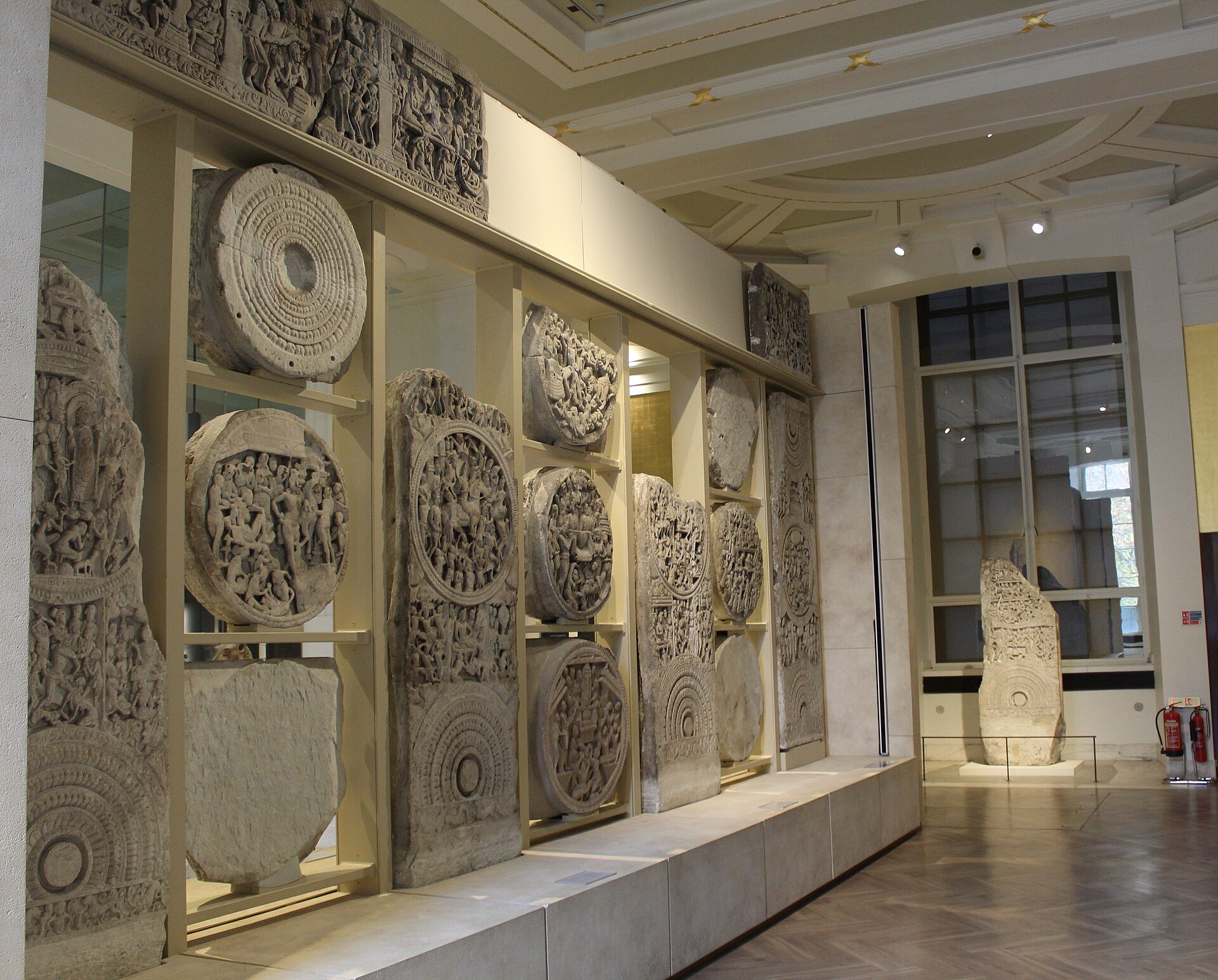
The record in full
Chapter 1The name is wrong in three different ways
Start with the label, because almost everything published about this collection carries an error inherited from it.They are not marble.
Start with the label, because almost everything published about this collection carries an error inherited from it.
They are not marble. The stone is a limestone known in the trade as Palnad marble, and even the quarry attribution is not decisively proven. The word marble in the popular name describes an appearance, not a geology.
They are not the Elliot Marbles in any sense Elliot would have recognised. That name is a nineteenth-century construction, applied to the whole group he shipped to Madras in explicit emulation of the Elgin Marbles and the other Greco-Roman groupings then defining what a prestigious classical collection looked like. Attaching a British administrator's surname to a south Indian Buddhist monument was a way of making it legible to a London audience as a trophy of the same order.
And Amaravati is not the ancient name of the place. The modern village took its name from the Amaresvara temple built in the eighteenth century. The ancient settlement beside it is Dharanikota, probably a capital. Colin Mackenzie's maps of 1816, the oldest there are, label the monument simply deepaladimma, the hill of lights. The ancient inscriptions do not call it a stupa either; they call it the mahacetiya, the great sanctuary.
Four names for one thing, three of them modern impositions and one of them the site's own. This record uses the British Museum's form for the collection and records the rest.
Chapter 2What the objects physically are
The British Museum's group runs to over 120 pieces: sections of the railing that enclosed the monument, coping stones, crossbars, pillars and pillar fragments, drum slabs from the stone facing of the...
The British Museum's group runs to over 120 pieces: sections of the railing that enclosed the monument, coping stones, crossbars, pillars and pillar fragments, drum slabs from the stone facing of the mound itself, two guardian lions, inscriptions and miscellaneous fragments from several periods. A typical drum slab is about 124 centimetres high, 86 wide and 12.5 thick.
Most of the figurative work is relief, and the most crowded scenes illustrate jataka tales, the vast body of narrative about the Buddha's previous lives. Medallions and roundels carry the finest surviving carving; many hold nothing but a single stylised lotus.
The monument these came off was enormous. Burgess's nineteenth-century estimate put the late railings at roughly three metres tall and fifty-nine metres in diameter, with 136 pillars and 348 crossbars, running some 803 feet in total. Those numbers do not reconcile with each other and the record says so rather than choosing between them. The stupa itself was in its day described as the greatest monument in Buddhist Asia and the most richly decorated stupa known.
Chapter 3Many of these slabs are two sculptures
This is the technical fact that changes how the whole collection should be read.Amaravati was rebuilt.
This is the technical fact that changes how the whole collection should be read.
Amaravati was rebuilt. In the late phase, beginning around the middle of the first century BCE, the exterior surfaces were entirely renewed, and the sculptors did not start with fresh stone. They took slabs already carved in the earlier phase, turned them round, cut new reliefs on the previously plain backs, and remounted them on the drum with the new work facing outward.
The consequence is that the earlier carving on many pieces spent centuries facing inward against the body of the monument, where it was abraded and worn down. A drum slab in the British Museum is dated by the museum on its two faces separately, because the two faces are separated by a century or more of the same object's working life.
Burgess recorded the same economy in the fabric: dig behind the outer rail and you find broken slabs and statues jammed in as fill, and the slate paving of the processional path laid on a concrete of chips, broken slabs and pillars. The monument recycled itself. Anyone doing diligence on a piece of Amaravati sculpture should be asking which face is being sold.
Chapter 4The first excavation was Indian, and it was destructive
Colin Mackenzie reached the site in 1797, the first European to describe it.
Colin Mackenzie reached the site in 1797, the first European to describe it. When he returned in 1816 the monument had been badly damaged, and not by Europeans. The powerful local zamindar Vasireddy Venkatadri Nayudu had run indiscriminate excavations, and much of the stone and brick had been carried off and reused to build local houses.
This has to be stated because the standard account of Amaravati as colonial looting is true and incomplete. By the time Elliot arrived in 1845, the mound had already been quarried by its own landholder for construction material for a generation. The stone was a resource before it was a heritage, to the people who lived on top of it.
What follows from that is uncomfortable in both directions. The British removals took what an Indian landholder's works had left. And the reason anything at all survives to be argued over is that Mackenzie recorded a plan in 1816 of a monument already being destroyed.
Chapter 5Elliot, 1845, and thirteen years on the grass
Sir Walter Elliot of the Madras Civil Service excavated near the west gate of the railing in 1845 and removed a large number of sculptures to Madras.
Sir Walter Elliot of the Madras Civil Service excavated near the west gate of the railing in 1845 and removed a large number of sculptures to Madras. His notes and sketches of the excavation were extensive and most of them were lost on the way back to England, which is a permanent loss of context: the findspots of the pieces he took are largely unrecoverable.
In Madras the sculptures were placed on the greens in front of the college. After enquiries from the Court of Directors of the East India Company they were shifted to a slightly less exposed position in front of the museum. That is the whole of their care for thirteen years: outdoors, on grass, in a tropical climate.
By 1853 the curator of the Madras museum, Dr Edward Balfour of the Madras Medical Service, was reporting to London that the sculptures were deteriorating where they stood, and pressing for them to be moved. To let London decide whether they were artistically important enough to be worth shipping, Balfour commissioned a set of drawings from the Indian artist P. Murugasa Moodaliar in 1855; they are now in the British Library. Dissatisfied with their accuracy, he then had Dr A. J. Scott photograph the sculptures and sent those too. In 1858 Linnaeus Tripe made a further series, preserved in the British Library as Photographs of the Elliot Marbles, shelfmark Photo 958.
Those photographs matter more than their status as illustrations suggests. They record the condition of the stones before the sea voyage and before another century of handling, and they are the reason a scholar can say what has been lost since. They also record the name of an Indian draughtsman in a chain of custody that otherwise names only Europeans.
Chapter 6Twenty years in the wrong buildings
The sculptures were shipped to London on the orders of the Court of Directors at the end of the 1850s.
The sculptures were shipped to London on the orders of the Court of Directors at the end of the 1850s. The two standard accounts give 1858 and 1859 for the sailing, and this record does not arbitrate between them.
Their destination was the East India Company's own India Museum, and they arrived just as the Company was being dissolved. So they went into storage at Beale's Wharf in Southwark, and then to Fife House in Whitehall, a private house once occupied by the second Earl Fife. The Indian collections there opened to the public in July 1861. Conditions at Fife House were poor and the Amaravati pieces were damaged by the weather.
That damage produced the intervention that eventually saved them. James Fergusson, who published a book on Amaravati in 1868 and made the first detailed study of the sculpture, appears to have raised his concerns with Augustus Wollaston Franks at the British Museum.
The lease on Fife House expired in 1869 and the India Museum went briefly back to the India Office, where there was so little room that the Amaravati sculpture was sent to the India Office Stores in Lambeth. Meanwhile John Forbes Watson, who had run the India Museum since 1858, fought to keep it whole and lobbied for an Imperial Museum for India and the Colonies. He lost. In 1879 Sir Louis Mallet asked George Birdwood to plan the dispersal of the India Museum, and in 1880 the institution was dissolved and its collections transferred.
The British Museum acquired this material in the break-up of a rival museum, not by purchase and not by gift from India. That distinction is routinely blurred and it matters for any claim: the transfer of 1880 was an internal reorganisation of British imperial institutions.
Chapter 7A stairwell, a war, a basement, and finally a room
Once at the British Museum the sculptures were arranged on the main stairwell, and stayed there for decades until they were removed for safekeeping during the Second World War.
Once at the British Museum the sculptures were arranged on the main stairwell, and stayed there for decades until they were removed for safekeeping during the Second World War. They came back out in the 1950s, and London's air at that time - the era of the coal smogs - attacked them again. In 1959 they were moved into an air-conditioned basement, where they remained for over thirty years.
The first proper display came in 1992, when the Sir Joseph Hotung Gallery opened as Room 33 and the Amaravati collection was given the adjoining Room 33a, with controlled humidity and air conditioning, showing about seventy objects including a reconstructed section of the railing and a selection of drum slabs. The room is named after the Asahi Shimbun, the Japanese publishing house that paid for it.
Count the sequence: outdoors on a Madras green, a Southwark wharf, a damp Whitehall house, a Lambeth store, a London stairwell, wartime storage, a stairwell again, a basement for thirty years, and then a gallery. The objects have spent far more of their time in London out of sight and in unsuitable conditions than on considered display, and the argument that a British museum was the safe destination has to be measured against that record rather than against the room as it is now.
Chapter 8The claim, and the statute that answers it
Indian calls for the return of the Amaravati sculptures are active.
Indian calls for the return of the Amaravati sculptures are active. In October 2021 the Deccan Chronicle reported the historian Dr Jasti Veeranjineyulu writing to the Indian Prime Minister after visiting the British Museum, saying that priceless objects had been taken from Amaravati during British rule and were being shown in gallery 33a. No response from the central government is recorded in that report.
The obstacle is not evidentiary. Nobody disputes where these objects came from, who removed them or when. The obstacle is statutory: the British Museum's ability to transfer objects out of its collection is constrained by its governing legislation, the British Museum Act 1963, and by domestic British law generally, and that is the ground on which the legal literature engages. Francesca Zepeda's article The Stupa Amaravati of India: Where British Common Law Controls the Repatriation of Cultural Property, in the Loyola University Chicago International Law Review in 2024, examines exactly that: the statutory basis of the museum's ownership, the international conventions binding the United Kingdom, and the museum's standing after recent theft allegations, and proposes reconciling the contradiction between British and international law.
The 1970 UNESCO and 1995 UNIDROIT instruments do not reach a removal of the 1840s in any event. What is left is politics and statute, and the statute currently says no.
Chapter 9The best collection is in Chennai
The largest and best collection of Amaravati sculpture is in the Government Museum, Chennai, supplemented by later finds and by the friezes from Goli.
The largest and best collection of Amaravati sculpture is in the Government Museum, Chennai, supplemented by later finds and by the friezes from Goli. There is a substantial collection at the site museum at Amaravati itself, and smaller groups in museums around the world. The British Museum's group is important and it is not the principal one.
Nearly all of the London material comes out of Elliot's shipment, which means the London and Chennai collections are two halves of a single removal to Madras, split by a decision taken in the 1850s about what was worth putting on a ship.
The Chennai collection has its own conservation problem: pieces not in air-conditioned storage have been reported as showing damage from the atmosphere and from salt, and the museum's plans for a climate-controlled gallery have not been realised. That is the honest state of the comparison. Neither city has solved the problem, and only one of them has had the resources of a national museum applied to it since 1880.
Chapter 10The monument is not dead
Amaravati is often written about as a ruin and a source of museum objects.
Amaravati is often written about as a ruin and a source of museum objects. It is also a living site.
The Chinese pilgrim Xuanzang came in 640 CE, stayed some time and studied there, and wrote an enthusiastic account of its monasteries. The place was still being named in Sri Lanka and Tibet as a centre of esoteric Buddhism in the fourteenth century, and a fourteenth-century Sri Lankan inscription records repairs made to the stupa. It is bound into the Vajrayana teaching of the Kalachakra, which is still practised in Tibetan Buddhism, and in 2006 the Dalai Lama conducted a Kalachakra initiation at the site before more than a hundred thousand pilgrims.
That is the fact that distinguishes an Amaravati claim from an antiquarian one. The railings in Room 33a were not detached from a dead religion. They were detached from a sanctuary that people were still travelling to in this century.
Chapter 11What it is worth, and the market that should not exist
There is no sale, no auction record, no valuation and no insurance figure in the public domain for the British Museum's Amaravati collection.
There is no sale, no auction record, no valuation and no insurance figure in the public domain for the British Museum's Amaravati collection. It arrived by an administrative transfer in 1880, no consideration passed, and it cannot be sold.
The market fact that matters here is a negative one and it is genuinely useful. The site was quarried by its landholder, excavated without adequate recording by Elliot, further dug by Robert Sewell under James Burgess in the 1880s with drawings but not to a standard anyone would now accept, and re-excavated since. Loose Amaravati stone therefore exists, and the recording is poor enough that a piece with no documented findspot cannot easily be shown to be either legitimate or not. Anything offered as Amaravati sculpture without a pre-1970 published photograph and a named collection should be treated as a title problem.
The published photographic record is the strongest diligence tool that exists for this material: Murugasa Moodaliar's drawings of 1855, Scott's photographs, Tripe's 1858 series in the British Library under Photo 958, Fergusson 1868, Barrett's British Museum catalogue of 1954, the 1992 catalogue, Shimada 2013, and the World Corpus of Amaravati Sculpture run with the Archaeological Survey of India. A piece that appears in none of them is a piece with a question attached.
The artist
The sculptors of the Amaravati or Andhra school
No name survives from the workshops that carved Amaravati across four and a half centuries, and no contract, no inscription naming a master and no biography. What survives instead is a style distinct enough that art historians treat it as one of the three great schools of early Indian sculpture, alongside Mathura and Gandhara, and coherent enough that its influence can be traced by sea across South India, Sri Lanka and Southeast Asia. The dossier for this maker is therefore a dossier for a school and for the chronology that has been argued over it, which is where the real scholarly action has always been.
Related works
| Work | Relation | Where it is |
|---|---|---|
| The Amaravati collection, Government Museum, Chennai Sculptors of the Amaravati school | The other and larger half of the same removal The best collection of Amaravati sculpture anywhere, supplemented by later finds and by the friezes from Goli. Split from the London group by a decision in the 1850s about what to ship. Pieces outside air-conditioned storage have been reported as damaged by atmosphere and salt. | Government Museum, Chennai |
| The Amaravati Mahacetiya, in situ Sculptors of the Amaravati school | The monument these pieces were removed from Ruined. Quarried for building stone by the zamindar Vasireddy Venkatadri Nayudu before 1816, excavated by Elliot in 1845 and by Robert Sewell under Burgess in the 1880s. The Dalai Lama gave a Kalachakra initiation here in 2006. | Amaravathi village, Andhra Pradesh; under the Archaeological Survey of India, with a site museum |
| Photographs of the Elliot Marbles Linnaeus Tripe | The condition record made before the sculptures left India Madras, 1858-1859. With the 1855 drawings by P. Murugasa Moodaliar and Dr A. J. Scott's photographs, this is the baseline against which every later loss can be measured. | British Library, shelfmark Photo 958 |
| The Great Stupa at Sanchi Anonymous, Madhya Pradesh | The closest surviving comparison, still standing The surviving highly decorated stupa nearest to its original condition. Its railings carry much less decoration than Amaravati's except at the torana gateways, which Amaravati appears not to have had. | Sanchi, Madhya Pradesh |
| The Elgin Marbles Phidias and workshop | The naming model, and the argument's template The Amaravati pieces were called the Elliot Marbles in conscious emulation of this group. The retention argument in both cases now rests on the same British statutory framework rather than on any claim about the objects. | The British Museum, London |
Open questions
- Did the sculptures sail for London in 1858 or 1859? The two standard accounts differ, and both are cited in the same reference literature.
- Where exactly at the site did each piece come from? Elliot's notes and sketches of the 1845 excavation were largely lost on the way to England, so the findspots of most of the London pieces are unrecoverable.
- What was lost or broken between the 1855 drawings and the Madras photographs on one side and the present state on the other? The comparison has not been published in the sources consulted, and the material to make it exists in the British Library.
- How many British Museum drum slabs carry earlier carving on their reverse faces, and has that earlier carving been systematically recorded? The recarving-and-turning practice is documented; a face-by-face census is not.
- Has the Indian government ever made a formal state-level request for the Amaravati collection, as opposed to the documented appeals by historians and campaigners? Nothing in the sources consulted records one. A December 2025 Artnet report on the British Museum's new loan-to-former-colonies scheme names the Amaravati Marbles, alongside the Koh-i-Noor, among the objects India has requested back, but cites no specific state document and the question stays open.
- Is the true source of the stone the Palnad quarry? The trade name says so and the attribution is described as not decisively proven.
- What happened to the pieces of Elliot's Madras group that were neither shipped to London nor retained by the Madras museum? The 120 in London are described as nearly all from his group, and the accounting of the whole removal is not published here.
- Did the Amaravati monument have torana gateways? The British Museum's own group is described as including gateway elements, while the comparison with Sanchi states that toranas do not seem to have been a feature at Amaravati. The two reference accounts contradict each other and this record does not arbitrate.
- Which of Burgess's railing figures is right? A diameter of 192 feet gives a circumference near 603 feet, not the 803 feet he records as the total run.
Questions about this object
What is The Amaravati Collection?
The Amaravati Collection is a sculpture, dated c. 200 BCE to c. 250 CE, with later pieces of about the 7th to 8th centuries. Medium: Carved limestone known as Palnad marble; it is not marble, and the Palnad quarry source is not decisively proven.
Who made The Amaravati Collection, and is the attribution settled?
The attribution to Sculptors of the Amaravati school, Andhra is recorded here as accepted. No sculptor is named. The material is attributed to the Amaravati or Andhra school, one of the three great styles of early Indian sculpture alongside Mathura and Gandhara. What is genuinely unsettled is the chronology rather than the hand: the phases were reordered by Akira Shimada in work published in 2013 that supersedes the earlier attempts, and the British Museum's own group spans several rebuildings between roughly the first century BCE and the eighth century CE. A nineteenth-century strand of interest in the site rested on the mistaken belief that it held early evidence of Christianity in India, and some early dating followed from that error.
Where is The Amaravati Collection now?
The British Museum, London, Room 33a, the Asahi Shimbun Gallery of Amaravati Sculpture, adjoining the Sir Joseph Hotung Gallery. Inventory number Transferred from the India Museum in 1880; over 120 pieces, about 70 on display. Last confirmed 4 August 2026. Dissolution of the India Museum of the East India Company and transfer of its collections in 1880.
What is still unknown about The Amaravati Collection?
Did the sculptures sail for London in 1858 or 1859? The two standard accounts differ, and both are cited in the same reference literature.
Sources
- 1Wikipedia, 'Amaravati Marbles', read as raw article text on 4 August 2026: the 120 pieces and the Palnad limestone that is not marble, the Elliot Marbles coinage in emulation of the Elgin Marbles, the mistaken belief in early Christian evidence, Mackenzie and Elliot, Balfour's 1853 report, the 1855 drawings by P. Murugasa Moodaliar and the Scott and Tripe photographs, the shipment of 1858, Beale's Wharf, Fife House, the India Office Stores at Lambeth, Forbes Watson, Birdwood, the 1880 transfer, the stairwell, the 1959 basement, the 1992 Asahi Shimbun Gallery in Room 33a, and the catalogue sequence from Fergusson 1868 to Shimada's World Corpus. TERTIARY: to be replaced with Barrett 1954, the 1992 British Museum catalogue and Shimada 2013. en.wikipedia.org/wiki/...
- 2Wikipedia, 'Amaravati Stupa', read as raw article text on 4 August 2026: the naming of the site and the mahacetiya and deepaladimma forms, the building phases and Shimada's chronology, the turning and recarving of drum slabs, Burgess's 1887 observation about slabs used as fill and his railing measurements, Mackenzie's visits of 1797 and 1816 and the destruction by the zamindar Vasireddy Venkatadri Nayudu, Elliot's 1845 excavation and the loss of his notes, Sewell's excavations under Burgess in the 1880s, Xuanzang's visit of 640 CE, the fourteenth-century Sri Lankan inscription, and the Dalai Lama's Kalachakra initiation of 2006. TERTIARY. en.wikipedia.org/wiki/...
- 3Deccan Chronicle, 'Amaravati relics at British Museum; PM urged to get them back', 21 October 2021. Reports the historian Dr Jasti Veeranjineyulu writing to the Indian Prime Minister after a visit to the British Museum, referring to objects taken from Amaravati during British rule and shown in gallery 33a. No governmental response is recorded in the report. deccanchronicle.com/nation/...
- 4Francesca Zepeda, 'The Stupa Amaravati of India: Where British Common Law Controls the Repatriation of Cultural Property', 20 Loyola University Chicago International Law Review 93 (2024). Cited from the publisher's landing page and abstract, which states the article's examination of the museum's founding statutes and domestic British law restricting return, the UNESCO and UNIDROIT frameworks binding the United Kingdom, and the museum's standing after recent theft allegations. The full text returned HTTP 403 and was not read. lawecommons.luc.edu/lucilr/...
- 5Wikimedia Commons file records for the photographs used, each carrying its LicenseShortName, author and description. Licences read per file on 4 August 2026: CC0 for the four British Museum photographs by 14GTR, CC BY 2.0 for the Chennai comparison by Richard Mortel, CC BY-SA 4.0 for the site photograph by Wilsonraj1976. commons.wikimedia.org/wiki/...
- 6Artnet News (Jo Lawson-Tancred), 'British Museum Launches Long-Term Loan Program to Former Colonies', 18 December 2025. Reports the museum's new up-to-three-year loan scheme launched under director Nicholas Cullinan, the first transfer being about 80 Greek and Egyptian antiquities to the CSMVS museum, Mumbai. Names the Amaravati Marbles, alongside the Koh-i-Noor diamond, as objects India has requested returned; states the British Museum Act 1963 still bars permanent return outside exceptional circumstances. Does not cite a specific formal Indian state document, so does not resolve the open question below. news.artnet.com/art-world/...

Last verified 8 August 2026 · Published 4 August 2026
Change log
2 August 2026 - Record deepened to the house standard: narrative sections, technical evidence, artist dossier, related works and open questions added; provenance chain and auction results replaced with the researched versions; sources rebuilt.
4 August 2026 - Record created at the house standard: researched narrative, technical evidence, maker dossier, graded provenance chain, prices with hammer and premium separated, related works, open questions and sources.
8 August 2026 - Re-verification pass. No change to the provenance chain or attribution. Added a December 2025 Artnet report on the British Museum's new loan-to-former-colonies scheme (launched under director Nicholas Cullinan) that names the Amaravati Marbles among the objects India has asked to have returned; the report does not amount to a formal state request, so the existing open question is extended rather than closed. Other source URLs re-checked; one (Loyola University Chicago International Law Review, source 4) still returns HTTP 403 to a bare fetch, consistent with the bot-block already noted rather than a dead link.