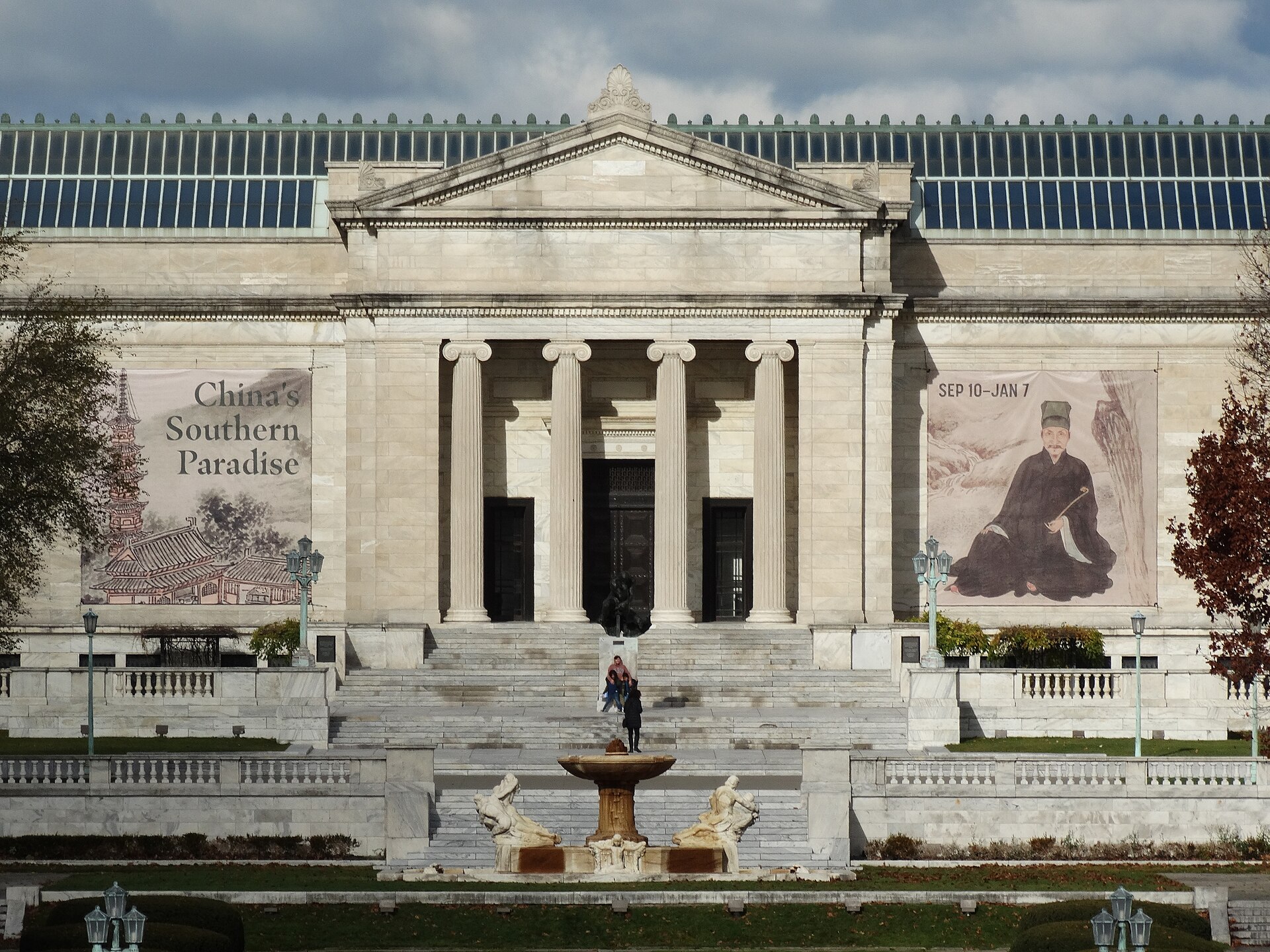
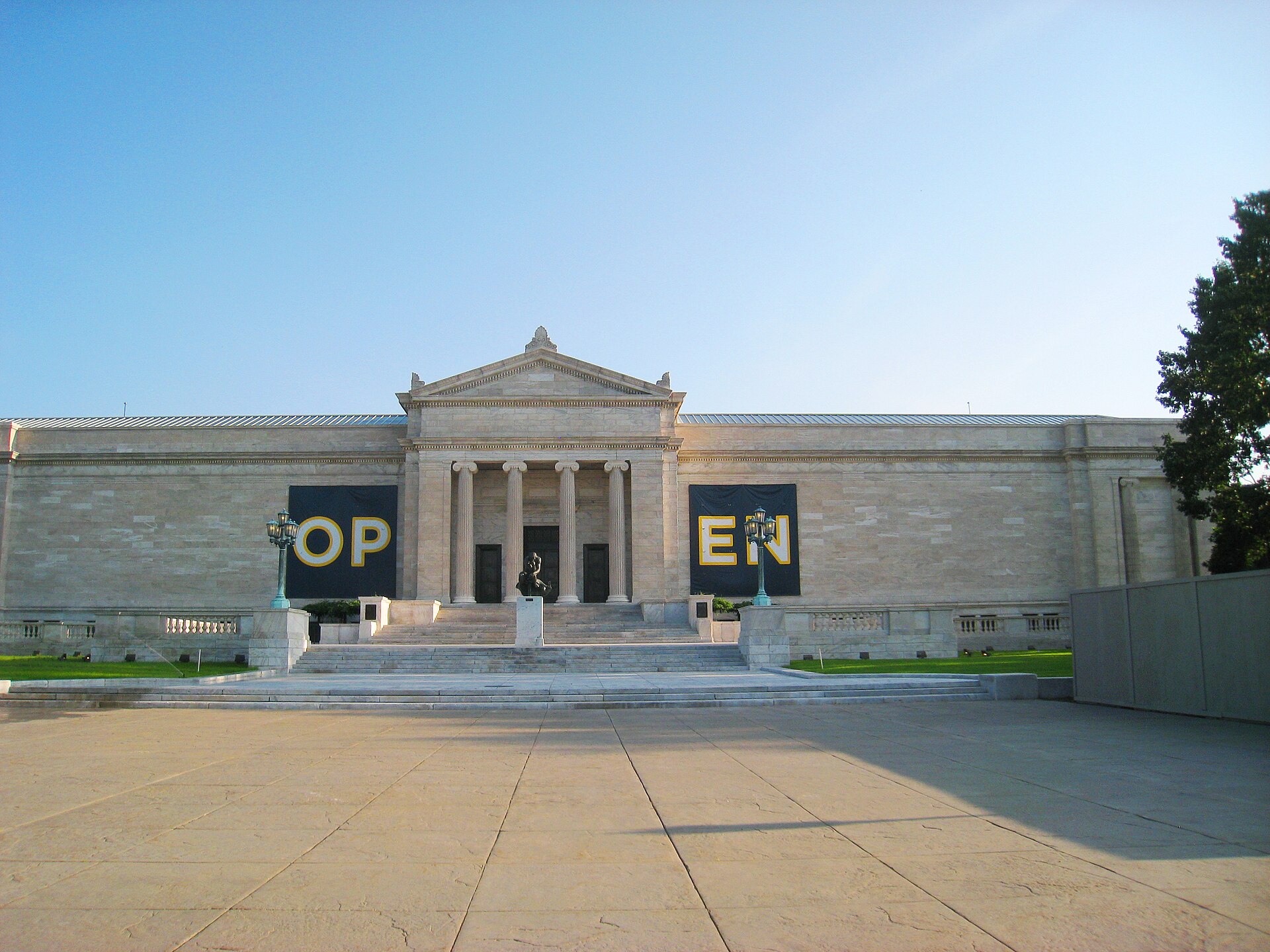
On this page 17 sectionsContentsCloseThe Hubbell and Benes building of 1916 from the Fine Arts Garden, its Ionic portico between two long wings of white Georgian marble, with OPEN lettered across banners on either side. The dark figure on the plinth at the head of the steps is Rodin's Thinker, reinstalled unrepaired after the bombing of 1970.Photograph by Daderot · Public domain
More than 63,000 works spanning about six thousand years, by the museum's own count, in a collection that is genuinely encyclopaedic rather than a European picture gallery with departments attached. The particular strengths are medieval art, including a treasury of reliquaries and the arms and armour that fill gallery 210A, and Asian art, built principally under Sherman Emery Lee from 1958 and rated among the finest in the country. European painting runs from Byzantine and Italian Gothic rooms through Caravaggio's Crucifixion of Saint Andrew to Turner and Picasso. The antiquities are strong and contested in equal measure. The paper and textile departments are deeper than a visitor will ever see at once, because almost everything in them is recorded as not on view. What distinguishes the collection from its peers is not only its quality but its availability: more than half of it is published as CC0 high-resolution imagery, which means a scholar can work from Cleveland without visiting Cleveland.
The Cleveland Museum of Art at a glance
Kind
Museum
Founded
Incorporated 1913; opened to the public on 6 June 1916
City and country
Cleveland, United States
Address
11150 East Boulevard, Cleveland, Ohio 44106, United States
What it costs and when it is openConfirmed 30 August 2026
Hours
Tuesday, Thursday, Saturday, Sunday10:00 to 17:00
Wednesday, Friday10:00 to 21:00Late opening
MondayClosed
Closed
Monday, every week. Closed on 1 January, Presidents Day, 4 July, Thanksgiving Day and 25 December. Closes early, at 16:00, on 24 December and 31 December. Open on Martin Luther King Jr. Day. The Provenance Cafe is closed on Mondays and the Provenance Restaurant is closed on Sundays and Mondays, so the catering does not track the gallery hours exactly.
Admission
General admission, permanent collection galleriesFreeFree at all times. The museum's own wording is that general admission is always free, and it describes free admission as a hallmark since it opened.
Daily guided highlights tourFreeOffered at 11:00 and 13:00. Free, but a ticket is required, reservable in advance or on site subject to availability. Limited to 15 participants per group.
Spectacular Freedom: Andrew Wyeth and the Modern American Watercolor, adultUSD 17Read from the museum's own ticket table for the special exhibition opening 20 September 2026 and running to 18 January 2027, ahead of its opening. GBP/USD combo price with Ten Kings of Hell (opening 11 October 2026) is USD 25.
Spectacular Freedom, senior (65 and up)USD 15Same exhibition; combo price with Ten Kings of Hell is USD 22.
Spectacular Freedom, adult group of 10 or more / member guest / college student with IDUSD 8Same exhibition; combo price is USD 12.
Spectacular Freedom, children 6-17, CMA members, or children 5 and underFreeFree.
Free entry: Every day, for the permanent collection: there is no general admission charge at any time. Active or retired military members with identification receive up to four complimentary exhibition tickets per ticketed exhibition per visit, under the Blue Star Museums programme. Sensory-Friendly Saturday sessions run on the third Saturday of each month from 09:00 to 10:00, before general opening. A caution worth carrying: general admission being free does not make the whole building free. Several of the museum's own special exhibitions require a paid ticket, and the price is set per show rather than published as a single figure
No for the permanent collection, which needs no ticket at all. Selected special exhibitions and events do require a ticket, reservable online or by telephone on 216-421-7350
Address
11150 East Boulevard, Cleveland, Ohio 44106, United States Map
Car and parking The museum has its own parking garage entered from Jeptha Drive, paid on site at the garage entrance by credit card or cash. Accessible parking is signed on the top level, a short distance from the north entrance, and on level P2, which connects to the lower level of the museum through a tunnel On foot In University Circle, with the Fine Arts Garden, the Fountain of the Waters and Wade Lagoon on the south side of the building. The Cleveland Museum of Natural History and the Cleveland Institute of Art are separate institutions a few hundred metres away in the same campus and are not part of this museum Off-site venue Transformer Station, in the Hingetown area of Ohio City, is programmed by this museum but is a different building at a different address. The hours and the free general admission recorded on this page are for the main museum at 11150 East Boulevard only
Before you go how long, access, photography, bags, eating, shop
How long to allow
The museum publishes no recommended duration. It holds more than 63,000 works by its own count across roughly six millennia, on two main floors plus the atrium level, so a first visit is a matter of choosing departments rather than attempting the building. The free daily highlights tours at 11:00 and 13:00 are the museum's own answer to that problem
Access
Designated accessible parking is signed on the top level of the garage near the north entrance and on level P2, which reaches the lower level of the museum by tunnel. Sensory-Friendly Saturday sessions are offered on the third Saturday of each month from 09:00 to 10:00
Photography
The museum publishes its rules on the Museum Policies page; check them on the day. Note separately that the museum releases high-resolution photography of more than half its collection under CC0, so a reader wanting a publishable image of an object does not need to take one
Bags
Coat check is in the Horace Kelley Art Foundation North Lobby. All visitors pass through metal detectors at the entrance and the museum operates a strict no-weapons policy; anyone refusing a security screening is denied entry. Prohibited items are listed on the Museum Policies page, and the museum states it is not responsible for lost or stolen items
Eating
Provenance Cafe, open Tuesdays and Thursdays 10:00 to 16:00, Wednesdays and Fridays 10:00 to 20:00, Saturdays and Sundays 10:00 to 16:00, closed Mondays. Provenance Restaurant runs Tuesday to Saturday, with the dining room 11:00 to 14:00 and the bar and lounge until 16:00 on Tuesdays and Thursdays and until 19:00 on Wednesdays and Fridays
Shop
Museum store on site, with online ordering and curbside pickup
Prices and hours change. We take them from the institution's own pages and print the day we read them, and you can check the current position at the source we used. Confirm before you travel.
What is inside
10 spaces, 8 photographed
Photograph by APK · CC BY 4.0
The 1916 Beaux-Arts building
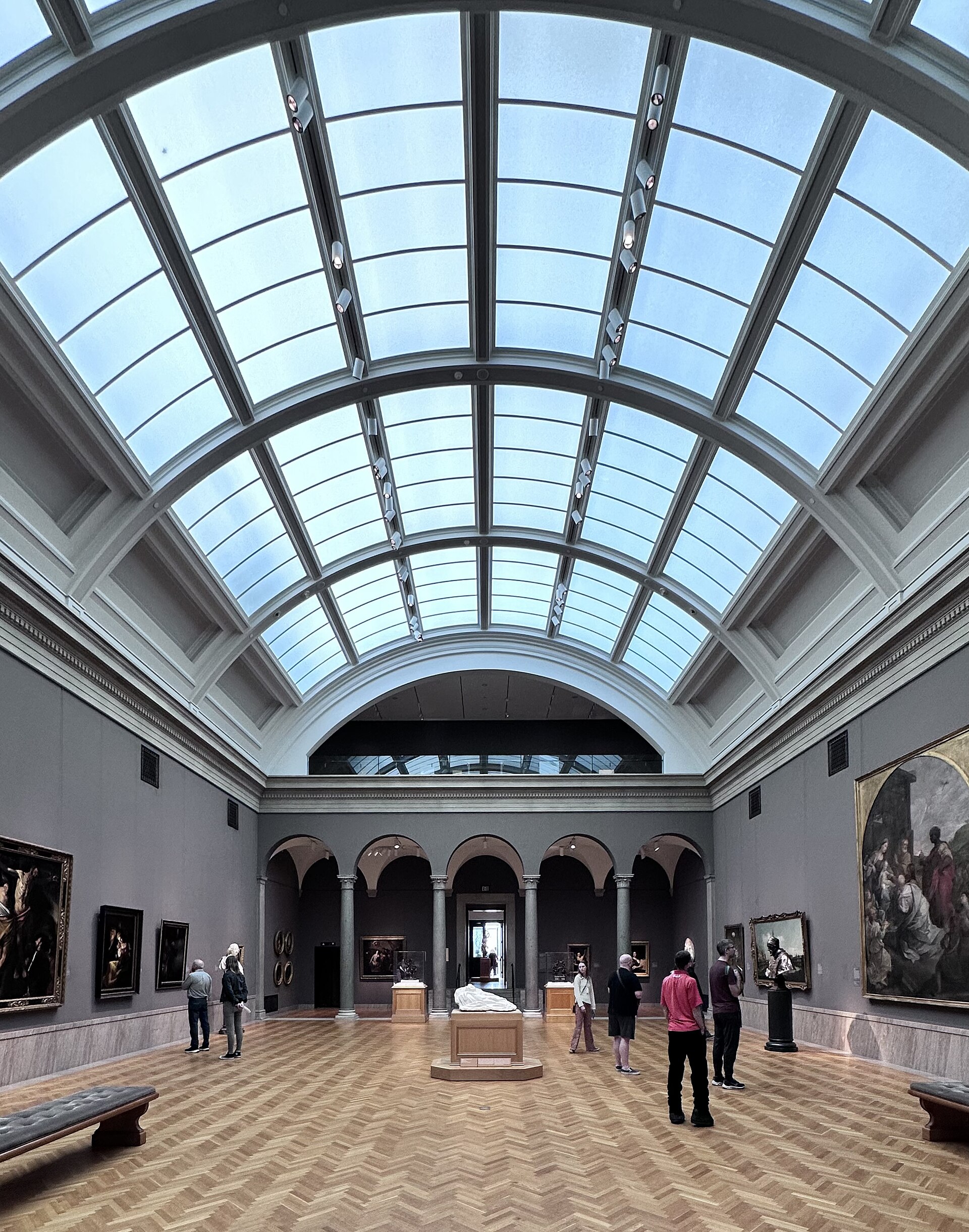
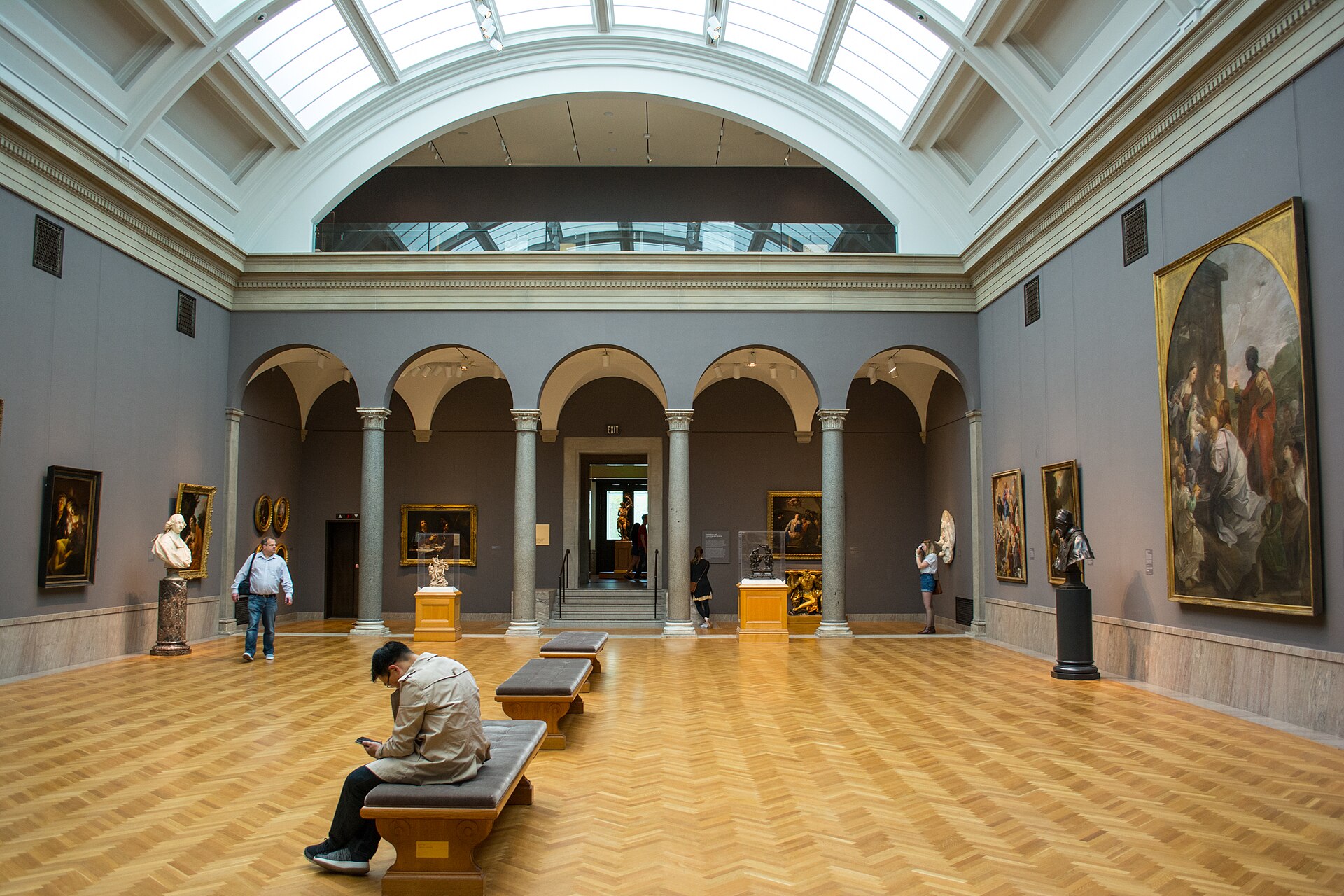
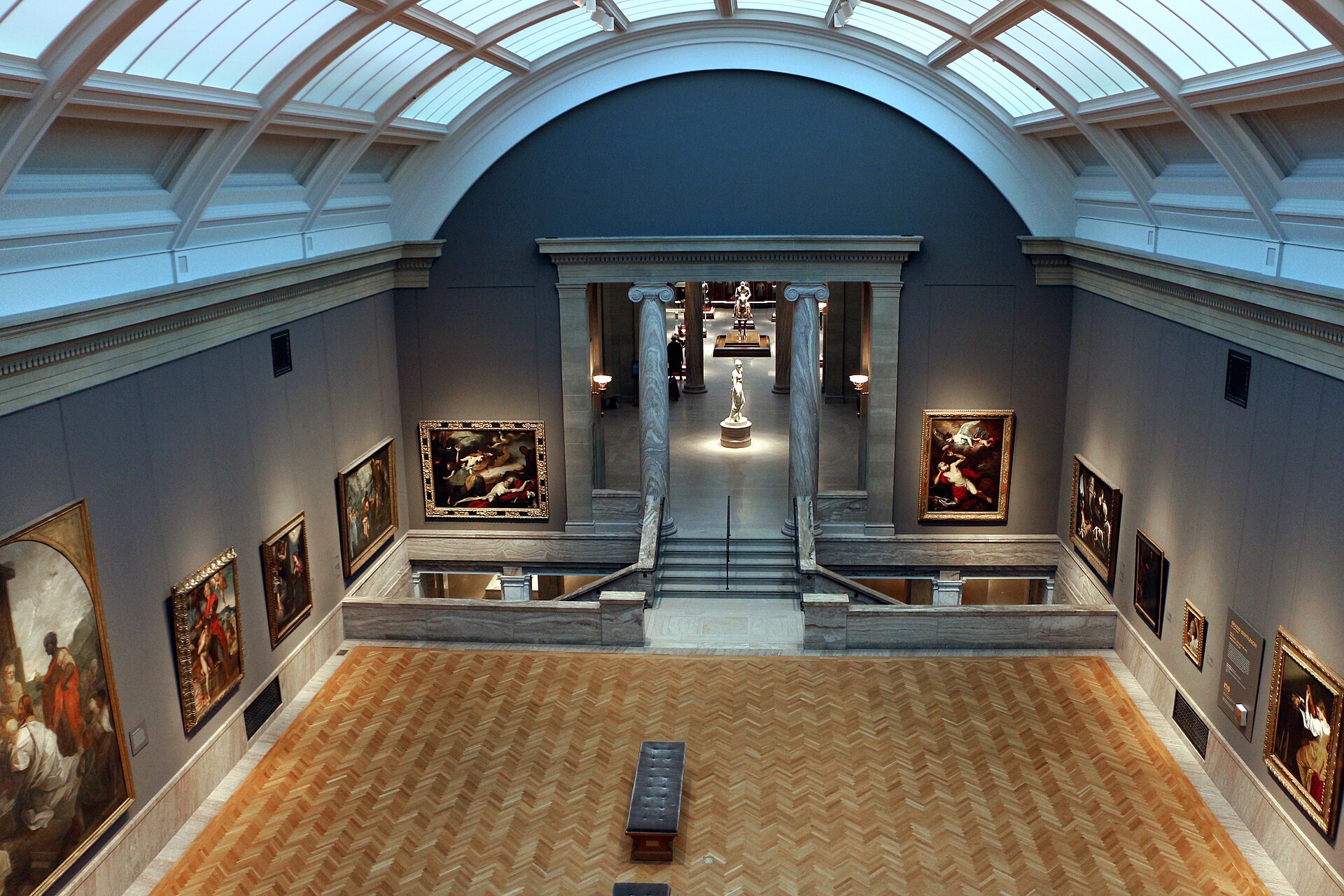
The original museum, a Neoclassical block of white Georgian marble by the Cleveland firm of Hubbell and Benes, built for 1.25 million dollars and opened on 6 June 1916. Its top-lit painting halls, with barrel-vaulted glazed ceilings, herringbone parquet and arcaded ends, still hold the European old masters, and the 2005 to 2012 rebuilding treated this pavilion as the piece to be restored rather than altered.
Photograph by APK · CC BY 4.0
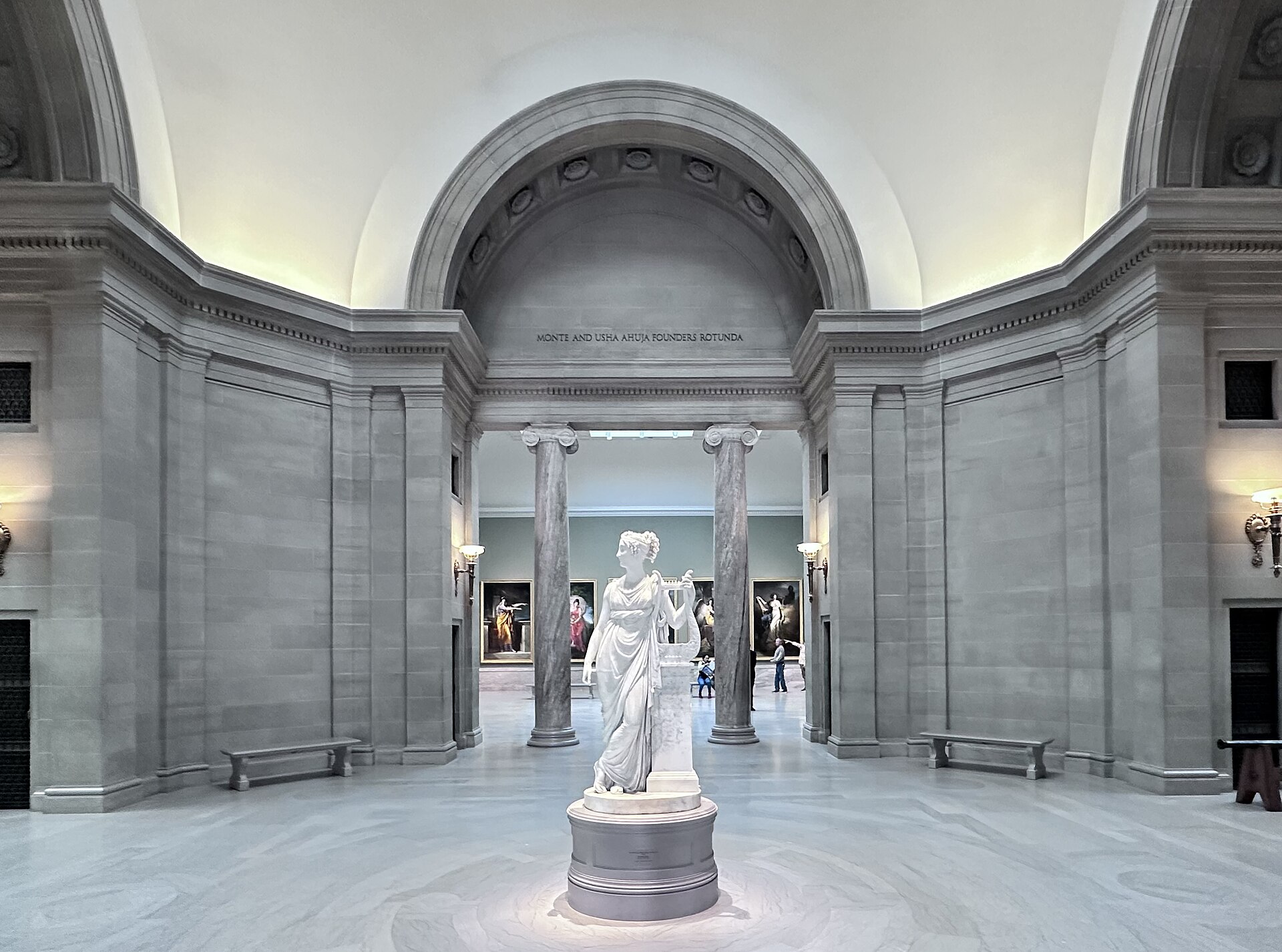
The Monte and Usha Ahuja Founders Rotunda
The domed rotunda on the upper floor of the 1916 building, its name cut into the stone above the arch, opening on the axis of the marble staircase into the painting galleries beyond. It is the ceremonial centre of the old building and the point from which the historic plan reads most clearly.
Photograph by Tim Evanson from Cleveland Heights, Ohio, USA · CC BY-SA 2.0
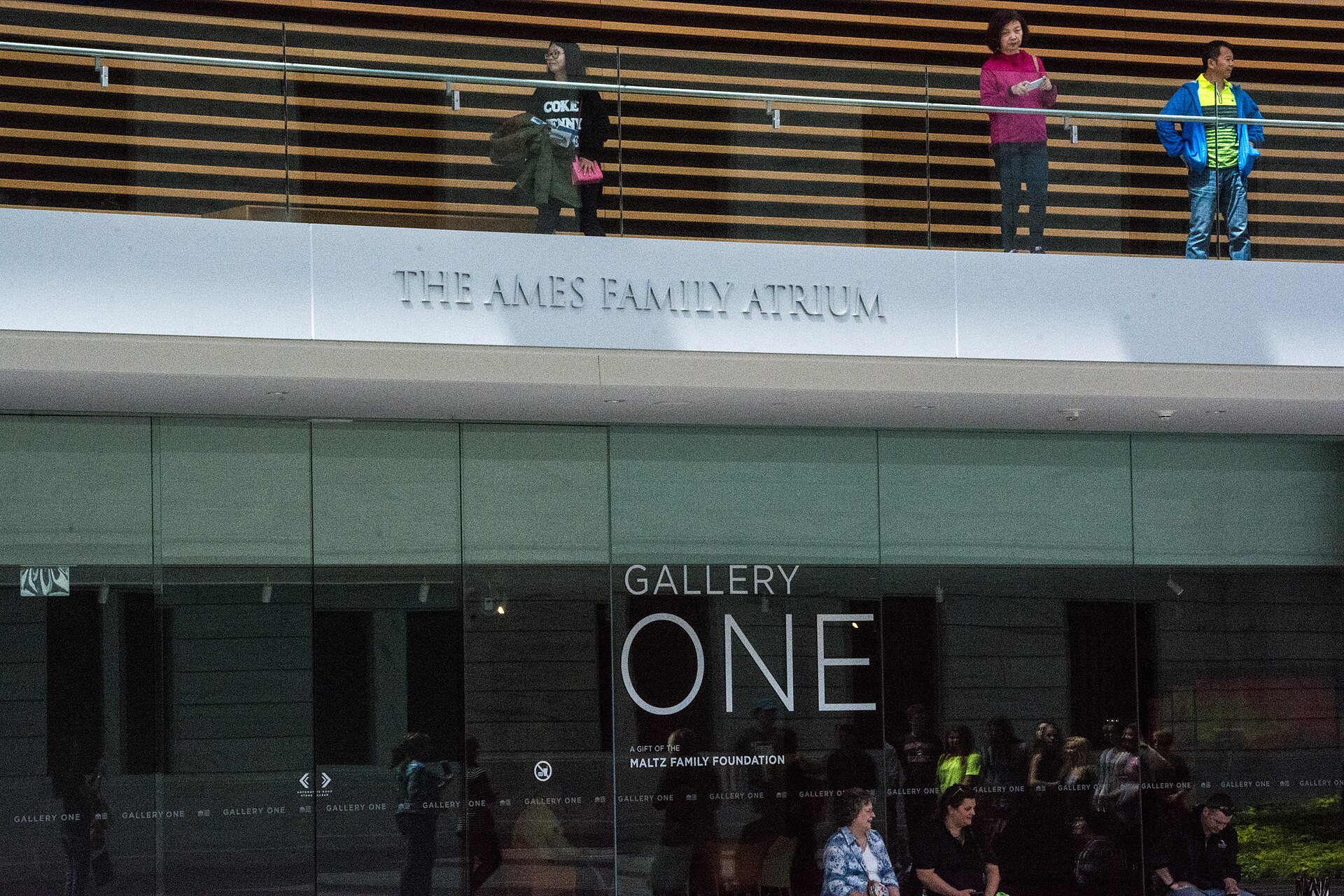
The Ames Family Atrium
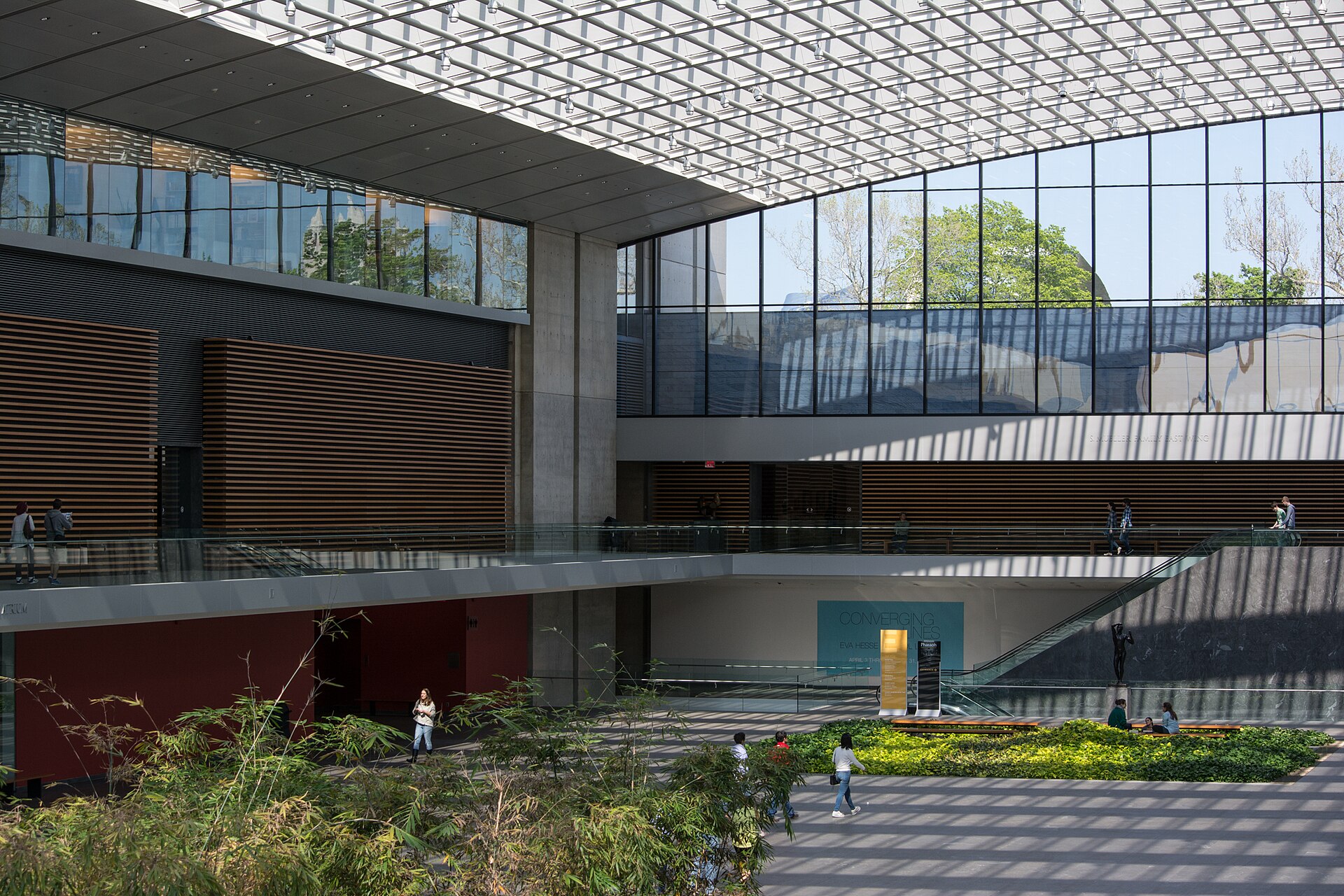
The 39,000 square foot glazed court at the centre of the museum, roofed by a curving canopy of glass and steel and completed in 2012 as the second phase of the Rafael Vinoly rebuilding. It is a covered public piazza rather than a gallery: bamboo planting, escalators, event space, and the entrance to the ArtLens interactive gallery off one side. It is free to enter and is where most visits now begin.
CC0
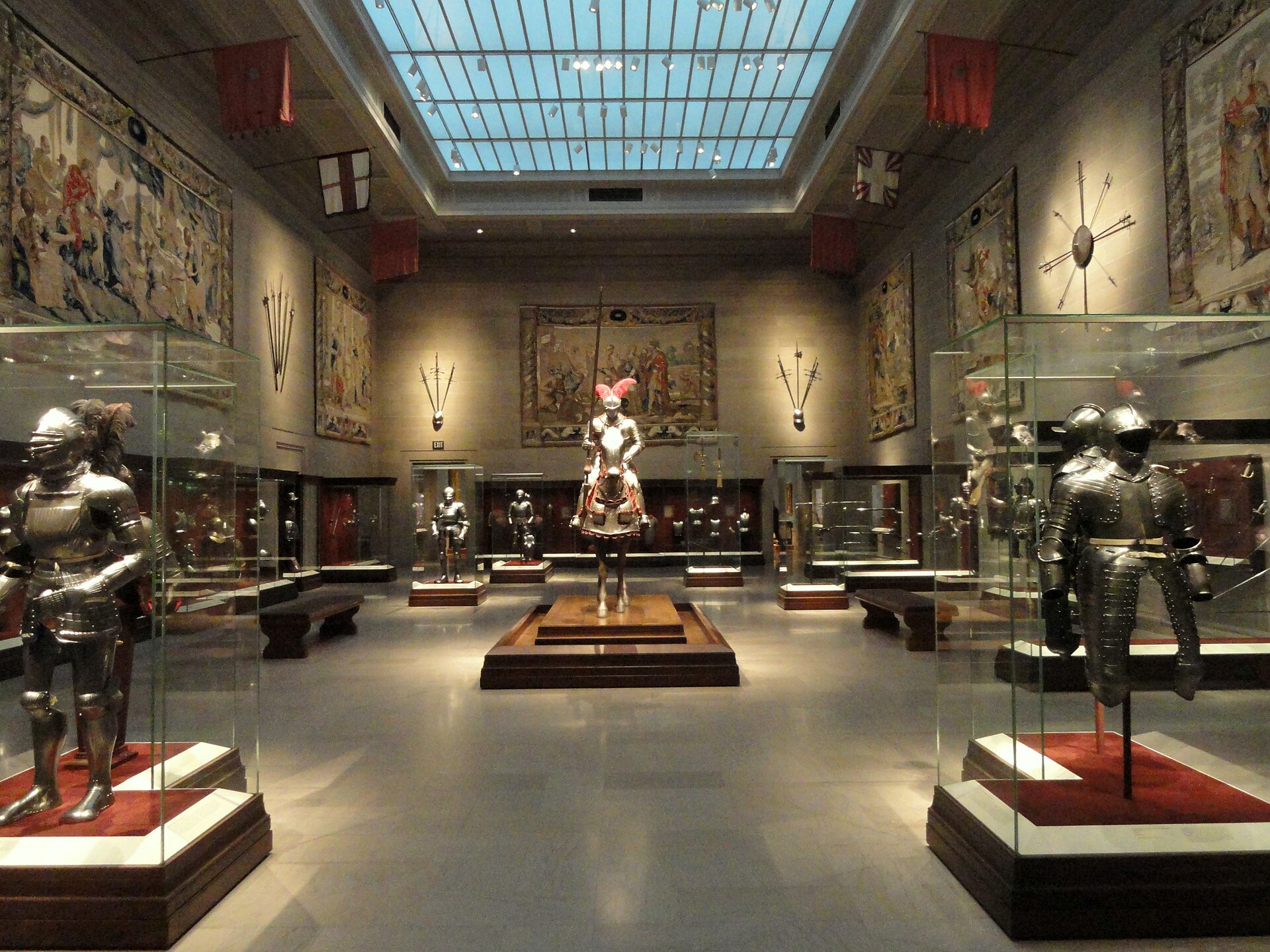
The Armor Court, gallery 210A
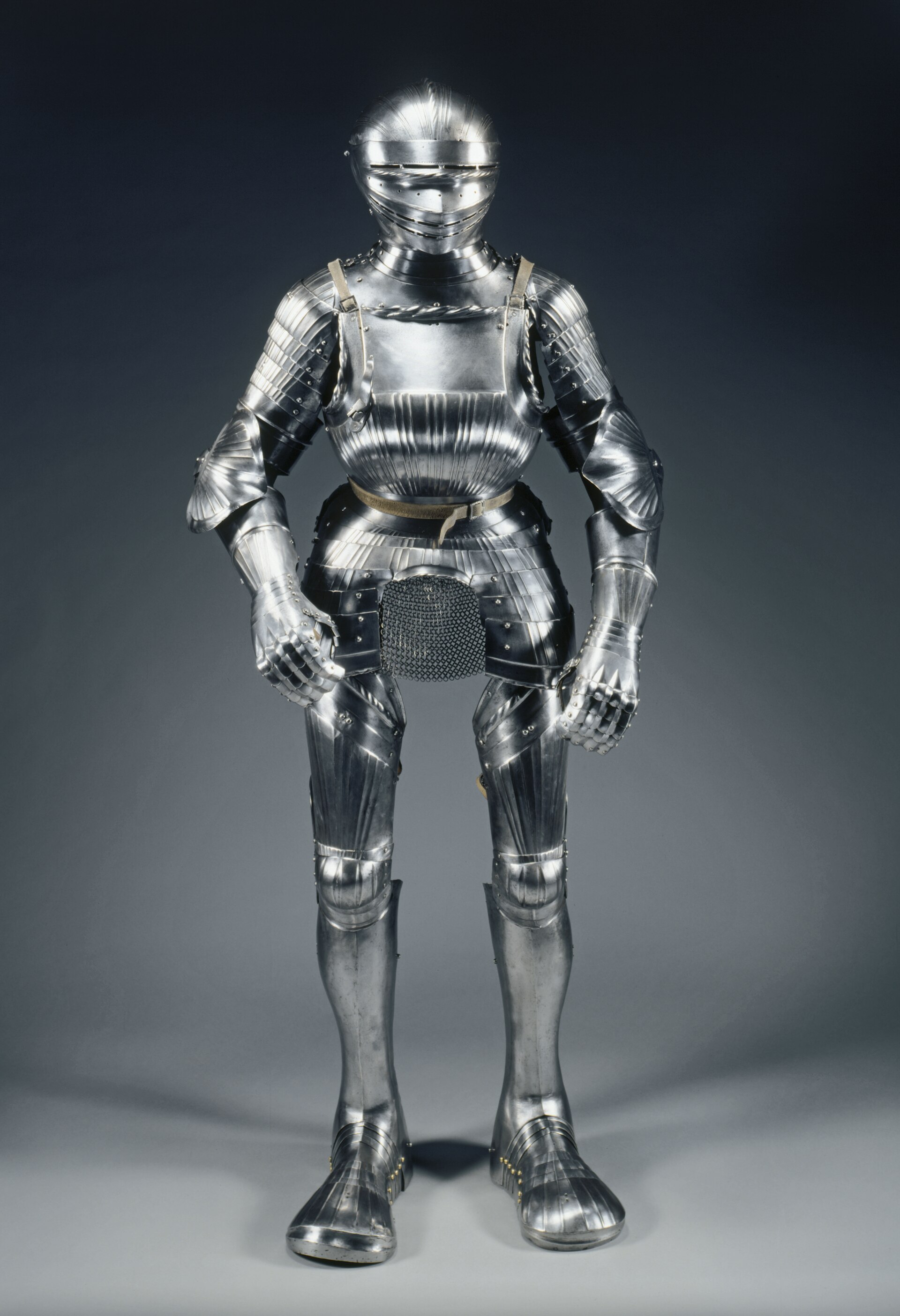
A top-lit hall of European arms and armour hung with tapestries and heraldic banners, with the armour for man and horse bearing the Vols-Colonna arms, made in north Italy about 1575, mounted on a plinth at its centre. Cased harnesses and fans of swords and polearms line the walls. It is the room children remember and it sits directly at the head of the marble staircase.
Photograph by Tim Evanson from Cleveland Heights, Ohio, USA · CC BY-SA 2.0
The European painting galleries
Ranged through the 1916 building by period and school, from Italian Gothic and Byzantine rooms on the lower floor up through Italian Baroque at 217, British painting and decorative arts at 203B, nineteenth-century European at 219 and the twentieth-century avant-garde at 223. Caravaggio's Crucifixion of Saint Andrew of 1606 to 1607 hangs in 217 and Turner's Burning of the Houses of Lords and Commons of 1835 in 203B.
Photograph by APK · CC BY 4.0
The medieval galleries and the treasury
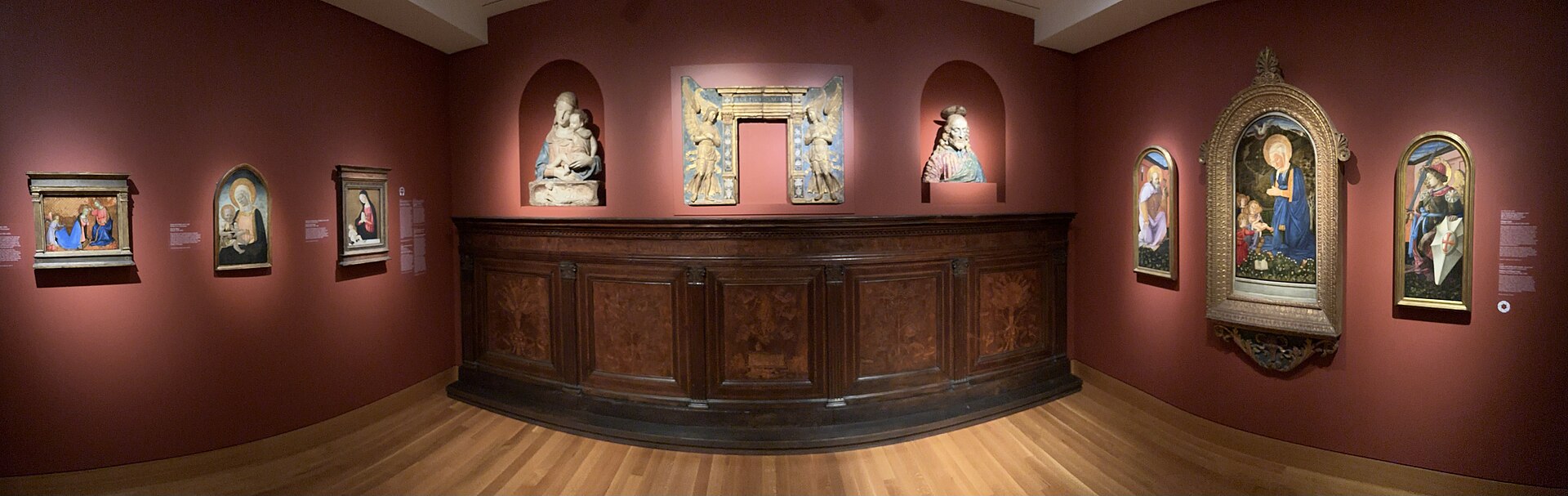
Gallery 110A holds early Italian panel painting against dark red walls, gold-ground Madonnas and a carved cassone; 106A covers the Migration Period and Coptic material and holds the late eighth-century Cumberland Medallion; 106C is the Medieval Treasury, with reliquaries including the relics of Saint Adelaide and Saint Hermetis of about 1045. Medieval Art is also the department that holds the armour and the manuscript leaves.
The Asian galleries
Chinese painting and calligraphy at 240A, Japanese art at 235A, Indian painting at 242B and Indian and Southeast Asian sculpture at 243, where the pre-Angkorian Krishna from Phnom Da stands. The collection was built principally under Sherman Emery Lee, director from 1958, and the Encyclopedia of Cleveland History rates it among the finest in the United States. Rotations are frequent here because much of the material is light-sensitive.
The print, drawing, textile and photograph galleries
Prints and Drawings occupy 101A and 101B, Manuscripts and Textiles 115, the Textile Gallery 234 and Photography 230. These are rotation galleries rather than permanent hangs: the vast majority of the museum's holdings in these departments are recorded as not on view at any one time, which is the honest answer to why a reader will not find a particular Rembrandt etching on the wall.
Photograph by Jcsulser · CC BY-SA 4.0
The Ingalls Library and Museum Archives
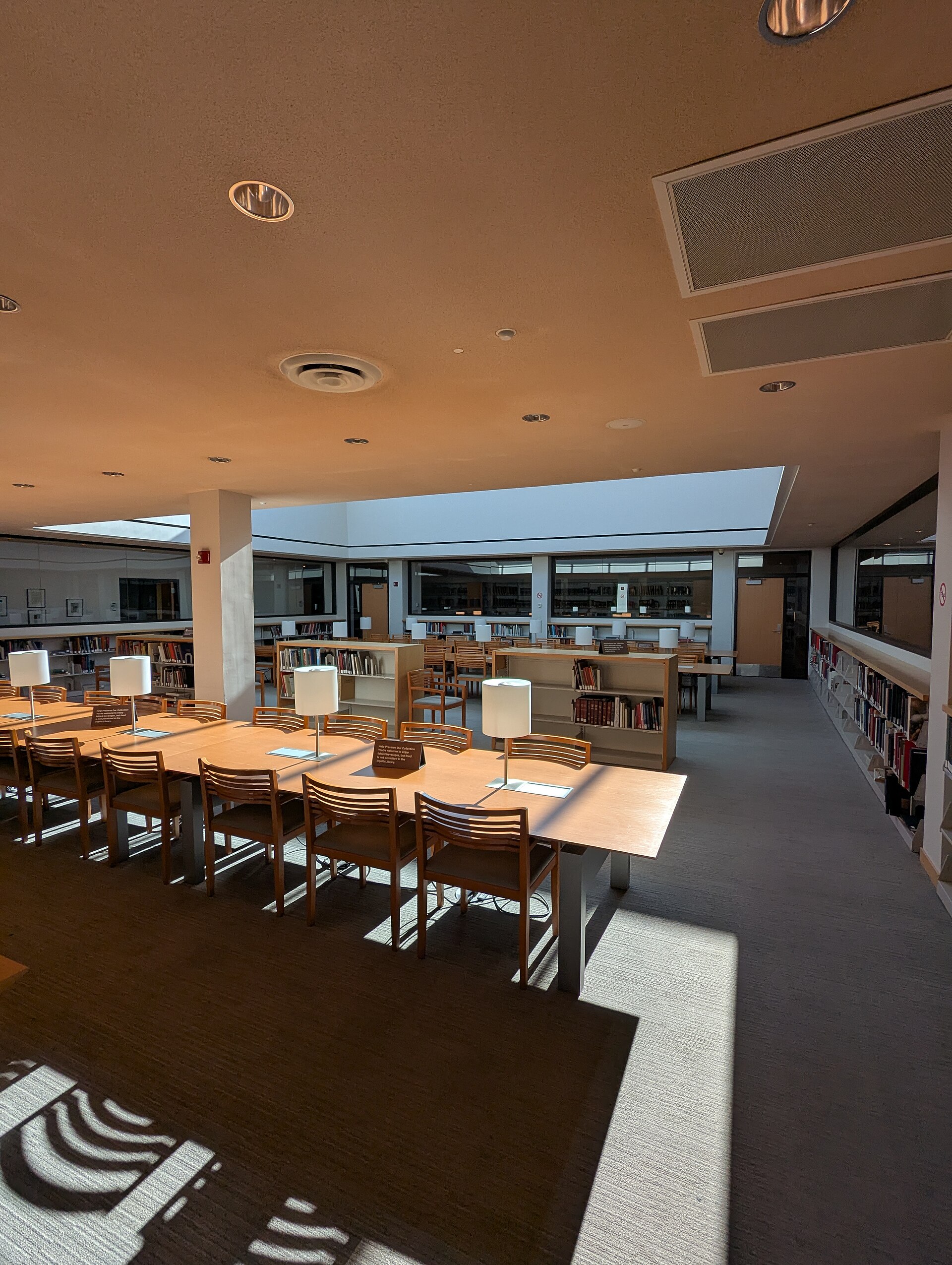
An art research library and the institutional archive, open to the public rather than to staff alone, with reading tables, open stacks and daylight from a clerestory. It is one of the beneficiaries named in the museum's current fundraising campaign, and it is the address the museum gives for donations of scholarly publications.
Photograph by Heidi Strean · CC BY 2.0
The Breuer wing of 1971 and the north entrance
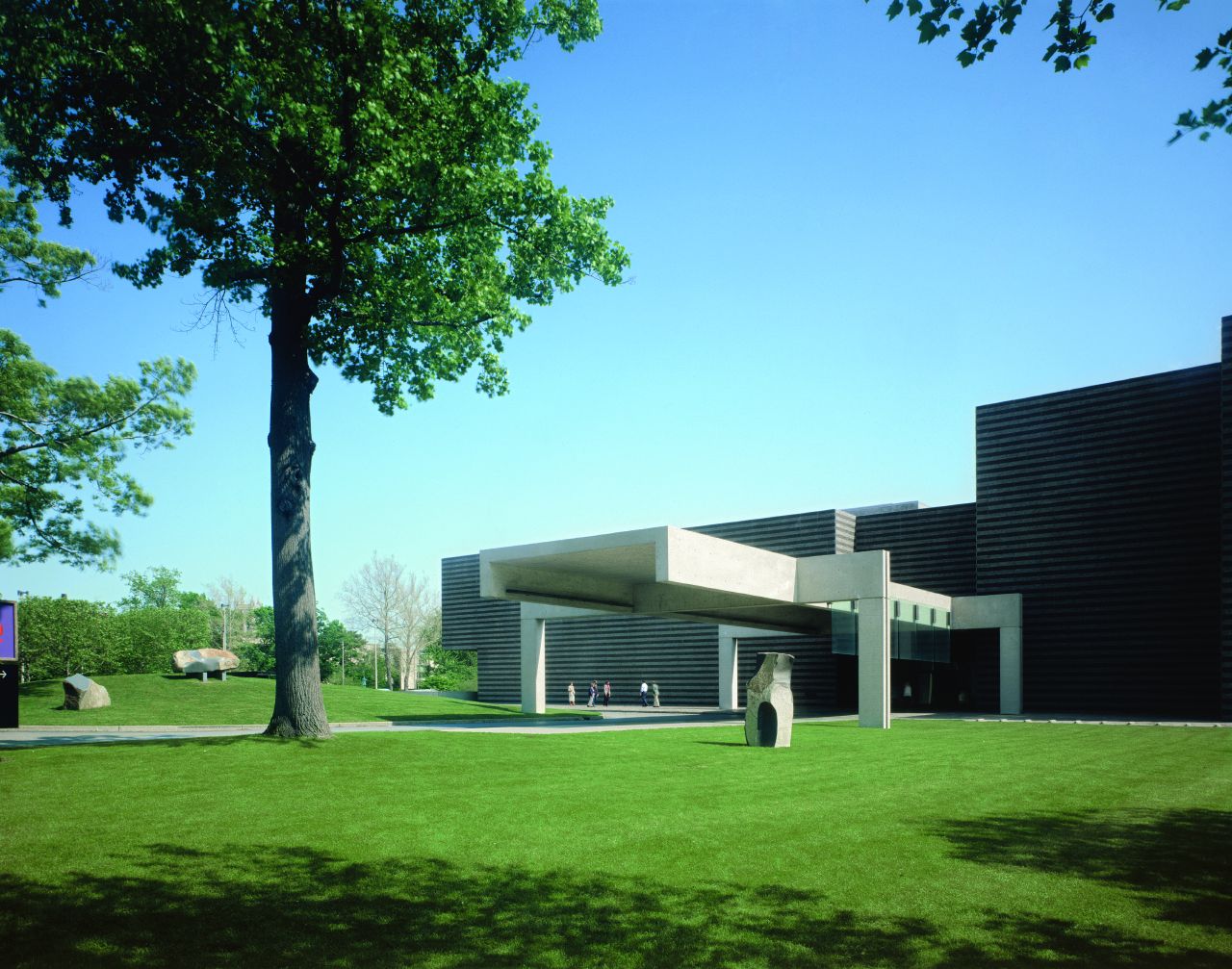
The education wing opened in 1971, clad in horizontal bands of light and dark granite bonded to concrete and fronted by a long concrete canopy over the north entrance. It brought special exhibition galleries, classrooms, lecture halls and the education department, and it was renovated rather than removed in the first phase of the Vinoly works, completed in 2009. The north lobby holds the coat check.
What to see first
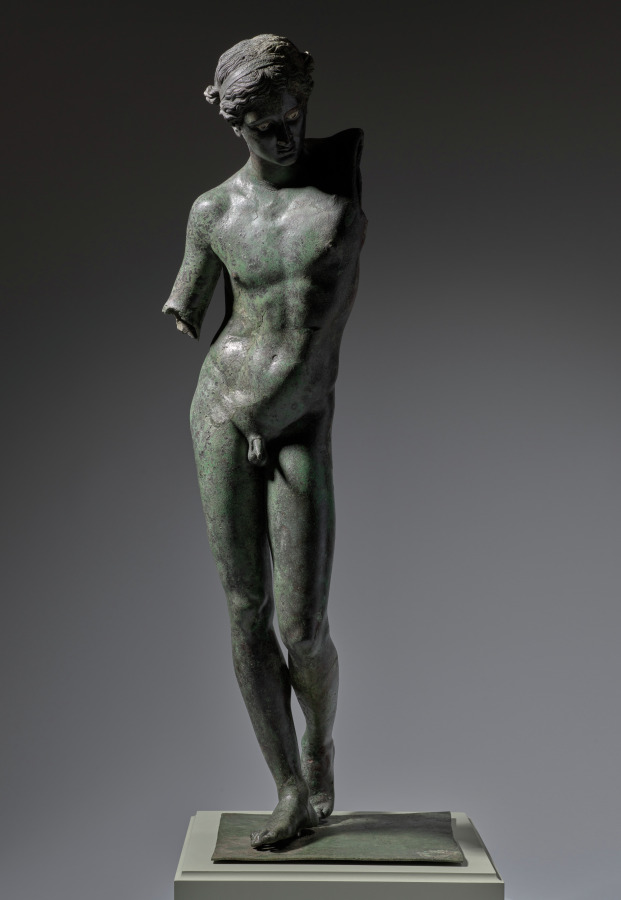
The Cleveland Apollo: Apollo Sauroktonos
Attributed by the museum to Praxiteles, c. 350 to 200 BCE
The most argued-over object in the building, and the museum shows it in gallery 100, the 1916 Lobby, rather than deep in the antiquities suite. Its attribution and its findspot are both contested; this archive holds a record on it and does not accept the Praxiteles attribution as settled. Go and look at it knowing that.6
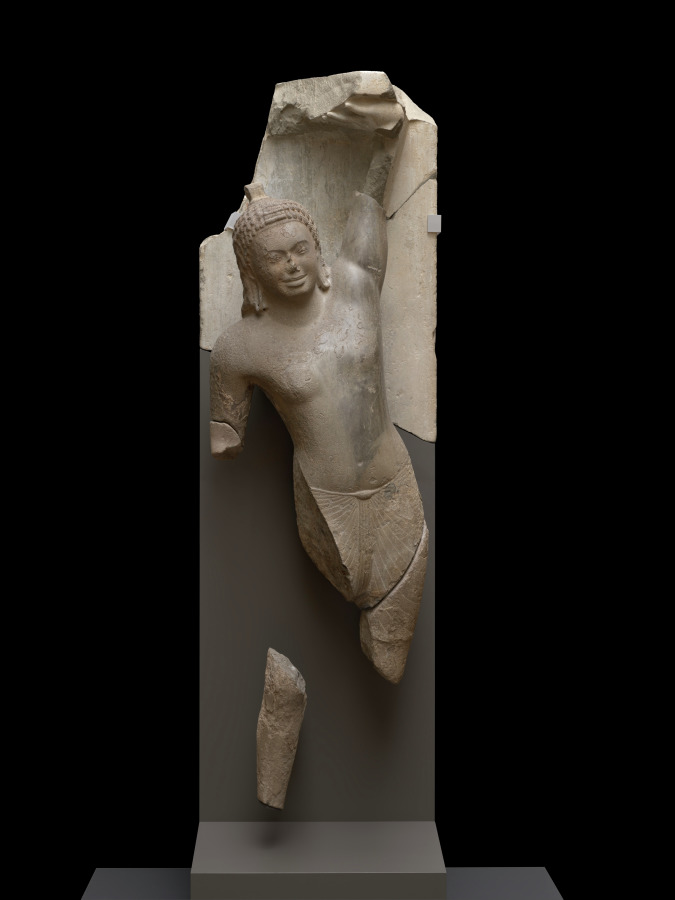
Unrecorded sculptor of Phnom Da, Angkor Borei, c. 600
Pre-Angkorian Khmer sculpture of the first rank, in gallery 243, and the object that carries the museum's best provenance story: fragments went to Phnom Penh in 2005, petrographic analysis matched the largest of them to the Cleveland stone, and Cambodia's Ministry of Culture authorised its transfer back to Cleveland in 2015 for the reassembly. This archive holds a record on it.6
Auguste Rodin, modelled 1880 to 1881, this monumental cast installed 1917
It stands outside, at the south entrance, and it is broken. A pipe bomb went off beneath it at about one in the morning on 24 March 1970, destroying the pedestal and turning the lower legs to shrapnel. The museum reinstalled it unrepaired, to preserve what remained of Rodin's own bronze and to leave the damage on the record. It is free to see without entering, and it is the figure on the plinth in the photograph at the head of this page.10
Armor for Man and Horse with the Vols-Colonna Arms
North Italy, c. 1575
The centrepiece of the Armor Court, etched in the Pisan style, with the family crest repeated seven times. The museum records the combined weight of horse and rider armour at 114 pounds and notes the suit may originally have belonged to a garniture with exchangeable elements for field and tournament use.14
The Crucifixion of Saint Andrew
Caravaggio, 1606 to 1607
In gallery 217, and the single painting most likely to justify the trip for a visitor who cares about the seventeenth century. Released by the museum as CC0, so it can be reproduced without permission.6
The Burning of the Houses of Lords and Commons, 16 October 1834
Joseph Mallord William Turner, 1835
In gallery 203B with the British painting and decorative arts. One of two Turner canvases of the fire; this is the version Cleveland holds, and it is open access.6
Medallion with the Bust of Christ, the Cumberland Medallion
Unattributed, late 700s
In gallery 106A with the Migration Period and Coptic material, and a reminder that the medieval holdings here are not an afterthought behind the paintings. The Medieval Treasury next door at 106C holds reliquaries dated to about 1045.6
La Vie
Pablo Picasso, 1903
In gallery 223 with the twentieth-century avant-garde, and worth naming for a second reason: the museum's own open access data flags it Copyrighted rather than CC0. It is the clearest single illustration of where the museum's free-image policy stops, and why.6
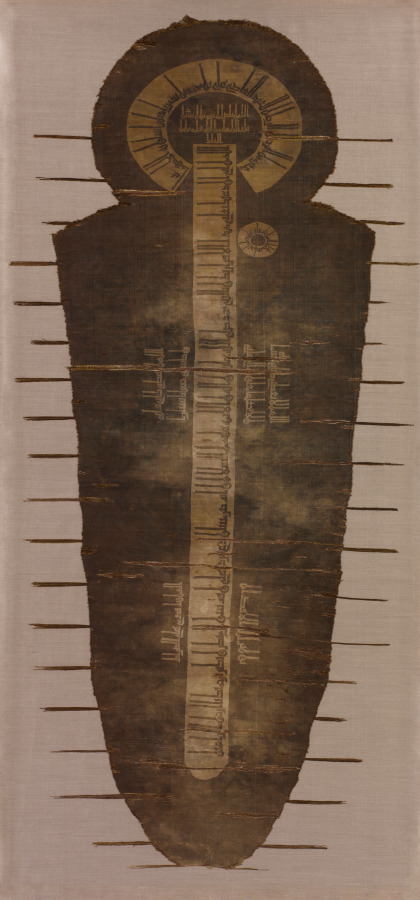
Tomb Cover
Unidentified weaver, Iran or Iraq
This archive holds a record on it, and a visitor should know before travelling that the museum's own collection data records it as not on view. Its radiocarbon range of 1640 to 1950 is irreconcilable with the medieval burial deposit its reported findspot implies, which is why it matters and why it is not hanging.6
A single leaf, accession 1982.141, from the Beauvais Missal that Philip Duschnes cut up in New York in October 1942. This archive holds a record on the dispersed book. The museum's data records the leaf as not on view, which is normal for a manuscript fragment and still worth checking before a visit.6
12 Apr to 9 Aug 2026Confirmed 7 Aug 2026 · check before you travel
Three bequests, one park, and a building that took thirty years to argue about
The Cleveland Museum of Art exists because three men left money for an art museum and none of them lived to see one. Hinman B. Hurlbut, John Huntington and Horace Kelley each bequeathed funds specifically for the purpose, and Jeptha H. Wade I gave part of his Wade Park property for the site. The separate estates had to be brought together before anything could be built, which is why the institution was incorporated only in 1913 and opened to the public on 6 June 1916, decades after the first of the bequests. The founding phrase the museum still uses, and still prints on its own pages, is that it was founded for the benefit of all the people forever.
The building they got was a Neoclassical block of white Georgian marble by the Cleveland firm of Hubbell and Benes, built at a cost of 1.25 million dollars, set above a lagoon and a formal garden on the south side so that the portico reads across water. Frederic Allen Whiting was the first director, from 1913 to 1930, and under him a circle of local families named after Cleveland streets and institutions, the Allens, Holdens, Huntingtons, Hurlbuts, Nortons, Warners, Severances and Wades, gave the works that turned three bequests into a collection. The first Annual Exhibition of Cleveland Artists and Craftsmen was held in 1919 and became the May Show. The point worth holding onto is that this is a museum built by a city's own money and, from the start, given away free.
Free admission is the fact, and it is older than the building's second century
General admission is always free. That is the museum's own phrasing on its visit page, and it is the single most useful fact a visitor can have, because it is unusual for a collection of this quality in the United States and because it changes how the building is used. There is no timed entry to negotiate, no membership calculation to do, and no reason not to come in for forty minutes. The museum began charging for selected special exhibitions in 1992 and has maintained free admission to the permanent collection throughout.
What makes the policy durable rather than merely traditional is the endowment behind it. The museum says on its own pages that it has one of the largest endowments of any art museum in the country. Steven Litt, reporting for Ideastream in June 2026, put the endowment at 1.1 billion dollars and reckoned it the sixth largest in the United States, behind the Getty, the Metropolitan, the Museum of Modern Art, the Art Institute of Chicago and the Museum of Fine Arts in Houston. He was careful to hedge that ranking as the product of an online search rather than an audited comparison, and the hedge is worth carrying: endowment values move with markets and reporting periods.
The current campaign makes the connection explicit. The museum announced in June 2026 that it had raised 480 million dollars in cash, pledges and artworks against a 600 million dollar target set for 2027, the largest campaign in its history and the largest of any museum in Ohio. Two hundred million of the goal is to come as gifts of art. Roughly forty million is reserved for capital work, including refurbishment of the Fountain of the Waters and the Zodiac Garden in the Fine Arts Garden and an overhaul of Wade Lagoon. The rest is intended to endow twenty-one curatorial and senior administrative posts, the exhibition programme, conservation, the library and digital work, and, in the director William Griswold's account, to ensure the museum keeps admitting everyone free. Attendance reached more than 800,000 in 2025, the museum's highest annual total, helped by a Takashi Murakami exhibition. A strategic plan of 2017 set ten-year goals of a million visitors and a 1.25 billion dollar endowment; the museum is now approaching both.
Open Access, and why this archive reaches Cleveland directly
In January 2019 the museum put more than half its collection into the public domain as high-resolution imagery under a Creative Commons Zero designation. Its own account of the policy is unusually plain: open access content is published digitally, free of charge, and without copyright and licensing restrictions, usable in any application from art making to data science, without fees, without restriction and without asking permission. Works designated CC0 do not require attribution or citation at all. Metadata for the entire collection is released, and over 61,000 records are reachable through a public application programming interface that needs no key or token. The data is also mirrored to GitHub, refreshed weekly, and to the Internet Archive, Wikimedia Commons and Wikidata. The museum updates the open access set every January as new works fall into the public domain.
The exclusions are stated as clearly as the grant. Images and data are not released where the museum has not yet digitised the work, where the work is under copyright or carries restrictions from an artist, donor or lender, or where the museum does not fully own it. That boundary is visible in the collection data itself: Picasso's La Vie of 1903, in gallery 223, comes back from the museum's own API flagged Copyrighted rather than CC0, while Caravaggio's Crucifixion of Saint Andrew a few rooms away comes back CC0. The policy is not a slogan; it is a per-object flag that anyone can read.
This bears directly on the archive you are reading. This publication's image pipeline queries Cleveland's open access API at openaccess-api.clevelandart.org and admits a photograph only when the museum's own share_license_status field returns CC0, refusing anything else. That code exists because searching a volunteer mirror and concluding that no free photograph exists is a search failure being reported as a fact about the world; Cleveland, along with the Metropolitan and the Art Institute of Chicago, publishes far more open imagery through its own API than ever reaches Commons. Of the institutions this archive depends on for photographs of three-dimensional objects, Cleveland is among the most useful, and the reason is a policy decision it made in 2019.
Four buildings pretending to be one
What a visitor walks through is four distinct architectural arguments stitched together. The 1916 marble pavilion by Hubbell and Benes is the first. The second is the addition completed on 4 March 1958, which doubled the museum's size and enclosed what had been an outdoor garden court; that year also brought the Leonard C. Hanna Jr. bequest, which gave the museum the means to buy in the international market, and the arrival of Sherman Emery Lee as third director. The third is the wing opened in 1971, clad in horizontal bands of light and dark granite bonded to concrete and fronted by a long concrete canopy, which brought special exhibition galleries, classrooms, lecture halls and the education department. A further addition under the fourth director, Evan Hopkins Turner, housed the library and nine new galleries.
The fourth argument is the largest and the most recent. In October 2005 the museum began an expansion designed by the Uruguayan architect Rafael Vinoly, reconstructing the east and west wings and covering the centre of the site with a glazed court. Much of the permanent collection went into storage and for much of 2006 the University Circle building was closed to the public entirely. The largest contributions came from the George Gund Foundation and the State of Ohio. The work was scheduled for completion in 2011 and finished in 2013; the architects record two phases, the first, taking in the 1916 building, the Breuer building and the new east wing, completed in 2009, and the second, the west wing and the central atrium, in 2012. The stated aim was to unify disparate architectural vocabularies, and the method was to treat the 1916 pavilion as the jewel of the composition, tapering the new wings towards it and glazing them so that its flanks stay visible from inside.
The result is the 39,000 square foot Ames Family Atrium, three new wings, a third more gallery space, the Gallery One interactive centre, and a cafe, restaurant and store. It also produced a running cost problem that the museum has been honest about. The 320 million dollar campaign completed in 2016 paid the construction bills but, as Litt reported Griswold conceding, did not account for operating a building 51 per cent larger, up from 389,000 to 588,000 square feet, for an audience that had grown with it. That is the gap the current campaign is meant to close.
Provenance: a museum that has returned objects, and litigated to keep one
This publication treats a museum as a party to provenance rather than a neutral host, and Cleveland's record has to be stated in both directions. On 19 November 2008 the museum and the Italian Ministry of Culture announced jointly that fourteen antiquities would return to Italy. Italy agreed to lend a similar number of pieces of comparable quality and to arrange a continuing association with an Italian institution. The objects were connected to the investigations that ran through the Geneva Freeport raid on Giacomo Medici in September 1995, the Paris raid on Robert Hecht in 2001, and the Basel raids on Gianfranco Becchina in 2002 and 2005. The then director Timothy Rub presented the agreement as absolving the museum of any intentional wrongdoing and declined to identify the dealers from whom the objects had come.
In late 2021 the museum returned three more objects, acquired from the New York-based dealer Edoardo Almagia in 1994 and 1995: two Roman amphorae with spiked handles and a small ancient Near Eastern glass bead in the form of a head. The archaeologist David Gill recorded the return in January 2022 and did not let the museum have it quietly. He noted that no press release about the returns had appeared, asked why there was reluctance to be transparent about the objects, and pointed out that in 2010 the museum had been similarly unwilling to say what else it had bought from the same dealer. That criticism stands: returning an object and describing it are different acts, and only the first has reliably happened here.
On the other side of the ledger is the Cambodian Krishna in gallery 243. Fragments from Phnom Da that Cleveland sent to Phnom Penh in 2005 were partly built into reconstructions there; conservators at the National Museum of Cambodia found in 2014 that the largest might belong to the Cleveland figure, petrographic analysis showed the fragment and the statue were cut from the same block, and in 2015 Cambodia's Ministry of Culture and Fine Arts authorised its transfer to Cleveland so the sculpture could be made whole. That is cooperation in the direction museums are rarely credited for, and this archive's own record on the object still notes that the legal form of the transfer has never been published.
Then there is the object the museum went to court over. On 14 August 2023 the New York County District Attorney's office obtained a warrant and seized, in place, a headless bronze the museum calls the Philosopher, said by prosecutors to depict Marcus Aurelius, dated around 180 to 200 CE and alleged to come from Bubon in south-western Turkey. The museum had bought it from a New York gallery in 1986 and it had been a star exhibit for close to forty years. On 19 October 2023 the museum sued the District Attorney in the United States District Court for the Northern District of Ohio, seeking a declaration that it holds good title, disputing the identification of the figure and arguing that there is a complete absence of scientific evidence tying it to Bubon. Filing against a prosecutor rather than negotiating a return is rare institutional behaviour, and a reader should know the museum chose it.
The Cleveland Apollo, in gallery 100, is a separate and quieter case, and it is worth correcting a common description of it: no lawsuit was brought over the Apollo. The museum bought it in 2004 from Phoenix Ancient Art in Geneva for a reported figure of about five million dollars. Greek and Italian claims followed as diplomatic and political pressure rather than litigation, including a Greek threat to withdraw nineteen loans from the Louvre if the Apollo were shown there. The museum's own collection data still gives Praxiteles as the maker. This archive's record on the object does not, and the disagreement between an institution's catalogue and the evidence for it is exactly the kind of thing this publication exists to keep visible.
What a visit actually involves
The museum opens at ten every day except Monday, closing at five on Tuesday, Thursday, Saturday and Sunday and at nine on Wednesday and Friday. Those two late evenings are the practical answer for anyone working, and they are twice as long as the standard day. It closes on 1 January, Presidents Day, 4 July, Thanksgiving and 25 December, closes at four on 24 and 31 December, and opens on Martin Luther King Jr. Day. The permanent collection needs no ticket. Selected special exhibitions do, and the prices are set per show: the museum's own table for Martin Puryear: Nexus, running from 12 April to 9 August 2026, gives seventeen dollars for an adult, fifteen for a senior of 65 and over or an adult group of ten or more, eight for a college student with identification, a child of six to seventeen or a member's guest, and free for members and children of five and under.
Two things surprise first-time visitors. The first is the security: every visitor passes through metal detectors, the museum operates a strict no-weapons policy, and it states that anyone refusing a screening will be denied entry. The second is the scale. With more than 63,000 objects and no published recommended duration, the building rewards a plan. The free daily highlights tours at 11:00 and 13:00, capped at fifteen people and requiring a free ticket, are the museum's own remedy, and the ArtLens app carries self-guided routes. Parking is in the museum's own garage off Jeptha Drive, paid at the entrance by card or cash, with accessible bays on the top level near the north entrance and on level P2, which reaches the lower floor by tunnel. Coat check is in the Horace Kelley Art Foundation North Lobby. Provenance Cafe and Provenance Restaurant keep their own hours, both narrower than the galleries'.
One caution about names, because University Circle is dense with them. The Cleveland Museum of Natural History and the Cleveland Institute of Art are separate institutions within a few hundred metres, and the Museum of Contemporary Art Cleveland is a fourth. Transformer Station, in Ohio City, is programmed by this museum but is a different building at a different address, and the museum's own listings mark exhibitions there as off-site. Everything on this page, the hours, the free admission and the galleries, refers to the main museum at 11150 East Boulevard.
What visitors say
We reproduce no visitor prose and cite no platform star average, so what follows is drawn from the museum's own published statements and from named journalism. The central fact is that general admission is free and always has been, and the museum treats that as constitutive rather than promotional: its director told Ideastream in June 2026 that the community's commitment to free general admission was the reason a 480 million dollar campaign had succeeded, and roughly 40 per cent of the money raised is intended to keep it that way. Attendance passed 800,000 in 2025, the highest in the museum's history. The building is genuinely large and the museum publishes no suggested visit length, so the common experience is of running out of stamina rather than out of things to see; the free daily highlights tours at 11:00 and 13:00 exist for that reason. The friction points are not the price. They are the metal detectors and the strict no-weapons screening at the door, the Monday closure, the paid tickets on selected special exhibitions that sit inside an otherwise free building, and the fact that the depth of the collection in prints, drawings, textiles and photography is mostly in store rather than on the wall. On provenance the museum's record is genuinely mixed and is discussed below.
What is praised, what is criticised
Praised: free general admission to the permanent collection, at all times, with no conditions and no timed ticket, in a collection of more than 63,000 objects
Praised: the Open Access programme: more than half the collection published as CC0 high-resolution images with over 61,000 records reachable through a public API that needs no key, which makes this one of the few museums a reader can cite and illustrate without asking anyone
Praised: the 1916 Hubbell and Benes building itself, restored rather than modernised in the 2005 to 2012 works, with its top-lit painting halls and the Ahuja Founders Rotunda intact
Praised: the Armor Court, the Asian galleries built under Sherman Lee, and the medieval treasury: three areas where the collection is strong enough to be a destination in its own right
Praised: free daily guided highlights tours at 11:00 and 13:00, and Sensory-Friendly Saturday sessions before opening on the third Saturday of each month
Praised: the museum's own parking garage with a tunnel connection to the lower level, which in a campus museum is not a small thing
Criticised: every visitor passes through metal detectors and a security screening, and the museum states plainly that anyone refusing it is denied entry
Criticised: closed every Monday, and closed outright on 1 January, Presidents Day, 4 July, Thanksgiving and 25 December, with early 16:00 closes on 24 and 31 December
Criticised: selected special exhibitions are ticketed inside a free building, at 17 dollars for an adult on the 2026 Puryear show, and the price is set per exhibition rather than published as a standing tariff, so a visitor cannot know the cost of a visit in advance from the admission page alone
Criticised: the prints, drawings, textile and photography holdings are overwhelmingly recorded as not on view, and the museum's own data confirms it object by object
Criticised: the provenance record is not clean. The museum agreed on 19 November 2008 to return fourteen antiquities to Italy, and returned three further objects associated with the dealer Edoardo Almagia in late 2021
Criticised: the archaeologist David Gill has criticised the museum specifically for a lack of transparency about those returns, noting in January 2022 that no press release had appeared and asking why there was reluctance to say what the objects were
Criticised: the museum's institutional history includes real instability: three directors and four periods of interim leadership across fifteen years, and the resignation of David Franklin in 2013 after trustees learned he had concealed an affair with an employee
Criticised: two of the three objects in this archive that name the museum as their current location are recorded by the museum as not on view
Litt, the Plain Dealer's long-serving art and architecture critic, reported the museum at 480 million dollars of a 600 million dollar campaign due to close in 2027, the largest in its history and in Ohio. He set the achievement against the museum's recent past rather than flattering it: the turbulence before William Griswold's arrival in 2014, the 6.2 million dollar deficit averted in 2020 by new revenue and by layoffs, buyouts and voluntary departures, and the 51 per cent growth in floor area from 389,000 to 588,000 square feet that the earlier campaign had built but not endowed. He gave the endowment as 1.1 billion dollars and the sixth largest in the United States, expressly hedging that figure as the result of an online search rather than an audited comparison.Ideastream Public Media, Steven Litt, 12 June 2026 [5]
Gill recorded the return of three further objects associated with Edoardo Almagia, acquired by the museum in 1994 and 1995, and pressed the museum on its silence about them. He noted that no press release had appeared and asked directly why there was reluctance to be transparent about the objects, and observed that the museum had been similarly unforthcoming in 2010 about what else it had bought from the same dealer.Looting Matters, David Gill, 6 January 2022 [8]
Records the joint announcement by the museum and the Italian Ministry of Culture that fourteen antiquities would go back to Italy, with Italy lending a similar number of comparable pieces in exchange and arranging a continuing association with an Italian institution. It also records the then director Timothy Rub presenting the agreement as absolving the museum of intentional wrongdoing, and his declining to name the dealers involved.Trafficking Culture, University of Glasgow, case study on the 2008 returns, 19 November 2008 [7]
A public-history account of the Thinker bombing of 24 March 1970 and of the decision not to repair the sculpture, which it reads as preserving Rodin's own bronze and leaving the Vietnam-era attack legible on the object. Read on the date given.Cleveland Historical, Cleveland State University, Chris Roy, 4 August 2026 [10]
Questions about The Cleveland Museum of Art
Where is The Cleveland Museum of Art?
11150 East Boulevard, Cleveland, Ohio 44106, United States.
How much does it cost to visit?
General admission, permanent collection galleries: free; Daily guided highlights tour: free; Spectacular Freedom: Andrew Wyeth and the Modern American Watercolor, adult: USD 17; Spectacular Freedom, senior (65 and up): USD 15; Spectacular Freedom, adult group of 10 or more / member guest / college student with ID: USD 8. As confirmed 30 August 2026.
When is it open?
Tuesday, Thursday, Saturday, Sunday 10:00-17:00; Wednesday, Friday 10:00-21:00; Monday closed. Closed: Monday, every week. Closed on 1 January, Presidents Day, 4 July, Thanksgiving Day and 25 December. As confirmed 30 August 2026.
How do you get there?
Car and parking: The museum has its own parking garage entered from Jeptha Drive, paid on site at the garage entrance by credit card or cash. Accessible parking is signed on the top level, a short distance from the north entrance, and on level P2, which connects to the lower level of the museum through a tunnel; On foot: In University Circle, with the Fine Arts Garden, the Fountain of the Waters and Wade Lagoon on the south side of the building. The Cleveland Museum of Natural History and the Cleveland Institute of Art are separate institutions a few hundred metres away in the same campus and are not part of this museum; Off-site venue: Transformer Station, in the Hingetown area of Ohio City, is programmed by this museum but is a different building at a different address. The hours and the free general admission recorded on this page are for the main museum at 11150 East Boulevard only.
What should you see first?
The Cleveland Apollo: Apollo Sauroktonos (Attributed by the museum to Praxiteles, c. 350 to 200 BCE); Krishna Lifting Mount Govardhan (Unrecorded sculptor of Phnom Da, Angkor Borei, c. 600); The Thinker (Auguste Rodin, modelled 1880 to 1881, this monumental cast installed 1917); Armor for Man and Horse with the Vols-Colonna Arms (North Italy, c. 1575); The Crucifixion of Saint Andrew (Caravaggio, 1606 to 1607); The Burning of the Houses of Lords and Commons, 16 October 1834 (Joseph Mallord William Turner, 1835).
What we could not confirm
The description of the museum as having litigated an Apollo attributed to Praxiteles does not survive checking. The 2023 lawsuit against the New York County District Attorney concerns a headless bronze the museum calls the Philosopher, said to come from Bubon in Turkey. The Apollo attracted diplomatic claims from Greece and Italy but no lawsuit in the sources read here. Anyone repeating the Apollo-litigation version should be corrected.
The outcome of Cleveland Museum of Art v. the New York County District Attorney, filed 19 October 2023 in the Northern District of Ohio, has not been established here. The bronze was seized in place and remained in the building pending resolution as of the November 2023 account read.
What the fourteen antiquities returned to Italy in 2008 actually were has never been published by the museum, and Timothy Rub declined to name the dealers. David Gill's transparency criticism of the 2021 returns applies with equal force to the 2008 agreement.
The endowment figure of 1.1 billion dollars and the sixth-place ranking are Steven Litt's, and he explicitly attributed the ranking to an online search rather than an audited comparison. The museum publishes no figure of its own beyond saying the endowment is one of the largest of any art museum in the country. A number from the museum's audited financial statements should replace this.
Ticketed exhibition prices are set per exhibition and no standing tariff is published, so the figures recorded here expire with the Puryear show on 9 August 2026 and must be re-read from the current exhibition page rather than assumed.
No free-licence photograph of the Asian galleries, the print and drawing galleries or the textile galleries was located on Wikimedia Commons, so three of the ten wings recorded here carry no plate. The museum's own CC0 imagery covers objects rather than rooms, so it does not solve this.
Images
3 plates
The Ames Family AtriumThe glazed court completed in 2012 as the second phase of the Rafael Vinoly rebuilding: a curving canopy of glass and steel over 39,000 square feet of covered public space, with bamboo planting, escalators and the wood-screened walls of the new wings. It is free to enter and is where most visits now begin.Photograph by Tim Evanson · Photograph by Tim Evanson from Cleveland Heights, Ohio, USA · CC BY-SA 2.0
A top-lit painting hall in the 1916 buildingLooking down the axis of one of the barrel-vaulted skylit halls towards the columned screen and the sculpture beyond, over herringbone parquet, with old masters hung against grey walls. This is the room type the 2005 to 2012 works were designed to restore rather than replace.Photograph by Sailko · CC BY 3.0
The south front with exhibition banners and the Fountain of the WatersThe same facade in November 2023, carrying banners for the museum's China's Southern Paradise exhibition, with the Fountain of the Waters and its flanking figures on the terrace below. The fountain and the Zodiac Garden are named for refurbishment in the museum's current capital programme.Photograph by Cards84664 · CC BY-SA 4.0
Sources
20
1The Cleveland Museum of Art, Plan Your Visit: opening hours for each day, the holiday closure list, the statement that general admission is always free, address and telephone, the parking garage and accessible parking, cafe and restaurant hours, coat check, the metal-detector and no-weapons policy, the Blue Star Museums military concession, free daily highlights tours at 11:00 and 13:00 capped at fifteen, Sensory-Friendly Saturdays, and the separate listing of Transformer Station. Fetched as raw HTML on 4 August 2026; note that /visit issues an HTTP 308 redirect to /plan-your-visit. clevelandart.org/plan-your-visit
2The Cleveland Museum of Art, Open Access: the CC0 designation, the January 2019 launch, coverage of more than half the collection, over 61,000 records through a public API needing no key, the annual January refresh, the GitHub and Internet Archive mirrors, the three stated exclusions, and the statement that CC0 works require no attribution. Every sentence used from this page was read in the raw HTML on 4 August 2026, including the 'Five years ago, in January 2019' line and the Griswold statement on transparency and universal access. clevelandart.org/open-access
3The Cleveland Museum of Art, About the Museum: more than 63,000 artworks spanning 6,000 years, the 1913 founding and the phrase 'for the benefit of all the people forever', the description of the museum as free of charge to all, and the University Circle location. Raw HTML, 4 August 2026. clevelandart.org/about
4Encyclopedia of Cleveland History, Case Western Reserve University, 'Cleveland Museum of Art': the Hurlbut, Huntington and Kelley bequests and the Wade Park gift, incorporation in 1913 and opening on 6 June 1916, Hubbell and Benes, white Georgian marble at a cost of 1.25 million dollars, Whiting as first director 1913-30, the May Show from 1919, the addition completed 4 March 1958 enclosing the garden court, the Hanna bequest, Sherman Lee and the Asian collection, the 1971 wing, Turner's library addition, the start of charging for special exhibitions in 1992 alongside continued free admission to the permanent collection, and the Vinoly expansion begun October 2005 with Gund Foundation and State of Ohio support. Raw HTML, 4 August 2026. case.edu/ech/articles/c/cleveland-museum-art
5Steven Litt, 'Cleveland Museum of Art hits 80% of $600 million goal for its future', Ideastream Public Media, 12 June 2026: 480 million dollars raised against a 600 million dollar goal for 2027, the largest campaign in the museum's history and in Ohio, 200 million of it in gifts of art, roughly 40 million for capital work including the Fountain of the Waters, the Zodiac Garden and Wade Lagoon, twenty-one endowed posts, Griswold as ninth director from 2014, the endowment at 1.1 billion dollars and sixth in the United States with Litt's own hedge that this came from an online search, attendance over 800,000 in 2025 and the Murakami exhibition, the 2017 strategic plan targets, the 320 million dollar campaign completed 2016, the expansion completed 2013 with the 39,000 square foot atrium and a 33 per cent gallery increase, growth from 389,000 to 588,000 square feet, the 6.2 million dollar deficit averted in 2020, and David Franklin's 2013 resignation. Raw HTML, 4 August 2026. ideastream.org/arts-culture/2026-06-12/cleveland-museum-of-art-hits-80-of-600-million-goal-for-its-future
6The Cleveland Museum of Art Open Access API, queried directly on 4 August 2026 for accessions 2004.30, 1954.780, 1973.106, 1982.141, 1976.2, 1942.647, 1917.42, 1964.88, 1930.504 and 1945.24, and by keyword for gallery names across the Chinese, Japanese, Egyptian, African, Prints, Drawings and Photography departments. Source of every gallery number and every on-view or not-on-view status on this page, and of the CC0 versus Copyrighted flags. This is the same endpoint this archive's own openaccess.py queries, gating on share_license_status. openaccess-api.clevelandart.org/api/artworks/2004.30
7Trafficking Culture, University of Glasgow, case study 'Cleveland Museum of Art Returns to Italy (2008)': fourteen antiquities, the joint announcement of 19 November 2008, Italy's reciprocal loans and institutional association, Timothy Rub on the agreement absolving the museum of intentional wrongdoing and his refusal to name dealers, and the Medici, Hecht and Becchina investigations behind the evidence. traffickingculture.org/encyclopedia/case-studies/cleveland-museum-of-art-returns-to-italy-2008/
8David Gill, 'Cleveland Museum of Art: further returns to Italy', Looting Matters, 6 January 2022: three objects associated with Edoardo Almagia acquired in 1994 and 1995, identified as two Roman amphorae with spiked handles and a small ancient Near Eastern glass bead in the form of a head, the December 2021 cleveland.com report, the 2010 reluctance over the same dealer, and Gill's own questions about the absence of a press release and the reluctance to be transparent. Read in raw HTML on 4 August 2026 and the criticism quoted only after being seen in those bytes. lootingmatters.blogspot.com/2022/01/cleveland-museum-of-art-further-returns.html
9Arnold and Porter, Enforcement Edge, 'Cleveland Art Museum Initiates Rare Legal Challenge to Antiquities Seizure by Manhattan DA', November 2023: the headless bronze the museum calls the Philosopher, said to depict Marcus Aurelius and dated about 180 to 200 CE, alleged to come from Bubon in south-western Turkey, bought from a New York gallery in 1986, seized in place under a warrant of 14 August 2023, and the museum's suit of 19 October 2023 in the United States District Court for the Northern District of Ohio asserting good title and a complete absence of scientific evidence linking the bronze to Bubon. arnoldporter.com/en/perspectives/blogs/enforcement-edge/2023/11/antiquities-seizure-by-manhattan-da
10Chris Roy, 'The Thinker: Cleveland's Philosopher King', Cleveland Historical, Cleveland State University: the bomb equivalent to three sticks of dynamite at about 01:00 on 24 March 1970, the destruction of the pedestal and the lower legs, the museum's decision to reinstall the sculpture unrepaired in order to preserve Rodin's original work and leave the Vietnam-era attack legible, Rodin's personal supervision of roughly ten of the monumental casts, and the 1917 installation. Raw HTML, 4 August 2026. clevelandhistorical.org/items/show/575
11Cleveland Scene, 'An ancient Apollo statue landed in Cleveland and touched off an international outcry': the 2004 purchase from Phoenix Ancient Art of Geneva for a reported 5.2 million dollars, the December 2006 Greek Ministry of Culture claim, the Greek threat to withdraw nineteen loans from the Louvre, the Italian list of works sought, and the absence of any lawsuit against the museum over the Apollo, the pressure being diplomatic and political rather than legal. clevescene.com/news/an-ancient-apollo-statue-landed-in-cleveland-and-touched-off-an-international-outcry-1504832/
12Rafael Vinoly Architects, project page for The Cleveland Museum of Art: the expansion and renovation intended to unify disparate architectural vocabularies, the indoor piazza under a gently curving canopy of glass and steel, new east and west gallery wings tapering towards the 1916 building with banded granite and marble exteriors, glazed galleries and pedestrian bridges keeping the historic pavilion visible, the 1916 structure restored as the focal jewel, the Breuer building renovated, and the two phases completed in 2009 and 2012. The square-footage figures on this page are internally inconsistent and were not used. vinoly.com/works/the-cleveland-museum-of-art/
13The Cleveland Museum of Art, collection record 1917.42, The Thinker: Rodin, modelled 1880-81, bronze, 182.9 by 98.4 by 142.2 cm, weighed by crane at 1,650 pounds on 31 May 2006, gift of Ralph King, Public Domain under the Open Access initiative, current location SE South Entrance, and the museum's note that this enlarged version is one of fewer than ten cast during Rodin's lifetime. Raw HTML, 4 August 2026. clevelandart.org/art/1917.42
14The Cleveland Museum of Art, collection record 1964.88, Armor for Man and Horse with Vols-Colonna Arms: north Italy, about 1575, steel with etched bands in the Pisan style, John L. Severance Fund, Public Domain, current location 210A Armor Court, the family crest appearing seven times, the combined man-and-horse weight of 114 pounds, and the suggestion that the suit came from a garniture with exchangeable field and tournament elements. Raw HTML, 4 August 2026. clevelandart.org/art/1964.88
15The Cleveland Museum of Art, Endowments: the museum's own statement that it has one of the largest endowments of any art museum in the country and that sustaining it is critical to its standing. Raw HTML, 4 August 2026. No numeric endowment figure is published on this page. clevelandart.org/endowment
16The Cleveland Museum of Art, What's On - Exhibitions, and the exhibition page for Martin Puryear: Nexus, 12 April to 9 August 2026 in gallery 003 Special Exhibition Hall. The ticket table was read out of the embedded page data in the raw HTML: 17 dollars adults, 15 dollars seniors 65 and over and adult groups of ten or more, 8 dollars member guests, college students with ID and children 6 to 17, free for members and children 5 and under, with the museum's note that additional discounts may apply. This listing also marks the Transformer Station exhibition as off-site. Raw HTML, 4 August 2026. clevelandart.org/exhibitions/martin-puryear-nexus
17Wikidata, The Cleveland Museum of Art (Q657415): coordinates 41.508952, -81.611614, inception 1913, official website, the telephone number +1-216-421-7350 which cross-checks against the museum's own visit page, and the postal address. TERTIARY, used for machine identity only and never for a price or an opening hour. wikidata.org/wiki/Q657415
18Wikimedia Commons, Category:Cleveland Museum of Art with its subcategories Exterior of the Cleveland Museum of Art, Interior of the Cleveland Museum of Art, Cleveland Museum of Art by room, 210A Armor Court and Ames Family Atrium. Every plate on this page had its licence read per file from extmetadata.LicenseShortName and its author from extmetadata.Artist on 4 August 2026, and every plate was downloaded and inspected by eye before use. commons.wikimedia.org/wiki/Category:Cleveland_Museum_of_Art
One artwork and its story every Tuesday, with the picture: who owned it, what it made, and what closes soon in the exhibition calendar. No promotion, and nothing we cannot cite.
We send one email to confirm the address and keep nothing else. Every letter carries a one-click unsubscribe. How we handle your data.
 Cleveland, United States